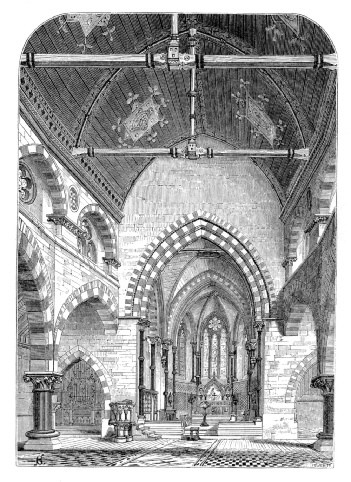
THE PORCH
Reading edition
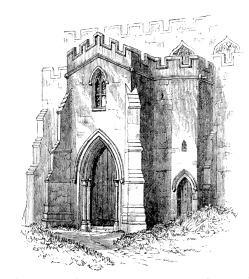
"The Vicar's first impulse, on recovering from his surprise at so unexpectedly meeting with the old Shepherd in such a place, at such an hour, was, if possible, to escape unnoticed, and to leave the churchyard without suffering him to know what he had heard and seen; but at that instant the light fell full upon him, and concealment was impossible.
"You'll be surprised, Mr. Ambrose," said the old man, "at finding me in the church at this late time. But it has, I assure you, been a great comfort for me to be here."
"My good friend," replied the Vicar, "I know you have been making good use of God's House, and I only wish there were more disposed to do the like. I rejoice to hear you have found consolation, for to-day has been one of heavy sorrow to you, and you needed that peace which the world cannot give. How often it is that we cannot understand these trials until we go into the House of the Lord, and then God makes it all plain to us."
"I've learnt that to-night, sir, as I never learnt it before. When I had put the last bit of turf on the little grave, and knew that all my work was over, there was such a desolate, lonely-like feeling came over me, that I thought my old heart must break; and then, all of a sudden, it got into my head that I would come into the church. But it was more dull and lonesome there than ever. It was so awful and quiet, I became quite fearful and cowed, quite like a child, you know, sir. When I stood still, I hardly dared look round for fear I should see something in the darkness under the old grey arches, and when I moved, the very noise of my footsteps, which seemed to sound in every corner, frightened me. However, I took courage, and went on. Then I opened this Prayer Book, and the first words I saw were these in the Baptismal Service:—'Whosoever shall not receive the Kingdom of God as a little child, he shall not enter therein.' So I knelt down at the altar rails and prayed, as I think I never prayed before, that I might in my old age become as good as the little maid I had just buried, and be as fit to die as I really believe she was. Then I said those prayers you see marked in the book, sir (she put the marks), and at last I came to those beautiful words in the Communion Service (there is a cross put to them, and I felt sure she meant me particularly to notice them):—'We bless and praise Thy holy Name for all Thy servants departed this life in Thy faith and fear.' I stood up, and said that over and over again; and as I did so, somehow all my fear and lonesomeness went away, and I was quite happy. It was this that made me so happy: I felt sure, sir, quite sure, that my poor dear wife and our child and little Lizzie were close to me. I could not see nor hear them, but for all that I was somehow quite certain that they were there rejoicing with me, and praising God for all the good people He had taken to Himself. Oh! I shall never forget this night, sir; the thought of it will always make me happy. You will never see me again so cast down as I have been lately."
"Well, Matthew, you cannot at least be wrong in allowing what you have felt and believed to fix more firmly in your faith the Church's glorious doctrine of the communion of saints."
For some time each stood following out in his own mind the train of thought which these words suggested. Matthew was the first to break silence, by begging the Vicar kindly to go with him into the room above where they were standing, as he wished there to ask a favour of him.
Matthew returned into the church to find the key of the chamber, and Mr. Ambrose at once recognized the volume which he had left on the stone seat of the porch, as that from which Lizzie was used to read when she sat beside the old Shepherd on the neighbouring hill. He took it up, and, opening it at the Burial Office, he found there a little curl of lovely fair hair marking the place. The page was still wet—it was the dew of evening, gentle tears of love and sorrow shed by one whose night was calmly and peacefully coming on.
The old man soon returned with the key, and, bearing the lantern, led the way up a narrow, winding stone staircase, formed in the masonry of a large buttress, to the little chamber. As soon as they had reached it, he said, "Before I beg my favour, Mr. Ambrose, I should much like you to tell me something about this old room. Ever since I was a boy it has been a sort of lumber-room, but I suppose it was not built for that?"
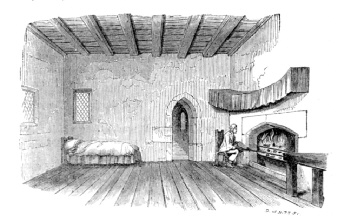
"Well, Matthew, there is not much here to throw light upon the history of this particular chamber; but I will tell you what I can about such places generally. The room is most commonly, but not correctly, called the parvise[28]. The word parvise, or paradise, properly only applies to an open court adjoining a church, and surrounded by cloisters; but in olden times a room in a private house was sometimes called a paradise[29], and hence, I suppose, the name came to be used for the porch-room of the church. It was also called the priest's chamber[30]; and such, I think, was the room in which we now are. You see it is provided with a nice little fire-place[31], and it is a comfortable little place to live in. Sometimes it was called the treasury[32], or record-room, because the parish records and church books were kept in it; or the library[33], from its being appropriated for the reception of a church or parochial library. There are many of these chambers furnished with valuable libraries which have been bequeathed from time to time for this purpose. It is also evident, from the remains of an altar and furniture connected with it, that not infrequently it was built for a chapel[34]. Occasionally it has been used as the parish school[35]; and I have heard that in some of the eastern counties poor people have occasionally, in cases of extreme distress, claimed sanctuary or refuge, both in the porch and parvise, and lived there undisturbed for some weeks together. But latterly, in many places, the parish clerk or sexton has been located in the parvise, that he may watch the churchyard and protect the church[36]; and I am inclined to think this is a much more sensible thing to do, than to give up the room to the owls and bats, as is very often the case now, but even that is better than to use it as it has sometimes been used—as a common prison[37]."
"I am glad to hear you say that, sir, for it makes the way for me to ask my favour. John Daniels wants to give up the place of sexton; and as I am getting too old now to walk far, and to take care of the sheep as I used to do, I'm going to make so bold as to ask you to let me be sexton in his stead, and to live in this little room, if you please, sir. I could then keep the key of the church, and it would be always at hand when wanted: I should be near to ring the bell for morning and evening prayer; I could watch the churchyard, and see that no one breaks the cross on Lizzie's grave—I shall be able to see it from this window. And then, sir, if you will have this little window opened again into the church[38], why I can keep guard over the church too; and that's rather necessary just now, for several churches about us have been robbed lately. Besides all this, the room is much more warm and comfortable than mine in the village, and I shall enjoy the quiet of it so much."
"Most glad, Matthew, shall I be to see the office of sexton in such good hands. You will not yourself be equal to all the work, but you will always be able to find a younger hand when you need one. And then, with regard to your living here, it's just the thing I should like, for, apart from other reasons, it would enable me to have the church doors always open to those who would resort thither for prayer or meditation. It is a sad thing for people to be deprived of such religious retirement. I almost wish that the church porch could be made without a church door altogether, as it used to be[39], and then the church would be always open. But, my friend, have you considered how gloomy, and lonely, and unprotected this place will be?"
"You mus'n't say gloomy, if you please, sir; I trust and believe my gloomy days are past; and lonely I shall not be: you remember my poor daughter's little boy that was taken out to Australia by his father (ah! his name almost does make me gloomy—but, God forgive him!)—he is coming home next week to live with me. He is now seven years old; I hear he is a quiet, old-fashioned boy. He will be a nice companion for me, and I hope you will let him help in the church; but we can speak of that again. Then for protection, sir, you must let my fond old dog be with me at nights; the faithful fellow would die of grief were we altogether parted. Come, sir, it's an old man's wish, I hope you'll grant it." This last sentence was said as they were returning down the little winding staircase back to the porch.
"It shall be as you wish; next week the room shall be ready for you. And as I have granted all the requests you have made, you must grant me one in return. You must let me furnish the room for you. No, I shall not listen to any objections; this time I must have my way. Good night."
CHAPTER VII
THE PAVEMENT
"The place whereon thou standest is holy ground."
Exod. iii. 5.
"Mark you the floor? that square and speckled stone, Which looks so firm and strong, Is Patience; "And the other black and grave, wherein each one Is checker'd all along, Humility; "The gentle rising, which on either hand Leads to the quire above, Is Confidence; "But the sweet cement, which in one sure band Ties the whole frame, is Love And Charity." George Herbert.