William Le Queux (continued 4)
Reading edition
“This,” she said, “you asked me to keep for you, on the day we were married.”
I glanced at the superscription, and recognised the handwriting. It contained the lost bank-notes!
Placing them in the fire, I watched the flames consume them, and from that night I commenced life afresh.
Jean is my secretary no longer. I effected a compromise with him, and at the present moment, owing to his shrewd business tact, combined with successful speculation, he is one of the most prosperous promoters of the South African mining companies in the City of London.
Chapter Eleven.
Death-Kisses.
The scene was composed of a bit of everything. An October evening, a dull sky, a fierce cold wind, and a woman. Yet the dreamy experience, where everything went at will, bears but little resemblance to reality.
The woman was sweet and tender; the interview passionate, yet innocent; and the words exchanged naïve as the questions of a child.
The recollection of it leaves no poison of deception; only indelible remorse.
It was a chill, windy afternoon. In the morning a great thirst for fresh air had taken possession of me, and I joyfully left Brussels, counting on stopping at a little station I knew.
I think my journey terminated about four o’clock. Cutting across the fields, I entered a narrow path, paying but little attention to the way, and strolling aimlessly. I seemed to be in an incredibly careless and absent mood that day. I am not even certain that I got out at the right station, so drunk was I with the frenzy to communicate with nature.
Picture to yourself a rolling plain under a cheerless sky; with empty roads, cut in the brown earth, here and there made green with tender shoots; a few solitary and distant houses, and occasional stumps of leafless trees, red and melancholy-looking.
A flight of crows sailed slowly overhead, talking among themselves with little continuous croakings, flying always towards the setting sun. The day was grey, with deeper shades towards the horizon, stamping everything with a uniform tint. Children’s voices sounded in the field. Suddenly three appeared, a boy and two girls, returning from school. They grew silent when they saw me, eyed me cautiously and crossed the path with quickened step. Soon I reached an isolated cross-road. A step further, and I encountered a strolling mountebank, with his wheeled home beside him. At my request he furnished me with a slight repast. Then, without saying a dozen words, I set off again, leaving the astonished man gaping at the money in his hand.
You say that I was mad.
Perhaps. At any rate, I was quite calm, but something evidently dominated and guided me. For of the three roads that spread out before me, why should I have chosen that one?
I assure you I have no spiritualistic tendencies, but there are times when I believe in a distinct influence.
The night had fallen, or rather, a sort of twilight, singularly lasting. A fine, cold rain, driven by a brisk wind, beat noisily upon my umbrella. I wandered slowly on. Holding it against the wind, I walked without effort. I think I must have slept, as I have only a vague recollection of that dreary promenade.
When I became aware of things around me, I was in front of a good fire. There was a dim consciousness of realising that the storm had redoubled its fury, that I had seen a light and knocked at a cottage door. As I recovered from the stupor, it seemed as if I had entered with some trivial formula of politeness; that I had seated myself in front of the genial flame as if I were in my own home.
A young woman, pale, but very beautiful, was sitting beside me. I glanced slowly around the room. We were alone. Little by little I remembered. It was she who had opened the door to me. Behold! even the card I gave her still in her hand. Were it not for her light breathing and the movement of her eyelids, I should say she was of wax.
She was older than myself, two or three years perhaps; tall and slight, with a gentle and melancholy grace. Her mouth, clear and tender, was near enough to the delicate nose to give her a slight appearance of a scolded child; the eyes were not large, but soft and pleading, and the oval of her face stretched the length of her blanched cheeks. Though sad, the face pleased me.
“How charming!” I exclaimed involuntarily, under my breath.
She must have heard the words, for she turned towards me and smiled.
“You are just as complimentary as of old—always the same Théophile.”
In that voice I found an air of recognition. Instantly I remembered a half-forgotten period, like a pleasant dream; a name was upon my lips, but I could not utter it; I stammered a question.
“Well, well,” she said. “They tell me I have altered, yet—why, don’t you know Mariette?”
Mariette!
Mariette! only this thought, and I fell on my knees beside her; our hands touched, and I kissed her dainty white fingers. Why was I certain in all my life never to know a like moment?
Ah! never shall I experience the same mad joy; the delight of holding in mine the thin hands of my childhood’s friend. It was that childhood I embraced; that other time, so free and pure, with its pretty welcoming air.
“Do you remember when last we met?” I asked earnestly.
She heaved a slight sigh, so like those of other days that tears rose to my eyes.
“Yes,” she murmured. “But—there, don’t speak of it. Such memories must be painful to both of us.”
“If to you, none the less to me, Mariette,” I replied, looking in her sad, sweet face.
Her lips quivered, and a tear stole down her cheek.
During a whole hour it was nothing but expressions of surprise and vain regrets. To the depths of our being we felt the force of these recollections, causing us to live over an almost forgotten period.
I found in looking at her, in listening to her, my great soul and little body of that sweet other time.
Once more I felt the immensity of the fields and of the sky; the fine smell of the leaves enthralled my senses, and the least sound was melody. Once more I lived the old free life over again. It was before I went to stay at Brussels, when I resided under the paternal roof on the edge of the dense Soignes forest, that Mariette and I were playmates and afterwards lovers.
How well I recollect one halcyon day, the memory of which now comes before me in all its vividness. It was autumn. We were walking alone in the wood. The leaves floated down noiselessly upon the chill November air, leaving the naked branches like black lace against a grey, snow-laden sky. That day she admitted that she loved me, that she would be my wife.
And all around us there was infinite space, coloured by the joyful imaginings of happy youth.
We were speaking of it, when suddenly she withdrew her hand from mine, and a red flush mounted to her forehead.
“But you soon forgot me when you went away,” she said reproachfully. “I waited months, but you never wrote; then I heard how an actress had infatuated you. Yet—you are rich now, and the world looks leniently upon what it calls a wealthy man’s folly.”
I could not prevent myself from frowning.
“You mean Clémentine Sucaret? People coupled our names without cause,” I replied coldly, almost cruelly. Yet I knew she spoke the truth.
“And I—I am mad,” she whispered.
I rose and looked at her. She was still seated, her eyes riveted upon the fire, her cheek resting upon her hand, appearing to have forgotten my presence. For a moment I remained in that position, then I reseated myself. There was nothing awkward in our silence. We felt too deeply for idle words. As we contemplated our past, the wind whistled without, the rain fell furiously, and from time to time I added a log to the fire and stirred the embers.
“Théophile,” she exclaimed suddenly, looking me straight in the face, “it is your fault that I am married.”
“Married?” I gasped in amazement. “I—I thought this cottage was your aunt’s; that you kept house for her?”
There was a silence. The voice made me tremble, gay, careless idler that I was. She spoke slowly, without moving, as though giving utterance to the thought that possessed her. “When a woman is forsaken by the man she loves, who can blame her for a hasty, loveless marriage?” she asked. “You wrecked my life, Théophile, but I forgive you freely. After you had left, I was stricken down with grief, madness followed, and I accepted the first man who proposed to me. I did not love him; I—I shall never love him. And how could I? He is a dissolute ne’er-do-well, who spends his days in the estaminet, drinking cognac. It is I who am compelled to toil and earn money for him to spend in drink. Ah, Théophile, you little know how dull and utterly hopeless is my life!”
“But your husband, does he not try and make you happy?” I asked.
“Happy?” she cried, jumping to her feet and impetuously tearing open the bodice of her dress. “See! See, here; the marks of his violence, where he tried to murder me!” And she disclosed to my view her delicate breast disfigured by an ugly knife-wound, only partially healed.
“Horrible!” I exclaimed, with an involuntary shudder.
“That is not all,” she continued, turning up her sleeves and revealing cruel bruises and lacerations upon her alabaster-like arms. “He wants to rid himself of me, to be free again; and when the brandy takes effect, he threatens to kill me.”
“Why stay and be brutally ill-used in this manner?” I asked.
Shrugging her shoulders, she smiled sadly, replying, “If I were dead, it would end my misery. Should he ever know that you have been here, his jealousy would be so aroused that I believe he would carry his threat into effect.”
“Come, come, Mariette, you must not talk like that,” I exclaimed. “It grieves me to know of your unhappiness, to think that I am to blame.”
“Remember, I forgive you.”
“Yes, but try to bear up against it; do your duty to your husband, and thus compel him to treat you kindly.”
“I have tried to do so, Heaven knows,” she replied hoarsely, bursting into tears; “But everything is useless. Only death can release me.”
“Don’t talk so gloomily,” I urged, taking one of her cold hands in mine. “Although we can be naught to one another save friends, let me be yours. I am ready to do anything you command me.”
“You are kind, Théophile, very kind,” she replied bitterly, shaking her head; “but friendship is poor reparation for love.”
I thought of the years we had passed together at the time when years are so long and beautiful.
Finally I said to her—
“Tell me, what can I do for you?”
She made no answer, only her face appeared to grow a shade paler. With her eyes on the clock, she seemed to listen. “Nothing,” she replied at last. “You—you must go.”
“So soon?”
“Yes,” she said, with a choking sob. “You ought not to have come here, and—and you must forgive me, Théophile, we women are so weak when memories are painful.”
She wished to aid me in my preparations for departure, handed me my hat and buttoned my coat. We said nothing, but she lingered over the buttoning as though it were something very difficult.
Suddenly, with a bitter burst of tears, she flung her head down against my arm. She seemed such a frail little creature as I held her tightly and stroked away the tendril curls that strayed across her face.
I longed to console her, but could not give utterance to my thoughts.
“Mariette. Poor little Mariette,” was all I could say.
“Good-bye, Théophile, good-bye,” she whispered brokenly. “A great gulf separates us; you have gaiety and happiness, I only misery and despair. My husband—”
Just as suddenly as they commenced, her tears ceased. Clasping her hands, she lifted her agitated face to mine.
“Promise me—promise you will never return here again!”
I did not reply.
Bending over, her lips met mine in one fierce passionate caress.
Next second we were startled by a strange noise, sounding suspiciously like a footstep upon the gravel. We listened, but the sound was not repeated.
“Hark!” she whispered anxiously. “If my husband should find you here, would it not compromise me?”
With a force I should never have suspected, she led me to the door, and, after giving me a gentle push, locked it behind me.
“Adieu!” I murmured, as tenderly as I could.
There was no answer.
Through the keyhole I could see Mariette kneeling before a crucifix on the opposite wall.
Then I turned and went forth into the darkness.
The morning was grey and dispiriting; the chill wind whirled the dead leaves in my path, and moaned through the bare branches as I walked up to the door of the cottage. My mind was perturbed by thoughts of what happiness might have resulted had I been true to the woman who loved me. I had spent a restless night at a roadside inn. Her misery tortured me, and, despite her entreaty, I was now on my way to again proffer assistance.
With trepidation I approached the door of the humble abode and knocked.
No one stirred. Everything seemed strangely silent.
About to repeat the summons, I noticed the door was ajar. Pushing it slowly open, I entered, at the same time uttering her name.
As I stepped into the neat, well-kept room, I at first saw nothing, but on glancing round the opposite side of the table, my eyes encountered a terrible sight.
Stretched upon the floor, Mariette was lying partly dressed, the pale light falling upon her upturned features. The cheeks and lips were bloodless; the eyes, wide-open, were staring wildly into space with a look of indescribable horror.
Falling upon my knees, I touched her face with my hand.
It was cold as marble. She was dead!
In her white breast a knife was buried up to the hilt, and from the cruel wound the blood had oozed.
She had been murdered!
The recollection of the events immediately following this ghastly discovery is but faint. I have a hazy belief that my mind became temporarily unhinged, that I left the place without informing any one of the tragedy; then, walking many miles through the forest, I reached a railway station, whence I returned to Brussels.
The one thing most in my mind was the terrible look of blank despair in the glazed eyes. I have never forgotten it. I shall carry its remembrance with me to the grave.
That awful look of reproach has ever since been uppermost in my memory. Try how I will, I cannot rid myself of its hideous presence.
A bright, crisp morning in December.
Hurrying down the Montagne de la Cour, where I chanced to have business, I came face to face with Clémentine Sucaret, who, warmly clad in furs, was enjoying that harmless pastime so dear to the feminine heart—inspecting shop windows.
We had bid each other farewell three years before. She then left Brussels to fulfil engagements as a dancer in London and Paris, and since I heard nothing of her.
Greeting me with the same winsome smile and merry manner as of old, she inquired whither I was going. When I explained that my business was important, and did not admit of delay, she requested that she might accompany me, at the same time inviting me to déjeûner with her afterwards, an arrangement to which I consented without reluctance.
As we walked together, she commenced describing her adventures and successes, declaring that, after all, it was pleasant to return among old friends and cherished recollections. I was well aware at what she hinted when she said this, for I was one of her oldest friends, and had known her when she was only a figurante at the Théâtre de la Monnaie, and lived with her decrepit and bibulous old father, a concierge, in the Rue du Trône. It was then that her cheerful, good-natured disposition and handsome face had fascinated me, causing me to forsake Mariette.
The thought inflicted a sharp twinge of remorse, for the tragedy in the little cottage was still fresh in my memory.
Having left her for a moment while I made a call, I rejoined her. Laughing and chattering, she chaffingly alluded to our former attachment, and pouted in feigned displeasure at what she termed my inconstancy.
Down the Rue de la Régence we had sauntered slowly, and were passing the imposing façade of the Palais de Justice, when suddenly she stopped, and, uttering an exclamation of surprise at the proportions of the vast building which had been completed in her absence, requested me to take her to see the interior.
Mounting the broad flight of granite steps, we passed into the magnificent marble hall.
Strange how Fate is constantly our mistress and rules our every action.
We had crossed under the gilded dome and were about to enter one of the court-rooms, when my eye caught a large printed notice fixed to the wall.
I halted and read.
It was an imposing poster, headed in great black capitals, “Court of Assize,” and was the public announcement that Henri Pirlot had been sentenced to death by that tribunal for the wilful murder of his wife, Mariette, at a cottage near Spoel. It further stated that the condemned man had confessed that the cause of the crime was jealousy. He was intoxicated, and having discovered his wife kissing a strange man who had visited her in his absence, he went in and deliberately stabbed her to the heart!
“What a pair of idiots!” exclaimed Clémentine, with a light laugh, as she read the notice. “The idea of killing a woman because she kissed her lover! Again, what a simpleton the woman was not to have been more wary! But—why—what’s the matter, Théophile? You stand there gazing and looking as scared as if you’d seen a ghost. Any one would think you knew the rustic beauty, and were the strange lover!”
I started. A sickening sensation crept over me. The actress had little idea it was the terrible truth she uttered. I pleaded that I was not feeling well, and we left the building.
Chapter Twelve.
The City in the Sky.
In the mystic haze of the slowly dying day, a solitary Arab, mounted on a méheri, or swift camel, and carrying his long rifle high above his head, rode speedily over the great silent wilderness of treacherous, ever-shifting sand. Once he drew rein, listening attentively, and turning his keen dark eyes to the left, where the distant serrated crests of the mountains of Nanagamma loomed forth like giant shadows; but as nothing broke the appalling stillness, he sped forward again until at length he came to a small oasis, where, under a clump of palms, he made his camel kneel, and then dismounted.
As he stalked towards the lonely shrine of Sidi Okbar—a small domed building constructed of sun-dried mud, under which reposed the remains of one of the most venerated of Arab marabouts—he looked a young and muscular son of the Desert, whose merry bronzed face bore an expression of genial good-nature that was unmistakable, notwithstanding the fact that he belonged to the fiercest race of Bedouins. Tall and erect, he strode with an almost regal gait, even though his burnouse was brown, ragged, and travel-stained; the haick that surrounded his face was torn and soiled, and upon his bare feet were rough, heavy slippers, that were sadly the worse for wear. The latter, however, he kicked off on approaching the shrine, then, kneeling close to the sun-blanched wall, he cast sand upon himself, kissed the earth, and, drawing his palms down his face, repeated the Testification. In fervent supplication he bowed repeatedly, and, raising his voice until it sounded distinct on the still air, invoked the blessing of Allah. “O Merciful! O Beneficent Granter of Requests!” he cried; “O King of the Day of Faith, guide us, ere to-morrows sun hath run its course, into the path that is straight, and leadeth unto the kasbah of our enemies of Abea. Strengthen our arms, lead us in times of darkness and in the hours of day, destroy our enemies, and let them writhe in Al-Hâwiyat, the place prepared for infidels, where their meat shall be venomous serpents, and they shall slake their thirst with boiling pitch.”
Startled suddenly by a strange sound, he listened with bated breath. The thought occurred to him that his words might have been overheard by some spy, and instinctively his hand drew from his belt his jambiyah, the long, crooked dagger, that he always carried. Again a noise like a deep-drawn sigh broke the silence, and Hatita—for such was the young Arab’s name—sprang to his feet and rushed round to the opposite side of the building, just in time to see a fluttering white robe disappearing in the gloom. With the agility of a leopard, the man of the Kanouri—the most daring of the slave-trading tribes in the Great Sahara—sprang towards it, and in twenty paces had overtaken the eavesdropper, who, with a slight scream, fell to earth beneath his heavy hand.
“Rise!” he cried, roughly dragging the figure to its feet, “thou son of Eblis!”
Next second, however, he discovered that the fugitive was a woman, veiled, enshrouded in her haick, and wearing those baggy white trousers that render all Arab females hideous when out of doors.
“Thou hast overheard my orison!” he cried, raising his knife. “Speak! speak! or of a verity will I strike!”
But the mysterious woman uttered no word, and Hatita, in a frenzy of desperation, tore the veil from her face.
Aghast he stood, and the knife fell from his fingers. The countenance revealed was amazingly beautiful, so charming, indeed, that instantly he became entranced by its loveliness, and stood speechless and abashed.
She was not more than eighteen, and her features, fair as an Englishwoman’s, were regular, with a pair of brilliant dark eyes set well apart under brows blackened by kohl, and a forehead half hidden by strings of golden sequins that tinkled musically each time she moved. Upon her head was set jauntily a little scarlet chachia, trimmed heavily with seed-pearls, while her neck was encircled by strings of roughly-cut jacinths and turquoises, and in the folds of her silken haick there clung the subtle perfumes of the harem.
Slowly she lifted her fine eyes, still wet with tears, to his, and, with her breast rising and falling quickly, trembled before him, fearing his wrath.
“Loosen thy tongue’s strings?” he cried at last, grasping her slim white wrist with his rough, hard hand. “Thou art from Afo, the City in the Sky, and thou hast gained knowledge of our intended attack?”
“Thy lips, O stranger, speak the truth,” she faltered.
“Why art thou here, and alone, so far from thine home on the crest of yonder peak?” he inquired, gazing at her in wonderment.
“I came hither for the same purpose as thyself,” she answered seriously, looking straight into his face—“to crave Allah’s blessing.”
“Art thou a dweller in the house of grief?” he asked. “Tell me why thou didst venture here alone.”
She hesitated, toying nervously with the jewelled perfume-bottle suspended at her breast; then she answered, “I—I am betrothed to a man I hate. The Merciful Giver of Blessings alone can rescue me from a fate that is worse than death—a marriage without love.”
“And who is forcing thee into this hateful union? If it is thy father, tell me his name.”
“Yes, it is my father. His name is Abd el Jelíl ben Séf e’Nasr, Sultan of Abea.”
“The Sultan?” he cried in amazement. “Then thou art Kheira!” he added, for the extraordinary beauty of the only daughter of the Sultan of Abea was proverbial throughout the Great Desert, from Lake Tsâd to the Atlas.
“Yes,” she replied. “And from thy speech and dress I know thou art of the Kanouri, our deadliest enemies.”
“True,” answered the desert pirate. “To-morrow my tribe, to the number of ten thousand, now lying concealed in the valley called Deforou, will swarm upon thine impregnable city and—”
“Ten thousand?” she gasped, pale and agitated. “And thou wilt kill my father and reduce our people to slavery. Ah, no!” she added imploringly. “Save us, O stranger! Our fighting men went south one moon ago to collect the taxes at Dchagada, therefore we are unprotected. What can I do—how can I act to save my father?”
“Dost thou desire to save him, even though he would force upon thee this odious marriage?”
“I do,” she cried. “I—I will save the City in the Sky at cost of mine own life.”
“To whom art thou betrothed?” Hatita asked, tenderly taking her hand.
“To the Agha Hassan è Rawi, who dwelleth at Zougra, beyond the Nanagamma. He is three score years and ten, and ’tis said he treateth his wives with inhuman cruelty. One of his slaves told me so.”
Hatita stood silent and thoughtful. Though he was a member of a tribe who existed wholly upon loot obtained from caravans and towns they attacked, yet so earnestly did the Sheikh’s daughter appeal, that all thought of preserving the secret of the intended attack by murdering her disappeared, and he found himself deeply in love. His was a poor chance, however, he told himself. The proud Sultan of Abea would never consent to a brigand as a son-in-law, even if Kheira, known popularly as “the light of the eyes of the discerning,” looked upon him with favour.
“To-night, O Daughter of the Sun, we meet as friends, to-morrow as enemies. Our spies have reported that thy city remaineth undefended, and, alas! there is a blood feud between my people and thine; therefore, when the hosts of the Kanouri enter with fire and sword, few, I fear, will be spared. Wilt thou not remain here with my tribesmen and escape?”
“No,” she answered proudly. “I am a woman of Afo, and I will return unto my people, even though I fall before to-morrow’s sundown under thy merciless swords.”
As she spoke, one hand rested upon her supple hip, and with the other she pointed to the high shadowy peak whereon stood the great white stronghold known to the Arabs as the City in the Sky.
“But thou, who art like a sun among the stars, knowest our plans, and it is my duty to kill thee,” he said, hitching his burnouse about his broad shoulders.
“I am in thine hands. If thou stainest them with my blood, thou wilt ever have upon thy conscience the remembrance that thou hast taken the life of one who was innocent of intrigue. If thou givest me freedom, I shall have at least one brief hour of felicity with my people before—before—”
And she sighed, without concluding the sentence.
“Thou, a fresh rose from the fountainhead of life, art in fear of a double fate, the downfall of to-morrow and the marriage feast next moon. Let not thy mind be troubled, for I stretch not forth the tongue to blame,” he said at last, endeavouring to smile. “In Hatita, son of Ibrahim, thou hast a devoted friend, and one who may peradventure assist thee in a manner thou hast not dreamed. Therefore mount thine horse and return with all speed to Afo—not, however, before thou hast given me some little souvenir of this strange meeting.”
“Thou slakest my thirst with the beverage of kindness!” she cried in joy. “I knew when first I saw thee that thou wert my friend.”
“Friend?—nay, lover,” he answered gallantly, as, taking her tiny hand again, he pressed her henna-stained nails softly to his lips. She blushed and tried to draw away, but he held her firmly until she withdrew one of her gold bangles from her wrist, and with a smile, placed it upon his.
“Behold!” she exclaimed, with a merry rippling laugh. “It is thy badge of servitude to me!”
“I am slave of the most handsome mistress in the world,” he said happily. Then, urging her to warn the Sultan of the intentions of the Kanouri, he kissed her once tenderly upon the lips, lifted her into the saddle of her gaily caparisoned horse, and then she twisted her torn veil about her face, and, giving him “Peace,” sped away swift as an arrow into the darkness, bearing intelligence that would cause the utmost sensation in the mountain fastness.
“I love her,” murmured Hatita, when the sound of her horse’s hoofs had died away. “But how can I save her? To-morrow, when we enter Afo and loot the Palace, she will be secured to grace our Sheikh’s harem. No!” he cried, with a fierce, guttural imprecation. “She shall never fall into Nikále’s brutal hands—never while I have breath!”
The sound of whispering caused him to fix his gaze upon a dark shadow thrown by some ethel-bushes, and next second, half a dozen men similarly attired to himself advanced.
“So, dog of a spy! thou hast betrayed us!” cried a voice, which in a moment he was startled to recognise as that of Mohammed El Sfaski, a kaid of his tribe.
“Yes,” the others shouted with one accord; “We watched the son of offal speaking with the woman, and we overheard him telling her to warn the Sultan!”
“Follow her on the wings of haste!” cried the kaid. “Kill her, for death alone will place the seal of muteness upon the lips of such a jade;” and in a few seconds two white-robed figures vaulted into their saddles and tore past in the direction Kheira had disappeared.
“Speak!” thundered El Sfaski, who with the others had now surrounded him. “Knowest thou the punishment of traitors?”
“Yes,” answered Hatita hoarsely.
“Who is the woman whose blackness and deceit hath captivated thee?”
Three rapid shots sounded in the distance. The Arabs had evidently overtaken and murdered the daughter of the Sultan! The young tribesman held his breath.
“I—I refuse to give thee answer,” he said resolutely.
“By Allah! thou art a traitor to our lord Nikále, and of a verity thou hast also A’inu-l Kamâl. Therefore shalt thou die!”
(“The eye of perfection,” or “evil eye,” is considered by the Arabs to be so maleficent that it can not only injure, but kill a person.)
Then, turning to the others, he added—
“We have no time to bandy words with this accursed son of the Evil One. Tie him to yon tree, and let the vultures feast upon their carrion.”
With loud imprecations the men seized their clansman, tore off his haick and burnouse, and bound him securely to a palm-trunk in such a position that he could only see the great expanse of barren sand. Then with that refinement of cruelty of which the nomadic Kanouri are past masters, they smeared his face, hands and feet with date-juice, to attract the ants and other insects; and, after jeering at him and condemning him to everlasting perdition and sempiternal culpability, they remounted their horses, and, laughing heartily, left him alone to await the end.
Through the long, silent night, Hatita, with arms and legs bound so tightly that he could not move them, remained wondering what terrible fate had befallen the beautiful girl who had overheard his orison. The two Arabs had not returned. He knew the men were splendid riders, therefore it was more than probable that they had very quickly overtaken her. Utterly hopeless, well knowing that to the blazing sun and the agonies of being half-devoured by insects he must very soon succumb, he waited, his ears on the alert to catch every sound.
In the sky a saffron streak showed on the edge of the sandy plain, heralding the sun’s coming. He watched it gradually spread, knowing that each moment brought him nearer to an end of agony. He lifted his voice in supplication to Allah, and showered voluble curses upon the expedition about to be attempted by his tribe. The pale, handsome face of Kheira was ever before him, haunting him like a half-remembered dream, its beauty fascinating him, and even causing him to forget the horror of those hours of dawn.
Saffron changed to rose, and rose to gold, until the sun shone out, lighting up the trackless waste. The flies, awakened, began to torment the condemned man, who knew that the merciless rays beating down upon his uncovered head would quickly produce the dreaded delirium of madness. The furnace heat of sunshine grew intense as noon approached, and he was compelled to keep his eyes closed to avoid the blinding glare.
Suddenly a noise fell upon his ear. At first it sounded like a low distant rumbling, but soon his practised ears detected that it was the rattle of musketry and din of tom-toms.
The City in the Sky was being attacked! His tribesmen had arranged to deliver the assault at noon, but what puzzled him was a sullen booming at frequent intervals. It was the sound of cannon, and showed plainly that Afo was being defended!
From where he was he could see nothing of it. Indeed, the base of the mountain was eight miles distant, and the city, parched upon its summit, could only be approached from the opposite side by a path that was almost inaccessible. Yet hour after hour the rapid firing continued, and it was evident a most desperate battle was being fought. This puzzled him, for had not Kheira said that the city was totally undefended? Still, the tumult of battle served to prevent him from lapsing into unconsciousness; and not until the sun sank in a brilliant, blood-red blaze did the firing cease. Then all grew silent again. The hot poison-wind from the desert caused the feathery heads of the palms to wave like funeral plumes, and night crept on. The horrible torture of the insects, the action of the sun upon his brain, the hunger, the thirst, and the constant strain of the nerves, proved too much; and he slept, haunted by spectral horrors, and a constant dread of the inevitable—the half-consciousness precursory of death.
So passed the night until the sun reappeared, but Hatita’s eyes opened not. The heat of the blazing noon caused him no concern, neither did the two great grey vultures that were hovering over him; for it was not until he heard voices in the vicinity that he gazed around.
One voice louder than the others was uttering thanks to Allah. He listened; then, summoning all his strength that remained, he cried aloud, in the name of the One Merciful, for assistance.
There were sounds of hurrying footsteps, voices raised in surprise, a woman’s scream, and then objects, grotesquely distorted, whirled around him and he knew no more.
When Hatita again opened his weary, fevered eyes, he was amazed to find himself lying upon a soft, silken divan in a magnificent apartment, with slaves watching, ready to minister to his wants. He took a cooling draught from a crystal goblet handed to him, then raised himself, and inquired where he was. The slaves made no reply, but, bowing low, left. Then in a few moments the frou-frou of silk startled him, and next second he leaped to his feet, and, with a cry of joy, clasped Kheira in his arms.
In her gorgeous harem dress of pale rose silk, with golden bejewelled girdle, she looked bewitching, though around her eyes were dark rings that betrayed the anxiety of the past few days. As their lips met in hot, passionate kisses, she was followed by a tall, stately, dark-bearded man of matchless bearing, whose robe was of amaranth silk, and who wore in his head-dress a magnificent diamond aigrette. Kheira saw him, and, withdrawing herself from Hatita’s embrace, introduced her lover to her father, the Sultan of Abea.
“To thee I owe my life and my kingdom,” said the potentate, giving him “Peace,” and wringing his hand warmly. “Kheira hath related unto me the mercy thou didst show towards her; and it was thy word of warning that enabled us to repel and defeat the Kanouri.”
“Then thou didst escape, O signet of the sphere of elegance!” the young Arab cried, turning to the Sultan’s daughter.
“Yes; though I was hard pressed by two of thine horsemen I took the secret path, and thus were they baffled.”
“The Director of Fate apprised our fighting men of their danger,” said the Sultan; “and they returned on the same night. The breeze of grace blew, the sun of the favour of Allah shone. The news brought by Kheira was quickly acted upon, and the defences of the city so strengthened, that when at noon the assault was delivered, our cannon swept thy tribesmen from the pass like grains of sand before the sirocco. For six hours they fought; but their attempts to storm the city gate were futile, and the handful of survivors were compelled to retire, leaving nearly a thousand prisoners, including Nikále himself, in our hands.”
“And how was I rescued?” Hatita asked, after briefly explaining how his conversation with Kheira had been overheard.
“On the day following the fight, we went unto the shrine of Sidi Okbar to return thanks to Allah, and there found thee dying of heat and thirst. Thou didst sacrifice thy life to save our ruler and his city, therefore we brought thee hither,” she said.
“And as a reward,” added the Sultan, smiling upon them both, “I give unto thee my daughter Kheira in marriage.” Then, taking their hands, he placed them in each other’s, and added, “Thou hast both the verdure of the meadows of life. May Allah preserve thee, and grant unto thee long years of perfect peace, and an eternal rose-garden of happiness. In order that thou shalt have position fitting the husband of thy Sultan’s daughter, I have ordered our Palace of Kyoukoï to be prepared for thy reception. Therefore, wipe off the rust of ennui and fatigue from the speculum of thy mind, and follow me; for a feast is already prepared for the celebration of this betrothal.”
And the happy pair, hand-in-hand, passed onward through the private pavilions—bewildering in their magnificence of marble and gold, and green with many leaves—to the Great Hall of the Divan, where, standing under the royal baldachin of yellow silk brocade, the Sultan of Abea rejoiced them with his favours, proclaiming Hatita, son of Ibrahim, as the future husband of Kheira, and appointing him Governor of the City in the Sky.
Chapter Thirteen.
The Blood-Red Band.
A series of exciting adventures that befell me four years ago were remarkable and puzzling. Until quite recently, I have regarded the mystery as impenetrable. Indeed, in this fin-de-siècle decade it is somewhat difficult to comprehend that such events could have occurred, or that the actors could have existed in real life.
I was in Piedmont, at the little village of Bardonnechia, a quaint, rural place comprising a few picturesque châlets, an inn, and a church with a bulgy spire, which nestles in the fertile valley at the foot of the towering, snow-capped Mont Cenis. I was staying at the inn, and I wished to go to Lanslebourg, on the opposite side of the mountain, intending to travel thence by diligence to Grenoble, where I had arranged to meet some friends. But I needed a guide. The by-paths in the Cottian Alps are rough and intricate, and he would be a daring spirit who would venture to cross the Cenis alone away from the beaten track.
There was not a single mule to be hired, and the only guide I could find refused to carry my valise, so I was in danger of missing my appointment. I could, of course, have gone by train through the tunnel to Modane, but that route would have taken me many miles out of my way, therefore I had decided upon the shorter road.
At evening, while I stood at dusk at the door of the inn, looking anxiously to see whether any guide or porter had returned from the mountains the innkeeper told me he had found a man.
“Does he come from the valley?” I asked.
“No, signore; from the mountains.”
“Impossible? I should have seen him. I have been watching the path for an hour.”
“This man does not follow the same path as the others.”
“Why?”
But my host vouchsafed no further explanation; he only called with a loud voice, “Giovanni!”
The guide appeared. He was tall, muscular, and rather strange-looking, about thirty years old, the wrinkles of his face giving an expression of hard and energetic will. He had a large, straight nose, wide mouth, thick, bushy black hair, and a beard of several days’ growth, while in his cap he wore a sprig of freshly-plucked edelweiss.
I invited him into my room, but he shrugged his shoulders.
“You wish to go to Lanslebourg, over the Cenis?” he said.
“Yes.”
“Very well; give me ten lire.”
The price was very moderate, but the fellow struck me as a swaggerer. Instinctively I did not like him.
“Where is your licence? Are you a regular guide?” I asked.
“I have no licence, but I have a certificate of honourable discharge. I was in the Fourth Regiment of Artillery.”
“And your name?”
“Do you want to know all this for ten lire?” and he began to laugh sarcastically. “Very well; I will tell you my name gratis. I am called Giovanni Oldrini. Has the cross-examination concluded?”
Seeing that his smile displeased me, he immediately changed his expression, and added emphatically—
“Ask the landlord about me; he will tell you. Buona sera.”
And he turned and left me abruptly.
At four o’clock next morning we set out. He tied my valise on his back, took his alpenstock, and set off nimbly, whistling a popular chansonette. His gait was peculiar. His step made no sound; he seemed to glide along.
Having crossed the rushing torrent by the ancient wooden bridge, we came to the foot of the mountain. Leaving the rough road that leads from Susa over the lower heights to Modane, we took a steep by-path that ran in serpentine wanderings over rocks and through woods of fir and pine. In climbing we passed a beautiful lavender garden. The side of the mountain was quite blue with the flowers, and the fresh air of dawn was scented by their fragrance. There were also barberries and gooseberries, and flowers which were among the first we know in our own land, such as dog-roses, white campions, and harebells. Then for some distance we skirted a wood, and as we went higher, the larches gave place to pines, and yet higher still only stunted herbage grew from the crevices of the bare brown rocks.
He climbed like a squirrel. Hardly had he started when he began to talk to me, but either from sleepiness or from the feeling of uneasiness which his company gave me, I did not answer him.
At first, in the steepest places, Giovanni turned and offered me his hand, but, being fresh, I refused his aid, proud to encounter the rough mountain. When we help ourselves with hands and knees, and every step must be studied, the mind does not notice the fatigue. Presently, however, the fellow began to walk by himself, abandoning me to my fate. There was no real danger, but I felt somewhat indignant at seeing him so high on the rocks.
Gradually he was increasing the distance between us, and I cried to him to stop, but my voice did not reach him. If it had not been for my valise, I would have returned immediately.
I saw he had a piece of paper in his hand and a pencil. Scribbling a few words, he folded the paper and placed it behind a large stone. My suspicions were increased when I saw him abstract something bright and shining from behind the stone and place it in his pocket. It was a revolver!
People do not generally go armed in the Cottian Alps, and I somehow felt convinced that the weapon was to be used for no lawful purpose. Perhaps the letter he had written was a message to his confederates, reporting the fact that he had secured a victim! How I regretted that I had not placed my revolver in my pocket instead of putting it in the valise he was carrying.
He was standing with his hands in his pockets, whistling a gay air and awaiting me. I was toiling up the steep path, and felt almost dead beat. The whole mountain was a mass of gigantic rocks, half buried in the sand, soft and moist from recently melted snow and the draining of the ice.
“I was looking for a franc-piece I dropped. It rolled behind that stone, and I cannot find it,” he said. Then he looked into my eyes, and asked, with an insolent air, “Don’t you believe me?”
“No.”
I did not believe him, and began to be greatly disquieted. He perceived it, and immediately became jovial and talkative. He knew me, he said—he had asked the innkeeper about me. He knew that I was a journalist; it must be a fine trade for making money by the sackful. He knew city life, for he had lived in Turin, and he always read the Secolo—it was his favourite paper. He also knew that I had written novels—another gold mine. Writers of romance, he supposed, were always seeking adventure, and poking their noses in out-of-the-way corners, and inquiring into other people’s business. Good! I was with him, and might meet with a strange experience presently.
But I paid no attention to him.
“You gentlemen come to the Alps for the fun of knowing what fatigue is,” he said. “Ah! if you only knew what it was—how much a piece of bread costs!”
He was eloquent and excitable, and spoke like a man believing himself to be followed by constant persecution.
We had almost reached the summit, when suddenly we came upon a rough pillar built of pieces of rock piled together.
“See!” he said; “there is the frontier mark.”
Then we continued walking a dozen paces or so, and were in France.
Soon afterwards we recommenced our ascent to the summit, trudging through patches of melted snow. For about half an hour we continued our rough climb, when he halted, and, scanning the mountain cautiously, said—
“Come, follow me quickly!”
“Where?” I asked. “This surely is not the road to Lanslebourg?”
“Do not argue, but come with me,” he said impatiently. “If you do not, it will be the worse for you!” he muttered between his teeth.
Linking his arm in mine, he half dragged me along to what appeared to be the face of a perpendicular rock. We passed along a narrow passage behind a great boulder, and as we did so, my strange guide gave a shrill whistle.
In a moment a cunningly-concealed door in the face of the rock opened and a wild-haired, black-bearded, brigandish-looking man emerged.
I was alarmed, for I saw I had been entrapped.
My guide uttered a few words in the Piedmontese patois, which I did not understand, whereupon the man who had opened the door exclaimed—
“The signore Inglese will please enter.”
I hesitated, but I saw that to refuse was useless, so together we went into a large dark cavern. The bolt of the door was shot back into its socket with an ominous sound, while our footsteps echoed weirdly through the distant recesses. The man took up a torch and guided us through intricate turnings, until at last we came to a door which he opened, and we found ourselves in a small natural chamber, with wonderful stalactites hanging from the roof.
Two sinister-looking men, who were seated at a rough deal table drinking and playing dominoes, rose as we entered.
Neither spoke, but the man who had admitted us poured out some cognac and handed it to me, afterwards filling the other glasses. The men lifted them to me and tossed off the contents, an example which I followed.
“We are safe here,” observed Giovanni, turning to me; “safe from the storm, the frontier guards, from everything.”
“I engaged you to conduct me to Lanslebourg, not to bring me here,” I said severely.
He smiled.
“This cave has been the grave of many men,” he replied, as he calmly selected a cigar from the box upon the table. “It may be yours.”
“What do you mean?” I cried, thoroughly alarmed.
“Surely you understand,” exclaimed the man who admitted us. “We are outlaws, brigands, contrabandists—whatever you like to call us in your language—it is quite immaterial. Come with me and I will convince you.”
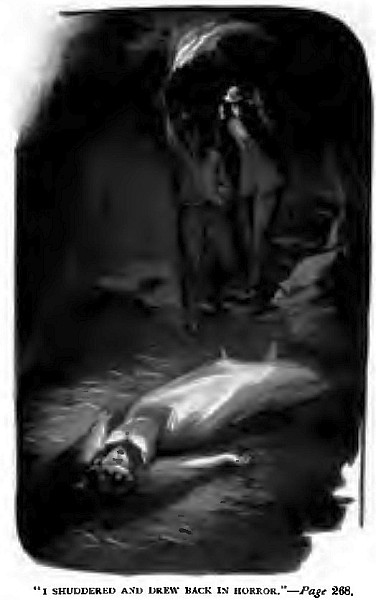
Again I hesitated.
“Follow!” he commanded, taking up the torch.
Together we descended a short flight of roughly-hewn steps into a small, dark, damp-smelling cavern below. As he lifted the torch above his head, I saw that the place was occupied.
I shuddered and drew back in horror.
Upon a heap of dirty, mouldy straw, lay a woman. Her dress was ragged and faded, but she was very beautiful, with light golden hair, and a face that betokened culture and refinement. Around her neck was a curious band of a blood-red colour. Upon her countenance was a ghastly pallor, the lips were bloodless, the jaw had dropped, the eyes were fixed and had a stony, horror-stricken look in them, for she was a corpse!
“You are satisfied that we are brigands?” he asked. “Good! Now I will show you that we are contrabandists.”
Ascending the steps, we went to another part of the great cave, where he showed me kegs of cognac and wine, boxes of cigars, silks, and an assortment of dutiable merchandise.
When we returned to where the other men were sitting, one of them, the elder of the party, who spoke with authority, addressed me.
“Well,” he said, “you have seen our stronghold, and recognise the impossibility of any one escaping from here, eh?”
“Yes,” I replied; “but I cannot conceive why I have been allured here. I am a poor man, and not worth robbing.”
“That is not our intention, signore,” the contrabandist answered, with mock politeness, as he puffed a cloud of smoke from his rank cigar. “True, you have been entrapped, but if you consent to perform for us a small secret service, you are at liberty to depart; and, moreover, our good Giovanni will complete his contract, and see you safely to Lanslebourg.”
“What is the service?” I asked.
“It is not at all difficult, and you will run no risk,” he replied. He took from an ancient oak coffer a small sealed packet, and added, “We desire this taken to Briançon; will you undertake to do so?”
“What am I to do with it?” I asked.
“The thing is simple enough. You will leave here and go to Lanslebourg, thence to Briançon. Arrived there, you will remain at the Couronne d’Or, and wear this peace of edelweiss in your coat. On the day after to-morrow, a lady will call upon you and ask for the packet, as promised. She will give her name as Madame Trois Etoiles, and will give you a receipt for the packet. This you will send to Giovanni Oldrini at the Poste Restante at Bardonnechia. There the matter will end.”
“If she does not call?”
“Then you must advertise to find her, announcing that you particularly desire an interview. Of course your undertaking will be binding, and you will preserve the secret of the existence of this place under penalty of death. Do you agree?”
I glanced round the weird cavern. The last straw of my self-possession was broken, and I was prepared to promise anything in order to escape.
“Agree, signore,” urged Giovanni anxiously. “There will be no risk, no inconvenience, I assure you.”
“Very well,” I said at last; “if you stipulate this as the price of my ransom, I suppose I am compelled to submit.”
“You will swear to preserve our secret; to tell no living soul where you obtained the packet, and to deliver it without fail and with the seals intact?” the elder man asked, handing me a carved ivory crucifix.
“Yes, I swear,” I said, taking it and pressing it to my lips.
“Good!” he exclaimed; “here is the packet. Deliver it safely, for its contents, if lost, could never be replaced. Join us in another glass, and then proceed. Oldrini will go with you to the outskirts of Lanslebourg.”
I emptied another glass of brandy with the smugglers, and a few minutes later saw the sunlight and breathed the fresh mountain air again. When we were well on our downward path, I felt inclined to reprimand my guide for having taken me to the cavern; but on reflection it became plain that he was in league with the contrabandists, and that he carried on smuggling and thieving in the guise of guide.
Onward we trudged down the steep, slippery rocks, scarcely uttering a word for an hour, when suddenly from a sentry-box there appeared a French soldier with rifle presented.
He inquired our names, and why we wished to enter France. A civil reply propitiated him, and he drew himself up at “Attention!” and allowed us to proceed.
We were compelled by the steepness of the mountain to take a circuitous route, so that the descent occupied longer than we had anticipated, and when, soon after sunset, we emerged upon the high road to Lanslebourg, he halted to take leave of me.
“Pardon, signore,” exclaimed my guide. “I only took you to the cavern because it is imperative that the packet should be delivered. I ask your forgiveness;” and he raised his cap deferentially.
“For what reason is it imperative?” I inquired.
“I regret I cannot tell you,” he replied. “Addio, signore. Remember your trust, and keep your promise, or—”
He did not finish the sentence, but shrugged his shoulders significantly, and, handing me my valise, turned and left me.
Two days later, I was sitting idly smoking at a little table outside the Couronne d’Or inn at Briançon, that curious little town inside the great fortress that commands the pass of Mont Genevre. The Alps were purple in the glorious sunset. The sun had long ago been hidden by the mountains behind, on whose tops the ice and snow glistened. Then, as the calm twilight came on, a pale, rosy light suffused the eastern sky, the moon rose, the aspens shook, the outlines of the valley shaded off into darkness and uncertainty, and the last glow sank into the deepening blue.
Having telegraphed to my friends, arranging to meet them at Grenoble on the morrow, I sat silent, thoughtful, and expectant.
Suddenly a musical voice behind exclaimed in English.
“The signore wears the edelweiss, I observe.”
“Yes,” I replied, turning and confronting a tall, handsome, middle-aged lady, attired in deep black. She was evidently of the upper class, and spoke English with an accent scarcely perceptible. A fact which struck me as very remarkable was that around her neck she wore a band of blood-red silk exactly the same as that upon the corpse in the brigand’s cave! What could it denote?
“I presume I am not mistaken in addressing you. I am Madame Trois Etoiles.”
“I have been expecting you,” I said.
“You have been commissioned to deliver something to me, have you not?” she asked, seating herself in the chair on the opposite side of the table.
“Yes. I must confess, however, that my mission is a somewhat mysterious one.” And I drew the packet from my pocket.
“Mine is also mysterious,” she laughed nervously. “But tell me, who gave it to you?”
“Unfortunately, I must not tell, madame; I am sworn to secrecy,” I replied. Then I asked, “Why is it imperative that the packet should be conveyed to you in this manner?”
“Ah, signore, I am as ignorant as yourself. Besides, I also have taken an oath. It was a stipulation that I should explain nothing. I was to meet you here and receive the packet—to act as messenger, in fact. That is all.”
“Then we cannot exchange confidences,” I said disappointedly.
She shook her head.
“Very well; there is the mysterious packet;” and I handed it to her.
Then I tore a leaf from my pocket-book, and, together with a pencil, handed it to my strange visitor, who wrote in Italian the words, “Received of Signore the Englishman, the packet with seals intact.—Madame * * *”
Passing the paper back to me, she drew on the glove she had removed, and, rising, wished me a haughty adieu, remarking that she was obliged to leave for Modane by the diligence which would start almost immediately from the Hôtel de Ville.
I raised my hat, and after a graceful bow she turned, and, walking away along the quiet, old-world street, was soon lost in the gathering gloom.
One evening, quite recently, I was sitting in the Trattoria di Piazza San Carlo, that great, gilded restaurant that overlooks the handsome square in the centre of Turin. Major Malaspina, of the National Guard, was with me, and we were chatting over our coffee and cigars. Giulio Malaspina is an old friend whom I first met ten years ago, when, in the performance of my journalistic duties, I visited the cholera hospitals of Naples with King Humbert and Queen Margherita. Mainly through him, various facilities were afforded me for visiting the hospitals and passing the military cordon as often as I pleased, hence our acquaintance ripened into warm and lasting friendship. Short and thick-set, with closely-cropped, iron-grey hair, and a fierce, bristly moustache, he is a merry little man, and at the present time the most popular officer of the Turin garrison.
He was glancing through the Tribuna, which the waiter had just brought, while I sat lazily contemplating the groups of diners through a veil of tobacco smoke.
“Ah!” he exclaimed suddenly, removing the cigar from his lips and looking up from the paper. “I see they’ve captured a band of robbers in the Carpathians. It is really remarkable that brigands should exist in Europe in these highly civilised days.”
“Are there any in the Alps?” I asked, half inclined to relate my extraordinary experience, but suddenly remembering that I had bound myself to secrecy.
“There were, but there are none now. I assisted in clearing out the last band. They were clever, daring scoundrels, who exhibited much remarkable ingenuity. The discovery of the gang caused a good deal of sensation about two years ago. But of course you were in England at that time; possibly you heard nothing about it?”
“No; tell me,” I said anxiously. “I’m always interested in stories of brigands.”
“Plots for novels, eh?” he said, laughing merrily, contemplating the fine diamond that glittered on his finger. “Well,” he began, “for a long time it had been known that a number of contrabandists were smuggling goods from France over the almost impassable summit of Mont Cenis.”
“They were Piedmontese brigands, then?” I exclaimed in surprise.
“Yes. Travellers had been robbed, diligences on the Modane road had been stopped, baggage rifled, and various depredations were being constantly reported. It was evident that they were in league with some receivers of stolen property at Milan, but the ingenious manner in which they disposed of their booty baffled all efforts to discover the identity of the thieves. Probably they would have continued their nefarious operations unmolested until the present time, had they not committed a most daring robbery, which very nearly culminated in a public scandal. Per Bacco! there is more comedy than tragedy in the story. You must be discreet if I relate it to you, for it is not generally known, and if it got about, a good deal of displeasure might be created at the Ministry at Rome.”
And, amused at his own thoughts, he laughed heartily.
“It happened about three years ago,” he continued, “that the King, while inspecting the crown jewels, discovered that the small jewelled cross which surmounts the great historic diamond of enormous value that forms the apex of the royal crown was loose, and, moreover, the great gem itself required resetting. After much consideration, it was at length resolved to entrust the work to a renowned jeweller in Paris, and the portion of the insignia was dispatched thither by royal messenger. The latter, it appears, took train by way of Turin and the Mont Cenis tunnel, but on arrival at the Alpine frontier, found that some repairs were being carried out in the tunnel, which necessitated it being closed to all traffic for several days. He was unable to walk through, because there had been a landslip. That the crown should be renovated without delay was imperative, as it was required for an important State ceremonial, therefore the messenger resolved to go by mule over the mountain to Modane. On the way, however, he and his guide were attacked, and the contrabandists carried away, among other things, the precious packet containing the most valuable portion of the regal crown!”
The major’s eyes twinkled merrily, and he laughed immoderately. Suddenly, noticing my grave, anxious expression, he said—
“Ah, of course you are interested! Dio mio! it was a huge joke. You desire to hear the dénouement? Well, you may easily imagine His Majesty’s wrath when the matter was reported to him; but the gravity of the situation lay in the fact that any hue and cry raised would create a public scandal, and in all probability cause the thieves to destroy the jewels. Had the newspapers got wind of the theft, the whole of Europe would be laughing at Italy’s ludicrous discomfiture. For several weeks the frontier guards kept a sharp look-out on the mountains, but no traces of the thieves could be discovered, therefore at Rome a good deal of anxiety began to be felt. At length, however, the King himself received a letter from the scoundrels, stating that they had discovered the nature of their booty, and as loyal subjects of His Majesty, and upholders of the dignity of the kingdom, they desired to return the portion of the crown. They stipulated, however, that the packet containing the jewels would only be given up to the Countess di Palermo, one of the queen’s ladies-in-waiting, and that if she called on a certain evening at an inn at Briançon, the packet would be duly delivered to her. Cool, audacious impudence, wasn’t it?”
“Yes,” I said; “but how ineffably loyal they were!”
“Most extraordinary rascals! Of course the King gave a pledge that no attempt would be made to trace whence the jewels came, and that the Countess alone would keep the appointment. She did so; and, remarkable to relate, the packet was handed to her by some wayfaring Englishman, whose name never transpired. In that manner the most valuable of the crown jewels was recovered, greatly to the satisfaction of His Majesty, the Council of Ministers, and all who were in the secret.”
Malaspina puffed vigorously at his cigar for a few seconds, and then continued—
“The recklessness of the outlaws was amazing. Robbery and extortion became more frequent, and thefts were committed with as cool determination as if the scoundrels held special licence from the King. At length the Minister of Police decided that such a state of things should no longer be allowed to continue. Hence it was that I found myself at the head of a company of Bersaglieri, scouring the mountains from Mont Blanc to Mont Rosa. After much fruitless search, we discovered that the stronghold of the bandits was a remarkable cave almost on the summit of the Cenis, at a point accessible only by a secret by-path. Having carefully laid our plans, we advanced to the attack early one morning. Unfortunately, the mountain afforded no cover, therefore our presence must have been immediately detected. Eventually, however, we battered down the door of their hiding-place, and entered. To our surprise, we found the cavern was an enormous one, and it took us a considerable time to explore its recesses. In the meantime, the occupants, whoever they were, must have escaped by another exit, for we never saw them, and they have not been apprehended to this day. In the cavern I found quantities of contraband goods stored, and every evidence of extensive smuggling. One discovery I made was indeed horrible, yet on closer investigation it proved as grimly humorous as the other incidents. Into a lower chamber I had descended with a light, and found, to my amazement, the body of a beautiful woman, who had evidently been kept a prisoner, and had died under harsh treatment. Apparently she had expired quite recently, for there were no signs of decomposition. At first I felt inclined to retreat, but the expression in the wide-open, staring eyes attracted my attention, and I bent and touched the face. It was clammy and cold, but quite hard. A portion of it came off in my hand. Dio! I had been deceived—it was of wax!”
“Wax?” I cried, astonished.
“Yes. Inquiries I subsequently made showed that a travelling waxwork show on its way across the frontier had been attacked a couple of years before, and among other things stolen was this wax figure. With cunning ingenuity, the contrabandists had contrived to transform the ruddy visage of a wax ‘Desdemona’ into the pallid countenance of a corpse, which they placed upon a heap of filthy straw in the damp, dark lower chamber. Around its neck, for some reason unaccountable, they had placed a scarlet band, similar to that always worn by the Countess di Palermo to conceal a cicatrice. The object, I suppose, was to show the corpse to travellers, whom they entrapped in order to extort money from them by threatening to keep them in the Dantean dungeon, and starving them to death.”
“A most ingenious device,” I said in abject astonishment. “The cave is now deserted, I suppose?”
“The cave? Pouf!” and he raised both his hands with a movement indicative of an explosion. “Acting under orders from Rome, a party of engineers blew it up with dynamite. As regards the thieves, no one knows what became of them. It must be admitted, however, that they had one redeeming characteristic—that of loyalty to their exemplary sovereign!”
And Major Malaspina laughed, sipped his vermouth, and lapsed into the full enjoyment of his long cigar.
Chapter Fourteen.
A Child of the Sun.
Sadness and joy, despair and ecstasy, were never so linked as they are in my soul to-night.
Many men have gone mad upon far less provocation, and yet I am calm—so calm with this whirligig of emotions that I surprise myself.
Ah! it will not be long ere it is all over. Death will bring oblivion, the game will stop; and though joy, ecstasy, and delight all flee, sadness, misery, and despair will be banished with them. Remorse will cease to gnaw—that everlasting longing for what can never be will end its torture, and I shall be at peace.
But if there should not be rest beyond the grave? Bah! I’m upset, and I imagined I was calm. There is a superlative in suffering as in everything, else, and I have reached it. Death at its worst can have no further horrors.
Three drops from this phial in my hand into that glass of cognac at my elbow, and my ticket is made out. One gulp, and I shall have started on my journey.
Ah! it was not an unpleasant draught— slightly bitter, perhaps. The spirit was strong—a bitter potion, a sweet release.
It is merely a question of time; a few minutes now, and I shall be carried from the here to the hereafter.
How strangely my memory stirs! Am I dreaming? Or am I really growing young again?
It is the evening of a hot August day. The sun has disappeared in a blaze of crimson and gold. The breeze rises, and the broad. Plage at Scheveningen is swept by the refreshing wind scudding across the North Sea. Long, sharp-crested, snowy waves are breaking into hissing spray on the shore, and, chased in by the heavy weather, the picturesque Dutch fishing-smacks fly like gulls to reach the anchorage behind the lighthouse towards Loosduinen.
The Casino is ablaze with light on top of the high dune dominating the villas and hotels that line the beach. There is dancing this evening, for the season is “at its height,” as Le Petit Courrier says.
Men of the haut ton are promenading on the broad terrace, and gazing on the file of fair ladies who are arriving, one after the other, in ball dress. They are mainly Belgians in queer hats, and Parisians in limp cravats, but there are some Dutch and English among them, and these are none the less merry.
Close to me half a dozen loungers are smoking cigars and talking loud enough for me to overhear. A handsome, elderly fop sets the key, and the others laugh in chorus whenever he utters a bon mot.
“I’m open to bet that the lovely Valerie de Noirville will not come,” he says. “Her foster-father has left her to mope alone at the Deutschmann. He is already sitting at the écarté-table, where he stands alone against all comers. I’m afraid, my dear Victor, you’ll not see your incomparable Valerie this evening.”
“I confess that, after all, I don’t care very much,” replies the person addressed, shrugging his shoulders. “This Southron is too dark-skinned, and has got a hasty temper too. For me, I only like the blondes.”
“That may be, but her millions will please you, I fancy. It is an open secret that mademoiselle is the favourite in the will, and she certainly is a most fascinating girl.”
“De Noirville hasn’t the least desire to have his will executed just yet. Besides, why should I waste time over her? The place is taken already.”
“At Paris, yes—by René Delbet; everybody knows that—but at Scheveningen—?”
“The same here, the same here, old fellow. The lady with the black eyes never pines alone—not even at seaside resorts. What is amusing, is that our excellent friend, De Noirville, does not notice how desperately his daughter flirts. Yet he’s seen a great deal of life, and if I had been married twice, I think I should know how to play the watch-dog.”
“Eh? Has she a cavalier here? Who—who?”
“A poor devil of a lieutenant in the Chasseurs d’Afrique. He adores her, and believes he has no rival. Nobody knows him; he is a mere chance-met gallant.”
“Infernal impertinence, to aspire to the hand of la belle Valerie!” remarks one.
“Is it a serious affair?” inquires another.
“Was Valerie ever serious?” asks the elder man, with a laugh. “No, my dear fellows, she’s only serious with René Delbet; but then, he’s one of the richest men on the Bourse.”
I turn away to hide myself, for they are speaking of me. I, Lucien Peyrafitte, am the “poor devil of a lieutenant,” and it is true that I adore Valerie, the charming girl of whom those jays had spoken with so much recklessness. Although I had known her for several months,—first in Paris, and afterwards here, on the Dutch coast,—I had not breathed one word of love.
Why should I not do so to-night? She was alone at the hotel; there could be no more fitting opportunity.
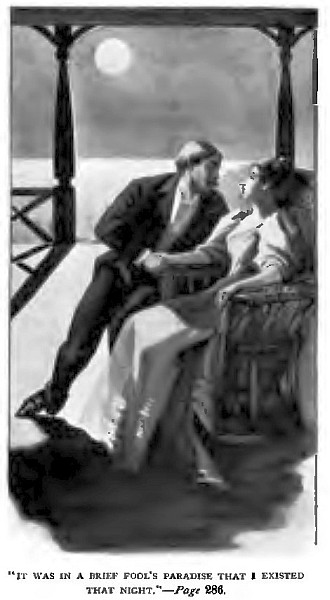
Retracing my steps along the Plage to the Hôtel Deutschmann, I found her sitting upon the verandah alone, plunged in a deep reverie. In one of those huge wicker chairs which one sees nowhere else but at Scheveningen, I took a seat beside her, and, grasping her white hand, raised it to my lips.
How long I sat there I cannot tell. It must have been several hours. Before we rose to enter the hotel, she had admitted that she loved me, and as a pledge of her affection, had given me a turquoise ring from her finger, while I had kissed her passionately, she returning my caresses and appearing supremely happy.
Yet it was in a brief fool’s paradise that I existed that night, for before midday on the morrow I had left Scheveningen, having received a telegram from one of my comrades in Paris, urging me to return at once, as the regiment was ordered to Africa immediately.
Such was the irony of fate! Just as I had won the love of the woman I worshipped, I was torn away from her without scarcely an opportunity of bidding her farewell.
“We may all three die to-night!”
The words were spoken by Captain Lavigniac, who with myself and Lieutenant Maurel were crouching around the dying embers of our camp-fire.
“That’s true,” remarked Maurel; “but if so, we shall die for France. And, after all, is life worth living?”
We laughed, blasé boulevardiers that we were. Having been nauseated by the sweets of life, we were now face to face with death.
The expedition against the fanatical Kel-Ahamellen was much more perilous than we had anticipated. General La Pelletier, who commanded the Algerian forces, had sent us—a mere handful of men—from In Salah away into the wild, inhospitable Tanezrouft Desert, in pursuit of a horde of the dusky rebels; but the long weary ride across the burning plains to Djedeyyed had taken all the spirit out of us. Under a blazing sun we had been journeying for a week, and on this particular night were encamped in a small oasis of Am Ohannan, which consisted of a well of brackish water and one single palm.
Unfortunately, owing to the treachery of our native guide,—who, by the way, was summarily dealt with by being shot,—we had entered a trap laid for us by the enemy. Our scouts had only an hour before reported that we were surrounded by the Arabs, who greatly outnumbered us, and that our position was extremely grave.
We were, therefore, waiting in the momentary expectation of a night attack.
For myself I did not care. Since my arrival in Africa I had received several warm, affectionate letters from Valerie; but, alas! my awakening had come. By the same mail that had brought her last letter to Algiers, I had received from a friend a Figaro, which contained the following announcement in its “High Life” column:—
“A marriage has been arranged, and will shortly take place between Mademoiselle Valerie de Noirville, who is well-known in Paris society, and Monsieur René Delbet.”
Perfidious fate! I had been tricked by her, and all her declarations of love were false. Heartsick and jaded, I sat beside the smouldering embers, thinking over the hopelessness of my future. The discovery of Valerie’s baseness had crushed me. With the exception of the crackling of the fire, and the measured tread of the sentry beyond, all was still in the bright, clear night. Around the well our men were lying, wrapped in their cloaks, but not sleeping. Each man, with his revolver in one hand and the bridle of his horse in the other, was ready at any moment to spring up, mount, and ride straight into the irregular column of brown-faced, white-burnoused foe, who had sworn on their Korân to exterminate us Christian dogs.
The moments passed, breathless and exciting.
“Qui est là?” suddenly demanded a sentry, causing us to start.
“Ami. Pour la France!” was the response, and in a moment later Colonel Chadoume joined us.
“There will be fighting to-night,” he said briefly. “There are thousands of those black devils.”
“There will not be so many when our sabres have whirled through them,” observed Lavigniac grimly.
“We are caught like rats in a trap,” whispered the colonel in a low tone, so that the men should not overhear his misgivings. “The only way in which we can save ourselves is to apprise Le Pelletier of our position, and give him a plan of the country between In Zizé and Chikh Salah from the survey we have made.”
“But how can we?” asked Maurel. “Whoever went would have to pass the lines of the enemy at the risk of being shot.”
We were silent for several minutes.
“I will go,” I said at last.
“You?” exclaimed the three men in surprise.
I nodded.
“I will make the attempt,” I added.
“But you must carry the plan as well as the letter, and start before daybreak,” said the colonel.
“I am ready,” I replied. I set but little value upon my life, for, truth to tell, I was utterly reckless now Valerie was false to me.
In the grey hour before the dawn I left the camp. I had exchanged my scarlet trousers and gilt-braided tunic for a shapeless white burnouse, and about my head wore a haick, around which was twisted many yards of brown camel’s hair; my face had been effectually dyed a deep brown, I had assumed a flowing black beard, and my bare feet were thrust into rough slippers. Any one who had met the inoffensive Arab trader from El Biodh, would scarcely have suspected him to be an officer of the Chasseurs d’Afrique, and a well-known figure in drawing-rooms of the Avenue de Champs Elysées.
Mounted on a camel, with well-filled bags across my saddle, I rode slowly along, over the rough stony desert, eastward, guided only by the streak of yellow light that heralded the dawn.
Far away upon the horizon was a low range of hills, at the foot of which the Kel-Ahamellen were encamped.
I knew it was useless to evade passing through their lines by taking a circuitous route, and had decided that it would be safer to act boldly, and endeavour to pass through their headquarters.
For hours I rode wearily onward. The pitiless rays of the blazing sun beat down upon the loose, parched earth, and their reflection almost blinded me. Not a breath of wind cooled the atmosphere, but, on the contrary, the blasts which ever and anon blew over the Great Sahara, whirling up dense clouds of sand, were like whiffs of hot air from a furnace.
The sun travelled its course, and sank behind me with a blood-red, angry glare that bathed the desert and mountains with brilliant tints. By shading my eyes with my hands, I could now distinguish that I was approaching the settlement of the hostile tribe, and could make out their scattered tents.
As I looked, I saw four figures approaching. They grew nearer rapidly. Then I saw they were mounted Arabs, galloping with all speed towards me. They were standing in the stirrups in the manner peculiar to the Bedouins of the Great Desert, and, with their long rifles carried high above their heads and their white burnouses flowing behind, were bearing down upon me.
Drawing a long breath, I collected all the courage I possessed.
A few minutes later, with wild yells, the brown-visaged quartette rode up to me, addressing rapidly-uttered questions in Arabic, which I answered coolly.
I told them that I had no sympathy with war, that I was a trader from El Biodh, and that my destination was In Salah, where I constantly had commercial transactions.
“But how camest thou here?” asked the great black-bearded fellow who had first addressed me, as he fixed his keen eyes upon mine.
“I rode,” I replied in Arabic, a language in which I was fortunately proficient. “Allah hath protected me.”
“Didst thou not see the red-legged French dogs?”
“Yes, I passed them yesterday. There are thousands of them.”
This statement seemed to cause them considerable dismay. They held a hurried conversation in an undertone, and then informed me that I should have to go before the Sheikh.
An hour later, I was taken before the chief of the tribe, who was seated cross-legged on a mat outside his tent. He was a grey-bearded, wizen-faced old man, whose eyes had lost none of the dark brilliance of youth, and whose teeth shone white in contrast with his red lips and sun-tanned yellow face. As I was led up to him, and the manner in which I had been discovered explained, he slowly removed his long pipe from his mouth, and regarded me critically.
“Thou sayest the French, the accursed offspring of Eblis, are numerous? Where didst thou see them?”
“In an oasis near Tighehert.”
“Ah! thine accent! Thou speakest French, then?”
“Yes, father,” I replied; “I learned it in Algiers.”
He grunted dubiously, and, turning to a great brawny giant who stood among the followers who crowded around him leaning upon their guns, uttered a few guttural words.
“Did not the sons of offal stop thee?” he inquired. “Relate unto me all thou knowest about them.”
“I know nothing,” I replied, bowing submissively. “I merely passed, having satisfied them that I was not a spy. I had no object in interesting myself in the movements of infidels.”
The old Sheikh replaced his chibouk between his lips and continued smoking in thoughtful silence, having fixed his gaze intently upon me.
“Hum!” he grunted.
Then he proceeded to interrogate me regarding my ride from El Biodh. My replies, however, did not apparently remove his suspicions, and he smiled sarcastically now and then, at the same time watching contemplatively the thin columns of blue smoke that rose from his pipe. Suddenly he turned, and, addressing the men who had ridden out to meet me, gave orders that I should be searched.
I stood silently by, watching the men turn out and examine closely the contents of my saddlebags, and the food I was carrying. Then they proceeded to search my pockets, compelling me to raise my arms above my head.
Peste! Fate was again unpropitious!
As I raised my hands, my loose burnouse fell from my arms, leaving them bare, and disclosing that they were white!
“Ah!” cried the Sheikh, his bright eyes flashing with anger. “So thou art a spy! Thou, son of a dog, seekest the overthrow of Allah’s chosen!”
“My father,” I cried, “I—I am not a spy. Behold! I have neither knife nor gun. Is it not written that the One Worthy of Praise showeth mercy only to the merciful?”
“Seize the dog! Take him away, and let him be shot at dawn, as soon as there is sufficient light to distinguish a black thread from a white,” the old rebel commanded with a wave of his sun-tanned hand.
Then, rising, he cast aside his pipe impatiently, and was about to enter his tent, when his passage was barred by a veiled girl in rich silks and gauzes, who stood for a moment gazing at me. Her adjar, although concealing her face, left visible a fine pair of sparkling black eyes, and a forehead that had been plentifully bedaubed with powder in the manner of Eastern women. Rows of golden sequins hung upon her brow, and upon her wrists and bare ankles were jingling bangles.
“Hold!” she cried in a commanding tone, raising her bare arm and addressing the Sheikh. “Though innocent of any crime, thou hast condemned him to die. Is it not written in the Book of Everlasting Will that mercy should be shown unto the weak?”
“He is a Roumi, and his tribe will be consumed by the unquenchable fire in Al-Hâwiyat,” answered the chief of the rebels.
“Of a verity thou speakest the truth,” she said. “But is it not also written that thou shalt not transgress by attacking the infidel first, for Allah loveth not the transgressors.”
“I have spoken!” roared the Sheikh in anger. “Seek not to argue, but return unto thy divan. The son of a dog shall die!” and, pushing her roughly aside, he strode into his tent amid the murmured approbation of the crowd of dark-visaged horsemen who had assembled.
“Brothers,” she cried in a voice that betrayed her agitation, “the Roumi now before thee hath fallen into our hands, therefore we should show him mercy. I, Halima Fathma, daughter of thy Sheikh,—upon whom may the One Merciful pour abundant blessing—appeal unto thee on his behalf. Wilt thou not release him, and lift from my heart the weight which oppresseth it?”
In the silence that followed, she gazed appealingly around.
“No,” they answered, when they had whispered among themselves. “Our Sheikh hath condemned the spy. He seeketh to betray us, and must die.”
“I am hungry,” I cried, as, after further vain argument, the Sheikh’s daughter was turning away. “It is permissible, I suppose, to have a last meal?”
Saying this, I stopped, and, picking up the small loaf which the Arabs had taken from my saddle-bag, commenced to eat it with a coolness which apparently astonished the group of freebooters of the plains.
Through that balmy moonlit night I remained where my captors had left me, bound to a palm tree in the vicinity of the settlement. Hour after hour I waited alone, watching the beauty of the Oriental sky, and longing for the end. I knew I should receive no quarter—that ere the sun rose I should be shot down, and my body left to the vultures. My thoughts reverted to my boyhood, to my gay, reckless career in Paris, and most of all to Valerie.
The moon was fast disappearing, and I was calmly watching for the steely-grey light which in the desert is precursory of dawn, when suddenly I heard a footstep. The person was concealed behind some huge boulders, and I concluded that it was one of my captors who had mounted guard over me.
Yet, as I listened, the steps sounded too stealthy, like those of a light-footed thief. I stood breathless in wonderment, when suddenly a slim, white-robed figure crept from behind the rocks, and advanced towards me.
It was an Arab youth. He placed his finger upon his lips, indicative of silence.
As he came up to me, I gazed at him in surprise, for his haick concealed his face.
“Hush!” he whispered in Arabic; “make no noise, or we may be discovered. It is cruel that a brave officer like thyself should be murdered,” he added. “I have come to save thee.”
“How didst thou know I was an officer?”
“Ask no questions,” he replied. And drawing a keen knife from beneath his burnouse, he severed the cords that bound me.
“Thou art free,” he said. “Come, follow me.”
Picking up the bread I had not eaten, I thrust it into my pocket, and followed my unknown friend up a stony path that led into a narrow mountain pass. When some distance from the settlement, we came to a clump of trees, to one of which was tethered my camel.
“Quick! Mount and ride away,” he urged. “Keep straight through the pass, and when thou gainest the desert, turn at once towards the north. A day’s journey from here will bring thee unto the encampment of thy comrades.”
“Only a day’s journey!” I cried. “To what do I owe the sudden interest that the daughter of the Sheikh hath taken in my welfare?” I asked, laughing.
“I know not. Women have such strange caprices sometimes. But get away quickly,” he urged. “Lose not a moment, or thou wilt be overtaken. Slamá. Alah iselemeck!”
Turning from me, he hurried away; not, however, before I had discerned in the faint grey light that the face, half hidden by the spotless haick surrounding it, was beardless, evidently that of a woman. Was it Halima herself?
At first I was prompted to follow and ascertain; but next second I saw the grave risks we both were running, and, mounting my swift méheri, started off at a gallop over the rough stones and dunes of loose, treacherous sand.
Suddenly the crack of a rifle startled me. Then, as I glanced back, I saw, to my amazement and dismay, the slim, burnoused figure lying in a heap upon the stones; while three yelling, gesticulating Arabs were standing over it, cursing, brandishing their knives and shaking their fists. Evidently they had shot my rescuer!
To linger, however, would mean death. Therefore, on emerging from the pass, I took the route described by the mysterious person who had given me my freedom; galloping over the trackless desert in a northerly direction, with eyes eager to discern the encampment of Spahis and Zouaves.
Before nightfall I was safe within the French lines, relating to General Le Pelletier the events of my journey, and explaining the perilous position of the 39th Regiment.
“But you mentioned something of dispatches, and a plan of the country?” he said.
“Yes; I have them here,” I replied.
Then, taking from my pocket the half-eaten roll of bread, I broke it, and took therefrom two small pieces of paper.
One was a map in miniature, showing the route he was to travel, and the other the dispatch.
“We are close upon them now,” I remarked to an officer riding by my side on the next night. “They’ll fight like demons.”
Hardly had the words passed my lips, before wild yells of rage rent the air on every side; and ere we could realise it, we had surprised the encampment of the Kel-Ahamellen, and rifles flashed on every side.
I need not describe the desperate hand-to-hand conflict in the darkness. Suffice it to say, that we punished the tribe for their temerity in sentencing me to death.
When in the early morning, after a severe engagement, we walked among the ruins of the tents and heaps of dead, I searched diligently for Halima, being aided by a dozen other officers and men. But we did not discover her; and I became convinced that my worst fears were realised, and that she had fallen a victim to the relentless vengeance of her people.
Nearly two years elapsed before I again trod the asphalte of my beloved Paris.
A few weeks after my return to civilisation, I attended a ball at the German Embassy. I had been dancing, and was taking my partner, a rather skittish widow, into the supper-room, when I accidentally stepped upon and rent the dress-train of a dark-haired girl, who, leaning upon the arm of an elderly man, was walking before me.
She turned, and I bowed my apologies. The words died from my lips.
The woman, whose flower-trimmed dress I had torn, was Valerie! It was a mutual recognition; but neither of us spoke.
Half an hour later, however, I was sitting alone with her. To my fierce demands for an explanation of the sudden breaking off of her communications, she replied boldly, and with such an air of veracity that I hated myself for having spoken so harshly.
Judge my joy when she told me she was still unmarried, that the paragraph in the Figaro was unauthorised, and that it had been inserted by some unknown enemy, during her absence from Paris.
“Then you are not Madame Delbet?” I cried, with ill-concealed delight.
“Certainly not; M’sieur Delbet is an old friend of our family, that is all,” she replied, laughing. “After you left Oran, I could not write, as you were away in the desert. I read of your adventures and your bravery in the newspapers, but did not know where a letter would find you; therefore, I left all explanations of my enforced silence until your return.”
“And—you still love me?” I asked, with trepidation, placing my arm tenderly around her slim waist, and drawing her towards me.
“Of course. But, mon cher, you have never doubted me, have you?”
“No,” I replied, after an awkward pause, gazing fondly into her eyes. “But now I have gained my promotion, will you become my wife?”
Her answer was affirmative, and we sealed our compact with a kiss.
Would that I could omit this last and terrible chapter of my biography. But no! The hideous story must be related to its bitter end, to serve as warning to others.
Through closed windows and drawn curtains was borne the solemn clang of a bell in a church tower in the Avenue de Villiers, recording the death of to-day and the birth of to-morrow. A simple canary in its gilded cage, mistaking for morning sunshine the soft glow of electricity, as it filtered through its shade of orange silk, chirped a matin song in shrill staccato. A tiny slippered foot nervously patted the sleek fur of the tiger rug beneath it, a strong arm girt a slender waist; and, between the solemn strokes of the church bell, and the cheery passages of the bird-song, quick, passionate kisses alone stirred the scented air.
The man spoke. It was René Delbet!
“I must go now, darling,” he said. “We have both braved too much already. He may return at any moment.”
“And if he did?” Valerie asked defiantly.
“He might at least—suspect.”
“Suspect?” and she laughed a chorus to the canary. “He doesn’t know what suspicion means. He would trust me with Mephistopheles himself. Should he find you here, he would only thank you for entertaining me. He’s the most easy-going fellow in the world.”
The man smiled, released his companion from his embrace, and rose from the settee, upon which the two had been seated.
“I’m afraid, my dear,” he said, “that you presume too much upon his confidence. There is no cord so elastic that it will not snap.”
I waited for no more, but burst into the room, having, in my frenzy of madness, drawn a revolver from my pocket.
“Diable! You?” cried Delbet, starting up in alarm.
“Ah, my husband!” gasped Valerie, covering her blanched face with her hands.
“Sacré! You shall die!” I shouted.
The tolling bell throbbed once again, and then—a short, sharp, loud report and a flash together. A little puff of blue-grey smoke floated ceilingward, a man’s frightened cry pierced the night, and upon the harmonious colours of the flower-strewn carpet Valerie lay dead.
Rushing to my wife’s boudoir, I broke open her escritoire, bent upon ascertaining the nature of any letters she might have concealed there.
There were many. Ah, Dieu! When I think of the passionate love-missives penned by the man whom I had implicitly trusted, and admitted to my home as a friend, my brain is lashed to frenzy.
One discovery I made was startling. Several of the letters bore the stamp of twenty-five centimes, and their envelopes were addressed to “Mademoiselle Halima Fathma, care of Hadj Hassan, Douéra Algérie.”
Searching further, I discovered a full-length cabinet photograph, taken in Algiers. It was of Valerie dressed as the Sheikh’s daughter, with the exception that the adjar, which had hidden the Arab girl’s face, had been removed.
In my surprise I almost forgot the terrible tragedy.
Continuing the investigation of the odds and ends in her private drawer, I found an Arab head ornament and several bracelets. The pattern of the crescent-shaped sequins I recognised as the same as those worn by the mysterious Halima.
These discoveries, combined with the contents of the letters which I hastily scanned, left no doubt that Halima and Valerie were the same person; and, further, that Hassan, the wealthy Sheikh of the Ahamellen, who had a house at Douéra, was really her father; and that Monsieur de Noirville had brought her up, and educated her to the ways of civilised society.