Front matter
Reading edition
Author of “The Ranch of the Tombstones,” “Tramps of the Range,” etc.
“Dusty” Corbett licked his dry lips and stared up at a morning sky. Somehow the waking was painful, and realization came slowly. He rolled his head and stared at the forefeet of a shaggy-legged bronco.
Some straw and a bunch of fox-tail grass seemed to irritate the back of his neck, and he swore wonderingly as he sat up and surveyed his surroundings.
He was, or rather had been, lying in the exact center of a corral, in which were several loose horses. The ground was lumpy and uneven, which accounted partly for the cramp-pains in his neck and shoulders.
On the top pole of the corral sat a long, lanky cowboy, humped like a buzzard, puffing negligently on a very limp cigaret. Dusty surveyed him closely through squinted eyes. Dusty was no beauty; not by any manner of means. His eyes were habitually squinted and set in mats of grin-wrinkles. His nose was deformed from many hard smashes, and, although still in his twenties, he looked to be forty.
After a close scrutiny of the tall cowboy, he spat dryly and scratched his mop of dust-colored hair, which scraggled down over his forehead.
“What in ——’s goin’ on?” he asked hoarsely.
“You been drunker’n seven hundred snakes,” grunted the tall one seriously.
“Um-m-m!” Dusty licked his lips thirstily. “Weary, that ain’t reasonable.”
“Weary” Willis rubbed his ear violently, which action dropped his wide sombrero down over his left eye.
“It ain’t,” agreed Weary. “It ain’t noways reasonable f’r a sheriff e-lect to do a thing like that.”
Dusty got to his feet and dusted himself with his hat as he walked over to the corral fence, started to climb up beside Weary, but decided that the accomplishment was not worth the effort, and leaned against it instead.
“You’re takin’ office t’morrow,” stated Weary, “and right away yuh gits loaded to the gills and bunks in the corral. My ——, ain’tcha got no pride, Dusty?”
“Yeah,” Dusty nodded. “I got pride, Weary. ——, yes, I’ve got a heap of pride—lotsa pride. But what I needed was capacity—not pride!”
“You ain’t con-trite, that’s a cinch.”
“Aw, where’d yuh git that word?” Dusty grew belligerent. “You lay off’n them big words, cowboy. ’F yo’re goin’ to be my deputy, why in —— do yuh suffer me to lay out here in the open?”
“I ain’t no bouncer,” said Weary. “Nobody hired me to throw drunks out of the corrals.”
“Aw-w-w,” protested Dusty, “yuh ain’t sore at me, are yuh, Mister Willis? C’m here t’ me!”
As he spoke he grasped Weary by both feet and yanked him loose from his perch. The tall cowpuncher hooked his elbows around the top pole and tried to hang on, but Dusty was not to be denied, and a moment later he was sitting on Weary’s chest, and Weary was begging to be released.
“Ain’t no corral-bouncer, eh?” jeered Dusty. “Let yore boss lay out in the corral, will yuh? Beg to be excused before I turn yore long nose upside down and let the next rain storm drown yuh.”
“Hol’ on!” begged Weary. “Leggo m’ ribs. Yee-ow-w! Dusty, fer ——’s sake, lemme up! I ain’t tol’ yuh half the news.”
“Go on and tell it,” Dusty grinned. “I’m listenin’.”
“’Member leavin’ yore paint pony at Smalley’s hitch-rack last night?”
“Y’betcha. Whatsa joke?”
“He’s went,” declared Weary seriously.
“Thasso?” Dusty spat reflectively and squinted down at Weary’s serious face.
“Who took him?”
Weary rolled his head negatively.
“I dunno. There’s a piece of rope hangin’ there on the hitch-rack, and it’s been smeared——”
Dusty got slowly to his feet and released Weary, who also got up and leaned against the fence. Dusty squinted closely at Weary, as though afraid it was a joke, but Weary was in deadly earnest.
“Sticky-rope, eh?” queried Dusty.
“Smeared with syrup, I reckon,” stated Weary softly. “I ain’t said nothin’ to anybody, Dusty. I knowed you was some’ers around; so I left it t’ you.”
Dusty rolled a cigaret slowly, shaping it with great care, after which he let the tobacco sift out on the ground and crumpled the paper in his fingers. Weary watched him and marveled at such a show of emotion.
“How much did yuh drink last night?” asked Weary.
Dusty squinted closely at Weary, as if about to tell him that it was none of his business, but the serious expression changed, and he grinned. When Dusty grinned, it was like the sun breaking through the clouds after a week of dreary weather. His face lost its homely contour and became a magnet to children and dogs.
“How many drinks? About six.”
“Lost all his education in one night,” declared Weary, speaking directly to a fuzzy-looking gray bronco. “Somebody throwed a monkey-wrench into his countin’ apparatus.”
“Six drinks,” declared Dusty emphatically. “S-i-x!”
“Spells, but can’t count.” Weary shook his head dolefully. “‘Sapphire’ Smalley’s liquor shore doth do queer things to a cowpuncher.”
“Had two drinks with you, t’ begin with,” declared Dusty, checking them off on his fingers. “Then I had one with Dixie Miller and one with Low Hat Lawson. Pretty soon I don’t take no drinks f’r a long time and then I has one with Smalley, and buys one in return. From that on I kinda loses m’ memory, but nobody can tell me that I don’t remember when I takes a drink!”
“What was yuh drinkin’ out of—a washtub?” Weary seemed very skeptical. “Six drinks don’t act thataway. Mebbe yore stummick was empty, Dusty. I’ve knowed hooch t’ act thataway.”
“Yeah? Well, now this is a —— of a time to come and expose yore wisdom, Weary. Let’s go and take one lingerin’ look at that hitch-rack.”
They went through the narrow alley between the Eagle River stage office and the livery-stable. About half a block up the street from where they struck the rough sidewalk was the hitch-rack, just beyond the entrance to Sapphire Smalley’s saloon.
Several horses were dozing at the long rack, but Dusty’s tall, Roman-nosed pinto was not in evidence. The town of Calumet was not a busy place at this time in the morning. In fact, Calumet never did appear to be busy.
Dusty and Weary walked to the hitch-rack and leaned indifferently against the top-rail, while they considered the short piece of rope, which hung across the rack, where Dusty had left Paint.
It was an inoffensive-looking piece of worn lariat rope, but sticky with a substance resembling syrup. Dusty wrinkled his nose away from the smoke of his cigaret and shoved his thumbs down inside his cartridge belt, while he cogitated deeply.
“Well,” he stated finally, “mebbe I talked too —— much last night.”
“Prob’ly,” agreed Weary, dryly. “You mostly allus do. F’r instance?”
Dusty grinned widely and brushed his hand across his lips.
“Declared m’ platform, I reckon. Low Hat got to arguin’ that Chet Taylor had been a good sheriff, and the bartender said that Chet didn’t do nothin’ but draw his pay every month. Low Hat said he didn’t blame Chet a —— bit f’r not tryin’ too hard to nose out the Sticky Ropes, and then I, like a —— fool—” Dusty rubbed the back of his neck and looked soberly down at his toes—“I speaks right out in church, and proclaims that I’m the little hummin’-bird what is ordained t’ make this Sticky Rope outfit line up and say their prayers.”
“And you only had six drinks?”
Weary glared wickedly at Dusty, who shook his head.
“Up to that time I only had three. Aw, I wasn’t drunk, but I must ’a’ been exhilarated t’ beat ——. Anyway, Paint’s gone, and I can sure appreciate the feelin’s of anybody what tried t’ ride him.
“When I buys that bronc’ from Cherokee Jim he’s honest about the failin’s of the pinto. He says t’ me:
“‘—— bad hoss! Yo’ seeum spots? Devil mark him so he no make mistake an’ ride um when hoss die.’
“It took me three weeks and two busted ribs to prove that I could ride him, and now some of them danged thievin’, murderin’, rope-packin’ devils has swiped him.”
“Don’t holler,” begged Weary. “My ——, yuh don’t need t’ advertise yore ambitions and failin’s. Remember that yo’re the new sheriff, and a sheriff has got t’ be kinda dignified and thoughtful.”
“My gosh, I’m thoughtful enough,” declared Dusty earnestly. “I sure was plumb attached t’ that painted critter and I’m packin’ a hunk of lead f’r the jasper that lifted him.
“Took m’ saddle, too!” exploded Dusty, after a moment’s thought. “My gosh, I never thought about that before! Seventy-dollar hull, fifty feet of danged good lariat and a silver-mounted bridle. Huh! I’m madder than —— right now!”
Dusty drew his hat down over his eyes and headed for the door of Smalley’s saloon, while Weary slouched along behind him, half-hobbling on his run-over heels.
A bad split in the voting strength of the Democratic and Republican parties had been the means of throwing the election to Dusty Corbett, who had been nominated on the Republican ticket, in a county where the Democratic vote was nearly two to one.
Buck Walsh had been beaten by Scott Magruder for the Democratic nomination, but Buck ran Independent and split the vote to such an extent that Dusty won by a big margin. The election of a sheriff in Big Bear County was of more local interest than the election of a President of the United States. It was a he-man’s job and gave a certain amount of anxiety to those interested in the activities of their leading peace-officer.
And also there was the Sticky Rope gang to take into consideration. Who they were, no one knew. Their trade-mark was a short section of rope, which had been dipped into syrup and left hanging prominently at the place of their activities.
For over a year they had been leaving their trade-marks hanging in Big Bear rangeland, and their crimes ranged from rustling to murder. Not only was the rope an ear-mark of their depredations, but it also served as a warning to those who became too active in trying to solve the identity of the gang.
In two instances it had caused the recipient to sell out and leave the country. No one seemed immune from them; yet there had been little active work done to apprehend them. It was a case of “suspect thy neighbor and keep still about it.”
Dusty and Weary went into Sapphire Smalley’s saloon and gambling parlor and leaned on the bar while the bartender tended to their wants. Swampers were busy cleaning out the dirt and débris of the night’s activities and the low-ceilinged room resounded hollowly to the clatter of chairs and scraping of table-legs.
Sapphire Smalley, a tall, gaunt man, with a flowing mustache, was slowly checking up the night’s receipts at his desk behind the front end of the bar. He was dressed in a soft, white silk shirt, striped trousers and patent-leather pumps, and the cerise four-in-hand, which circled his collar, was decorated with a six-carat yellow sapphire. On the third finger of his left hand was another yellow sapphire, which was even larger than the one in his tie, and from each cuff flashed the yellow light from two more large sapphires.
Dusty stood on the bar-rail and considered the profile of Smalley so intently that the gambler turned his head and looked at Dusty.
“Howsa business?” asked Dusty.
Smalley brushed his mustache tenderly and seemed to register that it was none of Dusty’s business, but said—
“Oh, all right; why?”
“Figurin’ in a loss of one pinto bronc’, a perfectly good saddle and a twelve-dollar bit?”
Smalley turned partly around and looked intently at Dusty.
“What do you mean, Corbett?”
“This is what I mean.” Dusty leaned closer but did not lower his voice. “My horse was stolen from yo’re hitch-rack last night.”
Smalley smiled deprecatingly and shook his head.
“I’m not responsible for horses at the rack.”
“No,” agreed Dusty. “But I’m holdin’ yuh responsible, Smalley. Cause why? ’Cause yore bartender handed me a herd of knockout drops last night; that’s why.”
Sapphire Smalley’s face did not register any emotion whatever, but his eyes expressed unbelief. He looked quizzically at the bartender, who had halted work and was listening closely. Dusty shook his head.
“Not this one, Sapphire. This happens last night.”
“But why would he dope you, Corbett?”
“Remains t’ be seen, as the undertaker said when the coffin’ busted. Anyway, m’ pinto is gone.”
Dusty did not mention the piece of rope. He did not trust Sapphire Smalley, although he did not feel that Smalley had anything to do with doping him.
“What makes you think you were doped?” queried Smalley.
“I only took six drinks, and I woke up this mornin’ in a corral. How long does it take a shot of that kinda stuff t’ hit yuh?”
“I don’t know what kind of stuff you got,” smiled Sapphire. “Maybe you drank six drinks on an empty——”
“Aw-w-w, ——!” exploded Dusty. “Yo’re castin’ a lot of reflections on m’ insides. ’F I thought I didn’t have stummick enough t’ stand for six drinks, full or empty, I’d have it cut out by a horse doctor and get me a gizzard.”
Dusty turned away from the bar and started for the door, but turned and spoke directly to Smalley.
“You better wise-up that night bartender; so he’ll have a —— of a good alibi, Smalley.”
“You mean Jeff Wharton?” queried one of the swampers, who was trying to sweep up some scattered cards near the doorway.
“Stubby mustache and shy a little finger?” said Dusty.
“Yeah. He left on the stage this mornin’, early. Said he was goin’ t’ Moscow, Idaho.”
“Did, eh?” grinned Dusty. “I reckon he had sense enough to come in out of the rain.”
He and Weary went outside, where they sat down on the sidewalk and considered the main street of Calumet. About half a block below them, across the street, a wagon had backed up to the front of the sheriff’s office and two men were loading in a few pieces of furniture.
“Chet Taylor’s movin’ out,” observed Weary. Taylor was the retiring sheriff.
“S’pose I’ve got to buy some furniture,” observed Dusty dolefully. “I worked like —— to get a chance to spend money for furniture and to dodge bullets and the county pays me a hundred and ten dollars a month. Folks will call me sheriff. Hm-m-m! Sounds good, don’t it? Fine—t’ everybody but me. Cost me one pinto bronc’ and a seventy-five dollar——”
“Aw, don’t e-numerate yore loss again,” begged Weary. “My gosh, anybody’d think yore outfit was a wonder. That hull wasn’t worth no seventy-five dollars, and that pinto wasn’t worth six-bits. He’d kill yuh some day.”
Dusty nodded seriously and walked back to the rack, where he gingerly picked up the piece of gobby rope and went straight to the open door of the sheriff’s office. Weary hobbled along behind him and grinned at Chet Taylor, the portly ex-sheriff, who was perspiring over the removal of a small piece of carpet from the floor.
Dusty picked up a hammer, which was lying on a desk, and proceeded to nail the section of rope to the outside of the door. Taylor watched him curiously, seriously, when he recognized the symbol. Dusty tossed the hammer back on the desk and contemplated his handiwork.
“What’s the idea, Dusty?” asked Taylor.
“Advertisin’ the fact that I ain’t a danged bit afraid of the Sticky Ropes,” grunted Dusty. “They’re a lot of flat-headed buzzards, thass all, and I’m on their spoor until they high-tails it out of the county.”
Taylor turned back to his work and carried the piece of carpet out to his wagon. He had nothing to say regarding the Sticky Ropes. Taylor was a married man and had several children.
Dusty’s open defiance of the gang was soon known in Calumet and people walked past the office just to get a glimpse of the innocent-looking rope nailed to the door. Weary shook his head sadly and went around with an unlit cigaret hanging to his lip. He was willing to back Dusty in anything, but he did not care to antagonize an invisible foe.
Dusty and Weary had both worked for the Cross-Anchor cattle outfit, owned by Scott Magruder, until Dusty’s nomination, which was unsolicited by Dusty. The primaries had been deadlocked over the nomination, and Dusty’s name had been suggested. Dusty was known as a fighter, and that is what the office needed. His defeat was a foregone conclusion, until the split came, but Dusty had worked hard.
Scott Magruder, Dusty’s former boss, had said many things against Dusty, and even hinted that Dusty knew quite a lot about the Sticky Rope gang, but Dusty did not resort to personalities in his campaign. Perhaps it was because of Stella Magruder, with her big blue eyes and copper-colored hair, who had always snubbed him and made open remarks about his homely face.
Stella was eighteen, slender as a reed and rode like a cowboy. She declared her dislike of Dusty Corbett in no uncertain language, but behind it all was a lack of sincerity. Others believed her, but Dusty only grinned softly, and made faces at her until she laughed. He had not seen her since election and he wondered if his defeat of her father had caused her to really dislike him.
The books of the sheriff’s office were a mystery to Dusty and Weary. Neither of them were educated beyond the little “readin’, ritin’ and ’rithmetic” of the rangeland school, and they nodded wisely over papers, and tried to fool themselves and each other into thinking that they knew all about it.
“She’s a dead open and shut t’ me,” declared Dusty that night, as he shoved some papers aside and held his cigaret over the chimney of their lamp to get a light.
Weary nodded enthusiastically and tilted back from the table, just in time to miss being the recipient of a bullet, which hummed through the window, snapped the lamp chimney from under Dusty’s cigaret and splatted into the wall just over Weary’s head.
Dusty slapped the guttering lamp aside, and it crashed to the floor, leaving the room in darkness. The crash of the lamp was echoed by two distinct thumps, as Dusty and Weary flopped to the floor.
“Now wouldn’t that make yuh sore?” complained Dusty. “Gotta buy another lamp! Dang such a job, anyway!”
“You hung that rope on the door.” Weary’s voice was more than mildly accusing. “You invited ’em t’ call yuh, Dusty. Didja ever try havin’ a li’l sense?”
“You don’t have t’ pay for the lamp, do yuh?” demanded Dusty hotly. “Whatcha kickin’ about?”
“Well, I danged near got killed, didn’t I?”
“Huh!” Dusty’s voice was sarcastic and his boot-heels scraped on the floor as he got to his knees.
“Reach me the blanket off the top of the bunk, Weary. We’ve gotta cover that window.”
Dusty got the blanket and edged in close to the window, where he peered out. Moonlight and the yellow lights from the windows flooded the street, but the blocky shadows precluded all chances of seeing who fired the shot.
The report of the gun had caused no one to investigate, as shots in Calumet were frequent. From Sapphire Smalley’s came the raucous notes of a three-piece orchestra, while from another direction came the metallic screech of a worn-out phonograph. A bunch of horsemen drifted past and dismounted at the saloon hitch-rack; their voices blending into a meaningless gabble, as they entered the place.
Dusty fastened the heavy blanket over the single window and scratched a match. Weary was sitting on the floor, with his head against the leg of a bunk, half-asleep.
Dusty looked at the smashed lamp and procured a candle, which he stuck into the neck of an empty bottle.
“See anybody?” queried Weary, getting slowly to his feet.
“Not a danged soul,” Dusty shook his head and produced his cigaret makings. “Them Sticky Ropes has fired their first gun—and—missed! I’ve got ’em worried, cowboy; I’ve got ’em worried!”
“And that ain’t all,” observed Weary slowly as he drew off one of his boots. “You’ve got me in the same fix, Mr. Corbett.”
“Want t’ quit?” Dusty squinted closely at Weary, who seemed to be closely inspecting his boot-heel.
“No-o-o,” Weary shook his head. “I ain’t worth a —— ’less I’m worried, Dusty. Le’s hit the hay.”
The next morning the rope was gone from the door of the office, and this fact seemed to amuse Dusty greatly.
“I tell yuh I’ve got ’em goin’,” he confided seriously to Weary, who did not seem to share Dusty’s enthusiasm. “I’m the li’l whippoorwill that’s goin’ t’ knock hard right between their antlers.”
“Yeah,” admitted Weary. “I reckon you got ’em scared—almost. You scared ’em so bad that I didn’t sleep a wink. Every time I dozed off a li’l I could see that bullet seepin’ into the window and chasin’ around f’r a chance to bore into m’ head. Yuh scared ’em so bad that we’ve got to stand with our backs against a tree all day and hang a blanket over the winder at night.”
“They think we’re scared, don’t yuh know it?” Dusty grinned, paying no attention to Weary’s flow of sarcasm.
“Them jiggers are mind-readers,” Weary nodded seriously. “’F I’d ’a’ knowed they was goin’ t’ act thataway I’d ’a’ told you and yore deputy job t’ go plumb t’ ——; but I’m too scared t’ quit now.”
Dusty grinned widely and jammed his hat down over one eye, while he did a double-shuffle to relieve his feelings.
“I’ve sure got a good start, Weary. Got drunk, had m’ horse stole and got shot at. ’F that ain’t some start at bein’ sheriff, what would yuh call it? I’ll borrow your rack-o’-bones and go out to the Cross-Anchor and get me a bronc’.
“Mac told me he’d sell me one of them Mission-Cross broncs, dirt cheap, and there’s a hammer-headed gray that looks good t’ me. I’ve got a saddle out there, too, if the rats ain’t chawed it all up by this time.”
“Jack Bonn will likely give yuh a good bronc’ and a saddle, ’f yuh ask him,” grinned Weary.
“That’s one reason I hate t’ go out there,” replied Dusty. “I sure hate t’ have anybody give me a lot o’ things thataway, and Jack Bonn’ll just about swamp me with presents.”
Weary grinned. Jack Bonn was the foreman of the Cross-Anchor outfit and had no use whatever for Dusty and Weary. Bonn was a big, raw-boned, heavy-handed cowman, with no sense of humor. He had been foreman of the Cross-Anchor for almost two years and his work was of the very best, although he was greatly disliked by the wild-riding cowboys of the Big Bear Range.
Bonn rode alone, bunked alone and seemed to hold himself aloof. He was stronger than the average cowboy and was reputed to be fast on the draw, although he had never made a killing in that part of the range. He never drank to excess, but was a fiend for poker or roulette, at which he never seemed to win.
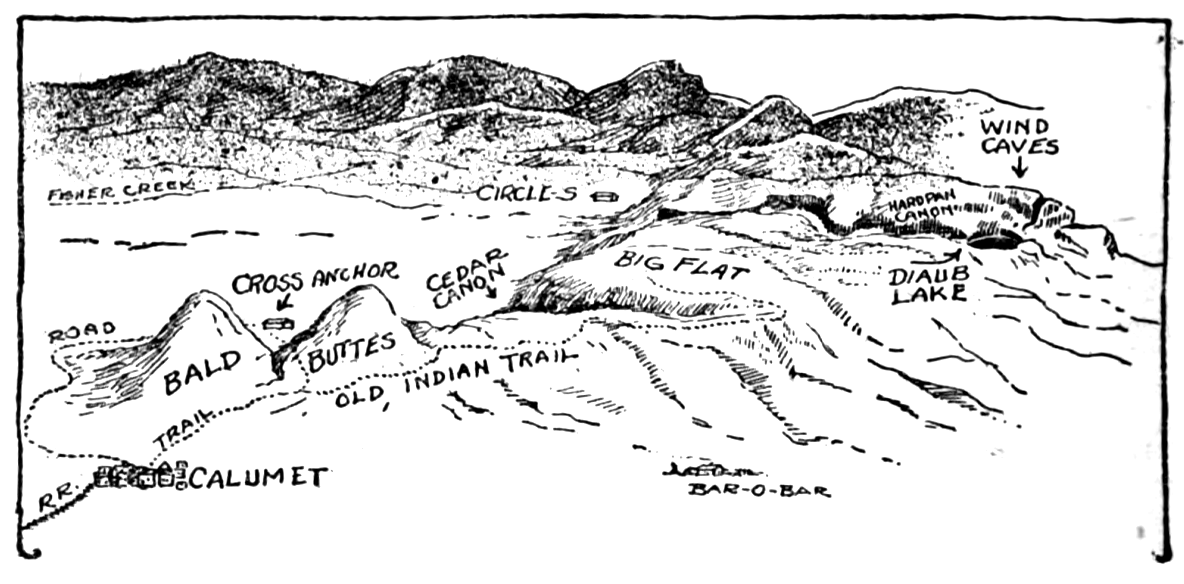
Dusty saddled Weary’s horse and swung into the hills. The Cross-Anchor ranch was about ten miles by the road, which wound in and out of the draws and circled the Bald buttes, but a short-cut trail over the buttes lessened the distance by at least five miles. It was a hard climb to the top of the buttes, but from there a horse could almost slide down to the little valley, where the Cross-Anchor ranch-house and out-buildings sprawled among the cottonwoods of Cub Creek.
Autumn had already tinted the foliage with red and gold along the creek, and from high overhead came the soft gabble of a V-shaped flock of brant, winging their way southward. Cattle lazied their way along the bank of the stream. Far beyond, the jagged line of the Little Rockies was almost lost in a blue haze. In another month the scene would change to the desolation of Winter, with its blinding blizzards, bitter cold; when the future of the cattlemen would lie entirely in the hands of Fate.
Dusty rode in through the big gate and dismounted at the ranch-house porch. A collie dog sniffed suspiciously at him for a moment and went into ecstasies of joy, barking and dancing like a wild thing.
A small woman, wearing a handkerchief wrapped around her head and carrying a rag rug and a broom, came to the doorway. She squinted at Dusty for a moment and dropped the rug.
“Land sakes, if it ain’t Dusty Corbett!” she exclaimed.
“’Lo, Ma!” Dusty grinned. “Howsa family?”
He walked up the steps and shook hands with her. “Ma” Magruder thought a lot of Dusty Corbett.
“Cleanin’ house?” Dusty grinned.
“Uh—huh. Gotta be done, Dusty. Mac’s sprained his ankle, and we’ve got comp’ny comin’. Gotta swamp out the old shack.”
“Mac sprained his ankle, did he?”
“Yeah. Bronc’ fell with him and he tried t’ step into the next county, I reckon. It ain’t bad, but it makes him cuss all the time. Me ’n’ Stell moved him down to the bunkhouse, where nobody but Jack Bonn and ‘Shorty’ Miles can hear him take the name of the Lord in vain.”
“Say yuh got comp’ny comin’, Ma?”
“Uh—huh. Couple of friends of Bonn. Man named Ramsey, and his son. Comin’ out here to go huntin’. Bonn’s goin’ to guide ’em. Say, whatcha mean by stayin’ away all this time?”
“Well,” grinned Dusty. “I didn’t know how yuh felt about the election, and——”
“Sa-a-ay!” Mrs. Magruder shook the broom at Dusty.
“Yuh make me tired—you and Weary. What do yuh think we are? Pers’nally, I’m glad yuh beat Mac. What in thunder does he want of that job? Has t’ hire men t’ help him run this ranch, and then runs for office. Politics! My gosh, do yuh think I want my husband t’ be a target for every pistol-packer in the country?”
“Me and Weary got shot at last night.”
“No! Yuh did? Who shot at yuh, Dusty?”
“Through the winder—at night.”
“Aw-w-w!” Mrs. Magruder shook her head and squinted narrowly.
“Dusty, ain’t there some way to stop things like that? Who are these Sticky Ropes, I wonder? Mac used to say it was a joke, but he’s kinda convinced that it’s serious.”
“Yes’m, I reckon it’s serious,” grinned Dusty. “Anyway, I’m takin’ it serious-like. They stole m’ pinto bronc’ and saddle yeste’day, and I’m out here t’ see ’f I can buy a horse from Mac. He had some o’ them Mission-Cross broncs, which he said he’d sell.”
“Well, for gosh sakes! Stole the sheriff’s horse and took a shot at him. I tell yuh, this old range is gettin’ tough, Dusty. I been tellin’ Mac that we ought t’ sell out and move into town where Stell could get some advantages. First thing I know she’ll be marryin’ somebody and we won’t know but what he belongs to the Sticky Rope gang.”
“Who’s she goin’ t’ marry?” asked Dusty blankly.
“Ain’t flung her loop yet,” grinned Ma Magruder, picking up the rug. “Keep your head up, cowboy. You go down and listen to Mac cussin’ the bones in his leg while I shake some alkali out of the rugs.”
“Yes’m, Ma, I reckon I will.”
Dusty turned and headed for the bunkhouse, while Ma Magruder squinted after him, a smile on her face.
“Don’tcha leave before eatin’ time,” she called after him. “You don’t look like town cookin’ was good for yuh.”
“I’m sure honin’ f’r reg’lar cookin’, Ma,” he called back, as he shoved open the bunkhouse door.
Scott Magruder looked up from his game of solitaire, as Dusty came inside. Magruder was a small man, with a lean face and a wispy-gray mustache, which was invariably chewed even with his lips on one side and hung below his chin on the other. Just now he was unshaven and his thin thatch of gray hair showed the lack of a morning combing.
“Hyah, Scott,” greeted Dusty.
“Hyah, Scott,” parroted Magruder sarcastically. “Comin’ out to gloat over a cripple, are yuh?”
“Nossir.” Dusty shook his head seriously. “I’m plumb sorry yuh sprained yore ankle, Scott; I wish it had been yore danged neck. As far as I’m concerned, pers’nally, I don’t care a whoop-galoo ’f yuh broke every bone in yore body. That’s how much I think of you, yuh old picketpin.
“Yuh slandered me in the campaign. Yuh—yes, yuh did, Scott. Yuh said a lot of —— nasty things about me. Yuh hinted that I might belong t’ the Sticky Rope outfit. I don’t like yuh—nossir. I don’t think yo’re fit t’ go out alone without a keeper. Outside of that, yo’re all right.”
Scott Magruder squinted closely at Dusty and nodded in agreement.
“I believe yuh, Dusty. You always told the truth, as far as I ever found out, and I betcha you’re right in everythin’ yuh say. Whatcha reckon I ought to do—shoot m’self in public?”
Dusty’s eyes roved around the bunkhouse, as if everything within those four walls were strange and wonderful to behold. His glance came back to Magruder and his face broke into a wide grin, as he held out his hand.
“Hyah, Scott!”
“Well, I’ll be doggoned ’f it ain’t Dusty Corbett!” exclaimed Magruder, shaking hands violently.
“Long time I no see yuh, Scott.”
“Y’betcha it is, Dusty. Whatcha doin’ for a livin’?”
“Sheriffin’.”
“Thasso? Well, I’m sure glad t’ hear it. Set down and rest your hoofs, cowboy. Mighty glad t’ see yuh.”
And thus amicable relationship was again established. No denials, no arguments. The past had been forgotten and forgiven.
“Sure yuh can have one of them Mission-Cross broncs,” said Magruder, after Dusty had told of the loss of the pinto. “Help yourself. Your old saddle’s hangin’ up in the barn. Whatcha know about them Sticky Ropes?”
“I dunno much, but I’m goin’ to, Scott,” declared Dusty. “’F I get ’em mad enough at me they’ll sure overplay their cards. Who’s these folks that are comin’ in today?”
“Name’s Ramsey. Jack Bonn knowed ’em for a long time, he says. Got a lot of money, I reckon. They wants t’ hunt and Jack’s goin’ t’ act as guide for ’em. Some more of them —— tenderfeet, I suppose. Have t’ picket ’em out to a guide t’ keep ’em from gettin’ lost.”
“Goin’ t’ live here at the Cross-Anchor?”
“Uh-huh—kinda. Bonn says he’ll hive ’em up at old ‘Snag’ Shirey’s place, when they’re huntin’, but they’ll be here for quite a spell, I reckon.”
“Seen old Snag lately, Scott?”
“Couple of weeks ago I seen him and that mongrel hired man of his. Know him, Dusty?”
“Palo Huston?” snorted Dusty. “I betcha I do. Gets on m’ nerves. Laughs just like a coyote—kinda lifts his lip, and he ain’t got no chin. Him and old Snag are a fine pair of coyotes.”
“That’s no lie,” agreed Magruder. “She’s a wonder they ain’t killed each other a long time ago.”
Came the sounds of some one at the door, and a tall, wry-necked cowboy with deep-set eyes and prominent teeth came inside. He glanced from Magruder to Dusty vacantly.
“Hyah, Shorty,” greeted Dusty cordially.
“Well, if it ain’t the sheriff!” exclaimed Shorty Miles. “How’s you-all, Dusty?”
“I’m-all is all right,” grinned Dusty. “How’s she comin’?”
“Aw’ right, Dusty.”
“Dusty wants t’ get one of them Mission-Cross animals,” explained Magruder. “Got any handy?”
“Yeah,” thoughtfully, and then to Dusty: “’Member that gray son-of-a-gun, with a hammer-head? That or’nary lookin’ gray, with pure white laigs?”
“’At’s the one,” grinned Dusty. “Reg’lar he-hoss.”
“Yes’m,” nodded Shorty. “He shore is. Th’owed Bonn six times, hand-runnin’. He-hoss and he-devil. Kick the sody out of a biscuit and never bust the crust. Man, yo’re plumb welcome to him, and a fond farewell to thee.”
“How much yuh want for him, Scott?” asked Dusty.
“Not a —— thing. He ain’t worth nothin’ t’ me, and I ain’t sellin’ somethin’ that ain’t worth nothin’. Take him free, gratis for nothin’. I’d admire t’ see yuh fork him, Dusty. When Bonn couldn’t stay——”
“You gets yore wish,” nodded Dusty. “I’ll switch the saddle off Weary’s bronc’, and I’ll ride that hammer-head t’ Calumet, or the Sticky Ropes won’t have me for a target again. C’m on, Shorty.”
The Mission-Cross gray was a wonderful piece of outlaw horseflesh, and would have delighted the heart of any horseman. Long-coupled, long-legged, lean as a greyhound, with a coat sparkling like the sheen of gray silk, in spite of the fact that it had never felt brush nor comb. The head was long and snake-like, with an almost square muzzle.
It halted in the middle of the corral and looked with suspicion upon Dusty, who was shaking out the coiled lariat. Twice the tall gray turned completely around, as if trying to make up its mind just what to do, and as it started another turn, the loop snapped forward from Dusty’s hand and dropped over the gray’s head.
With a squeal of rage the gray flung itself sidewise, rearing and bucking; whirling this way and that, like a gamey fish, trying to shake loose a hook. Dusty tried to follow up the rope, speaking softly to the enraged horse, but the outlaw did not understand kindness, and chased Dusty to the safety of the corral fence.
“I reckon he’s gotta be th’owed,” said Shorty as he shook out another rope and slid down into the corral. For a moment they had to fight the gray with rope-ends to keep it from running them down, and when it broke to get away, Shorty snagged its forefeet in a low-flung loop, and the tall gray horse almost turned a somersault.
Came a cloud of dust and flying gravel, the thud, as the outlaw went flat, and Dusty’s voice crowing triumphantly, as he perched on the gray’s head.
“C’m on with the saddle, Shorty. This is goin’ t’ be some ark t’ ride, if anybody cares t’ know.”
“You c’n give long odds on that, cowboy,” grunted Shorty, dragging the saddle over to the prostrate horse, which was blowing sand with its nostrils and grunting heavily.
“This bronc’ would be worth a fortune t’ some rodeo outfit. Goin’ to use a bridle, Dusty?”
“Hackamore,” declared Dusty. “I aim t’ ride his tail and hoofs loose, Shorty.”
“’F yuh do,” grunted Shorty, tying off the latigo, “Jack Bonn won’t sing so danged high about bein’ the top rider of Big Bear Range.”
Dusty looked up from fashioning the rope hackamore and grinned widely.
“Didn’t know that Bonn thought he was.”
“Ain’t much that Bonn don’t credit himself with,” stated Shorty. “All set, Dusty?”
“Y’betcha. Lemme do this alone, Shorty.”
“Don’tcha want me t’ ride yuh out of fences?”
“Naw-w-w. Help Scott to the door; so he won’t miss none of it, will yuh?”
Shorty bow-legged his way swiftly out of the corral and around to the bunkhouse, where he helped Magruder to a seat in the doorway. A spring-wagon outfit was just turning into the big gate, and Shorty swore softly.
“Stop Dusty, if yuh can,” urged Magruder. “He might start somethin’ with that half-broke team.”
Shorty darted away from the bunkhouse door, but he was too late. From the corral came a long-drawn yell—
“Yee-e-e-e-o-o-ow!”
Came the splintering rattle of loose corral poles, the heavy thud of a bucking horse, and around the corner of the long, low barn came Dusty Corbett atop the gray outlaw.
Dusty had swung sidewise in his saddle and had hooked his right spur into the cinch. He was not riding before a rodeo jury now—he was riding to stay in the saddle, and was finding his work cut out for him, at that.
The rope hackamore gave the horse almost complete freedom of head, and the horse was taking advantage of this fact. Straight down past the bunkhouse door came the bucker, plunging in a zig-zag line; sun-fishing, worm-fencing, spinning like a top; using every art known to a bucking horse to dislodge its rider.
But Dusty stuck like a burr and fanned the gray’s head with his battered sombrero, as they headed for the spring-wagon. Jack Bonn, driving the wagon-team, yelled threateningly at Dusty, while the frightened team cramped the wagon dangerously and fought to break away.
Dusty had no control over his mount. It was like riding a ship in a hurricane, without rudder or sail; and it was no fault of Dusty Corbett that the big gray outlaw crashed into the wagon-team and knocked both horses down, while the gray outlaw, itself, spun like a top and piled up in a heap fifty feet beyond.
In range parlance, Dusty “stepped-off,” but his stepping-off was ill timed and he landed, sitting-down in one of Mrs. Magruder’s hand-raised rose bushes. From the doorway of the bunkhouse came the voice of Scott Magruder:
“Ma-a-a-a! Dusty’s settin’ on Clementine!”
The big gray got to its feet, with the hackamore tangled in its front feet, and fell heavily again. Dusty limped swiftly back and sat down on its head, while Shorty and Jack Bonn fought to untangle the wagon-team.
Jack Bonn was mad and did not try to conceal the fact as he unfastened harness and helped the team back to an upright position. Stella and the two men did not get off the seats until the horses were both calmed down.
Dusty grinned at Stella and studied the two men with her. One of them was a large man, smooth-shaved, but the light color of his upper lip proclaimed that he had but recently shaved off a mustache. His small gray eyes were shaded with heavy eyebrows, and a cigar was clamped tightly between his thick lips.
The other was a hard-faced, cynical-looking young man of about twenty-five years of age, slightly over-dressed and with no doubt about his own importance.
“Kinda had a jubilee, didn’t we, Stell?” queried Dusty, from his seat on the gray outlaw’s head.
Before Stella had a chance to reply, Jack Bonn turned from his team and walked toward Dusty, muttering to himself.
“You danged fool!” gritted Bonn viciously. “Whatcha tryin’ to do around here?”
“Same t’ you,” replied Dusty calmly. “You busted up m’ ride. I had this gray poundin’ his own hoofs off, and you had t’ come along and spoil the fun.”
“Yeah!” spat Bonn. “What in —— right have you got to be ridin’ that gray bronc’?”
Dusty got to his feet slowly and stepped aside to let the gray get up. As it floundered to its feet Shorty Miles caught the hackamore rope.
Dusty walked straight to Bonn, who watched him narrowly. Bonn was bigger than Dusty, but Bonn was very mad. Dusty grinned at him.
“’F yuh want an answer to yore last question,” said Dusty slowly, “I can say that it ain’t none of yore —— business.”
Dusty made a motion to retreat, as he finished, but when Bonn sprang forward, lashing out with one hand, Dusty dove forward and threw his whole weight against Bonn’s shins, throwing him forward on his face.
Like a flash Dusty bounced to his feet, dove into the sprawling Bonn and pinned his face into the dirt, while he snapped Bonn’s gun from its holster and flipped it aside.
Like an angry bull, Bonn surged to his feet, trying to shake Dusty loose, but Dusty’s arm was locked under Bonn’s chin and his two spurs were locked into Bonn’s knees. Bonn cursed chokingly as he staggered about, and finally threw himself backward to shake the smaller man loose.
As they went down backward, Dusty flung himself sidewise and Bonn landed flat on his back alone. The jar of the fall dazed Bonn and he lay flat on his back and stared foolishly up at the faces about him.
At this point the cynical-looking young man decided to take matters into his own hands. He stepped in front of Dusty and attempted to shove him back. Came the dull chuck of a blow and the cynical young man capsized into Bonn, sitting down almost exactly upon the upturned face of Jack Bonn, who swore in a muffled voice and squirmed loose.
“Anybody else?” queried Dusty, looking around at Shorty and the other stranger, whose face was as hard as granite as he looked down at his son, who was gazing blankly into space and slowly working his jaw. Into the crowd came Scott Magruder, hopping on one leg. He braced himself against Shorty and squinted at the two men on the ground. Then he looked at Dusty.
“Too —— bad it happened, Dusty. You shore was goin’ to ride that gray to a fare-thee-well.”
Bonn got slowly to his feet and felt of his empty holster. The cynical young man followed suit, but he seemed very weary and indifferent to everything. The big man spoke directly to Bonn—
“Suppose we let things rest as they are for the present and go into the house.”
Bonn nodded in agreement and led the two men into the ranch-house, without introducing them to Mrs. Magruder, who was on the steps. Stella watched them go inside and looked at Dusty, who was staring down at the ground, where some envelopes, a pencil or two, a note-book and cigaret papers had fallen during the mix-up.
“Well,” said Shorty softly, “them two strangers got out-wested, that’s a cinch, and yuh shore combed Mister Bonn and the handsome offspring good and plenty. Dusty, you got one gosh-awful punch.”
“Uh-nn-n-n-n!” exclaimed Magruder. “That there young Ramsey looked like he kinda went to seed for a minute. Bonn is goin’ to love yuh, cowboy. He ain’t never done much except talk about his ability, but I’m bettin’ he ain’t goin’ to scalp-dance this victory.”
Dusty grinned and looked at Stella.
“Yuh ain’t sore at me, are yuh, Stell?” he asked.
“No-o-o, but it is going to make things embarrassing all the way around. Stranger comes to visit you, and gets knocked down on the door-step.”
“My gosh, that’s right,” dolefully. “I’m plumb ashamed of m’self, Stell. Still—I dunno.”
“Bonn never introduced ’em to Ma,” stated Shorty.
“Bonn didn’t even know his own name,” grinned Magruder. “Yuh got to excuse him f’r not doin’ the right thing.”
Dusty grinned and shifted his feet as he examined his right hand, which was swelling slightly from its contact with young Ramsey’s jaw.
“Yuh lost some things out of yore pocket,” reminded Shorty, pointing at the litter in the dust.
Dusty picked up the articles and shoved them into his pocket.
“Bonn knew you were here,” volunteered Stella. “We met Weary in Calumet. You know that homely cowpuncher who works for Snag Shirey, at the Box S?”
“Palo Huston?” queried Dusty.
“Yes. He ran into us on the street and talked with Bonn and the Ramseys for a few minutes, while I went into the store. Weary came along as I came out, and he told us that you were out here. I wouldn’t trust that Huston very far. Looks like he wasn’t quite all there.”
“Did Weary tell yuh about us gettin’ shot at?” grinned Dusty.
“No. Who shot at you, Dusty?”
“Sticky Ropes.”
Dusty hitched up his belt and told the main incidents of his first day in office, while he manufactured a cigaret.
“I betcha them Sticky Ropes are just one man,” said Shorty wisely. “Some cowpuncher’s been eatin’ loco-weed.”
Scott Magruder shook his head.
“No, I don’t think so, Shorty. Somebody shot down twenty head of Dick Shearer’s cows and left the sticky rope for a marker. I don’t know what Dick knew about them, but I do know that somebody killed him in the door of his little line camp on Fisher Creek, and left another rope.
“A week after that a rope was left hangin’ to the door of Clyde Smith’s ranch-house, and inside of a week Clyde sold out and went into Idaho. Since then several outfits have lost cows. The Bar-O-Bar has lost at least a hundred head and have found markers hanging to fence-posts and linecamp doors. Now, nobody can tell me that it is the work of one loco cowboy.”
Dusty shook his head.
“I reckon yo’re right, Scott. This country needs cleanin’ out. Mebbe they’ll get me, ’cause when a feller is talkin’ he never knows whether or not he’s talkin’ to one of them sons-of-guns; but I’m speakin’ right up and open, when I say that I’m gunnin’ f’r Sticky Ropes.”
Scott nodded gravely, as Dusty stepped over and took the rope from Shorty. The gray outlaw merely backed away from Dusty, but the fight seemed to have been all taken out of it. Perhaps it was still dazed from the impact with the wagon-team, but at any rate it was a much subdued horse.
“You ain’t goin’ to ride him, are yuh?” queried Shorty.
“Y’betcha,” nodded Dusty, “I came to get a horse, and I sure got one.”
Dusty led the gray down to the corral, where he put a lead-rope on Weary’s horse. Shorty helped Scott back to the bunkhouse, and Stella followed Dusty to the corral.
“Don’t you think Mr. Ramsey is handsome?” queried Stella seriously.
Dusty turned his head and looked at her, as he grunted something unintelligible and turned back to knotting his rope.
“He has lots of money, too,” volunteered Stella.
“Thasso?”
Dusty was having trouble with the knot.
“Jack Bonn told me that the Ramsey family were very rich. The young man’s name is Oscar.”
Dusty turned and squinted at Stella.
“Thasso? He tell yuh it was?”
“Yes.”
“Uh-huh,” thoughtfully, “he would, I reckon.”
“Said that he wanted to ride horseback with me.”
Dusty jerked hard on the rope and Weary’s horse reared from the unexpected violence.
“They are going to stay here with us for several weeks,” continued Stella maliciously. “Oscar said he loved dancing and asked if we had dances in Calumet. I’ll bet he can dance; he’s so light on his feet.”
“Yeah!” snapped Dusty. “I notice he has trouble keepin’ ’em on the ground. You tell yore ma that I won’t be able to stay f’r dinner, will yuh?”
“Why, certainly,” replied Stella indifferently and hurried toward the house with her head in the air. Dusty gazed dolefully after her and shook his head.
“—— the luck! I s’pose I said the wrong thing, as usual. Never have no sense, noway,” and then to the gray outlaw—
“Go ahead and buck and be —— to yuh!”
He swung into the saddle and set himself for a wild ride, but the tall gray turned like a gentle horse and went around the corner of the barn, past the doorway of the bunkhouse and out toward the gate, with Weary’s horse following behind.
“I hope to die!” exclaimed Shorty Miles from the bunkhouse doorway, and Scott Magruder echoed his words. Straight toward the bald buttes went the two horses and rider, while Stella Magruder stood on the porch and grinned delightedly. She had managed to jar Dusty out of his usual good-humor, and was delighted.
Dusty was very despondent as he rode into the Bald Butte trail which led sharply up the right-hand slope of the tallest butte. Dusty knew that his fight with Bonn and the young Ramsey would make things embarrassing for the Magruder family, and he also felt that he had hurt Stella’s feelings.
The gray outlaw squirmed under the touch of the lead-rope, and Dusty was a bit dubious over what might happen on the narrow trail. If the outlaw started bucking up there, it might mean that the whole outfit would go to the bottom of the cañon.
“Mebbe-so, I better herd yuh,” observed Dusty aloud to Weary’s horse. He urged the gray to the upper side of the trail and shoved Weary’s horse ahead of him, after taking off the lead-rope.
Higher and higher they climbed, until they reached the fairly level trail, which wound around the butte and sloped off into the breaks south and east of Calumet. The upper part of the buttes was broken cliffs, without a sign of vegetation, but the bottom of the cañon was heavily brushed with jack-pine and grease-wood.
Suddenly Weary’s horse flung itself sidewise, pawed wildly at the upper side of the trail and went over backwards; while from beyond them, somewhere in that jumble of broken rocks came the keen snap of a rifle.
The sudden whirling of the horse, the shot and the subsequent falling off the trail frightened the gray outlaw badly, and Dusty was almost unseated at its first plunge. But instead of bucking, the outlaw drove ahead with the speed of a quarter-horse; going straight toward the spot whence had come the bullet.
It was useless for Dusty to try and control the gray with the hackamore; so he drew his gun, swung low along the gray’s shoulder and prayed that the bush-whacker might not be a wing-shot with a rifle.
Straight into the jumble of tall rocks raced the gray, running like a gray ghost, its unshod hoofs making little sound in the dusty trail; while Dusty’s eyes flashed here and there, swiftly, as he tensed his gun for the first shot.
Suddenly he caught a flash of colored cloth in the rocks below the trail. It was only a flash, but he fired quickly before the gray swept on into another pass between the out-croppings. A bullet zipped past his head and ricocheted off the rocks beyond him.
The gray snorted and increased its pace a trifle. The trail dipped downward slightly now and Dusty’s left stirrup scraped the bank, as the gray swept around the crooked trail.
Dusty holstered his gun and sat upright in the saddle now. He had no further fear from the man with the rifle now; he only feared for what this crazy gray might do on the downward trail.
“Boy, boy!” he gritted into the wind, “’F yuh ever hit bottom alive and well, I’ve sure got a runnin’ horse that’ll throw gravel into the face of anythin’ on four feet.”
But the gray horse was no fool, and the rockier trail was beginning to hammer its bare feet badly. Slower and slower became the mad gallop, and the last fifty feet of the steep trail was made in a slow, jerky gallop, and they swept out into the gentle slope of the sage-brush hills.
Dusty drew up gently on the hackamore and the gray slowed down to a walk. Dust still floated upward in a filmy veil from far back along the trail, but Dusty was unable to see back to the rocky breaks where the ambush had been laid.
Dusty knew that Weary’s horse was dead. Even if the bullet had only crippled it the long fall into the cañon would have killed it.
“Gray horse,” said Dusty aloud, “yuh sure done the best thing. ’F we’d ’a’ tried t’ go back he’d ’a’ got us sure. I betcha he only seen one horse from where he was at. We was close together and coming in a dead-straight line to him. Hm-m-m!”
Dusty began wondering who had tried to kill him. He felt that it must be one of the Sticky Ropes—some one who knew that he had been at the Cross-Anchor and that he would come back over the Bald Butte trail.
It was an unpleasant sensation to know that he might be shot at from ambush at any time. He grinned, but with little mirth, and peered back over his shoulder, as he urged the gray into an easy gallop.
“I reckon I bought into somethin’, when I got m’self elected sheriff,” he mused aloud. “I had a idea that the Sticky Ropes would get too danged anxious and show their hand, but it kinda looks like I was goin’ t’ need as many lives as a cat t’ test out that theory. Anyway,” he grinned widely and looked down at the bobbing head of the gray outlaw, “I’ve got a humdinger of a bronc’ under me and I’ve still got m’ health and girlish laughter. I hate t’ do it, but I reckon I’ve got t’ be careful—kinda.”
Dusty rode into Calumet and went to the office, where Weary was sitting half-asleep, with his feet on the desk. In a few words, Dusty explained about the killing of the horse, and Weary exploded with indignation.
“Hundred dollars, that horse was worth——easy! I tell yuh, that was the best horse in Big Bear country.”
“Don’t yell,” advised Dusty. “You never sung no praises over that bronc’ when it was alive. Yuh won him in a pitch game, didn’t yuh? Yes, yuh did. Anyway, he wasn’t worth more than a dollar and six-bits, but he sure saved me a lot of misery. Do yuh know if Palo Huston is still in town?”
“Naw, he left two hours ago.”
“You seen him pull out?”
“Y’betcha. He drifted just a li’l after Bonn drove away with a wagonful of folks for the Cross-Anchor. Say, do yuh think he bushwhacked yuh, Dusty?”
“I dunno.”
Dusty shook his head.
“I got a glimpse of somebody in the rocks and I sure whanged loose at ’em, but I was goin’ like a bat out of —— and never had much time. Anyway, whoever it was, they spinned another bullet after me.”
Weary smoked thoughtfully for a while.
“Jack Bonn asked where you were, and I told him yuh had gone to the Cross-Anchor. Lemme see——”
Weary rubbed his chin.
“No, Palo wasn’t there when I told Bonn. Stella comes out of the store ’bout that time, and then Palo drifts up t’ us.
“I’ve gotta set on my gun-hand when he’s around; so I pulled out and left ’em talkin’. Stella went back to the store, if I ’member right. Them strangers was talkin’ to Palo about the game country back of the Box S. ’Pears that they’re out here to hunt.
“I was in Sapphire’s place for a while, and when I comes out I seen Bonn drivin’ out of town, and Palo was over to the hitch-rack cinchin’ up his saddle. He pulled out right away, but I didn’t pay no ’tention which way he went.”
“Notice ’f he had a rifle?”
Weary shook his head.
“Nope. Him and old Snag mostly always do pack rifles, though.”
“Might ’a’ been him,” mused Dusty, “but I won’t never know ’f it was. I comes almighty close t’ selectin’ m’ harp, I’m tellin’ yuh!”
Dusty reached into his pocket for cigaret papers and drew out the handful of stuff which he had picked up at the scene of the battle at the Cross-Anchor. Among the stuff was a small, red note-book, with a dog-eared cover. It showed much wear and was discolored from weather.
Dusty thumbed the covers.
“That never fell out of my pockets,” he declared. “I betcha I was so flustrated that I thought it belonged t’ me. Hm-m-m!”
He opened the note-book at random and studied it through half-closed eyes. He slowly turned the pages, which were bent and mutilated at the edges, while he frowned deeply.
“What is it, Dusty?” Weary noticed Dusty’s interest and grew curious.
“I don’t sabe it,” grunted Dusty. “Feller who wrote it used a pencil and it ain’t all readable. Listen t’ this and see if it means anythin’. Here’s the word, ‘Feeders,’ and after it is a dash, and the word, ‘sheep.’ Then it says, ‘Feed poor’ and after that, ‘Dangerous to continue now.’
“The next line says, ‘Stock in good shape,’ and after that it says, ‘Time ripe to buy.’
“This next line is kinda blurred, but it says, ‘No stock available,’ and under that it says—” Dusty squinted closely—“To be used, if there is any concerted movement among cattlemen.”
“What does she mean?” queried Weary. “Danged ’f I know. Looks like one of them code things that yuh use in telegraphin’, when yuh don’t want nobody t’ know what yuh mean.”
“Who owned it, Dusty?”
Dusty shook his head and told Weary of his fight with Jack Bonn and the younger Ramsey. Weary gasped with delight and forgot all about the note-book in his joy over Dusty’s description of Bonn’s downfall.
“And yuh popped Mister Smart Feller right on the chin, eh? Man, I hail yuh with delight! And Jack Bonn throwed himself! Mamma mine, them thoughts are as tinklin’ cymbals to m’ ears, I tell yuh. Dusty Corbett, may shadders never cross yore path! Whoo-o-o-ee-e-e!”
“And one of them lost this here note-book,” stated Dusty, tapping the book on the edge of the table.
Weary took the book and looked it over. “The —— thing’s as old as the hills, Dusty. Mebbe that was a code book that Robinson Crusoe used on Friday.”
“Prob’ly,” grinned Dusty, replacing the note-book in his pocket and getting to his feet. “I’ve gotta put up m’ horse. Got the best darned bronc’ that ever rattled a hock, Weary. Fastest thing yuh ever seen and——”
“Since my horse is dead,” interrupted Weary, “that horse-killin’ sure allowed a lot of crow-baits t’ claim certain honors. Didja ever see my bronc’ run?”
“Never did,” declared Dusty.
“I’m glad of that,” grinned Weary. “It sure gives me a fine chance t’ lie and nobody can disprove it. Oncet upon a time I ran into a bunch of antelope——”
But Dusty grabbed his hat and made a hurried exit, while Weary grinned widely and manufactured another smoke.
Dusty stabled his horse and studied the note-book again. He could not make out the reasons for such a code, and he did not know which one of the men had lost it. On the inside of the back cover was a stationer’s mark, which showed that the book had been purchased from a book store in Searchlight, Wyoming.
Dusty wandered down to the little telegraph office and leaned idly on the little counter, watching the operator refilling some battery jars. The man was undersized, unshaven and had gimlet-like eyes. He glanced at Dusty, who grinned and said—
“Pardner, I’m the sheriff of this county and I’m kinda startin’ t’ ask a question.”
The man replaced the full jar into a cupboard-like contrivance and wiped his hands on a piece of waste. He came over to Dusty and nodded for him to continue.
“Know Jack Bonn?” asked Dusty.
The man took this under advisement, but finally shook his head.
“Not that I know of.”
“How long yuh been here?”
“About a year and a half.”
“Uh-huh,” grunted Dusty. “Yuh don’t send a lot of messages, do yuh?”
“Not so many. Why?”
“I was just thinkin’ you’d remember this feller, ’f he sent many, thasall.”
The operator nodded and spat dryly. He was not much given to conversation.
Dusty reached for a telegraph blank and wrote out the following message:
SHERIFF’S OFFICE SEARCHLIGHT WYOMING
WANT INFORMATION REGARDING JACK BONN WHO USED TO LIVE NEAR YOUR TOWN WIRE COLLECT
(SIGNED) CORBETT SHERIFF
The operator counted the words, accepted payment and shoved the telegram over on his desk. Dusty grinned and leaned across the counter and tapped the operator on the arm.
“Send it right away, will yuh, pardner?”
“Certainly; in a few minutes.”
The operator turned back to his battery-cabinet, but Dusty was not to be denied.
“I want t’ hear it rattle,” insisted Dusty. “Go ahead, will yuh, please?”
The man appeared peeved for a moment, but then grinned.
“How could you tell whether I sent your message or not?”
“Pardner—” Dusty leaned far across the table and shifted his belt as he leaned—“Pardner, you send that wire right now, and I’ll make you a little bet that I’ll call yuh almighty quick, if yuh make one mistake.”
The operator studied Dusty’s serious face for a moment, turned and sat down at his desk. His hand trembled slightly, as he opened his key. Once he turned his head slightly and caught a reflection of Dusty’s face in the office mirror, as he ticked out the message. Dusty was watching him closely and moving his lips slightly.
As the operator closed his key, Dusty turned and walked out of the door. On the outside he leaned against the building and grinned widely. He hadn’t the slightest idea of what the operator had sent, but he was very sure that the operator had not made any mistakes.
Dusty did not know whether Jack Bonn had ever lived in Searchlight, but he was taking a chance. He had no reason for distrusting the telegraph operator, except that Dusty was beginning to distrust everybody. After two attempts on his life he was beginning to look seriously upon his position.
It was about noon the next day, when Jack Bonn, Stella and the two Ramseys rode into Calumet. Bonn was leading a pack-horse, and on this pack-horse was roped the body of a man.
Weary was standing in the doorway of the office and saw the cavalcade ride up to the front of the Calumet general store. He called to Dusty, who was studying how to make out an arrest warrant.
“Somebody has been got,” stated Weary ungrammatically, pointing toward the store. “Jack Bonn is bringin’ in somebody.”
Dusty scowled and followed Weary up to the store. Several men had gathered around, questioning, wondering, when Dusty came up and looked at the dead man.
It was Palo Huston. Dusty did not say anything, but waited for Bonn to speak. Stella dismounted and went into the store, and Dusty’s eyes followed her.
“He’s been shot,” stated Bonn indifferently. “We were coming over the Bald Butte trail and found him up near the highest point. He was pretty bad, y’understand, and we was goin’ to take him back to the Cross-Anchor.
“I got him into my saddle and we started back, but this danged bronc’ started buckin’ on that high trail. Yuh know how dangerous that trail is; so I seen there wasn’t no chance to stop him from buckin’, and got off real fast.
“I figured that the bronc’ was goin’ off the trail, but he pitched Palo off and whirled up the hill, where we caught him. Palo went plumb to the bottom, and was as dead as a door-knob when we got to him; so we brought him to town.”
“Who do yuh reckon killed him—shot him?” asked one of the bystanders.
“Remains to be seen,” stated Bonn, looking knowingly at Dusty, who had said nothing.
Dusty realized that it had been Palo who tried to kill him on the Bald Butte trail, and that he, Dusty, had shot better than he knew. But he was not going to admit that he had planted the bullet in Palo Huston. He also realized that every one at the Cross-Anchor knew that he had been over the Bald Butte trail the afternoon before.
“What do yuh think of it?” asked Bonn.
“Me?” Dusty looked up and grinned at Bonn. “I think yuh was careless, Bonn. That wasn’t no way to treat a wounded man, if yuh asks me.”
“Aw, ——!” snorted Bonn. “My part of it was an accident.”
“Yeah? Well, mebbe the shootin’ was an accident, too. Did yuh ever think of that?”
“Mebbe,” sarcastically, “somebody was shootin’ at a coyote and hit Palo.”
“Chances are they was,” nodded Dusty, and turned to Weary. “Will you take the body down to Doc Bevin, Weary? He’ll want to look it over.”
Weary took the lead-rope and started down the street, followed by several interested spectators, whose morbid curiosity was not satisfied. Bonn and the Ramseys dismounted and went into the store. Young Ramsey did not even look at Dusty, who leaned against a porch-post and seemed deep in thought.
Stella came out of the store in a few minutes and started past Dusty, but he stepped in front of her. She looked at him coldly, indifferently, but he made up a face at her and she was forced to smile.
“Stell, what do yuh know about this Palo Huston deal?”
“Didn’t Bonn tell you all about it, Mr. Corbett?”
“He did, Miss Magruder,” said Dusty seriously, “but I want to know a few things. Honest t’ ——, Stell’, I want to find out a few things. Was Palo Huston hurt bad when yuh found him?”
“Yes, he was unconscious.”
“Uh-huh. And then what?”
“He talked like a crazy man. I wanted to bring him to a doctor, but Bonn insisted on taking him to the ranch. I didn’t hear all that Palo Huston was saying, but he kept raving about sticky ropes.”
“Thasso?” Dusty grew interested. “Sticky Ropes, eh? And Jack Bonn’s horse bucked real hard, eh?”
“I don’t know,” admitted Stella. “I was at the rear end of the bunch, and you know how narrow the trail is? I heard Bonn yell and I saw him jump off on the upper side. There was sort of a mix-up and I heard one of the Ramseys yell something about Bonn being lucky. I got off my horse and climbed around there. Palo Huston had fallen off the horse and was way down in a thicket at the bottom of the cañon. It took us an hour to get the body back to the trail.”
“I’m sure much obliged to yuh, Stell,” said Dusty.
“You are very welcome, Mr. Corbett.” Stella walked past him and down the street. Dusty looked after her and grinned widely.
“Oh, Stell!” he called.
She stopped and turned.
“Thank yuh for tellin’ yore Maw that I wouldn’t stay for supper yesterday.”
Without a word Stella turned and went down the street. She wanted to get mad at Dusty Corbett, but it seemed almost impossible. Bonn and the two Ramseys came out of the store and started across toward Smalley’s saloon, but Bonn noticed Dusty and came slowly back to him.
“Corbett, I didn’t want to say much before the crowd, but down where we found Palo Huston we also found that Circle J bronc’ that belonged to Weary Willis. It had been shot through the head. Hadn’t been dead more than a day or so, ’cause the coyotes hadn’t got it yet.”
“What do yuh think?” queried Dusty seriously.
Bonn looked closely at Dusty, as he said—
“You rode that bronc’ to the Cross-Anchor yesterday.”
“Uh-huh. And then what?”
Bonn’s eyebrows went up a trifle and he turned on his heel, as he said—
“Well, it’s none of my business.”
“No,” shot back Dusty coldly. “I don’t think it is!”
Dusty walked down to the doctor’s office. He was in a quandary just how to explain the killing of Palo Huston. He had shot at a flash of colored cloth, while riding at break-neck speed, and it was hard to believe that he had hit his target.
And Stella had said that Palo had raved about the Sticky Ropes. Was Palo one of them, or did he know that one of them had shot him? Weary met Dusty at the door of the doctor’s office.
“Bullet through his shoulder, broken neck and a busted skull,” enumerated Weary.
“Well, I reckon that’s plumb sufficient,” observed Dusty, and went on into the room where Doctor Bevin was showing some of the bystanders the bullet hole. The doctor looked up and nodded at Dusty.
“Would the bullet have killed him, Doc?” asked Dusty.
“Not necessarily, Corbett—not with medical assistance. The bullet was through the left shoulder, high above the heart, and was not necessarily fatal.”
“Been shot quite a while?”
“That’s difficult to say. Possibly was shot yesterday. He had lost considerable blood. Still, I feel that I could have saved him.”
“Then yuh think that the fall killed him, Doc?”
“Without a doubt.”
“Hold an inquest?”
“Yes, I suppose we’ll have to. Won’t do any good, but the law requires it, Corbett. I dug out the bullet.”
The doctor turned and picked up a bullet, which he handed to Dusty.
“Perhaps you had better keep that as evidence.”
Dusty studied the bullet closely, nodded and put it in his pocket.
“You better tell Bonn and the rest of his party to be at the inquest tomorrow afternoon, Corbett,” stated the doctor, and Dusty nodded slowly as he turned and went out of the door. Weary fell into step with him and they went to the office.
“Well,” said Weary as they sat down inside the office, “you shot pretty danged straight, Dusty. That —— son-of-a-rooster won’t bother anybody again.”
Dusty took the bullet from his pocket and rolled it across the desk to Weary, who picked it up and looked closely at it.
“Well, say, this is a .38!” grunted Weary. “You don’t shoot .38’s in your .45, do yuh, Dusty?”
Dusty shook his head.
“Can’t be did, Weary. Just when I was congratulatin’ m’self on good shootin’, somebody steps in and ruins m’ good opinion.”
“Who shoots a .38?” asked Weary.
“Prob’ly a dozen men around here. It’s easier to ask who shoots a .45, or a .44. ’Pears that the .38 is a popular caliber in this range; which makes it danged hard to tell who fired that shot.”
“Too danged bad that Palo never lived to talk,” observed Weary.
Dusty got to his feet and walked to the door, where he leaned against the wall and cogitated deeply. In front of the store, Bonn was packing the horse. Stella was already mounted and talking to the younger Ramsey, while the elder Ramsey watched Bonn.
Dusty surged away from the door and walked up to them. Bonn looked up from his packing and scowled at Dusty.
“Inquest t’morrow afternoon,” stated Dusty, “and all of you folks will have to be here.”
“——!” swore Bonn under his breath. “We’re leavin’ early in the mornin’ for the hills.”
“I reckon you’ll have to put it off, Bonn.” Bonn yanked a rope tight and tied it off. “You reckon so, do yuh?” savagely. “Suppose we don’t?”
“Then I’ll have t’ come after yuh,” said Dusty softly. “Suit yoreself, Bonn.”
“Blamed nuisance,” said young Ramsey. “Too bad we found the body.”
“Yeah, it is,” said Dusty. “Too danged bad.”
Bonn finished his work and swung on to his horse, leading the way out of town. Stella looked closely at Dusty, turned her horse and rode away beside young Ramsey, engaging him in animated conversation. But Dusty only grinned. For some reason he felt very well satisfied with himself.
He walked down to the telegraph office and leaned in across the counter. The operator was reading a paper-backed novel but looked up and smiled as he reached over on his desk and picked up a telegram, which he handed to Dusty.
“Just came a few minutes ago,” he stated.
Dusty glanced at it and nodded his thanks, as he started away, but turned.
“What’s the charges on this, pardner?”
The operator hesitated for a second.
“It was paid at Searchlight.”
Dusty went outside and looked at the telegram again. It read:
SHERIFF CORBETT CALUMET MONT
JACK BONN WELL KNOWN HERE AND GOOD REPUTATION WORKED IN CATTLE HERE SEVERAL YEARS WELL LIKED BY EVERY ONE AND CONSIDERED GOOD CATTLE MAN.
(SIGNED) WILSON SHERIFF
Dusty scratched his head thoughtfully, folded up the telegram and put it in his pocket.
“Well liked by everybody, eh?” he grunted. “Good reputation. My ——, what kind of a town is that Searchlight? I’ll betcha this here Wilson kissed Jack Bonn good-by when he left. Hm-m-m!”
Dusty shook his head and started back toward the office. He hadn’t the slightest idea what he was going to do; where to begin. It looked like a blank wall.
The range country was well represented at the inquest the next day. Jack Bonn testified to practically the same story as he told the day before. The two Ramseys corroborated Bonn’s testimony, while Stella Magruder’s story was the same, except that it lacked details.
Dusty watched Bonn closely during the testimony. He knew that Bonn was going to remind the jury that Dusty Corbett had been the last man over the Bald Butte trail, and that Weary Willis’ horse was at the bottom of Bald Butte cañon; so Dusty took the stand, following Stella, and told of what had occurred on the trail.
“I just shot at a flash of color,” stated Dusty. “I wasn’t sure it was a man, ’cause I was travelin’ fast.”
“Why should Palo Huston try to kill you?” questioned Dr. Bevin.
“I dunno.” Dusty shook his head. “Unless Palo was one of the Sticky Rope gang. Yuh see, I’ve declared open season on them, and mebbe they realize that I mean business.”
“Hm-m-m!” Dr. Bevin seemed to have difficulty clearing his throat.
“Have you—er—any evidence that would—uh—connect Palo Huston with the so-called Sticky Rope gang?”
Dusty shook his head and looked at Stella.
“Miss Magruder, would yuh mind tellin’ us what Palo Huston said when yuh found him?”
“Not at all, Mr. Corbett,” she replied seriously, which drew a grin from the audience.
“He was plumb out of his head,” remarked Bonn.
“Is yore name Miss Magruder?” queried Dusty, and Bonn flushed hotly.
“I did not hear all that he said,” stated Stella, “but I did hear him say, ‘Git even with Sticky Ropes.’”
“And what else did he say?” asked Dusty.
Stella thought for a moment and shook her head.
“He was just mumbling a lot of foolish words, and all at once, while Jack Bonn and Mr. Ramsey were helping him on the horse, he bleated like a sheep.”
The audience laughed.
“In just what way, Miss Magruder?” queried the doctor.
“Baa-a-a-a,” bleated Stella, and every one, except Dusty, laughed.
“It appears,” stated the doctor, “that Palo Huston was shot by a party unknown, and later came to his death from an accidental fall. The bullet was not necessarily fatal.”
“The sheriff admits shootin’ at him,” emphasized Bonn.
“The sheriff,” said Dusty slowly, “shoots a .45. Palo Huston was shot with a .38.”
There was a shuffling of feet in the audience. A great percentage of them were carrying .38 caliber guns.
“How long you been wearing a .45?” asked Bonn.
“Ever since I left the Cross-Anchor,” replied Dusty.
Without leaving their seats, the jury adopted the findings of Dr. Bevin and the inquest was over. As far as Calumet was concerned the death of Palo Huston was a closed incident. Why bother over the demise of a man of his caliber? In the words of the majority of the cattlemen, “He got what was comin’ to him.”
There was one man at the rear of the crowd, who had listened to the evidence, and who was one of the first to leave the room. He was an undersized, weazened man, with the thin face of a ferret, scraggly hair, which hung down over his forehead, almost concealing a pair of ape-like eyes. When he opened his mouth it disclosed a few ill-shaped, yellow teeth, which grew in such a way that it appeared that the man was holding something in his mouth.
He was dressed in a coarse, black shirt, overalls and well-worn bat-winged chaps, and his sombrero was a shapeless thing of black felt, with a chin-strap of whangleather, greasy from much handling. His thin waist was circled with a wide cartridge belt, which hung low over his right hip, and his tied-down holster sagged from the weight of a heavy single-action Colt pistol.
He had been drinking heavily and seemed uncertain in his walk, but he missed none of the testimony. Outside the place, he went slowly up the sidewalk and sat down in front of the Eagle River stage office. The rest of the crowd separated, going their respective ways; most of them heading for Sapphire Smalley’s place.
Bonn, the Ramseys and Stella Magruder crossed the street to the hitch-rack, where their horses were tied. Dusty stood in the doorway of the doctor’s office and watched them. He wanted to talk with Stella, but did not want to be snubbed in front of Bonn and the Ramseys.
Weary came up to him and motioned up the street.
“Snag Shirey is drunk and settin’ alone up there.”
Dusty glanced up the street and nodded, as he recognized the former employer of Palo Huston.
“Danged old buzzard,” grunted Weary. “Mebbe he’s tryin’ to feel sorry for himself. He ain’t spoke but fifteen words since he hit Calumet.”
“Fifteen?” queried Dusty.
“Uh-huh. Asked for whisky fifteen times!”
Weary went on into the office. Dusty swung away from the door and went up the sidewalk toward Snag Shirey. He knew that Shirey was drunk; knew that he was an ignorant, cold-blooded fiend when sober—and whisky does not soften men of that nature.
Shirey squinted up at him, as Dusty sat down beside him. Across the street, Stella was talking with young Ramsey, while Bonn and the other Ramsey were coming across the street toward the store. They looked sharply at Dusty and Snag Shirey, but neither of them spoke.
“How’s things with yuh, Snag?” asked Dusty.
“Awright.”
“Lotsa stock running on the upper ranges?” asked Dusty.
Shirey shuffled his feet in the dust, but did not reply.
“Understand that Bonn’s takin’ some fellers in to stay at yore place to hunt deer.”
“Thasso?” Shirey spat dryly and did not appear interested.
“I wonder who shot Palo Huston.”
“Yeah?”
“You don’t talk much, do yuh,” observed Dusty, grinning. “Palo Huston ran out of talk and bleated like a sheep. I wonder if you’d do that, ’f I asked yuh a few more questions.”
“Whatcha mean?” Shirey squinted closely at Dusty, and appeared interested.
“Like a sheep,” explained Dusty. “Baa-a-a-a. Just like that. Whatcha suppose made Palo bleat thataway?”
Shirey looked away from Dusty and appeared to consider the question. Bonn and the elder Ramsey came out of the store and down the sidewalk, stepping down just beyond Shirey, who looked up at Bonn.
“We’ll likely show up at your place t’morrow, Shirey,” stated Bonn.
“Awright,” nodded Shirey, and the two men went on.
Bonn looked keenly at Dusty, who grinned widely, and as they got about half-way across the street, Dusty cupped his hands around his mouth and bleated like a sheep—
“Baa-a-a-a-a!”
Bonn whirled on his heel, but Dusty had dropped his hands and appeared to be in close conversation with Snag Shirey. Bonn turned back quickly and went on toward the hitch-rack.
Shirey was looking closely at Dusty, and for a moment a ghost of a smile seemed to flash across his homely face; a slight upward lift of the thin lips, which disclosed a yellowed tooth, like the fang of a wolf. Then Snag Shirey got to his feet and went across to the saloon, weaving a trifle in his walk. When he reached the sidewalk he turned his head and looked back at Dusty but went on into the saloon.
Bonn and his party mounted and rode out of town; none of them paying any attention to Dusty, who leaned against a porch-post and rolled a cigaret. For some reason he was not jealous of young Ramsey, who was riding very close to Stella. He went back to his office and found Weary reading a stack of old reward notices, which he had dug up in a closet.
Dusty told him of sending the message to Searchlight, and handed Weary the reply from Sheriff Wilson. Weary read it slowly and handed it back to Dusty.
“What do yuh think?” queried Dusty seriously.
“I think,” said Weary slowly, “that Searchlight folks must be a trustin’ bunch of pelicans and fond of knick-knacks.”
“I just been wonderin’,” reflected Dusty, “kinda wonderin’.”
“Thinkin’?” queried Weary.
“This job requires thinkin’, Weary.”
“Yeah,” sarcastically, “and if yuh stop to think—somebody’s goin’ to shoot yuh.”
“You want to quit the job, Weary?”
“No, I don’t want to quit, but I don’t want yuh to ask me to do any thinkin’, Dusty. I ain’t no Sherlock Holmes, which goes around deductin’ about things. I’m just a deputy—pure and simple.”
“That last part sure fits yuh, cowboy. I’ll do the thinkin’ for both of us.”
“All right. But you’ll excuse me if I do my own runnin’ and dodgin’, Dusty. Jist thinkin’ of these Sticky Ropes has got me doin’ a flip-flop every time anybody even spits behind me; and if you’ll do my thinkin’ for me, mebbe I can git my nerves into shape agin.”
Dusty grinned widely. In spite of Weary’s admitted fear of the Sticky Ropes Dusty knew that his lanky deputy, in the parlance of the range, was just plumb loaded with guts. Few brave men admit bravery; few cowards will admit fear.
Weary continued to look over the bunch of old reward notices, and Dusty studied one of them, as he rolled a smoke. It was a small reward for a cattle rustler, and was signed by Sheriff Claypool, of Carson County. The reward offer was of recent date.
Dusty got to his feet and walked over to the opposite wall, where several old maps were hanging. He studied the map closely for a few moments, grinned softly and went back to the table, where he folded up the reward notice and put it in his pocket. Weary glanced up at him.
“Yuh never can tell what you’ll find in these old notices.”
“That’s right,” nodded Dusty. “Yuh never can tell.”
It was two uneventful days later that Dusty decided to ride out to the Cross-Anchor ranch. As an excuse, he told Weary that the Mission-Cross gray needed riding out, but Weary grinned widely and watched him saddle.
The gray humped and flinched under the weight of the saddle and the pull of the cinching, but did not offer to buck. It seemed to realize that its last bucking effort had brought on disaster.
Dusty rode slowly out of town, but soon shook the gray into a swift gallop along the dusty road. He noted the length of stride, the easy swing, which carried them along at a mile-eating pace, without effort. Suddenly he leaned forward and spoke to the gray, which snorted, as if in reply, and began to fairly spurn the road.
Dusty grinned widely and patted the gray’s neck.
“Gray bronc’, it takes blood to do that stuff. Yore mammy or daddy wasn’t no cow-pony. Yore a ghost horse, that’s what yuh are! Take it easy!”
Dusty settled back in his saddle and the gray eased back to the swinging gallop again. There was no lost motion, no jerking; it was like the slowing down of a well-oiled engine.
“All horse,” chuckled Dusty. “Runnin’ horse. We may not be able to catch the Sticky Ropes, but they’ll never catch us, y’betcha.”
Scott Magruder was sitting on the porch of the ranch-house when Dusty rode up, and he squinted closely at the gray horse. Dusty swung down and came up on the steps, before either of them said a word.
“I reckon,” observed Scott, “that I gave away somethin’.”
“Yuh sure did,” grinned Dusty. “How’s everythin’, Scott?”
“All right,” nodded Scott. “Least I reckon she is. Was the last time I seen her.”
Dusty grinned and rolled a smoke.
“Did Bonn and his friends get away, Scott?”
“Yeah, they’re some’ers out in the mountains back of Shirey’s place, I reckon. I’ve listened to deer huntin’ stories until I’m all fed up on venison.”
“What do yuh know about the Ramseys?” queried Dusty.
“Not much. I know they had the nerve to offer to buy the Cross-Anchor for about half what it’s worth.”
“Thasso? Didn’t want it very bad, did they?”
“Not half-bad,” grinned Scott. “If my ankle had been real good, I reckon I’d ’a’ kicked him.”
“Where’s Ma Magruder today?”
“Takin’ a nap. Now ask me where Stell is, Dusty. She went ridin’ a while ago—hour or so. I kinda think she’s stuck on that young Ramsey.”
“Yeah?”
“Yeah. Don’t seem to faze you any.”
“Stell is old enough to know what she wants.”
“Like —— she is!” snorted Scott. “No woman ever gets old enough to know what she wants.”
“Well,” grinned Dusty, “yuh don’t need to get mad at me, Scott. I never asked Stell to marry me.”
Scott grunted indignantly and filled his pipe. As a matrimonial agent he found himself a failure. He had hoped for a rise out of Dusty when he mentioned young Ramsey, but the rise did not materialize; and Scott was really just a bit worried for fear that Stella might want to marry young Ramsey.
Suddenly Dusty’s attention was attracted by a horse and rider, which came swiftly down the point of a low hog-back ridge and into the dusty road, where they proceeded to leave a high-flung cloud of dust in their wake, as they came swiftly toward the Cross-Anchor.
“Somebody’s in a hurry,” remarked Dusty.
Scott got up from his chair and grasped the railing of the porch. A moment later the rider swerved through the open gate and galloped toward the house.
“It’s Stell!” grunted Scott. “What’s she racin’——”
The girl jerked her mount to a stop almost against the porch, and fairly fell out of the saddle. Dusty was off the porch and down to her as she hit the ground.
“Rustlers!” she panted, grasping him by the arm. “Look!”
She turned and pointed at her horse, which was blowing heavily. Across the hip of her sorrel was a jagged, bloody furrow, where a bullet had plowed just through the skin.
“They—they took a whack at me!” she blurted. “Several whacks, but that’s the only one to hurt anything.”
“Where were they?” asked Dusty.
“On that big flat across Cedar Cañon,” explained Stella. “I came up one of the draws and ran into a bunch of cattle, which were being driven pretty fast. They were cleaning the whole range, as far as I could see. I rode out of the draw and saw a lot more cattle, all traveling the same way. When I rode further out to see what was going on, they began to shoot at me; so I went back down the draw, and I went fast, too.”
“Didja see any of the rustlers?” asked Dusty.
“I never stopped to look,” declared Stella.
Dusty turned to Scott.
“Got a rifle, Scott?”
“Y’betcha. Shells and all in there by the fire-place.”
Dusty secured the gun and swung on to his horse. Stella mounted and spurred in beside him.
“You ain’t goin’ along, Stell,” stated Dusty.
“Is that so? Let me tell you this much, Dusty Corbett: I’m going, if I have to ride alone.”
“What did I tell yuh?” yelled Scott. “They never get old enough to have any sense.”
Dusty’s reply was to jerk his sombrero lower over his eyes and speak to the tall gray horse. Out of the gate they pounded, with Stella urging her horse to keep up with the gray.
“Where’s Shorty Miles?” yelled Dusty over his shoulder.
“Went to Calumet this mornin’,” answered Stella.
Dusty held the gray to a swinging gallop and let Stella pass him and lead the way up through the broken hills. There were no cattle in sight as they pounded along the side of a hill and headed for Cedar Cañon, about two miles away.
They rode cautiously down into the heavily wooded cañon and out the other side, without seeing any cattle nor any sight of the rustlers. There were no cattle in sight on the big flat, but Dusty knew that it would be impossible to run the cattle for any great length of time, and that they were not far behind the drive.
Beyond the big flat was another succession of breaks, and as they topped the first rise, Dusty saw a man ahead of them. Dusty had stopped his horse on the top of the rise, but Stella did not ride to the crest until the man had turned and disappeared in the opposite direction.
“Rear guard,” pronounced Dusty, shifting the rifle to a handy position. “I’ll rearguard him, if he thinks he can block me from findin’ out things. You better stay out of this, Stell.”
“Since when did you get the right to tell me what to do?” demanded Stella, riding in close to him.
“Aw, shucks!” groaned Dusty. “I don’t want yuh to get hurt. Bustin’ into rustlers ain’t no place for a lady.”
Dusty’s gray had swung into a faster gallop, and now Dusty spoke softly and leaned forward. He glanced over his shoulder and saw with satisfaction that Stella and her horse were falling further and further behind. If he was headed for trouble he had decided to get into it in time to give her plenty of warning.
At break-neck speed he raced over the broken country, with the gray running like a deer. Dusty stood high in his stirrups, swinging the Winchester in one hand. He had no plan of attack; no idea of what he was going to do beyond the fact that he was going to overtake the stolen herd. Suddenly he saw a steer backed defiantly against a tall granite outcropping, tired out and belligerent from the swift drive. The herd must be close now.
He glanced back. Stella was about two hundred yards behind him now; her horse tiring fast after its former run from the rustlers’ fire.
Over the crest of a ridge went Dusty and beyond him was a long slope covered with sage and mesquite, broken here and there with clumps of stunted pine. At the bottom of this slope he could see part of the herd, which was just starting up the other side.
A bullet whistled past him, as he jerked up his horse, and he saw a dismounted man running through the mesquite, as if to get behind him. Dusty shot at him, but his aim was too hurried.
Another shot came from almost behind him and he whirled in his saddle just in time to feel a crashing blow, which fairly lifted him out of his saddle. As he fell, men seemed to rise up from among the mesquite between him and the crest of the last hill, and into them came Stella, trying to stop her winded horse.
It was after sundown when Dusty Corbett regained consciousness. The awakening was painful in the extreme. His head pained him greatly and he peered out of eyes which seemed mere slits, so badly were they swollen.
For some little time he did not move. He was still dazed, and the events of the day were still a hazy dream. He tried to lift an arm, but seemed paralyzed. A rope was cutting into the flesh of his chest. He seemed to be half-hanging to a small tree, and investigation disclosed the fact that there was a rope under his arms, which half-suspended him.
He dug his heels into the dirt and loosened the rope sufficiently for him to turn facing the tree. His hands and arms gradually became part of his anatomy and he was able to untie the rope. There was another rope around his neck, and as he removed this his hands became sticky. It was difficult for him to see clearly, but he knew that this was the trade-mark of the Sticky Rope gang.
He felt of his head, which was stiff with dried blood, and his exploring fingers encountered a wide gash in his forehead about two inches above the bridge of his nose.
“Hit me plumb between the eyes!” he told himself dazedly and sat down on the ground to think it over. His head throbbed and extreme nausea overcame him, but he fought against it.
“They thought I was dead,” he told himself. “Thought that bullet went plumb through, and they hung the rope on me.”
His holster was empty. He got to his feet and tried to investigate his surroundings, but his swollen eyes precluded any chance of seeing more than a few yards.
“Well,” he decided, “they never packed me over the divide, that’s a cinch; so all I’ve got to do is to go down hill to strike the valley.”
He started down the slope, stumbling along drunkenly, when he suddenly remembered that Stella had been with him. His shocked brain worked slowly, but he remembered that she had been quite a distance behind him. Had she heard the shots in time to swerve back to safety?
He remembered now that he had ridden pell mell into an ambush. The rear guard had seen to that. Dusty cursed softly.
“No wonder they couldn’t shoot out m’ brains,” he groaned bitterly. “I never had none.”
There was no use searching for Stella, until he found out whether or not she had gone back to the Cross-Anchor; so he started on down the hill again.
It was dark when Dusty staggered into the ranch-house of the Cross-Anchor. Scott Magruder met him at the door and helped him to a chair, while Mrs. Magruder and Shorty Miles crowded in close and begged for an explanation. Stella had not come home, but Dusty’s gray bronco had drifted into the corral gate about fifteen minutes ahead of Dusty.
“My ——, yo’re a horrible sight!” exclaimed Shorty. “By all rights, yuh ought to be dead.”
Ma Magruder, putting her own worries aside, bathed Dusty’s head with warm water and soft towels, while Scott, who was also practical, fed Dusty regular doses of whisky. In broken sentences Dusty told of the ambush and of how the rustlers had thought him dead; but he had not the slightest idea what had become of Stella.
“But they won’t harm her,” insisted Scott. “In this day and age yuh can’t steal wimmin’. Why would they kidnap her? ——! Why, the whole country would rise up agin ’em for a thing like that.”
“The country,” said Dusty bitterly, “ain’t done a dang thing to shake ’em loose, Scott.”
“I know; but why would they steal a girl? It ain’t noways reasonable, Dusty.”
“Sure it ain’t,” Dusty shook his gore-stained head and blinked painfully.
“I don’t reckon they had any idea of stealin’ Stella, Scott. I remember that the rear guard didn’t see her, ’cause she was down the hill a ways when he rode away. She was behind me when they started shootin’, and I figure that she rode plumb into ’em before she could stop.”
“And they had to capture her?” exclaimed Mrs. Magruder. “Do you think she knew them, Dusty?”
Dusty nodded. “I reckon so, Ma. They had to steal her.”
“Then they won’t do her any harm,” Scott reassured them. “They’ll hold her until they have their getaway framed, and then turn her loose.”
“Yeah?” Dusty was unconvinced.
“Don’t you believe that, Dusty?” asked Ma Magruder nervously.
“They was Sticky Ropes, Ma—and it’s just a question as to whether they’re ready to leave or not. One girl ain’t never goin’ to put the run on that gang.”
“What can we do?” demanded Shorty. “Gotta do somethin’.”
“Y’betcha,” agreed Dusty. “And we don’t want everybody in the country in on it, Shorty. Do you know where yuh can get hold of Jack Bonn? He knows that country back in there. Old Snag knows it, too. Do yuh think yuh can locate ’em?”
“Well, I sure can try,” replied Shorty. “They said they was goin’ to Shirey’s place.”