TESTIMONIALS. (continued 2)
Reading edition
The Lord has been very good to me since I reentered His service, and I have found complete happiness and contentment in this Christian life, and no man on earth is happier than I when I am doing Christian work, and I am quite unhappy when I am not, being fully convinced that the Lord has a Christian work of some kind for me to engage in, and always being blest in the least effort I make for the salvation of others.
God has prospered me in business, too. I have been very successful in my business life, not getting rich, but making a good, honest living, having the confidence and respect of my employers, and the full confidence of those who work for me. I have endeavored, to the best of my ability, to use every means within my power to exert as good an influence over the men in my employ as I possibly can under the circumstances. I correspond with Brother Holcombe regularly, and have for the last three years, and I very often use his letters in endeavoring to bring others to Christ; and frequently in my talks and Christian work I take a great pride in referring to the Mission in Louisville, and believe there has been some good done in simply telling of these remarkable conversions that I have witnessed there, convincing me that the Mission is not only exerting a good influence in the city of Louisville, but is being felt all over this country.
After being away a little over three years, I returned to Kentucky on a visit to my mother and family in Paducah, and also to Brother Holcombe and my friends in Louisville, and stopped with Brother Holcombe. Of course, he received me with open arms and a hearty welcome, and I had the pleasure of meeting many of those men whom I had known when they were in their sinful lives, bound by the power of strong drink, and it did my heart good to look into their happy, shining faces, sober as they are, and active in business, and engaged in Christian work, thereby receiving new strength and stronger faith in the Blessed Gospel of Christ. I am fully persuaded there is no other power under heaven that would save men from these terrible habits except the religion of the Lord Jesus Christ.
Coming into the presence of Brother Holcombe seemed to have a peculiar effect upon me. It seemed that I received a new baptism of the Holy Ghost. I do not know what it is; I know that God's blessing is just as rich and precious in Cleveland as it is in Louisville, but having been associated with Brother Holcombe in this Christian work, and witnessing such wonderful conversions, and God's blessings having been bestowed upon us so richly, it seems that the place is precious to my soul, and the remembrance of those things so cheers my heart that it gives me new strength and new zeal, and I never could, under any circumstances, in my future life, doubt the reality of the Christian religion.
COLONEL MOSES GIBSON.
My birthplace was Bowling Green, Rappahannock county, Virginia. I was born May 7, 1837. My ancestors were Quakers, and my grandfather a Hicksite Quaker. He married a Methodist, and was, consequently, turned out of the church. The family originally came from the north of Ireland, opposite Glasgow; non-conformists. They came to this country about the time Penn did, and got over into Loudon county, Virginia. On my mother's side I am descended from Nathaniel Pendleton, who is a brother of Edmund Pendleton, and aid-de-camp of General Green during the Revolutionary war. On both sides a considerable number of the men were in both legal and literary pursuits. My mother was raised in the Presbyterian church—joined the Presbyterian church. I was baptized by the Rev. Dr. Foot, one of the corner-stones of the old school church. My father was never a member of any church until very late in life. My mother had me baptized by the Rev. Dr. Foot when I was six years old.
I was always, as a boy, religiously inclined; and never cared for those enjoyments and pleasures that boys indulge in so much, like playing ball, hunting and fishing, tobogganing, coasting and all such kind of sport. I was more of a house boy. I liked to stay at home and read, and was very affectionate in my disposition. Very early in life I started out in the world, and when I was fourteen years old I was a store boy; and even with all that, my early training, to a certain extent, kept me out of bad company, although I slept in the store, and was really under no restraint from the time I was about fourteen. I generally, when I found I was too far gone, pulled up stakes and went somewhere else; and in that way I grew up. I very rarely failed to go to church twice every Sunday; and I looked upon religion more as a pleasure and a matter of pride for the respectability of it. I liked the church, even after I grew up to be a man. But during the latter part of the war, I became impressed. I believe it was in October, 1864, I professed religion in a little church in New Market, Virginia; and after the war, I went to Baltimore, and united myself there with the Episcopal church. I never was confirmed, however, until some time in 1868, here in Calvary church in Louisville. But I always considered myself a member of the church, went to Sunday-school, and attended to my duties very particularly. I never drank anything, and never kept bad company. My association was always the most refined, principally that of ladies. I was fond of society, parties, theaters and things of that kind, which our church never objected to very particularly, but I kept myself in bounds.
It was only about 1874 or 1875 that I became associated with some gentlemen here who were very learned, and who were very earnest men; and we got into the study of the Bible in search of truth. We got all the books of modern thought on the subject that we could. We conversed together and talked together a great deal. We got all the modern authors, and studied them very thoroughly; and studied so much, that we finally studied ourselves into infidelity. We studied Draper, Max Muller, Ledyard, Bishop Colenzo and Judge Strange. Judge Strange's was the most powerful book, to me, of any. It was a reference to the Old Testament legends and the miracles of the New. I gradually by the association, and by reading these modern treatises on theology, etc., drifted into that thoughtful infidelity, which is the worst sort in the world, because I had a great respect for religion, but did not believe it. I believed in a God, but could not consistently believe that he was the God of the Bible, or that the Bible itself could be an inspired book, because so much of it was inconsistent with demands of human reason.
Following these convictions, I gradually drifted into the most complete infidelity that a man ever did on earth. I did not believe anything, still I did not attempt in any way to have my associates and friends believe that I was an infidel. I never boasted of it, I never made light of religion. I continued to go to church, continued to keep in the church; and when Ingersoll was here I would not go to hear him. I was satisfied that Ingersoll's teachings were, to a great extent, what I believed; but I did not like to hear a man get up and ridicule my mother's God; and my answer to those who wanted me to go was that I would not listen to any man who tried to ridicule the religion of my mother.
About 1878 I commenced drinking. I was then about forty-one years old. I got to taking a drink here and there, but do not suppose I took over a hundred drinks during the year. In 1879 I got to drinking a little more. In 1880 I got to drinking pretty hard. During the year 1879 I took rarely less than three, and very often six to eight drinks, a day, and in 1881 I was a confirmed, genteel tippler. I rarely took less than three or more than I could stand, but in a genteel way and in a genteel saloon.
I sold out my business and traveled seven or eight months for pleasure, and kept up the same thing everywhere. I seldom gambled. I played poker for twenty-five cents ante, and bet on horse races. I never was a profane man except when I was intoxicated; then I would be a little profane. I always remembered more than anything else the early teachings of my mother; they clung to me. I had respect not only for the church but respect for the ministry and respect for Christian people.
After I commenced drinking I would have given anything in the world if I could have stopped. I would get up in the morning and I would feel a lassitude—feel debilitated. I would not care to eat anything—a biscuit and a cup of coffee—and by eleven o'clock that was all emptied, and my stomach would crave something. Probably if I had sat down at a restaurant and made a good dinner it would have helped me; but it was so much easier to get a toddy, and that toddy did away with the craving, and probably in an hour and a half I would want the same thing, and, instead of going to dinner, I would take another drink, and about three o'clock I would want this toning of the stomach again.
In the fall of 1883 I thought I would call a halt. I quit drinking in October, 1883, of my own will, and I did not drink a drop of anything until July, 1884; and then I got at it in the same old way. I got to taking a toddy a day, and then I got to taking two, and for two months I was taking a toddy before every meal; and then my stomach got so I did not care to eat—I took the toddy without the dinner; and in the course of the year—probably by the first of October—I had got to drinking all the way from six drinks a day to about a dozen. I kept that up until I got to being genteelly intoxicated—always genteel, but always going to bed being pretty well intoxicated. When I got to bed, I would lie down and sleep; and when I got up in the morning I would have a toddy.
About October we sold out our business here. The winter was beginning, and I had no money. I began to be a little reckless; and I commenced drinking the first of October, and I was full until the first of January. I do not think from the first of October, 1884, until the first of January, 1887, there was a day that I did not take six drinks, and generally ten or twelve—pretty stiff drinks, too. I generally drank about two ounces of whisky. It never affected my health at all. It stimulated my mind; it made me bright—exceedingly so—so much so that if there was anybody about the bar-room I was the center of attraction. I could discourse upon any subject; but I was very bright and vivacious. I never was afraid of anything on the face of the earth; I guess there never was a man more fearless than I was when under the influence of whisky; otherwise, I was very timid.
I kept that thing up, and on the first of January I was walking down the street. I had gone to bed pretty sober on the night before; and I got up on the morning of the first of January and dressed myself up nicely, intending to go to church. I met a friend of mine, who said he was going around to the office, and asked me to go with him. I said I would. On the way around there he suggested we should have a pint of whisky. I said, "I believe I will quit; I am getting tired of whisky." "Well," he said, "let us have a bottle anyway; it is the first of January." "Yes," I said, "as it is the first of January." We sat there and drank that, and sent out and got another pint and drank that. After that, I went down to Louis Roderer's and sat there, and some gentlemen came in and they got to throwing dice for the drinks, and I was invited to join them, and I did; and I took six drinks there with them. The weather was cold; the pavement covered with ice. As long as I stayed in the house, the liquor did not affect me, but as soon as I got out of the door, the cold coming right into contact with it, seemed to throw all the undigested alcohol into my brain. I went back to this friend of mine. He was not there. I walked up Market street, and went to my room and went to bed. It was there, I suppose, I mashed my nose and cut my face badly. The servant girl came up stairs and found me lying on the floor. She went down and got help, and they bathed my face, and they both together put me to bed. I had been unconscious from the moment I left the bar-room and was so up to five o'clock the next morning.
They put me to bed, and I was totally unconscious until I woke up the next morning at five o'clock. It occurred to me that something was the matter; I felt the wound on my face. I got up and lighted the candle and looked into the glass, and saw that my face was all bruised and bloody. I said, "I suppose I ran against something and mashed my face last night." The next morning I heard this servant girl in the next room. I heard her saying, "Poor man, poor man." Pretty soon she came in and said, "What in the world is the matter with you? How did you hurt your face?" She then told me the condition they had found me in; and if they had not found me I would have frozen to death. I said, "If this thing is going to work that way on me, I must call a halt." I could not eat anything but some milk. I lay in bed all day.
I could not pray. I had got into that frame of mind I could not pray. I did not believe in the efficacy of prayer. I had lost sight of Christ as God, but I had great respect for Christ as a teacher. I lay there all that day, Monday. I was then thoroughly sober; and I said, "I will just see if there is any efficacy in religion, anyhow. I believe I will try it." I had gotten up and dressed myself. I had not eaten any breakfast. I drank some coffee. Not having taken anything to eat, I felt pretty weak, and I said, "I believe I will take a drink." I went around to a friend of mine on First street, and he was not there. Then I walked around to a saloon on Third street. Several gentlemen were there that I used to drink with. I stood around there for awhile, hoping that some one would ask me to take a drink, but nobody asked me.
Finally I came up here to Mr. Holcombe's and found him here, and we got to talking the matter over. I told him that I was tired of this kind of life. I wanted to take a pledge. "I do not give pledges to anybody to stop drinking." He said there was but one remedy—reliance upon Christ; that Christ was all—Christ and the love of God. If I determined to live up to the teachings of the Bible, if I was willing about it, that he believed I would be cured. Well, I told him that I thought that my mind was sufficiently prepared; that I had made up my mind to quit if I possibly could; that if the Lord wanted to take me the way I was, I had made up my mind to believe; that I had not believed anything for a long time, and that if I did believe I would have to take it by faith, and not by reason.
Finally, after talking it over, Mr. Holcombe prayed, and after prayer I said I had better go down to my boarding-house. "No," he said, "you stay with me awhile." I said I could not do that; I had to go down to my boarding-house. He said, "No!" he thought I had better stay awhile; that I could stay with him just the same, as I was around there; that I might get out and get to drinking; that I was not strong enough. I concluded I would stay with him, and I stayed with him for three weeks.
I went down stairs to the Mission meeting that night, and stood up for prayer. After the prayer, I felt a great deal better—in fact, I felt as much converted as I am now. Since then, I have had no trouble.
I never had made a prayer in public in my life; I never had talked religion in my life, and I got up a week afterward and preached a sermon an hour long. The second or third night I made a prayer. Before that night I had never prayed in public. The only prayer I would say was, "Our Father Who Art In Heaven."
I have never taken a drink since then, and I do not now chew tobacco. I had either a cigar or a chew of tobacco in my mouth all the time during the last year. From the time I was fifteen years old, I used to smoke from three to a dozen cigars a day. My general average of cigars was six a day. I have not chewed tobacco, I have not smoked a cigar, I have not taken a drink of liquor since January. A man talking to me the other day said: "You have the strongest will power on earth. If I had the will power you have, I could do anything I wanted." I said, "I do not think so. I do not believe I ever would have stopped smoking and chewing without the change which has been produced in me through faith and prayer."
I will tell you what broke me of chewing tobacco. It was Monday that I came here to the Mission, the 3d of January, and on Tuesday night I professed conversion. Wednesday morning I went out to see Mr. Minnegerode, and had my name again placed on the church record as a member of Calvary church. The first Sunday in the month was our communion, and I was very anxious that I should perform all the obligations necessary to fill out the measure of my conversion, and to do it as soon as possible; and I happened to be down in Cyrus Young's office, and he told me that they were going to have communion. They had quarterly meeting at the Broadway Methodist church. Dr. Brewer preached, and there I took my first communion. From there I went over to the house of a friend of mine, who has since died, named Lewis. I took dinner with him, and stayed there until half-past three o'clock. Well, I took a chew of tobacco going down the street, and when I had just commenced chewing it, I said: "You are a pretty kind of a Christian. You have got your mouth full of that stuff that a hog would not eat, and immediately after taking the bread and wine commemorative of the death of Christ. It is not right for a Christian to take that after having partaken of these emblems." And I spit it out of my mouth. For two or three days it bothered me a great deal—much more than drinking. I never had a desire to take a drink since that Monday, although I have been asked repeatedly. I was down at a hotel with two or three gentlemen the other day, and somebody got up and suggested taking a drink. I said, "No; I have joined the church; I am a Christian, and I do not believe in Christians or church members drinking." Shortly after that they offered me a cigar, which I refused.
I have now charge of a chapel, and have preached two sermons up there this week, one Sunday night and one Thursday night. I preached on the Prodigal Son the other night. I have held seven or eight services up there. I hold forth here at the Mission one night in the week—that is Tuesday night. I never killed anybody; have never won a thousand dollars at cards; and I never was in the gutter. I was a refined tippler. I was a leader of society all these years, as everybody who knows me is aware. I was prominent in social life and prominent in church life before I was an infidel, previous to 1874, and a member of the vestry of Advent church here. I kept up my acquaintances. All the drinking I did was with the tony men, at the high-typed, tony saloons. I am now a communicant of Calvary church. I am a lay reader, and, for the present, have charge of Campbell-street chapel. I go up there two nights a week. I was going up to Campbell street, the other evening, to hold service and I met Bishop Dudley, who was going up to Trinity to confirm a class, and he asked me where I was going. I told him I was going over to Campbell street to hold service. He asked me who did my singing. I said I did all the preaching and singing myself.
The sum of it is, I felt that mine was a bad case; I had been struggling for two years and a half to rid myself of this appetite, by making to myself all kinds of promises day after day, but was unable to do it; I said to myself, "Mine is a bad case—an aggravated case—and it needs heroic treatment. I can say I will quit drinking. I can go and kneel down and feel very well about it; but the question is, whether I would not go back to the same old way of living; and I reflected that I might be renewed or regenerated—if the Lord created me, He could re-create me—to the man He had made and created in His own image, if he believed, He could give back his manhood; would re-create him and give him a new birth." I felt that, and felt that I must make a public confession. Mine was a bad case, and there was only one way to cure me—a public confession before God and the world, and a prayer for strength to make me live up to that profession—and when I made that profession, I felt relieved.
I have had more strength since then. I have not had the least desire for liquor. Last night was the first time I ever dreamed about drinking since; and then I dreamed that I wanted a lemonade very badly and went to the saloon to get it; and my conscience pricked me even in my sleep for the desire for a lemonade and going into a saloon to get it. Before, I used to dream about going into drinking saloons. Instead of having a desire for a drink of whisky, I give you my word and honor, it was nauseating to me. That was not a qualm of conscience, but a physical sensation. It came when I picked up a glass that had had whisky in it. I smelled it, and set it down. And, by the grace of God, I am determined that I have drunk my last drop of intoxicating liquor.
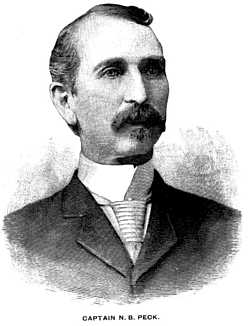
CAPTAIN N. B. PECK.
CAPTAIN BEN PECK.
I have had rather an eventful life; but I don't know that it would be interesting to the public.
I certainly had less reason to be a bad boy, and worse man, than almost anybody ever had. I was surrounded by the very best Christian influences. My father was a prominent minister of the Baptist denomination in this State. He died, though, when I was quite young. My mother's people had been Christian people very far back. The male members on my father's side were Baptist ministers as far as I could trace it. I lost my father when I was about eight years old. My mother tried to raise me right—taught me right; but we were living out here in a little town—Hodgensville—and I was wild from the start. I was not worse than any other boys, but I was in all sorts of mischief. I was looked upon as a bad boy, and regarded as no exception to the general rule, that preacher's boys are worse than other boys.
When about twelve years old, I joined the church at a revival. I believe I was truly converted, and for a short while I lived up to the duties of my church; but I soon neglected going to church—first I neglected going to prayer-meeting—and I got back so far that I would not be picked out as a Christian by any means.
The war came up when I was fourteen years old, and I went into it; and the first night out I got to drinking and playing cards; and I suppose I was known as the leader in all the mischief got up in the brigade. I was notorious throughout the command as a reckless, bad boy from the beginning.
My mother had been opposed to my going into the army at all; but, if I was going, she would have preferred my serving on the other side. I never shall forget one thing she said to me at starting. When the time came to go, I would not have hesitated to back out if she had given me any encouragement at all. She said, "My son, you have determined; you have cast your lot with the South. I had rather you would do your duty and be a brave soldier." But she continued to pray for me.
After the war I came back home, and found that our property was all gone. My mother had sent me to Georgetown college before the war, and my idea was to educate myself for a lawyer. When I came home the property was dissipated, and I did not have enough to finish my education; and the question was, what would be the best for me to do. I came here to Louisville and went to drumming; met with phenomenal success from the start; went up and up; was hail fellow, well met, with everybody; situations offered me on every side. But I continued to drink and play cards as I did in the army, and gambled all the time, although not a professional gambler. I played against Holcombe's bank many a time. I went from bad to worse. I continued to dissipate and gamble; and eleven years ago my health was very much shattered from my excesses, and I became soured with myself and everybody. I was as miserable as a man could be, in that condition, as a matter of course; and a gentleman who had been a comrade in the army with me, and had taken a great deal of interest in me, Captain Cross, in a conversation with me, insisted that I should go with him to Texas, where he was doing a flourishing business. I had tried, time and again, to reform, always in my own strength, and got further away from God all the time. I tried to believe that Christ was not the Son of God; that he was not inspired; I denied the divinity of Christ, although I never denied that there was a Supreme Ruler. Captain Cross wanted me to go to Texas, thinking that if I got away from the surroundings here, it would help me. Accordingly, I went to Texas with him, where I made plenty of money.
But I soon fell into the old ways, and found gambling houses as numerous there as they are here; I found dance-houses more accessible than the churches. I led a reckless life; and frequently did not hear from my family and friends for months at a time. Finally I drank until I drank myself into delirium tremens; tried to kill myself; went and bought morphine. But fortunately for me, they were watching me. That was in Paris, Texas. I was in bed for two or three weeks; and when I got up from that, I felt like I did not want to stay in Texas any longer.
I went to St. Louis and went into business there; had success as a salesman; had a big trade; and I went there with a determination not to drink any more whisky; but I was there only a few days before I was drinking and playing cards—my old life, in fact. Finally I got into a difficulty with a man, shot him and got shot myself. I got into a great deal of trouble on account of it. It cost me a great deal of money and my mother a great deal of sorrow. One time I went to Mexico to get out of the way, where I led a reckless life; went into the army; played cards and drank whisky. I neglected business for whisky a great deal of the time. Then I came here to Louisville, and kept up the same practice; went to Cincinnati and did the same thing there. I let up for a little while when I went to new places. When I got back from St. Louis, I met Steve Holcombe and shook hands with him. The first thing he said to me was, "I have changed my life." I had not heard anything of it. I asked him what he was doing. He said he was serving the Lord instead of the devil; that he had a little mission somewhere. I did not pay any attention to it. But one Sunday I was passing down Jefferson street, and there was a crowd on the courthouse steps, and I saw Steve talking to them. I listened to him, and after the crowd went away I asked him how he was getting along and he told me.
I kept on drinking, however. Sometimes I had a situation and sometimes I did not. People did not want me; they did not know when I would be sober. If I got a situation, it was in the busy season. After the busy season was over, they would reduce my salary and give me to understand they wanted me to get a new place.
One time I was drunk for a week or ten days, and as I passed I heard them singing in the Mission down stairs and went in. I thought that would be a good place to rest. I went back a night or two; and one night Mr. Holcombe delivered a powerful testimony and mentioned some circumstances that had occurred in his life, at some of which I had been present—I don't know that he had particular reference to me. I went back the next night and went up for prayer. I went again sober; but I did not see my way clear. I went back and took "a nip," as he said. I sank lower and lower; but I still went to that Mission. Something impelled me, I know now what it was. I got a situation, and was traveling; but whenever I got off a trip the spirit of the Lord impelled me to go to that Mission. I talked with Steve frequently, and promised him that I was going to try and reform; but I did not, and toward the last, in fact, I had almost quit going to the Mission. I said, "It is not for me, it is for these other men. I have gone too far."
I went in there in November. I was going away on a trip, and the next day I started. I met a friend on the street, and he asked me for a quarter. He wanted to get a drink and lunch. I told him it was about my time to get a drink, too, and we would go and get one together before I left. I was telling him about going to the Mission, and he hooted at the idea of a man of my sense going to the Mission. About two o'clock in the afternoon I was going down the street to take the boat, and I met another friend, and he certainly was the worst looking case I ever saw. I did not think he would live two weeks. He was a physical wreck, and almost a total mental wreck. After talking to him for a few minutes he asked me where I was going. I told him. And I told him, too, I did not care whether I ever got back or not. I told him it would be a relief to me if I never got back off of that trip. I had a family, saw them occasionally, and sent them money when I could; but I never lived with them. After talking with him a little while, I said my time was up, and asked him if he would not go and take a parting drink with me. We went into the Opera House down there and took a drink. I never expected to see my friend alive again, even if I got back from that trip myself. That was the 30th day of November. I got back here the 18th day of December.
The most of the night of the 18th I spent down here at the Grand Central—"made a night of it." The next morning, when I got up, the very first man I saw asked me if I had seen a certain friend of mine. I told him, "No." He said: "You would not know him." I said: "What is the matter with him?" He said: "He is reformed; he is a Christian, and he looks twenty years younger than you ever saw him." I said: "You are a liar." He said: "I am not a liar. You won't know him. He looks like a gentleman." I said: "It is pretty funny if he can look like a gentleman in this short time." I had not gone another square before some one asked me if I had seen another friend of mine. I said: "No." "Well," he said, "you ought to see him. He has quit drinking, and looks like he used to look." I said "What is the matter with him?" He said: "He has joined the church." I took a drink, and thought about this thing; went down to the store, and knocked around there all day long, thinking about those two men. But here I was, drunk and wretched and trying to get sober, but could not.
Somebody met me about four o'clock in the evening, and asked: "Where are you going?" I said: "I am going around here to get a drink." He said: "How are you going to drink when your partners have quit drinking?" I asked him where they could be found; that I wanted to take a look at them. He told me that I could find them at the Mission. I concluded I would come up to the Mission, and did so, pretty full; and, honestly, I would not have known either of these men on the street. I never saw such a transformation as in them. After the services were over they came up and shook hands with me, and treated me as kindly as they used to do when we were drinking together. And I made up my mind if Christ could save them, I wanted some of it for myself.
I came to the Mission, and stood up for prayers all the time, but came half drunk for four or five nights, but still with the determination to have salvation if it was to be found; but the more I came the darker the way grew. I think (on the 29th of December) Mrs. Clark came and talked to me, and Mr. Atmore came and talked to me, I was sober—comparatively so. I told them that I had given up all hope; that I had sinned away my day of grace, and there was no hope for me. They cheered me, and I promised them I would pray that night. I went out of the Mission and got blind, staving drunk; was hardly able to get up stairs to my bed at eleven o'clock, at night. I did it out of despair. The doctors had told me before that unless I quit drinking whisky I would go dead. I was tired of life, but afraid to commit suicide. I concluded that the sooner I died, the better. I got up at three o'clock in the morning to come down stairs and get a drink. The barkeeper was absent from his bar, and I concluded that I would wash myself before I took a drink. I said to myself while I was washing: "You promised yourself you would not drink, and the very first night you get drunk, and get up in the morning to take another drink, and if you take it you will be drunk before night." I concluded I would stop. I took a seat by the stove, and very soon the barkeeper came back. He looked at me and said: "Are you broke this morning, or too stingy to drink, or what is the matter?" He added: "Come on. If you are too stingy to take a drink yourself, take one with me." I was just dying for a drink. I was shaking—suffering physically and mentally. I got up two or three times to go to that bar to take a drink, but I argued to myself: "If you can not keep from taking a drink, you had better go up stairs and kill yourself." After awhile the boys commenced dropping in, and, as was the custom, said: "Come on, Peck, and take a drink." I told them, "No; I have quit."
I went around to the Mission that night, and went up to the front. I had a talk with some Christian people there about the matter, and talked with one of my converted friends. He said there was only one way to do—to give myself to God. I went to bed immediately after I left. I could not sleep. I continued to pray until somewhere along about three o'clock in the morning of the 2d of January; and the way was made clear for me. I don't know that there was any particular vision. I made up my mind that I would go and make my arrangements to join the church, and ask God's direction from that time on, and to lead another life—lead a Christian life as much as it is possible for a sinful mortal like me to do.
I came up to the Mission that night, and told Sister Clark and Brother Holcombe that I was as happy as I could be; I had found what I was seeking for, and I felt that I could trust God. The next Wednesday night I went down to the Fourth and Walnut-street Baptist church, and put myself under the care of the church. Since that time I have been leading a different life. I am in perfect peace and rest. Everything, of course, has not gone to suit me exactly; but I always have been able to say: "I know it is for the best." My faith grows stronger and my future brighter day by day. I think these people who have been moral and religious all of their lives can not enjoy religion like a hard customer, as I was—if they do, they do not show it.
Friends and relatives who had forsaken and avoided me came to me at once and upheld and encouraged me. Business came to me without seeking it. I was encouraged on every hand. People that I thought despised me, I found did not. I had every encouragement, so far as this life is concerned, and I am, to-day, in a better fix, a long ways, than I have been for years.
My appetite for whisky has troubled me three or four times since I came to Christ, but all I have to do is to get down on my knees, and ask for strength to resist it. And before I get through praying I forget about it. I have confidence that God will keep me to the end, and my confidence grows stronger every day. Things that were a great trial to me at first are no longer so.
A very remarkable thing in my case is, that the thing that I expected to give me the most trouble has given me the least. I was certainly one of the most profane men that ever lived, and I was always afraid that the sin that I would have to guard against most would be profanity. But, if I have ever sworn an oath, it has been unconsciously, and I do not have to think about it—I do not have to guard against it; it horrifies me to hear a man swear now. I thought I could fight whisky easier than I could that. Strange to say, it has not bothered me in the least, but whisky has, on three or four occasions. A craving came on me yesterday. It was a terrible, miserable, bleak, rainy day. I was sitting in my room, writing, and all at once I concluded that I must have a stimulant. I have not recovered, and will not for months, from the effects of whisky. I said: "It is a cold, damp, miserable day. Go up there to the drug-store and get some port wine as a medicine. Do not go into a bar-room. There will be no harm in going there to get a little port wine. Bring it into your room. It will be the best thing you can do." I got up and put on my overcoat and my overshoes, and it struck me that it would not be the best thing for me; and I got down on my knees and prayed to God, and before I got through praying I forgot all about it. The devil had tempted me previously, but he put it that day in the shape of the port wine.
Just about ten days after I joined the church, I was in the Phœnix hotel. A friend of mine, a man that I had gambled and drunk with all my life, or at least, for a number of years, said to me, "You are not drinking much from the way you look." I said, "No, I am not." He said he thought he would beckon me out, because he did not like to make that statement before the crowd, and had I been drinking as I did the last time he saw me, he would not have asked me. He wanted me to come in and take a drink with him. I said whisky had once got the upper hand of me, and he must excuse me. He said he knew I was a man, and could take a drink without getting drunk, and he wanted me to take it socially. I told him that might all be true. I might take the drink without getting drunk, and I might take it without its being a sin in his sight, or in the sight of other people; but that I had promised God that I would follow Him all my life, and walk in the way He wanted me to go; that I had joined the church, and our church rules forbade drinking. He then begged my pardon, with tears in his eyes, for having asked me, and bade me God speed.
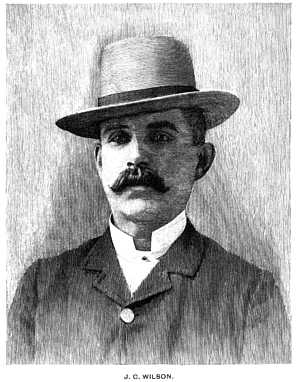
J. C. WILSON.
JAMES C. WILSON.
I started out in gambling during the war—about 1862. That was in New York State. I was born and raised there. I will be forty-five years of age the next eighth of July. I started out in New York in 1862. My father kept a shoe store there then. He was pretty well to do. Having money, I cared nothing about getting any kind of business. I got in with a man by the name of Captain Brown, who was one of the principal gamblers there; and I began to be expert in short cards at first.
From there I went into the army during the war, and stayed there until 1865, and then went to Texas. At Austin, Texas, I got into trouble in 1866, on account of my gambling. I believe it was about the 20th of January. Myself and a man by the name of Ryan had been playing together, and I had beaten him, which made him mad. He called me very insulting names. He slapped me and hit me, and I drew my pistol on him. I first struck him once and then shot him, and killed him instantly. I was put in jail. I had not been there long and was a stranger. The thing occurred down near the Colorado river. A mob assembled, and came down with ropes to hang me. But the sheriff and his posse, in order to save me, carried me out of the city, and ran me up to San Antonio. I stayed in jail six months and was tried; but there was nothing done with me—the witnesses testified that I was justified in doing what I did.
After that I went to Rochester, New York, and from there to Toronto, Canada. I made my living by gambling; and, of course, gambled in all these places. I got broke very often, but always managed to get hold of a stake. I went from Canada back to New York City; and used to play on the falls steamers—Fisk's boats. I stayed there until I came to Louisville in 1870, when I went into the army again. I was here in the Taylor barracks with General Custer. I went out West with him, and was there discharged from the army, and went to gambling at Bismarck, Dakota. When I had got out of the army, I had made about six thousand dollars, and went to St. Paul, and from there to Chicago. I gambled there for awhile, and was unsuccessful; and from there I came to Louisville again.
I have been here since 1873, I believe. Shortly after I commenced gambling here, the gambling houses were closed, but were re-opened in 1874 again, and I commenced gambling again, opening at the Richmond, the house on the South-west corner of Fifth and Market streets. Brother Holcombe before that, I think, was interested in the Richmond. That was the last house I dealt in, or worked in, until I opened for myself, which was at "84" Fifth street, between Main and Market. I was very unsuccessful there; had men working for me who did not attend to their business.
During all this time I had a wife and family, whom I really loved but whom I neglected and allowed to suffer greatly through my passion for gambling, the uncertainty of making a living and my wanderings from place to place. About this time I used to think of Holcombe; and we gamblers used to remark among ourselves how it was that he had become religious. I used to get to studying to myself how he got along, and ask myself how a man could be a Christian who had been a gambler so long as he had.
About this time I met Dr. Jno. B. Richardson and Mr. Samuel B. Richardson. They talked with me in regard to swearing and gambling and the life I was leading. They influenced me as best they could and advised me to see Brother Holcombe, and together with Brother Holcombe they watched over my spiritual condition for a couple of years. I had become disgusted with the life I was leading; and came to Brother Holcombe for advice. I had quit "84" and was broke. I had some money when I quit, and bought the house which I am living in yet. I said to Brother Holcombe: "I am getting tired of this infernal gambling. How can I quit it? Show me something to do. How can I get out of this life?" He said, "Brother Wilson, come up stairs." He talked with me and prayed with me. He said, "Do not be discouraged. Take my advice. The first thing you do, commit yourself; take a stand and after that every night, and during the day, ask God for strength and help, and come to this mission and," he said, "I will help you to get something to do in every way I can." I never will forget the first night I got down on my knees and prayed. I laughed at myself, which showed how the devil was after me to lead me back to my old life. I actually laughed to think I was trying to pray in earnest. I came to the mission and told Steve. Brother Holcombe said, "Keep on in that way, anyhow. Pray to God and ask for strength all the time. Keep away from gamblers and bad company, and do not mix with them," and I did so—I took his advice, and I began to get strength from Almighty God; He was helping me; He opened a way for me, though everything was new to me for awhile.
When I least expected it, I got a situation with the Louisville City Railway Company, which I still hold. I am happy and my family are happy, and all my surroundings are good; and I know, with the help of God, I will never touch a card again. If we trust in God, I know we are kept from all temptation. When any temptation comes to me, I always look to God for help; and the help comes as naturally as my pay does when pay-day comes. I feel that the number of friends I have made, and everything I have, I owe to our Saviour, the Lord Jesus Christ, and Brother Holcombe; and I trust I may be kept and continue in the life I am leading. I am happy and contented and all my surroundings are happy; and I hope all good people will pray for me that I may continue the life I am now leading.
I belong to the First Presbyterian Church, Dr. Witherspoon's church, and I am sorry I can not attend more regularly. My business occupies me so constantly that I can not get away.
I get only a dollar and a half a day. When I was a gambler, some months I would make three or four thousand dollars, and sometimes five thousand dollars; and some months I believe I have made more than that, so far as that is concerned; but a gambler, you know, has his ups and downs, I have been so hard up that I have been tempted to commit murder for money. In Texas I looked for a man to kill him for his money, but when I found him I did not have the heart to do it. It seemed as if I could not use my hands.
It would take me from now until to-morrow morning to tell all of my experiences. I have been in Europe, California, Old and New Mexico, and I believe that God was with me even when I was wicked. I have a bad temper to this day, but, by God's grace, I can control it.
My parents were church members—Presbyterians, and I was raised in the church. My father died when I was fifteen years old, and my mother died when I was eight years old. If I had been put to hard work, and had had something to do, it might have been different with me; but my father was well-to-do, and I had too much money to spend. My parents tried to give me a good education, and I went to school; but when I got to gambling I could not get anything in my head but cards. I did not care for anything else. But, thank God, it is now just the reverse; it just gives me the chills to think of playing cards.
Three years ago, if a man had told me that I would quit gambling, I would have told him that he was crazy. I thank God and Brother Holcombe for what has been done for me. I am truly thankful there was such a man. I know if it had not been for him I would have been right in hell to-day. If I had not been helped and lifted up, just like a little child in the new life, I think I would to-day be in hell. I never will forget Brother Holcombe.
I drank liquor, but was not a regular drunkard, because it made me too sick. I used to drink and get drunk, but I would get so sick I could not stand it. The habit was there, but the constitution could not endure it.
I have no trouble now; I am perfectly happy; I do not know what trouble is any more. Of course, we all have ups and downs; we can not have everything our own way; but I praise God and Brother Holcombe that I am able to bear them.
You must show that you are willing for the Lord to help you before He will do so. It is like a man teaching his children; if the child keeps shoving him off, the parent can not help the child, and so it is with God. But when a man has seen and felt the effects of sin, and his pride is broken down so that he is willing, then God will help him and save him, no matter how far he has gone in wickedness.
Note.—Mr. Wilson is employed by the Louisville City Railway Company, at the corner of Eighteenth and Chestnut streets, where, day after day, for years, he has faithfully discharged his duties, and he has the respect and esteem of his employers and of all who know him.
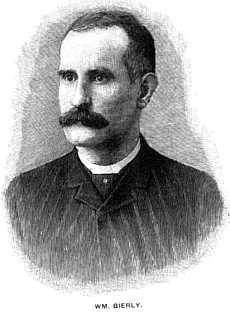
WM. BIERLY.
WILLIAM BIERLY.
I am thirty-two years of age. I was born at Louisville in 1856. My father was a Catholic then, but he is not now. My mother died when I was so small that I don't know what she was. I will tell you how it was: My mother died when I was quite young, my father went into the war, and I was kicked and cuffed about from one place to another, here and there, till I had no respect for myself, and felt that I was nobody.
I was with my father in the soldiers' hospital for a long time. He was nurse in the soldiers' hospital. At this time I would drink whisky whenever I could get it, which appetite did not leave me until I was about eighteen years old.
When I was about eleven years old I got to being bad—got to stealing. My father was a strictly honest man himself, and my pilfering was abhorrent to him; so he had me put in the house of refuge when I was eleven years old. I was to remain in the house of refuge until I was twenty-one years old, but I got out before I was twenty-one. When I was nineteen I got to be a guard there. But I got to misbehaving, and got discharged from there before I was twenty-one.
When I came out of the house of refuge I boarded around at different places, first at one place and then another; and sometimes I had no place to board at all, and sometimes I could almost lie down on the ground and eat grass. I did not go to my father's, but knocked about from one place to another. I got to stealing again, and I kept that up all the time. I never had a desire to do anything else wrong, but I always had the desire to steal; and while a boy I would steal anything I came across. I would go down to the river and steal a bag of peanuts, or burst in the head of a barrel of apples and take apples out—many a time have I done that. I worked in a tobacco shop for awhile, and would steal tobacco—I would steal anything.
I never was arrested when I was a boy. The first time I ever was arrested I was sent to the work-house, and Mr. Steve Holcombe got me out. After I got out of the work-house I attended the Mission, and there was a good religious impression made on me. That was the first time I ever had any religious impression.
I lived pretty straight for awhile, and after awhile my old desire to steal came back on me. Thank the Lord it does not bother me any more now, I was watching at the Louisville Exposition during the first year of the exposition, 1883, and I was boarding where there were some street car drivers boarding, and they had all their money boxes there at the boarding house. I was tempted to take a few of their boxes, and I did take two of them. I was arrested for it, tried, convicted and sentenced to six years in the penitentiary.
While I was in the penitentiary it seemed that everything turned around the other way with me; it seemed like I had got enough of it. I saw so many bad men there, I got disgusted. It seemed to me if ever I got out and got my liberty any more, I would try to do right if it took my head off.
During the time—two years—that I was in the penitentiary, I kept up a correspondence all the time with Mr. Holcombe; and Mr. Holcombe's Christian letters touched my heart, and I made up my mind by the grace of God I would lead a Christian life in the future. At the expiration of about two years, Mr. Holcombe, to my great surprise and delight, brought me a pardon from Governor Knott.
Since I have been out of the penitentiary I have been leading a Christian life, and have had no inclination to steal. I have been at work for Hegan Brothers, as engineer and fireman, for some time, have got married to a sweet girl, and am now living happily in the Lord; and I shall never cease to be grateful to God and Mr. Holcombe. I never go to sleep at night without thanking the Lord—and my wife joins me in it.
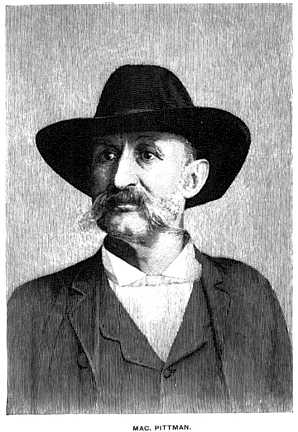
MAC. PITTMAN.
CAPTAIN MAC PITTMAN.
I was born in Baltimore in 1834. My ancestors were driven away from Arcadia by the English, on account of their Roman Catholic proclivities.
I was educated at two Catholic colleges, St. Mary's, at Baltimore; and St. Mary's at Wilmington, Delaware. At eighteen years of age, on account of the tyranny of my father, I ran away from home, and shipped in the United States Navy as a common sailor. I went around to San Francisco, and there joined "the gray-eyed man of destiny," General Walker.
I joined his expedition in September, 1885, and arrived in Nicaragua in October, the following month—the third day of October. There was a civil war then in progress in Nicaragua; and the pretense of this expedition was that we were hired by one of the parties to take part in it. Walker was to furnish three hundred Americans, who were to get one hundred dollars a month and five hundred acres of land, and their clothes and rations, of course. When I first arrived there, we were to escort specie trains across the isthmus—there are but twelve miles of land from water to water—from San Juan del Sur to Virgin Bay. I was one of the guard over the celebrated State prisoners, General Coral and the Secretary of War, whose name I forget, who were both executed. I was inside of the seventieth man who joined this expedition; when I joined him, Walker had but sixty men. The re-enforcements that came over made just one hundred men. He had sixty men, I think, and we numbered forty. With this one hundred men we took the city of Grenada, which had a population of twelve thousand, on the morning of October 13, 1855. A small division of men was sent to the town of Leon on the Pacific coast. The natives of that section of the country were all in favor of Walker; that part—the western part—is the Democratic part of the country. On our return to Grenada, on the 11th day of April, 1856, we went into the Battle of Rivas, after marching sixty-five miles. We fought from eight o'clock in the morning until two the next morning, by the flash of guns. I lost my arm that morning; and was promoted from the rank of sergeant to that of first lieutenant for taking a cannon in advance of the army. I returned to Grenada, and lay there for several months, and then returned to America. I went back with the re-enforcements from New York in the following August. In October, 1856, I resigned, and came back to America.
At the breaking out of the civil war, on the first call for troops, I refused a commission in the Federal army, and joined the Confederate forces.
In 1861 we formed the First Maryland regiment. The last six months of the war I spent as a prisoner in Fort Delaware, charged with the murder of the eleven men who were killed in Baltimore during the riot, on the 19th of April, 1861. I was court-martialed in Washington City, in the latter part of 1864, and was sent in irons to Fort Delaware, and remained there until May, 1865, when I was released.
From Fort Delaware I went to New York, and from there went to Virginia, where I married the great granddaughter of the illustrious patriot, Patrick Henry, at Danville. In January, 1866, I migrated to Texas, where I spent the little patrimony my grandfather had given me. When I left there, I took the position of commercial and marine editor of the Savannah News.
I never had given a thought to religion or my hereafter before this time. To illustrate this: When they amputated my arm, they asked me distinctly if I had any religion. They told me afterward they expected me to die. I said: "Yes, I have been raised a Catholic." They wanted to send for a priest. I said: "No, I do not want you to send for a priest." They asked me why? "Well," I said, "as I have lived, thus will I die; I don't have much faith in the hereafter business." I did not have much faith in hell, I meant.
I was interested, directly and indirectly, in several gambling establishments, and my proclivities were in that direction. The passion of gambling controlled me to such an extent that I was capable of all sins and crimes to indulge in it. It was one day up, one day down; one day with plenty, another day without a cent.
I continued in this wild, reckless career, until fate turned my footsteps toward the city of Louisville. For it was fate, sure enough, or I don't know what it was. I was sitting one Sunday in front of the old Willard Hotel, Steve Holcombe was preaching that Sunday on the courthouse steps. His remarks were such as to elicit my closest attention; so impressive were they that he seemed to picture before me a panorama of my whole life, in referring to his own career. When he got through with his sermon, I walked up to him, and said: "Mr. Holcombe, you are the first man that I ever heard in my life who impressed me with the importance of preparing for death and meeting God." I then commenced attending the Mission, on Jefferson street, near Fifth, daily. I was there nearly every day.
I then went South, to New Orleans, and fell from grace again—commenced going through the same old routine—gambling, drinking, spreeing. In fact, I was a fearful periodical spreer; if I took one drink, I had to keep drinking for a month. As long as I kept away from it I was all right. I was very abusive when I was drinking; I would knock a man down with a club. I have been arrested, I guess, fifty times for fighting and drunken brawls.
From New Orleans I again came back to Louisville, the 6th of August a year ago, still going on in the same reckless manner, getting drunk, and being drunk, as usual, a week at a time—sometimes a month; in fact, I lived in bar-rooms here. One night, while Mr. Murphy was here—I do not recollect the night, but at one of Mr. Murphy's meetings—he appealed to us all to try and reform and be sober men. I met Mr. Werne and Miles Turpin there, and while there, Mr. Werne asked me if I did not intend to reform, or something like that—that was the substance of the conversation of himself and his wife with me—and he told me that Miles Turpin had reformed. I said: "If Miles Turpin has reformed, I can, too. From this day henceforth I will be a sober man." And I signed the Murphy pledge a short time afterward, and I have not taken anything intoxicating from that day to this.
Mr. Werne then asked me to come up to the Mission, and I have not missed attending this Mission but three nights since, and the benefits that I have derived—the satisfaction, the happiness of mind, the contentment of spirit—I would not exchange for my old life for anything in the world. I mean I would not exchange my present life for the old one for any earthly consideration. I attribute this reformation to the strong personal interest that Mr. Holcombe has taken in my welfare, and if he does not save but one soul, as he says, it would pay him for all the trouble he has gone through within the last ten years or more.
The two following letters, though in the nature of testimonies, are from men of high standing in the community, who preferred, on account of others, not to give their testimonies in the form in which the foregoing are given:
Louisville, Ky., July 24, 1888.
Rev. Gross Alexander:
My Dear Brother—Yours of 21st is just received. I can not see how a sketch of my life can do "The Life of Brother Holcombe" any good. As I understand it, you are writing the life and conversion of Steve Holcombe and not of others. My past history is sufficiently sad and regretful without having it paraded before the public in book form. I am far from being proud of it. I am exceedingly anxious it should sink into the shades of forgetfulness. Having marked out a new and brighter life, I am only too glad to let "the dead past bury its dead."
Most sincerely,
—— ——.
Louisville, Ky., August 2, 1888.
Dear Brother Alexander:
Your kind letter was received several days ago, but I have delayed answering, in the expectation of seeing you here in person.
I am now anxious for the successful issue of the book, on account of the great moral influence it will have upon all classes of the community. But I can not consent to what you propose. I am endeavoring every day to blot out and forget the dark and cloudy past of my life, keeping always a bright future in view. There are dark and painful episodes in the life of every man and though he may be willing to expose them to the eyes of the public, there are those who are bound to him by the ties of blood and relationship, who would blush at the recital. This is the position I occupy. I hope to see you here soon.
Yours truly,
—— ——.
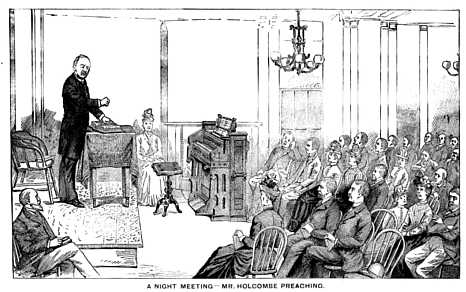
A NIGHT MEETING—MR. HOLCOMBE PREACHING.