Chapter XI · INTELLIGENCE OF THE SUCCESS OF THE “HERALD” ENTERPRISE.
Reading edition
Mr. Stanley’s Despatches to the “Herald” — They Create a Profound Sensation — The Question of Authenticity of his Reports — Conclusive Proof Thereof — Testimony of the English Press, John Livingstone, Earl Granville, and the Queen of England Herself — Mr. Stanley’s Reception in Europe — At Paris — In London — The Brighton Banquet — Honors from the Queen.
Mr. Stanley’s despatches to the “Herald” were sent through the London bureau of that office. The noted telegram printed on the morning of July 2, 1872, announcing his arrival at Zanzibar and the discovery of Livingstone, created a profound sensation. Followed by other cablegrams giving reports of his journey towards Europe and of his reception at Paris and elsewhere, the intelligence was received with almost as much avidity as the news which came from day to day of the Franco-German war, or that of the attempted revolution in Paris.
To some, however, the reports of Mr. Stanley’s great success were incredible. There were those who did not believe he had seen Livingstone, and who did believe that the story of the meeting—with, of course, all the correspondence from Zanzibar, Unyanyembe, Ujiji, and elsewhere—was but an adroitly-devised romance, after the fashion of that of Ali Moosa, to cover up inglorious failure. It is needless now to fully state the arguments upon which this incredulity was based. Perhaps newspaper jealousy had something to do with it. Certainly it was a matter of deep chagrin to many Englishmen that the British Government, upon whose soil the sun never sets, should have been totally eclipsed by the enterprise of private citizens of a rival nationality. Then there were certain little errors—chiefly misprints and the excusable mistakes of telegraphing long despatches great distances—which were claimed by the doubting as showing that the so-called great Special Search Expedition of the “Herald” was but a magnificent hoax, after all. Moreover, the universal interest manifested in the subject gave a splendid opportunity to adventurers, both male and female, to ventilate themselves and become public characters. Hence, those who had known Mr. Stanley as a native of Wales, and not of Missouri, or of this, that, or the other country; who knew that he had not been a correspondent as had been generally stated; and, in fine, who knew that many assertions in regard to him were untrue—these adventurers became even more numerous than the celebrated cow of the crumpled horn which originated the terrible conflagration of Chicago, and then, with miraculous self-multiplication, surpassed in number the cattle of a thousand hills, and, mournfully ruminating over her sad mishap in kicking over the kerosene lamp, became the observed of all observers in all Christian lands, and at the same instant of astronomical and clock time.
It were needless to disguise the fact, however, that the statements of those incredulous of the Search Expedition’s wonderful success, being for some time constantly iterated and reiterated through the press, had considerable effect upon the public mind, and actually left it for a period in a state of painful uncertainty in regard to the fate of the great explorer, the truth in regard to whom was earnestly desired by all intelligent persons throughout Christendom. Happily, the authenticity of Mr. Stanley’s reports were placed beyond reasonable doubt by a mass of testimony against which no one could dispute.
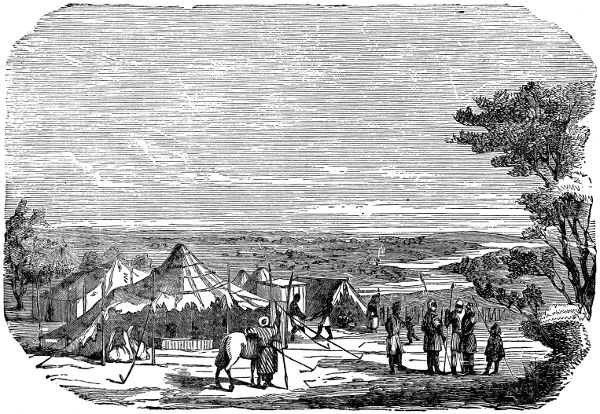
SLAVE-ROBBERS’ CAMP.
Much of that testimony has already appeared in this volume, different portions in their appropriate places. These are:
1.—The letters of Dr. Livingstone to Earl Granville, which were published by authority of the British Government. In these letters the African explorer not only gratefully alludes to Mr. Stanley, but expressly says his despatches are entrusted to his care because of the great traveller’s belief in Mr. Stanley’s enterprise and capacity to accomplish whatever he might undertake. In one of these despatches Dr. Livingstone also states that he had given to the custody of Mr. Stanley his journal of explorations, sealed, to be delivered to his daughter when the commander of the Search Expedition of the “Herald” should arrive in England.
2.—Upon Mr. Stanley’s arrival in England, this journal was promptly forwarded to Miss Livingstone. Her acknowledgment was published in many English and American journals. It was as follows:
Kelly Wemyss Bay, by Greenock, August 6th, 1872.
}
Dear Sir.—I write to say that I received last Saturday my father’s letters and the diary which were entrusted to you by him.
I wish also to express to you my heartfelt gratitude for going in search of my father, and aiding him so nobly and bringing the long-looked-for letters safely.
Henry M. Stanley, Esq.
Believe me, yours truly, AGNES LIVINGSTONE.
3.—Dr. Livingstone’s letter of thanks to James Gordon Bennett, Esq., Jr., the handwriting of which was published in fac-simile in the “Herald,” and fully substantiated by Mr. John Livingstone, of Canada, brother of the explorer, and more familiar with him and his handwriting than any man living.
4.—The letter of John Livingstone to Mr. Blake, American Consul at Hamilton, Ontario, in Canada, which was accompanied by a letter from Dr. Livingstone, proving handwriting, and forwarded to the “Herald” through the Department of State at Washington. This letter follows:
Listowell, August 24, 1872.
F. N. Blake, Esq., United States Consul, Hamilton, Ontario.
Dear Sir.—Would you kindly oblige me by conveying in your official capacity to Mr. Bennett, proprietor of the New York “Herald,” and also to Mr. Stanley, the leader of the “Herald Livingstone Search Expedition,” my warmest congratulations on the successful issue of that expedition.
Having noticed a number of articles in the public press reflecting doubts on the veracity of Mr. Stanley and the “Herald,” I am glad to be able to say that I place the most implicit confidence in the statements of Mr. Stanley and the “Herald.”
I can also assure you that Dr. Livingstone holds the American Government and people in the highest estimation, principally on account of the late abolition of slavery in the United States, and I trust that his persistent efforts to check the nefarious traffic in slaves in Africa will be crowned with success.
I am, yours respectfully, JOHN LIVINGSTONE.
5.—The Royal Geographical Society of London, fully persuaded of the authenticity of Mr. Stanley’s reports, tendered him a formal reception at Brighton. The meeting occurred, and caused a great deal of comment.
6.—The Sovereign of England herself, on more than one occasion, tendered special honors to Mr. Stanley on account of his success in finding Dr. Livingstone.
Evidence like this was not to be shaken by the asseverations of penny-a-liners. It was regarded by the candid as absolutely conclusive. Such, it is believed, would have been the result had Mr. Stanley been a British subject instead of an American citizen. As the fact is, the case for the “Herald” Expedition was almost immeasurably stronger. It was a matter of profound chagrin to most of the English people that an American enterprise should be successful in the search for one of the most illustrious of Englishmen, whilst English expeditions should have failed. Under such circumstances Mr. Stanley’s proofs had to be absolutely unassailable and his credentials unanswerably satisfactory, or they would not have been received at all. Both majesty and ministry would have given the commander of the American enterprise the coldest possible shoulder. Instead, they crowned him with laurels. The only conclusion with reasonable minds could be that the “Herald” expedition was a splendid success, and further doubt of it would only have been stupid and cruel skepticism.[3]
From Zanzibar Stanley sailed across the Indian Ocean to Bombay, whence he transmitted despatches announcing the success which had crowned his long labors and journeyings. It was this intelligence, transmitted so fully through the London office of the New York “Herald,” which so gratifyingly startled the world about the time of the anniversary of American independence in 1872. From Bombay, Mr. Stanley proceeded to Europe by way of the Suez canal, reaching Aden, southwestern Arabia, July 11; Port Said, the head of the Suez canal, on the 18th; and arrived at Marseilles, in France, on the 24th. Here he was received with kindest welcome, and to some extent besieged by gentlemen of his own profession, who transmitted to their journals accounts of his doings. At Paris a few days afterwards he was received with exhilarating hospitality by the American residents of the city, and was greatly lionized generally. Breakfasting with Hon. Elihu B. Washburne, American Minister, he there met among other distinguished guests, General William T. Sherman, the commanding officer of the Army of the United States, about completing a tour of Europe and the Levant. The General occupied much of the time in examining Mr. Stanley’s maps, and discharging some of his fund of caustic humor on the prevalence of the East African slave trade. On July 30th, Minister Washburne and many other Americans in Paris extended a formal invitation to Mr. Stanley to meet them at a banquet, where they might in a body testify their “high appreciation of the indomitable courage, energy, and perseverance which crowned with such brilliant success your efforts to find Dr. Livingstone, as well as to express their sense of the enterprise and liberality of the New York ‘Herald’ in sending you forth on such an extraordinary mission.”
Mr. Stanley’s reply to this cordial invitation was so modest, so happily expressed, that it is worthy of a place here:
Hotel Du Helder, Paris, July 30, 1872.
Gentlemen—I have received your letter of this date asking me to accept the compliment of a dinner from my compatriots and friends now resident in Paris, to be given in acknowledgment of the “enterprise and liberality of the New York Herald” in sending out an expedition in search of Dr. Livingstone, as well as of the extraordinary good fortune and perfect success which, under Providence, attended the footsteps of the expedition I had the honor to command. Gentlemen, believe me, I am deeply conscious of the great honor you would do me, and through me not only to the journal I have the pleasure of serving, but to the patient, resolute, brave and Christian gentleman whom I left in Central Africa. I therefore gladly accept your invitation, and shall be pleased to meet you July 31 at any house or place that may be deemed most convenient. I have the honor to be, gentlemen, your obedient and humble servant,
HENRY M. STANLEY.
To His Excellency E. B. Washburne, Minister Plenipotentiary of the United States of America, and many others.
The meeting was one of great enjoyment. The American Minister, after a happy speech, richly flavored with American allusions, proposed the guest of the evening—“Henry M. Stanley, the discoverer of the discoverer: we honor him for his courage, energy, and fidelity. We rejoice in the triumphant success of his mission, which has gained him imperishable renown and conferred additional credit on the American name.” To this the traveller responded felicitously, and was specially eloquent when speaking of the great explorer of Africa. A number of distinguished gentlemen—artists, journalists, public men—addressed the meeting. The assemblage adjourned at a late hour, Mr. Stanley strongly impressed with the difference between a Parisian banquet and an African supper of manioc and hippopotamus. Other like honors flew upon him, thick and fast. From scientific and literary bodies and from distinguished persons he received invitations to accept which would have occupied him a year. These things do not go to the author of a hoax, however magnificent.
The traveller-correspondent could not long remain at the fashionable metropolis, and at once departed for England. His reception in England was most cordial on the part of most intelligent persons, but there was a feeling of national chagrin, if one may so speak, on account of the discovery of Dr. Livingstone having been brought about through American enterprise, which vented itself in no little carping criticism and the discharge of British atrabilariousness. Hence at once originated that skepticism in regard to the discovery of the great explorer which continued to becloud some minds and journals for a number of weeks. But the publication of Dr. Livingstone’s several official despatches—already largely quoted from in this work—and the prompt production of other evidence, heretofore mentioned, brought the English people quite generally to an acknowledgment of the truth. At the annual meeting of the British Association for the Advancement of Science, which convened at Brighton, August 14th, W. B. Carpenter, LL.D., in the chair, Mr. Stanley’s successful mission was handsomely mentioned. He was twice compelled to rise, in acknowledgment of calls and cheers. Ex-Emperor Napoleon III. of France, was present and joined in the applause. Here at another meeting, Mr. Stanley read a paper on Tanganyika Lake, which was greatly praised. About this time there were many meetings of scientific associations at Brighton, to all of which Mr. Stanley was invited. On the occasion of what has been called “the Brighton Banquet,” it being a dinner given to the British Association by the Brighton and Sussex Medical Society, Mr. Stanley appeared late in the evening, and, being soon called out, responded to some remarks of a previous speaker in such way as to create some feeling. Good nature at last prevailed, and harmony was restored among the English savants.
But his honors in England did not stop below the recognition of his fine success by royalty itself. Early in September he was invited to an interview with Queen Victoria, and afterwards dined with her and the members of the royal family present at Balmoral. Upon this occasion the Queen is reported to have expressed to him in the most warm and friendly terms her congratulations on the successful result of the American enterprise in furnishing intelligence of the English traveller in Africa, his condition of health, his discoveries, and his hopes for the future previous to his return to Great Britain.