SIXTEENTH CENTURY TOURS (continued 2)
Reading edition
BOURG
In addition to the glass seen during these three trips, there are three isolated churches whose windows are so interesting as well as important that one should not be contented to conclude his sixteenth century studies without visiting them. Not only is each one of them distant from other contemporary glass, but it would seem as though the Imp of the Perverse had taken a hand in placing them as far away from each other as possible. Bourg is down south in Savoy; Auch is near Toulouse in the southwest; and Champigny-sur-Veude is off in the western part of Touraine, near the lower reaches of the river Loire. Each of these three not only was completely glazed during this epoch, but has also retained its glass in good condition. In each case the special interest which causes our visit is quite peculiar and very different from that which attracts us to the others. When we concluded our trips of the fourteenth and fifteenth centuries we were confronted with the advisability of a separate journey to Quimper, and in like manner we should now decide to visit Bourg, Auch and Champigny-sur-Veude. It must be confessed that it is inconvenient, but it will prove well worth while.
First in importance is the church of Brou at Bourg. Although Savoy now forms part of France, we shall, upon this excursion, find proof that it was not always French, and shall furthermore encounter much interesting history wrapped up in the tale of the building and glazing of the church of Brou. Up in the north, at St. Quentin, we found the high-water mark (on French soil) of that splendid empire which the Spaniard, Charles V, agglomerated under his banner and which he resigned to his son, Philip II, the victor of the Battle of St. Quentin. So vast and important was his empire that he lacked only France to have all the continent of Europe beneath his sway. It was the aunt of this Emperor Charles V, Marguerite d’Autriche, who built the exquisite church of Brou in memory of her husband, Philibert le Beau, Duke of Savoy, killed in a hunting accident. After this glance at history, it is not difficult to understand why Marguerite sent to Flanders for her architect and for her glass designers, for as Flanders was part of her nephew’s empire, none was more fully advised than she of the high reputation then enjoyed by the artists of the Low Countries. Apropos of the way in which her husband Philibert died, it is related that when his father had been at the point of death from a similar hunting accident, Philibert’s mother, Marguerite de Bourbon, had vowed to erect a chapel to St. Hubert, patron saint of huntsmen, if he recovered. Her failure to comply with this vow was by many firmly believed to be the reason why her son Philibert was killed upon the hunting field, and that his untimely end was a solemn warning that a vow to St. Hubert must be strictly kept. In any event, St. Hubert must have been fully satisfied with the manner in which the oath was finally carried out, for the chapel so built has remained to amaze and delight many generations. The wonderful marble tombs, the graceful rood screen, the splendid glass, all go to prove that there was here lavished everything that wealth, power and intelligence could command.
It is bewildering to decide with which of the eighteen windows we shall begin our inspection. Because of our interest in the foundress and her husband, let us commence with that in the choir, which is at the left of the most easterly window. Upon this one and its neighbour to the left we shall see spread out much concerning the life, family and habits of Philibert. The first window shows the Duke himself attended by his patron saint, St. Philibert, while in the background there looms up his favourite ducal palace of Pont d’Ain, where he lived and died. As indicating the importance of his duchy there are arranged above him thirteen shields displaying the arms of provinces at one time part of Savoy. The next window to the left bears a splendid array of thirty-five shields whose heraldry serves to complete our information about Duke Philibert by showing the individuals composing his family tree. Those on the right are of the paternal line of Savoy, and on the left we follow his mother’s line (the House of Bourbon) as far up as Louis IX, whose arms appear at the very top of the embrasure. It is most fitting that the arms of our old friend, the royal patron of stained glass, should preside over the most brilliant window in this famously glazed sanctuary. It is to be noticed that this church is very rich in heraldic blazons; in fact, upon five of its windows we find seventy-one shields. The Chapelle des Sept Joies contains a gorgeous work, the Crowning of the Virgin, in which every effort of the glassmaker’s skill seems to have been exerted. Above the principal subject runs a panel-like frieze showing in allegory the Triumph of Christ. This frieze is done in grey and yellow stain. The whole window would leave nothing to be desired in either technique or colour if it were not made the victim of an exaggerated outbreak of the curse of donors’ figures. The foundress and her husband are not only allowed to intrude upon the drawing of the general subject, but each of them is actually larger than the figure of the Virgin. The records show that this church (begun in 1511) had all its glass installed at the time of its completion in 1536, thus showing that the windows were made during the most vigorous part of the century, a fact thoroughly borne out by internal evidence. We may consider ourselves fortunate that the use of this glorious building for a store-house during the Revolution damaged the glass so little. In this connection it is surprising to read that its beauty was so much appreciated that the people voted to preserve it as a public monument, thus staying the hand of the ever-ready vandalism which then raged through so many French churches.
A sketch of Bourg would not be complete without a reference to the noble poem of Matthew Arnold. The following lines are particularly appropriate to the moving cause for our visit to this lovely shrine:
So sleep, forever sleep, O marble Pair! Or, if ye wake, let it be then, when fair On the carved western front a flood of light Streams from the setting sun, and colours bright Prophets, transfigured Saints, and Martyrs brave, In the vast western window of the nave; And on the pavement round the tomb there glints A chequer-work of glowing sapphire-tints, And amethyst, and ruby—then unclose Your eyelids on the stone where ye repose, And looking down on the warm rosy tints, Which chequer, at your feet, the illumined flints, Say: “What is this? We are in bliss—forgiven— Behold the pavement of the courts of Heaven!”
AUCH
Seventy-seven kilometres west of Toulouse there lies the interesting city of Auch, built upon a hillside rising sharply from the river Gers. Here one will happen upon many an ancient architectural bit which will take him back to the days when Henry of Navarre here entertained, much against her will, his mother-in-law, Catherine de Medicis, in this south-western corner of France, far off from her beloved Paris. The very remoteness has preserved many of its old-world features, and this ancient flavour, combined with the picturesque position above the river, renders it distinctly a town to be visited. But something more than the general mediæval air of Auch is the cause for our long jaunt hither. This reason we shall find in the eighteen windows that adorn the choir ambulatory of the cathedral of Ste. Marie. An inscription in the Gascon dialect on the final one of the series tells us that they are by the hand of Arnaud Desmoles and that they were finished June 25, 1513. We have here the work of a Frenchman, a Gascon at that, and there is no trace of Italian, German or any other foreign influence; it is the true flower of the country’s genius growing on its native soil. Perhaps the drawing and the colouring are not quite so good as we may see elsewhere, but it is purely French. Any imperfection of detail is hardly noticed, because we are instantly struck by the ensemble of eighteen windows made for the building which they decorate, as well as for each other, and all by the same artist. His scheme of subjects, showing the agreement between the teachings of the Old and those of the New Testament, is fully carried through to its completion. The colours show strength and yet are not too robust. The proportions, too, are very satisfactory, each window being about three times as high as it is broad. Their stories begin with the creation of the world and carry us on, step by step, until they conclude with the appearance of Christ to His disciples. The central part of each embrasure is filled by a large personage, with sundry smaller figures above, and groups below. It is but natural that so complete a series as this should have always enjoyed a wide reputation. Although we may feel, after examining them, that they do not reach the standard of perfection attained by some of their contemporaries elsewhere, still they cannot fail to please us. The charm lent by their logical completeness causes us to prefer them to others where the perfection of drawing and style in the individual window is partly offset by lack of harmony with others near it.
CHAMPIGNY-SUR-VEUDE
Any mention of Touraine generally calls up before us the picture of a smiling country through which rolls the lazy Loire hemmed in by its sandy banks, with every now and again the vision of a charming château, type of the best mediæval architecture. To the glass lover, however, the chief and almost the only attraction of the province is the cathedral at Tours (see page 51). We say “almost,” because although not generally known and but seldom visited by the tourist, Touraine has another glass shrine lying within a few kilometres of the Château de Chinon. The chapel in which we find this glass was formerly part of the Château of Champigny-sur-Veude, but the chapel alone remains. Before we enter, the writer wishes to deliver himself of a partial explanation or apology, and he does so for the following reason: he has all along inveighed bitterly against the curse of donors’ figures upon windows, but on this occasion he must frankly admit that he is guilty of taking you to see glass of which a most interesting feature is these very representations of the donors. In fact the chapel has a peculiar value because it contains thirty-six portraits of the Bourbon-Montpensier family. They are to be found along the lowest panels, each one kneeling before a prie-dieu. The chapel is admirably lighted, partly due to the destruction of the old château, but chiefly to the eleven large windows, each seven by three and a half metres. The same scheme of decoration prevails throughout. Lowest down we find the kneeling donors; above them and occupying far more space are historical episodes from the life of Louis IX, of peculiar interest to us, his humble followers in the love of stained glass. Among the most interesting of these glass pictures may be cited one showing a battle with the Saracens in the Holy Land, several portraying ships filled with armoured knights, and particularly the episode of St. Louis dedicating the Ste. Chapelle at Paris. Above these in the roomy oval traceries are scenes from the Passion. Highest of all are small panes containing either a capital L with a crown slipped down around it, or a bird’s wing similarly encircled by a crown, referring respectively to King Louis and the Bourbons. The only variation from the regularity of this general scheme is the east window, which shows the creation of the world and has below it Christ between the two thieves. The fact that this chapel is to-day completely glazed in its original glass and that there is a thorough coherence of style throughout, would alone serve to repay us for the long trip from Paris; but when we add the fact that this is a Bourbon portrait gallery, an historical interest is at once added to its other attractions. These arguments in its favour will keep us from observing too keenly how much the crudeness of some of the colours accentuates the dullness of others. It would be better if the greens could be softened and the greys enlivened. Lest we may seem by thus criticising the glass to wish to disparage it, we make haste to urge our reader to visit Champigny. He will find ample compensation for its isolation from other glass of its century by the many châteaux which make a trip through Touraine so enjoyable.
DEDICATION OF PARIS STE. CHAPELLE AT CHAMPIGNY-SUR-VEUDE.
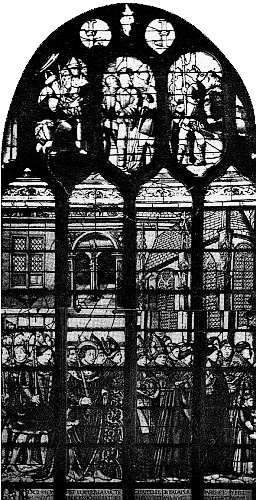
Panel containing kneeling donors not shown. 16th century glass picture of a 13th century event. (See page 26).