THE RIDDLE-BOX.
Reading edition
CLASSICAL DOUBLE ACROSTIC.
The initials and finals, read downward, name two Latin poets. 1. To affirm. 2. A male character in Shakspeare. 3. To cry aloud. 4. One of the United States. 5. An order of architecture. 6. Small.
VERTI.
NAMES OF AUTHORS ENIGMATICALLY EXPRESSED.
1. An Italian river. 2. A prefix, and an enemy. 3. A berry, and a spine. 4. A machine, and a small house. 5. The cat'll eat it. 6. What doves do, and an expression of contentment. 7. Bright things that fly upward. 8. What should be done with a sister in the sulks. 9. What should be done to one's mother. 10. Half of a New England city, and what is useless when dry.
RUSTICUS.
ENIGMA.
My first is in boy, but not in lad; My second in merry, but not in sad. My third is in stripe, but not in streak; My fourth is in proud, but not in meek. My fifth is in little and also in tall; My sixth in none, but not in all. My whole a trusty guide is found For animals men ride around.
JANIE M.B.
WHAT IS IT?
Name the thing described in the following paragraph:
Kingdom: Animal, vegetable, and mineral. Conducive to travel; dreaded by all with whom it comes in contact; an article of personal adornment; when misplaced, causes terrible disasters; false; beaten, hardened, and fire-tested; of various colors; preferred when green and flexible; constantly changed, and changing others; its use enjoined by Scripture.
M.S.R.
CHARADE.
Darker and darker still, the slow hours creeping, Bring to my first the inexorable gloom; Silent and soft, the tender skies are weeping For all the beauty they no more illume. Stay not. O wand'rer, by the hurrying river, Nor in the whispering wood, nor where above Rises the perilous crag. My second ever, With added final, welcomes all who rove. Wildly my third over the hill is flying, Over the wide moor, and the wider sea, Moaning as one whose latest hope, in dying, Leaves an eternity of agony. Listen! oh, listen! to my whole, while filling My shadowy first with ecstasy divine! Listen! oh, listen! would ye not be willing Ever in gloom to dwell, and not repine,— Ever to joy in such melodious gladness,— Ever to sorrow in such rapturous sadness?
L.S.
INCOMPLETE SENTENCES.
In each of the following sentences, fill up the blanks with suitable words having the same sound but spelled differently and having different meanings.
1. It is but —— to pay your —— to the conductor. 2. When the —— was over, he did —— to —— to his father. 3. The —— was —— to do her work well. 4. She —— that the —— of South America are exceedingly tall. 5. The enraged farmer —— his neighbor's cow for eating his ——. 6. Don't —— if the —— should hit you. 7. The —— of a knave is not always as —— as his character. 8. He —— would —— but is awed into sincerity before this sacred ——.
GRACE G.C.
PICTORIAL ANAGRAM PUZZLE.
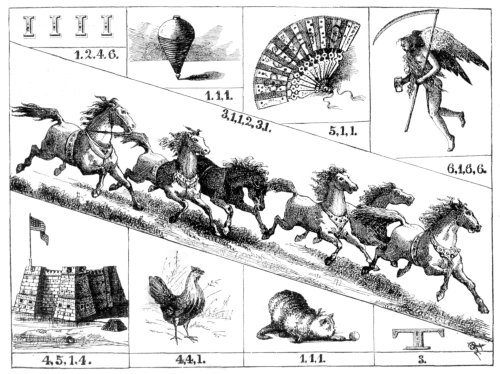
The answer—a line from Young's "Night Thoughts"—contains six words.
Each numeral beneath the pictures represents a letter in that word of the line which is indicated by the numeral—1 denoting that the letter it designates belongs to the first word of the line, 4 to the fourth word, and so on.
Find a word, letters, or a letter, descriptive of each picture, and containing as many letters as there are numerals beneath the picture itself. This is the first process. Then write down, some distance apart, the figures 1, 2, 3, 4, 5, 6, to correspond with the words of the answer. Group beneath figure 1 all the letters designated by the numeral 1 in the numbering beneath the pictures. You will thus have in a group all the letters that spell the first word of the line, and these letters, when set in the right order, will spell the word itself. Follow the same process of grouping and arranging, in making the remaining five words of the answer. Of course, the re-arrangement of the letters need not be begun until all of them have been set apart in their proper groups.
S.R.
THREE DIAMONDS.
I.—1. A consonant. 2. A kind of carriage. 3. A well-known river of Italy. 4. A precious stone. 5. In circumnavigator.
II.—1. In inconspicuous. 2. A Turkish name. 3. A spice. 4. A climbing plant. 5. In herbalist.
III.—1. In iniquity. 2. A girl's name. 3. A country in Asia. 4. Purpose. 5. In Niagara.
ALLIE.
RIDDLE.
A head have I, though never do I think; A mouth as well, but with it never drink. A body, too, is mine, of giant growth and strength, Combining with its force majestic length. But, as to feet, of them I have not one, Though I am never still, but always run. Ne'er was I known to leave my lowly bed, Or ope my mouth so that I might be fed.
E.S.S.
POSITIVES AND COMPARATIVES.
The positive is found from the first definition given, and the comparative is made by adding the sound "er" to the positive.
1. My positive is level, and my comparative is what one's true friends never do. 2. My positive is an article of food, and my comparative is a tool. 3. My positive is coarse, and my comparative is a trade. 4. My positive is a youth, and my comparative is an instrument for climbing. 5. My positive is a preposition, and my comparative is to esteem. 6. My positive is a part of the body, and my comparative is wrath. 7. My positive is an American poet, and my comparative is part of the body. 8. My positive is an article of food, and my comparative is something used in a part of Asia. 9. My positive is a public place, and my comparative is a sufferer.
G.S.
HIDDEN NAMES.
Find a girl's or a boy's name hidden in each of the following sentences.
1. Arthur likes my apples. 2. Herbert expected letters every night. 3. Alice rode to her uncle Robert's. 4. Mr. Allen bought eight lambs. 5. Hattie Arnold reached Rochester yesterday. 6. Even Theodore has eaten little. 7. Every rainy night Eva sews trimming. 8. Ellen's dog is terribly hurt. 9. Florence rides every day. 10. Softly the evening light lingers around. 11. Even dull wits improve, nowadays. 12. Generally, raisins are capital eating. 13. Fido ran after Ned's kite.
C.K.
EASY CROSS-WORD ENIGMA.
My first is in edict, but not in law; My second's in chilly, but not in raw. My third is in ice, but not in snow; My fourth is in cut, but not in mow. My fifth is in mild, but not in bland; My sixth is in country, not in land. My seventh is in silent, not in still; My eighth is in slaughter, but not in kill. My ninth is in learn, but not in teach; My tenth is in sandy, but not in beach. My whole is the name of a useful book, As soon you'll see, if you'll closely look.
W.B.H.
DOUBLE WORD-SQUARE.
Across: 1. Departed. 2. Declare. 3. Look askance. 4. Terminates. Down: 1. High wind. 2. Part of a stove. 3. Want. 4. Mistakes.
H.H.D.
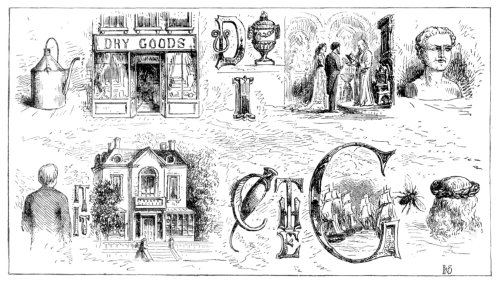
REBUS.
A two-line quotation from a poem by Thomas Gray.
CENTRAL SYNCOPATIONS.
1. Syncopate an orifice, and leave a troublesome insect. 2. Syncopate to cut, and get a natural underground chamber. 3. Syncopate a wise saying, and get to injure. 4. Syncopate a small house, and leave a fugitive named in the Bible. 5. Syncopate a crown of a person of rank, and leave a musical instrument.
A.B.
DOUBLE ACROSTIC.
The initials form the name of a European sovereign. The finals form the name of a great statesman.
1. Striking. 2. A vowel repeated. 3. A body of soldiers. 4. A lofty building. 5. A musical drama. 6. Scarce. 7. A pastoral poem. 8. The surname of a celebrated Italian poet.
DYCLE
ANSWERS TO PUZZLES IN AUGUST NUMBER.
Double Acrostic.—Primrose, 1. PeaR. 2. RomeO. 3. IsthmuS. 4. MacE.
Numerical Enigma.—All owing: allowing.
Pictorial Transposition Puzzles.—1. Ten mugs; nutmegs. 3. Ten tea-pots; potentates.
Diamond Puzzle.—1. M. 2. JAy. 3. MaCaw. 4. YAk. 5. W.
Square-word.—1. Crane. 2. Raven. 3. Avert. 4. Nerve. 5. Enter.
Shakspearean Rebus.—"Hamlet," Act III., Scene i.
"Thus conscience does make cowards of us all; And thus the native hue of resolution Is sicklied o'er with the pale cast of thought."
Geographical Double Acrostic.—1. ChilI. 2. HellesponT. 3. IndiA. 4. NepauL. 5. AlleghanY.
Metagram.—Dip, fip, lip, hip, rip, nip, pip, sip, tip.
Very Easy Hidden Furniture.—1. Table. 2. Sofa. 3. Chair. 4. Stool. 5. What-not. 6. Crib. 7. Cot 8. Hat-rack 9. Desk.
Double Cross-word Enigma.—Holmes, Lowell.
Transpositions.—1. Warned, warden, wander. 2. Red nag, gander, ranged, garden, danger. 3. No elms, Lemnos, lemons, melons, solemn. 4. Red opal, pale rod, real pod, leopard.
Proverb Rebus.—"One swallow does not make a summer."
Charade.—Pondicherry; pond, I, cherry.
Hour-glass Puzzle.—Centrals, Arrow, 1. CHAnt 2. ORe. 3. R. 4. COg. 5. BoWer.
Contractions.—1. Brown, brow. 2. Plane, plan. 3. Lathe, lath. 4. Heath, heat. 5. Hazel, haze. 6. Plume, plum. 7. Crown, crow. 8. Lunge, lung. 9. Forty, fort.
Word-syncopations.—1. Leveret; ever, let. 2. Slashing; ash, sling. 3. Slashings; lash, sings. 4. Carpenter; pea, carter. 5. Carpets; pet, cars.
Answers to Puzzles in the July Number were received, before July 18, from Bessie Hard, C.C. Bourne; Mamie H.S., and Louise G.H.; Cari Hinkle, O.C. Turner, "Prebo," "La Gazza Ladra," "Cosy Club," Bertha E. Keferstein, Nellie M. Slade, "Duchess May" R.H.R.; Alice MacNary and Elliot MacNary; "Kelloke and Cary and Rose," Fred W.M., E. Farnham Todd, "Winnie," "Stock-Broker and Doctor," "Dottie and Daisie;" May and Charlie Pray; Laurie T. Sanders, May Chester, "Hyacinth," H.P.B.; Frances and Margaret Bagley; W.H. McGee, Charlie Kellogg, Nellie Kellogg, T.W.H., A.G.D., Nessie E. Stevens, "Romeo and Juliet" Bella W. Brown, May Duffan, "St. Nicholas Club," H.B. Ayers; "Orada and Ibylsa;" William W. Bellinger, Lillian Willams E.J.F., A.C.S., George D. Mitchell, Arthur Boehm, Bessie Taylor, J.B.H., George C. Wedderburn, William T. Gray, John V.L. Pierson, Henry Kummel, Virginia Simpson; F.M.J., Jr.; Kitty Curtis, Mildred Meredith, Louisa F. Riedel; "Bessie and Tic;" X.Y.Z., Sarah Duffield, Dycie Warden, Nettie A. Ives, "Violet," R.T. French, Josie Hamilton, Alice M. Mason, Ellen Smith, Liffie D. Hacker, Mamie Packer, Jennie A. Carr, Willie Sellie, Arnold Guyot Cameron, Grant Squires, Georgine C. Schnitzspahn, T.H. Loomis, Rachel Hutchins, Mary G. Arnold, M.W. Collet, Laura Maude Benton, Willie Robinson, Fanny J. Schonacker; May and Louis Ogdea; Arthur Stowe, Nellie C. Graham, Mattie Olmsted, W.A. Wheeler, Maggie T. Gemmill, Rufus B. Clark, Lewis G. Davis, Clare G. Hess; Ella and Kittie Blanke; Nellie Quayle, Gertrude Weasondonk, Clara F. Allen, Addie S. Church, "My Maryland," Nellie L. Ninde, F. Popenhausen, A.B.C., "Hard and Tough," Nellie Emerson, L.B. Bancroft, M.P., Wm. C. Ferguson, Alice Lanigan, Florence Van Rensselaer, Anna E. Mathewson, Josie Morris Brown, Charles N. Cogswell, "Fritters," "Bertha and Daisy," "Beech-Nut," Stephen Waterman, E.M. Biddle, Jr., "So So and his Cousin," Georgie B., Chas. Alfred Christian, George J. Fiske, Esther L. Fiske; Frank Allen and May; "Lena Kate," Milly E. Adams, Eddie Vultee, Willie B. Deas, F.D., "Fannie," Grace E. Fuller, C. Speiden, M. Speiden, Austen M. Poole, Ada L. Goodwin, Fred Huckel, Estelle Jennings; William Guillet, of Canada; "Brutus and Cassius," Kate Sampson, Edwin C. Garngues, "Bessie and her Cousin," "A.B. and C.D.," Bessie Barnes, and Charles H. Stout.
"Fanny Pop" and Ernest B. Cooper answered correctly all the puzzles in the July number.