SAM'S BIRTHDAY.
Reading edition
BY IRWIN RUSSELL.
On the nineteenth day of last month, Sam could and would have testified, from information and belief, that he was "eight yeahs ol', gwine on nine;" but on the morning of the twentieth, that interesting infant of color was informed by his mother, as soon as he awoke, that he was "nine yeahs ol', gwine on ten." When Aunt Phillis imparted this surprising intelligence to her son, he was greatly amazed and confounded; and he immediately began to speculate as to what extraordinary combination of circumstances could have so suddenly wrought this remarkable change.
"Hoo-ee!" he cried, "whut a pow'ful while I mus' ha' slep'! Or else I grows wuss an' dat ar Jonus's gourd you tol' me 'bout, whut wuz only a teenchy leetle simblin at night, and got big as de hen-house afore mornin'—early sun-up. Hm! hey! look heah, mammy, is I skipped any Christmusses?"
"No, chile," replied his mother; "you aint skipped nuffin. Dis is yo' buff-day: de 'fects ob which is, dat it's des so many yeahs sence you wuz fust borned. I don't know how 't 'll be, Sam,—folks is sim'lar to de cocoa-grass, whut grows up mighty peart, tell 'long come somebody wid a hoe to slosh it down,—but ef you libs long enough, an' nuffin happens, you'll keep on habbin a buff-day ebry yeah wunst a yeah till you dies. An' ebry time you has one, son, you'll be one yeah older."
"Fine way to git gray-headed," said Sam.
At this moment a mighty crash resounded from the kitchen, down-stairs, and Aunt Phillis descended the steps with great precipitation. Then Sam heard her shouting, angrily:
"You, Bose! Oh, you bettah git, you mean ole no-'count rascal! I do 'spise a houn'-dog!"
Sam went on with his toilet, musing, the while, upon the probability of his ever getting to be as old as Uncle "Afrikin Tommy," who was the patriarch of the plantation, and popularly supposed to be "cluss onto" two hundred years of age; and who was wont to aver that when he arrived in that part of the country, when he was a boy, the squirrels all had two tails apiece, and the Mississippi River was such a small stream that people bridged it, on occasion, with a fence-rail. Thus meditating upon the glorious possibilities of his future, Sam got ready for breakfast, and went down. It was not until he had absorbed an enormous quantity of fried pickled-pork and hot corn-cakes, and finally with reluctance ceased to eat, that his mother told him what had caused the noise a little while before,—how old Bose, the fox-hound, had with felonious intent come into the kitchen, and surreptitiously "supped up" the chicken-soup that had been prepared for Sam's birthday breakfast; and further, how the said delinquent had added insult to injury, by contemptuously smashing the bowl that he had emptied.
"I alluz did 'low," exclaimed Sam, in justifiable wrath, "as dat 'ar ole houn' Bose wuz de triflin'est meanest dog in de whole State ob Claiborne County!"
Sam, however, was too true a philosopher to cry long over spilt milk—or soup. He reflected that the breakfast he had just taken would prevent his eating any soup, even if he had it. "I isn't injy-rubber," said he to himself, with which beautiful and happy thought his frown was superseded by a smile, the smile developed into his normal grin, and he began to chant an appropriate stanza from one of his favorite lyrics:
"O-o-o-old Uncle John! A-a-a-aunt Sally Goodin! When you got enough corn-bread It's des as good as puddin'."
The excellent Aunt Phillis was much affected by this saint-like conduct on the part of her son. She sighed; fearing that the boy was too good to live.
"Nemmind, Sam," said she; "you needn't tote no wood to-day, or fetch no water, or do nuffin. Go down to de quarters, an' git Pumble to play wid you."
Pumble was a boy who in age and tastes corresponded closely with Sam, as he did in complexion. His real name, at full length, was Pumblechook,—he having been so christened at the instance of Mahs'r George, in honor of the immortal corn-and-seedsman. Off went Sam in search of this boy; and he found him at the back of the maternal mansion splitting up pine-knots for kindlings. Sam approached him with a very slow, dignified step, and a look of commiseration.
"Hey, nigger!" said Sam, "dat's all you fit for, is to work. Why don't you be a gemman like me, whut aint a-gwine to do a lick o' work dis whole day?"
"Done runned away, is you?" answered Pumble. "Well, I'll come 'round dis ebenin, when de ole ooman gibs you a dose ob hickory-tea."
"Dat'll do, boy;" said Sam. "Let you know dis is my buff-day, an' I wont work for nobody, on my buff-day. Go ax yo' mammy kin you come up an' play wid me; tell her my mammy sont word for you to come."
Pumble dropped the hatchet, stared ecstatically, and ran in to obtain the desired permission. It was granted. Then this dialogue occurred:
"Be a good chile!"
"Yes'm."
"Don't forgit yo' manners!"
"Nome."
"'Member you's my son!"
"Yes'm."
"Don't you git into no mischuf!"
"Nome."
"Ef you dose, I'll w'ar you out, sah! Now, go 'long!"
The boys trotted merrily away together. But they had not gone fifty rods before they heard Pumble's mother calling him. They stopped to listen.
"Take—keer—ob yo'—clo'es!" she shouted, and then went back into her house.
Under a great pecan-tree, on the lawn before the "big house," Sam and Pumble sat down to consider and consult, or, as they expressed it, "to study up whut us gwine to do."
"Shill I tell a story?" asked Pumble.
"Does you know a good one?" inquired Sam.
"Dis story's gwine to be a new one," said Pumble "beakase I'll make it up as I go 'long."
"Tell ahead," said Sam.
"Wunst apon a time—" began Pumble.
"What time?" interrupted Sam.
"Shut up! Wunst upon a time. Dey wuz a man. An' dis heah man lighted up he pipe, an' started out on de big road. An' he went walkin' along. Right stret along. An' walkin' along, an' walkin' along, an' walkin' along. An' walkin' along. An' walkin' along, an' walkin' along—"
"Dat man wuz gwine all de way, wuzn't he?" interjected the listener.
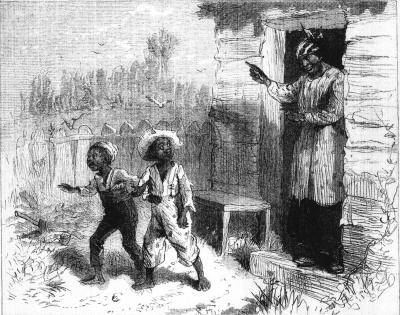
"THE BOYS TROTTED MERRILY AWAY TOGETHER."
"He hadn't got no way, hardly, yit," said Pumble, "but he kep' a-walkin' along. An' walkin' along, an' walkin' along, an' walkin' along, an' walkin' along, an' walkin' along, an' walkin' along, an' walkin' along, an' walkin' along—."
"Stop dat walkin' now," said Sam, "and tell whut he done when he got froo walkin'."
"He come to de place he wuz a-gwine to," said Pumble.
"Did he, sho' enough?" exclaimed Sam. "I wuz kinder skeered he wudn't nebber git dar at all. Whut did he don nex'?"
"De nex' t'ing he done," said Pumble, impressively, "wuz to turn right 'round an' go back whar he come from. An' dat's all!"
As was his invariable custom when deeply impressed Sam began to sing, Pumble joining in:
"Jay-bird a-settin On a swingin' limb, He wink at Stephen, Stephen wink at him; Stephen pint de gun, Pull on de trigger, Off go de load— An' down come de nigger!"
Greatly refreshed and invigorated by the chanting of this touching ballad, Sam and Pumble returned to the consideration of their day's programme. A great many amusements were proposed, discussed, and rejected in their respective turns. Almost any one of them would have been held entirely satisfactory on any ordinary occasion, but Sam thought none of them good enough for his birthday. He required something extraordinary.
"Kaint you think up nuffin else?" he asked his friend, after a long pause.
"I done thinked plumb to de back o' my head a'ready," replied Pumble.
"Den I tell you what," said Sam; "I heared my pappy say dis: when a pusson want to think rale strong, he mus' lay down on de flat ob his back and shet his eyes; an' den, putty soon, he kin think anything he wants to. Let's try it."
This plan was immediately experimented on. Pumble instantly succeeded in thinking; but he only thought that he wished he could have a "buff-day" of his own. Very soon afterward, he ceased to think at all. As for Sam, his thoughts were for some time very ordinary—of too commonplace a nature to be here recorded; but they gradually assumed such an odd and remarkable shape that they may fairly be described as a vision. It seemed to Sam that the whole country around, as far as one could see, was transformed into one great field, in a perfect state of cultivation. But the growing "crop" was not one of cotton, or corn, or cow-peas, or sorghum, or anything else that he had ever before seen in such a place. Coming up out of the ground were long rows of very singular bushes, whereof the stalks were sticks of candy, and the leaves were blackberry pies, and over the whole field was falling a drenching rain of molasses. Sam, however, was most astonished at the curious fruit that the bushes bore. The twigs of some of them supported jew's-harps and tin trumpets; others bent beneath a wealth of fire-crackers and Roman candles; others, again, were weighted with his favorite sardines; and so on in endless variety. It is not at all surprising that the idea occurred to him that this crop ought to be "picked." He found himself becoming highly indignant at the negligence of the planter—whoever he might be—in leaving all these good things to spoil on the bushes; and he burned with a desire to have them properly gathered, and to assist in that work himself. Accordingly, he was just about to reach for a pie and a jew's-harp, by way of beginning, when he found that this was made impossible, by the fact of himself having been suddenly and incomprehensibly changed to a huge water-melon. Over him grew one of the largest bushes, from whose branches depended seven roasted 'possums. It was some consolation to look at them, and imagine how good they would taste if he only could taste them. Presently a little gingerbread bird flew down and began to peck at him, and say, "Git up, Sam! You Sam! Sam!"
He woke up, and found that the wonderful field had vanished, and that he was lying under the old pecan-tree instead of the 'possum-bush; and there was his mother shouting in his ear:
"Sam! don't you heah me, you lazy—S-a-m! Git up dis minnit an' go to de well for a bucket ob water, sah, foah I whoop you!"
Pumble sat up and stared.
"Why, mammy," said Sam, "you tol' me I needn't do no work, kase it's my buff-day."
"I's ben countin' it up ag'in," said Aunt Phillis, "an' foun' out where I made a mis-figger, de fust time, and tallied wrong altogedder. 'Cordin' to de c'rect calkilation, yo' buff-day was one day las' month. WALK arter dat water!"