Act 5 — A FRIEND IN NEED; OR, HOW “THE VICAR OF WAKEFIELD” FOUND A PUBLISHER
Reading edition
By Maude Morrison Frank
“I received one morning a message from poor Goldsmith that he was in great distress, and, as it was not in his power to come to me, begging that I would come to him as soon as possible. I accordingly went as soon as I was dressed, and found that his landlady had arrested him for his rent, at which he was in a violent passion. I perceived that he had already changed my guinea, and had got a bottle of Madeira and a glass before him. I put the cork into the bottle, desired he would be calm, and began to talk to him of the means by which he might be extricated. He then told me that he had a novel ready for the press, which he produced to me. I looked into it, and saw its merit; told the landlady I should soon return, and, having gone to a book-seller, sold it for sixty pounds. I brought Goldsmith the money, and he discharged his rent....”
From Boswell’s “Life of Johnson.”
CHARACTERS
Oliver Goldsmith.
Dr. Samuel Johnson.
The Landlady.
Margery, aged 13, The Landlady’s Children.

Dick,aged 12,
Time: 1762
SCENE
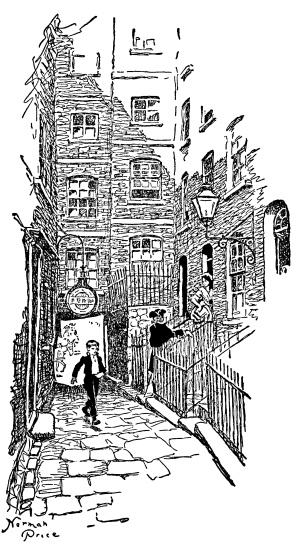
Oliver Goldsmith’s lodgings, Wine Office Court, Fleet Street, London. The walls are discolored, the furniture is old and rickety. The floor, the chairs, and the tables are littered with quantities of ragged books and loose papers.
[Goldsmith, untidily dressed, is striding up and down.]
Goldsmith. [After glancing impatiently at the door several times, opens it and calls loudly.] Margery!
Margery. [Coming in and curtseying.] Did you want for anything, sir?
Goldsmith. Has that graceless brother of yours not come back? Sure it’s above an hour since he set off.
Margery. Oh, sir, Dick has never been so long as that!
Goldsmith. An hour, I tell you, and the half of that besides! He’ll be playing at pitch-and-toss in the court, I warrant you.
Margery. Oh, sir, he’d not do that—not when you sent him so particular!
Goldsmith. Never you be too sure, Margery, of what folks will do or not do. There’s myself now. You’d never believe that I could be so foolish as to sell a good song for a paltry five shillings. But many’s the time I did it in the old town of Dublin, and climbed the college wall at night to hear the verses sung in the streets too. Then, like as not, some poor soul that needed the money more than I would beg the crown piece from me before I found my way back to the wretched garret where I lodged. But times have changed, Margery.
Margery. [Hesitatingly.] Yes, sir; but, you see, sir, you still—
Goldsmith. [Hurriedly.] Run down to the door like a good maid, do, and see if Dick’s in sight. [Margery goes out; Goldsmith paces up and down restlessly for a moment, then, going to the table, opens the drawer noisily and rummages among his papers.] A plague on all landladies, say I! [In a tone of disgust.] And not so much as an old song left to sell this time!
Margery. [Reappearing, timidly.] Dick’s not to be seen yet, sir. I ran to the end of the court and looked as far as ever I could.
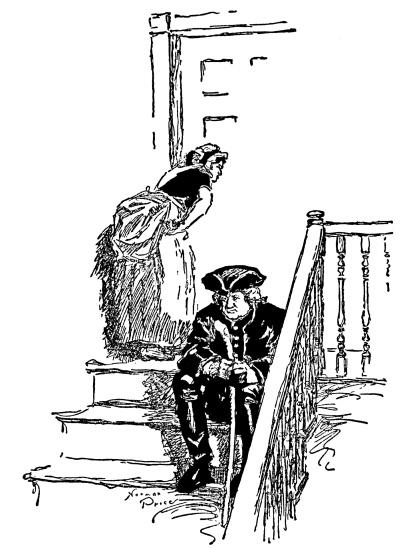
Goldsmith. [Angrily.] A pretty pass for a gentleman like me to be in!—unable to stir beyond the four walls of the room, and very dirty walls they are, too [with a scornful look about him], with that cowardly bailiff sitting on the stairs, like a vile cat ready to pounce at any moment. And, unless Dr. Johnson is as quick to send help as he is to contradict me at the club, I must go to prison, and all because that mother of yours is so vixenish about the trifle of rent. She knows I’d give away my last halfpenny to any one who needed it.
Margery. [Beginning to cry.] Yes, indeed, sir; but that’s just it! Mother heard the young gentlemen who were here last night talking in the passage about the guinea you’d given them to go to the play; and then, this morning, she only asked for some of the rent because she’s obliged to pay Dick’s fees to Mr. Filby, the tailor, who’s willing to take him to ’prentice and teach him the trade if he finds he’s a likely lad.
Goldsmith. [Excitedly.] But I haven’t another guinea to my name, I tell you!
[Margery sobs loudly.]
Goldsmith. [Dreadfully distressed.] You shall have a whole shilling for yourself, my girl, if you’ll give over crying. But [in a lower tone], faith, I’ll have to get the shilling first!
[Door opens, and Dick enters, much out of breath.]
Dick. I’d a deal of trouble to give the letter to the old gentleman in the Temple. Frank, the black man-servant, said at first that his master, who could write a great book like the dictionary, all out of his own head, had no call to be bothered with forward London lads. Then he made me wait a long time while Dr. Johnson drank tea with Miss Williams, the little old blind lady that lives there. But at last the Doctor read your letter and gave me this one for you, with a penny for myself. Then he called very loud for a man-servant, and said a lot of things I couldn't rightly understand, the words were so long; but he said “Scatter-brain!” at the end. Could that mean you, sir?
Goldsmith. [Without heeding the boy, hurriedly breaks the seal, and reads.]
Temple Lane.
My Dear Sir:
Your vexatious situation has awakened the liveliest emotion of sympathy in the breast of one who, while condemning the follies of his fellow men, rejoices in an opportunity of alleviating their miseries. The inclosed piece of gold is designed to meet your most pressing necessities, and I will myself follow your Mercury with as much expedition as I can compass.
I am, sir, your sincere well-wisher,
Samuel Johnson.
Goldsmith. [With a deep sigh of relief.] Ah! 'tis a great thing to have real friends. And they're not always the people that have the smoothest tongues, either. The Doctor's rough in his speech, yet there's nothing of the bear about him but his skin. [Remembering the children, with a start.] Here, Dick, old debts must always be paid. I've promised Margery a shilling, and you shall have sixpence. Run and change this guinea at the Green Dragon Tavern, hard by. [Dick makes for the door.] But, stay! If I must spend the day indoors, at least I'll have some good wine to keep me company. You may as well bring a quart of Madeira, lad, the best you can buy. [Dick goes out.] And, Margery, there's an old corkscrew on the floor in yonder corner. There should be a goblet, too, on the shelf. The other three were broken at our little meeting last night, and the china monster I was always so fond of, too, because Cousin Jane Contarine gave it to me. Ah, well! [Picking up some fragments from the floor and placing them on a shelf.] I'll keep the pieces to remind me of her. [Dick enters, sets a dusty bottle on the table, and takes the change out of his various pockets, piece by piece, with an air of great responsibility.]
Goldsmith. [Without counting the money.] Ah, the boy at last! Here's a sixpence for you, lad. [Dick pulls his forelock and promptly pockets the coin.] And here's your shilling, Margery.
Margery. [Taking it reluctantly.] I'll be sure to tell Mother how kind you are, sir, and then perhaps—
Goldsmith. Perhaps she'll not let the bailiff carry me off to prison? No use hoping for that, my dear, or for any other piece of good luck, for that matter. Poor Noll will never gallop in a coach and six, for all his hard work. But the sun shines sometimes even in Fleet Prison, and here's good wine, for once, to make him forget his troubles, so—
[Fills a goblet to the brim, lifts it to his lips, but sets it down quickly upon hearing a heavy step on the landing.]
Dr. Johnson. [Outside, in a sonorous voice, heard through the half-open door.] Madam, I am fully aware that Dr. Goldsmith is in an embarrassing situation. I am also aware that your behavior is, in part, responsible for his embarrassments. If you will have the goodness to refrain from violent recriminations, I will visit him forthwith to investigate these complications. [Advancing to the center of the room with great dignity.] My dear Goldsmith, I trust your messenger reported that I should employ the utmost expedition in coming to your assistance. The existence of a literary man is, I apprehend,—[Coming closer to the table, he perceives the bottle and well-filled goblet, peers at the pile of coins and counts them, snorts violently in disgust, corks the bottle, and then, perceiving the children, says, sternly:] Sir, our conversation need not be extended, but I shall take the liberty of dismissing these young persons.
[Children go out on tiptoe.]
Goldsmith. [Advancing with outstretched hand and an engaging smile.] Nay, Doctor, it'll ill work thumping a poor harmless fellow with hard words when the jade Misfortune has him by the throat. Life has many a dull day for poor Noll, and he could never cure his ills with tea-drinking, either.
Dr. Johnson. [Shaking his massive silver-headed cane indignantly.] Sir, you are impertinent as well as improvident! Disturbed at my sixth cup of tea, barely half my usual allowance, as Miss Williams will testify, I hasten hither only to find that your most pressing necessities are such as can be supplied from the nearest tavern. The gold I despatched by your messenger, as from one literary man to another, I could ill spare, and, since I find you in affluence [Goldsmith turns out his empty pockets ruefully] and employed in a manner eminently befitting your talents, I will bid you good day without further ceremony! [Paces solemnly toward the door.]
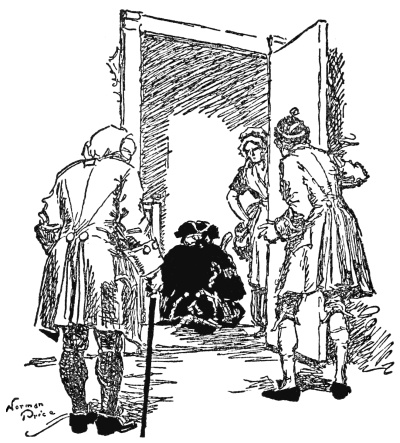
Goldsmith. [Coming forward quickly.] Sure, Doctor, you can never do that! I was always my own worst friend and you my best. Isn't it the sober truth I wrote in the letter, that the bailiff fellow's sitting in the passage, waiting to take me to prison if I once put my nose outside the door? You can see the ugly back of him now.
[He flings open the door, to the confusion of the Landlady, who has been listening at the keyhole.]
Dr. Johnson. [Ignoring Goldsmith completely.] Madam, it argues an amiable disposition on your part to manifest so strong an interest in Dr. Goldsmith's misfortunes. Have the goodness to enter and favor me with an explanation of these circumstances.
Landlady. Begging your pardon, sir, I'm not a good 'and at hexplaining and such, but when a lone woman 'as two children and heverything to do for them, and gentlemen as 'as guineas to give away promiscuous and owe rent for months don't pay a penny, though the lad's to be 'prenticed and 'is fees found—as good a lad as there is in the court too, though I say it as shouldn't—why, then, one time as well as hanother for the bailiffs, thinks I, when things come to be so houtrageous—[Stops, out of breath.]
Dr. Johnson. [Very sternly, to Goldsmith.] How, sir! Am I to understand that your indebtedness to this good woman has covered a period of months? [Goldsmith opens his mouth as if to speak.] Never bandy words with me, sir! She must be paid, and at once!
Goldsmith. That's like your old kindness, Doctor, and I'll be sure to pay you when I get the next money from my old skinflint of a publisher.
Dr. Johnson. Not so fast, sir; not so fast! Keep your compliments until they are wanted. For my own guineas I can find worthier employment [glancing meaningly at the table], but you shall set your roving wits to work for the discharge of your debt to this poor woman here.
Goldsmith. But I can't so much as take a step without having that greasy fellow yonder hale me to prison, and no man can write there.
Dr. Johnson. Better men than you have written there, sir, and to the glory of England, too! But your foolish errands can be done for you. Have you scribbled nothing of late that you have not sold before it was finished? No verses? The last—I should be wiser than to tell you—were as sensible as their writer is foolish. Nothing? [Goldsmith shakes his head.] Nay, sit down and look through this heap of rubbish. [Pointing to the open drawer full of untidy manuscript.]
Goldsmith. [Looks blankly at the papers, picks up a ragged rôle, runs through the leaves rapidly, shakes his head, and looks up doubtfully.] I wonder would they give me anything for this? I'd completely forgot it. It's only a poor tale, though I liked it well enough when I wrote it. But I've nothing else.
Dr. Johnson. What sort of tale, sir? Is it a fable? Has it a moral?
Goldsmith. 'Tis about a clergyman and his family. I'd thought to call it “The Parson of Wakefield,” or some such name. I had my father, rest his soul, in mind when I wrote it; and I put in some of my own mad doings as well. There's comfort sometimes in setting down your own follies in print. It seems like a way of getting rid of them. They're not all so easy to get rid of, though, more's the pity!
Dr. Johnson. Here, sir! Cease maundering and let me look at your nonsense. [Settles his spectacles, sits down in an arm-chair, and begins to read.] “I was ever of the opinion that the honest man who married,” m—m—m—m. [Turning pages.] “The only hope of our family now was that the report of our misfortunes might be malicious or premature,” m—m—m—m. [Turning pages.] “I now began to find that all my long and painful lectures upon temperance, simplicity, and contentment were entirely disregarded.” [Turns pages for a while, seizes his hat and stick, and stalks out without a word. Goldsmith stares at the Landlady in surprise; the children rush in.]
Margery. [Eagerly.] Oh, sir! Will the old gentleman help you? He said, “Thank you, my little mistress,” so kindly, when I picked up his stick just now, that I'm sure he's not a great bear, as Dick calls him.
Goldsmith. [Sadly.] He's a very good-hearted bear, if he's one at all, Margery, and if anything can be made of a worthless fellow like me, the Doctor will do it. But sometimes I misdoubt me that it can be done.
Landlady. [Sharply.] There, now, Dr. Goldsmith, I don't 'old with hany one calling 'imself names! I've 'ad a many lodgers in my time, and take them hall, bad and good, I'd a deal rather 'ave shillings from you, sir, than pounds from the hother gentlemen, for you've always a bit of a laugh about you for me and the young ones, and that halways 'elps a body through the day. But, you see, sir, I was that worried about the lad's fees for 'is 'prenticing that I was maybe a bit 'ard about the rent, but, indeed—
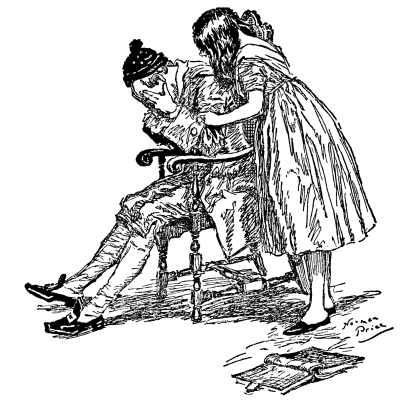
Goldsmith. Not half so hard as you had a right to be! It's a shameless scamp I am to be giving my guineas to such idle lads as were here last night, and there's none knows it better than myself. A sorry tale my life will be at this rate, with only debts and follies and maybe worse till the end of the chapter—[He buries his face in his hands. Margery steals up behind him and lays her hand timidly on his shoulder.]
[A heavy step is heard, the door is flung wide open, and Dr. Johnson enters, breathing hard, and wearing an air of great importance.]
Dr. Johnson. Madam, what is the exact amount of my colleague's indebtedness to your establishment?
Landlady. Dr. Goldsmith, sir? 'E owes me fifteen guineas, come last Lady-day.
Dr. Johnson. And the officer in the passage? What amount must be expended for the benefits of his presence?
Landlady. It's twelve shillings for the warrant, sir, and the stamp will be three more. 'E'll want two for 'is supper and ale, but I'll not give it. 'E'd best get into an honest business and not come cluttering up folk's 'ouses with 'is great hugly self.
Dr. Johnson. Here are sixteen guineas, Madam, and I desire you to pay the poor wretch's supper. 'Twas by no fault of his that he came here.
Goldsmith. [Starting up.] Which of the knaves did you talk into giving sixteen guineas for that poor tale? I would never have believed it!
Dr. Johnson. To be sure, sir, it would have been another story had you carried your wares to market yourself, for the booksellers have but an ill opinion of you at present. But there was no fear that any one of them would venture to say me nay, or waste words in cheapening what I chose to recommend. [Impressively.] Mr. Newbery, your former publisher, has been pleased to purchase the work which you intrusted to me, and to send you a remuneration of sixty guineas.
Goldsmith. Sixty guineas! [Sinks back on his chair in astonishment.] Dick, lad, do you hear that? You shall have the finest jack-knife in all Cheapside, my boy, and Margery a new bonnet with flowered ribbons on it, for she was always sorry for me when pence were hard to come by. And I [rising and strutting up and down] shall be all the better myself for a little smartening. I'll have another look at that marvelous pretty plum-colored velvet I saw in Filby's shop last week. He'll be sure to trust me for it if I pay something on the old bill, and—[Stops short, as Dr. Johnson raps violently on the floor with his stick.]
Dr. Johnson. [Shaking his head solemnly.] Nay, sir, a spendthrift you were born, but an honest man I'll make you, if this money [holding up a large leather purse] will discharge your outstanding accounts. There shall be no plum-colored velvets, I promise you, until justice is done. But [observing the downcast looks of the children] you, my little mistress, shall not be deprived of your finery, nor the lad of his promised toy.
Goldsmith. [Plucking up courage.] Then, Doctor, you'll not leave me without a penny, like Simple Simon in the old rime? Sure, no tradesman will trust me with his wares, either.
Dr. Johnson. [Firmly.] And quite right too, sir. But to leave you four and forty pounds in your present state of mind would be sheer madness. Steady your wits, sir, by making a fair copy of your debts, to show me at five, when Miss Williams shall give you a slice of mutton in the Temple. On your solemn assurance that your creditors shall be satisfied without delay, the balance shall be yours, though it will be wasted on folly, I make no doubt. I have the honor to wish you good day, sir. [Claps his hat on, seizes his stick, and marches out, stopping a moment to pat Margery's curls as she curtseys to him.]
Goldsmith. [With a sigh of relief.] Ah, well! It's an ill wind that blows nobody good. Things looked black enough an hour since, and now, Margery, you'll be monstrous fine in a new bonnet, and Dick the cock of the court with his jack-knife. And I—I'll manage to get that plum-colored velvet—with a taffeta lining, too—or my name's not Oliver Goldsmith!
[Children clap their hands in delight; Landlady shakes her head at Goldsmith disapprovingly.]