INTRODUCTION.
Reading edition
The Great Pope, the thirteen hundredth anniversary of whose death is commemorated on March the 12th, 1904, was born at Rome, probably about the year 540. His father, Gordianus, was a wealthy man of senatorial rank; his mother, Silvia, was renowned for her virtues. He received from his parents an excellent liberal and religious education. He further applied himself to the study of law, and—probably at about the age of 30—was made prætor of Rome by the Emperor Justin II. But he became dissatisfied with his mode of life, and retiring to the monastery of St. Andrew, which he had founded on the Cœlian hill, lived there as monk and as abbot. He had long been an ardent admirer of St. Bennet (who had been dead little more than thirty years), and on his father’s death had made use of his patrimony to found six other monasteries in Sicily. He was not, however, allowed to enjoy his retirement at St. Andrew’s for long, for Pope Benedict I. ordained him deacon, and sent him to Constantinople as his apocrisiarius or confidential agent. Pelagius II. continued him in this office, making use of him especially to appeal to the Emperor for aid against the Lombards, who, while settling in North Italy, were wandering southwards, devastating the country as they went.
When he was at length recalled to Rome, he begged to be allowed to return to his monastery. The Pope [6] allowed him to do this, but employed him as his secretary. It was either now, or just before he went to Constantinople, that there occurred the famous incident in the slave market, when, struck by the beauty of some lads exposed for sale, he asked what was the name of their nation. On being told, “Angles,” he exclaimed, “Good, for they have the faces of angels, and ought to be fellow-heirs of the angels in heaven.” In reply to his inquiry as to the name of their native province, he was told that its inhabitants were called Deiri. He answered, “Good; snatched from the wrath, and called to the mercy of Christ.” What was the name of the king of that province? The answer was “Ælia.” Then said he, “Alleluia! the praise of God ought to be sung in those parts.” He passed on, but did not forget the incident, for he wrung permission from the Pope to go himself on a mission to convert the Angles; but no sooner had he started than the Romans clamoured to have him recalled, and he had to return. He did not, however, forget his interest in the nation, and when he was Pope he was able to carry out those plans which earned him the affectionate titles of “Gregory our Father,” and “The Apostle of the English,” from those who owed so much to him.
DEPRECAMUR TE DOMINE
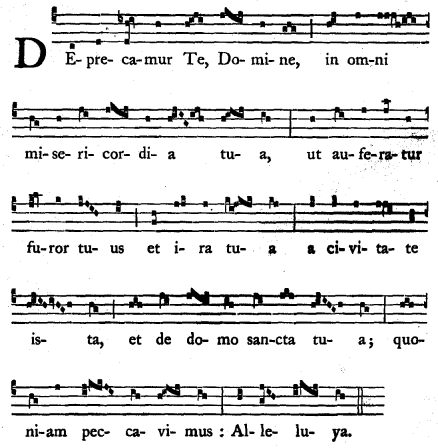
De-pre-ca-mur Te, Do-mi-ne, in om-ni mi-se-ri-cor-di-a tu-a, ut au-fe-ra-tur fu-ror tu-us et i-ra tu-a a ci-vi-ta-te is-ta, et de do-mo san-cta tu-a; quo-ni-am pec-ca-vi-mus: Al-le-lu-ya.
[play tune: Deprecamur de domine]
In 590 Pope Pelagius died. It was a time of great misery at Rome; there was famine and a pestilence in the city, the Tiber overflowed its banks, and the Lombards threatened invasion. The Popes were virtually the rulers of Rome at this time, and all the inhabitants turned to [7] Gregory as their only hope. His proved abilities and high character were known to all, and he was unanimously elected by the clergy and the people. He shrank, however, from the office, and even petitioned the Emperor Maurice to withhold his confirmation of the election. While waiting for the Emperor’s answer, Gregory employed the occasion in preaching to the people, calling them to repentance. A Litany was sung through the streets of the city by seven companies of the clergy and people, starting from different churches and meeting at the Basilica of St. Maria Maggiore. From this litany, perhaps, was taken the processional antiphon, “Deprecamur Te Domine,” which was sung by Augustine and his companions on entering Canterbury at the outset of their English mission. At length the confirmation of his election arrived from the Emperor, and though Gregory still tried to avoid the office, he was eventually obliged to take it, and was consecrated September the 3rd, 590.
During the thirteen years of his popedom, Gregory had full scope for his talents as administrator, as well as ruler. The Roman Church had by this time become possessed of a great “patrimony,” and Gregory found time in the midst of his work of reforming the clergy and purifying the morals of the Church, to attend to even the smallest details in the management of these great estates. His letters give us the most vivid picture of his work and of his character. In them he is constantly giving directions and making arrangements that [8] no injustice should be done to even the meanest peasant or serf on these estates; that their rents should be fixed, and no capricious exactions demanded of them, nor surcharges added to the payments legally due from them. He showed to the Jews a toleration and consideration which he did not always extend to schismatics, heretics, and heathen. He seems to have reserved his most violent language for Lombards and Patriarchs of Constantinople. He called worldly or negligent bishops to order, and in particular took vigorous measures to root out simony, which was very prevalent. He sent Augustine and his companions to England, and wrote them letters of exhortation and instruction; he found time to send them also church furniture, vessels and vestments, and a number of books.
He also became engaged in a controversy with John the Faster, the Patriarch of Constantinople, about the title of “Universal Bishop,” which was arrogated to the latter by himself and those about him. It was not a novelty, but Gregory seems to have seen the danger involved in its continued usage to the power which he claimed for the See of Rome. A whole series of his letters are consequently taken up with his vehement, not to say violent, protests against John’s use of the title. It is probably in connection with the fact that the Emperor Maurice had supported the Patriarch John in his claim of equality with the Pope of Rome, that the explanation is to be sought of a circumstance which remains the chief blot on Gregory’s fame. Maurice [9] had given him little help against the Lombards, and had in various ways seemed to oppose or actually opposed Gregory in some of his reforms. When, therefore, Phocas murdered Maurice and usurped his throne, the Pope wrote him a fulsome letter of congratulation. He may not have been fully acquainted with the infamous character of Phocas, nor have fully known of the atrocious manner in which he had murdered the Emperor and his family, yet he must have known, at least, that he was a traitor, a murderer, and an usurper. Nothing can excuse him—knowing this—for writing in such a strain, saying “Glory to God in the highest,” and “Let the heavens rejoice and let the earth be glad,” at the hopes aroused by the piety of the new Emperor.
He attached great importance to preaching, and many of his sermons remain to this day. He also wrote “Liber Pastoralis Curæ,” a treatise on the responsibilities and duties of Bishops. This book had immense influence; it was circulated in Spain; the Emperor had it translated into Greek; it was an authoritative text-book in Gaul for centuries; and it was translated into Anglo-Saxon by King Alfred, and was widely disseminated in England. But it is in the services and service-books of the Church that he set his mark most conspicuously. He organized and enriched them, even the Canon of the Mass in which he added to the prayer of oblation the words “Diesque nostras in tua pace disponas.” The work which has been traditionally ascribed to him in the department of Church Music we shall enter into more fully.
[10]
From his monastic life onwards Gregory seems to have suffered from bad health, due in part, probably, to his extreme asceticism while living in his monastery. During the last few years of his life he was in continual pain from gout, which makes his activity and his achievements still more astonishing. For long he was confined to his bed altogether. He died on March 12th, 604. In contrast to the enthusiasm with which his accession to the Papacy was greeted, he was now accused by the fickle population of having caused the famine, which was then raging, by his lavish expenditure, though the latter was largely due to the charitable relief which he habitually gave to alleviate the distress which prevailed all the time that he filled the Papal chair. But he was canonized after his death by universal consent in the West, and the Council of Cloveshoo, in 747, fixed the 12th of March for his veneration: “That the birthday of the blessed Pope Gregory, and also the day of the burial of St. Augustine the Archbishop and Confessor (who being sent to the English by the said Pope, our father Gregory, first brought the knowledge of the Faith, the sacrament of Baptism, and the notice of the Heavenly Country), which is the 26th of May, be honourably observed by all: so that each day be kept with a cessation from labour, by ecclesiastics and monastics; and that the name of our blessed father and doctor Augustine be always mentioned in singing the Litany after the invocation of St. Gregory.”
[10f]
[11]