Chapter IV · APRIL (continued 2)
Reading edition
BIRD-NESTING WE GO
Suddenly Thady stopped before a yew tree. Hals and Bess followed, panting and crying out eagerly, “Where, where?” for Thady had discarded his jacket, and in a twinkling had thrown his arms round the tree. In a second he was aloft. “A lintie’s nest,” he whispered, and then peered in. A minute later he called out, “Two eggs.”
“Will you bring one down?” we said in chorus. For all answer, Thady nodded, slipped an egg into his mouth, and then proceeded to descend. We looked at the little egg that Thady held out on the palm of his hand. It was of a pale bluish white, speckled and streaked with lines of purplish brown.
After we had all peered over it, the egg was put back solemnly by Thady.
A little further on, and Thady again halted. “Here it be, yer leddyship,” he cried, in a high treble; and there, sure enough, looking upward, we discerned a nest of twigs and roots. It was quite low down, and I was able easily to lift up the children to get a peep themselves. The little nest was lined with hair and wool stolen from the neighbouring fields, but as yet there were no eggs. “A nope’s (bullfinch’s) sure enough,” said Thady, dogmatically. Then on we wandered until we paused below a fir tree. Below the bole of the tree there was no herbage, for the fir leaves had fallen like needles and had pierced and stabbed the grass to death—so it was quite bare now, not a leaf, or even a patch of moss; as bare, in fact, as a village playground.
Suddenly we heard overhead a loud, ringing clap of wings, and as we looked up, we saw an ill-made nest of sticks, and two eggs, which last we could see glistening inside, like two button mushrooms. For a minute I had a vision of a big departing bird of a soft lavender grey, and as I looked, Thady called out, “Quice,” which is the Shropshire name for the wood-pigeon. Thady was anxious to mount the tree and bring me down an egg for closer inspection; but I begged him not to do so, for the Cushat-Doos, as he tells me he has heard them called in the North Country, are very shy birds in a wild state, and I have been told will never return to a nest where the hand of man has trifled with eggs or nest.
I lingered, looking up at the shining round pink eggs with the light glimmering through the twigs; and then I mounted up the hill, which was very hard work, for both children were a little weary and hot, and I went up the incline, pulling both up as best I could. Mouse kept close to my heels. She had had dark suspicions ever since we entered the wood, and was convinced of the existence, I felt sure, of robbers, footpads, wolves, and also of innumerable vague dangers, and alarms.
We passed a blackbird’s nest, but Thady waved his hand in lofty disdain, and refused to pull back the bough so that we might look at the eggs. “’Tisn’t for dirt like that that I’ll trouble yer leddyship and the young squire to spier round,” he exclaimed. “The black ouzel is just a conny among feathered folk, or what blackberries be ’mongst the fruit.”
Thady seemed to know every inch of the ground. “It isn’t in woods or field that I forget myself,” he remarked to me, when I commended him for his knowledge of the Edge. “Devil a bit,” he said, “if I have ever lost my way along, or missed a mark or forgotten the bend of a stick; but,” he added, in a tone of contrition, “’tis in the book larning and figures that Thady Malone cannot always discern rightly.”
At last, after much puffing and panting, we reached the top of the hill.
THE SCOBBY’S NEST
“Like enough we’ll find a scobby’s nest in the hedge,” said Thady. Then he went on to say, “They be wonderful builders be scobbys; ‘tight and nanty,’ as folks say here.” And sure enough, a little further on, fixed in a branch of blackthorn, we saw a little nest of exquisite beauty. Outside it appeared to be built almost entirely of lichen, pulled off the bark of trees; whilst inside it was lined with hair and feathers, woven together with marvellous dexterity. There were three eggs, all of a reddish pale grey, blotched here and there with vinous patches.
As we stood watching the nest, the handsome little cock chaffinch eyed us anxiously. With a quick movement he turned round, and we caught the flash of his white wings. “A bobsome, joyous little gent,” said Thady; “a scobby, I have heard folks say, is the last bird to give over singing in summer.”
Then we sat down to luncheon. “We must eat,” Bess cried with conviction; “seeing so many nests has made me feel eggy with hunger.” All round us the birds filled the thicket with the joy of their carols. “The place fair swarms with them,” observed Thady, “but come a week or two, we shall have all the foreigners over.” By which he, doubtless, meant the arrival of all the delicious warblers that come from the South in spring, not to mention many of the cock chaffinches, most of the pipits, the yellow water-wagtails, the gorgeous redstarts, and the beautiful turtle, or Wrekin doves.
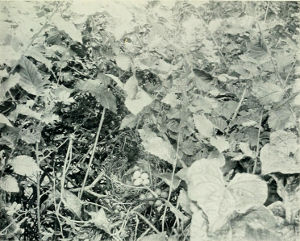
NEST OF GREENFINCH.
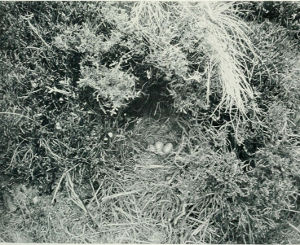
NEST OF RING-OUZEL.
Photos by Mrs. New.
Listening to the different notes, we sat down and got our luncheon, which Bess and Hal, who had acquired the appetite of hunters, declared was fit for any king, and believed that even Nan, if she had been there, wouldn’t grumble.
“When I’m at home,” said Bess, after a pause, “I eat mutton, but here I call it the flesh of sheep,” and as she spoke she put upon Hal’s knees another slice. Hal looked at her and retorted gravely, “Mutton isn’t good, but the flesh of sheep is fit for a general.”
Thady, overhearing these remarks, exclaimed, “Begorra, it is a poor place where Thady Malone cannot eat to your leddyship’s health.” And added, “Deed, I’m like Mrs. Langdale’s chickens, I could peck a bit wherever it was.” So saying, he fell heartily to work on some huge beef sandwiches which had been prepared for him and Fred, by Auguste. A few minutes later, the girths of the saddle were loosened and Jill was allowed to graze at her own free will, nipping and cropping the tender grass with avidity.
“Mamsie,” said Bess, after the last scrap of chocolate had been eaten, and the last Blenheim orange apple munched, “have you no fairy-story to tell us, for you know, this is a real place for fairy-tales.” Then the children crept under my cloak, and I rambled on aloud about princes and princesses, giants and dragons, enchanted castles, good and evil fairies, and knights and ladies.
Thady approached our group and listened also. “’Tis better nor a theatre,” he was kind enough to say, as I came to an end at last, with the happy marriage of the prince and princess, and a description of the royal festivities on that occasion. “Begorra,” he exclaimed, “I’d like to be a man, and fight dragons and giants. Fightin’ is the life for me.”
Then we got up, packed the basket, and prepared to return homeward across the fields. Jill was caught, but could with difficulty be girthed, so enlarged had she become by several hours of happy browsing; but after a struggle the saddle and basket are put on, and we turned our heads homewards. Hals had been silent for the last few moments.
“Well,” I said, “what is it?”
“I too should like to fight,” he answered, “but it must be on a horse and in armour.”
THE GLORY OF AULD OIRELAND
“’Tis all one, sir,” replied Thady, cheerily, “so long as yer get a stomach full of blows and can give good knocks back. Fighting,” he explained, “is what makes the difference between boys and girls, and it is the glory of auld Oireland.”
We talked away and walked homeward. There was a nest of a cutty wren in a juniper bush, which Thady knew of, and a tomtit’s in a hollow tree, beautifully made of a mass of feathers, and in it were many tiny eggs, almost too small to touch without breaking, and Fred lifted both children up to see. A little further on, Thady pointed away to a distant orchard that encircled two lonely cottages nestling against the opposite hill. “There,” he said, “be the nest of a Harry red-cap.” But our energy had died away for bird-nesting. “It shall be for another day,” said Bess. And then added dreamily, “I didn’t think I ever could have seen bird-nests enough, but I think some other play now would be nice.”
So we walked on, Hals leading the way, and Thady bringing up the rear and whistling, as he went along, the Shan Van Vocht. Thus we returned home, Bess and Hals riding on Jill in turns. The cry of the cuckoo pursued us like a voice out of dreamland, while the scents of the sweet spring day were wafted to us on a hundred eddying breezes.
In the evening I found a note from Constance at the Abbey. She sent me a full list of the flowers she proposed working on the quilts, and added, “What do you think of these words about sleep?—
“‘Sweet sleep fell upon his eyelids.’—The Odyssey.
“‘Sleep and death.’—The Iliad.
“‘Death and his brother sleep.’—Shelley.
“‘Sleep thy fill, and take thy soft repose.’—Quarles.
“‘Sleep in peace and wake in joy.’—Scott, Lord of the Isles.
“‘Never sleep the sun up.
Rise to prevent the sun.’—Vaughan.”
When I had written to Constance, I thought of bed in a happy sleepy state of mind. As I brushed out my hair, I went over our pleasant long day in the woods, away from men, and noise, and even home. A day spent amidst birds and beasts, looking at nests, resting on mossy banks, and seeing only the sweet, sprouting things of field and lane, is a delightful thing.
Is there anything better than a day out in the heart of the country? As I slipped into bed, Bess’s last words came back to me as she went off to her cot. “Is it really very wicked, mamsie, to take nests and eggs?—for Fred says he has done it scores and scores of times, and he doesn’t see no use in such things if they can’t make sport for young ladies and gentlemen.”
“Some day you will understand,” I had replied. “One cannot know some things when one is very young.” And I have often noticed with children, that, up to a certain age, the uneducated view of everything is the sympathetic and natural one; later, to a few, the light does come.