Sporting Society (continued 4)
Reading edition
"Come through the gap and give us a hand, old fellow; I've come down, busted both girths and a stirrup leather, lost my curb chain and split my br—waistcoat!"
I was happy again. I had a companion in misfortune, and, better still, one in sorrier plight than my own. By the time we had (as far as a piece of string, two torn handkerchiefs and a necktie, the thongs of both hunting crops, and a pair of braces would allow) repaired damages, lighted and smoked a couple of cigars, and talked the day's doings over as we rode back to the cheery lights shining from the barrack windows, I for one felt just as happy as if I had managed to live through the whole, instead of only part, of that invigorating gallop with the Woolwich Drag.
STAG-HUNTING ON EXMOOR
We sons of Devon are, I doubt not, too prone to dwell and enlarge upon the fact that we are not quite as other men, that when all things were made none was made better than this, our land of sunny skies and mystic moors, of lane and hedgerow, of sea and river, where the balmy fragrance of Torbay invites the winter, and the chill grandeur of Exmoor repels the summer's heat; with goodness overflowing from Porlock to Penzance; the home of traditions and folkspeech that mark us out a people meet to enjoy the wholesomest clime under the canopy of heaven.
I say we are too apt to allow these matters to weigh with us, and breed a smiling contentment and ease of living perhaps not good for those who shall come after us—for those who may be forced to quit their native soil and sojourn among aliens of sharper wits and noisier mode of life. Soft as a Dartmoor bog the South Devon man has been found by those of northern blood, who in mean ways despoil him. Yet if history doth not lie, there have been sundry occasions when, for stoutness of heart and a kind of obstinacy of courage, the men of the west of England had no need to suffer by comparison with any. To many of us now, alas, the home of our fathers, the haunts of our boyhood, are no longer daily present; but the exile's memory is strong and vivid, and, aided as is natural by not infrequent visits to them, yields abundant pleasure in the contemplation of spots hallowed to us by fond associations, the tombs of our sires, the scenes of early passion, and perhaps above all, to him of man's estate, the otter bank and Exmoor.
Stronger than death, more lasting than love of woman, is the passion for the chase, and of all those who ride to hounds, the hunter of the wild deer of Devon must surely bear the palm for all the qualities that go to make up the sportsman; and as I have been challenged to show that this at least is no empty boast, nor figment of the brain, I proceed to tell, for all but those who know it better than I, how the men of Devon hunt the wild red deer.
It was ordained that I should be the first of my race born out of Devon, and there was perhaps allotted to me lacking that birthright a keener relish for all that Devon yields, so that a certain home-sickness will often befall me, which that sweet air and homely speech and hospitable fare only may cure. It is then I go west, go where merrie England is merrie England still, remote from stir and traffic of modern life, forgotten of civilization and the so-called march of mind. Cathay within three hundred miles of Paddington Station!
Not many years ago there came over me the old longing. As summer merged into autumn it got into my blood and there being no help for it, ere September waned I packed my bag and set out for Exmoor. There, descendants of the tall deer whom the Conqueror "loved as if he were their father," were to be found in plenty, hunted with horn and hound, captured and slain.
As much in the spirit of the pilgrim as of the sportsman, I made my way to where the river Exe and its big brother Barle have union. To Dulverton I fared, even as John Ridd had fared two hundred years before, and as I crossed the threshold of the Red Lion, recalled John Fry's striding into the hostel, "with the air and grace of a short-legged man, and shouting as loud as if he were calling sheep upon Exmoor."
"Hot mootton pasty for twoo trarv'lers, at number vaive, in vaive minnits! Dish un up in the tin with the grahvy, zame as I hardered last Tuesday."
In these days Dulverton may be said to exist for one purpose only, that of hunting the stag—with perhaps a little fishing thrown in. The oldest inhabitant will meet you upon the bridge, and with true Devonshire garrulity discourse of stag. Sauntering alongside you the length of its single street, he will point out the abode of the tailor (who makes hunting garments), of the cobbler (who makes riding boots). A saddler's shop is almost an appanage of the inn under whose portico, on the day of my arrival, a fuming sportsman and a well "done" horse were eloquent of stag. In the town there was suppressed excitement, and what passes in those parts for bustle and stir. The traffic had a way of suddenly disappearing down an alley which led to the banks of the Barle, and so to Exford. Needless to say, the attraction at Exford was Mr Bisset's kennels, nor would any peace or comfort reign in Dulverton until such time as news should arrive of the find and the kill.
That evening we sat in the stone-floored parlour of the inn and drank cider out of blue pint mugs—no true son of Devon drinks from a tumbler—and by my side was the warped old man who had weathered eighty Exmoor winters, and who told of the season of bitter frost when the red deer would come by the score of a morning to the farmers' ricks of corn and hay and clover, and some of them so tame that they would present themselves at the back door for a drink of water.
On the following day, things had quieted down. The staghounds were in kennel; and although the Exmoor foxhounds met in the neighbourhood for cub-hunting, heedless people went their way and took no notice of a pursuit only distantly connected with stag.
At last the eventful or stag-hunting day is ushered in, and as usual one's preparations are discovered at the last moment to be incomplete. A refractory boot causes delay and consequent anguish to a small party who have to travel with me on wheels from Dulverton to the meet at Venniford Cross; for eighteen Devonshire miles are before us, and it is conceivable that the day would have ended before our journey, had our coachman been other than a native Jehu. A man must live in the west of England to get used to driving horses at a hand-gallop up and down hills of which the gradient is sometimes less than 1 in 4 and sometimes more. And so we go on, our driver singing—
"When the wind whistles cold on the moors of a night, All along, down along, out along lee, Tom Pearce's ould mare doth appear gashly white, Wi' Bill Brewer, Jan Slewer, Peter Gurney, Peter Davy, Dan'l Whiddon, Harry Hawke; Old Uncle Tom Cobleigh and all, old Uncle Tom Cobleigh and a—a—ll."
At noon we reach Venniford Cross and find our horses who were sent on yesterday, little short-legged animals with perfect shoulders and forelegs of iron; as well they may have, to climb almost perpendicular hills and gallop over the rugged Devonian slate country, which attains its greatest elevation on Exmoor. The stream of traffic was enormous, or so it seemed in those unfrequented parts. The countryside was agog, and for twenty miles round few Devonians able to sit a horse can have been absent from the meet. Here leaked out a change of venue: it had been determined to draw the gorse and the combes which seam the side of Dunkery, and so for some miles we jogged on by road, sometimes at a walk, often at a fast trot, but always ascending higher and higher. We seemed to be climbing heights of stupendous proportions.
Cloutsham is at length reached, and on the plateau assembled the sort of "field" that Devon and Somerset turn out when the staghounds are afoot. There are the sporting farmer, a doctor or two, boys on ponies, parsons on cobs, strangers from London, neighbours from South Devon, the master of Pixton and other "county" people, and of course every hunting lady of the district, not all of whom use the side saddle! Among this goodly company hardly one is there whose thoughts and anxieties are not centred on the chase—the chase stripped of polish and luxury, the chase divorced from good cheer and even from opportunities for vain display. The instinct and passion of the hunter possesses them all.
We have all come long journeys and have perhaps many hours to remain in the saddle; and now is the time to ease our horses. The field dismounts, and booted ladies are seen seated by the roadside, or seeking refreshment of milk and bread and clotted cream at an adjacent farmhouse. While the "tufters" are drawing, we look round again and inly rejoice that Exmoor is still a vast wild tract hardly civilised. Around it Brendon common lies unenclosed, and the miles from Alderman's Barrow to the east of Dunkery are unbroken by a fence. We are told of rare birds and beasts to be seen there along with the red deer which have had a home in Exmoor from time immemorial; polecats are found, though now somewhat rarely; the Montagu's harrier is occasionally seen; a snowy owl was shot some few years back, and only two years ago a pelican was found walking about on the North Forest if the story of a Somersetshire farmer may be believed. The stag-hunting country is a matter of six and thirty miles, which often the tireless hounds will cross from end to end after their quarry.
Surely the most important, interesting, and difficult part of the chase of the wild deer is the "harbouring," as it is called. How fine an exercise of woodcraft! The harbourer's best guide is the slot, or footprint of the deer, which, to the experienced eye, tells whether the deer afoot be stag or hind, and whether of proper age to hunt and kill. Four or five hours are often spent by the most skilful harbourer in tracking a warrantable stag to his lair. The deer duly harboured, the next thing is to rouse him, and force him to break cover and run for dear life. Selected hounds called "tufters" are laid on the drag, and master, huntsman, whip and harbourer, post themselves where they will be able to stop the hounds after this purpose is served.
Looking across the declivity in front of us, we see the wooded slopes where a stag has been harboured. The scarlet jackets of huntsman and whips move about in the distance, directing the tufters by horn and voice. "There he goes, sir," at length cries a schoolboy on his pony, whose sharp eyes have detected the graceful bound of a deer; but it is a hind, and the schoolboy is told that, although hinds are hunted later on, the present is a close time for them, and that our jolly company of sportsmen and ladies will not ride to hounds this day unless a warrantable stag be found. Our "harboured" stag had evidently wandered on.
Let us leave the field to indulge in that gossip for which Devonians are famous, and follow at a respectful distance the tufters now moving across Cloutsham Ball to Ten Acre Cleeve. We of course find it necessary almost immediately to negotiate a combe, that is, to descend the sides of one of those deep ravines with which Exmoor abounds. We yield the reins and see our horse's head disappear between our knees, his croup rises to our neck, and so we slip, shuffle, and slide down the precipitous pathway. In the bottom of the combe, we meet the tufters returning; they have roused their stag, and now rejoin the pack. Jogging forward, we see a noble beast of chase, large as an eastern donkey, the antlered monarch of Exmoor, trotting in a leisurely way, and evidently making for Holm Wood.
Jumping the fence into the fields by Bucket Hole, our stag has met a woman and two children, who flourished a pink apron at him, so he has turned back, showing how easily sometimes a stag may be headed if he has formed no definite plan as to where he will go; within five minutes we were to see how hopeless a task it is to head a stag when he is determined to make his point. Crossing the combe towards us, the stag came up to the edge of the bushes and coasted along the side, while we rode along the heather on the ridge, in the vain hope that we could keep him out of the Porlock Coverts. Just by Whitestones he turned up, and, undismayed by the shouting and smacking of whips, trotted up to our horses. Riding at him was no good; a sudden stop with lowered antlers—all his rights and three on top both sides—a bound to one side or another, and he is behind you, and perfectly ready to encounter the next one; horses, too, will not go near a stag if they can help it.
Although we did all we knew to turn him, I do not think we forced him fifty yards from the course he would have taken had he been left to himself. Andrew Miles always declared that there was only one way to turn a stag, and it would have required an exceedingly well-drilled field, proof against the temptation to look at the stag, to carry out his plan. "Get right in front of the stag," Miles would say, "and ride as hard as you can go for the point to which he is making; he will dodge round you if you ride at him, but he will not deliberately follow you."
But now our stag, with an air of insulted majesty, turns his back upon us and sets out for his long last journey. He must rouse himself, for the soul-stirring notes of the hounds float towards us. The pack is at length laid on, the sweet scent fills the big hounds with delirious joy, and in long drawn file they race forward, and the chase begins.
We had a nice gallop over Skilgate Common and down a steep, root-grown slope, through the Bittscombe plantations. The stag turned down the valley to Raddington. Despite the blazing sun and intense heat, hounds ran fast, but Devonia's wilds are not everywhere to be invaded, and here the sobbing horses must pound along the road, while the hounds turn up over a grass field as steep as the side of a house; some riders indeed climbed up, some cast forward, others like myself cast back towards Skilgate, on the chance of the stag swinging round towards Haddon again; but we were wrong, as he went straight over the top, past Hove and Quarterly, into the Exe valley by Morebath, running through several little coverts. From this point I was beaten out of my country and hardly know how to tell of our wanderings.
The stag worked the line of a brook past Shillingford as far as Hockley bridge where he soiled, but the eager hounds gave little respite, and our new-found stag went away up a little valley to the left. Hounds ran on fast, keeping about a hundred yards from the lane, which helped us to get along, for Devonshire banks with the leaves on cannot be ridden over in September. The heat and dust were something to be remembered, but hounds pushed on, hovering a minute where bullocks had been over the line, and again where a mare and foal charged them in a most determined manner doing, luckily, no harm. Huntsham seemed to be the point, a good old-fashioned line often travelled by deer fifty years ago, but most unusual now.
Leaving Huntsham on the right, we went on by Cudmore to Hole Lake, hounds running on grass, horses again pounding along the road. Now we turn into the fields and gallop alongside the pack, which kept on in most determined manner, and with more music than is usually given on so hot a day. We soon got into a maze of small combes running down to the brook which passes under Huntsham Wood. From gate to gate, and gap to gap we hie, keeping as near hounds as may be, and passed a farm which I was told is Redwood. A patch of ferny gorse-covered ground is Bere Down, across which hounds ran fast, much disturbing a pony at grass, who jumped the fence down the biggest drop I ever saw anything except a deer come over in safety. The stag went down the line of the brook till its junction with the bigger Loman Water near Chief Loman. Here a long check refreshed us, the stag having worked first the road and then the water for a long distance. The pack puzzled it out slowly, both Anthony and Col. Hornby dismounting to keep close to them through the impassable places. Then we heard a holloa ahead, and hounds were lifted about a quarter of a mile to Land's Mill, when they hit off the line, just owning it down the road, and so recall us to the chase.
The field seemed hardly to diminish, though it kept changing; many of those from the Minehead and Dunster side stopped and went home, but every hamlet, every farm we passed, brought out recruits eager to see the hounds, for they do not often come this way. The whole country was in a wild state of commotion and excitement. A capital gallop over a ridge of hills, where the chase went through a field of roots, which some gentlemen were just beginning to shoot over (and much I fear we spoiled their sport), brought us to the Western Canal, where the stag swam over, while we crossed by a bridge, and went on again to the Halberton lane. In the field beyond, sheep had foiled the ground, but hounds cast forward, and were soon running again down to the canal, which here "ran a ring." Hounds feathered down the towing-path and over the railway, where we had to make a détour. We had just rejoined them when there was a burst of music, and the stag was seen swimming in the canal. He scrambled out, ran down the road a few hundred yards with the pack at his heels, and then jumped over the fence into ploughed ground, where he fell, and was rolled over a moment afterwards, when he was found to have a broken leg. The fatal stab to the heart was dealt as soon as our stag was taken, and now the hounds must be given their portion. "Look at that!" exclaims a sporting farmer as the body is turned over and the legs are seen standing stark and stiff in the air. "Ay, properly runned up, poor thing," answers the huntsman, who is busy anatomising. "Brisher, bother your old head, you'm always after the venison." And Brusher, who has stolen forward and began licking the haunch, beats a hasty retreat, not without a taste of whipcord. Then the hounds' portion is made over to them, the huntsman reserves his perquisites, and the head being claimed by the Master, all the farmers of the district account for the venison share and share alike. The run lasted exactly seven hours from the lay on; the last hour and a-half we hunted in the dark. Eight only of us saw the finish.
And now looking over my record of this memorable run how bare an itinerary it seems, lacking the mental eye to fill up the scene with luscious autumn tints, and lacking too the stir and movement of the chase. Then the blood boils in veins of horse and man, then a fierce energy urges on the pursuers. What can compare with it, but the wild charge of cavalry? The occasion past, however, our pulse resumes its normal beat, and presently in slumber the scene and all its glories fade away. But not the memory fades! Year by year while trouble, sickness, hopes and longings get blotted from our recollection, the printed page or glance at whip and spur, shall revive with more than pristine splendour, the memory of the chase.
And what of the stag? Well, the stag's life is not, I fear, a happy one; for him no sooner is one trouble past than another is upon him. During the summer his horns are growing and keep him in constant irritation and anxiety. The velvet is hardly lost when the fever of the rutting season consumes him. Then there is the hard winter to live through, and with the return of spring returns also the period for the shedding of old horns, and sprouting of new ones. Indeed, it is only for a few weeks in every year that the stag is his perfect self, and those weeks, with a small margin before and after, constitute what is called the stag-hunting season, a season of relief to the farmer whose turnip crops have been ruined by the herd's depredations, a season of anxiety to the master of the Devon and Somerset staghounds, a season of delight to him who loves the chase. Pleasure unalloyed, indeed, for so long as fortune favours him, but assuredly the day will sooner or later arrive when a grip or cart rut on Exmoor will turn horse and rider over, when the red grass or white bog flower that should warn the horseman to "take a pull" is overlooked or disregarded, with alarming results. The least of the ills that flesh is heir to, when stag-hunting on Exmoor, is to lose one's way twenty miles from home, and be found a solitary horseman wandering on the moor, soaked to the skin, out of hail of any living creature but forest ponies, and uneasily musing on the old nurse-tales of pixies. If, in such case, you are fortunate enough to stumble upon a moorland farm, do not fail to accept the shelter which will surely be offered; and so shall the congratulations of your friends sound sweet in your ears when you return safe and sound on the morrow. Your landlord also, if you are staying at an inn and hunting on a hired mount, will welcome you with such evident sincerity that you feel sure it is not unconnected with the recovery of his horse.
SPORT AMONGST THE MOUNTAINS
By "Sarcelle"
It is a gloriously bright, glowing autumn morning, a light breeze ruffles the clear, blue surface of the Atlantic, or rather of a little bay thereof, which lies in a pretty setting of hills and mountains just in front of the window whereat I am writing, beyond the hydrangeas and fuchsias of the garden and an intervening stretch of marshland, home of many a snipe and duck. As the day is bright, and the water in the river low, there is but little chance of hooking either salmon or trout before evening; therefore, instead of "dropping a line" to those finny aristocrats, I will endeavour to "improve the shining hour" by writing a few lines about them, and their "followers."
Truly a fitting room is this in which to write of matters piscatorial—ay, of sport in general. In a corner, just two feet to the left of me, are my two beloved rods, a trout fly-rod and a trolling-rod; by the opposite end of the fire-place repose a handsome salmon-rod, and a landing-net of portentous dimensions, so huge that it looks more suitable for Og, king of Bashan, or Goliath of Gath, than for any modern mortal: but it is not upon record that those large gentlemen ever studied the quaint pages of "The Contemplative Man's Recreation." Two chairs off me lies my old creel, which had eleven good sea-trout in it yesterday, but now contains only my precious fly-book, its cover shiny with hundreds of glittering scales of the beautiful fish, which I shall be at no pains to remove; for when I am far away from these charming scenes those scales shall remind me of the river and the lough, of the mountains and the heather, of the grouse and the snipe, and of the genial companions it has been my good luck to meet in old Ireland.
A little beyond my fishing-basket is a sideboard which is littered with central-fire cartridges, tins of powder, and bags of shot. It is also adorned by one or two short clay pipes, and by a "billy-cock" hat, which, like almost every other hat in this inn, is covered with the most approved "casts" of salmon and trout-flies. In the corner, by the sideboard, two more rods and another landing-net; on the floor, sundry and divers pairs of sturdy-looking shooting boots. Next we come to a big salmon-creel, three central-fire guns, and a muzzle-loader; more hats, adorned with bunches of heather and casts of flies; a big shrimp-net (by the way, I and a fellow-sportsman took about five quarts of beautiful prawns with that latter one afternoon); more pipes, more fishing-rods.
In one corner of the room is a stuffed badger, which was pulled out of a deep and narrow hole, after a struggle of nearly two hours, by a white bull-terrier with a brown patch over one eye, who is now lying at my feet. On the chimney-piece are a grouse and a peregrine falcon, the latter incurring grave penalties by "the wearing of the green," for some friendly hand has adorned it with a little Dolly Varden hat of that colour. Now to complete his notion of my immediate surroundings, the reader must picture another window at the other end of this room, looking out not upon the sea, but upon a high heathery mountain, the home of the grouse and the hare; and he must imagine frequent interruptions from the incursions of friendly dogs, pointers, setters, retrievers, greyhounds, and terriers. Yes, the whole atmosphere of this house is evidently of the sport, sporting; the "commercial" would be at a discount here; all are lovers of the rod or gun, many of both; and those of the fair sex who honour us with their presence—thank goodness we are not without their refining and humanising influence—take a keen interest in our sport, and are proud of the doings of their respective husbands, brothers, or sons—for there are several family-parties staying here.
Some of my readers with sporting proclivities are already beginning to ask, "Where is this 'happy hunting ground?'" Alas, I fear me that I must not proclaim it in the pages of so popular a periodical as this, for there were nine rods on the little river yesterday, and our worthy hostess has her house nearly full of people, and her hands quite full of work; and if it were only generally known in London how delightful a place is the White Trout Inn (that is the most appropriate sobriquet I can think of for the moment), we should be flooded with eager sportsmen, the rivers would be over-fished, the moors over-shot, and the place spoiled. Before I dilate further on the delights of the White Trout Inn and its surroundings, I must lay down my pen for a brief space, and devote myself to the consumption of a hearty breakfast, at which some of the fish, from which the inn takes its name, invariably figure, accompanied generally by eggs and bacon, grilled mutton, and other solid viands.
It is done, the inner man is refreshed; and though a stronger breeze has sprung up, bringing clouds with it, and rods are off to the river, and guns to the mountain, and a knowing old professional angler in long-tailed frieze coat, indescribable hat, knee breeches, and black stockings, opines that there is a good chance for both trout and salmon, I must forego the sport for the present, and finish my appointed task. The White Trout Inn is not situated in a town, nor even in a village, though there are a few scattered houses here and there, but the place has the inestimable advantage to the sportsman of being twenty miles distant from a railway. Within a comfortable hour's walk of mine inn is a lovely lake five miles in length, surrounded by mountains as grand as artist could desire. White villas nestle here and there on the wooded slopes that lead down to the clear blue water, dotted with sundry fishing-boats, from which anglers are throwing the fly for salmon or trout, both of which swarm in the lake.
From the lake down to the sea a beautiful river runs a picturesque course of about four miles, in a valley with mountains on the one side and well-cultivated hills and slopes on the other; and in every part of the river are to be found the noble salmon, the brilliant white or sea-trout, and their humble relative, the brown trout—in England a prize coveted by most anglers, and esteemed by most gourmands, but here looked upon with contempt alike by fishermen and epicures, being far exceeded both in strength and gamesomeness, and in delicacy of flavour, by its migratory brother from the sea. The fishing in both river and lake is free to visitors at this inn, who have, moreover, the privilege of shooting over some of the neighbouring mountains, where may be found grouse, hares, woodcock, and snipe. There is grand duck-shooting here in the season, and the lovely bay affords an immense abundance and variety of sea fish to those who like a good breeze and a bit of heavy hand-pulling, as an occasional change after many days' fly-fishing. We have a glorious sandy beach, where sea-bathing may be enjoyed untrammelled by conventionalities of machines or costumes. We have always some of "the best of all good company" here; in fact, one gentleman, as true a sportsman as ever crossed country, drew trigger, or threw salmon-fly, has taken up his abode here en permanence, and finds sport of some kind for nearly every day in the year.
I must not omit to mention that, for those who like to take rifle or shot-gun out to sea with them, we have seals pretty frequently, and a great abundance of large wild-fowl. Our larder, I need hardly say, is kept constantly supplied with the best of fish and game, and the "cellar's as good as the cook," the whisky especially being undeniable and insinuating, and "divil a headache in a hogshead of it."
But I am to say something about salmon-fishing. Faith, it's difficult to say anything new about it, inspiring and exciting theme though it be. The rationale of it I utterly renounce. We know pretty well why a trout takes an artificial fly. It is a tolerably correct imitation of a natural insect, which is the natural food of our spotted friend; and the different flies which are used on different waters, and during the various months, are constantly changed to correspond with the proper insects frequenting each locality at each period. Of course, this is reasonable enough. A trout is lying on the look-out for flies, and something comes floating down the stream towards him, which so closely resembles his natural food, that he sees no earthly (or watery) reason to suppose it to be unwholesome, and he takes it, and—it disagrees with him. But why on earth a salmon should ever make such a fool of himself as to jump at a huge, gaudy arrangement of feathers, fur, silk, &c., which is not an imitation of anything "in the heavens above or the earth below, or the waters under the earth," the nearest approach to a faithful simile for which would seem to be an imaginary cross between a humming-bird and a butterfly, altogether passes my comprehension. Still more astonishing is it that these extraordinary objects must be varied in size, colours, and sundry other particulars, according to locality and time of year.
But let not the reader, who is yet unlearned in the craft, imagine that every salmon is such a fool as to leap at the gaudy lure. From my little experience of the number of these princely fish which run up certain rivers, and the small proportion of them which fall victims to the rod, I would rather be inclined to come to the conclusion that these unhappy individuals must either be lunatics or morbid misanthropical (misopiscical?) specimens of the genus, that a fish who takes the fly is either entirely bereft of his senses, or has firmly made up his mind, wearied with subaqueous trials, to hang himself—upon a hook—and that his vigorous struggles after he is hooked are to be accounted for by that instinct of self-preservation which is the first law of nature, and which often leads a would-be suicide, after he has jumped into the water, to exert himself might and main to get out of it again.
Not the least charm of salmon-fishing is the wild grandeur of the scenery in which the best of it is found, heather-clad mountains, ravines, and gorges, rapid, rushing streams, splashing waterfalls, deep smooth pools, and huge rocks here and there in the river, adding picturesqueness to the scene and increased danger to the line.
Who has not read vivid descriptions of the killing of a salmon?
First comes the "rise," no little circling splash like that of a trout, but a rushing boil in the water, hailed with a joyous shout by the angler and his attendant; then there is a momentary check; then the merry music of the clicking reel as the fish rushes off, perchance quite slowly at first, not apparently quite alive to the danger of his position; but when the fact dawns upon him that the little sting in the tail of the fly he snapped at is attached to something that is seriously menacing his liberty, his struggles become exciting in the extreme. Now comes a swift rush, taking out some fifty yards of line without a check. Now he is seen for a moment—of extreme danger to the tackle—throwing himself high out of water, a huge bar of brightest silver, falling back into it again with a splash. Instantaneous guesses are made at his weight; then comes a long run, fatiguing for both fish and fisherman, up and down stream; then the salmon, getting rather fagged, half turns on his side near the opposite bank, but he is of no use over there. A little later on he comes over to our side, and Sandy or Patsy, as the case may be, "makes an offer" at him with the gaff, but it is too soon; the fish, roused to fresh life by the sight of the horrid biped, exerts all his remaining strength—we have two or three last frantic rushes, moments of intense excitement, during which we have not one single thought for anything in the wide world but that salmon and that gaff. At last the gallant fellow is near the bank, thoroughly tired this time—the gaff is in his quivering flesh; Patsy struggles up the bank with our glittering prize; the fish is knocked on the head, the fly carefully cut out, the hackles blown and cleared of blood or dirt—for some salmon-flies are worth from fifteen shillings to two pounds each—and then we and Patsy, or Sandy, can sit down on the bank and enjoy our well-earned rest.
First we must have a "tot" of whisky to "wet that fish"; then Patsy says, "Sure now, yer honour'll be afther giving the blessed pool a bit of rest, an' we'll thry another directly."
So we sit and enjoy the beauty of the mountain and river scenery, with a pipe of good tobacco and a frequent furtive glance at the salmon, till a freshening breeze, or the sight of a rising fish, inspires us with fresh courage, to result, if we are lucky, in a fresh capture.
Pleasant, too, is the fishing from a boat on the rippling surface of our fair gem of a lake in the grand setting of those majestic mountains; ay, and pleasant too when the salmon are sulky, is the fishing for the beautiful white trout in the various streams between the lake and the tideway; and exciting indeed is the struggle when a white trout with glittering scales, only a few hours from the sea, is hooked on a small trout-fly and fine drawn gut—for your sea-trout is the most active of fish, and will give the angler a braver fight than a brown trout of more than double his size, flinging himself constantly high into the air, a silvery flash of light, game to the very last, making rush after rush, and spring after spring, when you think he should be quite safe for the landing-net.
Ay, and when the shades of evening are falling over mountain and valley, river, lake, and bay, when the smoke from the chimney of our inn, rising from amongst the trees which surround it, suggests busy doings at the huge peat-fire in the kitchen, pleasant is the walk or drive back to that snug hostelry, and jovial the dinner—with salmon and trout fresh from lake and river, grouse not quite so fresh from the mountain, and snipe from the marsh.
Genial and jolly, too, is the evening talk over our glasses of punch, the recital of incidents of sport during the day, the comparison of flies, the arrangement of plans for the morrow. "Early to bed and early to rise," is a very good motto generally for the sportsman; but there are seasons when the morning fishing is of but little account, and, mindful of this, we prolong our symposia and our yarns far into the small hours till our stock of anecdotes and tobacco are alike exhausted.
Many a rich man has paid down his hundreds for the rental of part of a salmon river, and perhaps his fish have cost him twenty to a hundred guineas each. But then again the poor professional anglers often make a good living by it, partly by the salmon they catch, and partly by acting as guides and instructors to tourists and amateurs. And here let me tell the reader to take the anecdotes of his tourist friends anent the salmon they have killed in Ireland or Scotland cum grano salis. I believe that about nineteen out of twenty fish "taken" by non-resident amateurs are risen and hooked by Patsy or Sandy aforesaid.
The most delicate part of the negotiation having thus been effected, the rod is carefully handed to the amateur, and he is instructed how to humour and play the fish, which is gaffed at last, and he may certainly be said to have killed it, though he was not exactly the man who caught it.
But to do Patsy or Sandy justice he is—though sometimes, sub rosâ, a bit of a poacher—a keen lover of real sport, and infinitely prefers accompanying anyone who can throw a fly and kill a fish himself to one of the amateurs aforesaid, in spite of the heavier fee he may expect from the latter.
A friend called one day on a professional fisherman near here, and found him lugging a big table about his cabin by the aid of a hook and a bit of a line. "What the divil are ye doin' at all at all?" asked his friend Corny. "Sure, thin, I'd betther be brakin' the hook in the table than brakin' it in a salmon," was the reply.
And this little yarn bears a very good practical moral. See that your tackle is sound and perfect in every respect before you go after salmon.
Ludicrous incidents sometimes happen in salmon-fishing. A bungling amateur on the Bandon river, near Cork, hooked something which seemed to him to be an immense and very sulky salmon. The stream was swift, but the fish never travelled very far, moving sluggishly about and resisting all his efforts to bring it to the surface.
At last, after a long but very uneventful play of about two hours, the thing came into a more rapid part of the stream, lifted to the top of the water, and behold, a big ox-hide, which had been sunk in that part of the river! The disgust of that angler, and the profane language he gave way to, may be imagined. A friend of mine had a long play with what seemed to be a very heavy spring fish, but at last it came to the top, when the attendant Patsy exclaimed, "Bedad, it's a judy, sir!" And a "judy" it was, that is, a spent fish or kelt, but it was hooked by the tail, which accounts for the vigorous play it gave.
There is a rather strong religious sentiment among some of our Irish professional salmon-fishers. One of them has been known at the commencement of a season to sprinkle his patron's rod, line, and flies with holy water, as a potent charm. Another worthy was out the other day with a friend of mine fishing for white trout. My friend hooked a nice strong fish over two pounds, which got away after a brief play. In the first excitement of this loss his attendant exclaimed, "Oh, the divil carry him then!" but, suddenly bethinking himself, added, "an' may God forgive me for cursin' the blessed fish—that didn't take a good hould!"
But the day has become so beautifully breezy and cloudy that I can't possibly sit here any longer, knowing that all my brethren of the craft are on the river or the lake, so I will e'en pick up rod, shoulder basket, and be off after them. Kind reader, I crave your indulgence, and—Au revoir.
A BIRMINGHAM DOG SHOW [1]
BY "OLD CALABAR"
Fourteen years have passed away and somewhat mildewed my hair since the first show of dogs took place at Birmingham.
How many glorious fellows connected with that and subsequent exhibitions have "gone from our gaze," never again to be seen by those who were "hail-fellow well met" with them!
Poor Frederick Burdett, Paul Hakett, George Jones, George Moore, that inimitable judge of a pointer; Joseph Lang, and lately, Major Irving, with a host of others, have passed away.
Ruthless Death, with his attendant, "Old Father Time," has mowed them down in quick succession without favour or distinction.
It makes one sad to think of it; and also to know that some who are in the land of the living have, to use a sporting expression, "cut it."
For years I have not seen "the Prior," "Idstone," the Revs. O'Grady and Mellor, John Walker of Halifax, and Croppen of Horncastle. Yet I know that some of them are still to the fore in dog matters, and are running their race against "all time."
Poor Walker, by-the-by, I saw last year. He was unfortunately shot by accident some two or three seasons back by a friend; he has never, if I may so term it, "come with a rush" again. William Lort, one of our oldest judges, is hard at work here, there, and everywhere, with one or two more of the old circuit.
What has become of Viscount Curzon, who so well filled the chair at the Annual Dinner? Death has been busy again, for Viscount Curzon is, by the demise of his father, now Earl Howe. The last time I saw his Lordship was at the "Hen and Chickens" at Birmingham, in 1869. Poor Lord Garvagh was on his right hand; he too has gone "the way of all flesh."
On that occasion I remember that prince of good fellows, R. L. Hunt, who has been connected with the show from its commencement, singing a song that made our hair curl, and drove one or two white-tied gentlemen from the room.
The Earl Howe has been chairman of the Committee ever since the show was started, and Mr George Beech, the secretary, nearly as long; and right well has he done his work.
I do not exactly know with whom the idea of dog shows originated. My old friend, the late Major Irving, told me it was with Frederick Burdett; others have informed me it was Mr Brailsford, the father of the present men, and formerly keeper to the Earl of Derby, the present Earl's father. Whoever it originated with, it was a happy idea, and has given endless amusement to thousands.
As I have often stated, I do not think shows have improved the breed of dogs, but they have brought many strains forward which were known nothing about before, except to a few.
Dog shows have opened the door to a good deal of roguery; unscrupulous breeders have bred dogs for size, head, coat, and colour. To effect this they have mixed up strains; the consequence is that, although it cannot be detected by the judges, the animals are, in reality, nothing more or less than mongrels; this has been done more particularly in the sporting classes, and with fox-terriers especially.
But dog shows are wonderfully popular all over the kingdom. It has not rested with us alone, for the French have for years had exhibitions, and this year there was one at Vienna.
It has often surprised me there is so much wrangling, and so many letters from disappointed exhibitors, after a dog show. The same thing does not occur in cattle and horse shows; why then with dog shows?
The Birmingham Dog Show is a favourite of mine. Everything is so well conducted and carried out. The comfort of the animals is strictly attended to, and the building is spacious and airy. You see so many old friends you would not otherwise meet, which makes it very enjoyable.
One of the most celebrated breeders of bloodhounds is Major John A. Cowen, of Blaydon Burn, Blaydon-on-Tyne; and he has also a famous breed of setters, but he never has a bad one of any sort.
All coursing men breed good greyhounds, so I cannot pitch on anyone in particular for these—and foxhounds, deerhounds, otterhounds, harriers or beagles, are bred by so many that I cannot pick out anyone in particular.
The most celebrated breeders of fox-terriers are Messrs Murchison and Gibson, Brokenhurst, Lymington, Hants; Mr Cropper, of Horncastle, and Mr T. Wootton, Mapperley, near Nottingham. Of pointers, small and medium-sized, perhaps Mr Whitehouse, Ipsley Court, Redditch, Warwickshire, is the best known; of the large size, Mr Thomas Smith, The Grange, Tettenhall, Wolverhampton; Richard Garth, Esq., Q.C.; Lord Downe, Danby Lodge, Yarm, Yorkshire; Mr Francis R. Hemming, Bentley Manor, Bromsgrove, and others. Of setters, R. Ll. Purcell-Llewellin, Esq., Willesley Hall, Ashby-de-la-Zouche, Leicestershire; Edward Laverack, Esq., Broughall Cottage, near Whitchurch, Shropshire; Geo. Jones, Esq., Ivy Cottage, Ascott; Thomas Pilkington, Esq., Lyme Grove, Prescot, Lancashire; Major John A. Cowen, Blaydon Burn, Blaydon-on-Tyne; Captain Thomas Allaway, Highbury House, near Lydney; Captain Richard Cooper, Thornly Hall, Welford, Rugby; Capt. Hutchison; The Prior, and many others. Of retrievers, I shall only name one, Mr J. D. Gorse, Old Manor House, Radcliffe-on-Trent, Notts. His curly black-coated dogs are the handsomest I ever saw.
There are so many different breeds of spaniels that I will not attempt to name any breeders—their name is legion—neither do I intend to touch on the non-sporting classes; but should anyone wish to know where any particular sort of dog is to be had, and will write to me, I shall have great pleasure in giving him every information.
Gentlemen who are anxious to become members of a canine society, cannot, I imagine, do better than belong to the National, which is composed of many of the first noblemen and sportsmen in the United Kingdom.
The society held their show the latter part of last year at Nottingham, and a very capital show it was, too, and bids fair to be second to none.
To exhibitors, disappointed or otherwise, I would say, never mind the reports you read in papers as to the merits or demerits of your dogs; remember that such reports are only the production of one, and that one may know just as much of a dog as he does of the man in the moon. It is amusing to read the accounts of a show in the different papers. I have very frequently seen every one of them disagree; one calling a dog a splendid animal; another, that the said splendid animal was nothing but a cur: so I say, never be disheartened at what the papers may write, and remember the fable of the old man and his ass.
Curzon Hall has been much enlarged of late years, and it is now not nearly big enough for the number of dogs that are sent. It is a fine building, and eminently adapted for the purpose. Walking along the galleries, which are very spacious, you can look over and see all the dogs below and the people as well.
The entries this year are exactly thirty-three in advance of 1872. Take it altogether, it is the best entry, as to numbers and quality, they have ever had. The total entries in the sporting classes were 557; viz.:—10 bloodhounds, 23 deerhounds, 19 greyhounds, 4 otterhounds, 11 harriers, 8 beagles, 127 fox-terriers, 85 pointers, 87 setters, 78 retrievers, 82 spaniels, 15 Dachshunds, and 5 in the extra class for any foreign breed of sporting dogs.
For dogs not used in field-sports there were 387 entries; viz.:—46 mastiffs, 24 St Bernards, 19 Newfoundlands, 26 sheep-dogs, 6 Dalmatians, 23 bull-dogs, 27 bull-terriers, 15 smooth-haired terriers, 25 black-and-tan terriers, 16 Skye terriers, 15 Dandie Dinmonts, 6 broken-haired terriers, 17 Bedlington terriers, 12 wire-haired terriers, 14 Pomeranians, 19 pugs, 6 Maltese, 7 Italian greyhounds, 8 Blenheim spaniels, 7 King Charles spaniels, 28 toy terriers, and 21 foreign dogs.
I have before remarked that many, very many, find fault with the decisions of judges when there is no occasion to do so, and some when there is just reason; but they should remember it is not etiquette to question the judges' fiat. They enter their dogs subject to those who are chosen to adjudicate on their merits; and after the awards are made, right or wrong, there should be an end to the matter.
I have always thought, and always shall think, that the public would be much more satisfied if they knew who the judges would be at the time a show was advertised. Those intending to exhibit could then do as they liked, enter or not. But, on the other hand, if this were done, the entries would not be nearly so numerous, and the receipts smaller in proportion; but in such a show as Birmingham, where the Committee have a good balance in hand, it would not much matter. At any rate, it is worth the trial. The Birmingham Committee is composed of men who are thoroughly well up on the subject, and have, doubtless, good reasons for continuing as they do.
An attempt was made, some years ago, of judging by points—a thoroughly absurd notion, and one worthy of those from whom it emanated.
Fancy men who really knew what a dog was, going about with a tape, like a tailor! Would you see judges of horses or cattle doing this? Perhaps to take the girth of a bullock it might be, and is done; but that is all, except weighing them. When the entries are numerous, of course it takes time to judge them. In such a class as the fox-terriers, which is extremely large at Birmingham—this year it being no less than 127, and many of the animals being very evenly balanced—it is anything but an easy task; but with all this, judges generally manage to spot the right animals. It does not follow that sporting dogs who gain a prize at a show are any good for the field. Many first-prize dogs are utterly useless for it, never having been broken: and, if they had, might perhaps have turned out worthless. Dogs of the first breed are often gun-shy, want nose, face, method of range, will not back or stand, and are otherwise utterly unmanageable. It is not every dog that breaks well; not one in ten makes what is called a first-class animal. All judges can do, when the dogs are led from their benches, is to give prizes to those who come up to the standard in head, shape, strength, colour, and general goodness of formation.
At some shows judging in public is the fashion; but this is a very great mistake, and has been proved to be so time after time. Judges should be quite to themselves when they are giving their awards; and not have a crowd around them making their remarks, which are sometimes anything but flattering. A dog, to win at such a show as Birmingham, must not only be handsome, but he must go up in good coat and in the pink of condition.
Having now given a general outline of the Birmingham Dog Show from its commencement, I will turn to the show itself for this year. Take it altogether, it has been the most successful one that has yet taken place; and when in Class 3, bloodhounds (dogs), the following prices are attached to them, perhaps all readers may form some idea how the owners value their animals:—Rival, £500; Brutus, £1000; Baron, £1050; Draco, £10,000,000,000. Of course these prices are only put against them to show they are not for sale. Another, by the same owner as Draco, was merely £10,000. So highly are stock dogs and breeding bitches valued, that it is simply impossible to get them; and it is very rarely the best pups are sold, and if they are, at an enormous price.
Altogether, there were 103 classes, so it will be impossible for me to notice all; in fact, I must leave the non-sporting classes, and confine myself to pointers, setters, spaniels, and retrievers.
I will take three gentlemen who sent heavy entries:—Mr Price of Rhiwlas, Bala, North Wales, had fourteen entries, comprising 1 fox-terrier, 6 pointers, 1 setter, 2 retrievers, 1 spaniel, 1 sheep-dog, 1 Dalmatian and 1 bull-dog. He only got with these, two first prizes, one commended, and five highly commended. Notwithstanding all the puff and long pedigrees given by this gentleman in the catalogues, it will be seen he did not do very much. Two of the highly commended ones, Ginx's Baby, and a dog with an unwriteable name, were bred by Mr Purcell Llewellin, who has three more of the same litter in his kennel far superior to these. His pointer bitch, Belle, was absent, but in her place was a large photograph—another species of puff. The bitch is not A 1, being a soft, tiring animal. In the catalogue she appears with £10,000,000,000 as her price. Take away the figure 1, and we should then get at her right value. As regards his old setter, Regent, who took a first in Class 34, it is an incomprehensible bit of judgment; for Mr Llewellin's eleven months old, Flame, was the best in the class, far away. I am forced to admit that the Rhiwlas kennel is but a second-rate one. Mr Purcell Llewellin had eight entries, one absent (Nellie). None of his dogs were in feather, yet so good are they that out of the seven who represented him six were to the fore—two first prizes, one second prize, and three highly commended. This is something like form. Prince took the first in the Champion Class. He is, without doubt, the handsomest headed setter in England, and the Champion Countess not only very beautiful, but the best in the field. Prince won at the Crystal Palace this year, taking champion prize and extra cup—the same at Birmingham in 1872 and 1873; first prize and extra cup at the Crystal Palace in 1872; at Birmingham in 1871 and 1872, first prize and extra cup. He has never been shown anywhere else, and has never been beaten. Countess, the nonpareil, though out of feather, was in good muscle and condition, and beat Mr Dickens's celebrated Belle. Countess has only been exhibited four times—at the Crystal Palace and Birmingham—has won each time and never been beaten. Take her altogether she is the setter of England.
Mr Whitehouse of Ipsley Court, Warwickshire, had an entry of twelve—11 pointers and 1 retriever. Out of these there were three first prizes, one second, one highly commended, and one commended. It will thus be seen that, as breeders, both Mr Whitehouse, for pointers, and Mr Purcell Llewellin, for setters, are far before Mr Price—and will be, for his animals are not up to the mark. Mr Thomas Smith of the Grange, Tettenhall, Wolverhampton, had a grand entry of ten; and he spotted three first prizes and one commended. Take the setters all through, they were very good.
The black-and-tan setters in Class 37 (dogs) were good; but in Class 38 (bitches) were still better.
Class 39, setters (Irish dogs), was good. Curiously enough, there was exactly the same entry this year as last, viz., 14. Mr Stone, with Dash, spotted the first prize; Mr Purcell Llewellin, the second with Kite, V.H.C. with Kimo, and three others got V.H.C.
In 1872 the entry for Class 40, setters (Irish bitches), was 10; this year it was only 8; but they were the best lot that have ever been shown at the Hall, and so highly were they thought of by the judges that every one in the class was highly commended. Here three gentlemen, probably the best breeders of the Irish setter we have, contended, viz.:—Captains Cooper and Allaway and Mr Purcell Llewellin. Captain Cooper exhibited three, Captain Allaway one, Mr Llewellin one; but the first prize fell to neither of these gentlemen, Mr Jephson beating them on the post with Lilly II., and Captain Cooper running a good second with Eilie; though neither were bred by the same gentleman, yet each was two years and four months old.
There were 78 entries for retrievers. For the best in all classes (curly-coated), Mr Morris took it with True; he also secured the Champion Class Bitches (curly-coated) with X L; second prize in Class 43 with Marquis; highly commended in same class with Monarch; first prize in Class 44 with Moretta. So with an entry of six he secured three first prizes, one second, and one highly commended—good form indeed.
My old friend Mr Gorse, one of our very best breeders, took the champion prize in smooth or wavy-coated dogs with Sailor, four years old; and a fine animal he is. The spaniels were 82 entries, and some very good ones, too, there were among them. Classes 55 and 56 were capital. Better have never been seen at Curzon Hall.
The greyhounds were a poor lot. It is not the time of year for hounds or greyhounds, as they are all at work.
The non-sporting and toy classes were well represented. And it was amusing to see the excitement and hear the exclamations of some of the ladies on looking at the cages which held these beautiful little animals.
I have often thought how much better it would be if ladies, or others who want dogs, instead of sending to a London dealer, who is almost sure to "do" them, were to attend such shows as Birmingham, the Crystal Palace, or Nottingham. There you can pick out what you want—always remembering you must give a good price for a good article. But, then, if you intend to exhibit, and you have a good animal, it will soon pay itself; and if you breed, the pups will see your money back.
Good as the other exhibitions have been at Birmingham, this must be considered the best; and with an entry of 944 against 911 of last year.
At the time of writing this—the 3rd December—I have seen no letters from disappointed exhibitors or others. But then, "Bell's Life," "Land and Water," and THE Authority (query) have not yet appeared.
The "Times," however, for the 2nd December, says it was a most capital show.
Both Mr Murchison and the Rev. Mr Tennison Mosse were conspicuous by their absence, but I hope to see them to the fore again at the Crystal Palace Show, with their unapproachable fox and Dandie Dinmont terriers. Talking of fox-terriers, I have overlooked them. Not only was the entry a grand one (127), but the quality was good too. I love the terrier, for he is a sporting little dog, no matter what breed; but the fox-terrier is the favourite, if one may judge from the entries. But why other terriers, such as smooth-haired, black-and-tan, Skye, drop-eared, and others, Dandie Dinmont, broken-haired, wire-haired, and Bedlington should not be included in the sporting classes, I have ever been at a loss to imagine. There is no better terrier exists to drive heavy gorse for rabbits than the Dandie Dinmont. He is the gamest of the game, and no cover, however thick, will stop him. Mr Wootton of Mapperley, near Nottingham, has a magnificent breed of wire-haired terriers, the best in England. For this class (92), there were twelve entries; but Mr Wootton skinned the lamb, taking first and second prizes with Venture and Tip, and the highly commended Spot being bred by him.
Whatever sort of terrier Mr Wootton has, you may be sure of one thing—that it is the right sort.
I confess to a penchant for the wire-haired terrier, rather than the fox-terrier, for the latter are now bred very soft and delicate—there is too much Italian greyhound in them for me. Of course I am speaking generally. Give me, if I must have fox-terriers, hard ones, such as Old Jock was—something that will stand wet and cold, the cut-and-come-again sort.
One thing I sincerely hope will be done away with next year at Birmingham, viz.:—the photographic dodge of advertisement, as was the case with Mr Price's Belle. It is quite wearying enough to inflict his long-winded pedigrees on the public, without the picture puff; and I trust the committee will see the necessity of putting a stop to this, or in a few years Curzon Hall will be turned into a photographic gallery instead of a dog show, which I hardly think would be pleasing to the visitors.
The next dog show of any importance will be at the Crystal Palace, held from June 9th to the 12th. It is to be hoped that the judges this year will be properly selected; but as it is to be held under the auspices of the Kennel Club, I suppose none but their own clique will officiate. But let me hope they will see the folly of such a course, and that they will select judges that do not belong to their association—then the public will have confidence, which they will not if members of the club exhibit, and members of the club adjudicate.
HUNTINGCROP HALL.
"Reputation! Reputation! oh, I have lost my reputation!" It was, I believe, one Michael Cassio, a Florentine, who originally made the remark; and I can only say I sincerely wish I were in Michael Cassio's position, and could lose mine. It may be a "bubble," this same reputation; indeed, we have high authority for so terming it: but "bubble" rhymes with "trouble," and that is the condition to which such a reputation as mine is apt to bring you; for it supposes me to be a regular Nimrod, whereas I know about as much of the science of the chase as my supposititious prototype probably knew of ballooning: it sets me down as being "at home in the saddle;" whereas it is there that I am, if I may be allowed the expression, utterly at sea.
When, last November, I was seated before a blazing fire in Major Huntingcrop's town house, and his too charming daughter, Laura, expressed her enthusiastic admiration for hunting, and everything connected with it—mildly at the same time hinting her contempt for those who were unskilled in the accomplishment—could I possibly admit that I was amongst the despised class? Was it not rather a favourable opportunity for showing our community of sentiment by vowing that the sport was the delight of my life, and firing off a few sentences laden with such sporting phraseology as I had happened to pick up in the course of desultory reading?
Laura listened with evident admiration. I waxed eloquent. My arm-chair would not take the bit between its teeth and run away; no hounds were in the neighbourhood to test my prowess; and I am grieved to admit that for a fearful ten minutes "the father of —— stories" (what a family he must have!) had it all his own way with me.
"Atra cura sedet post equitem indeed!" I concluded. "You may depend upon it, Miss Huntingcrop, that man was mounted on a screw! Black Care would never dare to intrude his unwelcome presence on a galloper. Besides, why didn't the fellow put his horse at a hurdle? Probably Black Care wouldn't have been able to sit a fence. But I quite agree with you that it is the duty of a gentleman to hunt; and I only wish that the performance of some of my other duties gave me half as much pleasure!"
Where I should have ended it is impossible to say; but here our tête-à-tête was interrupted by the advent of the Major, who heard the tag end of my panegyric with manifest delight.
"Huntingcrop is the place for you, Mr Smoothley," said he, with enthusiasm, "and I shall be more than pleased to see you there. I think, too, we shall be able to show you some of your favourite sport this season. We meet four days a week, and you may reckon on at least one day with the Grassmere. It is always a sincere pleasure to me to find a young fellow whose heart is in it."
As regards my heart, it was in my boots at the prospect; and, despite the great temptation of Laura's presence, I paused, carefully to consider the pros and cons before accepting.
How pleasant to see her fresh face every morning at the breakfast-table—how unpleasant to see a horse—most likely painfully fresh also—waiting to bear me on a fearsome journey as soon as the meal was concluded! How delightful to feel the soft pressure of her fingers as she gave me morning greeting: how awful to feel my own fingers numbed and stiff with tugging at the bridle of a wild, tearing, unmanageable steed! How enjoyable to—
"Are you engaged for Christmas, Mr Smoothley?" Laura inquired, and that query settled me. It might freeze—I could sprain my ankle, or knock up an excuse of some sort. Yes, I would go; and might good luck go with me.
For the next few days I unceasingly studied the works of Major Whyte-Melville, and others who have most to say on what they term sport, and endeavoured to get up a little enthusiasm. I did get up a little—very little; but when the desired quality had made its appearance, attracted by my authors' wizard-like power, it was of an extremely spurious character, and entirely evaporated when I arrived at the little railway station nearest to the Hall. A particularly neat groom, whom I recognised as having been in town with the Huntingcrops, was awaiting me in a dogcart, and the conveyance was just starting when we met a string of horses, hooded and sheeted, passing along the road: in training, if I might be permitted to judge from their actions, for the wildest scenes in "Mazeppa," "Dick Turpin," or some other exciting equestrian drama. I did not want the man to tell me that they were his master's: I knew it at once; and the answers he made to my questions as to their usual demeanour in the field plunged me into an abyss of despair.
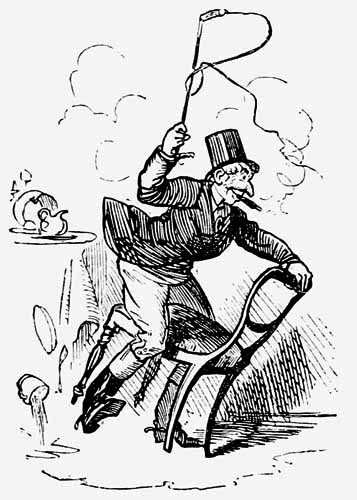
"I unceasingly studied the works of Major Whyte-Melville, and endeavoured to get up a little enthusiasm."—Page 271.
The hearty welcome of the Major, the more subdued but equally inspiriting greeting of his daughter, and the contagious cheerfulness of a house full of pleasant people, in some measure restored me; but it was not until the soothing influence of dinner had taken possession of my bosom, and a whisper had run through the establishment that it was beginning to freeze, that I thoroughly recovered my equanimity, and was able to retire to rest with some small hope that my bed next night would not be one of pain and suffering.
Alas for my anticipations! I was awakened from slumber by a knock at the door, and the man entered my room with a can of hot water in one hand and a pair of tops in the other; while over his arm were slung my—in point of fact, my breeches; a costume which I had never worn except on the day it came home, when I spent the greater portion of the evening sportingly arrayed astride of a chair, to see how it all felt.
"Breakfast at nine, sir. Hounds meet at Blackbrook at half-past ten; and it's a good way to ride," said the servant.
"The frost's all gone, I fea—— I hope?" I said, inquiringly.
"Yes, sir. Lovely morning!" he answered, drawing up the blinds.
In his opinion a lovely morning was characterised by slightly damp, muggy weather; in mine it would have been a daybreak of ultra-Siberian intensity.
I ruefully dressed, lamenting that my will was not a little stronger (nor were thoughts of my other will—and testament—entirely absent), that I might have fled from the trial, or done something to rescue myself from the exposure which I felt must shortly overwhelm me. The levity of the men in the breakfast-room was a source of suffering to me, and even Laura's voice jarred on my ears as she petitioned her father to let her follow "just a little way"—she was going to ride and see the hounds "throw off," a ceremony which I devoutly hoped would be confined to those animals—"because it was too hard to turn back when the real enjoyment commenced; and she would be good in the pony-carriage for the rest of the week."
"No, no, my dear," replied the Major; "women are out of place in the hunting field. Don't you think so, Mr Smoothley?"
"I do, indeed, Major," I answered, giving Laura's little dog under the table a fearful kick as I threw out my foot violently to straighten a crease which was severely galling the inside of my left knee. "You had far better go for a quiet ride, Miss Huntingcrop, and"—how sincerely I added—"I shall be delighted to accompany you; there will be plenty of days for me to hunt when you drive to the meet."
"No, no, Smoothley. It's very kind of you to propose it, but I won't have you sacrificing your day's pleasure," the Major made answer, dashing the crumbs of hope from my hungering lips. "You may go a little way, Laura, if you'll promise to stay with Sir William, and do all that he tells you. You won't mind looking after her, Heathertopper?"
Old Sir William's build would have forbidden the supposition that he was in any way given to activity, even if the stolidity of his countenance had not assured you that caution was in the habit of marking his guarded way; and he made suitable response. I was just debating internally as to the least circuitous mode by which I could send myself a telegram, requiring my immediate presence in town, when a sound of hoofs informed us that the horses were approaching; and gazing anxiously from the window before me, which overlooked the drive in front of the house, I noted their arrival.
Now the horse is an animal which I have always been taught to admire. A "noble animal" he is termed by zoologists, and I am perfectly willing to admit his nobility when he conducts himself with reticence and moderation; but when he gyrates like a teetotum on his hind legs, and wildly spars at the groom he ought to respect, I cease to recognise any qualities in him but the lowest and most degrading.
Laura hastened to the window, and I rose from the table and followed her.
"You pretty darlings!" she rapturously exclaimed. "Oh! are you going to ride The Sultan, Mr Smoothley? How nice! I do so want to, but papa won't let me."
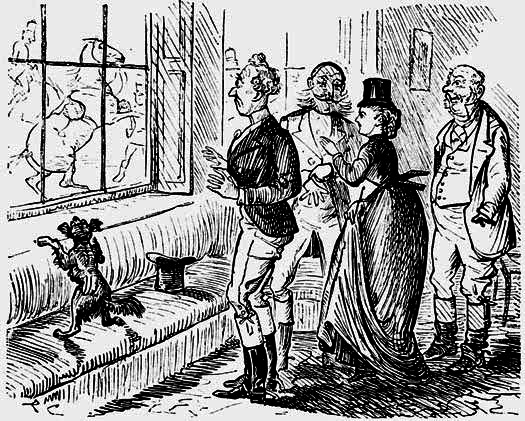
"Gazing anxiously from the window before me, I noted the arrival of the horses. Laura hastened to the window. 'You pretty darlings!' she rapturously exclaimed."—Pages 274-5.
"No, my dear; he's not the sort of horse for little girls to ride;—but he'll suit you, Smoothley; he'll suit you, I know."
Without expressing a like confidence, I asked, "Is that the Sultan?" pointing to a large chestnut animal at that moment in the attitude which, in a dog, is termed "begging."
"Yes; a picture, isn't he? Look at his legs. Clean as a foal's! Good quarters—well ribbed up—not like one of the waspy greyhounds they call thoroughbred horses now-a-days. Look at his condition, too; I've kept that up pretty well, though he's been out of training for some time," cried the Major.
"He's not a racehorse, is he?" I nervously asked.
"He's done a good deal of steeplechasing, and ran once or twice in the early part of this season. It makes a horse rush his fences rather, perhaps; but you young fellows like that, I know."
"His——eye appears slightly blood-shot, doesn't it?" I hazarded; for he was exhibiting a large amount of what I imagine should have been white, in an unsuccessful attempt to look at his tail without turning his head round. "Is he quiet with hounds?"
"Playful—a little playful," was his not assuring reply. "But we must be off, gentlemen. It's three miles to Blackbrook, and it won't do to be late!" And he led the way to the Hall, where I selected my virgin whip from the rack, and swallowing a nip of orange-brandy, which a servant providentially handed to me at that moment, went forth to meet my fate.
Laura, declining offers of assistance from the crowd of pink-coated young gentlemen who were sucking cigars in the porch, was put into the saddle by her own groom. I think she looked to me for aid, but I was constrained to stare studiously in the opposite direction, having a very vague idea of the method by which young ladies are placed in their saddles. Then I commenced, and ultimately effected, the ascent of The Sultan: a process which appeared to me precisely identical with climbing to the deck of a man-of-war.
"Stirrups all right, sir?" asked the groom.
"This one's rather too long.—No, it's the other one, I think." One of them didn't seem right, but it was impossible to say which in the agony of the moment.
He surveyed me critically from the front, and then took up one stirrup to a degree that brought my knee into close proximity with my waistcoat: The Sultan meanwhile exhibiting an uncertainty of temperament which caused me very considerable anxiety. Luckily I had presence of mind to say that he had shortened the leather too much, and there was not much difference between the two, when, with Laura and some seven companions, I started down the avenue in front of the house.
The fundamental principles of horsemanship are three: keep your heels down; stick in your knees; and try to look as if you liked it. So I am informed, and I am at a loss to say which of the three is the most difficult of execution. The fact that The Sultan started jerkily, some little time before I was ready to begin, thereby considerably deranging such plans as I was forming for guidance, is to be deplored; for my hat was not on very firmly, and it was extremely awkward to find a hand to restore it to its place when it displayed a tendency to come over my eyes. Conversation, under these circumstances, is peculiarly difficult; and I fear that Laura found my remarks somewhat curt and strangely punctuated. The Sultan's behaviour, however, had become meritorious to a high degree; and I was just beginning to think that hunting was not so many degrees worse than the treadmill, when we approached the scene of action.
Before us, as we rounded a turning in the road, a group of some thirty horsemen—to which fresh accessions were constantly being made—chatted together and watched a hilly descent to the right down which the pack of hounds, escorted by several officials, was approaching. The Major and his party were cordially greeted, and no doubt like civilities would have been extended to me had I been in a position to receive them; but, unfortunately, I was not; for, on seeing the hounds, the "playfulness" of The Sultan vigorously manifested itself, and he commenced a series of gymnastic exercises to which his previous performances had been a mere farce. I lost my head, but mysteriously kept what was more important—my seat, until the tempest of his playfulness had in some measure abated; and then he stood still, shaking with excitement. I sat still, shaking—from other causes.
"Keep your horse's head to the hounds, will you, sir?" was the salutation which the master bestowed on me, cantering up as the pack defiled through a gate; and indeed The Sultan seemed anxious to kill a hound or two to begin with. "Infernal Cockney!" was, I fancy, the term of endearment he used as he rode on; but I don't think Laura caught any of this short but forcible utterance, for just at this moment a cry was raised in the wood to the left, and the men charged through the gate and along the narrow cart-track with a wild rush. Again The Sultan urged on his wild career—half-breaking my leg against the gate-post, as I was very courteously endeavouring to get out of the way of an irascible gentleman behind me, who appeared to be in a hurry, and then plunging me into the midst of a struggling pushing throng of men and horses.
If the other noble sportsmen were not enjoying themselves more than I, it was certainly a pity that they had not stayed at home. Where was this going to end? and—but what was the matter in front? They paused, and then suddenly all turned round and charged back along the narrow path. I was taken by surprise, and got out of the way as best I could, pulling my horse back amongst the trees, and the whole cavalcade rushed past me. Out of the wood; across the road; over the opposite hedge, most of them—some turn off towards a gate to the right—and away up the rise beyond; passing over which they were soon out of sight.
That The Sultan's efforts to follow them had been vigorous I need not say; but I felt that it was a moment for action, and pulled and tugged and sawed at his mouth to make him keep his head turned away from temptation. He struggled about amongst the trees, and I felt that, under the circumstances, I should be justified in hitting him on the head. I did so; and shortly afterwards—it was not exactly that I was thrown, but circumstances induced me to get of rather suddenly.
My foot was on my native heath. I was alone, appreciating the charms of solitude in a degree I had never before experienced; but after a few minutes of thankfulness, the necessity of action forced itself on my mind. Clearly, I must not be seen standing at my horse's head gazing smilingly at the prospect—that would never do, for the whole hunt might reappear as quickly as they had gone; so, smoothing out the most troublesome creases in my nether garments, I proceeded to mount. I say "proceeded," for it was a difficult and very gradual operation, but was eventually managed through the instrumentality of a little boy, who held The Sultan's head, and addressed him in a series of forcible epithets that I should never have dared to use: language, however, which, though reprehensible from a moral point of view, seemed to appeal to the animal's feelings, and to be successful.
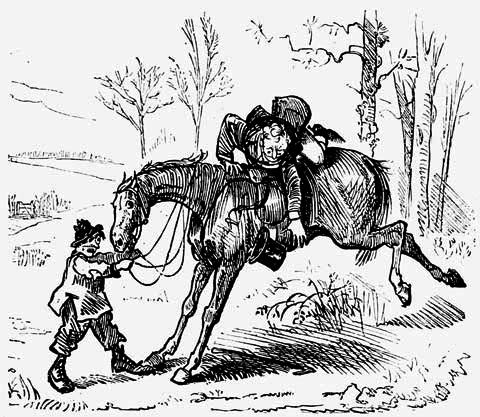
"I proceeded to mount. I say proceeded, for it was a difficult and very gradual operation, but was eventually managed through the instrumentality of a little boy, who held The Sultan's head, and addressed him in a series of forcible epithets that I should never have dared to use."—Page 280.
He danced a good deal when I was once more on his back, and seemed to like going in a series of small bounds, which were peculiarly irritating to sit. But I did not so much mind now, for no critical eye was near to watch my hand wandering to the convenient pommel, or to note my taking such other little precautions as the exigencies of the situation, and the necessity for carrying out the first law of nature, seemed to suggest.
Hunting, in this way, wasn't really so very bad. There did not appear to be so very much danger, the morning air was refreshing and pleasant, and the country looked bright. There always seemed to be a gate to each field, which, though troublesome to open at first, ultimately yielded to patience and perseverance and the handle of my whip. I might get home safely after all; and as for my desertion, where everyone was looking after himself, it was scarcely likely they could have observed my defection. No; this was not altogether bad fun. I could say with truth for the rest of my life that I "had hunted." It would add a zest to the perusal of sporting literature, and, above all, extend the range of my charity by making me sincerely appreciate men who really rode.
But alas! though clear of the trees practically, I was, metaphorically, very far from being out of the wood. When just endeavouring to make up my mind to come out again some day, I heard a noise, and, looking behind me, saw the whole fearful concourse rapidly approaching the hedge which led into the ploughed field next to me on the right. Helter-skelter, on they came! Hounds popping through, and scrambling over. Then a man in pink topping the fence, and on again over the plough; then one in black over with a rush; two, three, four more in different places. Another by himself who came up rapidly, and, parting company with his horse, shot over like a rocket!
All this I noted in a second. There was no time to watch, for The Sultan had seen the opportunity of making up for his lost day, and started off with the rush of an express train. We flew over the field; neared the fence. I was shot into the air like a shuttlecock from a battledore—a moment of dread—then, a fearful shock which landed me lopsidedly, somewhere on the animal's neck. He gives a spring which shakes me into the saddle again, and is tearing over the grass field beyond. I am conscious that I am in the same field as the Major, and some three or four other men. We fly on at frightful speed—there is a line of willows in front of us which we are rapidly nearing. It means water, I know. We get—or rather it comes nearer—nearer—nearer—ah-h-h! An agony of semi-unconsciousness—a splash, a fearful splash—a struggle….
I am on his back, somewhere in the neighbourhood of the saddle: without stirrups, but grimly clutching a confused mass of reins as The Sultan gently canters up the ascent to where the hounds are howling and barking round a man in pink, who waves something brown in the air before throwing it to them. I have no sooner reached the group than the master arrives, followed by some four or five men, conspicuous among whom is the Major.
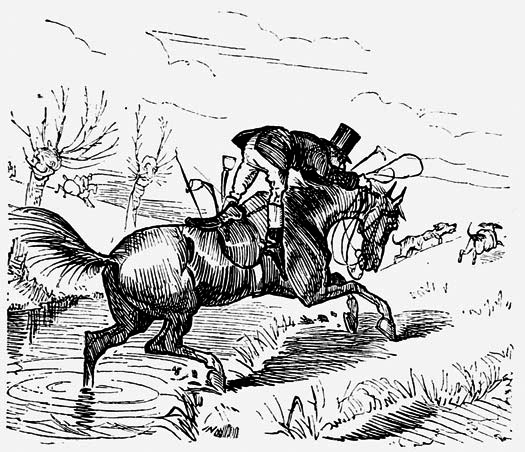
"An agony of semi-unconsciousness—a splash, a fearful splash—a struggle…. I am on his back, somewhere in the neighbourhood of the saddle; without stirrups, but grimly clutching a confused mass of reins as The Sultan gently canters up the ascent to where the hounds are howling."—Page 283.
He hastens to me. To denounce me as an impostor? Have I done anything wrong, or injured the horse?
"I congratulate you, Smoothley,—I congratulate you! I promised you a run, and you've had one, and, by Jove! taken the shine out of some of us. My Lord"—to the master—"let me present my friend, Mr Smoothley, to you. Did you see him take the water? You and I made for the Narrows, but he didn't turn away, and went at it as if Sousemere were a puddle. Eighteen feet of water if it's an inch, and with such a take-off and such a landing, there's not a man in the hunt who'd attempt it! Well, Heathertopper! Laura, my dear,"—for she and the bulky Baronet at this moment arrived at the head of a straggling detachment of followers—"you missed a treat in not seeing Smoothley charge the brook:
'Down in the hollow there, sluggish and idle, Runs the dark stream where the willow trees grow, Harden your heart, and catch hold of your bridle— Steady him—rouse him—and over we go!'
"Isn't that it? It was beautiful!"
It might have been in his opinion; in mine it was simply an act of unconscious insanity, which I had rather die than intentionally repeat.
"I didn't see you all the time, Mr Smoothley; where were you?" Laura asked.
"Where was he?" cried the Major. "Not following you, my dear. He took his own line, and, by Jove! it was a right one!"
It was not in these terms that I had expected to hear the Major addressing me, and it was rather bewildering. Still I trust that I was not puffed up with an unseemly vanity as Laura rode back by my side. She looked lovely with the flush of exercise on her cheek, and the sparkle of excitement in her eyes; and as we passed homewards through the quiet country lanes I forgot the painful creases that were afflicting me, and with as much eloquence as was compatible with the motion of my steed—I ventured!
The blushes deepen on her cheek. She consents on one condition: I must give up hunting.
"You are so rash and daring," she says, softly—very softly, "that I should never be happy when you were out."
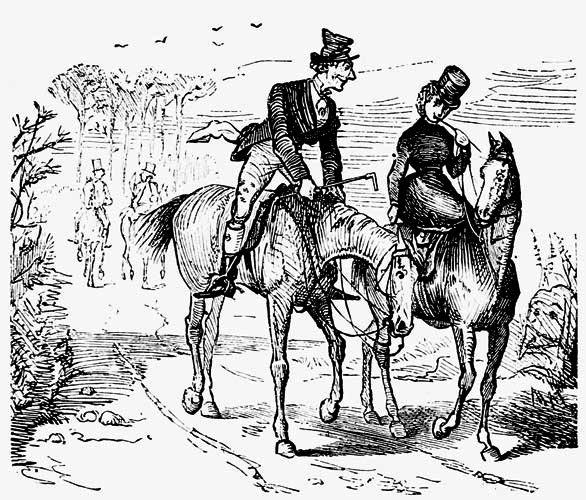
"I trust I was not puffed up with an unseemly vanity, as Laura rode back by my side…. 'You are so rash and daring,' she says softly, 'that I should never be happy when you were out.'"—Pages 284-5.
Can I refuse her anything—even this? Impossible!
I promise: vowing fervently to myself to keep my word; and on no account do anything to increase the reputation I made at Huntingcrop Hall.
A DOG HUNT ON THE BERWYNS
Thanks to the columns of the sporting papers, every Englishman, whatever his occupation, is sufficiently familiar with the details of fox-hunting, and all other kinds of hunting usually practised in merry England; but few, I fancy, have either seen or heard of a dog-hunt. It has fallen to my lot to participate in such a hunt; one, too, which was quite as exciting as a wolf-hunt must have been in the olden time, or as that most glorious of sports, otter-hunting, is now. Imagine to yourself a three days' chase after a fierce and savage dog, a confirmed sheep worrier, and that in the midst of the picturesque ruggedness and grandeur of the Welsh hills.
Some three or four miles east from Bala, the Berwyn Mountains raise their heathery summits in the midst of a solitude broken only by the plaintive bleat of a lost sheep or the shouts of men in search of it.
For miles the purple moorland rolls on without a moving creature to break the stillness. Deep ravines run down on either hand through green, ferny sheep-walks, dotted with innumerable sheep. These ravines in winter time, when the snow lies deep on the hills, are, when not frost-bound, roaring torrents. In the summer, huge blocks of stone are scattered about in strange confusion, and a tiny stream can scarcely find its way between them. Lower down still can be seen, here and there, a farm-house, in some sheltered glen, kept green all the year round by the trickling moisture. Further off still, in the valleys, are villages and hamlets tenanted by hardy Welsh sheep-farmers and dealers.
In the least-exposed corners of the sheep-walks are folds built of loose, unmortared stones, in which the sheep huddle to find shelter from the fury of the frequent storms which sweep over the mountains.
As the wealth of the hill farmers consists chiefly of sheep, if a dog once takes to worrying them, he is either kept in durance vile, or killed. The habit once acquired is never got rid of; and after a sheep-dog has once tasted blood, it becomes practically useless to the farmer. The quantity of sheep that can be killed by such a dog in a short time is almost incredible.
It may be imagined, therefore, with what feelings the Berwyn farmers heard of sheep after sheep being killed on their own and neighbouring farms, by a dog which nobody owned, and which ran loose on the mountains catering for itself. Descending from the lonelier parts of the hills, it would visit the sheep-walks and kill, as it appeared, for the pure love of killing; in most cases leaving the mangled bodies on the spot.
Month after month ran by, and it still eluded the vengeance of the indignant hillmen. The most exaggerated accounts were current respecting its size and ferocity. No two versions agreed as to its colour, though all gave it enormous size. As it afterwards turned out, it was a black and white foxhound bitch.
Everybody carried a gun, but on the few occasions that the dog came within shot, it appeared to be shot proof. The loss of numerous sheep was becoming serious; in some instances the farmers suffered heavily. It was the staple topic of conversation. From time to time, paragraphs, such as the following, appeared in the papers published in the neighbouring towns:—
"The Rapacious Dog.—The noted sheep destroyer on the Berwyn hills still continues to commit his depredations, in spite of all efforts to kill him.
"The last that was seen of him was on Sunday morning, by Mr Jones on the Syria sheep-walk, when the dog was in the act of killing a lamb. Mr Jones was armed with a gun at the time, and tried to get within gunshot range; but it seems that the animal can scent a man approaching him from a long distance, so he made off immediately. After it became known to the farmers and inhabitants of Llandrillo that he had been seen, a large party went up to the mountain at once, and were on the hills all day, but nothing more was heard of him till late in the evening, when he was again seen on Hendwr sheep-walk, and again entirely lost. On Monday a number of foxhounds were expected from Tanybwlch, and if a sight of him can be obtained, no doubt he will be hunted down and captured, and receive what he is fully entitled to—capital punishment."
On a bright May morning, five months after the first appearance of the sheep-destroyer, a pack, consisting of a dozen couple of fox-dogs, with their huntsman, started up the lane from Llandderfel to the hills, followed by a motley crowd of farmers and labourers, armed with guns and sticks, and numbering many horsemen.
Up the lane till the hedges gave place to loose stone walls, higher still till the stone walls disappeared, and the lane became a track, and then a lad came leaping down the hill, almost breathless, with the news that the dog had been seen on a hill some six miles away.
Up the mountain, down the other side, up hill after hill, following the sheep-tracks, the cavalcade proceeded, until we reached the spot where our quarry had been last seen. A line of beaters was formed across the bottom of a glen, and proceeded up the hill. Up above was Dolydd Ceriog, the source of the Ceriog, which came through a rent in the moorland above.
A wilder scene could not be imagined. On either side the hills rose up, until their peaks were sharply defined against the blue. The steep sides were covered with gorse and fern, with fantastic forms of rock peering through. At the bottom the infant Ceriog eddied and rushed over and among rocks of every shape and size, forming the most picturesque waterfalls. In front up the ravine the numerous cascades leaped and glittered, growing smaller and smaller, until the purple belt of moorland was reached.
The hounds quartered to and fro, and the men shouted in Welsh and English. The hardy Welsh horses picked their way unerringly over the débris.
"Yonder he is," was the cry, as up sprang the chase a hundred yards ahead. From stone to stone, from crag to crag, through the water, through the furze and fern fled the dog, and the foxhounds catching sight and scent, followed fast. At first they gained, but when the pursued dog found it was terrible earnest for her, she laid herself well to her work—mute.
Startled by the unusual noise, the paired grouse flew whirring away. The sheep were scattered in confusion, and a raven flew slowly away from a carcase. Upward still we went, the footmen having the best of it on the uneven ground—
"Upward still to wilder, lonelier regions, Where the patient river fills its urn From the oozy moorlands, 'mid the boulders; Cushioned deep in moss, and fringed with fern."
Now the hounds are over the crest, and soon we followed them. We now had the bogs to contend with, worse enemies than the rocks.
"Diawl! John Jones, I am fast," we heard and saw an unfortunate pony up to its belly in the bog. Another stumbles in a crevice and sends its rider headlong. We footmen have still the best of it, although it is no easy matter to run through the heather.
We had now reached the other side of the mountain, and were fast descending into the valley of the Dee. There seemed a probability of our catching the quarry here; but no, she left the heather—much to my relief, it must be confessed—and made for the valley, past a farm; now well in advance of her pursuers; over the meadows; then, for a short distance, along the Bala and Corwen line. Then past Cynwyd village, where the crowd of people, and the various missiles sent after her, failed to stop her. Then through the churchyard, and along the road for some distance.