Chapter VIII · BIOLOGICAL WORK
Reading edition
The biological work done on the journey made by Mr. Anderson and myself through Shensi, along the Ordos border and back into Shansi, resulted in some very interesting discoveries. No fewer than eight new species and five new subspecies were described by Mr. Oldfield Thomas of the British Museum from our collection of mammals. The descriptions of these, together with the names of and notes on the other twenty species represented, were published in the Proceedings of the Zoological Society of London, 1908, pages 963 to 983. A detailed list would therefore be superfluous here, though the following general remarks may be of interest to the reader.
As Mr. Thomas pointed out, the most striking feature of the mammalia of the districts adjoining the Ordos is a general paling of colour, as compared with the nearly related species of the non-desert regions further south and east. This is especially noticeable in the Ordos chipmunk (Eutamias 174asiaticus ordinalis), the hare (Lepus swinhoei subluteus), and the North Shensi sulphur-bellied rat (Epimys confucianus luticolor), and is undoubtedly due to the general pale buff colour of their sandy or loess surroundings.
Amongst the most interesting species in the collection were the three-toed jerboa (Dipus sowerbyi), and the little sand hamster (Phodopus bedfordiæ), both of which inhabit exclusively the sands of the Ordos, and both of which show to a marked degree the light sandy colouring. On the other hand species such as David’s squirrel (Sciurotamias davidianus), the three voles (Microtus johannes, M. (Caryomys) inez and Craseomys shanseius), the little wood pika (Ochotona sorella), the wood mouse (Apodemus speciosus peninsulæ), and Anderson’s hamster (Cricetulus andersoni), all of which inhabit the forested and mountainous districts of Western Shansi, show none of this paling of colour.
Another interesting feature in the mammalia of these regions is the extreme scarcity of Insectivores. The only member of this group secured on this journey was the hedgehog (Erinaceus miodon), while the only other Insectivores hitherto secured in or near the desert regions are the mole (Scaptochirus gillesei) and a shrew (Crocidura sp.), from the T’ai-yüan Fu plain in Shansi. It is interesting to compare the paucity of this class of mammals on the north-western border of China, 175with their comparative abundance in the not very distant districts of South-western Kansu, Ssŭ-chuan, Corea, and the Japanese Islands. Recently Mr. Anderson has collected no fewer than nine species of shrews, and two moles, besides the remarkable Neotetracus sinensis from the province of Ssŭ-chuan and the neighbouring districts of South-western Kansu. Previous to this he collected three species of shrews and two moles in Corea, and no less than eight species and subspecies of moles, and eleven species and subspecies of shrews in Japan and the neighbouring islands.
Judging from what we know of the climatic conditions of these several districts, one is naturally led to suppose that Insectivores require a country with a humid atmosphere, and damp, well vegetated soil wherein to thrive.
This is not so much the case with rodents, so that we find this class of mammals greatly predominating throughout the whole region along the Sino-Mongolian borderland. Of the thirty-one species secured on our journey, twenty-five were rodents, represented by three hundred and twenty-four specimens, while the seven remaining species, including a bat (Myotis sp.), the hedgehog (Erinaceus miodon), a cat (Felis catus), a wolf (Canis lupus tschiliensis), a fox (Vulpes vulpes), a marten (Martes flavigula borealis), and a badger (Meles leptorhynchus), were represented by only seventeen specimens. One mammal seen, but 176not secured, was the antelope (probably Gazella subgutturosa).
The Ordos hedgehog (Erinaceus miodon), which was one of the new discoveries of this expedition, is a light-coloured species, closely related to the Chihli and Shantung form, E. dealbatus. Its chief characteristic is that it has “no wholly white spines intermixed with the brown-ringed ones.” This hedgehog seems to belong exclusively to Mongolia, as we never heard of it south of the Wall. The nearest locality in Shensi at which hedgehogs have been secured is Pao-chi in the Wei River basin, where Father Hugh discovered a new species (E. hughi), named after him by Mr. Thomas. The food of the Ordos hedgehog seems to consist of beetles, numerous varieties of which swarm over the sandhills.
The badger from this district is identical with Meles leptorhynchus described from Peking. This animal exists all over North China and is very common in certain places. The Chinese value dressed badger skins, which make excellent damp-resisting rugs. The Manchurian hunter wears a badger skin hanging from his waist at the back, thus ensuring a dry seat when out in the snows and rains. The badger is a great robber of melon patches and maize fields, in search of which he will travel long distances during the night.
Amongst the chipmunks obtained by us two new subspecies were discovered, namely, Eutamias 177asiaticus intercessor and E. a. ordinalis. Of these the latter is a pale desert form found on the borders of the Ordos, the former being intermediate in colour between E. a. ordinalis and E. a. senescens from Chihli. The chipmunks are beautiful little creatures, making lively and entertaining pets. They are to be found all over the hilly and mountainous districts of North China, in some places being extremely abundant.
The sulphur-bellied rat (Epimys confucianus luticolor), secured near Yen-an Fu in Shensi, turned out to be a new subspecies. These rats are inhabitants of the rocky valley sides and ravines in the loess country. They are characterized by the pale sulphur yellow colour of their belly fur, their long white-tipped hairy tails and large ears. The chief subspecific characteristics of the Shensi form are its pale colour and delicate build, differing from true confucianus in the first respect and from the Shantung from E. c. sacer in the second.
The next new subspecies is the giant hamster (Cricetulus triton incanus), which differs from the Chihli and Shantung species in being of a paler colour and of a less heavy build. This rodent is very common in certain districts. It lives in burrows, which go down into the earth in a straight, perpendicular, smooth, round shaft. Like all hamsters, this animal has a predilection for storing grain, which it steals from the farmers’ fields.
178Another hamster which was a new discovery has already been mentioned. The little sand hamster (Phodopus bedfordiæ), whose home is in the sand of the Ordos, is one of the most beautiful little creatures imaginable. It makes an excellent pet, being absolutely fearless of man, even when just caught. Amongst themselves these little creatures are terrible fighters. Originally placed in the genus Cricetulus, it was subsequently placed by Mr. Miller in a new genus of its own, called Phodopus, owing to the coalescence of the lobes on the sole of the foot into one ball.
Microtus johannes, a hill inhabiting vole from Western Shansi, was another new species, as also was Microtus (Caryomys) inez, another small vole from the same locality.
Of the two species of molerat (Myospalax cansus and M. fontanus), the latter from Ning-wu Fu was first identified as M. fontanieri, but has since been described as a new species. The other species found in Shensi and the Ordos seems to be identical with Lyon’s Kansu variety.
The Ordos jerboa (Dipus sowerbyi) was also a new discovery on the expedition, it being entirely different from anything of the kind hitherto found in Eastern Asia. Its nearest ally in these parts is the allactaga (Allactaga mongolica), a single specimen of which was secured at Ning-wu Fu.
The Shensi and Ordos hare (Lepus swinhoei 179subluteus) was described as a new subspecies, its distinguishing feature being a general paling of colour.
The two remaining species in the collection, which were new to science, are two pikas, Ochotona bedfordi and O. sorella, both described from the Ning-wu Fu district in Shansi. The first is a large pika allied to O. dauurica from the Mongolian Plateau, but with larger bullæ and slightly larger in size. In colour it is slightly paler than the Mongolian form. In habits the two animals are very similar. Some pikas caught at Yen-an Fu in Shansi were also referred to this species, but a specimen in its winter coat secured by me near Yen-an Fu, on the Clark Expedition, was distinctly paler and less yellow than a specimen from Ning-wu Fu district taken by me on our expedition up the Fên Ho in the winter of 1909–10.
The other pika (O. sorella) was trapped by me in a wood. It is a very small, dark-coloured species, nearly related to O. cansa from Kansu.
The next collection from North China was that made on the Clark Expedition from September, 1908, to the same month in 1909. The details of this collection were published in Through Shên-Kan, and may be found in the appendix attached to that book.
Owing to unavoidable delay, the description of the new roe-deer, Capreolus melanotis, secured 180in Kansu on this expedition was not published in time to be embodied in the volume already mentioned. This roe-deer was described in the Proceedings of the Biological Society of Washington, Vol. XXIV, pp. 231–232, by Mr. Gerrit S. Miller, Jr., who says: “Resembling Capreolus bedfordi in essential characters, including the hypsodent form of the teeth, but colour of summer pelage more reddish, and outer surface of ear mostly clear black, in striking contrast with surrounding parts.” The type specimen was an immature female collected thirty miles east of Ching-yang Fu, Kansu, China.
After the Clark Expedition, my wife and I made collections in the T’ai-yüan Fu district, during the months of October and November, 1909. Details of these collections appear hereafter in this chapter.
Subsequently in the course of the journey made by us up the Fên Ho, a most interesting collection was made. This journey intersected that made by Anderson and myself at Wu-tsai Hsien and Ning-wu Fu, but it so happened that while my wife and I made a large collection at Wu-tsai Hsien, and secured nothing at Ning-wu Fu, the very reverse was the case with Anderson and myself. On the Wu-tsai plain the species collected, with but few exceptions, were identical with many of those already secured in and round the Ordos.
PLATE XIII.
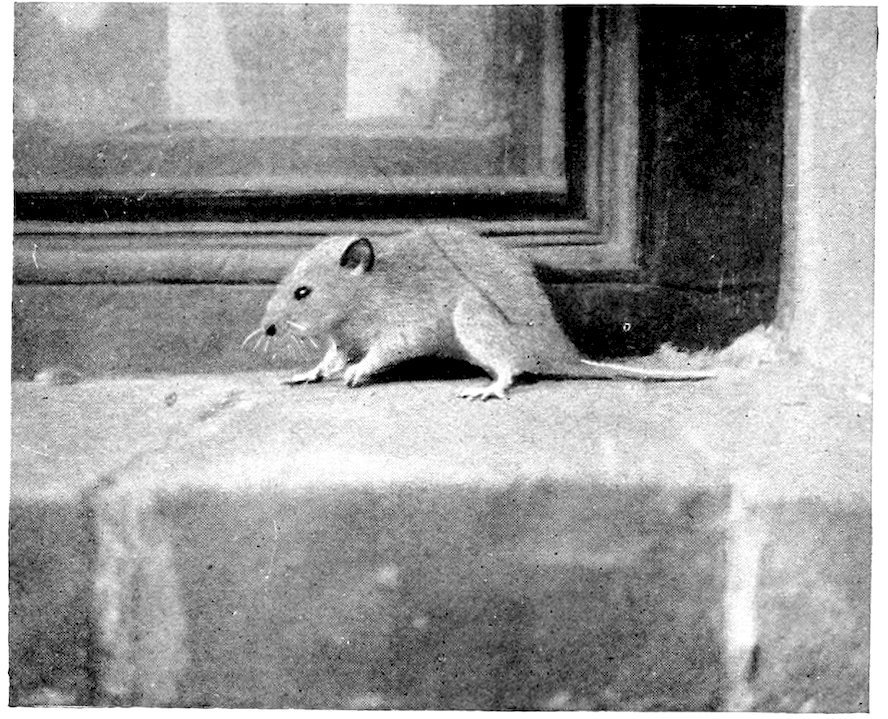
Giant Hamster (Cricetulus triton incanus).
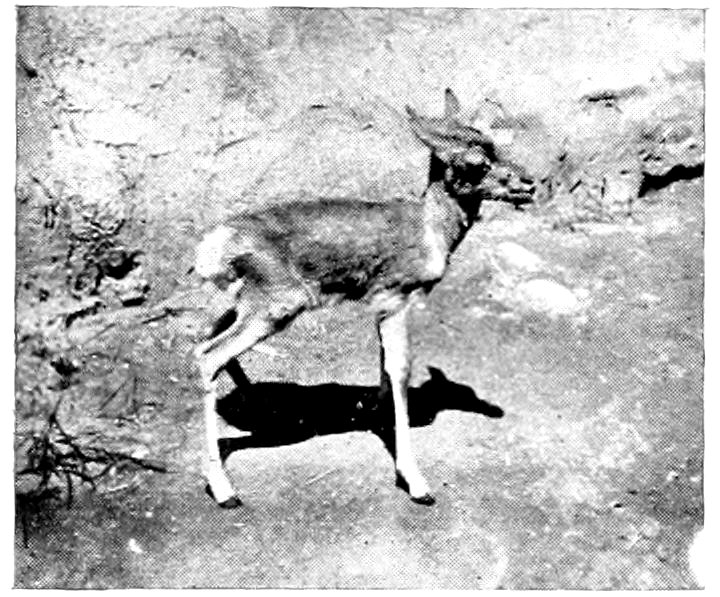
Young Antelope.
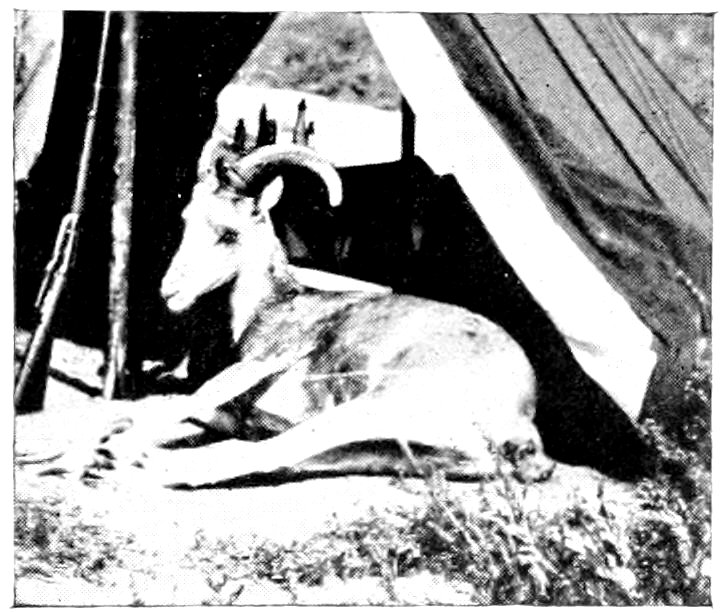
Wild Sheep. Opposite p. 180.
181The biological work of the year ending in August, 1912, as might be expected, was very much hampered by the unsettled state of the country. From October 27, 1911, to May 10, 1912, more than half the year, not a single specimen was added to my collection, except three antelope skulls, which I purchased in the Tientsin game market. Subsequently we tried to make up for lost time, making collections during the summer in North Shansi and on the Mongolian Plateau. Altogether from October, 1909, to August, 1912, about two hundred and seventy specimens of mammals were collected, including forty-five species and subspecies.
Very little was done in the way of collecting birds or cold-blooded vertebrates, while invertebrates were left entirely alone. It was unfortunate that I could not do more in these branches of zoology, but reptiles and amphibians were almost non-existent in most of the localities visited. It was only in Mongolia that insects were at all plentiful, and while travelling in that country I had my time occupied with other important work.
Following is a list of the different species and subspecies of mammals obtained on the various expeditions subsequent to the Clark Expedition. For the sake of the general reader I have given popular names of my own to distinguish the different forms.
1.182
Hedgehog. Erinaceus dealbatus, Swinhoe.
2.
Mole. Scaptochirus gillesei, Thos.
3.
Shrew. Crocidura sp.
4.
Leopard. Felis fontanieri, M.-Edw.
5.
Marten. Martes flavigula borealis, Radde.
6.
Siberian mink. Mustela sibirica, Pallas.
7.
Small mink. Mustela sp.
8.
Polecat. Mustela larvata, Hodgson.
9.
Badger. Meles leptorhynchus, M.-Edw.
10.
Wolf. Canis lupus tschiliensis, Matsch.
11.
Fox. Vulpes vulpes subsp.
12.
Flying squirrel. Sciuropterus sp.
13.
David’s squirrel. Sciurotamias davidianus, M.-Edw.
14.
Chipmunk. Eutamias asiaticus intercessor, Thos.
15.
Mongolian suslik. Citellus mongolicus umbratus, Thos.
16.
Large gerbil. Meriones auceps, Thos.
17.
Sand gerbil. Meriones psammophilus, M.-Edw.
18.
Mongolian gerbil. Meriones unguiculatus, M.-Edw.
19.
Common house mouse. Mus wagneri mongolium, Thos.
20.
Sulphur-bellied rat. Epymis confucianus luticolor, Thos.
21.
Woodmouse. Apodemus speciosus peninsulæ, Thos.
22.
Giant hamster. Cricetulus triton incanus, Thos. 183
23.
Anderson’s hamster. Cricetulus andersoni, Thos.
24.
Striped hamster. Cricetulus griseus, M.-Edw.
25.
Mongolian striped hamster. Cricetulus griseus obscurus, Thos.
26.
Campbell’s hamster. Cricetulus campbelli, Thos.
27.
Desert hamster. Phodopus bedfordiæ, Thos.
28.
Mandarin vole. Microtus mandarinus, M.-Edw.
29.
Light-coloured mountain vole. Microtus johannes, Thos.
30.
Dark-coloured mountain vole. Microtus pullus, Miller.
31.
Mongolian narrow-headed vole. Microtus angustus, Thos.
32.
Mongolian camp vole. Microtus warringtoni, Miller.
33.
Shansi red-back vole. Craseomys shanseius, Thos.
34.
Ning-wu molerat. Myospalax fontanus, Thos.
35.
Mongolian allactaga. Allactaga mongolica, Radde.
36.
Sowerby’s hare. Lepus swinhoei sowerbyæ, Hollister.
37.
Mongolian hare. Lepus tolai, Pallas.
38.
Duke of Bedford’s pika. Ochotona bedfordi, Thos.
39.
Mongolian pika. Ochotona dauurica, Pallas. 184
40.
Wood pika. Ochotona sorella, Thos.
41.
Wild pig. Sus sp.
42.
Wapiti. Cervus canadensis subsp.
43.
Roe-deer. Capreolus bedfordi, Thos.
44.
Wild sheep. Ovis jubata, Peter.
45.
Goitred antelope. Gazella subgutturosa.
PLATE XIV.
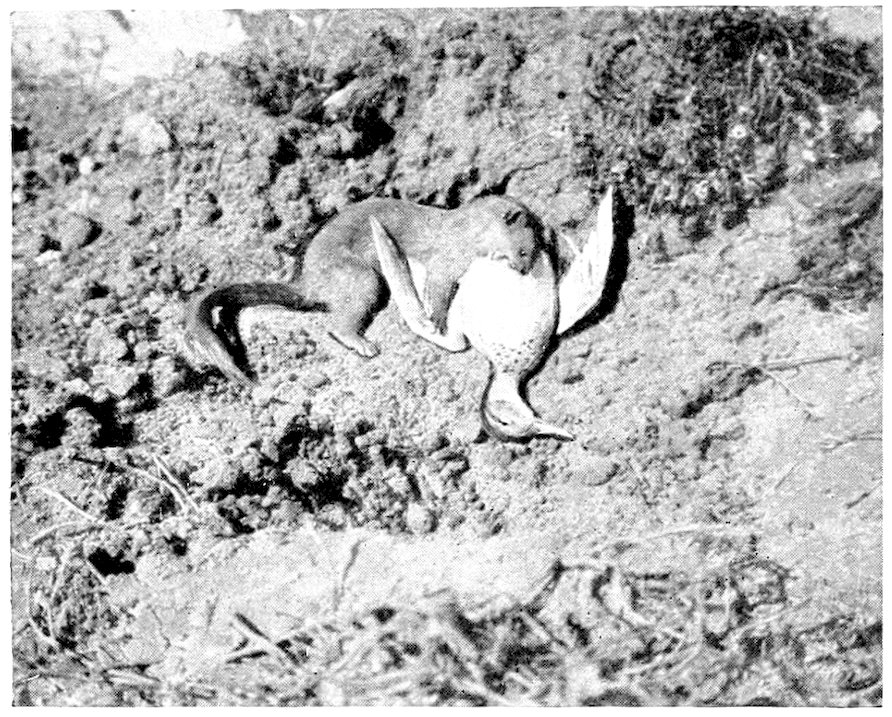
Mink (Mustela sibirica) Eating Teal.
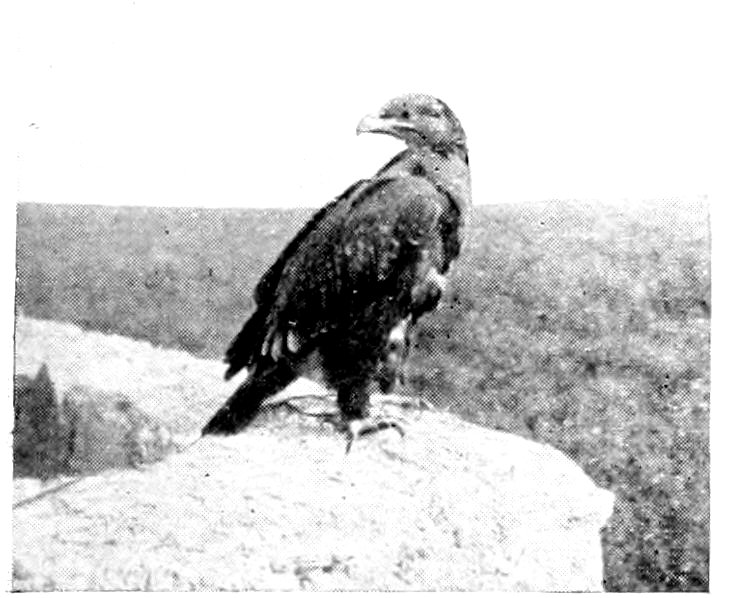
Golden Eagle.
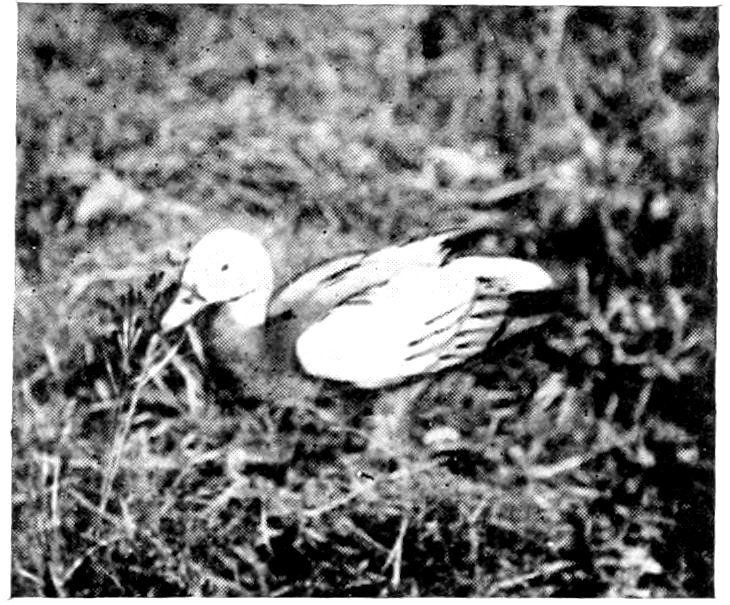
Ruddy Sheld-Duck. Opposite p. 192.]
Following are details concerning the specimens of the above listed species and subspecies collected since October, 1909, and sent to the Smithsonian Institution, Washington.
1. Erinaceus dealbatus, Swinhoe.
One specimen, ♂︎. Tientsin, Chihli. Almost sea level.
This hedgehog was first described by Swinhoe from Peking. It is comparatively common round Tientsin, where it is revered by the natives as a “Great Spirit.” Owing to this fact it enjoys immunity from molestation. The Chinese name is “T’si wei,” meaning “thorny animal” (T’si = thorn, wei = animal).
2. Scaptochirus gillesei, Thos.
Four specimens, 2 ♂︎♂︎, 1 ♀︎, 1 skeleton only. Wu-tsai, 20 miles W. of Ning-wu Fu, Shansi. 6,000 ft.[7]
Moles seemed to be rather abundant on this plain. The specimens secured were 185brought in by the natives. This mole has also been recorded from Yü-lin Fu, on the border of the Ordos, from T’ai-yüan Fu, in Shansi, and from South Shansi. It was originally described from the last mentioned place.
Its Chinese name is “Ti chu,” meaning “ground hog” (Ti = earth, ground; chu = pig, or hog).
3. Crocidura sp.
Three specimens, 2♂︎♂︎, 1 ♀︎ (immature). 5 miles S. of T’ai-yüan Fu, Shansi. 2,600 ft.
Owing to the immaturity of these specimens it has been impossible to identify them with any hitherto known species. They appear to be most like Crocidura coreæ, which species is found in the neighbouring province of Chihli. Shrews are evidently very scarce in Shansi, no other specimens having yet been recorded.
4. Felis fontanieri, M.-Edw.
One specimen from near T’ai-yüan Fu, Shansi.
The skin and skull were purchased from a native, so that no flesh measurements could be taken. The leopard is comparatively common in the mountains of Shansi, being 186much hunted for its fine coat in winter. It is also found in Shensi, Kansu, Ssŭ-chuan, Chihli and Honan.
Chinese name = Pao-tzŭ.
5. Martes flavigula borealis, Radde.
One specimen. No measurements. T’ai-yüan Fu, Shansi.
This specimen also was secured by a native hunter. The marten is a handsome animal, with dark grey-brown upper parts, bright yellow throat and black legs and tail, the latter being long and bushy. About the size of a large cat, this animal is very savage, and commits serious depredations upon the chicken roosts of the villages. The marten inhabits almost exclusively the loess hills. The Chinese always refer to it as the animal that “eats cats.”
Its Chinese name is Huang yao, (Huang = yellow, yao = marten).
6. Mustela sibirica, Pallas.
Two specimens, ♀︎♀︎. 5 miles S. of T’ai-yüan Fu, Shansi. 2,600 ft.
One specimen, ♂︎. Tientsin, Chihli. Sea
level.
This mink is found all over North China, but is especially common round towns in low-lying, swampy districts. It frequents 187human habitations, where it preys upon rats, mice and the occupants of the poultry yard. This mink has nothing to boast of in the way of fur, but skins are shipped in great numbers from North China to Europe under the name of weasel.
The Chinese name, “Huang hsu lang,” means “Yellow rat wolf.”
7. Mustela sp.
One skin from the Ning-wu district in West Shansi.
A small musteline, closely resembling in colour the foregoing species, but having a much shorter tail. As yet this specimen cannot be identified.
8. Mustela larvata, Hodgson.
Three incomplete specimens (two skins and one skull). Wu-tsai, 20 miles W. of Ning-wu Fu, Shansi. 6,000 ft.(?)
These specimens were indistinguishable from those secured in Kansu on the Clark Expedition, though the winter fur showed a distinct lightening in colour, one skin being almost white. So far, this species has not been discovered east of the Wu-tsai plain, though the natives of K’uei-hua-ch’êng, North Shansi, described an animal very similar to this polecat.
188Chinese name in Kansu, “Sao-hu-tzŭ,” meaning “Ermine fox”; in Shansi, Ngai ho (ho = ape or monkey).
9. Meles leptorhynchus, M.-Edw.
One specimen, ♂︎. Tabool, 100 miles N. of Kalgan, Mongolia. 4,000 ft.
The single specimen of the badger was shot and presented to my collection by Mr. F. A. Larson. While in the Tabool district we saw several badgers, but they always succeeded in escaping into their holes before we could capture them. We also failed to secure any with traps.
The Chinese name is “Huan-tzŭ.”
10. Canis lupus tschiliensis, Matsch.
Two specimens, ♀︎♀︎. Wu-tsai, 20 miles W. of Ning-wu Fu, Shansi. 6,000 ft. (?)
Wolves in this district were very common, and stories of their depredations came to our ears continually. Fourteen were seen on the journey, but they were nearly always out of range of my rifle. The Chinese distinguish two varieties, named respectively “ts’ai” and “lang.” The former refers to the smaller and more yellow-coloured wolves; the latter to the large grey animals, which do so much damage to the village livestock, and frequently attack human beings. 189The wolves seen in the extreme north of Shansi were large and of a very pale colour, with long hair. Two seen on the Mongolian Plateau near Lama Miao were, on the other hand, rather dark, though in size they surpassed the Shansi variety. The winter skins from K’ou-wai, that is beyond the northern passes of China, meaning Mongolia generally, command a much better price in the fur market than do the skins from China proper. They are of a far better quality, the hair being longer, thicker and softer, and usually of a much lighter colour. These skins also are generally larger than those from further south.
11. Vulpes vulpes subsp.
Three specimens. One skull, 20 miles S.W. of Ning-wu Fu, Shansi. 5,700 ft.
One skull, and one complete specimen, ♂︎.
Wu-tsai, 20 miles W. of Ning-wu Fu,
Shansi.
The fox, like the wolf, has a very wide distribution in North China. Annually great numbers of skins are exported from Tientsin.
Its Chinese name is “Hu li” or “Hu-tzŭ.”
12. Sciuropterus sp.
Nine specimens, 4 ♂︎♂︎, 5 ♀︎♀︎. Mountains 10 miles S. of Wu-tsai, Shansi. Altitude, 8,000 ft.
190One skin and skull, without measurements, was received from a native hunter who said it came from about 70 miles N.N.W. of T’ai-yüan Fu—this would be about the same locality as the above. It was at first thought that this was a new form, but Büchner’s description of a species from Kansu so exactly agrees with it, though from so widely distant a locality, that our species cannot be separated, at least, till specimens from both places have been compared. A somewhat rare animal, it is found only in the largest forests of the high mountain ranges, where it hides in holes in trees, coming out only in the evening. These squirrels are difficult to trap and are not easily kept alive in captivity. The latter fact is due doubtless to the difficulty in supplying their natural diet.
The Chinese name “Fei-hsu” means “Flying rat.” (Fei = to fly; hsu = rat.)
13. Sciurotamias davidianus, M.-Edw.
Five specimens, ♀︎♀︎. 50 miles N.W. of T’ai-yüan Fu, Shansi. 5,500 ft. and 6,000 ft.
Four specimens, 2 ♂︎♂︎, 2 ♀︎♀︎. Mountains
70 miles N.N.W. of T’ai-yüan Fu, Shansi.
7,000 ft.
The first specimens of this very widely distributed squirrel were obtained by myself; the other four by a native hunter. All came 191from the same general district, where they are very common.
14. Eutamias asiaticus intercessor, Thos.
Four specimens, 2 ♂︎♂︎, 2 ♀︎♀︎. Mountains 50 miles N.N.W. of T’ai-yüan Fu, Shansi. 6,000 ft.
One specimen, ♀︎. Mountains 70 miles
N.N.W. of T’ai-yüan Fu, Shansi.
7,000 ft.
One specimen, ♀︎. Mountains 30 miles W.
of K’uei-hua-ch’êng. North Shansi. 7,000
ft.
As already stated, the chipmunk is an intermediate form between that of the Ordos (Eutamias asiaticus ordinalis) and that from the mountains west of Peking (E. a. senescens).
Its Chinese name is “Ke li.”
15. Citellus mongolicus umbratus, Thos.
Four specimens, ♀︎♀︎. 20 miles W. of Lama Miao, Mongolia. 4,000 ft.
Two specimens, ♀︎♀︎. 50 miles W. of Lama
Miao, Mongolia. 4,000 ft.
Six specimens, ♂︎♂︎. Tabool, 100 miles N.
of Kalgan, Mongolia. 4,000 ft.
This ground squirrel, which closely resembles the species from China proper and the Ordos, is extremely common throughout the region we traversed. The six specimens 192from Tabool are topotypes, the subspecies having been described by Mr. Thomas from specimens taken by Anderson in this district.
One of the four specimens taken 20 miles west of Lama Miao, inside the ruins of Sui-lang-ch’êng, is remarkable in having a much greyer and softer pelt than any of the others. At first sight I took it to be a totally different animal, but from an examination of its skull and its other characteristics it seems to belong to the same species.
The Chinese name is “Sha hsu,” meaning “Sand rat” (Sha = sand; hsu = rat).
16. Meriones auceps, Thos.
Five specimens, 1 ♂︎, 4 ♀︎♀︎. Wu-tsai, 20 miles W. of Ning-wu Fu, Shansi. 6,000 ft. (?)
Originally described from the T’ai-yüan Fu district, Mr. Thomas says of it: “Of the other Chinese Meriones described, this very pretty species may be distinguished from M. unguiculatus by its whitish claws, buffy ears, whiter bullæ, and less blackened tail; from M. psammophilus by its larger size and buffy ears; and from both by its enormously large bullæ, which indicate that it is not really closely allied to either of them.”
This species is purely nocturnal in its habits, which may account for the “enormously 193larger bullæ,” than in the other two species, of which M. unguiculatus is entirely diurnal and M. psammophilus partly so.
M. auceps has also been recorded from North Shensi, as well as from the Ordos Desert itself.
Chinese name “Huang hsu,” meaning “Yellow rat.”
17. Meriones psammophilus, M.-Edw.
Eight specimens, 6 ♂︎♂︎, 2 ♀︎♀︎. 5 miles S. of T’ai-yüan Fu, Shansi. 2,600 ft.
Two specimens, ♂︎♂︎. 20 miles N.W. of T’ai-yüan
Fu. Shansi. 3,950 ft.
A very common species in these districts. It inhabits sandy places, from which fact it derives its name. It is smaller than either of the other two gerbils already mentioned, though in colour it more closely resembles M. auceps.
Chinese name as in M. auceps.
18. Meriones unguiculatus, M.-Edw.
Two specimens, ♂︎, ♀︎. Tabool, 100 miles N. of Kalgan, Mongolia. 4,000 ft.
This gerbil differs from the first named species in being of a more sandy colour, in the absence of the white underparts, and in the smaller bullæ. It is found in the Ordos Desert and in Northern Shansi, as well as in 194the present district. In the first named country it is very common, often living in large colonies. It is diurnal in its habits.
19. Mus wagneri mongolium, Thos.
Three specimens, 2 ♂︎♂︎, 1 ♀︎. 5 miles S. of T’ai-yüan Fu, Shansi. 2,600 ft.
Six specimens, 2 ♂︎♂︎, 4 ♀︎♀︎. Tabool, 100 miles
N. of Kalgan, Mongolia. 4,000 ft.
The second series of mice is topotypical, the subspecies having been described from this locality by Mr. Thomas, from six specimens taken by Mr. Anderson in 1907. As Mr. Thomas points out, it is darker than M. wagneri from Central Asia. M. wagneri mongolium occurs all over North China, and is very common.
20. Epimys confucianus luticolor, Thos.
Five specimens, 1 ♂︎, 4 ♀︎♀︎. Lung-wang Shan, 20 miles E. of T’ai-yüan Fu, Shansi. 4,000 ft.
Three specimens, 1 ♂︎, 2 ♀︎♀︎. Mountains,
50 miles N.W. of T’ai-yüan Fu, Shansi.
5,500 ft.
One skull, ♀︎, one complete specimen, ♂︎.
Mountains 30 miles W. of K’uei-hua-ch’êng,
N. Shansi. 7,000 ft.
Usually common in rocky ravines in mountainous country, this rat enjoys a wide distribution. 195It is a very voracious animal, and readily eats its companions when trapped. In certain parts where the natives lay their dead in holes along the rocky valley sides these rats live upon the corpses. While in North Shansi we heard a gruesome tale, how a lonely mountaineer fell ill and before help came was horribly gnawed by these rats. The subspecies was originally described from Yen-an Fu.
21. Apodemus speciosus peninsulæ, Thos.
Thirteen specimens, 5 ♂︎♂︎, 8 ♀︎♀︎. Lung-wang Shan, 20 miles E. of T’ai-yüan Fu, Shansi. 4,000 ft.
Four specimens, 2 ♂︎♂︎, 2 ♀︎♀︎. 50 miles N.W.
of T’ai-yüan Fu, Shansi. 5,500 ft.
Five specimens, 2 ♂︎♂︎, 3 ♀︎♀︎. Mountains
30 miles W. of K’uei-hua-ch’êng, N.
Shansi. 7,000 ft.
The last five specimens all agree with the others taken further south in Shansi and those recorded from Shensi, which have been referred to this subspecies. So far this is the most northerly point from which this species has been recorded. It is one of the commonest inhabitants of the mountainous and wooded areas, and is found at altitudes varying from 3,000 ft. to 8,000 ft. It was first described from Corea.
196
22. Cricetulus triton incanus, Thos.
Eleven specimens, 5 ♂︎♂︎, 6 ♀︎♀︎. 5 miles S. of T’ai-yüan Fu, Shansi. 2,600 ft.
Three specimens, 2 ♂︎♂︎, 1 ♀︎. Lung-wang
Shan, 20 miles E. of T’ai-yüan Fu,
Shansi. 4,000 ft.
One specimen, ♀︎. Mountains 50 miles N.W.
of T’ai-yüan Fu, Shansi. 5,500 ft.
A very common species upon the T’ai-yüan Fu plain, where it does much damage to crops. It was originally described from Shansi.
Chinese name, “Pan ts’ang êrh (Ts’ang = store).”
23. Cricetulus andersoni, Thos.
Seven specimens, 3 ♂︎♂︎, 4 ♀︎♀︎. 5 miles S. of T’ai-yüan Fu, Shansi. 2,600 ft.
Three specimens, 2 ♂︎♂︎, 1 ♀︎. Lung-wang
Shan, 20 miles E. of T’ai-yüan Fu,
Shansi. 4,000 ft.
Seven specimens, 3 ♂︎♂︎, 4 ♀︎♀︎. 50 miles
N.W. of T’ai-yüan Fu, Shansi. 5,500 ft.
This hamster is very common throughout Shansi and Shensi. Recorded also from Kansu.
24. Cricetulus griseus, M.-Edw.
Seven specimens, 6 ♂︎♂︎, 1 ♀︎. Wu-tsai, 20 miles W. of Ning-wu Fu, Shansi. 6,000 ft.
197This species seems to replace C. andersoni on the Wu-tsai plain, and other non-mountainous districts of North China. In habits the two closely resemble each other. Griseus has a shorter tail and is characterized by a dark median dorsal line, otherwise closely resembling andersoni.
25. Cricetulus griseus obscurus, M.-Edw.
Two specimens, ♂︎, ♀︎. Tabool, 100 miles N. of Kalgan, Mongolia. 4,000 ft.
Milne-Edwards described a hamster from Sartchy (or Saratsi or Sa-la-ch’i), 40 miles west of K’uei-hua-ch’êng, giving it the name of Cricetulus obscurus. Some specimens of hamsters taken by Mr. Anderson at Tabool were referred to Milne-Edwards’ C. obscurus by Mr. Thomas, who considered that this species should be considered as a subspecies of C. griseus, under the name of Cricetulus griseus obscurus. This being the case, it is possible that the specimens from Wu-tsai, identified as C. griseus, should really be C. g. obscurus. These specimens were in their winter coat, which being very grey seemed to agree more with C. griseus from Shantung and Chihli.
Mr. Anderson, when collecting in the present district, found this hamster very common. We found it rather rare, but this may be due 198to the fact that our visit was during a very good year, when, owing to a greater abundance of food, they may have been less tempted to enter our traps. We failed to find their burrows.
26. Phodopus campbelli, Thos.
Two specimens, ♂︎, ♀︎. Tabool, 100 miles N. of Kalgan, Mongolia. 4,000 ft.
From its general appearance, and the coalescence of the lobes of the foot into one ball, this species certainly ought to be referred to Mr. Miller’s new genus Phodopus.
This interesting little hamster was originally described by Mr. Thomas from almost the same district, so that these specimens are practically topotypes. Mr. Anderson found this species also very common, which again was contrary to our experience.
27. Phodopus bedfordiæ, Thos.
One specimen, ♀︎. Wu-tsai, 20 miles W. of Ning-wu Fu, Shansi. 6,000 ft. (?)
Judging from the tracks in the sand this little hamster is evidently fairly common in this locality.
Its Chinese name is “Mi-ts’ang”—means “Storer of millet.”
28. Microtus angustus, Thos.
199Four specimens, 2 ♂︎♂︎, 2 ♀︎♀︎. Tabool, 100 miles N. of Kalgan, Mongolia.
This interesting vole, belonging to the “Stenocranius” group, was described by Mr. Thomas from a single specimen taken by Mr. Anderson in this district in 1907. This vole differs from the following species in the extreme narrowness of its skull.
I found them comparatively common, but so voracious that many trapped specimens were completely destroyed by their companions before I could secure them. They seemed to be nocturnal in their habits. Their burrows usually ran just under the earth’s surface for a considerable distance, the broken up earth marking their course as in the case of the excavations of moles and mole rats. They appear to live in colonies much as do the gerbils.
29. Microtus mandarinus, M.-Edw.
One specimen, ♂︎. 5 miles S. of T’ai-yüan Fu, Shansi. 2,600 ft.
It has been found impossible to separate this single specimen from M. mandarinus, though their localities are so far apart. This is evidently a somewhat rare species in Shansi. It is readily distinguishable from any of the following species by its powerfully built skull. In colour it resembles M. johannes.
200
30. Microtus johannes, Thos.
Five specimens, 4 ♂︎♂︎, 1 ♀︎. Wu-tsai, 20 miles W. of Ning-wu Fu, Shansi. 6,000 ft. (?)
The type of this species was described from the mountainous district west of K’o-lan Chow, about 20 miles south-east of the present locality. Owing to their close similarity it was found impossible to separate the specimens from the two different localities, in spite of the fact that one series was taken on a plain and the other on the tops of high mountains.
31. Microtus pullus, Miller.
Two specimens, 1 ♂︎, 1 ♀︎. Mountains 50 miles N.W. of T’ai-yüan Fu, Shansi. 5,500 ft.
Though in dimensions of body and skull, and in general shape, this vole closely resembles the preceding species, M. johannes, its very much darker colour at once renders it distinct. It was described by Mr. Miller as new from specimens taken in the Chiao-ch’êng Shan, some 50 miles south of the present locality. It frequents the open glades in the highest mountain regions.
32. Microtus warringtoni, Miller.
Six specimens, 1 ♂︎, 5 ♀︎♀︎. Tabool, 100 miles N. of Kalgan, Mongolia. 4,000 ft.
This is a pale-coloured vole, about the same 201size as M. mandarinus, but with a very much smaller skull. The skull is narrower than in either M. johannes or M. pullus, but not nearly so narrow as in M. angustus. Of a lighter colour than M. angustus, it has a larger hind foot, though in other body measurements the two are very similar.
While M. angustus seems to keep away from camps and buildings, our present species is essentially a camp follower, as we were unable to trap them anywhere except immediately round the house and tents. Unlike M. angustus this vole is nocturnal in its habits, usually being trapped during the night.
This interesting species was found to be new and was named by Miller after Mr. Warrington, who first discovered it.[8]
33. Craseomys shanseius, Thos.
Seven specimens, 3 ♂︎♂︎, 4 ♀︎♀︎. Mountains 50 miles N.W. of T’ai-yüan Fu, Shansi. 5,500 ft.
Three specimens. 1 ♂︎, 2 ♀︎♀︎. Mountains 30
miles W. of K’uei-hua-ch’êng, N. Shansi.
7,000 ft.
This vole, which usually occurs in the forested areas of the Shansi mountains, was first described by Mr. Thomas from specimens taken in the Chiao-ch’êng Shan, west of 202T’ai-yüan Fu. Here and further north in the K’o-lan and Ning-wu mountains they are very abundant, especially where there is plenty of moss.
The three specimens from the K’uei-hua-ch’êng district were also found in wooded and mossy localities, though here the timber is less heavy.
This vole is at once distinguishable from any of the foregoing species by its reddish colour.
34. Myospalax fontanus, Thos.
Two specimens, 1 ♂︎, 1 ♀︎. Mountains 50 miles N.W. of T’ai-yüan Fu, Shansi. 6,000 ft.
Eleven specimens, 2 ♂︎♂︎, 9 ♀︎♀︎. Wu-tsai, 20
miles W. of Ning-wu Fu, Shansi. 6,000
ft. (?)
One specimen, ♂︎. Mountains 10 miles S.
of Wu-tsai, Shansi. 7,000 ft.
Originally identified as M. fontanieri, Mr. Thomas subsequently described it as a new species (Ann. Mag. Nat. Hist., January, 1912, p. 93). This species differs from M. cansus in the very much more rugged nature of the skull, its greater size, and persistent white spot on the forehead.
It is very common in certain parts of Shansi.
Its Chinese names, “Ha lao,” “Hsia lao” and “Ha huei” all refer to its supposed blindness, “Ha” and “Hsia” meaning blind.
203
35. Allactaga mongolica, Radde.
One specimen, ♀︎. 100 miles W. of Lama Miao, Mongolia. 4,000 ft.
One specimen, ♀︎. Tabool, 100 miles N. of
Kalgan, Mongolia. 4,000 ft.
In both specimens the comparative shortness of the ear and hind foot confirm Mr. Miller’s distinction between this species and the Kansu allactaga, which he named A. mongolica longior. Though common enough in some districts, the Mongolian allactaga is very difficult to secure. The two specimens were caught by us in broad daylight, by riding them down on horseback. The first sought refuge in a short burrow and was easily dug up; the second was chased into a shallow lagoon, which it very nearly succeeded in crossing by repeated jumps. The Mongol name is “Allactahai”; the Chinese name is T’iao-t’u-tzŭ (meaning “jumping hare”). The Mongols have a superstition that the allactaga sucks the milk of cows, and it is one of the few animals that they will kill on sight.
It is semi-diurnal in its habits, and may be seen skipping about in the twilight or early morning. It refuses to enter a trap or to take any bait.
36. Lepus swinhoei sowerbyæ, Hollister.
Two specimens, ♂︎♂︎. Wu-tsai, 20 miles W. of Ning-wu Fu, Shansi. 6,000 ft. (?)
204This new subspecies was named after Mrs. Sowerby by Mr. N. Hollister in the Proc. of the Biological Society of Washington, Vol. XXV, pp. 182–183.
This hare differs from Lepus swinhoei subluteus of the Ordos in having a “greyer rump, lighter pinkish-buff chest-band, and more white on undersides of fore legs,” and also in having a larger and heavier skull—with larger audital bullæ. Lepus swinhoei subluteus was distinguished from Lepus swinhoei on account of its paler colour.
These hares were very abundant on the Wu-tsai plain and elsewhere on our line of march. Its Chinese name is “T’u êrh” or “T’u tzŭ.”
37. Lepus tolai, Pallas.
One specimen, ♂︎. Tabool, 100 miles N. of Kalgan, Mongolia. 4,000 ft.
In colour this hare seems to be darker than the foregoing species. In North Shansi we sometimes saw extremely light-coloured hares, but were never fortunate enough to secure one, the specimens we shot all being of the usual colouring. These hares are very common, being especially abundant in the long grass round lagoons. As Mongol camps are usually situated in the same localities, it gives one the impression that these much 205harassed animals seek the protection of human habitations. This may be the case, as the Mongol watch dogs, while keeping away wolves and foxes, are much too slow to catch a hare. The long grass shelters the latter from their worst enemies, hawks and eagles, which abound in Mongolia.
38. Ochotona bedfordi, Thos.
Two specimens, ♂︎, ♀︎. Tsing-lo Hsien, 30 miles N.W. of T’ai-yüan Fu, Shansi. 4,600 ft.
One specimen, ♀︎. 50 miles N.W. of T’ai-yüan
Fu, Shansi. 6,500 ft.
Three specimens, 2 ♂︎♂︎, 1 ♀︎. Wu-tsai, 20
miles W. of Ning-wu Fu, Shansi. 6,000
ft. (?)
All these specimens were taken from within easy distance of Ning-wu Fu, the type locality. This species has also been recorded from North Shensi, but as already stated the Shensi specimens in their winter coats show a paler and less yellow colouring.
Its Chinese name is “Hao-t’u-tzŭ,” meaning rat hare, or “Ti-t’u-tzŭ,” meaning ground hare (Hao = a rat, Ti = ground; T’u-tzŭ = a hare).
39. Ochotona dauurica, Pallas.
Eight specimens, 5 ♂︎♂︎, 3 ♀︎♀︎. Tabool, 100206 miles N. of Kalgan, Mongolia. 4,000 ft.
All eight specimens were caught in certain small ravines in the “five hills” from which Tabool gets its name. They seemed to frequent disused badger holes, adding extensive excavations of their own. They are easy to trap with small “gins” placed in the runways; but will not take bait. This is the common Mongolian and Siberian form.
40. Ochotona sorella, Thos.
One specimen, ♀︎. Mountains 50 miles N.W. of T’ai-yüan Fu, Shansi. 5,500 ft.
This is the second specimen recorded of this very rare pika, the type, the only other specimen, having been secured by me from the forests twenty miles north of this locality. It is related to O. cansa from Kansu, but is smaller, and darker in colour.
41. Sus sp.
Three specimens, 1 ♂︎, 2 ♀︎♀︎. Mountains 50 miles N.W. of T’ai-yüan Fu, Shansi. 5,500 ft.
One specimen, ♂︎ (immature). Wu-tsai, 20
miles W. of Ning-wu Fu, Shansi. 6,000 ft.(?)
The last specimen was brought down to the plain from the mountains south-east of Wu-tsai by native hunters.
The species of the Shansi pig has not yet 207been determined. Much material from all parts of North China will be needed before the status of the North Chinese Suidæ can be satisfactorily determined. This seems to be a halfway species between Sus amurensis and Sus moupinensis.
As detailed accounts of the hunting of these pigs appear in Chapter II, further remarks here are not needed. Sufficient to say that recently some very large pigs have been shot in Shansi, where they are on the increase. Districts where pigs were unknown twenty years ago are overrun now. About ten years ago there was an epidemic amongst the wild pigs in Shansi, when hundreds were found dead by the natives.[9]
Its Chinese name is “Yeh chu,” meaning “Wild pig,” or “Shan chu,” meaning “Mountain pig.”
42. Cervus canadensis subs.
Two specimens, 1 ♂︎, 1 ♀︎. Mountains 30 miles W. of K’uei-hua-ch’êng, N. Shansi. 7,000 ft.
At present it is impossible to identify the subspecies to which this deer belongs. From its habitat it would appear to be related to Cervus canadensis asiaticus of Siberia, or to C. canadensis songaricus of the Thian 208Shan. It seems smaller than the Manchurian wapiti, C. canadensis xanthopygus, a specimen of which I had the opportunity of examining. The habitat of this deer, according to the Chinese, extends right into Turkestan, whence comes the Bactrian wapiti (C. canadensis bactrianus). Having examined horns of this species, and also of C. canadensis asiaticus, in comparison with some horns picked up in the same locality as that from which our specimens came, I should not hesitate to pronounce our specimens distinct from either of the others.
Its Chinese name, “Ma lu,” means “Horse deer” (Ma = horse, lu = deer).
43. Capreolus bedfordi, Thos.
Two skulls, ♂︎, ♀︎. Mountains 30 miles W. of K’uei-hua-ch’êng, N. Shansi. 7,000 ft.
Two skins, Lama Miao, Mongolia. 4,000 ft.
The two skins purchased in Lama Miao were said to have been brought from Northern Mongolia. They are very pale indeed, being winter specimens, and are somewhat larger than the usual run of Shansi skins.
The horns of the roe-deer in North Shansi seem to run to an unusually large size. A pair that were secured by a European sportsman were nearly eighteen inches in length and of great thickness.
209Some roe-deer shot in North Chihli, east of Kalgan, during a late winter shooting trip in 1912, showed a very pale colour, as compared with Capreolus bedfordi from West Shansi.
The Chinese name is P’ao-tzŭ.
44. Ovis jubata, Peters.
Two complete specimens, ♀︎♀︎. Four skulls, ♂︎♂︎. Mountains 5 miles W. of K’uei-hua-chêng, N. Shansi. 7,000 ft.
First described in 1876 from the mountains north of Peking, this sheep has since been pretty much lost sight of. It is probable that it has been steadily killed off, till now it is found in China proper only, in North Shansi, where a few isolated herds still find shelter in the high, barren and precipitous mountains. The most marked characteristic is the increased thickness of the horns in proportion to their length. In this they differ from the other members of the genus Ovis in Asia.
These sheep are difficult to hunt, being extremely shy, besides having wonderful eyesight and sense of smell. Their hearing is also extremely good.
The horns, as already indicated, attain a great thickness. Specimens measured by me ranged from 16 inches to 19½ inches in 210circumference at the base. The longest horn measured by me was 50 inches.
In winter this sheep has a fine thick coat of a dark grey slate colour, with a brown mane and cream legs. It is very agile and climbs with ease the rocky precipices which occur throughout its haunts.
The mating season is in October and November, the young being born in April, at which time the old rams do not associate with the ewes.
The Chinese name is “P’an-yang” (P’an = a circle, doubtless referring to the shape of the horn; yang = a sheep).
The Mongol name is “Argali.”
45. Gazella subgutturosa.
Three skulls, ♂︎♂︎. Mongolian Plateau, N. of Kalgan.
Three specimens, ♀︎♀︎. Mongolia, 70 miles
N.N.E. of Kalgan. 4,000 ft.
One specimen, ♀︎. Mongolia, 80 miles N.N.E.
of Kalgan. 4,000 ft.
Four specimens, 1 ♂︎, 3 ♀︎♀︎. Tabool, 100
miles N. of Kalgan, Mongolia. 4,000 ft.
The three skulls were purchased in the game market in Tientsin, and were said to come from somewhere north of Kalgan.
The other eight specimens were all shot by us during our journey through Inner Mongolia, 211when we saw large herds, sometimes numbering many hundreds of individuals.
The antelopes are very wary, and difficult to approach. Their hearing is good, but is far surpassed by their sight and sense of smell.
The females are hornless, while the horns of the males are not very large, but well shaped and graceful.
This antelope is called the goitred antelope, on account of the enormously distended larynx. The reason for this is not very clear, as the antelope does not seem to possess a voice.
The speed of these antelopes is very great, far exceeding that of the best greyhounds.
The Chinese name is “Huang yang,” meaning “Yellow sheep.” The Mongol name is “Gurrusu.”
213FRONTIER
215