———— (continued 2)
Reading edition
I hope you don't think that I have been speaking too long about astronomical matters, for there is one other important thing connected with astronomy that I must speak of. You see, I have had almost nothing practically to do with astronomy, and hence I have a strong interest in the subject. It is very curious, but quite true, that men practically engaged in any pursuit are almost unable to see the romance of it. This is what the imaginative outsider sees. But the overworked astronomer has a different point of view. As soon as it becomes one's duty to do a thing, and it is part of one's every-day work, the thing loses a great deal of its interest. We have been told by a great American philosopher that the only coachmen who ever saw the romance of coach-driving are those titled individuals who pay nowadays so largely for the privilege. In almost any branch of engineering you will find that if any invention is made it is made by an outsider; by some one who comes to the study of the subject with a fresh mind. Who ever heard of an old inhabitant of Japan or Peru writing an interesting book about those countries? At the end of two years' residence he sees only the most familiar things when he takes his walks abroad, and he feels unmitigated contempt for the ingenuous globe-trotter who writes a book about the country after a month's travel over the most beaten tracks in it. Now the experienced astronomer has forgotten the difficulties of his predecessors and the doubts of outsiders. It is a long time since he felt that awe in gazing at a starry sky that we outsiders feel when we learn of the sizes and distances apart of the hosts of heaven. He speaks quite coolly of millions of years, and is nearly as callous when he refers to the ancient history of humanity on our planet as a weather-beaten geologist. The reason is obvious. Most of you know that the Nautical Almanac is as a literary production one of the most uninteresting works of reference in existence. It is even more disconnected than a dictionary, and I should think that preparing census-tables must be ever so much more romantic as an occupation than preparing the tables of the Nautical Almanac. And yet a particular figure, one of millions set down by an overworked calculator, may have all the tragic importance of life or death to the crew and passengers of a ship, when it is heading for safety or heading for the rocks under the mandate of that single printed character.
But this may not be a fair sort of criticism. I so seldom deal with astronomical matters, I know so little of the wear and tear and monotony of the every-day life of the astronomer, that I do not even know that the above facts are specially true about astronomers. I only know that they are very likely to be true because they are true of other professional men.
I am happy to say that I come in contact with all sorts and conditions of men, and among others, with some men who deny many of the things taught in our earliest school-books. For example, that the earth is round, or that the earth revolves, or that Frenchmen speak a language different from ours. Now no man who has been to sea will deny the roundness of the earth, however greatly he may wonder at it; and no man who has been to France will deny that the French language is different from ours; but many men who learnt about the rotation of the earth in their school-days, and have had a plentiful opportunity of observing the heavenly bodies, deny the rotation of the earth. They tell you that the stars and moon are revolving about the earth, for they see them revolving night after night, and the sun revolves about the earth, for they see it do so every day. And really if you think of it, it is not so easy to prove the revolution of the earth. By the help of good telescopes and the electric telegraph or good chronometers, it is easy to show from the want of parallax in stars that they must be very far away; but after all, we only know that either the earth revolves or else the sky revolves.[8] Of course, it seems infinitely more likely that the small earth should revolve than that the whole heavenly host should turn about the earth as a centre, and infinite likelihood is really absolute proof. Yet there is nobody who does not welcome an independent kind of proof. The phenomena of the tides, and nearly every new astronomical fact, may be said to be an addition to the proof. Still there is the absence of perfect certainty, and when we are told that these spinning-top phenomena give us a real proof of the rotation of the earth without our leaving the room, we welcome it, even although we may sneer at it as unnecessary after we have obtained it.
Fig. 17.
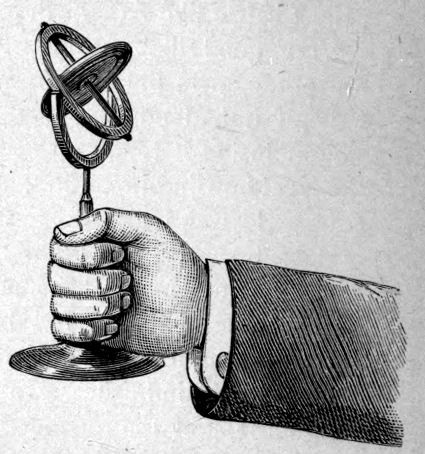
You know that a gyrostat suspended with perfect freedom about axes, which all pass through its centre of gravity, maintains a constant direction in space however its support may be carried. Its axis is not forced to alter its direction in any way. Now this gyrostat (Fig. 17) has not the perfect absence of friction at its axes of which I speak, and even the slightest friction will produce some constraint which is injurious to the experiment I am about to describe. It must be remembered, that if there were absolutely no constraint, then, even if the gyrostat were not spinning, its axis would keep a constant direction in space. But the spinning gyrostat shows its superiority in this, that any constraint due to friction is less powerful in altering the axis. The greater the spin, then, the better able are we to disregard effects due to friction. You have seen for yourselves the effect of carrying this gyrostat about in all sorts of ways—first, when it is not spinning and friction causes quite a large departure from constancy of direction of the axis; second, when it is spinning, and you see that although there is now the same friction as before, and I try to disturb the instrument more than before, the axis remains sensibly parallel to itself all the time. Now when this instrument is supported by the table it is really being carried round by the earth in its daily rotation. If the axis kept its direction perfectly, and it were now pointing horizontally due east, six hours after this it will point towards the north, but inclining downwards, six hours afterwards it will point due west horizontally, and after one revolution of the earth it will again point as it does now. Suppose I try the experiment, and I see that it points due east now in this room, and after a time it points due west, and yet I know that the gyrostat is constantly pointing in the same direction in space all the time, surely it is obvious that the room must be turning round in space. Suppose it points to the pole star now, in six hours, or twelve, or eighteen, or twenty-four, it will still point to the pole star.
Now it is not easy to obtain so frictionless a gyrostat that it will maintain a good spin for such a length of time as will enable the rotation of the room to be made visible to an audience. But I will describe to you how forty years ago it was proved in a laboratory that the earth turns on its axis. This experiment is usually connected with the name of Foucault, the same philosopher who with Fizeau showed how in a laboratory we can measure the velocity of light, and therefore measure the distance of the sun. It was suggested by Mr. Lang of Edinburgh in 1836, although only carried out in 1852 by Foucault. By these experiments, if you were placed on a body from which you could see no stars or other outside objects, say that you were living in underground regions, you could discover—first, whether there is a motion of rotation, and the amount of it; second, the meridian line or the direction of the true north; third, your latitude. Obtain a gyrostat like this (Fig. 46) but much larger, and far more frictionlessly suspended, so that it is free to move vertically or horizontally. For the vertical motion your gymbal pivots ought to be hard steel knife-edges.
Fig. 46.
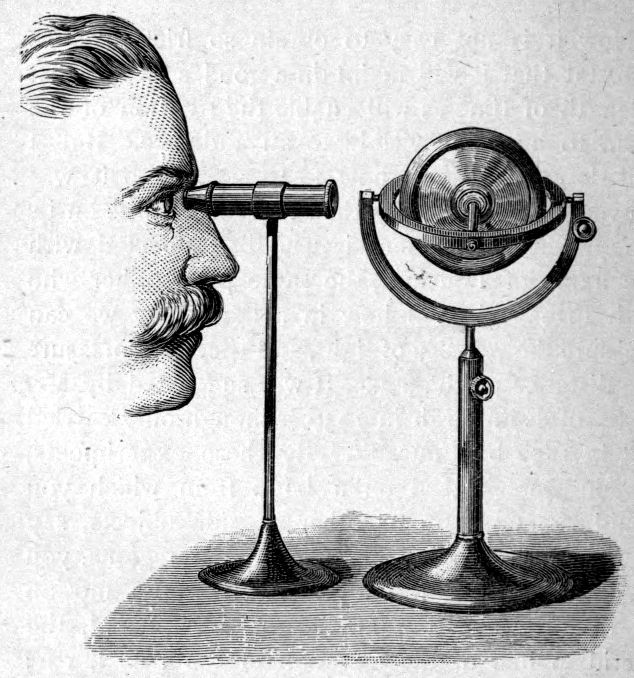
As for the horizontal freedom, Foucault used a fine steel wire. Let there be a fine scale engraved crosswise on the outer gymbal ring, and try to discover if it moves horizontally by means of a microscope with cross wires. When this is carefully done we find that there is a motion, but this is not the motion of the gyrostat, it is the motion of the microscope. In fact, the microscope and all other objects in the room are going round the gyrostat frame.
Now let us consider what occurs. The room is rotating about the earth's axis, and we know the rate of rotation; but we only want to know for our present purpose how much of the total rotation is about a vertical line in the room. If the room were at the North Pole, the whole rotation would be about the vertical line. If the room were at the equator, none of its rotation would be about a vertical line. In our latitude now, the horizontal rate of rotation about a vertical axis is about four-fifths of the whole rate of rotation of the earth on its axis, and this is the amount that would be measured by our microscope. This experiment would give no result at a place on the equator, but in our latitude you would have a laboratory proof of the rotation of the earth. Foucault made the measurements with great accuracy.
If you now clamp the frame, and allow the spinning axis to have no motion except in a horizontal plane, the motion which the earth tends to give it about a vertical axis cannot now affect the gyrostat, but the earth constrains it to move about an axis due north and south, and consequently the spinning axis tries to put itself parallel to the north and south direction (Fig. 47). Hence with such an instrument it is easy to find the true north. If there were absolutely no friction the instrument would vibrate about the true north position like the compass needle (Fig. 50), although with an exceedingly slow swing.
Fig. 47.
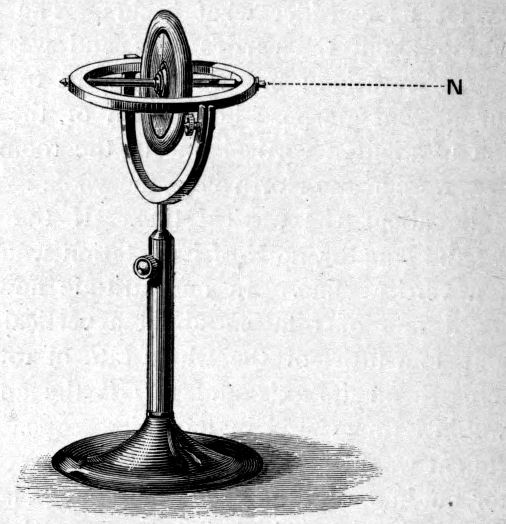
It is with a curious mixture of feelings that one first recognizes the fact that all rotating bodies, fly-wheels of steam-engines and the like, are always tending to turn themselves towards the pole star; gently and vainly tugging at their foundations to get round towards the object of their adoration all the time they are in motion.
Fig. 48.
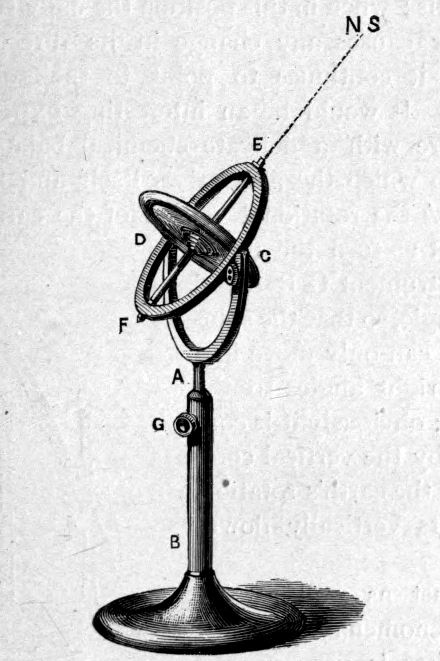
Now we have found the meridian as in Fig. 47, we can begin a third experiment. Prevent motion horizontally, that is, about a vertical axis, but give the instrument freedom to move vertically in the meridian, like a transit instrument in an observatory about its horizontal axis. Its revolution with the earth will tend to make it change its angular position, and therefore it places itself parallel to the earth's axis; when in this position the daily rotation no longer causes any change in its direction in space, so it continues to point to the pole star (Fig. 48). It would be an interesting experiment to measure with a delicate chemical balance the force with which the axis raises itself, and in this way weigh the rotational motion of the earth.[9]
Now let us turn the frame of the instrument G B round a right angle, so that the spinning axis can only move in a plane at right angles to the meridian; obviously it is constrained by the vertical component of the earth's rotation, and points vertically downwards.
Fig. 50.
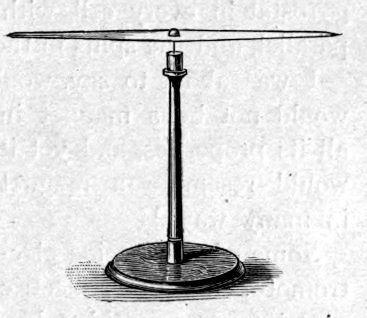
Fig. 49.
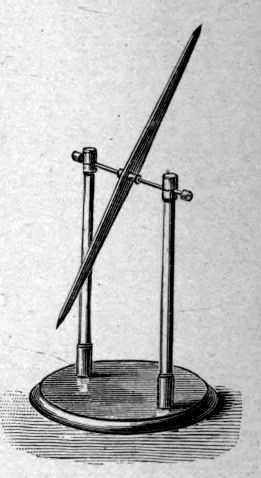
This last as well as the other phenomena of which I have spoken is very suggestive. Here is a magnetic needle (Fig. 49), sometimes called a dipping needle from the way in which it is suspended. If I turn its frame so that it can only move at right angles to the meridian, you see that it points vertically. You may reflect upon the analogous properties of this magnetic needle (Fig. 50) and of the gyrostat (Fig. 47); they both, when only capable of moving horizontally, point to the north; and you see that a very frictionless gyrostat might be used as a compass, or at all events as a corrector of compasses.[10] I have just put before you another analogy, and I want you to understand that, although these are only analogies, they are not mere chance analogies, for there is undoubtedly a dynamical connection between the magnetic and the gyrostatic phenomena. Magnetism depends on rotatory motion. The molecules of matter are in actual rotation, and a certain allineation of the axes of the rotations produces what we call magnetism. In a steel bar not magnetized the little axes of rotation are all in different directions. The process of magnetization is simply bringing these rotations to be more or less round parallel axes, an allineation of the axes. A honey-combed mass with a spinning gyrostat in every cell, with all the spinning axes parallel, and the spins in the same direction, would—I was about to say, would be a magnet, but it would not be a magnet in all its properties, and yet it would resemble a magnet in many ways.[11]
Fig. 51.
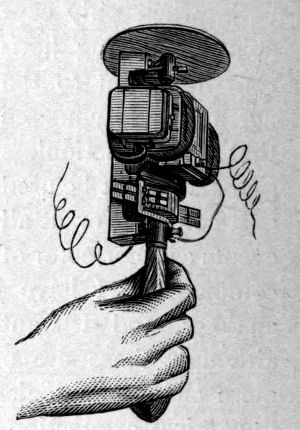
Fig. 52.
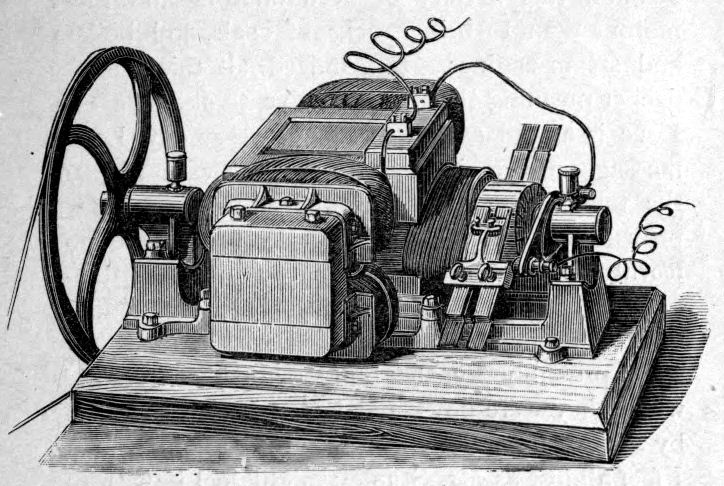
Some of you, seeing electromotors and other electric contrivances near this table, may think that they have to do with our theories and explanations of magnetic phenomena. But I must explain that this electromotor which I hold in my hand (Fig. 51) is used by me merely as the most convenient means I could find for the spinning of my tops and gyrostats. On the spindle of the motor is fastened a circular piece of wood; by touching this key I can supply the motor with electric energy, and the wooden disc is now rotating very rapidly. I have only to bring its rim in contact with any of these tops or gyrostats to set them spinning, and you see that I can set half a dozen gyrostats a-spinning in a few seconds; this chain of gyrostats, for instance. Again, this larger motor (Fig. 52), too large to move about in my hand, is fastened to the table, and I have used it to drive my larger contrivances; but you understand that I use these just as a barber might use them to brush your hair, or Sarah Jane to clean the knives, or just as I would use a little steam-engine if it were more convenient for my purpose. It was more convenient for me to bring from London this battery of accumulators and these motors than to bring sacks of coals, and boilers, and steam-engines. But, indeed, all this has the deeper meaning that we can give to it if we like. Love is as old as the hills, and every day Love's messages are carried by the latest servant of man, the telegraph. These spinning tops were known probably to primeval man, and yet we have not learnt from them more than the most fractional portion of the lesson that they are always sending out to an unobservant world. Toys like these were spun probably by the builders of the Pyramids when they were boys, and here you see them side by side with the very latest of man's contrivances. I feel almost as Mr. Stanley might feel if, with the help of the electric light and a magic-lantern, he described his experiences in that dreadful African forest to the usual company of a London drawing-room.
The phenomena I have been describing to you play such a very important part in nature, that if time admitted I might go on expounding and explaining without finding any great reason to stop at one place rather than another. The time at my disposal allows me to refer to only one other matter, namely, the connection between light and magnetism and the behaviour of spinning tops.
You are all aware that sound takes time to travel. This is a matter of common observation, as one can see a distant woodchopper lift his axe again before one hears the sound of his last stroke. A destructive sea wave is produced on the coast of Japan many hours after an earthquake occurs off the coast of America, the wave motion having taken time to travel across the Pacific. But although light travels more quickly than sound or wave motion in the sea, it does not travel with infinite rapidity, and the appearance of the eclipse of one of Jupiter's satellites is delayed by an observable number of minutes because light takes time to travel. The velocity has been measured by means of such observations, and we know that light travels at the rate of about 187,000 miles per second, or thirty thousand millions of centimetres per second. There is no doubt about this figure being nearly correct, for the velocity of light has been measured in the laboratory by a perfectly independent method.
Now the most interesting physical work done since Newton's time is the outcome of the experiments of Faraday and the theoretical deductions of Thomson and Maxwell. It is the theory that light and radiant heat are simply electro-magnetic disturbances propagated through space. I dare not do more than just refer to this matter, although it is of enormous importance. I can only say, that of all the observed facts in the sciences of light, electricity, and magnetism, we know of none that is in opposition to Maxwell's theory, and we know of many that support it. The greatest and earliest support that it had was this. If the theory is correct, then a certain electro-magnetic measurement ought to result in exactly the same quantity as the velocity of light. Now I want you to understand that the electric measurement is one of quantities that seem to have nothing whatever to do with light, except that one uses one's eyes in making the measurement; it requires the use of a two-foot rule and a magnetic needle, and coils of wire and currents of electricity. It seemed to bear a relationship to the velocity of light, which was not very unlike the fabled connection between Tenterden Steeple and the Goodwin Sands. It is a measurement which it is very difficult to make accurately. A number of skilful experimenters, working independently, and using quite different methods, arrived at results only one of which is as much as five per cent. different from the observed velocity of light, and some of them, on which the best dependence may be placed, agree exactly with the average value of the measurements of the velocity of light.
There is then a wonderful agreement of the two measurements, but without more explanation than I can give you now, you cannot perhaps understand the importance of this agreement between two seemingly unconnected magnitudes. At all events we now know, from the work of Professor Hertz in the last two years, that Maxwell's theory is correct, and that light is an electro-magnetic disturbance; and what is more, we know that electro-magnetic disturbances, incomparably slower than red-light or heat, are passing now through our bodies; that this now recognized kind of radiation may be reflected and refracted, and yet will pass through brick and stone walls and foggy atmospheres where light cannot pass, and that possibly all military and marine and lighthouse signalling may be conducted in the future through the agency of this new and wonderful kind of radiation, of which what we call light is merely one form. Why at this moment, for all I know, two citizens of Leeds may be signalling to each other in this way through half a mile of houses, including this hall in which we are present.[12]
I mention this, the greatest modern philosophical discovery, because the germ of it, which was published by Thomson in 1856, makes direct reference to the analogy between the behaviour of our spinning-tops and magnetic and electrical phenomena. It will be easier, however, for us to consider here a mechanical illustration of the rotation of the plane of polarized light by magnetism which Thomson elaborated in 1874. This phenomenon may, I think, be regarded as the most important of all Faraday's discoveries. It was of enormous scientific importance, because it was made in a direction where a new phenomenon was not even suspected. Of his discovery of induced currents of electricity, to which all electric-lighting companies and transmission of power companies of the present day owe their being, Faraday himself said that it was a natural consequence of the discoveries of an earlier experimenter, Oersted. But this magneto-optic discovery was quite unexpected. I will now describe the phenomenon.
Some of you are aware that when a beam of light is sent through this implement, called a Nichol's Prism, it becomes polarized, or one-sided—that is, all the light that comes through is known to be propagated by vibrations which occur all in one plane. This rope (Fig. 53) hanging from the ceiling illustrates the nature of plane polarized light. All points in the rope are vibrating in the same plane. Well, this prism A, Fig. 54, only lets through it light that is polarized in a vertical plane. And here at B I have a similar implement, and I place it so that it also will only allow light to pass through it which is polarized in a vertical plane. Hence most of the light coming through the polarizer, as the first prism is called, will pass readily through the analyzer, as the second is called, and I am now letting this light enter my eye. But when I turn the analyzer round through a right angle, I find that I see no light; there was a gradual darkening as I rotated the analyzer. The analyzer will now only allow light to pass through which is polarized in a horizontal plane, and it receives no such light.
Fig. 53.
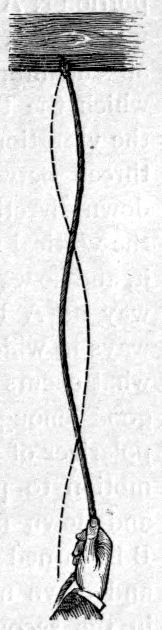
Fig. 54.

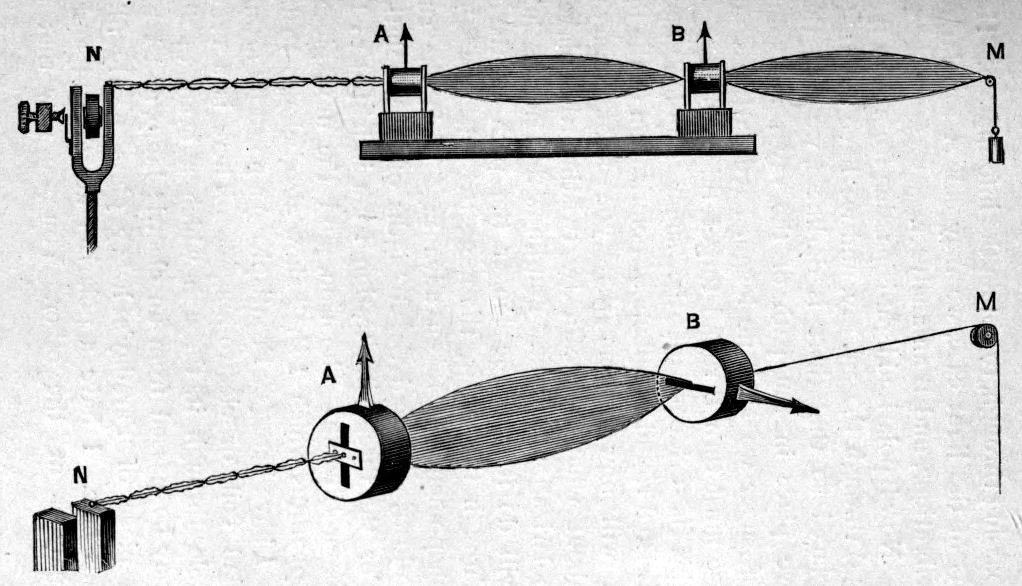
You will see in this model (Fig. 55) a good illustration of polarized light. The white, brilliantly illuminated thread M N is pulled by a weight beyond the pulley M, and its end N is fastened to one limb of a tuning-fork. Some ragged-looking pieces of thread round the portion N A prevent its vibrating in any very determinate way, but from A to M the thread is free from all encumbrance. A vertical slot at A, through which the thread passes, determines the nature of the vibration of the part A B; every part of the thread between A and B is vibrating in up and down directions only. A vertical slot in B allows the vertical vibration to be communicated through it, and so we see the part B M vibrating in the same way as A B. I might point out quite a lot of ways in which this is not a perfect illustration of what occurs with light in Fig. 54. But it is quite good enough for my present purpose. A is a polarizer of vibration; it only allows up and down motion to pass through it, and B also allows up and down motion to pass through. But now, as B is turned round, it lets less and less of the up and down motion pass through it, until when it is in the second position shown in the lower part of the figure, it allows no up and down motion to pass through, and there is no visible motion of the thread between B and M. You will observe that if we did not know in what plane (in the present case the plane is vertical) the vibrations of the thread between A and B occurred, we should only have to turn B round until we found no vibration passing through, to obtain the information. Hence, as in the light case, we may call A a polarizer of vibrations, and B an analyzer.
Fig. 55.
Now if polarized light is passing from A to B (Fig. 54) through the air, say, and we have the analyzer placed so that there is darkness, we find that if we place in the path of the ray some solution of sugar we shall no longer have darkness at B; we must turn B round to get things dark again; this is evidence of the sugar solution having twisted round the plane of polarization of the light. I will now assume that you know something about what is meant by twisting the plane of polarization of light. You know that sugar solution will do it, and the longer the path of the ray through the sugar, the more twist it gets. This phenomenon is taken advantage of in the sugar industries, to find the strengths of sugar solutions. For the thread illustration I am indebted to Professor Silvanus Thomson, and the next piece of apparatus which I shall show also belongs to him.
I have here (see Frontispiece) a powerful armour-clad coil, or electro-magnet. There is a central hole through it, through which a beam of light may be passed from an electric lamp, and I have a piece of Faraday's heavy glass nearly filling this hole. I have a polarizer at one end, and an analyzer at the other. You see now that the polarized light passes through the heavy glass and the analyzer, and enters the eye of an observer. I will now turn B until the light no longer passes. Until now there has been no magnetism, but I have the means here of producing a most intense magnetic field in the direction in which the ray passes, and if your eye were here you would see that there is light passing through the analyzer. The magnetism has done something to the light, it has made it capable of passing where it could not pass before. When I turn the analyzer a little I stop the light again, and now I know that what the magnetism did was to convert the glass into a medium like the sugar, a medium which rotates the plane of polarization of light.
In this experiment you have had to rely upon my personal measurement of the actual rotation produced. But if I insert between the polarizer and analyzer this disc of Professor Silvanus Thomson's, built up of twenty-four radial pieces of mica, I shall have a means of showing to this audience the actual rotation of the plane of polarization of light. You see now on the screen the light which has passed through the analyzer in the form of a cross, and if the cross rotates it is a sign of the rotation of the plane of polarization of the light. By means of this electric key I can create, destroy, and reverse the magnetic field in the glass. As I create magnetism you see the twisting of the cross; I destroy the magnetism, and it returns to its old position; I create the opposite kind of magnetism, and you see that the cross twists in the opposite way. I hope it is now known to you that magnetism rotates the plane of polarization of light as the solution of sugar did.
Fig. 56.
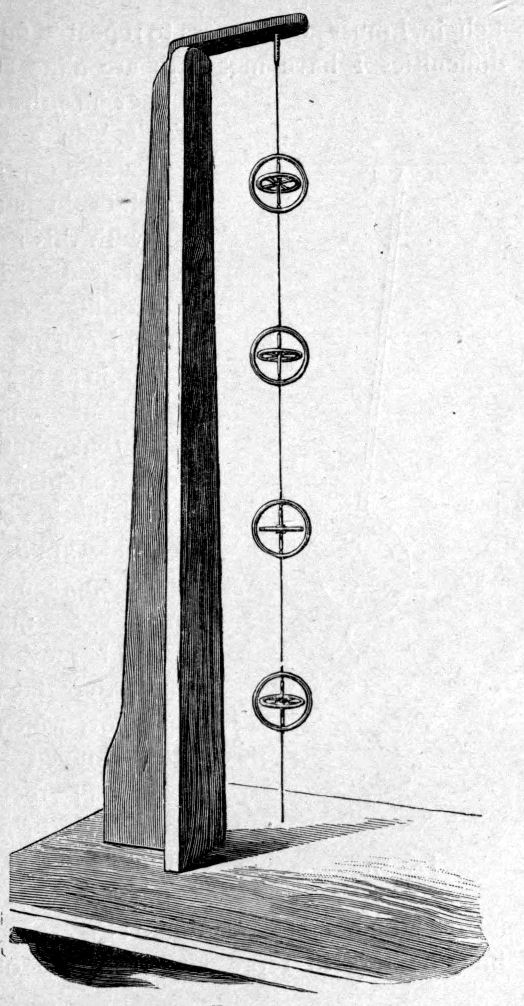
Fig. 57.
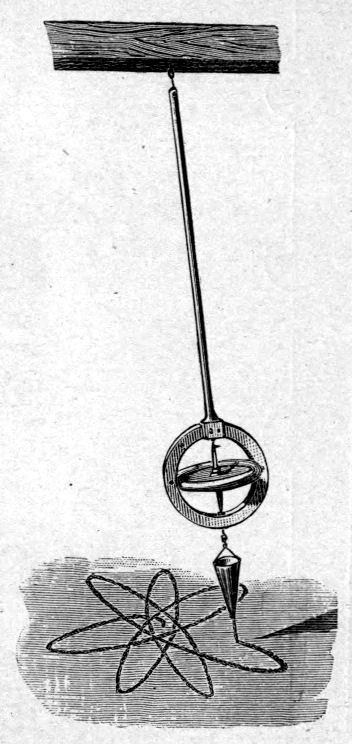
As an illustration of what occurs between polarizer and analyzer, look again at this rope (Fig. 53) fastened to the ceiling. I move the bottom end sharply from east to west, and you see that every part of the rope moves from east to west. Can you imagine a rope such that when the bottom end was moved from east to west, a point some yards up moved from east-north-east to west-sou'-west, that a higher point moved from north-east to south-west, and so on, the direction gradually changing for higher and higher points? Some of you, knowing what I have done, may be able to imagine it. We should have what we want if this rope were a chain of gyrostats such as you see figured in the diagram; gyrostats all spinning in the same way looked at from below, with frictionless hinges between them. Here is such a chain (Fig. 56), one of many that I have tried to use in this way for several years. But although I have often believed that I saw the phenomenon occur in such a chain, I must now confess to repeated failures. The difficulties I have met with are almost altogether mechanical ones. You see that by touching all the gyrostats in succession with this rapidly revolving disc driven by the little electromotor, I can get them all to spin at the same time; but you will notice that what with bad mechanism and bad calculation on my part, and want of skill, the phenomenon is completely masked by wild movements of the gyrostats, the causes of which are better known than capable of rectification. The principle of the action is very visible in this gyrostat suspended as the bob of a pendulum (Fig. 57). You may imagine this to represent a particle of the substance which transmits light in the magnetic field, and you see by the trickling thin stream of sand which falls from it on the paper that it is continually changing the plane of polarization. But I am happy to say that I can show you to-night a really successful illustration of Thomson's principle; it is the very first time that this most suggestive experiment has been shown to an audience. I have a number of double gyrostats (Fig. 58) placed on the same line, joined end to end by short pieces of elastic. Each instrument is supported at its centre of gravity, and it can rotate both in horizontal and in vertical planes.
Fig. 58.
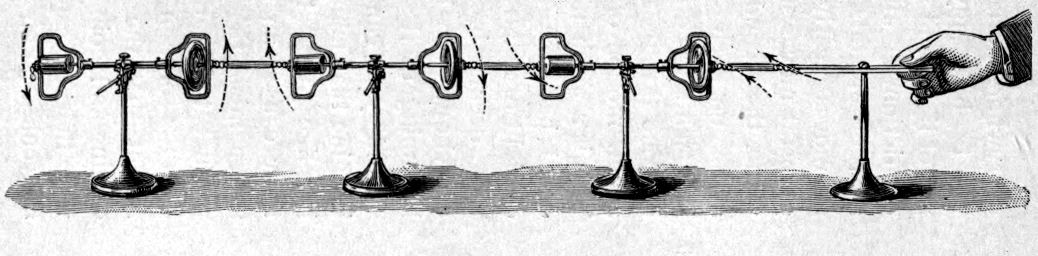
The end of the vibrating lever A can only get a horizontal motion from my hand, and the motion is transmitted from one gyrostat to the next, until it has travelled to the very end one. Observe that when the gyrostats are not spinning, the motion is everywhere horizontal. Now it is very important not to have any illustration here of a reflected ray of light, and so I have introduced a good deal of friction at all the supports. I will now spin all the gyrostats, and you will observe that when A moves nearly straight horizontally, the next gyrostat moves straight but in a slightly different plane, the second gyrostat moves in another plane, and so on, each gyrostat slightly twisting the plane in which the motion occurs; and you see that the end one does not by any means receive the horizontal motion of A, but a motion nearly vertical. This is a mechanical illustration, the first successful one I have made after many trials, of the effect on light of magnetism. The reason for the action that occurs in this model must be known to everybody who has tried to follow me from the beginning of the lecture.
And you can all see that we have only to imagine that many particles of the glass are rotating like gyrostats, and that magnetism has partially caused an allineation of their axes, to have a dynamical theory of Faraday's discovery. The magnet twists the plane of polarization, and so does the solution of sugar; but it is found by experiment that the magnet does it indifferently for coming and going, whereas the sugar does it in a way that corresponds with a spiral structure of molecules. You see that in this important particular the gyrostat analogue must follow the magnetic method, and not the sugar method. We must regard this model, then, the analogue to Faraday's experiment, as giving great support to the idea that magnetism consists of rotation.
I have already exceeded the limits of time usually allowed to a popular lecturer, but you see that I am very far from having exhausted our subject. I am not quite sure that I have accomplished the object with which I set out. My object was, starting from the very different behaviour of a top when spinning and when not spinning, to show you that the observation of that very common phenomenon, and a determination to understand it, might lead us to understand very much more complex-looking things. There is no lesson which it is more important to learn than this—That it is in the study of every-day facts that all the great discoveries of the future lie. Three thousand years ago spinning tops were common, but people never studied them. Three thousand years ago people boiled water and made steam, but the steam-engine was unknown to them. They had charcoal and saltpetre and sulphur, but they knew nothing of gunpowder. They saw fossils in rocks, but the wonders of geology were unstudied by them. They had bits of iron and copper, but not one of them thought of any one of the fifty simple ways that are now known to us of combining those known things into a telephone. Why, even the simplest kind of signalling by flags or lanterns was unknown to them, and yet a knowledge of this might have changed the fate of the world on one of the great days of battle that we read about. We look on Nature now in an utterly different way, with a great deal more knowledge, with a great deal more reverence, and with much less unreasoning superstitious fear. And what we are to the people of three thousand years ago, so will be the people of one hundred years hence to us; for indeed the acceleration of the rate of progress in science is itself accelerating. The army of scientific workers gets larger and larger every day, and it is my belief that every unit of the population will be a scientific worker before long. And so we are gradually making time and space yield to us and obey us. But just think of it! Of all the discoveries of the next hundred years; the things that are unknown to us, but which will be so well known to our descendants that they will sneer at us as utterly ignorant, because these things will seem to them such self-evident facts; I say, of all these things, if one of us to-morrow discovered one of them, he would be regarded as a great discoverer. And yet the children of a hundred years hence will know it: it will be brought home to them perhaps at every footfall, at the flapping of every coat-tail.
Imagine the following question set in a school examination paper of 2090 A.D.—"Can you account for the crass ignorance of our forefathers in not being able to see from England what their friends were doing in Australia?"[13] Or this—"Messages are being received every minute from our friends on the planet Mars, and are now being answered: how do you account for our ancestors being utterly ignorant that these messages were occasionally sent to them?" Or this—"What metal is as strong compared with steel as steel is compared with lead? and explain why the discovery of it was not made in Sheffield."
But there is one question that our descendants will never ask in accents of jocularity, for to their bitter sorrow every man, woman, and child of them will know the answer, and that question is this—"If our ancestors in the matter of coal economy were not quite as ignorant as a baby who takes a penny as equivalent for a half-crown, why did they waste our coal? Why did they destroy what never can be replaced?"
My friends, let me conclude by impressing upon you the value of knowledge, and the importance of using every opportunity within your reach to increase your own store of it. Many are the glittering things that seem to compete successfully with it, and to exercise a stronger fascination over human hearts. Wealth and rank, fashion and luxury, power and fame—these fire the ambitions of men, and attract myriads of eager worshippers; but, believe it, they are but poor things in comparison with knowledge, and have no such pure satisfactions to give as those which it is able to bestow. There is no evil thing under the sun which knowledge, when wielded by an earnest and rightly directed will, may not help to purge out and destroy; and there is no man or woman born into this world who has not been given the capacity, not merely to gather in knowledge for his own improvement and delight, but even to add something, however little, to that general stock of knowledge which is the world's best wealth.
ARGUMENT.
1. Introduction, pages 9-14, showing the importance of the study of spinning-top behaviour.
2. Quasi-rigidity induced even in flexible and fluid bodies by rapid motion, 14-21.
Illustrations: Top, 14; belt or rope, 14; disc of thin paper, 14; ring of chain, 15; soft hat, 16; drunken man, 16; rotating water, 16; smoke rings, 17; Thomson's Molecular Theory, 19; swimmer caught in an eddy, 20; mining water jet, 20; cased gyrostat, 21.
3. The nature of this quasi-rigidity in spinning bodies is a resistance to change of direction of the axis of spinning, 21-30.
Illustrations: Cased gyrostat, 21-24; tops, biscuits, hats, thrown into the air, 24-26; quoits, hoops, projectiles from guns, 27; jugglers at the Victoria Music Hall, 26-30; child trundling hoop, man on bicycle, ballet-dancer, the earth pointing to pole star, boy's top, 30.
4. Study of the crab-like behaviour of a spinning body, 30-49.
Illustrations: Spinning top, 31; cased gyrostat, 32; balanced gyrostat, 33-36; windage of projectiles from rifled guns, 36-38; tilting a hoop or bicycle, turning quickly on horseback, 38; bowls, 39; how to simplify one's observations, 39, 40; the illustration which gives us our simple universal rule, 40-42; testing the rule, 42-44; explanation of precession of gyrostat, 44, 45; precession of common top, 46; precession of overhung top, 46; list of our results given in a wall sheet, 48, 49.
5. Proof or explanation of our simple universal rule, 50-54.
Giving two independent rotations to a body, 50, 51; composition of rotations, 52, 53.
6. Warning that the rule is not, after all, so simple, 54-66.
Two independent spins given to the earth, 54; centrifugal force, 55; balancing of quick speed machinery, 56, 57; the possible wobbling of the earth, 58; the three principal axes of a body, 59; the free spinning of discs, cones, rods, rings of chain, 60; nodding motion of a gyrostat, 62; of a top, 63; parenthesis about inaccuracy of statement and Rankine's rhyme, 63, 64; further complications in gyrostatic behaviour, 64; strange elastic, jelly-like behaviour, 65; gyrostat on stilts, 66.
7. Why a gyrostat falls, 66, 67.
8. Why a top rises, 67-74.
General ignorance, 67; Thomson preparing for the mathematical tripos, 68; behaviour of a water-worn stone when spun on a table, 68, 69; parenthesis on technical education, 70; simple explanation of why a top rises, 70-73; behaviour of heterogeneous sphere when spun, 74.
9. Precessional motion of the earth, 74-91.
Its nature and effects on climate, 75-80; resemblance of the precessing earth to certain models, 80-82; tilting forces exerted by the sun and moon on the earth, 82-84; how the earth's precessional motion is always altering, 85-88; the retrogression of the moon's nodes is itself another example, 88, 89; an exact statement made and a sort of apology for making it, 90, 91.
10. Influence of possible internal fluidity of the earth on its precessional motion, 91-98.
Effect of fluids and sand in tumblers, 91-93; three tests of the internal rigidity of an egg, that is, of its being a boiled egg, 93, 94; quasi-rigidity of fluids due to rapid motion, forgotten in original argument, 95; beautiful behaviour of hollow top filled with water, 95; striking contrasts in the behaviour of two tops which are very much alike, 97, 98; fourth test of a boiled egg, 98.
11. Apology for dwelling further upon astronomical matters, and impertinent remarks about astronomers, 99-101.
12. How a gyrostat would enable a person living in subterranean regions to know, 1st, that the earth rotates; 2nd, the amount of rotation; 3rd, the direction of true north; 4th, the latitude, 101-111.
Some men's want of faith, 101; disbelief in the earth's rotation, 102; how a free gyrostat behaves, 103, 104; Foucault's laboratory measurement of the earth's rotation, 105-107; to find the true north, 108; all rotating bodies vainly endeavouring to point to the pole star, 108; to find the latitude, 110; analogies between the gyrostat and the mariner's compass and the dipping needle, 110, 111; dynamical connection between magnetism and gyrostatic phenomena, 111.
13. How the lecturer spun his tops, using electro-motors, 112-114.
14. Light, magnetism, and molecular spinning tops, 115-128.
Light takes time to travel, 115; the electro-magnetic theory of light, 116, 117; signalling through fogs and buildings by means of a new kind of radiation, 117; Faraday's rotation of the plane of polarization by magnetism, with illustrations and models, 118-124; chain of gyrostats, 124; gyrostat as a pendulum bob, 126; Thomson's mechanical illustration of Faraday's experiment, 127, 128.
15. Conclusion, 129-132.
The necessity for cultivating the observation, 129; future discovery, 130; questions to be asked one hundred years hence, 131; knowledge the thing most to be wished for, 132.
APPENDIX I.
THE USE OF GYROSTATS.
In 1874 two famous men made a great mistake in endeavouring to prevent or diminish the rolling motion of the saloon of a vessel by using a rapidly rotating wheel. Mr. Macfarlane Gray pointed out their mistake. It is only when the wheel is allowed to precess that it can exercise a steadying effect; the moment which it then exerts is equal to the angular speed of the precession multiplied by the moment of momentum of the spinning wheel.
It is astonishing how many engineers who know the laws of motion of mere translation, are ignorant of angular motion, and yet the analogies between the two sets of laws are perfectly simple. I have set out these analogies in my book on Applied Mechanics. The last of them between centripetal force on a body moving in a curved path, and torque or moment on a rotating body is the simple key to all gyrostatic or top calculation. When the spin of a top is greatly reduced it is necessary to remember that the total moment of momentum is not about the spinning axis (see my Applied Mechanics, page 594); correction for this is, I suppose, what introduces the complexity which scares students from studying the vagaries of tops; but in all cases that are likely to come before an engineer it would be absurd to study such a small correction, and consequently calculation is exceedingly simple.
Inventors using gyrostats have succeeded in doing the following things—
(1) Keeping the platform of a gun level on board ship, however the ship may roll or pitch. Keeping a submarine vessel or a flying machine with any plane exactly horizontal or inclined in any specified way.[14] It is easy to effect such objects without the use of a gyrostat, as by means of spirit levels it is possible to command powerful electric or other motors to keep anything always level. The actual methods employed by Mr. Beauchamp Tower (an hydraulic method), and by myself (an electric method), depend upon the use of a gyrostat, which is really a pendulum, the axis being vertical.
(2) Greatly reducing the rolling (or pitching) of a ship, or the saloon of a ship. This is the problem which Mr. Schlick has solved with great success, at any rate in the case of torpedo boats.
(3) In Mr. Brennan's Mono-rail railway, keeping the resultant force due to weight, wind pressure, centrifugal force, etc., exactly in line with the rail, so that, however the load on a wagon may alter in position, and although the wagon may be going round a curve, it is quickly brought to a position such that there are no forces tending to alter its angular position. The wagon leans over towards the wind or towards the centre of the curve of the rail so as to be in equilibrium.
(4) I need not refer to such matters as the use of gyrostats for the correction of compasses on board ship, referred to in page 111.
Fig. 1.
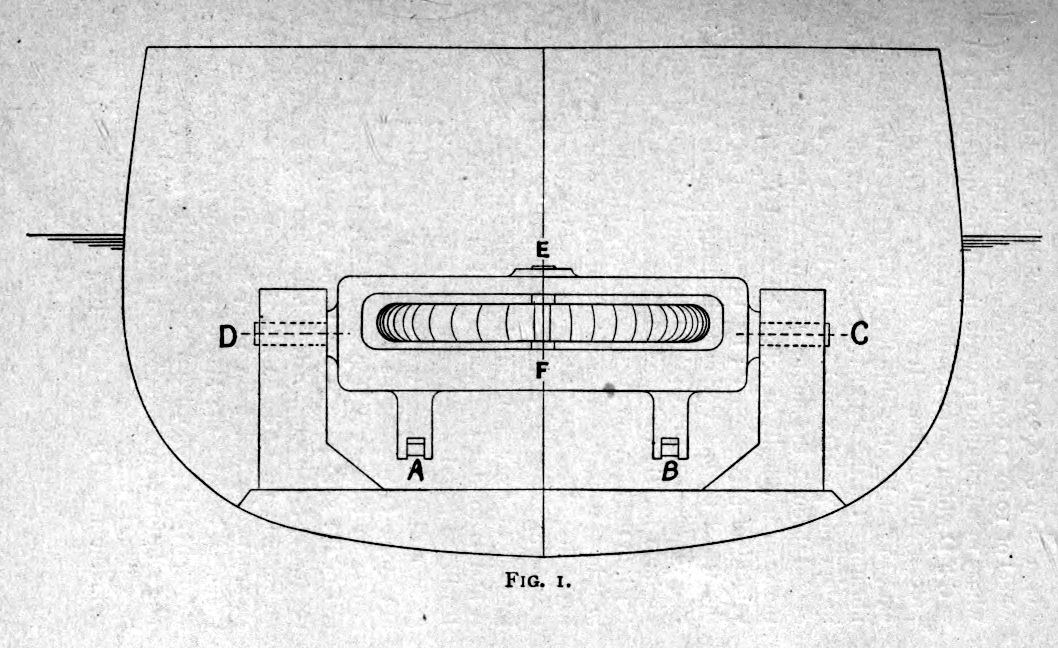
Problems (2) and (3) are those to which I wish to refer. For a ship of 6,000 tons Mr. Schlick would use a large wheel of 10 to 20 tons, revolving about an axis E F (fig. 1) whose mean position is vertical. Its bearings are in a frame E C F D which can move about a thwart-ship axis C D with a precessional motion. Its centre of gravity is below this axis, so that like the ship itself the frame is in stable equilibrium. Let the ship have rolled through an angle R from its upright position, and suppose the axis E F to have precessed through the angle P from a vertical position. Let the angular velocity of rolling be called R˙, and the angular velocity of precession P˙; let the moment of momentum of the wheel be m. For any vibrating body like a ship it is easy to write out the equation of motion; into this equation we have merely to introduce the moment m P˙ diminishing R; into the equation for P we merely introduce the moment m R˙ increasing P. As usual we introduce frictional terms; in the first place F R˙ (F being a constant co-efficient) stilling the roll of the ship; in the second case f P˙ a fluid friction introduced by a pair of dash pots applied at the pins A and B to still the precessional vibrations of the frame. It will be found that the angular motion P is very much greater than the roll R. Indeed, so great is P that there are stops to prevent its exceeding a certain amount. Of course so long as a stop acts, preventing precession, the roll of the ship proceeds as if the gyrostat wheel were not rotating. Mr. Schlick drives his wheels by steam; he will probably in future do as Mr. Brennan does, drive them by electromotors, and keep them in air-tight cases in good vacuums, because the loss of energy by friction against an atmosphere is proportional to the density of the atmosphere. The solution of the equations to find the nature of the R and P motions is sometimes tedious, but requires no great amount of mathematical knowledge. In a case considered by me of a 6,000 ton ship, the period of a roll was increased from 14 to 20 seconds by the use of the gyrostat, and the roll rapidly diminished in amount. There was accompanying this slow periodic motion, one of a two seconds' period, but if it did appear it was damped out with great rapidity. Of course it is assumed that, by the use of bilge keels and rolling chambers, and as low a metacentre as is allowable, we have already lengthened the time of vibration, and damped the roll R as much as possible, before applying the gyrostat. I take it that everybody knows the importance of lengthening the period of the natural roll of a ship, although he may not know the reason. The reason why modern ships of great tonnage are so steady is because their natural periodic times of rolling vibration are so much greater than the probable periods of any waves of the sea, for if a series of waves acts upon a ship tending to make it roll, if the periodic time of each wave is not very different from the natural periodic time of vibration of the ship, the rolling motion may become dangerously great.
If we try to apply Mr. Schlick's method to Mr. Brennan's car it is easy to show that there is instability of motion, whether there is or is not friction. If there is no friction, and we make the gyrostat frame unstable by keeping its centre of gravity above the axis C D, there will be vibrations, but the smallest amount of friction will cause these vibrations to get greater and greater. Even without friction there will be instability if m, the moment of momentum of the wheel, is less than a certain amount. We see, then, that no form of the Schlick method, or modification of it, can be applied to solve the Brennan problem.
Fig. 2.
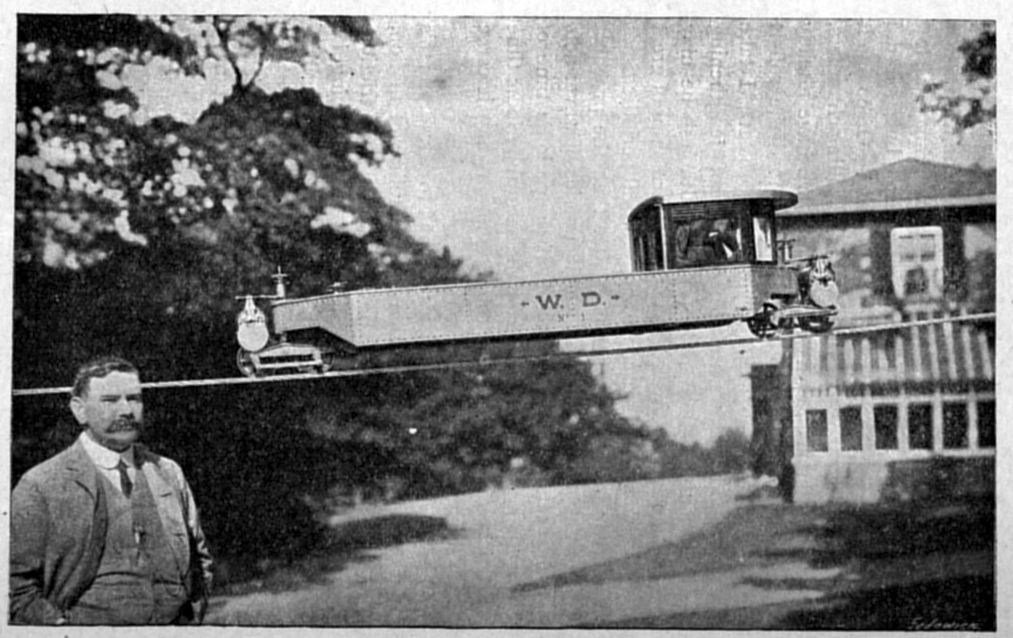
Mr. Brennan's method of working is quite different from that of Mr. Schlick. Fig. 2 shows his model car (about six feet long); it is driven by electric accumulators carried by the car. His gyrostat wheels are driven by electromotors (not shown in fig. 3); as they are revolving in nearly vacuous spaces they consume but little power, and even if the current were stopped they would continue running at sufficiently high speeds to be effective for a length of time. Still it must not be forgotten that energy is wasted in friction, and work has to be done in bringing the car to a new position of equilibrium, and this energy is supplied by the electromotors. Should the gyrostats really stop, or fall to a certain low speed, two supports are automatically dropped, one on either side of the car; each of them drops till it reaches the ground; one of them dropping, perhaps, much farther than the other.
The real full-size car, which he is now constructing, may be pulled with other cars by any kind of locomotive using electricity or petrol or steam, or each of the wheels may be a driving wheel. He would prefer to generate electropower on his train, and to drive every wheel with an electric motor. His wheels are so independent of one another that they can take very quick curves and vertical inequalities of the rail. The rail is fastened to sleepers lying on ground that may have sidelong slope. The model car is supported by a mono-rail bogie at each end; each bogie has two wheels pivoted both vertically and horizontally; it runs on a round iron gas pipe, and sometimes on steel wire rope; the ground is nowhere levelled or cut, and at one place the rail is a steel wire rope spanning a gorge, as shown in fig. 2. It is interesting to stop the car in the middle of this rope and to swing the rope sideways to see the automatic balancing of the car. The car may be left here or elsewhere balancing itself with nobody in charge of it. If the load on the car—great lead weights—be dumped about into new positions, the car adjusts itself to the new conditions with great quickness. When the car is stopped, if a person standing on the ground pushes the car sidewise, the car of course pushes in opposition, like an indignant animal, and by judicious pushing and yielding it is possible to cause a considerable tilt. Left now to itself the car rights itself very quickly.
Fig. 3.
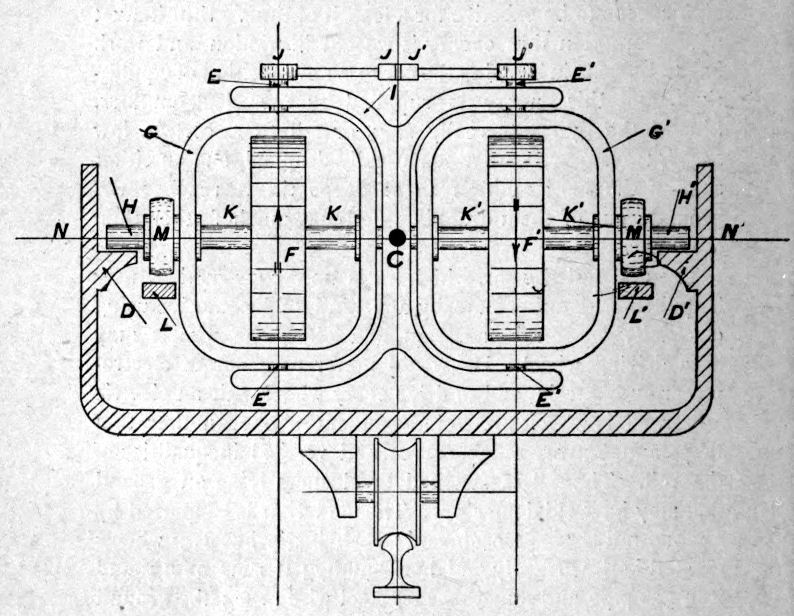
Fig. 3b (showing the ground-plan of Fig. 3).
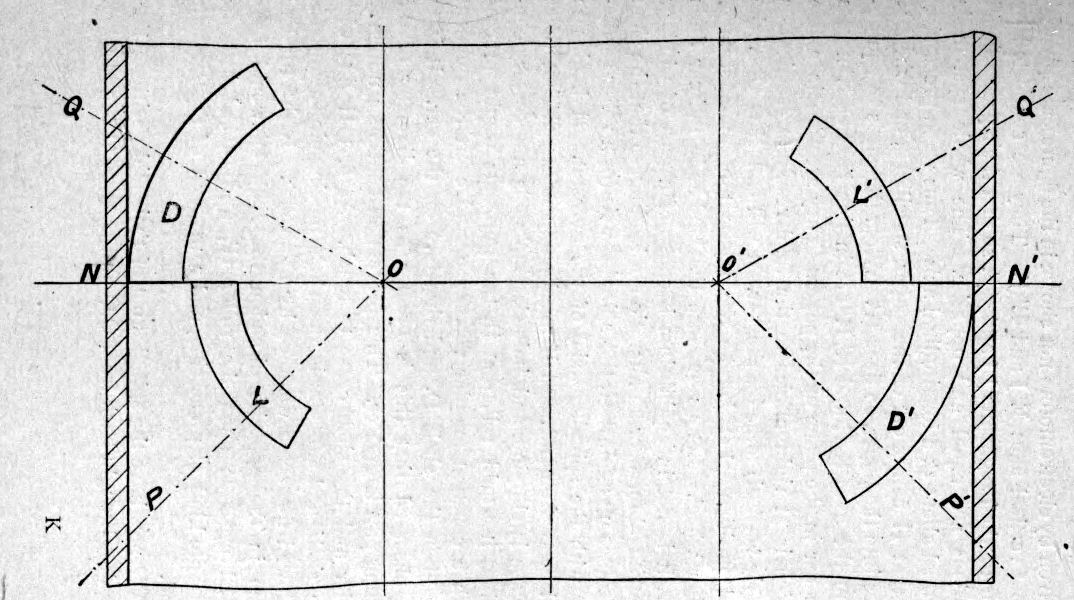
Fig. 3 is a diagrammatic representation of Mr. Brennan's pair of gyrostats in sectional elevation and plan. The cases G and G', inside which the wheels F and F' are rotating in vacuo at the same speed and in opposite directions (driven by electromotors not shown in the figure), are pivoted about vertical axes E J and E' J'. They are connected by spur-toothed segments J J and J' J', so that their precessional motions are equal and opposite. The whole system is pivoted about C, a longitudinal axis. Thus when precessing so that H comes out of the paper, so will H', and when H goes into the paper, so does H'. When the car is in equilibrium the axes K H and K' H' are in line N O O' N' across the car in the plane of the paper. They are also in a line which is at right angles to the total resultant (vertical or nearly vertical) force on the car. I will call N O O' N' the mid position. Let ½m be the moment of momentum of either wheel. Let us suppose that suddenly the car finds that it is not in equilibrium because of a gust of wind, or centrifugal force, or an alteration of loading, so that the shelf D comes up against H, the spinning axis (or a roller revolving with the spinning axis) of the gyrostat. H begins to roll away from me, and if no slipping occurred (but there always is slipping, and, indeed, slipping is a necessary condition) it would roll, that is, the gyrostats would precess with a constant angular velocity α, and exert the moment mα upon the shelf D, and therefore on the car. It is to be observed that this is greater as the diameter of the rolling part is greater. This precession continues until the roller and the shelf cease to touch. At first H lifts with the shelf, and afterwards the shelf moving downwards is followed for some distance by the roller. If the tilt had been in the opposite direction the shelf D' would have acted upwards upon the roller H', and caused just the opposite kind of precession, and a moment of the opposite kind.
We now have the spindles out of their mid position; how are they brought back from O Q and O' Q' to O N and O' N', but with H permanently lowered just the right amount? It is the essence of Mr. Brennan's invention that after a restoring moment has been applied to the car the spindles shall go back to the position N O O' N' (with H permanently lowered), so as to be ready to act again. He effects this object in various ways. Some ways described in his patents are quite different from what is used on the model, and the method to be used on the full-size wagon will again be quite different. I will describe one of the methods. Mr. Brennan tells me that he considers this old method to be crude, but he is naturally unwilling to allow me to publish his latest method.
D' is a circular shelf extending from the mid position in my direction; D is a similar shelf extending from the mid position into the paper, or away from me. It is on these shelves that H' and H roll, causing precession away from N O O' N', as I have just described. When H' is inside the paper, or when H is outside the paper, they find no shelf to roll upon. There are, however, two other shelves L and L', for two other rollers M and M', which are attached to the frames concentric with the spindles; they are free to rotate, but are not rotated by the spindles. When they are pressed by their shelves L or L' this causes negative precession, and they roll towards the N O O' N' position. There is, of course, friction at their supports, retarding their rotation, and therefore the precession. The important thing to remember is that H and H', when they touch their shelves (when one is touching the other is not touching) cause a precession away from the mid position N O O' N' at a rate α, which produces a restoring moment mα of nearly constant amount (except for slipping), whereas where M or M' touches its shelf L or L' (when one is touching the other is not touching) the pressure on the shelf and friction determine the rate of the precession towards the mid position N O O' N', as well as the small vertical motion. The friction at the supports of M and M' is necessary.
Suppose that the tilt from the equilibrium position to be corrected is R, when D presses H upward. The moment mα, and its time of action (the total momental impulse) are too great, and R is over-corrected; this causes the roller M' to act on L', and the spindles return to the mid position; they go beyond the mid position, and now the roller H' acts on D', and there is a return to the mid position, and beyond it a little, and so it goes on, the swings of the gyrostats out of and into the mid position, and the vibrations of the car about its position of equilibrium getting rapidly less and less until again neither H nor H', nor M nor M' is touching a shelf. It is indeed marvellous to see how rapidly the swings decay. Friction accelerates the precession away from N O O' N'. Friction retards the precession towards the middle position.
It will be seen that by using the two gyrostats instead of one when there is a curve on the line, although the plane N O O' N' rotates, and we may say that the gyrostats precess, the tilting couples which they might exercise are equal and opposite. I do not know if Mr. Brennan has tried a single gyrostat, the mid position of the axis of the wheel being vertical, but even in this case a change of slope, or inequalities in the line, might make it necessary to have a pair.
It is evident that this method of Mr. Brennan is altogether different in character from that of Mr. Schlick. Work is here actually done which must be supplied by the electromotors.
One of the most important things to know is this: the Brennan model is wonderfully successful; the weight of the apparatus is not a large fraction of the weight of the wagon; will this also be the case with a car weighing 1,000 times as much? The calculation is not difficult, but I may not give it here. If we assume that suddenly the wagon finds itself at the angle R from its position of equilibrium, it may be taken that if the size of each dimension of the wagon be multiplied by n, and the size of each dimension of the apparatus be multiplied by p, then for a sudden gust of wind, or suddenly coming on a curve, or a sudden shift of position of part of the cargo, R may be taken as inversely proportional to n. I need not state the reasonable assumption which underlies this calculation, but the result is that if n is 10, p is 7.5. That is, if the weight of the wagon is multiplied by 1,000, the weight of the apparatus is only multiplied by 420. In fact, if, in the model, the weight of the apparatus is 10 per cent. of that of the wagon, in the large wagon the weight of the apparatus is only about 4 per cent. of that of the wagon. This is a very satisfactory result.[15]
My calculations seem to show that Mr. Schlick's apparatus will form a larger fraction of the whole weight of a ship, as the ship is larger, but in the present experimental stage of the subject it is unfair to say more than that this seems probable. My own opinion is that large ships are sufficiently steady already.
In both cases it has to be remembered that if the diameter of the wheel can be increased in greater proportion than the dimensions of ship or wagon, the proportional weight of the apparatus may be diminished. A wheel of twice the diameter, but of the same weight, may have twice the moment of momentum, and may therefore be twice as effective. I assume the stresses in the material to be the same.
APPENDIX II.
Page 23; note at line 3. Prof. Osborne Reynolds made the interesting remark (Collected Papers, Vol. ii., p. 154), "That if solid matter had certain kinds of internal motions, such as the box has, pears differing, say, from apples, the laws of motion would not have been discovered; if discovered for pears they would not have applied to apples."
Page 38; note at line 8. The motion of a rifle bullet is therefore one of precession about the tangent to the path. The mathematical solution is difficult, but Prof. Greenhill has satisfied himself mathematically that air friction damps the precession, and causes the axis of the shot to get nearer the tangential direction, so that fig. 10 illustrates what would occur in a vacuum, but not in air. It is probable that this statement applies only to certain proportions of length to diameter.
Page 129; note at line 5. Many men wonder how the ether can have the enormous rigidity necessary for light transmission, and yet behave like a frictionless fluid. One way of seeing how this may occur is to imagine that when ordinary matter moves in the ether it only tends to produce motion of translation of the ether particles, and therefore no resistance. But anything such as light, which must operate in turning axes of rotating parts, may encounter enormous elastic resistance.
Richard Clay & Sons, Limited, London and Bungay.
PUBLICATIONS
OF THE
Society for Promoting Christian Knowledge.
THE ROMANCE OF SCIENCE.
Small post 8vo, cloth boards.
Coal, and What We Get From It. By Professor R. Meldola, F.R.S., F.I.C. With several Illustrations. 2s. 6d.
Colour Measurement and Mixture. By Sir W. de W. Abney, K.C.B., R.E., F.R.S. Numerous Illustrations. 2s. 6d.
Diseases of Plants. By Professor Marshall Ward. Numerous Illustrations. 2s. 6d.
Our Secret Friends and Foes. By Percy Faraday Frankland, Ph.D., B.Sc. (Lond.), F.R.S. Illustrated. 3s.
Soap-Bubbles, and the Forces which Mould Them. By C. V. Boys, A.R.S.M., F.R.S. Illustrated. 2s. 6d.
Sounding the Ocean of Air. By A. Lawrence Rotch, S.B., A.M. Numerous Illustrations. 2s. 6d.
Spinning Tops. By Professor J. Perry, M.E. With several Illustrations. 2s. 6d.
The Making of Flowers. By the Rev. Professor George Henslow, M.A., F.L.S., F.G.S. With Illustrations. 2s. 6d.
The Story of a Tinder-Box. By the late Charles Meymott Tidy, M.B., M.S., F.C.S. Numerous Illustrations. 2s.
Time and Tide. A Romance of the Moon. By Sir Robert S. Ball, LL.D. With Illustrations. 2s. 6d.
The Birth and Growth of Worlds. By the late Professor Green, F.R.S. With Illustrations. 1s.
The Splash of a Drop. By Professor A. M. Worthington, F.R.S. Numerous Illustrations. 1s. 6d.
The Machinery of the Universe. By Professor A. E. Dolbear, A.B., A.M., M.E., Ph.D. Illustrated. 2s.
The New State of Matter. An Address by Professor H. Pellat. Translated by Edmund McClure, M.A. 1s.
Turbines. By Engineer-Commander A. E. Tompkins, R.N. Illustrated. 3s. 6d.
WORKS BY MRS. RUNDLE CHARLES, AUTHOR OF "The Chronicles of the Schönberg-Cotta Family."
The Beatitudes. Thoughts for All Saints' Day. Post 8vo. Cloth boards. 1s.
"By the Mystery of Thy Holy Incarnation." Post 8vo. Cloth boards. 1s.
"By Thy Cross and Passion." Thoughts on the words spoken around and on the Cross. Post 8vo. Cloth boards. 1s.
"By Thy Glorious Resurrection and Ascension." Easter Thoughts. Post 8vo. Cloth boards. 1s.
"By the Coming of the Holy Ghost." Thoughts for Whitsuntide. Post 8vo. Cloth boards. 1s.
The True Vine. Post 8vo. Cloth boards. 1s.
The Great Prayer of Christendom. Thoughts on the Lord's Prayer. Post 8vo. Cloth boards. 1s.
An Old Story of Bethlehem. One link in the great Pedigree. Fcap. 4to, with six plates, beautifully printed in colours. Cloth boards. 2s.
Joan the Maid, Deliverer of England and France. Demy 8vo. Cloth boards. 2s. 6d.
Songs, Old and New. Demy 16mo. Cloth boards. 2s. 6d.
Ecce Ancilla Domini. Mary the Mother of our Lord. Studies in the Ideal of Womanhood. Post 8vo. Cloth boards. 1s. 6d.
Ecce Homo, Ecce Rex. Pages from the Story of the Moral Conquests of Christianity. Crown 8vo. Cloth boards. 2s. 6d.
Three Martyrs of the Nineteenth Century. Studies from the Lives of Gordon, Livingstone, and Patteson. Crown 8vo. Cloth boards. 2s. 6d.
Martyrs and Saints of the First Twelve Centuries. Studies from the Lives of the Black-letter Saints of the English Calendar. Crown 8vo. Cloth boards. 2s. 6d.
Against the Stream. The Story of an Heroic Age in England. With eight page woodcuts. Crown 8vo. Cloth boards. 2s. 6d.
Conquering and to Conquer. A Story of Rome in the days of St. Jerome. Illustrated. Crown 8vo. Cloth boards. 2s.
Attila and his Conquerors. A Story of the days of St. Patrick and St. Leo the Great. Crown 8vo. Cloth boards. 2s.
Te Deum Laudamus. Christian Life in Song. Cloth 2s. 6d.
Early Christian Missions of Ireland, Scotland, and England. Crown 8vo. Cloth boards. 2s. 6d.
Lapsed, not Lost. A Story of Roman Carthage. Crown 8vo. Cloth boards. 2s.
Within the Veil. Studies in the Epistle to the Hebrews. Post 8vo. Cloth boards. 1s.
The Book of the Unveiling. Studies in the Revelation of St. John the Divine. Post 8vo. Cloth boards. 1s.
Lady Augusta Stanley. Reminiscences. 18mo. Limp cloth. 6d.
Sketches of the Women of Christendom. Crown 8vo. 2s. 6d.
CONVERSION OF THE WEST.
Fcap. 8vo, with Map, cloth boards, 2s. each.
The Continental Teutons, by the late Very Rev. C. Merivale.
The English, by the late Rev. G. F. MacLear, D.D.
The Northmen, by the late Rev. G. F. MacLear, D.D.
The Slavs, by the late Rev. G. F. MacLear, D.D.
EARLY BRITAIN.
This Series has for its aim the presentation of Early Britain at great historic periods. Each volume is the work of an accredited specialist, and the whole gives the result of recent critical examinations of our Early Records.
Anglo-Saxon Britain. By the late Grant Allen. With Map. 2s. 6d.
Celtic Britain. By Professor Rhys. With two Maps. 3s.
Norman Britain. By the Rev. W. Hunt. With Map. 2s.
Post-Norman Britain. By Henry G. Hewlett. With Map. 3s.
Roman Britain. By the Rev. E. Conybeare. With Map. 3s. 6d.
Roman Roads in Britain. By Thomas Codrington, M. Inst. C.E., F.G.S. With Maps. Second Edition, revised. 5s.
Scandinavian Britain. By W. G. Collingwood, M.A., F.S.A. With Chapters Introductory to the subject by the late Professor F. York Powell, M.A. 3s. 6d.
THE DAWN OF EUROPEAN LITERATURE.
A set of Works designed to present the chief races of Europe as they emerge out of pre-historic darkness into the light furnished by their earliest recorded words.
Post 8vo, cloth boards, 2s. 6d. each.
Anglo-Saxon Literature. By the Rev. Professor Earle.
French Literature. By the late Gustave Masson, B.A.
Slavonic Literature. By W. R. Morfill, M.A.
The Greek Epic. By George C. W. Warr, M.A. 3s.
THE FATHERS FOR ENGLISH READERS.
A Series of Monograms on the Chief Fathers of the Church, the Fathers selected being centres of influence at important periods of Church History, and in important spheres of action.
Fcap. 8vo, cloth boards, 2s. each.
Boniface. By the Rev. Canon Gregory Smith. 1s. 6d.
Clement of Alexandria. By the Rev. F. R. Montgomery Hitchcock, B.D. 3s.
Leo the Great. By the Right Rev. C. Gore, D.D.
Gregory the Great. By the late Rev. J. Barmby, B.D.
Saint Ambrose: his Life, Times, and Teaching. By the Rev. R. Thornton, D.D.
Saint Athanasius: his Life and Times. By the Rev. R. Wheler Bush. 2s. 6d.
Saint Augustine. By the late Rev. E. L. Cutts, D.D.
Saint Basil the Great. By the Rev. R. T. Smith, B.D.
Saint Bernard: Abbot of Clairvaux, A.D. 1091-1153. By Rev. S. J. Eales. 2s. 6d.
Saint Jerome. By the late Rev. Edward L. Cutts, D.D.
Saint Hilary of Poitiers, and Saint Martin of Tours. By the Rev. J. Gibson Cazenove, D.D.
Saint John of Damascus. By the Rev. J. H. Lupton.
Saint Patrick: his Life and Teaching. By the Rev. E. J. Newell, M.A. 2s. 6d.
Synesius of Cyrene, Philosopher and Bishop. By Alice Gardner.
The Apostolic Fathers. By the Rev. Canon Scott Holland.
The Defenders of the Faith; or, The Christian Apologists of the Second and Third Centuries. By the Rev. F. Watson, D.D.
The Venerable Bede. By the Right Rev. G. F. Browne.
THE HISTORY OF THE ANCIENT PEOPLES OF THE CLASSIC EAST.
By Professor Maspero. Edited by the Rev. Professor Sayce. Translated by M. L. McClure. Each volume contains Maps, coloured Plates, and numerous other Illustrations.
Demy 4to, cloth, bevelled boards.
Volume I. The Dawn of Civilization: Egypt and Chaldaea. Fourth Edition. 24s.; half-morocco, 48s.
Volume II. The Struggle of the Nations: Egypt, Syria, and Assyria. 25s.; half-morocco, 50s.
Volume III. The Passing of the Empires, 850 B.C.-330 B.C. 25s.; half-morocco, 50s.
ANCIENT HISTORY FROM THE MONUMENTS.
Fcap. 8vo, cloth boards, 2s. each.
Assyria, from the Earliest Times to the Fall of Nineveh. By the late George Smith, of the British Museum. A New and Revised Edition, by the Rev. Professor Sayce.
Sinai, from the Fourth Egyptian Dynasty to the Present Day. By the late Henry S. Palmer. A New Edition, revised throughout by the Rev. Professor Sayce. With Map.
Babylonia (The History of). By the late George Smith. Edited and brought up to date by the Rev. Professor Sayce.
Persia, from the Earliest Period to the Arab Conquest. By the late W. S. W. Vaux, M.A. A New and Revised Edition, by the Rev. Professor Sayce.
The "Higher Criticism" and the Verdict of the Monuments. By the Rev. Professor A. H. Sayce. Demy 8vo. Buckram, bevelled boards, 5s.
CHIEF ANCIENT PHILOSOPHIES.
This Series deals with the chief systems of Ancient Thought, not merely as dry matters of History, but as having a bearing on Modern Speculation.
Fcap. 8vo, cloth boards, 2s. 6d. each.
Neoplatonism. By the Rev. C. Bigg, D.D. 3s.
Platonism. By the Rev. Thomas B. Strong, M.A. 3s.
Epicureanism. By the late Professor William Wallace.
Stoicism. By Rev. W. W. Capes, Fellow of Hertford College.
Aristotelianism. The Ethics of Aristotle. By the Rev. I. Gregory Smith. The Logical Treatises, the Metaphysics, the Psychology, the Politics. By the Rev. W. Grundy.
DIOCESAN HISTORIES.
This Series furnishes a perfect Library of English Ecclesiastical History. Each volume is complete in itself, and the possibility of repetition has been carefully guarded against.
Fcap. 8vo, with Map, cloth boards.
Bath and Wells. By the Rev. W. Hunt. 2s. 6d.
Canterbury. By the late Rev. R. C. Jenkins. 3s. 6d.
Carlisle. By the late Richard S. Ferguson. 2s. 6d.
Chester. By the Rev. Rupert H. Morris. With Map. 3s.
Chichester. By the late Very Rev. W. R. W. Stephens. With Map and Plan. 2s. 6d.
Durham. By Rev. J. L. Low. With Map and Plan. 2s.
Hereford. By the late Rev. Canon Phillpott. 3s.
Lichfield. By the Rev. W. Beresford. 2s. 6d.
Lincoln. By the late Rev. Canon E. Venables, and the late Ven. Archdeacon Perry. With Map. 4s.
Llandaff. By the Rev. E. J. Newell, M.A. With Map. 3s. 6d.
Norwich. By the Rev. A. Jessopp, D.D. 2s. 6d.
Oxford. By the Rev. E. Marshall. 2s. 6d.
Peterborough. By the Rev. G. A. Poole, M.A. 2s. 6d.
Rochester. By the Rev. A. J. Pearman. With Map. 4s.
Salisbury. By the Rev. W. H. Jones. With Map. 2s. 6d.
Sodor and Man. By A. W. Moore, M.A. 3s.
St. Asaph. By the Ven. Archdeacon Thomas. 2s.
St. David's. By the Rev. Canon Bevan. With Map. 2s. 6d.
Winchester. By the Rev. W. Benham, B.D. 3s.
Worcester. By the Rev. I. Gregory Smith and Rev. Phipps Onslow. 3s. 6d.
York. By the Rev. Canon Ornsby, M.A., F.S.A. 3s. 6d.
EARLY CHURCH CLASSICS.
Small post 8vo, cloth boards.
A Homily of Clement of Alexandria, entitled, Who is the Rich Man that is Being Saved? By Rev. P. Mordaunt Barnard. 1s.
Bishop Sarapion's Prayer-Book: An Egyptian Pontifical dated probably about 350-356 A.D. Translated from the Edition of Dr. G. Wobbermin. With Introduction, Notes, and Indices, by the Right Rev. John Wordsworth, D.D. 1s. 6d.
Origen the Teacher. Being the Address of Gregory the Wonder-Worker to Origen, together with Origen's Letter to Gregory. Translated, with an Introduction and Notes, by the Rev. W. Metcalfe, D.D. 1s. 6d.
St. Cyprian on the Lord's Prayer. An English Translation, with Introduction by the Ven. Archdeacon T. H. Bindley, D.D. 1s. 6d.
St. Polycarp, Bishop of Smyrna. By the late Rev. Blomfield Jackson, M.A. 1s.
The Doctrine of the Twelve Apostles. Translated into English, with Introduction and Notes, by the Rev. Charles Bigg, D.D. 1s.
The Epistle of St. Clement, Bishop of Rome. By the Rev. John A. F. Gregg, M.A. 1s.
St. Augustine's Treatise on the City of God. By Rev. F. R. M. Hitchcock, M.A., B.D. 1s. 6d.
St. Chrysostom on the Priesthood. By the Rev. T. Allen Moxom, M.A. 2s.
The Apostolical Constitutions and Cognate Documents, with special reference to their Liturgical Elements. By the Rev. De Lacy O'Leary, M.A. 1s.
The Epistle of Diognetus. By the Rev. L. B. Radford, M.A. 1s. 6d.
The Epistle of the Galilean Churches: Lugdunum and Vienne. With an Appendix containing Tertullian's Address to Martyrs and the Passion of St. Perpetua. Translated, with Introduction and Notes, by Ven. Archdeacon T. H. Bindley, D.D. 1s.
The Epistles of St. Ignatius, Bishop of Antioch. By Rev. J. H. Srawley, M.A. In two volumes. 1s. each.
The Liturgy of the Eighth Book of "the Apostolic Constitutions," commonly called the Clementine Liturgy. Translated into English, with Introduction and Notes, by Rev. R. H. Cresswell, M.A. 1s. 6d.
The Shepherd of Hermas. By the late Rev. C. Taylor, D.D. Vols. I. and II. 2s. each.
NON-CHRISTIAN RELIGIOUS SYSTEMS.
Fcap. 8vo, cloth boards, 2s. 6d. each.
Buddhism: being a sketch of the Life and Teachings of Gautama, the Buddha. By T. W. Rhys Davids, M.A. With Map.
Buddhism in China. By the Rev. S. Beal. With Map.
Confucianism and Taouism. By Sir Robert K. Douglas, of the British Museum. With Map.
Hinduism. By the late Sir M. Monier-Williams, M.A., D.C.L. With Map.
Islam and its Founder. By J. W. H. Stobart. With Map.
Islam as a Missionary Religion. By Charles R. Haines. 2s.
The Coran: its Composition and Teaching, and the Testimony it bears to the Holy Scriptures. By Sir William Muir, K.C.S.I.
The Historical Development of the Qurán. By the Rev. Edward Sell, D.D., M.R.A.S.
The Religion of the Crescent, or Islam: its Strength, its Weakness, its Origin, its Influence. By the Rev. W. St. Clair Tisdall, M.A. 4s.
Studies of Non-Christian Religions. By Eliot Howard.
COLONIAL CHURCH HISTORIES.
Fcap. 8vo, with Map, cloth boards.
Diocese of Mackenzie River, by the Right Rev. W. C. Bompas, D.D., Bishop of the Diocese. 2s.
New Zealand, by the late Very Rev. Henry Jacobs, D.D., Dean of Christchurch. Containing the Dioceses of Auckland, Christchurch, Dunedin, Nelson, Waiapu, Wellington and Melanesia. 5s.
History of the Church in Eastern Canada and Newfoundland, by the Rev. J. Langtry. 3s.
The Church in the West Indies, by the Rev. A. Caldecott, B.D. 3s. 6d.
The Story of the Australian Church, by the Rev. E. Symonds. 2s. 6d.
LONDON: NORTHUMBERLAND AVENUE, W.C. 43 QUEEN VICTORIA STREET, E.C.
Notes
[1] The Operatives' Lecture is always well advertised in the streets beforehand by large posters.
[2] Bulwer Lytton's Coming Race.
[3] The glass vessel ought to be broader in comparison with its height.
[4] In 1746 Benjamin Robins taught the principles of rifling as we know them now. He showed that the spin of the round bullet was the most important thing to consider. He showed that even the bent barrel of a gun did not deflect the bullet to anything like the extent that the spin of the bullet made it deflect in the opposite direction.
[5] Note.—In Fig. 16 the axis is shown inclined, but, only that it would have been more troublesome to illustrate, I should have preferred to show the precession occurring when the axis keeps horizontal.
[6] When this lecture containing the above statement was in the hands of the printers, I was directed by Prof. Fitzgerald to the late Prof. Jellet's Treatise on the Theory of Friction, published in 1872, and there at page 18 I found the mathematical explanation of the rising of a top.
[7] Roughly, the Inertia or Mass of a body expresses its resistance to change of mere translational velocity, whereas, the Moment of Inertia of a body expresses its resistance to change of rotational velocity.
[8] It is a very unlikely, and certainly absurd-looking, hypothesis, but it seems that it is not contradicted by any fact in spectrum analysis, or even by any probable theory of the constitution of the interstellar ether, that the stars are merely images of our own sun formed by reflection at the boundaries of the ether.
[9] Sir William Thomson has performed this.
[10] It must be remembered that in one case I speak of the true north, and in the other of the magnetic north.
[11] Rotating a large mass of iron rapidly in one direction and then in the other in the neighbourhood of a delicately-suspended magnetic needle, well protected from air currents, ought, I think, to give rise to magnetic phenomena of very great interest in the theory of magnetism. I have hitherto failed to obtain any trace of magnetic action, but I attribute my failure to the comparatively slow speed of rotation which I have employed, and to the want of delicacy of my magnetometer.
[12] I had applied for a patent for this system of signalling some time before the above words were spoken, but although it was valid I allowed it to lapse in pure shame that I should have so unblushingly patented the use of the work of Fitzgerald, Hertz, and Lodge.
[13] How to see by electricity is perfectly well known, but no rich man seems willing to sacrifice the few thousands of pounds which are necessary for making the apparatus. If I could spare the money and time I would spend them in doing this thing—that is, I think so—but it is just possible that if I could afford to throw away three thousand pounds, I might feel greater pleasure in the growth of a great fortune than in any other natural process.
[14] Probably first described by Mr. Brennan.
[15] The weight of Mr. Brennan's loaded wagon is 313 lb., including gyrostats and storage cells. His two wheels weigh 13 lb. If made of nickel steel and run at their highest safe speed they would weigh much less.