SPENSER’S FAERIE QUEENE
Reading edition
EDITED BY
J. C. SMITH
VOLUME II: BOOKS IV-VII
OXFORD AT THE CLARENDON PRESS
Oxford University Press, Amen House, London E.C.4
GLASGOW NEW YORK TORONTO MELBOURNE WELLINGTON BOMBAY CALCUTTA MADRAS KARACHI LAHORE DACCA CAPE TOWN SALISBURY NAIROBI IBADAN ACCRA KUALA LUMPUR HONG KONG
FIRST PUBLISHED 1909 REPRINTED LITHOGRAPHICALLY IN GREAT BRITAIN AT THE UNIVERSITY PRESS, OXFORD FROM SHEETS OF THE FIRST IMPRESSION 1961, 1964
CONTENTS.
THE SECOND PART OF THE FAERIE QVEENE.
PAGE
BOOK IV. The Legend of Cambel and Telamond, or of Friendship 3
BOOK V. The Legend of Artegall, or of Ivstice 159
BOOK VI. The Legend of S. Calidore, or of Covrtesie 309
BOOK VII. Two Cantos of Mvtabilitie 454
A Letter of the Avthors to Sir Walter Raleigh 485
Commendatory Verses:
A Vision vpon this conceipt of the Faery Queene 488
Another of the same 488
To the learned Shepheard 489
Fayre Thamis streame, that from Ludds stately towne 490
Graue Muses march in triumph and with prayses 490
When stout Achilles heard of Helens rape 490
To looke vpon a worke of rare deuise 491
Dedicatory Sonnets:
To the right honourable Sir Christopher Hatton 492
To the right honourable the Lo. Burleigh 492
To the right Honourable the Earle of Oxenford 493
To the right honourable the Earle of Northumberland 493
To the right honourable the Earle of Cumberland 494
To the most honourable and excellent Lo. the Earle of Essex 494
To the right Honourable the Earle of Ormond and Ossory 495
To the right honourable the Lo. Ch. Howard 495
To the right honourable the Lord of Hunsdon 496
To the most renowmed and valiant Lord, the Lord Grey of Wilton 496
To the right honourable the Lord of Buckhurst 497
To the right honourable Sir Fr. Walsingham knight 497
To the right noble Lord and most valiaunt Captaine, Sir Iohn Norris knight 498
To the right noble and valorous knight, Sir Walter Raleigh 498
To the right honourable and most vertuous Lady, the Countesse of Penbroke 499
To the most vertuous, and beautifull Lady, the Lady Carew 499
To all the gratious and beautifull Ladies in the Court 500
Critical Appendix 501
THE SECOND PART OF THE FAERIE QVEENE.
Containing
The Fovrth, Fifth, and Sixth Bookes.
By Ed. Spenser.
Imprinted at London for VVilliam Ponsonby. 1596.
THE FOVRTH BOOKE OF THE FAERIE QVEENE. Containing The Legend of Cambel and Telamond[1], OR OF FRIENDSHIP.
The rugged forhead that with graue foresight i Welds[2] kingdomes causes, and affaires of state, My looser rimes (I wote) doth sharply wite, For praising loue, as I haue done of late, And magnifying louers deare debate; By which fraile youth is oft to follie led, Through false allurement of that pleasing baite, That better were in vertues discipled, Then with vaine poemes weeds to haue their fancies fed. Such ones ill iudge of loue, that cannot loue, ii Ne in their frosen hearts feele kindly flame: For thy they ought not thing vnknowne reproue, Ne naturall affection faultlesse blame, For fault of few that haue abusd the same. For it of honor and all vertue is The roote, and brings forth glorious flowres of fame, That crowne true louers with immortall blis, The meed of them that loue, and do not liue amisse. Which who so list looke backe to former ages, iii And call to count the things that then were donne, Shall find, that all the workes of those wise sages, And braue exploits which great Heroes wonne, In loue were either ended or begunne: Witnesse the father of Philosophie, Which to his Critias, shaded oft from sunne, Of loue full manie lessons did apply, The which these Stoicke censours cannot well deny. To such therefore I do not sing at all, iv But to that sacred Saint my soueraigne Queene, In whose chast[3] breast all bountie naturall, And treasures of true loue enlocked beene, Boue all her sexe that euer yet was seene; To her I sing of loue, that loueth best, And best is lou’d of all aliue I weene: To her this song most fitly is addrest, The Queene of loue, and Prince of peace from heauen blest. Which that she may the better deigne to heare, v Do thou dred[4] infant, Venus dearling doue, From her high spirit chase imperious feare, And vse of awfull Maiestie remoue: In sted thereof[5] with drops of melting loue, Deawd with ambrosiall kisses, by thee gotten From thy sweete smyling mother from aboue, Sprinckle her heart, and haughtie courage soften, That she may hearke to loue, and reade this lesson often.

FOOTNOTES:
Cant. I.
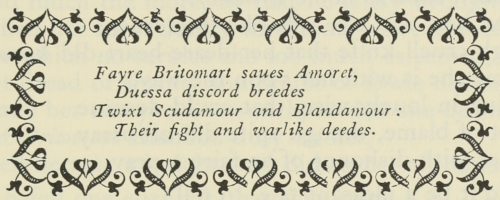
Fayre Britomart saues Amoret, Duessa discord breedes Twixt Scudamour and Blandamour: Their fight and warlike deedes.
Of louers sad calamities of old, i Full many piteous stories doe remaine, But none more piteous euer was ytold, Then that of Amorets hart-binding chaine, And this of Florimels vnworthie paine: The deare compassion of whose bitter fit My softened heart so sorely doth constraine, That I with teares full oft doe pittie it, And oftentimes doe wish it neuer had bene writ. For from the time that Scudamour her bought ii In perilous fight, she neuer ioyed day, A perilous fight when he with force her brought From twentie Knights, that did him all assay: Yet fairely well he did them all dismay: And with great glorie both the shield of loue, And eke the Ladie selfe he brought away, Whom hauing wedded as did him behoue, A new vnknowen mischiefe did from him remoue. For that same vile Enchauntour Busyran, iii The very selfe same day that she was wedded, Amidst the bridale feast, whilest euery man Surcharg’d with wine, were heedlesse and ill hedded, All bent to mirth before the bride was bedded, Brought in that mask of loue which late was showen: And there the Ladie ill of friends bestedded, By way of sport, as oft in maskes is knowen, Conueyed quite away to liuing wight vnknowen. Seuen moneths he so her kept in bitter smart, iv Because his sinfull lust she would not serue, Vntill such time as noble Britomart Released her, that else was like to sterue, Through cruell knife that her deare heart did kerue. And now she is with her vpon the way, Marching in louely wise, that could deserue No spot of blame, though spite did oft assay To blot her with dishonor of so faire a pray. Yet should it be a pleasant tale, to tell v The diuerse vsage and demeanure daint, That each to other made, as oft befell. For Amoret right fearefull was and faint, Lest she with blame her honor should attaint, That euerie word did tremble as she spake, And euerie looke was coy, and wondrous quaint, And euerie limbe that touched her did quake: Yet could she not but curteous countenance to her make. For well she wist, as true it was indeed, vi That her liues Lord and patrone of her health Right well deserued as his duefull meed, Her loue, her seruice, and her vtmost wealth. All is his iustly, that all freely dealth: Nathlesse her honor dearer then her life, She sought to saue, as thing reseru’d from stealth; Die had she leuer with Enchanters knife, Then to be false in loue, profest a virgine wife. Thereto her feare was made so much the greater vii Through fine abusion of that Briton mayd: Who for to hide her fained sex the better, And maske her wounded mind, both did and sayd Full many things so doubtfull to be wayd, That well she wist not what by them to gesse[6], For other whiles to her she purpos made Of loue, and otherwhiles of lustfulnesse, That much she feard his mind would grow to some excesse. His will she feard; for him she surely thought viii To be a man, such as indeed he seemed, And much the more, by that he lately wrought, When her from deadly thraldome he redeemed, For which no seruice she too much esteemed, Yet dread of shame, and doubt of fowle dishonor Made her not yeeld so much, as due she deemed. Yet Britomart attended duly on her, As well became a knight, and did to her all honor. It so befell one euening, that they came ix Vnto a Castell, lodged there to bee, Where many a knight, and many a louely Dame Was then assembled, deeds of armes to see: Amongst all which was none more faire then shee, That many of them mou’d to eye her sore. The custome of that place was such, that hee Which had no loue nor lemman there in store, Should either winne him one, or lye without the dore. Amongst the rest there was a iolly knight, x Who being asked for his loue, auow’d That fairest Amoret was his by right, And offred that to iustifie alowd. The warlike virgine seeing his so prowd And boastfull chalenge, wexed inlie wroth, But for the present did her anger shrowd; And sayd, her loue to lose she was full loth, But either he should neither of them haue, or both. So foorth they went, and both together giusted; xi But that same younker soone was ouerthrowne, And made repent, that he had rashly lusted For thing vnlawfull, that was not his owne: Yet since[7] he seemed valiant, though vnknowne, She that no lesse was courteous then[8] stout, Cast how to salue, that both the custome showne Were kept, and yet that Knight not locked out, That seem’d full hard t’accord two things so far in dout. The Seneschall was cal’d to deeme the right, xii Whom she requir’d, that first fayre Amoret Might be to her allow’d, as to a Knight, That did her win and free from chalenge set: Which straight to her was yeelded without let. Then since that strange Knights loue from him was quitted, She claim’d that to her selfe, as Ladies det, He as a Knight might iustly be admitted; So none should be out shut, sith all of loues were fitted. With that her glistring helmet she vnlaced; xiii Which doft, her golden lockes, that were vp bound Still in a knot, vnto her heeles downe traced, And like a silken veile in compasse round About her backe and all her bodie wound: Like as the shining skie in summers night, What time the dayes with scorching heat abound, Is creasted all with lines of firie light, That it prodigious seemes in common peoples sight. Such when those Knights and Ladies all about xiv Beheld her, all were with amazement smit, And euery one gan grow in secret dout Of this and that, according to each wit: Some thought that some enchantment faygned it; Some, that Bellona in that warlike wise To them appear’d, with shield and armour fit; Some, that it was a maske of strange disguise: So diuersely each one did sundrie doubts deuise. But that young Knight, which through her gentle deed xv Was to that goodly fellowship restor’d, Ten thousand thankes did yeeld her for her meed, And doubly ouercommen, her ador’d: So did they all their former strife accord; And eke fayre Amoret now freed from feare, More franke affection did to her afford, And to her bed, which she was wont forbeare, Now freely drew, and found right safe assurance theare. Where all that night they of their loues did treat, xvi And hard aduentures twixt themselues alone, That each the other gan with passion great, And griefull[9] pittie priuately bemone. The morow next so soone as Titan shone, They both vprose, and to their waies them dight: Long wandred they, yet neuer met with none[10], That to their willes could them direct aright, Or to them tydings tell, that mote their harts delight. Lo thus they rode, till at the last they spide xvii Two armed Knights, that toward them did pace, And ech of them had ryding by his side A Ladie, seeming in so farre a space, But Ladies none they were, albee in face And outward shew faire semblance they did beare; For vnder maske of beautie and good grace, Vile treason and fowle falshood hidden were, That mote to none but to the warie wise appeare. The one of them the false Duessa hight, xviii That now had chang’d her former wonted hew: For she could d’on so manie shapes in sight, As euer could Cameleon[11] colours new; So could she forge all colours, saue the trew. The other no whit better was then shee, But that such as she was, she plaine did shew; Yet otherwise much worse, if worse might bee, And dayly more offensiue vnto each degree. Her name was Ate, mother of debate, xix And all dissention, which doth dayly grow Amongst fraile men, that many a publike[12] state And many a priuate oft doth ouerthrow. Her false Duessa who full well did know, To be most fit to trouble noble knights, Which hunt for honor, raised from below, Out of the dwellings of the damned sprights, Where she in darknes wastes her cursed daies and nights. Hard by the gates of hell her dwelling is, xx There whereas all the plagues and harmes abound, Which punish wicked men, that walke amisse:[13] It is a darksome delue farre vnder ground, With thornes and barren brakes enuirond round, That none the same may easily out win; Yet many waies to enter may be found, But none to issue forth when one is in: For discord harder is to end then to begin. And all within the riuen walls were hung xxi With ragged monuments of times forepast, All which the sad effects of discord sung: There were rent robes, and broken scepters plast,[14] Altars defyl’d, and holy things defast[15], Disshiuered speares, and shields ytorne in twaine, Great cities ransackt, and strong castles rast, Nations captiued, and huge armies slaine: Of all which ruines there some relicks did remaine. There was the signe of antique Babylon, xxii Of fatall Thebes, of Rome that raigned long, Of sacred Salem, and sad Ilion, For memorie of which on high there hong The golden Apple, cause of all their wrong, For which the three faire Goddesses did striue: There also was the name of Nimrod strong, Of Alexander, and his Princes fiue, Which shar’d to them the spoiles that he had got aliue. And there the relicks[16] of the drunken fray, xxiii The which amongst the Lapithees befell, And of the bloodie feast, which sent away So many Centaures drunken soules to hell, That vnder great Alcides furie fell: And of the dreadfull discord, which did driue The noble Argonauts to outrage fell, That each of life sought others to depriue, All mindlesse of the Golden fleece, which made them striue. And eke of priuate persons many moe, xxiv That were too long a worke to count them all; Some of sworne friends, that did their faith forgoe; Some of borne brethren, prov’d vnnaturall; Some of deare louers, foes perpetuall: Witnesse their broken bandes there to be seene, Their girlonds rent, their bowres despoyled all; The moniments whereof there byding beene, As plaine as at the first, when they were fresh and greene. Such was her house within; but all without, xxv The barren ground was full of wicked weedes, Which she her selfe had sowen all about, Now growen great, at first of little seedes, The seedes of euill wordes, and factious deedes; Which when to ripenesse due they growen arre, Bring foorth[17] an infinite increase, that breedes Tumultuous trouble and contentious iarre, The which most often end in bloodshed and in warre. And those same cursed seedes doe also serue xxvi To her for bread, and yeeld her liuing food: For life it is to her, when others sterue Through mischieuous debate, and deadly feood, That she may sucke their life, and drinke their blood, With which she from her childhood had bene fed. For she at first was borne of hellish brood, And by infernall furies nourished, That by her monstrous shape might easily be red. Her face most fowle and filthy was to see, xxvii With squinted eyes contrarie wayes intended, And loathly mouth, vnmeete a mouth to bee, That nought but gall and venim comprehended, And wicked wordes that God and man offended: Her lying tongue was in two parts diuided, And both the parts did speake, and both contended; And as her tongue, so was her hart discided, That neuer thoght one thing, but doubly stil was guided. Als as she double spake, so heard she double, xxviii With matchlesse eares deformed and distort, Fild with false rumors and seditious trouble, Bred in assemblies of the vulgar sort, That still are led with euery light report. And as her eares so eke her feet were odde, And much vnlike, th’one long, the other short, And both misplast; that when th’one forward yode, The other backe retired, and contrarie trode. Likewise vnequall were her handes twaine, xxix That one did reach, the other pusht away, That one did make, the other mard againe, And sought to bring all things vnto decay; Whereby great riches gathered manie a day, She in short space did often bring to nought, And their possessours often did dismay. For all her studie was and all her thought, How she might ouerthrow the things that Concord wrought. So much her malice did her might surpas, xxx That euen th’Almightie selfe she did maligne, Because to man so mercifull he was, And vnto all his creatures so benigne, Sith she her selfe was of his grace indigne: For all this worlds faire workmanship she tride, Vnto his last confusion to bring, And that great golden chaine quite to diuide, With which it blessed Concord hath together tide. Such was that hag, which with Duessa roade, xxxi And seruing her in her malitious vse, To hurt good knights, was as it were her baude, To sell her borrowed beautie to abuse. For though like withered tree, that wanteth iuyce, She old and crooked were, yet now of late, As fresh and fragrant as the floure deluce She was become, by chaunge of her estate, And made full goodly ioyance to her new found mate. Her mate he was a iollie youthfull knight, xxxii That bore great sway in armes and chiualrie, And was indeed a man of mickle might: His name was Blandamour, that did descrie His fickle mind full of inconstancie. And now himselfe he fitted had right well, With two companions of like qualitie, Faithlesse Duessa, and false Paridell, That whether were more false, full hard it is to tell. Now when this gallant with his goodly crew, xxxiii From farre espide the famous Britomart, Like knight aduenturous in outward vew, With his faire paragon, his conquests part, Approching nigh, eftsoones his wanton hart Was tickled with delight, and iesting sayd; Lo there Sir Paridel, for your desart, Good lucke presents you with yond louely mayd, For pitie that ye want a fellow for your ayd. By that the louely paire drew nigh to hond: xxxiv Whom when as Paridel more plaine beheld, Albee in heart he like affection fond, Yet mindfull how he late by one was feld, That did those armes and that same scutchion weld, He had small lust to buy his loue so deare, But answerd, Sir him wise I neuer held, That hauing once escaped perill neare, Would afterwards afresh the sleeping euill reare. This knight too late his manhood and his might, xxxv I did assay, that me right dearely cost, Ne list I for reuenge prouoke new fight, Ne for light Ladies loue, that soone is lost. The hot-spurre youth so scorning to be crost, Take then to you this Dame of mine (quoth hee) And I without your perill or your cost, Will chalenge yond same other for my fee: So forth he fiercely prickt, that one him scarce could see. The warlike Britonesse her soone addrest, xxxvi And with such vncouth welcome did receaue Her fayned Paramour, her forced guest, That being forst his saddle soone to leaue, Him selfe he did of his new loue deceaue: And made him selfe thensample of his follie. Which done, she passed forth not taking leaue, And left him now as sad, as whilome iollie, Well warned to beware with whom he dar’d to dallie. Which when his other companie beheld, xxxvii They to his succour ran with readie ayd: And finding him vnable once to weld, They reared him on horsebacke, and vpstayd, Till on his way they had him forth conuayd: And all the way with wondrous griefe of mynd, And shame, he shewd him selfe to be dismayd, More for the loue which he had left behynd, Then that which he had to Sir Paridel resynd. Nathlesse he forth did march well as he might, xxxviii And made good semblance to his companie, Dissembling his disease and euill plight; Till that ere long they chaunced to espie Two other knights, that towards them did ply[18] With speedie course, as bent to charge them new. Whom when as Blandamour approching nie, Perceiu’d to be such as they seemd in vew, He was full wo, and gan his former griefe renew. For th’one of them he perfectly descride, xxxix To be Sir Scudamour, by that he bore The God of loue, with wings displayed wide, Whom mortally he hated euermore, Both for his worth, that all men did adore, And eke because his loue he wonne by right: Which when he thought, it grieued him full sore, That through the bruses of his former fight, He now vnable was to wreake his old despight. For thy he thus to Paridel bespake, xl Faire Sir, of friendship let me now you pray, That as I late aduentured for your sake, The hurts whereof me now from battell stay, Ye will me now with like good turne repay, And iustifie my cause on yonder knight. Ah Sir (said Paridel) do not dismay Your selfe for this, my selfe will for you fight, As ye haue done for me: the left hand rubs the right. With that he put his spurres vnto his steed, xli With speare in rest, and toward him did fare, Like shaft out of a bow preuenting speed. But Scudamour was shortly well aware Of his approch, and gan him selfe prepare Him to receiue with entertainment meete. So furiously they met, that either bare The other downe vnder their horses feete, That what of them became, themselues did scarsly weete. As when two billowes in the Irish sowndes, xlii Forcibly driuen with contrarie tydes Do meete together, each abacke rebowndes With roaring rage; and dashing on all sides, That filleth all the sea with fome, diuydes The doubtfull current into diuers wayes: So fell those two in spight of both their prydes, But Scudamour himselfe did soone vprayse, And mounting light his foe for lying long vpbrayes. Who rolled on an heape lay still in swound, xliii All carelesse of his taunt and bitter rayle, Till that the rest him seeing lie on ground, Ran hastily, to weete what did him ayle. Where finding that the breath gan him to fayle, With busie care they stroue him to awake, And doft his helmet, and vndid his mayle: So much they did, that at the last they brake His slomber, yet so mazed, that he nothing spake. Which when as Blandamour beheld, he sayd, xliv False faitour Scudamour, that hast by slight And foule advantage this good Knight dismayd, A Knight much better then thy selfe behight, Well falles it thee that I am not in plight This day, to wreake the dammage by thee donne: Such is thy wont, that still when any Knight Is weakned, then thou doest him ouerronne: So hast thou to thy selfe false honour often wonne. He little answer’d, but in manly heart xlv His mightie indignation did forbeare, Which was not yet so secret, but some part Thereof did in his frouning face appeare: Like as a gloomie cloud, the which doth beare An hideous storme, is by the Northerne blast Quite ouerblowne, yet doth not passe so cleare, But that it all the skie doth ouercast With darknes dred[19], and threatens all the world to wast. Ah gentle knight,[20] then false Duessa sayd, xlvi Why do ye striue for Ladies loue so sore, Whose chiefe desire is loue and friendly aid Mongst gentle Knights to nourish euermore? Ne be ye wroth Sir Scudamour therefore, That she your loue list loue another knight, Ne do your selfe dislike a whit the more; For Loue is free, and led with selfe delight, Ne will enforced be with maisterdome or might. So false Duessa, but vile Ate thus; xlvii Both foolish knights, I can but laugh at both, That striue and storme with stirre outrageous, For her that each of you alike doth loth, And loues another, with whom now she goth In louely wise, and sleepes, and sports, and playes; Whilest both you here with many a cursed oth, Sweare she is yours, and stirre vp bloudie frayes, To win a willow bough, whilest other weares the bayes. Vile hag (sayd Scudamour) why dost thou lye? xlviii And falsly seekst a vertuous wight to shame? Fond knight (sayd she) the thing that with this eye I saw, why should I doubt to tell the same? Then tell (quoth Blandamour) and feare no blame, Tell what thou saw’st, maulgre who so it heares. I saw (quoth she) a stranger knight, whose name I wote not well, but in his shield he beares (That well I wote) the heads of many broken speares. I saw him haue your Amoret at will, xlix I saw him kisse, I saw him her embrace, I saw him sleepe with her all night his fill, All manie nights, and manie by in place, That present were to testifie the case. Which when as Scudamour did heare, his heart Was thrild with inward griefe, as when in chace The Parthian strikes a stag with shiuering dart, The beast astonisht stands in middest of his smart. So stood Sir Scudamour, when this he heard, l Ne word he had to speake for great dismay, But lookt on Glauce grim, who woxe afeard Of outrage for the words, which she heard say, Albee vntrue she wist them by assay. But Blandamour, whenas he did espie His chaunge of cheere, that anguish did bewray, He woxe full blithe, as he had got thereby, And gan thereat to triumph without victorie. Lo recreant (sayd he) the fruitlesse end li Of thy vaine boast, and spoile of loue misgotten, Whereby the name of knight-hood thou dost shend, And all true louers with dishonor blotten, All things not rooted well, will soone be rotten.[21] Fy fy false knight (then false Duessa cryde) Vnworthy life that loue with guile hast gotten, Be thou, where euer thou do go or ryde, Loathed of ladies all, and of all knights defyde. But Scudamour for passing great despight lii Staid not to answer, scarcely did refraine, But that in all those knights and ladies sight, He for reuenge had guiltlesse Glauce slaine: But being past, he thus began amaine; False traitour squire, false squire, of falsest knight, Why doth mine hand from thine auenge abstaine, Whose Lord hath done my loue this foule despight? Why do I not it wreake, on thee now in my might? Discourteous, disloyall Britomart, liii Vntrue to God, and vnto man vniust, What vengeance due can equall thy desart, That hast with shamefull spot of sinfull lust Defil’d the pledge committed to thy trust? Let vgly shame and endlesse infamy Colour thy name with foule reproaches rust. Yet thou false Squire his fault shalt deare aby, And with thy punishment his penance shalt supply. The aged Dame him seeing so enraged, liv Was dead with feare, nathlesse as neede required, His flaming furie sought to haue assuaged With sober words, that sufferance desired, Till time the tryall of her truth expyred: And euermore sought Britomart to cleare. But he the more with furious rage was fyred, And thrise his hand to kill her did vpreare, And thrise he drew it backe: so did at last forbeare.
FOOTNOTES:
Cant. II.
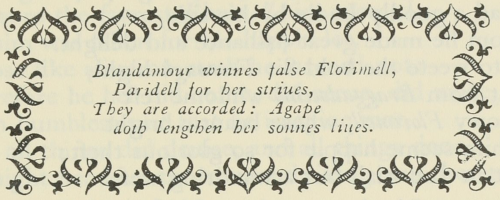
Blandamour winnes false Florimell, Paridell for her striues, They are accorded: Agape doth lengthen her sonnes liues.
Firebrand of hell first tynd in Phlegeton, i By thousand furies, and from thence out throwen Into this world, to worke confusion, And set it all on fire by force vnknowen, Is wicked discord, whose small sparkes once blowen None but a God or godlike man can slake; Such as was Orpheus, that when strife was growen Amongst those famous ympes of Greece, did take His siluer Harpe in hand, and shortly friends them make. Or such as that celestiall Psalmist was, ii That when the wicked feend his Lord tormented, With heauenly notes, that did all other pas, The outrage of his furious fit relented. Such Musicke is wise words with time concented, To moderate stiffe minds, disposd to striue: Such as that prudent Romane well inuented, What time his people into partes did riue, Them reconcyld againe, and to their homes did driue. Such vs’d wise Glauce to that wrathfull knight, iii To calme the tempest of his troubled thought: Yet Blandamour with termes of foule despight, And Paridell her scornd, and set at nought, As[22] old and crooked and not good for ought. Both they vnwise, and warelesse of the euill, That by themselues vnto themselues is wrought, Through that false witch, and that foule aged dreuill, The one a feend, the other an incarnate deuill. With whom as they thus rode accompanide, iv They were encountred of a lustie Knight, That had a goodly Ladie by his side, To whom he made great dalliance and delight. It was to weete the bold Sir Ferraugh hight, He that from Braggadocchio whilome reft The snowy Florimell, whose beautie bright Made him seeme happie for so glorious theft; Yet was it in due triall but a wandring weft. Which when as Blandamour, whose fancie light v Was alwaies flitting as the wauering wind, After each beautie, that appeard in sight, Beheld, eftsoones it prickt his wanton mind With sting of lust, that reasons eye did blind, That to Sir Paridell these words he sent; Sir knight why ride ye dumpish thus behind, Since so good fortune doth to you present So fayre a spoyle, to make you ioyous meriment? But Paridell that had too late a tryall vi Of the bad issue of his counsell vaine, List not to hearke, but made this faire denyall; Last turne was mine, well proued to my paine, This now be yours, God send you better gaine. Whose scoffed words he taking halfe in scorne, Fiercely forth prickt his steed as in disdaine, Against that Knight, ere he him well could torne:[23] By meanes whereof he hath him lightly ouerborne. Who with the sudden stroke astonisht sore, vii Vpon the ground a while in slomber lay; The whiles his loue away the other bore, And shewing her, did Paridell vpbray; Lo sluggish Knight the victors happie pray: So fortune friends the bold: whom Paridell Seeing so faire indeede, as he did say, His hart with secret enuie gan to swell, And inly grudge at him, that he had sped so well. Nathlesse proud man himselfe the other deemed, viii Hauing so peerelesse paragon ygot: For sure the fayrest Florimell him seemed, To him was fallen for his happie lot, Whose like aliue on earth he weened not: Therefore he her did court, did serue, did wooe, With humblest suit that he imagine mot, And all things did deuise, and all things dooe, That might her loue prepare, and liking win theretoo. She in regard thereof him recompenst ix With golden words, and goodly countenance, And such fond fauours sparingly dispenst: Sometimes him blessing with a light eye-glance, And coy lookes tempring with loose dalliance; Sometimes estranging him in sterner wise, That hauing cast him in a foolish trance, He seemed brought to bed in Paradise, And prou’d himselfe most foole, in what he seem’d most wise. So great a mistresse of her art she was, x And perfectly practiz’d in womans craft, That though therein himselfe he thought to pas, And by his false allurements wylie draft[24] Had thousand women of their loue beraft, Yet now he was surpriz’d: for that false spright, Which that same witch had in this forme engraft, Was so expert in euery subtile slight, That it could ouerreach the wisest earthly wight. Yet he to her did dayly seruice more, xi And dayly more deceiued was thereby; Yet Paridell him enuied therefore, As seeming plast in sole felicity: So blind is lust, false colours to descry. But Ate soone discouering his desire, And finding now fit opportunity To stirre vp strife, twixt loue and spight and ire, Did priuily put coles vnto his secret fire. By sundry meanes thereto she prickt him forth, xii Now with remembrance of those spightfull speaches, Now with opinion of his owne more worth, Now with recounting of like former breaches Made in their friendship, as that Hag him teaches: And euer when his passion is allayd, She it reuiues and new occasion reaches: That on a time as they together way’d, He made him open chalenge, and thus boldly sayd. Too boastfull Blandamour, too long I beare xiii The open wrongs, thou doest me day by day;[25] Well know’st thou, when we friendship first did sweare, The couenant was, that euery spoyle or pray Should equally be shard betwixt vs tway: Where is my part then of this Ladie bright, Whom to thy selfe thou takest quite away? Render therefore therein to me my right, Or answere for thy wrong, as shall fall out in fight. Exceeding wroth thereat was Blandamour, xiv And gan this bitter answere to him make; Too foolish Paridell, that fayrest floure Wouldst gather faine, and yet no paines wouldst take: But not so easie will I her forsake; This hand her wonne, this hand shall her defend. With that they gan their shiuering speares to shake, And deadly points at eithers breast to bend, Forgetfull each to haue bene euer others frend. Their firie Steedes with so vntamed forse xv Did beare them both to fell auenges end, That both their speares with pitilesse remorse, Through shield and mayle, and haberieon did wend, And in their flesh a griesly passage rend, That with the furie of their owne affret, Each other horse and man to ground did send; Where lying still a while, both did forget The perilous present stownd, in which their liues were set. As when two warlike Brigandines at sea, xvi With murdrous weapons arm’d to cruell fight, Doe meete together on the watry lea, They stemme ech other with so fell despight, That with the shocke of their owne heedlesse might, Their wooden ribs are shaken nigh a sonder; They which from shore behold the dreadfull sight Of flashing fire, and heare the ordenance thonder, Do greatly stand amaz’d at such vnwonted wonder. At length they both vpstarted in amaze,[26] xvii As men awaked rashly out of dreme;[27] And round about themselues a while did gaze, Till seeing her, that Florimell did seme, In doubt to whom she victorie should deeme, Therewith their dulled sprights they edgd anew, And drawing both their swords with rage extreme, Like two mad mastiffes each on other flew, And shields did share, and mailes did rash, and helmes did hew. So furiously each other did assayle, xviii As if their soules they would attonce haue rent Out of their brests, that streames of bloud did rayle Adowne, as if their springs of life were spent; That all the ground with purple bloud was sprent, And all their armours staynd with bloudie gore, Yet scarcely once to breath[28] would they relent, So mortall was their malice and so sore, Become of fayned friendship which they vow’d afore. And that which is for Ladies most besitting, xix To stint all strife, and foster friendly peace, Was from those Dames so farre and so vnfitting, As that in stead of praying them surcease, They did much more their cruelty encrease; Bidding them fight for honour of their loue, And rather die then Ladies cause release. With which vaine termes so much they did them moue, That both resolu’d the last extremities to proue. There they I weene would fight vntill this day, xx Had not a Squire, euen he the Squire of Dames, By great aduenture trauelled that way; Who seeing both bent to so bloudy games, And both of old well knowing by their names, Drew nigh, to weete the cause of their debate: And first laide on those Ladies thousand blames, That did not seeke t’appease their deadly hate, But gazed on their harmes, not pittying their estate. And then those Knights he humbly did beseech, xxi To stay their hands, till he a while had spoken: Who lookt a little vp at that his speech, Yet would not let their battell so be broken, Both greedie fiers on other to be wroken. Yet he to them so earnestly did call, And them coniur’d by some well knowen[29] token, That they at last their wrothfull hands let fall, Content to heare him speake, and glad to rest withall. First he desir’d their cause of strife to see: xxii They said, it was for loue of Florimell.[30] Ah gentle knights (quoth he) how may that bee, And she so farre astray, as none can tell.[31] Fond Squire, full angry then sayd Paridell, Seest not the Ladie there before thy face? He looked backe, and her aduizing[32] well, Weend as he said, by that her outward grace, That fayrest Florimell was present there in place. Glad man was he to see that ioyous sight, xxiii For none aliue but ioy’d in Florimell, And lowly to her lowting thus behight; Fayrest of faire, that fairenesse doest excell, This happie day I haue to greete you well, In which you safe I see, whom thousand late[33] Misdoubted lost through mischiefe that befell; Long may you liue in health and happie state.[34] She litle answer’d him, but lightly did aggrate. Then turning to those Knights, he gan a new; xxiv And you Sir Blandamour and Paridell, That for this Ladie present in your vew, Haue rays’d this cruell warre and outrage fell, Certes me seemes bene not aduised well, But rather ought in friendship for her sake To ioyne your force, their forces to repell, That seeke perforce her from you both to take, And of your gotten spoyle their owne triumph to make. Thereat Sir Blandamour with countenance[35] sterne, xxv All full of wrath, thus fiercely him bespake; A read thou Squire, that I the man may learne, That dare fro me thinke Florimell to take. Not one (quoth he) but many doe partake Herein, as thus. It lately so befell, That Satyran a girdle did vptake, Well knowne to appertaine to Florimell, Which for her sake he wore, as him beseemed well. But when as she her selfe was lost and gone, xxvi Full many knights, that loued her like deare, Thereat did greatly grudge, that he alone That lost faire Ladies ornament should weare, And gan therefore close spight to him to beare: Which he to shun, and stop vile enuies sting, Hath lately caus’d to be proclaim’d each where A solemne feast, with publike turneying, To which all knights with them their Ladies are to bring. And of them all she that is fayrest found, xxvii Shall haue that golden girdle for reward, And of those Knights who is most stout on ground, Shall to that fairest Ladie be prefard. Since[36] therefore she her selfe is now your ward, To you that ornament of hers pertaines, Against all those, that chalenge it to gard, And saue her honour with your ventrous paines; That shall you win more glory, then ye here find gaines. When they the reason of his words had hard, xxviii They gan abate the rancour of their rage, And with their honours and their loues regard, The furious flames of malice to asswage. Tho each to other did his faith engage, Like faithfull friends thenceforth to ioyne in one With all their force, and battell strong to wage Gainst all those knights, as their professed fone, That chaleng’d ought in Florimell, saue they alone. So well accorded forth they rode together xxix In friendly sort, that lasted but a while; And of all old dislikes they made faire weather, Yet all was forg’d and spred with golden foyle, That vnder it hidde hate and hollow guyle. Ne certes can that friendship long endure, How euer gay and goodly be the style, That doth ill cause or euill end enure: For vertue is the band, that bindeth harts most sure. Thus as they marched all in close disguise[37] xxx Of fayned loue, they chaunst to ouertake Two knights, that lincked rode in louely wise, As if they secret counsels did partake; And each not farre behinde him had his make, To weete, two Ladies of most goodly hew, That twixt themselues did gentle purpose make, Vnmindfull both of that discordfull crew, The which with speedie pace did after them pursew. Who as they now approched nigh at hand, xxxi Deeming them doughtie as they did appeare, They sent that Squire afore, to vnderstand, What mote they be: who viewing them more neare Returned readie newes, that those same weare Two of the prowest Knights in Faery lond; And those two Ladies their two louers deare, Couragious Cambell, and stout Triamond, With Canacee and Cambine linckt in louely bond. Whylome as antique stories tellen vs, xxxii Those two were foes the fellonest on ground, And battell made the dreddest[38] daungerous, That euer shrilling trumpet did resound; Though now their acts be no where to be found, As that renowmed Poet them compyled, With warlike numbers and Heroicke sound, Dan Chaucer, well of English vndefyled, On Fames eternall beadroll worthie to be fyled. But wicked Time that all good thoughts doth waste, xxxiii And workes of noblest wits to nought out weare, That famous moniment hath quite defaste, And robd the world of threasure endlesse deare, The which mote haue enriched all vs heare. O cursed Eld the cankerworme of writs, How may these rimes, so rude as doth appeare, Hope to endure, sith workes of heauenly wits Are quite deuourd, and brought to nought by little bits? Then pardon, O most sacred happie spirit, xxxiv That I thy labours lost may thus reuiue, And steale from thee the meede of thy due merit, That none durst euer whilest thou wast aliue, And being dead in vaine yet many striue: Ne dare I like, but through infusion sweete Of thine owne spirit, which doth in me surviue, I follow here the footing of thy feete, That with thy meaning so I may the rather meete. Cambelloes sister was fayre Canacee, xxxv That was the learnedst Ladie in her dayes, Well seene in euerie science that mote bee, And euery secret worke of natures wayes, In wittie riddles, and in wise soothsayes, In power of herbes, and tunes of beasts and burds; And, that augmented all her other prayse, She modest was in all her deedes and words, And wondrous chast of life, yet lou’d of Knights and Lords. Full many Lords, and many Knights her loued, xxxvi Yet she to none of them her liking lent, Ne euer was with fond affection moued, But rul’d her thoughts with goodly gouernement, For dread of blame and honours blemishment; And eke vnto her lookes a law she made, That none of them once out of order went, But like to warie Centonels well stayd, Still watcht on euery side, of secret foes affrayd. So much the more as she refusd to loue, xxxvii So much the more she loued was and sought, That oftentimes vnquiet strife did moue Amongst her louers, and great quarrels wrought, That oft for her in bloudie armes they fought. Which whenas Cambell, that was stout and wise, Perceiu’d would breede great mischiefe, he bethought How to preuent the perill that mote rise, And turne both him and her to honour in this wise. One day, when all that troupe of warlike wooers xxxviii Assembled were, to weet whose she should bee, All mightie men and dreadfull derring dooers, (The harder it to make them well agree) Amongst them all this end he did decree; That of them all, which loue to her did make, They by consent should chose[39] the stoutest three, That with himselfe should combat for her sake, And of them all the victour should his sister take. Bold was the chalenge, as himselfe was bold, xxxix And courage full of haughtie hardiment, Approued oft in perils manifold, Which he atchieu’d to his great ornament: But yet his sisters skill vnto him lent Most confidence and hope of happie speed, Concerned by a ring, which she him sent, That mongst the manie vertues, which we reed, Had power to staunch al wounds, that mortally did bleed. Well was that rings great vertue knowen to all, xl That dread thereof, and his redoubted might Did all that youthly rout so much appall, That none of them durst vndertake the fight; More wise they weend to make of loue delight, Then life to hazard for faire Ladies looke, And yet vncertaine by such outward sight, Though for her sake they all that perill tooke, Whether she would them loue, or in her liking brooke. Amongst those knights there were three brethren bold, xli Three bolder brethren neuer were yborne, Borne of one mother in one happie mold, Borne at one burden in one happie morne, Thrise happie mother, and thrise happie morne, That bore three such, three such not to be fond; Her name was Agape whose children werne All three as one, the first hight Priamond, The second Dyamond, the youngest Triamond. Stout Priamond but not so strong to strike, xlii Strong Diamond, but not so stout a knight, But Triamond was stout and strong alike: On horsebacke vsed Triamond to fight, And Priamond on foote had more delight, But horse and foote knew Diamond to wield: With curtaxe vsed Diamond to smite, And Triamond to handle speare and shield, But speare and curtaxe both vsd Priamond in field. These three did loue each other dearely well, xliii And with so firme affection were allyde, As if but one soule in them all did dwell, Which did her powre into three parts diuyde; Like three faire branches budding farre and wide, That from one roote deriu’d their vitall sap: And like that roote that doth her life diuide, Their mother was, and had full blessed hap, These three so noble babes to bring forth at one clap. Their mother was a Fay, and had the skill xliv Of secret things, and all the powres of nature, Which she by art could vse vnto her will, And to her seruice bind each liuing creature,[40] Through secret vnderstanding of their feature. Thereto she was right faire, when so her face She list discouer, and of goodly stature; But she as Fayes are wont, in priuie place Did spend her dayes, and lov’d in forests wyld to space. There on a day a noble youthly knight xlv Seeking aduentures in the saluage wood, Did by great fortune get of her the sight,[41] As she sate carelesse by a cristall flood, Combing her golden lockes, as seemd her good: And vnawares vpon her laying hold, That stroue in vaine him long to haue withstood, Oppressed her, and there (as it is told) Got these three louely babes, that prov’d three champions bold. Which she with her long fostred in that wood, xlvi Till that to ripenesse of mans state they grew: Then shewing forth signes of their fathers blood, They loued armes, and knighthood did ensew, Seeking aduentures, where they anie knew. Which when their mother saw, she gan to dout Their safetie, least by searching daungers new, And rash prouoking perils all about, Their days mote be abridged through[42] their corage stout. Therefore desirous th’end of all their dayes xlvii To know, and them t’enlarge with long extent, By wondrous skill, and many hidden wayes, To the three fatall sisters house she went. Farre vnder ground from tract of liuing went, Downe in the bottome of the deepe Abysse, Where Demogorgon in dull darknesse pent, Farre from the view of Gods and heauens blis, The hideous Chaos keepes, their dreadfull dwelling is. There she them found, all sitting round about xlviii The direfull distaffe standing in the mid, And with vnwearied fingers drawing out The lines of life, from liuing knowledge hid. Sad Clotho held the rocke, the whiles the thrid By griesly Lachesis was spun with paine, That cruell Atropos eftsoones vndid, With cursed knife cutting the twist in twaine: Most wretched men, whose dayes depend on thrids so vaine. She them saluting, there by them sate still, xlix Beholding how the thrids of life they span: And when at last she had beheld her fill, Trembling in heart, and looking pale and wan, Her cause of comming she to tell began. To whom fierce Atropos, Bold Fay, that durst Come see the secret of the life of man, Well worthie[43] thou to be of Ioue accurst, And eke thy childrens thrids to be a sunder burst. Whereat she sore affrayd, yet her besought l To graunt her boone, and rigour to abate, That she might see her childrens thrids forth brought, And know the measure of their vtmost date, To them ordained by eternall fate. Which Clotho graunting, shewed her the same: That when she saw, it did her much amate, To see their thrids so thin, as spiders frame, And eke so short, that seemd their ends out shortly came. She then began them humbly to intreate, li To draw them longer out, and better twine, That so their liues might be prolonged late. But Lachesis thereat gan to repine, And sayd, Fond[44] dame that deem’st of things diuine As of humane, that they may altred bee, And chaung’d at pleasure for those impes of thine. Not so; for what the Fates do once decree, Not all the gods can chaunge, nor Ioue him self can free. Then since[45] (quoth she) the terme of each mans life lii For nought may lessened nor enlarged bee, Graunt this, that when ye shred with fatall knife His line, which is the eldest of the three, Which is of them the shortest, as I see, Eftsoones his life may passe into the next; And when the next shall likewise ended bee, That both their liues may likewise be annext Vnto the third, that his may so be trebly wext. They graunted it; and then that carefull Fay liii Departed thence with full contented mynd; And comming home, in warlike fresh aray Them found all three according to their kynd: But vnto them what destinie was assynd, Or how their liues were eekt, she did not tell; But euermore, when she fit time could fynd, She warned them to tend their safeties well, And loue each other deare, what euer them befell. So did they surely during all their dayes, liv And neuer discord did amongst them fall; Which much augmented all their other praise. And now t’increase affection naturall, In loue of Canacee they ioyned all: Vpon which ground this same great battell grew, Great matter growing of beginning small; The which for length I will not here pursew, But rather will reserue it for a Canto new.
FOOTNOTES:
Cant. III.
The battell twixt three brethren with Cambell for Canacee:[46] Cambina with true friendships bond doth their long strife agree.
O Why doe wretched men so much desire, i To draw their dayes vnto the vtmost date, And doe not rather wish them soone expire, Knowing the miserie of their estate, And thousand perills which them still awate, Tossing them like a boate amid the mayne, That euery houre they knocke at deathes gate? And he that happie seemes and least in payne, Yet is as nigh his end, as he that most doth playne. Therefore this Fay I hold but fond and vaine, ii The which in seeking for her children three Long life, thereby did more prolong their paine. Yet whilest they liued none did euer see More happie creatures, then they seem’d to bee, Nor more ennobled for their courtesie, That made them dearely lou’d of each degree; Ne more renowmed for their cheualrie, That made them dreaded much of all men farre and nie. These three that hardie chalenge tooke in hand, iii For Canacee with Cambell for to fight: The day was set, that all might vnderstand, And pledges pawnd the same to keepe a right, That day, the dreddest day that liuing wight Did euer see vpon this world to shine, So soone as heauens window shewed light, These warlike Champions all in armour shine, Assembled were in field, the chalenge to define. The field with listes was all about enclos’d, iv To barre the prease of people farre away; And at th’one side sixe iudges were dispos’d, To view and deeme the deedes of armes that day; And on the other side in fresh aray, Fayre Canacee vpon a stately stage Was set, to see the fortune of that fray, And to be seene, as his most worthie wage, That could her purchase with his liues aduentur’d gage. Then entred Cambell first into the list, v With stately steps, and fearelesse countenance, As if the conquest his he surely wist. Soone after did the brethren three aduance, In braue aray and goodly amenance, With scutchins gilt and banners broad displayd: And marching thrise in warlike ordinance, Thrise lowted lowly to the noble Mayd, The whiles shril trompets and loud clarions sweetly playd. Which doen the doughty chalenger came forth, vi All arm’d to point his chalenge to abet: Gainst whom Sir Priamond with equall worth,[47] And equall armes himselfe did forward set. A trompet blew; they both together met, With dreadfull force, and furious intent, Carelesse of perill in their fiers affret, As if that life to losse they had forelent, And cared not to spare, that should be shortly spent. Right practicke was Sir Priamond in fight, vii And throughly skild in vse of shield and speare; Ne lesse approued was Cambelloes might, Ne lesse his skill[48] in weapons did appeare, That hard it was to weene which harder were. Full many mightie strokes on either side Were sent, that seemed death in them to beare, But they were both so watchfull and well eyde, That they auoyded were, and vainely by did slyde. Yet one of many was so strongly bent viii By Priamond, that with vnluckie glaunce Through Cambels shoulder it vnwarely went, That forced him his shield to disaduaunce:[49] Much was he grieued with that gracelesse chaunce, Yet from the wound no drop of bloud there fell, But wondrous paine, that did the more enhaunce His haughtie courage to aduengement[50] fell: Smart daunts not mighty harts, but makes them more to swell. With that his poynant speare he fierce auentred, ix With doubled force close vnderneath his shield, That through the mayles into his thigh it entred, And there arresting, readie way did yield, For bloud to gush forth on the grassie field; That he for paine himselfe n’ote[51] right vpreare, But too and fro in great amazement reel’d, Like an old Oke whose pith and sap is seare, At puffe of[52] euery storme doth stagger here and theare. Whom so dismayd when Cambell had espide, x Againe he droue at him with double might, That nought mote stay the steele, till in his side The mortall point most cruelly empight: Where fast infixed, whilest he sought by slight It forth to wrest, the staffe a sunder brake, And left the head behind: with which despight He all enrag’d, his shiuering speare did shake, And charging him a fresh thus felly him bespake. Lo faitour there thy meede vnto thee take, xi The meede of thy mischalenge and abet: Not for thine owne, but for thy sisters sake, Haue I thus long thy life vnto thee let: But to forbeare doth not forgiue the det. The wicked weapon heard his wrathfull vow, And passing forth with furious affret, Pierst through his beuer quite into his brow, That with the force it backward forced him to bow. Therewith a sunder in the midst it brast, xii And in his hand nought but the troncheon left, The other halfe behind yet sticking fast, Out of his headpeece Cambell fiercely reft, And with such furie backe at him it heft, That making way vnto his dearest life, His weasand pipe it through his gorget cleft: Thence streames of purple bloud issuing rife, Let forth his wearie ghost and made an end of strife. His wearie ghost assoyld from fleshly band, xiii Did not as others wont, directly fly Vnto her rest in Plutoes griesly land, Ne into ayre did vanish presently, Ne chaunged was into a starre in sky: But through traduction was eftsoones deriued, Like as his mother prayd the Destinie, Into his other brethren, that suruiued, In whom he liu’d a new, of former life depriued. Whom when on ground his brother next beheld, xiv Though sad and sorie for so heauy sight, Yet leaue vnto his sorrow did not yeeld, But rather stird to vengeance and despight, Through secret feeling of his generous spright, Rusht fiercely forth, the battell to renew, As in reuersion of his brothers right; And chalenging the Virgin as his dew. His foe was soone addrest: the trompets freshly blew. With that they both together fiercely met, xv As if that each ment other to deuoure; And with their axes both so sorely bet, That neither plate nor mayle, whereas their powre They felt, could once sustaine the hideous stowre, But riued were like rotten wood a sunder, Whilest through their rifts the ruddie bloud did showre And fire did flash, like lightning after thunder, That fild the lookers on attonce with ruth and wonder. As when two Tygers prickt with hungers rage, xvi Haue by good fortune found some beasts fresh spoyle, On which they weene their famine to asswage, And gaine a feastfull guerdon of their toyle, Both falling out doe stirre vp strifefull broyle, And cruell battell twixt themselues doe make, Whiles neither lets the other touch the soyle, But either sdeignes with other to partake: So cruelly these Knights stroue for that Ladies sake. Full many strokes, that mortally were ment, xvii The whiles were enterchaunged twixt them two; Yet they were all with so good wariment Or warded, or auoyded and let goe, That still the life stood fearelesse of her foe: Till Diamond disdeigning long delay Of doubtfull fortune wauering to and fro, Resolu’d to end it one or other way; And heau’d his murdrous axe at him with mighty sway. The dreadfull stroke in case it had arriued, xviii Where it was ment, (so deadly it was ment[53]) The soule had sure out of his bodie riued, And stinted all the strife incontinent. But Cambels fate that fortune did preuent: For seeing it at hand, he swaru’d asyde, And so gaue way vnto his fell intent: Who missing of the marke which he had eyde, Was with the force nigh feld whilst his right foot did slyde. As when a Vulture greedie of his pray, xix Through hunger long, that hart to him doth lend, Strikes at an Heron with all his bodies sway, That from his force seemes nought may it defend; The warie fowle that spies him toward bend[54] His dreadfull souse, auoydes it[55] shunning light, And maketh him his wing in vaine to spend; That with the weight of his owne weeldlesse might, He falleth nigh to ground, and scarse recouereth flight. Which faire adventure when Cambello spide, xx Full lightly, ere himselfe he could recower[56], From daungers dread to ward his naked side, He can let driue at him with all his power, And with his axe him smote in euill hower, That from his shoulders quite his head he reft: The headlesse tronke, as heedlesse of that stower, Stood still a while, and his fast footing kept, Till feeling life to fayle, it fell, and deadly slept. They which that piteous spectacle beheld, xxi Were much amaz’d the headlesse tronke to see Stand vp so long, and weapon vaine to weld, Vnweeting of the Fates diuine decree, For lifes succession in those brethren three. For notwithstanding that one soule was reft, Yet, had the bodie not dismembred bee, It would haue liued, and reuiued eft; But finding no fit seat, the lifelesse corse it left. It left; but that same soule, which therein dwelt, xxii Streight entring into Triamond, him fild With double life, and griefe, which when he felt, As one whose inner parts had bene ythrild With point of steele, that close his hartbloud spild, He lightly lept out of his place of rest, And rushing forth into the emptie field, Against Cambello fiercely him addrest; Who him affronting soone to fight was readie prest. Well mote ye wonder how that noble Knight, xxiii After he had so often wounded beene, Could stand on foot, now to renew the fight. But had ye then him forth aduauncing seene, Some newborne wight ye would him surely weene: So fresh he seemed and so fierce in sight; Like as a Snake, whom wearie winters teene[57] Hath worne to nought, now feeling sommers might, Casts off his ragged skin and freshly doth him dight. All was through vertue of the ring he wore, xxiv The which not onely did not from him let One drop of bloud to fall, but did restore His weakned powers, and dulled spirits whet, Through working of the stone therein yset. Else how could one of equall might with most, Against so many no lesse mightie met, Once thinke to match three such on equall cost, Three such as able were to match a puissant host. Yet nought thereof was Triamond adredde, xxv Ne desperate of glorious victorie, But sharpely him assayld, and sore bestedde, With heapes of strokes, which he at him let flie, As thicke as hayle forth poured from the skie: He stroke[58], he soust, he foynd, he hewd, he lasht, And did his yron brond so fast applie, That from the same the fierie sparkles flasht, As fast as water-sprinkles gainst a rocke are dasht. Much was Cambello daunted with his blowes.[59] xxvi So thicke they fell, and forcibly were sent, That he was forst from daunger of the throwes Backe to retire, and somewhat to relent, Till th’heat of his fierce furie he had spent: Which when for want of breath gan to abate, He then afresh with new encouragement Did him assayle, and mightily amate, As fast as forward erst, now backward to retrate. Like as the tide that comes fro th’Ocean mayne, xxvii Flowes vp the Shenan with contrarie forse, And ouerruling him in his owne rayne, Driues backe the current of his kindly course, And makes it seeme to haue some other sourse: But when the floud is spent, then backe againe His borrowed waters forst to redisbourse, He sends the sea his owne with double gaine, And tribute eke withall, as to his Soueraine. Thus did the battell varie to and fro, xxviii With diuerse fortune doubtfull to be deemed: Now this the better had, now had his fo; Then he halfe vanquisht, then the other seemed, Yet victors both them selues alwayes esteemed. And all the while the disentrayled blood Adowne their sides like litle riuers stremed, That with the wasting of his vitall flood, Sir Triamond at last full faint and feeble stood. But Cambell still more strong and greater grew, xxix Ne felt his blood to wast[60], ne powres emperisht, Through that rings vertue, that with vigour new, Still when as he enfeebled was, him cherisht, And all his wounds, and all his bruses guarisht, Like as a withered tree through husbands toyle Is often seene full freshly to haue florisht, And fruitfull apples to haue borne awhile, As fresh as when it first was planted in the soyle. Through which aduantage, in his strength he rose, xxx And smote the other with so wondrous might, That through the seame, which did his hauberk close, Into his throate and life it pierced quight, That downe he fell as dead in all mens sight: Yet dead he was not, yet he sure did die, As all men do, that lose the liuing spright: So did one soule out of his bodie flie Vnto her natiue home from mortall miserie. But nathelesse whilst all the lookers on xxxi Him dead behight, as he to all appeard, All vnawares he started vp anon, As one that had out of a dreame bene reard, And fresh assayld his foe, who halfe affeard Of th’vncouth sight, as he some ghost had seene, Stood still amaz’d, holding his idle sweard; Till hauing often by him stricken beene, He forced was to strike, and saue him selfe from teene. Yet from thenceforth more warily he fought, xxxii As one in feare the Stygian gods t’offend, Ne followd on so fast, but rather sought Him selfe to saue, and daunger to defend, Then life and labour both in vaine to spend. Which Triamond perceiuing, weened sure He gan to faint, toward the battels end, And that he should not long on foote endure, A signe which did to him the victorie assure. Whereof full blith, eftsoones his mightie hand xxxiii He heav’d on high, in mind with that same blow To make an end of all that did withstand: Which Cambell seeing come, was nothing slow Him selfe to saue from that so deadly throw; And at that instant reaching forth his sweard[61] Close vnderneath his shield, that scarce did show, Stroke him, as he his hand to strike vpreard, In th’arm-pit full, that through both sides the wound appeard. Yet still that direfull stroke kept on his way, xxxiv And falling heauie on Cambelloes crest, Strooke him so hugely, that in swowne he lay, And in his head an hideous wound imprest: And sure had it not happily found rest Vpon the brim of his brode plated shield, It would haue cleft his braine downe to his brest. So both at once fell dead vpon the field, And each to other seemd the victorie to yield. Which when as all the lookers on beheld, xxxv They weened sure the warre was at an end, And Iudges rose, and Marshals of the field Broke vp the listes, their armes away to rend; And Canacee gan wayle her dearest frend. All suddenly they both vpstarted light, The one out of the swownd, which him did blend, The other breathing now another spright, And fiercely each assayling, gan afresh to fight. Long while they then continued in that wize, xxxvi As if but then the battell had begonne: Strokes, wounds, wards, weapons, all they did despise, Ne either car’d to ward, or perill shonne, Desirous both to haue the battell donne; Ne either cared life to saue or spill, Ne which of them did winne, ne which were wonne. So wearie both of fighting had their fill, That life it selfe seemd loathsome, and long safetie ill. Whilst thus the case in doubtfull ballance hong, xxxvii Vnsure to whether side it would incline, And all mens eyes and hearts, which there among Stood gazing, filled were with rufull tine, And secret feare, to see their fatall fine, All suddenly they heard a troublous noyes, That seemd some perilous tumult to desine, Confusd with womens cries, and shouts of boyes, Such as the troubled Theaters oftimes annoyes. Thereat the Champions both stood still a space, xxxviii To weeten what that sudden clamour ment; Lo where they spyde with speedie whirling pace, One in a charet of straunge furniment, Towards them driuing like a storme out sent. The charet decked was in wondrous wize, With gold and many a gorgeous ornament, After the Persian Monarks antique guize, Such as the maker selfe could best by art deuize. And drawne it was (that wonder is to tell) xxxix Of two grim lyons, taken from the wood, In which their powre all others did excell; Now made forget their former cruell mood, T’obey their riders hest, as seemed good. And therein sate a Ladie passing faire And bright, that seemed borne of Angels brood, And with her beautie bountie did compare, Whether of them in her should haue the greater share. Thereto she learned was in Magicke leare, xl And all the artes, that subtill wits discouer, Hauing therein bene trained many a yeare, And well instructed by the Fay her mother, That in the same she farre exceld all other. Who vnderstanding by her mightie art, Of th’euill plight, in which her dearest brother Now stood, came forth in hast[62] to take his part, And pacifie the strife, which causd so deadly smart. And as she passed through th’vnruly preace xli Of people, thronging thicke her to behold, Her angrie teame breaking their bonds of peace, Great heapes of them, like sheepe in narrow fold, For hast did ouer-runne, in dust enrould, That thorough rude confusion of the rout, Some fearing shriekt, some being harmed hould, Some laught for sport, some did for wonder shout, And some that would seeme wise, their wonder turnd to dout. In her right hand a rod of peace shee bore, xlii About the which two Serpents weren wound, Entrayled mutually in louely lore, And by the tailes together firmely bound, And both were with one oliue garland crownd, Like to the rod which Maias sonne doth wield, Wherewith the hellish fiends he doth confound. And in her other hand a cup she hild, The which was with Nepenthe to the brim vpfild. Nepenthe is a drinck of souerayne grace, xliii Deuized by the Gods, for to asswage Harts grief, and bitter gall away to chace, Which stirs vp anguish and contentious rage: In stead thereof sweet peace and quiet age[63] It doth establish in the troubled mynd. Few men, but such as sober are and sage, Are by the Gods to drinck thereof assynd; But such as drinck, eternall happinesse do fynd. Such famous men, such worthies of the earth, xliv As Ioue will haue aduaunced to the skie, And there made gods, though borne of mortall berth, For their high merits and great dignitie, Are wont, before they may to heauen flie, To drincke hereof, whereby all cares forepast Are washt away quite from their memorie. So did those olde Heroes hereof taste, Before that they in blisse amongst the Gods were plaste. Much more of price and of more gratious powre xlv Is this, then that same water of Ardenne, The which Rinaldo drunck in happie howre, Described by that famous Tuscane penne: For that had might to change the hearts of men Fro loue to hate, a change of euill choise: But this doth hatred make in loue to brenne, And heauy heart with comfort doth reioyce. Who would not to this vertue rather yeeld his voice? At last arriuing by the listes side, xlvi Shee with her rod did softly smite the raile, Which straight flew ope, and gaue her way to ride. Eftsoones out of her Coch she gan auaile, And pacing fairely forth, did bid all haile, First to her brother, whom she loued deare, That so to see him made her heart to quaile: And next to Cambell, whose sad ruefull cheare Made her to change her hew, and hidden loue t’appeare. They lightly her requit (for small delight xlvii They had as then her long to entertaine,) And eft them turned both againe to fight, Which when she saw, downe on the bloudy plaine Her selfe she threw, and teares gan shed amaine; Amongst her teares immixing prayers meeke, And with her prayers reasons to restraine[64] From blouddy strife, and blessed peace to seeke, By all that vnto them was deare, did them beseeke. But when as all might nought with them preuaile, xlviii Shee smote them lightly with her powrefull wand. Then suddenly as if their hearts did faile, Their wrathfull blades downe fell out of their hand, And they like men astonisht still did stand. Thus whilest their minds were doubtfully distraught, And mighty spirites bound with mightier band, Her golden cup to them for drinke she raught, Whereof full glad for thirst, ech drunk an harty draught. Of which so soone as they once tasted had, xlix Wonder it is that sudden change to see: Instead of strokes, each other kissed glad, And louely haulst from feare of treason free, And plighted hands for euer friends to be. When all men saw this sudden change of things, So mortall foes so friendly to agree, For passing ioy, which so great maruaile brings, They all gan shout aloud, that all the heauen rings. All which, when gentle Canacee beheld, l In hast she from her lofty chaire descended, To[65] weet what sudden tidings was befeld: Where when she saw that cruell war so ended, And deadly foes so faithfully affrended, In louely wise she gan that Lady greet, Which had so great dismay so well amended, And entertaining her with curt’sies meet, Profest to her true friendship and affection sweet. Thus when they all accorded goodly were, li The trumpets sounded, and they all arose, Thence to depart with glee and gladsome chere. Those warlike champions both together chose, Homeward to march, themselues there to repose, And wise Cambina taking by her side Faire Canacee, as fresh as morning rose, Vnto her Coch remounting, home did ride, Admir’d of all the people, and much glorifide. Where making ioyous feast[66] theire daies they spent lii In perfect loue, deuoide of hatefull strife, Allide with bands of mutuall couplement; For Triamond had Canacee to wife, With whom he ledd a long and happie life; And Cambel tooke Cambina to his fere, The which as life were each to other liefe. So all alike did loue, and loued were, That since their days such louers were not found elswhere[67].
FOOTNOTES:
Cant. IIII.
Satyrane makes a Turneyment For loue of Florimell: Britomart winnes the prize from all, And Artegall doth quell.
It often fals, (as here it earst befell) i That mortall foes doe turne to faithfull frends, And friends profest are chaungd to foemen fell: The cause of both, of both their minds depends,[68] And th’end of both likewise of both their ends. For enmitie, that of no ill proceeds, But of occasion, with th’occasion ends; And friendship, which a faint affection breeds Without regard of good, dyes like ill grounded seeds. That well (me seemes) appeares, by that of late ii Twixt Cambell and Sir Triamond befell, As als[69] by this, that now a new debate Stird vp twixt Scudamour[70] and Paridell, The which by course befals me here to tell: Who hauing those two other Knights espide Marching afore, as ye remember well, Sent forth their Squire to haue them both descride, And eke those masked Ladies riding them beside. Who backe returning, told as he had seene, iii That they were doughtie knights of dreaded name; And those two Ladies, their two loues vnseene; And therefore wisht them without blot or blame, To let them passe at will, for dread of shame. But Blandamour full of vainglorious spright, And rather stird by his discordfull Dame, Vpon them gladly would haue prov’d his might, But that he yet was sore of his late lucklesse fight. Yet nigh approching, he them fowle bespake, iv Disgracing them, him selfe thereby to grace, As was his wont, so weening way to make To Ladies loue, where so he came in place, And with lewd termes their louers to deface. Whose sharpe prouokement them incenst so sore, That both were bent t’auenge his vsage base, And gan their shields addresse them selues afore: For euill deedes may better then bad words be bore. But faire Cambina with perswasions myld, v Did mitigate the fiercenesse of their mode, That for the present they were reconcyld, And gan to treate of deeds of armes abrode, And strange aduentures, all the way they rode: Amongst the which they told, as then befell, Of that great turney, which was blazed brode, For that rich girdle of faire Florimell, The prize of her, which did in beautie most excell. To which folke-mote they all with one consent, vi Sith each of them his Ladie had him by, Whose beautie each of them thought excellent, Agreed to trauell, and their fortunes try. So as they passed forth, they did espy One in bright armes, with ready speare in rest, That toward them his course seem’d to apply, Gainst whom Sir Paridell himselfe addrest, Him weening, ere he nigh approcht to haue represt. Which th’other seeing, gan his course relent, vii And vaunted speare eftsoones to disaduaunce, As if he naught but peace and pleasure ment, Now falne into their fellowship by chance, Whereat they shewed curteous countenaunce. So as he rode with them accompanide, His rouing eie did on the Lady glaunce, Which Blandamour had riding by his side: Whom sure he weend, that he some wher tofore had eide. It was to weete that snowy Florimell, viii Which Ferrau[71] late from Braggadochio wonne, Whom he now seeing, her remembred well, How hauing reft her from the witches sonne, He soone her lost: wherefore he now begunne To challenge her anew, as his owne prize, Whom formerly he had in battell wonne, And proffer made by force her to reprize, Which scornefull offer, Blandamour gan soone despize. And said, Sir Knight, sith ye this Lady clame, ix Whom he that hath, were loth to lose so light, (For so to lose a Lady, were great shame) Yee shall her winne, as I haue done in fight: And lo shee shall be placed here in sight,[72] Together with this Hag beside her set, That who so winnes her, may her haue by right: But he shall haue the Hag that is ybet, And with her alwaies ride, till he another get. That offer pleased all the company, x So Florimell with Ate forth was brought, At which they all gan laugh full merrily: But Braggadochio said, he neuer thought For such an Hag, that seemed worse[73] then nought, His person to emperill so in fight. But if to match that Lady they had sought Another like, that were like faire and bright, His life he then would spend to iustifie his right. At which his vaine excuse they all gan smile, xi As scorning his vnmanly cowardize: And Florimell him fowly gan reuile, That for her sake refus’d to enterprize The battell, offred in so knightly wize. And Ate eke prouokt him priuily, With loue of her, and shame of such mesprize. But naught he car’d for friend or enemy, For in base mind nor friendship dwels nor enmity. But Cambell thus did shut vp all in iest, xii Braue Knights and Ladies, certes ye doe wrong To stirre vp strife, when most vs needeth rest, That we may vs reserue both fresh and strong, Against the Turneiment which is not long. When who so list to fight, may fight his fill, Till then your challenges ye may prolong; And then it shall be tried, if ye will, Whether shall haue the Hag, or hold the Lady still. They all agreed, so turning all to game, xiii And pleasaunt bord, they past forth on their way, And all that while, where so they rode or came, That masked Mock-knight was their sport and play. Till that at length vpon th’appointed day, Vnto the place of turneyment they came; Where they before them found in fresh aray Manie a braue knight, and manie a daintie dame Assembled, for to get the honour of that game. There this faire crewe arriuing, did diuide xiv Them selues asunder: Blandamour with those Of his, on th’one; the rest on th’other side. But boastfull Braggadocchio rather chose, For glorie vaine their fellowship to lose, That men on him the more might gaze alone. The rest them selues in troupes did else dispose, Like as it seemed best to euery one; The knights in couples marcht, with ladies linckt attone. Then first of all forth came Sir Satyrane, xv Bearing that precious relicke in an arke Of gold, that bad eyes might it not prophane: Which drawing softly forth out of the darke, He open shewd, that all men it mote marke. A gorgeous girdle, curiously embost With pearle and precious stone, worth many a marke; Yet did the workmanship farre passe the cost: It was the same, which lately Florimel had lost. That same aloft he hong in open vew, xvi To be the prize of beautie and of might; The which eftsoones discouered, to it drew The eyes of all, allur’d with close delight, And hearts quite robbed with so glorious sight, That all men threw out vowes and wishes vaine. Thrise happie Ladie, and thrise happie knight, Them seemd that could so goodly riches gaine, So worthie of the perill, worthy of the paine. Then tooke the bold Sir Satyrane in hand xvii An huge great speare, such as he wont to wield, And vauncing forth from all the other band Of knights, addrest his maiden-headed[74] shield, Shewing him selfe all ready for the field. Gainst whom there singled from the other side A Painim knight, that well in armes was skild, And had in many a battell oft bene tride, Hight Bruncheual the bold, who fiersly forth did ride. So furiously they both together met, xviii That neither could the others force sustaine; As two fierce Buls, that striue the rule to get Of all the heard, meete with so hideous maine, That both rebutted, tumble on the plaine: So these two champions to the ground were feld, Where in a maze they both did long remaine, And in their hands their idle troncheons held, Which neither able were to wag, or once to weld. Which when the noble Ferramont espide, xix He pricked forth in ayd of Satyran; And him against Sir Blandamour did ride With all the strength and stifnesse that he can. But the more strong and stiffely that he ran, So much more sorely to the ground he fell, That on an[75] heape were tumbled horse and man. Vnto whose rescue forth rode Paridell; But him likewise with that same speare he eke did quell. Which Braggadocchio seeing, had no will xx To hasten greatly to his parties ayd, Albee his turne were next; but stood there still, As one that seemed doubtfull or dismayd. But Triamond halfe wroth to see him staid, Sternly stept forth, and raught away his speare, With which so sore he Ferramont assaid, That horse and man to ground he quite did beare, That neither could in hast themselues againe vpreare. Which to auenge, Sir Deuon him did dight, xxi But with no better fortune then the rest: For him likewise he quickly downe did smight, And after him Sir Douglas him addrest, And after him Sir Paliumord[76] forth prest, But none of them against his strokes could stand, But all the more, the more his praise increst. For either they were left vppon the land, Or went away sore wounded of his haplesse hand. And now by this, Sir Satyrane abraid, xxii Out of the swowne, in which too long he lay; And looking round about, like one dismaid, When as he saw the mercilesse affray, Which doughty Triamond had wrought that day, Vnto the noble Knights of Maidenhead, His mighty heart did almost rend in tway, For very gall, that rather wholly dead Himselfe he wisht haue beene, then in so bad a stead. Eftsoones he gan to gather vp around xxiii His weapons, which lay scattered all abrode, And as it fell, his steed he ready found. On whom remounting, fiercely forth he rode, Like sparke of fire that from the anduile glode,[77] There where he saw the valiant Triamond Chasing, and laying on them heauy lode. That none his force were able to withstond, So dreadfull were his strokes, so deadly was his hond. With that at him his beamlike[78] speare he aimed, xxiv And thereto all his power and might applide: The wicked steele for mischiefe first ordained, And hauing now misfortune got for guide,[79] Staid not, till it arriued in his side, And therein made a very griesly wound, That streames of bloud his armour all bedide. Much was he daunted with that direfull stound, That scarse he him vpheld from falling in a sound. Yet as he might, himselfe he soft withdrew xxv Out of the field, that none perceiu’d it plaine, Then gan the part of Chalengers anew To range the field, and victorlike to raine, That none against them battell durst maintaine. By that the gloomy euening on them fell, That forced them from fighting to refraine, And trumpets sound to cease did them compell, So Satyrane that day was iudg’d to beare the bell. The morrow next the Turney gan anew, xxvi And with the first the hardy Satyrane Appear’d in place, with all his noble crew, On th’other side, full many a warlike swaine, Assembled were, that glorious prize to gaine. But mongst them all, was not Sir Triamond, Vnable he new battell to darraine, Through grieuaunce of his late receiued wound, That doubly did him grieue, when so himselfe he found. Which Cambell seeing, though he could not salue, xxvii Ne done vndoe, yet for to salue his name, And purchase honour in his friends behalue,[80] This goodly counterfesaunce he did frame. The shield and armes well knowne to be the same, Which Triamond had worne, vnwares to wight, And to his friend vnwist, for doubt of blame, If he misdid,[81] he on himselfe did dight, That none could him discerne, and so went forth to fight. There Satyrane Lord of the field he found, xxviii Triumphing in great ioy and iolity; Gainst whom none able was to stand on ground; That much he gan his glorie to enuy, And cast t’auenge his friends indignity. A mightie speare eftsoones at him he bent; Who seeing him come on so furiously, Met him mid-way with equall hardiment, That forcibly to ground they both together went. They vp againe them selues can lightly reare, xxix And to their tryed swords them selues betake; With which they wrought such wondrous maruels there, That all the rest it did amazed make, Ne any dar’d their perill to partake; Now cuffling close, now chacing to and fro, Now hurtling round aduantage for to take: As two wild Boares together grapling go, Chaufing and foming choler each against his fo. So as they courst, and turneyd here and theare, xxx It chaunst Sir Satyrane his steed at last, Whether through foundring or through sodein feare To stumble, that his rider nigh he cast; Which vauntage Cambell did pursue so fast, That ere him selfe he had recouered well, So sore he sowst him on the compast creast, That forced him to leaue his loftie sell, And rudely tumbling downe vnder his horse feete fell. Lightly Cambello leapt downe from his steed, xxxi For to haue rent his shield and armes away, That whylome wont to be the victors meed; When all vnwares he felt an hideous sway Of many swords, that lode on him did lay. An hundred knights had him enclosed round, To rescue Satyrane out of his pray; All which at once huge strokes on him did pound, In hope to take him prisoner, where he stood on ground. He with their multitude was nought dismayd, xxxii But with stout courage turnd vpon them all, And with his brondiron round about him layd; Of which he dealt large almes, as did befall: Like as a Lion that by chaunce doth fall Into the hunters toile, doth rage and rore, In royall heart disdaining to be thrall. But all in vaine: for what might one do more? They haue him taken captiue, though it grieue him sore. Whereof when newes to Triamond was brought, xxxiii There as he lay, his wound he soone forgot, And starting vp, streight for his armour sought: In vaine he sought; for there he found it not; Cambello it away before had got: Cambelloes armes therefore he on him threw, And lightly issewd forth to take his lot. There he in troupe found all that warlike crew, Leading his friend away, full sorie to his vew. Into the thickest of that knightly preasse xxxiv He thrust, and smote downe all that was betweene, Caried with feruent zeale, ne did he ceasse, Till that he came, where he had Cambell seene, Like captive thral two other Knights atweene, There he amongst them cruell hauocke makes, That they which lead him, soone enforced beene To let him loose, to saue their proper stakes, Who being freed, from one a weapon fiercely takes. With that he driues at them with dreadfull might, xxxv Both in remembrance of his friends late harme, And in reuengement of his owne despight, So both together giue a new allarme, As if but now the battell wexed[82] warme. As when two greedy Wolues doe breake by force Into an heard, farre from the husband farme, They spoile and rauine without all remorse, So did these two through all the field their foes enforce. Fiercely they followd on their bolde emprize, xxxvi Till trumpets sound did warne them all to rest; Then all with one consent did yeeld the prize To Triamond and Cambell as the best. But Triamond to Cambell it relest. And Cambell it to Triamond transferd; Each labouring t’aduance the others gest, And make his praise before his owne preferd: So that the doome was to another day differd. The last day came, when all those knightes againe xxxvii Assembled were their deedes of armes to shew. Full many deedes that day were shewed plaine: But Satyrane boue all the other crew, His wondrous worth declared in all mens view. For from the first he to the last endured, And though some while Fortune from him withdrew, Yet euermore his honour he recured, And with vnwearied powre his party still assured. Ne was there Knight that euer thought of armes, xxxviii But that his vtmost prowesse there made knowen, That by their many wounds, and carelesse harmes, By shiuered speares, and swords all vnder strowen, By scattered shields was easie to be showen. There might ye see loose steeds at randon ronne, Whose luckelesse riders late were ouerthrowen; And squiers make hast to helpe their Lords fordonne, But still the Knights of Maidenhead the better wonne. Till that there entred on the other side, xxxix A straunger knight, from whence no man could reed, In quyent disguise, full hard to be descride. For all his armour was like saluage weed, With woody mosse bedight, and all his steed With oaken leaues attrapt, that seemed fit For saluage wight, and thereto well agreed His word, which on his ragged shield was writ, Saluagesse sans finesse, shewing secret wit. He at his first incomming, charg’d his spere xl At him, that first appeared in his sight: That was to weet, the stout Sir Sangliere, Who well was knowen to be a valiant Knight, Approued oft in many a perlous fight. Him at the first encounter downe he smote, And ouerbore beyond his crouper quight, And after him another Knight, that hote Sir Brianor, so sore, that none him life behote. Then ere his hand he reard, he ouerthrew xli Seuen Knights one after other as they came: And when his speare was brust, his sword he drew, The instrument of wrath, and with the same Far’d like a lyon in his bloodie game, Hewing, and slashing shields, and helmets bright, And beating downe, what euer nigh him came, That euery one gan shun his dreadfull sight, No lesse then death it selfe, in daungerous affright. Much wondred all men, what, or whence he came, xlii That did amongst the troupes so tyrannize; And each of other gan inquire his name. But when they could not learne it by no wize, Most answerable to his wyld disguize It seemed, him to terme the saluage knight. But certes his right name was otherwize, Though knowne to few, that Arthegall he hight, The doughtiest knight that liv’d that day, and most of might. Thus was Sir Satyrane with all his band xliii By his sole manhood and atchieuement stout Dismayd, that none of them in field durst stand, But beaten were, and chased all about. So he continued all that day throughout, Till euening, that the Sunne gan downward bend. Then rushed forth out of the thickest rout A stranger knight, that did his glorie shend: So nought may be esteemed happie till the end. He at his entrance charg’d his powrefull speare xliv At Artegall, in middest of his pryde, And therewith smote him on his Vmbriere So sore, that tombling backe, he downe did slyde Ouer his horses taile aboue a stryde; Whence litle lust he had to rise againe. Which Cambell seeing, much the same enuyde, And ran at him with all his might and maine; But shortly was likewise seene lying on the plaine. Whereat full inly wroth was Triamond xlv And cast t’auenge[83] the shame doen to his freend: But by his friend himselfe eke soone he fond, In no lesse neede of helpe, then him he weend. All which when Blandamour from end to end Beheld, he woxe therewith displeased sore, And thought in mind it shortly to amend: His speare he feutred, and at him it bore; But with no better fortune, then the rest afore. Full many others at him likewise ran: xlvi But all of them likewise dismounted were, Ne certes wonder; for no powre of man Could bide the force of that enchaunted speare, The which this famous Britomart did beare; With which she wondrous deeds of arms atchieued, And ouerthrew, what euer came her neare, That all those stranger knights full sore agrieued, And that late weaker band of chalengers relieued. Like as in sommers day when raging heat xlvii Doth burne the earth, and boyled riuers drie, That all brute beasts forst to refraine fro meat, Doe hunt for shade, where shrowded they may lie, And missing it, faine from themselues to flie; All trauellers tormented are with paine: A watry cloud doth ouercast the skie, And poureth forth a sudden shoure of raine, That all the wretched world recomforteth againe. So did the warlike Britomart restore xlviii The prize, to knights of Maydenhead that day, Which else was like to haue bene lost, and bore The prayse of prowesse from them all away. Then shrilling trompets loudly gan to bray, And bad them leaue their labours and long toyle, To ioyous feast and other gentle play, Where beauties prize shold win that pretious spoyle: Where I with sound of trompe will also rest a whyle.