Front matter (continued 2)
Reading edition
Utah: Weber Co.: Mt. Willard, Weber-Box Elder Co. line, 9768 ft., 2 UU. Salt Lake Co.: Butterfield Canyon, 7000 ft., 1 UU; Brighton, Silver Lake P. O., 8700 ft., 2 UU; Brighton, Silver Lake P. O., 8750 ft., 8 UU; Brighton, Silver Lake P. O., 9000 ft., 2 UU; Brighton, Silver Lake P. O., 9500 ft., 1 UU. Summit Co.: Jct. Bear River and East Fork, 2 CM; Smith and Morehouse Canyon, 7000 ft., 1 UU; Mirror Lake, 10,000 ft., 1 UU. Daggett Co.: Jct. Deep and Carter creeks, 7900 ft., 1 UU. Utah Co.: Nebo Mtn., 1 mi. E Payson Lake, 8300 ft., 1 UU; Nebo Mts., 12 mi. SE Payson Lake, 1 UU. Wasatch Co.: Current Creek, Uinta Mts., 1 BS; Wasatch Mts., 1 BS. Uintah Co.: Paradise Park, 21 mi. W and 15 mi. N Vernal, Uinta Mts., 10,050 ft., 2 CM, 3 KU; Paradise Park, Uinta Mts., 10,100 ft., 6 UU. Sanpete Co.: Manti, 3 BS. Sevier Co.: 7 mi. Creek, 20 mi. SE Salina, 5 CM; Fish Lake Plateau, 2 BS. Emery Co.: Lake Creek, 11 mi. E Mt. Pleasant, 4 CM. Grand Co.: Warner R. S., La Sal Mts., 9750 ft., 2 UU; La Sal Mts., 11,000 ft., 1 BS. Beaver Co.: Puffer Lake, Beaver Mts., 2 BS. Wayne Co.: Elkhorn G. S., Fish Lake Plateau, 14 mi. N Torrey, 9400 ft., 3 UU. Garfield Co.: Wildcat R. S., Boulder Mtn., 8700 ft., 6 UU; 18 mi. N Escalante, 9500 ft., 1 UU. Washington Co.: Pine Valley Mts., 7 BS. San Juan Co.: Geyer Pass, 18 mi. SSE Moab, 3 CM; Cooley, 8 mi. W Monticello, 3 CM.
Colorado: Larimer Co.: Poudre River, 1 KU. Rio Blanco Co.: 9½ mi. SW Pagoda Peak, 2 KU. Grand Co.: Arapaho Pass, Rabbit Ears Mts., 2 BS. Boulder Co.: Willow Park, Rocky Mtn. Nat'l Park, 8 UM; Longs Peak, 1 BS; ¾ mi. N and 2 mi. W Allenspark, 8400 ft., 5 KU; Ward, 9500 ft., 1 BS; Buchanan Pass, 1 BS; 3 mi. S Ward, 1 KU; 7 mi. NW Nederland, 1 KU; 5 mi. W Boulder, 3 BS; Boulder, 3 BS, 1 ChM; Nederland, 6 BS, 4 ChM; Eldora, 1 BS. Garfield Co.: Baxter Pass, 8500 ft., 2 BS. Eagle Co.: Gores Range, 1 BS. Gilpen Co.: Black Hawk, 1 BS. Lake Co.: 3 mi. W Twin Lakes, 2 KU; 12 mi. S and 1 mi. W Leadville, 1 KU. Gunnison Co.: 2 mi. W Gothic, 2 FC; Copper Lake, 2 FC; Gothic, 1 FC. Chaffee Co.: St. Elmo, 10,100 ft., 2 BS; E side Monarch Pass, 7 mi. W Salida, 2 ChM. Teller Co.: Glen Core, Pikes Peak, 2 UM. El Paso Co.: Hunters Creek, a tributary of Bear Creek, 7250-7400 ft., 1 AMNH. Montrose Co.: Uncomphagre Plateau, 8500 ft., 3 BS. Saguache Co.: 3 mi. N and 16 mi. W Saguache, 8500 ft., 2 KU; Cochetopa Pass, 10,000 ft., 4 KU; Monshower Meadows, 27 mi. W Saguache, 2 BS. San Juan Co.: Silverton, 4 BS. Mineral Co.: 23 mi. S and 11 mi. E Creede, 1 KU. Costilla Co.: Fort Garland, 2 BS. Huerfano Co.: 5 mi. S and 1 mi. W Cuchara Camps, 8 KU.
New Mexico: Taos Co.: 3 mi. N Red River, 2 BS; Taos, 1 BS. Colfax Co.: 1 mi. S and 2 mi. E Eagle Nest, 8100 ft., 2 KU. Sandoval Co.: Jemez Mts., 3 BS. Santa Fe Co.: Hyde Park, 5 mi. NE Santa Fe, 2 HC; Santa Fe Field Station, 1 HC; Santa Fe Ski Basin, 1 KU; Pecos Baldy, 4 BS. Torrance Co.: Manzano Mts., 2 BS.
Marginal Records.—Alaska: Chandler Lake, 68° 12' N, 152° 45' W; Yukon River, 20 mi. above Circle; Mountains near Eagle. Mackenzie: Nahanni River Mts.; Fort Simpson; Fort Resolution, Mission Island. Alberta: Wood Buffalo Park; Athabaska River, 30 mi. above Athabaska Landing. Saskatchewan: Cypress Hills. Montana: St. Mary; 4 mi. S Fort Logan; Pryor Mts. Wyoming: 1 mi. W and 1 mi. S Buffalo, 27424 KU; Springhill, 12 mi. N Laramie Peak; 5 mi. W and 1 mi. N Horse Creek PO. Colorado: Boulder; Hunters Creek; 5 mi. S and 1 mi. W Cuchara Camps. New Mexico: 3 mi. N Red River, 10,700 ft.; Pecos Baldy; Manzano Mts.; Jemez Mts. Colorado: Navajo River (Jackson, 1928:120); Silverton. Utah: La Sal Mts., 11,000 ft. Colorado: Baxter Pass. Utah: junction Trout and Ashley Creeks, 9700 ft. (Durrant, 1952:35); Mirror Lake, 10,000 ft.; Mt. Baldy R. S. (Durrant, 1952:53); Wildcat R. S.; Pine Valley Mts.; Puffer Lake; Butterfield Canyon. Idaho: Preuss Mts.; 4 mi. S Trude (Davis, 1939:104); head Pahsimeroi River, Pahsimeroi Mts.; Perkins Lake; 1 mi. NE Heath; ½ mi. E Black Lake. Montana: Sula; 8 mi. NE Stevensville. Washington: head Pass Creek; Conconully; Wenatchee; Easton; Stehekin; Pasayten River. British Columbia: Second Summit, Skagit River, 5000 ft., (Jackson, 1928:120); Babine Mts., 6 mi. N Babine Trail, 5200 ft.; Hazleton (Jackson, 1928:120); 23 mi. N Hazleton; Flood Glacier, Stikine River (Jackson, 1928:120); Cheonee Mts. (ibid.); Level Mtn.; west side Mt. Glave, 4000 ft., 14 mi. S and 2 mi. E Kelsall Lake. Alaska: head Toklat River; Tanana; Alatna; Bettles.
Sorex vagrans soperi Anderson and Rand
Sorex obscurus soperi Anderson and Rand, Canadian Field-Nat., 59:47, October 16, 1945.
Type.—Adult male, skin and skull; No. 18249, Nat. Mus. Canada; obtained on September 21, 1940, by J. Dewey Soper, from 2½ mi. NW Lake Audy, Riding Mtn. Nat'l Park, Manitoba.
Range.—Southwestern Manitoba to central Saskatchewan.
Diagnosis.—Size medium to small for the species; measurements of type and two topotypes are: total length, 107, 108, 117; tail, 45, 45, 45; hind foot, 12.1, 12.3, 12.5. Color dark brownish or fuscous in summer pelage; winter pelage unknown.
Comparison.—Resembles S. v. obscurus in size; darker than obscurus in summer pelage; cranium slightly higher and top more nearly flat; larger and darker in summer pelage than the new subspecies from central Montana.
Remarks.—In their description of this subspecies Anderson and Rand pointed out that specimens from the type locality and from central Saskatchewan represent the dark extreme in a color cline which begins in south-central British Columbia with "pale, brownish-tinged animals." These authors referred shrews from Cypress Hills, southwestern Saskatchewan and southeastern Alberta to S. o. soperi, although they noted that these specimens, taken by themselves, are not strikingly different from S. o. obscurus from the Rocky Mountains. The specimens from the Cypress Hills were included in soperi because the authors felt that the subspecific boundary should be drawn "where specimens average about half way between the extremes (of the cline) in characters."
It is true, as Anderson and Rand say, that the shrews from Cypress Hills are hardly separable from those from, say, Waterton Lakes Park. The specimens from the Cypress Hills are noticeably different from specimens from the Okanagan area, but some of the latter, in my opinion may represent intergrades between S. v. obscurus and the more reddish S. v. vagrans and are not, at any rate, typical obscurus. In view of the similarity of shrews from Cypress Hills to typical S. v. obscurus and since the Cypress Hills are much nearer to the range of S. v. obscurus than to the record-stations of occurrence in central Saskatchewan and Manitoba, I have chosen to restrict the name soperi to shrews from these latter two localities. Seemingly S. vagrans is absent from the plains separating the Cypress Hills from the Rocky Mountains and from Riding Mountain National Park.
Specimens examined.—none.
Marginal records.—Saskatchewan: Prince Albert National Park, 1700 ft. (Anderson and Rand, 1945:48). Manitoba: Riding Mountain National Park, 2½ mi. NW Audy Lake (ibid.).
Sorex vagrans longiquus new subspecies
Type.—First year male, skin and skull; No. 87332, Univ. Michigan Mus. Zool.; obtained on July 21, 1942, by Emmet T. Hooper from 25 mi. ESE Big Sandy, Eagle Creek, Chouteau Co., Montana, original no. 2184.
Range.—Central Montana; marginal localities are: Bearpaw Mts., Zortman, Big Snowy Mts., Buffalo, Little Belt Mts.
Diagnosis.—Size small for the species; measurements of three topotypes are: total length, 101, 105, 108; tail, 39, 40, 42; hind foot, 11.5, 11.5, 12. Color pale; summer pelage: back near (17´´´k) Olive Brown but hairs of dorsum with a pale, buffy band proximal from the tips which imparts a pale over-all appearance; flanks near Wood Brown; underparts Pale Smoke Gray, usually not with a buffy wash; color of underparts often extending along margin of upper lip. Skull small for species; rostrum relatively broad and heavy; relatively broad interorbitally.
Comparisons.—From S. v. obscurus, S. v. longiquus differs as follows: size smaller; skull smaller in all dimensions although similar in proportion. From S. v. soperi, S. v. longiquus differs in: size smaller; color paler in summer pelage. From S. v. vagrans, S. v. longiquus differs in: color paler in summer pelage, less brownish; color of venter extending higher on flanks; venter Pale Smoke Gray, rarely tinged with buffy rather than usually tinged with buffy. From S. v. monticola, S. v. longiquus differs in: summer pelage slightly paler, venter Pale Smoke Gray rather than suffused with buffy.
Remarks.—The subspecies longiquus is obviously derived from the neighboring S. v. obscurus and differs from it mainly in size. Some specimens of obscurus from western Montana show evidences of intergradation with S. v. vagrans in possessing a somewhat buffy belly and these are thus more strikingly different from longiquus than are other specimens of obscurus. Many specimens of obscurus from the eastern slope of the Lewis and Clark Range in Montana show the tricolored pattern seen in many specimens of longiquus. The smallest individuals of longiquus are found on the Big Snowy Mountains. Intergradation with obscurus is seen in specimens here referred to S. v. obscurus from the Big Belt Mountains.
Specimens examined.—Total number, 45. Montana: Hill Co.: Bearpaw Mts., 5 UM, 2 BS. Phillips Co.: Zortman, 1 BS. Chouteau Co.: type locality, 3 UM; Highwood Mts., 13 BS. Cascade Co.: Neihart, Little Belt Mts., 1 BS. Judith Basin Co.: 3 mi. W Geyser, 4100 ft., 1 KU; Otter Creek, 10 mi. SW Geyser, 1 BS; Dry Wolf Creek, 20 mi. SW Stanford, 1 BS. Buffalo, 13 mi. W Buffalo Canyon, 2 BS. Fergus Co.: Moccasin Mts., 15 mi. NW Hilger, 3 BS; Judith Mts., 17 mi. NE Lewiston, 1 BS; 15 mi. S Heath, N. fork Flat Willow Creek, Big Snowy Mts., 1 BS; Timber Creek, Big Snowy Mts., 1 BS; Crystal Lake, 6000 ft., Big Snowy Mts., 2 UM; Rocky Creek, 5600 ft., Big Snowy Mts., 3 UM; Big Snowy Mts., 3 BS. Meagher Co.: Sheep Creek, 16 mi. N White Sulphur Springs, Little Belt Mts., 1 BS.
Marginal records.—Montana: Bearpaw Mts.; Zortman; Big Snowy Mts.; 16 mi. N White Sulphur Springs; Highwood Mts.
Sorex vagrans neomexicanus Bailey
Sorex obscurus neomexicanus Bailey, Proc. Biol. Soc. Washington, 26:133, May 21, 1913.
Type.—Adult male, skin and skull; No. 100440, U. S. Biol. Surv. Coll.; obtained on May 29, 1900, by Vernon Bailey, from Cloudcroft, 9000 ft., Otero Co., New Mexico.
Range.—Sacramento and Capitan Mountains of New Mexico.
Diagnosis.—Size medium for the species; average and extreme measurements of 4 topotypes are: total length, 105.2 (103-107); tail, 41.0 (39-42); hind foot, 13.1 (12.5-14). Color near Olive Brown in summer; winter pelage unknown; skull large and relatively broad; teeth relatively large.
Comparisons.—Skull larger than that of S. v. obscurus and relatively somewhat broader; much larger in all cranial dimensions than S. v. monticola.
Remarks.—S. v. neomexicanus is a well-marked subspecies seemingly limited to the mountains of southeastern New Mexico. It is the only species of Sorex thus far recorded from that area.
Specimens examined.—Total number, 12. New Mexico: Otero Co.: SW slope Capitan Mts., 2 BS; 10 mi. NE Cloudcroft, 2 BS; Cloudcroft, 7 BS, 1 UM.
Marginal records.—New Mexico: SW slope Capitan Mts.; 10 mi. NE Cloudcroft; type locality.
Sorex vagrans monticola Merriam
Sorex monticolus Merriam, N. Amer. Fauna, 3:43, September 11, 1890.
Sorex vagrans monticola, Merriam, N. Amer. Fauna, 10:69, December 31, 1895.
Sorex melanogenys Hall, Jour. Mamm., 13:260, August 9, 1932, type from Marijilda Canyon, 8600 ft., Graham Mts. [= Pinaleno Mts.] Graham Co., Arizona.
Type.—Adult male, skin and skull; No. 17599/24535, U. S. Biol. Surv. Coll.; obtained on August 28, 1899, by C. Hart Merriam and Vernon Bailey from San Francisco Mtn., 11,500 ft., Coconino Co., Arizona.
Range.—Mountains of western New Mexico, eastern Arizona, and the northern Sierra Madre Occidental of Mexico.
Diagnosis.—Size small for the species; average and extreme measurements of 12 specimens from the White Mountains, Arizona, are: total length, 104.3 (98-112); tail, 41.2 (37-45); hind foot, 12.0 (11-13). Summer pelage between (15´m) Proutts Brown and (15´´m) Bister, venter tinged with (15´f) Pale Ochraceous Buff; winter pelage near (17´´´k) Olive Brown; skull relatively broad.
Comparisons.—For comparisons with S. v. obscurus and S. v. neomexicanus see accounts of those subspecies. Skull slightly larger and relatively broader than that of S. v. orizabae, and color slightly paler. Differs from S. v. vagrans in: winter pelage grayish (near 17´´´k Olive Brown) rather than blackish (17´´´´k or 17´´´´m Chaetura Drab or Chaetura Black); summer pelage slightly grayer; skull relatively slightly broader rostrally and interorbitally.
Remarks.—S. v. monticola intergrades gradually with S. v. obscurus to the north and east; indeed the type locality is actually in this area of intergradation. So far as I know, monticola is not in reproductive continuity with any other subspecies of Sorex vagrans. Specimens from southeastern Arizona are the smallest and seem to be the most "typical" in the sense that they are most different from S. v. obscurus. Some specimens from the whole length of the Rocky Mountain chain in the United States have for years been referred to monticola. Some of these, as I have pointed out, belong to S. v. longiquus, and others are intergrades between S. v. obscurus and S. v. vagrans. Since vagrans and monticola resemble one another somewhat, and since topotypes of S. v. monticola actually show the influence of intergradation with obscurus, it is easy to understand how intergrades between obscurus and vagrans could have been assigned to monticola.
Throughout most of its range, S. v. monticola is the only Sorex present. In some places monticola may occur with S. nanus or S. merriami. S. v. monticola occurs with the water shrew in southeastern Arizona.
Specimens examined.—Total number, 80.
Arizona: Coconino Co.: San Francisco Mtn., 3 BS, 6 CMNH. Apache Co.: Spruce Creek, Tunitcha Mts., 7 BS; Springerville, 1 BS; North Fork White River, White Mts., 12 SD; White River, Horseshoe Cienega, 8300 ft., White Mts., 5 BS; Mt. Thomas, 9500 to 11,000 ft., White Mts., 12 BS; Little Colorado River, White Mts., 4 BS; near head Burro Creek, 9000 ft., White Mts., 1 BS. Graham Co.: Graham Mts., 9200 ft., 2 BS. Greenlee Co.: Prieto Plateau, 9000 ft., S. end Blue Range, 1 BS. Pima Co.: Summerhaven, 7500 ft., Santa Catalina Mts., 3 BS, 1 SD. Cochise Co.: Fly Park, Chiricahua Mts., 4 BS; Rustler Park, Chiricahua Mts., 1 SD; Long Park, Chiricahua Mts., 1 UM; Huachuca Mts., 1 BS. Santa Cruz Co.: Stone Cabin Canyon, 8500 ft., Santa Rita Mts., 1 BS.
New Mexico: San Juan Co.: Chusca Mts., 1 BS. Catron Co.: Mogollon Mts., 3 BS; 10 mi. E Mogollon, 1 KU. Socorro Co.: Copper Canyon, Magdalena Mts., 3 BS. Sierra Co.: Mimbres Mts., near Kingston, 1 BS.
Chihuahua: Sierra Madre, near Guadalupe y Calvo, 5 BS.
Marginal records.—Arizona: Tunitcha Mts. New Mexico: Chusca Mts.; Copper Canyon, Magdalena Mts.; Mimbres Mts., near Kingston. Chihuahua: Guadalupe y Calvo. Arizona: Huachuca Mts.; Santa Catalina Mts.; White River, Horseshoe Cienega, 8300 ft., White Mts.; San Francisco Mtn.
Sorex vagrans orizabae Merriam
Sorex orizabae Merriam, N. Amer. Fauna, 10:71, December 31, 1895.
Sorex vagrans orizabae, Jackson, N. Amer. Fauna, 51:113, July 24, 1928.
Type.—Adult female, skin and skull; No. 53633, U. S. Biol. Surv. Coll.; obtained on April 24, 1893, by E. W. Nelson from W slope of Mt. Orizaba, 9,500 ft., Puebla.
Range.—Transverse volcanic belt of mountains at the southern end of the Mexican Plateau.
Diagnosis.—Size small for the species; measurements of 3 specimens from Volcan Toluca, Mexico, are: total length, 98, 100, 108; tail, 35, 39, 40; hind foot, 13, 13, 14. Summer pelage Mummy Brown tending toward Olive Brown; Fuscous to Fuscous-Black in winter; skull and teeth relatively narrow.
Comparisons.—For comparison with S. v. monticola see account of that subspecies.
Remarks.—The range of S. v. orizabae probably is not now in contact with that of any other subspecies of S. vagrans, although judging by the slight degree of difference between orizabae and monticola the separation between the two has not been of great duration.
Sorex vagrans orizabae occurs with S. saussurei saussurei throughout the transverse volcanic belt.
Specimens examined.—Total number, 23.
Michoacán: Patambán, 1 BS; Nahuatzín, 3 BS; Mt. Tancítaro, 4 BS.
Mexico: Salazar, 2 BS, 1 KU; Volcan de Toluca, 3 BS.
Tlaxcala: Mt. Malinche, 2 BS.
Puebla: Mt. Orizaba, 6 BS.
Veracruz: Cofre de Perote, 1 BS.
Marginal records.—Michoacán: Patambán. Veracruz: Cofre de Perote. Puebla: Mt. Orizaba. Michoacán: Mt. Tancítaro.
Sorex vagrans vagrans Baird
Sorex vagrans Baird, Rep't Pacific R. R. Survey 8: pt. 1, Mammals, p. 15, July 14, 1858.
Sorex suckleyi Baird, Rep't Pacific R. R. Survey 8: pt. 1, Mammals, p. 18, July 14, 1858, type from Steilacoom, Pierce Co., Washington.
Sorex dobsoni Merriam, N. Amer. Fauna, 5:33, July 30, 1891, type from Alturas or Sawtooth Lake, altitude about 7200 ft., E base Sawtooth Mts., Blaine Co., Idaho.
Sorex amoenus Merriam, N. Amer. Fauna, 10:69, December 31, 1895, type from near Mammoth, 8000 ft., head Owens River, E slope Sierra Nevada, Mono Co., California.
Sorex nevadensis Merriam, N. Amer. Fauna, 10:71, December 31, 1895, type from Reese River, 6000 ft., Nye-Lander Co. line, Nevada.
Sorex shastensis Merriam, N. Amer. Fauna, 16:87, October 28, 1899, type from Wagon Camp, Mt. Shasta, 5700 ft., Siskiyou Co., California.
Type.—Adult male, alcoholic; No. 1675, U. S. Nat. Mus.; obtained at Shoalwater (Willapa) Bay, Pacific Co., Washington; received from J. G. Cooper, and entered in Museum catalog on October 23, 1856.
Range.—The Great Basin, and Columbia Plateau west across the mountains to the Pacific coast of northern California, Oregon, Washington and southwestern British Columbia.
Diagnosis.—Size small for the species; average and extreme measurements of 8 topotypes are: total length, 104.1 (99-109); tail, 43.3 (42-45); hind foot, 12.9 (12-14). Summer pelage ranging from (15´k) Cinnamon Brown through (15´m) Proutt's Brown to (17´m) Mummy Brown. Winter pelage (13´´´´m) Fuscous Black to (17´´´´m) Chaetura Black.
Comparisons.—For comparison with S. v. monticola see account of that subspecies. Differs from S. v. halicoetes in relatively narrower and more attenuate rostrum and in less brownish underparts in winter pelage; smaller and more brownish (less grayish) than Sorex vagrans from the southern Sierra Nevada.
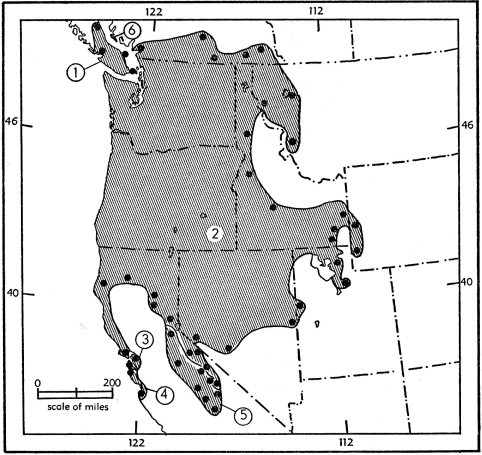
Fig. 18.
Probable geographic ranges of
Sorex vagrans vagrans
, its derivative subspecies, and
S. v. mixtus
.
1. S. v. vancouverensis 2. S. v. vagrans 3. S. v. halicoetes 4. S. v. paludivagus 5. S. v. obscuroides 6. S. v. mixtus
Remarks.—Restriction of the range of S. v. monticola to Arizona and New Mexico leaves shrews that were formerly assigned to this subspecies from Utah, Idaho, Washington and southern British Columbia unassigned. Several names are available for consideration. The name Sorex vagrans dobsoni Merriam, 1891, type locality Alturas Lake, Blaine Co., Idaho, was once applied to small shrews from Idaho, Montana, Wyoming, and Utah, but was considered by Jackson to be synonymous with S. v. monticola. The name Sorex vagrans amoenus Merriam, 1895, type locality near Mammoth, Mono Co., California, has been applied to wandering shrews from western Nevada, northeastern California and southern Oregon. Sorex vagrans nevadensis Merriam, 1895, type locality Reese River on Nye-Lander Co. line, Nevada was considered by Hall (1946:119) to be synonymous with S. v. amoenus. Specimens of Sorex vagrans west of the Cascade Mountains have long been referred to the nominate subspecies which has its type locality at Willapa Bay, Pacific Co., Washington. Over so wide an area it is only to be expected that some geographic variation is to be found. Thus specimens from central Nevada average slightly paler in summer pelage than those from the Pacific Coast or from the foothills of the Rocky Mountains. In addition there are slight average differences in size from place to place. Topotypes of S. v. vagrans, however, show a fair degree of variability and some are nearly as pale as the paler Great Basin stocks. Furthermore topotypical individuals of vagrans can be lost in series of S. v. amoenus, although amoenus is shorter-tailed on the average. Specimens from the western foot-hills of the Rocky Mountains show an amazing series of relationships with the montane S. v. obscurus. In Utah, as previously pointed out, complete intergradation occurs. At 1 mi. N Heath, Washington Co., Idaho, the lowland and the highland forms approach each other within a short distance and still maintain a degree of distinctness, especially in size. In northwestern Montana intergradation is extensive (Clothier, 1950). In northeastern Washington distinctly separable populations occur within a few miles of one another. In southern British Columbia some populations are clearly intergrades while at 6 mi. S Yahk intergradation seemingly has not taken place. Where some intergradation has occurred the result often has been increased size of the lowland shrews, although they usually retain the reddish summer pelage rather than acquiring the more grayish pelage of obscurus. The name dobsoni was based upon shrews from a place where lowland and highland forms occur almost together with only a slight amount of intergradation. Examples of "dobsoni" may not with certainty be distinguished from typical vagrans except that they are, as Merriam (1895:68-69) points out, somewhat larger. Merriam (loc. cit.) further notes that dobsoni is "intermediate in size and cranial characters between S. vagrans and obscurus;" a statement which hits very close to the heart of the matter. I consider the name dobsoni to apply to intergrades. To attempt to apply the name to the highly variable populations of intergrades from British Columbia to southern Idaho seems inadvisable. I have examined the possibility of using the name amoenus for the animals from this region. The characters which set amoenus apart from vagrans, slightly shorter tail and slightly darker summer pelage, however, are not universally found in shrews from the Columbian Plateau and eastern Great Basin and furthermore these differences between amoenus and vagrans do not seem to me to be of great enough magnitude to warrant subspecific recognition of the former. Thus the name S. v. vagrans may apply to shrews in the region under consideration. The subspecies, as thus thought of, embraces several incipient subspecies, namely (1) the populations on the isolated mountain ranges of Nevada, (2) the coastal rain forest population and possibly (3) the population on the Columbian Plateau.
In western British Columbia, Washington, and Oregon no evidences of intergradation between S. v. vagrans and the races setosus, permiliensis, bairdi, yaquinae, or pacificus are seen. In this region S. v. vagrans occurs sympatrically with one or the other of these subspecies. Different degrees of differentiation thus obtain between the subspecies vagrans as here defined and the surrounding subspecies of Sorex vagrans to wit: complete intergradation and allopatry in Utah with S. v. obscurus; partial intergradation and partial sympatry with S. v. obscurus in the foothill region from Idaho to British Columbia; no intergradation and complete sympatry with all the other races of Sorex vagrans from the Cascades to the coast and south to San Francisco Bay. The relationship of S. v. vagrans to the wandering shrews of the high Sierra is discussed on page 58.
Throughout most of the Great Basin and Columbian Plateau Sorex vagrans is, with the exception of the rare S. merriami and S. preblei, the only small shrew. In the Cascades and in the coastal lowlands it is the only small shrew except for S. cinereus and S. trigonirostris, both extremely rare and local in this region. S. vagrans seemingly competes to a certain extent with the larger S. trowbridgii in western Washington and seems to be partially dominant to trowbridgii, at least in marshy habitats (Dalquest, 1941:171).
Specimens examined.—Total number, 1197.
British Columbia: Osoyoos District: Okanagan, 20 PMBC; Okanagan Landing, 2 PMBC; Nahun Plateau, 2 PMBC. Vancouver District: Vancouver, 2 PMBC. New Westminister District: Port Moody, 16 BS; Westminster Jct., 4 AMNH; Langley, 1 BS; Vedder Crossing, 1 PMBC; Huntingdon, 69 NMC; Sumas, 16 BS; Cultus Lake, 1 NMC. Similkameen District: Princeton, 6 Mile Creek, 1 NMC. Hedley, Stirling Creek, 7 NMC; Fairview-Keremeos Summit, 5 NMC; Oliver, 1 NMC; Westbridge, 6 NMC; Osoyoos, 1 PMBC; Osoyoos-Bridesville Summit, 4 NMC; Cascade, 7 NMC. Nelson District: Kuskonook, 1 PMBC; Rossland, 14 NMC; Trail, 2 NMC; Creston, 4 PMBC, 4 NMC; near Creston, 7 NMC. Cranbrook District: Cranbrook, 5 BS; Yahk, 2 NMC; Yahk Camp 6, 2 NMC; Goatfell, 2 NMC. Fernie District: Newgate, 3 NMC.
Washington: Whatcom Co.: Blaine, 1 BS; Beaver Creek, 5 WSC; Glacier, 1 BS; Mt. Baker Lodge, 1 WSC; Lake Whatcom, 1 BS; Barron, 2 BS. Okanogan Co.: Sheep Mtn., 3 BS; E. end Bauerman Ridge, 1 BS; Oroville, 1 BS; Hidden Lakes, 1 BS; Loomis, 1 BS; Conconully, 1 BS; Twisp, 1 BS. Ferry Co.: 5 mi. W Curlew, 2 BS. Stevens Co.: Marcus, 1 BS. Pend Oreille Co.: Canyon, 1 WSC; Metaline, 2 BS; Sullivan Lake, 1 BS. San Juan Co.: East Sound, Orcas Island, 3 BS; Friday Harbor, San Juan Island, 1 BS; San Juan Park, 2 WSC; Blakely Island, 1 KU; Richardson, 6 BS. Skagit Co.: Cypress Island, 1 KU; Hamilton, 1 BS; Sauk, 1 BS; Avon, 3 BS; Mt. Vernon, 2 BS; La Conner, 5 BS. Island Co.: San de Fuca, Whidby Island, 3 BS; Greenbank, Whidby Island, 2 BS; 3 mi. N Clinton, Whidby Island, 1 BS. Snohomish Co.: Oso, 2 BS; Hermosa Point, Tulalip Indian Reservation, 7 mi. W and ½ mi. N Marysville, 3 KU. Chelan Co.: Entiat, 2 BS. Lincoln Co.: 6 mi. E Odessa, 4 BS. Spokane Co.: Marshall, 7 BS. Clallam Co.: Neah Bay, 29 BS; 8 mi. W Sekin River, 1 WSC; mouth Sekin River, 1 WSC; Dungeness, 1 BS; Port Townsend, 3 BS; Ozette Indian Reservation, 1 CMNH; Sequim, 4 BS; Tivoli Island, Ozette Lake, 1 CMNH; Garden Island, Ozette Lake, 3 CMNH; Elwah, 1 WSC; Blyn, 1 BS; Soleduck River, 1 BS; 12 mi. S Port Angeles, 1 WSC; Forks, 9 CMNH, 1 BS; Cat Creek, 1 WSC; Lapush, 5 BS. Jefferson Co.: Jefferson Ranger Station, N Fork Hoh River, 5 CMNH; Duckabush, 6 BS. Kitsap Co.: Vashon Island, 2 BS. King Co.: Redmont, 2 BS; Kirkland, 20 BS; Seattle, 1 WSC, 3 KU; Northbend, 2 BS: Lake Washington, near Renton, 2 BS; Kent, 1 BS; Enumclaw, 1 BS. Grays Harbor Co.: Lake Quinault, 9 BS; Aberdeen, 20 BS; Westport, 5 BS, 2 WSC; Oakville, 1 BS. Mason Co.: Lake Cushman, 11 BS; Hoodsport, 1 BS; North Fork Skokomish River, 1 BS; Shelton, 2 BS. Pierce Co.: Puyallup, 6 BS; Steilacoom, 1 BS; 6 mi. S Tacoma, 2 BS; Roy, 3 BS; Bear Prairie, Mt. Rainier, 1 BS; Reflection Lake, Mt. Rainier, 1 WSC. Kittitas Co.: Blewett Pass, 3 BS; Easton, 3 BS; 2 mi. E Cle Elum, 4 FC; Ellensburg, 2 BS. Grant Co.: Moses Lake, 1 BS; 9 mi. S and 1 mi. W Neppel, 1 UM. Whitman Co.: Hangman Creek, Tekoa, 1 WSC; 4 mi. ENE Pullman, 1 KU; 2 mi. N Pullman, 2 WSC; 2 mi. NW Pullman, 1 WSC; 2 mi. W Pullman, 1 WSC; Pullman, 5 WSC; Armstrong, 1 WSC; 5 mi. NE Wawawai, 1 BS; Wawawai, 5 WSC. Thurston Co.: Nisqually Flats, 2 BS; Nisqually, 1 BS; 4 mi. S Olympia, 1 BS; Tenino, 4 BS. Pacific Co.: Tokeland, 4 BS; 1 mi. S Nemah, 2 FC; 1 mi. N Bear River, Willapa Bay, 8 FC; ¼ mi. N Bear River, 3 FC; 3½ mi. E Seaview, 6 FC; Ilwaco, 1 BS. Lewis Co.: 8 mi. W Chehallis, 2 BS; Chehallis, 2 BS; Toledo, 1 BS. Yakima Co.: Selah, 7 KU; Wiley City, 4 BS. Wahkiakum Co.: Cathlamet, 1 BS. Skamania Co.: 45 mi. SE Toledo, 2 BS; Carson, 1 BS; Stevenson, 1 BS; 15 mi. NW White Salmon, 1 BS. Klickitat Co.: Trout Lake, 15 mi. S Mt. Adams, 2 BS; 15 mi. N Goldendale, 1 WSC; Goldendale, 1 BS. Walla Walla Co.: College Place, 1 KU. Columbia Co.: Starbuck, 3 BS. Garfield Co.: 1 mi. E Pomeroy, 1 SGJ. Asotin Co.: 21 mi. SE Dayton, 1 BS; Rogersburg, 1 BS.
Idaho: Bonner Co.: 4 mi. S Sandpoint, 1 UM. Kootenai Co.: Coeur d'Alene, 2 BS. Shoshone Co.: Osburry, 1 BS; Mullan, 2 BS. Latah Co.: Felton's Mills, 1 WSC; Cedar Mtn., 5 WSC. Lewis Co.: Nezperce, 2 BS. Idaho Co.: Seven Devils Mtn., 1 BS. Adams Co.: Summit of Smith Mtn., 7500 ft., 5 KU; New Meadows, 1 BS; Tamarack, 1 BS. Washington Co.: 1 mi. NE Heath, SW slope Cuddy Mtn., 4000 ft., 7 KU. Boise Co.: Bald Mtn. R. S., 10 mi. S Idaho City, 1 BS. Elmore Co.: Cayuse Creek, 10 mi. N Featherville, 1 BS. Canyon Co.: Nampa, 5 BS. Blaine Co.: Sawtooth City, 5 BS; Alturas Lake, 1 BS. Bonneville Co.: 10 mi. SE Irwin, 5 BS. Bannock Co.: Pocatello, 1 BS, 1 KU; 1 mi. W Bancroft, 1 KU; Swan Lake, 1 BS. Owyhee Co.: Grasmere, 1 SGJ. Cassia Co.: 10 mi. S Albion, Mt. Harrison, 1 BS.
Montana: Sanders Co.: Prospect Creek, near Thomson Falls, 4 BS. Lake Co.: Flathead Lake, 5 BS. Ravalli Co.: Bass Creek, NW Stevensville, 2 BS; 2 mi. NE Stevensville, 1 UM; Corvallis, 4 BS; 6 mi. E Hamilton, 1 KU.
Oregon: Clatsop Co.: Seaside, 1 BS. Washington Co.: 5 mi. SE Hillsboro, 1 BS; Beaverton, 1 BS. Multnomah Co.: Portland, 20 BS; Portland, Switzler Lake, 5 BS. Hood River Co.: 2 mi. W Parkdale, 1 BS; north slope Mt. Hood, 2 BS. Umatilla Co.: 10 mi. W Meacham, 2 BS; Meacham, 3 BS. Union Co.: Elgin, 2 BS; Kamela, 2 BS; Hot Lake, 2 BS. Wallowa Co.: 25 mi. N. Enterprise, 4 BS; Wallowa Lake, 23 BS; S Wallowa Lake, 1 BS. Clackamas Co.: Estacada, 1 KU. Marion Co.: Salem, 8 BS; Permilia Lake, 2 BS. Benton Co.: Corvallis, 2 BS; 5 mi. SW Philomath, 5 BS. Linn Co.: Shelburn, 1 BS. Jefferson Co.: 20 mi. W Warm Springs, 2 BS. Grant Co.: Beech Creek, 6 BS; Austin, 1 BS; Strawberry Butte, 1 BS; Strawberry Mts., 12 BS. Baker Co.: Homestead, 1 BS; Cornucopia, 11 BS; Rock Creek, 1 BS; Bourne, 7 BS; McEwen, 1 BS; Huntington, 1 BS; Anthony, 42 AMNH. Lane Co.: north slope Three Sisters, 3 BS; Vida, 1 BS; Mapleton, 1 BS; Eugene, 2 BS; 10 mi. S McKenzie Bridge, 1 BS; Florence, 1 BS. Deschutes Co.: Paulina Lake, 7 BS; Lapine, 8 BS. Crook Co.: 1 SGJ. Douglas Co.: Winchester Bay, 1 SGJ; Scottsburg, 3 BS; Drain, 5 BS; Lookingglass, 1 BS; Diamond Lake, 6 BS. Coos Co.: Empire, 5 BS. Curry Co.: Port Orford, 1 BS; Gold Beach, 4 BS. Klamath Co.: Anna Creek, Mt. Mazama, 1 BS; Crater Lake, 14 BS; Upper Klamath Marsh, 2 BS; Ft. Klamath, 35 BS; Klamath Falls, 6 BS. Lake Co.: 10 mi. SW Silver Lake, 3 BS; west fork Silver Creek, Yamsay Mts., 4 BS; Plush, 1 BS; Warner Creek, Warner Mts., 1 BS; Warner Mts., 3 BS; Gearhart Mts., 17 SGJ; Harney Co.: Diamond, 2 BS; Keiger Gorge, Steens Mts., 3 BS. Malheur Co.: 8 mi. W Jordon Valley, 1 BS.
Wyoming: Lincoln Co.: 13 mi. N and 2 mi. W Afton, 6 KU; 10 mi. N Afton, Salt River, 2 BS; 9 mi. N and 2 mi. W Afton, 6 KU; 7 mi. N and 1 mi. W Afton, 4 KU; Cokeville, 1 BS; 12 mi. N and 2 mi. E Sage, 2 KU; 6 mi. N and 2 mi. E Sage, 1 KU.
California: Del Norte Co.: Smith River, 2 BS; Crescent City, 20 BS. Siskiyou Co.: Beswick, 1 BS; Hornbrook, 3 BS; Brownell, Klamath Lake, 1 BS; Mayten, 2 BS; Squaw Creek, Mt. Shasta, 5 BS; Upper Ash Creek, Mt. Shasta, 1 BS; upper Mud Creek, Mt. Shasta, 8 BS; Wagon Camp, Mt. Shasta, 5 BS; Warmcastle Soda Springs, Squaw Creek Valley, 2 BS; Sisson, 7 BS. Modoc Co.: Davis Creek, Goose Lake, 1 BS. Humboldt Co.: Humboldt Bay, 10 BS. Trinity Co.: Canyon Creek, 2 BS. Shasta Co.: Fort Crook, 11 BS; Dana, 17 BS; Fall Lake, Fall River Valley, 3 BS; Cassel, 2 BS; 12 mi. E Burney, 1 BS; Lassen Peak, 13 BS; Kellys, Warner Creek, 1 KU; Drakes Hot Springs, Warner Creek, 2 BS. Mendocino Co.: Russian Gulch State Park, 2 FC. Plumas Co.: 12 mi. NE Prattville, 2 BS; Spring Garden Ranch, Grizzly Mts., 3 BS; Sierra Valley, 1 BS. Sierra Co.: Lincoln Creek, 1 BS. Sonoma Co.: Petaluma, 3 BS; Point Reyes, 7 BS. Placer Co.: Donner, 3 BS. El Dorado Co.: Tallac, 3 BS. Mono Co.: Mt. Conness, 1 BS; Mono Lake, 1 BS; near Mammoth, 8000 ft., head of Owens River, 2 BS. Inyo Co.: Alvord, 1 BS.
Nevada: Elko Co.: Mountain City, 1 BS; Three Lakes, 1 KU; west side Ruby Lake, 3 mi. N White Pine Co. line, 8 KU; Ruby Mts., 9 BS; W side Ruby Lake, 3 BS. White Pine Co.: W side Ruby Lake, 3 mi. S Elko Co. line, 1 KU. Nye Co.: Cloverdale, Reese River, 3 BS.
Utah: Weber Co.: Beaver Creek, S Fork Ogden River, 2 UU; Huntsville, 10 mi. E Ogden, 1 UU; Hooper Bay Refuge, 4200 ft., 1 UU; Riverdale, 4200 ft., 3 UU; Riverdale, 4250 ft., 1 UU; 3 mi. SE Ogden, 2 UU; Snow Basin, 2 UU; Snow Basin, S part Wheeler Canyon, 1 UU; Uinta, 2 mi. W Weber Canyon entrance, 4 UU; 2 mi. W Uinta, 1 UU. Salt Lake Co.: City Creek Canyon, 6 mi. NE Salt Lake City, 4700 ft., 2 UU; 1 mi. up City Creek Canyon, 4600 ft., 1 UU; ¾ mi. above Forks, City Creek Canyon, 1 UU; The Firs, Millcreek Canyon, 1 UU; Olympus Water Box, 1 UU; Salamander Lake, Lamb's Canyon, 9000 ft., 3 UU (near obscurus); Salt Lake City, 7500 ft., 1 UU; 1 mi. W Draper, 4500 ft., 6 UU; Draper, 4500 ft., 5 UU; 1½ mi. SW Draper, 4500 ft., 1 UU; 3 mi. SW Draper, 4400 ft., 2 UU; 3 mi. S Draper, 4400 ft., 2 UU; 1 mi. S Draper, 4500 ft., 1 UU. Juab Co.: W side Deep Creek Mts., Queen of Sheba Canyon, 8000 ft., 3 UU. Wasatch Co.: Midway Fish Hatchery, 5450 ft., 1 UU.
Marginal records.—British Columbia: Okanagan; Westbridge; Kuskonook; Cranbrook. Montana: Flathead Lake; 6 mi. E Hamilton; Prospect Creek. IDAHO: Cedar Mtn.; New Meadows; Alturas Lake; 10 mi. SE Irwin. Wyoming: 13 mi. N and 2 mi. W Afton; 6 mi. N and 2 mi. E Sage. Idaho: 1 mi. W Bancroft; Swan Lake. Utah: Beaver Creek, South Fork, Ogden River; Midway Fish Hatchery; west side Deep Creek Mts., Queen of Sheba Canyon, 8000 ft. Nevada: Baker Creek (Hall, 1946:120); Reese River (ibid.); 2 mi. S Hinds Hot Springs (ibid.). California: Mono Lake (Jackson, 1928:110); near Mammoth; Alvord; Mount Conness; Donner; Buck Ranch (Jackson, 1928:110); Warner Creek, Drake Hot Springs (ibid.); Canyon Creek; Cuddeback (Jackson, 1928:105); Novato Point (ibid.), thence northward along the coast to Washington: Friday Harbor, San Juan Island. British Columbia: Port Moody.
Sorex vagrans obscuroides new subspecies
Type.—First year female, skin and skull; No. 30064/42074, U. S. Biol. Surv. Coll.; obtained on August 9, 1891, by Frank Stephens from Bishop Creek, 6600 ft., Inyo Co., California, original no. 811.
Range.—The Sierra Nevada of California, north at least to El Dorado County, intergrading northerly with S. v. vagrans.
Diagnosis.—Size medium for the species; average and extreme measurements of 5 topotypes are: total length, 107 (103-112); tail, 47 (45-50); hind foot, 12.8 (12-13.5). Skull relatively broad interorbitally; color of dorsum in summer pelage nearest (17´´´k) Olive Brown.
Comparisons.—Differs from S. v. vagrans, with which it intergrades to the north, in: longer tail and total length; skull larger and relatively broader interorbitally; color in summer grayer (less reddish), the lighter subterminal color bands of the hair often showing through the darker tips and imparting a grizzled appearance to the dorsum. Differs from S. v. parvidens to the south in: skull relatively broader interorbitally and less flattened; teeth slightly larger.
Remarks.—S. v. obscuroides has long been called S. v. obscurus. In fact, obscuroides is separated from the range of obscurus by the intervening, smaller subspecies S. v. vagrans. S. v. obscuroides resembles S. v. obscurus in color and size but the skull is smaller, although relatively slightly broader. The resemblance in color is possibly due to the fact that obscuroides, like obscurus, is a high mountain form. S. v. obscuroides intergrades with S. v. vagrans along the crest of the Sierra between Yosemite National Park and Lassen Peak and on the eastern slope of the Sierra from approximately Mammoth northward. Specimens from Donner are intergrades but are closest to S. v. vagrans. Although all specimens from Lassen Peak are referable to S. v. vagrans, some show cranial characters of obscuroides.
Specimens examined.—Total number, 76. California: Mono Co.: Mt. Dana, 6 BS; Mt. Lyell, 11 BS. Mariposa Co.: Tuolumne Meadows, Muir Meadow, 9300 ft., 1 BS; Tuolumne Meadows, Mt. Unicorn, 1 BS; Tuolumne Meadows, N base Mt. Lyell, 8 BS; Tuolumne Meadows, Soda Springs, 4 BS; Lake Tenaya, 5 BS. Madera Co.: San Joaquin River, 8000 ft., 4 BS. Fresno Co.: Horse Corral Meadows, 3 BS. Mono Co.: head of Owens River near Mammoth, 2 BS. Inyo Co.: Bishop Creek, 5 BS; Round Valley, 1 BS. Tulare Co.: E. Fork Kaweah River, 7 BS; Mt. Whitney, 5 BS; Whitney Creek, Mt. Whitney, 4 ChM; Whitney Meadows, 9700 ft., 1 BS; Mineralking, 2 BS; N. Fork Kern River, 9600 ft., 1 BS; S. Fork Kern River, 4 BS; Kern Lakes, 1 BS.
Marginal records.—California: Pyramid Peak; near Mammoth; Round Valley; Bishop Creek; Mt. Whitney; Kern Lakes; Halstead Meadows; Horse Corral Meadows; east fork Indian Canyon (Jackson, 1928:121).
Sorex vagrans parvidens Jackson
Sorex obscurus parvidens Jackson, Jour. Mamm., 2:161, August 19, 1921.
Type.—Adult male, skin and skull; No. 56561, U. S. Biol. Surv. Coll.; obtained on October 3, 1893, by J. E. McLellan from Thurmans Camp, Bluff Lake, 7500 ft., San Bernardino Mts., California.
Range.—Confined, so far as known, to the San Bernardino and San Gabriel mountains, San Bernardino Co., California.
Diagnosis.—Size medium for the species; measurements of two specimens from the San Bernardino Mountains are: total length, 105, 106; tail, 41, 48; hind foot, 12, 14. Upper parts in summer Olive-Brown to Buffy-Brown; cranium flattened and relatively narrow; unicuspids and incisors relatively small.
Comparisons.—For comparison with S. v. obscuroides, the only adjacent subspecies, see the account of that subspecies.
Remarks.—S. v. parvidens is seemingly an uncommon mammal. I have been informed by Terry Vaughan that repeated attempts by him to obtain it in suitable habitat in the San Gabriel Mountains failed. This shrew is probably no longer in reproductive continuity with Sorex vagrans of the Sierra Nevada.
Specimens examined.—Total number, 4. California: San Bernardino Co.: type locality, 4 BS.
Marginal records.—California: Camp Baldy, San Antonio Canyon (Jackson, 1928:124); type locality.
Sorex vagrans halicoetes Grinnell
Sorex halicoetes Grinnell, Univ. California Publ. Zool., 10:183, March 20, 1913.
Sorex vagrans halicoetes, Jackson, N. Amer. Fauna, 51:108, July 24, 1928.
Type.—Young adult male, skin and skull; No. 3638, Mus. Vert. Zool.; obtained on May 6, 1908, by Joseph Dixon from salt marsh near Palo Alto, Santa Clara Co., California.
Range.—Marshes in the southern part of San Francisco Bay, California.
Diagnosis.—Size small for the species; measurements of two topotypes are: total length, 105, 106; tail, 39, 40; hind foot, 12, 13. Upper parts in winter Chaetura Black or near Fuscous-Black; underparts brownish; upper parts in summer near (17´m) Mummy Brown; underparts with a decided buffy wash, near (15´d) Light Ochraceous Buff; rostrum relatively large; maxillary tooth-row relatively long; teeth relatively large.
Comparisons.—Darker ventrally, both summer and winter, than S. v. vagrans; slightly more reddish dorsally in summer pelage than S. v. vagrans, rostrum and teeth relatively larger; smaller externally than S. v. paludivagus, paler; skull longer, narrower cranially and broader rostrally.
Remarks.—This subspecies seems to be restricted to salt marshes where it occurs with Sorex ornatus.
Specimens examined.—Total number, 12. California: San Francisco Co.: San Francisco, 4 BS. Alameda Co.: West Berkeley, 1 BS; Berkeley, 1 BS; Dumbarton Point, 1 KU. San Mateo Co.: San Mateo, 2 BS. Santa Clara Co.: Palo Alto, 3 BS.
Marginal records.—California: Berkley, Elmhurst; Palo Alto; San Mateo.
Sorex vagrans paludivagus von Bloeker
Sorex vagrans paludivagus von Bloeker, Proc. Biol. Soc. Washington, 52:93, June 5, 1939.
Type.—Adult male, skin and skull; No. 5053, Los Angeles Museum of History, Science and Art, obtained on November 3, 1938, by Jack C. von Bloeker, Jr., from salt marsh at mouth of Elkhorn Slough, Moss Landing, Monterey Co., California, original no. 9456.
Diagnosis.—Size medium for the species; average and extreme measurements of 6 topotypes are: total length, 115 (113-118); tail, 46.5 (42-48); hind foot, 14.5 (14-15) (von Bloeker, 1939:94). In winter nearly black dorsally, deep mouse gray ventrally; in summer nearly as dark dorsally as in winter, hairs of venter tipped with Clove Brown; skull short, relatively broad cranially and relatively narrow rostrally.
Comparisons.—For comparison with S. v. halicoetes see account of that subspecies.
Remarks.—This subspecies, occurring at the limits of the range of the species, is uncommon in most collections. Seven specimens were available for the original description. The summer pelage is not completely described in the original description, but is stated to be darker than the winter pelage of S. v. vagrans, and must thus be considerably darker than the summer pelage of S. v. halicoetes. Two specimens in the Museum of Vertebrate Zoology, from San Gregario, referred by Jackson to S. v. halicoetes, were included in the present subspecies by von Bloeker.
Specimens examined.—None.
Records of occurrence (von Bloeker, 1939:94).—California: San Mateo Co.: San Gregario. Monterey Co.: Seaside; mouth of Salinas River; Moss Landing.
Marginal records.—California: San Gregario; Seaside.
Sorex vagrans vancouverensis Merriam
Sorex vancouverensis Merriam, N. Amer. Fauna, 10:70, December 31, 1895.
Sorex vagrans vancouverensis, Jackson, N. Amer. Fauna, 51:106, July, 1928.
Type.—Adult male, skin and skull; No. 71913, U. S. Biol. Surv. Coll.; obtained on May 10, 1895, by Clark P. Streator, from Goldstream, Vancouver Island, British Columbia.
Range.—Vancouver Island from Sayward south, and Bowen Island.
Diagnosis.—Size small for the species; average and extreme measurements of 6 specimens from Alberni Valley, Vancouver Island, are: total length, 106.5 (97-115); tail, 41.7 (40-43); hind foot, 12 (11-13) (Jackson, 1928:107). Ventral parts brownish, winter pelage reddish brown rather than grayish.
Comparisons.—Differs from S. v. vagrans in more brownish ventral parts and more brownish, rather than grayish, winter pelage; differs from the sympatric S. v. isolatus in shorter tail, shorter hind foot, more narrow skull, and smaller teeth.
Remarks.—This is a poorly differentiated subspecies which is closely related to S. v. vagrans. The differences in color noted are average ones. Some individuals of this shrew might be difficult to separate from S. v. isolatus. The slight degree of morphological divergence is such that intergrades might be expected to occur. Possibly some habitat separation occurs, but such has not been reported.
Specimens examined.—Total number, 3. British Columbia: Vancouver Island: Mt. Washington, 1 KU; Nanaimo, 1 BS; type locality, 1 BS.
Marginal records.—British Columbia: Sayward (Anderson, 1947:18); Bowen Island (Hall, 1938:463); Alberni (Jackson, 1928:107).
CONCLUSIONS
1. Sorex vagrans, S. obscurus, S. pacificus, and S. yaquinae are conspecific with one another. Each is a valid subspecies but all should bear the specific name Sorex vagrans Baird, 1858.
2. The subspecies of Sorex vagrans form a cline from large (pacificus) to small (vagrans). The cline is bent in such a manner that the terminal subspecies occur together. Where the two subspecies occur together, individuals of one subspecies do not crossbreed with individuals of the other subspecies and therefore react toward one another as do full species. Sorex vagrans vagrans occurs sympatrically with S. v. sonomae, S. v. pacificus, S. v. yaquinae, S. v. bairdi, S. v. permiliensis, and S. v. setosus. S. v. vancouverensis occurs sympatrically with S. v. isolatus.
3. The sympatric existence of the terminal subspecies of the Sorex vagrans rassenkreis is made possible by marked differences between them in size and in ecological preference.
4. The west-coast subspecies, sonomae, pacificus, yaquinae, bairdi, and permiliensis probably differentiated from the Great Basin and Rocky Mountain subspecies, vagrans, obscurus and monticola, during a separation caused first by aridity in the Great Basin, and secondly by glaciation of the Cascade Mountains and the Sierra Nevada, possibly in the Sangamonian and Wisconsinan ages respectively.
5. Sorex v. vagrans originated in the Great Basin and arrived on the Pacific Coast after the last deglaciation of the Cascades and Sierra Nevada.
6. In S. vagrans, heterogonic growth is illustrated; the larger the skull, the larger the rostrum in proportion to the skull as a whole.
7. In the species S. vagrans, size and color vary geographically more than do other features.
8. The S. ornatus group, S. longirostris, and S. veraepacis had a common ancestor with S. vagrans, possibly in the Illinoian Age.
9. S. vagrans, the S. ornatus group, S. veraepacis, S. longirostris, S. palustris, S. bendiri, and the S. cinereus group, because of structural resemblances, should be placed in a single subgenus, Otisorex. S. trowbridgii, the S. arcticus group, the S. saussurei group, S. merriami, S. fumeus, and S. dispar, should be included in the subgenus Sorex.
10. Sorex cinereus occurs with the medium-sized and large-sized S. vagrans in the Rocky Mountains and in Canada, but does not occur with the smaller subspecies of S. vagrans, probably because competition between two shrews of like size excludes S. cinereus.
Table 1—Cranial Measurements of Sorex vagrans
Catalog number or number of individuals averaged Condylobasal length Palatal length Maxillary tooth-row Cranial breadth Least interorbital breadth Maxillary breadth
Sorex vagrans pacificus, Orick, California.
8 av 21.8 9.6 8.6 10.4 4.1 6.6
Max 22.8 10.2 9.0 11.1 4.3 6.8
Min 21.3 9.3 8.4 10.2 4.1 6.4
Sorex vagrans yaquinae, Newport, Oregon.
707 AW 20.1 8.9 7.6 9.3 3.7 5.7
706 AW 19.3 8.8 7.3 9.3 4.0 5.8
Mapleton, Oregon.
205273 USBS 20.6 9.0 8.2 9.9 4.2 6.0
205270 USBS 20.4 8.9 7.9 9.3 3.7 6.0
205272 USBS 9.2 8.3 4.0 6.1
Vida, Oregon.
4 av 19.5 8.4 7.5 9.2 3.6 5.5
Max 20.3 8.8 7.9 9.5 3.7 5.7
Min 19.3 8.2 7.3 8.9 3.5 5.3
McKenzie Bridge, Oregon.
6 av 18.9 8.2 7.1 9.1(5) 3.7 5.6
Max 19.5 8.6 7.6 9.4 3.8 5.7
Min 18.7 8.0 6.8 8.4 3.6 5.4
Sorex vagrans bairdi, Astoria, Oregon.
6 av 18.5 7.8 7.0 8.9(4) 3.4 5.3
Max 19.2 8.1 7.4 9.0 3.5 5.5
Min 18.0 7.6 6.9 8.9 3.2 5.2
Sorex vagrans permiliensis, Mt. Jefferson, Oregon.
14 av 18.0 7.5 6.8 9.0 3.5 5.2
Max 18.9 7.9 7.2 9.4 3.7 5.3
Min 17.2 7.2 6.5 8.6 3.3 4.8
Sorex vagrans setosus, Olympic Mts., Washington.
12 av 17.2(9) 7.1 6.5 8.5(8) 3.3 5.0
Max 17.9 7.4 6.8 8.7 3.4 5.3
Min 16.7 6.9 6.2 8.3 3.0 4.8
Mt. Rainier, Washington.
16 av 17.2 7.1 6.5 8.4(14) 3.3 5.0
Max 17.6 7.3 6.7 8.7 3.5 5.2
Min 16.4 6.5 6.1 8.1 3.2 4.7
Sorex vagrans longicauda, head Rivers Inlet, B.C.
15 av 18.0 7.4 6.7 8.7 3.2 5.0
Max 18.4 7.6 6.9 8.9 3.3 5.2
Min 17.6 7.2 6.4 8.4 3.1 4.8
Port Simpson, British Columbia.
10 av 18.1(9) 7.6 7.0 8.9 3.4 5.1
Max 18.8 7.8 7.2 9.2 3.6 5.4
Min 17.2 7.2 6.6 8.5 3.3 4.9
Fort Wrangell, Alaska.
18 av 18.5 7.8(15) 7.1 9.0(15) 3.3 5.1
Max 18.9 8.0 7.3 9.2 3.5 5.3
Min 17.8 7.5 6.7 8.6 3.2 5.0
Sorex vagrans elassodon, Woewodsky Is., Alaska.
20550 AMNH 18.0 7.5 6.7 8.7 3.3 5.0
20553 AMNH 17.5 7.1 6.3 8.3 3.2 4.7
Sorex vagrans alascensis, 9 mi. W and 4 mi. N Haines, Alaska.
10 av 17.2 7.2 6.7 8.5 3.1 4.9
Max 17.6 7.4 6.9 8.8 3.3 5.0
Min 16.9 6.9 6.5 8.2 3.0 4.7
Yakutat Bay, Alaska.
73543 USBS 18.0 7.5 6.8 ... 3.2 5.0
73536 USBS 18.0 7.6 6.8 8.8 3.4 5.3
73541 USBS 17.9 7.4 6.7 8.8 3.1 5.2
Sorex vagrans shumaginensis, Sandpoint, Popof Is., Alaska.
9 av 17.2(5) 7.0 6.3 8.3(7) 3.1 4.8
Max 17.6 7.2 6.6 8.5 3.2 5.1
Min 16.8 6.8 6.1 8.0 3.0 4.7
Sorex vagrans obscurus, Barkerville, British Columbia.
5 av 17.1 7.1 6.5 8.5(4) 3.3 4.8
Max 17.3 7.3 6.6 8.6 3.3 5.0
Min 16.6 6.7 6.4 8.2 3.2 4.6
10 mi. SSW Leadore, Idaho.
7 av 17.2(4) 7.3(9) 6.6 8.6(4) 3.3 5.0
Max 17.3 7.5 6.8 8.9 3.4 5.1
Min 17.0 7.1 6.4 8.3 3.2 4.7
Albany Co., Wyoming (several localities).
20 av 17.3 7.3 6.8 8.7(19) 3.2 5.2
Max 17.9 7.6 6.9 9.0 3.4 5.5
Min 16.7 6.9 6.5 8.4 3.1 5.0
Sorex vagrans longiquus, 25 mi. ESE Big Sandy, Montana.
87332 UM 16.4 6.8 6.2 8.2 3.0 4.8
87334 UM 16.8 7.1 6.3 8.1 3.2 4.7
87335 UM 15.8 6.7 6.0 8.4 3.1 4.9
Highwood Mts., Montana.
10 av 16.3(9) 6.7 6.2 8.0(9) 3.1 4.7
Max 16.9 6.9 6.4 8.3 3.3 5.0
Min 15.6 6.5 6.0 7.8 3.0 4.5
Sorex vagrans neomexicanus, Cloudcroft, New Mexico.
4 av 17.6(3) 7.6 7.0 8.7 3.3 5.2
Max 17.7 7.7 7.1 8.8 3.4 5.4
Min 17.4 7.4 7.0 8.5 3.2 5.1
Sorex vagrans monticola, White Mts., Arizona.
12 av 16.1(9) 6.6 5.9(9) 8.2 3.1(11) 4.7
Max 16.6 7.0 6.1 8.5 3.3 4.9
Min 15.5 6.5 5.6 8.1 3.0 4.6
Sorex vagrans orizabae, Volcan Toluca, Mexico.
55900 USBS 17.1 6.9 6.2 7.8 2.9 4.5
55898 USBS 17.1 6.8 6.1 8.0 3.0 4.8
55897 USBS 16.8 6.9 6.1 7.9 2.9 4.6
Sorex vagrans vagrans, Lincoln Co., Wyoming.
7 av 16.5(6) 6.6 6.1 8.2 2.9 4.7
Max 17.1 7.0 6.4 8.5 3.1 4.9
Min 16.0 6.4 5.9 7.9 2.9 4.5
Gearhart Mtn., Lake Co., Oregon.
17 av 16.5(15) 6.6 5.9 8.1 2.9 4.6
Max 17.1 7.0 6.6 8.5 3.1 4.9
Min 16.1 6.2 5.7 7.8 2.8 4.4
Willapa Bay, Washington.
9 av 16.6 6.8 6.2 8.1 2.8 4.7
Max 17.2 7.1 6.4 8.3 3.1 5.0
Min 16.2 6.6 5.9 7.9 2.7 4.6
Sorex vagrans obscuroides, Bishop Creek, California.
4 av 16.7 7.0 6.3 8.2 3.2 4.8
Max 16.8 7.1 6.4 8.3 3.4 4.9
Min 16.6 6.9 6.2 8.1 3.1 4.7
Mt. Whitney, California.
4 av 16.7(3) 6.9 6.3 8.4 3.3 4.8
Max 16.7 7.0 6.4 8.5 3.4 5.0
Min 16.7 6.7 6.1 8.4 3.1 4.7
Sorex vagrans parvidens, San Bernardino Peak, California.
56559 USBS 17.1 7.0 6.1 8.0 2.9 4.8
56558 USBS 16.4 6.8 6.1 8.0 3.0 4.8
LITERATURE CITED
Anderson, R. M.
1947. Catalogue of Canadian Recent mammals. Nat. Mus. Canada, Bull. 102, Biol. ser. 31:i-v + 1-238, January 24.
Anderson, R. M. and A. L. Rand
1945. A new form of dusky shrew from the prairie provinces of Canada. Canadian Field-Nat., 59:47-48, March-April.
Bailey, V.
1936. The mammals and life zones of Oregon. N. Amer. Fauna, 55:1-416, 52 pls., 102 figs. in text, August 29.
Brown, B.
1908. The Conard Fissure, a Pleistocene bone deposit in northern Arkansas: with descriptions of two new genera and twenty new species of mammals. Mem. Amer. Mus. Nat. Hist., 9:157-208, pls. 14-25, February.
Clothier, R. R.
1950. Contribution to the taxonomy and life history of Sorex vagrans monticola and Sorex obscurus obscurus. Master's thesis, Montana State University, Missoula, Montana—a manuscript.
Conaway, C. H.
1952. Life history of the water shrew (Sorex palustris navigator). Am. Midl. Nat., 48:219-248, 6 tables, 9 figs. in text, July.
Cowan, I. McT.
1936. Distribution and variation in deer (Genus Odocoileus) of the Pacific coastal region of North America. California Fish and Game, 22(3):155-246, 13 figs., 3 graphs, 8 tables, July.
1941. Insularity in the genus Sorex on the north coast of British Columbia. Proc. Biol. Soc. Washington, 54:95-108, July 31.
Dalquest, W. W.
1941. Ecologic relationships of four small mammals in western Washington. Jour. Mamm., 22:170-173, May 14.
1944. The molting of the wandering shrew. Jour. Mamm., 25:146-148, one fig. in text, May 25.
1948. Mammals of Washington. Univ. Kansas Publ., Mus. Nat. Hist., 2:1-444, 140 figs. in text, April 9.
Davis, W. B.
1939. The Recent Mammals of Idaho. The Caxton Printers, Ltd., Caldwell, Idaho. Pp. 1-400, 33 figs. in text, 2 pls., April 5.
Durrant, S. D.
1952. Mammals of Utah, taxonomy and distribution. Univ. Kansas Publ., Mus. Nat. Hist., 6:1-549, 91 figs. in text, 30 tables, August 10.
Findley, J. S.
1953. Pleistocene Soricidae from San Josecito Cave, Nuevo Leon, Mexico. Univ. Kansas Publ., Mus. Nat. Hist., 5:633-639, December 1.
1955. Taxonomy and distribution of some American shrews. Univ. Kansas Publ., Mus. Nat. Hist., 7:613-618, June 10.
Fitch, H. S.
1940. A biogeographical study of the ordinoides artenkreis of garter snakes (genus Thamnophis). Univ. California Publ. Zool., 44:1-150, October 31.
Grinnell, J.
1933. Review of the Recent mammal fauna of California. Univ. California Publ. Zool., 40:71-234, September 26.
Grinnell, J., and A. H. Miller.
1944. The distribution of the birds of California. Pacific Coast Avifauna, 27:1-608, 57 figs. in text, December 30.
Hall, E. R.
1938. Variation among insular mammals of Georgia Strait, British Columbia. Amer. Nat., 72:453-463.
1946. Mammals of Nevada. University of California Press, Berkeley and Los Angeles, pp. i-xi + 1-710, 11 pls., 485 figs. in text, July 1.
Hamilton, W. J., Jr.
1940. The biology of the smoky shrew (Sorex fumeus fumeus Miller). Zoologica, 25:473-492, 4 pls., 1 fig. in text, 2 tables.
Hibbard, C.
1944. Stratigraphy and vertebrate paleontology of Pleistocene deposits of southwestern Kansas. Geol. Soc. America, Bull. 55:707-754, 3 pls., 20 figs. in text, June.
Howell, T. R.
1952. Natural history and differentiation in the yellow-bellied sapsucker. Condor, 54:237-282, September 22.
Jackson, H. H. T.
1928. A taxonomic review of the American long-tailed shrews (genera Sorex and Microsorex). N. Amer. Fauna, 51:i-vi + 1-238, 13 pls., 24 figs. in text, July 24.
1947. A new shrew (genus Sorex) from Coahuila. Proc. Biol. Soc. Washington, 60:131-132, October 9.
Krutzsch, P. H.
1954. North American jumping mice (genus Zapus). Univ. Kansas Publ., Mus. Nat. Hist., 7:349-472, 47 figs. in text, 4 tables, April 21.
Macnab, J. A., and J. C. Dirks.
1941. The California red-backed mouse in the Oregon Coast Range. Jour. Mamm., 22:174-180, May 14.
Mayr, E.
1940. Speciation phenomena in birds. Amer. Nat., 74:249-278.
Merriam, C. H.
1895. Synopsis of the American shrews of the genus Sorex. in N. Amer. Fauna, 10:57-100, December 31.
1899. Results of a biological survey of Mt. Shasta, California. N. Amer. Fauna, 16:1-179, 46 figs. in text, 5 pls., October 28.
Murie, A.
1933. The ecological relationship of two species of Peromyscus in the Glacier Park region, Montana. Occ. Pap. Mus. Zool., Univ. Michigan, 270:1-17, 2 figs., 3 tables, July 1.
Pearson, O. P.
1945. Longevity of the short-tailed shrew. Amer. Midl. Nat., 34:531-546, 2 tables, 4 figs. in text, September.
Pruitt, W. O., Jr.
1954. Aging in the masked shrew, Sorex cinereus cinereus Kerr. Jour. Mamm., 35:35-39, February 10.
Rensch, B.
1933. Zoologische systematik und artbildungsproblem. Ver. deutsch. zool. Gesellschaft, 1933:19-83.
Ridgway, R.
1912. Color standards and color nomenclature. Washington, D. C., privately printed, i-iv + 1-44, 53 pls.
Rudd, R. L.
1953. Differentiation in shrews of the tidal marshes of the San Francisco Bay region. Summary of the dissertation for the degree of Doctor of Philosophy, University of California Graduate Division, 4 pages, unnumbered, June.
Simpson, G. G.
1945. The principles of classification and a classification of mammals. Bull. American Mus. Nat. Hist., 85:i-xvi + 1-350, October 5.
Ticehurst, Cl. B.
1938. A systematic review of the genus Phylloscopus. British Mus., London, i-viii + 1-193, 8 maps, 2 pls., November 26.
Van Den Brink, F. H.
1953. La musaraigne masquée, espèce circum-boréale. Mammalia, 17:96-125, 1 map, June.
26-7903

UNIVERSITY OF KANSAS PUBLICATIONS MUSEUM OF NATURAL HISTORY
Institutional libraries interested in publications exchange may obtain this series by addressing the Exchange Librarian, University of Kansas Library, Lawrence, Kansas. Copies for individuals, persons working in a particular field of study, may be obtained by addressing instead the Museum of Natural History, University of Kansas, Lawrence, Kansas. There is no provision for sale of this series by the University Library, which meets institutional requests, or by the Museum of Natural History, which meets the requests of individuals. Nevertheless, when individuals request copies from the Museum, 25 cents should be included, for each separate number that is 100 pages or more in length, for the purpose of defraying the costs of wrapping and mailing.
* An asterisk designates those numbers of which the Museum's supply (not the Library's supply) is exhausted. Numbers published to date, in this series, are as follows:
Vol. 1. Nos. 1-26 and index. Pp. 1-638, 1946-1950.
*Vol. 2. (Complete) Mammals of Washington. By Walter W. Dalquest. Pp. 1-444, 140 figures in text. April 9, 1948.
Vol. 3. *1. The avifauna of Micronesia, its origin, evolution, and distribution. By Rollin H. Baker. Pp. 1-359, 16 figures in text. June 12, 1951.
*2. A quantitative study of the nocturnal migration of birds. By George H. Lowery, Jr. Pp. 361-472, 47 figures in text. June 29, 1951.
3. Phylogeny of the waxwings and allied birds. By M. Dale Arvey. Pp. 473-530, 49 figures in text, 13 tables. October 10, 1951.
4. Birds from the state of Veracruz, Mexico. By George H. Lowery, Jr., and Walter W. Dalquest. Pp. 531-649, 7 figures in text, 2 tables. October 10, 1951.
Index. Pp. 651-681.
*Vol. 4. (Complete) American weasels. By E. Raymond Hall. Pp. 1-466, 41 plates, 31 figures in text. December 27, 1951.
Vol. 5. 1. Preliminary survey of a Paleocene faunule from the Angels Peak area, New Mexico. By Robert W. Wilson. Pp. 1-11, 1 figure in text. February 24, 1951.
2. Two new moles (Genus Scalopus) from Mexico and Texas. By Rollin H. Baker. Pp. 17-24. February 28, 1951.
3. Two new pocket gophers from Wyoming and Colorado. By E. Raymond Hall and H. Gordon Montague. Pp. 25-32. February 28, 1951.
4. Mammals obtained by Dr. Curt von Wedel from the barrier beach of Tamaulipas, Mexico. By E. Raymond Hall. Pp. 33-47, 1 figure in text. October 1, 1951.
5. Comments on the taxonomy and geographic distribution of some North American rabbits. By E. Raymond Hall and Keith R. Kelson. Pp. 49-58. October 1, 1951.
6. Two new subspecies of Thomomys bottae from New Mexico and Colorado. By Keith R. Kelson. Pp. 59-71, 1 figure in text. October 1, 1951.
7. A new subspecies of Microtus montanus from Montana and comments on Microtus canicaudus Miller. By E. Raymond Hall and Keith R. Kelson. Pp. 73-79. October 1, 1951.
8. A new pocket gopher (Genus Thomomys) from eastern Colorado. By E. Raymond Hall. Pp. 81-85. October 1, 1951.
9. Mammals taken along the Alaskan Highway. By Rollin H. Baker. Pp. 87-117, 1 figure in text. November 28, 1951.
*10. A synopsis of the North American Lagomorpha. By E. Raymond Hall. Pp. 119-202, 68 figures in text. December 15, 1951.
11. A new pocket mouse (Genus Perognathus) from Kansas. By E. Lendell Cockrum. Pp. 203-206. December 15, 1951.
12. Mammals from Tamaulipas, Mexico. By Rollin H. Baker. Pp. 207-218. December 15, 1951.
13. A new pocket gopher (Genus Thomomys) from Wyoming and Colorado. By E. Raymond Hall. Pp. 219-222. December 15, 1951.
14. A new name for the Mexican red bat. By E. Raymond Hall. Pp. 223-226. December 15, 1951.
15. Taxonomic notes on Mexican bats of the Genus Rhogeëssa. By E. Raymond Hall. Pp. 227-232. April 10, 1952.
16. Comments on the taxonomy and geographic distribution of some North American woodrats (Genus Neotoma). By Keith R. Kelson. Pp. 233-242. April 10, 1952.
17. The subspecies of the Mexican red-bellied squirrel, Sciurus aureogaster. By Keith R. Kelson. Pp. 243-250, 1 figure in text. April 10, 1952.
18. Geographic range of Peromyscus melanophrys, with description of new subspecies. By Rollin H. Baker. Pp. 251-258, 1 figure in text. May 10, 1952.
19. A new chipmunk (Genus Eutamias) from the Black Hills. By John A. White. Pp. 259-262. April 10, 1952.
20. A new piñon mouse (Peromyscus truei) from Durango, Mexico. By Robert B. Finley, Jr. Pp. 263-267. May 23, 1952.
21. An annotated checklist of Nebraskan bats. By Olin L. Webb and J. Knox Jones, Jr. Pp. 269-279. May 31, 1952.
22. Geographic variation in red-backed mice (Genus Clethrionomys) of the southern Rocky Mountain region. By E. Lendell Cockrum and Kenneth L. Fitch. Pp. 281-292, 1 figure in text. November 15, 1952.
23. Comments on the taxonomy and geographic distribution of North American microtines. By E. Raymond Hall and E. Lendell Cockrum. Pp. 293-312. November 17, 1952.
24. The subspecific status of two Central American sloths. By E. Raymond Hall and Keith R. Kelson. Pp. 313-337. November 21, 1952.
25. Comments on the taxonomy and geographic distribution of some North American marsupials, insectivores, and carnivores. By E. Raymond Hall and Keith R. Kelson. Pp. 319-341. December 5, 1952.
26. Comments on the taxonomy and geographic distribution of some North American rodents. By E. Raymond Hall and Keith R. Kelson. Pp. 343-371. December 15, 1952.
27. A synopsis of the North American microtine rodents. By E. Raymond Hall and E. Lendell Cockrum. Pp. 373-498, 149 figures in text. January 15, 1953.
28. The pocket gophers (Genus Thomomys) of Coahuila, Mexico. By Rollin H. Baker. Pp. 499-514, 1 figure in text. June 1, 1953.
29. Geographic distribution of the pocket mouse, Perognathus fasciatus. By J. Knox Jones, Jr. Pp. 515-526, 7 figures in text. August 1, 1953.
30. A new subspecies of wood rat (Neotoma mexicana) from Colorado. By Robert B. Finley, Jr. Pp. 527-534, 2 figures in text. August 15, 1953.
31. Four new pocket gophers of the genus Cratogeomys from Jalisco, Mexico. By Robert J. Russell. Pp. 535-542. October 15, 1953.
32. Genera and subgenera of chipmunks. By John A. White. Pp. 543-561, 12 figures in text. December 1, 1953.
33. Taxonomy of the chipmunks, Eutamias quadrivittatus and Eutamias umbrinus. By John A. White. Pp. 563-582, 6 figures in text. December 1, 1953.
34. Geographic distribution and taxonomy of the chipmunks of Wyoming. By John A. White. Pp. 584-610, 3 figures in text. December 1, 1953.
35. The baculum of the chipmunks of western North America. By John A. White. Pp. 611-631, 19 figures in text. December 1, 1953.
36. Pleistocene Soricidae from San Josecito Cave, Nuevo Leon, Mexico. By James S. Findley. Pp. 633-639. December 1, 1953.
37. Seventeen species of bats recorded from Barro Colorado Island, Panama Canal Zone. By E. Raymond Hall and William B. Jackson. Pp. 641-646. December 1, 1953.
Index. Pp. 647-676.
*Vol. 6. (Complete) Mammals of Utah, taxonomy and distribution. By Stephen D. Durrant. Pp. 1-549, 91 figures in text, 30 tables. August 10, 1952.
Vol. 7. *1. Mammals of Kansas. By E. Lendell Cockrum. Pp. 1-303, 73 figures in text, 37 tables. August 25, 1952.
2. Ecology of the opossum on a natural area in northeastern Kansas. By Henry S. Fitch and Lewis L. Sandidge. Pp. 305-338, 5 figures in text. August 24, 1953.
3. The silky pocket mice (Perognathus flavus) of Mexico. By Rollin H. Baker. Pp. 339-347, 1 figure in text. February 15, 1954.
4. North American jumping mice (Genus Zapus). By Philip H. Krutzsch. Pp. 349-472, 47 figures in text, 4 tables. April 21, 1954.
5. Mammals from Southeastern Alaska. By Rollin H. Baker and James S. Findley. Pp. 473-477. April 21, 1954.
6. Distribution of Some Nebraskan Mammals. By J. Knox Jones, Jr. Pp. 479-487. April 21, 1954.
7. Subspeciation in the montane meadow mouse, Microtus montanus, in Wyoming and Colorado. By Sydney Anderson. Pp. 489-506, 2 figures in text. July 23, 1954.
8. A new subspecies of bat (Myotis velifer) from southeastern California and Arizona. By Terry A. Vaughan. Pp. 507-512. July 23, 1954.
9. Mammals of the San Gabriel mountains of California. By Terry A. Vaughan. Pp. 513-582, 1 figure in text, 12 tables. November 15, 1954.
10. A new bat (Genus Pipistrellus) from northeastern México. By Rollin H. Baker. Pp. 583-586. November 15, 1954.
11. A new subspecies of pocket mouse from Kansas. By E. Raymond Hall. Pp. 587-590. November 15, 1954.
12. Geographic variation in the pocket gopher, Cratogeomys castanops, in Coahuila, México. By Robert J. Russell and Rollin H. Baker. Pp. 591-608. March 15, 1955.
13. A new cottontail (Sylvilagus floridanus) from northeastern México. By Rollin H. Baker. Pp. 609-612. April 8, 1955.
14. Taxonomy and distribution of some American shrews. By James S. Findley. Pp. 613-618. June 10, 1955.
15. The pigmy woodrat, Neotoma goldmani, its distribution and systematic position. By Dennis G. Rainey and Rollin H. Baker. Pp. 619-624, 2 figs. in text. June 10, 1955.
Index. Pp. 625-651.
Vol. 8. 1. Life history and ecology of the five-lined skink, Eumeces fasciatus. By Henry S. Fitch. Pp. 1-156, 26 figs. in text. September 1, 1954.
2. Myology and serology of the Avian Family Fringillidae, a taxonomic study. By William B. Stallcup. Pp. 157-211, 23 figures in text, 4 tables. November 15, 1954.
More numbers will appear in volume 8.
Vol. 9. 1. Speciation of the wandering shrew. By James S. Findley. Pp. 1-68, 18 figures in text. December 10, 1955.
More numbers will appear in volume 9.
Transcriber's Notes
Except for the movement of the list of publications to the end, the typographical corrections noted below and a number of minor typo corrections not detailed, the text is the same as the original printed version.
Typographical Corrections
Page Correction
13 predeliction ⇒ predilection
36 Clallum ⇒ Clallam
37 Mt. Ranier ⇒ Mt. Rainier
39 Towsend ⇒ Townsend
41 Admiraltry ⇒ Admiralty
49 Okanagon ⇒ Okanagan
57 Lookinglass ⇒ Lookingglass
64 Popoff Is. ⇒ Popof Is.
ii Vaughn ⇒ Vaughan