Artificial Key to the Subgenera and Species
Reading edition
1. (a) Tail less than 90 per cent of head and body; aristiforms not evident on outer thighs and rump; skull with ridges across parietals; size of upper cheekteeth increasing from P4 to M2; main fold small.
subgenus Proechimys, 2
(b) Tail 90 per cent or more of head and body; aristiforms evident on outer thighs and rump; skull with no ridges across parietals; size of upper cheekteeth decreasing from P4 to M3; main fold large.
subgenus Trinomys, 5
2. (a) One or more upper molars with four counterfolds, 3
(b) Upper molars with no more than three counterfolds, 4
3. (a) Aristiforms wide (more than 0.7 mm).
P. semispinosus, p. 342
(b) Aristiforms narrow (less than 0.7 mm).
P. goeldii, p. 338
4. (a) Aristiforms wide (0.9 mm or more), or narrow (0.6 to 0.7 mm) but then with only two counterfolds in each lower molar.
P. guyannensis, p. 355
(b) Aristiforms narrow (0.5 to 0.65 mm) but with one or more lower molars having three counterfold.
P. longicaudatus, p. 346
5. (a) Aristiforms narrow (0.5 mm) and limber; no differentiated light-colored aristiforms on outer thighs and rump; incisive foramen short and widest posteriorly.
P. dimidiatus, p. 371
(b) Aristiforms 0.6 mm or more and stiff; differentiated light-colored aristiforms on outer thighs and rump; incisive foramen elongated and constricted posteriorly. 6
6. (a) Skull large, more than 50 mm in total length, incisors opisthodont.
P. iheringi, p. 373
(b) Skull small, less than 49 mm in total length, incisors orthodont or proodont. 7
7. (a) No clavate aristiforms, tail with white tip,
P. setosus, p. 384
(b) Clavate aristiforms among the ordinary ones, tail without white tip,
P. albispinus, p. 388
Fig. 22. Map showing the distribution of the two subgenera of the genus Proechimys.
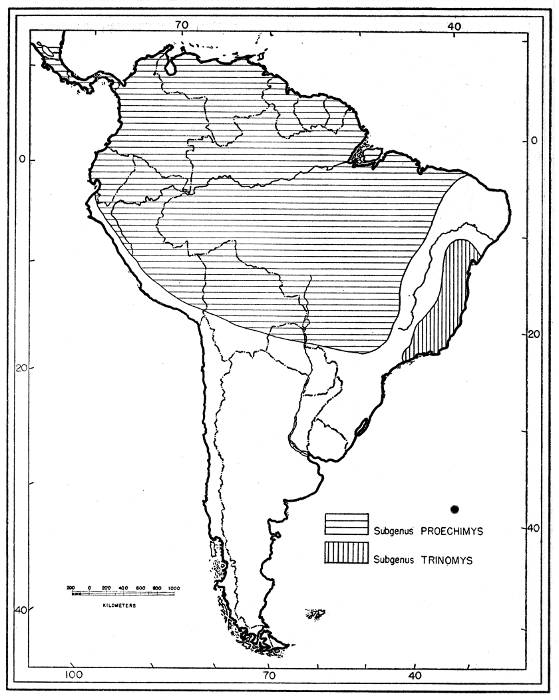
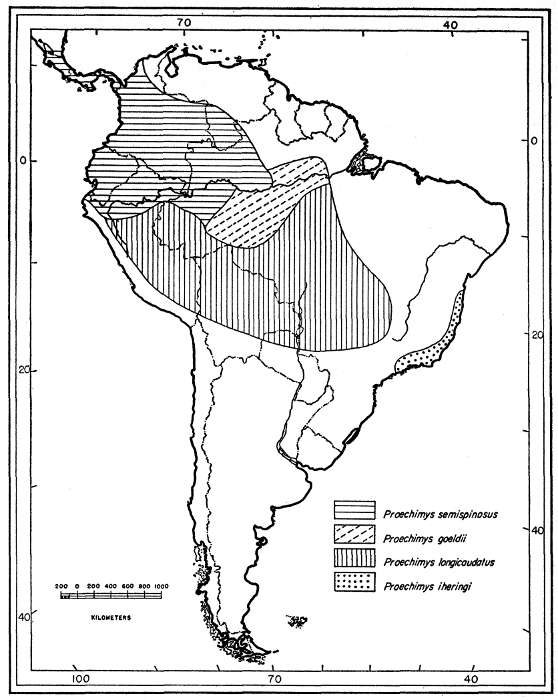
Fig. 23. Map showing the geographic ranges of four species of the genus Proechimys.
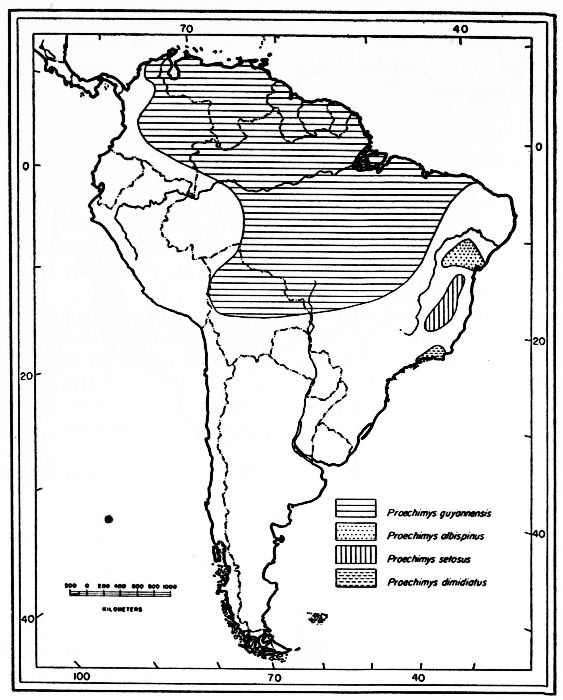
Fig. 24. Map showing the geographic ranges of four species of the genus Proechimys.