Front matter (continued 2)
Reading edition
Thanksgiving is a universal holiday; it is for all the people. As heretofore, each year brings new households, enlarged families, increased affections, comfortable homes, plentiful tables, abundant harvests, a beneficent government, free schools, and religious liberty. There is much to be grateful for in our national history. Whatever may have been our sense of past duty, it is the privilege of all to thank God that He has given us the unexpected and unsought for opportunity to relieve much oppression and to extend the blessings of good government and fair freedom to many millions of people.
It is a wonderful opportunity, and no people on the face of the globe have a stricter sense of duty than our great country. We may be far from perfect if tried by the highest standards, but where shall we find a nation which less desires to rule, and desires to rule more justly, giving liberty to all? We as a generation have lived to see what may be the greatest epoch in the world's history. Truly the seeds of this harvest were sown years ago by our Pilgrim fathers. For such mercies what soul will not raise its thanksgiving to God? Let us as teachers of the state of New Jersey teach our children these great truths, and enter with an open mind and a willing heart into each Thanksgiving festival, and let us all try to inculcate in the hearts of our pupils this significant brotherhood.
THE FESTIVAL COMMITTEE
Let the history of this great Thanksgiving Feast be the background and setting for your play-festival. Let it be the duty of teachers to see that the program for this celebration is inspired by patriotism, by a reverence for God, who has been most gracious to us as a people. For social reasons, it will be well to let some particular grade prepare the program for the festival. The other grades of the school will be in the audience, and thus the whole school will be united into one large social group. Before it is decided which grade shall be selected to prepare the program the principal and teachers should meet and, after talking over the preliminary plans, appoint the festival committee. It is important that the proper kind of machinery for this festival work be constructed. It will be the duty of this special committee to keep in mind such objects of the play-festival as the promotion of a keener appreciation and a more reverent remembrance of great events and great men and women of our history; the promotion of a deep national patriotism; the promotion of a sense of deep gratitude that we live in such a bountiful and beautiful earth. The play-festival should be looked upon as a means of moral, social, cultural and esthetic education.
Keeping these things in mind, the play-festival should be invented almost entirely by the children, who will present the program. Of course this will require the watchful guidance of teachers and committee. A play or program that has been already planned for the occasion may be taken, but even in such a program the scenes should be planned by the class. If this plan is followed almost any of the ready-made plays may be adapted for any grade from the kindergarten to the high school. The wealth of historic material which readily conforms to the Thanksgiving program is abundant. There is no school that cannot act some scene, pantomime, tableau or the like, with but little thought and drill. The results obtained by bringing any class in touch with some of our masterpieces of history, literature, art, music, or sculpture, cannot be easily estimated.
PREPARING THE PROGRAM
A good method of preparing the program is to bring before the class who has been decided upon to render the festival the fact that this grade has been appointed to do this bit of patriotic service. Tell them about the festival, its simple aims; about the historic material on which the day is founded. Have the pupils write their ideas about developing the program. These may be discussed, and the best suggestions can be used about which to form an outline. This is admirable training for the pupils. Not infrequently surprises occur; unsuspected talents are discovered; and often the children who have appeared as dullards in them regular school subjects will take an interest which will lead to salutary results. Many times children will enjoy working on such plans and develop a new interest in their studies. The children should also be asked for suggestions as to developing the stage scenery, costumes, etc. Frequently their suggestions, with slight modifications, have an effectiveness beyond the reach of the teacher. Of course we as teachers must be satisfied with rather crude suggestions, and work up to a satisfactory result.
The stage setting should always be simple, but suggestive. Often a play-festival may be rendered with little or no scenery. In fact, most of our present school programs are given without even a semblance of scenery or decorations. Some simple stage setting, scenery, or decorations will add wonderfully to the effect of your program, and this will be found easy to accomplish. This is particularly true of the Thanksgiving Day program. In the rural districts, especially, can be found the proper materials for this day. Such things as cornstalks, pumpkins, apples, fruits, cereals, and vegetables of many kinds will meet your needs. Whatever is good for a harvest home celebration may be used to celebrate Thanksgiving.
It is desirable, also, to have simple costumes. The teacher should not be burdened with the making of the costumes. Arouse the interest of your class, and they will take home this interest. The result will be that the teacher will get more than he had hoped or suggested.
The work of preparing the music should be done during the period of the day when singing is usually done. The music is very valuable. The whole school appreciates music and singing. It is the one unifying influence within the reach of the school. If all the various classes are used to promote the play-festival a practical correlation of the work of the school may be profitably accomplished.
THE PROGRAM
Below is submitted a type program for the Thanksgiving Day Festival. This is suitable for fifth and sixth grade pupils. This type of program may be easily changed so that it may be rendered by pupils of the first grade or by students of the high school. Care should always be exercised that the plan of the program is easily understood by the class who renders it. Scenes should be molded to meet the needs and capacities of the grade that is to perform. The dialog or monolog should also be adapted to the ages of the pupils who are to do the acting. Below will be found a list of scenes which by thoughtful manipulation may be made to fall within the command of pupils from the kindergarten to the high school. The bibliography given will furnish much information.
THANKSGIVING EXERCISES
In Charge of Grade VI
Theme: The Harvest
Song—"America," by the school Prayer Reading—"George Washington's Thanksgiving Proclamation of 1795" Song—"Harvest Home," by the school Act I. Getting ready for seed time Scene I. Indians showing the Pilgrims how to plant corn Scene II. Resting (a camp scene) Song—"Thanksgiving Day," by the school Recitation—"Thanksgiving," by a pupil Act II. A corn husking bee (place, a New England barn) Scene I. Husking corn Scene II. The frolic Scene III. Going home Song—"Star Spangled Banner," by the school
The following scenes may be made appropriate for the different grades by changing the quality and quantity of the scenery. Pantomimes are especially to be recommended for use in our school programs. Many of these scenes will lend themselves to this purpose. Hints for the preparation of these scenes may be gained from the great paintings or their reproductions.
Autumn Memories The Pilgrims An Indian Camp An Indian Village Miles Standish and his Warriors The Pilgrim's Town Meeting The Pilgrims going to Church The Pilgrims Hunting The Pilgrims Fishing The Husking Bee The Dying Year Thanksgiving at Home The Harvest Home (Old English) The Country Dance The Love Scene of Priscilla and John Alden Miles Standish's Home Many Indian Scenes from Hiawatha Many Harvest Home Scenes
BIBLIOGRAPHY
See Bibliography at end of monograph.
LINCOLN'S BIRTHDAY
February 12
Again thy birthday dawns, O man beloved, Dawns on the land thy blood was shed to save, And hearts of millions, by one impulse moved, Bow and fresh laurels lay upon thy grave.
Ida Vose Woodbury
LINCOLN'S BIRTHDAY
CHARLES A. PHILHOWER, SUPERVISING PRINCIPAL, WESTFIELD
The observance of Lincoln's birthday as a national holiday has grown steadily until twenty-four states have designated it by statute as a holiday. The great emancipator is today our foremost national hero. His most unusual career from the log cabin to the White House sets ambition and hope of attainment before the most lowly and the most favorably environed alike.
There are many salient reasons why the boys and girls of our schools should study the life of this great hero. He established once and for all time the now inalienable right of life, liberty, and the pursuit of happiness to all mankind. Early in life he was dubbed by his friends and neighbors with the enviable title of "Honest Abe." On the frontier we find him inuring himself to toil. He was thoroughly acquainted with that slogan always necessary to success, "hard work." His life was pure, untainted with the vices which spring from luxury, the lust for gain, the greed for fame. Simple in living, steadfast in purpose, kindly in spirit, he towered among his fellows, exemplary of that manhood toward which all boys who would be of worth to mankind should aspire.
At the present time it is especially opportune that Lincoln's birthday be celebrated most impressively. The freedom for which we have just been fighting is a greater freedom than that of '61. That was for the freedom of the slave, this for a greater freedom of men already free; that was freedom for a part of mankind, this a freedom for all, for the democracy of the world. The principles for which he stood are the principles for which we must ever stand, but the application of those principles is limitless in its scope. It is for us to see that those who have sacrificed their lives in this great cause shall not have died in vain. It is for the boys and girls in our schools today to carry to a successful issue this great project of making the world safe for democracy and democracy safe for the world, and no small part of this work lies on our shoulders as teachers of boys and girls who will be citizens tomorrow.
The law requires that on the last school day preceding Lincoln's birthday appropriate exercises be held for the development of a high spirit of patriotism. The whole day should center around the life of Lincoln. For the afternoon a special program should be prepared and the parents of the school children invited by special letters written by the pupils of the school. The pupils of each school should assist in working out the program. In some schools, in the upper grades the pupils should be held responsible for much of the work in program making. Each teacher and principal should arrange the work of the day and the special program to one end, that of utilizing the great spirit and profound wisdom of a wonderful man to the establishment of a greater patriotism and the working out of the national problems before us.
The following general suggestions indicate the important factors to be considered in making a Lincoln program.
Point out the significance of the flag salute
Analyze the pledge
Sing patriotic songs
The songs of today The songs of the past
Study Lincoln's boyhood. His career from the log cabin to the White House is phenomenal
Lincoln the lawyer and politician
Emphasize the work and honesty in the life of Abraham Lincoln
President of the United States and statesman. His great speeches
Read, study and memorize the Gettysburg speech. Each child should have a copy
Learn quotations, and know their meaning and application
Collect a number of pictures of Lincoln
Call special attention to the best statuary
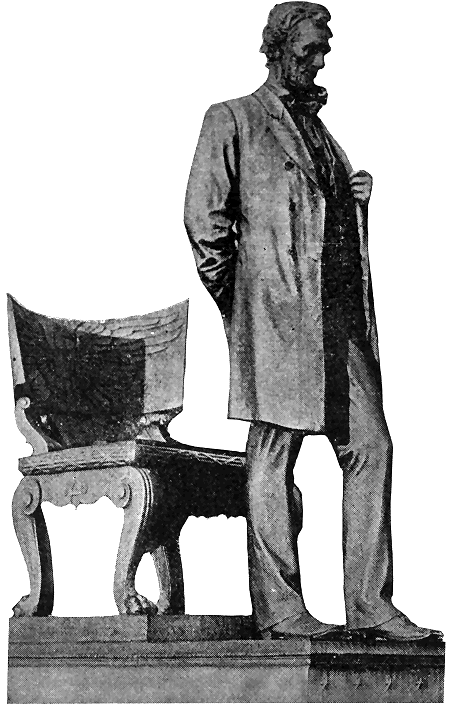
Gutzon Borglum's Lincoln before the Court House in Newark, New Jersey, and the statue by Saint Gaudens in Lincoln Park, Chicago, are the most worthy and should be particularly noted
"O Captain, My Captain," by Whitman, and "The Perfect Tribute," by Mary Shipman Andrews, should be read by the teacher
Do not neglect the great humor in his life; children enjoy a joke
Pupils will enjoy writing acrostics on the name of Lincoln
The Lincoln Highway and the National Lincoln Memorial are recent monuments to the honor of this great man
Let the decorations of the room be in keeping with the celebration
Lincoln posters may be made in the drawing class
The younger pupils will be interested in collecting the stamps with Lincoln's picture
Civil War veterans, Civil War pictures, Civil War newspapers, Civil War correspondence, will make vital contributions in vivifying the life of Lincoln, incidents of the War, and this special observance. Invite veterans to come in and make brief speeches. Request pupils to bring old newspapers, old correspondence, war relics and the like with the assurance that they will be cared for and safely returned
Saint Gaudens' Lincoln Lincoln Park, Chicago Copyright by Underwood & Underwood, N.Y.
Read letters from boys who were at the front. Collect war pictures from the Sunday newspapers. Remember the boys from your community who went to war. Contrast the present war situation and practices with those of the Civil War. Classroom activity of this kind may continue for the whole week.
SUGGESTIONS FOR USE OF THE MATERIAL WHICH FOLLOWS
Preparatory to the observance of Lincoln's birthday teach carefully and thoroughly the Gettysburg Speech. Each pupil from the fifth grade through the high school ought to know this great masterpiece. Teach the occasion on which it was given, which brought forth this great production, the significance of the speech then and now, and finally have each child give it from memory. A contest in the delivery of Lincoln's Gettysburg Speech would interest the school and the public. The winner should appear on the holiday program.
The placing in schools of Lincoln Memorial Bronze Tablets containing the Gettysburg Speech will give special significance to the observance. This practice should be promoted. Every new school should have its Lincoln Memorial Tablet.
The most interesting persons in the eyes of children are children. They are most concerned with what kind of a boy Lincoln was. Books such as "Life of Abraham Lincoln for Boys and Girls," by C. W. Moores, and "The Boy's Life of Abraham Lincoln," by J. G. Nicolay, should be made available. Pupils should be encouraged to tell to the class what they have found of interest in the accounts of his boyhood. Incidents of his honesty, his desire for learning, and habit of hard work, will be brought forth and no effort should be spared to emphasize these most important characteristics. Strive for enthusiastic admiration, and the imitation of these most desirable qualities will follow.
Stories from his life, incidents in his experience, and periods in his career, such as the twenty-two years on the farm, the twenty-seven years in intellectual pursuits, and the seven years in national service, will give profitable material for work in English. Oral and written reproductions should be taught for some time before the holiday observance and the best of these used on this occasion. Mr. Judd Stewart's suggestions (given on another page) respecting the study of Lincoln's English are very valuable.
Give an exercise or two in acrostic writing with the aim of setting forth in a succinct way his admirable character and laudable accomplishments. A problem of this type appeals to children and has value in it.
The humorous stories of Lincoln should not be neglected. There is great need for high standards of humor, jokes and jests with boys and girls. Every one should be able to tell a good story well. The humor in Lincoln's life presents good material for such teaching.
A study and memorizing of quotations may be begun early in the fall; in fact, such study should be pursued throughout the whole school course. If this is done many pupils will be able to give on February twelfth their choice from among Lincoln's sayings with reasons for their selections and with statements respecting the source of their admiration. Every pupil should have a stock of Lincoln sayings at his command. These selected thoughts should be a part of the thinking of boys and girls.
Readings for the week preceding the holiday observance can be made from the following brief publications:
"Lincoln Centenary Ode," Percy MacKaye "Commemorative Ode," James Russell Lowell "Abraham Lincoln," Carl Schurz "Abraham Lincoln," George Bancroft "The Perfect Tribute," Mary Shipman Andrews
The selections should be read in their entirety, in most cases by the teacher to the class. If there is a pupil who is a very good reader, such a pupil may do it effectively. Each school library ought to have a good selection of Lincolnia from which the pupils could draw books for outside reading. Books such as these should be read by the class supplemental to the study of the Civil War period.
A good teacher is able to read well "O Captain, My Captain," and she reads it often to her pupils. Ultimately the children will get the spirit of the poem and some will be able to read it well or give it from memory. The various poems herein mentioned are worthy of similar treatment.
As the Gettysburg Speech is studied, so should the Civil War songs be studied. The "Battle Hymn of the Republic" should be sung with all the feeling which its meaning is capable of conveying. As much should be done with "Tenting on the Old Camp Ground." The allusion here is very impressive. The sentiment is the song, the tune is a mode of expression.
Each school in the state should have a picture of Lincoln. It should be hung by the pupils where it can be seen by the youngest as well as the oldest. A child does well in having a definite acquaintance with the rugged, kindly face of Lincoln. A look at this picture should give renewed emphasis to his standards of living and the great principles which he established. Not long since a teacher said to me, "When I have a case of discipline where the pupil has difficulty in getting the right point of view I often say to the boy, especially if he be of the upper grades, 'Go out into the hall and look for a few minutes at the fatherly face of the great Lincoln and then come back to me and tell me what you think he would say in this case.'" Such procedure is extremely effective, particularly when the pupil is acquainted with Lincoln's sayings and the great principles for which he stood. Marshall's "Lincoln" is a fine portrait for schools.
The decoration of the classroom will present demands for drawing and handwork activities such as picture frames, draperies, red, white and blue chains, and flag decorations. Much can be done in the making of posters with water colors and crayons, in the artistic ornamentation of Lincoln picture mounts on drawing paper, and in the lettering and decoration of Lincoln acrostics. The use of Lincoln picture cutouts; the drawing or painting of flags, the state seal and shields, the American eagle; perspective drawings of the log cabin, the White House and the Capitol are suggested activities. Postage stamps containing Lincoln's picture may be used in connection with handwork and drawing activities. Booklets for acrostics, anecdotes, quotations, brief biography or history incidents, with appropriate cover design, initial letters and simple illustrations will afford attractive and profitable projects.
Many other ways and means of presenting the life of Lincoln will suggest themselves to the active, thinking teacher. The whole object is to help boys and girls to know Lincoln as he lived, to make his life function in making their lives better and more worth while through his great thoughts, high ideals and indefatigable spirit of work.
The following programs, selections, suggestions and bibliography are intended to make available some selected material which in many cases may not be accessible.
ASSEMBLY PROGRAM
Organization of School for exercises
1. School orchestra 2. Two color bearers at each entrance to auditorium 3. One color bearer with honorary guard of two at each side of platform 4. Color bearer for flag salute—center of platform
Program
Salute flag draped over Lincoln portrait Song, "America" Story of Lincoln's life told by pupil[D] Reading "Gettysburg Address" by teacher Solo "When The Boys Come Home" Reading Civil War letter Solo, "Star Spangled Banner," school joining in chorus Talk by Civil War veteran Chorus sung by school, "Keep the Home Fires Burning" Salute Formal dismissal in keeping with assembly
GENERAL PROGRAM FOR CLASSROOM
Place in front of the room the picture of Lincoln veiled with the American Flag
Unveil picture
Pupils stand in saluting posture ten seconds
Quote in concert, verse from Ida Vose Woodbury's "Lincoln's Birthday"
Song, "Battle Hymn of the Republic"
Brief story of life of Lincoln (compare autobiography). (Told by an older pupil—not longer than five minutes)
At least three incidents from Lincoln's life given by intermediate pupils
Damage to borrowed book
Returning of right change
Lincoln and the pig
Long walk to school
Wood chopping for log house
Lincoln and his sums
Illustrate on sand table Lincoln's log house and the clearing of forest land
Recitation, "Gettysburg Speech"
"O Captain, My Captain" read by teacher
Song, "My Country 'Tis of Thee"
Salute flag and give pledge: "I pledge allegiance to my flag, and to the republic for which it stands; one nation, indivisible, with liberty and justice for all"
INTERMEDIATE GRADE PROGRAM
Reading of acrostics, using letters of Lincoln's name
Make Lincoln booklets
Conversational lesson in which each child contributes what he knows or was able to find about Lincoln, the teacher adding interesting items
Lincoln's Gettysburg Speech recited by one child
Civil War newspaper articles read
Patriotic songs chosen by children sung
Pledge—"I pledge allegiance to my flag, and to the republic for which it stands; one nation, indivisible, with liberty and justice for all"
PRIMARY PROGRAM
Picture of Lincoln in front of room
Salute and pledge
Song, "America"
Stories about Lincoln selected and read by children from books brought from home or library
Recitation, "A Prayer for our Soldiers and Sailors," by Oriola Johnson
Marching and military exercises with flags
Lincoln's early boyhood told by pupil. A few readings of sketches written by pupils. Request that each child take his composition home and read it to his parents
Song
KINDERGARTEN OBSERVANCE
1. Morning Circle
Singing
Tone plays about flag, etc.
Hail to the flag (Gaynor)
2. Morning talk about Lincoln
Get from the children what they know about Lincoln. Add to this until they know something of his life, laying emphasis on his kindness, obedience, thoughtfulness, bravery. Hint as to how these much admired qualities may be used by little children
3. Table Work
Gift period
Make soldier hats from squares of newspaper. Build Lincoln log house
4. Games
(a) "Soldier Boy, where are you going?"
(b) Parade for Lincoln's Birthday
Choice by children of best kindergarten soldiers to carry the flags in parade; use drum
5. Table Work
Occupation period
Make crayoneine frame around picture of Lincoln
Take picture home
6. Sing "America," at least one verse
GETTYSBURG SPEECH
Four score and seven years ago our fathers brought forth on this continent a new nation, conceived in liberty, and dedicated to the proposition that all men are created equal. Now we are engaged in a great civil war, testing whether that nation, or any nation so conceived and so dedicated, can long endure. We are met on a great battle-field of that war. We have come to dedicate a portion of it as the final resting-place of those who here gave their lives that that nation might live. It is altogether fitting and proper that we should do this.
But, in a larger sense, we cannot dedicate—we cannot consecrate—we cannot hallow—this ground. The brave men, living and dead, who struggled here, have consecrated it far above our poor power to add or detract. The world will little note nor long remember what we say here, but it can never forget what they did here. It is for us, the living, rather, to be dedicated here to the unfinished work which they who fought here have thus far so nobly advanced. It is rather for us to be here dedicated to the great task remaining before us—that from these honored dead we take increased devotion to that cause for which they gave the last full measure of devotion; that we here highly resolve that these dead shall not have died in vain; that this nation, under God, shall have a new birth of freedom; and that the government of the people, by the people, for the people, shall not perish from the earth.
Abraham Lincoln
SECOND INAUGURAL ADDRESS
[Lincoln's ideas respecting the injustice of the principles of slavery and the honesty of purpose in waging the Civil War are set forth in the Second Inaugural Speech. This passage is probably the most beautiful, the most chaste, the most profound, the grandest, ever uttered by an American.]
Fellow-countrymen: At this second appearing to take the oath of the presidential office, there is less occasion for an extended address than there was at the first. Then a statement somewhat in detail, of a course to be pursued, seemed fitting and proper. Now, at the expiration of four years, during which public declarations have been constantly called forth on every point and phase of the great contest which still absorbs the attention and engrosses the energies of the nation, little that is new could be presented.
The progress of our arms, upon which all else chiefly depends, is as well known to the public as to myself; and it is, I trust, reasonably satisfactory and encouraging to all. With high hope for the future, no prediction in regard to it is ventured.
On the occasion corresponding to this, four years ago, all thoughts were anxiously directed to an impending civil war. All dreaded it; all sought to avert it. While the inaugural address was being delivered from this place, devoted altogether to saving the Union without war, insurgent agents were in the city seeking to destroy it without war—seeking to dissolve the Union, and divide effects, by negotiation.
Both parties deprecated war; but one of them would make war rather than let the nation survive, and the other would accept war rather than let it perish. And the war came.
The prayer of both could not be answered—those of neither have been answered fully. The Almighty has His own purposes. "Woe unto the world because of offenses! for it must needs be that offenses come; but woe to that man by whom the offense cometh."
If we shall suppose that American slavery is one of those offenses which, in the providence of God, must needs come, but which, having continued through His appointed time, He now wills to remove, and that He gives to North and South this terrible war as the woe due to those by whom the offense came, shall we discern therein any departure from those divine attributes which the believers in a living God always ascribe to Him?
Fondly do we hope, fervently do we pray, that this mighty scourge of war may soon pass away.
Yet, if God wills that it continue until all the wealth piled by the bondsman's two hundred and fifty years of unrequited toil shall be sunk, and until every drop of blood drawn by the lash shall be paid by another drawn with the sword, as was said three thousand years ago, so still it must be said, "The judgments of the Lord are true and righteous altogether."
With malice toward none, with charity for all, with firmness in the right, as God gives us to see the right, let us strive on to finish the work we are in; to bind up the nation's wounds; to care for him who shall have borne the battle, and for his widow and for his orphan; to do all which may achieve and cherish a just and lasting peace among ourselves, and with all nations.
Abraham Lincoln
ABRAHAM LINCOLN'S AUTOBIOGRAPHY
The following autobiography was written by Mr. Lincoln's own hand at the request J. W. Fell, of Springfield, Illinois, December 20, 1859. In the note which accompanied it the writer says: "Herewith is a little sketch, as you requested. There is not much of it, for the reason, I suppose, that there is not much of me."
I was born February 12, 1809, in Hardin County, Kentucky. My parents were both born in Virginia, of undistinguished families—second families, perhaps I should say. My mother, who died in my tenth year, was of a family of the name of Hanks, some of whom now reside in Adams County, and others in Mason County, Illinois. My paternal grand-father, Abraham Lincoln, emigrated from Rockingham County, Virginia, to Kentucky, about 1781 or 1782, where, a year or two later, he was killed by Indians, not in battle, but by stealth, when he was laboring to open a farm in the forest. His ancestors, who were Quakers, went to Virginia from Berks County, Pennsylvania. An effort to identify them with the New England family of the same name ended in nothing more definite than a similarity of Christian names in both families, such as Enoch, Levi, Mordecai, Solomon, Abraham, and the like.
My father, at the death of his father, was but six years of age, and grew up literally without any education. He removed from Kentucky to what is now Spencer County, Indiana, in my eighth year. We reached our new home about the time the state came into the Union. It was a wild region, with many bears and other wild animals still in the woods. There I grew up. There were some schools, so called, but no qualification was ever required of a teacher beyond readin', writin' and cipherin' to the rule of three. If a straggler, supposed to understand Latin, happened to sojourn in the neighborhood, he was looked upon as a wizard. There was absolutely nothing to excite ambition for education. Of course, when I came of age I did not know much. Still, somehow, I could read, write, and cipher to the rule of three, but that was all. I have not been to school since. The little advance I now have upon this store of education I have picked up from time to time under the pressure of necessity.
I was raised to farm work, at which I continued till I was twenty-two. At twenty-one I came to Illinois, and passed the first year in Macon County. Then I got to New Salem, at that time in Sangamon, now Menard County, where I remained a year as a sort of clerk in a store. Then came the Black Hawk War, and I was elected a captain of volunteers—a success which gave me more pleasure than any I have had since. I went into the campaign, was elected, ran for the Legislature the same year (1832), and was beaten—the only time I have ever been beaten by the people. The next and three succeeding biennial elections I was elected to the Legislature. I was not a candidate afterward. During the legislative period I had studied law, and removed to Springfield, to practice it. In 1846 I was elected to the Lower House of Congress. Was not a candidate for reelection. From 1849 to 1854, both inclusive, practiced law more assiduously than ever before. Always a Whig in politics, and generally on the Whig electoral ticket, making active canvasses. I was losing interest in politics when the repeal of the Missouri Compromise aroused me again. What I have done since then is pretty well known.
If any personal description of me is thought desirable, it may be said I am in height six feet four inches, nearly; lean in flesh, weighing, on an average, one hundred and eighty pounds; dark complexion, with coarse black hair and gray eyes—no other marks or brands recollected.
THE BIXBY LETTER
Executive Mansion, Washington, November 21, 1864
Dear Madam:
I have been shown in the files of the War Department a statement of the Adjutant-General of Massachusetts, that you are the mother of five sons who have died gloriously on the field of battle. I feel how weak and fruitless must be any words of mine which should attempt to beguile you from the grief of a loss so overwhelming. But I cannot refrain from tendering to you the consolation that may be found in the thanks of the Republic they have died to save. I pray that our Heavenly Father may assuage the anguish of your bereavement, and leave you only the cherished memory of the loved and lost, and the solemn pride that must be yours to have laid so costly a sacrifice upon the altar of freedom.
Yours, very sincerely and respectfully Abraham Lincoln
To Mrs. Bixby Boston, Massachusetts
SAYINGS FROM LINCOLN'S SPEECHES
Let us have faith that right makes might; and in that faith let us, to the end, dare to do our duty as we understand it.
I intend no modification of my oft-expressed wish that all men everywhere should be free.
A house divided against itself cannot stand. I believe this government cannot endure permanently half slave and half free.
I take the official oath today with no mental reservation and with no purpose to construe the constitution by any hypercritical rules.
You can have no oath registered in heaven to destroy the government; while I shall have the most solemn one to "preserve, protect and defend" it.
The mystic chords of memory stretching from every battle-field and patriot grave to every living heart and hearthstone all over this broad land, will yet swell the chorus of Union, when again touched, as surely they will be, by the better angels of our nature.
In giving freedom to the slaves we assure freedom to the free—honorable alike in what we give and what we preserve.
Do not swap horses in the middle of the stream.
You can fool part of the people all of the time, and all of the people part of the time; but you cannot fool all of the people all of the time.
I do not think much of a man who is not wiser today than he was yesterday.
The leading rule for the man of every calling is diligence; never put off until tomorrow what you can do today.
I never let an idea escape, but write it on a piece of paper and put it in a drawer. In this way I sometimes save my best thoughts on a subject.
Wealth is a superfluity of what we do not need.
Come what will, I will keep faith with friend and foe.
Faith in God is indispensable to successful statesmanship.
God bless my mother; all I am or hope to be I owe to her.
I will study and get ready and maybe my chance will come.
Be sure you put your feet in the right place and then stand firm.
And having thus chosen our course, without guile and with pure purpose, let us renew our trust in God, and go forward without fear and with manly hearts.
Nothing valuable can be lost by taking time.
It is all in that one word—thorough.
Let us strive on to finish the work we are in.
When you can't remove an obstacle plow around it.
The way for a young man to rise is to improve every way he can, never suspecting that anybody wishes to hinder him.
To add brightness to the sun or glory to the name of Washington is alike impossible. Let none attempt it. In solemn awe pronounce the name and in its naked deathless splendor leave it shining on.
O CAPTAIN! MY CAPTAIN!
O Captain! my Captain! our fearful trip is done; The ship has weather'd every rack, the prize we sought is won; The port is near, the bells I hear, the people all exulting, While follow eyes the steady keel, the vessel grim and daring. But O heart! heart! heart! O the bleeding drops of red, Where on the deck my Captain lies, Fallen cold and dead. O Captain! my Captain! rise up and hear the bells; Rise up—for you the flag is flung—for you the bugle trills; For you bouquets and ribbon'd wreaths—for you the shores a-crowding; For you they call, the swaying mass, their eager faces turning. Here, Captain! dear father! This arm beneath your head! It is some dream that on the deck, You've fallen cold and dead. My Captain does not answer; his lips are pale and still; My father does not feel my arm; he has no pulse nor will. The ship is anchor'd safe and sound, its voyage closed and done; From fearful trip the victor ship comes in with object won. Exult, O shores, and ring, O bells! But I with mournful tread, Walk the deck my Captain lies, Fallen cold and dead.
Walt Whitman
THE UNFINISHED WORK
The crowd was gone, and to the side Of Borglum's Lincoln, deep in awe, I crept. It seemed a mighty tide Within those aching eyes I saw. "Great heart," I said, "why grieve alway? The battle's ended, and the shout Shall ring forever and a day— Why sorrow yet, or darkly doubt?" "Freedom," I plead, "so nobly won For all mankind, and equal right, Shall with the ages travel on Till time shall cease, and day be night." No answer—then; but up the slope With broken gait, and hands in clench, A toiler came, bereft of hope, And sank beside him on the bench.
Joseph Fulford Folsom
ACROSTIC
(Written by a fifth grade child)
L is for Lincoln, brave and true I is for the Iron nerve which helped him through N is for Nation whose tongue sings his praise C is for Colors on his birthday we raise O is for Oration or speech he gave L is for Liberty given the slave N is his Name which ever we'll save
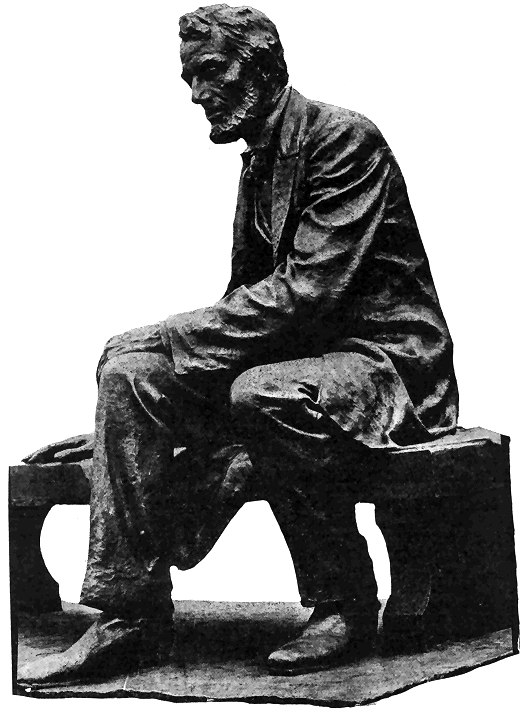
Statue of Lincoln by Gutzon Borglum In front of Court House, Newark
THE BOY THAT HUNGERED FOR KNOWLEDGE
In his eagerness to acquire knowledge, young Lincoln had borrowed of Mr. Crawford, a neighboring farmer, a copy of Weems' Life of Washington—the only one known to be in existence in that section of the country. Before he had finished reading the book, it had been left, by a not unnatural oversight, in a window. Meantime, a rain storm came on, and the book was so thoroughly wet as to make it nearly worthless. This mishap caused him much pain; but he went, in all honesty, to Mr. Crawford with the ruined book, explained the calamity that had happened through his neglect, and offered, not having sufficient money, to "work out" the value of the book.
"Well, Abe," said Mr. Crawford, after due deliberation, "as it's you, I won't be hard on you. Just come over and pull fodder for me for two days, and we will call our accounts even."
The offer was readily accepted, and the engagement literally fulfilled. As a boy, no less than since, Abraham Lincoln had an honorable conscientiousness, integrity, industry, and an ardent love of knowledge.
ABE LINCOLN'S HONESTY
Lincoln could not rest for an instant under the consciousness that he had, even unwittingly, defrauded anybody. On one occasion, while clerking in Offutt's store, at New Salem, Illinois, he sold a woman a little bill of goods, amounting in value by the reckoning, to two dollars six and a quarter cents. He received the money, and the woman went away. On adding the items of the bill again, to make sure of its correctness, he found that, he had taken six and a quarter cents too much. It was night and closing and locking the store, he started out on foot, a distance of two or three miles, for the house of his defrauded customer, and, delivering over to her the sum whose possession had so much troubled him, went home satisfied.
On another occasion, just as he was closing the store for the night, a woman entered, and asked for a half pound of tea. The tea was weighed out and paid for, and the store was left for the night. The next morning, Lincoln entered to begin the duties of the day, when he discovered a four-ounce weight on the scales. He saw at once that he had made a mistake, and, shutting the store, he took a long walk before breakfast to deliver the remainder of the tea. These are very humble incidents, but they illustrate the man's perfect conscientiousness—his sensitive honesty—better perhaps than they would if they were of greater moment.
YOUNG LINCOLN'S KINDNESS OF HEART
An instance of young Lincoln's practical humanity at an early period of his life is recorded, as follows:
One evening, while returning from a "raising" in his wide neighborhood, with a number of companions, he discovered a straying horse, with saddle and bridle upon him. The horse was recognized as belonging to a man who was accustomed to excess in drink, and it was suspected at once that the owner was not far off. A short search only was necessary to confirm the suspicions of the young men.
The poor drunkard was found in a perfectly helpless condition, upon the chilly ground. Abraham's companions urged the cowardly policy of leaving him to his fate, but young Lincoln would not hear to the proposition. At his request, the miserable sot was lifted to his shoulders, and he actually carried him eighty rods to the nearest house. Sending word to his father that he should not be back that night, with the reason for his absence, he attended and nursed the man until the morning, and had the pleasure of believing that he had saved his life.
A BIT OF HUMOR FROM THE BUSY LIFE OF LINCOLN
Two persons who had been arguing with each other how long a man's legs should be in proportion to his body, stepped into Lincoln's office and asked him to settle the dispute.
To them he replied: "After much thought and consideration, not to mention mental worry and anxiety, it is my opinion, all side issues being swept aside, that a man's lower limbs, in order to preserve harmony of proportion, should be at least long enough to reach from his body to the ground."
HOW LINCOLN AND JUDGE B. ... SWAPPED HORSES
When Abraham Lincoln was a lawyer in Illinois, he and a certain judge once got to bantering each other about trading horses, and it was agreed that the next morning at nine o'clock they should make a trade, the horses to be unseen up to that hour, and no backing out, under a forfeiture of $25.
At the hour appointed the Judge came up, leading the sorriest-looking specimen of a horse ever seen in those parts. In a few minutes Mr. Lincoln was seen approaching with a wooden sawhorse upon his shoulders. Great were the shouts and the laughter of the crowd, and both were greatly increased when Mr. Lincoln, on surveying the Judge's animal, set down his sawhorse, and exclaimed: "Well, Judge, this is the first time I ever got the worst of it in a horse trade."
The following paragraphs are quoted from a small pamphlet of Mr. Judd Stewart of Plainfield, New Jersey, entitled "Suggestions for a Text Book for Students of English." Mr. Stewart is a profound student of Lincoln, and without doubt has the largest private collection of Lincolnia in the United States.
It was recently suggested to me by a lieutenant in the navy, a graduate of Annapolis, that in teaching English the writings and speeches of Lincoln would be a very proper text-book. This appeals to me most forcefully because all school children know who Lincoln was, know something of his Gettysburg Address, know him as the Emancipator of the Slaves and probably a majority of them admire him. Therefore, it seems to me that a text-book based upon, or rather made up from Lincoln's speeches and letters would be of great interest to the majority of children, and by having such a text-book they would learn history and good expressive English at the same time and in a most interesting way.
The suggested text-book would consist of: The House Divided Against Itself Speech, in 1858; The First Debate with Douglas Speech in 1858; The Cooper Institute Speech, 1860; The First Inaugural, 1861; The First Message to Congress, 1861; The Emancipation Proclamation, 1863; The Gettysburg Address, 1863; The Letter to Mrs. Bixby, 1864; The Second Inaugural, 1865.
Lincoln spent 49 years of his life in preparation, six years in the accomplishment of his work. The study of his life is commended and commends itself to all thinking people.
Why should we not teach his thoughts, his modes of speech, his simplicity of expression to those who with their children and descendants for ages will remember Abraham Lincoln, the Emancipator, the Martyr, the Greatest American?
Attention should be given to the great statue of Lincoln before the Court House in Newark, New Jersey. It presents our most admired statesman seated on a bench absorbed in thought. The statue is a wonderful work of art. From every angle it is unique, beautiful, and a masterpiece. At all times of day passersby may see the children of the city sitting in his arm, lovingly admiring the fatherly face. On his knees and on the bench they gather, children of all races, rejoicing in the freedom which he gave to mankind.
The statue was conceived and made by the Sculptor Gutzon Borglum, for Amos H. VanHorn, the donor. It was presented to the Lincoln Post on May 30, 1911, by Chancellor Mahlon Pitney. Colonel Theodore Roosevelt received it in behalf of the Post, and Mayor Husaling made the speech of acceptance.
Pass on, thou that hast overcome. Your sorrows, O people, are his peace. Your bells and bands and muffled drums sound triumph in his ear. Wail and weep here; God made it echo joy and triumph there. Pass on.
Four years ago, O Illinois, we took from your midst an untried man, and from amongst the people. We return him to you a mighty conqueror. Not thine any more, but the Nation's; not ours, but the world's. Give him place, O ye prairies. In the midst of this great continent his dust shall rest, a sacred treasure to myriads who shall pilgrim to that shrine to kindle anew their zeal and patriotism. Ye winds that move over the mighty places of the West, chant his requiem. Ye people, behold a martyr whose blood as so many articulate words, pleads for fidelity, for law, for liberty.
Henry Ward Beecher
BIBLIOGRAPHY
See Bibliography at end of monograph.
WASHINGTON'S BIRTHDAY
February 22
It was almost unconsciously that men learned to cling to Washington with a trust and faith such as few other men have won, and to regard him with a reverence which still hushes us in presence of his memory.
Green
WASHINGTON'S BIRTHDAY
HENRY W. FOSTER, SUPERVISING PRINCIPAL, SOUTH ORANGE
February is the greatest month for the teaching of patriotism. The national heroes, Washington and Lincoln, whose birthdays we celebrate, give distinction to two of its days. The time falls happily in midyear, when pupils and teachers alike need inspiration for a new period of sustained effort requiring determination and vigor.
It has been shown very clearly that through its schools a nation can be trained in ideals which will govern national life and conduct. Neither Washington nor Lincoln, however, owed his heroic quality to schools; but they did owe it to the very same ideals for which our schools stand. Indeed, their greatest service to mankind is the fact that they incarnated those ideals.
It is not so easy to venerate abstract principles and to submit one's life to them as it is to imitate great personalities whose deeds have embodied those principles.
Because we love our national heroes and venerate them personally, they still live and work through us. The principles of democracy are established eternally in their deeds and in ours.
The child who writes an appreciation of Washington, or recites from his addresses, or renders a poem commemorating him, or dramatizes something from his life, enters into his spirit, and in the child Washington lives again.
The Declaration of Independence asserts the lofty principle of equality in liberty. All men are created free, and equal in the right to life, liberty and the pursuit of happiness. It is a declaration of rights, not of duties. Each person has a right to his life, his liberty, the pursuit of his happiness. The deeds of Washington embodied not only these principles, but emphasized the duty of service. In our time our country has fully justified a new statement of political faith, which Washington lived. All men are born equal in the right to opportunity—each to make the best of himself—so that he may render the best service.
Think not of the reward! On the whole, service is requited according to its worth. Too many want to do what they can't do, and won't do what they can do! It may be pride, or it may be looking for an undeserved reward. The school should train for service, and teach self-respect in doing the best that one can in the thing for which he is best fitted. Washington sought no reward; but he commands the undying veneration, not only of his countrymen, but of all mankind. Speaking of the retirement of Washington, at a time when party spirit against the policy of the great founder and preserver of the Republic was calculated to arouse bitterness in a less noble man, Knight, in his "History of England," says: "Had his nature been different, had his ambition been less under the control of his virtue, he might have taken up his sword and, sweeping away his enemy, have raised himself to supreme power upon the ruins of his country's liberty. He retired to his estate at Mount Vernon to pass the rest of his days as a private citizen.... Washington's scheme of glory was realized. He had been a ruler of free men, ruling by the power of law. He laid down his authority when he had done the work to which he was called, most happy in this, that ambitions of a selfish order could never be justified by his example."
Washington's point of view as a ruler of men was unique at that period in the world's history.
We need to teach from the life of Washington that same respect for English ideals of government which he maintained and defended, even by revolting against the English king. Too many of our people have grown up in hatred of England, through the story of the Revolution and the War of 1812, and the unfortunate attitude of aristocratic England in our Civil War.
How does England, the heart and brain of England, regard us? If we know that she sympathizes with our ideals and her heart has been with us all the time, shall we not feel safe with her, and find in Englishmen brothers with whom we may work for the good of the world?
English historians have an appreciation of Washington which we cannot surpass. Writing English history for the instruction of English boys and girls, and men and women, they justify our Revolution and laud our national hero as a world hero. No American orator has ever magnified Washington in more laudatory terms than are to be found in Green's "History of England." Green says: "Washington more than any of his fellow colonists represented the clinging of the Virginia land owner to the Mother Country, and his acceptance of the command proved that even the most moderate of them had no hope now save in arms."
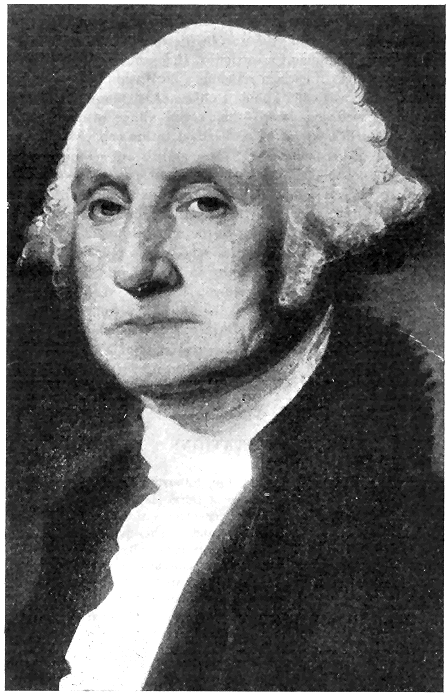
Stuart's Washington Copyright by Underwood & Underwood, N. Y.
For the future we shall need a better understanding of our English brothers. This cannot better be attained than by knowing well that our ideals are held in the same regard by them as by ourselves.
There was one man who was the chief instrument in the hands of Providence for conducting the war, by his energy, prudence, and constancy, to that triumphant assertion of Independence which has built up the great North American republic. To Washington the historian naturally turns, as to the grandest object of contemplation, when he laid aside his victorious sword—that sword which, with those he had worn in his earlier career, he bequeathed to his nephews with words characteristic of his nobleness: "These swords are accompanied with an injunction not to unsheathe them for the purpose of shedding blood, except it be for self-defence, or in defence of their Country and its rights, and in the latter case to keep them unsheathed, and prefer falling with them in their hands to the relinquishment thereof."
The United Colonies in America had such a man as Washington to control the destinies of our country in the making. The new nation had such a man for a leader during the early years of trial and promise. The nation today has the records, accomplishments and deeds of the national hero, Washington, to ever honor, venerate and imitate. The school children of the great state of New Jersey should be happy to learn from the life of this great man lessons of service, respect for law and order, truthfulness and patriotism.
QUOTATIONS
According to Captain Mercer, the following describes Washington when he took his seat in the House of Burgesses in 1759:
"He is as straight as an Indian, measuring six feet two inches in his stockings, and weighing one hundred and seventy-five pounds. His head is well shaped, though not large, and is gracefully poised on a superb neck, with a large, and straight rather than prominent nose; blue-gray penetrating eyes, which are widely separated and overhung by heavy brows. A pleasing, benevolent, though commanding countenance, dark-brown hair, features regular and placid, with all the muscles under control, with a large mouth, generally firmly closed."
Houdon's bust accords with this description.
To the man of all men for whom his manly heart felt most tenderness, to Lafayette, it is that he wrote the beautiful letter of February 1, 1784, unaware that his rest was only temporary, and that he was to become the first President of the country he had given life to:
"At length, my dear marquis, I am become a private citizen on the banks of the Potomac, and under the shadow of my own vine and my own fig-tree, free from the bustle of a camp and the busy scenes of public life, I am solacing myself with those tranquil enjoyments of which the soldier who is ever in pursuit of fame, the statesman whose watchful days and sleepless nights are spent in devising schemes to promote the welfare of his own, perhaps the ruin of other countries, as if the globe was insufficient for us all ... can have very little conception. I have not only retired from all public employments, but I am retiring within myself, and shall be able to view the solitary walk of private life with heart-felt satisfaction. Envious of none, I am determined to be pleased with all; and this, my dear friend, being the order for my march, I will move gently down the stream of life until I sleep with my fathers."
J. J. Jusserand
Among these men whose union in purpose and action made the strength and stability of the republic, Washington was first, not only in the largeness of his nature, the loftiness of his desires, and the vigor of his will, but also in that representative quality which makes a man able to stand as the true hero of a great people. He had an instinctive power to divine, amid the confusions of rival interests and the cries of factional strife, the new aims and hopes, the vital needs and aspirations, which were the common inspiration of the people's cause and the creative forces of the American nation. The power to understand this, the faith to believe in it, and the unselfish courage to live for it, was the central factor of Washington's life, the heart and fountain of his splendid Americanism.
Henry van Dyke
"How did George Washington look?" asked Nell; "What was he like? Won't you please to tell?" Thus I answered: "A courtly man, Wearing his honors as heroes can. Erect and tall, with his six feet two; Knee-breeches, buckles, frills and queue; Powdered brown hair; blue eyes, far apart; Strong-limbed and fearless, with gentle heart; Gracious in manner toward every one— Such, my Nellie, was Washington."
Washington one day came across a small band of soldiers working very hard at raising some military works, under command of a pompous little officer, who was issuing his orders in a peremptory style indeed.
Washington, seeing the very arduous task of the men, dismounted from his horse, lent a helping hand, perspiring freely, till the weight at which they were working was raised.
Then, turning to the officer, he inquired why he, too, had not helped, and received the indignant reply: "Don't you know I'm the corporal?"
"Ah, well," said Washington, "next time your men are raising so heavy a weight, send for your commander-in-chief." And he strode off, leaving the corporal dumbfounded.
An American sailor landing in England shortly after the close of the War of the Revolution took a first-class seat in a stage coach, but was told to get out, as such seats were reserved for gentlemen. "I am a gentleman," said the sailor. "Who made gentlemen out of fellows like you?" asked the coach guard. "George Washington," said the sailor; and he kept his seat.
No nobler figure ever stood in the forefront of a nation's life. Washington was grave and courteous in address; his manners were simple and unpretending, his silence and the serene calmness of his temper spoke of a perfect self-mastery; but there was little in his outer bearing to reveal the grandeur of soul which lifts his figure, with all the simple majesty of an ancient statue, out of the smaller passions, the meaner impulses of the world around him. What recommended him for command was simply his weight among his fellow landowners of Virginia, and the experience of war which he had gained by service in border contests with the French and the Indians, as well as in Braddock's luckless expedition against Fort Duquesne. It was only as the weary fight went on that the colonists learned little by little the greatness of their leader, his clear judgment, his heroic endurance, his silence under difficulties, his calmness in the hour of danger or defeat, the patience with which he waited, the quickness and hardness with which he struck, the lofty and serene sense of duty that never swerved from its task through resentment or jealousy, that never through war or peace felt the touch of a meaner ambition, that knew no aim save that of guarding the freedom of his fellow countrymen, and no personal longing save that of returning to his own fireside when their freedom was secured. It was almost unconsciously that men learned to cling to Washington with a trust and faith such as few other men have won, and to regard him with a reverence which still hushes us in presence of his memory. Even America hardly recognized his real greatness till death set its seal on "the man first in war, first in peace, and first in the hearts of his fellow countrymen."
J. R. Green
Washington is the mightiest name on earth, long since mightiest in the cause of civil liberty, still mightiest in moral reformation. On that name a eulogy is expected. It cannot be. To add brightness to the sun or glory to the name of Washington is alike impossible. Let none attempt it. In solemn awe pronounce the name, and in its naked, deathless splendor leave it shining on.
Abraham Lincoln
LIFE OF WASHINGTON[E]
The story of George Washington's life has been often told, but it is worth repeating. It was an active, busy life from his earliest days, beginning as it did away back in Colonial times when the country was wild and unsettled. Washington was born in Westmoreland County, Virginia, in 1732. There is no reliable record of his early education, but it has been supposed that the first school he ever attended was a little old field school kept by one of his father's tenants, named Hobby, who was both sexton and schoolmaster. Even at this early age George was fond of playing at war. He used to divide his playmates into parties and armies. One of them was called the French and the other American. A big boy named William Bustle commanded the French, and George commanded the Americans. Every day, with cornstalks for muskets and gourds for drums, the two armies would turn out and march and fight.
George was not remarkable as a scholar, but he had a liking for mathematics. He was of a more serious turn of mind than most boys of his age. His last two years at school were devoted to engineering, geometry, trigonometry, and surveying, and at sixteen years of age he was appointed a public surveyor. His new employment brought him a handsome salary, and well it might; for it took him into the perils and hardships of the wilderness, often meeting savage chieftains, or fording swollen streams, climbing rugged mountains, breasting furious storms, wading through snowdrifts, sleeping in the open air, and living upon the coarse food of hunters and of Indians. But everywhere he gained the admiration of the backwoodsmen and the Indians by his manly bearing and his wonderful endurance.
In the year 1751 the frontiers of the colony of Virginia were constantly being attacked by the French and the Indians, so it was decided to divide the colony into military districts under a major; and when he was but nineteen, George Washington received one of these appointments. Two years later he was sent to the French, who were becoming threatening, to find out their intentions and to warn them against invading Virginian territory. This important mission made it necessary for him to journey six hundred miles through the wilderness; but he carried out his instructions successfully, and traveled the whole distance without an escort....
In 1755 George Washington served under the British officer, General Braddock, showing great bravery under fire at the battle of Monongahela, against the French and Indians, which would probably not have been lost if the general had taken Washington's advice.
In 1759 Washington married a widow named Martha Custis, with two children, John and Martha Parke Custis. He was a great favorite with the two youngsters, and used to order toys, dolls, and gingerbreads for them from London. Mrs. Custis had a large estate and so had Washington, and the management cf them took up all of his time.
When the disputes between England and the American colonies were at their height, in 1774, he became a member of the First Continental Congress, and the following year was chosen by that body Commander-in-Chief of the Continental army. For this position his training and his surveying experiences had thoroughly fitted him. He took command of the troops at Cambridge, Massachusetts, on July 3, 1775; but it was a poor army that he found under him. It was in want of arms, ammunition, and general equipment. Washington, however, kept it together with patience and skill during the trying years of the Revolution. The war lasted six years and ended with the surrender of the British commander, Cornwallis, at Yorktown, Virginia, in 1781. During all this time Washington had had to contend with the greatest difficulties. The troops were poorly paid or equipped; often there were disputes among the officers, and Congress did not know the army's needs; but the General always kept the confidence of his men until victory was assured....
In 1783 Washington bade farewell to his army, and for the next six years lived the simple life of a country gentleman on his estate at Mount Vernon, attending to the affairs of his homestead and property.
In 1789 he was again called from private life, to become first president of the United States. Congress was sitting at New York, for which city he started, in April. He disliked fuss and ceremony, but the people could not be restrained from showing their love and admiration. His progress through New Jersey was amid constant cheering, ringing of bells, and the booming of cannon. At Elizabethtown he embarked on a splendid barge, followed by other barges and boats, making a long water procession up the Bay of New York, the ships in the harbor being decorated with colors, and firing salutes as it passed. The inauguration took place on April 30, 1789, at the old City Hall, in Wall Street, Broad Street being crowded with thousands of people as far as the eye could reach. In 1793, he was re-elected for a second term of four years, after which he bade farewell to the people and retired into private life. On the 12th of December, 1799, he caught a severe cold in making the round of his plantations and died two days later, in his sixty-eighth year. In number of years he had not lived a long life, but how much was crowded into it!
Most of the portraits of Washington show him as a serious-looking gentleman in a wig, and the earliest biographies of him would lead us to believe that he was always on his dignity. But our first president was, in fact, a very genial man, with a hearty laugh, who enjoyed going to the theater, was fond of fox-hunting and was a thorough sportsman, and, as he himself admitted, had a hot temper. Towards young people and children he was always very gracious and kind....
Like Lincoln, Washington was very athletic. Both of our two great presidents were tall men: Washington was six feet two inches; Lincoln was six feet four. When he first visited the Natural Bridge, in Virginia, Washington threw a stone to the top, a distance of about two hundred feet, and, climbing the rocks, carved his name far above all others....
In all the positions which he was called upon to fill, in his remarkable life, whether as host at his home, as surveyor, as general, or as president, Washington showed the same desire to give the best that was in him for his people, his country, and for humanity at large. He endeared himself to the lowly and he gained the admiration of the great. He was never influenced by mean motives, and those who were under him loved him. Thus it was that among Americans he came to be regarded as "First in war, first in peace, first in the hearts of his countrymen;" and when his death became known on the other side of the Atlantic Ocean, the armies of Napoleon in France, and the fleet of Great Britain, his former enemy, did homage to his memory.
Washington's birthday was celebrated even during his lifetime, and he had the satisfaction of receiving the congratulations of his fellow-citizens many times upon the return of this day, frequently being a guest at banquets given in honor of the occasion. In fact, after the Revolution, Washington's birthday practically took the place of the birthday of the various crowned heads of Great Britain, which had always been celebrated with enthusiasm during colonial times. When independence was established, all these royal birthdays were cast aside, and the birthday of Washington naturally became one of the most widely celebrated of American holidays....
Let us not forget what we owe to Washington, or make him merely a name—an excuse for a holiday. Let us remember him as a real, flesh and blood man—one of the greatest known to history.
He gave us a nation to make it immortal; He laid down for Freedom the sword that he drew; And his faith leads us on through the uplifting portal Of the glories of peace and our destinies new.
J. Walker McSpadden
SELECTIONS FROM THE RULES OF CIVILITY
(Copied by Washington at the age of fourteen from an old translation of a French book of 1595.)
Show not yourself glad at the misfortune of another, though he were your enemy.
When you see a crime punished you may be inwardly pleased; but always show pity to the suffering offender.
Superfluous compliments and all affectation of ceremony are to be avoided; yet, where due, they are not to be neglected.
When a man does all he can, though it succeed not well, blame not him that did it.
Be not hasty to believe flying reports to the disparagement of any.
In your apparel be modest, and endeavor to accommodate Nature, rather than to procure admiration; keep to the fashion of your equals.
Associate yourself with men of good quality, if you esteem your own reputation; for 'tis better to be alone than in bad company.
Speak not injurious words neither in jest nor in earnest; scoff at none, although they give occasion.
Gaze not at the marks or blemishes of others, and ask not how they came. What you may speak in secret to your friend, deliver not before others.
Nothing but harmony, honest industry, and frugality are necessary to make us a great people. First impressions are generally the most lasting. It is therefore absolutely necessary, if you mean to make any figure upon the stage, that you should take the first steps right.
There is a destiny which has the control of our actions not to be resisted by the strongest efforts of Human Nature.
Let your heart feel for the afflictions and distresses of everyone, and let your hand give in proportion to your purse; remembering always the widow's mite, but that it is not everyone who asketh that deserveth charity; all, however, are worthy the inquiry, or the deserving may suffer.
I consider storms and victory under the direction of a wise Providence, who no doubt directs them for the best purposes, and to bring round the greatest degree of happiness to the greatest number.
Happiness depends more upon the internal frame of a person's mind, than on the externals in the world.
To constitute a dispute there must be two parties. To understand it well, both parties and all the circumstances must be fully heard; and to accommodate differences, temper and mutual forbearance are requisite.
Idleness is disreputable under any circumstances; productive of no good, even when unaccompanied by vicious habits.
It is not uncommon in prosperous gales to forget that adverse winds blow.
Economy in all things is as commendable in the manager, as it is beneficial and desirable to the employer.
It is unfortunate when men cannot or will not see danger at a distance; or seeing it, are undetermined in the means which are necessary to avert or keep it afar off.
Every man who is in the vigor of life ought to serve his country in whatever line it requires, and he is fit for.
Rise early, that by habit it may become familiar, agreeable, healthy, and profitable. It may, for a while, be irksome to do this, but that will wear off; and the practice will produce a rich harvest forever thereafter, whether in public or in private walks of life.
SAID BY WASHINGTON
To be prepared for war is one of the most effectual means of preserving peace.
There is a rank due to the United States among nations which will be withheld, if not absolutely lost, by the reputation of weakness.
The propitious smiles of Heaven can never be expected on a nation that disregards the eternal rules of order and right which Heaven itself has ordained.
The very idea of the power and right of the people to establish government presupposes the duty of every individual to obey the established government.
If there was the same propensity in mankind for investigating the motives, as there is for censuring the conduct, of public characters, it would be found that the censure so freely bestowed is oftentimes unmerited and uncharitable.
Where is the man to be found who wishes to remain indebted for the defense of his own person and property to the exertions, the bravery, and the blood of others, without making one generous effort to repay the debt of honor and gratitude?
There is no truth more thoroughly established than that there exists in the economy and course of nature an indissoluble union between virtue and happiness, between duty and advantage, between the genuine maxims of an honest and magnanimous policy and the solid rewards of public prosperity and felicity.
Against the insidious wiles of foreign influence the jealousy of a free people ought to be constantly awake.
The name American must always exalt the just pride of Patriotism.
To the efficacy and permanency of your union a government for the whole is indispensable.
Every attempt to alienate any portion of our country from the rest should be indignantly frowned upon.
Let us impart all the blessings we possess, or ask for ourselves, to the whole family of mankind.
Let us erect a standard to which the wise and honest may repair.
'Tis substantially true that virtue or morality is a necessary spring of popular government.
It is incumbent upon every person of every description to contribute to his country's welfare.
It would be repugnant to the vital principles of our government virtually to exclude from public trusts, talents and virtue, unless accompanied by wealth.
Give such encouragements to our own navigation as will render our commerce less dependent on foreign bottoms.
I have never made an appointment from a desire to serve a friend or relative.
Labor to keep alive in your breast that little spark of celestial fire, conscience.
WASHINGTON'S FAREWELL TO THE ARMY
(Dated at Rocky Hill, near Princeton, New Jersey, November 2, 1783)
It is universally acknowledged that the enlarged prospects of happiness, opened by the confirmation of our independence and sovereignty, almost exceed the power of description. And shall not the brave men who have contributed so essentially to these inestimable acquisitions, retiring victorious from the field of war to the field of agriculture, participate in all the blessings which have been obtained? In such a republic, who will exclude them from the rights of citizens and the fruits of their labor?
To those hardy soldiers who are actuated by the spirit of adventure, the fisheries will afford ample and profitable employment; and the extensive and fertile regions of the West will yield a most happy asylum to those who, fond of domestic enjoyment, are seeking personal independence.
Little is now wanting to enable the soldier to change the military character into that of a citizen but that steady and decent behavior which has distinguished not only the army under this immediate command, but the different detachments and separate armies through the course of the war. To the various branches of the army the General takes this last and solemn opportunity of professing his inviolable attachment and friendship. He can only again offer in their behalf his recommendations to their grateful country and his prayers to the God of armies. May ample justice be done them here, and may favors, both here and hereafter, attend those who, under the divine auspices, have secured innumerable blessings for others!
With these wishes and this benediction the commander-in-chief is about to retire from service. The curtain of separation will soon be drawn, and the military scene to him will be closed forever!
WASHINGTON'S FAREWELL ADDRESS
(To the People of the United States—September 17, 1796)
Friends and Fellow-Citizens:
The period for a new election of a citizen to administer the executive Government of the United States being not far distant, and the time actually arrived when your thoughts must be employed in designating the person who is to be clothed with that important trust it appears to me proper, especially as it may conduce to a more distinct expression of the public voice, that I should now apprise you of the resolution I have formed, to decline being considered among the number of those out of whom a choice is to be made....
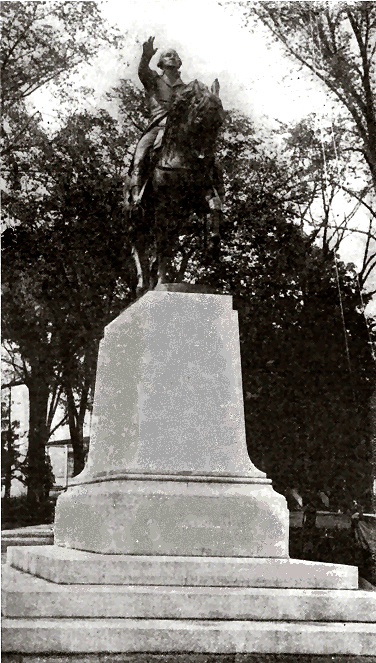
Statue of Washington at West Point Presented to the United States Military Academy by a Veteran of the Civil War Copyright by Underwood & Underwood, N. Y.
In looking forward to the moment which is intended to terminate the career of my public life my feelings do not permit me to suspend the deep acknowledgment of that debt of gratitude which I owe to my beloved country for the many honors it has conferred upon me; still more for the steadfast confidence with which it has supported me, and for the opportunities I have thence enjoyed of manifesting my inviolable attachment, by services faithful and persevering, though in usefulness unequal to my zeal. If benefits have resulted to our country from these services, let it always be remembered to your praise, and as an instructive example in our annals, that under circumstances in which the passions, agitated in every direction, were liable to mislead, amidst appearances sometimes dubious, vicissitudes of fortune often discouraging, in situations in which not unfrequently want of success has countenanced the spirit of criticism, the constancy of your support was the essential prop of the efforts, and a guarantee of the plans by which they were effected. Profoundly penetrated with this idea, I shall carry it with me to my grave, as a strong incitement to unceasing vows that Heaven may continue to you the choicest tokens of its beneficence; that your union and brotherly affection may be perpetual; that the free Constitution, which is the work of your hands, may be sacredly maintained; that its administration in every department may be stamped with wisdom and virtue; that, in fine, the happiness of the people of these States, under the auspices of liberty, may be made complete, by so careful a preservation and so prudent a use of this blessing, as will acquire for them the glory of recommending it to the applause, the affection and adoption of every nation which is yet a stranger to it.
Here, perhaps, I ought to stop. But a solicitude for your welfare, which cannot end but with my life, and the apprehension of danger, natural to that solicitude, urge me, on an occasion like the present, to offer to your solemn contemplation, and to recommend to your frequent review, some sentiments, which are the result of much reflection, of no inconsiderable observation, and which appear to me all important to the permanency of your felicity as a People.
Interwoven as is the love of liberty with every ligament of your hearts, no recommendation of mine is necessary to fortify or confirm the attachment.
The unity of government, which constitutes you one people, is also now dear to you. It is justly so; for it is a main pillar in the edifice of your real independence, the support of your tranquility at home, your peace abroad; of your safety; of your prosperity; of that very liberty which you so highly prize. But as it is easy to foresee that from different causes and from different quarters much pains will be taken, many artifices employed, to weaken in your minds the conviction of this truth; as this is the point in your political fortress against which the batteries of internal and external enemies will be most constantly and actively (though often covertly and insidiously) directed, it is of infinite moment that you should properly estimate the immense value of your national Union to your collective and individual happiness; that you should cherish a cordial, habitual, and immovable attachment to it, accustoming yourself to think and speak of it as of the palladium of your political safety and prosperity; watching for its preservation with jealous anxiety; discountenancing whatever may suggest even a suspicion that it can, in any event, be abandoned; and indignantly frowning upon the first dawning of every attempt to alienate any portion of our country from the rest, or to enfeeble the sacred ties which now link together the various parts.
For this you have every inducement of sympathy and interest. Citizens, by birth or choice, of a common country, that country has a right to concentrate your affections. The name 'American,' which belongs to you in your national capacity, must always exalt the just pride of patriotism more than any appellation derived from local discriminations. With slight shades of difference, you have the same religion, manners, habits, and political principles. You have in a common cause fought and triumphed together; the independence and liberty you possess are the work of joint counsels, and joint efforts, of common dangers, sufferings, and successes.
But these considerations, however powerfully they address themselves to your sensibility, are greatly outweighed by those which apply more immediately to your interest. Here every portion of our country finds the most commanding motives for carefully guarding and preserving the union of the whole....
To the efficacy and permanency of your union a government for the whole is indispensable. No alliances, however strict, between the parts can be an adequate substitute; they must inevitably experience the infractions and interruptions which all alliances in all times have experienced. Sensible of this momentous truth, you have improved upon your first essay by the adoption of a constitution of government better calculated than your former for an intimate union and for the efficacious management of your common concerns. This government, the offspring of our own choice, uninfluenced and unawed, adopted upon full investigation and mature deliberation, completely free in its principles, in the distribution of its powers uniting security with energy and containing within itself a provision for its own amendment, has a just claim to your confidence and your support. Respect for its authority, compliance with its laws, acquiescence in its measures, are duties enjoined by the fundamental maxims of true liberty. The basis of our political systems is the right of the people to make and to alter their constitutions of government. But the constitution which at any time exists, till changed by an explicit and authentic act of the whole people, is sacredly obligatory upon all. The very idea of the power and the right of the people to establish government presupposes the duty of every individual to obey the established government.
All obstructions to the execution of the laws, all combinations and associations, under whatever plausible character, with the real design to direct, control, counteract, or awe the regular deliberation and action of the constituted authorities, are destructive of this fundamental principle and of fatal tendency. They serve to organize faction, to give an artificial and extraordinary force: to put in the place of the delegated will of the nation, the will of a party, often a small but artful and enterprising minority of the community; and, according to the alternate triumphs of different parties, to make the public administration the mirror of the ill-concerted and incongruous projects of faction, rather than the organ of consistent and wholesome plans digested by common counsels, and modified by mutual interests....
Towards the preservation of your government, and the permanency of your present happy state, it is requisite, not only that you steadily discountenance irregular opposition to its acknowledged authority, but also that you resist with care the spirit of innovation upon its principles, however specious the pretext. One method of assault may be to effect, in the forms of the constitution, alterations which will impair the energy of the system, and thus to undermine what cannot be directly overthrown. In all the changes to which you may be invited, remember that time and habit are at least as necessary to fix the true character of government as of other human institutions; that experience is the surest standard by which to test the real tendency of the existing constitution of a country; that facility in changes, upon the credit of mere hypothesis and opinion, exposes to perpetual change, from the endless variety of hypothesis and opinion; and remember, especially, that, for the efficient management of your common interests, in a country so extensive as ours, a government of as much vigor as is consistent with the perfect security of liberty is indispensable. Liberty itself will find in such a government, with powers properly distributed and adjusted, its surest guardian. It is, indeed, little else than a name, where the government is too feeble to withstand the enterprise of faction, to confine each member of the society within the limits prescribed by the laws, and to maintain all in the secure and tranquil enjoyment of the rights of person and property....
Of all the dispositions and habits which lead to political prosperity, religion and morality are indispensable supports. In vain would that man claim the tribute of patriotism who should labor to subvert these great pillars of human happiness, these firmest props of the duties of men and citizens. The mere politician, equally with the pious man, ought to respect and to cherish them. A volume could not trace all their connections with private and public felicity. Let it simply be asked, where is the security for property, for reputation, for life, if the sense of religious obligation desert the oaths which are the instruments of investigation in courts of justice? And let us with caution indulge the supposition that morality can be maintained without religion. Whatever may be conceded to the influence of refined education on minds of peculiar structure, reason and experience both forbid us to expect that national morality can prevail in exclusion of religious principle....
Promote, then, as an object of primary importance, institutions for the general diffusion of knowledge. In proportion as the structure of a government gives force to public opinion it is essential that public opinion should be enlightened.
As a very important source of strength and security, cherish public credit. One method of preserving it is to use it as sparingly as possible, avoiding occasions of expense by cultivating peace, but remembering also that timely disbursements to prepare for danger frequently prevent much greater disbursements to repel it; avoiding likewise the accumulation of debt, not only by shunning occasions of expense, but by vigorous exertions in time of peace to discharge the debts which unavoidable wars may have occasioned, not ungenerously throwing upon posterity the burden which we ourselves ought to bear. The execution of these maxims belongs to your representatives, but it is necessary that the public opinion should cooperate....
Observe good faith and justice towards all nations; cultivate peace and harmony with all. Religion and morality enjoin this conduct; and can it be that good policy does not equally enjoin it? It will be worthy of a free, enlightened, and, at no distant period, a great nation, to give to mankind the magnanimous and too novel example of a people always guided by an exalted justice and benevolence.
TRIBUTES
The life of our Washington cannot suffer by a comparison with those of other countries who have been most celebrated and exalted by fame. The attributes and decorations of royalty could have only served to eclipse the majesty of those virtues which made him, from being a modest citizen, a more resplendent luminary.
Malice could never blast his honor, and envy made him a single exception to her universal rule. For himself he had lived enough to life and to glory. For his fellow-citizens, if their prayers could have been answered, he would have been immortal. His example is complete, and it will teach wisdom and virtue to magistrates, citizens, and men, not only in the present age, but in future generations, as long as our history shall be read.
John Adams
Washington stands alone and unapproachable like a snow peak rising above its fellows into the clear air of morning, with a dignity, constancy, and purity which have made him the ideal type of civic virtue to succeeding generations.
James Bryce
First in war, first in peace, first in the hearts of his countrymen, he was second to none in the humble and endearing scenes of private life, pious, just, humane, temperate, and sincere, uniform, dignified, and commanding, his example was as edifying to all around him, as were the effects of that example lasting.
Henry Lee
Others of our great men have been appreciated—many admired by all. But him we love. Him we all love. About and around him we call up no dissentient and discordant and dissatisfied elements, no sectional prejudice nor bias, no party, no creed, no dogma of politics. None of these shall assail him. When the storm of battle blows darkest and rages highest, the memory of Washington shall nerve every American arm and cheer every American heart. It shall relume that Promethean fire, that sublime flame of patriotism, that devoted love of country, which his words have commended, which his example has consecrated.
Rufus Choate
Let a man fasten himself to some great idea, some large truth, some noble cause, even in the affairs of this world, and it will send him forward with energy, with steadfastness, with confidence. This is what Emerson meant when he said: "Hitch your wagon to a star." These are the potent, the commanding, the enduring men—in our own history, men like Washington and Lincoln. They may fail, they may be defeated, they may perish; but onward moves the cause, and their souls go marching on with it, for they are part of it, they have believed in it.
Henry van Dyke
Brave without temerity, laborious without ambition, generous without prodigality, noble without pride, virtuous without severity—Washington seems always to have confined himself within those limits where the virtues, by clothing themselves in more lively but more changeable and doubtful colors, may be mistaken for faults. Inspiring respect, he inspires confidence, and his smile is always the smile of benevolence.
Marquis Chastelleux
Great without pomp, without ambition brave, Proud, not to conquer fellow-men, but save; Friend to the weak, a foe to none but those Who plan their greatness on their brethren's woes; Aw'd by no titles—undefil'd by lust— Free without faction—obstinately just; Warm'd by religion's sacred, genuine ray, That points to future bliss the unerring way; Yet ne'er control'd by superstition's laws, That worst of tyrants in the noblest cause.
From a London Newspaper
BIBLIOGRAPHY
See Bibliography at end of monograph.
ARBOR DAY
Second Friday in April
TREES
I think that I shall never see A poem lovely as a tree; A tree whose hungry mouth is prest Against the earth's sweet flowing breast; A tree that looks at God all day And lifts her leafy arms to pray; A tree that may in summer wear A nest of robins in her hair; Upon whose bosom snow has lain, Who intimately lives with rain. Poems are made by fools like me, But only God can make a tree.
Joyce Kilmer
ARBOR DAY
FOREWORD IN PAMPHLET ON ARBOR DAY ISSUED IN 1913
The following are the provisions of the statutes of the State concerning the observance of Arbor Day:
The day in each year known as Arbor Day shall be suitably observed in the public schools. The Commissioner of Education shall from time to time prepare and issue to schools such circulars of information, advice and instruction with reference to the day as he may deem necessary.
For the purpose of encouraging the planting of shade and forest trees, the second Friday of April in each year is hereby designated as a day for the general observance of such purpose, and to be known as Arbor Day.
On said day appropriate exercises shall be introduced in all the schools of the State, and it shall be the duty of the several county and city superintendents to prepare a program of exercises for that day in all the schools under their respective jurisdiction.
You will notice that Arbor Day now occurs on the second Friday of April, the Legislature of 1912 having changed the date.
It is believed that Arbor Day may not only be devoted to the consideration of the value of trees and forests, including, of course, the planting of trees and shrubs, but that it may also be used to direct attention to birds and their protection, to the importance of the school garden, and to other related matters. The conservation of some of our natural resources might well be considered as the broad theme of the day, the main emphasis, however, being placed on trees.
Much of the contents of this pamphlet will afford suggestive material for the use of teachers at any appropriate time. The general information given may be of help to many teachers throughout the spring months. The discussions of the various subjects presented may afford valuable reading material in the grammar schools.
The main purpose of the pamphlet is to give an impetus to the movement for a greater interest in our natural resources, and the movement for a greater appreciation of the opportunities offered by rural or semi-rural life. It is hoped that the suggestions made are such as may appeal to the interests of children.
It is hoped that Arbor Day may be a profitable one to the pupils in the schools. It is further hoped that the influence of the contents of the pamphlet may not be confined to any one day, but may be extended to many days of the school year.
Calvin N. Kendall Commissioner of Education
LETTER ISSUED TO SCHOOL OFFICIALS IN 1919
Arbor Day will occur this year on Friday, April 11. An announcement concerning it may be found in the March number of the Education Bulletin.
It has been happily suggested by Secretary Houston of the Department of Agriculture at Washington that the day be observed in part this year by planting trees upon our roadways, in our yards, and in our pleasure places, each tree being named for a soldier who has fallen in the late War. Such trees would be appropriate memorials to these soldiers.
I suggest that this particular year there be wide-spread planting of trees dedicated to those whose lives have been sacrificed in the War. The planting of the trees should be marked with some appropriate exercises and these exercises should take on more than a school significance. The whole community should be invited by the school to take part.
I trust there may be a generous response on the part of the schools of New Jersey to this idea.
Calvin N. Kendall Commissioner of Education
TREES AND FORESTS
ALFRED GASKILL, STATE FORESTER
Save What We Have, Let Planting Come After
When the farmers of Nebraska, led by J. Sterling Morton, established Arbor Day in 1872, they sought the threefold blessing that trees always give—shade from the summer sun, shelter from winter winds, and wood. These men found the broad prairies of the Middle West practically treeless and they soon discovered that unless nature's fault was remedied the homes they hoped to make could be neither pleasant, nor secure, nor successful.