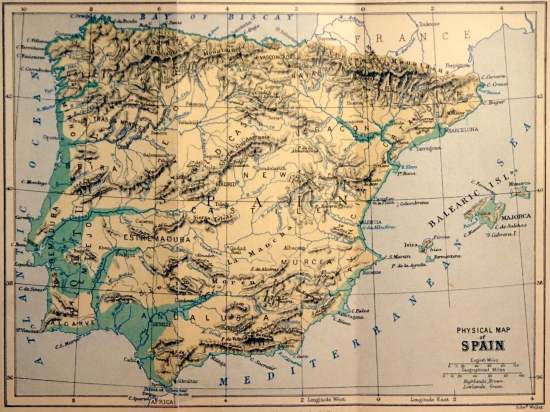
Front matter
Reading edition
London, Sampson Low, Marston, Searle, & Rivington.
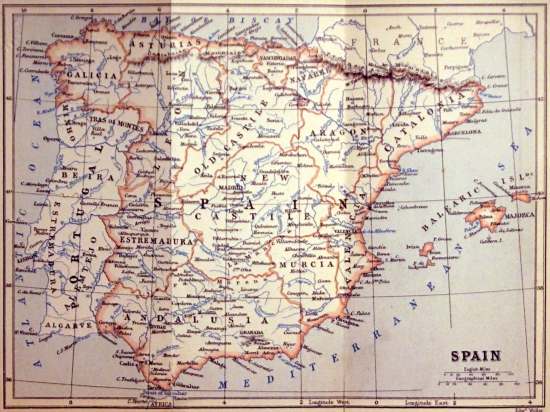
SPAIN
BY THE REV. WENTWORTH WEBSTER, M.A. OXON. WITH A CHAPTER BY AN ASSOCIATE OF THE SCHOOL OF MINES.
WITH ILLUSTRATIONS.
London: SAMPSON LOW, MARSTON, SEARLE, & RIVINGTON, CROWN BUILDINGS, 188, FLEET STREET. 1882. [All rights reserved.]
LONDON: PRINTED BY GILBERT AND RIVINGTON, LIMITED, ST. JOHN'S SQUARE.
[etext transcriber's note: No attempt has been made to correct, normalize or de-anglicize the spelling of Spanish names or words. For example: Calayatud/Calatayud, Alfonso/Alfonzo, Cacéres/Caceres/Cáceres, Cardénas/Cárdenas, Guipúzcoa/Guipuzcoa all appear. Click on any of the images to view them enlarged.]
ANALYTICAL TABLE OF CONTENTS. LIST OF ILLUSTRATIONS. INDEX.
PREFACE.
————
THERE is a difficulty in writing a book of this character on Spain, which does not exist, we think, to the same extent with any other European country. In most European nations the official returns and government reports may be accepted as trustworthy, and the compiler has little more to do than to copy them; but in Spain this is far from being always the case. In some instances, from nonchalance and habitual inexactitude, in others, and especially in all matters of finance and taxation, from designed misstatement, all such reports have to be received with caution and scrupulously examined. The reader must remember also that in Spain smuggling and contraband dealing in various forms is carried on to such a vast extent as seriously to vitiate all trade returns. Thus it is that Spanish statistics can be considered only as approximate truths.
Another difficulty arises from the very varied character of the Spanish provinces. Hardly any statement can be made of one province which is not untrue of another. The ordinary descriptions of Spain present only one, or at most two, types, the Castling and Andalusian, and utterly neglect all the rest. The provinces of Spain have been well described as divided into "five Irelands" whose habits and modes of thought, political aspirations, and commercial interests and aptitudes, are often utterly opposed to those of the capital. A brief survey of the whole of Spain is attempted in the following pages.
In a work of this kind one other obvious difficulty is to know what to omit. Some well-worn topics will be found to be absent from these pages. No references are made to the great Peninsular War. This can be easily studied in the admirable pages of Sir W. Napier in English, and of Toreno in Spanish, or in compendiums of these, which again are filtered down in every guide-book. For a like reason Prescott's brilliant works are not alluded to.
For the chapter on Geology and Mining the reader is indebted to one of the most distinguished Associates of the School of Mines, who has been recently engaged in practical geological survey and mapping in Spain.
Much also of the present work is due to private information most kindly furnished by Spanish friends of high position in the literary and political world, and with whom some of the subjects treated have been frequently discussed. To these the author offers his warmest and most grateful thanks.
ANALYTICAL TABLE OF CONTENTS.
CHAPTER I.
THE GEOGRAPHY OF SPAIN.
PAGE
Boundaries of the Peninsula1
Area and Coast-line2
Six divisions of Spainib.
Mountain chains:
Pyrenees3
Cantabrian, Asturian, and Galician mountains4
Leonib.
Oca, Sierra Moncayo, and Idubeda chains5
Central Plateau and its passesib.
Culminating water-shed of the Peninsula6
Guadarrama rangeib.
Toledan range7
Sierra Morena and passesib.
Central ranges and river basins8
Sierra Nevada and offshootsib.
Minor ranges9
Rivers, river basins, and rainfall:
Five great rivers10
Rivers of Galicia and Asturias11
Basque Provinces12
Ebro and its tributaries and canals12
Catalonia, streams of14
Douro and its tributaries15
Tagus " "17
Guadiana " " and lakes19
Guadalquiver, its tributaries, islands, and marismas22
Segura and its irrigation24
Jucar " "25
Guadalaviar or Turiaib.
Lakes and Albuferas26
Water toponymy27
Comparative table of principal rivers28
Mineral springs and Salinasib.
CHAPTER II.
CLIMATE AND PRODUCTIONS.
Five climates of Spain30
Temperature and rainfall of:
Galicia and the Asturias31
Santander and the Basque Provinces32
Aragonib.
Cataloniaib.
Valencia34
Alicanteib.
Murcia35
Cartagena to Almeriaib.
Malaga, Motril, Seville, and Cordovaib.
Granada36
Cadiz, Gibraltar, &cib.
Elevation of Central Plateauib.
Temperature and rainfall of Madrid, Salamanca, and Soria38
Agricultural products of:
Galicia and the Asturias39
Basque Provinces and basin of the Ebro40
Moorish agriculture and exotic flora of Southern Spain41
Products of Valencia and Murcia43
Palms at Elche44
Aromatic mountain shrubs45
Products and wines of Andalusia46
Products of the Central Plateauib.
Estremadura and law of the Mesta47
Locusts48
Corn-lands of Castile and Sierras de Campos50
Comparative Flora of Spain52
Fauna:
Monkeys of Gibraltarib.
Beasts and birds of preyib.
Game birds and African visitantsib.
Noxious and useful insectsib.
Merino sheep54
Horses, cattle, and beasts of burden55
Fisheries56
Estimated total production of Spain57
CHAPTER III.
GEOLOGY AND MINES.
Peculiar interest of Spanish geology58
Granite and Silurian rocksib.
Carboniferous formation59
Secondary formationsib.
Upper Cretaceousib.
Eocene tertiary60
Miocene fresh-waterib.
Plioceneib.
Influence of geology on populationsib.
Statistics of Spanish geology61
Volcanoes, recentib.
Minerals of:
Gneiss and crystalline schists62
Metamorphic rocksib.
Cambrian formationib.
Silurian slatesib.
Devonian sandstonesib.
Carboniferous seriesib.
Permian63
Triassic conglomeratesib.
Jurassic limestones and marlib.
Cretaceous formationib.
Eocene, Miocene, and Plioceneib.
Production and export of six chief mineralsib.
Of argentiferous ore, cobalt, silverib.
Coal65
Iron of the Bilbao districtib.
Locality of principal mines66
Mining laws67
CHAPTER IV.
ETHNOLOGY, LANGUAGE, AND POPULATION.
Pyrenees, no true boundary of69
Population of Spain, mixed70
Iberi, Kelt-Iberi, Basques, and Keltsib.
Foreign races in Spain73
Visigoths, Arabs, and Moors75
Toponymy of Spain76
Language of Spanish Jews77
Existing dialectsib.
Statistics of the Spanish language78
Characteristics of " "79
Population of Spain80
Density ofib.
Occupations of81
Manufacturing and mining Provinces82
Clergyib.
Distribution of property, great changes in83
Abolition of Mesta and of feudal privilegesib.
Sale of Crown and Church property84
Actual distributionib.
Characteristics of the various populations85
Galicians, Asturians, Basques, and Aragonese86
Catalans, Valencians, and Murcians86, 87
Andalusians87
Manchegans, and Castilians89
Gipsies, Maragatos, Passiegos, Hurdes, Sayagos, &c.90
Contrabandistasib.
CHAPTER V.
DESCRIPTION OF PROVINCES.
Division of Kingdoms and Provinces91
Galicia and its provinces, Corunna, Lugo, Pontevedra, and Orense92
Asturias94
Santanderib.
Basque Provinces, Biscay, Guipuzcoa, Alava95
Navarre96
Aragon and its provinces, Huesca, Saragossa, Teruel97
Catalonia " Gerona, Barcelona, Tarragona, Lerida100
Valencia " Castellon de la Plana, Valencia, Alicante103
Murcia " Murcia and Albacete107
Andalusia, Mediterranean Provinces, Almeria, Granada, Malaga109
Atlantic: Cadiz, Huelva117, 122
Inland: Seville, Cordova, Jaen120, 123, 125
Estremadura, Badajoz, Cacéresib.
New Castile and La Mancha, Provinces—Ciud ad Real, Toledo, Madrid, Cuenca, Guadalajara127
Old Castile—Avila, Segovia, Soria, Logrono, Burgos133
Leon—Salamanca, Valladolid, Zamora, Palencia, Leon137
Balearic Isles141
CHAPTER VI.
HISTORY AND POLITICAL CONSTITUTION.
Early liberties, behetria, fueros145
Capitulations of Moors and Jews147
Conquest of the South and its results149
The Santa Hermandadib.
The Austrian Dynasty151
The Bourbon Dynasty152
Modern Constitutional Spain153
Cortés of Cadizib.
Reign of Ferdinand VII., and loss of American coloniesib.
" Isabella II.154
First Carlist Warib.
Ministry of Narvaez156
" O'Donnell157
Expulsion of Isabella II., and provisional governmentib.
Amadeo I.158
Republicib.
Second Carlist War159
Cantonalist insurrectionib.
Alphonso XII.160
Ministry of Cánovas del Castillo161
Present Constitution and Administration of Spain162
Cortés, Senate, Congress163
Provincial administration164
Municipal "ib.
Religion165
Rights of persons, natives and foreignersib.
Military Administration166
Army167
Quality of Spanish soldiery, pronunciamientos, &c.168
Naval Administration169
Royal Navyib.
Mercantile Navyib.
Judicial Administration169
Legal Procedure170
Prisonsib.
Hospitals and lunatic asylums171
Railways172
Telegraphsib.
Letters and postib.
Finances of Spain.
Public debt174
Increase of, since 1868175
Deficit of budgetsib.
Sources of revenue176
Expenditureib.
Imports and exports177
Foreign tariffsib.
Protection and free trade178
Empleomania and its results179
CHAPTER VII.
EDUCATION AND RELIGION.
Universities, number of students, salaries of professors181
Theological seminaries182
Course of university study183
Provincial and special institutesib.
Secondary instruction, institutes and colleges184
Number of students, and salary of masters185
Course of instruction186
University degreesib.
Primary education187
Church and Religion.
Early Church Councils188
Roman and Mazarabic liturgyib.
Inquisitionib.
Philip II., the Jesuits, and the Reformation189
Expulsion of the Jesuits191
Concordat of 1851ib.
Archbishops, bishops, and clergyib.
Mode of appointment of bishops192
Spanish Protestantsib.
CHAPTER VIII.
LITERATURE AND THE ARTS.
Præhistoric art and architecture194
Roman and Visigothicib.
Arabic195
Three periods of196
Mudejar201
Christianib.
Renaissance202
Churrigueresque203
Domestic architectureib.
Church furniture and minor arts204
Painting.
Characteristics of Spanish painting205
Local schools206
Murillo208
Painters of Valencian school209
" " Castilian "ib.
" " Andalusian "ib.
Modern painters210
Industrial arts, goldsmith's work, iron, porcelain, glass, wood, lace212
Musicib.
Literature.
Early Romances213
" Prose works214
La Celistina and the picaresque novels215
Drama and Autors216
Lope de Vegaib.
Calderon de la Barca217
Cervantesib.
Quevedo219
Historical writings220
Poetryib.
Mystic writers222
Classical and romantic schoolsib.
Modern writers: Poets—Espronceda, Zorilla, Becquer, &c.224
Novelists—Fernan Caballero, J. Valera, &c.ib.
Dramatists—Hartzenbusch, Breton de los Herreros, &c.225
Nunez de Arce226
Historians—Condé Gayangos, De la Fuente, &c.ib.
Geographers—Fernandez Guerra, Coello, Bowlesib.
Geologists—Macpherson, &c.ib.
Economists—Cárdenas, Colmeiro, De Azcárate227
Theologians—Balmés, Donoso Cortez, C. Gonzalez, &c.ib.
Philologists—F. Fita, &c.ib.
Orators228
Provincial literature229
CHAPTER IX.
EPILOGUE.
Spain not a worn-out country231
Two hindrances to developmentib.
Protection and free trade233
Cruelty and charities of Spain234
————————
Appendix I.—Census of Provinces237
" II.—Chief historical events239
" III.—Chief books used241
LIST OF ILLUSTRATIONS.
PAGE
Caballeros86
Dominique, the Espada88
Gipsies at Granada90
Leaning Tower of Saragossa98
General View of Granada, with the Alhambra110
Alhambra Tower by Moonlight114
Fountain of the Four Seasons, Madrid130
Port of Cadiz153
Vespers190
Giralda of Seville197
Moorish Ornamentation199
London: Sampson Low, Marston, Searle, & Rivington.