GEORGE O. SMITH
Reading edition
Illustrated by VIRGIL FINLAY
[Transcriber's Note: This etext was produced from Startling Stories Fall 1954. Extensive research did not uncover any evidence that the U.S. copyright on this publication was renewed.]
I
Over the hubbub and chatter came the brief warning wail of a small siren. The noise died as the people in the vast waiting room stopped talking.
"Your attention, please!" boomed the loud-speaker. "Passengers for Spaceflight Seventy-nine, departing for Castor Three and Pollux Four, will proceed to Gate Seven for ground transportation to the take-off block. Spaceflight Seventy-nine, waiting for passengers at Gateway Seven!"
There was a moment of silence, then a loud racket burst out as everybody started talking at once. There was only a small flow of people toward Gate Seven, almost negligible, because Flight Seventy-nine was essentially a cargo hop. In fact, this morning less than a half-dozen headed for the gateway.
Among these was a tall man, impressive in his blue-black uniform. A space commodore, no less. He carried the light bag of the woman who was beside him, proud and happy and eager-looking. But traces of some internal storm clouded the man's features, and as they approached Gateway Seven, the man's perturbation worked closer and closer to the surface until finally it broke through.
"You could still back out," he said.
"No, I couldn't," she said. Her own face clouded a bit.
"Yes, you could," he snapped.
She stopped ten or fifteen feet from Gateway Seven and turned to face him. She was pert and pretty in a traveling suit of gray; brand-new for this occasion. Her name was Alice Hemingway, but she would have swapped it in a minute to become Mrs. Theodore Wilson, even on a commodore's salary.
"Look, Ted," she said slowly. "We've been back and forth over this argument for a couple of months now. Can't you forget it?"
"No, I can't," replied Ted Wilson. "I don't like the idea of you taking to space."
"I do," she said simply. "I want to see these places you are always telling me about. I want to see 'em before I'm sixty. It's no fun listening to your stories, then having you trot off for three or four months on another jaunt while I sit home alone and wonder where you are and what's doing."
"But we—" He paused, thinking. "Alice," he said suddenly, "will you marry me?"
A welling of tears came then, but Alice blinked them back. "If you'd asked me that a month ago I would have said 'Yes,' with no stipulations, but right now I'll say 'Yes, as soon as I come back, if you still want me.' Understand?"
"Not quite."
"I want you to be dead certain that the reason you want to marry me is not to keep me from taking this spaceflight."
Ted looked down at her. "I'd really like to know if you accepted this trip just to force me into asking you," he said slowly.
"You'll never know," she said with a bright smile.
He swore under his breath. "I still don't like the idea of you trotting off to Castor Three with that old goat."
"Mr. Andrews? Old goat? Why Ted! You're jealous."
"I am."
"Good. Stay jealous. But don't be an imbecile. Mr. Andrews is merely my boss, not my lover. He has never so much as watched me walk, let alone made a pass at me. I couldn't think of him as anything but a boss."
"But up there—"
Alice shook her head. "Forget it, Ted. I'm still your girl, and I intend to stay that way. Even though it's smart for a girl to have a lover or two before she marries, I'm the old-fashioned one-man type. Virgin. No hits, no runs, no errors, and no one left on first base."
"Okay," he said sullenly.
She smiled up at him again. "Ted," she said seriously, "don't you see I have to go a-space? You've ducked marriage because you can't see two people living on a commodore's salary, and also with you flitting off and leaving me home alone. So you want to wait until you get your next boost. But that will get you stationed on some planetary post. I'll get one flight to Base, then be set down for years. Well, until that time I'm going to travel and see the interstellar sights. I want to see the Dark Column on Procyon Five, I want to visit the Golden Rainbow on Castor Three, and toss a penny into the Bottomless Pit on Pollux Four, and.... Well, I can do these things so long as Mr. Andrews wants me to travel."
"But—"
"Oh, Ted—please!" she cried.
She clutched at him and buried her face in his shoulder. He held her, then put a hand under her chin and lifted her face. He kissed her, not tenderly, but with more of a frantic striving for something beyond reach.
The siren wail lifted again and the loud-speaker boomed:
"Last call for Spaceflight Seventy-nine at Gateway Seven. Will Miss Alice Hemingway please proceed to Gateway Seven!"
Reluctantly she withdrew herself from her sweetheart's arms and turned to the gateway. Ted picked up her small bag and followed her.
As they reached the gate a smallish, nervous, wiry man with a clipped gray mustache eyed Alice crisply.
"Ah, Miss Hemingway, you're just in time," he said. He smiled thinly as he looked at Ted Wilson. "However, I presume the delay was justified. Commodore, I think the use of your handkerchief is essential."
Before Ted could reply, Mr. Andrews had walked through the gateway to the waiting spaceport bus. Alice turned back to Ted and held up her face. This time their kiss was less frantic, but also less personal. It was chaste, and brief, and proper. It promised for the future, but it did not give any part of that future warmth or passion as a down payment.
Then Alice came out of his arms and went through the gateway to climb into the bus beside her boss.
As Commodore Wilson turned away, the bus drove off along the road to the waiting spacecraft.
Commodore Wilson entered the base commander's office and smiled glumly. The commander, Space Admiral Leonard F. Stone, a man of about forty-five and as lithe and as hard as a man of that age could be, looked expectant. His command was exacting and just, but he was also human.
He said, "What's troubling you, Wilson?"
"Admiral," Ted Wilson said, "I know it is against the unwritten rules to discuss the matter of increase in rank, but I wonder if we mightn't break them for a minute or two."
"We might if there were proper justification. Why?"
"A commodore's salary is just a bit meager for marriage," said Wilson unhappily.
Stone's face clouded a bit and he nodded seriously. "I know," he said. "But there's a reason, Ted. We do prefer to keep our commodores single so long as they're in active flight service. So long as you are well-fed, well-clothed, and well-housed yourself, the monetary payment is sufficient to take care of your personal needs. I know it is not enough to provide for a wife on top of that. Of course, some men do. And others manage to marry well-to-do women."
"Mine is not well-to-do, but I don't want to make her do with less."
"Naturally."
"Then how about this rank business? I'm about due."
"You are."
"Then when can I expect it?" asked Wilson.
Admiral Stone looked at him determinedly. "You can hasten that process yourself, Wilson. By acting a bit more for the benefit of the Service than you have in the past."
"Why, what do you mean?"
"There's more to rank than merely following orders to the letter. Now, you've never disobeyed orders, and it has been obvious that when orders coincide with your personal ideas, you act eagerly and swiftly. But when orders are opposed to your pleasure you act at the last moment and follow them reluctantly along the thin outer edge."
"For instance?"
"For instance last November. You had front line tickets to the finish post of the Armstrong Classic, but you were ordered on a training flight around and through the Centaurus System, to last no less than ten days and no more than thirty, at your discretion. You returned in ten days and four hours, even though you couldn't see the end of the Armstrong affair. Then, last May you were ordered to Eridanus Seven, which is a remarkably interesting place as I recall from my early days. You got home barely under the wire. Twenty-nine days, twenty-three hours, forty minutes, and a few seconds. Follow?"
Ted nodded slowly. "I felt that my crew would appreciate my attitude," he said.
"Certainly. They did. Both times. They also appreciate your stalling in a stack-circle, waiting for that last half-hour to expire so they'd draw overtime flight pay. But you've got to remember, Wilson, that we are running the Space Service for the public weal, not for the benefit of the spacemen. A parent does not bring up a child knowing only the pleasant things of life. A balanced program of work and play is essential. I know that the Centaurian run is no picnic, but it is a fine training for spacemen. Now, that'll be all. I'm not criticizing you Wilson. I recall doing similar things myself years ago. It does draw a crew closer to their commander when he gives them consideration. But making them work makes them efficient, and they will also love a commander who mixes well his periods of pleasure with hours of hard work. Agree?"
"Yes. Of course."
"Fine," said Admiral Stone. "So now that you know, we'll watch you for a bit. If you come through, you'll get your increase in rank—and your girl." He smiled. "You're a good commodore, Wilson. But with a little work and application you could be brilliant. We need brilliant men. Remember that. Good-by and good luck, Commodore Wilson...."
His name translated from his native tongue, was Viggon Sarri. In medieval times he might have been called "Sarri the Conqueror" for his exploits, his conquests. But of course then it was the king, emperor, or caesar who led his own troops.
In these days the ruler sends out men of military might to fight his battles, and Viggon Sarri was not a ruler. His position was the equivalent of space admiral in the Interstellar Service, and though devoted to his own service, he was only a paid hand.
His home was far across the galaxy from Sol and the sprinkling of stellar systems colonized by human beings. Viggon Sarri had never met a human, he did not know that this section of the universe had any trace of sentient life. He was just out looking for new worlds to exploit, perhaps to conquer. A new district to colonize, perhaps, or a world of beings advanced at least to the point where the produce and manufacture of his homeland could be sold for metal.
Naturally, Viggon Sarri explored space at the head of several hundred ultra-fast and ultra-hard-boiled fighting spacecraft—fourteen big battle wagons, two fighter carriers each providing a hundred one-man space attack craft, and one hunter, a detecting craft. It was loaded to the astrodome with every device for locating evidences of anything from advanced races to enemy spacecraft.
Sarri rode in his flagship, one position ahead of the hunter. And so, when the detecting equipment in the hunter registered that some race in this sector of the galaxy was advanced enough to be using the power of the atomic nucleus, Viggon Sarri gave orders for his fleet to spread out in a big, flat dishlike formation, flatwise toward this section of the sky.
It came to as near a halt as anything can approach in deep space, and Viggon Sarri called a conference.
He sat at the head of the table, his two second officers at his left and right. They were equal in rank, Regin Naylo and Faren Twill. This irked them both, and for a long time they had been striving to rise above one another. But only Viggon Sarri knew which was listed in the sealed orders, to be opened only in the case of the death of the supreme commander.
At the far end of the table sat Linus Brein, commander-mathematician of the hunter spacecraft.
Viggon said, "Linus, what do we know about these people?"
Brein thought, then said, "Very little, actually. They use atomic power. They have discovered interstellar flight. They seem to have some interstellar commerce. They use the infrawave bands for communication across space. I would say, off-hand, that they may have colonized no more than a dozen planets, and are exploring perhaps a dozen more. I would also guess that their exploration is done by sheer go-out-and-look techniques."
"Why do you suggest that?" asked Viggon.
"Analogy. Their use of the infrawave is not highly developed. I doubt that they have planet-finding equipment. I have not noticed any attempt to use the infrawave as a detecting and locating means. Only for communication is the infrawave employed by them."
"I see. Any more?"
"Not at present," said Linus Brein. "We will collect more as our men pick up information and our analyzers compile data."
"Keep me posted," ordered Viggon Sarri.
He sat there in silence, a tall man with a thin face that looked wolfish. His ears were flat and distorted, to the human point of view. His eyes were glittery bright, having that shiny cornea characteristic of the nocturnal animal of Terra. He had six stubby strong fingers on each hand and a long double-jointed thumb. Each hand had two palms, fore and back so that the fingers could curl either inward or outward. His elbows were double, one bent in or locked straight, the other bent out or locked straight, as he moved.
Viggon stared at the ceiling, lost in thought. His eyes, roaming independently gave his features a bizarre look which his own race thought quite natural.
Finally he said, "Has anybody any suggestions?"
Regin Naylo said, "I say we attack as soon as we know more about them."
He felt confident. He believed that his admiral enjoyed swift and decisive action, and by suggesting it he hoped to show that his thoughts ran in the same channels as those of his commander.
Faren Twill said, "It might be better to make allies of them, rather than enemies."
Twill held the notion that Viggon Sarri's main motivation was to build and expand in the easiest, and most profitable manner. And he felt that careful negotiations might pay off better than invasion and strong conquest.
But in truth Viggon Sarri himself did not know which course to take. He was not above the use of force, if force were needed. Nor was he against the idea of peaceful negotiation, even the formation of an alliance. Which course he would take depended entirely upon what sort of culture this was, how the people reacted, and what they favored. For such knowledge he would rely on data collected by Linus Brein and analyzed by the mathematician's vast bank of computers.
Regin Naylo grunted in a superior tone. "They sound like an inferior race. Inept and primitive. Let's not waste time."
Faren Twill shook his head. "You want to barge in there with the projectors flaming and conquer them by force. That would be easy, but would it leave enough to make the conquest economically sound?"
"Can you sell anything to mice?"
Faren Twill grinned. "Cheese," he suggested. "Besides, an angry gang of rats can do in an elephant, you know."
"Chicken," sneered Regin Naylo.
Of course none of them had ever seen a mouse, a rat, an elephant, or a chicken. But on their homeland, a planet called "Brade," there were myriad life forms, just as on any inhabitable planet. The forms of animal life mentioned were similar enough to permit a free transliteration. "Chicken" also existed in its completely alien form.
But until the native tongue of Brade becomes common to Earthmen, this loose transliteration of their speech characteristics suffices to convey their meaning. Since their grammar bears no relation to any Solarian tongue, it must be converted rather than translated, or even transliterated. So if they sound like people of Earth instead of extra-solar aliens, that is the only way to convey their meaning.
"Twill is right," said Viggon Sarri. "We must be wary. This may be a communal culture, like that of the insect, ant, in which the individual is expendable so long as the nucleus is undamaged. In such a case suicide fighters would swarm over us, and against such we could not stand. If, on the other hand, this is a completely individualistic, or anarchic culture, we must call Brade for help. We would need a horde of space fighters to control the entire group." He looked at Linus Brein. "You will, of course, have their language analyzed?"
"We are working on it now. It is not difficult to connect the sound forms with the meaning, under known conditions and situations. But it is extremely difficult to make such analysis when we have not the foggiest notion of what situation is being described by the sounds. I—"
A winking light on the wall called his attention. Linus Brein touched a stud on an armlet. The tiny communicator said, in a thin, tinny voice:
"Commander Brein? Analyst Hogar speaking. The space-strain detectors have just picked up a violent response. The computer-analyzer bands report the following probability to at least three nines: That a space craft has foundered due to the failure of the warp-generator. Have you any orders as to our next moves?"
"Yes, Hogar. Record everything. Analyze everything!" He let the stud snap back into place, then said to Viggon Sarri:
"An ill wind blows, Admiral Sarri. Their misfortune may be our gain."
"It might indeed." Viggon nodded.
"I suggest that we send a fleeter out to seek survivors," said Regin Naylo.
"No," said Faren Twill. "We will learn more by listening to their communications and watching how they face this problem."
"What's better than a being able to interpret his own sounds?" snapped Naylo.
"Taking a little longer by doing it ourselves, and not giving them any warning that there stands another intelligent race not far offside. Why forearm them?"
"Right," interposed Viggon Sarri. "We watch from a distance."
Linus Brein stood up. "I'd best be going back," he said. "This language analysis may get deeply involved. I'd feel better if I could supervise it myself. May I leave, Admiral Sarri?"
"We'll all leave. This conference is over until more detailed information is at hand. My orders are: Take no action, but observe closely and critically. Dismissed, gentlemen. We'll all drink to success!"
Viggon Sarri pressed the stud on his armlet and ordered a tray of refreshments. Linus Brein did not stay for his share.
II
Spaceflight Seventy-nine took off, lifted on schedule by Pilot Jock Norton. Norton was a big man, rather on the lazy side, but a good pilot. If he had had any ambition at all, he would have owned his spacecraft, maybe a string of several, instead of being a paid space jockey.
But Jock Norton lacked the drive, or perhaps had never seen anything he actually wanted. He was a love-em-and-leave-em kind of guy who spent everything he earned on good times and luxuries. He spent no time seeking out the better pay loads as other pilots did, and so did not collect any of the fancy commissions for being a good businessman. He had gravitated to a standard contract type of job and with this he was satisfied.
His cargoes were invariably bid-basis job lots, instead of valuable merchandise with a delivery factor. He ran mail loads mostly—mail that could not, for legal reasons, be micro-microfilmed, transmitted by facsi-wave, or recomposed by infrawave at the receiving end. Legal contracts, documents, and the like, the one-and-only original of which must bear the bona fide signature of both parties.
Norton took the spacecraft up, fired the warp-generator, and headed for Castor Three at about forty parsecs per hour. Then, with the control room on the full automatic, he went down to the salon, because it had been a couple of months of Sundays since he had been pilot-host to anyone as young and attractive as Miss Alice Hemingway. Most of his passengers had been businessmen. The few women had been wives of such businessmen, a bit on the dowager side, and therefore more boring than interesting.
But Miss Alice Hemingway was interesting. Not that Jock Norton favored her ash-blond and dark-eyed attractiveness more than he would have admired a redhead or an olive-skinned brunette. He favored all women under thirty who were properly rounded here and there—especially there—and who had clear-skinned faces with regular features.
That Alice Hemingway, secretary, was traveling with her boss made her even more interesting. Norton had cased Mr. Charles Andrews carefully and put him down as a Napoleon type, peppery and active, and probably well-to-do, but not personally attractive to the opposite sex. It was money, decided Norton, that bought a reasonable facsimile of affection to Mr. Charles Andrews.
It would be masculine virility, thought Jock Norton, that would offset the money of Charles Andrews and really bring a proper emotional response from the girl.
"Good morning," he greeted them from the last step of the ladder that led down from the control room.
"How do you do, Pilot Norton," responded Andrews.
"My goodness!" exclaimed Alice. "Isn't that dangerous?"
"Isn't what dangerous?" asked Norton, with a wide, lazy smile.
"Your leaving the ship to run itself."
"Not at all." Norton showed his superior knowledge. "Our auto-pilot is the best that money can buy and maintain. And after all, Miss Hemingway, there is little a pilot can do while we are in transit. The auto-pilot does the job from after take-off to before landing. In between, the human pilot relaxes and enjoys his space travel. So—may I build you a cocktail? Or maybe you'd prefer a highball."
"At this hour in the morning?"
Norton laughed and inspected his watch. "I admit that it is ten o'clock by Chicago time. But it is past midnight on Polaris Two at Minervatown. It's three A.M. in Leyport, Procyon Five. It's even three o'clock in London, Terra."
"Besides," said Charles Andrews curtly, "we're hard at work."
"Work?" exploded Norton loftily. "You're hard at work in deep space?"
"Certainly. Deep space or hard planet, work must go on. I did not get where I am by goofing off, Pilot Norton."
Jock Norton grinned. "All work and no play, you know."
"All play and no work is worse."
"It's more fun," said Jock, with a feeling that he was coming off second-best in this fool argument. "Look," he said, "everybody relaxes in deep space. It's customary. It's holiday."
"It's damn foolish." Andrews turned to Alice. "Miss Hemingway, what do you think?"
"I'm half-inclined to agree with you, Mr. Andrews. But you must know I'm thrilled to be a-space. I've never been off Earth before."
"Oh. Then I capitulate. Pilot Norton, will you give Miss Hemingway a space tourist's run of the ship, please?"
"Be happy to." Norton nodded.
He looked around the salon, from face to face. There were four others there, all of them watching with a blank sort of interest. Norton took a deep breath of inner cheer for his luck. All the rest looked as though nothing could be as boring as a tourist's run of a spacecraft. He made the gesture of asking, but all shook their heads.
Norton opened the small bar and set everyone up to cocktails. Then he said to Alice, "Now, let's start at the bottom and work our way up."
"Any way you say," she told him.
Andrews got to his feet. "I think I'll tag along."
Norton swore below his breath.
Alice walked between them as Norton explained the workings of the spacecraft. She found Norton a good talker, and his lazy manner of speech somehow managed to convey a lot of information that a more intense man would have flubbed, because of a greater preoccupation with facts.
Even Mr. Andrews seemed interested, although he had been a-space many times before, as a matter of business.
Norton explained the workings of the power pile in a much oversimplified way, showed them the various rooms of machinery for maintaining air and water and electrical circuits throughout the ship. As he had suggested, they started at the bottom, looking out through the below-hatch at the hull of the ship, where the misty blue corona flared down and back from the eight tubular drivers that thrust their blunt cylindrical noses down in a large circle, surrounding the after viewport.
Then Norton worked them aloft slowly, up through the room filled with water for the reaction mass, and hurled out from the throat of the driver tubes as a molecular-atomic gas so highly energized that it was not water, but nascent hydrogen and oxygen, completely ionized. The coronal flare below, he explained, was the recombination of the nuclei with their electrons in shells, and the partial recompositions of the gases into water.
He showed them the warp-generator that created the extra space field around the ship, nullifying every physical attribute of matter. Neither mass nor inertia remained, so that the thrust of the flare had no resistance against which to exert its force, resulting in a drive that violated the Einstein equations. Forward velocity reached terminal when the interstellar matter provided a tenuous medium against which the velocity of the ship found resistance.
He showed them the magnetic-mass detector that protected them against meteors, and explained that while the thing was primitive, it was the best that Mankind had. The infrawave was hopeless because it had an instantaneous velocity of propagation and was also nondirectional, and therefore neither direction-finding nor ranging could be accomplished with the infrawave.
But the magnetic-mass detector was not as hopeless as it looked.
He said casually, "There were a lot of tall stories back in the Early Twentieth Century about spacecraft filled with course-computing gear that measured the course of meteorites, then directed the spacecraft. A more practical study of any such device shows that any extraneous object that does not change its aspect angle is necessarily on a collision course. Ergo, any target that does not move causes the alarm to ring, and the auto-pilot to swerve aside." He grinned and added in a low voice, "We're as safe as if we were all in bed."
As his arm touched Alice's she realized that Jock Norton had been entertaining the idea of bed ever since this tourist's run had started. She smiled because it amused her. Jock Norton had made a snap judgment, probably because he had seen a lot of such shenanigans as man and woman playing employer and secretary before. She almost laughed at Norton, realizing that he was displaying all of his knowledge and his virility in the hope of convincing her that he was probably more fun in bed than the elderly Napoleon type with whom she was traveling.
She stole a look at Andrews, comparing the two men. She wondered whether Andrews had cottoned onto Norton's play and if he had, whether her boss found it funny or irritating.
As they walked along a curved corridor, she saw with some surprise that twice Mr. Andrews had lagged back a bit, then had come forward behind them to walk by her side instead of on the far side of Jock Norton. And both times Norton had quietly lagged back to circle her and step forward between them, explaining quietly that Mr. Andrews could hear his explanation better if he, Norton, walked between.
Alice was still wondering whether Charles Andrews actually held any off-trail notions about his traveling secretary when all hell broke loose.
First came the wild clangor of an alarm, and the automatic cry of a recorded order:
"Your undivided attention, please! This is urgent! You have eleven minutes from the end of this announcement to follow these directions. There has been a partial failure of the warp-generator. If this failure becomes complete, and the space field collapses, the effect will be that of precipitating intrinsic mass into the real Universe while traveling at some high multiple of the velocity of light. The spacecraft then will drop instantly below the speed of light but in doing so will radiate all the energy-mass equivalent to those multi-light speeds, according to the Einstein equation of mass and energy. It is therefore expedient that you repair to the lifeship locks and prepare to debark. The partial failure may or may not continue. If not, there will be no more danger. But in case of continued breakdown—"
The recorded announcement stopped abruptly as a louder alarm bell rang briefly. Then another voice from the squawk-box shouted:
"The warp-generator is failing! You have—"
A third voice came in automatically saying, "Eleven minutes," after which the second voice continued neatly, "to make your way to a lifeship and debark. Please do not panic. You have plenty of time."
"It's this way," Norton said anxiously.
"We'll find it," said Andrews. "I know this spacecraft type. Hadn't you better take care of your other passengers?"
Norton wanted to swear. It would have been so neat if Andrews hadn't insisted upon coming along on this tourist's run of the spacecraft. As it was, Norton couldn't quite bring himself to suggest that Andrews take care of the other customers while Norton himself took care of the girl. On the other hand, Norton had no intention of rushing off to take care of the others when they were probably being taken care of right now by the engineer-technician. He said that, and repeated it to give it force.
"This way," he said.
The announcer bawled, "You now have ten minutes!"
"Couldn't I get my bag?" pleaded Alice.
"Anything of real value in it?" asked Norton.
"Not really."
"Then we'd best leave it." Norton breathed a sigh of relief. Now she wouldn't find it more expedient to travel with the bunch upstairs.
He led them up a flight of curved stairs and around another curved corridor as the announcement howled:
"Nine minutes!"
The squawk-box said, in a more natural voice, "Jock? Look, I've got this section under control. How're you doing?"
"I'm doing fine, Limey. We're almost at the below-station lock."
"Be seein' you. Luck."
The announcement yelled:
"Eight minutes! You all have plenty of time. Remember, safety is more important that blind speed! Listen!"
The tremolo of an organ filled the spacecraft—vibrant, thrilling, brilliant music rising over the throb, throb, throb of heavy bass, beating time just fast enough to keep feet moving briskly, but nowhere fast enough to cause panic or fumbled steps.
"Seven minutes!" came the cry.
Norton's hands closed on the space lock and he twisted the emergency handles. The inner door swung open ponderously and they walked past the portal. The lock swung behind them and the dogs went home.
"Six minutes!" came a less resonant call from a smaller loud-speaker in the lock.
Jock Norton handed Alice through the small space lock of the lifeship, boosted Andrews in after her, then climbed in himself.
"Five minutes!" was almost cut off as the lifeship space lock swung shut.
"Four minutes!" came as the big outer space lock was cracked.
Norton's hands on the lifeship controls moved and the little spacer leaped out of the doorway.
On the infrawave they heard the call of "Three minutes!" then "Two!" and finally the announcement, "You are now all debarked and are in places of safety. The distress call has been sent constantly from the moment of danger. Sit tight and make no foolish moves until help comes. Do not look to the rear, as the explosion of a collapsed field generator is brilliant enough to sear the eyes—"
The voice stopped abruptly as there came a wave of sheer heat. The ports on the side of the lifeship flared blue-white, and the spacecraft bucked as though it were being driven into a heavy gas cloud.
"What was that?" blurted Andrews, picking himself up off the heaving deck.
Norton shrugged. "That was Spaceflight Seventy-nine going to hell in a wicker basket," he said.
"But why? We weren't hit by anything."
"You can bet not," Norton said cheerfully. "Don't you know about spaceflight factors? The Einstein equation?"
Andrews eyed the pilot coldly. For several hours the younger man had been explaining all sorts of things in a condescending manner, showing off his knowledge in a field that he knew far better than any one else present. This was galling to the financier, who was used to paying mathematicians and physicists small change.
"I don't have time to clutter up my mind with equations," he told Norton coldly. "I usually pay people to have them explain these things to me. So go right ahead."
Norton's thick hide sloughed off the insult because he was still the bright one.
He said, "The original Einstein equation of mass and energy shows that as the speed of light is reached, the mass reaches infinite mass. This is an obvious impossibility, since even the total mass of the Universe is not an infinite mass. So when a body traveling at faster-than-light is hurled into the real Universe by the collapse of the warp-generator, for the barest instant it is actually traveling beyond light. This causes it to assume some unknown factor of mass that no physicist has been able to theorize yet, but must be the impossible infinity-plus. At any rate, the fabric of space is twisted, as if by a gravitational field so powerful that the field wraps up around itself and forces the mass into a Universe of its own."
"You're talking gibberish."
"Sure I am. But you find me someone who can explain this effect without talking like an imbecile and I'll buy you a good cigar."
"All right—go on. What is supposed to happen?"
Norton shrugged. "If a volume of space is removed from the structure of space—this is more gibberish, Andrews, believe me—then there must be an instantaneous flow of space back to fill the gap. Now, for God's sake don't ask me why empty space has got to flow into a place where some empty space has been removed. I've always been taught that nothing from nothing leaves nothing. Maybe nothing from nothing leaves less nothing than before, but that sounds as silly as the rest of the whole fool argument. At any rate, every time a warp-generator collapses, the same twist occurs in the structure of space. There have been billions of bucks' worth of equipment shot into nothingness by the White Sands Space Academy in the last hundred years, just to see if someone can come up with a logical answer."
Andrews said coldly, "All right. So now what do we do?"
"We sit it out," Norton said cheerfully.
"Doing what?"
"Decelerating to a velocity below light. We still have our ship's intrinsic to get rid of, you know."
"Why don't we keep on?"
"Because this is a lifeship and not a spacecraft. We have only enough space power to pull ourselves down safely, with some reserve, and then we use the reserve to emit our distress call. Cheer up. We got off safely. This will be a breeze."
"It will? And why are you so happy about it?"
Jock Norton smiled, then said the one thing that removed all and any chance of Alice Hemingway ever looking upon him as a desirable character, virile or not.
"Spaceman's insurance," he said. "For spacewreck, one thousand cold clams. For debarking with every passenger within a reasonable distance of my position at the time of distress, an award of one thousand more frogskins each. This is not so much an insurance award as it is a reward incentive for a spaceman to do the right and proper thing. Then, for every lonely hour adrift in deep space, from the time of distress until we are collected safely, one hundred fish. This should add up to a neat sum by the time we are picked up. Tommy Walton and Joe Lake drifted for eight hours and collected. Sure, we're sitting pretty and we'll be rescued in due time. So let's settle down and take it easy."
Andrews said, "I suppose you've spent half of your time a-space hoping for some disaster so you could collect a neat pile."
"Not quite that bad. This is likely to be sure rough before we're collected. But it does pay off. So let's relax, huh?"
Alice was breathing a silent prayer to Commodore Wilson that he make it a quick run. She was sick and tired of spacing already....
Admiral Stone said, "These are your orders, Wilson. You are to take your squadron out to Cube X-Z-Fifty-nineteen, District Forty-seven. You'll have to comb it inch by inch."
"I'll comb it millimeter by millimeter," asserted Wilson. "Miss Hemingway was on that spacer."
"Don't do anything foolish," warned the space admiral. "Just remember that you're a flight commodore and not a full squadron commander yet. You have your orders."
"I have. And I'll bring them back. Both lifeship loads."
"Then get going. Remember that every hour decreases their chances of a safe rescue. Luck, Wilson. Spaceman's luck!"
"Correct, Admiral Stone."
Less than a quarter-hour later, Ted Wilson's flight of twenty-five swift light spacecraft went barreling up out of Chicago Spaceport and into that region of the sky called Gemini....
Viggon Sarri sat in the main control cabin of the hunter spacecraft, quietly waiting for Linus Brein to finish some involved equations in logic symbols. When the long string of symbols had come to what looked like a satisfactory conclusion, Brein looked up.
"Any success?"
"Oh, yes indeed." Brein nodded. "Of course our interpretations of their speech is only symbolic at this point. But this much we know. This series of sounds—" he snapped a switch on the side of his desk and a wall speaker delivered a series of what sounded to them like sheer gibberish—"connotates as follows: Voice A has called for contact with any receiving station. Voice B has responded, informing A that he is ready to receive. Voice A then delivers a running account of the disaster, delivering his computed position, vector of travel, and space coordinates. I've untangled some of their tongue." Brein replayed the recording and stopped it after the first passage. He parroted the gibberish, "'Spaceflight Seventy-nine calling Distress.' That, Viggon, is interpreted in our tongue as 'Identification Number So-and-so calling to announce disaster.'"
He let the recording run a bit then said, again parroting the gibberish, "'Chicago Spaceport, Interstellar Service to Spaceflight Seventy-nine. We read you five by five, go ahead. What is your distress?' We interpret the reply as, 'Base of Operations has received your distress call. Please elucidate.' What follows defies identification, Admiral Sarri. Until we can meet one of these people and learn more of their physiognomy, we cannot hope to unravel their numerical system. Damn it, we don't even know how many fingers they have."
"Or," suggested Sarri drily, "whether they might have stopped counting on their hands."
"Indeed." Linus Brein nodded thoughtfully. "However, not long after the reception of this distress signal, the entire infrawave band seemed to fill up with all sorts of signals, all of them repeating the sounds that we assume are the space coordinates of this foundered spacecraft."
"Indicating that this is not a completely anarchistic or communal, insect-type culture. The individual is important."
"I would say so."
Regin Naylo smiled. It would have been an odd-looking facial grimace to an Earthman, for it turned the corners of his pencil-thin lips down and furrowed the skin of his head between the gleaming eyes and the low, ragged hairline.
Viggon Sarri said, "What do you find so amusing?"
Regin replied, "If they are individually important, then the culture finds the individual important, as opposed to the insect-type which wouldn't mind losing a few billions so long as the inner hive is intact, or the anarchistic culture where the loss of a unit is not even noticed, because every one of them is so preoccupied with his own affairs that he can take no time to consider the next man."
"Right. So what?"
"I say let's hit 'em while they're all occupied in tracking down the survivors of this wreck."
Faren Twill grunted sourly, "Ever try to interfere with a dog and her pups? You get bitten whether you mean good or ill. If you care for my opinion you'll ... Or do you give a damn?"
"Go ahead."
"I say we just slide in there quietly and collect the lifeships. Then, later, we can go in boldly and establish our superior position."
Regin Naylo shook his head superciliously. "I say we should hit 'em with all we've got and establish our physical superiority. Look, Faren, either way this gang of subhumans is going to end up in some form of servitude to us. Let's make it the quick and dirty way and save manpower. Besides, what can they possibly have that we want?"
Twill shrugged. "Any subject race is a good market."
Naylo laughed. "I'd rather shove it down their throats by taxation. Then we'd collect without having to give them a string of uranium beads for exchange."
Faren Twill asked Viggon Sarri for his opinion.
Viggon said, without changing expression, "There are races that will not abide the idea of collaboration, and there are races that either revolt or die under any superior government. It has been my lifework to expand the Bradian culture, one way and another, across the galaxy. When we finish with this problem here, another world—in this case another series of colonized worlds—will enter one of the forms of economic relationships with Brade. Whether we blast in and smash them, or ooze in and coerce them quietly; take them over, or hail them as an ally."
"Ally?" roared Regin Naylo scornfully. "This bunch of primitives who haven't even got an infrawave detector?"
"Ally?" snarled Faren Twill disgustedly. "This people who cannot protect their spacecraft from warp failure?"
Viggon Sarri held up his doubly-prehensile hand. "Either of you may be right," he said. "But remember that we do have time. So we'll wait until we know more about their basic character before we take any course. Go consult Linus Brein. Watch his computations and his evaluations. Come back when you have more complete data for your own evaluation."
Naylo and Twill left together.
Viggon Sarri called Brein on the ultra-infrawave.
"Linus? My headstrong youths are coming over to look at your data. Like any other kids they know everything, but dammit, like a lot of kids one of them may be right. Maybe I'm overcautious. So give them all the data you have, and let them evaluate it. I'll happily pin a medal on one of them if he's right and I'm wrong. Okay?"
Linus Brein agreed.
III
Under the temporary command of Commodore Theodore Wilson the space squadron sped out into the uncharted wastes of the sky on the true line toward Castor. Slowly, as the squadron flew, its component spacecraft diverged in a narrow cone so that the volume of space to be covered would fall within the scope of the detection equipment aboard each ship. Computers flicked complex functions in variables of the laws of probability, and came up with a long series of "and-or-if" results.
Toby Manning, Master Computer for the squadron, sympathized when Wilson showed the latest sheaf.
Wilson grunted, "This is no damn good at all. It sort of says that the lifeships will be wherever we find them."
Manning nodded. "Like the problem of catching a lion on the Sahara Desert. You get a lion cage with an open door, electronically triggered to close at the press of a distant button. Then the laws of probability state that at any instant there exists a mathematical probability the lion is in the region of the cage. At this instant you shut the door. The lion lies within the cage, trapped."
"Stop goofing off. This is no picnic. Have you any idea of how many square light years we have to comb?"
"Cubic light years, Commodore Wilson."
"Cubic. So I'm sloppy in my speech, too? Look, Manning, all we really want from you is the overall conic volume in which the lifeships must lie. You know the course of Flight Seventy-nine. You know the standard take-off velocity of a lifeship. The forward motion plus the sidewise, escape velocity, produces a vector angle which falls in the volume of a cone because we don't know which escape angle they may have used. We can pinpoint the place of escape fairly close."
"Yeah, within a light year. Maybe two."
"And we know that the lifeship will reduce its velocity below light as soon as possible."
"Naturally."
"So somewhere on that vector cone, or within it, is a lifeship—two lifeships—traveling on some unknown course at some velocity considerably lower than the speed of light."
"We've located 'em before. We'll locate 'em again."
Wilson shook his head worriedly. "That's a lot of vacant space out there. Even admitting that we have the place pinpointed, the pinpoint is a couple of light years in diameter, and will grow larger as time and the lifeship course continues. Or," he added crisply, "shall we take a certain volume of space and assert that a definite mathematical probability exists that the survivors lie within that volume?"
"Sorry, Commodore. I didn't mean to be scornful."
"Well, then, you'd better set up your space grid in the coordinate tank and we'll start combing it cube by cube."
"Correct," said Toby Manning.
The "tank" was not really a tank. It was a stereo projection against a flat glass wall at one end of the big Information Center Room below the bridge section of the flagship. Wilson went there some time later to watch the bustle as the tank was set up to cover the segment of space they intended to comb.
Even looking at the thing required some training. The plotters and watchers wore polaroid glasses to provide the stereo effect. Through the special glasses, the tank looked like a small scale model of this section of the sky. Castor and Pollux and other nearby stars were no longer pinpoints on a flat black surface, but tiny points of light that seemed to hang in space, some in front of and some behind the position of the screen itself.
Behind the glass screen, a technician was carefully laying a curve down on a drawing table with a pantagraph instrument. As he moved the pencil point along the curve, a thin green line appeared in stereo, starting close by and abruptly, and leading towards the dot labeled Castor.
The loud-speaker said, "This green line is the computed course of Spaceflight Seventy-nine."
A red knot was placed on the line.
"This is the approximate point of explosion."
Wilson asked, "Is that nominal or is that placed on the minus side?"
"The spot is placed to give the maximum factor of safety."
"Good."
"Now, after considering the probable velocity of escape from Seventy-nine, which would be a lifeship leaving the mother vessel at a ninety-degree relative course at full lifeship speed, we find a vector combination of velocities and courses that diverge from the main course."
From the red knot another line went out at a small angle to the original course, thin and red.
"But because we have no way of knowing what the axial attitude of Seventy-nine was at the moment of escape, the volume of probability now becomes a cone."
The angled red line revolved about a green course line describing a thin cone, its base pointed toward the star, Castor. As the line revolved about the axis of the cone, it left a faint residue behind it, which became a thin, transparent cone.
Manning said, "Our field of operations lies within this cone."
Someone running the projector went to work. The scene expanded until the thin red cone filled the screen and seemed to project deep into the room, its apex almost at the eyes of the watchers. Then a polar pattern appeared across the cone near the apex, a circular grid marked off in thin white lines, each line numbered, each area or segment, marked with a letter.
Down the room where the cone was larger, another grid appeared similarly marked.
Manning went on, "We cannot tell, of course, at what point in the collapse the survivors made their escape. We know that the automatic circuits begin deceleration as soon as the warp-generator shows signs of failure, the hope being that the spacecraft will fall to a safe velocity before the field collapses completely. Therefore escape could be made at any velocity between forty parsecs per hour, if they escaped before the deceleration began, or at normal under-light velocity, which might take place if the spacecraft had succeeded in dropping to safety before the field collapsed. However, in that case, there would have been no explosion and our space wreck victims would have remained in the spacecraft, or returned to it as soon as they saw it was safe. Therefore, integrating the probabilities outlined here, the survivors must lie between the planes of maxima and minima, representing escape at maximum forward velocity and minimum forward velocity. Here, gentlemen, is your search grid."
The rest of the stereo-field went out, leaving the white lines of the grids. Lateral lines now appeared to connect intersections of the fore grid with the corresponding intersection of the aft grid.
"We are here."
Tiny discs of purple dotted space before the small end grid. The discs were flat-on to the grid and represented the maximum distance for space detection of matter.
Wilson felt something touch him on the arm. He turned. A tech-operator standing there had a bewildered look on his face.
"Yes?" said Wilson.
"I'm puzzled, Commodore. Suppose we don't find them in a long time. Won't that far grid have to be pushed back?"
"No," Wilson explained wearily. "The function of a lifeship is to get its occupants down below the velocity of light and then coast. Since that grid represents a total distance of about ten light years, they'd have to be floating for ten years at the velocity of light to make it. Any normal speed, over a period of weeks, would hardly appear long enough to cover the thickness of one of the grid lines."
"Ten light years!"
Wilson nodded and repeated. "This is no picnic." He turned from the tech-operator to the planning table. "Unless someone has a better suggestion, we'll set up a hexagonal flight pattern with a safe detector overlap and start by cutting a hole down through this grid volume along the prime axis. Anybody got any other suggestions?"
Space Captain Frank Edwards shook his head. "Not unless someone has improved on the Manual of Flight Procedures," he said.
"Okay then. Here we go."
Commodore Wilson leaned back and watched the grid as Edwards got on the ship-to-ship and gave the operational orders. The little discs rearranged themselves slowly into a hexagonal lattice with their edges overlapping, then the flight began to move forward into the grid, running down the line of axis.
Somewhere inside of the cage made by the white lines a lifeship was drifting, a sub-sub-microscopic mote alone in a volume of space so large that light would take ten years to traverse the volume from top to bottom.
Wilson shook his head and took off his polaroids to brush his eyes. The stereo-field collapsed flat against the glass screen and became a meaningless jumble of lines. Wilson put his glasses back on hastily.
Captain Edwards said softly, "Take it easy, Ted. We'll find her."
Wilson nodded. "I know. But I can't help thinking how rough it must be."
"Why?"
"To take her first space flight and get involved in a blowup."
"It will be an experience she'll never forget, but it shouldn't be too hard on her. It isn't as though she were completely alone, you know."
"No, I suppose not. She probably got out with anywhere from two to eight others. A lot of those were—well, not real spacemen, but at least they were regular space trippers. I—"
A detector alarm rang and everybody jumped to the alert. Edwards barked an order and one of the flight-techs darted off toward the launching deck. There was no point in stopping the whole flight, for any detection of matter would be investigated by one-man scooters. If a lifeship should be found, an infrawave call would bring the search flight hurrying back.
This was not it. The flight-tech reported a small clutter of pebbles and frozen gas. Probably a comet on its long, cold, dead swing near aphelion.
And the search went on....
Charles Andrews snorted angrily and growled, "It's damned inefficient, that's all I have to say."
Pilot Jock Norton shrugged. "We're alive."
"But why can't we pack on some power and get going somewhere?"
"Because this is a lifeship and not an interstellar spacecraft. I told you that before. D'ye expect a lifeship to be as big as the carrier?"
"Don't be an imbecile."
Norton towered over Andrews. "Don't be too bright, Andrews. Ships don't founder once in a green-striped moon. The function of a lifeship is to protect the customers until help can arrive. Our storage bank held enough quick-power to counteract the speed of the lifeship, with a safety factor. We've a small accumulator cell for temporary storage. It ain't pheasant under glass and brandy, but we'll neither starve nor die of asphyxiation. We're alive and healthy. So just wait it out. I told you that, too."
"I don't like it."
"Do I sound as though I did?"
"You seem to," Alice said reproachfully.
Norton gave her a bland smile. "I didn't intend to imply that I was in love with this clambake. Sure, it's a rough situation, but there's little point in looking at the black side."
"How long will this take?" she asked.
"Maybe a couple of days," he said easily. "Maybe as long as a week. Maybe even more. But we'll be all right."
"At a hundred dollars per hour," sneered Andrews.
"It ain't hay."
Andrews pulled a long pale cigar out and lit it with a flourish. "Norton, tell you what I think of a hundred dollars per hour. I'll take that week you mentioned as an outside limit and if you can do something to get us home before that date, I'll pay you one thousand dollars for every hour under that week."
"Nuts!"
Andrews said firmly, "Miss Hemingway, witness this, please. Do something brilliant right this moment, Norton, and you'll collect seven times twenty-four times one thousand dollars. Now that's what I call not-hay."
Norton growled angrily, "If there was anything I could do, I'd take you up on that."
"There probably is, if you'd only try to think."
"I'm the space pilot," Norton pointed out. "And I'm telling you there is nothing we can do about it."
"All right. Forget it. Let's have something to eat."
"We don't eat for an hour, Andrews."
Charles Andrews puffed on his cigar. "Why not?" he asked softly.
"Because we've got to conserve. It's in the book of rules."
"Rules are made to be broken."
"Not space rules. And I'm still skipper, you know."
"No matter how—" Andrews was going to say "incompetent" but he stopped short as Norton got lazily up out of his chair and came forward. Andrews realized he could push Norton just so far, then the pilot would lose his laziness and begin getting violent. Andrews could not stand up to violence. He was not big enough. He was not young enough.
Alice said calmly, "Stop it, both of you! You'll just make trouble for all of us."
Norton sat down again. Doggedly he said, "We'll eat in an hour."
Andrews turned to Alice. "Miss Hemingway, are you, perhaps, a bit hungry?"
She shook her head quickly. "Frankly, I couldn't get it down and keep it."
"Then perhaps in an hour," said Andrews. "I was only thinking of your comfort."
Alice squirmed. Both of them were, in their own way, fighting to control the situation. Andrews had just oozed out of the indignity of having an order or request countermanded. Norton had just ignored an implied insult.
So long as they struggled, quietly, nothing would result but well-rubbed nerves. But if open conflict broke out it might get rough indeed.
IV
Faren Twill looked across the table at Regin Naylo. They were alone, and finally Twill voiced the thought uppermost in both of their minds:
"This waiting is ridiculous, Regin."
"I agree. In fact, the only point upon which we disagree is the method. I say hit them hard, and with finality. You want to make an equal-to-equal alliance with them."
Faren shook his head. "Not really," he said. "No real alliance can ever be possible between stellar races. The alliance I had in mind would be patterned on the relationship between mother state and protectorate. We supervise their laws, control their commerce, and apply a small but adequate taxation to pay us for our service to them. Tariffs and duties to be set up for a beneficial economy in our favor, and yet low enough so that they can continue operating, only mildly limited. That sound sensible to you?"
"I think it can be carried out more efficiently than that," Regin Naylo objected thoughtfully. "First we collect the lifeship nearest us, maybe both of them. We sweep down along the line of search and wait in battle pattern. Why, we can probably collect their entire fleet without firing more than a couple of batteries. Then we have the survivors broadcast on the blanketing infrawave that we are applying the rules of space salvage and that redemption of their fleet is to cost some nominal fee—er—say ten metric tons of uranium, nine-nines pure. After which we take their captured fleet to the seat of their government and take over. Then we are in a real position to make demands. None of this simple taxation and commerce control. None of this mother state and protectorate. This will be conqueror and vanquished."
"Suppose they fight back?"
"With what?" asked Naylo sarcastically. "Guided torpedoes and A-heads? Faugh!"
"They may have—"
"Bet you a hat. If they haven't been able to use the infrawave bands for space locating and detecting, they wouldn't get to first base discovering the magnus forces."
"You realize," said Twill, "that you're setting up a pattern of violence that may never be resolved?"
"No matter how you set up the meeting of cultures, you've started a pattern of violence that can never be resolved. I say make 'em realize right now that they are clobbered. And if they want fight, we'll give it to 'em."
Twill growled, "Not too long ago you were cautiously admitting that elephants can be beaten by a pack of determined rats."
"Until they put out more than that squadron of twenty-five spacecraft, they're no real pack, compared to our task force."
"You may be.... Hush!"
The door opened. Viggon Sarri looking refreshed and alert, greeted, "Good morning. You've heard the latest?"
"What latest?"
"We've probably located the destination-star. From one of the large stars along the flight path of the original spacecraft there has formed a second search squadron of twenty-five spacecraft. The infrawaves are filled with calls back and forth, coordinating the search pattern."
"How are they doing?"
"Depends," replied Viggon Sarri, with a grin. "Poorly, if you mean that their success looks imminent. But excellently, if you mean their technique. They're really covering space like a blanket, slice by slice. But they started on the wrong slice."
Viggon's armlet buzzed tinnily and he said, "Yes? Go ahead."
"This is Linus Brein. We have more of their language analogued."
"I'll be right over." To his second officers Viggon said, "Want to come along? This may be interesting."
Naylo shook his head. "We've a bit of a problem to haggle over. We'll be over to Brein's bailiwick later."
"You might be missing something, but it's your decision."
As soon as the door was closed behind Viggon, Naylo said, "I wonder if he is getting chicken."
"Don't let him hear you say that."
"I won't. But haven't you wondered?"
"Maybe," said Twill. "But it figures. Viggon Sarri has had a long and successful career. He has expanded our realm more than any other one man in history. He will go down in history as a valiant hero. He does not care to spoil a good record."
"Hah! You agree, then."
Twill nodded soberly. He sneered, "Valiant! Hero! Sarri, the Victorious! Eyewash. What's so glorious about conquering races that fight back with slings and spears? What's so heroic about mowing down a flight of airplanes or turning A-heads back on the senders? But now that we have come upon a race that really has space travel developed to a fine art—even though they have not exploited it much—Viggon wants to wait. He's been pushing over children. Now that he's come up against a half-baked adolescent, he's afraid."
"What do you suggest?"
Twill eyed Naylo soberly. "One of us is due to succeed the great Viggon Sarri," he said flatly. "It may be you and it may be me. It will, however, be the one who decides properly how to handle this race."
"All right, then," Naylo grunted. "But it may be neither of us." He scowled. "Unless you or I can talk the venerable gentleman into action at once."
"Right. Let's get started."
Naylo grinned. "I hope you won't mind working as my second officer, Faren."
"You should see the day, Regin. I'll have you reporting to me before we get home."
But beneath the banter was an undertone of dead seriousness....
Commodore Ted Wilson eyed the search grid unhappily. Out of the center one thin hexagonal hole had been taken. It left such a lot of space to be combed.
The infrawave receiver in the Information Center was alive, and chattering with data and information and orders. Finally came a call for Wilson, from Flight Commander Hugh Weston from Castor.
"Weston here, Ted. How's it coming?"
"We've completed our first crossing. Nothing but a comet and a rather insignificant gas cloud."
"We're approaching you. Any suggestions?"
"Let's make contact and carry this out together instead of running at cross-purposes."
"Meaning?"
"No independent searching."
"I think you're wrong," said Weston.
"But we can do a better job of coverage if we combine all forces into one big comb."
"We could," replied Weston. "But do you realize that you'll probably leave huge holes in your search grid?"
"That's the point. I know we will. After about the fourth pass, we'll not be too sure of where we are. God, how I wish we had some method of pinpointing this absolute nothing! I wish the infrawave could be used as detecting and ranging."
"Make that double. But since we haven't got it, I suggest that we form behind you. There'll be a third squadron from Pollux as soon as Wally Wainright can get into space with his gang. I expect there'll be more, too. We'll need 'em all. Out in this featureless void, we don't really know where we are to any degree of accuracy. At least not the kind of accuracy needed to find a thing as small as a spacecraft."
"Lifeship."
"Lifeship, spacecraft, both Godawful minute when lost in a few cubic light years of space."
"I still say we should combine."
"I still think you should clean out one channel and let us take the next."
"Can't see it, Weston."
"Okay, Ted. You're running this exercise. You're the boss. We combine. We'll meet you where you are and reform before we make the return pass. Right?"
"Right, Hugh. I don't want to argue, but our master computer feels we've a better chance at the laws of probability if we all comb along the same line than if each takes a different course and we try to correlate our positions by sheer stellar astrogation."
Poised in space, Wilson and his squadron waited. While they waited, the astro-techs made star sightings and the computer mulled over their readings and delivered opinions of several probable enclosures of position. These volumes were horribly vast compared with the mote of a spacecraft. They were spherical, indicating the margin of error in precision-pinpointing their position in deep space. And as the astro-techs delivered more and more angle sightings on the known stars, the computer delivered smaller and smaller enclosures as their true position.
The problem was a matter of parallax, a matter of angular measurement against the more distant, or "fixed" stars. Now, it may seem an easy job to measure the angle of a star with respect to another star. But it must be remembered that the parallax of the nearer stars, as measured across the orbit of the earth, is a matter of seconds of arc.
Parallax is not measured directly with a protractor. It is measured by comparing the position of the star on a plate against a similar photograph taken six months ago, using the fixed stars as the frame of reference.
In deep space, position is pinpointed by solid triangulation. This can be represented by a pyramid suspended in space, the corners of which end at the fixed stars. Take a pyramid of certain solid angles, depended by points in space, and the apex can be satisfied for only one spacial position. Repeat these solid-angle measurements and there are several pyramids pointing their apexes toward the true position.
But if the orbit of the Earth produces only a second or so of parallax-arc, any error in angular measurement of such magnitude produces an error of a thousand light seconds. And the greater the error in measurement, the larger is the volume of uncertain position.
This, then, was their problem. To cover, like a blanket, a volume of space so vast as completely to defy description. All that can be said of it is in comparison with a number of cubic light years. And who can grasp the fathomless distance of a light year? It is just a meaningless statement.
Eventually the second squadron came up and the ships milled around until a larger space pattern was formed. Then the two squadrons began to return along the search grid, on a line overlapping that area covered in the first pass along the computed line of flight....
Alice Hemingway woke up from a fitful doze at the noise of the infrawave receiver. Charles Andrews was listening to the rapid chatter back and forth from one squadron to the next. He looked around, and when he caught her eyes, he said cheerfully, "They're really out looking for us."
"I heard," she murmured.
"Three squadrons, now. And a fourth is just heading out from Procyon. We'll be picked up—"
Jock Norton came awake with a cry. "Shut that damned thing off!" he roared.
"Why?" demanded Andrews belligerently.
"It's a waste of power."
"This thing?" sneered Andrews.
"That thing. It draws one point three kilowatts. That's plenty important for a lifeship."
"Look," suggested Andrews, "why don't we call back and have 'em pick us up?"
"Because nobody has ever found any directional quality about the infrawaves. That's why we can't use 'em for detecting, ranging, and locating. If they echoed, we might be able to use 'em somehow. But they're not even directional, let alone echoing. Not only that, but they are instantaneous in transmission, so even if they did echo they couldn't be used for ranging. So we'll not waste power howling for more help. We spend a bit every hour, because we want to let 'em know we're still alive. But let's not waste any more than we have to."
Andrews shut off the infrawave receiver. "It was interesting," he said. "But I suppose we can always assume that they are on the search." He shivered. "Is it getting cold in here, or am I getting exhausted?"
Norton smiled thinly. "Probably both. This space can isn't collecting any heat. We're too far from any sun. And there aren't enough people in it to keep it hot."
"Huh?"
"The average human puts out an average of about a thousand B.T.U. per hour over a twenty-four hour day. It rises in activity and falls with relaxing. But this can needs about five people to keep up the heat against the black body radiation from the hull."
"What do we do? Freeze?"
"One thing we can do. We can use the pedal generator."
"For what?"
"Two things. One is to charge up the energy cells. The other is that a human body in vigorous work can deliver as high as two thousand B.T.U. per hour. Although I doubt if any human body can keep up that kind of vigor for a full hour. If you're cold, you can easily warm up, Andrews."
"Why doesn't this tin can have a small pile?"
"Why doesn't a steamship lifeboat have a turbine?"
"I've seen some very small piles and generating gear."
Norton shook his head. "A lifeship is aimed at providing the maximum protection for a maximum number of people, under a minimum of luxury. Stop whining. We're still alive, I keep telling you."
"At," sneered Andrews, "a hundred bucks an hour."
"Are you going to argue, or do you want to try some vigor for that bad temper of yours?"
"We've got some power left over from the bank," suggested Andrews. "Let's use that."
"Not on your life. That's reserve. Sooner or later we're going to use it for radio pulses."
"Radio pulses?"
"For fine control direction-finding and locating."
Andrews snorted. "How are they going to pick up radio pulses when they're going thirty or forty parsecs an hour?"
"They use gravitic mass detectors. As soon as someone gets a register, they send one of the scouts out to drop below light and listen for radio pulses. If he hears any, then the whole search squadron stops and starts really to comb the neighborhood with radar."
Andrews shivered again. "I'll try that generator," he said. "Could we pedal enough juice to run the drivers?"
Norton laughed. "Sure. Like you could row a battleship with a rusty broom handle. Have you got the remotest idea of how far we are from anything?"
"No."
"Neither have I."
"All right. Where's your damned exercising machine?"
"Below. I'll show you. I want to cut the paragrav generator by half, anyway."
"Paragrav?"
"Pseudo-gravity," said Norton crisply. "You've noticed there's still an up and down? That's it. But the damned thing radiates heat like mad, along with producing its gravitic field. I want to conserve all the heat we can. With a full complement of survivors, this space can stay more than comfortably warm. But with only three, it radiates more than is comfortable. Come on, Andrews. I'll show you this crate, too."
Alice felt the gravitic pull diminish, and then Norton was back in the main room of the lifeship. He came over and sat down beside her.
"Cold, kid?"
Alice shivered. "Just a little. Is this going to get worse?"
"Probably, but not too much. If we all exercise heavily, keep the pedal generator going, and eat heartily, we'll not fight too losing a battle against radiation."
She shivered again. Jock put a large but gentle hand on her shoulder. "Let me warm you a bit," he said softly.
Alice looked at him cynically. "I'm not that cold," she told him. She did not move, but the tone of her voice made him remove his hand from her shoulder.
He smiled at her. "You're likely to be eventually."
"Maybe. But there are blankets, and I'm not above taking a turn on that pedal generator myself, you know."
"It's no job for a woman, Alice."
She sniffed contemptuously. "This is no place for woman or man," she said. "But I can pull my own weight, Mr. Norton."
"You're a solid character," he said.
"I've always thought so."
"This is going to get rougher, Alice. Can't we be a little more friendly?"
"Meaning what?" she snapped icily.
"Meaning only that you deserve better than that Napoleon type down there."
Alice laughed in a brittle tone. "And you're it?"
"I'll be a lot more fun."
"No doubt. And nothing but fun. What do you expect to do when the fun becomes hollow?"
"It hasn't yet."
"It will some day. You can't go on being a slightly irresponsible loafer all your life."
"Who is?"
"You are."
"Look," said Jock Norton angrily, "I'm still running this lifeship the way it's supposed to be run."
"At a hundred an hour."
"Maybe so. But let me ask you, which one of us would you rather have around right now? The trained spaceman or the captain of industry?"
"That's a fool question," said Alice. "Loaded to the gills. You know the answer to that. But once we get back home, then?"
"You're not hoping to marry that dried-up little—"
Alice laughed, almost hysterically.
"This will kill you, but until you assumed that I was sleeping with him as well as taking his dictation, I hadn't really looked upon Charles Andrews as anything but an employer. Sure, he's male. So is my Uncle Ned, my brother, and my nephew. Not to mention my father and grandfather. But Mr. Andrews is not my idea of a lover."
Jock Norton nodded soberly. He took a deep breath of satisfaction. Alice underwent a swift revision in his mental classification of her. She changed from a luxury-bought mistress to be seduced by the offer of real fun and passion into a woman with no emotional connections, to be seduced for the fun of it. Both, in Norton's mind, were fair game.
"What's wrong with me?" he asked.
"Nothing much, Jock Norton, except that you're essentially lazy."
"Lazy?"
"Lazy," she repeated. "Want it both barrels, or will you take it with sugar?"
"Hard. What's wrong with me?"
"You're educated. You know a lot. You've explained things that neither Mr. Andrews nor I had ever dreamed of, let alone understood. You know your way around spacecraft, know a lot of the basic sciences. Not that you'd ever be a scientist, but you're bright enough to grasp the idea and make it work. But what do you do about it? You jockey a spacer, instead of digging in and making it pay off. You look for the easy way out instead of working for it." Alice looked up at him sharply to see how he was taking it, and then she added, "You have the only brain present that has the mental right to stand up and direct operations. Instead, you argue and backstep."
Harshly he said, "What would you have me do—take a swing at Napoleon when he sits on those short hind legs of his and objects or demands?"
"I don't know. I'm not a spaceman, responsible for the lives of three people—at a hundred clams an hour."
"Some day I'm going to shove those hundred fish down your throat."
"Do. And I'll spit 'em back at you!"
Norton roughly took her shoulders in his hands. He twisted her to face him, clamped down on her soft shoulders until she turned her face up to complain with welling eyes. He put his lips on hers and tried to force some warmth into them. She submitted calmly, and when he found no response and opened his eyes, she was staring at him vacantly.
Abruptly he let her go. She relaxed in the seat.
"I'm not afraid to work," he said in a hollow voice.
"Prove it," she replied flatly.
He got up, left her there, and went below.
V
Wilson sat in the Information Center and eyed the search grid glumly. It stretched stereoscopically out in the room, a lot of its vacant network of gleaming white lines frosted over with white shading, to mark where the search had covered.
There were a lot of untouched spaces—a horde, a myriad. On the side wall was a chart, showing that nine squadrons of twenty-five spacecraft each were patrolling back and forth through the uncharted wastes, seeking the space-wrecked lifeships.
The maddening part was the hourly report from both lifeships. It was like someone hiding in the dark and calling for aid, invisible and alone. And not really calling for aid, but only making whimpering noises. For the signaling equipment on the lifeships was not equipped with the complicated infrawave phone, but only with the simple signal-emitter, coded to transmit the identification call of the unit.
On the hour they came in, calling three times, "Lifeship Seventy-nine, Seventy-nine, Number Three." Number Two had not been heard from. Presumably it was not in use, or hadn't made the grade.
Wilson chewed his fingernails and fretted. Was Alice on Number One or Number Three, or was she on Number Two and it had foundered?
If she were still alive, what kind of fellow survivors were with her?
He hoped she was with a group. If she had blown out in a lifeship with only one other—well, Ted Wilson did not like the idea. Of course, it was more customary than not for a young woman to love lightly before she mated permanently. There was a lot less chance of wading into matrimony wide-eyed and ignorant of what it was all about.
But Wilson, if willing to face such transient loving at all, would have preferred that Alice have her chance to pick and choose, rather than have the matter thrust upon her in the middle of a threatening situation. The passion that comes with the shadow of death is only the instinct of racial preservation, and it mates men and women unsuited to one another during subsequent peace and quiet.
Above all, he did not want Alice to emerge from this moment of personal danger morally bound to some unsuitable mate because of a child conceived under the shadow of the sword!
Hourly, after the coded signals came in, Ted Wilson took the microphone himself and called out into space in the infrawave. He called messages of hope, and explained how many spacecraft were scouring the deep black void. He could only pray that he would be heard, that his voice would give Alice some firm foundation for hope.
He could not be sure the passengers from the wrecked spaceship even had their receivers turned on, because infrawave receivers drink up a lot of power and lifeships are not equipped with any vast reserve. There just was not the room in a lifeship for anything more than the bare necessities of living.
The search grid was a truncated cone, and the whitened areas of finished search had finally filled the smaller end of the cone. There was the flared skirt of the cone yet to be combed, and this provided more volume than the cylinder taken out of the middle. It also provided a shorter search path as the searching spacecraft built out the volume, ring after ring around the first pass along the line of flight.
Far, far to one side a detector registered, and brought every man in the fleet to the alert. Then they relaxed unhappily again as the scooter returned with another report of a small gas cloud. Wilson thought glumly that they had discovered enough space meteors, gas clouds, and unawakened comets to make up a small sun.
Then his attention was taken from his own personal troubles by the arrival of another squadron from Centauri. He found himself busy readjusting the search pattern to accommodate this new contingent.
He eyed the pattern in the stereo and hoped it was good enough.
There was the basic aggregate of nine full squadrons spread out flat in a space lattice that ran back and forth from narrow end to wide end of the cone of probability. There was one full squadron of roving ships that went aimlessly back and forth across the pattern, just to cope with the happenstance factor.
One squadron was parked at either end of the search grid as space markers, with a computer ship at either end to maintain a constant check on their space coordinates. The big search pattern shuttled from one end to the other, and if they came back to miss the marker ships, they retraced their path so that no space went uncombed.
The infrawave chattered and Space Admiral Stone was calling for Commodore Theodore Wilson.
"How're you coming?"
Wilson replied, "We're still at it, Admiral. So far we haven't seen her."
"Don't forget, Wilson, there's more lost out there than the woman you want."
Ted wanted to snap back angrily, but all he said was, "You don't mind if I take this search personally, do you, Admiral Stone? I'm not overlooking any bets, but I do admit that Miss Hemingway is a bit more important to me than any of the rest."
"No, I suppose no one could blame you for that. Just keep it up, Wilson."
"Sure," Ted said wearily. "After all, this is a black and white job I'm on. Either we'll be successful—or we won't."
"Luck."
"Spaceman's luck, Admiral."
Wilson went back to his brooding....
Charles Andrews came back into the salon with a brisk air. He flexed his arms, took a deep breath, and mopped his forehead with a handkerchief. He sat down beside Alice and smiled at her warmly.
"That thing is a wonder worker," he said, breathing deeply. "Nothing like exercise to make a man feel fine and fit."
Alice looked up at him with some amusement. "Mr. Andrews, tell me. Are you the kind of man who opens the window on a winter morning about six o'clock, and takes deep lungsful of icy air?"
"Not quite that bad, my dear. Not quite. But brisk living does keep a man sharp and hard. I daresay I acquitted myself well on that pedal generator despite my fifty years."
"No doubt."
Andrews chuckled. "I'll do better than our young pilot friend. The man is big, and should be muscular, but he is soft from lack of exercise. Yet he'll attempt to stay there longer than I did, I guess."
"No doubt."
He eyed her sharply, not missing her repetitious dry reply.
"Which, incidentally," he said, "gives me my first chance to speak with you alone since we took off from Earth."
"That's so. But—"
"Miss Hemingway, you are an exceedingly brisk young woman, attractive and intelligent. May I ask if you have ever taken a lover?"
"Why, no."
"Never considered it?"
She smiled thinly. "Naturally. All women think about it. Most do. I—er—"
Alice let her voice trail away uncertainly. The direct, frontal attack had put her off-balance, but she realized that this was Andrews' direct way.
He had smiled at her uncertainty, and said swiftly, "Then may I be the first—" when he noted the fading amusement in her face and glibly ad libbed—"to congratulate you on your choice of young men? The space commodore to whom you bade farewell in Chicago was an up and coming man, I'd assume."
"I rather imagine he's out here somewhere in the search group," she said.
"He may even be directing it," Andrews said carefully.
One thing he knew well—never run down a rival. It always brought on a defensive attitude. Build the rival up, and the return might be sympathetic. A clever course could be traveled between build-up and tear-down.
Looking at Alice thoughtfully, Andrews got up and began to rummage through a few lockers. Eventually he found a blanket and brought it to her.
"I'm not too familiar with these life cans," he told her, with a disarming smile. "I hope I remain in ignorance of them. But I found what I was after. Now, Miss Hemingway, if you'll stretch out, I'll tuck you in, and you can get some shut-eye."
"That I can use," she said honestly.
The blanket felt good. So did his hands, smoothing out the blanket, but being carefully tender and proper. Andrews was a smooth operator of many years' experience.
Eventually she slept.
Andrews found another cigar, and smoked it languidly, his eyes roaming around the metal walls of the cabin. He was thinking that he disliked Jack Norton immensely, although he knew that chances of survival were better with Norton's boorish, interfering presence than without. He was bored, he was angry, he was above all resentful of the time wasted in this spacewreck business....
An orderly tapped Commodore Wilson on the shoulder. "Message from Terra," he said.
Wilson groaned and reached for the telephone beside his bunk. "Wilson here," he said. "Go ahead!"
"Admiral Stone. Wilson, a new ship is on the way. I want you to get into this thing fully, so I'm briefing you now."
"New type of ship?"
"Well, not a new ship, but some new equipment. The Infrawave Section of the Space Department Radiation Laboratory has some experimental gear they want to try in actual service."
"Experimental gear?"
"Sheer experiment, Wilson. It's supposed to be an infrawave detecting and ranging device. It's shown low grade response so far, and it may be entirely useless to you. But Radiation feels that even something incomplete and erratic may be better than going it blind."
Wilson sat up, interested. "How does it work?"
"Darned if I know. It took a whole cruiser class to carry the junk that makes it tick. It's piled in with twine and baling wire, and when the crate took off the advanced techs were still connecting cables and adjusting the guts. Er—how're you feeling?"
"Tired and frustrated."
"Mind a bad joke?"
"Well—"
"Go on and have a laugh, Wilson. This gizmo reminded me of the new machine that made shoes so fast that it put twelve shoemakers out of work—and it took only eighteen men to run it."
A silence ensued. Then Stone said:
"Well, Wilson, I thought you'd like to know we're pouring the best we've got into space for you. Ship should be along in another hour or two."
"Yeah—thanks, Admiral Stone. And the joke was funny, at least the first time I heard it, it was. I'll get on the cubes and wait for the ship."
Wearily Commodore Ted Wilson climbed out of his bunk and began to dress....
Viggon Sarri said, "Now we know more about this race. They definitely are of the class where the individual is of extreme importance to the whole. This belies both the communal, or insect type and the anarchistic, or individualistic type. The quantity of men and machinery they are pouring into this search is amazing."
"They aren't much closer to success," offered Regin Naylo. "And we're wasting time."
"You think so?"
"We both think so," Faren Twill said firmly.
"Oh?" Viggon Sarri looked at them in surprise. "Then maybe I have the wrong idea. Let me hear your suggestions."
Twill and Naylo looked at one another, fencing with their eyes. Finally Twill nodded and said, "You say it, Regin."
"It's already been said." Regin Naylo looked pointedly at Linus Brein. "A day or so ago you claimed that you'd picked up some primitive infrawave emission that looked as though someone might be trying to develop a detecting and ranging device."
"Yes."
"Then it is my contention that any moves we make against this race should be made before anybody down there gets such a detector and ranger working."
"Why?" demanded Viggon Sarri.
Regin Naylo looked at his commander. "We're losing a technical advantage. Whether we go in with a benign and peaceful-looking air and show them how big and fast we are, or whether we plunge in and hit 'em with every battery we've got and reduce 'em to submission, we've got to do it before anybody succeeds in making an infrawave space detector. Understand?"
Viggon Sarri looked from one to the other, grimly. "You believe I'm wasting time? Is that it?"
The two aides answered together, "Yes!" and "Absolutely!"
Viggon Sarri said, "I am still in command of this force. We'll continue to observe until I am satisfied. You two officers have one common idea—that of moving in fast. You have differing ideas of how we are to move in. Until you can settle your difference and provide me with a good logical basis for your decision—whichever way—then we'll follow my plan. And my plan is to move in just as soon as we have enough data on the character and strength of this race to provide us with the correct way to take them."
"Then you are going to continue stalling?" demanded Naylo.
"Yes, if you wish to call it stalling. Maybe another man might call it planning."
"We'll be just wasting time, as I've already said. We have enough stuff to take 'em right now."
Viggon Sarri shrugged. "Yes. We could swoop in and take them like mowing down a wheat field. Tell me, young men, what happens when you mow down a wheat field."
They looked at him blankly.
Viggon smiled in a superior manner. "One of two things, depending upon how you operate. If you mow it down and let it lay, you drop seeds and next year it comes up thicker. If you mow it down, remove the seeds, sow it with salt and kill the field, you have a useless plot of land, a worthless territory. Then some day up comes weed and briar—which then must be removed root and branch before the land is plantable again. Just remember, we are after a profitable exchange of economy, not another stellar system to list as a conquest for the sake of history our children will read. I want my reward now, or next week. Having my name on a monument does not have much appeal."
He was half standing with his hands closed into fists, his knuckles on the table supporting him as he leaned forward to drive his facts home.
"Or," he added scathingly, "are you two firebrands so youthful that you don't know that a man has only one single lone chance at this business of living? And that your finest reward at eventide is knowing you have lived a full and eventful life without screwing it up somewhere along the line by making a lot of idiotic moves?"
Viggon Sarri turned on a heel and walked out.
Naylo and Twill turned to Linus Brein.
"What do you think?" Twill asked.
Linus Brein shrugged. "He is undoubtedly right. Besides, we don't know all there is to know about the strange race out there yet."
"Oh, faugh! What else—"
Linus Brein smiled. He said slowly. "We don't even know whether or not they are oxygen-breathing."
"We can assume from the stellar type of their primaries that they are."
Linus nodded. "Probably, but not positively."
Regin Naylo said, "And what's second, Linus?"
"They may be contraterrene."
"Seetee?"
Linus Brein nodded. "In which case from both sides we must watch our steps. Get involved with a seetee race the wrong way and you have two cultures with absolutely nothing in common but a life-factor, busy tossing chunks of their own kind of matter at one another in a fight to exterminate. So before either of you start making half-baked plans, you'd better get your heads together and plan something that sounds reasonable to the Big Boss. Right?"
VI
Commodore Wilson eyed the spacecraft full of hastily assembled instruments with a grimace. The ship was swarming with techs who were peering into oscilloscopes, watching meters, and tinkering with signal generators. A huge concave hemispherical dome above was a splatter of little flickering green pinpoints and dark patches.
"This idea is hopelessly haywire," Wilson said unhappily.
"It sure is," said Space-Tech Maury Allison. "But everything is, at first."
"You hope to make something out of it?"
"We hope," replied Allison. "We can't be sure."
"But surely this pile of junk has been tested before?"
Allison nodded.
"Any results?"
"Some. We've had as much as five minutes of constant operation out of it."
As he spoke, the hemisphere over their heads flashed a full bright green, then went black. A bell tinkled somewhere and a couple of techs dropped their tools and headed for the back room on the double. A couple of others stood up from their work and lit cigarettes because their instruments had gone dead. Some of the rest continued to nurse their particular circuits because that section was still running.
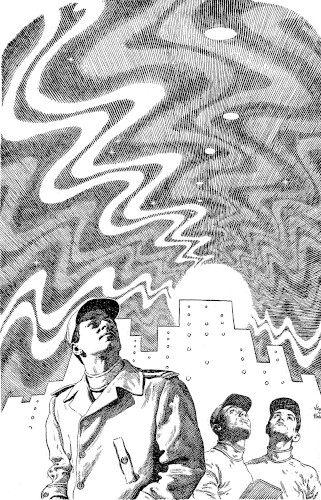
The dome became a riot of flaming green.
After scanning the operation to see which section had gone blooey, Allison went on. "We've never tested this outfit under anything but ideal conditions. We've had spacecraft sent out to specified distances, fired up the gizmo and found fragments of response right where there should be a response."
"That's hardly fair, is it?" commented Wilson.
"It's a start. You have to start somewhere. Radio—know its start? The first message was sent across the ocean a few hundred years ago from one man to the other after they had made a complete plan as to time, date, location and frequency, and also the transmitted message. Sure enough, they got through. That, too, was under the ideal test conditions. So when we finally assembled the half-a-hundred separate circuits and devices that made it look as though we might have a space detector, we put up targets, aimed our equipment, and looked for a response where there should be one."
"We don't know where our target is," objected Wilson.
"And we haven't yet fired up this equipment to seek a target of unknown position and range," admitted Allison. "But this gear is better than nothing."
Again the green spots flickered in the dome over their heads.
"What do all those spots mean?" asked Wilson.
"Those are false targets, probably caused by background noise. Although the infrawave is noiseless, we still seem to be getting it. Dr. Friedrich disagrees. He claims this is not noise, but interferences. However, the good doctor is not at all certain that the so-called interferences come from localized conditions within the equipment or from external sources."
Wilson shrugged. "I don't see how it's done with a radiation type that has neither a directional quality nor a velocity of propagation."
"Do you understand Accum?"
"I stopped shortly before Matrix. Accumulative Math is so much pothooks on a sheet of paper to me."
"Um. Then I'd find it hard to explain. The theory seems to be demonstrable, and the accumulative mathematics upholds the experimental evidence. But there hasn't yet been an acceptable verbal description of what happens."
"I've often wondered, leaving the nondirectional quality out of it, why we couldn't cut our emitting power and somehow compute range by observing the incoming power from a distant infrawave transmitter."
Allison shook his head. "Oddly enough, the matrix mathematics that deal with radiation shows that for any hypothetical radiation with an infinite velocity of propagation, there can be no attenuation with distance."
"Meaning that we should be able to transmit all the way from here to hell and back."
"Not exactly. Infrawave radiation comes in quanta, you know. A kilowatt covers two point one, seven nine three six plus parsecs. Two kilowatts covers twice that distance minus the ninth root of two point, seven nine three six plus. Three kilowatts covers three times two point et cetera, minus two times the ninth root." Allison shrugged and spread his hands.
"And so on it goes," he said, "indicating that at some devilish distance—I've forgotten the figure but we had the master computer chew it out on the big machine at Radiation once—an additional kilowatt just shoves the signal coverage distance out by a micron. But if you don't put in your honest kilowatt, you don't excite the infraspace that carries infrawaves. And if you put in a kilowatt and a half, you have to dissipate the half."