Chapter II · THE PEARL OF ANDALUSIA (continued 2)
Reading edition
Murillo's house is still standing in the Plaza de Alfaro in the old Ghetto. Here he died on April 3, 1682, after his fall from the scaffolding at Cadiz. His studio is shown filled with several undoubted works of his brush. The house belongs to the executors of the late Dean Cepero.
The Duke de Montpensier has a fine collection of pictures at his ugly Palace of St. Telmo, near the Torre del Oro. Among them is included a sketch by our late Queen, when she was still a princess. The palace looks on a parade which is much resorted to by the Sevillanos in the summer months. Here you see the boys playing at the inevitable bull-fight. One who takes the part of toro has a real bull's horns with which he "gores" his comrades with great ferocity. The insistence on this brutal "sport" among the Andalusians has taken the form of acute monomania. Exasperated strangers have been heard to declare that in southern Spain you hear of but two things—Toros y Moros. In another corner of the promenade, you will come upon a party of little girls going through the peculiar and stately dances, or rather measures, of their country, to the accompaniment of a low chant and a clapping of hands, in which the boys, looking on from a distance, will join. Boys and girls, unless they are quite babies, are seldom seen together. You pass on and find a group of citizens seated at the little tables round a kiosk, refreshing themselves with lemonade and being entertained by a conjuror—a fine-looking man—who sends round the hat after every two or three tricks. In the ordinary way you are asked for alms more often than in Granada, but not, of course, to anything like the same extent as in London. English travellers are given to commenting on the mendicity in foreign cities, but I must confess that nowhere have I met with so many beggars as in our own capital. In Spain the fraternity chiefly haunt the steps of churches, the one spot in our happy country that they seem to avoid.
We reach the beginning of the Delicias Gardens, which extend two or three miles southward along the river bank. All the rank and fashion of Seville—and a great deal besides—turns out in summer evenings to drive in the Delicias. The concourse of vehicles is immense, but reminded me rather of the return from the Derby than of Rotten Row. The great ambition of the Spaniard is to possess a conveyance, and he seems to care little how dilapidated or ancient it may be, so long as it goes on wheels. Side by side with the handsome equipages of the Sevillian aristocracy, you will see a wretched Rosinante painfully dragging what I took to be the original "one-hoss shay," or the carriage in which Lord Ferrers was driven to the scaffold. It is impossible to restrain a smile, but after all a conveyance is a real necessity in a climate like this, and if a man cannot afford a good carriage, he must needs put up with a bad one. The traffic is well regulated by mounted police. The foot-paths are also crowded, and when night falls, everyone adjourns to the numerous open-air cafés and kiosks to drink light beer and lemonade. Sober, steady Spain! How certain of our reformers at home would love you, if they but knew you! Where in the world (except in the East) are men more abstemious or women more staid and demure?
If you wish (as of course, being a modern traveller, you are sure to do) to study the life of the people, you had better betake yourself to the other end of the city—to the Alameda de Hercules, so called after two columns which the natives believe were presented by that muscular demigod. Here a perpetual fair seems in progress. There are the usual booths, with fat ladies, boneless wonders, and dwarfs, and more questionable exhibitions. On a platform sat three depressed and underfed wretches, who, I thought, were to be immediately garrotted. Suddenly one sprang up and gave a very clever rendering of the arrival and departure of a train at a country station. He was vociferously applauded, and, thus encouraged, danced a sort of "cellar-flap" with great animation to the indispensable accompaniment of hand-clapping. In a popular assembly of Andalusian town and country folk, the modern observer ought, I am well aware, to find many extraordinary and significant phases of humanity, exhibiting the striking individuality of the people, their race-consciousness, their psychological import, their evolutional significance, and so forth. I blush to confess that in the crowds applauding the ventriloquist or gaping at the fat lady, I saw only a collection of good-humoured ordinary people, enjoying themselves much after the fashion of ordinary people in England.
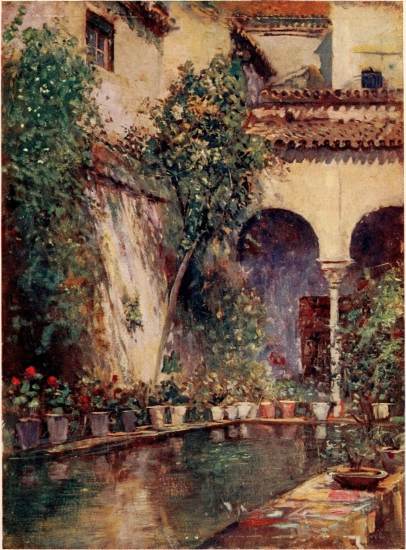
SEVILLE—GARDEN OF THE CASA DE PILATOS
Perhaps the Sevillano is more his real self on these occasions than when disporting himself at the world-famous fair, which begins on the Monday after Easter and attracts strangers from all parts of Europe. Though a somewhat overrated festival, I think it more distinctive and original in certain of its aspects than the gorgeous religious ceremonies by which it is preceded. The wealthier families of Seville rig up for themselves on the fair-ground "casetas," or temporary residences of wood or canvas, with two or more apartments. A great deal of expense is lavished on the upholstering and decoration of these pavilions, and those of the four principal clubs are fitted up in the most luxurious fashion. In the evening the jeunesse dorée of the city drive out to the fair in smart traps drawn by dashing little horses with jangling little bells, and visits are exchanged at the casetas, where as the evening becomes cooler, dancing takes place, to the sound of the piano, the guitar, and the castanet. The pretty señoritas of Seville have no objection to going through the graceful measures of the South in full view of an uninvited audience who crowd round the opening of the tent and from time to time give vent to admiring "Olés!" and bursts of hand-clapping. Dancing will be interrupted at 8.30, when everyone comes out to look at the firework display. Then of course there are the usual popular amusements—the inevitable bioscope, the gramophone, and all sorts of shows. Peasantry and aristocracy alike dress their very best on this occasion. The smartest toilettes and the most picturesque of native costumes are seen side by side, the latest confections of Worth and Paquin and costly heirlooms handed down from the days of Boabdil and Gonsalvo de Cordova.
Whether such an intermingling of all classes, of the richest and the poorest, could take place with mutual enjoyment and comfort in any country but Spain, is a matter open to doubt.
The object of the fair is, I believe, the sale of cattle, and about eighty thousand beasts are to be seen on the Prado de San Sebastian. To say that the most sanguinary bull-fights complete the festivities is perhaps superfluous. The most skilful and renowned toreros are engaged on this occasion, and the arenas literally smoke with the blood of bulls and disembowelled horses. Smithfield and Deptford can show nothing in comparison.
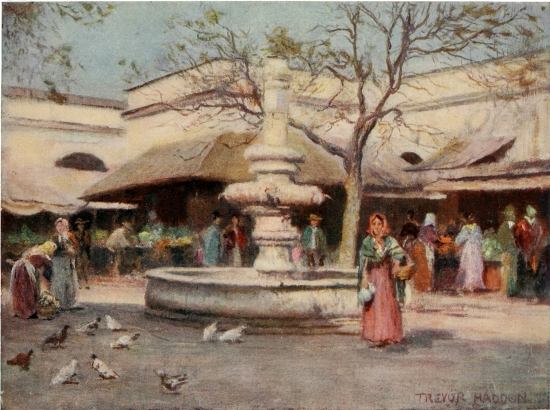
SEVILLE—THE MARKET PLACE
The religious ceremonies, of which travellers talk so much, are not for the most part peculiar to Seville, as it ought to be unnecessary to remind them. The tableaux in the processions struck me as theatrical, but as being on the whole as well represented as similar show-pieces in our pageants. The famous Dance of the Seises is reserved for the octaves of the Immaculate Conception and Corpus Christi. It has been described over and over again. There is nothing irreverent about the performance, which is in itself graceful and quaint; only carried out before the high altar it strikes one as rather meaningless. So, I suppose, most such functions impress those who are unprepared for them by temperament and education. There cannot be much doubt that the ceremony originated in an attempt to attract the ungodly to church—an early and respectable precedent for the methods of the Salvation Army.
Others have it that the dance is a survival of some pagan ceremony—which will remind us that we have so far neglected the monuments of the Romans which were bequeathed to Seville. These are not very numerous or interesting. Only a fragment remains, at the north-east angle of the city, of the massive wall which Cæsar built, and which completely girdled Seville as late as the reign of Juan II. It was strengthened, tradition tells us, by 166 towers, which were freely used as prisons by later rulers. The Cordoba Gate marks the site of the dungeon of the canonized Hermenegild. Close to it is the Capuchin Convent, built upon the foundations of the palace of the Roman governor, Diogenianus, and afterwards associated with Murillo. A noble aqueduct built by the Romans, and known to-day as the Caños de Carmona, still brings water from Alcala de Guadaira to Seville. Everyone who visits Seville is expected to make an excursion to the ruins of Italica, a few miles on the other side of the Guadalquivir. There is remarkably little to see when you get there, and not much is known about the place. There were few, if any, private dwellings here, and it existed rather as the place of meeting and distributing centre for the colonists scattered over the district. It was indeed raised to the dignity of a municipality by Augustus, but petitioned to be restored to its old rank of a Roman colony. It did not prove unworthy of its connection with the great capital. Hence sprang the illustrious line of the Ælii, and many of the eminent Roman Spaniards who conferred such lustre on the early empire are believed to have been natives. The town was embellished in those palmy days with temples, palaces, amphitheatres, and baths, quite out of proportion to its population.
Its downfall, like its earlier history, is mysterious. Here Leovigild placed his headquarters when besieging Seville. Then came the Arabs, who dismantled it and carried off columns and blocks of masonry on which are founded the Giralda and other important buildings in the neighbouring city. Italica disappeared from history; and all you can see of it to-day is a few remains of walls and earthbanks outlining the amphitheatre.
It might not be worth the journey were it not that it can be included in an excursion to the villages of Santi Ponce, Castilleja la Cuesta, and the Cartuja. The parish church of the first named wretched village is remarkable as the last resting-place of the illustrious Guzman el Bueno, that Spaniard of the Roman mould who refused to save the life of his son at the cost of the fortress of Tarifa, which he held for his king. The hero's kneeling effigy dates, as the inscription beneath informs us, from the year 1609, the three hundredth anniversary of his death. The modern traveller, whose sympathies are usually more with the æsthetic than the heroic, will be more interested in the lifelike St. Jerome, one of the finest works of Montañez, to be seen over the high altar. The saint, regarding a crucifix devoutly, beats his breast with a stone. On either side are beautiful bas-reliefs of the Nativity and the Adoration of the Magi.
The convent was inhabited first by the Cistercians, next by the Hermits of St. Jerome. It presents rather the appearance of a fortified abbey of the middle ages. The church is divided into two naves, each of which was a distinct church—one, I suspect, belonging to the monastery, the other to the parish; a not uncommon medieval arrangement. I almost forgot to add that it contains the ashes (literally) of Doña Urraca Osorio, a lady burnt to death, as I have said, by Pedro the Cruel.
At Castilleja la Cuesta—a village on the height—is the house where Hernando Cortes died in 1547. The house has been converted by the Duc de Montpensier into a sort of museum. The Conquistador's bones repose in the land which, with so much intrepidity and ruthlessness, he won for Spain.
The old Charterhouse or Cartuja is now occupied by the porcelain factory of Pickman & Co. It lies on the west bank of the Guadalquivir, a few minutes' walk from the railway bridge. It was founded in the first decade of the fifteenth century by Archbishop de Mena, and was the burial-place of the Riberas, till their remains were transferred to the University Church. There is little to see except some stalls carved, if I remember aright, by Duque Cornejo, in the little chapel.
You may return to the city through the transpontine quarter of Triana, a collection of whitewashed houses inhabited chiefly by gipsies. To distinguish these no longer nomadic Bohemians from the lower-class Andalusians around them is not an easy task. As at Granada, gipsy dances are got up by the guides and hotel people, and here, I am told, they possess the merit which a Frenchman denies to those of the other city—impropriety. The patron saints of Seville, Saints Justa and Rufina, were potters in this quarter. In their time the Carthaginian goddess, Astarte or Salambo, was much venerated in the Roman city. The commemoration of the death of Adonis took place in the month of July, when the image of the goddess was borne in triumph through the streets, while the people following with cries and lamentations deplored the untimely end of her beloved. A strange survival, this, on soil so far to the west, of the hideous Punic rites! The two maidens, newly converted to the religion of the Crucified, refused to do reverence to the image as it was carried past, and were haled before the governor, Diogenianus, in his palace by the Cordova Gate. They were put to death in due course, and have received more honour since from architects, sculptors, and painters, than Venus-Astarte in all her glory received from her devotees.
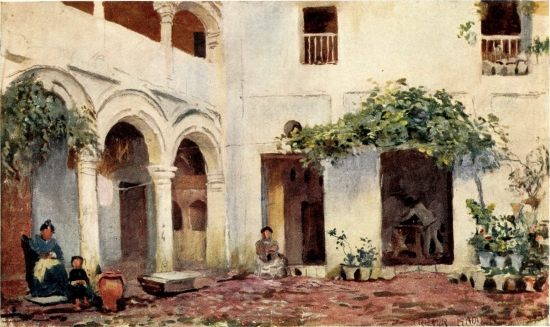
CORDOVA—A COURTYARD
Before leaving Triana, visit the Church of Santa Ana, to see the exquisite Madonna of Alejo Fernandez, whom Lord Leighton considered the most conspicuous among the Gothic painters. There is a regard for beauty in the figures, not by any means obtrusive in most of the paintings of the period, though the awkward pose of some of the angels shows that the artist had not quite emancipated himself from Byzantine influence. And the thought occurred to me as I made my way back to the Delicias Gardens, where the people were driving out to take the air, and knots were collecting round musicians and mountebanks—when the whole city was yielding itself up to the sensuous charm of the summer night—that the art of Fernandez was expressive of Seville: of a people in whom the sense of beauty and the joy of living cannot be extinguished, though at the call of religion they reluctantly keep their faces half turned towards sad facts and yet more sombre unrealities.