Volume 7 — COMPOSITION OF COLUMNS
Reading edition
Composition and Strength of Columns Engaged in Major-General Bruce-Hamilton’s Operations in Southern Orange River Colony.[1]
Lieut.-Colonel du Moulin’s Column.
30th Sqdn., Imperial Yeomanry (31-32).
31st Sqdn., Imperial Yeomanry (153-177).
39th Battery, R.F.A., 2 guns.
“N” Section Pompoms, 1 pompom.
1st Royal Sussex Regiment (436).
Colonel Rochfort’s Column.
9th Bn., Imperial Yeomanry (302-274).
17th Mounted Infantry (331-358).
17th Battery, R.F.A., 2 guns.
“G” Section Pompoms, 1 pompom.
28th Co., Army Service Corps (11).
Lieut.-Colonel Byng’s Column.
5th Sqdn., Imperial Yeomanry (129-109).
23rd Sqdn., Imperial Yeomanry (123-75).
66th Sqdn., Imperial Yeomanry (104-95).
32nd Sqdn., Imperial Yeomanry (91-93).
South African Light Horse (503-642).
17th Battery, R.F.A., 2 guns.
Pompom Section, 1 pompom.
3rd Brigade Field Hospital (5).
13th Brigade Field Hospital (11).
Lieut.-Colonel W. H. Williams’ Column.
1st Mounted Infantry (203-241), 1 M.G.
50th Sqdn., Imperial Yeomanry (120-91).
60th Sqdn., Imperial Yeomanry (121-110).
43rd Battery, R.F.A., 1 5-inch Howitzer.
“D” Section Pompoms, 1 pompom.
20th Bearer Company (8).
Colonel Monro’s Column. (Afterwards in Cape Colony.)
Bethune’s Mounted Infantry (273-500), 2 M.G.
56th Sqdn., Imperial Yeomanry (80), 3 M.G.
57th Sqdn., Imperial Yeomanry (92-95).
58th Sqdn., Imperial Yeomanry (71-56).
59th Sqdn., Imperial Yeomanry (77-80).
39th Battery, R.F.A., 2 guns.
“Z” Section Pompoms, 1 pompom.
Lieut.-Colonel A. Murray’s Column. (Afterwards in Cape Colony.)
Lovat’s Scouts (152-182).
“M” Battery, R.H.A., 2 guns.
Lieut.-Colonel White’s Column. 28/6/01. (Since broken up.)
16th Lancers (469-329).
29th Sqdn., Imperial Yeomanry (132-114).
49th Sqdn., Imperial Yeomanry (141-100).
39th Battery, R.F.A., 2 guns.
“X” Section Pompoms, 1 pompom.
9th Bearer Company (8).
Colonel Henry’s Column.
22nd Mounted Infantry (446-325).
24th Bn., Imperial Yeomanry (373-270).
82nd Battery, R.F.A., 2 guns.
Pompom Section, R.F.F., 1 pompom.
2nd Gloucestershire Regiment (271), 1 M.G.
23rd Bearer Company (9).
Kimberley Column.
74th Sqdn., Imperial Yeomanry (125-135).
Kimberley Light Horse (94-99).
Dennison’s Scouts (81-85).
Mounted Infantry, Royal Welsh Fusiliers (20-24).
Vol. Northumberland Fusiliers (102).
3rd Leinster Regiment (100).
38th Battery, R.F.A., 2 guns.
2nd Royal Scots Fusiliers (38).
Diamond Field Artillery (13-19), 1 M.G.
Columns Engaged in Major-General Charles Knox’s Operations in Central Orange River Colony.
Colonel Pilcher’s Column.
7th Corps Mounted Infantry (891-860), 2 M.G.
6th Battalion Imperial Yeomanry (642-582).
Major Pine Coffin’s Column.
Mounted Infantry, Suffolk Regiment (119-112).
Mounted Infantry, South Wales Borderers (105-107).
Mounted Infantry, Berkshire Regiment (88-116).
Mounted Infantry, West Riding Regiment (114-117).
“O” Battery, R.H.A., 2 guns.
14th Battery, R.F.A., 4 guns.
“M” Section Pompoms, 1 pompom.
36th Co. Army Service Corps (37).
13th Brigade Bearer Company (8).
Lieut.-Colonel Thorneycroft’s Column.
21st and 22nd Sqds. and 18th Battalion.
Imperial Yeomanry (740-780).
Thorneycroft’s Mounted Infantry (168-339).
Burmah Mounted Infantry (185-230).
76th Battery, R.F.A., 4 guns.
“X” Section Pompoms, 1 pompom.
Royal Army Medical Corps (14).
Colonel Henry’s Column.
Kimberley Column.
Columns Engaged in Major-General Elliot’s Operations in Northern Orange River Colony.
Brigadier-General Broadwood’s Column.
7th Dragoon Guards (581-584), 1 M.G.
6th Sqdn., Imperial Yeomanry (123-126).
42nd Sqdn., Imperial Yeomanry (29-105).
44th Sqdn., Imperial Yeomanry (107-122).
46th Sqdn., Imperial Yeomanry (108-102).
78th Sqdn., Imperial Yeomanry (59-70).
Gun Section, Imperial Yeomanry (17-23), 2 M.G.
82nd Battery, R.F.A., 4 guns.
20th Brigade Bearer Company (21).
86th Co., Army Service Corps (17).
17th Co., Army Service Corps (11).
Royal Engineers (7).
Colonel Bethune’s Column.
1st Dragoon Guards (384-510), 1 M.G.
3rd Dragoon Guards (317-390).
7th Sqdn., Imperial Yeomanry (99-98).
8th Sqdn., Imperial Yeomanry (99-87).
28th Sqdn., Imperial Yeomanry (92-90).
“Q” Battery, R.H.A., 4 guns.
Elswick Battery, 1 gun.
“K” Section Pompoms, 1 pompom.
2nd Somerset Light Infantry (196).
4th Field Troop, Royal Engineers (39).
19th Co., Army Service Corps (29).
Royal Army Medical Corps (19).
Lieut.-Colonel Colville’s Column.
2nd Division Mounted Infantry (300-340).
2nd Johannesburg Mounted Rifles (106-130).
63rd Battery, R.F.A., 4 guns.
“O” Section Pompoms, 1 pompom.
2nd East Surrey Regiment (345), 1 M.G.
No. 1 Auxiliary Co., Army Service Corps (13).
2nd Brigade Field Hospital (16).
2nd Brigade Bearer Company (4).
Colonel Rimington’s Column.
3rd Regiment, 5th Contingent, New South Wales Mounted Rifles (734-854), 4 M.G.
41st Sqdn., Imperial Yeomanry (106-113).
77th Sqdn., Imperial Yeomanry (91-96).
106th Sqdn., Imperial Yeomanry (102-115).
Prince of Wales Light Horse (501-504), 2 M.G.
“G” Battery, R.H.A., 4 guns.
“G” Section Pompoms, 1 pompom.
“R” Section Pompoms, 1 pompom.
30th Co., Army Service Corps (14).
20th Brigade Field Hospital (23).
Lieut.-Colonel De Lisle’s Column.
6th Regiment Mounted Infantry (392-457), 2 M.G.
South Australians (326-398).
62nd Battery, R.F.A., 2 guns.
“A” Section Pompoms, 1 pompom.
2nd Co., Army Service Corps (16).
Colonel E. C. Knox’s Column.
10th Hussars (566-668), 1 M.G.
12th Lancers (663-771), 1 M.G.
21st Bn., Imperial Yeomanry (259-316).
“A” Battery, Royal Australian Artillery, 4 guns.
2nd East Surrey Regiment (274).
“U” Section Pompoms, 1 pompom.
17th Co., Royal Engineers (7).
40th Co., Army Service Corps (15).
4th Brigade Field Hospital (25).
Lieut.-Colonel Western’s Column.
No. 1 Co., Royal Irish Rifles Mounted Infantry (103-130).
No. 2 Co., Royal Irish Rifles Mounted Infantry (99-137).
Mounted Infantry, Royal West Kent Regiment (61-76).
Driscoll’s Scouts (422-489).
62nd Battery, R.F.A., 2 guns.
“M” Section Pompoms, 1 pompom.
1st Oxfordshire Light Infantry (120).
1st Royal Irish Fusiliers (120).
2nd Division Field Hospital (17).
17th Co., Army Service Corps (15).
Columns Engaged in Lieut.-Colonel Western’s Operations on the Vaal River.
Brigadier-General G. Hamilton’s Column.
5th Dragoon Guards (373-340), 1 M.G.
13th Hussars (544-578), 1 M.G.
“Q” Battery, R.H.A., 2 guns.
64th Battery, R.F.A., 2 guns.
“F” Section Pompoms, 1 pompom.
1st East Lancashire (363), 1 M.G.
7th Co., Army Service Corps (7).
3rd Field Troop, Royal Engineers (29).
2nd Brigade Bearer Company (27).
Lieut.-Colonel Western’s Column.
Colonel Allenby’s Column.
6th Dragoon Guards (475-488), 3 M.G.
2nd Dragoons (506-533), 1 M.G.
“O” Battery, R.H.A., 4 guns.
83rd Battery, R.F.A., 1 gun.
87th Battery, R.F.A., 1 5-inch Howitzer.
“E” Section Pompoms, 1 pompom.
1st Inniskilling Fusiliers (683), 1 M.G.
1st Field Troop, Royal Engineers (27).
6th Field Hospital (10).
6th Bearer Company (13).
Colonel Henry’s Column.
Columns Engaged in Clearing the East of the Orange River Colony.
Major-General B. Campbell’s Column.
1st Sqdn., Imperial Yeomanry (134)}
2nd Sqdn., Imperial Yeomanry (160)} Total
3rd Sqdn., Imperial Yeomanry (114)} horses,
4th Sqdn., Imperial Yeomanry (139)} 536.
2nd Battery, R.F.A., 4 guns.
“T” Section Pompoms, 1 pompom.
2nd Scots Guards (688).
1st Leinster Regiment (402).
Colonel Harley’s Column.
36th Sqdn., Imperial Yeomanry (142-153).
53rd Sqdn., Imperial Yeomanry (138-138).
62nd Sqdn., Imperial Yeomanry (82-35).
Unallotted Imperial Yeomanry (343-121).
Mounted Infantry, Manchester Regiment (96-114).
Tempest’s Scouts (38).
36th, Southern Division, R.G.A., 1 5-inch.
77th Battery, R.F.A., 4 guns.
“T” Section Pompoms, 1 pompom.
1st South Staffordshire Regiment (787).
2nd Manchester Regiment (645).
2nd Grenadier Guards (62).
Columns Engaged in Operations in the South-West Transvaal.
Lieut.-General Lord Methuen’s Column.
13th Sqdn., Imperial Yeomanry (128).
14th Sqdn., Imperial Yeomanry (130-154).
15th Sqdn., Imperial Yeomanry (140-162).
16th Sqdn., Imperial Yeomanry (130-141).
100th Sqdn., Imperial Yeomanry (36-35).
101st Sqdn., Imperial Yeomanry (142-148).
102nd Sqdn., Imperial Yeomanry (105-116).
Gun Section, Imperial Yeomanry (15-24), 2 M.G.
37th Sqdn., Imperial Yeomanry (99-115).
38th Sqdn., Imperial Yeomanry (96-105).
39th Sqdn., Imperial Yeomanry (119-124).
Major-General Babington’s Column.
14th Hussars (98-105).
Mounted Infantry, Royal Welsh Fusiliers (29-35).
Imperial Light Horse (162-229).
4th New Zealand Rifles (216-280).
6th Imperial Bushmen (193-260).
103rd Sqdn., Imperial Yeomanry (135-144).
107th Sqdn., Imperial Yeomanry (145-153).
37th Battery, R.F.A., 1 5-inch Howitzer.
68th Battery, R.F.A., 4 guns.
Elswick Battery, 1 gun.
Pompom Section, R.F.F., 2 pompoms.
Signallers, R.F.F. (7).
1st Royal Welsh Fusiliers (522).
11th Co., Royal Engineers (9).
7th Co., Army Service Corps (21).
9th Brigade Field Hospital (20).
12th Bearer Company (11).
Colonel Sir H. Rawlinson’s Column.
2nd Mounted Infantry (352-439).
8th Mounted Infantry (375-428).
“P” Battery, R.H.A., 2 guns.
38th Battery, R.F.A., 2 guns.
37th Battery, R.F.A., 1 5-inch Howitzer.
40th Sqdn., Imperial Yeomanry (95-91), 1 M.G.
43rd Sqdn., Imperial Yeomanry (113-116).
73rd Sqdn., Imperial Yeomanry (105-153).
51st Sqdn., Imperial Yeomanry (81-106).
Mounted Infantry, Bedfordshire Regiment (63-72).
Bechuanaland Rifles (64-90).
4th Battery, R.F.A., 6 guns.
37th Battery, R.F.A., 2 5-inch Howitzers.
R.F.F. Artillery, 2 guns.
“H” Section Pompoms, 2 pompoms.
Pompom Section, R.F.F., 2 pompoms.
1st Northumberland Fusiliers (146).
1st Loyal North Lancashire (334).
3rd South Wales Borderers (146).
Lieut.-Colonel Hickie’s Column.
“P” Battery, R.H.A., 2 guns.
78th Battery, R.F.A., 2 guns.
Pompom Section, 2 pompoms.
103rd Sqdn., Imperial Yeomanry (108-113).
107th Sqdn., Imperial Yeomanry (99-109).
Kitchener’s Horse (29-51).
Roberts’ Horse (114-118).
Imperial Light Horse (369-439).
2nd Cheshire Regiment (182), 1 M.G.
11th Field Troop, Royal Engineers (7).
7th Co., Army Service Corps (24).
29th Co., Army Service Corps (6).
9th Brigade Field Hospital (14).
12th Bearer Company (10).
Brigadier-General Dixon’s Column.
7th Bn., Imperial Yeomanry (151-164).
1st Scottish Horse (451-543).
8th Battery, R.F.A., 4 guns.
28th Battery, R.F.A., 2 guns.
37th Battery, R.F.A., 1 5-inch Howitzer.
“G” Section Pompoms, 1 pompom.
1st King’s Own Scottish Borderers (469), 1 M.G.
1st Derby Regiment (411), 1 M.G.
“B” Section Pompoms, 1 pompom.
“Z” Section Pompoms, 1 pompom.
2nd Cheshire Regiment (179).
2nd Field Troop, Royal Engineers (14).
Lieut.-Colonel E. C. Williams’ Column.
2nd New South Wales Mounted Rifles (526-536).
3rd New South Wales Bushmen (229-244).
21st Bn., Mounted Infantry (432-415).
78th Battery, R.F.A., 2 guns.
Elswick Battery, 1 gun.
“A” Batt., Royal Australian Artillery, 2 guns.
“B” Section Pompoms, 1 pompom.
“D” Section Pompoms, 1 pompom.
2nd Cheshire Regiment (192).
Australian Medical Corps (23).
7th Co., Royal Engineers (7).
10th Co., Army Service Corps (24).
12th Field Hospital (32).
10th Bearer Company (12).
7th Co., Royal Engineers (4).
Brigadier-General G. Hamilton’s Column.
Colonel Allenby’s Column.
General Barton’s Column.
108th Sqdn., Imperial Yeomanry (100).
Mounted Infantry (200).
81st Battery, R.F.A., 2 guns.
1st Cameron Highlanders (700).
Major G. Williams’ Column.
11th Bn., Mounted Infantry (323-403).
Columns Engaged in Operations between the Delagoa and Natal Lines.
Brigadier-General Plumer’s Column.
5th Queensland Imperial Bushmen (340-361).
6th New Zealand Mounted Rifles (419-406).
18th Battery. R.F.A., 4 guns.
“Q” Section Pompoms, 2 pompoms.
1st Royal Munster Fusiliers (264).
2nd and 11th Cos., Royal Engineers (37).
13th Brigade Field Hospital (18).
14th Brigade Field Hospital (16).
Elswick Battery, 1 gun.
2nd Dorset Regiment (500), 1 M.G.
26th Co., Royal Engineers (20).
11th Field Hospital (9).
18th Field Hospital (10).
20th Co., Army Service Corps (20).
45th Co., Army Service Corps (16).
Lieut.-Colonel Grey’s (afterwards Lieut.-Colonel Garratt’s) Column.
6th Queenslanders (307-302).
7th New Zealanders (489-504), 1 M.G.
9th Battery, R.F.A., 2 guns.
73rd Battery, R.F.A., 2 guns.
“C” Section Pompoms, 1 pompom.
1st East Lancashire (309).
15th Field Hospital (22).
91st Co., Army Service Corps (22).
Major-General W. Kitchener’s Column.
5th West Australian Mounted Infantry (160-194).
6th West Australian Mounted Infantry (195-186).
Brigadier-General Bullock’s Column.
5th Corps, Mounted Infantry (758-894).
Gough’s Mounted Infantry (590-742), 3 M.G.
Johannesburg Mounted Rifles (318-366).
Commander-in-Chief’s Bodyguard (182-310), 2 guns and 1 pompom.
74th Battery, R.F.A., 4 guns.
“J” Battery, R.H.A., 6 guns.
“F” Section Pompoms, 1 pompom.
2nd Imperial Light Horse (138-170), 1 M.G.
53rd Battery, R.F.A., 2 guns.
16th Southern Division, R.G.A., 1 5-inch.
10th Mountain Battery, R.G.A., 1 gun.
“S” Section Pompoms, 1 pompom.
1st Devonshire Regiment (833), 2 M.G.
24th Bearer Company and Field Hospital (9).
23rd Co., Royal Engineers (10).
Lieut.-Colonel Pulteney’s Column.
1st Royal Dragoons (345-349), 1 M.G.
6th Inniskilling Dragoons (370-400), 2 M.G.
66th Battery, R.F.A., 2 guns.
“P” Section Pompoms, 1 pompom.
1st Scots Guards (854), 1 M.G.
Royal Engineers (48).
11th Field Hospital (19).
9th Bearer Company (21).
Colonel Rimington’s Column.
Colonel Allenby’s Column.
Colonel E. C. Knox’s Column.
Columns Engaged in Brigadier-General Plumer’s Operations in South-Eastern Transvaal.
Brigadier-General Plumer’s Column.
Colonel E. C. Knox’s Column.
Colonel Rimington’s Column.
Major-General Beatson’s Operations.
Major-General Beatson’s Column.
5th Victorian Mounted Rifles (740-721).
9th Battery, R.F.A., 4 guns.
2nd Duke of Cornwall’s Light Infantry (366).
2nd Seaforth Highlanders (178).
26th Co., Royal Engineers (23).
20th Field Hospital (26).
84th Co., A.S.C. (18).
Columns Engaged in Lieut.-General Sir Bindon Blood’s Operations in the Eastern Transvaal.
Major-General Babington’s Column.
19th Hussars (279-268), 1 M.G.
83rd Battery, R.F.A., 2 guns.
10th Mountain Battery, R.G.A., 1 gun.
“J” Section Pompoms, 1 pompom.
1st King’s Royal Rifle Corps (637), 1 M.G.
43rd Co., Army Service Corps (16).
12th Field Hospital (21).
9th Co., Royal Engineers (12).
Lieut.-Colonel Benson’s (R.A.) Column.
18th Mounted Infantry (466-513).
19th Mounted Infantry (362-430).
2nd Scottish Horse (503-647).
21st Battery, R.F.A., 2 guns.
81st Battery, R.F.A., 2 guns.
61st Battery, R.F.A., 1 5-inch Howitzer.
10th Mountain Battery, R.G.A., 1 gun.
“C” Section Pompoms, 1 pompom.
“R” Section Pompoms, 1 pompom.
1st Argyll and Sutherland Highlanders (724).
23rd Co., Royal Engineers (23).
8th Bearer Company (22).
31st Co., Army Service Corps (19).
Brigadier-General Spens’ Column.
5th Lancers (153-132).
4th Mounted Infantry (457-534).
4th Mountain Battery, R.G.A., 2 2.5-inch.
10th Mountain Battery, R.G.A., 1 12-pr.
“S” Section Pompoms, 1 pompom.
2nd Royal Berkshire Regiment (570), 3 M.G.
19th Co., Royal Engineers (23).
19th Bearer Co. (29).
Colonel Campbell’s Column.
18th Hussars (543-470).
53rd Battery, R.F.A., 2 guns.
14th Southern Division, R.G.A., 1 5-inch.
Pontoon Troop, R.E. (10).
2nd Rifle Brigade (587), 1 M.G.
12th Brigade Field Hospital (30).
Army Service Corps (10).
Colonel Park’s Column.
4th Division Mounted Infantry (123-137),
1 Krupp gun.
53rd Battery, R.F.A., 2 guns.
“P” Section Pompoms, 1 pompom.
1st Royal Irish Regiment (613), 1 M.G.
40th Co., Army Service Corps (8).
4th Division Field Hospital (4).
Lieut.-Colonel Douglas’ Column.
3rd Mounted Infantry (349-446).
84th Battery, R.F.A., 4 guns.
“L” Section Pompoms, 1 pompom.
1st Royal Scots (704), 1 M.G.
23rd Co., Royal Engineers (17).
19th Field Hospital (22).
19th Bearer Company (11).
Major-General W. Kitchener’s Column.
Lieut.-Colonel Pulteney’s Column.
Major-General Beatson’s Column.
Lieut.-Colonel Colville’s Column.
Colonel Garratt’s Column.
Columns Engaged in Operations on the Pietersburg Line.
Major McMicking’s Column.
20th Bn., Mounted Infantry (374-317).
75th Battery, R.F.A., 2 guns.
2nd Lincoln Rifles (179).
Lieut.-Colonel Wilson’s Column.
Kitchener’s Fighting Scouts (417-399).
Bush Veldt Carabineers (21-22).
12th Mounted Infantry (13-13).
2nd Gordon Highlanders (104).
Lieut.-Colonel Grenfell’s Column.
Kitchener’s Fighting Scouts (364-361).
12th Mounted Infantry (193-194).
2nd Wiltshire Rifles (363).
85th Battery, R.F.A., 2 guns.
“A” Section Pompoms, 1 pompom.
Operations in the Standerton-Heidelberg District.
Lieut.-Colonel Colville’s Column.
Lieut.-Colonel Grey’s Column.
Columns Engaged in Operations in Cape Colony.
Colonel Doran’s Column. (Late Lieut.-Colonel Henniker’s.)
Warren’s Mounted Infantry (181-191).
11th Sqdn., Imperial Yeomanry (134-131).
23rd Sqdn., Imperial Yeomanry (141-148).
24th Sqdn., Imperial Yeomanry (125-94).
“M” Battery, R.H.A., 2 guns.
Cape Colony Cyclists (4).
Lieut.-Colonel Crabbe’s Column.
P. A. Guards (193-205).
Marshall’s Horse (120-139).
99th Sqdn., Imperial Yeomanry (53-63).
104th Sqdn., Imperial Yeomanry (58-60).
105th Sqdn., Imperial Yeomanry (53-69).
111th Sqdn., Imperial Yeomanry (47-53).
85th Battery, R.F.A., 2 guns.
2nd Royal Fusiliers (78).
Cape Medical Staff (13).
Lieut.-Colonel Gorringe’s Column.
Cape Defence Force (263).
Cape Police (212).
Tasmanian Imperial Bushmen (92).
5th Battery, R.F.A., 2 guns.
“O” Section Pompoms, 1 pompom.
Total horses (1401).
Lieut.-Colonel Crewe’s Column.
Kaffrarian Rifles (301-374), 2 machine guns.
Queenstown Volunteer Rifles (78-137).
44th Battery, R.F.A., 2 guns.
“Y” Section Pompoms, 1 pompom.
Captain Lund’s Column.
9th Lancers (132).
Brabant’s Horse (209).
Imperial Yeomanry (278).
“A” Section Pompoms, 1 pompom.
Total horses (828), and 1 machine gun.
Lieut.-Colonel Scobell’s Column.
9th Lancers (303-332).
Cape Mounted Rifles (203-356).
Cape Mounted Royal Artillery, 3 guns.
Cape Cyclists (9).
Royal Engineers (2).
Lieut.-Colonel Wyndham’s Column.
17th Lancers (387-412), 1 machine gun.
Lieut.-Colonel Hon. A. D. Murray’s Column.
Colonel Monro’s Column.
Note.—Where two figures appear, the first refers to effective men, the second to effective horses.
Force Employed at Vlakfontein (584) on May 29th.
(a) Left (afterwards rear), under Major Chance, R.A.
28th Battery, R.F.A., 2 guns.
“G” Section Pompoms, 1 pompom.
7th Bn., Imperial Yeomanry (230).
1 Co., 1st Derbyshire Regiment.
(b) Centre, under Brigade-General Dixon.
8th Battery, R.F.A., 2 guns.
37th Battery, R.F.A., 1 5-inch Howitzer.
2 Cos., 1st King’s Own Scottish Borderers.
1 Co., 1st Derbyshire Regiment.
(c) Right, under Lieut.-Colonel Duff.
8th Battery, R.F.A., 2 guns.
1st Scottish Horse (200).
2 Cos., 1st King’s Own Scottish Borderers.
Major-General Beatson’s Column (on 12th June).
5th Victorian Mounted Rifles (780-806).
9th Battery, R.F.A., 4 guns.
“B” and “E” Sections Pompoms, 2 pompoms.
1st Royal Munster Fusiliers (347).
26th Co., Royal Engineers (23).
20th Field Hospital (26).
84th Co., Army Service Corps (20).
Of which the following were detached to Wilmansrust (22) under Major Morris, R.F.A.:—
5th Victorian Mounted Rifles (350).
Pompom Section, 2 pompoms.
FOOTNOTES:
SOUTH AFRICA AND THE TRANSVAAL WAR
PEACE
“On her knees, before the glory of the Lord, Britannia sheathes the lightnings of her sword; Once again, to utmost ends Of the Red Line it defends, She hath peace.”—Sir Edwin Arnold.
THE SITUATION—FEBRUARY 1901
The reign of His Majesty King Edward VII. began in clouds! There was no denying that the last half-year had been one of retrogression. In June 1900, from the Orange River southwards, there had been comparative quietude. The southern and eastern half of the Orange River Colony had become fairly settled, while even in some districts of the Transvaal—towards the south-western area especially—the inhabitants gave indications of a willingness to accept British rule, and of a desire to return to their agricultural and peaceful avocations. But with the end of the year came a deplorable change. The enemy, broken up into a large number of desultory gangs, commenced raiding and wrecking, consequently the British forces, in order to cope with and pursue these vagrant bands, had to be broken up to correspond. The area of hostility and destruction grew larger daily and the difficulty of fighting more extreme. The lack of supplies now drove the Boers, who lived entirely on the country through which they passed, to spend their time in looting, in pouncing on the farms and small villages, and in seizing everything they might need. Stores, clothing, horses, cattle, all were grabbed at the point of the rifle, if not, as in some cases, delivered up on demand. To frustrate the tactics of the enemy, the British forces were compelled to denude the country of every movable thing, and to place whatever could be conveyed there in refuge camps which were established at points along the railway lines. But in this operation great loss was entailed, owing to the difficulty of finding sufficient grass for the number of collected animals, and of keeping them alive en route.
The loss of crops and stock became a still more serious matter than even the destruction of farm buildings—a measure which had almost entirely been abandoned. Having regard to the inexpensive character of these structures, this measure, to quote Sir Alfred Milner, was a “comparatively small item” in the total damage caused by the war to the agricultural community. But, he said, the wanton and malicious injury done to the headgear, stamps, and other apparatus of some of the outlying mines by Boer raiders was a form of destruction for which there was no excuse. It was a vandalism unjustified by the requirements of military operations and outside the scope of civilised warfare. Directly or indirectly, all South Africa, including the agricultural population, owes its prosperity to the mines, and, of course, especially to the mines of the Transvaal. To money made in mining it is indebted for such progress, even in agriculture, as it has recently made, and the same source will have to be relied upon for the recuperation of agriculture after the ravages of war. The damage done to the mines Lord Milner estimated was not large “relatively to the vast total amount of the fixed capital sunk in them. The mining area,” he said, “is excessively difficult to guard against purely predatory attacks having no military purpose, because it is, so to speak, ‘all length and no breadth’—one long thin line, stretching across the country from east to west for many miles. Still, garrisoned as Johannesburg now is, it was only possible successfully to attack a few points in it. Of the raids previously made, and they have been fairly numerous, only one has resulted in any serious damage. In that instance the injury done to the single mine attacked amounted to £200,000, and it is estimated that the mine is put out of working for two years. This mine is only one out of a hundred, and is not by any means one of the most important. These facts may afford some indication of the ruin which might have been inflicted, not only on the Transvaal and all South Africa, but on many European interests, if that general destruction of mine works which was contemplated just before our occupation of Johannesburg had been carried out. However serious in some respects may have been the military consequences of our rapid advance to Johannesburg, South Africa owes more than is commonly recognised to that brilliant dash forward, by which the vast mining apparatus, the foundation of all her wealth, was saved from the ruin threatening it.”
The events of the last six months promised to involve a more vast amount of repair and a longer period of recuperation, especially for agriculture, than would have been anticipated at the commencement of hostilities. Still, having regard to the fact that both the Rand and Kimberley were virtually undamaged, and that the main engines of prosperity, when once set going again, would not take very long to get into working order, the economic consequences of the war, though grave, did not appear by any means appalling. The country population it was admitted would need a good deal of help, first to preserve it from starvation, and then, probably, to supply it with a certain amount of capital to make a fresh start. And the great industry of the country would require some little time before it would be able to render any assistance. But, in a young country with great recuperative powers, many years would not elapse before the economic ravages of the war would be effaced.
Still, the moral effect of the recrudescence of the war was lamentable. Everywhere after the occupation of Pretoria the inhabitants had seemed resigned to the state of affairs—the feeling in the colony had been one of acquiescent relief. The rebellious element was glad of the opportunity to settle down. Had these people been shut off from communication with the enemy they would have maintained their calm, and engaged themselves with their former peaceful pursuits. As it was, while the great advance to Pretoria, and subsequently to Delagoa Bay, demanded the presence of the British troops in the north, the country was left open to raiders, who daily grew more audacious as the small successes of their guerilla leaders appeared to give promise of a turn of fortune’s wheel.
And now came the real tug of war. These raiders, both on the brink of the Orange Colony and the Southern Transvaal, kept the peaceable inhabitants of the colony in an unenviable quandary. These, and many others, on taking the oath of neutrality, instead of being made prisoners of war, had been permitted to return to their farms. But under pressure from their old comrades, they now wavered between the obligations of their oath and the calls of friendship—and many of them fell. Men who had been exceptionally well treated were again in arms, sometimes justifying their break of faith by the poor apology that they had not been “preserved from the temptation to commit it.” Naturally, on the return of the troops to again quell a rising in the south, their conduct was not marked by the same leniency which had characterised the original conquest. Still, these parole breakers were not punished with the severity which might have been meted out to them in the same circumstances by other nations. Though we were by the rules of war entitled to shoot men who had broken their parole, we had not availed ourselves of the right.
We remained as humane as the exigence of discipline would permit. Efforts were made to check the general demoralisation by establishing refuge camps for the peaceable along the railway lines, but these camps were mainly tenanted by the women and children of burghers who still determined to flout us.
Lord Milner, in speaking of the situation in the new territories and the Cape Colony, described it as possibly “the most puzzling that we have had to confront since the beginning of the war.” On the one hand there was the outcry for greater severity and for a stricter administration of martial law. On the other hand, there was the expression of the fear that strict measures would only exasperate the people. He himself was in favour of reasonable strictness as the proper attitude in the presence of a grave national danger, and he further affirmed that exceptional regulations for a time of invasion, the necessity of which every man of sense could understand, if clearly explained and firmly adhered to, were not only not incompatible with, but actually conducive to, the avoidance of injustice and cruelty. He went on to say:—
De Wet’s Rush in Cape Colony viâ Zand Drift, 10th February 1901
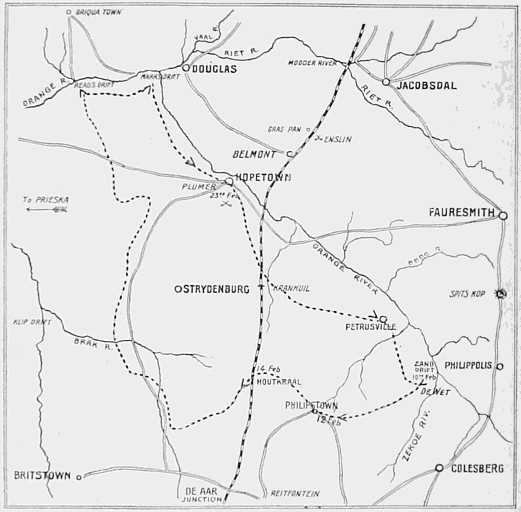
“I am satisfied by experience that the majority of those Dutch inhabitants of the Colony who sympathise with the Republics, however little they may be able to resist giving active expression to that sympathy when the enemy actually appear amongst them, do not desire to see their own districts invaded or to find themselves personally placed in the awkward dilemma of choosing between high treason and an unfriendly attitude to the men of their own race from beyond the border. There are extremists who would like to see the whole of the Cape Colony overrun. But the bulk of the farmers, especially the substantial ones, are not of this mind. They submit readily enough even to stringent regulations having for their object the prevention of the spread of invasion. And not a few of them are, perhaps, secretly glad that the prohibition of seditious speaking and writing, of political meetings, and of the free movement of political firebrands through the country, enables them to keep quiet, without actually themselves taking a strong line against the propaganda, and, to do them justice, they behave reasonably well under the pass and other regulations necessary for that purpose, as long as care is taken not to make these regulations too irksome to them in the conduct of their business, or in their daily lives.”
He suggested that the fact that there had been an invasion at all was no doubt due to the weakness of some of the Dutch colonists in tolerating, or supporting, the violent propaganda, which could not but lead the enemy to believe that they had only to come into the Colony in order to meet with general active support. But this had been a miscalculation on the part of the enemy, though a very pardonable one. They knew the vehemence of the agitation in their favour as shown by the speeches in Parliament, the series of public meetings culminating in the Worcester Congress, the writings of the Dutch press, the very general wearing of the Republican colours, the singing of the Volkslied, and so forth, and they regarded these demonstrations as meaning more than they actually did. Three things were forgotten. Firstly, that a great proportion of the Afrikanders in the Colony who really meant business, had slipped away and joined the Republican ranks long ago. Secondly, that the abortive rebellion of a year ago had left the people of the border districts disinclined to repeat the experiment of a revolt. Thirdly, that owing to the precautionary measures of the Government the amount of arms and ammunition in the hands of the country population throughout the greater part of the Colony is not now anything like as large as it usually was, and far smaller than it was at the onset of the war.
In regard to the “call to arms” that took place on the 1st of January, and the vehement response it had met, Lord Milner stated that it had always been admitted, by their friends and foes alike, that the bulk of the Afrikander population would never take up arms on the side of the British Government in this quarrel, even for local defence. The appeal therefore had been virtually directed to the British population, mostly townspeople, and to a small, but no doubt very strong and courageous, minority of the Afrikanders who have always been loyalists. These classes had been already immensely drawn on by the Cape Police, the regular Volunteer Corps, and the numerous Irregular Mounted Corps which had been called into existence because of the war. There must have been 12,000 Cape colonists under arms before the recent appeal, and as things were going, as many more promised to answer that appeal—a truly remarkable achievement under a purely voluntary system.
Position of Troops after the Engagement of 23rd February. De Wet’s Escape from the Enveloping Cordon, 28th February 1901
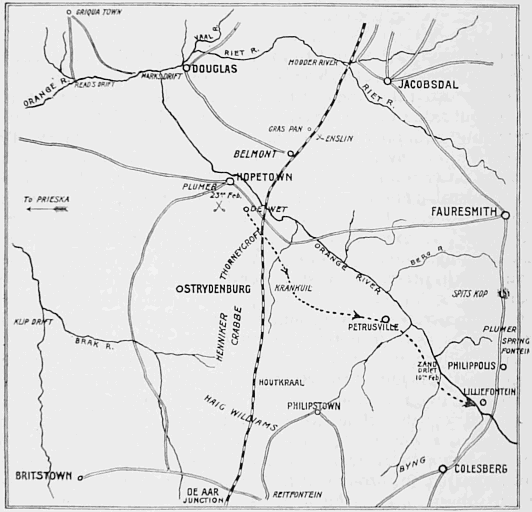
How gloriously the system worked throughout the year 1901 has yet to be seen, for peace was still a great way off. All yearned for it, all were fairly sick of carnage and ruin and sacrifice, but, nevertheless, it was agreed that to endure and fight to the bitter end were preferable to an ignoble compromise, which must inevitably bring about a recurrence of the terrible scourge in the future. All were determined that South Africa should become one country under one flag, and that the British; and this once accomplished, they would be ready to bury racial animosities for ever. But, in order to bring about that happy, that inevitable end, all decided that a vigorous prosecution of the war, at whatever cost, was an imperative duty.