Volume 2 — CHAPTER IV (continued 2)
Reading edition
On the 8th of December a very brilliant operation took place at Lombard's Kop. General Hunter, with a hundred picked men of the Imperial Light Horse under Colonel Edwards (5th Dragoon Guards), and five hundred Natal Carabineers under Colonel Royston, started from Ladysmith camp about nine o'clock on the previous night. Four abreast they marched from the outpost and faded in the gloom. The march lay across a stony, rugged plain, through the scrub of mimosa bush and among dongas deep and shallow. Close on the heels of Major Henderson and several of the Corps of Guides the troops pressed on. About ten o'clock they reached the base of the hill under Lombard's Kop, and there took up a position. While still pitch dark—two o'clock in the morning—they began to advance on their perilous enterprise, climbing up steep and slippery slopes, and stumbling over boulders, and tripping on loosened stones. The stars blinked, the sky seemed slumbering in one vast dream of blue. Stealthily they moved with the footfalls of tigers stalking their prey. Not a word was spoken. Scarcely a breath drawn.
Above, on the flat top of the hills, were the objects of British desire—the Boer guns. A 6-inch Creusot, throwing a 94-lb. shell, and a 4.7-inch howitzer, firing a 40-lb. shot. More anxious than sweetheart for the sight of his lady-love were these gallant fellows for the touch of these treasures. Up they went, each outracing the other, straining every nerve and muscle to gain the summit of the hill, to be first to handle the prize!
At last, when about half the distance had been cleared, they were challenged by the picket. "Wie gaat daar?"—"Who goes there?" he sang out in alarm. It was a thrilling moment. To the challenge there could be but one reply. That reply they gave. Shots rang out in the darkness. There was now no more creeping. Tongues of flame darted from every side. The troops pushed forward in the grey mysterious gloom to the ping of bullets that whizzed in shoals swiftly past their ears. Major Henderson dropped. More bullets rained down. A Guide fell wounded by cycle bearing-balls shot from a rifle—so it was subsequently said. One gallant fellow after another threw up his arms dying or dead. But still the troops pressed on, Colonel Edwards in advance shouting them on to victory. "Fix bayonets," he called with a voice of thunder, knowing there were but four bayonets among the lot. "Give 'em cold steel," shouted some one else with delirious rapture, and the Carabineers and Light Horse, with scarce a bayonet to their name, cheered and charged! But the Boers delayed not to find out if there were steel or no steel. They fled in dismay, leaving behind them their cherished guns. So swift indeed was their flight, that hats, boots, letters, everything—were scattered to the winds.
Thereupon Captain Fowke and Lieutenant Turner, R.E., with great skill destroyed a 6-inch gun and a 4.7-inch howitzer with gun-cotton. They also captured a Maxim. This magnificent piece of work, counting from the moment the order to charge was given, was performed in three-quarters of an hour, with the loss to our troops of only seven men. The conduct of the Imperial Light Horse was superb, and Major Edwards was the first man in the embrasure. The following is an account of the destruction of the guns given by the war correspondent of the Standard:—
"In order to give the rest of the force time to complete its work, Major Edwards, who was the first man to set foot on the summit, led his men of the Imperial Light Horse to the far side of the hill, and poured volleys in the direction of the Boer retreat. Some of their vedettes could be seen hovering about, but they were evidently too demoralised to approach us closely.
"Meanwhile, the Volunteers and Sappers were making a hurried search for the big guns. For a moment the horrible thought seized us that there might be no guns at all—that the enemy, as has so often been the case of late, had somehow got wind of the projected attack, and had removed the cannon to a safe distance. But at last, to the delight of everybody, 'Long Tom' itself was discovered, snugly ensconced behind a parapet of sand-bags no less than 31 feet thick. A 4.7-inch howitzer was found in an emplacement hardly less strong, with a Maxim gun between the two—posted there, apparently, for the purpose of repelling any such assault as the one we had actually delivered.
"Lieutenant Turner, with a party of two sappers and six artillerymen, at once took charge of 'Long Tom,' and, getting to work with crowbars and hammers, smashed the breach and elevating gear. Two charges of gun-cotton were then placed in the breech and muzzle and connected with fuses. While 'Long Tom' was thus being provided for, similar attentions were bestowed on the howitzer by Captain Fowke and the other sappers and gunners.
"The preparations being complete, General Hunter ordered the men to make their way back down the hill, and the fuses were set light to with the burning ends of the officers' cigars. Everybody fell back, with the exception of Captain Fowke, who remained midway between the big guns, and, after a couple of minutes' suspense, a loud report showed that our object had been accomplished. Captain Fowke hastened to examine the débris, and found that the 6-inch gun had two gaping holes in its muzzle, which was badly bulged, and that the breech and rifling had been destroyed beyond all chance of repair. The howitzer was in an even worse plight, the explosion having wrecked the carriage as well as the gun."
The force under General Hunter was composed of a hundred men selected from three squadrons of the Imperial Light Horse: Squadron B, Captain Mullens; Squadron E, Captain Codrington; Squadron F, Captain Fowler; Commanding Officer, Colonel A. H. M. Edwards, of the 5th Dragoon Guards, with Major "Karri" Davis, and Captain Fitzgerald, Adjutant of the Regiment. The second hundred men were chosen from the Natal Volunteers, and were led by Major Addison. The flanking parties, under Colonel Royston, were composed of Natal Mounted Rifles, under Major Evans; Border Mounted Rifles, under Major Rethman; Carabineers, under Colonel Greene; and Natal Mounted Police, under Inspector Clarke; Colonel Royston in command. Major Henderson was in charge of the Guides. Our casualties were nine wounded, one mortally.
A little later in the day a smart skirmish commenced between Colonel Knox with one squadron of the 19th Hussars and the Boers on Pepworth Hill. The enemy thinking that all the troops had been engaged, to their discomfiture, near Lombard's Kop, arranged that they would seize the opportunity to approach the town. Again they were somewhat surprised to find Colonel Knox and his party in readiness for them. Some brisk fighting ensued, but all was over by six o'clock, and the net result of the morning's work was considered highly satisfactory. The voice of "Long Tom" was completely silenced, and Ladysmith had got a Maxim to the good. The Boer telegraph lines were cut and their kraals burnt. On the whole, the troops were well pleased with themselves, and returned to receive an enthusiastic reception from those within the town. The only regret was that Major Henderson, D.A.A.G., 1st Argyll and Sutherland Highlanders, should have been wounded in two places.
Probably this was the first time in the history of British arms that guns have been stormed by Mounted Infantry, and the complete success of the movement reflected the utmost credit, not only on the troops themselves, but on Major-General Hunter, who so magnificently led the assault. After the men returned to camp, General White had the Volunteers, Light Horsemen, and other portions of the force paraded, and addressed them as follows:—
"Colonel Royston, officers and men of the Natal Mounted Volunteers, officers and men of the Imperial Light Horse, and officers and men of the Imperial Forces,—I have heard the details of last night's work from Major-General Hunter, who so ably planned the undertaking and carried it out. He has asked me to express to you his appreciation—and deep appreciation—of the admirable manner in which you supported him in it throughout. It is a great pleasure to me that I am here, not only to acknowledge the fine work you did last night and your valuable services, but also as I was longing for an opportunity of acknowledging the value of your services since this campaign commenced. I am glad to think that the very important service rendered last night was got through with so few casualties. It will be a great pleasure to me to report to General Sir Redvers Buller, whom we all hope to see in a few days, the good behaviour and great help we have had from the Natal Volunteers, who, I may say without any inflated or exaggerated language, are a credit, not only to their own Colony, but to the Empire. We I daresay, have a lot of severe fighting before us, and it is a great gratification to me to know I have the help of such men as I see before me. I know you had a bad night last night and are needing rest, but I thought you would not, perhaps, mind my turning you out to tell you how all the officers of this force appreciate your behaviour, and I hope you will keep it up to the end. Colonel Royston, I won't keep the parade any longer."
Hearty cheers were given for General White, Major-General Hunter, and the Queen.
General White also addressed the Royal Engineers and Artillery, stating that all praise was due to the officer in charge for the able manner in which he had performed his duty, and to the men for the steadiness with which they had assisted individually.
General White visited the I.L.H. camp, inspecting the corps on parade, and expressed himself in similar terms to those used to the Volunteers.
Doubtless the success of the last midnight sortie roused a spirit of emulation in the breast of the gallant besieged, for another daring manœuvre was secretly planned. It was decided that an effort should now be made to destroy an inconveniently active 4.7-inch howitzer which was posted on a height appropriately termed Surprise Hill. When the shades of night began to fall, five companies of the Rifle Brigade, with an Engineer detachment in charge of Lieutenant Digby Jones, R.E., started off from King's Post on their dangerous mission. The moon, however, shone clear and white, throwing undesirable magnesian light over their progress. It was a night for Hero and Leander, not for deeds dark and deadly. For this reason they halted at the base of Observation Hill until such time as it was possible to proceed in safety. Presently the moon sank behind clouds and they moved on. At half-past one they crossed the railway lines and commenced, stealthy as cats, to ascend the hill. One company and a half was left on the right, and one company and a half on the left flank. A half company was posted in a nullah near the railway. The remainder of the force, led by Colonel Metcalfe, deployed into line and ascended with steady, cautious step. The Boer picket was evidently dozing, as the party was never challenged till the British had almost reached the top of the hill. Then, with a sudden surprised "Who goes there?" and a leap to arms, the enemy fired several shots. Directly afterwards, the order to "Fix bayonets" was given. This was followed by the click of steel and the rush of our men wildly cheering—cheering till the midnight echoes rang with weird reverberations. The crest of the hill was carried! The Boers, after firing a few shots, had vanished into space.
After some moments of anxious search the gun—the object of the British operations—was found. It was promptly surrounded, and the breech-block and muzzle were destroyed with gun-cotton by Lieutenant Digby Jones, R.E. The fuse unluckily declined at first to ignite, causing the delay of some twenty minutes, during which interval the Boers, reinforced, had swept back round the kopje and sandwiched themselves between the attacking force as they retired down-hill and the reserves. The confusion that ensued was lamentable, as the fighting line were forced to cut their way through with the bayonet, but this with extreme caution, as in the darkness it was difficult to distinguish between friend and foe. The Boers cunningly enhanced the difficulty of the position by passing themselves off as British, and repeating our cries and orders, and calling "Is that the Rifle Brigade?" &c. On receiving an answer they promptly fired, our reserve being unable to make return owing to a fear of injuring our own force. The Boers' losses were great. Our own were: Lieutenant Fergusson, 2nd Rifle Brigade, and ten rank and file killed; Captain Paley, Second Lieutenant Davenport, Second Lieutenant Bond, and forty rank and file wounded. Six men of the Rifle Brigade who remained in charge of the wounded were taken prisoners.
Sir George White now continually used his balloon for purposes of observation. He was also in communication with Frere Camp, where an electric searchlight was in operation, and with Umkolanda, near Weenen, where Captain Cayzer of the Dragoons worked the heliograph.
The garrison still remained cheerful although the Boer bombardment grew heavier. Threatening sounds of firing in the neighbourhood of Colenso caused them to sustain hope, though the pinch of siege life, suspense, sickness, and shell-fire were beginning to be felt. However, owing to the admirable forethought of Colonel Ward, Army Service Corps, the food supply was still equal to the drain upon it.
FRERE CAMP
General Sir F. C. Clery arrived at Frere on the 2nd of December, and assumed command of the Second Division. He took up his quarters at the shattered house of the stationmaster. Preparations were set on foot to repair Frere bridge, which had been entirely wrecked, and a mounted force under Lord Dundonald was actively engaged in chasing large parties of Boers on their return to Colenso. Great interest was caused by the arrival in camp of another of the inventions of Captain Scott of the Terrible. It consisted of a searchlight apparatus for signalling to Ladysmith, with engine and dynamo, entirely armoured. Communication with Ladysmith by heliograph was soon successfully established, much to the consternation of the Boers at Colenso, who tried their best to interfere with messages. The camp was daily increasing in size, and reinforcements, with their baggage, horses, waggons, and guns, began to pour in from Maritzburg, while the Durban Light Infantry and a battery of Natal Field Artillery were posted to protect Estcourt, Willow Grange, and Mooi River from raiders and attacks on lines and telegraph wires.
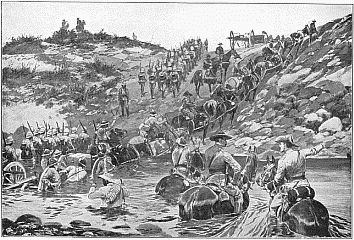
FROM FRERE TO CHIEVELEY—DIFFICULTIES OF TRANSPORT.
Drawing by R. Caton Woodville.
The arrival of Generals Buller and Clery and the increasing concentration of troops now began to presage an important and, it was hoped, decisive movement. Visual communication was being held nightly with General White, and a combined action seemed quite possible. It was recognised, however, that the Boer position at Colenso could not be taken by direct frontal attack, and that some arrangement to turn the left of the enemy must simultaneously accompany a demonstration in front. Mounted troops had now joined the British forces, and there was every hope that the Dutchmen, once routed, could be pursued and kept on the run. But so far the Boers were unconcerned; they seemed to be in fine fettle, and even indulged in humour at the expense of the British garrison. When the heliographers questioned the enemy, "Are you Boers?" they replied, "Yes." They were then asked, "Where are you going?" and bounced back, "To Maritzburg." "God help you," said we. "We think He will," they devoutly replied. They also indulged in compliments of a less righteous description, finishing up with the crude and scarcely eloquent expression, "Go to h—ll." But, as a mild diversion, Boer humour was accepted, for, in the routine of the soldier's existence, the smallest mercies in the form of distraction were thankfully received. Life just then, even for the officers, was not roseate—the messes had a ubiquitous menu of bully beef and bread, and the mess-tents were made of the tarpaulins of the big mule-waggons. Repose was a beautiful name. The torture of sleeping on a valise on the ground for weeks at a stretch was—so an officer declared—much the same as that produced by some beds in Irish inns—after lying down for some hours, you have to get up and take a rest!
Meanwhile, Provost-Marshal Major Chichester, at Frere Camp, distinguished himself. On the 7th of December he started off with thirty men of the Natal Carabineers and a few Mounted Police for the purpose of arresting three colonists suspected of aiding the enemy. They left camp for the Gourton district at about 5 a.m., and marched through the country beneath the snow-capped Drakensberg Mountains some fifty miles. There the landscape is picturesque and beautiful as any in Natal; but their object was not to admire scenery, but to pursue traitors. At a small farm they came upon the objects of their search. The miscreants were promptly seized, together with their loot, some 150 head of cattle. With these the party started to return, but were fired on by six Boers from a neighbouring donga or ditch. Major Chichester then ordered forward part of his troop with the prisoners in charge, while he and the rest of his men held the enemy at bay. A brisk fusillade ensued, in which five of the enemy's ponies were killed, and several of the Boers were shot. The party returned to camp safely, after having accomplished the object of their expedition in the space of twenty-three hours.
The trestle bridge at Frere was now completed, and trains began to run over it. Frere Bridge, on the Natal Government Railway, some twenty miles from Ladysmith, was, it may be remembered, the first to be blown up by the Boers on their retreat from Estcourt to Colenso.
The following is a rough list of the force, under General Sir Redvers Buller, Major-General Sir C. F. Clery, Major-General Hildyard, and Major-General Barton, which was now advancing towards Ladysmith from Durban by way of Pietermaritzburg, Mooi River, Estcourt, and Colenso:—
1st Border Regiment, 2nd Royal Dublin Fusiliers, 2nd West Yorkshire, 2nd East Surrey, 2nd West Surrey, 2nd Devonshire, 1st Welsh Fusiliers, 2nd Scottish Rifles, 2nd Royal Fusiliers, 2nd Royal Scots Fusiliers, 2nd Royal Irish Fusiliers, 1st Royal Dragoons, 1st Durham Light Infantry, 13th Hussars, 1st Connaught Rangers, 1st Dublin Fusiliers, 1st Gordon Highlanders, 1st Inniskilling Fusiliers, 2nd Somersetshire Light Infantry, 3rd King's Royal Rifles, B Squadron 6th Dragoon Guards, one Squadron Imperial Light Horse, Durban Light Infantry, various Local Rifle Associations, Naval Detachments, Volunteer Cavalry and Infantry, Uitlander Corps under Major Thorneycroft, 7th, 14th, 64th, 66th, 73rd Field Batteries, several Companies Royal Engineers, several Companies R.A.M.C., Field Hospitals.
Besides the arrival of incoming regiments, camp life at Frere was enlivened by many minor episodes. Provost-Marshal Major Chichester paid more surprise visits to Dutch farms whose owners were suspected of aiding the enemy. Though looting was strictly forbidden, some of the raiding parties returned with interesting souvenirs of their expeditions—sometimes in the form of corpulent turkey, squeaking sucking-pig, or other dainty with which to vary the monotony of camp fare. Good-nature prevailed among the troops, and the health of the men testified to the excellence of their feeding. Fair beef, occasional mutton, and beer were available, and with these at hand and the enemy in front, and shortly to be interviewed by heavy guns plus the bayonet, "Tommy" was well content. Meanwhile, reinforcements continued to come up from Maritzburg in all haste. The march from thence to Balgowan made the first twenty-five miles. On to Nottingham Road made another ten. After a halt they took another twelve miles stretch to Mooi River. To Estcourt was twenty-four miles over fresh and verdurous country, and to Frere Camp was another fifteen. The troops, as a rule, were on the move about three in the morning, for it was now the Cape summer, and as much toil as possible was accomplished before the sun was up. Striking tents, loading waggons, feeding and watering horses, swallowing breakfast, took place in twilight, and then they proceeded to saddle up and march. Arrived at their destination, the troops off-saddled, attended to the horses, pitched tents, and performed other camp duties. Rations consisted of bread, tea, coffee, sometimes meat and potatoes. Water was a luxury, and so little was wasted for external application that several troopers offered to play the part of Othello without any make up. The war kit of the men was somewhat of the Christmas-tree order. On them were haversacks containing food, horse-brush, currycomb, and towel, water-bottle, bandolier with fifty cartridges, waistbelt and gun weighing ten pounds. Often as not they turned in to rest, if not exactly thus equipped, at least booted and spurred, ready to be up and doing at a moment's notice!
On the morning of the 14th of December the troops advanced from Frere to Chieveley. Reveille was sounded at 3 a.m., and soon the camp was one buzz of active life. In the warm glow of camp-fires tents were struck, kits packed, horses fed and watered, and the men breakfasted. Four regiments of infantry "fell in" and moved out from the camp, followed at intervals by other arms. The procession measured some eight miles long, and was composed of variegated objects, such as ambulance waggons dragged by innumerable oxen, mule and donkey carts, the teams and guns of six field-batteries, cavalry and infantry, and hale and hearty Jack Tars, looking very ship-shape, square and determined, and joking as though they were off to a ball. All were equally jovial, all confident that the big move was begun, and a big and glorious ending was in store.
The entire force encamped three miles from the Tuegla River to north-west of Chieveley Station; the Infantry Brigades being on the extreme front, while the Cavalry, Mounted Infantry, and Artillery were nearer to Chieveley. Soon after this the Naval guns set to work to search the intrenchments and positions of the enemy north of Colenso. These guns, consisting of two 4.7-inch and four 12-pounders, were posted some 3000 yards south of the Tugela, about three miles from Colenso village, and facing what was afterwards discovered to be the Boers' position. Their bark resounded over the kopjes for miles, throwing up gigantic volcanic eruptions, which resembled mammoth mushrooms suddenly springing to life. But beyond filling the hearts of hearers with awe, they produced no result. The Boers were silent, so silent indeed that some imagined that they had vacated their positions and that the passage of the Tugela would after all be quite a frolicsome picnic, with perchance a few crackers thrown in. All were deceived—even those well acquainted with Boer tricks and duplicity—and all imagined that the enemy had fallen back, possibly for the closer protection of Ladysmith.
But before going further, it is necessary to keep in touch with other brave defenders of the Empire.
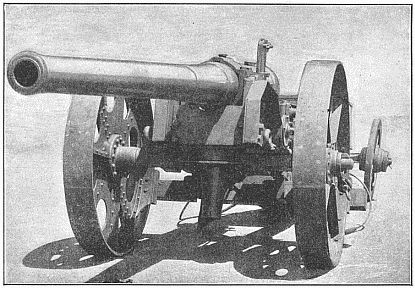
Types of Arms—4.7 Naval Gun on Carriage Improvised by Capt. Percy Scott of H.M.S. Terrible.
Photo by E. Kennard, Market Harborough