Chapter I
Reading edition
The Battle of Majuba Hill.
Lord Rosebery's Reflections
The Earl of Rosebery, under date of October 11, 1899, wrote that he could speak "without touching politics, for a situation had been created beyond party polemics, and it was needless to discuss how we could best have attained our simple and reasonable object of rescuing our fellow-countrymen in the Transvaal from intolerable conditions of subjection and injustice, and of securing equal rights for the white races in South Africa, for an ultimatum has been addressed to Great Britain by the South African Republic which is in itself a declaration of war."
Lord Rosebery continued that the people would close their ranks and relegate party controversy to a more convenient season, and there was in addition this to say: "Without attempting to judge the policy which concluded a peace after the reverse at Majuba Hill, I am bound to state my profound conviction that there is no conceivable Government in this country which could repeat it."
In a speech at Bath, unveiling the mural tablets to the Earl of Chatham and William Pitt, Mr. Gladstone's brilliant lieutenant and successor said of the Boer ultimatum, it was such as, he thought, the proudest empire in the world would have hesitated about sending. But since the commencement of the war the Boers had engaged in the strange policy of issuing decrees of annexation of British territory, which were, apparently, desirable additions to the Republic of the Transvaal.
Lord Rosebery's Speech at Bath
There had been a great misunderstanding about the Majuba Hill transaction. It was a mere skirmish, and concurrently with that there was an attempt on the part of the then Government to settle peaceably the issue in the Transvaal. Now, whatever they might think of the result of that attempt, the thing in itself was a sublime experiment. Mr. Gladstone, with his overpowering conviction of the might and power of England, thought that she could do things which other nations could not do, and, therefore, endeavored to treat with the Boers after the reverse which took place. We knew how Mr. Gladstone's magnanimity was rewarded. He (Lord Rosebery) felt a deep misgiving at the time in respect to this course of policy, and his fears had been realized in the result. The Boers had regarded that magnanimity as a proof of weakness, and they rewarded Mr. Gladstone's magnanimity with a deliberate and constant encroachment on the terms of the settlement. Then there came the discovery of gold. If they might judge from all that they had read, the income secured by the discovery of gold produced great corruption in the Transvaal. The bill of salaries—public salaries in the Transvaal—amounted, on a calculation, to about £40 a head of the population, and it could not but be considered that that was a liberal allowance for the working of so simple a republican Government. The Jameson raid was not merely a deplorable incident from a diplomatic point of view, but it was also the symptom of a deplorable state of things. They might be quite certain that no English gentleman would have engaged in what might be called a filibustering raid had it not been for the strong cry of distress that proceeded from within the Transvaal.
But it was unfortunate from many points of view. In the first place, it gave the Transvaal Government very much the best of the argument. They had then a great grievance to complain of, and we in those circumstances could not urge those grievances of which our subjects had to complain. In the meantime, almost all the taxation of the country was drawn from our fellow-countrymen—the very people who were not subjects of the Transvaal. Our fellow-subjects combined in vain for the most elementary form of education. They were losing face, so to speak, in the eyes of the natives and of the world at large. And the most important element of all was beginning to attract attention—which was that with the money derived from the gold the Transvaal Government was gradually piling up a great military power, armed to the teeth. That was a standing menace to to our dominion. If it had continued we should have had to consider whether we who rule so many nations were to become a subject nation in our turn in South Africa; and had we become a subject nation, or remained even in the position in which we were, it was scarcely possible to doubt that we should have lost South Africa itself.
The Sting of Majuba Hill
Nothing has happened showing more distinctly than Lord Rosebery's utterance, the sting that has rankled in England of the unfortunate campaign that closed in the surrender at Majuba Hill; and the history of that event, with the influential circumstances before and after, has been obscured rather than cleared by the strenuous spirit of controversy on both sides. Every point is contested except the defeat of the British. The Boers claim that 120 of their riflemen assailed the British soldiers and made prisoners of them, though they were 600 strong. The British version is that they were caught in an untenable position and overwhelming forces, outnumbering them four to one, were their assailants. There is bitter feeling in the British Army on the relative responsibilities of disaster, and the reinforcements sent from England, arriving at Cape Town soon after the battle were in a desperate state of dissatisfaction with the peacemaking that followed, and felt themselves not only aggrieved but insulted. The Gordon Highlanders at Majuba Hill A despatch from Bombay about the embarkation to take part in the present Boer and British war of the Gordon Highlanders, contained the following: "The stern, grim Highlanders were curiously quiet. Every Englishman who saw them knew the reason. The Gordons are one of the finest regiments in the army. They have a splendid fighting record. But in the last Boer war a strong detachment of the Second Battery broke and turned on the bloody hill of Majuba. It was an inexplicable occurrence, for the men were bronzed veterans who had just fought their way through Afghanistan and made the famous march with Lord Roberts from Kabul to Kandahar. The regiment has brooded over the stain for nineteen years. No man has ever dared to mention Majuba before a Gordon Highlander. Everyone who saw them embark this morning knew what their rigid faces portended. Their chance had come. This time there would be no mistake. Highlanders have long memories and the 'Gay Gordons' are in the mood to allow themselves to be hewn to pieces rather than take a single step backward before the Boers or any other foe."
An Eyewitness About Majuba Hill
John Boyd of Galt, who was of the Gordon Highlanders Regiment for 21 years, regards this as a "foul aspersion." He says of his old regiment:
"Its reputation can dispense with both personality and egotism. Its deeds speak for themselves, and at Majuba Hill the bonnie Gordons upheld their honor and glory. I was there, and I know that I speak truth. As distinctly as if the events took place yesterday, I remember all that occurred on that awful night, when 121 Gordon Highlanders braved thousands of enemies in ambush. I am not exaggerating. Hundreds of Boers were concealed on the hill, while 2000 lay hidden across the nek, and pitted against such overwhelming odds were 100 Highlanders, and barely 300 other troops.
"And the writer of that London dispatch says that we 'broke and turned'; that, in short, we retreated. Let me tell you that of the 121 Gordons, 60 were killed or wounded, and 27 were taken prisoners. And these men who fought against fate, yet who—I solemnly declare—stood their ground to the last, are accused of showing the white feather. Dead men tell no tales, nor can they defend themselves from such calumnies. But how, I ask, could they play the craven when one-half were stark and stiff, dying, as they had lived, for their country? And of the handful who escaped the Boers and their bullets all were on the hill when morning broke. I was one, with a wounded comrade at my side.
"I am not in the habit of talking of what I have or have not done, nor do I proclaim from the housetops the Gordons' enviable past. But I was with them at Majuba Hill; in spirit I am with them now; and the man who says that the Ninety-second ever disgraced its colors or its Queen, does the regiment a grievous wrong, and himself a greater one."
The claims of Great Britain to sovereignty in the Orange Free State were withdrawn in 1854, and this seemed to give additional force to the annexation of the Transvaal in 1877, and that, it must be admitted, was in a sense a mistake, because it was done under the impression that the Boers really desired it. That was evidently an error when the time came for the fulfillment of the policy, but what amount of demagogy occurred in the meantime to change the sentiments of the ruling class of the Transvaal is a matter of doubt; and there are other difficulties that do not necessarily enter into the consideration of the subject.
Proclamation of President Steyn
The proclamation of President Steyn of the Orange Free State entering unreservedly into an alliance, defensive and offensive, with the Transvaal Boers, states with vehemence the principles contended for and the attitude assumed in antagonism with the British during the present conflict. President Steyn said that the Orange Free State was bound "with the sister republic not only by ties of blood, of sympathy and of common interests, but also by formal treaty, which has been necessitated by circumstances. This treaty demands of us that we assist her if she should be unjustly attacked, which we unfortunately for a long time have had too much reason to expect;" and President Steyn added:
What the Proclamation Charges
"Our own unfortunate experiences in the past have also made it sufficiently clear to us that we cannot rely on the most solemn promises and agreements of Great Britain when she has at her helm a Government prepared to trample on treaties, to look for feigned pretext for every violation of good faith by her committed. This is proved among other things by the unjust and unlawful British intervention after we had overcome an armed and barbarous black tribe on our eastern frontier, as also by the forcible appropriation of the dominion over part of our territory where the discovery of diamonds had caused the desire for this appropriation, although contrary to existing treaties. The desire and intention to trample on our rights as an independent and sovereign nation, notwithstanding a solemn convention existing between this State and Great Britain, have also been more than once and are now again shown by the present Government by giving expressions in public documents to an unfounded claim of paramountcy over the whole of South Africa, and therefore also over this State."
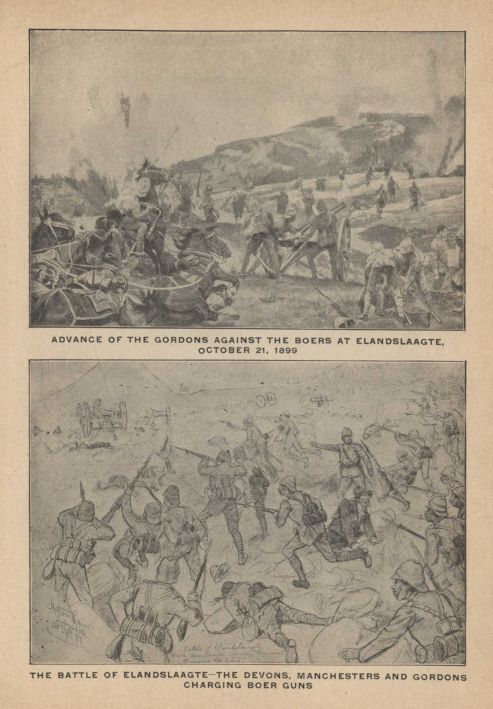
ADVANCE OF THE GORDONS AGAINST THE BOERS AT ELANDSLAAGTE, OCTOBER 21, 1899. THE BATTLE OF ELANDSLAAGTE—THE DEVONS, MANCHESTERS AND GORDONS CHARGING BOER GUNS
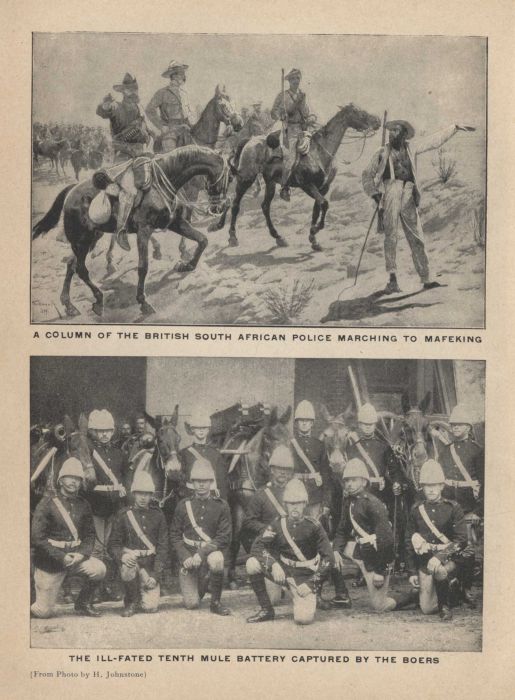
A COLUMN OF THE BRITISH SOUTH AFRICAN POLICE MARCHING TO MAFEKING. THE ILL-FATED TENTH MULE BATTERY CAPTURED BY THE BOERS (From Photo by H. Johnstone)
The Orange proclamation charges that it is the discovery of gold mines in the country that causes the claims made upon the Republic, and adds:
"The consequence of these claims would be, moreover, that the greater part of the power will be placed in the hands of those who, foreigners by birth, enjoy the privilege of depriving the country of its chief treasure while they have never shown any loyalty to a foreign government. Besides, the inevitable consequence of the acceptance of these claims would be that the independence of the country as a self-governing, independent sovereign republic would be irreparably lost."
Boers not Capable of Modern Mining
This statement does not seem to be made in the fullness of candor. The Transvaal people are not capable of working gold mines by the modern methods. They are essentially the masters of cattle ranches and of farming in an extensive and rather rude way. Their country is much like Western Kansas, New Mexico and Colorado in some respects; and the interest they have taken in the gold mines has been not to get the gold by digging for it. They have neither capital nor labor to put into the mining operations, but they have insisted upon their pre-eminence in authority and profited through the taxation of the gold product and of the accumulations of property by the British, and held the immigrants to the gold region to be intrusive and a disagreeable and troublesome people who must be subordinated, because they were adequate in the business of mining, the methods of which have become exceedingly complicated. Unquestionably the Boers have got more gold than they would have acquired if they had worked the mines for themselves. The Newcastle Chronicle, one of the most important provincial papers of England, because it is assuredly representative of the public opinion of the country, says plainly in reply to the proclamations of the Boers and of the President of the Orange State:
Newcastle "Chronicle" on the War
"We are fighting to prevent men of British blood from being treated as 'helots' on British territory by a sordid oligarchy which British arms saved from extinction and British generosity endowed with autonomy.
"We are at war for the purpose of preventing our brethren in South Africa from being taxed without representation; from being placed under the control of courts whose judges take their orders from a corrupt Executive; from being refused the right to carry arms while their oppressors flourish theirs with insolent brutality; from being compelled to contribute to schools in which English is treated as a foreign tongue; in short, from being denied the elementary rights of self-government in territory undoubtedly British.
"We ask no privilege for ourselves that we would not give to the Boers, but we will not submit to be ostracized and domineered over in our own dominions.
"We cherish no revengeful feelings.
"The British flag is the herald of mercy as well as might.
"But we will have justice for our countrymen and control of our own Empire, come what may."
The language of President Steyn as to gold mines is: "The British Government, now that gold mines of immense value have been discovered in the country, make claims on the republic, the consequences of which, if allowed, will be that those who or whose forefathers have saved the country from barbarism and have won it for civilization with their blood and tears, will lose their control over the interests of the country to which they were justly entitled according to divine and human laws."
The First Right to the Transvaal Gold
The British resent as the greatest injustice the accusation that they are fighting expressly for the diamond and gold mines, that, indeed, are already the property of the English speaking people who discovered and developed them. As the claim of proprietorship is made by President Steyn, it amounts to the announcement of the confiscation of this property if the Almighty, whom they call upon so familiarly, gives them the victory they solicit in their prayers. If we must go back to the beginning, the aborigines have the first right to the precious stones and metals, if the rights of discovery, investment and labor are to be absolutely disregarded. There is an unyielding spirit on both sides, and war has been in the air and unavoidable ever since that English aberration which the Earl of Roseberry called the "sublime experiment of Mr. Gladstone in magnanimity" after the Majuba Hill defeat of the British. There is no question that the fight must be fought out. The issues are racial and radical.
The war that ended in the magnanimous policy after the defeat at Majuba Hill began with the Boer's resistance to taxation. They are as determined not to be taxed by others without representation as they are to tax others and refuse representation, because they have the power to do it or make war. Having subjugated and in a great measure enslaved the natives, it seems to be the temper and the passion of their lives to treat the English as inferiors and forbid them to exercise local authority, or assert that they have rights beyond those of paying for being on the ground.
The Broukhorst Spruit Affair
The first of the war, when the English assumed to have annexed the Transvaal, was caused by the seizure of a Boer wagon. A great wagon and a string of oxen are to the Boer almost sacred objects, and his sense of propriety of an immense structure on wheels drawn by ten long-horned oxen, propelled with a whip, the handle as long as a fishing pole, is something extraordinary. The Boers rose at once and took the wagon from the Sheriff, resisting what the Uitlanders have been resenting. They had suspected trouble was ahead and prepared for it, collecting ammunition and storing it in their wagons. A portion of the Ninety-fourth British Regulars was stationed at Leydenburg, north and east of Pretoria, and ordered to go to that city, The Boers came to the warlike resolution to oppose the march of the British, and ordered them to halt, with the placid purpose of discussing an accommodation, but the commander of the detachment of the Ninety-fourth had his orders and proceeded. A fight ensued, and the British, after suffering severe losses, were surrounded and surrendered. This was the Broukhorst Spruit affair.
The Laing's Nek
Mr. Gladstone was at the time too deeply interested in Irish affairs to give much attention to those in Africa, and Sir George Colley, who had been appointed High Commander over the Transvaal and Natal, took charge of the leading responsibilities. Sir George had visited Pretoria in 1875, and thought public opinion favorable to British rule over the Transvaal. When he heard of the Boers fighting for their wagons to be free, he collected available troops and led them into the difficult country encountered in advancing from Natal to the Transvaal. The Boer forces upon Natal territory commanded the pass across Laing's Nek. In January, 1881, Sir George attacked the pass and fought on the precise plan followed by the British officers in the present war. First he used the artillery, shelling the Burghers, followed it up by an infantry attack straight in front, while the mounted men made flank diversions. The Boers stood shelling as well then as recently, met the assaults in front with a deadly fire, and soon stood off the mounted men, endeavoring to turn the flanks. The Boers were very successful in picking off the gunners of Sir George's artillery, and his attacks proved failures all around.
Majuba Hill
The Burghers thought the British would have to surrender, but they managed by great exertions to recross the Ingogo River and returned to their camp at Mount Prospect. Both sides were of the judgment after the conflict that serious business was on hand, and there was an informal and perhaps an involuntary suspension of hostilities, with a great deal of talk about making peace. Sir Evelyn Wood was on his way to take command, and Sir George Colley concluding not to wait for him, made a rush for the summit of Majuba on the night of February 26th, 1881, and, dragging artillery, reached the table-land at the top, after excessive exertion. The plateau contains about four acres, curiously surrounded by a confusion of rocks, and in the center is a considerable depression. It seemed that the capture of the mountain was a decisive success, as the British forces had turned the position of their enemy. The Boers were greatly surprised, their camp was overlooked by the English. One doesn't always have an advantage over an enemy when he gets into a high place, and it happened that the ground was well suited to the peculiar tactics of the Boers. Instead of retreating, there was a call for volunteers to attack the British, and the matchless riflemen of the Transvaal were ardent and energetic in undertaking the seemingly desperate but really rather simple task before them. They took shelter behind the rocks, and, by rushes and dodges reached the fringe of stones that were like a framing beam around the plateau of four acres at the top with the depression in it, and then it appeared the British were entrapped in their position that they had sought, believing that it was one that commanded the situation. The fringe of rocks became a ring of fire. Sir George was killed and his troops defeated as decidedly as Braddock's regulars were by the French and Indians near Pittsburg.
The camp of Sir George at Mount Prospect is distinguished now for the cypress trees that surround his grave. After his fall there was no intelligent resistance by his forces. They were simply shot down by the Boers from their ambuscade in the tumbled rocks, until the slaughter was terminated by a surrender.[1]
Terms of Settlement
This called Mr. Gladstone's attention to the conditions in South Africa, and it was his understanding that the majesty of England was so great that she could afford to do anything that he thought was right. The President of the Orange Free State became useful as a mediator, and terms of settlement, to which Mr. Gladstone and Mr. Kruger, then Vice President of the Transvaal, with some minor disagreements omitted, were signed on the 24th of March, subject to ratification by the Transvaal Volksraad; and Sir Frederick Roberts, with reinforcements, met peace men at Cape Town. Mr. Kruger, Pretorius and Joubert had a good deal of trouble to carry the terms of settlement in the Boers' representative Assembly, for they had conceived ideas of sovereignty, and their successes appeared to warrant them in extensive assertions of themselves. They were very pressing for further concessions from Mr. Gladstone, and had a list of points of their dissatisfaction with the protocol that had been signed. The leading objection they made was the reference of foreign affairs to British supervision; Mr. Gladstone, however, insisted upon that. It was the Boers' idea the British should have nothing to do with the Transvaal, that there was to be no interference in any form with the legislation of the country, whether it was about foreign or domestic affairs. The negotiations were terminated by a continuation of the truce, and the gold discoveries and increasing importance of the Uitlanders caused a succession of difficulties and exasperations, culminating at last in the Jameson Raid, and, after an intermission of disquietude, the war that is on.
When the death of Sir George Colley, the High Commissioner in Southeastern Africa, occurred on Majuba Hill, it developed upon Sir Evelyn Wood to become Governor of Natal, and his Chief of Staff was Sir Redvers Buller. It was a very distasteful task that Sir Evelyn Wood and Sir Redvers Buller had, to talk peace in the shadow of British defeat, but they did their duty in that respect. In the course of the adjustments Sir Redvers and Mr. Kruger, President of the Transvaal, met personally, but the negotiations were fruitless until President Rand, of the Orange Free State, exerted his mediating capacity and won great reputation as a peacemaker.