Part 2 — NOTES ON THE SONGS
Reading edition
A second version of the melody was obtained from Bruce Tyndall, Esq., of Exmouth, who had learned it from a Devonshire nurse in 1839 or 1840. The melody was but a variant. It had lost the E♮ that comes in so pleasantly.
The tune was certainly originally in the Dorian mode, the E♭ being an alteration of a modern singer. We did not, however, feel justified in restoring the air to its early form, as we had no authority for so doing.
The words of the song are to be found in a collection of early ballad books in the British Museum, entitled "The Court of Apollo." There it consists of six verses, the first three of which are almost word for word the same as ours. In "The Songster's Favourite Companion," a later collection, the same song occurs. There it is in three verses only, and in a very corrupt form.
We are inclined to think that the song dates from the time of James I. or Charles I.
John Arscott, the last of his race, died in 1788. The "Sons of the Blue" are taken to have been Sir John Molesworth of Pencarrow, Bart., William Morshead of Blisland, and Braddon Clode of Skisdon. But neither Sir John Molesworth nor Mr. Morshead was, as it happens, a naval man. If the date were either 1652 or 1672, it would fit John Arscott of Tetcott, who died in 1708, and Sir John Molesworth of Pencarrow, who was Vice-admiral of Cornwall; and the "Sons of the Blue" would be Hender, Sparke, and John, sons of Sir John. The second John Molesworth married Jane, daughter of John Arscott of Tetcott, in 1704. It seems probable, accordingly, that the song belonged originally to the elder John Arscott, and was adapted a century later to the last John Arscott. The date is not given with precision in the song; it is left vague as to the century—"In the year '52."
The author of the version of the song as now sung is said to have been one Dogget, who was wont to run after the foxhounds of the last Arscott. He probably followed the habit of all rural bards of adapting an earlier ballad to his purpose, and spoiling it in so doing. I think this, because along with much wretched stuff there occur traces of something better, and smacking of an earlier period. As Dogget's doggerel has been printed, and as I have taken down a dozen variants, I have retained only what I deemed worthy of retention, and have entirely recast the conclusion of the song.
John Arscott is still believed to hunt the country, and there are men alive who declare positively that they have seen him and his hounds go by, and have heard the winding of his horn, at night, in the park at Tetcott.
Mr. Frank Abbott, gamekeeper at Pencarrow, but born at Tetcott, informed me, concerning Dogget: "Once they unkennelled in the immediate neighbourhood of Tetcott, and killed at Hatherleigh. This runner was in at the death, as was his wont. John Arscott ordered him a bed at Hatherleigh, but to his astonishment, when he returned to Tetcott, his wife told him all the particulars of the run. 'Then,' said Arscott, 'this must be the doing of none other than Dogget; where is he?' Dogget was soon found in the servants' hall, drinking ale, having outstripped his master and run all the way home."
In the MS. copy of 1820, the names of the "Sons of the Blue" were Bob (Robt. Dennis of S. Breock), Bill (Bill Tickell), and Britannia (Sir J. Molesworth). The tune, which is in the Æolian mode, was obtained through the assistance of Mr. W.C. Richards, schoolmaster at Tetcott. We also had it from John Benney, labourer, Menheniot.
Mr. Richards writes:—"This song is sung annually at the Rent-audit of the Molesworth estate at Tetcott. Thirty years ago an old man sang it, and the version I send you is as near the original, as sung by him, as can be secured. Workmen on the estate often hum the air, and always sing it at their annual treats." The Arscott property at Tetcott passed by inheritance to the Molesworths.
Half of the tune was employed by D'Urfey, a Devonshire man, in his "Pills to Purge Melancholy," to the words, "Dear Catholic Brother" (vi. p. 277, ed. 1719-20). From D'Urfey it passed into the "Musical Miscellany," 1731, vi. p. 171, to the words, "Come take up your Burden, ye Dogs, and away." From England the same half-tune was carried into Wales, and Jones, in his "Musical Relicks of the Welsh Bards," 1794, i. p. 129, gives it set to the words of "Difarwch gwyn Dyfl."
As Benny's variant is interesting, I give it here—

[Audio content is not currently supported on your device. [XML]
Hard sang the words of Charles Swan—
"'Twas on a Sunday morning, before the bells did peal, A note came through the window, with Cupid as the seal."
These words were set to music by Francis Mori in 1853. I give Mori's tune, and advise that with it should be compared Hard's variation of it. I have written fresh words to this variation—
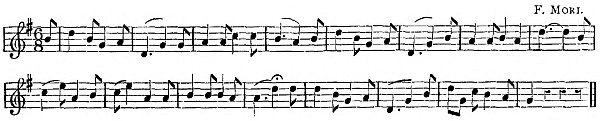
[Audio content is not currently supported on your device. [XML]
Johnson, in his "Museum," professed to give a Scottish version—
"O Lady Mary Ann looks owre the Castle wa', She saw three bonny boys playing at the ba', The youngest he was the flower among them a'; My bonny laddie's young, but he's growing yet."
But of his version only three of the stanzas are genuine, and they are inverted; the rest are a modern composition.
A more genuine Scottish form is in Maidment's "North Country Garland," Edinburgh, 1874; but there the young man is fictitiously converted into a Laird of Craigstoun. It begins—
"Father, said she, you have done me wrong, For ye have married me on a childe young man, And my bonny love is long Agrowing, growing, deary, Growing, growing, said the bonny maid."
But the most genuine form is on an Aberdeen Broadside, B.M., 1871, f. This, the real Scottish ballad, has verses not in the English, and the English ballad has a verse or two not in the Scottish.
I have received an Irish version as sung in Co. Tipperary; it is in six verses, but that about the "Trees so High" is lacking. The rhyme is more correct than that of any of the printed versions, and the lines run in triplets. One verse is—
"O Father, dear Father, I'll tell you what we'll do, We'll send him off to college for another year or two, And we'll tie round his college cap a ribbon of the blue, To let the maidens know he is married."
In one of the versions I have taken down (Hannaford's and Aggett's) there were traces of the triplet very distinct, and the tune was akin to the Irish melody sent me, as sung by Mary O'Bryan, Cahir, Tipperary. Portions of the ballad have been forced into that of "The Cruel Mother" in Motherwell's MS., Child's "British and Scottish Ballads," i. p. 223. In this a mother gives birth to three sons at once and murders them; but after they are murdered—
"She lookit over her father's wa', And saw three bonnie boys playing at the ba'."
Our melody is in the Phrygian mode, a scale which is extremely scarce in English folk-song. The only other example we know is in Ducoudray's book of the "Folk Melodies of Brittany."
The Scotch have two airs, one in Johnson's "Museum," the other in "The British Minstrel," Glasgow, 1844, vol. ii. p. 36, both totally distinct from ours.
That the ballad is English and not originally Scotch is probable, for Fletcher quotes it in "The Two Noble Kinsmen," 1634. He makes the crazy jailer's daughter sing us a snatch of an old ballad—
"For I'll cut my green coat, a foot above my knee, And I'll clip my yellow locks, an inch below my eye, Hey ninny, ninny, ninny; He's buy me a white cut (stick) forth for to ride, And I'll go seek him, through the world that is so wide, Hey ninny, ninny, ninny."
In the ballad as taken down from Aggett—
"I'll cut my yellow hair away by the root, And I will clothe myself all in a boy's suit, And to the college high, I will go afoot."
I have had versions also from Mary Langworthy, Stoke Flemming, in the Hypodorian mode, and from W.S. Vance, Penarth, as sung by an old woman at Padstow in 1863, now dead.
Mr. Sharp gives a version in "Folk Songs from Somerset," No. 15.
"O once I had plenty of thyme, It would flourish by night and by day, Till a saucy lad came, return'd from the sea, And stole my thyme away. "O and I was a damsel fair, But fairer I wish't to appear; So I wash'd me in milk, and I clothed me in silk, And put the sweet thyme in my hair. "With June is the red rose in bud, But that was no flower for me, I plucked the bud, and it prick'd me to blood, And I gazed on the willow tree. "O the willow tree it will twist, And the willow tree it will twine, I would I were fast in my lover's arms clasp't, For 'tis he that has stolen my thyme. "O it's very good drinking of ale, But it's better far drinking of wine, I would I were clasp't in my lover's arms fast, For 'tis he that has stolen my thyme."
The song, running as it does on the same theme and in the same metre as "The Seeds of Love," is very generally mixed up with it, and Miss Broadwood calls her version of it, in "English County Songs," p. 58, "The Seeds of Love, or The Sprig of Thyme." The "Seeds of Love" is attributed by Dr. Whittaker, in his "History of Whalley," to Mrs. Fleetwood Habergham, who died in 1703. He says: "Ruined by the extravagance and disgraced by the vices of her husband, she soothed her sorrows by some stanzas yet remembered among the old people of her neighbourhood." See "The New Lover's Garland," B.M. (11,621, b 6); a Northumbrian version in "Northumbrian Minstrelsy," 1882, p. 90; a Scottish version in "Albyn's Anthology," 1816, i. p. 40; a Somersetshire in "Folk Songs from Somerset," No. 1; a Yorkshire in Kidson's "Traditional Tunes," p. 69. As the two songs are so mixed up together, I have thought it best to re-write the song.
The melody was almost certainly originally in the Æolian mode, but has got altered.
The words and tune were clearly composed at the time of the Commonwealth, 1649-1661.
"I am Ormond the brave, did you ever hear of me? Who lately was banished from my own country. They sought for my life and plundered my estate, For being so loyal to Queen Anne the Great. I am Ormond, etc. "Says Ormond, If I did go, with Berwick I stood, And for the Crown of England I ventured my blood, To the Boyne I advanced, to Tingney (Quesnoy?) also, I preserved King William from Berwick his foe. "I never sold my country as cut-purses do, Nor never wronged my soldiers of what was their due. Such laws I do hate, you're witness above, I left my estate for the country I love. "Although they degrade me, I value it not a straw, Some call me Jemmy Butler, I'm Ormond you know. (Rest of verse missing.) "But in the latter days our late Mistress Anne, Disprove my loyalty if you can, I was Queen Anne's darling, old England's delight, Sacheverel's friend, and Fanatic's spite."
When Peake sang the song to Mr. Sheppard and me, he converted German Elector into German lecturers.
The impeachment and attainder of the Duke in 1715 was a cruel and malicious act. When he was in the Netherlands acting in concert with Prince Eugene, he was hindered from prosecuting the war by secret instructions from Queen Anne. When Quesnoy was on the point of capitulating, he was forced to withdraw, as he had received orders to proclaim a cessation of arms for two months. After the death of Queen Anne, the new Whig Ministry was resolved on his destruction, and he fled to France, where, although he had been loyal to William of Orange, and had fought under him at the Boyne, and had also been one of the first to welcome George I., he threw himself into the cause of the Pretender, in a fit of resentment at the treatment he had received. He died on 16th November 1745 at Avignon, but his body was brought to England and buried in Henry VII.'s Chapel, Westminster. Swift, writing in the hour of his persecution, gives his character at great length. "The attainder," says he, "now it is done, looks like a dream to those who will consider the nobleness of his birth; the great merits of his ancestors, and his own; his long, unspotted loyalty; his affability, generosity, and sweetness of nature.... I have not conversed with a more faultless person; of great justice and charity; a true sense of religion, without ostentation; of undoubted valour; thoroughly skilled in his trade of a soldier; a quick and ready apprehension; with a good share of understanding, and a general knowledge of men and history."
Mackay, in his "Characters of the Court of Great Britain," says of him when Governor in Ireland:—"He governs in Ireland with more affection from the people, and his court is in the greatest splendour ever known in that country. He certainly is one of the most generous, princely, brave men that ever was, but good-natured to a fault."
This ballad begins—
"As I went through the North Country I heard a merry greeting, A pleasant toy and full of joy— Two noblemen were meeting."
These two noblemen are Sir John Barleycorn and Thomas Goodale.
The sixth verse runs—
"Sir John Barlycorne fought in a boule Who wonne the victorie, And made them all to fume and sweare That Barlycorne should die. "Some said kill him, some said drowne, Others wisht to hang him hie; For as many as follow Barlycorne Shall surely beggars die. "Then with a plough they plow'd him up, And thus they did devise, To burie him quicke within the earth, And sware he should not rise. "With harrowes strong they combèd him And burst clods on his head, A joyfull banquet then they made When Barlycorne was dead."
Then the ballad runs on the same as ours. Burns got hold of this ballad, and tinkered it up into the shape in which it appears in his collected works, altering some expressions, and adding about six stanzas. He in no way improved it. Jameson, in his "Popular Ballads," Edinburgh, 1806, tells us that he had heard it sung in Morayshire before that Burns' songs were published.
Dixon, in his collection of the "Songs of the English Peasantry," 1846, says that "John Barleycorn" was sung throughout England to the tune of "Stingo, or Oil of Barley," which may be found in Chappell, from the "Dancing Master," in which it occurs from 1650 to 1690. But this is not the air to which it is set in the Broadsides above referred to, nor is it that to which it is sung in the West of England.
Dr. Barrett has given a different "John Barleycorn" in his "English Folk-Songs," and another is in the Folk-Song Journal, vol. i. p. 81.
The words as now sung may be found in "The Mountain of Hair Garland," B.M. (1162, c 4), circ. 1760. It is also among Such's broadsides. Words and air were taken down by Mr. Bussell, from James Mortimore, a cripple, at Princetown, in 1890.
A version taken down in Sussex, to a different tune, is seen in the Folk-Song Journal. This begins—
"There were three men came out of the West, They sold their wheat for rye; They made an oath and a solemn oath, John Barleycorn should die."
One verse is not in our version—
"And in the mash-tub he was put, And they scalded him stark blind. And then they served him worse than that They cast him to the swine."
Mr. Bell did not know much of the subject, or he would have been aware that so far from the song being of the 17th century, it was composed by Bickerstaff for "Thomas and Sally" in 1760, and was set to music by Dr. Arne. I have, however, adopted Bell's words instead of those of Bickerstaff, as shorter. The Cornish melody is quite distinct from that by Arne, and is not earlier or later than the second half of the 18th century.
Mr. C. Sharp has taken down a variant as "Midsummer Fair" in Somersetshire. The words so far as they went were the same, but each verse ended in a jingle instead of names.
"You maidens pretty In country and city With pity hear, My mournful tale; A maid confounded, In sorrow drownded, And deeply wounded, With grief and pain."
In the third line the "pity" has got misplaced, and "sad complain" has been turned into "mournful tale," to the loss of the rhyme. Verse 4 has fared even worse. It runs—
"My hardened parents Gave special order That I should be Close confined be (sic.) Within my chamber Far from all danger, Or lest that I Should my darling see."
A parody on the song was written by Ashley, of Bath, and sung in "Bombastes Furioso," Rhodes' burlesque, in 1810, to the Irish tune of "Paddy O'Carrol." This appears also in "The London Warbler," 3 vols., N.D., but about 1826, vol. i. p. 80—
"My love is so pretty, so gay, and so witty, All in town, court, and city, to her must give place. My Lord on the woolsack, his coachman did pull back, To have a look, full smack, at her pretty face," etc.
A Catnach Broadside, "The Cruel Father and the Affectionate Lovers," is a new version of the original ballad. Words and melody are probably of the Elizabethan age; an air to which this ballad has been recovered from tradition in Surrey resembles ours, and is a corruption of the earlier melody.
The ballad goes back to a remote antiquity. The French have it, a "complainte romanesque," of which Tiersot says: "It was known in past ages, as is shown by a semi-literary imitation, published in a song-book of the beginning of the 17th century. And in our own day, poets and literary men, such as Gerard de Nerval, Prosper Mérimée, M. Auguste Vitu, have given their names to it, having picked it up as a precious thing from oral recitations by the peasants of our provinces." It is the ballad of a princess loving a knight, "qu' n'a pas vaillant six deniers." The King Loys, her father, has imprisoned her in the highest of his towers—
"Elle y fut bien sept ans passés Sans qu' son pèr' vint la visiter; Et quand l'y eut sept ans passés, Son père la fut visiter."—Tiersot, op. cit. p. 20.
There can, I think, be no doubt that it is an old troubadour lay which has been re-composed in Elizabethan times, and has since been somewhat degraded.
The ballad is in Dixon's "Songs of the English Peasantry," 1846, as taken down by him from oral recitation in Yorkshire in 1845. It exists in a chap-book, under the title of "The Crafty Farmer," published in 1796. In Yorkshire the song goes by the name of "Saddle to Rags"; there, and elsewhere in the North of England, it is sung to the tune of "The Rant," better known as "How happy could I be with either." It has been published as a Scottish ballad in Maidment's "Ballads and Songs," Edinburgh, 1859. It is given in Kidson's "Traditional Tunes." The words also in "A Pedlar's Pack," by Logan, Edinburgh, 1849. The tune to which this ballad is sung in Devonshire is quite distinct.
The tune is possibly based on one used by the Savoyard sweeps, for Tiersot refers to one such: "Avec sa bizarre vocalise descendante, d'un accent si étrange dans sa rudesse montagnarde—
"Ramonez-ci, ramonez-là, Sh-a-a-a-ah La cheminée du haut en bas."
And this corresponds with the passage, "Aye and there," with its curious descent in our tune: Tiersot, "Hist. de la Chanson Populaire en France," Paris, 1889, p. 143.
Miss F. Crossing sent me another version of the words, taken down from an old woman in South Devon, in or about 1850—
"'My man John, what can the matter be?' 'I love a lady, and she won't love me.' 'Peace, sir, peace, and don't despair, The lady you love will be your only care; And it must be gold to win her.' "'Madam, will you accept of this pretty golden ball, To walk all in the garden, or in my lady's hall?' 'Sir, I'll accept of no pretty golden ball,' etc. "'Madam, will you accept of a petticoat of red, With six golden flounces around it outspread?' "'Madam, will you accept of the keys of my heart, That we may join together, and never, never part?' "'Madam, will you accept of the keys of my chest, To get at all my money, and to buy what you think best?' "'Sir, I will accept of the keys of your chest, To get at all your money, and to buy what I think best; And I'll walk and I'll talk with you.' "'My man John, there's a box of gold for you, For that which you told me has come true, And 'twas gold, 'twas gold that did win her.'"
Another version comes from Yorkshire ("Halliwell Nursery Rhymes," 4th ed., 1846); another from Cheshire (Broadwood, "English County Songs," p. 32); another in Mason's "Nursery Rhymes" (Metzler, 1877, p. 27). Melodies different from ours.
On April 15, 1797, when Admiral Bridport, commanding the line-of-battle ships at Portsmouth and Spithead, signalled for the fleet to prepare for sea, the men, by a preconcerted agreement, refused to raise anchors till they had obtained redress for their grievances, which had been sent in the form of a petition to Lord Howe, two months before, and which had remained unnoticed. The Lords of the Admiralty endeavoured for some days, but ineffectually, to reduce the men to obedience. At last the grievances complained of were redressed by the action of Lord Bridport, who also obtained his Majesty's pardon for the offenders. However, in May, the sailors at Portsmouth, thinking that the Government did not intend to keep faith with them, came ashore and committed great excesses. Shortly after this the fleet at Sheerness exhibited a mutinous spirit, and this broke out into open mutiny at the Nore. At the head of the men was Richard Parker, a Devonshire man. The obnoxious officers were sent ashore, and the red flag was hoisted. Altogether twenty-five ships were included in the mutiny. The mutineers seized certain store-ships, fired on some frigates that were about to put to sea, and blockaded the mouth of the Thames. All attempts at conciliation having failed, it became necessary to resort to stringent measures. Ships and gunboats were armed, batteries were erected on shore; the mutineers were prevented from landing to obtain fresh water and provisions; and all buoys and beacons were removed, so as to render egress from the Thames impossible. One by one the ships engaged in the mutiny began to drop off, and at last the Sandwich, Parker's flagship, ran in under the batteries and delivered up the ringleader. Parker was hung at the yard-arm on June 30. The ballad was composed at the time, and obtained a wide circulation by appearing on Broadsides.
At the Exeter Assizes in 1828, John C. Parker, son of Richard Parker, obtained a verdict against his aunts for the possession of an estate called Shute, which had belonged to his father's elder brother. The question turned upon the legitimacy of the plaintiff, which was proved by his mother, a woman who exhibited the remains of uncommon beauty, and who was a Scottish woman, married to Richard Parker in 1793.
At one o'clock a large party of ladies and gentlemen, in summer attire—the ladies decorated with garlands of flowers, the gentlemen with nosegays and flowers in their hats, assemble at the Town Hall, and proceed to dance after the band, playing the traditional air. They first trip in couples, hand in hand, during the first part of the tune, forming a string of from thirty to forty couples, or perhaps more; at the second part of the tune the first gentleman turns with both hands the lady behind him, and her partner turns in like manner with the first lady; then each gentleman turns his own partner, and then they trip on as before. The other couples, of course, pair and turn in the same way, and at the same time.
The dancing is not confined to the streets; the house doors are thrown open, and the train of dancers enters by the front, dances through the house, and out at the back, through the garden, and back again. It is considered a slight to omit a house. Finally the train enters the Assembly Room and there resolves itself into an ordinary waltz.
As soon as the first party is finished, another goes through the same evolutions, and then another, and so on, and it is not till late at night that the town returns to its peaceful propriety.
There is a general holiday in the town on Flora Day, and so strictly was this formerly adhered to, that anyone found working on that day was compelled to jump across Pengella, a wide stream that discharges its waters into Loo Pool. As this feat was almost impracticable, it involved a sousing. The festival has by no means ceased to be observed; it has rather, of late years, been revived in energetic observance.
The "Helston Furry Dance" is a relic of part of the Old English May Games. These originally comprised four entirely distinct parts. 1st. The election and procession of the King and Queen of the May, who were called the Summer King and Queen. 2nd. The Morris Dance, performed by men disguised, with swords in their hands. 3rd. The "Hobby Horse." 4th. The "Robin Hood."
In the Helston performance we have a fragment only of the original series of pageants; at Padstow the Hobby-horse still figures. I have given the two Padstow songs in "A Garland of Country Song," 1895, No. 42.
The Helston Furry Dance tune was printed in Davies Gilbert's "Christmas Carols," 2nd ed., 1823. His form is purer than ours, which is as now sung. Edward Jones had already published it in his "Bardic Museum," vol. ii. (1802) as "The Cornish May Song," and George Johnson in his "Welsh Airs," vol. ii. (1811).
"Would I had drunk the water cleare When I had drunk the wine, Rather than any shepherd's brat Should be a lady of mine. Would I had drunk the puddle foule When I had drunk the ale," etc.
The burden or chorus, "Blow away," etc., occurs also in the ballad of "The Baffled Knight."
"Long time I've travelled the North Country Seeking for good company. Good company I always could find, But none was pleasing to my mind. Sing whack, fal de ral, etc., I had one Penny."
The rest is very much the same as our version. I also heard it sung by a worker at the Aller Potteries, near Newton Abbot. Mr. Kidson has obtained a traditional version in Yorkshire, and Mr. C. Sharp one in Somersetshire from Eliza Hutchins of Langport. As the accent came wrong in the version we received from Hard, we have adopted that as given by Eliza Hutchins.
This was a favourite fo'castle song in the middle of the nineteenth century. There is a version of it in Christie's "Traditional Ballads." One has also been recovered by Mr. Kidson in Yorkshire. The song was such a favourite that a public-house near Wakefield bears "The Bonny Bunch of Roses, O!" as its sign.
Dr. Arnold recast the song to a tune of his own in "Auld Robin Gray," 1794. The Scottish version begins—
"The good man cam hame at e'en And hame cam he. And there he saw a saddle horse Where nae horse should be."
Dr. Arnold begins—
"'Twas on Christmas day, my father he did wed, Three months after that, my mother was brought to bed."
In the original English song the final line to each stanza runs—
"Old Wichet went a cuckold out, and a cuckold he came home."
But in one version taken down—
"When honest men went out, under a horned moon."
I have thought it advisable to modify the last line of each stanza, and to compose a last stanza, so as to give to the song a less objectionable character. A somewhat similar ballad exists in France, as "Marianne," in Lemoine, "Chansons du Limousin," Limoges, 1890; in Daymard, "Vieux chants populaires de Quercy," Cahors, 1889; "Le Jaloux," in Bladé, "Poésies populaires de Gascogne," 1881. But, in fact, all these songs are the versification of an old troubadour tale, that is given in Barbazan, "Fabliaux et contes des poètes François xi.-xiv. siècles," as the "Chevalier à la robe vermeille," t. iii. p. 296. Alphonse Daudet, in "Numa Roumestan," introduces a great portion of the ballad. He says, "C'est sur un air grave comme du plain-chant." In the midst of the song, the person reciting it breaks off, and transported by enthusiasm exclaims: "Ça, voyez-vous, mes enfants, c'est bo (beau) comme du Shakespeare."
Our tune is rugged, and Somersetshire in character. It is in the Æolian mode.
The black letter ballad of 1673 begins—
"One morning I walked by myself on the shoar When the Tempest did cry and the Waves they did roar, Yet the music of the Winds and the Waters was drownd By the pitiful cry, and the sorrowful sound, Oh! Ah! Ah! Ah! my Love's dead. There is not a bell But a Triton's shell, To ring, to ring, to ring my Love's knell."
"Colonel Digby's Lament," 1671, begins—
"I'll go to my Love, where he lies in the Deep, And in my Embrace, my dearest shall sleep. When we wake, the kind Dolphins together shall throng, And in chariots of shells shall draw us along. Ah! Ah! My Love is dead. There was not a bell, but a Triton's shell, To ring, to ring out his knell."
A second version of the melody, but slightly varied from that we give, was sent us by Mr. H. Whitfeld of Plymouth, as sung by his father. Our air is entirely different from that given by Playford, and is probably the older melody, which was not displaced by the composition of Mr. R. Smith. The song is sung to the same melody, but slightly varied, in Ireland.
"A maiden sweet went forth in May, Nor sheet nor clout she bare, She went abroad all on the day To breathe the fresh spring air. Before that she came back again The maiden bore a pretty son, And she roll'd it all up in her apron."
The theme is the same as "She roun't in her apron" in Johnson's "Musical Museum," v. p. 437; and as it was quite impossible for us to print it, I have set to the air another song.
In "Stray Garlands," B.M. (71621, a, b), is "The Blue Cockade," but this is a fusion of the two ballads.
In Beaumont and Fletcher's "Knight of the Burning Pestle," printed in 1613 and again in 1635, the merchant sings snatches of the song—
"Go from my window, love, go; Go from my window, my dear; The wind and the rain Will drive you back again, You can not be lodged here. "Begone, begone, my Juggy, my Puggy, Begone, my love, my dear! The weather is warm, 'Twill do thee no harm, Thou canst not be lodged here."—Act III.
In Fletcher's "Monsieur Thomas," 1639, a maid sings—
"Come to my window, love, come, come, come! Come to my window, my dear: The wind and the rain Shall trouble thee again, But thou shalt be lodged here."—Act III. Sc. iii.
In Fletcher's "The Woman's Prize," 1640, Jaques says—
"A moral, sir; the ballad will express it: The wind and the rain Have turn'd you back again, And you cannot be lodged there."—Act I. Sc. iii.
It is evident that this ballad was very familiar in the latter part of the 16th century, and we find that on March 4, 1587-8, John Wolfe had a licence to print a ballad, entitled "Goe from my Window." It was one of those early songs parodied in "Ane compendious booke of Godly and Spirituall Songs," Edinburgh, 1590. This begins—
"Quho (who) is at my windo, who, who? Goe from my windo; goe, goe. Quha calls there, so like a strangere? Goe from my windo, goe!"
At the end of Heywood's "Rape of Lucrece," 1638, is—
"Begone, begone, my Willie, my Billie, Begone, begone, my deere; The weather is warm, 'twill doe thee no harm, Thou canst not be lodged here."
And in this form it appears in "Wit and Drollery," 1661, p. 25.
In "Pills to Purge Melancholy," 1719, iv. 44, is another version of the song, beginning, "Arise arise, my juggy, my puggy." The tune is found in what is erroneously called Queen Elizabeth's "Virginal Book," and in "A New Book of Tablature," 1596; and in Morley's "First Book of Concert Lessons," 1599; and in Robinson's "Schoole of Musick," 1603. In the "Dancing Master," from 1650 to 1680, the tune is given under the title of "The New Exchange, or Durham Stable," but altered into 6-4 time to fit it for dancing.
The tune in its original form may be seen in Chappell, i. p. 141.
Chappell has also given a traditional form of the air as obtained at Norwich. Dr. Barrett has given another in his "English Folk-Songs," No. 46, but without saying where he picked it up.
We obtained ours from John Woodrich; he heard it in an ale-house near Bideford in 1864, from an old man, who recited a tale, in which the song comes in in snatches. He had been soaked by the rain, and he told the tale as he dried himself by the kitchen fire. The story is this—
Two men courted a pretty maid; one was rich, the other poor; and the rich man was old, but she loved the young poor man. Her father, in spite of her tears, forced her to marry the rich man; but her other suitor came under her window and tapped, and when the husband was away she admitted him. So passed a twelvemonth, and she had a little child. Then, one night, the lover came under the window, thinking her goodman was from home. With his tapping the husband awoke, and asked what the sound was. She said that an ivy leaf, fluttered by the wind, struck the pane.
But fearing lest the lover should continue to tap, she began to sing, as she rocked the cradle—
"Begone, begone, my Willie, my Billy, Begone my love and my dear. O the wind is in the west And the cuckoo's in his nest, And you cannot have a lodging here."
Again the lover tapped, and the husband asked what that meant. She said that a bat had flown against the window. Then she sang—
"Begone, begone, my Willie, my Billy, Begone, my love and my dear. O the weather it is warm And it cannot do thee harm, And thou canst not have a lodging here."
Then the lover called, and the husband asked what that was. She said it was the hooting of an owl; and then she sang—
"Begone, begone, my Willie, my Billy, Begone my love and my dear. O the wind and the rain Have brought him back again, But thou canst not have a lodging here."
Again the lover rapped; then she sprang out of bed, threw abroad the casement, and sang—
"Begone, begone, my Willy, you silly, Begone, my Fool and my Dear. O the Devil's in the man, And he cannot understan', That to-night he cannot have a lodging here."
This is almost certainly the original framework to which these snatches of song belong. But there was another version of the story in a ballad entitled "The Secret Lover, or the Jealous Father beguil'd, to a West Country tune, or Alack! for my love and I must dye," printed by P. Brooksby, between 1672 and 1682, given by Mr. Ebsworth in the "Roxburgh Ballads," vi. p. 205. This begins—
"A dainty spruce young Gallant, that lived in the West, He courted a young Lady, and real love professt, And coming one night to her, his mind he thus exprest— And sing, Go from my window, love, go! "'What, is my love a sleeping? or is my love awake?' 'Who knocketh at the window, who knocketh there so late?' 'It is your true love, Lady, that for your sake doth wait.' And sing, Go from my window, love, go!"
Here the father, and not the husband, is the person who is troublesome to the lovers.
That this is an adaptation, and not the original form of the story, is obvious from the line—
"And the cuckoo's in his nest,"
a play on the word cuckold.
A still later version, circ. 1770, is given by Ebsworth, "Roxburgh Ballads," vi. p. 205.
Messrs. Moffat and Kidson have given the song in the "Minstrelsy of England," N.D., but 1903, p. 24. So also Dr. Barrett in his "English Folk-Songs," No. 26. I have recast the words. The song may derive from a tale used by Boccaccio in his "Decameron," vii. 1.
"Tom a Lin and his wife and his wife's mother They got over the bridge all three together. The bridge was broken, and they fell in, The Devill go with you all, quoth Tom a Lin."
It was printed in Ritson's "North Country Chorister," Durham, 1802; and it occurs in "The Distracted Sailor's Garland," B.M. (11,621, c 3). "Bryan o' Lynn was a gentleman born," as sung by "Mr. Purcell's celebrated Irish vocalists," is in the "Dublin Comic Songster," Dublin, 1841. Halliwell gives the song in his "Popular Rhymes," 1849, p. 271, and one verse in his "Nursery Rhymes," No. 61.
Mr. J. Phillips, who founded the Aller Vale potteries, in a lecture on the condition of Dartmoor in 1837, says: "For roughing it on the moor, warm waterproof coats were made by using a sheep's skin, the wool on the inside. Warm caps of rabbit skin were common, with lappets over the ears. An old rhyme sung by the boys was—
"Old Harry Trewin, no breeches to wear, He stole a ram's skin to make a new pair. The shiny side out and the woolly side in, And thus doth go old Harry Trewin."
We have taken down the song twice from Thomas Dart and from James Parsons. What "A Bone of my stover" signifies I am unable to say.
"For he's low down, he's in the broom That's waiting for me."
The English form is "Whitsun Monday," an early copy of which is in one of the collections in the British Museum, date about 1760. Each verse ends—
"And 'tis low down in the broom She's waiting there for me."
Broadsides by Disley and Such. In a collection of early ballad books in the British Museum is "The Lady's Book of Pleasure," printed in Cow Lane, circ. 1760. This contains a ballad that begins—
"As I was a walking one morning in May, I heard a young damsel to sigh and to say, My love is gone from me, and showed me foul play, It was down in the meadow, among the Green Hay."
Another, with Green Bushes in place of Green Hay, published by Hodges of Seven Dials, B.M. (1875, b 19). For other versions, see Kidson's "Traditional Tunes"; Joyce's "Ancient Irish Music," 1873; Petrie's "Ancient Music of Ireland," 1855. The Irish air is not the same as ours.
"A Keenly Lode" is a lode that promises well. A "Bâll" is a mine in Cornish. In Cornwall every old man is termed "Uncle."
We have taken down "The Meat Pie" to the same air.
"A deale of youth ere this is come Back, and with white thorn laden home, Some have dispatched their cakes and cream, Before that we have left to dream."
The melody is a very early one in the Dorian mode, and resembles that of the carol, "The Moon shines bright," Broadwood's "County Songs," p. 108. The carol is still sung in Cornwall.
"In all stories of this kind," says Professor Child, "the person upon whom a task is imposed stands acquitted if another of no less difficulty is devised which must be performed first."
This ballad and dramatic scene corresponds with that in "Cold blows the wind" (No. 6). There, in the original, the ghost desires to draw the girl underground, when she is seated on his grave. She objects, and he sets her a task—
"Go fetch me a light from dungeon deep, Wring water from a stone, And likewise milk from a maiden's breast, That never babe had none."
She answers the requirement—
"She stroke a light from out a flint, An icebell squeezed she, And likewise milk from a Johnnis' wort, And so she did all three."
Icebell is icicle. By this means she was quit. In the version I have given I have altered this to suit the song for modern singing.
In "The Elfin Knight," Child's "British Ballads," No. 2, an elf appears to the damsel and sets her tasks. If she cannot accomplish these, she must accompany him to the elf world. Here we have a substitution of a fairy for a ghost.
In an Ulster Broadside in the British Museum (1162, k 5) we have a later substitution. A low-born gamekeeper gets a damsel of high degree into his power, and will not release her unless she can solve a series of riddles. This she does, and so makes her escape.
Of the Northumbrian ballad, "Lay the Bent to the Bonny Broom," Child, No. 1, there are two versions. In one given by Miss Mason, "Nursery Rhymes and Country Songs," a stranger comes to the door of a house where are three sisters, and demands that one shall follow him or answer a series of riddles. Then ensues a contest of wit, and the girl escapes the obligation of following the mysterious stranger. Who he is is not ascertained. In the other version it is different; he is a knight, and he offers to marry the girl who can solve his riddles. The youngest sister effects this, so he marries her. It is the same in the corresponding Cornish ballad of "Genefer Gentle and Rosemarie," originally given by Gilbert in his "Cornish Christmas Carols," 2nd ed., p. 65, and reprinted by Child.
To the same category belongs the song, "Go no more a-rushing, Maids, in May," that we have taken down from several singers, and which is given as well by Miss Mason, and by Chappell, i. p. 158, where the task is to solve riddles—
"I'll give you a chicken that has no bone, I'll give you a cherry without a stone, I'll give you a ring that has no rim, I'll give you an oak that has no limb."
The solution is—
"When the chicken is in the egg it has no bone, When the cherry is in bloom it has no stone, When the ring is a-melting it has no rim, When the oak is in the acorn it has no limb."
But the story about the setting of the puzzle has fallen away.
We did obtain a ballad in Cornwall about the ghost visiting the damsel and demanding that she should keep her engagement, but the metre was not the same as that of the "Lovers' Tasks."
Apparently at some remote period a maiden who was pledged to a man was held to belong to him after he was dead, and to be obliged to follow her lover into the world of spirits, unless she could evade the obligation by some clever contrivance. When this idea fell away, either an elf was substituted or a man of low birth, or else the whole story was dropped; or, again, it was so altered that a knight was put in the place of the ghost, and it became the privilege of the shrewd girl who could answer the riddles to be taken as his wife.
The setting of hard tasks occurs in German folk-tales, as in "Rumpelstiltskin," where the girl has to spin straw into gold.
In the "Gesta Romanorum," ed. Osterley, p. 374, one of the most popular collections of stories in the Middle Ages, is a corrupt reminiscence of the tale. A king delayed to take a wife till he could find one sagacious enough to make him a shirt without seam out of a scrap of linen three inches square. She retorts that she will do this when he sends her a vessel in which she can do the work. Jacques de Voragine wrote his "Golden Legend" in or about 1260. In that he tells this tale. A bishop was about to succumb to the blandishments of the devil in female form, when a pilgrim arrived. Either the damsel or the palmer must leave, and which it should be was to be determined by the solution of riddles. The pilgrim solved two. Then the fiend in female form asked: "How far is it from heaven to earth?" "That you know best, for you fell the whole distance," replied the palmer, and the fiend vanished. Then the pilgrim revealed himself as St. Andrew, to whom the bishop had a special devotion.
The classic tale of Œdipus and the Sphinx will be remembered in connection with delivery from death by solving riddles. In Norse mythology we have the contest in conundrums between Odin and the giant Vafthrudnir. The Rabbis tell of the Queen of Sheba proving Solomon with hard questions, which are riddles.
The historians of Tyre, as Josephus informs us, recorded that an interchange of riddles went on constantly between Solomon and Hiram, each being under an engagement to pay a forfeit of money for every riddle that he could not solve. Solomon got the best of Hiram, till Hiram set a Tyrian boy to work, who both solved the riddles of Solomon, and set others which Solomon could not answer. We have a later version of this story in the ballad of King John and the Abbot of Canterbury, who, unable to solve the king's riddles, set his cowherd to do this, and he accomplished it successfully.
We took down the ballad and air from Philip Symonds of Jacobstow, Cornwall, also from John Hext, Two Bridges, and from James Dyer of Mawgan. The burden, "And every grove rings with a merry antine," is curious; antine is antienne—anthem. In "Gammer Gurton's Garland," 1783, the burden is "Parsley, sage, rosemary and thyme." In one of Motherwell's MSS. it stands, "Every rose grows merry wi' thyme." These are attempts made to give sense where the meaning of the original word was lost.
In Folk-Song Journal, vol. i. p. 83, is a version from Sussex: "Sing Ivy, Sing Ivy."
The Scottish version of the ballad is that of "Johnny Faa," in Allan Ramsay's "Tea-Table Miscellany," 1724, from which it passed into all collections of Scottish songs. Allan Ramsay's version turns on a story—utterly unhistorical—that Lady Jean Hamilton, married to the grim Covenanter, John, Earl of Cassilis, fell in love with, and eloped with, Sir John Faa of Dunbar, who came to the castle disguised as a gipsy along with some others. She was pursued, and Faa and his companions were hung. No such an event took place. The Scotch are wont to take an old ballad, give it local habitation and name, and so make it out to be purely Scottish. My impression is that this was an old English ballad dealt with by Ramsay. It may have been so adapted for political purposes, as a libel on Lady Cassilis, who was the mother of Bishop Burnet's wife. An Irish form of the ballad in the British Museum (1162, k 6). For a full account of the "Johnny Faa" ballad, see Child's "English and Scottish Ballads," No. 200. He is of opinion that the English ballad is taken from the Scottish. I think the reverse is the case. Parsons sang right through without division of parts. I have made the division, so as to allow of the use of both airs; but actually the second is a modern corruption of the first, and is interesting as showing how completely a melody may undergo transformation. Mr. Sharp has given a Somersetshire version of the ballad in his "Folk Songs from Somerset," No. 9.
Mr. Kidson has printed two versions of the song in his "Traditional Tunes," from Yorkshire sources. Miss Broadwood has also collected it, Folk-Song Journal, vol. i. p. 162, in Sussex.
Henry Martyn is a corruption of Andrew Barton. In 1476, a Portuguese squadron seized a richly laden ship, commanded by John Barton, in consequence of which letters of reprisal were granted by James IV. to the three sons, Andrew, Robert, and John, and these were renewed in 1506. Hall, in his "Chronicle," under 1511, says that King Henry VIII. being at Leicester, tidings reached him that Andrew Barton so stopped the king's ports that the merchant vessels could not pass out, and he seized their goods, pretending that they were Portuguese. Sir Edward Howard, Lord High Admiral, and Sir Thomas Howard were sent against him. Their two ships were separated, but a fight ensued, in which Andrew was wounded, and his vessel, the Lion, was taken. He died of his wounds.
The ballad was re-composed in the reign of James I., and this is published in Percy's "Relicks" and in Evans' "Old Ballads." For an account of Sir Andrew Barton, see Child's "English and Scottish Ballads," No. 167. The ballad in full in Percy's MS. book is in sixty-four stanzas. Our form of the ballad is probably earlier, but it is incomplete. I have added the last verse to give a finish to the story. The tune is in the Æolian mode.
"The fox and his wife they had a great strife, They never eat mustard in all their life; They eat their meat without fork or knife, And loved to be picking a bone, e-no!"
In a collection of songs in the British Museum is the ballad on a Broadside by Harkness of Birmingham. It begins—
"The fox went out of a moon-shiny night, When the moon and the stars they shined so bright; I hope, said the Fox, we'll have a good night, When we go to yonder town, O! Mogga, mogga, Reynard. The wheel it goes round, and we'll tally-ho th' hounds, And I wish I was through the town, O!"
The tune we give was taken down from James Parsons. There were two other airs to which it was sung in other parts of England. These I give—
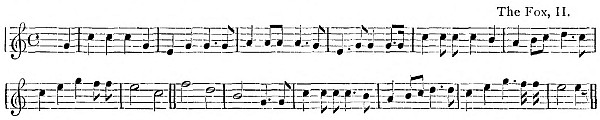
[Audio content is not currently supported on your device. [XML]
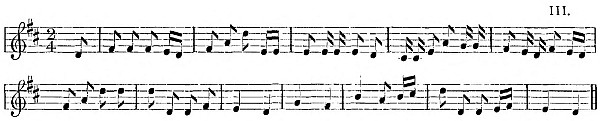
[Audio content is not currently supported on your device. [XML]
"When the Furze is out of bloom, Then Love is out of tune."
Mr. Sharp has also taken this down note for note in North Devon from an old farmer, Mr. Lake of Worlington, who remembered the use of oxen ploughing.
A very similar folk-song is found in France, with its refrain, naming the oxen—
"Aronda, Vironda, Charbonné, Maréchaô, Motet et Roget, Mortaigne et Chollet, Ho! ho! ho! ho! ho! mon mignon, He! he! he! he! he! he! mon valet."
See George Sand's account of the song in "Le mare au diable," c. 2; Tiersot, op. cit., p. 157.
The words are on Broadsheets by Such, Fortey, Barr of Leeds, etc.
In the original the lover betrayed by Flora stabs to the heart the "lord of high degree" who has supplanted him—
"I walked up to my rival with a dagger in my hand, And seized him from my false love, and bid him boldly stand; Then, mad with desperation, I swore I'd pierce his breast, And I was betrayed by Flora, the Lily of the West."
He is tried for murder, but "a flaw was in the indictment found," and he escapes the gallows. And the ballad winds up—
"Although she swore my life away, she still disturbs my rest, I must ramble for my Flora, the Lily of the West."
I have thought it well to cut out the murder and the trial.
The ballad has clearly an Irish origin, what air is used for it in Ireland I am unable to say. It has been generally accepted that the ending of a phrase on the same three notes is characteristic of Irish music. It is not more so than of English folk airs. "Flora, the Lily of the West" was wont to be sung annually at the Revel at St. Breward's on the Bodmin Moors, and can be traced back there to 1839. There Henry Hawken, sexton at Michaelstow, hard by, acquired it, and from him the first melody was taken down as well by the Rev. W.J. Wyon, vicar of St. Issey, in 1899.
A version of the song, "It's of a Pretty Ploughboy," is given in the Folk-Song Journal, vol. i. p. 132, as taken down in Sussex. The words are very corrupt, and they closely resemble those on Broadsides.
This song has already been given, arranged by Dr. Bussell, who took it down, in "English Minstrelsie," iv. p. 84.
"In six weeks' time when the 'sizes came on, Young Polly appeared in the form of a swan, Crying Jimmy, young Jimmy, young Jimmy is clear, He never shall be hung for the shooting of his dear."
And he is, of course, acquitted.
In Fone's version she appears in dream to her lover as a swan, and comforts him, but the sequel of the story he could not recall.
The ballad is found in a fragmentary condition in Kent—
"O cursed be my uncle for lendin' of a gun. For I've bin' and shot my true love in the room of a swan."
And the apparition of the girl says—
"With my apron tied over me, I 'peared like unto a swan, And underneath the green tree while the showers did come on."
This was heard in 1884, sung by a very old man at a harvest supper at Haverstall Doddington, near Faversham.
The transformation of the damsel into a swan stalking into the Court is an early feature, and possibly the ballad may be a degraded form of a very ancient piece.
This ballad, arranged as a song with accompaniment by Mr. Ferris Tozer, has been published by Messrs. Weeks.
Mr. Sharp has given the song to a different air in his "Folk-Songs from Somerset," No. 16.
In the second verse we have the breakfast described as consisting of bread and cheese and stingo. In Miss Broadwood's version the breakfast consists of cold beef and pork; the drink is not specified.
"Sir Walter Raleigh has built a ship, In the Netherlands. And it is called the Sweet Trinity, And was taken by the false Gallaly, Sailing in the Lowlands."
It has been reprinted in Child, No. 286, as also the earliest form of the ballad from the Pepys Collection. By writing some of the words as "awa'" and "couldna'," it has been turned into a Scottish ballad. Under the form of "The Goulden Vanity," it is given with an air (of no value) in Mrs. Gordon's "Memoirs of Christopher North," 1862, ii. p. 317, as sung at a convivial meeting at Lord Robertson's, by Mr. P. Fraser of Edinburgh.
We obtained the same ballad at Chagford as "The Yellow Golden Tree." "Sir Walter Raleigh," says Mr. Ebsworth, in his introduction to the ballad in the "Roxburgh Ballads" (v. p. 418), "never secured the popularity, the natural affection which were frankly given to Robert Devereux, the Earl of Essex. Raleigh was deemed arrogant, selfish, with the airs of an upstart, insolent to superiors, unconciliating with equals, and heartlessly indifferent to those in a lower position. The subject of the ballad is fictitious—sheer invention, of course. The selfishness and ingratitude displayed by Raleigh agreed with the current estimate. He certainly had a daughter."
In the ballad in the Pepys Collection the Sweet Trinity, a ship built by Sir Walter Raleigh, has been taken by a galley of a nationality not specified. He asks whether any seaman will take the galley and redeem his ship: the reward shall be a golden fee and his daughter. A ship-boy volunteers and with his auger bores fifteen holes in the galley and sinks her, and releases the Sweet Trinity. Then he swims back to his ship and demands his pay. The master will give golden fee but not his daughter. The ship-boy says, Farewell, since you are not so good as your word.
In the stall copy of the ballad, the master refuses to take the boy on board after he had sunk the galley, and threatens to shoot him, and the boy is drowned. Then he is picked up, is sewed in a cow-hide and thrown overboard.
Mr. Kidson has obtained no less than four different versions from sailors.
A version from Sussex is in Folk-Song Journal, vol. i. p. 104. Another in Miss Broadwood's "English County Songs." It is also in Ferris Tozer's "Sailors' Songs and Chanties." The black letter ballad of "Sir Walter Raleigh Sailing in the Lowlands low ... or the Sweet Trinity" was priced in Russell Smith's catalogue, £1, 5s.
In connection with this charming air, I will give Mr. Cayzer's account of taking it down in 1849, which he has kindly extracted for me from his diary:—"This air, together with 'As Johnny walked out' (No. 11), I got from Dartmoor; nor shall I soon forget the occasion. The scene was a lonely one (I think Two Bridges, but it may have been Post Bridge). It had been raining all day. There was not a book in the house, nor musical instrument of any kind, except two hungry pigs and a baby that was being weaned. Towards nightfall there dropped in several miners and shepherds, and I well remember how the appearance of these Gentiles cheered us. We soon got up a glorious fire—such a fire as peat only can make, and drew the benches and settles round. By the friendly aid of sundry quarts of cyder I, before long, gained the confidence of the whole circle, and got a song from each in turn; and noted down two that were quite new to me: no easy matter, considering that they were performed in a strange mixture of double bass and falsetto. The action with which they accompanied the singing was extremely appropriate. They always sing standing."
Many a similar evening have Mr. Sheppard, Mr. Bussell, and I spent in like manner over the peat fire with the burly, red-faced moor men and shepherds, standing to sing their quaint old songs, and very happy evenings they have been.
The same melody was taken down by Miss Wyatt Edgell from an old woman near Exeter, in 1891. The words sung to it related to the same Oxford Tragedy, but were a version different from the stall copy.
It was a common belief in the West of England that a soul after death appeared as a blue flame; and that a flame came from the churchyard to the house of one doomed to die, and hovered on the doorstep till the death-doomed expired, when the soul of the deceased was seen returning with the other flame, also as a flame, to the churchyard.
"Ben was a Hackney coachman sure, Jarvey! Jarvey!—Here I am, your honour."
I have never found a singer who had any knowledge of Beuler's song, but all have heard "Strawberry Fair," and some men of seventy or eighty years of age say they learned it from their fathers.
"I went to my lady the first of May, A jolly Goss-hawk and his wings were grey, Come let us see who'll win my fair ladye—you or me."
To the 2nd of May is "a two twitty bird," then "a dushy cock," a "four-legged pig," "five steers," "six boars," "seven cows calving," "eight bulls roaring," "nine cocks crowing," "ten carpenters yawing," "eleven shepherds sawing," "twelve old women scolding." Mr. C. Sharp has taken it down in Somersetshire. A Scottish version in Chambers' "Popular Rhymes of Scotland," 1842; as "The Yule Days," a Northumbrian version; "The XII. days of Christmas," with air not like ours, in "Northumbrian Minstrelsy," Newcastle, 1882, p. 129.
A Breton version, "Gousper ou ar Ranad" in "Chansons Populaires de la Basse Bretagne," by Luzel, 1890, p. 94. The West of England song has got mixed up with the "Goss Hawk," another song. See "The Fond Mother's Garland," B.M. (11,621, c 5). A companion song to this is "The Bonny Bird," given further on in this collection, No. 106. The song, in Devonshire, goes by the name of "The Nawden Song."
The original began as follows—
"O when I was an Infant, to London I did go, Among the French and Spaniards my gallantry to show. And when I reached the Eastern shore, I let my head hang down, I tripped over Baganells (?) and never touched the ground. Fal-de-ral-de, etc. "So when I reached the Eastern shore, I met a giant high, He lookèd down upon me, and bade me pass him by. He challenged me to dance and sing, to whistle and to run, I beat him out of all his wits, and kill'd him when I'd done. "The people in amazement stood, to see what I had done, They gave me silver plate, about a fifty ton. I made myself a little box, about three acres square, I filled it to the very top, with my bright silver ware."
And so on through a string of absurdities. It is apparently a modernised version of "The Jovial Broomman," by R. Climsall, published by R. Harper, 1635-1642. "Roxburgh ballads," ed. Chappell, i. p. 500.
"As I walked out one May morning, One May morning so early, O there I spied a fair pretty maid All on the dew so pearly. With a fa-la-la, with a fa-la-la, All on the dew so pearly. "O where are you going my fair pretty maid? O where are you going my lambie? Then cheerfully she answered me, On an errand for my mammie. "How old are you, my fair pretty maid? How old are you, my honey? Then cheerfully she answered me, I'm seventeen on Sunday."
For good reasons we could not give the words as taken down, so Mr. Sheppard wrote fresh words to the tune. The ballad was obtained from Roger Huggins, Lydford, and from William Bickle, Bridestowe, but it is known and sung throughout Devon and Cornwall. The original ballad was altered by Burns to "The Waukrife Mammy" for Johnson's "Museum," iv. p. 210, and Allan Cuningham also arranged a song on the same theme, as the original was objectionable. Lyle gives it in his "Ballads," 1827, saying: "This ballad, in its original dress, at one time, from my recollection, was not only extremely popular, but a great favourite among the young peasantry of the West of Scotland. To suit the times, however, we have been necessitated to throw out the intermediate stanzas, as their freedom would not bear transcription, whilst the second and third have been slightly altered from the recited copy." An Irish version (re-written) to the Irish air, by Joyce, "Ancient Irish Music," 1873, No. 17. He says: "I cannot tell when I learned the air and words of this song, for I have known them as long as my memory can reach back. For several reasons [the original words] could not be presented to the reader."
Burns, when forwarding the ditty to Johnson, said of it: "I picked up this old song and tune from a country girl in Nithsdale; I never met with it elsewhere in Scotland." The words may be found on Broadsheets, printed by Such and by Bebbington, Manchester. Mr. Kidson has recovered several versions in Yorkshire, and one is given in the Folk-Song Journal, vol. i. p. 92, as taken down in Sussex, and two were in vol. ii. p. 9 noted down by Mr. Sharp in Somerset. Our tune is in the Dorian mode.
The earliest form of the words is found in a garland printed by Angus of Newcastle, B.M. (11,621, c 4). There are later Broadside versions. The words also in Fairburne's "Everlasting Songster," circ. 1825. Mr. Kidson gives the song in his "Traditional Tunes," p. 70, but to a melody different from ours. About 1760 Dr. Berg set the song, recast in a Scotch form: "As Jamie gang'd blithe his way along the banks of Tweed," to be sung at Ranelagh. As sung, the ballad consists of four lines in a stanza, and the two last are repeated; and it is in seven stanzas. To shorten the ballad I have made each stanza consist of six lines. Our tune is not that of Dr. Berg. But it is redolent of the art-music of the 18th or early 19th century, and hardly possesses the character of folk-made song. Still, it is very freely sung by old people in Devon and Somerset.
"There were three men of Gotham, as I've heard say, That needs would ride a hunting upon St. David's Day. Through all the day they hunting were, yet no sport could they see, Untill they spide an Owle as she sate on a tree. The first man said 'twas a Goose, the second man said Nay, The third man said 'twas a Hawke, but his Bells were falne away."
The tune to which it was to be sung was "Rock the Cradle, sweet John," for which, see Chappell, i. p. 189.
Another, and more modern version, is that of "The Three Jovial Huntsmen"—
"It's of three jovial huntsmen an' a hunting they did go; An' they hunted, an' they hallo'd, an' they blew their horns also,"
which has been illustrated by Caldecott.
The original ballad is in "The Woody Chorister," B.M. (1162, e 2).
This is one of the ballads Mr. Incledon Johns heard sung on the outskirts of Dartmoor in 1830, mentioned in his book, already noticed, published in 1832.
A version, "Six Jovial Welshmen," is given in vol. i. p. 128, Folk-Song Journal, from Sussex. It runs—
"It's of six jovial Welshmen, six jovial men were they, And they would all a hunting ride, upon St. David's Day. Then fill each glass and let it pass, no sign of care betray, We'll drink and sing, 'Long live the King!' upon St. David's Day." "When crook-back'd Richard wore the crown, as regent of the land, No policy could pull him down, nor his proud foe withstand. A tribute he from them did seek, which they refused to pay, And in their caps they wore a leek, upon St. David's Day. Then fill each glass, and let it pass, etc."
This is probably a re-edition of the older song.
Now, the traditional ballad, as compared with the printed ballad, is superior at every point. It begins abruptly with the address of the sailor to the carpenter's wife, without the long story that precedes his attempt to cajole her to elope. Moreover, there is in it no intimation that the tempter is an evil spirit in the form of the dead lover, and when she has eloped, she pines not for three, but for her one babe, whom she has deserted.
Thirteen of the verses of the traditional ballad are found in "The Rambler's Garland," B.M. (1162, c 2). A form closely resembling our Devon ballad is in Buchan's "Ballads of the North of Scotland," i. p. 214, but is longer, consisting of twenty-six stanzas. Kinloch, Motherwell, and Laidlaw have also portions of it. Laidlaw, in a letter to Scott, January 3, 1803, says of the ballad, as sung to him by Walter Grieve: "He likewise sung part of a very beautiful ballad which I think you will not have seen.... The tune is very solemn and melancholy, and the effect is mixed with a considerable proportion of horror." See Child, No. 243.
The printed ballad that is in the Roxburgh Collection is, I feel convinced, a clumsy re-writing of the earlier ballad, so as to convey a moral, as its title implies, "A Warning to Married Women." James Harris is the demon lover. In the traditional ballad, when the carpenter's wife has eloped, she falls into deep depression—
"I do not weep for your gold, she said, Nor do I weep for your fee, But by the masthead stands my baby dead, And I weep, I weep for my dead babie.... "She had not a-been upon the seas But six days of the week, Before that she lay as cold as clay And never a word, one word did speak. "They had not a-been upon the seas Of weeks but three and four, But down to the bottom the ship did swim And never was heard of, heard of more."
There is another ballad running on somewhat similar lines, "The Undutiful Daughter," who is in like manner enticed away; but the ship will not proceed, and lots are cast who is to be thrown overboard. The lot falls on the girl, and she is cast into the sea, but the body swims before the ship and reaches land first. This ballad we have taken down several times.
The last verse (six) I have added to make some sort of conclusion to the song.
What the air is to which the ballad is sung in Scotland I do not know.
In "Sailors' Songs and Chanties," Boosey & Co., the song is given under the title of "The Dead Horse." In Derbyshire, at Christmas, boys and young men were wont, and may be still are wont, to go about, one dressed as a horse, with a horse's skull in his hands or affixed to his head; then this song was sung by the attendants and money asked for the feeding of the beast, and the head was made to snap its jaws. The song is also given in Topcliff's "Melodies of the Tyne and Wear," N.D., but circ. 1815, and is also found on Broadsides by Such.
Mr. Sharp has given a version in his "Folk-Songs from Somerset," No. 27.
2. "God's own Son, or Christ's Natures"; or "The strangers o'er the wide world rangers"; or "The lily-white maids."
3. "Three is all eternity"; "Three are the Thrones." The strangers are probably the Wise Men from the East.
4. "The Gospel Preachers"; "The Evangelists."
5. "The Ferryman in the Boat"; "The Nimble Waiters."
6. "The Cherubim Watchers"; "The Crucifix"; "The Cherrybird Waiters."
7. "The Crown of Heaven"; "The Seven Stars."
8. "The Great Archangel"; "The Angels"; "The Daybreak."
9. "The Nine Delights," i.e. the Joys of Mary; "The Moonshine."
10. "The Commandments"; "Begin Again."
11. "The Eleven Disciples"; "They that go to Heaven."
There are similar verses in German and Flemish; a Scottish version in Chambers' "Popular Rhymes," 1842, p. 50. Also found in Brittany: Luzel, "Chansons Populaires," 1890, p. 88. There is a Mediæval Latin form, beginning "Unus est Deus." A Hebrew form is printed in Mendez: "Service for the First Night of the Passover," London, 1862; a Moravian form in Wenzig: "Slavischer Märchen-Schatz," 1857, p. 295. It is also sung in the Eifel, Schmitz: "Sitten u. Bräuche des Eifler Volkes," Trier, 1856, p. 113. A Greek form is in Sanders: "Volksleben der Neugriechen." See also: Coussemaker, "Chants populaires des Flamands," Gand, 1850; Villemarqué, Barzas Breis, 1846, and later editions.
The lily-white boys are probably the Gemini, or sign for Spring. In the "Queen-like Closet, or Rich Cabinet," 1681, are instructions for embroidering emblems of the months. "May is to be clothed in a robe of white and green, and his sign must be Gemini."
"The Ferryman in the Boat" is perhaps Charon. In other versions Five is the Dilly-bird, or the Dilly-hour, "when blooms the dilly-flower."
Some are obviously merely adopted as rhymes, as "six the crucifix."
In Cornwall and Devon the song goes by the name of "The Dilly Song." What the meaning of "Dilly" is must remain uncertain. Possibly it signifies the Festal Song (Welsh, dillyn, pretty, gay).
The song used to be sung by Eton boys. It was introduced by Sir Arthur Sullivan into "The Yeomen of the Guard"; he, I believe, heard it sung by a sailor. His melody bears a certain relationship to ours. The song requires to be sung by at least two persons, a questioner and the responder.
"Oh, what have I ate, and what have I ate? I have eaten the toe of a mallard. Toe and toe, nevins and all, And I have been to ballery allery, And so good meat was the mallard."
The singer proceeds to eat the foot, then the leg, the thigh, the rump, the wing, the back, the breast, the neck, the head; and then the dance was concluded. A Breton version in Luzel, p. 80. I have written fresh words to the tune.
This tune is in the Dorian mode. As sung by J. Masters, the E was sharpened in the 3rd bar but flattened on the repetition of the same phase in the penultimate bar. Mr. Sheppard, when arranging the song, flattened the E throughout. It must be one thing or the other. Flattened throughout, it makes a charming melody, but the last flattened E was probably due to the singer's memory failing him in the latter part of the air, but serving him at the beginning of the tune. Mr. Sharp has accordingly retained the E natural throughout. The opening phrase is similar to the Plain-Song Easter Carol, "O Filii et Filiæ." This was a melody used in French folk-song for the welcoming in of spring. In fact, a May song. It forced its way into the service of the Church, and was adopted and used for the Easter Sequence. See Tiersot, op. cit., pp. 361, 391. It is certainly curious finding the same in Devonshire folk-music. Neither Mr. Sheppard nor I observed it; it was pointed out by Mr. Sharp.
These dialogue songs between a lover and his lass were very popular. Addison, in The Guardian of 1713, gives snatches of a West Country ballad of this kind, and shows how vastly superior it is to the pastorals of Dresden china shepherds and shepherdesses of Pope and Philips.
The words "The Nutgirl" occur on Broadsides by Fortey, Such, etc. See Ballads collected by Crampton, B.M. (11,621, h), and (1875, b 19); but these are without the chorus. The printed Broadside has lost somewhat. For Gerard's—
"His voice rang out so clear and stout, It made the horse-bells ring,"
it gives—
"His voice was so melodious, It made the valleys ring."
The Broadside ballad consists of fourteen verses, and is very gross. I have had to considerably tone down the words.
An earlier Broadside by Pitts has the chorus.
The same air was employed for the ballads, "In January last, on Monday at Morn," for "The Brags of Washington," 1775, for "Calder Fair," and "To Rodney we will go." It is given in the third edition of "Scotch, Irish, and Foreign Airs," Glasgow, 1788.
A version is in Folk-Song Journal, vol. i. p. 127, as taken down in Sussex. This version begins—
"And as this brisk young farmer was ploughing up his land, He called to his horses and bade them gently stand. He sat himself down a song to begin, His voice was so melodious, made the valleys to ring. And as this brisk young damsel was nutting in the wood, His voice was so melodious, it charmed her as she stood; She had no longer power in that lonely wood to stay, And what few nuts she'd got, poor girl, she threw them all away."
"I put my finger into the bush Thinking the sweetest rose to find, I prickt my finger to the bone, And yet I left the rose behind,"
is found in "The Distressed Virgin," a ballad by Martin Parker, printed by J. Coles, 1646-74. Parker seems to have taken the lines into his ballad from one previously existing. Two of the stanzas, 3 and 6, occur in the Scottish song, "Wally, wally up the Bank," in "Orpheus Caledonicus," 1733, No. 34; the stanzas 4 and 5 in the song in "The Scot's Musical Museum," 1787-1803, vi. p. 582. In "The Wandering Lover's Garland," circ. 1730, are two of the verses worked into another ballad.
We took down the song a third time from William Nichols of Whitchurch, near Tavistock. It was a song of his grandmother's, who seventy years ago was hostess of the village inn.
Mr. Sharp has taken this song and air down in N. Devon and Somerset four or five times, in every case with a flattened 7th in the Mixolydian mode. Our version is clearly a modernised edition of the older tune.
The incident referred to in the ballad is the accidental shooting of William Combe or Coome of St. Agnes, at the Revel or Village Feast at Crantock in 1721. In the parish register at this date is the entry: "William Coome of St Agnes, a youth about 20 years of age, who att the ffeast att this Parish recd his death of a shot; buried May 17."
Crantock Feast is on May 16.
There are a good many more verses in the original than are here given. They have no poetic merit; and the tune is not very original, but has a certain plaintive sweetness.
I re-wrote the ballad for the first edition, but in this I have restored the original words, only slightly modifying them.
A Broadside version has nine stanzas, and ends—
"So here's a health to the bird in the bush, Likewise to the linnet and thrush; For birds of a feather will all flock together, Let their parents say little or much."
The same ballad in Lyle's Collection, 1827, "From Recollection; air plaintive and pastoral." A Broadside version of this ballad in nine stanzas by Williamson of Newcastle. Song and air are given also in Kidson's "Traditional Tunes," 1891, as taken down in Yorkshire; but that version of the melody is inferior to ours. A Welsh version of the tune comes nearer to ours.
The ballad was printed by Keys of Devonport, circ. 1830, with four verses, of which verse 3 was an importation from another ballad. In other Broadside versions, the short original, consisting of four verses only, has been swelled out with scraps from other ballads to fill available space. Broadsides by Catnach, Whiting of Birmingham, etc.
A Breton version, "Merc'hed Caudan," is given by Luzel, ii. 142.
In the original ballad, reprinted in Bell's "Songs and Ballads of the English Peasantry," there are many more stanzas than we can give here.
"In yonder grove sat a lovely creature, Who she is, I do not know; But I'll go court her for her feature, Whether she'll answer me Yes or No! "O maiden I am come a-courting If your favour I can gain; If that you will but entertain me, Then I'm sure I'll call again."
The original words are to be found in "The Vocal Library," London, 1822, No. 1,421: "As a Fair Maid walked."
The earliest copy in print with which I am acquainted is in "The New Pantheon Concert," 1773, B.M. (11,621, e 6). A re-writing of the theme is on a Broadside by Such, "When I heard he was married I stood not alone"; it is No. 592. See also a "Collection of Old Ballads," in the B.M., vol. i. p. 490, "The Forlorn Lover."
Mr. C. Sharp has obtained a fine air to the same words, and has published it in "Folk-Songs from Somerset," No. 20.
What is the signification of "branchey tree" in connection with Death, I am at a loss to say. "Death and the Lady" was one of the ballads sung by Farmer Williams in "The Vicar of Wakefield."
We took the song down from John Rickards, Lamerton, and again from J. Benney, Menheniot. Mr. Kidson prints a Yorkshire version in his "Traditional Tunes," 1891. Miss L. Broadwood has noted it down from the singing of a baker at Cuckfield, Sussex. Dr. Barrett gives our melody to "The Gallant Hussar," No. 13. We have also taken it down to this ballad; so has Mr. Sharp in Somerset.
Compare with this the ballad in d'Urfey's "Pills to Purge Melancholy," named "Jolly Roger Twangdillo," 1719, i. p. 19. A Broadside copy of the ballad exists, printed by Jennings, of Waterlane, London, circ. 1790.
The same theme is used in a ballad in the Pepysian Collection. See Ebsworth, "Roxburgh Ballads," vii. 231. Each verse ends—
"I vow I will marry, but I know not when."
The ballad, however, is probably earlier than the Cecil marriage, and refers to some other legendary mésalliance. Henry Cecil, afterwards Earl and still later first Marquis of Exeter, saw, loved, and married a farmer's daughter named Sarah Hoggins, at Bolas Magna in Staffordshire, in 1790, he under the assumed name of John Jones. She was then aged seventeen, and he aged thirty-seven. Moreover, he was married at the time to Miss Vernon, a Worcestershire lady, to whom he had been united in 1776. In 1791, Henry Cecil obtained a divorce from his wife, Emma Vernon, and then was married in his proper name to Sarah Hoggins, at St. Mildred's, Bread Street, in the City of London. Not fully six years later the "Cottage Countess" died; and after three years the widower espoused a divorcée, sometime wife of the eighth Duke of Hamilton. Happily no question as to the legitimacy of the children arose. Henry, the eldest, was not born till 1793. He died the same year; but his brother, Brownlow, born two years later, lived to succeed his father in 1804.
These plain facts take away most of the romance of the story of the "Cottage Countess." Moreover, Henry Cecil did not meet his Sarah among the new-mown hay. He arrived at Bolas in a chaise in a snow-storm, late in November 1788, and was lodged for a few nights in the farm. There he saw Sarah, who with friends was dancing. She was then only fifteen and a half years old. Cecil left, but returned in eighteen months and married her, as already said, under an assumed name, and before he was quit of his first wife. The whole story has been told in Chambers's Edinburgh Journal, part 60 (sixth series), December 1, 1902.
Melody taken down from James Dingle, Coryton.
The song is given under the title "The Lowlands of Holland," in the Folk-Song Journal, vol. i. p. 97, as taken down in Sussex.
"Little Tom Dogget, what doest thou mean, To kill thy poor Colly now she's so lean? Sing oh! poor Colly, Colly my cow; For Colly will give me no more milk now. Pruh high, pruh hoe, pruh high, pruh hoe, Pruh, pruh, pruh, pruh, pruh, pruh, pruh, tal-dal daw."
Printed by T. Passinger (1670-86) at the Seven Stars on London Bridge. The ballad is also found in the Rawlinson Collection and elsewhere. It was afterwards sung in a shortened form at the concerts in Marylebone Gardens, and is printed in "The Marylebone Concert," N.D.
In the heading to the old ballad we have—
"A country swain of little wit, one day Did kill his cow, because she went astray."
But it is probable that the song originally turned on a different theme. On the 9th September 1605, a man was killed by a Protestant in the Rue de la Harpe, at Paris, for singing the song "De Colas." This song was composed by a seditious faction, with the intent of provoking the Huguenots, upon the subject of a cow which had walked into one of their conventicles during the performance of divine service. The cow, which belonged to a poor peasant named Colas, was killed by the Huguenots for her sacrilegious act. Thereupon the Catholics made a collection in every town and village in France to raise a sum for the indemnification of Colas. The day after the murder the singing of the song of "Colas his Cow," was forbidden under the penalty of the gallows, and it was even dangerous for anyone to hum the tune in the street ("Concert Room Anecdotes," 1825, ii. p. 230). The song must have been brought to England and adapted to English words after the Restoration, and as the story of the occasion of the killing of the cow was forgotten, it was altered. The tune is very old, and we had it from an aged woman at Kingsweare, who sang "The Abbot of Canterbury" to it. But this has its own tune, given by Chappell, i. p. 348. I have added the final verse.
"A fair maid walking in her garden, A brisk young sailor came passing by; And he stepped up to her, thinking to woo her, And said, 'Fair maid, can you fancy I?' "'You seem to talk like some man of honour, Some man of honour, you seem to be; How can you fancy such a poor young woman, Not fit your servant for to be?'"
The ballad is published by Such as "The Young and Single Sailor," No. 126. It is also in "The Vocal Library," London, 1822, p. 525. It was printed on Broadside by Catnach as "The Sailor's Return." We obtained it again from James Parsons.
In all the versions taken down from oral recitation, the word is Boy and not Bird, but Bird is the original word. The ballad was printed by J. Coles, 1646-74, and by W. Thackeray, 1660-1680, and is in the Douce Collection of early Broadsides in the Bodleian Library; also in the Pepysian Collection, and is printed by Ebsworth in the Roxburgh Ballads, viii. p. 359.
It was originally sung to "Cupid's Trepan," also called "Up the Green Forest," and "Bonny, Bonny Bird." This air is given by Chappell, ii. p. 557, but this differs from our tune entirely, as also from that given by Miss Broadwood. The ballad has not, as yet, been traced earlier than the reign of Charles II. It begins—
"Once I did love a bonny brave bird, And thought he had been all my own; But he loved another far better than me, And has taken his flight and is flown, Bonny Boys, And has taken his flight and is flown. "Up the green forest, and down the green forest, Like one distracted in mind, I hoopt and I hoopt, and I flung up my hood, But my bonny bird I could not find."
A later version is found, circ. 1780, in Single Sheet Broadsides, in the British Museum (11,621).
"Cupid's Trepan or Up the Green Forest" was priced in Russell Smith's Catalogue at £1, 11s. 6d.
The melody is actually the same as that of "Love's Tale" in our "Garland of Country Song."
Paul Jones was the terror of our coasts; he was born near Kirkcudbright in 1747. His real name was John Paul. When the rupture took place between Great Britain and America, he enlisted under the Revolutionary flag, and assumed the name of Paul Jones. His daring disposition, and his knowledge of the British coast, pointed him out as a fitting leader in marauding schemes. Towards the end of 1777 he was actively employed, as commander, in fitting out the Ranger privateer, mounting eighteen guns, and manned with a crew of 150 men. We have not the space for narrating his daring exploits; his life has often been written, and a good notice of him will be found in the "Dictionary of National Biography." The fight described in the ballad took place on September 23, 1779. The body of Paul Jones was removed from Paris, where he died, to America in 1905.
The ballad is found on Broadsides. It is given by Logan in his "Pedlar's Pack," p. 32. Dr. Barrett, in his "English Folk-Songs," No. 33, has the ballad to the tune we have given here to "The Bonny Blue Kerchief," to which Paul Jones is quite unsuited.
"The Merry Haymakers" is in D'Urfey's "Pills," and as a Broadside printed by C.B. (Bates), 1695, was priced in Russell Smith's Catalogue, 1850, at three guineas.
"In Beverley Town a maid did dwell, A buxom lass, I knew her well. Her age it was just twenty-two, And for a man she had in view."
It is a coarse ballad, and Mr. Sheppard re-wrote it. The first phrase in the melody is apparently a modernised edition of an older one. The rest of the air is ancient, and in the Mixolydian mode.
We have taken down the ballad, "Come all ye worthy Christian men," to this melody, which is in the Dorian mode. A fragment of this latter ballad is given in Folk-Song Journal, vol. i. p. 74, taken down in Sussex, in five verses. We have had it twice: once from J. Dingle, Coryton, and once as learned in 1820 by George Radford, from a blind fiddler at Washfield, near Tiverton, and "pricked down" by H. Pinkney, gardener, Washfield. Mr. Sharp has also met with it in Rackenford, N. Devon. The air in Sussex is not the same.
In "Hakluyt's Voyages," vol. iii. (1600), is an account of "The Voyage of the ship called the Marigold of Mr. Hill of Redrife unto Cape Breton and beyond, to the latitude of 44 degrees and a half, 1593, written by Rd Fisher, Master Hille's man of Redriffe."
So also Hakluyt mentions "the Marigold 70 tunnes in burthen, furnished with 20 men, whereof ten were mariners," which is stated to have "departed out of Falmouth, the 1st June, 1593," commanded by Richard Strong, "bound for an island within the straights of S. Peter on the backe side of Newfoundland to the S.W. in the lat. of 47 degrees."
In Latimer's 17th century "Annals of Bristol" is mention made of a ship "The Marigold," under the date 1627-8, of seventy tons, owned by Mr. Ellis. It was granted letters of marque to prey upon the enemy's commerce; but no mention is made of Sir Thomas Merrifield. The Redrife above is Redcliffe, Bristol. Bristol was spelled Bristow in maps of the city published in 1568 and 1610, but in one of 1671 it is spelled Bristoll.
I have been unable to find Sir Thomas Merrifield in any lists of knights; but before the reign of James I. no official record of knights was kept.
There was one more verse in the original, omitted to reduce the lengthy ballad to singable proportions.
"Jack my master, sing you well, Very well, with my derry down, With my Down, down, down."
I have been compelled to re-write most of the song, which in the original is very gross. It is certainly an ancient composition.
"O my poor heart, my poor heart is breaking For a false young man, or I am mistaking: He is gone to Ireland, for a long time to tarry, Some Irish girl I am afraid he will marry."
This is obviously an addition to fill out space in the Broadside. The ballad has a flavour of the period of Charles II.
"Nose, nose, jolly red nose, And who gave thee this jolly red nose? Cinnamon, ginger, nutmegs, and cloves, And they gave me this jolly red nose."
Mr. Bussell noted down the melody from James Olver, tanner of Launceston, in 1889. Of the words, Olver could not recall the line that follows
"And all the day long the Owl is asleep,"
and I have had to supply what lacked.
I give this song because it is interesting to note the changes that the air has undergone since it was performed as a Three Man's song before King Henry VIII. It will be noticed that Olver has not got all that portion of the song beginning "To whom drink'st thou." Chappell has given "Of all the Birds," in i. p. 75. On the other hand, in "Deuteromelia," only the first verse is given; Olver had three. A re-writing of the song "Of all the Birds on Bush or Tree" in "The Thrush," London, 1830, has two stanzas. The second concerns the lark.
"I am a lusty, lively lad Now come to one and twenty, My father left me all he had, Both gold and silver plenty. "Now he's in grave, I will be brave, The ladies shall adore me, I'll court and kiss, what hurt's in this? My father did so before me."
The first appearance of this ballad is in Thomas Jordan's "London Triumphant," 1672. It was taken by D'Urfey into his "Pills to Purge Melancholy," vol. i., 1699 and 1707. The air appears in the "Dancing Master" as "Jamaca," 4th edition, 1670, and in those subsequent.
The tune we give was taken down to the song from S. Fone by Mr. Sheppard in 1895.
"My Mother did so before Me" occurs without music in "The Nightingale," a song-book published in Edinburgh, 1776, and is given by Logan in his "Pedlar's Pack," 1869, from a chap-book of 1804. It occurs also on a Broadside by Pitts of Seven Dials. It is also in "The Quaver," Lond. 1831. The tune we have taken down is certainly based on the early air as given in the "Dancing Master." It is in Chappell, ii. p. 446.
The ballad is found in "West Country Garlands," date circ. 1760, B.M., 1161, b 11.
It actually begins thus—
"O when that I was a bachelor brave, Enjoying of all that my soul could have; My silver and guineas I then let fly, I cock'd my beaver, and, who but I? "I roved about, and I roved awhile, Till all the ladies did on me smile; From noble lady to country Joan, Both gentle and simple, were all mine own. "My rapier it was a Bilboa blade, My coat and waistcoat were overlaid With silver spangles, so neat and gay, As I were a king in some country play. "Besides, I had such a flattering tongue, The ladies laughed whene'er I sung; I had a voice so sweet and fine That every lady's heart was mine."
I have had to re-compose the ballad from the fragment and the story. It bears a family resemblance to "The Old Couple" given in "The Garland of Country Song," p. 100. In the story the old man locks his wife out. She threatens to drown herself, and throws a stone into the well. The old man, when he hears the splash, descends, opens the door, and goes forth to see whether his wife really has drowned herself. At once she slips in at the open door and locks him out. The story is very ancient. It occurred in the lost Sanscrit book of tales of which Persian and Arabic and Turkish versions exist, and which filtered into Europe through Greek and Latin and Hebrew translations. This story came into Dolopathos and the Seven Wise Masters. The French and Latin versions were made in the 13th century. But the story had already got to Europe through the converted Jew, Peter Alphonsus, who inserted it in his "Disciplina Clericalis," written in 1062. From this it got into some of the versions of the "Gesta Romanorum," and finally into Boccaccio's "Decameron," seventh day, tale 4.