NOTES
Reading edition
v. 33. Odes et Ballades, 1822-1824. 57. Les Orientales, 1829. 69. Les Feuilles d'Automne, 1831. 71. Les Chants du Crépuscule, 1835. 73. Les Voix Intérieures, 1837. 81. Les Rayons et les Ombres, 1840. 101. Hernani, 1830. 105. Marion de Lorme, 1831. 109. Le Roi s'amuse, 1832. 113. Lucrèce Borgia, 1833. 121. Marie Tudor, 1835. 127. Angelo, Tyran de Padoue, 1835. 129. La Esmeralda, 1836. 133. Ruy Blas, 1838. 137. Les Burgraves, 1842. 153. Cromwell, 1827: Étude sur Mirabeau, 1834 (Littérature et Philosophie mêlées, 1819-1834). 177. Han d'Islande, 1823. Bug-Jargal, 1826. 182. Le Dernier Jour d'un Condamné, 1829: Claude Gueux, 1834. 193. Notre-Dame de Paris, 1831. 205. Le Rhin, 1845. 216.
Napoléon le Petit, 1852. Châtiments, 1853. Histoire d'un Crime, 1877. In this place I must take occasion to relieve my conscience from a sense of duty unfulfilled so long as I for one have not uttered my own poor private protest—worthless and weightless though it may seem, if cast as a grain into the scale of public opinion—against a projected insult at once to contemporary France and to the present only less than to past generations of Englishmen.
On the proposed desecration of Westminster Abbey by the erection of a monument to the son of Napoleon III
"Let us go hence." From the inmost shrine of grace Where England holds the elect of all her dead There comes a word like one of old time said By gods of old cast out. Here is no place At once for these and one of poisonous race. Let each rise up from his dishallowed bed And pass forth silent. Each divine veiled head Shall speak in silence with averted face. "Scorn everlasting and eternal shame Eat out the rotting record of his name Who had the glory of all these graves in trust And turned it to a hissing. His offence Makes havoc of their desecrated dust Whose place is here no more. Let us go hence." Feb. 25, 1880.
At the end of such a list, so incomparable as to seem incredible, of one great man's good works, we may be forgiven the alteration of a word even in a verse from Æschylus which we cannot choose but apply once more to this leader in the advance of men made perfect through doom of trial and long wayfaring, whose progress he furthers by example and stimulates by song:—
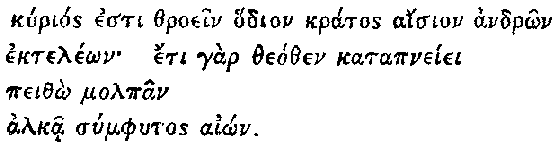
κυριος εστι θροειν οδιον κρατος αισιον ανδρων εκτελεων ετι γαρ θεοθεν καταπνειει πειθω μολπαν αλκα συμφυτος αιων. Æsch. Agam. 104-8.
Transcriber's Notes
The Greek text has been changed from the original book in order to be viewed along with the Latin-1 text by many different browsers. Below are images of the Greek text from the original book.
Page 311:

Page 361: