INTRODUCTION (continued 6)
Reading edition
Wrington, a large and compact village 10 m. S.W. of Bristol. A light railway connects it with Yatton. In size and arrangement it is practically a little town, and is surrounded by some very pretty country. The glory of Wrington is its church, which possesses one of the finest towers in Somerset. It is a stately and harmonious composition, with long and graceful belfry windows, and bears a strong family likeness to the towers of Evercreech and St Cuthbert's, Wells. The church as a whole is worthy of its tower, though the chancel is, as usual, low and undignified. Both inside and out the design is rich without being florid, and the workmanship good. The beauty of the interior is much enhanced by the insertion of "vaulting shafts" beneath the corbels of both nave and aisles. It contains few curiosities. Note (1) aumbry in N. wall of sanctuary, (2) richly carved font. Externally should be observed (1) panelled W. door, (2) canopied niches in buttresses at E. end, (3) sanctus bell-cot. John Locke, the philosopher, was born here, as his mother was at the moment staying in the village. A tablet once fixed to his actual birthplace is built into the churchyard wall. There is also a tablet in the church to Hannah More, who resided at Barley Wood, a large house on the Redhill road.
Writhlington, a small colliery village on a hill 1 m. E. of Radstock. The church, rebuilt in 1874, lies in a valley at the bottom of a steep lane, half a mile from the village. Near the church is an old manor house, at which Cromwell is said to have stopped on his march into Somerset.
Wyke Champflower (or Wyke Chapel), a hamlet 1½ m. W. of Bruton. The little chapel, said to have been built in 1482, was rebuilt in 1623. It contains a stone pulpit, and the ceiling is ornamented with nine escutcheons, including those of the Tudor sovereigns. There is an old black-letter Bible of 1623.
Yarlington, a village 3 m. S.E. from Castle Cary. The church, which has been much altered and enlarged, contains a finely carved font. In the wall of the churchyard is an old stone coffin, found during the restoration of the building.
Yatton, a large village (with a station), 12 m. S.W. of Bristol. The first syllable is perhaps the same as the second part of Symond's Yat. The place has an interesting church, with a central tower which is rendered conspicuous by being surmounted by a truncated spire, and by having its stair-case attached to a diagonal buttress (instead of replacing it, as is usual). The plan of the church is cruciform, the transepts and chancel being short, and the latter very low. The oldest part is the base of the tower, which belongs to the E.E. or Dec. period; and there is a very good Dec. window in the S. transept; the remainder of the building is Perp. Externally, the most impressive feature is the W. front, with turrets at the corners (as at Crewkerne), a recessed and richly carved doorway, and above the window a representation of the Father holding the crucified Son (cp. S. Brent). The S. door has a groined and panelled porch, and the N. door an ogee moulding. Within, the nave is lofty, with slender pilasters ascending to the roof. In the N. transept is the alabaster tomb of Sir Richard Newton (d. 1448) and his wife; and under foliated recesses a male and female effigy (attributed to the 13th cent.). Attached to this transept is a chapel which is noticeable for being loftier than the adjoining chancel, and has a fine turret at its N.E. angle. It contains a pillar-piscina, and the tomb of Sir John Newton (son of Sir Richard) and his lady, above which is a relief of the Annunciation. S.E. of the church is the Rectory, dating from the 15th cent., whilst on the N. are some old alms-houses.
YEOVIL, a town of some importance on the river Yeo, in the S.E. corner of the county, doing a considerable trade in the manufacture of leather and kid gloves. Its population in 1901 was 9838. It lies chiefly on a slope which shelves down towards the little stream from which it takes its name. The G.W.R. and L. and S.W.R. have a joint station in the town, and another G.W.R. station is at Pen Mill just outside. Yeovil seems to have outgrown its original intentions and is still rapidly increasing. The older streets have the usual congested appearance of a small country town, but more spacious thoroughfares are now spreading outwards in every direction. The chief glory of the place is its fine church, remarkable alike for architecture and situation. It is a cruciform Perp. building, said to date from 1376, with a severe-looking W. tower. The interior is of great impressiveness owing to the size of its windows and the loftiness of its arches. The most noteworthy feature of the church is its 13th-cent. crypt, now used as a vestry. A groined roof rises from a central pillar, and the entrance to the communicating stairway is groined also. Otherwise the church, though noble as a whole, is somewhat devoid of objects of interest. Note, however (1) the fine roof, (2) old brass lectern with ungrammatical inscription, (3) 16th-cent. brass on floor of chancel, (4) 15th-cent. brass to an ecclesiastic. Yeovil contains few old houses, as it was burnt out in the 15th cent., but in Middle Street two buildings deserve attention: (a) an old chantry house, now transformed into the "Castle" Inn, (b) almost immediately opposite, the "George," a good specimen of an old half-timbered hostelry. Some alms-houses in Bond Street, called Woborne's alms-houses, go back, as a foundation, to the reign of Edward IV. (1476). A good view of the low lying alluvial plain which stretches around the foot of Glastonbury Tor may be obtained by following for a short distance the road to Mudford. But this is only one of the many interesting walks in the neighbourhood: Yeovil is a good centre for excursions, and Windmill and Summerhouse Hills should both be climbed.
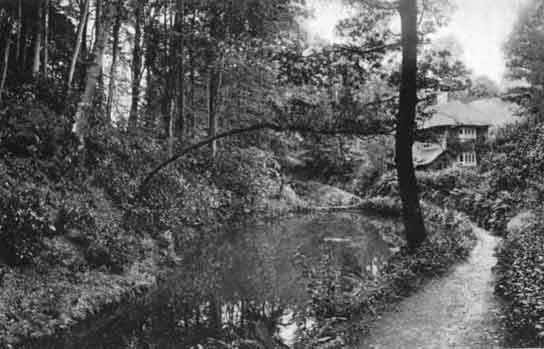
Nine Springs, Yeovil
Yeovilton, a parish 2 m. E. of Ilchester. Its church retains but few features of interest, but notice should be taken of (1) the remains of the stoups in the N. porch and at the W. door; (2) the two piscinas (that in the chancel has a quaint carving below it); (3) the bracket in the S. wall of the nave, and the old corbels built into the walls of the chancel; (4) the fragments of ancient glass in the W. and E. windows, the former displaying the arms of Bishop Beckington, and the latter having the letters R.S. and the figure of a swan, the initials and rebus of Richard Swan (one of Bishop Beckington's executors), who was rector here. There is also an incised slab to the memory of Sir John Hunt of Speckington (d. 1626). One of the bells dates from 1435.
Footnotes:
APPENDIX
Places of interest mentioned in the text, but not entered under separate headings in the alphabetical list. The figures refer to pages.
Alfoxden 156
Allerford 209
Barlynch Priory 122
Blackmoor Farm 75
Bower Farm 127
Brymore House 77
Cockercombe 213
Combwich 201
Creech Hill 130
Danesborough 214
Devil's Punch Bowl 80, 182
Dundon Beacon 107
Ebbor Rocks 283
Gaulden Farm 246
Goblin Combe 98
Gothelney Hall 83
Gurney Street Farm 78
Halsway 56
Halswell House 146
Hanging Chapel 169
Hare Knap 156
Hautville's Quoit 224
Hestercombe 167
Higher Wadeford 106
Holwell Cavern 32
King Ina's Palace 205
Lamb's Lair 80, 149
Lytes Cary House 84
Malmesmead 199
Marshwood Farm 78
Mouncey Castle 122
Mynchin Buckland 127
Naish Priory 105
Parkfield Monument 117
Richmont Castle 149
Sedgemoor 18, 88, 273
Seven Wells Combe 213
Sexey's Hospital 68
Small Down 90
Stantonbury 225
Stoney Littleton 254
Sutton Court 234
Tarr Steps 122
Walton Castle 103
Wansdyke 11, 52, 129
Weary All Hill 145
INDEX OF PERSONS
A
Aethelm, Bp.
Aldhelm, Bp.
Alfred, King
Allen, Ralph
Alphege, Archbp.
Arthur, King
Asser, Bp.
Audley, Lord
Austen, Jane
B
Bacon, Roger
Bagehot, Walter
Barbara, Saint
Barlow, Bp.
Barnes, Bartholomew
Beaufort, Cardinal
Beckford, William
Beckington, Bp.
Bennett, Rev. W.J.
Bere, Abbot
Berkeley family
Berkley, Sir M.
Bird, Prior
Bisse, George
Blake, Robert
Blanchard, William
Botreaux, Sir W.
Bradney, Joel de
Bray, Sir R.
Brett, John
Bridport, Visct.
Brito (Brett)
Briewere, William de
Bubwith, Bp.
Buckingham, Duke of
Buckland, Walter
Burgess, Dean
Burnell, Bp.
Burne-Jones
Butler, Bp.
Byam, Rector
Bytton, Bp.
C
Cantlow, Prior
Carent, William
Carew, family
Ceawlin
Cenwealh
Chard, Col.
Chard, Prior
Charles I.
Charles II.
Charlotte, Queen
Chatham, Lord
Cheddar, Sir T. de
Choke, Sir R.
Church, Dean
Clarke, Thomas
Clarkes of Chipley
Cole, Richard
Coleridge, Hartley
Coleridge, S.T.
Coles, Humphrey
Colthurst, Edmund
Coryate, Thomas
Courtenay, William and Robert
Coutances, Bp. Geoffrey of
Cromwell, Oliver
Cromwell, Thomas
Cudworth, Ralph
Cuffe, Robert
D
Dampier, William
Danbery, Henry
Danbery, Sir Giles
Daniell, Samuel
David, St
De Courcy family
Decuman, St
De la Mere, Sir J.
Denham, Sir J.
Douay, Walter de
Dovell, Abbot
Drokensford, Bp.
Dubricius, St
Dummer, Sir J.
Dummer, Sir W.
Dunstan, St
Dyves, Sir Lewis
E
Edgar, King
Edmund Ironside, King
Edmund, King
Ela, Countess
Ethelgar, Archbp.
Eveleigh, J. de
Everard family
Evercy, Sir Peter d'
F
Fairfax, Sir T.
Farewell, J.
Feversham, Lord
Fielding, Henry
Fitz-James, Bp.
Fitz-Odo, Serlo
Fitz-Roger, Sir H.
Fitz-Roger, Simon
Fitzurse, Reginald
Fitzurse, Robert
Fitzwalter family,
G
Gainsborough, Thomas
Gates, Sir J.
Gorges, Sir E.
Goring, Lord
Gray, Robert
Grenville, Sir B.
Grobham, Nicholas
Gunthorpe, Dean
Guthrum,
Gyvernay, Sir G. and Sir R.
H
Hallam, Arthur
Hallam, Henry
Halswell, Sir Nicholas
Hammet, Sir B.
Harewell, Bp.
Harington, Baron
Hautville, Sir J.
Henry VII.
Henry of Blois
Herlewinus, Abbot
Hertford, Marquis of
Hext, Sir R.
Hine, Henry
Hodges family
Hood, Viscount
Hooper, Bp.
Hopton, Sir R.
Horne, Bp.
Horner, Sir G.
Hubba
Hugh of Avalon
Hungerford family
Hunt, Sir J.
Husee, Treasurer
I
Ina, King
Irving, Sir H.
J
Jeffreys, Judge
Jennings, Robert
Jennings, Sarah
Joceline, Bp.
Jones, Inigo
Joseph of Arimathea
K
Kemble, Rev. C.
Ken, Bp.
Keyne, St
King, Bp. Oliver
Kinglake, A.W.
Kinglake, W.
Kingsmill, Sir F.
Kirke, Col.
Knight, Bp.
L
Lake, Bp.
Landor, W.S.
Langton, Bp.
Lawrence Sir T.
Leversedge family
Lightfoot P.
Locke, John
Lovel, R.
Luttrell family
M
Magee, Archbp.
Mallet family
Marchia, Bp. de
Marlborough, Duke of
Martok, John
Matilda, Queen
Maurice, Prince
Merriet family
Misiers, Louis de
Mohun, William de
Monington, Abbot
Monmouth, Duke of
Montague, Bp.
Monteagle, Lord
More, Hannah
Mowbray, Robert de
N
Nash, Richard
Nelson, Viscount
Nelson, Rev. Earl
Newton, Sir J.
Newton, Sir R.
Norris, Edwin
O
Odda, Earl
Oldmixon, John
Orange, Prince of
Osric
P
Palmer, John
Parry, Sir J.
Patrick, St
Penruddock, Col.
Percival, R.
Phelips family
Poole, Anthony
Poole, Thomas
Popham, Chief-Justice
Portman family
Poulett (Powlett)
Prowse, William and Ann
Prynne, William
Pym, John
Q
Queckett, J.T.
Quin, James
R
Raleigh, Sir W.
Raleigh family
Ralph, Bp.
Reginald, Bp.
Robert, Bp.
Robert of Normandy
Rodney family
S
Savaric, Bp.
Selwood, Abbot
Servington, Sir O. de
Sexey, Hugh
Shaa, Mrs
Sherborne, Prior
Sheridan, R.B.
Smith, Sydney
Sodbury, Abbot
Somerset, Protector
Southey, Robert
Speke family
Sprynge, Richard
Staling, Nicholas
Stawel (Stawell) family
Stephen, King
St Maur, John
Stone, John
Strode family
Sugar, Dean
Swan, Richard
Sydenham family
T
Tennyson, Lord
Thackeray, W.M.
Thomas à Becket
Thurstan, Abbot
Toplady, A.M.
Trevelyan, John
Turberville, Bp.
V
Vernais, De
Verney, Sir J.
Verney, Sir R.
Villula, Bp. John de
W
Wadham family
Wagstaff, Sir J.
Wake family
Waller, Lady
Waller, Sir W.
Walshe family
Walrond, Humfrey
Warbeck, Perkin
Warr, Lord de La
Warre family
Wellington, Duke of
Whiting, Abbot
William of Gloucester
Winter family
Wolfe, General
Wolsey, Cardinal
Wood (father and son)
Wordsworth, W.
Worman, Simon
Wulfric, St
Wyndham (Windham) family
Y
Young, Thomas