Front matter (continued 2)
Reading edition
"Young Raines. Do you know which he is?"
"Yes." She paused. "There's only one young one. Why are you worried about him? Do you think he's sick or something?" But that was the question she should have asked before asking the man's identity.
Mattern let a moment elapse, then said, "His papers appear to be forged."
He glanced at the reflection of her face, but it held neither relief nor fear, merely its usual sweet emptiness. "Maybe he needed a job real bad," she said.
"Maybe," her husband agreed, "but why use forged papers?"
"He might of gotten into some kind of trouble—you know how boys are."
"I'd hardly care to employ the kind of spaceman who gets into trouble serious enough for him to lose his papers. You have to do something pretty drastic to get them taken away, you know."
She said nothing.
He went on, "What I'm beginning to suspect is that he isn't really a trained spaceman at all, that he didn't go to any of the Earth space schools."
"Do you have to go to an Earth space school to be a spaceman? Can't you study somewhere else?"
"Earth's the only place where they give the conditioning." He told the truth, figuring she wouldn't understand.
She turned to look at him. "That's so the men shouldn't—see the things outside when they go through hyperspace, isn't it?"
Mattern was somewhat taken aback. "How did you know? It's not public information."
She shrugged and turned back to the dressing table. "I've known a lot of spacemen, hon."
Her face was pale, but why just now? He wondered just what Raines had told her—how much the boy actually knew. Naturally there could be only one possible reason he had chosen Lyddy as his confidante.
"There's something between you and Raines, isn't there?" he asked.
There was a slight delay. Then her laughter shrilled through the cabin. "Don't be silly, hon; I hardly know the man! All I've done was speak to him a couple of times!" She got up and put her soft arms around her husband. "You're jealous, Len," she said, and there was complacency mixed with the fright in her eyes.
He felt a pang of disgust, but tried not to let it show. Gently, he put her away from him.
"But that's so silly," she murmured. "How could I prefer a dumb pimply kid to you?"
In theory, that was quite true, but Len knew women had strange tastes. And possibly "a dumb pimply kid" had more to offer her emotionally and, in reverse, intellectually, than he had. It was not impossible that she was telling the truth, but Mattern could not, of course, believe her. And there was no point in making a further issue of it now. When they reached Burdon, he would fire Raines simply on the basis of the forged papers. No need to bring Lyddy into it at all. So that problem would be easily solved, but what of the others?
He went to play chess with the kqyres. "I trust you have got over your whimsical notion to retire," the xhind said hopefully.
"No," Len told him maliciously, "I've practically made up my mind to quit. There doesn't seem to be any point to it any more."
"The woman has changed! That's the whole trouble, isn't it? Even though it's not apparent, in some way she has changed?"
"No," Len said again, "she hasn't changed at all. In fact, I think that's what the trouble is. She hasn't changed, but I have."
"I never thought of that," the kqyres confessed.
The night of the Jump, Mattern turned in at the kqyres' suggestion. "For once, your men can take care of the ship," the xhind said, "since there will be no trading stop." Lyddy would be drugged, but Mattern would not need drugs, for hyperspace held no more horrors for him. Or so he thought.
But that night he was awakened by the sound of a screaming so hideous that, if he hadn't known voices don't change during the hyperjump, he would be tempted to think it was one result of the law of mutability—so monstrous were these shrill, worse-than-animal cries.
He rushed out of his cabin.
In the corridor stood Lyddy, still screaming, her face contorted with terror that only the sight of Alard Raines standing there in his normal shape let Mattern know that they had already passed the Jump.
The shrieking separated into words. "I saw it! It was horrible!" And she made an ugly noise in her throat. "You were right, Alard. It's true! There's a monster on board and it did something awful to me...." Her voice ebbed to a bubble as she looked down at her body beneath the thin veil of fabric and found the same voluptuous curves she had started out with.
Mattern sighed. "Better come into my cabin, Lyddy." And then he jerked his head at Raines. "You come, too." He paused in the doorway when he saw there was no need for privacy. "Where are the other crewmen?"
"Asleep," Raines said. "Drugged. As usual. Who do you think you're fooling, anyway?"
Mattern was too disturbed at the news to take notice of the boy's manner. "But they weren't supposed to be drugged this trip! And who's in charge then? You?"
Raines flushed and struggled to pronounce the word he wanted to use in return. "Your kek—kqyres, I'd say, is in charge. Like he always has been," he concluded triumphantly.
Mattern shut the cabin door behind the three of them. Lyddy went over and sat down on the edge of the bunk, quieter now that she found her personal transformation had been ephemeral. Seeing a monster is not, after all, anywhere near as bad as being a monster. Her fright dimmed and was outshone by a strong sense of personal injury.
"I thought all Alard's talk of kek-kek-monsters was just superstition," she babbled, "but it's true. I saw that thing with my own eyes and it's hideous! Len, why do you have it on board, especially when I'm here?"
"I have to," Len said. "He's my partner."
Her blue eyes widened in shock. "Then you've been doing more than just trading with the hyperspacers. You've been associating with them, and they're even worse than extraterrestrials because they're so much more—extraterrestrial!"
She went on talking in this vein, but Mattern ignored her and turned his attention to the boy. "I suppose you told her not to eat or drink anything so she'd see the hyperspacer?"
Raines nodded, his face essaying contempt but imperfectly concealing terror.
"And I suppose you yourself did the same thing, not knowing the men weren't going to be drugged this trip?" Len sat down behind his writing table and looked thoughtfully at the young man. "You must have done the same thing before, on other trips, to know as much as you seem to. You must have heard and seen a great deal, eh?"
"Plenty," Raines said, through brave, stiff lips. "Plenty."
Obviously the boy hates me, Mattern thought. But why? Is Lyddy enough reason?
"Why did you bring her into this?" he asked, almost mildly.
Lyddy didn't give Alard a chance to answer. "Because he wanted me to see you as you really are!" she shrieked.
The boy shuffled his feet. "I had to tell somebody."
"Why my wife, though? She owes you nothing; she owes me everything. The first woman of the streets you picked up would have made a safer confidante."
"Maybe I trusted her."
"Maybe you had no right to trust her!" Mattern cried, almost with sincerity. "It would have been wrong of her not to tell me."
"Maybe it was because I—I love her," Alard said, looking down at the thick rugs that covered the cabin floor. "If you fall in love with somebody, you tell them things."
Mattern couldn't help smiling. "I never do," he said.
"Maybe you've never been in love. Maybe you don't have any human feelings at all."
There was an uncomfortable feeling in Mattern's shoulders, as if his tailor had made a mistake for once. Had he, during sixteen years of alien trade, changed into something not quite human? Was there then a solid basis for the anti-extraterrestrial prejudice? He picked up a slender, sharp thike and ran his thumb absent-mindedly along the blade. Alard stiffened in his effort not to flush.
Mattern smiled and laid the thike down on the table. It was only a paperknife and had never been used for anything more. If he ever had need for such a thing to be done, the time was long past when he would have needed to do it himself. He looked at the crewman.
"One would almost think you told my wife because you wanted her to tell me," he suggested.
"That's ridiculous!" Alard flashed. "I may be a fool, but not that much of a fool!"
"Why are you on my ship with forged papers then?" Mattern demanded.
"I wanted—I wanted to bring you to justice."
"By committing a crime yourself? Surely a roundabout way. And why have you taken it upon yourself to help rid humanity of me?"
"Why shouldn't I?" Alard asked. "I'm a human being; isn't that enough? But, as a matter of fact, that wasn't the reason I came to your ship. I only found out later what you were doing."
Mattern waited patiently.
"You killed my father!" the boy burst out. And then tension seemed to ebb from him, as if the worst had happened. "So now you know who I am!"
Mattern picked his words delicately. "If you have proof that I murdered your father, why don't you prosecute? There's no statute of limitation on murder on any of the planets. Or don't you have proof?"
Alard's voice broke slightly. "Everybody on Fairhurst knows you killed him, but they won't do anything about it. They say he deserved what he got."
Mattern sighed, knowing now who the young man was. His brother. Another responsibility, another vain tie. "How do you know, he didn't deserve what he got?" Mattern asked.
Suddenly Alard grew shy. He lowered his eyes to the rug again. "Because I didn't deserve what I got."
And there, Mattern thought, Alard had him. Whatever the boy was now, he certainly had not deserved what he'd got then. But I was only sixteen, Mattern argued with himself; how could I have been held responsible? And then he told himself, You haven't been sixteen for twenty-four years.
"I thought one of the women in the village would have adopted you," he said.
"One of 'em did. They took me away from her after she beat me so hard she practically killed me. Every little thing I did wrong, she said it was the bad blood coming out in me, and beat me so hard the blood did come. I went from one family to another, but nobody really wanted me." His voice cracked wide across. "You don't know what it's like to grow up with nobody caring for you!"
"It so happens I do," Mattern said, "but I can't expect you to believe me."
Alard wasn't interested in Mattern's life story; he wanted to wallow in his own in front of a captive audience. "The only hope I had was that you would come back for me some day. They told me you were probably dead, but I wouldn't believe it, see? It was all I had to hang onto."
"I thought you were part of a family," Mattern tried to defend himself. "I thought you belonged to somebody." He almost convinced himself that this was true, but, at the back of his mind, something whispered, You ditched him.
"When I was sixteen, like you'd been, I ran away to look for you. I found out where you'd gone and I followed. I even stayed a while with the flluska. I liked them better than my own people. They said I should try looking for you in hyperspace."
"They are a very wise people," Mattern said.
Alard hadn't had his brother's luck. None of the great starships offered him a berth. But there were unchartered vessels—smugglers and pirates and worse—that would hire anybody who didn't value his life very highly and knew how to keep his mouth shut. He got jobs on them. And as the bandit ships he sailed on took Jumps closer and closer in to the more sophisticated sectors, Alard began to hear of a Len Mattern. It took him a long time before he could bring himself to believe that this king of finance was the brother whom he had imagined finding derelict and penniless. Instead, he was rich and oblivious, not needing anything the younger man could give him.
It was then that Alard determined revenge. It took him years to save up enough money to buy the false papers he needed—more years to buy his way into Mattern's crew. And, finally, he had achieved his end; he was there.
"But you've been with me almost a year now," Mattern pointed out, "and done nothing except talk to Lyddy against me. What were you planning to do?"
"I don't know," the boy said hopelessly. "Lots of times I thought of killing you, but then I'd be killing the only relative I had."
"You could have told me who you were. I'd have done something for you."
Alard's eyes blazed. "Yes, you would have. When it's easy, when it wouldn't mean a damn thing to you, you'd do something for me!"
Len pulled out a smokestick and offered it to the boy. Alard shook his head impatiently. Len lit one for himself. Neither of them said anything.
Lyddy was sobbing softly. "You never really loved me," she whimpered. "It was just a way of getting back at Len."
Alard looked away from her, met his brother's eye, and dropped his gaze to the rug, without denying the impeachment.
Mattern exhaled smoke. "All right, you had a grudge against me, but what did you have against her? If you were using her to get back at me, then I think you have no cause to reproach me for anything I did. Maybe your foster-mother was right; there is bad blood in the family."
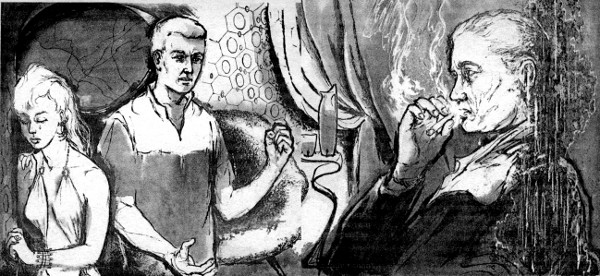
The young spaceman was still silent.
Lyddy lifted her head. There was resolution on her tear-smudged face. "I'm going to leave you, Len! I can't go on living with a man who does the awful, evil, unnatural things you do...." Her voice petered out as her vocabulary proved unequal to her emotions. Poor Lyddy, he thought. And then, Poor Len, with emotions unequal to his vocabulary.
"Everything I did, I did for your sake, Lyddy," he told her softly, but no longer with any hope of her comprehension. "It was because I was poor and couldn't afford your love that I went into hyperspace." He couldn't help adding, "Doesn't it mean anything to you that I risked a whole universe for your sake, and that now I have worlds to offer you?"
"Don't put the blame on me, Len Mattern!" Angry tears stood in her eyes. "I never wanted anybody to do that much for me. All I wanted were nice things and somebody to take care of me and maybe love me. I never wanted to have the whole universe risked for me." Her voice broke on the truth. "Nobody's worth all that!"
She was right, he thought—being given too much can be worse than being given too little. The words spilled out of her; he'd been so disenchanted by her stupidity that he gave her credit for less understanding than she did have.
"You wouldn't've been able to wait fifteen-sixteen years for me if you really loved me. But you were happy the way you were—you and that extraterrestrial of yours. All you wanted was to dream about me. You were a fool ever to have come back for me; you shoulda stuck with your dreams."
And again, he knew, she was right. He felt very tired and empty, the way he'd felt after Schiemann and Balas had died, as if nothing mattered any more. He didn't argue with her.
"What would you do if you left me, Lyddy?" he asked gently.
"I can always—" she swallowed—"go back to my old job, I guess."
Alard gave an exclamation of horror, and Mattern agreed in his mind that that solution would never do. Beyond a doubt, she was his responsibility. And so was Alard. Why had he ever longed for a family?
And then an outside mind joined in with his and he knew what to do.
"Alard," he said, "before, I offered to do something for you. Now I'm not going to do anything for you, not a damn thing."
Alard drew himself erect. "I wouldn't expect you to, see? Even if you wanted to, I wouldn't take—"
"I want you to do something for me," Mattern cut in.
Alard paled, then flushed with anger. "If this is some half-baked way of thinking you can make up for things without me feeling—"
"Hear me out before you leap to conclusions. You said that you loved my wife...."
Lyddy gave a moan. "You know he was only stringing me along to get back at you."
"He wouldn't have done that," said Mattern. "Not a fine, upstanding boy like Alard, no matter how much he hated me. You really love Lyddy, don't you, Alard—as you said before?"
The boy looked frightened. "Only in a manner of speaking," he said quickly. "I was trying to make you jealous. I think of her as a sister—a sister-in-law."
"She's very beautiful," Mattern reminded him. And the xhindi had done their work well. She hadn't changed; they had preserved her for him just as she had been sixteen years before. If only they had let her change, then things might have worked out. They could have kept the body from growing old without holding back the mind—or had they not held back the mind? Was this the fullest maturity it was capable of?
"A man who has her as his wife should be very happy," Mattern pointed out. "You wouldn't want her to go back to what she'd been doing, and she won't stay with me."
"Yes, sure." There was a desperate note in the boy's voice. "But she's not young. I mean for me—although, of course, she looks young," he added, with a wild glance in her direction. "And she's not very—she isn't—"
Mattern got up and put his hand on his brother's shoulder. "Then if you feel that way about her and do as I ask, it will really be a favor to me."
"Why should I do you a favor?" Alard demanded. His eyes darted back and forth like an animal that is beginning to realize it is caught in a trap.
"To prove you're the better man," Mattern told him. "To heap coals of fire on my head. To prove that if there's bad blood in the family, it exists only in me."
Alard didn't ask what Mattern wanted him to do. He knew already.
Mattern put it into words: "I want you to take her with you."
"Take her," Alard repeated numbly. "Where?"
"Anywhere she wants to go—to Earth or back to Erytheia, or any one of the planets she chooses."
"Will she go with me?" Alard challenged. "You have to ask her; she has the right—"
"Oh, I'll go with you, Alard," Lyddy interrupted joyfully. "I'd go with anybody right now, but especially you."
"Even if you know I love you only as a sister?"
"That's better than nothing," Lyddy said. "Besides, you could change your mind. I think you and me have a lot more in common than him and me."
"I want to make sure there will always be someone to take care of her, to watch over her," Mattern told his brother. "Funny, I wouldn't have done what I did except for the sake of winning her, and now that I've won her, I can't hold her because of what I did to get her. But she was my dream and I want her to be cherished."
"That's noble of you, Len," Lyddy said. "I'll think of you often, and I won't be mad at you." She got up and linked her arm in Alard's. "You'll take good care of me, won't you, hon?"
But it was to his brother that Alard spoke. "I'll take good care of her," he promised, his voice thick with an emotion that was one part sentiment, one part resignation.
"Splendid," Mattern said. "I wouldn't want her to be cast adrift. She knows so little of any of the worlds outside her own restricted sphere."
"Sure," Alard replied miserably, "I understand. I'll do my best."
Mattern got up and put out his hand and, after a little hesitation, Alard took it.
"I hope in time you'll come to forgive me," Mattern said, "and that your hatred will dwindle into dislike, perhaps even tolerance."
"Oh, I don't hate you any more," Alard assured him. "I guess, in your way, you've had as much to put up with as I did." He frowned in perplexity. "But why did it have to be me?"
"You'll change your mind about that, too," Mattern said comfortably. "Lyddy is a very accomplished woman."
VIII
He felt quite cheerful as he left the two together in his cabin. At long last, he was free of responsibility, of illusion, of dreams. He didn't need a woman; it would be wrong for him to expect a woman to live with the kqyres, even unwittingly. Love was for the very young; he had his work. And now that he was free of all these vexing human entanglements, he'd be able to take hold of the business the way he should have been doing all along. The kqyres was getting old; it was time to assume the details of management himself. There were quite a few areas of operation which could become even more productive if the business was thoroughly reorganized.
Mattern went up to the control room. The kqyres was there, which was not his usual place. Perhaps Alard had been right when he said it was Njeri who had drugged the other crewmen and taken control of the ship. Presently, Mattern would ask him why, but there were other matters to be discussed first.
"Well," Mattern said, flinging himself into a chair, "Lyddy seems to be disposed of satisfactorily." He gave a rueful laugh. "I take it you had a hand in the arrangements. That was only fair—she's your creation." He waved his smokestick at the xhind. "However, I'm warning you, I won't let myself be manipulated any more. You're through pushing me around."
The kqyres seemed almost offended. Then there came a soft chuckle. "Manipulated, nonsense! We merely deluded you a little, in the same manner you were wont to delude yourself, but more purposefully. In truth, what else could we do? We needed you, and in order to induce you to accept our terms, we had to establish some goal, some ideal for you to aim at."
Something about the kqyres' voice disturbed Mattern; he only half listened as the hyperspacer continued: "And the resources of your mind were so pitifully meager at that time that this woman was the best we could dredge up. Later, when your horizons had broadened and your perceptions deepened, we attempted to alter your goal to a more worthy one, but the woman had already become an obsession...."
"You're not the kqyres," Mattern interrupted. "You have a different voice."
"Not the same kqyres," the voice corrected. "Truly, it was unfair to make Lord Njeri go through a thing like this twice in one lifetime. Moreover, as he grew old, he grew careless."
So that was why the men had been drugged. There had been an unscheduled stop in hyperspace.
Mattern got up and looked intently at the shadowy form. The xhind flickered a little, as if in embarrassment, and embarked almost nervously upon an explanation. "You were never intended to attain Lyddy, merely to keep her image before you like the star a mariner follows but can never reach." And then the kqyres laughed. "Except, of course, that today he can reach his star."
"A carrot and a donkey might be a more suitable simile," Mattern said. "Pity you couldn't have provided a better carrot."
The new kqyres ignored this comment. "Lord Njeri was transferred. He has asked me to say that he looks forward to the pleasure of renewing your friendship when you come again to Ferr. Meanwhile, I have taken his place." After some hesitation, the new kqyres added, "I hope we shall be good friends, also."
There was no use pretending any longer. "I know who you are," Mattern said. "I recognize your voice. You're the mbretersha herself, aren't you?"
She seemed pleased rather than dismayed. "Yes, I am the mbretersha. I came to realize that the post of kqyres was more difficult than that of queen. Therefore, I was the only one who should rightfully undertake it. As I told you, in our universe a ruler cannot afford pride. She lives only for the good of her people."
"She's got to," Mattern said bluntly, "if, as you said, her nervous system is attuned to theirs. What actually did happen is that Njeri told you I was quitting the business and he couldn't control me any more. So you took his place to see if you could change my mind."
"Oh, that was a mere pleasantry!" she said. "I knew you would not give up the hyperspace trade. What else would you have left?"
What else would he have left? His money, his collections, his unpleasant memories. All his emotional ties now were with that other universe.
"Who's ruling Ferr?" he asked, evading her question.
"Lord Njeri, your former kqyres, serves as my regent. He is my father, so he is fitted by birth; his system is also attuned to the planet's, although not as sensitively as mine, since he is a male. Perhaps that would make him a better ruler; he will suffer less. And I see no reason otherwise why a male should be deemed incapable of ruling, providing he is under careful supervision."
"No reason at all," Mattern agreed.
"Moreover," she continued, "I have organized the whole government of my planet so that it runs itself. And, of course, from time to time, when we make our trips, I shall be able to check into what's going on."
"But we're not going to make any more trips," he said. Although he had not been serious about retiring—he knew that now—he wasn't going to let the hyperspacers push him around. Make her sweat a little, he thought irreverently.
"Will you not give me a chance, Captain?" she asked. "Is the prospect of my company so displeasing to you that it will make you give up the business immediately?"
"You know it's not that. I told the kqyres before you came—"
"But my people won't know it's not that. I shall lose face."
"If only you had a face!" he cried. "I'm sick of sailing with shadows!"
"My form in your universe is truly horrible, Mattern," she said softly, "truly monstrous. The xhindi who have seen themselves in mirrors in your universe have often gone mad."
"Anything is better than emptiness," he told her.
"If I appear in my true form, then will you accept me as your kqyres?"
"Well," he said, enjoying himself, "I'll make a few more trips with you, but that's all I'll promise."
"I accept your promises," she said.
He felt a tiny shiver rise up in him. Suppose her normspace form was even more hideous than her hyperspace form, which of course, was no longer hideous to him. Would his nerves be strong enough to bear it?
He held his breath as the vibrations began to slow down, the grays shimmering into substance, taking on all the colors of the rainbow and then flowing into one basic roseate hue. Bit by bit, the planes and shapes began to coalesce into the shape of....
A woman. The most beautiful woman he had ever seen. A woman next to whom even the dream of Lyddy paled into thin air.
And, momentarily, he became the Len Mattern of fifteen years back, standing there with his mouth agape. "But you said you'd be a monster...."
"To my people, Mattern," she smiled, "this form is as monstrous as ours is to your people. You change into our doubles in hyperspace; we change into yours in normspace. Had you kept the continuity of tradition that we have, you would know what we have always known—that xhind and human are different aspects of the same race. That is why you fear us, and we do not fear you."
Of course, he thought. How else could they understand us so well? How else could they find logic in our illogic and be able to condition us according to our human natures? And he smiled to think that all objection to the xhindi from the social angle was invalid. Monsters they might be, but not non-humans.
"Once I thought this appearance was monstrous, Mattern," the mbretersha went on, in the sweet voice which suited her now, "because I thought you and your kind were, though forms of our race, monstrous forms—not only without beauty, but without dignity or intelligence or compassion."
"Maybe you were right," he said.
"But since I have learned to know you and to—like you, I have come to realize that outward semblances are meaningless. I may appear one way in your universe, another way in mine, but I am the same I. If there is beauty—" and she gave what, in a lesser personage, would have been almost a giggle—"it is an inner beauty."
Mattern could not agree with this premise. Although he had admired the mbretersha on Ferr, he felt quite differently toward her now, and because of no suddenly discovered inner beauty.
"You'll stay this way in this universe then?" he asked. "It makes it so much more comfortable for me—than just a collection of shadows," he added hastily.
"I will stay this way permanently while I am in your universe, Mattern," she told him, "if, in your turn, you will accept me as—as—"
"As my shipmate," Mattern finished, "my kqyres. I have already done so."
"Not merely as your shipmate."
"As my—wife?" he blurted, wondering whether he was reading her mind or whether she was projecting so forcibly into his that he merely spoke her thoughts for her.
She nodded.
To be chained again, after this brief moment of freedom! He wanted her, right enough, and he was delighted to have her for his partner, his companion, but he saw no need for formal commitments between them.
"You're the mbretersha," he protested, "the queen. It wouldn't be right for you to marry a commoner!"
"And you," she retorted, "are one of nature's own noblemen, and, hence, a fitting consort for me. There is no one in either universe whom I could marry without lowering myself," she explained, "so I might as well wed where there is a basis of respect, of admiration, and, to be sure, expediency."
"But—but our ceremony wouldn't be valid in your universe, would it?" he spluttered wildly. "And your ceremony—"
"We will have two ceremonies, Mattern, one in each universe."
This, he could see in alarm, was going to be a truly lasting marriage.
Mattern was happy with the mbretersha, for she knew how to satisfy a man's every dream as well as his desires, and of course, being the kqyres, she was the only woman who would not be disturbed by the presence of one on board. Moreover, she was a woman for whom a universe could be risked, a woman to whom worlds could be offered—in short, just as he was the only man worthy of her, so she was the only woman worthy of him.
But sometimes he fancied that the mbretersha's blue eyes had the same haunting familiarity that he had seen in Lyddy's and Alard's, and he wondered. Alard's had been explicable enough; he and Mattern had had the same mother. But why should Lyddy also have his mother's eyes—and, stranger still, why should the mbretersha?
Len could not help wondering whether, to create the ideal fantasy, the ultimate carrot, the xhindi had reached far back in his mind to get the earliest—and thus the most fundamental—illusion of beauty for him. Could both Lyddy and the mbretersha have been deliberately modeled on his mother, and was the mbretersha's form in normspace merely whatever she chose it to be—or appear to be?
Oh, well, he thought, perhaps an artful illusion is the truest form of reality.