Chapter XV
Reading edition
THE MEDIUM FOR INDIVIDUAL UTTERANCE
A closer examination of the musical reforms instituted by the camerata which met at the Vernio and Corsi palaces will convince us that they were directed toward two objects; first, the restoration of the Greek method of delivering the declamation of a drama, and second, the reduction of purely lyric forms to a rational musical basis on which could be built intelligible settings of texts. The revolt was not only against polyphonic music in which text was treated without regard for its communicative purpose, but also against the decorative manner of solo singing, which made words only backgrounds for arabesques of sound. On this point we have the conclusive evidence of Caccini's own words as found in the preface to his "Nuove Musiche."36 He begins by giving the reasons why he had not earlier published his lyrics in the new style, though they had long been sung. He continues:
"But when I now see many of these pieces torn apart and altered in form, when I see to what evil uses the long runs are put, to wit, those consisting of single and double notes (repeated ones), as if both kinds were combined, and which were invented by me in order to do away with the former old fashion of introduced passages, which were for wind or stringed instruments rather than the human voice; when further I see how dynamic gradations of tone are used without discrimination, what enunciation now is, and how trills, gruppetti and other ornaments are introduced, I consider it necessary—and in this I am upheld by my friends—to have my music printed."
Furthermore he will explain in this preface the principles which led him to write in this manner for the solo voice. He says that for a long time he has been a member of the Florentine circle of cultivated men and that he has learned from them more than he acquired in thirty years in the schools of counterpoint.
"For these wise and noble personages have constantly strengthened me and with most lucid reasons determined me to place no value upon that music which makes it impossible to understand the words and thus to destroy the unity and meter, sometimes lengthening the syllables, sometimes shortening them in order to suit the counterpoint—a real mangling of the poetry—but to hold fast to that principle so greatly extolled by Plato and other philosophers: 'Let music be first of all language and rhythm and secondly tone,' but not vice versa, and moreover to strive to force music into the consciousness of the hearer and create there those impressions so admirable and so much praised by the ancients, and to produce which modern music through its counterpoint is impotent. Especially true is this of solo singing with the accompaniment of a stringed instrument when the words are not understood because of the immoderate introduction of passages."
This, he declares, can only extort applause of the "crowd" and such music can only result in mere tickling of the ear, because when the text is not intelligible there can be no appeal to the understanding.
"The idea came to me to introduce a style of music which makes it possible in a certain manner to speak musically by employing, as already said, a certain noble subordination of the song, with now and then some dissonances, while however holding the chord by means of the sustained bass, except when I follow the already common custom of assigning the middle voices to the accompanying instrument for the purpose of increasing the effect, for which purpose alone they are, in my opinion, appropriate."
He now tells us that, after he found that his principle stood the tests of practice and he was satisfied that in the new style lay a power to touch hearts far beyond that possessed by polyphony, he wrote certain madrigals for the solo voice in the manner described, which manner "I hereafter used for the representations in Florence." Then he went to Rome where the dilettanti, particularly Lione Strozzi, gathered at the house of Nero Neri, expressed themselves enthusiastically about the new revelation of the power of solo song to move the heart. These amateurs became convinced that there was no longer any satisfaction to be drawn from the old way of singing the soprano part of madrigals and turning the other parts into an instrumental accompaniment.
Caccini went back to Florence and continued to set canzonettas. He says that in these compositions he tried continually to give the meaning of the words and so to touch responsive chords of feeling. He endeavored to compose in a pleasing style by hiding all contrapuntal effects as much as possible. He set long syllables to consonances and let passing notes go with short syllables. He applied similar considerations to the introduction of passages "although sometimes as a certain ornamentation I have used a few broken notes to the value of a quarter, or at most a half note, on a short syllable, something one can endure, because they quickly slip by and are not really passages, but only add to the pleasant effect."
Caccini continues his preface with reiterated objections to vocal passages used merely for display, and says that he has striven to show how they can be turned to artistic uses. He deprecates the employment of contrapuntal device for its own sake, and says that he employs it only infrequently and to fill out middle voices. He forcefully condemns all haphazard use of vocal resources and says that the singer should labor to penetrate the meaning and passion of that which he sings and to convey it to the hearer. This he asserts can never be accomplished by the delivery of passages.
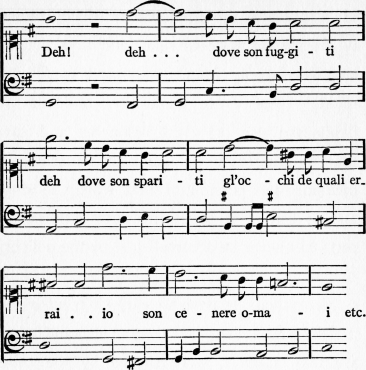
Here, then, we have a clear statement of the artistic ideals cherished by Caccini, and these, we may take it, were shared by the other members of the camerata who were engaged in the pursuit of a method of direct, eloquent, dramatic solo expression. The opening measures of one of the numbers in the "Nuove Musiche" will serve to show in what manner Caccini developed his theories in practice and equally what close relation this style had to that of the new dramatic recitative.
MIDI file
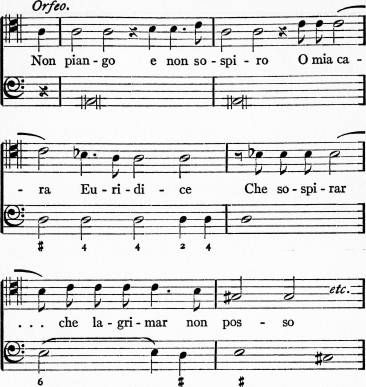
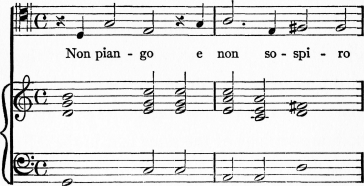
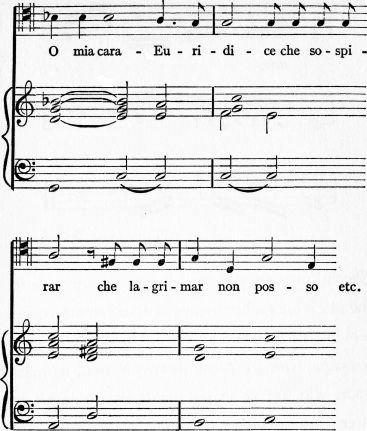
In the preface to his score of "Euridice" Peri has set forth his ideas about recitative. He has told us how he tried to base its movement upon that of ordinary speech, using few tones and calm movements for quiet conversation and more extended intervals and animated movement for the delineation of emotion. This was founded upon the same basis as the theory of Caccini, which condemned emphatically the indiscriminate employment of swelled tones, exclamatory emphases and other vocal devices. Caccini desired that the employment of all these factors in song should be regulated by the significance of the text. In other words these reformers were fighting a fight not unlike that of Wagner. They deplored the making of vocal ornaments and the display of ingenuity in the interweaving of parts for their own sakes, just as Wagner decried the writing of tune for tune's sake, and on one of the same grounds, namely, that nothing could result but a tickling of the ear. Yet these young reformers had no intention of throwing overboard all the charms of floridity in song. Here are two examples of their treatment of passionate utterance in recitative. The first is by Peri and the second by Caccini. Both are settings of the same text in the "Euridice."
MIDI file (without figured bass)
MIDI file
Caccini was somewhat more liberal than Peri in the use of floridity and always showed taste and judgement therein. Here is a sample of his style taken from a solo by one of the nymphs in "Euridice":
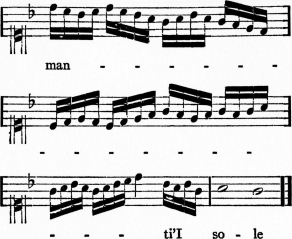
MIDI file
Caccini also showed that he was not averse to the lascivious allurements of two female voices moving in elementary harmonies. Here is a passage from a scene between two nymphs upon which rest many hundreds of pages in later Italian operas.
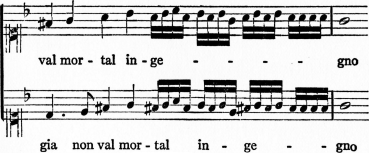
MIDI file
This was the immediate predecessor of the well-known "Saliam cantando" in Monteverde's "Orfeo."
The innovations of the Florentine reformers included also the invention of thorough bass, or the basso continuo, as the Italians call it. Ludovico Grossi, called Viadana from the place of his birth, seems to have been the first to use the term basso continuo and on the authority of Prætorius and other writers was long credited with the invention of the thing itself. But it was in 1602 that he published his "Cento concerti ecclesiastici a 1, a 2, a 3, e a 4 voci, con il basso continuo per sonar nell' organo." The basso continuo had been in use for some time before this. It appears in the score of Peri's Euridice as well as in the "Nuove Musiche" of Caccini. It was employed in Cavaliere's "Anima e Corpo" and was doubtless utilized in some of the camerata's earlier attempts which have not come down to us.
Just which one of the Florentines devised this method of noting the chords arranged for the support of the voice in the new style matters little. The fact remains that the fundamental principle of related chord harmonies, as distinguished from incidental accords arising in the interweavings of voice parts melodic in themselves, had been recognized and the basis of modern melodic composition established. This, indeed, was not the achievement of the young innovators, but the result of a slow and steady development in the art of composition. The introduction of thorough bass shows us that the reformers had found it essential to the success of their experiments that, in their effort to pack away in solid chords the tangle of parts which had so offended them in the old counterpoint, they should codify to some extent the relations of fundamental chords and contrive a simple method of indicating their sequence in the new and elementary kind of accompaniments. They at any rate perceived that the vital fact concerning the new monophonic style was that the melody alone demanded individual independence, while the other parts could not, as in polyphony, ask for equal suffrage, but must sink themselves in the solid and concrete structure of the supporting chord. Thorough bass was in later periods utilized in such music as Bach's and Handel's, but its original nature always stood forth most clearly when it was employed in the support of vocal music approaching the recitative type.
Here, then, we may permit the entire matter to rest. It ought now to be manifest that in their experiments at the resuscitation of the Greek manner of declamation the ardent young Florentines were impelled first of all by the feeling that the obliteration of the text by musical device was a crying evil and that by it dramatic expression was rendered impossible. Doubtless they felt that their art lacked a medium for the publication of the individual, but it is by no means likely that they realized the full significance of this deficiency or of their own efforts to supply it. Nevertheless, what they did under the incentive of a genuine artistic impulse was in direct line with the whole intellectual progress of the Renaissance. The thing that was patent to them was the importance of studying the models of antiquity to find out how dramatic delineation was to be accomplished; but in doing so they discovered the one element which had been wanting in the Italian lyric drama since its birth in the Mantuan court, namely, the way to set speeches for one actor to music having communicative potency and capable of preserving the intelligibility of the text.
So they completed a cycle of the art of dramatic music, and, having found the link that was missing in the musical chain of Poliziano's "Orfeo," reincarnated Italy's Arcadian prophet, and built the gates through which Monteverde ushered lyric composition to the broad highway of modern opera.
Footnotes
INDEX
Agility, vocal 214
Alemannia, Rudolfo de 41
Alessandro, Gian Andrea di 46
Ambros, August Wilhelm 107
"Amfiparnaso" 191 et seq.
"Apollo and the Python," spectacular intermezzo 174
Arcadia, the Italian 62 et seq.
Archilei, Vittoria 216, 218
Argyropoulos, John 69
"Arion," spectacular intermezzo 175
Ariosto, performance of his "Suppositi" 90, 136
Ballata 76, 116, 144
"Ballet Comique de la Reine" 178
Banchieri, Adriano 198
Banquets, music at 139
Basso continuo 232
Bati, Luca 30
Beccari 170
Bembo, Pietro 61
Boccaccio 59
Botta, Bergonzo, festal play by 161
Busnois, Antoine 115
Caccini, Giulio 172
"Nuove Musiche," its aim 221 et seq.
"Calandra," performance of 96
Cantori a liuto 119, 121 et seq.
Carnival Song (canto carnascialesco) 76, 105, 116
Casella 119
Castiglione 61, 114
performance of his "Tirsi" 164
Cavaliere, Emilio del, first recitatives written by 177
Chant, music of liturgical drama 11
disappearance from "Sacre Rappresentazioni" 24
Chartreux, Jean le 40
Chorus, in first secular drama 89, 116
Comedy, influence on lyric drama 179 et seq.
Vecchi's theories 192
Compère, Loyset 115
Concerts, early 142
Corteccia 119
Costumes in early lyric plays 92
Dance, dramatic, in church ritual 2, 3
in open-air plays 16
orchestral music for 144
executed to concealed chorus 172
characteristic national 176
Dante 58
Della Viola, Alfonso 170
Della Viola, Gian Pietro 45
Des Prés, Josquin 104
Disciplinati di Gesu Cristo 22
"Divozione" 25 et seq.
Drama, lyric, sources 4
open-air religious 13
at Florence 19
revival in Europe 54
causes of disappearance 53
Dramatic dialogue, in madrigal drama 184
Dramatic element, in early church music 2
in ceremonials 4, 5
"Esaltazione della Croce," sacred play 29
orchestra in 138
"Euridice," Peri's 219
Feltre, Vittorino da 37, 41
Ferrara, musical relations with Mantua 46
Festa, Constanzo 165
Fête of the Ass 14
Ficino, Marsilio 70
Florence, reform of dramatic music 220, 234
Florid element, in early church music 1
its disappearance 2
in madrigal 214
in early operas 231
Frottola 76, 101, 102, 104 et seq., 122
distinguished from madrigal 108, 112
arranged for solo voice 124 et seq.
Gaffori, Franchino 43
Gonzaga, house of 35 et seq.
Gian Francesco 37
Ludovico 38
Grecian ideals in Italian literature 54, 58 et seq., 62 et seq.
Gualterotti, spectacular festal play 171
"Harmony of the Spheres," intermezzo by Cavaliere 173
Harmony, modern begun 233
Individuality, medium of expression sought 155, 157
found 220 et seq.
Intermezzi, spectacular in 1589 173
Intermezzo 91
Isaak, Heinrich 107
Italian, Latin preferred to 59
Poliziano's use of 72
Italian music, defining its character 149
Italian thought, state of in sixteenth century 181, 209, 210, 211
Italy, lack of national unity 60
Kallistos, Andronicus 69
Landino 61, 69
Lauds 21 et seq.
music of 23
development of 25
Lavagnolo, Lorenzo, teacher of dance at Mantua 45
Lighting in early plays 95
Liturgical drama 1 et seq.
early examples 6 et seq.
its longevity 9
character of music 5, 6, 10
French as related to opera 12
costumes, etc. 26
stage used 26
Luzzaschi, music to "Pastor Fido" 172
Lyra di braccio 134
Lyre 130
Madrigal 102, 104, 105, 112
Italian 148
solo 168, 216, 217, 218, 219, 223
florid element in 214
ornamented by singer 217, 218
Madrigal drama, transition to from frottola 147 et seq.
in maturity 191 et seq.
Madrigal dramas 166
comedy in 179 et seq.
dialogue in 181, 198 et seq., 201, 203
instruments in 185, 199
manner of performance 198 et seq.
voices in 200
solo in 201
unintelligibility of text 213
Mantegna 38, 39, 40
Mantua, birthplace of secular drama 35
sketch of the marquisate 35 et seq.
literary and artistic importance 36
music at 40 et seq.
musical relations with Ferrara 46
Marenzio, Luca 50
"Marienklage, die," liturgical drama 9
"Mary Magdalen," sacred play 33
Masques 32, 33
Medici, Lorenzo de, writer of sacred plays 29
Merulo, Claudio, his "Tragedia" 171
Minuccio 119, 120
Monody, movement toward 149
Caccini's 222, 225
Music, in sixteenth century lyric dramas 164
The letter N is absent from the Index. Possible entries include: Namur, Naples, Narcissus, Naumann, Nero Neri, Netherlands, Noirville, Novellara, Nuove Musiche, Nuremberg, nymphs.
Oboe 145
Opera buffa, germs of 188
Orchestra, in "Sacre Rappresentazioni" 30, 31
at Mantua 44
in first secular drama 89; 136 et seq.
Striggio's 138, 185, 186
in other early lyric plays 161, 162, 174, 175, 177, 199
"Orfeo," performed at Mantua 52, 55, 68
Italian estimates of 55, 56
importance of its production 57, 66
its lyric character 66, 77, 79
description of poem 76 et seq.
how written 72
Sismondi's comments on 73
Symonds on 74
editions compared 75, 79, 80
how performed 85 et seq.
examination of its music 98 et seq.
choruses 101, 116
solo parts 101, 117 et seq.
solo parts, frottola as basis of 124
instrumental parts 101, 129, 136 et seq., 144
Orpheus, embodiment of Arcadian ideal 63, 65
Paganism, Italian medieval 62
Pageant of St. John's Day, Florence 28
Pageants, relation to "Sacre Rappresentazioni" 27
Part singing, its popularity in fifteenth century 103
Passion, early performances of 17
French fourteenth century version 17
Pastoral drama 170
Peri, Jacopo 216, 219
Petrarch 59
Philosophy, its effect on medieval literature 64
Poliziano, Angelo 52, 55
sketch of career 68 et seq.
Procession, succeeds dance 3
Prompter 200
Realism, Italian 61
"Recitar alla lira" 114, 170
Recitative, in liturgical drama 10
in first secular plays 114
Florentine 118, 212, 224
beginnings 177
in comic opera 181
impulses leading to modern 207 et seq.
Caccini's 224, 225, 229
Peri's 227, 229
Romano, Giulio 39
"Sacre Rappresentazioni" 13, 21 et seq.
music of 24
time of origin 27
sources of 27
their construction and performance 29
scenic effects 30
as forerunners of opera 32
"Saint Uliva," sacred play 29
Sannazzaro, Jacopo, his "Arcadia" 62
Scene painting, in early plays 93
Scenic effects, in "Sacre Rappresentazioni" 30
in Poliziano's "Orfeo" 86, 93
Schalmei 145
Sensualism, esthetic in Italy 61
Singing, development of technic 214, 215
Solo, superseded by part song 117
in madrigal drama 198, 205
vocal 114, 119, 222 et seq., 227
adapted from part songs 119 et seq.
florid element abused 222
Songs, arranged for lute accompaniment 121
Spectacular, element in early plays 93, 155, 166
in early dramatic music 158
predominance of the 160 et seq.
in music of sixteenth century 207 et seq.
in music of sixteenth century, revolt against 212
Striggio, Alessandro 51, 185
his art work 185
Table music 139
Tasso, "Aminto," music of 172
Technic, vocal 214
Thoroughbass 154, 232
Todi, Jacopone da 23
Tromboncino, Bartolomeo 46, 115
Ugolino, Baccio, original Orfeo 79, 87
Vecchi, Orazio 190 et seq.
artistic theories 192
Viadana, Ludovico 232
"Vierges sages et Vierges folles" 6 et seq.
Villanelle 112
Violinists, early 142
Virgil, Italian worship of 59
Visconti, Nicolo de Corregio, his "Cephale et Aurore" 163
Voices, in madrigal plays 200, 203
Voice, technic in early music 215
Wert, Jacques de 49
Willaert, Adrian 104, 112, 151, 165
LAVIGNAC'S MUSIC AND MUSICIANS
Translated by William Marchant. 5th printing.
With Chapters on Music in America and The Present State of the Art of Music by H. E. Krehbiel. $1.75 net.* Practically a Cyclopædia of its subject, with numerous illustrations.
W. J. Henderson. "A style which can fairly be described as fascinating ... one of the most important books on music that has ever been published."
ANGELO NEUMANN'S PERSONAL RECOLLECTIONS OF WAGNER
With portraits, etc. 8vo. $2.50 net.*
By the famous manager of the Wagner Traveling Theater that visited Germany, Holland, Belgium, Italy, Austria, England and Russia. Vivid personal glimpses of Wagner acting his own characters and many humorous and dramatic episodes of life behind the scenes.
"The most important biographic contribution to musical literature since the beginning of the century, with the exception of Wagner's Letters to Frau Wesendonck."—H. T. Finck in New York Evening Post. (Circular with complete review and sample pages on application.)
WAGNER'S ART, LIFE, AND THEORIES
Selections from his Writings translated by E. L. Burlingame, with a Preface and drawings of the Bayreuth Opera House, etc. 5th printing. 12mo. $1.50 net.*
WAGNER'S RING OF THE NIBELUNG
By G. T. Dippold. Revised Edition. 6th printing. $1.50.
The mythological basis is explained. (76 pp.) Then the stories of the four music dramas are given with translations of many passages and some description of the music. (160 pp.)
BANISTER'S MUSIC
A hand book on musical theory. 7th printing. 80 cents net.*
"One would have to buy half a dozen volumes to acquire the contents of this one little book."—N.Y. Times.
JOHNSON'S (Helen K., ed.) OUR FAMILIAR SONGS AND THOSE WHO MADE THEM
300 standard songs of the English-speaking race, arranged with piano accompaniment, and preceded by sketches of the writers and histories of the songs. 12th printing. $3.00.
HENRY HOLT AND COMPANY
KREHBIEL'S CHAPTERS OF OPERA
By the musical critic of the New York Tribune, author of "Studies in the Wagnerian Drama," "How to Listen to Music," etc. With over 60 full-page illustrations. Second printing, revised. 435 pp., 8vo. $3.50 net. By mail, $3.72. (Illustrated circular on application.)
Mr. Krehbiel's most important book. The first seven chapters deal with the earliest operatic performances in New York. Then follows a brilliant account of the first quarter-century of the Metropolitan, 1883-1908. He tells how Abbey's first disastrous Italian season was followed by seven seasons of German Opera under Leopold Damrosch and Stanton, how this was temporarily eclipsed by French and Italian, and then returned to dwell with them in harmony, thanks to Walter Damrosch's brilliant crusade,—also of the burning of the opera house, the vicissitudes of the American Opera Company, the coming and passing of Grau and Conried, and finally the opening of Oscar Hammerstein's Manhattan Opera House and the first two seasons therein, 1906-08.
"The most complete and authoritative ... pre-eminently the man to write the book ... full of the spirit of discerning criticism ... Delightfully engaging manner, with humor, allusiveness and an abundance of the personal note."—Richard Aldrich in New York Times Review.
ROMAIN ROLLAND'S JEAN-CHRISTOPHE
DAWN . MORNING . YOUTH . REVOLT
600 pp. $1.50 net; by mail, $1.62.
It commences with the musician's childhood, his fears, fancies, and troubles, and his almost uncanny musical sense. He plays before the Grand Duke at seven, but he is destined for greater things. An idol of the hour, in some ways suggesting Richard Strauss, tries in vain to wreck his faith in his career. Early love episodes follow, and after a dramatic climax, the hero, like Wagner, has to fly, a hopeful exile.
"As big, as elemental, as original as though the art of fiction began today."—Springfield Republican.
"The most momentous novel that has come to us from France, or from any other European country, in a decade.... Highly commendable and effective translation ... the story moves at a rapid pace. It never lags."—Boston Transcript.
"He embraces with a loving understanding the seven ages of man.... It not only contains a picture of contemporary musical life, but holds a message bearing on our conception of life and art. It presents genius for once without the morbid features that obscure its essence."—New York Times Review.
HENRY HOLT AND COMPANY
PUBLISHERS NEW YORK