Front matter
Reading edition
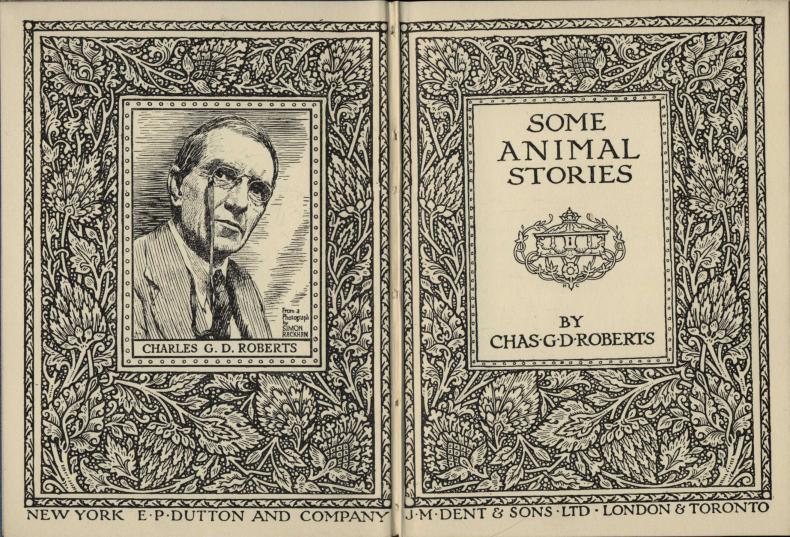
Charles G. D. Roberts, title page
SOME ANIMAL STORIES
BY
CHARLES G. D. ROBERTS
NEW YORK E. P. DUTTON AND COMPANY J. M. DENT & SONS LTD LONDON & TORONTO
All rights reserved
FIRST PUBLISHED . . . 1921 REPRINTED . . . 1923, 1925, 1926, 1928, 1930, 1932
PRINTED IN GREAT BRITAIN
CONTENTS
Do Seek their Meat from God
"The Young Ravens that Call upon Him"
Strayed
The Watchers in the Swamp
Quills the Indifferent
Stripes the Unconcerned
The Black Mule of Aveluy
Star-Nose of the Under Ways
Kroof, the She-Bear
The Initiation of Miranda
A Royal Marauder
SOME ANIMAL STORIES
DO SEEK THEIR MEAT FROM GOD
One side of the ravine was in darkness. The darkness was soft and rich, suggesting thick foliage. Along the crest of the slope tree-tops came into view—great pines and hemlocks of the ancient unviolated forest—revealed against the orange disc of a full moon just rising. The low rays slanting through the moveless tops lit strangely the upper portion of the opposite steep,—the western wall of the ravine, barren, unlike its fellow, bossed with great rocky projections, and harsh with stunted junipers. Out of the sluggish dark that lay along the ravine as in a trough, rose the brawl of a swollen, obstructed stream.
Out of a shadowy hollow behind a long white rock, on the lower edge of that part of the steep which lay in the moonlight, came softly a great panther. In common daylight his coat would have shown a warm fulvous hue, but in the elvish decolourising rays of that half hidden moon he seemed to wear a sort of spectral grey. He lifted his smooth round head to gaze on the increasing flame, which presently he greeted with a shrill cry. That terrible cry, at once plaintive and menacing, with an undertone like the fierce protestations of a saw beneath the file, was a summons to his mate, telling her that the hour had come when they should seek their prey. From the lair behind the rock, where the cubs were being suckled by their dam, came no immediate answer. Only a pair of crows, that had their nest in a giant fir-tree across the gulf, woke up and croaked harshly their indignation. These three summers past they had built in the same spot, and had been nightly awakened to vent the same rasping complaints.
The panther walked restlessly up and down, half a score of paces each way, along the edge of the shadow, keeping his wide-open green eyes upon the rising light. His short, muscular tail twitched impatiently, but he made no sound. Soon the breadth of confused brightness had spread itself further down the steep, disclosing the foot of the white rock, and the bones and antlers of a deer which had been dragged thither and devoured.
By this time the cubs had made their meal, and their dam was ready for such enterprise as must be accomplished ere her own hunger, now grown savage, could hope to be assuaged. She glided supplely forth into the glimmer, raised her head, and screamed at the moon in a voice as terrible as her mate's. Again the crows stirred, croaking harshly; and the two beasts, noiselessly mounting the steep, stole into the shadows of the forest that clothed the high plateau.
The panthers were fierce with hunger. These two days past their hunting had been wellnigh fruitless. What scant prey they had slain had for the most part been devoured by the female; for had she not those small blind cubs at home to nourish, who soon must suffer at any lack of hers? The settlements of late had been making great inroads on the world of ancient forest, driving before them the deer and smaller game. Hence the sharp hunger of the panther parents, and hence it came that on this night they hunted together. They purposed to steal upon the settlements in their sleep, and take tribute of the enemies' flocks.
Through the dark of the thick woods, here and there pierced by the moonlight, they moved swiftly and silently. Now and again a dry twig would snap beneath the discreet and padded footfalls. Now and again, as they rustled some low tree, a pewee or a nuthatch would give a startled chirp. For an hour the noiseless journeying continued, and ever and anon the two grey, sinuous shapes would come for a moment into the view of the now well-risen moon. Suddenly there fell upon their ears, far off and faint, but clearly defined against the vast stillness of the Northern forest, a sound which made those stealthy hunters pause and lift their heads. It was the voice of a child crying,—crying long and loud, hopelessly, as if there were no one by to comfort it. The panthers turned aside from their former course and glided toward the sound. They were not yet come to the outskirts of the settlement, but they knew of a solitary cabin lying in the thick of the woods a mile and more from the nearest neighbour. Thither they bent their way, fired with fierce hope. Soon would they break their bitter fast.
Up to noon of the previous day the lonely cabin had been occupied. Then its owner, a shiftless fellow, who spent his days for the most part at the corner tavern three miles distant, had suddenly grown disgusted with a land wherein one must work to live, and had betaken himself with his seven-year-old boy to seek some more indolent clime. During the long lonely days when his father was away at the tavern the little boy had been wont to visit the house of the next neighbour, to play with a child of some five summers, who had no other playmate. The next neighbour was a prosperous pioneer, being master of a substantial frame house in the midst of a large and well-tilled clearing. At times, though rarely, because it was forbidden, the younger child would make his way by a rough wood road to visit his poor little disreputable playmate. At length it had appeared that the five-year-old was learning unsavoury language from the elder boy, who rarely had an opportunity of hearing speech more desirable. To the bitter grief of both children, the companionship had at length been stopped by unalterable decree of the master of the frame house.
Hence it had come to pass that the little boy was unaware of his comrade's departure. Yielding at last to an eager longing for that comrade, he had stolen away late in the afternoon, traversed with endless misgivings the lonely stretch of wood road, and reached the cabin only to find it empty. The door, on its leathern hinges, swung idly open. The one room had been stripped of its few poor furnishings. After looking in the rickety shed, whence darted two wild and hawklike chickens, the child had seated himself on the hacked threshold, and sobbed passionately with a grief that he did not fully comprehend. Then seeing the shadows lengthen across the tiny clearing, he had grown afraid to start for home. As the dusk gathered, he had crept trembling into the cabin, whose door would not stay shut. When it grew quite dark, he crouched in the inmost corner of the room, desperate with fear and loneliness, and lifted up his voice piteously. From time to time his lamentations would be choked by sobs, or he would grow breathless, and in the terrifying silence would listen hard to hear if any one or anything were coming. Then again would the shrill childish wailings arise, startling the unexpectant night, and piercing the forest depths, even to the ears of those great beasts which had set forth to seek their meat from God.
The lonely cabin stood some distance, perhaps a quarter of a mile, back from the highway connecting the settlements. Along this main road a man was plodding wearily. All day he had been walking, and now as he neared home his steps began to quicken with anticipation of rest. Over his shoulder projected a double-barrelled fowling-piece, from which was slung a bundle of such necessities as he had purchased in town that morning. It was the prosperous settler, the master of the frame house. His mare being with foal, he had chosen to make the tedious journey on foot.
The settler passed the mouth of the wood road leading to the cabin. He had gone perhaps a furlong beyond, when his ears were startled by the sound of a child crying in the woods. He stopped, lowered his burden to the road, and stood straining ears and eyes in the direction of the sound. It was just at this time that the two panthers also stopped, and lifted their heads to listen. Their ears were keener than those of the man, and the sound had reached them at a greater distance.
Presently the settler realised whence the cries were coming. He called to mind the cabin; but he did not know the cabin's owner had departed. He cherished a hearty contempt for the drunken squatter; and on the drunken squatter's child he looked with small favour, especially as a playmate for his own boy. Nevertheless he hesitated before resuming his journey.
"Poor little devil!" he muttered, half in wrath. "I reckon his precious father's drunk down at 'the Corners,' and him crying for loneliness!" Then he reshouldered his burden and strode on doggedly.
But louder, shriller, more hopeless and more appealing, arose the childish voice, and the settler paused again, irresolute, and with deepening indignation. In his fancy, he saw the steaming supper his wife would have awaiting him. He loathed the thought of retracing his steps, and then stumbling a quarter of a mile through the stumps and bog of the wood road. He was foot-sore as well as hungry, and he cursed the vagabond squatter with serious emphasis; but in that wailing was a terror which would not let him go on. He thought of his own little one left in such a position, and straightway his heart melted. He turned, dropped his bundle behind some bushes, grasped his gun, and made speed back for the cabin.
"Who knows," he said to himself, "but that drunken idiot has left his youngster without a bite to eat in the whole miserable shanty? Or maybe he's locked out, and the poor little beggar's half scared to death. Sounds as if he was scared"; and at this thought the settler quickened his pace.
As the hungry panthers drew near the cabin, and the cries of the lonely child grew clearer, they hastened their steps, and their eyes opened to a wider circle, flaming with a greener fire. It would be thoughtless superstition to say the beasts were cruel. They were simply keen with hunger, and alive with the eager passion of the chase. They were not ferocious with any anticipation of battle, for they knew the voice was the voice of a child, and something in the voice told them the child was solitary. Theirs was no hideous or unnatural rage, as it is the custom to describe it. They were but seeking with the strength, the cunning, the deadly swiftness given them to that end, the food convenient for them. On their success in accomplishing that for which nature had so exquisitely designed them depended not only their own, but the lives of their blind and helpless young, now whimpering in the cave on the slope of the moon-lit ravine. They crept through a wet alder thicket, bounded lightly over the ragged brush fence, and paused to reconnoitre on the edge of the clearing, in the full glare of the moon. At the same moment the settler emerged from the darkness of the wood-road on the opposite side of the clearing. He saw the two great beasts, heads down and snouts thrust forward, gliding toward the open cabin door.
For a few moments the child had been silent. Now his voice rose again in pitiful appeal, a very ecstasy of loneliness and terror. There was a note in the cry that shook the settler's soul. He had a vision of his own boy, at home with his mother, safe-guarded from even the thought of peril. And here was this little one left to the wild beasts! "Thank God! Thank God I came!" murmured the settler, as he dropped on one knee to take a surer aim. There was a loud report (not like the sharp crack of a rifle), and the female panther, shot through the loins, fell in a heap, snarling furiously and striking with her fore-paws.
The male walked around her in fierce and anxious amazement. Presently, as the smoke lifted, he discerned the settler kneeling for a second shot. With a high screech of fury, the lithe brute sprang upon his enemy, taking a bullet full in his chest without seeming to know he was hit. Ere the man could slip in another cartridge the beast was upon him, bearing him to the ground and fixing keen fangs in his shoulder. Without a word, the man set his strong fingers desperately into the brute's throat, wrenched himself partly free, and was struggling to rise, when the panther's body collapsed upon him all at once, a dead weight which he easily flung aside. The bullet had done its work just in time.
Quivering from the swift and dreadful contest, bleeding profusely from his mangled shoulder, the settler stepped up to the cabin door and peered in. He heard sobs in the darkness.
"Don't be scared, sonny," he said, in a reassuring voice. "I'm going to take you home along with me. Poor little lad, I'll look after you if folks that ought to don't."
Out of the dark corner came a shout of delight, in a voice which made the settler's heart stand still. "Daddy, daddy," it said, "I knew you'd come. I was so frightened when it got dark!" And a little figure launched itself into the settler's arms, and clung to him trembling. The man sat down on the threshold and strained the child to his breast. He remembered how near he had been to disregarding the far-off cries, and great beads of sweat broke out upon his forehead.
Not many weeks afterwards the settler was following the fresh trail of a bear which had killed his sheep. The trail led him at last along the slope of a deep ravine, from whose bottom came the brawl of a swollen and obstructed stream. In the ravine he found a shallow cave, behind a great white rock. The cave was plainly a wild beast's lair, and he entered circumspectly. There were bones scattered about, and on some dry herbage in the deepest corner of the den, he found the dead bodies, now rapidly decaying, of two small panther cubs.
"THE YOUNG RAVENS THAT CALL UPON HIM"
It was just before dawn, and a greyness was beginning to trouble the dark about the top of the mountain.
Even at that cold height there was no wind. The veil of cloud that hid the stars hung but a hand-breadth above the naked summit. To eastward the peak broke away sheer, beetling in a perpetual menace to the valleys and the lower hills. Just under the brow, on a splintered and creviced ledge, was the nest of the eagles.
As the thick dark shrank down the steep like a receding tide, and the greyness reached the ragged heap of branches forming the nest, the young eagles stirred uneasily under the loose droop of the mother's wings. She raised her head and peered about her, slightly lifting her wings as she did so; and the nestlings, complaining at the chill air that came in upon their unfledged bodies, thrust themselves up amid the warm feathers of her thighs. The male bird, perched on a jutting fragment beside the nest, did not move. But he was awake. His white, narrow, flat-crowned head was turned to one side, and his yellow eye, under its straight, fierce lid, watched the pale streak that was growing along the distant eastern sea-line.
The great birds were racked with hunger. Even the nestlings, to meet the petitions of whose gaping beaks they stinted themselves without mercy, felt meagre and uncomforted. Day after day the parent birds had fished almost in vain; day after day their wide and tireless hunting had brought them scant reward. The schools of alewives, mackerel, and herring seemed to shun their shores that spring. The rabbits seemed to have fled from all the coverts about their mountain.
The mother eagle, larger and of mightier wing than her mate, looked as if she had met with misadventure. Her plumage was disordered. Her eyes, fiercely and restlessly anxious, at moments grew dull as if with exhaustion. On the day before, while circling at her viewless height above a lake far inland, she had marked a huge lake-trout, basking near the surface of the water. Dropping upon it with half-closed, hissing wings, she had fixed her talons in its back. But the fish had proved too powerful for her. Again and again it had dragged her under water, and she had been almost drowned before she could unloose the terrible grip of her claws. Hardly, and late, had she beaten her way back to the mountain-top.
And now the pale streak in the east grew ruddy. Rust-red stains and purple, crawling fissures began to show on the rocky face of the peak. A piece of scarlet cloth, woven among the faggots of the nest, glowed like new blood in the increasing light. And presently a wave of rose appeared to break and wash down over the summit, as the rim of the sun came above the horizon.
The male eagle stretched his head far out over the depth, lifted his wings and screamed harshly, as if in greeting of the day. He paused a moment in that position, rolling his eye upon the nest. Then his head went lower, his wings spread wider, and he launched himself smoothly and swiftly into the abyss of air as a swimmer glides into the sea. The female watched him, a faint wraith of a bird darting through the gloom, till presently, completing his mighty arc, he rose again into the full light of the morning. Then on level, all but moveless wing, he sailed away toward the horizon.
As the sun rose higher and higher, the darkness began to melt on the tops of the lower hills and to diminish on the slopes of the upland pastures, lingering in the valleys as the snow delays there in spring. As point by point the landscape uncovered itself to his view, the eagle shaped his flight into a vast circle, or rather into a series of stupendous loops. His neck was stretched toward the earth, in the intensity of his search for something to ease the bitter hunger of his nestlings and his mate.
Not far from the sea, and still in darkness, stood a low, round hill, or swelling upland. Bleak and shelterless, whipped by every wind that the heavens could let loose, it bore no bush but an occasional juniper scrub. It was covered with mossy hillocks, and with a short grass, meagre but sweet. There in the chilly gloom, straining her ears to catch the lightest footfall of approaching peril, but hearing only the hushed thunder of the surf, stood a lonely ewe over the lamb to which she had given birth in the night.
Having lost the flock when the pangs of travail came upon her, the unwonted solitude filled her with apprehension. But as soon as the first feeble bleating of the lamb fell upon her ear, everything was changed. Her terrors all at once increased tenfold,—but they were for her young, not for herself; and with them came a strange boldness such as her heart had never known before. As the little weakling shivered against her side, she uttered low, short bleats and murmurs of tenderness. When an owl hooted in the woods across the valley, she raised her head angrily and faced the sound, suspecting a menace to her young. When a mouse scurried past her, with a small, rustling noise amid the withered mosses of the hillock, she stamped fiercely, and would have charged had the intruder been a lion.
When the first grey of dawn descended over the pasture, the ewe feasted her eyes with the sight of the trembling little creature, as it lay on the wet grass. With gentle nose she coaxed it and caressed it, till presently it struggled to its feet, and, with its pathetically awkward legs spread wide apart to preserve its balance, it began to nurse. Turning her head as far around as she could, the ewe watched its every motion with soft murmurings of delight.
And now that wave of rose, which had long ago washed the mountain and waked the eagles, spread tenderly across the open pasture. The lamb stopped nursing; and the ewe, moving forward two or three steps, tried to persuade it to follow her. She was anxious that it should as soon as possible learn to walk freely, so they might together rejoin the flock. She felt that the open pasture was full of dangers.
The lamb seemed afraid to take so many steps. It shook its ears and bleated piteously. The mother returned to its side, caressed it anew, pushed it with her nose, and again moved away a few feet, urging it to go with her. Again the feeble little creature refused, bleating loudly. At this moment there came a terrible hissing rush out of the sky, and a great form fell upon the lamb. The ewe wheeled and charged madly, but at the same instant the eagle, with two mighty buffetings of his wings, rose beyond her reach and soared away toward the mountain. The lamb hung limp from his talons; and with piteous cries the ewe ran beneath, gazing upward, and stumbling over the hillocks and juniper bushes.
In the nest of the eagles there was content. The pain of their hunger appeased, the nestlings lay dozing in the sun, the neck of one resting across the back of the other. The triumphant male sat erect upon his perch, staring out over the splendid world that displayed itself beneath him. Now and again he half-lifted his wings and screamed joyously at the sun. The mother bird, perched upon a limb on the edge of the nest, busily rearranged her plumage. At times she stooped her head into the nest to utter over her sleeping eaglets a soft chuckling noise, which seemed to come from the bottom of her throat.
But hither and thither over the round bleak hill wandered the ewe, calling for her lamb, unmindful of the flock, which had been moved to other pastures.
STRAYED
In the Cabineau Camp, of unlucky reputation, there was a young ox of splendid build, but of a wild and restless nature.
He was one of a yoke, of part Devon blood, large, dark-red, all muscle and nerve, and with wide magnificent horns. His yoke-fellow was a docile steady worker, the pride of his owner's heart; but he himself seemed never to have been more than half broken in. The woods appeared to draw him by some spell. He wanted to get back to the pastures where he had roamed untrammelled of old with his fellow-steers. The remembrance was in his heart of the dewy mornings when the herd used to feed together on the sweet grassy hillocks, and of the clover-smelling heats of June when they would gather hock-deep in the pools under the green willow-shadows. He hated the yoke, he hated the winter; and he imagined that in the wild pastures he remembered it would be for ever summer. If only he could get back to those pastures!
One day there came the longed-for opportunity; and he seized it. He was standing unyoked beside his mate, and none of the teamsters were near. His head went up in the air, and with a snort of triumph he dashed away through the forest.
For a little while there was a vain pursuit. At last the lumbermen gave it up. "Let him be!" said his owner, "an' I rayther guess he'll turn up agin when he gits peckish. He kaint browse on spruce buds an' lung-wort."
Plunging on with long gallop through the snow he was soon miles from camp. Growing weary he slackened his pace. He came down to a walk. As the lonely red of the winter sunset began to stream through the openings of the forest, flushing the snows of the tiny glades and swales, he grew hungry, and began to swallow unsatisfying mouthfuls of the long moss which roughened the tree-trunks. Ere the moon got up he had filled himself with this fodder, and then he lay down in a little thicket for the night.
But some miles back from his retreat a bear had chanced upon his foot-prints. A strayed steer! That would be an easy prey. The bear started straightway in pursuit. The moon was high in heaven when the crouched ox heard his pursuer's approach. He had no idea what was coming, but he rose to his feet and waited.
The bear plunged boldly into the thicket, never dreaming of resistance. With a muffled roar the ox charged upon him and bore him to the ground. Then he wheeled, and charged again, and the astonished bear was beaten at once. Gored by those keen horns he had no stomach for further encounter, and would fain have made his escape; but as he retreated the ox charged him again, dashing him against a huge trunk. The bear dragged himself up with difficulty, beyond his opponent's reach; and the ox turned scornfully back to his lair.
At the first yellow of dawn the restless creature was again upon the march. He pulled more mosses by the way, but he disliked them the more intensely now because he thought he must be nearing his ancient pastures with their tender grass and their streams. The snow was deeper about him, and his hatred of the winter grew apace. He came out upon a hill-side, partly open, whence the pine had years before been stripped, and where now grew young birches thick together. Here he browsed on the aromatic twigs, but for him it was harsh fare.
As his hunger increased he thought a little longingly of the camp he had deserted, but he dreamed not of turning back. He would keep on till he reached his pastures, and the glad herd of his comrades licking salt out of the trough beside the accustomed pool. He had some blind instinct as to his direction, and kept his course to the south very strictly, the desire in his heart continually leading him aright.
That afternoon he was attacked by a panther, which dropped out of a tree and tore his throat. He dashed under a low branch and scraped his assailant off, then, wheeling about savagely, put the brute to flight with his first mad charge. The panther sprang back into his tree, and the ox continued his quest.
Soon his steps grew weaker, for the panther's cruel claws had gone deep into his neck, and his path was marked with blood. Yet the dream in his great wild eyes was not dimmed as his strength ebbed away. His weakness he never noticed or heeded. The desire that was urging him absorbed all other thoughts,—even, almost, his sense of hunger. This, however, it was easy for him to assuage, after a fashion, for the long, grey, unnourishing mosses were abundant.
By and by his path led him into the bed of a stream, whose waters could be heard faintly tinkling on thin pebbles beneath their coverlet of ice and snow. His slow steps conducted him far along this open course. Soon after he had disappeared, around the curve in the distance there came the panther, following stealthily upon his crimsoned trail. The crafty beast was waiting till the bleeding and the hunger should do its work, and the object of its inexorable pursuit should have no more heart left for resistance.
This was late in the afternoon. The ox was now possessed with his desire, and would not lie down for any rest. All night long, through the gleaming silver of the open spaces, through the weird and chequered gloom of the deep forest, heedless even of his hunger, or perhaps driven the more by it as he thought of the wild clover bunches and tender timothy awaiting him, the solitary ox strove on. And all night, lagging far behind in his unabating caution, the panther followed him.
At sunrise the worn and stumbling animal came out upon the borders of the great lake, stretching its leagues of unshadowed snow away to the south before him. There was his path, and without hesitation he followed it. The wide and frost-bound water here and there had been swept clear of its snows by the wind, but for the most part its covering lay unruffled; and the pale dove-colours, and saffrons, and rose-lilacs of the dawn were sweetly reflected on its surface.
The doomed ox was now journeying very slowly, and with the greatest labour. He staggered at every step, and his beautiful head drooped almost to the snow When he had got a great way out upon the lake, at the forest's edge appeared the pursuing panther, emerging cautiously from the coverts. The round face and malignant green eyes were raised to peer out across the expanse. The labouring progress of the ox was promptly marked. Dropping its nose again to the ensanguined snow, the beast resumed his pursuit, first at a slow trot, and then at a long, elastic gallop. By this time the ox's quest was nearly done. He plunged forward upon his knees, rose again with difficulty, stood still, and looked around him. His eyes were clouding over, but he saw, dimly, the tawny brute that was now hard upon his steps. Back came a flash of the old courage, and he turned, horns lowered, to face the attack. With the last of his strength he charged, and the panther paused irresolutely; but the wanderer's knees gave way beneath his own impetus, and his horns ploughed the snow. With a deep bellowing groan he rolled over on his side, and the longing, and the dream of the pleasant pastures, faded from his eyes. With a great spring the panther was upon him, and the eager teeth were at his throat,—but he knew nought of it. No wild beast, but his own desire, had conquered him.
When the panther had slaked his thirst for blood, he raised his head, and stood with his fore-paws resting on the dead ox's side, and gazed all about him.
To one watching from the lake shore, had there been any one to watch in that solitude, the wild beast and his prey would have seemed but a speck of black on the gleaming waste. At the same hour, league upon league back in the depth of the ancient forest, a lonely ox was lowing in his stanchions, restless, refusing to eat, grieving for the absence of his yoke-fellow.
THE WATCHERS IN THE SWAMP
Under the first pale lilac wash of evening, just where the slow stream of the Lost-Water slipped placidly from the open meadows into the osier-and-bulrush tangles of the swamp, a hermit thrush, perched in the topmost spray of a young elm tree, was fluting out his lonely and tranquil ecstasy to the last of the sunset. Spheral, spheral, oh, holy, holy, clear, he sang; and stopped abruptly, as if to let the brief, unfinished, but matchlessly pure and poignant cadence sink unjarred into the heart of the evening stillness. One minute—two minutes—went by; and the spaces of windless air were like a crystal tinged with faint violet. And then this most reticent of singers loosed again his few links of flawless sound—a strain which, more than any other bird-song on this earth, leaves the listener's heart aching exquisitely for its completion. Spheral, spheral, oh, holy, holy—but this time, as if seeking by further condensation to make his attar of song still more rare and precious, he cut off the final note, that haunting, ethereal—clear.
Again the tranced stillness. But now, as if too far above reality to be permitted to endure, after a few seconds it was rudely broken. From somewhere in the mysterious and misty depth of the swamp came a great booming and yet strangulated voice, so dominant that the ineffable colours of the evening seemed to fade and the twilight to deepen suddenly under its sombre vibrations. Three times it sounded:—Klunk-er-glungk ... Klunk-er-glungk ... Klunk-er-glungk, an uncouth, mysterious sound, sonorous, and at the same time half muffled, as if pumped with effort through obstructing waters. It was the late cry of the bittern, proclaiming that the day was done.
The hermit-thrush, on his tree-top against the pale sky, sang no more, but dropped noiselessly to his mate on her nest in the thickets. Two bats flickered and zigzagged hither and thither above the glimmering stream. And the leaf-scented dusk gathered down broodingly, with the dew, over the wide solitudes of Lost-Water Swamp.
* * * * * *
It was high morning in the heart of the swamp. From a sky of purest cobalt flecked sparsely with silver-white wisps of cloud, the sun glowed down with tempered, fruitful warmth upon the tender green of the half-grown rushes and already rank water-grasses—the young leafage of the alder and willow thickets—the wide pools and narrow, linking lanes of unruffled water already mantling in spots with lily-pad and arrow-weed. A few big red-and-black butterflies wavered aimlessly above the reed-tops. Here and there, with a faint elfin clashing of transparent wings, a dragon-fly, a gleam of emerald and amethyst fire, flashed low over the water. From every thicket came a soft chatter of the nesting red-shouldered blackbirds.
And just in the watery fringe of the reeds, as brown and erect and motionless as a mooring stake, stood the bittern.
Not far short of three feet in length, from the tip of his long and powerful dagger-pointed bill to the end of his short rounded tail, with his fierce, unblinking eyes round, bright and hard, with his snaky head and long, muscular neck, he looked, as he was, the formidable master of the swamp. In colouring he was a streaked and freckled mixture of slaty greys and browns and ochres above, with a freckled whitish throat, and dull buff breast and belly—a mixture which would have made him conspicuous amid the cool light green of the sedges, but that it harmonised so perfectly with the earth and the roots. Indeed, moveless as he stood, to the undiscriminating eye he might easily have passed for a decaying stump by the water side. His long legs were of dull olive which melted into the shadowy tones of the water.
For perhaps ten minutes the great bird stood there without the movement of so much as a feather, apparently unconcerned while the small inhabitants of the swamp made merry in the streaming sunshine. But his full round eyes took in, without stirring in their sockets, all that went on about him, in air, or sedge, or water. Suddenly, and so swiftly that it seemed one motion, his neck uncoiled and his snaky head darted downward into the water near his feet, to rise again with an eight-inch chub partly transfixed and partly gripped between the twin daggers of his half-opened bill. Squirming, and shining silverly, it was held aloft, while its captor stalked solemnly in through the sedges to a bit of higher and drier turf. Here he proceeded to hammer his prize into stillness upon an old half-buried log. Then, tossing it into the air, he caught it adroitly by the head, and swallowed it, his fierce eyes blinking with the effort as he slowly forced it down his capacious gullet. It was a satisfying meal, even for such a healthy appetite as his, and he felt no immediate impulse to continue his fishing. Remaining where he was beside the old log, thigh deep in the young grasses and luxuriously soaking in the sunshine, he fell once more into a position of rigid movelessness. But his attitude was now quite different from that which he had affected when his mind was set on fish. His neck was coiled backwards till the back of his head rested on his shoulders, and his bill pointed skyward, as if the only peril he had to consider seriously during his time of repose might come, if at all, from that direction. And though he rested, and every nerve and muscle seemed to sleep, his gem-like eyes were sleeplessly vigilant. Only at long intervals a thin, whitish membrane flickered down across them for a fraction of an instant, to cleanse and lubricate them and keep their piercing brightness undimmed.
Once a brown marsh-hawk, questing for water-rats, winnowed past, only ten or a dozen feet above his head. But he never stirred a muscle. He knew it would be a much more formidable and daring marauder than the marsh-hawk that would risk conclusions with the uplifted dagger of his bill.
In about half-an-hour—so swift is the digestion of these masters of the swamp—the bittern began to think about a return to his easy and pleasant hunting. But, always deliberate except when there was need for instant action, at first he did no more than uncoil his long neck, lower his bill to a level, and stand motionlessly staring over the sedge-tops. One of the big red-and-black butterflies came wavering near, perhaps under the fatal delusion that that rigid yellow bill would be a good perch for him to alight on. A lightning swift dart of the snaky head; and those gay wings, after curiously adorning for a moment the tip of the yellow bill, were deftly gathered in and swallowed—an unsubstantial morsel, but not to be ignored when one is blest with a bittern's appetite.
After a few minutes more of statuesque deliberation, having detected nothing in the landscape particularly demanding his attention, the bittern lazily lifted his broad wings and flapped in slow flight, his long legs almost brushing the sedge-tops, back to the post of vantage where he had captured the chub. As soon as he alighted he stiffened himself erect, and stared about as if to see whether his flight had been noticed. Then, presently, he seemed to remember something of importance. This was the season of mating joys and cares. It was time he signalled his brown mate. First he began snapping his bill sharply, and then he went through a number of contortions with his throat and neck, as if he were trying to gulp down vast quantities of air, and finding the effort most difficult. At length, however, the painful-looking struggle was crowned with achievement. Once more, as on the preceding evening, that great call boomed forth across the swamp, sonorous yet strangulated, uncouth yet thrilling and haunting, the very voice of solitude and mystery:—Klunk-er-glungk—Klunk-er-glungk—Klunk-er-glungk.
Almost immediately came an acknowledgement of this untuneful love-song—a single hoarse quaw-awk; and another snaky brown head and yellow dagger bill were raised above the tops of the sedges. The hen bittern, in response to her mate's cry, had just come off her nest.
For some tranquil moments the two eyed each other without stirring, and it almost seemed as if their very immobility was a mode of expression, a secret code for communication between them. The result, if so, appeared to be satisfactory. The hen came stalking solemnly through the grass and sedges towards the water's edge, only pausing on the way to transfix and gulp down a luckless frog. And the stately male, once more spreading his spacious vans, flapped slowly over and dropped again into the grass some ten or a dozen feet from the nest.
The nest was a rather casual structure of dry grass and weeds, in a hollow of the turf, and more or less concealed by leaning tufts of swamp-grass. It contained three large eggs of a dull greenish buff, clouded with darker tones, and blending elusively with the soft colourings of the nest. These precious eggs the male bittern had no intention of brooding. His object was merely to stand guard over them, with jealous vigilance, while his mate was away foraging. The sun was softly warm upon them, through the thin shadows of the grass blades, and he knew they would not chill during her brief absence. He took his post just near enough to keep his eye upon the nest, without unduly drawing attention to its hiding-place.
This patch of water-meadow, perhaps a half-acre in extent, on which the bitterns had their nest, was one of many such tiny islands scattered amid the interlacing channels of Lost-Water Swamp. It formed a congenial refuge for all that small life of the wilderness which loves to be near water without being in it. It was particularly beloved of the meadow-mice, because the surrounding watercourses and morasses were an effectual barrier to some of their worst enemies, such as foxes, skunks, and weasels; and they throve here amazingly. To be sure the bittern would take toll of them when they came his way, but he did not deliberately hunt them, rather preferring a diet of frogs and fish; and moreover, his depredations upon the mice were more than counterbalanced by his eager hostility to their dreaded foes, the snakes. So, on the whole, he might have been regarded by the mouse community as a benefactor, though a rather costly one.
Even now, as he stood there apparently thinking of nothing but his guardianship of the nest, he gave a telling example of his beneficence in this regard. There was a tiny, frightened squeak, a desperate small rustling in the grass-stems, and a terrified mouse scurried by, with a two-foot black snake at its tail. The bittern's head flashed down, unerringly, and rose again, more slowly, with the snake gripped by the middle. Held high in air, as if on exhibition, between the knife-edge tips of that deadly yellow bill, the victim writhed and twisted, coiling itself convulsively around its captor's head and neck. But with two or three sharp jerks it was drawn further back, towards the base of the mandibles, and then, with an inexorable pressure, bitten clean in two, the halves uncoiled and fell to the ground, still wriggling spasmodically. With grave deliberation the bittern planted one foot upon the head half, and demolished the vicious head with a tap of his bill. This done, he swallowed it, with determined and strenuous gulpings. Then he eyed the other half doubtfully, and decided that he was not yet ready for it. So, placing one foot upon it with a precise air, as if in assertion of ownership, he lifted his head again and resumed his motionless guarding of the nest. If any mice were watching—and their beady bright eyes are always watching—they may well have congratulated themselves that the pair of bitterns had chosen this particular island for their nesting-place.
A little later in the morning—perhaps fifteen or twenty minutes after the incident of the snake—the mice found yet another potent reason for congratulating themselves on the presence of their expensive champion. The hen bittern, apparently, had not been very successful in her foraging. She had shown as yet no sign of returning to the nest. The male was just beginning to get impatient. He even went so far as to move his head, though ever so slightly. Indeed, he was on the very point of beginning those grotesque snappings of the bill and gulpings of air, which would be followed by his booming triple call, when he caught sight of a dark form moving through the grass, beyond the nest. Instantly he stiffened again into rigidity. Only, very slowly, the long slender feathers which crowned his head and lay along his neck began to rise.
The dark form, gliding stealthily among the grasses, was that of an animal about two feet in length, low on the legs, slender, sinuous, quick-darting. The bittern had never chanced to observe a mink before, but he needed no one to tell him that this creature was dangerous. Ferocity and efficiency were written all over the savage, triangular head, and lithe, swift body. But the intruder had evidently not yet discovered the precious nest. He was half a dozen paces away from it, and not moving directly towards it. He seemed quite otherwise occupied. Indeed, in the very next moment he pounced upon a mouse, which he tore and devoured with an eagerness which showed him to be hungry. The bittern, being blest with prudence and self-control, made no move to meet trouble half-way. He waited, and hoped anxiously that the treasure of the nest might escape discovery.
The mink, to do that sanguinary marauder justice, was not at the moment thinking of any such luxury as eggs. A restless and far-ranging slayer, and almost as much at home in the water as on dry land, he had entered the swamp in the hope of finding just such a happy hunting ground as this bit of mouse-thronged meadow. He had just arrived, after much swimming of sluggish channels, scrambling over slimy roots, and picking a fastidious way about dark pools of treacherous ooze, and he was now full of blood-thirsty excitement over the success of his adventure. His acute ears and supersensitive nostrils had already assured him that the meadow was simply swarming with mice. His nose sniffed greedily the subtle, warm mousy smells. His ears detected the innumerable, elusive mousy squeaks and rustlings. His eyes, lit now with the red spark of the blood-lust, were less fortunate than his ears and nose, because word of a new and dreadful foe had gone abroad among the mouse-folk, and concealment was the order of the day. But already, he had made one kill—and that so easily that he knew the quarry here was not much hunted. He felt that, at last, he could afford to take life easily and do his hunting at leisure.
He licked his lips, gave his long whiskers a brush with his fore-paws, to cleanse them after his rather hasty and untidy meal, and was just preparing to follow a very distinct mouse trail which lay alluringly before his nose, when a chance puff of air, drawing softly across the grass, bore him a scent which instantly caught his attention. The scent of bittern was new to him, as it chanced. He knew it for the scent of a bird, a water-bird of some kind,—probably, from its abundance, a large bird, and certainly, therefore, a bird worth his hunting. That the hunting might have any possible perils for himself was far from occurring to his savage and audacious spirit.
Curious and inquiring, he rose straight up en his hind-quarters in order to get a good view, and peered searchingly over the grass-tops. He saw nothing but the green and sun-steeped meadow with the red-and-black butterflies wavering over it, the gleam of the unruffled water, and the osier-thickets beyond, their leafage astir with blackbirds and swamp-sparrows. He looked directly at, and past, the guardian bittern, not discovering him for a bird at all, but probably mistaking that rigid, vigilant shape for an old brown stump. For the mink's eyes, like those of many other animals, were less unerring than his ears and nostrils, and much quicker to discern motion than fixed form. Had the bittern stirred by so much as a hair's breadth, the mink would have detected him at once for what he was. But there in the full glare of the open, his immobility concealed him like a magic cloak. The mink looked at him and saw him not; nor saw another similar form, unstirring, tensely watchful, over by the water-side. The hen bittern, warned perhaps by some subtle telepathic signal from her mate, had stopped her fishing and stood on guard.
Having failed to detect the source of that strange, intriguing smell, the mink concluded, from past experiences with partridge, grouse, and duck, that it must come from a brooding mother, hiding on a nest in the grass. Nothing could be more satisfactory. His eyes blazed blood-red at the prospect of slaughter. Dropping down again upon all fours, he darted forward, up the trail of the scent, soundless as a shadow and swift as a shifting beam of light,—and came full upon the nest with its three unsheltered eggs. Instantly seizing the nearest one between his agile forepaws, he crunched the shell and began greedily sucking up the contents.
But the savour of the feast had hardly thrilled his palate when it seemed as if the skies had fallen upon him. A scalding anguish stabbed his hunched-up shoulders, a smother of buffeting wings enveloped him, and he was borne backward from the nest in an ignominious bundle, the broken egg-shell still clinging to his nose.
At that moment when he had dropped upon all fours and darted forward through the grass toward the nest, all the immobility of the watching bittern had vanished. His long crest standing straight up in his fury, he had launched himself to the attack, covered the intervening distance with two tremendous thrusts of his powerful wings, and fallen like a cyclone upon the violator of his home. The dagger of his bill had struck deeply, though at random; his hard wing-elbows had landed their blows effectively; and the impetus of his charge had swept the battle clear of the nest, thus saving the two remaining eggs from destruction. The same impetus carried him clear of his foe and a couple of paces past, but he turned adroitly in the air and landed facing about, ready for the inevitable counter-attack.
Amazed and startled though he was, and handled with a roughness quite new to his experience, the mink was in no way daunted. Rather he was so boiling with rage that his wonted wariness forsook him completely. With a snarl that was almost a screech he sprang straight at the long, exposed, inviting throat of his adversary. Had those keen white fangs of his, still dripping with egg, reached their aim, the fight would have been over. His leap was swift, true, and deadly. But equally true, and more swift, was the counter-stroke. He was met, and stopped in mid-air, by a thrust of the bittern's bill, which, had he not twisted his head just in time, would have split his skull. As it was, it laid open one side of his snarling face, destroyed one eye, and brought him heavily to the ground. Even under this punishment, however, he would not acknowledge defeat. Springing aside, with a lightning zigzag movement to confuse the aim of that terrific bill, he darted low and made a leap at his antagonist's long, vulnerable legs. He missed only by a hair's breadth, as the bittern, keenly alive to the risk of such a manoeuvre, leapt nimbly aside and baulked him with a stiff wing-stroke. He seized the baffling wing and strove to pull his tall adversary down. But two great pinion feathers came away in his jaws, and the next moment he got another terrible, driving stab from the dagger beak, well forward on the flank. It was a slanting thrust, or it would have pierced his lungs; but it nearly knocked the wind out of him, and ploughed a deep red gash in his glossy coat.
Screeching furiously, he doubled on himself like a snake to meet this attack. But at the same moment he cringed under another excruciating stab, this time in the haunch; and looking up, he saw himself enveloped in a cloud of blinding wings. The hen bittern had arrived to join in the defence of her nest.
Now, bloodthirsty and merciless marauder though he was, the mink's courage was a thing beyond dispute; and terribly though the fight had so far gone against him, with a single foe to confront he would probably have held on to the death. But for all his fury he was not quite mad; and this reinforcement of the enemy was too much for him. Suddenly straightening himself out long and small like an eel, he slipped from under the terrifying storm of wings and stabs, and made off through the grass at the best speed that in all his swift career he had ever attained. He made for the water, which he felt would be his safest refuge. The angry bitterns were after him on the instant, flying as low as possible and stabbing down at him through the grass-stems. But his cunning and slippery zigzags enabled him to dodge most of their thrusts; and in their eagerness they got in each other's way—which probably saved him his bare life. At length, streaming with blood, and leaving behind him a red trail to proclaim his discomfiture to the mice, he reached the water, and dived in. Without daring to come to the surface he swam across the channel—here about two score paces in width—and cautiously raised his head behind a screen of over-hanging weeds. He saw his two pursuers standing, motionless and erect, on the opposite bank, watching with fierce eyes for him to reappear. He decided not to reappear. Submerging himself again, he swam on down stream till he had rounded a sharp bend of the channel. When he thought it prudent to show himself once more, he was sheltered from those avenging eyes by a dense screen of alder and willows. These bushes were full of nesting red-wings, who chattered at him angrily. He paid no heed to their scolding, but hurried through the thicket, and on down the bank till he found an ancient musk-rat hole. Into this he crept eagerly, and lay down in the grateful dark to nurse his wounds and his humiliation.
After the disappearance of the mink the hen bittern soon returned to her nest. But the male stayed where he was. From time to time he would snap up a butterfly or beetle, or spear a passing frog or chub or sucker. But always his indignant heart was hoping that the mink would return. After an hour or two, however, his wrath died down and he began to forget.
Then he would occasionally vary his still-hunting, by walking with slow, meditative steps up and down the strip of bare ooze between the grass and the water, feeling out with his sensitive claws the little freshwater clams which lay hidden in the mud. The clams were scarce, however, so along about the middle of the afternoon he flapped lazily back to his old fishing station on the other side of the meadow.
Later in the day, when the osiers were beginning to throw long shadows across the water, and the red-and-black butterflies had grown too indolent to dance, and the blue-and-amethyst dragon-flies had ceased their hawking of mosquitoes over the lily-pads and arrow-weed, the great bittern, full fed and at ease with life, flapped languidly up from the water-side and dropped close beside the nest. His brooding mate lifted her head, as if in greeting, and laid it back at once between her shoulders, with her yellow bill pointing skyward as was her vigilant custom.
Soon the first warm tints of sunset began to stain the edges of the clouds above the far fringes of the swamp. Motionless and erect beside his mate, the bittern watched the oncoming of the enchantment as his day drew to its quiet close. Suddenly the coloured quiet of the air was disturbed by the beating of hurried wings. He glanced upward, without moving. A mallard drake, in frantic flight, whirred past, fifteen or twenty feet above his head, making for the water. Close after the fugitive, and swiftly overhauling him with long, tremendous thrusts of his mighty wings, came that most dreaded cut-throat of the air, a great blue goshawk. Swift and bullet-like was the flight of the desperate fugitive; but that of the hawk was far swifter. Had the water been two feet further away the fate of the glossy drake would have been sealed. He would have been overtaken, his throat torn out in mid-air, his body carried off to the nearest tree-top to be plucked and devoured. But this time the inscrutable Fates of the wilderness, too seldom so lenient to the weak, decided to favour him. With a heavy-sounding splash he shot down into the blessed water, and disappeared into safety beneath the lily-pads, just in time.
The destroying talons of the great hawk clutched convulsively at the dandy curled tips of his tail as he vanished.
With his arrowy speed, his precision of stroke, his audacity and fiery spirit, the blue goshawk was little accustomed to the experience of being baulked of his prey. He knew well enough that his quarry would not show itself again, but would swim away under water and only come up to breathe in the safe shelter of some dense thicket of rushes. With a sharp yelp of wrath, he swept up from the water on a long, graceful curve, wheeled sharply above the osiers, and sailed back low above the bittern's island, seeking other prey. And his piercing gaze fell upon the bittern, standing rigid beside the nest.
His swoop was instantaneous, straight and swift as a bolt from a cross-bow. But that coiled steel spring of the bittern's neck was even swifter; and as his talons struck downward, the bittern's dagger thrust caught him in the very centre of the impending claw, splitting the foot fairly and disabling it. Nevertheless, by the shock of the attack the bittern was borne downward, and would have been caught in the breast or throat by the other talon; but at the same instant his watchful mate, who had half risen on the nest that her eggs might not be crushed in the mêlée, delivered her thrust. It went true. And it had not only the drive of her sinewy neck behind it, but also the full force of her powerful thighs, as well as the assailant's descending weight to drive it home. It caught the goshawk full in the base of the neck, pierced clean through, and severed the spine. And in a wild confusion of sprawled legs and pounding wings the three great birds fell in a heap in the grass, just beyond the nest.
The two bitterns nimbly extricated themselves, and with wings pounding, stabbed savagely, again and again, at the unresisting body of the hawk. Presently, as if by one impulse, they both stood up, erect and still as images, their yellow bills dripping with blood. The male had a bleeding gash along the side of his head, and had lost several of his haughty crest feathers. But this concerned him little. His heart swelled with triumph. He was forced to give it utterance. He snapped his bill sharply, gulped a few mouthfuls of air, and then sent forth his booming challenge across the swamp:—Klunk-er-glungk ... Klunk-er-glungk ... Klunk-er-glungk.
His mate spread her broad wings, shook herself till her ruffled plumage fell into place, wiped her conquering bill on the grass, stepped delicately back into the nest, and softly settled herself down upon her two eggs, so miraculously preserved.
Silence fell on Lost-Water Swamp. The air became gradually transfused with amethyst and pale rose. And then, far and faint, tranquil and poignant, came the entrancing cadence—Oh, spheral, spheral, oh, holy, holy, spheral—the silver vesper ecstasy of the hermit-thrush, in his tree-top against the pellucid sky.
QUILLS THE INDIFFERENT
Quills was born in a capacious hole in the heart of a huge and ancient red maple, near the banks of the Tobique River, in New Brunswick.
The hole had to be capacious, for Quills's mother was a fine porcupine, in her prime, fully two and a half feet in length, massive in build, and a good twenty pounds in weight; and, moreover, her armament of long, bristling spines made it essential that she should not be unduly crowded in her nest. But the entrance was only large enough for her to squeeze through it without discomfort, so the dusky interior was sheltered, warm and dry. It was also safe; for in all the wilderness there was no savage marauder reckless enough to invade a porcupine's nest while the owner was at home.
In proportion to the size of his mother, Quills, like all young porcupines, was an amazingly big baby—hardly smaller, indeed, than the new-born cub of the black bear. His length was about eleven inches, his weight a shade over two pounds—and this when he was not yet twenty-four hours old. He was richly clothed with long, dark fur, almost black, under which lay hidden his sprouting armament of spines, already formidable, though only about half an inch in length. Born with the insatiable appetite of his tribe, he lay stretched out between his mother's stumpy fore-legs, nursing greedily, with an incessant accompaniment of tiny squeaks and squeals of satisfaction. The sounds were loud enough to attract the notice of two little black-and-white woodpeckers who had just alighted on the trunk near the hole. With sleek heads cocked alertly, and bright eyes keen with interrogation, they listened to the curious noises inside the tree. Then they clambered on up the trunk to a safer height, wondering, no doubt, that any youngling should be guilty of such an indiscretion as thus to betray the secret of its hiding-place. They could not know that the porcupine baby, almost alone among the babes of the wild, was exempted, through the reputation of his spines, from the law of silence as the price of life. Young or old, the porcupine will make a noise whenever it pleases him to do so, and with a lofty indifference as to who his hearers may be.
* * * * * *
It was spring, and spring comes late to the high valley of the Tobique stream. The ancient red maple, still full of vigorous life in the sap-wood of its outer shell, in spite of the great hollow at its decaying heart, was mantled over every branch and twig with a glowing veil of tiny rose-bud blooms, though the green of its leaf-buds was hardly yet showing through the brown sheaths. The ice had been broken up and been swept away in tumbling masses, and the current of the swift river, swollen with the spring freshet, filled the air about the porcupine's nest with a pleasant, softly thunderous roar. From all the open glades the snow was gone, though masses of it, shrunken and greyish and sprinkled with dead leaves and twigs, still lingered in the fir thickets and the deeper hollows. On the drier hillocks and about the rotting stumps a carpet of round, flat, yellowish-green and bronzy leaves shielded the lurking pink-and-white blossoms and haunting perfumes of the Mayflower, or trailing arbutus, the shy darling of the Northern spring. The fairy fragrance came and went elusively across the pervading scent of moist earth and spicy balsam-tips, as the mild breeze pulsed vaguely through the forest.
It was mid-afternoon of the second day of Quills's life. Pleasantly fatigued from his double duty of nursing and growing, he fell into a sound sleep. Then his mother, spurred by the now insistent demands of her own appetite, gently disentangled herself from the clutch of his baby claws in her fur, crawled from the hole, and descended the trunk to seek a hasty meal.
But what was haste for a porcupine would have been regarded at the extreme of lazy loitering in any other creature of the wild. At the foot of the old maple she stood for some moments loudly sniffing the air with her blunt nostrils. Then, as if making up her mind that it was hemlock she wanted, she ambled off with heavy deliberation to the nearest hemlock tree, climbed it with a noisy rattling of claws, settled herself comfortably in the first crotch, and fell to gnawing the rough bark. When she had taken the edge off her appetite with this fare—which no stomach but a porcupine's could ever digest—she crawled out along a branch, as far as it would bear her weight, and, gathering a lot of the slender twigs between her fore-paws, made a hearty dessert of the dark-green, glossy frondage. Other hemlocks, standing at a greater distance from her nest, already bore the conspicuous marks of her foraging; but this one she had hitherto left untouched against the day when she would be wanting to take her meals near home.
While his mother was away feeding, Quills had slept, soundly and silently, for perhaps an hour or more. Then he woke up—hungry, of course, as befitted a healthy young porcupine. Finding no warm mother to snuggle him and feed him, he at once set up his small but earnest complaint of whines and squeals and grumbles, all unconcerned as to who or what might overhear him.
As it chanced at this moment, a hungry weasel—the most insatiably bloodthirsty of all the wilderness prowlers—was just approaching the foot of the old maple, nosing out the somewhat stale trail of a rabbit. As his keen ear caught these tell-tale sounds from within the tree, he stopped short, and his malignant little eyes began to blaze. Then he glided around the great trunk, halted just below the hole, and sniffed discriminately at the strong fresh scent upon the bark. But at this point he hesitated—and it is not usual for a hungry weasel to hesitate. The scent was porcupine, and a grown-up porcupine was a proposition which not even his audacity was prepared to tackle. The sounds from within that tempting hole, to be sure, were the voice of a baby porcupine. But was the baby alone, or was the mother with it? In the latter case, he would as soon have jumped into the jaws of a lynx as enter that hole. The fresh scent on the bark offered no solution to the problem. Was it made in coming out or going in? He sniffed at it again, growing fiercer and more hungry every moment.
Suddenly he heard behind him a dry rattling of quills and a confused noise of squeals and chattering grunts. The mother porcupine was hurrying across the moist turf, gnashing her jaws, and looking twice her natural size with every quill on end. In her rage and anxiety she was making remarkable speed for a porcupine. The weasel, his long white fangs bared and his eyes red with disappointed fury, whipped about and stood facing her till she was within three or four feet of him. But for all his rage he was no fool. For her gnashing yellow teeth he had no respect whatever. But those deadly, poisonous, needle-sharp spines of hers! He had no wish to interview them too closely. With eleventh-hour discretion he slipped aside to make way for her, and glided off to pick up again the trail of the rabbit.
The mother porcupine never even turned her head to see where the enemy had gone to. Wild with anxiety, she scrabbled up the trunk and into her nest. Her experienced nose, however, at once assured her that the weasel had not been inside. Instantly appeased, she stretched herself on her side, drew the complaining youngster to her breast, licked and nosed him for a few moments, and settled into a comfortable doze.
Having this hearty mother's attention all to himself—an exceptional advantage, as a porcupine baby has generally one brother or sister, if not more, to share the maternal supply—young Quills grew and throve amazingly. And his armoury of spines throve with him. In a few weeks he was out of the hole and following his mother up into the hemlock trees, where he speedily learned to feed on the glossy green tips of the frondage. From this diet he passed quickly to the stronger fare of the harsh and bitter bark, the gnawing of which was a delight to his powerful, chisel-like teeth. By the time the full flush of the Tobique summer, ardent and swift, had crowded the rich-soiled valley with greenery and bloom, Quills's mother had grown altogether indifferent to him. She had long ago refused him her breasts, of which, indeed, he had no further need. But she still permitted him to follow her about, if he wanted companionship, so long as he did not trouble her. And in this way he learned the few things—astonishingly few, it would seem—that a porcupine needs to know in order to hold his own in the struggle for existence. He learned, among other things, that nearly all the green stuff that the forest produced was more or less fit for his food, that there were other trees besides the hemlock whose bark was tasty and nourishing and pleasantly resistant to his teeth, and that in a broad, sunny backwater of the river there grew a profusion of great round flat leaves, the pads of the water-lily, which were peculiarly thrilling to his palate. In fact, most of his learning had to do with food, which was what he appeared to live for. His enemies were few, and seldom enthusiastic. And he never troubled his head about avoiding them. With an indifference nothing less than colossal, he left it to them to avoid him, if they wished; and they did so wish, ninety-nine times out of the hundred.
Along towards the latter part of August, Quills found that his mother was no longer indifferent. She had grown actively unfriendly. Whenever he came near her she grunted and chattered to him in such an irritable fashion that it was obvious, even to a not over-sensitive spirit like his, that his companionship was distasteful to her. This attitude neither grieved nor angered him, however. She was no longer of any importance to him. He simply quit following her, went his own way, and forgot her. Striking off on his own, and impelled by instinct to seek a fresh range for himself, he plunged into the still, warm tide of the sunny backwater and swam, with much splashing and little speed, to the opposite bank. Swimming was no task to him, for his coat of hollow quills made it impossible for him to sink. The backwater was not more than thirty or forty yards in width, but when he had crossed it, and crawled forth upon the opposite bank, he felt that he had found a new world, and owned it. He ambled joyously along the bank to a point where he had marked a bed of bright-green arrow-weed, and gorged himself to his great content on the shapely, pointed leaves and stout succulent stalks. Then he climbed a big poplar and curled up to sleep, self-sufficient and pleased to be alone.
Quills was by this time more than half grown up, and, moreover, thanks to his happily selected parentage and his ample nourishment when a baby, he was as big and strong as many a less favoured porcupine achieves to be at maturity. In colour he was of a very dark brown, verging on black, and peppered with a dingy yellowish white, his long fur being dark with light tips, and his spines cream-coloured with black tips. The spines on his body ranged from two to four inches in length, and when he was not angry, they were partly concealed by the fur, which was considerably longer. The quills on his head and the sides of his face were about an inch in length. His short, blunt muzzle was free from spines, but closely furred to the lips, and conspicuously adorned by his large and prominent front teeth, his gnawing teeth, which were of a vivid dark yellow colour. His legs and all the under parts of his body were clothed in dense, soft fur, entirely without spines. His tail, about five inches in length, was very thick and powerful, and heavily armed with spines to the tip. The spines on his body were for his protection, but this armed tail was his one weapon of offence—a weapon with which at a single stroke he could fill an enemy's mouth or paws with a hundred barbed and poisonous needles; and the peculiar deadliness of these needles, large and small alike, lay in their power of swift and inexorable burrowing. Once their subtle points penetrated the skin, their innumerable, microscopic, scale-like barbs would begin working them inwards through the muscles, setting up violent inflammations as they went, till they would reach some vital part and put their wretched victim out of his misery.
So far in his career young Quills had had no occasion to test the efficiency of that formidable tail of his as a weapon, though from time to time he would stretch himself elaborately, leg after leg and claw after claw, ruffle up all his spines as if to see that they were in working order, and lash out alarmingly with the aforesaid tail by way of keeping it efficient and ready for action. And now, as luck would have it, the first enemy he was to encounter was the very one against whom his best defences were of least avail—namely, Man himself. But fortunately for young Quills, and for this his brief biography, the man in question was neither needing meat—least of all, such harsh meat as porcupine—nor of a destructive disposition. He was magnanimous, and Quills never knew that he held on to his little lease of life by favour.
The man had come up to the Tobique in a canoe, partly for the fishing, partly to refresh his spirit with the clean airs of the wilderness. He left his guide frying bacon and trout for the midday meal, and strolled up the backwater to cast a fly and see if there were any big fish lurking in the shade of the lily-pads. He forgot about his fishing, however, when he caught sight of Quills, looking somewhat like a big dilapidated bird's nest, curled up asleep in the crotch of a young poplar. Being interested in all the kindred of the wild, the man reeled in his line, stood his rod carefully in a bush, and went and shook the tree as hard as he could, to see what Quills would do.
Quills woke up with a startled squeak, dug his claws into the bark to secure himself, and peered down to see what was the matter. At sight of this wanton disturber of his dreams he grew very angry. He chattered and grunted, and clashed his big yellow teeth loudly, and ruffled up his deadly spines as a clear warning to the intruder to keep off.
The man laughed, as if pleased at this bold defiance. He looked about for a long pole, thinking to poke Quills from his perch, so as to study him a little nearer at hand. But poles for poking porcupines do not lie about the Tobique wilderness, as he presently realised. He decided to climb the poplar, for a closer—but not too close—investigation. But the moment he began to climb, Quills, boiling with indignation, started down to meet the danger half-way. He came down backwards, with his tail lashing savagely. And he came down so astonishingly fast that the man had barely time to drop to the ground and jump out of the way, chuckling at the speedy success of his experiment.
"Half a jiffy, and the beggar would have made my face look like a pin-cushion," he muttered approvingly.
Reaching the ground, Quills stopped and stood chattering his defiance. The man, some paces distant, eyed him humorously for a few seconds, then went and got his fishing-rod out of the bush. With a bit of string from his jacket pocket he tied his cloth cap over the butt of the rod, and then, like a fencer with a button on his foil, with this weapon of courtesy he came and made a gentle thrust at Quills's blunt nose. Quick as a flash Quills whisked around and lashed at the impertinent weapon with his tail. The man at once withdrew it and examined his cap. It was stuck full, at that one slashing blow, with beautiful, polished, black-tipped white quills.
"Thanks awfully, old chap," said he. "They are lovely specimens, so I won't tease you any more." And, carrying his prize carefully before him, he turned back to the canoe. Quills glared after him, till his long form had vanished through the trees. Then his anger cooled, and exultation at this easy and signal triumph took its place. His spines went down till they were hidden beneath the dark fur and he seemed to have shrunk to half his size. The stress of his emotions having made him hungry—anything will do to make a porcupine hungry—he crawled down to the edge of the water and fell to feasting in a patch of arrow-weed.
* * * * * *
Autumn on the Tobique passed swiftly in a blaze of colour. A few sudden touches of frost in the night, and then the maples stood glorious in scarlet and crimson, the birches and poplars shimmered in pale gold, the ash trees smouldered in dull purple, and the rowans flaunted their great bunches of waxy orange-vermilion berries against the solid dark-green background of hemlock and spruce. The partridge-coveys whirred on strong wing across the glowing corridors of the forest, under a sky of sharp cobalt. For a day or two every tree-top was elusively vocal with the thin-drawn single notes of the migrating cedar wax-wings—notes which were mere tiny beads of sound. The ice which formed each night along the edges of the shallow pools flitted away each morning before the unclouded sun was two hours high. And the air, stirred with light breezes, sparkling, and rich with earth-scents, was like wine in the veins of every creature alive. One night came a light sifting of snow, in gossamer flakes which vanished at the first touch of the sun. Then the breezes died away; the air, losing its crisp tang, grew balmy and languorous, the sharp blue of the sky veiled itself in a tender opaline haze; the wilderness seemed to fall asleep, its silence broken only by the whispers of the falling leaves and, once in a while, the startling chirr-rr-rr of a red squirrel exulting over his hoard of beech-nuts. Life for the moment had taken on the tissue of a dream. It was the magic "Indian Summer." And folk in the scattered settlements, drinking in the beauty and the wonder of it, were sad because they knew how swiftly it must pass.
It passed, as it had come, in a night. Day broke steel-grey and menacing, with a bitter wind cutting down out of the North, and in a few hours everything was rigid with frost. Quills, though cold in reality had small terror for his hardy and well-clad frame, had been disturbed and annoyed by the sudden change. He didn't like the wind. It occurred to him that a warm and sheltered retreat, like his dimly-remembered nest in the heart of the old maple, would be a better sleeping-place than the draughty branches of a hemlock or a spruce. In this frame of mind he thought of a tempting-looking hole which he had noticed under a big boulder some fifty yards or so up the backwater. He knew, to be sure, that the hole belonged to an old dog-fox, but that fact did not trouble him. His brain had only room for one idea at a time. He set out straightway for that hole.
At the entrance to the den the strong smell of fox seemed to him like a challenge, and his spines rose angrily. He had no idea whether the owner was at home or not, and he made no attempt to find out. By way of precaution, however, he turned round before entering and backed in, slashing vigorously with his armed tail as he did so. The fox was not at home. He found the retreat dry and warm—in fact, just what he wanted. So, having well breakfasted before leaving his tree, he settled himself down with his hind-quarters to the entrance, pretty well blocking it, and unconcernedly went to sleep.
Presently the fox came trotting home, intent on getting out of the wind and having a nap in his snug den. But just before the threshold he stopped short, the fur on his neck stood up, and his eyes went green. He had scented the trail of Quills, and it led straight into his lair. Stealthily he tiptoed forward, peered in, and saw confronting him that spiny tail and rump, just inside the doorway.
His blood boiled at the intruder's insolence. But he was a wise old beast, and in his rash youth he had once been lame for a month, with a steely quill burning and festering under his knee-joint, through having tried to interfere with a most insignificant-looking porcupine. Curbing his righteous wrath—as there was nothing else to do—he turned about and with his scratching hind paws insultingly sent a shower of soiled earth upon the slumbering Quills. Then he trotted off to seek another retreat. Quills, thus rudely awakened, crawled forth, chattering indignantly, and shook out the defilement from his long coat. But, as the fox was nowhere in sight, he promptly forgot his wrath and turned into the den again to resume his nap.
Gradually, but inexorably, winter now closed down upon the valley of the Tobique. And it was a hard winter—for all the hunting beasts and birds, a desperate winter. The rabbits that autumn had been smitten with one of their periodical epidemics, and died off like flies. This did not trouble Quills directly—a strict vegetarian, he was assured of plenty so long as the forest stood. But indirectly it made a vital difference to him. All the prowling and pouncing kindred—the great horned owls and the eagles, the lynxes, foxes, martens, and minks, and even certain surly old he-bears who were too restless to "hole-up" for the winter—soon found themselves goaded by such a hunger as might at any moment drive them to take unwonted risks. Quills little guessed how often, as he was gnawing complacently at his meal of hemlock bark, he would be watched longingly by savage and hungry eyes. But, had he guessed it, his indifference would have remained quite unruffled. He had all he could eat, and a warm hole to sleep in, and why should he borrow trouble?
But one biting December afternoon, when the straight shadows of the fir trees were stretching long and blue across the snow, Quills's complacency got something of a shock. Just as he was crawling luxuriously into his den, one of those great horned owls which are the feathered Apaches of the wilderness came winnowing low overhead on wings as silent as sleep. His round staring eyes caught sight of Quills's hind-quarters just vanishing into the hole. There was no time to note exactly what it was, and hunger had made the great bird rash even beyond his wont. He swooped instantly and struck his terrible talons into the tail and haunch.
With a loud hiss, like that of an angry cat, he let go precipitately and fairly bounced up into the air again, both murderous talons stuck deep with spines which seemed to burn into his sinews. He flew in haste to the nearest branch, steadied himself with difficulty on the perch, and set himself to the painful task of plucking out the torments with his beak, holding up first one claw and then the other. With some of the spines he was successful, but others he merely managed to nip off close to the skin. His feet began to swell immediately. For several weeks he could do no hunting, for the fiery anguish in them, but could only sit moping in his hollow tree, where he would soon have starved but for the food brought to him by his faithful mate.
As for Quills, this was his first experience of physical pain, and it was his first taste of fear. Whining and squealing and grunting all at once, he shrank into his den, and, carefully parting the spines and fur with his nose, strove to lick the wounds made by those steel-sharp talons. For a day or two he had no appetite, and stayed sulking in the den. But the healthy flesh, being unpoisoned, soon healed, and Quills was himself again, except for a certain unaccustomed watchfulness. He did not know what creature it was which had dared to attack him, so at sight of any strange beast whatsoever, up would go his spines and he would put himself on guard. Even a malevolent—but to him harmless—little weasel, or a scouting mink, he would honour with his suspicions; and one day, when a gigantic bull moose came and stood beneath the tree in which he was feeding, he chattered down at him furiously and arrayed all his defences as if expecting immediate attack. But as the huge black beast did not even trouble to look at him, his fears were soon allayed.
A porcupine's memory, however, seems to be extraordinarily short, and Quills's was no exception to the rule. In the course of three or four weeks, when his wounds no longer pricked him to remembrance, he forgot all about the affair and recovered his old indifference. One day when he was returning to his den for a doze—and only a score of yards away from the entrance—right into his pathway, with a noiseless pounce, dropped a great, grey, furry beast with tufted ears, and long, white snarling teeth, and huge pads of paws. It crouched before him, its stub of a tail twitching, and glared upon him with pale, cruel, moon-like eyes. Up went Quills's spines at once, and he ducked his nose between his fore-paws; but he was determined to get to his den, so he came right on. Seeing, however, that the intruder showed no sign of getting out of the way, Quills suddenly turned round and came on backwards, lashing out fiercely with his tail. The lynx was wild with hunger, but not to the pitch of suicidal recklessness. He ached intolerably for the well-nourished flesh that he knew lay hidden beneath those bristling spines, but he knew the price that he would have to pay for it. With a screech of disappointed rage, he restrained himself and slipped from the path; and Quills, chattering noisily, disappeared into his hole.
As the long and bitter winter drew on, burying the wilderness under five or six feet of snow and scourging it with storm and iron frost, Quills had many more or less similar encounters with the lynxes, and twice with a surly old black-bear. Paradoxical as the statement may appear, he usually faced the foe with his tail. And the result was always the same. No prowler was prepared to pay the price which Quills would have exacted for his carcase. But along in March, when the snow had begun to settle heavily under a week of thaw, Quills was confronted by a new enemy before whom his indifference melted more swiftly than the snow.
Very early one morning, when the first ghost-grey light of dawn was beginning to glimmer through the windless forest, Quills had just come down out of an old hemlock, when he caught sight of a strange beast gliding over the snow some thirty or forty yards away. The stranger, dark brown in colour, with a bushy tail, long and low-set body, weasel-shaped head, and grizzly-grey face with black snout, was somewhat under three feet in length. It was distinctly smaller, and at first glance less dangerous-looking, than a lynx. But some inherited instinct told Quills at once that this was an enemy far more to be dreaded than the fiercest of lynxes. He had never seen a fisher before. Fortunately for the porcupine tribe, fishers were very scarce in the valley of the Tobique. But a chill of ancestral fear struck to Quills's heart.
The fisher, catching sight of him, whirled in his tracks and darted at him with a light swiftness and deadly intensity of purpose very different from the hesitating attitude of Quills's other foes. And Quills's tactics were now different. Jutting from the snow, near the trunk of the hemlock, was a heavy windfall, its top supported by the lower branches of a neighbouring beech tree. Under this protection Quills thrust his nose and head, clear to the shoulders, leaving only his armed back and fiercely-slashing tail exposed to the assault. He was no more than in position ere the enemy was upon him.
Now, in nine cases out of ten—perhaps even in ninety-nine out of a hundred—the fight between a porcupine and a fisher has but one result. The fisher eats the porcupine. He is incomparably the stronger. He is, taking it all in all, the most savage, swift, and crafty of all the marauders of the wilderness, and, above all else, for some reason as yet unexplained by the naturalists, the porcupine's quills, so deadly to others, have for him comparatively few terrors. They do not poison or inflame his flesh, which seems to possess the faculty of soon rejecting them and casting them forth again through the skin. All he has to do is to flip the victim over on its back—annexing as few spines as possible in the act—and he has the unprotected throat and belly at the mercy of his fangs.
In the present case, however, the too-confident fisher had an exceptional porcupine to deal with. Quills was not only unusually large and vigorous, but, for a porcupine, sagacious. He had settled himself down solidly into the snow, and when the fisher, dodging a blow of his tail, and accepting a sharp dose of spines in the shoulder, tried to turn him over with a twist of the paw, Quills resisted successfully, and, with a timely swing of his haunches, stabbed his assailant's whole flank full of spines.
The fisher had expected some resistance, some more or less futile defence, but this was attack. Always short in temper, he flew into a blind rage at the pain and the surprise of it. He drew back a few inches to gain impetus for the next effort, and this was his mistake—this, and underrating his opponent. At that very instant he got a full, flailing stroke across his face from Quills's tail. It filled his nose and mouth with spines—that was to be expected; but—for the blow had surely been guided by the patron spirit of all the porcupines—it also filled both his eyes.
With a screech of anguish he flung himself full on Quills's back and strove to bite down through the armour of spines. But he was now totally blind, and his jaws were stuck so full of spines as to be practically powerless. Meanwhile his mad struggles were simply driving deeper and deeper into all his tender underparts those terrible four-inch spikes which clothed the back of his intended victim. All at once the agony grew too appalling for even his indomitable spirit. He lurched off and dragged himself away, stumbling and staggering, and bumping into tree trunk and bush, till he reached a thicket which he felt to be dense enough to hide his defeat. And here death came to him, not too soon.
For some minutes after his defeated foe had gone, Quills remained with his head thrust under the branch, chattering fierce defiance and lashing wildly with his tail. Then very cautiously he backed off and looked about him. He had been roughly mauled. His spines and fur were dishevelled, and he was bleeding from some deep scratches where his assailant's claws had got home. But he was not seriously the worse from his terrible encounter, and he had beaten, fairly and overwhelmingly, the terrible killer of porcupines. His sombre and solitary spirit glowed with triumph. Rather hurriedly he crawled on to his lair, and there set himself to a much-needed toilet. And outside his retreat the first long, level rays of the sunrise crept across the snow, touching the trunks of the birches and the poplars to a mystical rose-pink and saffron.
STRIPES THE UNCONCERNED
On the edge of evening, when the last of the light was gathered in the pale-green upper sky, and all the world of the quiet backwoods clearings was sunken in a soft violet dusk, a leisurely and self-possessed little animal came strolling among the ancient stumps and mossy hillocks of the open upland sheep-pasture. He was about the size of an average cat, but shorter of leg, with a long, sharp-muzzled head, and he carried his broad feathery tail very high in a graceful arch, like a squirrel in good humour. Unlike most other creatures of the wild, his colouring was such as to make him conspicuous rather than to conceal him. He was black, with a white stripe down his face, a white patch on the back of his neck, and a white stripe all the way along each side of his body. And, also unlike the rest of the furtive folk, he seemed quite unconcerned to hide his movements from observation. Neither was he for ever glancing this way and that, as if on the watch for enemies. Rather he had the air of being content that his enemies should do the watching—and avoid him.
The skunk—for such was the undignified appellation of this very dignified personality of the wilderness—was pleasantly engrossed in his own business. That business, at the moment, consisted in catching the big, fat, juicy, copper-brown "June-bugs" as they emerged from their holes in the sod, crawled up the bending grass-stems, and spread their wings for their heavy evening flight. It was easy hunting, and he had no need of haste. To snap up these great slow and clumsy beetles as they clung upon the grass-stems was as easy as picking strawberries, and, indeed, not altogether dissimilar, as he would nip off the hard, glossy wing-cases of the big beetles as one nips off the hull of the berry before munching the succulent morsel.
Having slept the day through in his snug burrow, in the underbrush which fringed the forest edge of the clearing, he had come forth into the dewy twilight equipped with a fine appetite. He had come with the definite purpose of hunting "June-bugs," this being the season, all too brief, for that highly-favoured delicacy. At first he had thought of nothing else; but when he had taken the edge off his hunger, he began to consider the chances of varying his diet. As he seized an unlucky beetle, close to the edge of a flat, spreading juniper bush, a brooding ground-sparrow flew up, with a startled cheep, from under his very nose. He dropped the beetle and made a lightning pounce at the bird. But her wing had flicked him across the eyes, confusingly, and he missed her. He knew well enough, however, what her presence there among the warm grass-tussocks meant. He went nosing eagerly under the juniper bush, and soon found a nest with four little brown-mottled eggs in it. Tiny though they were, they made a tit-bit very much to his taste, all the more so that they were very near hatching. Having licked his jaws and fastidiously polished the fur of his shrewd, keen face, he sauntered off to see what other delicacies the evening might have in store for him.