III. The Housing Problem
Reading edition
81
TENEMENT HOUSE REGULATION—THE REASONS FOR IT—ITS PROPER LIMITATIONS
By Robert W. De Forest
Tenement House Commissioner of the City of New York
83When Theodore Roosevelt, then Governor of the State of New York, attended the opening of the Tenement House Exhibition of the Charity Organization Society of New York, and looked over the models of tenements, old and new, and the charts which showed the close connection between the housing of the vast majority of that city’s population, and health, pauperism and crime, he said to the few of us who had organized this exhibition—“Tell us at Albany what to do, and we will do it.” The result was the New York State Tenement House Commission of 1900, the enactment last year of the most advanced code of tenement house laws as yet put in force in any American city, and the creation for the first time in this country of a department directly charged with the oversight of the construction and proper maintenance of tenement houses.
The tenement house problem we had to meet in New York was the most serious of any city in the civilized world, for in New York, according to the last census, out of 3,437,202 inhabitants, 2,273,079, or more than two-thirds, lived in tenement houses, and there were 82,652 of these tenements in the city.
The interest in this particular phase of the housing question is not confined to New York. No one who has followed, even carelessly, public opinion on this subject can fail to realize the hold it has upon the public conscience. It may be that some tremble at the effect upon their own fortunes of a possible social revolution, and seek to protect themselves, for their own sake, by trying to make what they call the lower classes more comfortable in their homes. But the large body of men and women in this country who are giving to this subject attention, are doing so from love of their fellow-men, and an earnest desire to give them in their homes some of the healthful surroundings and comforts they enjoy in their own.
84There are few large cities in America in which there is not some tenement regulation, and some agitation for its extension. At the moment there is an active movement in Boston for the appointment of a commission to frame a new code of tenement house laws for that city. There is a similar movement in Chicago and in Cincinnati. Nor is this activity confined to the larger cities. Kansas City in the West, Hartford in the East, Yonkers, Syracuse and Rochester in New York, are already moving in the same direction, and the subject is receiving close attention in Washington, Cleveland and Pittsburg.
The New York law of last winter was a state law applicable to all cities of the first class. It included Buffalo as well as New York, and Buffalo did its full part in securing the enactment of the law. Philadelphia is emphatically the City of Homes, and not of tenements. Fortunately for Philadelphia, its working classes are almost exclusively housed in single family dwellings. It has, as most of you know, an admirable code of tenement house laws, which has proved very useful to us at New York in preparing ours, and it has its Octavia Hill Association to advance the cause of housing reform.
In some quarters benevolent people are proposing to build model tenements. That is good as far as it goes, but if at the same time other people, not benevolent, who have no motive but gain for themselves, are permitted to build tenements which are not models, the extent of progress is very limited. What we must do, first and foremost, is to secure proper legislation, using that term in its broadest sense, to include city ordinance, as well as state law. Legislation to regulate building, so as to secure for new buildings proper air and light space and proper sanitation; legislation to regulate, in buildings old and new, their maintenance so that health conditions may be improved and at least not be impaired; legislation, moreover, that provides the means for its own enforcement, by proper inspection.
Most of us have been brought up to believe that, as owners of real estate, we could build on it what we pleased, build as high as we pleased, and sink our buildings as low as we pleased. Our ideas of what constitutes property rights and what constitutes liberty are largely conventional. They vary with time and place. They are different in different countries. Liberty, proper liberty, to-day, may, under changing conditions, become license to-morrow. 85I came home from Europe not long since with a French friend, who had gone home to his native country to take possession of his ancestral estates. He told me of having found the trees grown up quite thickly around his father’s country home, and of the difficulties he had encountered in obtaining permission from the public authorities to cut down some of them, which was finally only granted on condition that he replanted elsewhere. That his trees could only be cut down with the consent of the public authorities, and that he could properly be required to replant elsewhere as a condition of obtaining that consent, seemed to him a part of the eternal order of things. He no more questioned it in his mind than we, who live in cities, question the propriety of obtaining from the city building department a permit to build, based upon approval of our architect’s plans.
Lecky, in one of his later books, speaking of sanitary legislation, says: “Few things are more curious than to observe how rapidly, during the past generation, the love of individual liberty has declined; how contentedly the English race are committing great departments of their lives to the web of regulations restricting and encircling them.” It is not that love of liberty has declined, it is that the English race are meeting new conditions with the same genius with which they have evolved their great system of common law. Living, as most of them did a century ago, in separate houses, and in small villages or towns, every man could build as he pleased and could maintain his building as he pleased without seriously endangering the liberty of his neighbors, but with the steady movement of the population from the country to the city, and the marvelous growth of cities, not only horizontally but vertically, new conditions must be met, and the property rights and liberty of one neighbor must be limited to protect the property rights and liberty of another. If a man built an isolated house in the country, without light or air for the bedrooms, and kept it in such filthy condition as to breed disease, it is a fair question whether his liberty should be infringed by any building or health regulation. He may be fairly left free to suffer the consequences of his own misuse of his liberty. His death, and that of his family, from disease so caused may, as an awful example, do more to advance civilization by making his neighbors more careful, than would his life and theirs under enforced sanitary regulation. But if that same man is separated from you and me only by a board partition or twelveinch 86wall, and our families meet every time they go into the street or into the back yard, his liberty must be restricted in some degree in order to enable you and me to enjoy ours.
How and why has tenement house law been evolved in American cities? In the same way in which the Anglo-Saxon mind deals with any such problems. Just as it evolved common law, and for the same reasons. First a case—that is, an evil—to be remedied; afterward a decision—the application of the remedy, and the establishment of a principle or law by which similar evils shall be remedied. It is not according to the genius of our race to provide the remedy in advance of the supposed disease. Better be sure that the disease really exists, even if some few die from it, and then provide the remedy which will be sure to meet actual conditions, than to burden the community with advance remedies for diseases that after all may prove to be imaginary. Even if the disease be not imaginary, such remedies are apt to be worse than the disease itself. Thus, in Anglo-Saxon countries, a conflagration has usually preceded precautions against fire, and the evils of sunless, airless and unwholesome tenements have preceded any attempt to prevent these deplorable conditions. Eventually we act, and when we do we act practically.
It may be well to define what is meant by a tenement house, for without definition there is infinite confusion in the use of this term. In one of our recent civil service examinations in New York, a candidate, evidently “learned in the law,” or supposing himself to be so, defined it as being “That which is neither land nor hereditament.” It has its popular and its legal meaning. Popularly, it is used to designate the habitations of the poorest classes, without much thought of the number of families living under any particular roof. The National Cyclopedia significantly says: “Tenement houses, commonly speaking, are the poorest class of apartment houses. They are generally poorly built, without sufficient accommodation for light and ventilation, and are overcrowded. The middle rooms often receive no daylight, and it is not uncommon in them for several families to be crowded into one of their dark and unwholesome rooms. Bad air, want of sunlight and filthy surroundings work the physical ruin of the wretched tenants, while their mental and moral condition is equally lowered. Attempts to reform the evils of tenement life have been going on for some time in many of the great cities of the world.”
87Legally, tenement is applied to any communal dwelling, inhabited by three, or in some cities four, or more families, living independently, who do their cooking on the premises. It includes apartment houses, flat-houses and flats, as well as what is popularly called a tenement, if only built to accommodate three, or as the case may be four, or more families who cook in the house. It is in its legal sense that I use the term. At first blush it may seem objectionable to class apartment houses, flat-houses and tenements, so called, together, and subject them to the same code of regulation. Practically, it has never been possible to draw any line of separation between different houses which are popularly designated by these different words. Nor has anyone ever suggested any regulation proper for the poorest tenement, using the word now in its popular sense, which would not be voluntarily, and as matter of self-interest, complied with in the most expensive apartment house. Nor is there any certainty that what to-day is popularly called an apartment house may not to-morrow, in popular parlance, be a tenement of the worst kind. My own grandmother, within my own recollection, lived in what was then one of the finest houses, in one of the most fashionable streets of New York. Not long since I passed the house, and noticed on the front door a sign reading, “French flats for Colored People.”
In its earliest form (and many cities have not yet passed beyond the first stage) the tenement was a discredited private house, or other building, not originally built for the occupation of several families, but altered for the purpose. Each floor of what was originally a private dwelling was changed so that it could be occupied by a family. Later on—it may be at the beginning—each floor was subdivided between front and rear, so that it could be occupied by two families. One of the chief evils of such tenements arose from cellar occupation, and consequently some of the earliest tenement house regulations relate to the occupation of cellars.
In its second stage the tenement house is built for the purpose, imitating, not infrequently, in a servile manner, the arrangement of the altered house, with its dark rooms, and only gradually being adapted to a new architectural form growing out of its special use. The introduction of running water and city health regulations made it possible and desirable to locate water-closets inside. Courts and air-shafts increased in size. Fortunately, the process of evolution is not exhausted, and is still going on.
88The tenement is still regarded in many places as an exotic, not adapted to our climate. But, judging from the history of New York and other cities, West and East, the tenement house has come to stay, and is, perhaps, destined to crowd out other and better forms of housing. I remember well when the first tenement to be dignified by the term apartment house was built in New York. It was in the early 70’s. Now it is a prevailing type of new building for dwelling purposes on Manhattan Island. There were no less than 82,652 tenements in Greater New York at the time of the last census. The development of the tenement has been largely influenced by legislation intended to prevent its worst evils. To test the reason for such legislation, and to define its limitations, a brief summary of particular subjects of regulation is desirable.
Protection against fire is almost universal. Structural provisions directed to this end are contained in the building laws of all cities. In New York, Philadelphia, San Francisco, Jersey City, Providence, Syracuse and Nashville, all tenements must have fire-escapes. All tenements over two stories in height must have fire-escapes in St. Louis, Baltimore, Louisville, Minneapolis, St. Paul, Denver, Toledo and Columbus. In Chicago, Cleveland and Cincinnati, this rule only applies to tenements over three stories in height. In many cities tenements must be fireproof throughout when over a certain height. In Philadelphia this is true of all over four stories; in Washington of those over five stories; in New York, Buffalo, Louisville, Minneapolis and Denver, of those over six stories in height. In Boston, the limit is 65 feet.
Light and ventilation are protected by minimum open spaces. In Philadelphia there must be open spaces at the side or rear equal to one-fifth of the lot area, and the minimum width of all spaces is eight feet. In Buffalo, under the local law in force before the general state act of 1901 was passed, the minimum width of any outer court was six feet in two-story buildings, eight feet in three and four-story buildings, and one additional foot in width for each additional story. The minimum interior court was eight by ten. In Boston, a clear open space at the rear must be left equal to one-half the width of the street on which the tenement fronts, and there must be two open spaces at least ten feet wide. In some cities the required court area is expressed in square feet, without regard to minimum width or length, and increases proportionately with the height of the building. This principle is adopted in New York, 89where the minimum width of exterior courts in buildings five stories high is six feet on the lot line and twelve feet between wings, and the minimum area of interior courts on the lot line in buildings of the same height is twelve by twenty-four, reduced this winter in three-story tenements to eight by fourteen. Such buildings must have an open yard at least twelve feet wide in the rear. The height of rooms is almost universally regulated, the minimum usually being eight feet. The height of tenements is limited in many cities.
Water supply is prescribed. In New York, water must be furnished on each floor. In Philadelphia and Buffalo, on each floor, for each set of rooms. In Boston, Chicago, Jersey City and Kansas City, in one or more places in the house or yard.
Water-closet accommodation is very generally prescribed. In Philadelphia, and in New York under the new law, there must be one for every apartment. Under the old law in New York, and at present in Chicago and Detroit, there must be one for every two families. In other cities the unit is the number of persons. It is twenty persons in Boston, Baltimore and Denver; ten persons in Rochester.
The reasons for tenement regulation may be roughly classed as follows—precise classification is impossible, as it is seldom that any particular regulation is attributable solely to a single reason:
The protection of property rights in adjacent property. Such is the reason for regulations requiring fireproof construction in whole or in part. Such is the chief reason for limitations of height and for leaving an obligatory open space at the rear of each house so as to preserve thorough ventilation for the block. The protection of neighbors and the community from unsanitary conditions, by which they might be affected, or which might breed contagion. Under this class falls the great body of sanitary law and tenement house regulation of a sanitary kind. That all legislation which falls within these classes can be justified as a proper restraint on the liberty and property rights of some, in order to protect and preserve the property rights and liberty of others, is clear.
There is another and increasing class of regulations intended to protect the life and health of those who cannot, it is supposed, protect themselves by any means within their control. Fire-escapes, which are almost universally required by law in non-fireproof tenement houses, belong to this class. There is no such regulation 90for private houses, and there is usually no such requirement for two-family houses. The reason for the fire-escape in tenements and hotels must rest either on the supposed inability of the inmates to protect themselves, as the owner of a private house can protect himself and his family, or else from the greater number of persons exposed to risk. Of such class also is the law providing that there be a separate water-closet for each apartment, as in New York, or for every two families, as in Detroit and elsewhere, and that lights be kept burning in public halls at night. No such regulations exist for private houses. They can be only justified in tenement houses on the theory that the tenants in such houses must live in them, cannot control their maintenance in these particulars, and are entitled to the protection of affirmative law for these necessities or conveniences. It may be answered that they need not rent rooms in houses not furnished with separate water-closets, and the halls of which are not kept lighted, unless they wish to, and that they should not be restricted in their liberty to rent rooms in such houses, it may be at a lower rent, if they so desire. The reply may be, and in some cities would properly be, that they would have no choice unless the law intervened to protect them. Moreover, it might be urged that in the provision for separate water-closets for each apartment, and in the lighting of public halls, there was an element of protection to public health and morals in which the community had an interest, and which the community by regulation should insure.
I have sought by these illustrations to point the closeness of the dividing line between justifiable restriction of the individual liberty of the house builder and house owner, for the protection of the liberty of others, and paternalism. It is undoubtedly true, as Mr. Lecky states in the concluding part of the paragraph to which I have already referred, that “the marked tendency of these generations to extend the stringency and area of coercive legislation in the fields of sanitary reform is one that should be carefully watched. Its exaggerations may, in more ways than one, greatly injure the very classes it is intended to benefit.” There is real danger lest in our eagerness and earnestness to improve the condition of others, we legislate from the point of view of those fathers and mothers who are always ready to regulate the affairs of every family but their own, and break down the habit of self-dependence 91and the spirit of individual responsibility upon which the vigor of our American social fabric so largely depends.
Perhaps the most important limitation to tenement house reform, in the construction of new tenements, is the question of cost. If tenements cannot be rented at a profit they will not be built. There are many things which it would be desirable to have in a tenement, each one of which adds to its cost, and if they be required by law to an extent which makes it unremunerative, tenement building will cease. It is undoubtedly desirable that all tenements should be fireproof throughout; indeed, the same may be said of private houses. In 1892, Boston so prescribed; but few, if any, were erected, and the law was consequently modified in 1899.
The amount of rent which the average American workingman in any particular city can pay approximates a fixed quantity. Any legislation which materially increases this rent, or which prevents building and therefore prevents his finding shelter, is quite certain to be repealed. This proposition, however, is not so discouraging as it may appear at the outset. The standard of living among our working classes is steadily improving. What yesterday was a luxury, to-day is a necessity. In many cities, apartments which are not provided with running water are unrentable. Bathing facilities are increasingly in demand, and are frequently being provided. Families that have once lived in apartments where the bedrooms have light and air, will not hire apartments which are dark and unventilated. The supply must meet the demand. Interest rates are receding; economies in construction are being introduced, which some time ago were unknown, largely by the building of houses by the wholesale. The large profits which were demanded as the normal income on tenement houses in the past are no longer expected. Rooms up to the standard of the modern tenement house law can be provided without increasing the rental.
Another limitation in many cities is the prevailing lot dimension. If Dante were to-day writing his “Inferno,” the lowest depth would be reserved for those men who invented the twenty-five foot lot and imposed it on so many American cities. In unbuilt districts, where several lots, whatever be their dimensions, can be purchased and built upon together, the lot dimension does not necessarily control the frontage of the building, and the tendency 92in such districts in New York is to build tenement houses of wider frontage, which admit of better court arrangement, but there are usually so many lots separately owned, and so many which are situated between lots already built upon, so that their enlargement is impossible, that any proposed legislation prescribing court areas which, however desirable, puts the prevailing lot unit at a disadvantage, will meet with overwhelming resistance. No better illustration of this can, perhaps, be found than the story of New York legislation this winter, of which I intend to speak. From the point of view of proper tenement house construction, happy that city in which land is sold by the front foot, instead of by any procrustean lot unit.
There is another practical limitation, not necessarily to the enactment of tenement house law, but to its permanence, in the extent to which it, either actually or supposedly, interferes with the profits of builders and material men, and perhaps no better illustration of this practical limitation can be given than a simple recital of the contest over the radical amendment of the New York law which has been waged at Albany during the past few weeks, and which terminated only a few days ago. The New York law of 1901 marked the longest step in advance that tenement house reform in that state has ever taken, though in its provisions for court areas, the particular point in which it was assailed this winter, it does not go so far as the Philadelphia law, and but little further than the previous Buffalo law. It unquestionably increased the cost of construction by its fireproof provisions, as well as, though in a less degree, by its larger court areas. That there would be, this winter, organized effort on the part of building and real estate interests to modify it was certain and inevitable. Many bills were introduced amending it, but my illustration only concerns two, the City Administration bill, in the preparation of which I myself had part, and a bill introduced by a Brooklyn member of the Legislature in the interest of Brooklyn builders and material men, who claimed that they represented the people of Brooklyn. It is a fair question whether Brooklyn did not really have a grievance against last winter’s law. One of the prevailing types of Brooklyn tenements is a three-story house on a twenty-five foot lot, with two families on a floor, making six families in all, each apartment running through from front to rear. These houses had been built with interior courts or air-shafts about two and a half 93feet wide and ten feet long. These light-shafts were supposed to light and ventilate the interior rooms of each apartment. As a matter of fact, they furnished little light or ventilation to any bedrooms below the top floor. The same type of air-shaft in taller tenements of Manhattan was one of the chief evils against which the new law was directed. These evils were undoubtedly less in a three-story building, but still existed. The minimum interior court or air-shaft permitted by the new law in such buildings was eleven feet wide by twenty-two feet long. Such a court prevented the building of this type of house, and no tenements of this type were consequently built on twenty-five foot lots from the time when the law went into effect. The Brooklyn bill sought to amend the law, as respects three and four-story houses, by permitting a return to the old air-shaft, with an increased width of six inches, and with a somewhat increased length, making it three by twelve. We conceded that under the law it was impossible to build this particular type of tenement on a twenty-five foot lot, with each apartment running through from front to rear, but we demonstrated that it was perfectly practicable to build what seemed to us a much better two-families-on-a-floor tenement on such a lot, by putting one apartment in the front and another in the rear; that it was perfectly practicable to build, under the law, apartments running through from front to rear on a somewhat larger lot, and that the law interfered with no other current type except the one in question. The separate front and rear apartments, which were practical under the new law, are usual in Manhattan, and the rent obtainable from the front apartment differs but little from that obtainable from the rear apartment. Our Brooklyn friends insisted that though Brooklyn was a borough of New York and only separated from Manhattan by the East River, Brooklyn people were so accustomed to apartments running through from front to rear that they would not rent rear apartments, and indeed, that the social distinction between families who could afford to live in the front apartment, and those who would be forced to live in the rear apartment, was so great that they would not rent apartments in the same house.
This proposition may seem strained, but we of the City Administration were finally satisfied that so much regard should be paid to local habits and customs, that it was wise to modify our minimum court areas in three-story houses to such a point as would 94permit the building of this particular type of Brooklyn house. Plans were then made which demonstrated beyond peradventure that by reducing the minimum court area to 8x14, instead of 3x12, this particular type of house could be built, with bedrooms infinitely better lighted and better ventilated than those opening upon the narrow shaft. One would have supposed that this improved plan, which permitted Brooklyn builders to construct a front-to-rear apartment, for which they claimed so many advantages, would have been received with acclamation as a solution of the difficulty. Not at all. Some insisted that Brooklyn must have what it was accustomed to, narrow air-shaft and all. Others more openminded, while frankly admitting that the new plans made better apartments, which should bring in an increased rental of from fifty cents to a dollar a month, insisted that tenants would not pay more rent, and that because the buildings under these new plans cost say $800 per house more than under the old plans, they would not be commercially profitable, and therefore would not be built. Not a word was said as to the interests of tenement dwellers. There was no dearth of apartments in Brooklyn at current-rents. Indeed, the supply was far beyond the demand. The whole issue turned on the commercial profitableness of building under the law, as amended by the City Administration bill, to meet this Brooklyn condition. The Brooklyn builders were perfectly frank in their arguments. They started with the premise that the building of tenements in Brooklyn must be made commercially profitable; that buildings under the new plan, with a minimum court area of 8x14, would not be commercially profitable, because about $800 was added to their cost, and therefore insisted that the law should be amended to meet their ideas of commercial profitableness. That the purpose of the law was not to promote building operations, or increase the value of real estate, but to provide healthy habitation for tenement dwellers, and that that purpose was certainly being accomplished under the new law so long as tenement dwellers could house themselves without any increase in rent, was ignored, nor if it had been urged would it have seemed to them an argument worth considering.
I am happy to say that they did not succeed, but they demonstrated the influence which can be exerted upon the average legislator by men of their type through their trade and allied labor organizations, and had those who, at the moment, represented the 95unorganized public in the cities been less active, and had the force of public opinion as voiced by the press been less outspoken, the result might have been different.
The advance of tenement house reform undoubtedly means some diminution in the profit of the landlord, or some increase in rent. Improved tenements must cost more. Someone must pay that cost. If any material rise in rents would produce such opposition to the law as to repeal or modify it, then either the cost must be borne by the landlord, or the law must be modified. Whether the landlord’s rent will by the law proposed in any city be diminished below the point of legitimate profit, cannot be certainly demonstrated until the experiment be tried. Some enlightened landlords, with a sense of their obligations toward their tenants, are perfectly willing to suffer this small diminution of income. Others are not, and the others, who usually constitute the majority, in alliance with the builders and material men, will always seek to prevent legislation which affects their pockets. Tenement house reform must always be militant, not only to gain ground, but to hold the ground that has once been gained.
There is something for almost everyone to do. Let none suppose that our cities, however small, will remain free from the evils of the tenement house, which in larger cities has necessarily evolved in self-protection tenement house regulation. The tenement has come to the United States, like the Canada thistle, to grow and to multiply. The smaller cities need not go through the bitter experience which is teaching New York and other cities their lesson. They can, by timely regulation, prevent the crystallization of unsanitary conditions into brick and mortar. I do not recommend the adoption in every city of the New York law. It was framed to meet the special conditions there existent. The remedy should be no greater than the prevailing or expected disease warrants. A few elementary regulations with regard to court areas, vacant spaces, and regular and official inspection to make certain that these simple regulations are followed in construction and that ordinary sanitary rules are complied with in maintenance, will suffice, if there always be a keen eye to look some years ahead, to meet future needs before they make themselves unpleasantly manifest in your own surroundings, and before conditions are created, as in New York, which cannot be changed except at great cost to owners and to the municipality.
97
THE HOUSING PROBLEM IN CHICAGO
By Miss Jane Addams
Hull House, Chicago
99In considering the housing problem in Chicago, it is at once evident that we are not in the deplorable condition of New York, nor yet perhaps in the happy condition of Philadelphia. Until a year and a half ago, we thought that all our problems in connection with the housing question were in the future. We have a way in Chicago of shoving disagreeable problems into the future, and saying that we will take care of them by and by, when our resources are more adequate, when we have developed a little more civic consciousness. An association of people, however, called the City Homes Association, come eighteen months ago, made a very careful investigation of such tenement districts as we have and their report was startling, even to those of us who knew something of the conditions by daily seeing them.
The time at the disposal of the committee was only six months, and Chicago is very large as to area. We have 187 square miles under city management, and the tenement houses, certainly according to the legal definition given by Mr. De Forest, are scattered more or less through that very large region. It seemed, therefore, better to take three districts, limiting carefully the area of the districts, and to make as careful a study as possible of each. The largest one, in two of the river wards of Chicago, was mainly occupied by Italian immigrants and Russian Jews. The second in size was the Polish district northeast of the business quarter of the city, and the third in size the Bohemian district extended south from the centre. We discovered several things which were very surprising, among them that many of the houses were owned or partially owned by the people living in them. The thrifty Bohemian put his savings into a house, perhaps building at first a house on the front of his lot, living in a few rooms, and so saving rent until he had enough money to build a rear tenement, in the end covering up his lot as much as possible and renting it all out. The Italians to a somewhat lesser extent did the same thing, and the Poles also, so that one could not talk of the effect of 100tenement house regulation upon the landlord in contradistinction to the effect upon the tenant, for it is very largely the neighbors of the tenants themselves who are the landlords, and the tenant and landlord are represented by the same type of person. Their interests are identical, not in the larger sense, but in the immediate sense, and they stand together either in demanding or opposing certain regulations. The situation is quite unlike that obtaining in the cities where the landlord lives in some other part of the town, and where tenement legislation affects only his property interests and not his human interests.
We also were very much surprised at the density in certain quarters which this investigation disclosed. If the average tenement house density of the three districts investigated were spread throughout the city, we could house within our borders 23,000,000 people. We discovered one-seventh of an acre which was occupied to the ratio of 900 people to the acre, and if that density were applied to our borders we could house, not very comfortably to be sure, all the people of the Western Hemisphere. This seemed to us sufficiently alarming in a city in which it was said that the matter of density was something concerning only the future. The average tenancy in the houses throughout these three districts was only three families to a house. This average means that in many cases there is no real tenement, but a single house. Again, many of these single houses were very small, sometimes containing but two or three rooms, and the average number of rooms to an apartment was 3 116–1000. Although many houses were small and the tenements for each house again small, in certain quarters the density within the houses was very great and the conditions bad. We also found in these three areas almost a hundred full-fledged double-deckers, and a great many more that only escaped being double-deckers through a mere technicality in the definition that had been settled upon. These double-deckers are growing and, unless we have a more vigorous enforcement of tenement house regulations in Chicago, threaten to become very common there.
In both the building department and in the health department of the city, a great deal is left to the discretion of the inspector. Of course, in the city where the landlord not only owns his house but also lives in it and at least knows which way his tenants vote, this matter of discretionary power becomes an important one. It is very hard for an official to stand out against a certain amount of 101political pressure, and the consequence is, that while there are laws fairly good on books, this large discretion left to the enforcing officers has made many of them of little account. This is especially true in regard to the yard spaces, which are set between the front and rear tenements, the size of the shafts, and other special regulations. The City Homes Association is trying at present to secure a better code of tenement house legislation, to restrict the discretionary power and thus to limit the very casual and varying judgment of the enforcing official, and to give some sturdy standard in law observances.
In the matter of rents, Chicago is in rather a curious state. The property in the river wards, in which many of these houses are situated, has been held for a long time by its owners upon the theory that finally factories and shipping interests were going to occupy the land. The consequence is, that the little houses which were built very soon after the fire have been allowed to remain, without very much repair and without very much change, and in many cases have become so wretched that only a low rental can be asked for them. The men who own them, content themselves with getting out of the houses about enough to pay taxes and to keep up a minimum amount of repairs. So that the rent of certain houses in the river districts is low. Perhaps this is not low for Philadelphia, although I am sure it will sound low for New York. The average rent paid by an Italian family for an apartment is $4.92 a month, or $1.78 per room a month; the average rent paid by a Bohemian family for an apartment is $5.93 a month, or $1.64 a room; by a Polish family $5.66 for an apartment, and $1.40 for a room; by a Jewish family $8.28; the average rent rising to $2.12 a room. Whenever the question of modern tenements comes up in Chicago, and the cost is carefully gone into, it is found very difficult to furnish apartments in good, satisfactorily well-built houses at so low a rental, and yet once this rental has been established, it is found on the other hand very difficult to ask much more than the current rate. By a strict enforcement of law many of these houses should be demolished. That would rid the city of a number of unsanitary houses and bring conditions to a more normal situation.
What Mr. De Forest says about the twenty-five foot lot, I should very much like to corroborate. It is very difficult to erect a convenient house on a lot 25 feet wide and 120 feet deep. This 102unfortunate division of property was made in the first instance, doubtless, to enable as many men as possible to own their own separate houses. For a long time we have made a sort of fetich of the house, and have come to believe that a man has a sense of being at home only when he is within four walls standing alone upon one piece of ground. In reality the idea of a home reaches back so much further than the four walls, and is so much more deeply implanted in the human breast than the ownership of land that we do not need to fear that a new type of house will destroy it. But we are timid and would rather be uncomfortable in a little house than to start out in some reasonable way in building apartments. If one has a house 12½ feet wide and 24 feet deep and 24 feet high, one has not a very comfortable arrangement. It is not even rationally divided, but by a purely imitative method; in every house you enter you will find the little hall, the little stairs, and all the other things that presuppose plenty of space. If that same strip of twelve feet had been added to the other strips in the block and the whole treated in some reasonable manner, we could comfortably house the same number of people in a sort of glorified tenement house or apartment house; each family might have at least one large living-room where the members could get together in comfort and have a much better chance for conserving family life than they have in the little square box. Some of us still believe that a workingman has a sense of ownership only when he puts his savings into a piece of ground or the house in which he lives. To tie a workman down to a given piece of ground is often of questionable good. A man may put all his savings into a house on the North Side of Chicago, for instance, and before it is paid for, find himself out of work; his next work may be fifteen miles from that place, in South Chicago. If his house is partially paid for, it is very difficult to get rid of it, and it is also difficult and expensive to travel fifteen miles twice a day. If his property had been in some other form, let us say stocks or bonds, it would have allowed him much more mobility in regard to his labor, and he would have a better chance of adjusting himself to the changing conditions of his trade.
A Housing Conference, it seems to me, ought first of all to look at industrial conditions as they confront the workingman of to-day, not as conditions existed fifteen or twenty years ago, nor as they existed for our fathers. A conference should not consider the workingman of its imagination, nor yet the workingman as he 103ought to be, but the workingman of to-day as he finds himself, with his family, with his savings, with his difficulty of keeping a place very long, due to the sudden changes in the methods of his trade. His employer is obliged to make constant changes and adaptations in his factory, but his landlord is afraid to try changes in his house. We hold a certain fiction in our minds of what home is and what it ought to be, forgetting how far back it goes, that it can survive all sorts of changes and adaptations, that the one thing which will kill it is that which kills every living thing, i. e., lack of adaptation to its environment; if it fails to adapt itself to the situation as it really exists, it is for the first time endangered. If the community, as a whole, gives its mind to it, as the Philadelphia community seems to be doing, and knows conditions accurately and thoroughly, I am sure we are going to see very marked changes in the housing of the poorer people of the modern cities, and we shall no more cling to the single house than to the country store. The time may come, when, if in any city, the death-rate rises above the normal, that the body of public-spirited citizens shall at once feel forced to do something about it, that they shall be filled with a sense of disgrace and feel that a disaster has occurred in their city. At the present moment the death-rate is constantly above the normal, in certain quarters of our cities; we allow it to be high year after year, knowing that it is excessive. This apathy can only be explained on one of two grounds, either that we do not know the housing conditions which exist, or that we are so selfish as to have no sense of responsibility in regard to them.
Discussion of the Papers Read by Miss Addams and Mr. De Forest:
“Q. Is the discretion, which Miss Addams says is abused in Chicago to such an extent, exercised with regard to the legal court area which should be left unoccupied by the building?
“A. (Miss Addams), I would reply, yes, that buildings are permitted to go up with lesser court areas than provided by law. The matter is so largely in the hands of the office giving the permit that almost every provision is changed. I think we found in this investigation houses which illustrated the encroachment upon and the breaking of every single ordinance found upon the statute books, in regard to the shaft area as well as other provisions.
104“Q. I cannot see why the figures mentioned should be unduly low for the rent per room per month, or should be too low to permit a reasonable profit to the owner of property. I have rented a six-room house in Washington, around the corner from one of the best residence districts, for $3.50 per room per month; furnished rooms in New York, near Columbia University, for $2.00 a week, and downtown, near the business part of the city, for $1.50, furnished, with attendance. I wonder if Mr. De Forest can tell us what, under modern conditions in New York City, for example, should be a fair rent which would enable a landlord to get a fair profit on the investment per room per month.
“A. (Mr. De Forest), In New York, rents are, I think, on a business basis. In other words, I do think the landlords expect to receive, and do receive from their tenements a normal income, and, in many instances more than a normal income. The modern tenements which are being put up by the City and Suburban Homes Company of New York, which are now being increased in number, do produce a fair income, representing not less than 4 per cent on the money invested. I refer to the buildings constructed at the present time under the modern requirements of the state law.
“Q. The Washington Sanitary Improvement Company paid 5 per cent from the very beginning and rents its flats for about $3.00 per room per month. The buildings are one to three stories high.
“A. Land is considerably higher in Washington. This land is not less than $150, and usually $200 a foot. The price quoted lowest was $1.78 per room per month, whereas your price was $2.00 a week, for New York; $3.00 and $3.50 per month for Washington.
“Q. We have heard this question from the standpoint of Chicago, New York and Philadelphia, but the clientele of this association, as I understand it, covers the entire country, and I should like to ask Mr. De Forest whether it is not true that the investigation made by the Tenement House Commission of New York disclosed the fact that in virtually every manufacturing city of the country there is to-day distinctly a housing problem for the poor and that definite constructive work needs to be done to remedy the evils.
“A. The investigation made by the Tenement House Commission which covered all the large cities, and some of the smaller ones of the country, includes statistics from twenty selected cities. 105It is true that the tenement house problem presents itself in a much less degree in some places than in others; it does so to a much less extent in Philadelphia. In other large cities of the country the housing problem exists to a large extent, and so much so in some of the smaller cities that last winter the cities of the second class in New York State—Syracuse, Utica, Albany and Rochester—took up the problem of regulation in these cities. Jersey City, which is directly opposite New York, and which is a comparatively small city, has some of the worst housing conditions in the whole country.
“Q. About how large a proportion of the population is affected by the housing problem in New York?
“A. The total population of New York is about 3,400,000. Out of that population upwards of 2,200,000 live in tenement houses, as legally defined, which includes apartment houses. The proportion in Brooklyn is quite as large as in New York, although there is a smaller number of families per house.
“Q. What is a double-decker?
“A. (Miss Addams), The double-decker was originally, of course, a house, which grew from the fact that there was a front tenement and a rear tenement, and that later the two were joined into one house.
“Q. I would like to ask Miss Addams as to Chicago and Mr. De Forest as to Brooklyn, whether any notice has been taken of the question as to the best pavement for the poor sections of the city, that is, whether asphalt for the lanes and alleys is not, as a rule, cleaner in appearance and in other ways, than other kinds of paving, as cobblestone, for instance.
“A. (Miss Addams), I will ask Mr. De Forest to answer that. Paving is a weak point in Chicago.
“A. (Mr. De Forest), Perhaps I ought to say that I am glad to find some point on which New York has something to say. Most of our congested tenement districts in New York, largely on the East Side, have been paved with asphalt. This is regarded as a matter of grave importance, and was one of the subjects considered by the Tenement House Commission; that in some districts there should be asphalt pavements, because the families almost live in the streets in summer and the children all play there, was one consideration, and keeping the streets clean was another of great importance.
“Q. Do you think that the facilitation of the workingman 106in change of residence, either within metropolitan borders, or from one city to another, or from one state to another, is a good thing in contemplation of his privileges and duties as an American citizen?
“A. I think that in industry, as it is now organized, with the sudden changes and fluctuations of skill, if the workman is deprived of the power to sell his labor, it is very bad for him. Then I think the adaptable person is a better American citizen than a person who is planted too hard.
“Q. Are you not, therefore, regarding only the rights and the good that may be done to the individual, eliminating altogether his obligations as a citizen?
“A. What I wanted to say was this, that I think we have a way of relegating all the old-fashioned virtues to workingmen and reserving to ourselves the most interesting and more adaptable virtues. We say to our workmen, do not drink, be thrifty and industrious. These are good but negative. We reserve to ourselves the power of developing an interesting life, and all the rest of it. On general principles, if a man can stay in one place and own his house, of course it is better for him both from a financial and social point of view; but there are exceptions, and we all know that the present industrial conditions imply constant change both in methods and place of manufacture, that if we really understood the workingman’s needs and were trying to serve him, we would evolve some such plan as has been evolved in Belgium. A man there puts his savings into the Government Savings Bank, which has all the features of a building and loan association. As I understand it, he may make partial payments upon a house in Brussels, but if his work takes him away from that city to another within the kingdom—let us say Ghent—he may transfer his payments to a house in Ghent. On the other hand he may remain in Brussels, complete his payments until he owns his house or withdraw his stock in his own house, after allowing for proper depreciation, and hold his savings in simple bank stock. The entire arrangement is flexible and adaptable, and transfers the sense of ownership from the simple ownership of land and house, to the more complex one of stock.
“Q. Regarding gardens, playgrounds and gymnasiums, which, in some sections of Philadelphia—namely, the College Settlement—have been located on the tops of buildings for the benefit of children, has that been done in New York and Chicago, and with what success?
107“A. I should say, yes, so far as the movement has gone, that is with regard to open playgrounds, not speaking of roof gardens, and with regard to open parks. The small park movement has undoubtedly done a great deal of good, and the children’s playground, so far as it has gone. It has not gone to the extent that its friends desire. So far as roof gardens are concerned, that is, the adoption of roofs for recreation, that has not been done so far as I know. It has been thought of and talked of, but never carried out.”
109
CERTAIN ASPECTS OF THE HOUSING PROBLEM IN PHILADELPHIA
Report Prepared by the Octavia Hill Association
111The work of the Octavia Hill Association has been one of detailed management of the houses of the poor and not of investigation, but it cannot let this opportunity pass without describing some of the conditions known to it. No comprehensive report of housing conditions in Philadelphia has ever been made. The Seventh Special Report of the Commissioner of Labor in 1894 on the Slums of Great Cities has interesting data on living conditions at that time in certain sections of the slum districts, while “The Philadelphia Negro,” a social study, by W. E. Burghardt Dubois, published by the University of Pennsylvania in 1899, throws a vivid light on the problem in its relation to the colored population of the Seventh Ward. We believe that the time has come for wider consideration of this important subject. Our purpose in this paper is to urge strongly the importance, if not the necessity, of a thorough investigation and that one may be undertaken in the near future before our situation becomes more serious.
Philadelphia had in 1900 a population of 1,293,697 persons, covering an area of almost 130 square miles, with an average density of about fifteen persons to an acre. Of its 258,690 dwelling-houses more than one-half are two-story dwellings, and its average number of persons to a dwelling is 4.91. These facts show that our problems differ radically from those of New York and Chicago and that it is the house built for occupation by a single family and not the tenement, which is the important feature for us to consider. The excellent system which has made Philadelphia famous and has given it a larger proportion of separate dwellings for the working classes than any city of an equal population, has blinded our eyes too long to the evils which have been growing up about us. Until within a few years the building law was practically a dead letter, and no check was placed on the avarice of the landlord in his desire to gain the utmost possible return from his ground space. Even to-day we have no laws for the enforcement of underdrainage and our municipal departments are unable with their small force 112of inspectors to cope with the conditions we are facing. These facts have given us problems which though the way to their solution may be plain, yet demand serious consideration.
Philadelphia can be justly proud of the way in which the needs of the regularly employed wage-earner have been met by the small house. In the newer and outlying parts of the city this house is found in its best development. There are rows upon rows, streets upon streets of attractive four and six roomed houses with an increasing number of modern conveniences. Sanitary plumbing, bath, range, furnace, gas, a cemented cellar, a porch and a small yard may be had for from $15.00 to $20.00 a month. Three thousand six hundred and twenty-five two-story houses were in 1901 added to the already large number of these and the Building and Loan Associations bear witness to the continued demand and the increase of popular ownership.
Nearer to the centre of the city also, and in the great mill and factory districts, one finds still the individual home, but here the houses are older, the rows seem longer and more unbroken in their monotony and in innumerable courts and alleys there is surface drainage. Here, also, we find the various features of the problem which grows more difficult in the older parts of the city and as the social scale is lowered. In prosperous times, each small house holds one family. In times of industrial depression the house built for one family must with no additional conveniences, no better arrangements for privacy and comfort, accommodate two or more.
For the purpose of this report we have considered mainly the district in the southeastern part of the city where our own work centres.[4] The five wards, where this district lies, contain about one-tenth of the population of the city and cover about one-eightieth of the area or one and three-fifths square miles. The average density of population in these wards is 123 persons to an acre. In the Third Ward the average number increases to 209. The wards are relatively well provided with park area, but the whole amount used for this purpose is only 16.88 acres out of a total of 1030 acres, which shows the crying need there is for more breathing spaces in these congested districts. There are a number of old graveyards which would be valuable additions to the park area if they were so used. The total number of inhabitants in the five wards is 113127,466. Of these, 50,733 are foreign born, 17,611 are negroes. It is impossible to attempt a description of the many phases of life throughout this region. The large numbers of foreigners are grouped together according to nationality, in fairly well-defined geographical areas, each showing many characteristics of its own national life. The slum districts shift their centres somewhat in the changing of populations, but are seemingly as strongly entrenched as ever and extend over increasingly large areas. Architecturally the buildings show great variety. Quaint, gabled frame houses often in the most dilapidated condition, modern brick dwellings, colonial houses of fine proportions, and tenements are found side by side often in picturesque proximity.
The size of the block in Philadelphia is an important factor in any consideration of its housing conditions. This block averages about 400 feet square. By the purpose of the founder of the city it was intended that each house should be in the middle of the “breadth of his ground, so as to give place to gardens, etc., such as might be a green country towne which might never be burnt and might always be wholesome.”[5] This large size has continued to be the plan of the city and has lent itself readily to being cut up into the network of inner courts and alleys which are practically universal. The gardens, however, in all the poorer districts, have totally disappeared. The small house has been crowded onto the ground formerly allotted to them, and the revenue from the land has been increased by an intensive process, which while not building into the air has covered the ground with large numbers of dwellings. It is the limited height of the buildings that is the saving factor. If the houses were high with the consequent increase of overcrowding to the acre, the conditions would be extreme.
From the various types of houses known to us we have chosen for special mention three of those which show most clearly the character and needs of this district. The most striking of these is the occasional large tenement. In the early nineties the great increase of immigration suggested the building of tenements as a profitable investment. The result was a goodly number of scattered houses, built under the law governing the building of the ordinary dwelling-house and showing some of the worst phases of tenement house construction. Narrow air-shafts, lots closely built 114over, insufficient plumbing, badly ventilated and dark rooms, inadequate fire-escapes, would if multiplied have thrust upon us a problem of a very serious form. These houses hold from sixteen to fifty families. In many instances the yard space is a long narrow strip on which all the rooms are dependent for air and light except those on the front of the building. When the adjoining lot is covered in the same way the result is a narrow well in which sunshine cannot enter and through which there is no circulation of air. In one case, in a house built on the four sides of its ground, sixty-four rooms open on such a well which is seven feet six inches in width, while in another instance a copy of the New York dumb-bell plan is found. This movement was fortunately watched and arrested in its early development. Through the thoughtful action of Mr. Hector McIntosh and with the co-operation of a number of prominent city officials and others, a wise law was framed and accepted by the Legislature. The evil was checked and the building of large and badly arranged tenements prevented.
Under this act of May 7, 1895, the term tenement is defined as meaning every building which is, or is to be, occupied by three or more families, living independently of each other and doing their cooking on the premises. The act provides that not more than 80 per cent of a lot can be built on, except in corner properties, that the width of a yard shall be not less than eight feet, that every room in such houses shall have a window opening upon a street or upon the yard, that every tenement house over four stories high shall be fireproof, throughout. It has also stringent provisions in regard to water supply, sanitation, minimum size of rooms, halls, etc. The cost of building is thus so much increased as to be almost prohibitive.
In 1890 the percentage of families living in tenement houses in Philadelphia was 1.44. Whatever the increase in this figure may be in the census of 1900,[6] it remains true that only the poorest live in one and two rooms, and that as soon as a higher rent can be paid, or a small house can be had at a low rent, the change is eagerly made. The management of all large tenements is very difficult, and manifest evils are sure to follow neglect and inefficiency on the part of the owners. Thus, in a community containing so large a number of small houses, the tide was turned from this plan of 115housing at a critical moment, the results of which are of far-reaching benefit.
The second class of house which is found prominently is that built for one family of the better class and now converted to the use of three or more families of the very poor. In the history of housing in other cities, these houses have formed one step in the evolution of such tenements as we have described. Here, they form the most important phase of our tenement house problem. May it not be that by wisely adapting them to the needs of the very poor they can take the place of the larger tenements and give to Philadelphia the proud distinction of housing these classes in small buildings, which shall avoid the evils attendant upon the herding of many families together? At present, there are large numbers of houses of this class in the older parts of this region and a total failure of any adaptation of the old arrangements to suit the new conditions. The houses are usually well built and the rooms large and well ventilated, but there is no attempt at adequate or sanitary plumbing. The hydrant in the yard is often the only water supply and there is probably but one closet, also in the yard, the privy well of which may be shared by three adjoining houses. Little attention is given to care or management. The repairs are neglected, the stairways are dark, the halls obstructed by extra furniture and rubbish. In many cases the cellars are damp and filthy and give no provision for storage. The yards are obstructed, there are no arrangements for drying clothes.
The law provides that when buildings are altered into tenements certain provisions shall be enforced, but it makes no mention of the need for this alteration in houses so used without changes, nor does it exact any such changes. The landlord of the district is keenly alive to the fact that when alterations are to be made, an affidavit that the house is to be used by only two families will protect him from the exactions of the tenement house law. A special investigation into houses of this class would surely show how the law could be amended to cover their defects and to fit them at a moderate expenditure and under good regulation to meet the needs of the newly arrived immigrant and of the very poor.
This type of houses built for one family and changed into tenements has another and a worse form when it is used for what is known as a “furnished room house.” There is a large, and it is believed a steadily increasing, number of these in the older parts 116of the city and where conditions have greatly deteriorated. There are no data on which to estimate their number. A thorough inquiry could be made only with police or other authority behind the workers. These houses are tenements and have all the objectionable features of tenements in a marked degree, besides others peculiar to themselves. These features are intensified by the character of the tenants, who are of the lowest class. Sometimes the houses are used for immoral purposes, and the occupants generally are shiftless, intemperate and slovenly. Some few are deserving families where the breadwinner is out of work. Their conditions are deplorable, and they have not even the stimulus to decent living that comes from the ownership of household goods. The buildings are generally old, and ill-adapted to the number of people crowded in them. The rooms are rented by the week at prices ranging from $1.50 to $2.50 per room. They have the scantiest possible equipment of old and dilapidated furniture. They are dirty and unventilated; the beds and bedding indescribable. Water is seldom found above the ground floor. Bath-tubs are unknown or used for storage. In most cases there is but one closet in the yard for all the tenants of the house. The yards, as a rule, are filthy. There is no apparent effort at cleanliness or supervision. One room is the ordinary rule for one family, with frequent boarders in addition. In some cases the large rooms have been divided by flimsy partitions, and each half is occupied by a family. The primary need of these houses is frequent and efficient inspection. This is more urgent than in a case of ordinary tenements, as the occupants are the lowest and the poorest, and unable or unwilling to make any efforts in their own behalf. In no way can the Health and Building Department regulations be enforced, nor any general improvement in the condition of these houses be effected, except by a system of periodic inspection, followed by action by the proper city departments. It is entirely possible that a thorough investigation of these houses made under adequate authority throughout the city, would show the prevalence of conditions warranting a system of licensing—the license to be revoked upon failure by the landlord to enforce reasonable regulations as to cleanliness, decency, overcrowding, etc.—in addition to the present laws applying to all tenement houses.
The third class of houses to which we would draw special attention is that of the rear dwelling, a small two or three-story 117house, built sometimes singly and sometimes in rows of from two to eight or ten houses on the rear of the front house. This plan of building has been characterized as the horizontal rather than the vertical tenement. The entrance to the row is by a narrow passage-way from the street or court. This passage-way is also frequently the means by which the surface drainage is carried to the street or to an open sewer-connection at its entrance. The space in front of the houses is the only yard. Sometimes this space widens at the end of the entrance-way and there is a double row of dwellings facing each other and covering the rears of two or three front lots. Sometimes again the open space forms a square with houses on three sides. Thus one comes unexpectedly on a little community whose existence one has not imagined. More often, however, the narrow passage-way runs the whole length of the row and in many cases the brick wall of an adjoining lot shuts away all air and sunshine and makes a prison of the little court.
In a careful investigation made by the college settlement into the sanitary condition of one block in its immediate neighborhood, this type of house was strongly illustrated. Out of a total of 196 houses in the block, over 90 were rear dwellings, and but a small proportion of these was underdrained. The building of rear houses is now prohibited by law. Such an investigation as we ask for would show many localities where some houses should be torn down to give light and air to the others, and other cases where the courts should be cut through or entirely demolished. Where the conditions are good, however, these houses meet the needs of the very poor and offer the advantage of an individual house, at a low rent, even though it involve the common use of yard space and closet and water conveniences.
Enough has been said about sanitation to show the great need of reform. The death-rate is not the only gauge of the sanitary condition of the neighborhood. It is shown also in lowered vitality and poor health for which there are no statistical returns. The prevalence of surface drainage in Philadelphia is very imperfectly realized. Of its 1500 miles of streets, according to a Bulletin of the Department of Labor in 1901, there were in that year 419 miles that were unpaved, and 613 miles without sewers, leaving a balance of at least 193 miles of paved streets without underdrainage. In streets where drains have been laid, many houses have not been connected. The open drains still run through the great 118majority of alleys, where the decaying matter stands in the gutters and when dried is scattered about by the wind. Neglected and foul privy wells are frequently found. The people are eager to tell their grievances and many are submitting patiently to intolerable conditions.
The most essential step now to be taken by the city is systematic and frequent inspection of sanitary conditions. If it is not possible to enforce underdrainage at once, such inspection would cause it to be enforced where flagrant nuisances exist, and the moral influence of an official would stimulate to better standards. The Board of Health can make but rare inspections on its own initiative and its small force of twenty inspectors of nuisances is unable to respond promptly to the numbers of complaints made to it. If this force and the force of the Bureau of Building Inspection were largely increased, with added powers, the evils of insanitary dwellings and of the evasion of the building law could be readily dealt with. There is no large city where these problems could be more easily solved.
To prove more fully the need of such measures we hope that an investigation full enough to give a comprehensive knowledge of existing conditions may soon be made. The results of such an investigation would not only promote these reforms, but would suggest other means of undoing the evils which have arisen from our long neglect and of safeguarding the future.
We have spoken thus far of the need of reform through legislation and the strengthening of the municipal departments whose work is so important in these districts. Such measures are necessary for all classes; it is for the very poor that something more is needed. The principle cannot be too strongly set forth that it is the management of the dwellings of the poor, whether they live in courts or tenements, that is to be the means of securing to them health and comfort, of giving them, in reality, homes. Miss Octavia Hill began in London in 1864 the work that was destined from the strength of its underlying principles to become a significant factor in dealing on these lines with the housing problem in Europe and also to some extent in this country.
While considering that the “spiritual elevation of a large class depends to a considerable extent on sanitary reform,”[7] Miss Hill believes also that sanitary improvement itself depends upon the 119educational work among grown-up people and that this work must be effected by individual influence. It is this influence in the hands of the landlord or his representative that is so great a power, and can be used either for weal or woe.
Miss Hill’s plan is not to tear down old buildings and to begin anew, but to improve existing conditions gradually as the tenants are trained gradually to appreciate and desire better things. This work is done with the assistance of large numbers of volunteer rent collectors, each one of whom is specially trained and is given a small group of tenants to care for. We quote from Miss Hill as to the duties of the collectors: “We have tried so far as possible to enlist ladies who would have an idea of how, by diligent attention to all business which devolves on a landlord, by wise rule with regard to all duties which a tenant should fulfill, by sympathetic and just decisions with a view to the common good, a high standard of management could be obtained. Repairs promptly and efficiently attended to, references carefully taken up, cleaning sedulously supervised, overcrowding put an end to, the blessing of ready money payment enforced, accounts strictly kept and, above all, tenants so sorted as to be helpful to one another.” The relation thus established on a basis of mutual obligation is one of real and often enduring helpfulness, and the opportunities for service are almost unlimited.
Miss Hill’s work has from the first been on a sound business basis and has given excellent financial returns. She has never formed any association of the owners of the many properties under her care, or of the workers who manage them. She has felt that the work is freer, and more real when thus untrammeled.
Many cities have followed the example of London in this plan of work. That of the Edinburgh Social Union is of unusual interest. It believes, as we must all believe, that the “immediate question to face is how to make the best of present conditions, how to raise the standard of comfort without waiting for legislative changes.” Its reports tell a story of successful growth which is full of valuable and suggestive experience.
In Philadelphia the need for the extension of such work grows to us stronger and more insistent as we learn more of the neglected places of our city, of the many streets and courts which need such influences as these. We believe that this work must grow and that there will come also a more realizing sense of the responsibility of 120the community for the welfare of its people. In the wise control of new building, and of the apartment houses which may be tenements in the future, by planning for wide streets and many open spaces, by the awakening of higher civic standards we shall come also to a higher social order. “Victory over evil at its source and not in its consequences; reforms which shall regard the welfare of future generations, who are the greatest number.”[8]
Editor’s Note.—The Octavia Hill Association is a stock company organized to improve living conditions in such neighborhoods as those described in the foregoing paper, on lines similar to the work of Miss Octavia Hill in London. Its aim is to improve old houses and small properties rather than to build new ones. It uses women rent collectors, both paid workers and volunteers. The Association was organized in 1896 and has a capital stock of $50,000; it has paid yearly dividends of 4 per cent and 4½ per cent. Its capital is invested in houses which when purchased were typical of the classes above described. These houses have been properly altered and repaired and demonstrate the possibility of overcoming such conditions and yet receiving a fair financial return. The Association assumes also the management of property for other owners. It has seventy-seven houses now under its care, sixty-five of which are small houses for separate families, and twelve are tenements of a medium size, averaging eleven or twelve rooms each. The Association desires especially to extend its work of managing the properties of other owners, believing that the relation thus established is stronger and more enduring than where the ownership is in a company. Its directors are:
Nathaniel B. Crenshaw, President, Girard Trust Company, Broad and Chestnut streets; Miss Hannah Fox, 339 South Broad street; Mrs. William F. Jenks, 920 Clinton street; Mrs. Thomas S. Kirkbride, Secretary, 1406 Spruce street; Hector McIntosh, 605 North Sixteenth street; Miss Helen L. Parrish, 1135 Spruce street; Mrs. William M. Lybrand, 139 East Walnut Lane, Germantown; George Woodward, M. D., Chestnut Hill; C. H. Ludington, Jr., Treasurer, 425 Arch street.
121
THE HOUSING CONDITIONS IN BOSTON
By Robert Treat Paine, Esq.
Boston
123The housing conditions of Boston may be studied under five aspects:
1. The growth of population compared with the increase of houses.
2. The facilities for the building of new houses by private enterprise.
3. The influence of philanthropic efforts in building model blocks and separate homes.
4. Building laws.
5. The diminution of slum conditions.
1. The following table has been prepared by Dr. E. M. Hartwell, statistician of Boston.
Population and Number of Dwelling-Houses with Per Cent of Annual Increase.
Year. Estimated Population. Per Cent Increase. Total Number of Dwelling-Houses. Per Cent Increase. Of those Vacant Dwellings.
1891 457,772 2.07 53,429 2.42 1,104
1892 467,260 2.07 54,853 2.67 1,269
1893 476,945 2.07 56,730 3.42 1,446
1894 486,830 2.07 58,310 2.79 1,866
1895 496,920 2.07 60,039 2.96 1,964
1896 509,102 2.45 60,278 .40 2,205
1897 521,583 2.45 61,573 2.15 2,127
1898 534,370 2.45 62,850 2.07 2,647
1899 547,470 2.45 63,890 1.65 2,902
1900 560,892 2.45 64,886 1.56 2,686
1901 573,579 2.26 65,600 1.10 2,627
In the ten years from 1891 to 1901, while the population increased from 457,772 to 573,579, or 25.3 per cent, the number of dwelling-houses increased from 53,429 to 65,600, or 22.8 per cent, not quite keeping pace; and though not a few of the new buildings 124are capacious tenement houses, yet actual conditions have probably not improved. It is to be noted that 4 per cent of the dwellings are vacant.
2. The facilities for the building of new houses in the suburbs steadily increase. The suburbs of Boston are deservedly healthy and are ample for a vast population.
The President of the Boston Elevated Railway Company has furnished the following statistics, which show in the last five and ten year periods a marvelous development and explain the exodus outward from the crowded centre into happy and healthy suburban life on some of the hundred hills which make these suburbs so attractive. This outward migration shows no sign of culmination, but is still under full headway.
The running time of the cars has improved so that it now averages nine miles per hour on the whole system, against six miles or less ten years ago when horses were used, and within the last five years it has been reduced about 8 per cent. The track mileage increased from 260 miles in 1891 to 296 in 1896 and 408 in 1901. “For the year ending September 30, 1891, we ran 2,326,274 trips, 17,462,572 miles, carried 119,264,401 revenue passengers and 8,466,311 free transfer passengers. The average length of each trip at that time was 7.5 miles. Five years later we ran 2,822,142 trips, 25,841,907 miles, carried 166,862,288 revenue passengers and 17,566,361 free transfer passengers. The average length of each trip was 9.16 miles. Five years later, or for the last fiscal year, we ran 3,883,737 trips, 43,631,384 miles, carried 213,703,983 revenue passengers and 65,000,000 free transfer passengers. The length of each trip had increased to 11.23 miles.”
The co-operative bank system has greatly promoted the construction and separate ownership of the modest and cosy little homes springing up so rapidly in all the suburbs of Boston. The Pioneer Bank was started in 1877, and to-day there are in Boston eighteen of these co-operative banks with a capital of $5,029,478, nearly the whole of it loaned out on small estates. A score of years ago it was no easy matter to obtain a “building loan,” but co-operative banks have perfected the system of loans to builders upon houses “in process of construction.” The admirable process of small monthly payments not only educates the borrowers into habits of saving, but in a few years reduces the loan, so that the old-fashioned savings banks with their immense capital can take 125up at lower rates these loans, when they are reduced to the statute limit of 60 per cent of the value of the estate. Hence it is the case that the $5,000,000 of co-operative bank capital by no means measures the full beneficial influence of this system in the growth of suburban homes.
3. The influence of philanthropic enterprise, compared with that of private business, has been insignificant.
Three incorporated societies are working in a small way, the oldest, the Boston Co-operative Building Company, chartered in 1871. With a capital of $292,000, it has about $400,000 invested in seventy-eight houses with 985 rooms, occupied by 311 families containing 1,023 persons.
The Harrison avenue group of twenty-four three-storied brick houses—each, except the corners, arranged for three families—has attracted deserved attention, with its hollow square in the centre, tastefully arranged as a playground for the children, and a bit of beauty for the parents.
The company has just started to reproduce this hollow square on its last purchase of 33,000 feet on Massachusetts avenue. Mr. A. W. Longfellow, the architect of the Harrison avenue group, furnishes this plan of a corner and a normal interior house just completed on Massachusetts avenue, showing the latest developments of model tenement house design, and also a land plan.
The thirty-one years of life of this company show many vicissitudes; 7 per cent being earned for some years, and then from 1876 to 1889, dividends were stopped or reduced to 3 per cent and earnings were invested. Recently dividends have been 6 per cent or 5 per cent. But the capitalization of undivided profits has been so large, that it is not possible to ascertain what the just annual earnings are from year to year, and hence the educational influence is lost upon other capitalists who might be incited, by a clear and exact statement of facts, to follow the most commendable lead of this company in building the very best model tenements and having them managed by the considerate care of women agents.
The Workingmen’s Building Association was organized in 1888, to build small separate houses for sale. Its first purchase of 668,591 feet, about three miles out in Roxbury, was most successful. This tract was divided into 150 lots, averaging 4,457 feet, so that one acre has ten lots, with an estimated population of sixty to seventy souls.
126
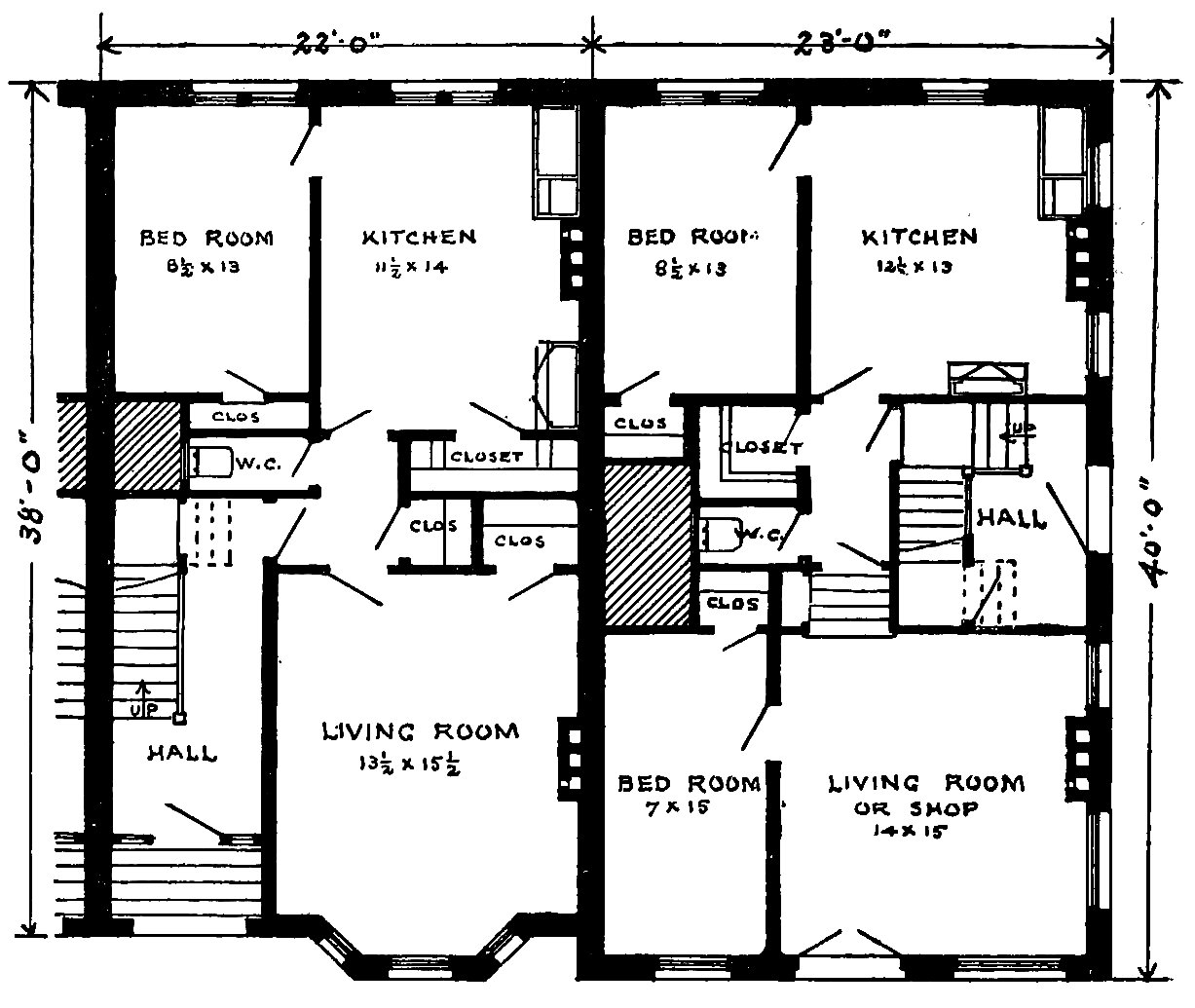
FIRST FLOOR PLAN OF TWO HOUSES OF THE MASSACHUSETTS AVENUE BLOCK FOR THE BOSTON COÖPERATIVE BUILDING COMPANY ❋ ·A· W· LONGFELLOW· ARCHITECT·
127
PLAN SHOWING ARRANGEMENT OF BLOCKS ON MASS. AVE. LOT [150′ × 200′] AS PROPOSED FOR THE BOSTON COÖPERATIVE BUILDING COMPANY ❋❋❋ ·A·W·LONGFELLOW·ARCHITECT· BOSTON·
128The houses cost from $1,800 to $3,000, and were almost all for single families, total cost of a house and land varying from $2,600 to $4,500. They were all sold by 1894. Its next venture in Dorchester found the demand for single houses painfully reduced in the depression of the last seven years, while a marked preference shows itself for “two-family” or “three-flat” houses.
This company has not succeeded in building houses at lower cost, to its great regret.
4. The building laws of a city greatly influence results. Boston was startled by its great fire of 1872 into creating a stringent code. This was remodeled in 1885, chapter 374. After a commission had studied the subject anew, the present code was enacted in 1892, chapter 419, with subsequent amendments.
Two features are especially important: (1), the percentage of the area of a lot which may be built upon; (2), the height of the buildings and the provisions as to fireproof construction.
The law of 1892 permitted three-quarters of the area to be covered, measuring to the middle of the streets on which the lot abuts. This proviso, however, would allow a building to cover the whole of a lot sixty feet deep on a forty-foot street. The act also required two exposures on open spaces at least ten feet wide, of an aggregate length of one foot, for every twenty-five square feet occupied by the building.
These last provisions, however, were found not to prohibit the construction of a huge four-storied tenement house on a lot forty-two feet wide and 101 feet deep, built on a dumb-bell plan, with only about two feet of open land across a part, but not the whole, of the rear. It was the erection, in 1894, of this barrack, which led many observers to doubt whether these new conditions were not worse than the old; whether these vast tenement houses, sometimes called model houses, were not far worse in many essentials for the health and welfare of their occupants than the little old houses, often built of wood, which they replaced. These views are confirmed by the deliberate judgment which Miss Octavia Hill has put on record in her valuable chapter in the second volume of Charles Booth’s great work on London.
The construction of this great tenement house, with such trifling rear light, occasioned the act of 1895, chapter 239, which reduced the area to be occupied from 75 to 65 per cent, and also required an open space across the whole rear of the building, and 129of a depth equal to one-half the width of the front street, not exceeding twenty feet, or an equivalent area of open space in the rear of other dimensions.
The act of 1897, chapter 413, section 9, exempts corner lots from this requirement of open rear land, and also gives the Building Commissioner discretion to accept “an equivalent area of open space in the rear or on either side of such building.”
It is worthy of note that these requirements are less stringent than those in the new tenement house law, chapter 334, of 1901, for Greater New York, which limits the building to 90 per cent of a corner lot and 70 per cent of any other lot.
Secondly, the law of 1897, chapter 413, section 3, required every tenement house to be a first-class building, i. e., “of fireproof construction throughout.” It was at once apprehended that this requirement, that all tenement houses must be of fireproof construction, would stop the building of tenement houses for tenants paying moderate rents. Subsequent investigation showed, that after existing permits had been exhausted, few, if any, tenement houses were built with tenements renting at $16 a month or less. Reaction set in, and by the act of 1900, chapter 321, the requirement of fireproof construction was removed from tenement houses of not more than four stories and not more than fifty feet in height, but here again came a proviso limiting these houses to “two families, or less, above the second story.”
This is the present tenement house law of Boston. It seriously handicaps the construction of tenement houses, but whether this is too stringent, and the influences are harmful, is not yet apparent. So far as an impulse is given to scatter the population out into the healthier suburbs and into the small, separate, detached suburban homes, each with its little plot of land, instead of the fearful overcrowding of families in the huge new tenement houses, students of the social welfare of the people must certainly rejoice.
In the old North End of Boston, where population is densest and rentals are highest, the erection of new tenement houses and the remodeling of old buildings into tenement houses are visible in many of the streets. On the other hand, in the southerly part of old Boston, such enterprise is nearly at a standstill and rents are falling, owing probably to the greater attractiveness of the neighboring suburbs.
130The definition of a tenement house by the number of tenements, rather than by the number of rooms, discriminates with unintended harshness on just that class whose welfare ought especially to be studied, the very poor, the lone widow, the widower, the parent with a single child, who always find with difficulty a single spacious room, and usually pay higher rents because of the short supply of such much-needed accommodation. Twenty years ago a committee of the Associated Charities made a report to show the importance of building tenements of a single room and to call the attention of capitalists to this need. A small one-storied house with only four rooms, adapted for the needs of four separate women, must conform to all the expensive provisions of the tenement house code.
A just and judicious amendment should define a tenement house as having more than three tenements “and containing more than twelve rooms.”
Workers among the poor were surprised last year at orders issuing from the Board of Health, for single tenants to vacate single rooms. Such a notice was nailed on the door of the large “square room” in the model block of the Boston Co-operative Building Company, on Canton street, occupied by a lone old woman. It is supposed that this mistaken policy has been abandoned.
A strange thing happened in 1892; the building law of that year, chapter 419, in its final section 138, repealing numerous laws, included a repeal of the health provision, 1885, chapter 382, section 4, defining for health purposes a “tenement house.” So that since 1892, the Board of Health has been shorn of so much of its powers over tenement houses as depended on the definition, so carefully inserted in the health law of 1885, which has been since then the health code of Boston. Perhaps it is stranger still that no allusion can be found in the annual reports of the Board of Health, to this mysterious and probably unintended curtailment of health powers, the exact legal effect whereof no man can tell.[9]
1315. A crusade for the extirpation of the slums of Boston has been waged for the last fifteen years, thus far with no great success. Housing conditions are justly to be condemned so long as old, dilapidated and unsanitary buildings are allowed to stand, often so overcrowded upon the land that sunlight and air are practically shut out. Such conditions are a disgrace to any city. They tempt the most wretched of the poor, or vicious, or criminal classes to worse degradation. The breadwinner loses his health, which is his only wealth. Children grow up in shameless loss of self-respect. Frequent visitors are physicians, police officers, and charity agents; physicians to struggle with needless disease, the police to arrest criminals created by their foul environment, and charity agents to relieve countless varieties of want caused by cruel and unjust conditions of life.
Private initiative has been struggling in these years to secure more vigorous action by the Board of Health in the destruction of the worst slums. Prof. Dwight Porter, acting under the auspices of a voluntary committee, made an investigation and “Report upon a Sanitary Inspection of Certain Tenement house Districts in Boston,” in 1888, which really started the movement.
Committees of the Associated Charities have lodged indictments against many vile slums and have been heard by the board. In 1891–2, the state caused the Bureau of Labor to make a thorough and exhaustive investigation. The report of Hon. H. G. Wadlin sets forth in two volumes the results. (22d and 23d Annual Reports of the Bureau of the Statistics of Labor. “A Tenement House Census of Boston,” made pursuant to chapter 115, Resolves of 1891.)
Sanitary conditions were classified under five heads: excellent, good, fair, poor, and bad. It may be truly stated that tenements falling so low as to be classed “bad” are so intolerable as to demand most summary measures for their destruction, yet 1,346 houses were found to deserve this just but terrible condemnation (Vol. 1, p. 577).
“It may be safely assumed that whenever a tenement was designated as entirely bad as to its inside condition—that is, to be more explicit, was bad as to facilities for light and air, ventilation and cleanliness—such a tenement was unfit for human habitation. The existence of such tenements forms primarily an indictment against the landlord who is responsible for their condition. They 132should either be abandoned or improved. In some cases such improvement as would render them suitable for occupancy can easily be made; in other cases, no doubt, they should be permanently abandoned.” (Vol. 2, p. 417.)
“The existence of defective outside sanitary conditions is, upon the whole, an indictment against the city; for while some of the defects are due to unclean or poorly kept private ways and alleys, the responsibility of the city for the existence of such defects can hardly be avoided.” (Italics are the writer’s.) (Vol. 2, p. 418.)
In the reports of the Boston Board of Health no allusion is found to this fearful indictment by the authorities of the Commonwealth, or to the following municipal report.
In 1895 a special committee of the Common Council was appointed to consider what improvement could be made in the tenement districts of Boston, and what legislation was needed. They made a very brief “Partial Report” (Document 125 of 1895) from which may be quoted:—“In the North End the tenement houses are to-day a serious menace to public health.... The most astounding circumstance in connection with this investigation that attracted the attention of your committee is the social and financial standing of the owners of the most of these tenement houses.”