"Snow Shoes and Canoes" (continued 5)
Reading edition
The current helping us, we rapidly neared the ducks. Martin and I hit two, and Alick and Robin brought down a brace. Hearing the report of our guns, the flock flew towards the wood for shelter. We soon picked up those we had shot; but the flock had got too far off to permit of our killing any others. Those we had obtained were fine fat fellows with rich plumage, and would afford us an ample feast, with some to spare for Bouncer.
Our success encouraged us to hope that we should not want for provisions during our voyage. We at last got into the main river. Evening was approaching, and as we had eaten nothing since breakfast, and a convenient spot appearing on the left bank, we could not resist the temptation of landing to cook our ducks.
It of course took time to collect sticks for our fire. While Martin and Robin were doing this, Alick and I prepared the ducks, which had not, it must be understood, nearly as much flesh on them as tame ducks, and would therefore, after all, not afford an overpoweringly large meal to each of us, considering that Bouncer was to have his share.
We soon saw that by the time the ducks were cooked it would be too late to proceed on our voyage, and therefore agreed to camp during the night where we were. While Alick and I were engaged on our task, Robin arrived with a large bundle of wood sufficient to kindle the fire. We therefore at once set the ducks on to roast, hoping that Martin would soon come in with a further supply of fuel. As he did not appear, Robin and I set off to collect some more, lest our fire should burn out. We were hurrying back when we heard Martin’s voice.
He had only a small bundle of wood on his shoulders, while he carried under his arm a number of deer-horns.
“I found these near an old Indian camp,” he exclaimed, “and it struck me at once that we could manufacture out of them some heads for spears, with which we may manage to kill some fish.”
“I don’t know what Alick will think about it, but I suspect that it will take too long a time,” I said; “and where are the handles to be found?”
“As I came along I saw some saplings, which we can soon cut down with our axe; besides which I found a quantity of deer sinews, which the Indians must have dropped. Though it is some time since the Indians were at the camp, the sinews are still in good condition.”
Alick was better pleased with Martin’s idea than I had fancied he would be. Martin indeed was very ingenious, and could turn his hand to anything, as could Robin. As soon as we had eaten our ducks, as there was still some daylight remaining, Alick and I cut down four thin saplings for spear-handles, while our two friends were working away at the deer-horns, which they shaped into barbs.
“We shall not have time to manufacture more than two,” said Martin; “and those are as many as we can use, for two must paddle, while the others strike the fish.”
“How are we to get the fish to stop and be struck at?” I asked.
“We must try fishing by night,” answered Martin.
“Still less likely we shall be to see them,” I observed.
“Not if we have a light on board, and I have been thinking about that,” he answered. “We must fill our pot with resinous wood, and by placing it on the bows we shall have the means of attracting the fish. When they come up we must spear them. I have seen the Indians on the upper lakes catch fish in this way, and I know that they are caught in the same manner in many other countries.”
From Martin’s description we all became eager to try to catch fish in the way he spoke of. We soon found the wood he mentioned, a species of fir which contained a large amount of resin, and split up into small pieces it emitted a bright light.
While seated on the bank we had observed a number of fish leaping in the river, which here formed a bay with little or no current; and we agreed that as soon as the spears were ready we would go out and try our luck that night.
As the deer-horns were hard, it took a long time to fashion even two spearheads, so that it must have been past ten o’clock when they were ready, though we all worked away diligently by the light of the fire. Alick proposed lying down and waiting till the following night; but we were all so eager to set out that we persuaded him to start at once, that we might try the sport for an hour or so, and then land again with our fish ready to cook for breakfast in the morning.
We should have time enough for sleep, as, having to sit in the canoe all day, we could do very well with less than usual. All things being ready we started. We still had our two swans, which Alick observed might be useful should our spears not answer as well as we hoped. Martin and I undertook to use the spears while Alick and Robin paddled.
As soon as we had got a short distance from the shore we lighted our fire, which as it blazed up cast a lurid glare over the waters. Though we looked eagerly for the fish none could we see. They had either swum away or were not to be attracted by the bright light.
“Perhaps there may be more out in the stream,” said Martin. “Let us paddle slowly down, and ten to one we see some.”
Alick consented, and proposed, moreover, that as we had embarked we might as well proceed on our voyage, as the light enabled us to see our way as well as in the daytime, while the air was cooler than when the hot sun beat down on the stream. We had gone some distance when Martin struck down his spear.
“I hit a fish,” he exclaimed, “but it got off. We may have better luck the next time.”
I shortly afterwards saw another fish, which I succeeded not only in striking but in securing, though it fell off the moment I got it into the canoe. It showed us that our spears were not as perfectly barbed or as sharp as was necessary. This success encouraged us to continue the sport, and we went on and on, though we did not succeed in securing any more fish. Our fire, however, had produced an effect we had not expected. As we were passing a low cliff, loud cries of wild-fowl saluted our ears. The birds, roused by the appearance of the light, flew off from their nests, and came circling around us; so we fired several shot at them, and brought three down.
The rest, not aware of what had happened, continued pursuing us; their numbers increased from the other denizens of the banks. Alick, in his eagerness to shoot the birds, was using less caution than before. I fancied that I heard the rushing sound of water.
“There must be rapids near us,” I exclaimed.
Just as I spoke Alick again fired, and two birds fell into the water ahead of us. Taking his paddle, he urged the canoe forward to pick them up. None of us could tell how it was, but all of a sudden we found ourselves whirled onwards by an unseen power. Though we got the paddles out, we had lost all control over our canoe. The next instant, her bow striking a rock, she was whirled round, when her stern came in contact with a snag also fixed in the crevices of another rock.
“Jump out for your lives, lads!” cried Alick, setting us the example.
The water, we found, was rushing over the ledge on to which he stepped. Martin and I followed, carrying our guns. Robin sprang after us, catching hold of the sail; while Bouncer, acting as a brave sailor does, was the last to quit the ship.
I had just time to leap forward and catch hold of the iron pot when the canoe was whirled away down the rapids. On examining our position we found ourselves on a large rock nearly in the middle of the stream, which afforded us a resting-place, but how we were to reach the bank was the question.
We sat down very disconsolate to discuss the matter. It did not do just then to think too much of the future. Our first business was to get on shore where food was to be obtained; though, fortunately, having had a good supper we were not hungry. As far as we could judge in the darkness, the way to the left bank was most practicable; but even in that direction there were broad places to be passed, across which we might be unable to wade.
We had gone through many adventures, but this was the most trying and perhaps the most dangerous. The rapids below us boiled and foamed, and ran with great force. Should we lose our footing we might be carried away and dashed against the rocks.
“Though this is not a pleasant place on which to pass the night, I think we shall do wisely to remain here till daylight will enable us better to see our way,” observed Alick.
Our position was too uncomfortable to allow us to sleep; indeed, had we done so we should have run the risk of slipping off into the water. We therefore discussed various plans for getting on shore.
“If we had but a rope we might do it without danger,” said Martin, “and I think we have materials enough to manufacture one. The sail cut up and twisted will form a good length.”
“You shall have my overcoat,” said Alick. “We must try to kill a deer, the skin of which will make a covering for me at night. I can do very well without it in the daytime.”
I also had a coat, and imitating Alick offered to sacrifice it for the public good. “A shirt which I have in my knapsack will supply its place,” I observed.
“I have a strong linen shirt in mine,” said Martin.
Robin had a couple of handkerchiefs, besides which we had the straps of our knapsacks and pouch-belts. With these materials we considered that we could make a rope sufficiently strong for our purpose. It required considerable ingenuity to fasten all these together. The parcel of sinews which Martin had found were exceedingly useful; indeed, I don’t know how we could have secured the straps without them. We had to wait, however, till daylight before we could perform the neater work, though there was light sufficient in the open river to enable us to cut up and twist some of the articles we had destined for the purpose. We had thus made a pretty strong bit of rope when day broke.
We then began to secure the straps together. To do this we had to make holes in the ends with the prickers of our knives, through which to pass the threads—a long and tedious operation, as, of course, it was of vital importance that they should be firmly secured: a weak part might endanger our safety. As may be supposed, we worked very diligently, for we were getting hungry, and had no chance of obtaining food where we were. How long it might be after we reached the shore before we could fall in with game of some sort it was impossible to say.
Our spears had been lost, so that even should we see any fish in the rapids we could not catch them.
At last the rope was completed. It was sufficiently long, we calculated, to reach from one side to the other of the broadest passage we should have to cross, as there were several rocks which would serve as resting-places between us and the left or northern bank.
Before using it, by Alick’s advice we tried every part, hauling with all our might, two against two. It was fortunate it did not give way, for had it done so we all four might have fallen into the river on opposite sides of the rock.
“Come, that will do,” said Alick; “I’ll go first, and you three hold on to the other end. If I miss my footing, haul me in; but if I succeed, you, David, remain behind, and let either Martin or Robin make their way across, holding on to the rope. When they are safe over, you fasten it round your waist, and we’ll haul you after us.”
The plan seemed a good one, with every prospect of success. The water was apparently of no great depth, and did not run with nearly as much force on the north side of the rapids as it did on the south, towards which by a bend of the river the principal current was directed; still, as we looked at the foaming, hissing, roaring waters below us, we saw the fearful danger to which we should be exposed should we miss our footing and be carried away in them. Indeed, without a rope, the passage seemed to be altogether impossible.
Alick, of course, ran the chief danger, as he had nothing to support him, and had, besides, the rope to drag and his rifle to carry. We scrambled over to the west side of the rock, or that which looked up the stream; then Alick fastened the rope round his waist, and offering up a short prayer for protection, he stepped carefully into the foaming water. At first it did not reach much above his ankles, but it soon began to rise higher and higher, until it reached his knees; and as we saw it foaming round him, we feared every instant that he would be carried off his legs.
Though he stepped directly across the stream he kept looking upwards, so that, should he have to swim, he might strike out at once in the right direction. More than half the passage had been accomplished. There was ample length of rope, which we allowed occasionally to run out as it was required. Still the water got deeper.
Alick stopped for a moment, as if hesitating whether he should proceed. Then again he stepped out, and the water surged up almost to his waist, as it seemed to us at that distance.
A cry escaped us. We thought he had gone, but he recovered himself and sprang to a higher level. Again the water reached no higher than his knees. He went on with more confidence, till he stood safe on the rock for which he was making.
“Hold on tightly to the rope,” he shouted.—“Robin, you come next. Don’t let go your grasp, though you may find yourself carried off your legs.”
“Ay, ay!” answered Robin. “I’ll not do that; the rope is what I’m going to trust to.” And without more ado he plunged in, not walking steadily as Alick had been compelled to do, but leaping like a dog in shallow water, so that he got across in much less time with apparently less risk.
Martin followed his example, and was twice nearly carried off his legs.
It was now my turn. The rope, should it not break, would haul me back should I lose my footing; but the danger was that it might break, as it would have to bear my weight with the current pressing against it, as also that of the articles I carried.
There was a piece of rope to spare. I put the end into Bouncer’s mouth, and patting him on the head told him to hold on and swim after me. He understood perfectly what was to be done. I did not for a moment hesitate, as there was no time to be lost; and springing in, instead of going directly across I waded diagonally up the stream, Bouncer holding tight on to the rope, and bravely breasting the current. By this means I found, as I expected, that I was in shallower water, and was able to get across almost as fast as the others had done with the aid of the rope.
The next passage we had to make was shorter, but was quite as deep, and for a few seconds Alick was in great danger of being carried down the stream. Two other watery spaces had still to be crossed; the last looked the more dangerous, but Alick got over and stood safely on the bank. He then went up the stream some way, when Robin and Martin crossed as they had done at the other places. I followed, with Bouncer towing after me, though I had to put no small strain on the rope to enable myself to get over.
Every moment I thought that it would give way, but it held fast, and most thankful we were to find ourselves at length safe on the northern bank of the river. We had kept our guns and ammunition dry, though of course our lower garments were perfectly wet.
“My boys,” said Alick, “we have reason every day to be thankful to God for His watchful care over us, but especially now we should return thanks for our preservation, for I tell you we have run a fearful risk of losing our lives. We might have been all drowned together when the canoe was destroyed, and at any moment in crossing above these rapids we might have been carried off our feet and swept down them.”
We all acknowledged the truth of his remarks, and together kneeling down on the grass, we lifted up our voices in a prayer of thanksgiving. We then hurried away to collect wood for a fire, that we might dry our drenched clothes and consider what was next to be done.
“One thing is very clear,” observed Alick, as we sat round the fire. “We have no food, and being hungry the sooner we can get some the better. Our way is down the stream, and we must set off as soon as possible in that direction.”
The sun and wind assisted the fire in drying our clothes, and we were soon ready to commence our journey. We kept our eyes about us as we went on, on the chance of any birds or animals appearing. Hunger, it is truly said, makes keen sportsmen, and we should not have let a mouse escape us if we had seen one. We kept close to the bank, and for a mile or more the rapids continued, though we saw that on the opposite side a canoe might descend without danger. Alick was constantly examining the bank. “I thought so,” he exclaimed, when we had got about half a mile below the rapid. Running forward he picked up three of our paddles and one of the spears. The others could not be far off, unless they had struck in the crevice of a rock. This, perhaps, they had done, for we could not find them.
Martin immediately took possession of the spear.
“I may still have a chance of killing a fish, if we come to any deep little bay or bend of the river, where some are likely to be at rest,” he observed.
It was getting late, and unless we could kill something soon we should have to go supperless to bed.
“Hillo! I see something,” cried Robin, and rushing forward he held up one of the despised swans.
The sight at all events gave pleasure to Bouncer, who began barking and leaping round it.
“You shall have some directly, old fellow,” cried Robin.
As we saw a suitable spot for encamping a little distance from the bank, we agreed to stop for the night. The wind blowing somewhat colder than usual, a wigwam, or at all events a lean-to, was considered advisable. Martin and I set to work to collect the necessary materials, while Alick and Robin lighted the fire and spitted the swan for cooking.
Chapter Nine.
Wood-pigeons and squirrel for supper—Bear’s meat—Canoe-building—Grasshoppers—She floats even—Row, brothers, row!—The thunderstorm—Our narrow escape—Our hut—Deer—The buck is dead—Venison in plenty—Improvidence of the Indians—Breakers ahead.
I cannot describe our adventures from day to day as I have been lately doing.
While eating our somewhat unsavoury swan, we discussed how we should next proceed. We knew but little of the bank of the river on which we found ourselves, but at all events we should have a long journey on foot before us, and we did not fancy the tramp through the woods.
“But if we do not go on foot how are we ever to get to Fort Ross?” exclaimed Robin. “We can scarcely expect to find another canoe.”
“Why, of course we must build one,” said Martin. “I have never made one entirely myself, but I have seen them built frequently, and have helped sometimes, and I am very sure that we all together could manage to construct one which will carry us safely down the river.”
There were no dissentient voices. Martin warned us that it would take some time. We should have to shape out all the ribs, and search for birch trees of sufficient girth to afford large sheets of bark. The chief object for consideration was, that it would take us almost as long to build a canoe as to travel to Fort Ross, but then we should be saved the fatigue and dangers of the journey, and we should be more likely to fall in with any of the people whom our friends at the fort might have dispatched to look for us, in the hopes that we had escaped from the massacre at Fort Black. Another great reason for proceeding by water was the state of our shoes: getting so often wet and dry they had become completely rotten. Alick’s were falling off his feet; mine were in a very little better condition; Martin had thrown his away as useless, and Robin had done the same, but as he had so long gone without shoes, his feet were hardened, and he cared very little about the matter.
While the weather was warm it was not of much consequence, but we might expect frost soon to set in, and unless we could manufacture some moccasins we should suffer greatly. If we could kill a deer we might supply ourselves, but hitherto we had seen none along the banks of the river; still we hoped to fall in with some, as both skins and meat would be very acceptable.
“Then I consider that the best thing we can do is to camp in an eligible spot, and commence building a canoe without delay,” said Alick.
We all agreed with him.
“I have no doubt about being able to do it,” said Martin; “but we must fix on some place where the white birch trees are abundant, that we may have a good selection of bark. Much depends on its perfect condition, and many of the trees we have passed are of insufficient size or have holes in the bark, which would render them useless for our purpose.”
We trudged on therefore, eagerly looking out for a spot which would answer all our requirements. Before long we found one with some cedar trees in the neighbourhood, and some young spruce firs not far off. On a hillside a little way from the river grew a number of pines; the pitch which exuded from them we wanted for covering the seams. The wood of the cedar was required for forming the frame of the canoe, while the slender and flexible roots of the young spruce trees would afford us what is called “wattap”—threads for sewing the bark on to the gunwale and securing it to the ribs.
“As we shall be some days building our canoe, we may as well put up a hut and make ourselves comfortable in the meantime,” observed Martin. “It won’t take long to do that, and should a storm come on we should require shelter.”
“We shall want something of still more consequence,” observed Alick. “We have no food, and you fellows will soon be crying out for it. While Martin and David get the camp ready, light a fire, cut some poles for a wigwam, and collect some rough sheets of bark to cover it with, Robin and I will go in search of game. We shall find something or other before dark, if we keep our eyes open and our wits awake, and I shall not feel inclined to return without food, so take care to have a good fire burning to roast it by.”
“But I say, don’t go off with the axe,” exclaimed Martin, as Alick was walking away with it stuck in his belt. “We cannot cut down the poles without it, or strip off the bark from the trees.”
Alick handed the axe to Martin, who, giving a flourish with it, observed, “We shall have work enough for this fellow to do, but I must take care to keep its edge sharp.”
Alick and Robin set off with their guns, while Martin and I commenced the work we had undertaken. We at first collected sticks and had a fire blazing in an open spot from which we had cleared off all the grass for fear of its igniting the surrounding herbage and producing a conflagration—no unusual occurrence in the woods. The feeling of hunger made us very active, for we hoped that Alick and Robin would soon return with some game. As they did not appear, we cut down a number of poles and fixed them up on a spot a little distance from the river, towards which the ground gradually sloped down. Having secured all together at the top, the framework of our hut was complete.
We had then to obtain some slabs of birch-bark. Several lay on the ground stripped off by the wind. Many of these we found lying at the foot of the trees, and though unfitted for building a canoe, they were very well suited for our present purpose. We worked so diligently that we completely covered our wigwam. We now began to look out anxiously for the return of our companions, our hunger reminding us that it was high time for them to be back. While we were working we had not thought so much about it. I had thrown myself down on the grass, having finished my labours.
“Come!” said Martin, who was always very active; “if game is not brought to us, I vote we go in search of it,” and seizing his gun he made his way amid the trees.
I followed him. Presently I heard him fire, and directly afterwards I caught sight of a squirrel on a high branch. Taking good aim, I brought it down, and was soon joined by Martin, who had shot a couple of wood-pigeons. We hurried back to the camp, stripped the birds of their feathers, skinned the squirrel, and soon had them roasting before the fire.
“Our friends will be well pleased not to have to wait for their supper,” said Martin, as he quickly turned round the wood-pigeons on the spit.
They were soon cooked, and unable to resist the gnawings of hunger we divided one of them and ate it up. We then attacked the squirrel, but restraining our appetites, reserved half for Alick and Robin, for we thought it possible that they might after all return without any game. Having satisfied our hunger, we thought more seriously about them. What could have happened to delay them?
At last I began to fear that some accident must have befallen them. It was getting dusk. Should darkness overtake them, they would be unable to find their way through the woods. We piled up more wood on the fire, and went some way from it in the direction we expected they would come, shouting loudly at the top of our voices to attract their attention.
“I cannot fancy that they have lost themselves,” observed Martin. “Robin, with his Indian training, would find his way anywhere; and Alick is not likely to have gone wrong, especially with the river to guide him.”
Still I grew more and more anxious, and pictured to myself all sorts of accidents.
“We should never think of the worst till it happens,” observed Martin. “They were probably tempted to go farther than they intended. Perhaps we shall see them come back loaded with venison or a few dozen wild ducks, which will supply our larder for many days to come. Hark! I think I hear a shout. Now!” and we again shouted out. A reply immediately came through the trees.
“That’s Alick’s voice, and I heard Robin’s shriller treble,” said Martin. “They will be here anon, and will be highly delighted to sit down and munch the remainder of the squirrel and the wood-pigeon.”
We hurried forward to meet our friends, as far as the light of the fire would enable us to see our way, and presently they both appeared, carrying huge masses of something on their backs.
“We have got food enough to last us till we reach Fort Ross,” exclaimed Alick, as he limped along, and I observed that he had lost both his shoes. “It might have cost us dear, though. Robin was nearly getting an ugly grip. See! we have killed a bear, and brought as much of the meat as we could carry, and a part of the skin to form moccasins till we can kill some deer, which will afford us more comfortable covering for our feet.”
We relieved them of their loads, and were soon seated round the fire, Bouncer lying down complacently watching us, while they discussed the provisions we had cooked; he, having devoured as much of the bear as he could manage, was independent of other food. Alick then told us that they had come suddenly on Bruin, who was on the point of seizing Robin when he had shot at it, but had missed; the bear, instead of pursuing them, frightened by the report of the gun, had taken to flight, when they followed and finally killed it. In their chase, while passing over a piece of boggy ground, he had lost his shoes. The chase and the return to camp had occupied a considerable amount of time.
“All’s well that ends well,” exclaimed Martin, “and now I propose that we smoke some of the bear’s flesh.”
To this we all agreed, and thus employed ourselves till we turned in at night.
“Up, up,” cried Martin the next morning at daybreak. “We must turn to without loss of time, and begin building our canoe. We must first cut out the ribs, which will be the longest part of the operation, and those who like can accompany me to the cedar wood.”
We all did so; and Martin, selecting some young trees, cut them down; then, with his axe, he chopped them into lengths. This done, we all worked away with our knives to form them into thin strips. The wood is remarkably tough, hard, and white, and can be bent into any form. We were employed all day in this work, and it was not till the next that we had a sufficient quantity of strips to commence forming the frame.
To form the gunwale we had to fasten a number together. The gunwale was kept apart by slender bars of the same wood, while the ribs were bent into the required shape, which they easily retained. There was no keel, and the bottom was nearly flat. The third bar was broader than the rest, and in it we cut a hole for stepping the mast, though unless with a very light and perfectly favourable wind we should be unable to carry sail.
It took us several days to put the framework together. We had now to cut the bark from the white birch trees. To do this we formed two circles round a tree, about five or six feet apart, and then cut a perpendicular notch down from one to the other; next, putting pieces of wood under the bark at the notches, we without difficulty pulled it off.
Martin having before taken his measurements, the bark exactly fitted the centre part of the canoe, being also very nearly of the required shape. We now sewed it on with the wattap. This was a long operation, as every hole had to be carefully bored. Another piece of somewhat less width formed the bows, easily conforming itself to the required shape. A single thickness of bark formed the sides, but at the bottom we placed some long strips to serve as bottom-boards, which rested on the ribs.
The bark had to be sewn on also to all the ribs, though this did not require the same number of stitches as used at the gunwale. We all worked away at it till some progress had been made, when Robin took charge of the gum-pot, he having previously concocted a quantity of pitch from the pine trees. This had to be thickened by boiling, and the joinings were luted with it, thus rendering the canoe perfectly water-tight.
The seats were formed by suspending strips of bark with cords from the gunwales in such a manner that they did not press against the sides of the canoe. Our canoe was only about twelve feet long, but was sufficiently large to carry us four. I have seen such canoes thirty-five feet in length, and six feet in width at the widest part, tapering gradually towards the bow and stern, which are brought to a wedge-like point, and turned over from the extremities towards the centre so as to resemble, in some degree, the head of a violin.
These large canoes are calculated to carry sixty packages of skins weighing ninety pounds each, and provisions amounting to one thousand pounds’ weight. They are paddled by eight men, each of whom has a bag weighing forty pounds.
Every canoe also carries a quantity of bark, wattap, gum, and pine for heating the gum, an axe, and some small articles necessary for repairing her. The weight altogether is probably not under four tons. The eight men can paddle her across a lake, in calm weather, at the rate of about four miles an hour; and four can carry her across portages. Altogether, for making voyages in this region, no vessel has been constructed in any way to equal the birch-bark canoe, such as I have described. Ours was very different, being much smaller; and the work, though pretty strong, was not as neat as that performed by Indians.
Robin, who was fond of quizzing—a trick he had learned from the redskins—declared that she would prove lopsided, at which Martin, her architect, was very indignant.
“She’ll swim as straight and steady as a duck,” he answered.
“We shall see,” cried Robin; “the proof of the pudding will be in the eating. However, if she does float a little crooked she’ll manage to get to the end of her voyage somehow or other, and we can lay her up at Fort Ross as a specimen of our ingenuity.”
While building our canoe, one or two of us were compelled to go out in search of game, as it was necessary to dry the bear’s flesh as provision for our voyage, and we preferred fresh meat. We generally returned with two or three wood-pigeons or other birds.
Just before the completion of the canoe, I accompanied Alick on an excursion which we intended should be longer than usual. We found the forest extending not more than a mile from the bank of the river, after which the country was open, with grassy land and hollows which had once been the beds of ponds. Here the grass grew especially long.
We had not long started when I observed that the horizon wore an unearthly ashen hue, and it struck me at once that we were about to have a storm. Presently it seemed as if the whole air was filled with light silvery clouds, and what looked at first like flakes of snow falling, which we saw as they approached nearer to be numberless large insects with wings. They were, indeed, grasshoppers, as they are called in the North-West Territory, though they are really locusts. The number in the air in a short time became so great that at intervals they perceptibly lessened the light of the sun. I had seen them before in much smaller quantities; and I at once knew what they were. That I might watch them more conveniently, I threw myself on my back. When looking upwards, as near to the sun as the light would permit, I saw the sky continually change colour from blue to silvery white, ashy grey, and lead colour—according to the density of the masses of insects. Opposite to the sun, the prevailing hue was a silvery white, perceptibly flashing.
On one occasion the whole heavens towards the south-east and west appeared to irradiate a soft grey-tinted light with a quivering motion. As the day was calm, the hum produced by the vibration of so many millions of wings was quite indescribable, and was more like what people call a ringing in one’s ears than any other sound that I can think of.
Strange as it may seem, there was something peculiarly awe-producing to the mind as we watched these countless creatures, as it reminded us of those scourges sent by God on the land of Egypt as a punishment to its inhabitants.
At first they took short flights, but as the day increased cloud after cloud rose from the prairie, and pursued their way in the direction of the wind. As the day advanced, they settled round us in countless multitudes, clinging to the leaves of shrubs and grass to rest after their long flight. The whole district where they had settled wore a curious appearance, for they had cut the grass uniformly to one inch from the ground.
The surface was covered with their small round grey exuvia. Had they passed over any cultivated ground, as they do occasionally, the entire crops of the farms would have been destroyed. They leave nothing green behind them, and devour even such things as woollen garments, skins, and leather, with the most astonishing rapidity. Though they fly very high in the air when they are making their journeys, they pitch usually on the ground, not touching the forests, or one could easily conceive that they would in the course of a year or two strip the trees of their leaves, and leave them with a thoroughly wintry aspect.
As, owing to the grasshoppers, we did not expect to obtain any game in the open country, we returned to the wood, and were fortunate in killing a number of wood-pigeons.
On our arrival at the camp, Martin and Robin shouted out to us that the canoe was finished, and only required to have the seams gummed. This task was soon accomplished; and as we were in a hurry to try the canoe, Alick and I, lifting her up with the greatest ease, carried her down to the bank. Without hesitation we stepped in and placed her on the water, when she floated with perfect evenness.
“Hurrah!” exclaimed Martin, who stood on the bank, throwing up his cap in his delight at the triumphant success of his undertaking; “I knew she’d do! I knew she’d do!”
Bouncer, who had followed us down, apparently as much interested as any one, leaped up on his hind legs, barking loudly; while Robin, who had remained at the fire attending to the gum-pot, that we might stop any leaks which were discovered, echoed our shouts. We had indeed reason to congratulate ourselves, for though the canoe was not equal to the one we had lost, yet it would answer our purpose, and convey us safely, we hoped, to our destination. As it was too late to start that day, we lifted her up again, and employed ourselves in finishing off two fresh paddles, in lieu of those which had been lost.
We were very merry that evening, as it appeared to us that our difficulties were well-nigh over. We had meat enough to last us for some days, and we might reasonably expect to obtain as much as we could want on the voyage by landing and spending a day or part of a day in hunting; still we were not altogether free from care. Martin was excessively anxious about his parents. He could not avoid recollecting the bad disposition shown by the Indians; and though his father and mother might not have been molested, or might have managed to escape, there was a fearful possibility of their having been attacked and murdered.
We were still also doubtful whether Sandy and Pat had got away in safety from the fort, though we hoped that they had, and had arrived safely at Fort Ross. If so, we might, by keeping a lookout on the right bank of the river, see any expedition which, we felt sure, would be sent up to restore Fort Black.
Having breakfasted, we again launched our canoe, but we found on putting her into the water that she leaked in two or three places, where the gum had been knocked off. We had to haul her up again, light our fire, and heat some more gum to stop the leaks. This occupied us for some time, but at length we were fairly under way; and singing “Row, brothers, row,” we began paddling down the stream.
We agreed not to attempt shooting any rapids we might meet with, but rather to land and make a portage with our canoe. Two of us could carry her on our shoulders without difficulty, and, as Robin remarked, she weighed scarcely a feather when four of us lifted her. Though we intended camping on the left bank, we kept over to the right side, that we might have a better chance of seeing any party travelling towards Fort Black.
The morning had been fine, and we expected to be able to continue on all day; but before noon clouds gathered in the sky, from which a vivid flash of lightning darted towards us, followed by a tremendous peal of thunder; then came in quick succession another and another flash, with deafening peals. The wind began to blow up the river, and its hitherto calm surface was broken into angry waves. Down rushed the rain, half filling our canoe.
“We must make for the shore, lads!” exclaimed Alick, as a heavy sea broke over our bows. “Paddle, lads, for your lives! This is no joke,” he added; and he had good reason for saying what he did, for our light bark was tossed about in a way which rendered it difficult to steer her.
We all energetically worked at our paddles. We had some way to go. The wind increased, the thunder roared, and the lightning flashed faster than ever.
Alick kept the canoe with her head partly up the stream, so that we crossed diagonally, or the canoe would have been upset, as the increasing waves rolled against her. At length the northern bank was reached, but we had still the difficulty of landing. The waves were washing against it with considerable force, and should our canoe be driven against any projecting branches, a dangerous rent might be made in it in a moment, and before we could get safely on shore we might be carried away by the current. We had therefore to look out for some bay or creek up which we could run, so as to be sheltered from the waves.
The wind blew now rather up the river than across it, and enabled us to stem the current. We had gone some little distance when we saw the place we were seeking.
“Look out, and see that there are no snags or branches ahead of us,” cried Alick to Robin, who had the bow paddle. “If you can find a clear space, we will run the canoe alongside the bank.”
“There is a spot that will do,” answered Robin; “and I’ll jump on shore and hold her while you get out.”
Gently paddling the canoe, the next moment we got her up to the bank and stepped on shore in safety. We then hauled her up, but we were not free of danger. Tall trees surrounded the place, their tops waving to and fro and bending to the gale. Every now and then fragments of branches were torn off and carried to a distance. There was a risk of one of them falling on us, or on the canoe, and crushing her; but it was impossible to shift our position, so we had to make the best of it and pray that we might be preserved.
We at first ran for shelter under one of the tall trees, and Robin proposed that we should build a hut against it, with a fire in front at which we might dry our wet clothes.
“That would do very well, if it were not for the lightning,” observed Alick. “At any moment that tree might be struck, and we, if close to the trunk, might all be killed or severely injured.”
As he said this, Robin and I, who were leaning against it, sprang out into the open. The next instant a loud report was heard; a branch came crashing down, and the stout tree appeared riven to the very roots! Happily the branch fell on one side.
“We may thank Providence that we have all escaped,” said Alick. “It won’t do to be standing out here exposed to the rain. The sooner we can get up a hut of some sort the better.”
The branch which had fallen afforded us the framework of a hut. Alick, taking the axe, cut off as many pieces as we required, pointing them so that we could run them deep into the earth. A little way off there was an abundance of bark, which, seizing, we quickly dragged up to the spot.
Hurrying out of the wood again as fast as we could, in a short time we had a roughly-formed hut erected, sufficient to turn off the rain. The spot was almost completely sheltered from the wind, so that we had no fear about lighting a fire. At the same time the wood was already so wet that it cost us some trouble to ignite it. We succeeded at last, and, drawing it close up to the hut, it afforded us warmth and enabled us to dry our wet clothes.
The rain soon ceased, but the wind held and whistled in the branches. The thunder roared, and flashes of lightning illumined the dark sky. We had reason to be thankful that we were so far protected, and hoped that we might escape any other falling branches or the effects of the lightning. Had we ventured to land in a more exposed situation, our canoe might at any moment have been blown off into the river, while we could neither have put up a hut nor have lighted a fire.
We sat on hour after hour, hoping that the storm would cease. The ground was too damp to allow us to lie down with any prospect of comfort; but we had some pieces of bark which afforded us seats, and had we had time to get larger pieces we might have rested with more comfort.
Thus the night passed away, but when daylight returned the storm was blowing with as much fury as before. Though we saw masses of leaves and branches flying over our heads, none of the latter fell into our sheltered little nook. We agreed that it would be wise to remain where we were.
Alick employed himself, with Martin’s assistance, in making a pair of moccasins, which, though rough and ugly, were calculated to protect his feet from the thorns and splinters he might step upon in the forest. I mended my shoes, patching them with small pieces of bearskin; but they would not have served for a long walk. Robin improved one of the paddles, which had been roughly cut out at first.
Thus we passed the greater part of the morning seated before our fire, except when we were cooking and eating some bear’s flesh to satisfy our hunger.
We had formed also two lookout holes at the back of our hut, through which we could watch should any deer or other animals come near, which we thought it possible they might do for the sake of the shelter it afforded. Robin was continually jumping up to take a look out; but in that respect we were disappointed.
Soon after noon the wind began to fall, as we knew by the decrease of its sound among the trees and the lessened agitation of the boughs overhead.
“Come, boys, we may make a few miles good this evening,” exclaimed Alick, jumping up. “If we find the river still too rough, we can but put back and spend the night here; but I suspect that in a short time the wind will drop altogether, and we shall be able to paddle on till dark. We are sure to find some place or other where we can land to camp for the night.”
We accordingly lost no time in lifting our canoe into the water and getting on board. Bouncer, observing the careful way in which we stepped into our canoe, imitated our example, his sagacity showing him that if he were to leap on the gunwale he might upset her.
Once more we shoved off, and going down the creek were soon in the open river. By this time it was almost calm, and the water was perfectly smooth.
We paddled on at a quick rate, the river being free of obstructions of any sort, while at the same time we kept a lookout on both sides for the appearance of either friends or foes, or of any game.
The air after the storm was unusually pleasant, and our spirits rose. The banks on either side were wooded, and prevented us from seeing to any distance beyond them. Here and there, however, grassy points ran out into the stream, on which it was possible that deer might be found feeding, while in little bays and indentations of the banks tall reeds grew, likely to afford shelter to wild-fowl.
We were just about to round one of these points when a duck flying up directed its course across the river. Putting in my paddle, I seized my gun, and was on the point of firing at it when Alick exclaimed, “Hold fast! see out there;” and as I looked ahead, I observed on a low, grassy point a herd of five or six deer, which had come down to the river to drink. Some of them, catching sight of the canoe, looked up and stood curiously watching us. Our great object was now to approach without frightening them.
“Keep silence, all of you,” whispered Alick. “Paddle cautiously on. Get ready your guns, so as to fire when I tell you.”
We did as he bade us.
“We must have one of those fellows, at all events, and two if we can. It will be provoking to lose them altogether,” said Alick.
He steered first directly towards the opposite side of the stream, so as not to alarm the deer sooner than was necessary; then altering the course of the canoe, we made directly for the point where the animals were standing, their curiosity still inducing them to remain watching us. We had got almost within shot when they took the alarm, and turning round retreated into the wood.
Exclamations of disappointment escaped from all of us, for we thought that we should see no more of them.
“Don’t think they are lost; we may still have them,” cried Alick. “Paddle away as hard as you can go, and we’ll land and give chase. We may get round them and drive them back towards the water.”
Instead of steering for the point where the deer had been standing, he directed the course of the canoe higher up the river, and as we neared the bank he cried out, “David, you and Martin remain on board, and Robin and I will make our way through the wood, and endeavour to turn the deer.”
As he said this, he tried the depth of the water, and finding that it was shallow, and the bottom hard, he stepped out, followed by Robin and Bouncer, when, soon getting on shore, all three hurried off through the wood, which was there considerably open.
We watched them making their way amid the trees till they were lost to sight. I feared that there was little chance of their driving back the deer; still Martin and I kept a lookout along the shore, on the possibility of the animals returning, either driven by Alick and Robin, or, supposing all danger to have passed, to finish their evening’s draught.
Several wild-fowl got up and went flying across the stream, some within shot; but we were afraid of firing, lest we should alarm the nobler game. We kept our paddles ready to urge the canoe in any direction which might be necessary.
Our patience was somewhat tried. It was possible, however, that Alick and Robin might get near enough to the deer to shoot one of them, and we listened eagerly for the report of their guns. We waited and waited, when we saw some way down the stream a magnificent buck burst forth from amid the trees and rush towards the water. Without hesitating a moment he plunged in and began to swim towards the opposite bank.
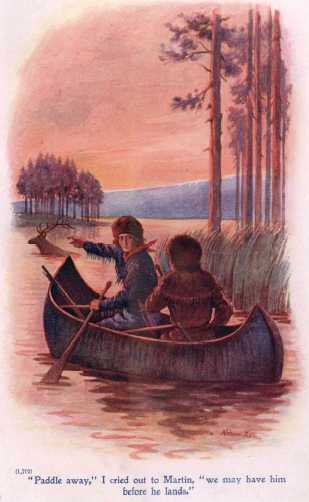
“Paddle away,” I cried out to Martin. “We may have him before he lands.”
We did paddle, with might and main, feeling almost sure of the prize; but the deer swam rapidly, and the current, which he did not attempt to stem, carried him down. It was, however, impelling our canoe, so that made no difference. As we advanced, we saw a low island of some extent about two-thirds of the way across the river. The deer was making for it. Should he land he would gain considerably on us.
Martin proposed that we should steer for the southern side, so as to intercept him. We were close to the western end of the island, on which the deer was about to land, when I thought that I could hit him. I fired. My bullet took effect—of that I was sure; but the deer still continued his course. Martin now steered the canoe as we had proposed, and we saw the deer land and begin to make his way across the island.
It was evident, however, that my shot had injured him, for he moved slowly, and by exerting ourselves to the utmost we were soon able again to get him within range. He stopped and gazed at us, apparently not expecting to see us again in front of him. Instead of taking to the water he moved on towards the east end of the island. Again he stopped, facing us, when raising my rifle I sent a shot directly at his breast.
Lifting up his head, and vainly endeavouring to recover himself, he slowly sank down on his knees, and the next instant rolled over dead.
Martin and I, uttering a shout of triumph, paddled towards the shore.
“Shall we cut him up at once, or go back and take Alick and Robin on board, and then return for the purpose?” asked Martin.
“It may probably be some time before they get back to the bank,” I answered; “and I think it would be best to cut up the deer, and then we shall astonish them with the result of our exploit.”
Of course we felt not a little proud of our success. We accordingly landed, and set to work in a scientific manner—first skinning the deer, and then by means of our axe and long knives cutting it up into pieces. We took only the best portions, with bits for Bouncer’s share, leaving the rest of the carcass with the head, excepting the tongue and the antlers, which might be useful for manufacturing spears and other articles.
We extricated also some of the sinews, which we were sure to want.
Having loaded our canoe, we shoved off and began to paddle back towards the place where Alick and Robin had landed, looking out for them, in case they should appear in any other part of the bank. We found it a very difficult matter, however, to get up the stream. When we went in chase of the deer we had the current with us, and the canoe was light. Now we had a cargo on board. Though we exerted ourselves to the utmost, we made but slow progress, till Martin proposed that we should pull up near the right bank, where the current appeared to run with less strength.
Neither of our companions appearing, it did not seem that we need be in any great hurry until we observed that the sun had sunk low, and that, before long, darkness would come on; still, as we were doing our best, we could do no more. We at last got up some way above the spot where we had seen the deer, and after relaxing our efforts for a minute or two to regain strength, we directed the canoe straight across the stream. We hoped, as we drew near the left bank, that Alick and Robin would make their appearance, and we began to be somewhat anxious at not seeing them.
“They were probably induced to follow the deer farther than they intended,” observed Martin, “and perhaps, hearing our shots, may have gone down the river; and if so, we might have saved ourselves our fatiguing paddle.”
On looking along the bank, however, as we could nowhere see them we finally paddled in for the shore, and very glad we were to reach a spot where we could rest. Throwing the painter round the branch of a tree which projected over the water, we hung on to it to wait for our companions’ return. We shouted to them to attract their attention, but no answer came, and we were unwilling to expend a charge of powder by firing a signal, as our stock was limited, and it was necessary to husband it as much as possible.
The shades of evening were already extending across the river, the bright reflection from the clouds gradually giving place to a uniform grey tint, which soon spread over the whole surface. Martin proposed that we should land and light a fire to cook our venison, for neither of us fancied having to spend the night cramped up in a canoe.
“Let us first give another shout. Perhaps they’ll hear it, and know where we are,” I said.
We hailed two or three times. At last, as there was only just sufficient light to enable us to see our way, we paddled up to the bank, unloaded our canoe, and hauled her up. We then piled up the venison, covering it over with the deerskin, lighted a fire, and began cooking some steaks. We were thus engaged when we heard a rustling in the brushwood. We started up with our guns in our hands, expecting to see a deer or bear, when Bouncer came rushing towards us, leaping up and licking his jaws. Martin examined his mouth and sides.
“Depend upon it he has had a good tuck-out, the rogue, and feels in a happy humour,” observed Martin. “They have killed a deer, and we shall see them here before long.”
Martin was right, for in a few minutes Alick and Robin came trudging up to the camp, heavily-laden with venison.
“We have brought you something to eat, boys,” said Alick. “Thanks to Bouncer’s guidance, we followed up one of the deer till we shot him, but we have had a heavy tramp back. We should have brought the deerskin, but the meat was of more consequence, and we must go back and get it to-morrow morning. Hillo! you seem to have got something!”
“I think we have,” I answered, exhibiting our pile of venison.
We then described how we had shot the deer; still, as the deerskin would prove of value for many purposes, we settled to go for it at daylight.
We had now an abundance of venison, in addition to some of the dried bear’s flesh which still remained. Though the Indians often suffer from hunger in this region, so teeming with animal life, it is entirely in consequence of their own want of forethought, as most of them when they obtain food feast on it till it is gone, and few are wise enough to lay up a store for the future. Thousands of buffalo are slaughtered on the prairies, and their carcasses allowed to rot, which, if distributed among the people, would supply every native in the country with an abundance of wholesome food.
We had never been without provisions, though sometimes we had run rather short. We had, therefore, no fear for the future.
Next morning, Alick and Robin having obtained the skin of the deer they had shot, we proceeded on our voyage. We at first made good way, aided by the current; but as the day advanced, a strong wind arose which created a considerable amount of sea in the river. Our canoe being more deeply laden than usual, with the venison we had on board, the water began to wash over the bows.
We had set Robin to work to bail it out; still there appeared to be no actual danger, and we continued our course. As we went on, however, the wind increased, and meeting the current, which here ran stronger than in other places, the canoe was half filled by a foaming wave into which she plunged.
Robin bailed away with all his might.
“This will never do,” cried Alick. “If we meet another wave like that the canoe will be swamped. We must make for the shore. Paddle away, boys, as fast as you can!”
We exerted ourselves to the utmost, for we saw the danger to which we were exposed. Martin proposed throwing some of the cargo overboard.
“Not if we can help it,” cried Alick. “It would be a pity to lose so much good meat. The water looks smoother towards the south bank, and we shall soon be out of danger.”
In this respect he was not mistaken, but we saw that had we continued on longer the canoe would to a certainty have been filled, for line after line of white breakers extended completely across the stream. We found a safe place for landing, with a sufficient number of trees and brushwood to afford us fuel for our fire, the place also being sheltered by a high bank from the wind. We landed our cargo, and hauling up the canoe, turned her over to empty out the water. It seemed a wonder from the quantity there was in her that she had not sunk.
Chapter Ten.
Tanning—The prairie on fire—“Hillo! Pat Casey! What! don’t you remember us?”—Pat’s marvellous adventures and hairbreadth escapes—Vegetable diet—Pat’s hut—Martin’s danger—Alick’s noble conduct—“He is still alive,” cried Alick—Our wigwam—Two men sick in the camp—Indian summer—Snow again—Winter has set in—Wattap nets—Fishing through the ice—Roast fish and boiled fish.
As the wind continued blowing with great force, we saw that there was no prospect of our continuing our voyage that day. We therefore made preparations for camping as usual.
Martin suggested that we should employ the time in drying some of the venison, which could not possibly last till it was all consumed. He advised also that we should try to manufacture some pemmican, which, though not equal to that of buffalo, would make nutritious food. We were thus busily employed for the remainder of the day. Alick, too, who wished to prepare the deerskins, stretched them out with pegs on the bank. We then carefully scraped them over, and having boiled some wood ashes in water, we washed them thoroughly with it. This we did twice before dark, leaving them to dry during the night.
“I hope no grasshoppers will come this way,” observed Alick, laughing, while we were afterwards seated at supper.
As I looked round on the river, my eye caught a bright glare reflected on it.
“That light comes from a fire somewhere, and not far off,” I exclaimed; and, springing to my feet, I made my way up to the top of the bank, which was somewhat higher than the country farther off.
There were but few trees, so that I had an uninterrupted view to the southward.
There was a fire indeed, and such a fire as I had never before seen. About half a mile off appeared what looked like a vast burning lake, about a mile in width, and extending to a much greater distance.
Presently, beyond it, another began to blaze up, increasing with terrible rapidity; and, farther off, a third bright light was seen, which also began quickly to extend itself. I have never seen a volcano in full activity; but this, I think, must have surpassed in grandeur the most terrible eruption. The flames rose up to an extraordinary height, rushing over the ground at the speed of racehorses, and devouring every tree and shrub in their course. The wind being from the north-east blew it away from us; but we saw how fearful would have been our doom, had we been on foot travelling across that part of the country. We should have had no chance of escape, for the intervals which at first existed between these lakes of fire quickly filled up.
The conflagration swept on to the westward, gradually also creeping up towards us. We continued watching it, unable to tear ourselves away from the spot. It was grand and awful in the extreme. To arrest its progress would have been utterly beyond the power of human beings. What might be able to stop it, we could not tell. As far as we could see, it might go on leaping over rivers and streams, destroying the woods and burning up the prairies to the very foot of the Rocky Mountains, or even making its fearful progress over the whole of the continent.
We knew that prairie fires often took place, and we had seen some on a smaller scale; but this appeared to us more extensive than any we had heard of. Gradually it came creeping up towards us; still, however, at too slow a pace, in consequence of the power of the wind, to make us quit our post.
“This, I have no doubt, has been ‘put out’ by the Plain Crees, to prevent the buffalo from going to the eastward and benefiting the Ojibbeways, Wood Crees, and other natives in that direction,” observed Alick, using a term common among the Indians—to “put out fire” signifying to set the prairie on fire.
I could scarcely suppose that such would have been done on purpose; but he asserted that they very frequently committed this destructive act simply as a signal to let their friends know that they had found buffalo; and that in most instances the fire did not extend to any great distance, being stopped by marshes, or even narrow streams, when there was not much wind, and sometimes by a heavy fall of rain.
Robin corroborated what Alick had stated.
“I think the fire has got much nearer than when we first saw it,” observed Martin. “Should the wind shift, we shall have to run for it, or the burning trees will be tumbling down upon us and our canoe, and we shall be very foolish to be thus caught.”
In the course of a few minutes after this the wind did shift, and the flames came leaping and crackling towards us.
“We will follow Martin’s advice,” said Alick. “We shall have plenty of time though, I hope, to get our traps on board and shove off. We must look out for another camping-ground to spend the remainder of the night.”
We hastened down the bank, followed by Bouncer, who stood for some seconds barking furiously at the fire, as if indignant at its having put us to flight. We were not long in launching our canoe, reloading her, and tumbling in the skins; when, shoving off, we paddled to a safe distance from the shore. In a couple of minutes we saw the flames reach the base of the narrow line of trees which lined the bank; when, aided by the dry creepers which encircled them, it climbed up at a rapid rate, twisting and turning and springing from branch to branch till the whole wood presented a solid wall of fire. It could not injure us, as the wind, blowing in the opposite direction, carried the falling boughs away from the river. The valley a little to the eastward prevented the conflagration from extending in that direction, but it still gave forth sufficient light to enable us to select a sheltered bay, into which we steered the canoe. Here we again landed, hoping to remain unmolested for the rest of the night. As the wind was cold we lighted a fire, though we could find no bark with which to put up a lean-to.
We had therefore to sleep as well as we could on the bare ground. Very frequently one or other of us climbed to the top of the bank to watch the progress of the flames. They were sweeping along to the west and south-west, leaving a space in their rear still glowing with the burning embers.
Alick, who was anxious to get the skins dressed as soon as possible, again spread them out, and those of us who were unable to sleep employed ourselves in beating them with the paddles. As soon, also, as we could scrape a sufficient quantity of ashes from the fire we made a ley, with which we kept them moist, the effect being to render them soft and pliable.
Before morning the fire had got to a considerable distance, but we could still see a thin line of flame extending from north to south. After all, I believe that it was not so destructive as we had supposed. At the same time, such fires constantly occurring on the prairies render them arid and sterile and prevent the growth of forest trees. Were any means taken to put a stop to their occurrence, willows and other trees would soon sprout up, and the prairies would be converted into humid tracts in which vegetable matter would accumulate, and a soil be formed adapted to promote the growth of fine trees.
We were tempted to remain an hour or two after sunrise, for the sake of making progress with the dressing of our deerskins, and also to dry some more venison, as it was very evident that it would not keep fresh wetted as it had been, with the sun beating down upon it, though covered up by the skins.
“We have plenty to eat and plenty to drink,” observed Martin, as we were paddling along; “but I should very much like a variety, and unless we can get it I am afraid that we shall be attacked by scurvy, or fall ill in some other way.”
“To be sure, it will take us some time to drink up the water of the river, but I don’t know that the venison will hold out quite as long,” said Robin. “We might find some berries and roots if we were to search for them in any of the woods we may come to, or perhaps we might shoot some birds or catch some fish. I should like some fish amazingly. We have materials for lines, but I have not had time yet to manufacture some hooks, as I intended. If some of you like to search for berries and roots, or to shoot any birds you may meet, I’ll undertake to stay by the canoe and work away at the hooks.”
“But if we delay, we shall not get to Fort Ross before the winter sets in,” remarked Alick.
“But it will be better to be delayed than to fall sick from want of wholesome food,” observed Martin. “I have an extraordinary longing for vegetable diet, and would give anything just now for a dish of greens, or mashed potatoes, or strawberries and cream.”
While this conversation was going on, we came to the mouth of a pretty large stream, the banks of which were covered with wood of considerable growth, while here and there grassy spots offered tempting landing-places.
My feelings were very like Martin’s, and Robin joining us, we all begged Alick to steer up the stream, intending to land and search for what we were so eager to obtain.
We kept a lookout, some of us on one side of the canoe and some on the other, for any animals or birds which might appear on the bank. Martin and I, who were in the bow, fancied we saw a deer on the right-hand side, and called Alick’s attention to it.
While we were looking out Robin, whose quick sight had been attracted by some movements in the foliage, exclaimed, “There’s a man—an Indian. If he’s an enemy, he’ll have a shot at us;” and pulling in his paddle, he seized his gun, ready to take aim at our supposed foe. As he spoke we turned our heads round in the same direction, and we all saw among the trees a human being stooping and apparently intently watching us.
“If he sees that we’re all armed he won’t fire, though he should have a musket,” said Alick. “We’ll wave to him, and try to make him understand that we have no wish to be foes to any one. Show your fowling-pieces, lads!”
We all lifted up our guns, then laying them down, again took to our paddles. We now steered the canoe towards the shore, where we had seen the man. We soon reached a spot where we could land; but Alick desired us to sit still in the canoe, as possibly there might be other persons besides the one we saw.
The gloom of the forest prevented our seeing his features, but on getting nearer, to our surprise we perceived that the seeming Indian was a white man, though clad from head to foot in skins. There he stood, in an attitude of astonishment, with his mouth wide open, unable apparently to utter a word. Though he was greatly altered, I felt sure that I knew the man before me.
“Hillo! Pat Casey!” I exclaimed. “What! don’t you remember us?”
“Och! shure, is it yourself that’s spaking to me?” exclaimed Pat, for Pat he was—of that I had no doubt. “I belaved that you were all murthered by the Injins months ago, and niver expected to see your faces again.”
“But you see that you were mistaken, Pat, and that we are all alive and well,” I said.
While I was speaking, Pat had been slowly approaching, still evidently greatly in doubt whether we were real beings of this world or spirits from another. When at length he was convinced that we were ourselves, he rushed forward towards us, and seizing me by the hand, exclaimed, “Shure, it’s a reality, and you have escaped the redskins.”
The rest of the party also convinced him that we were alive by shaking him warmly by the hand, and inquiring how he came to be there.
“Och! shure, but it’s a sad story,” he answered, “and I’ll be afther telling you all about it. I need not ask you whether you know that the fort was surprised by the Sioux, and all who could not escape put to death, for if you have been to the place you would have been afther seeing the state those thafes of the world left it in. Sandy McTavish and I, with five others, managed to get away by leaping from the stockade on one side, as the redskins came in on the other; but short time we had to do it and hide ourselves. Making our way down to the canoe, we had just time to shove off before they discovered us and sent a shower of arrows whizzing round our heads. As it was dark, they did not take good aim, and though they came howling along on the top of the bank, we got over to the opposite side, and soon paddled out of their sight. We had no food and only a couple of muskets which Sandy and I carried off, for the other men had dropped theirs in their fright, and what was worse, we found that we had only a few charges of powder and shot. We got on very well, barring the want of food—for we could see nothing to shoot—till we came to the rapids, and faith! it would have been betther if we hadn’t thried to shoot them, for though Sandy and the other man had gone up and down them several times, it was always in a large canoe. It was late in the day and getting dusk, and somehow or other Sandy, who was steering, let the canoe strike against a big rock. Over she went, with a hole knocked through her bows! Having no fancy to be drowned, I made a leap on to the rock, and shouting to my companions to follow, with many a hop, skip, and jump, managed to reach the shore; but when I looked out for the rest of us, I could nowhere see them. I shouted again and again, but they did not answer. My belafe is that they were all carried away and drowned. I sat down on the bank, and at last, as I had been awake for many a long hour, I fell fast asleep. When I awoke in the morning, not a sight was there of the canoe, and I thought to myself, What was I to do? I knew that Fort Ross was somewhere in the direction the sun was used to rise, and so thinks I, if I kape along in that direction I shall some day get there. I had only four charges of powder in my pouch, and as I might have been afther starving when I had shot it all away, I felt gloomy enough. However, there was no use sighing, so I got up and set forward. As ill-luck would have it, I missed the first two shots, but with the third I killed an aigle, or bird of that sort. It was not very good ateing, anyhow, but it kept body and soul together for a day or two. I had now got only one charge remaining, and thinks I to myself, I’ll never be reaching Fort Ross with this, if I don’t manage to kill a deer or some other big baste which would give me mate enough to last me all the way. I went on all day, eagerly looking out for a deer or a buffalo or a bear, and thinking how I could get up to it to make shure. At last, what should I see between the trees but a crayther with big horns cropping the grass all alone. Thinks I to myself, ‘If I can creep up and put a shot into his head, I’ll have mate enough to last me for a month to come.’ There was no time to be lost, so creeping along Indian fashion, I made towards him. I kept my gun all ready to fire, not knowing what moment he might start off. All the time I felt my heart beating pit-a-pat, for thinking what I should do if I missed. ‘Take it easy,’ says I to myself, but that was no aisy matther. At last I got within twenty yards of the deer, who hadn’t yet seen me. It may be if I thry to get nearer, he’ll know there’s danger near and will be off with a whisk of his tail, and my bullet will be flying nowhere; so, just praying that I might shoot straight, I raised my piece as he was lifting his head to look about him. I fired. He leaped into the air, and I thought he was going to be off; but instead of doing that same, over he fell. ‘Hurrah! good luck to ye, Pat Casey,’ I cried out, making the forest ring with my shouts. I soon had some slices off the deer, and lighting a fire where I was, I quickly cooked them, for I had had nothing to eat since I had finished the aigle. I had now food enough to last me till I could reach the fort, but how to kape it swate till then was the question. I thried to smoke some, but I did not manage it altogether well. I was still considering what to do when, going into the wood to get some more sticks for my fire, I saw the river running directly in front of me. At first I thought it was the big sthrame itself, but when I looked down it and up it, I saw that it was neither, and that if I was going to reach Fort Ross I must cross it somehow or other, but how to get over was the throuble. I’d be dhrowned if I thried, and be no better off than poor Sandy and the rest, so at last I thought to myself, ‘I’ll just squat where I am; maybe some canoes will be coming this way, or some friendly Indians will be finding me out.’ Well, that’s the long and short of my history.”
We agreed that Pat, perhaps, had acted wisely, knowing the difficulties he would have had to encounter, had he continued his journey overland. He took us to his hut, which was a short distance from the bank of the river. It was very well formed of birch-bark, and of good size. He had made himself a bed from the tops of spruce firs. Alongside it was a smaller hut in which he had hung up his venison. The top of this smaller wigwam was covered with the deer’s skin.
During the summer he might have done very well, but in the winter he would, I suspect, have perished from cold and hunger, as he would have had great difficulty in catching any animals. It was indeed fortunate for him that we had put into that river.
We did not forget the object for which we had visited it, and we immediately set to work, under the guidance of Robin, to search for roots and berries.
Of the latter, Pat had already collected a great quantity for present use, but remembering how nearly poisoned we had been, he was afraid to cook any roots. Robin, however, knew well what were good to eat and what were pernicious, and we had perfect confidence in his judgment.
Altogether we added a considerable amount of what I may call vegetables to our stock. As we all had a peculiar longing for them, we at once cooked as many as we could eat, scarcely touching the venison, of which we had already begun to get tired.
Pat, who appeared to consider himself at home, begged that we would occupy his hut for the night, remarking that it was already too late to make much progress before nightfall. We accordingly agreed to stay where we were till the following morning.
His stock of venison added to ours would enable us to perform the voyage without having again to stop and hunt for game. Martin had been employing himself, as he had undertaken to do, in manufacturing some hooks and lines, aided by Robin, who had learned very ingenious arts from the Indians. The rest of us employed the evening in cutting out some moccasins, for not one of us had a pair of shoes to our feet, and should we have to make any portages we should seriously suffer in having to walk with our loads over the hard ground.
We used but a small portion of our deerskins. We intended the remainder to serve as a covering for our provisions in the daytime, and for ourselves at night, should the weather become cold. Our intention, however, was to kill two or three bears, the skins of which might better answer the latter purpose. It was with evident regret that Pat the next morning left the hut in which he had made himself so completely at home; still, he had no wish to remain behind.
“If I had but a few pigs and praties,” he observed, with a sigh, “I’d soon be afther making a garden of this wilderness.”
Again we were paddling down the stream, with Pat on board. There was room for him, and though his weight brought the canoe much deeper in the water than before, as long as it remained calm we had no fear.
We paddled along, and were speaking to Pat of the possibility that Sandy and the other men had escaped. He, however, declared that they must have been drowned, as he had seen them, he asserted, a long way below the rocks in the seething foam, through which it would be impossible for them to swim; still, we had some hopes—knowing the dangers from which some men manage to escape—that they had saved their lives.
Martin had manufactured some hooks, and had greatly improved his fish-spear, of which he was very proud. We had not gone far when we came to a slight rapid, down which, however, Alick declared he should have no difficulty in steering the canoe; though the water ran swiftly and a few dark rocks appeared above the surface, as there were no waves of any size and but comparatively little foam, there did not appear to be much danger.
Martin, who was seated in the bow, exclaimed, “I saw a sturgeon pass us just now; if I catch sight of any more, I must have one of them.”
Presently, before Alick could warn him of the danger he was running, he stood up and darted his spear. The next instant what was our horror to see him fall over headlong into the water, the line attached to the spear catching as he did so round his leg!
I was sitting next to him, and attempted to catch hold of one of his feet, which hung for a moment on the gunwale.
The canoe was nearly upset, the water rushing quickly in. At the same time, her bow being stopped she was brought broadside to the current. Before I could catch Martin’s foot, it slipped off the gunwale, and he disappeared under the waves.
“He’s Rose’s brother, and for his own sake I must save him!” exclaimed Alick, and without considering the fearful danger he was running of losing his own life, he threw himself over the stern, and swam towards the spot where Martin had disappeared.
Robin, who was sitting next to him, seizing the steering-paddle, with great presence of mind brought the canoe with her bow down the stream.
“Back, both of you!” he shouted out to Pat and me.
We did as he advised, but the strong current drove the canoe downwards. Just below us a dark rock of some extent rose above the water, and we had to exert ourselves to the utmost to avoid drifting against it.
With the deepest interest we watched Alick’s progress. Presently down he dived, and to our joy returned holding Martin in one hand, and energetically treading water, while with the other hand he released him from the line which had got round his leg. The current was rapidly bearing them down towards the rock.
I should have said that there was another rock, just above where the accident happened, and though it scarcely rose above the surface, it had the effect of deflecting the current, thus causing it to run with less violence than would otherwise have been the case against the larger rock. Lower down, a powerful swimmer such as Alick was could alone have borne up another person, and that person almost senseless, and at the same time have contrived to direct his course amid those furious waters. We were using all our efforts to get up to him.
“Keep off!” he shouted. “You will upset the canoe if you attempt to take us on board. I’ll make for the rock.”
That he would be able to do so, however, seemed very doubtful, and we trembled for his and Martin’s safety, while we still plied our paddles to stem the current and at the same time to avoid the rock.
“Go to the other side,” shouted Alick; “and, Pat, you get on the rock and help me.”
Understanding his intentions, and seeing that it was the best course to pursue, we obeyed his order, and turning round into our usual position when paddling, we directed the canoe so as to round the southern end of the rock, and then, though drifted down some yards, we once more paddled up to it on its eastern or lower side. Here we could approach it without difficulty, and finding bottom with our paddles, Pat, as directed, stepped out, and clambered up to the top of the rock.
A minute or more of intense anxiety had passed since we had last seen Alick and Martin; and Robin and I looked eagerly up at Pat to hear his report. Without uttering a word, however, we saw him slip down to the other side of the rock.
“Can they have sunk!” exclaimed Robin. “He would have told us if he had seen them.”
“He would not have gone down the rock had they disappeared,” I answered, but still I felt terribly anxious, and wished that Alick had told me to land instead of Pat; still, under such circumstances, it is always wise to obey orders, and I hoped for the best.
To leave the canoe and go to their assistance would be dangerous in the extreme, as, should she drift away, Robin would be unable by himself to paddle her back. I could not, however, resist the temptation of sending Bouncer, and one pat on the back while I pointed to the top of the rock was sufficient to make him leap on to it and climb to the top.
The loud bark he gave and the wag of his tail, as he looked down on the other side, convinced me that our companions were safe, and presently afterwards I saw Alick and Pat lifting Martin’s apparently inanimate body to the summit.
“He is still alive,” cried Alick; “but we must reach the shore, and get a fire lighted as soon as possible.”
He said no more, except to direct us to bring the stern of the canoe closer to the rock.
This we did, when, wading into the water, he placed Martin on board, he himself getting in, followed by Pat and Bouncer.
We were now, we found, close to the foot of the rapid, and a few more strokes carried us into comparatively still water. A short distance off, on the left bank, was a wood of some size. The bank, which here formed a small bay, was sufficiently low to enable us to land; we paddled rapidly towards it, but when we got near the spot we found that the water was not of sufficient depth to allow the canoe, heavily-laden as she was, to get alongside. Pat therefore stepped out, and loading himself with a couple of packages of meat and all the skins, carried them on shore. The rest of us then getting into the water, we were able to drag the canoe much nearer to the bank. On this, Alick lifting Martin by the shoulders and I taking his legs, we carried him on shore.
He made no movement, and as I looked into his face I certainly feared that he was dead. Robin must have thought the same, for, putting his hands before his eyes, he burst into tears.
“Oh! he’s gone, he’s gone!” he murmured.
We could say nothing to reassure our young friend. An open space being found, Pat spread out the skins, and without a moment’s loss of time began to collect wood for a fire. As soon as Robin and I had unloaded the canoe and lifted her up the bank, we assisted him, while Alick, regardless of himself, was getting off Martin’s wet garments. Having done so, he called and desired me to rub his feet and hands, while we wrapped him up in the skins.
Our friend was still breathing, which gave us some encouragement, and we continued our exertions without ceasing. As soon as the fire was lighted we placed him as close to it as was prudent, while Pat and Robin cut some stakes and collected some bark to form a lean-to, that we might still further shelter him. He at length opened his eyes and recognised us, but was still unable to speak. We continued rubbing him, our hopes of his complete restoration being raised.
Pat, also by Alick’s directions, got water and put some venison on to boil, that we might have broth to pour down his throat as soon as he was able to swallow it. The improvement we looked for was, however, so gradual that I proposed—as it was impossible for us to continue our voyage till the next day—that it would be advisable to build a wigwam, which would afford better shelter than the lean-to during the night.
“I agree with you,” answered Alick, “and the sooner you set about it the better.”
“So we will,” I said; “but I wish that you would get off your wet clothes, or, strong as you are, you may suffer from remaining in them so long.”
Alick laughed at this notion. “This fire will soon dry me,” he answered, “and I’ll stay by it and attend to Martin while you three collect the materials and build the wigwam.”
I in vain expostulated with my brother. Even though my clothes were dry, except my moccasins and the lower part of my trousers, I felt the wind very chilly. At last I was obliged to set off with Pat and Robin.
We settled to put up a good large wigwam, which might hold us all; and we could then have a fire in the centre. This for Martin’s sake would be very important. We accordingly cut down the largest saplings we could find, and we were fortunate in discovering numerous large sheets of bark, some in a sufficiently good condition to have formed a canoe, had we been compelled to build one.
A very short time only is necessary to erect a birch-bark wigwam when materials are abundant, as they were in the present instance; and it is wonderful what a comfortable abode it affords, impervious alike to rain or wind or even to an ordinary amount of cold.