SNOW-FLAKES: (continued 2)
Reading edition
The early spring and late fall and summer snows are more cellular and less condensed than the nearly impalpable powder of winter. The drifts, therefore, that accumulate during nine months of the year, are dispersed in well-defined layers of different density. We have first the warm cellular snows which surround the plant; next, the fine, impacted snow-dust of winter; and above these, the later, humid deposits of the spring.
It is interesting to observe the effects of this disposition of layers upon the safety of the vegetable growths below them. These, at least in the earliest summer, occupy the inclined slopes that face the sun, and the several strata of snow take, of course, the same inclination. The consequence is, that as the upper snow is dissipated by the early thawings, and sinks upon the more compact layer below, it is, to a great extent, arrested, and runs off like rain from a slope of clay. The plant reposes thus in its cellular bed, guarded from the rush of waters, and protected too from the nightly frosts by the icy roof above it.
Dr. Kane.
There is a pretty, curious old town in Germany. The streets are narrow and the houses very quaint, with their pointed, gable-ends toward the street. One house stands somewhat isolated from the rest. It is at an angle where two streets meet, and is built with so many projections and jutting windows and carved friezes that it is quite a study.
One cold, cold afternoon in midwinter, when the silent frost was penetrating every where, and men moved quickly, muffled up in furs,—a time for people to close their doors, and gather round their firesides,—all the quiet inhabitants were astir. There was a bustle of preparation in parlor and kitchen; and young and old, wrapping their garments about them, were ready to go out in the cold. There were dismay and confusion in all the streets. Why?
They had heard that the French regiment, called the Pitiless, on its retreat from Moscow, was only three leagues off, and was to quarter in their village that night. There was every thing to fear from the revelry and excesses of soldiers, who acknowledged no right but that of the strongest.
In the queer old house of which we have spoken, there was no bustle of preparation. By the fire, in a large old room, sat an aged woman and her two grandchildren. Unable from her lameness to leave home, her grandchildren would not forsake her. Her faith in God enabled her to feel that they might be safer there than when fleeing from danger.
“O God! till darkness goeth hence, Be thou our stay and our defense; A wall, when foes oppress us sore, To save and guard us evermore!”
These, the last notes of their evening hymn, died away amid the rafters of the shadowy room.
“Alas!” said the boy, mournfully, “we have no wall about us to-night to protect us from enemies.”
“He will be our Wall himself,” said the aged woman, reverently. “Think you his arm is shortened?”
“No, grandmother; but the thing is impossible without a miracle.”
“Take care, my boy; nothing is impossible with God. Hath he not said he will be a wall of fire unto his people? We must trust him and he will be our wall of defense.”
They sat quietly by the fireside. The wind moaned down the large open chimney, and the snow fell softly against the window-pane. Steadily it fell all night, and the wind drifted it in high banks, covering the shed, streets, walls, and paths of the silent and deserted town. And yet there was peace by that quiet fireside, the peace that can only be felt by the mind that is stayed on God. Few words were spoken. They held one another’s hands, and looked into the fire, and listened, in the pauses of the storm, to catch the blast of the French trumpets. At nine o’clock the sound was faintly borne to them on the breeze; a few hurried blasts swept past them, intermingled with sounds of trampling feet and loud voices, and all was still.
Their hearts beat almost audibly; and they drew closer together, as they felt that they were now in the midst of their enemies. Helpless age and defenseless youth! What armor had they wherein to trust? The shield of faith! and safely they rested beneath its shadow!
Every house was a scene of revelry. Great fires were kindled. Altars were ransacked. The soldiers, with their songs and wine-cups, their oaths and blasphemy, made the streets ring, striving to drown the remembrance of intense cold and terrible privation in those hours of drunken merriment.
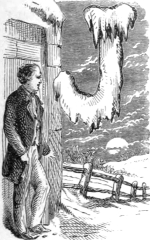
Still the little group in the quaint old house sat peacefully through the long, long hours of the night, till morning dawned and showed them the wall of defense which God had built round about them. Exposed as was their house, from its position, to the eddies and currents of the wind, the snow had so drifted about them that the doors and windows were completely blocked up; and the French soldiers had not found it. With the daylight they had left the town.
Wind and storm had fulfilled God’s word, and encircled those who put their trust in him with a wall that protected them from their enemies,—a wall, not of fire, but of snow.

Under the Snow.
ALL in your gleaming folds of white, And robe the mountain-crest with snow; Make each dark vale and hillside bright, Till all the earth is fair below! Let all the forest oaks be clad,— The birch, and shivering aspen-tree, Nor fail to shroud the tender buds And roots of frail anemone! Then fold them close and shield them well To guard against the winter’s cold; While fast yon snowy flakes descend And penetrate the frozen mold. And we will sing, though wild the storm,— Sing in December as in May, Fill pledges from the icy brook, And all the year be glad and gay. For when the winter solstice brings The Earth resplendent, like a bride, She, with her snowy coronal, Fulfills her promise, glorified! Fulfills her promise, when the days And months have brought the circling year, When vernal woods and bursting buds And blue-eyed violets appear. Faint type of what our hearts foretell, Of something glorious yet to be; The life for which our spirits thirst,— And hid from all eternity! And most for thee, high Hope, and Faith, I languish. Oh, return to me! Come, fold me in thy heavenly robes, And mantle of sweet Charity. And hide me from the outer world, And quicken to my inward sense The earnest of those heavenly joys, Till I, departing, shall go hence. And through those clouded days and brief, To yonder heaven I lift my eyes; While, through life’s frost and over-growth, The violet of my heart shall rise, Up to that flaming Soul of Love, Who makes with joy my soul to sing; And folds beneath the wintry snow The buds and garniture of spring. S. D. C.

Wild-Flowers.
E swept away the old sear leaves From off the wintry ground, And underneath the frozen snow The tiny buds we found, Just waiting for the beckoning nod Of sun and mellow air, To spring in beauty from the sod, And shed their fragrance there. So under many a frozen heart, Where Hope lies chilled and dead, Beneath the tempest cares of life, Love’s precious buds lie hid; The smile of tender sympathy, The word of kindly cheer, Like the warm, sunny air of spring, Will make the flowers appear. H. E. B.

The Alpine Violet.
ID Alpine wilds and thick-descending snows, Where massive hights uplift their towering crest, Adown whose rugged sides no verdure glows, And e’en a feathery flake could scarcely rest; Fearless alike of winter’s rudest shock, Impending glaciers, or the tempest wild, On the stern side of that cloud-piercing rock, A single violet looked up and smiled. Some might have said, ’twas “born to blush unseen, And waste its sweetness on the desert air;” But no! Heaven’s light shone in its humble mien, And He was pleased who placed the floweret there. So I, a human flower, am bid to grow, Mayhap, in life’s most wild, sequestered spot, Where Sorrow’s rudest tempests fiercely blow, And woes accumulate o’ershade my lot. Yet even here, alone and sadly chilled, Nor known, nor noticed by the passing gaze, Like that lone violet, I too may yield To Heaven a silent offering of praise. Earth may not know that I have ever been; Yet pleasure to the eye of Heaven to give, And thence, one sweet, approving smile to win, Is, sure, no worthless mission to achieve. Ib.



Whoso is wise and will observe these things, even they shall shall understand the loving-kindness of the Lord.—Psalm 107: 43.
JANUARY! Darkness and light reign alike. Snow is on the frozen ground. Cold is in the air. The winter is blossoming in frost-flowers. Why is the ground hidden? Why is the earth white? So hath God wiped out the past: so hath he spread the earth, like an unwritten page, for a new year! Old sounds are silent in the forest and in the air. Insects are dead, birds are gone, leaves have perished, and all the foundations of soil remain. Upon this lies, white and tranquil, the emblem of newness and purity, the virgin robes of the yet unstained year!
April! The singing month. Many voices of many birds call for resurrection over the graves of flowers, and they come forth. Go, see what they have lost. What have ice and snow and storm done unto them? How did they fall into the earth stripped and bare? How do they come forth opening and glorified? Is it then so fearful a thing to lie in the grave?
In its wild career, shaking and scourged of storms through its orbit, the earth has scattered away no treasures. The hand that governs in April governed in January. You have not lost what God has only hidden. You lose nothing in struggle, in trial, in bitter distress. If called to shed thy joys as trees shed their leaves; if the affections be driven back into the heart, as the life of flowers to their roots, yet be patient. Thou shalt lift up thy leaf-covered boughs again. Thou shalt shoot forth from thy roots new flowers. Be patient! Wait!
Beecher.
The sun had gone down before we entered the valley of Chamouni; the sky behind the mountain was clear, and it seemed for a few moments as if darkness was rapidly coming on. On our right hand were black, jagged, furrowed walls of mountain, and on our left Mont Blanc, with his fields of glaciers and worlds of snow; they seemed to hem us in and almost press us down. But in a few moments commenced a scene of transfiguration, more glorious than any thing I had witnessed yet. The cold, white, dismal fields gradually changed into hues of the most beautiful rose-color. A bank of white clouds, which rested above the mountains, kindled and glowed, as if some spirit of light had entered into them. You did not lose your idea of the dazzling, spiritual whiteness of the snow, yet you seemed to see it through a rosy vail. The sharp edges of the glaciers and the hollows between the peaks reflected wavering tints of lilac and purple. The effect was solemn and spiritual beyond any thing I had ever seen. These words, which had often been in my mind during the day, and which occurred to me more often than any others while I was traveling through the Alps, came into my mind with a pomp and magnificence of meaning unknown before:—“For by Him were all things created that are in heaven and that are in earth, visible and invisible, whether they be thrones, or dominions, or principalities, or powers; all things were created by him and for him; and he is before all things, and by him all things consist.”
In this dazzling revelation I saw not that cold, distant, unfeeling fate, or that crushing regularity of wisdom and power, which was all the ancient Greek or modern deist can behold in God; but I beheld, as it were, crowned and glorified, one who had loved with our loves, and suffered with our sufferings. Those shining snows were as his garments on the Mount of Transfiguration, and that serene and ineffable atmosphere of tenderness and beauty, which seemed to change these dreary deserts into worlds of heavenly light, was to me an image of the light shed by his eternal love on the sins and sorrows of time, and the dread abyss of eternity.
Sunny Memories.
It is painful to think how our youth are coming to maturity without looking into these Treasure Houses of the King. The Bible and nature are mutually illustrative. And he has not a full Christian nature, who can not profoundly read and intensely enjoy both. As one has said of the book of nature,—and it might equally have been said of the Book of grace;—“The casual and general observer of nature soon ceases to be interested, because he looks only at the surface, and soon exhausts all the novelties. He merely stands on the outside of the temple, and, after gazing for a time at its noble proportions and splendid columns, his interest subsides. But he who really studies the works of God because he loves them is admitted into the penetralia, and there ten thousand new objects reward his search, opening continually before him, until he reaches the very Holy of Holies, and becomes a consecrated Priest.” Education, then, consists in forming rather than in informing. Its two chief instruments are, not the wisdom of men, nor classical literature, but God’s works and God’s Book. Science without Revelation is of doubtful value. Revelation without Science is not seen in its fullness.
Let the snow-flake preach Sinai and Calvary, Eden and Gethsemane, the first and the second Adam. In its purity and beauty, its freshness and its bounty, it shows what a world this was when God made it. But when we see it rushing in the turbid stream, rolling in the dreadful avalanche, to bury the homes and possessions of men with their owners,—when we see it sullied and stained,—let us learn that man is fallen, that a curse is upon the earth and its lord, that “the whole creation groaneth and travaileth in pain together.”
Kirk.
God in Nature.
HAT prodigies can Power divine perform More grand than it produces year by year, And all in sight of inattentive man! Familiar with the effect, we slight the cause, And in the constancy of Nature’s course, And regular return of genial months, And renovation of a faded world, See naught to wonder at. Should God again, As once in Gibeon, interrupt the race Of the undeviating and punctual sun, How would the world admire! But speaks it less An agency divine to make him know His moment when to sink and when to rise, Age after age, than to arrest his course? All we behold is miracle; but seen So duly, all is miracle in vain. All this uniform uncolored scene Shall be dismantled of its fleecy load And flush into variety again. From dearth to plenty, and from death to life, Is Nature’s progress when she lectures man In heavenly truth; evincing, as she makes The grand transition, that there lives and works A soul in all things, and that soul is God. The beauties of the wilderness are his, That make so gay the solitary place Where no eye sees them; and the fairer forms That cultivation glories in are his. He sets the bright procession on its way, And marshals all the order of the year: He marks the bounds which Winter may not pass And blunts its pointed fury; in its case, Russet and rude, folds up the tender germ, Uninjured, with inimitable art; And, ere one flowering season fades and dies, Designs the blooming wonder of the next. Cowper.
Teachings of Nature.
OOK on this beautiful World and read the truth In her fair page; see, every season brings New change to her of everlasting youth; Still the green soil with joyous living things Swarms; the wide air is full of joyous wings; And myriads still are happy in the sleep Of Ocean’s azure gulfs, and where he flings The restless surge. Eternal love doth keep, In his complacent arms, the earth, the air, the deep. Will, then, the Merciful One, who stamped our race With his own image, and who gave them sway O’er earth, and the glad dwellers on her face, Now that our swarming nations far away Are spread, where’er the moist earth drinks the day, Forget the ancient care that taught and nursed His latest offspring? Will he quench the ray, Infused by his own forming smile at first, And leave a work so fair all blighted and accursed? Oh, no! a thousand cheerful omens give Hope of yet happier days, whose dawn is nigh. He who has tamed the elements shall not live The slave of his own passions; he whose eye Unwinds the eternal dances of the sky, And in the abyss of brightness dares to span The sun’s broad circle, rising yet more high,— In God’s magnificent works his will shall scan, And love and peace shall make their paradise with man. W. C. Bryant.