Front matter
Reading edition
SMALL HORSES IN WARFARE by SIR WALTER GILBEY, Bart.
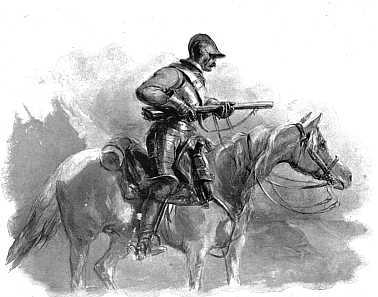
Frederick Taylor, pinxt. ON THE ALERT.
SMALL HORSES IN WARFARE
BY
SIR WALTER GILBEY, Bart.
ILLUSTRATED
VINTON & CO., Ltd. 9, NEW BRIDGE STREET, LONDON, E.C. 1900
CONTENTS.
PAGE
Horses in the Crimean War. 3
Cape Horses. 4
Ponies in the Soudan. 6
Burnaby's Ride to Khiva. 13
Post Horses in Siberia. 17
Ponies in India. 17
Ponies in Northern Africa.[2] 21
Ponies in Morocco. 24
Ponies in Eastern Asia. 26
Ponies in Australia. 28
Ponies in America and Texas. 29
Army Horses of the Future. 34
Breeding Small Horses. 36
APPENDIX. 44
LIST OF ILLUSTRATIONS.
PAGE
On the Alert Frontispiece
Bashi Bazouk face 4
One of Remington's Horse face 12
Six Original Pencil Sketches by Henry Alken face 24
Gimcrack face 41
The present seems an appropriate time to put forward a few facts which go to prove the peculiar suitability of small horses for certain campaigning work which demands staying power, hardiness and independence of high feeding. The circumstance that the military authorities have been obliged to look to foreign countries for supplies of such horses for the war in South Africa has suggested the propriety of pointing out that we possess in England foundation stock from which we may be able to raise a breed of small horses equal to, or better than, any we are now obliged to procure abroad.

Elsenham Hall, Essex, May, 1900.
SMALL HORSES IN WARFARE.
The campaign in South Africa has proved beyond doubt the necessity for a strong force similar to that of the Boers. Their rapidity of movement has given us an important lesson in the military value of horses of that useful type which is suitable for light cavalry and mounted infantry.
Since the war broke out we have seen that we possess numbers of men able to ride and shoot, who only need a little training to develop them into valuable soldiers, but our difficulty throughout has been to provide horses of the stamp required for the work they have to perform. The experience we have gained in South Africa goes to confirm that acquired in the Crimea, where it was found that the horses sent out from England were unable to withstand the climate, poor food, and the hardships to which they were subjected, while the small native horses and those bred in countries further East suffered little from these causes. It was then proved beyond dispute that these small horses are both hardy and enduring, while, owing to their possession like our English thoroughbreds of a strong strain of Arab blood, they were speedy enough for light cavalry purposes.
Breeders of every class of horse, saving only those who breed the Shetland pony and the few who aim at getting ponies for polo, have for generations made it their object to obtain increased height. There is nothing to be urged against this policy in so far as certain breeds are concerned; the sixteen-hand thoroughbred with his greater stride is more likely to win races than the horse of fifteen two; the sixteen-hand carriage horse, other qualities being equal, brings a better price than one of less stature; and the Shire horse of 16.2 or 17 hands has commonly in proportion greater strength and weight, the qualities most desirable in him, than a smaller horse. Thus we can show excellent reason for our endeavours to increase the height of our most valuable breeds; and the long period that has elapsed since we were last called upon to put forward our military strength has allowed us to lose sight of the great importance of other qualities.
Breeders and horsemen are well aware, though the general public may not know or may not realise the fact, that increased height in the horse does not necessarily involve increased strength in all directions, such as greater weight-carrying power and more endurance. Granting that the saying, "a good big horse is better than a good little one," is in the main correct, we have to consider that the merits which go to make a useful horse for campaigning are infinitely more common in small horses than in big ones.
All the experience of campaigners, explorers and travellers goes to prove that small compact animals between 13.2 and 14.2 hands high are those on which reliance can be placed for hard and continuous work on scanty and innutritious food.