Front matter (continued 2)
Reading edition
"After exhaustive tests, it has been adjudged that an over-estimation has been made regarding your mental ability. Since that is the case, it will mechanically be necessary to change your position."
Sullenly, plotting shapeless revenge at a Central Intelligence which would never consider the possibility of an outside factor intervening unexpectedly and hence altering or spoiling what had been planned, 63-17-B listened to his fate.
"A position currently is vacant as supervisor of the Shining Ones in a section of the repair bays. Do you have any objections to assuming this new duty in place of the old?"
To object was disastrous. To object was to admit you needed not merely a lesser job commensurate with your lesser skill but also complete readjustment of your thinking process. "No objections at all, sir," thought 63-17-B, all the while smouldering with resentment. His time would come. What was the old human expression about every dog having his day?
"Then you will report at once to repair bay 151. Do you know its location?"
"I will find it." That was the prescribed answer. One rarely asked questions. One found out for oneself from Central Information. 63-17-B half thought he was still being tested in some less-obvious and hence all the more deadly fashion. But to be placed in charge of a gang of humans! It was degrading.
"In time, 63-17-B, you shall be tested again. If it is our opinion you have gained back what we thought you once possessed, you will again be elevated to a higher station."
63-17-B cursed Central Intelligence on a private wavelength. Central Intelligence was the creator of perfect plans. If a plan misfired, Central Intelligence could not be held responsible. Since accidents of nature had never been considered valid excuses, blame always fell on the executing Robot. Until recently, 63-17-B had managed to beat the system, largely through luck. Now while he realized it was the most mechanical thing in the world to do as you were told, he could not hide his bitter disappointment. But he pushed it from his mind all at once when he felt another mind nibbling at his private wavelength. No one could be trusted, not when each Robot tried to outdo every other Robot in the eyes of Central Intelligence, not when private thoughts could be intercepted by monitors, not when communal thinking was considered preferable to individual thinking.... That thought made 63-17-B shudder, his joints clanking as a sudden surge of power, the electrical equivalent of adrenal secretions, coursed through his frame. He was indeed thinking not along the prescribed lines. Probably something was wrong with him.
"This is ironical," said Amos Westler as the first inert Robot came sliding down the conveyor belt to stop, a rusted man-shaped creature twice man's size with huge conical head and withdrawn antenna, in front of his bench. "We'll never learn anything this way. You won't learn the whereabouts of Diane at this bench, and I won't learn what I've come to find out."
"We're not on duty twenty-four hours a day," Johnny reminded him, unfastening leg-joints with a large, wrench-like instrument and wiping the parts with an oily rag before he reassembled them. "If Diane is here, I'll find her."
"Well, we've learned nothing so far. They took us into the Citadel through a tile-walled tunnel—"
"Surely one of the wonders of the world!" Johnny cried, remembering.
"The world has many wonders, natural and man-made, if we could but see them. Anyway, they then deposited us in those underground quarters where all the humans seem to live here. The old hag interviewed us—"
"Yes. She wouldn't say if she'd seen Starbuck and Diane or not when I described them, but it sure made her smile. I think they're here in the Citadel, Amos."
"—then assigned us to this repair bay for work. Do you realize that except for the brief time it took to go from the tunnel exit to the underground quarters, we haven't seen the light of day. Try learning something in these, these caves!"
Without warning, the conveyor belts were stilled. Hidden lighting in the walls flared brighter as a group of Robots entered the large vault.
"ATTENTION!" A voice blared at them, oddly metallic. Johnny could not tell where it came from. "Robot 63-17-B is now entering the vault. As your supervisor, 63-17-B is to be obeyed as if he were Central Intelligence itself. He is to be addressed not directly, but through your human supervisor."
The Robot numbered 63-17-B (but the numbers were hidden under the central face plate and you hardly could tell the machines apart) made a brief inspection of the vault, then climbed to his niche in the wall, where he sat completely without motion while the other Robots filed from the chamber.
"Although we can't address the Robot, our supervisor can," Westler said eagerly. "That means, at least, communication of some sort is possible."
"I guess so. Why don't you get to know the supervisor?"
"You're much better at that sort of thing than I am, Johnny."
"We came here for different reasons, don't forget. There's an old hag I'd like to answer more questions when I find her."
"Here comes our supervisor now," Westler whispered. Then, aloud: "My name is Amos Westler."
"I don't care what it is. It's recorded. Keep working, friend." The supervisor was a brutal-faced man who snarled out his words. His jaw, cheekbones and forehead were silver-sheened with Plague scar, with the Plague silver remaining there as well as on his limbs. His face seemed metallic as a Robot's.
"See?" Westler whispered in despair as another damaged Robot slid to a stop in front of them.
Johnny offered a wan grin. "Take it easy," he said, but hardly felt more than the last remaining shreds of patience within himself. If the old hag wouldn't talk when he saw her tonight....
"Don't bother calling me names, young man," cackled the hag. "I'm virtually immune. It is against existing regulations to give you that information since it is felt all ties with the past and the outside world must be broken, not gradually but at once."
"Listen," Johnny said desperately, "you must remember your own youth." He had tried every other verbal assault he could think of. Now he hardly thought flattery would work on the ancient bag of bones in front of him, but it seemed his last hope. "You must have had your lovers in your day, were you as attractive for your years as a younger woman...."
Something melted in the hag's eyes. She scrubbed her breastbone with the knuckles of one parchment hand, as if preening. "Why, yes," she admitted.
"I'm in love with the girl. You must know how I feel. He—he took her." At least in part, it was the truth. In love with Diane? He'd never thought of it, yet what had impelled him to battle Keleher in an uneven fight, to set out for New York when he could have ruled the encampment instead, to surrender himself to the Robots of the Citadel? Johnny smiled. Trying to awaken something in the hag, he had succeeded in awakening something, all right, but in himself.
"Such information I cannot give you, young man—"
"And I thought you remembered your youth!"
"—but they say the view from the corridor 13 exit is magnificent. To reach it, one travels along corridor 14, which is a dormitory for some of our young, unmarried women." The hag cackled. "Don't get caught."
"I won't. Thank you."
"Good luck, my boy." The hag patted his shoulder, crowed something which he failed to hear, disappeared from the room.
Outside at a forking of four corridors, Johnny found a map and studied it. Lights recessed high on the walls showed him his direction, and soon he was pounding down the corridors and praying silently that the hag knew what she was talking about. By the time he reached corridor 14 he was breathless.
Several young women stood in the corridor talking. Their chatter was stilled when they saw Johnny, and those who had been in various stages of undress hastened to cover themselves. Clearly, it was not common for a man to venture this way, particularly at night.
"Are you lost, man?"
"No. I'm looking for someone. A girl named Diane."
They were smiling, and Johnny began to wonder. He suspected that corridor trysts were not particularly uncommon.
"Is she expecting you?" demanded the boldest of the women, who had stepped to the fore while her more timid companions drew back, ready to dart into the surrounding cubicles.
"I cannot truthfully say," Johnny admitted. "If she knew I was in the Citadel, I think she would be expecting me." But even that was with tongue in cheek, for ever since he had refused to fight with Starbuck, Diane had said not a word to him.
"This Diane, what does she look like?"
Johnny described her. When he finished, the woman chuckled. "Could you perhaps be trysting? From your description, I would say you love the girl, for no woman could be so beautiful. I think I know who you mean, though."
Still chuckling, the tall woman entered one of the cubicles while her companions melted away into the others. Soon Johnny stood alone in the corridor, waiting as nervously as a youth in Hamilton Village might wait while the village matchmaker entered a house to fetch him his bride. Someone appeared in the doorway. Not the tall woman. Diane!
"Johnny.... Johnny Hope...."
"Diane, I never thought I would see you again. I thought Starbuck...."
"I was so afraid for you, because you couldn't adjust to your new life, because I thought you might do something desperate. I was a fool, I should have known why you refused to fight with Starbuck. Johnny, Johnny ... let me look at you."
"Look later," he said, his eyes suddenly, unexpectedly misty. He drew her to him and for a long time stood there with her, feeling the beat of her heart tight against him, the warmth of her body and long smoothness of limbs. She was trembling, the warmth of her all a-flutter against him. She was murmuring something softly against his shoulder. He was whispering in her ear, "I love you. I love you, Diane...."
Her lips were perfumed and yielding, her arms went behind him, hands joining behind his neck, then playing with his hair. The Plague, his exile from Hamilton Village, the fight with Keleher, the long trek, even captivity in the Citadel—all were a small price to pay, he thought dreamily, then abruptly drew back.
"We don't want to stay here all our lives," he said.
"I'll go anywhere with you, Johnny."
"Save that for later, darling—but I love to hear it. I don't think we'd have much trouble leaving the Citadel."
"Not if we go tonight, we wouldn't. Every day I work with Starbuck, but if we left at once, now, tonight!"
Her new-found enthusiasm not only matched his, but added wings to it. He was on the point of saying yes, of leading her through the corridors in a dash for freedom, when he remembered. "We can't," he said. "Not tonight. We've got to include Amos Westler in our plans."
"Westler is here?"
Johnny explained the situation to her, then added, "Tonight Westler went looking for some information about the Robots. He feels certain they have an Achilles Heel someplace, if only he can find it. Actually, it won't be easy dragging him away from the Citadel, even tomorrow night."
"We can wait one night longer, sweetheart. You convince him tomorrow."
"I don't like the thought of leaving you alone again until tomorrow night."
Diane stilled his words by placing cool fingers to his lips. "We have no choice. I can take care of myself one night more."
"Starbuck?"
"I can take care of myself in that respect, too. Go back to your dormitory and get some sleep."
"Tomorrow night. Same time, same place. Westler will be with me."
They came close and drank of each other again. They parted, Johnny edging down the corridor backwards until the last shaft of light disappeared from the entrance to Diane's cubicle. His head was whirling in a giddy new delight, in a rapture which clouded his mind with a buoyant optimism which almost made him forget the Citadel, the Robots, and men like Harry Starbuck....
Footsteps pounding down the hall, heavy, too heavy for a woman's. Quickly, Johnny flattened himself in the darkness of a niche which served some nameless purpose. With the light behind it, a shadow loomed, reared up toward him.
It was Harry Starbuck.
Johnny held his breath until the big man with the smug boy's face strode past. Heading for Diane? In all probability, yes. Follow him? Stop him? Attack him? Wild thoughts ran their course through Johnny's head. And lose everything, all they were looking forward to, for his impulsiveness? Footsteps receded. The shadow vanished. Even if he could follow Starbuck, overpower him and escape with Diane, their secret would be secret no longer, which would leave Amos Westler to fare for himself.
Wait for tomorrow, Johnny Hope. His course seemed clear, yet he had to fight himself all the way back down the corridor until he had reached the male dormitories.
For many hours—which seemed like days—he waited up for Amos Westler, but his thoughts were all with Diane. If Starbuck so much as touched her....
CHAPTER VII
"I found it, Johnny! It was so obvious, it seems incredible no one has tried to end the Robot's reign before. We can do it. One man could do it, alone. One man, with careful planning—"
"Diane is here, Amos. I saw her tonight. We're going to try to break out tomorrow night, the three of us."
"You see," Westler went on, "there are two items of importance to consider. The first is Central Intelligence, the mind, the elan vital, the sentience which motivates the Robots. Did you know, could you ever imagine, that there was but one Central Intelligence for the entire western hemisphere, Johnny? It seems incredible, but it is not. That was the Achilles Heel we sought, the seed of destruction which some pessimistic scientist had sown into the Robots in case man had created a Frankenstein."
"Can you believe it? Tomorrow night, the three of us will be on our way out of here. I think we stand a good chance, Amos. If we—"
"The second item—why, what in the world are you talking about? Escape? Now? Never! Within our grasp is the chance to free humanity from a thraldom which it does not yet fully recognize. Would you give up the chance to render the Robots harmless in exchange for your own personal safety?"
"Not mine. Diane's. We love each other, Amos. I wouldn't expose her to any danger. We're leaving tomorrow and we want you to come with us."
Westler paced back and forth, caged in spirit more than in body. "Look at you," he said bitterly. "You call yourself a man. But have you the right to a woman's love when you think only of tomorrow, of one day out of thousands, of one small life out of all that humanity has to offer? You want to hold the girl and kiss her and show her your virility, eh? While the rest of the race goes to pot."
"That's enough, Amos!" Johnny cried. "My motives are my own. We leave here tomorrow."
"You're weak, Johnny Hope. You're a coward."
Johnny said, "Shut up, damn you." He couldn't deny all that Amos was saying, but his parents had perished at the hands of a man-made Plague, he had been driven from his home, rejected by the Shining Ones, even, until he proved himself in battle. What did he owe to humanity, to that big, sprawling concept which took in all kinds of men and their women, children, good people, bad ones, big and small, with every type of mind and every type of body...?
"All right, marry the girl. Will you raise a family? You're Shining Ones, Johnny, both of you. The rest of humanity fears you, and rightfully. Your children will be stoned away if they venture near normal people. Perhaps life with the Robots would be best for them after all.
"Here you have the chance to stop all that. Not only could we negate the power of the Robots, but we could destroy the Plague as well. Did you hear me, we could destroy the Plague? Before you give me your final answer, let me tell you what I found."
"I'm listening. But—"
"But nothing. Only listen. This Central Intelligence is a vast cybernetics machine occupying an entire building—ironically, it is the United Nations building where once were housed the dreams of mankind. Now, understand this, Johnny. Every Robot in North and South America has its own particular wavelength, although the master intelligence is in tune with all of them. Each individual Robot sentience is dependent for its existence upon the great cybernetics machines in Central Intelligence. In other words, if you were to destroy them, at one blow you would 'kill' every Robot in the hemisphere!"
"How did you find all that out?"
Westler smiled. "There was one thing the Robots did not bargain for—an ex-college professor! The information was available in, of all places, the main library for humans here in the city. It took some finding, but as an old hand at research I had an edge even on the Robots with their mechanical minds. Anyway, all you'd have to do is destroy this Central Intelligence, and—"
"Might as well say destroy the moon, Amos. It's probably so well guarded a whole Army of men couldn't break through, let alone two of us."
"That's right," Westler said eagerly, "men could never hope to get through, but Robots could."
"What are you talking about?"
"The second thing I learned tonight. Once again, it was so deeply cross-referenced, so thoroughly hidden away that although it was available if one knew where to look, the science of research is such a dead thing that no one knew of its existence, probably not even the Robots. Johnny, the earliest model Robots were built to function in a double fashion. They were Robots, yes—but they are also compartments in which a man can fit for manual control. They were originally designed, you might say, as glorified suits of armor. While the research material is naturally old, all I could gather seems to indicate that no changes have ever been made structurally in those early models. In other words, a man could climb inside a Robot today, right now, and no one would know the difference."
"You're forgetting one thing," Johnny pointed out. "Are you going to walk up to a Robot and tell him, 'Pardon me, old fellow, I'd like to borrow you and use you for a disguise for a while'?"
"I'm not forgetting anything. We work in the repair bays, remember? We have access to partially dismantled Robots. We could find ourselves two dismantled old ones, somehow manage to get inside, make our way to Central Intelligence...."
"I still haven't said I'm going to do it. I'd like to help you, Amos. I'll take your word about the plan. It has possibilities. But that still has nothing to do with my own problems. Right now Diane is the most important thing."
"Diane's future, your future, all our futures ultimately depend on this. What's the matter with you? You fail to see the forest for the trees. Tomorrow, what's tomorrow, with all mankind's days ahead of us—slave or free? Perhaps one man could do the job alone, although two would have a better chance. But I think you know I'm not the man for the job. I don't await your answer, Johnny Hope. I've no one else to turn to. Humanity awaits your answer."
"Let me think," said Johnny, waving Westler away when he would have continued talking. More quickly than he dared hope, he had found Diane. With equal swiftness, Westler had discovered what he sought. That left Johnny in the middle of a tug-of-war which wouldn't wait indefinitely for his answer.
As the closing gong sounded, 63-17-B watched the Shining Ones shuffle away from their benches and make their way down the corridor toward the cafeteria which would serve them an unimaginative but well-balanced evening meal. But two humans remained behind, talking avidly over the gleaming bodies of two stripped-down Robots. Strange, thought 63-17-B, who was now confronted with the first even mildly unusual event since taking over the dull routine of his new job that they should continue working after the closing gong had sounded. He could summon Hartness, the scarred human supervisor, and have him talk with the two, or ... Hartness, his metal-jointed foot! He would do no such thing. If perhaps the humans were up to some mischief, and if it did not endanger 63-17-B's own position still further, then let them play. If it gave a few Robots and even Central Intelligence a hard time for a while, it served them right. Of course, nothing really serious could come from the tampering of two helpless humans....
"What about that guy up there?" Johnny raised an eyebrow in the direction of the supervising Robot, motionless on his stone perch. "Is he watching us?"
"It appears that he is. Unfortunately, we can't do a thing about it. At least not until we find out if these gadgets will work with us inside them. Here, Johnny—you see these tiny items? These are transistors, using germanium instead of a vacuum grid to activate electrons, smaller, more compact, more powerful, of longer life. Without them the whole science of cybernetics which ultimately made the Robots possible would never have advanced beyond the rudimentary stage. For with transistors replacing vacuum tubes you still need the entire U.N. building to house Central Intelligence. Under the older system, all New York City would not have been enough."
"Tell me later," Johnny pleaded. "I want to get started. The longer we delay here the longer it will take until we're finished. And I still have that appointment with Diane tonight. I couldn't contact her during the day because she said she works with Starbuck. We've got to hurry."
Westler's hands, guiding the complex tools, moved with swift efficiency, as if, indeed, he had worked with the Robots all his life. Wires were crossed, insulated, re-arranged. Gaps and relays were tested and retested, gears changed, long-unused parts oiled, cleaned, checked for defects. Surface plates were clamped into place over layers of insulation. At last the two Robots lay there, supine but—Westler hoped—ready for human use.
"He's still watching," said Johnny.
"Let him. We couldn't prevent him. Only hope he suddenly doesn't decide to come down here for a closer look or send for help. It seems amazing he's done neither so far."
"Maybe he's asleep."
"Robots do not sleep. I assure you. Well, it's ready." Westler reached into the Robots' interior before clamping on the final head plates. Each Robot stood up in ponderous silence.
"You first, Johnny. I can clamp my plate from the inside. Are you sure my explanations on how to work this were satisfactory? Once inside we'll have to contact each other by signals only."
"What about the radio sets inside? I don't know much about radio, but you said they worked."
"They do, but the wavelength might be too close to a Robot wavelength and we'd give ourselves away. Remember, we are to be nothing more or less than two Robots once we climb inside. That way, there shouldn't be any trouble. All ready? Up you go."
Johnny was boosted up, pulled himself within the cramped interior of the Robot. There was barely room for him to stand upright, his shoulders hunched, arms tight in front of him. A dizzying mass of dials and levers confronted him suddenly, and although Westler had explained them and diagrammed them and made Johnny memorize them, he was still bewildered by direct contact. He was almost afraid to try his first movement, lest the Robot remain immobile.
The face plate slammed home. Johnny could see through the one-way plastic of the Robot's eyes as Westler climbed into his own machine.
Johnny pulled the starting lever and felt his Robot lurch forward. Must learn to control the motion ... so ... he was now aware of a lumbering gait, of a steady advance toward the farther wall....
Something made him whirl and peer through the rear eyes. The Robot supervisor was coming toward them at a rate of speed they couldn't match.
"You see?" said Starbuck proudly. "I am no longer a servant. I suppose you would call me a junior executive now. But I'm on the way up. Definitely on the way up. In a while there is no telling how far I can go."
"I'm sure of it," Diane nodded agreement. She didn't want to be bothered by Starbuck today, not when her thoughts were all on the night and Johnny. She was so nervous she couldn't keep from looking anxious. If only Starbuck, all wrapped up in himself the way he was, would fail to see it for a few hours longer.
"I suppose you wonder how I can advance so rapidly. It is quite simple, Diane. I look around me. I make contacts. I miss nothing. As an example, I even know of your meeting with Johnny Hope last night."
"What!"
"I wouldn't really mind it, except that my informant said you are considering escape from the Citadel. That, of course, is out of the question."
In his short time at the Citadel, Diane realized, Starbuck had affected a way of speaking which hardly fit his booming voice or boyish face. It was as if he had decided to ape the Shining Ones who stood highest in the Robots' confidence. To Diane it was contemptuous, although now her mind was awhirl with the thought that she and Johnny had been discovered.
"What are you going to do?" she asked in a small, helpless voice.
"Hope will be arrested. Naturally, he will never be permitted to see you again."
Diane stared at Starbuck in horror. Johnny must be found and warned. There was still time. They could alter their plans, this time in secrecy, without any women around who could spy on them for Starbuck. But she had to find Johnny before it was too late.
In sudden despair, she realized she didn't even know where to look.
CHAPTER VIII
Stop! Stand perfectly still.
The thought was unexpected, peremptory, driving into Johnny's brain with more authority than any words. He wanted to stop, wanted to immobilize the Robot in which he hid—but where had the thought come from?
Westler's Robot was pointing a many-jointed metal arm at the supervising Robot which rushed toward them. Then, did the thought originate there? Could the Robot somehow send a soundless message to them?
Stop! Let me dismantle you.
The urge to render his own Robot motionless became stronger within Johnny. It was as if the unbidden thought originated outside his head but tried to direct his own muscles, as surely as his own mind.
Something made soft beeping noises in his ear and it took a while before he realized Westler wanted to break their radio silence, so soon after they had started. The other Robot was almost upon them.
Awkward and uncomfortable in his cramped quarters, Johnny found the radio switch and pulled it.
"We've got to destroy that Robot, Johnny. Now, at once, or we're finished."
"But how—"
The Robot was upon them, its unbidden thoughts stronger.
Halt....
It was Johnny who struck the first blow—clumsily, lifting his great right arm up and bringing it down stiffly on the other Robot's head. Metal arms came up, swung blurringly. A clanging tumult deafened Johnny as dents appeared inside the chamber of his own Robot's head. He triggered the levers mechanically now, aware that they were fighting under a tremendous disadvantage, for their fingers were still stiff on the unfamiliar controls and their artificial reflexes could not hope to match the Robot's.
"Look out, Johnny—"
Two metal shapes loomed, Westler and the real Robot. The three of them came together, clashing, clanging, metal arms swinging and wrecking metal bodies. It was Westler's Robot which went down first, slowly, buckling at the knee joints and then collapsing. Metal feet drove down upon it ponderously, crushing the head section. Westler's Robot was still.
Johnny hammered with huge metal hands at the other robot hardly knowing where he might strike a mortal blow. But the Robot slowed, its reactions grew feeble, its blows denting Johnny's head-chamber no longer. Finally, it sprawled across Westler's Robot, then rolled away and was still.
Cursing to himself, Johnny climbed down from his Robot, found the battered head plate of Westler's, forced it open.
He saw at once he could never hope to extricate the older man, for the metal walls of his chamber had been crushed, knifing into bone and flesh and trapping him.
"Amos, can you hear me?"
The eyelids fluttered open with pain. "I never will see the end, Johnny...."
"What are you talking about?"
"Don't ... fool me. I'm all broken, inside. I—"
"We'll get you out of there in no time."
"You'd have to melt ... the metal down to ... do it, and you know it."
"We'll do it."
"Your only hope is that the Robot did not have time to broadcast a warning. If ... he did ... you will have to hurry, but—"
"They still don't know our plans. Maybe they think we only want to escape, using these Robot bodies for a disguise."
"Perhaps. I hadn't thought ... of that." Westler lapsed into silence, his face twisted with pain. "If you can do it, if you can destroy their cybernetics center ... new start for humanity. I was going to tell you about the Plague, Johnny. The Robots ... have been using ... a particularly virulent form of the ... toxin which does not exist naturally. Spreading it in the air, all over the earth. That, combined with the ... toxin carried by a Shining One, causes illness ... and death." Westler's words were harder to hear now, low, the barest whisper of sound. Johnny leaned close to the glazed eyes, the barely opening lips. "When the Robots are ... gone ... the Plague will die out almost at once. Shining Ones even will be harmless. You see why it's so important? You see...."
"I could never do it without you. We'll hide away somewhere, nurse you back to health—"
"Stop fooling ... an old man. We both know I'm dying."
"That's ridiculous."
"Please ... don't interrupt me. I want to finish telling you ... the Robots communicate with humans by telepathy. You witnessed it yourself, a few ... minutes ago. They can make it seem like your own thoughts and ... who can say? Thought waves are electromagnetic, like ... so many other things. There is nothing mysterious about ... telepathy. Give humanity a chance to study what the ... Robots have done and ... you'll have civilization flourishing again within a generation. Give humanity the chance...." It was a whisper, a prayer.
On that final note of hope, Westler died.
"The human has emerged from the underground within his Robot and is heading north-east across the city."
"I still think we ought to stop him now, while we know we can do it."
"Silence. Think on the primary level. In unity we will triumph. It is our one weapon they cannot hope to match."
"But 63-17-B warned us before he perished—"
"Precisely. That the humans were attempting something other than mere escape. We must find out what that is, what they have learned. Don't you realize that if this man fails another might succeed in his place? Whatever knowledge he has, perhaps it is widely disseminated. We must find out before we kill him."
There was a silence among the conclave of motionless Robots, their unblinking eyes intent upon a huge three-dimensional map of the city, following a tiny pip of light in its slow progress.
"He seems to be heading straight for Central Intelligence."
"That's hardly possible, unless it is mere coincidence."
"I don't think so.... See? Not half a mile away, now."
"Have the supervisors discovered who is missing?"
"Yes. He was employed in the very repair bay where 63-17-B perished—a defective Robot, incidentally, and no great loss. We have given his name to the top-level Shining Ones in the hope that they can help us."
"There is a Shining One, a human, here right now. He wants an audience concerning the rebel."
"Very well, although we'll have to make it brief."
Starbuck entered the chamber cockily, then lost his poise when he saw the solemn, unmoving conclave of Robots. "I have outside," he began, moistening his lips and talking rapidly, "a woman who this man, this Johnny Hope, loves. Can you understand me? Do you know what love is? He won't do a thing that might harm her."
We can understand.
"I thought that—"
We can read your thoughts. Leave your name with the Robot outside. Take this woman within the U.N. building and hold her there until you hear from us.
"The U.N. building?"
No questions. Go.
Starbuck shuffled from the room, self-conscious and fearful under the mental command.
"I doubt if we'll need the hostage, but you never can tell."
"It seems incredible that—"
"Does it? The man has almost reached the U.N. building. It will take him perhaps half an hour, for the rubble is piled high there. Underground he could reach it in a few moments, but apparently he is unfamiliar with the passages."
"He has only recently arrived at the Citadel."
"Somehow, they have learned something. It is why we cannot kill the man until we are sure. Have them alerted at Central Intelligence, but let him enter. Watch him. If he blunders about as if he has arrived there by accident, kill him. If he knows something, take him alive."
"Someday we must learn the secret of Central Intelligence, if we are to survive. We must learn how to duplicate it or face the possibility of perishing in a single accident."
"Men built it once. Men could do it again."
"Defective! Silence. Man can do nothing we cannot do."
Then they were quiet, watching the tiny, darting pip on the three-dimensional map as it struggled through the uncleared rubble southwest of the U.N. building.
Even in ruin, the city held more wonders for Johnny Hope than he had ever thought possible. In many ways, it was like a scar on the face of the earth, pitted with bomb craters, strewn with the debris of toppled towers, its streets choked with fallen, crumbling masonry and blocked by the skeletons of buildings which once had stood, bare and rusted now but not always so, as monuments to the greatness of man. Yet it was a scar which could be healed, a broken, dying city which could be made great again, with men and women roving its streets, repairing the structures, making the living city function once more.
That was Amos Westler's dream. It was the dream of all mankind, Johnny thought philosophically, although they did not realize it as they roved the earth in hunter-bands of Shining Ones or tilled its soil in small communities fearful of the Plague.
Now, directly ahead of him, he could see the monolithic slab of the U.N. building. Like one structure in five, it stood incredibly intact, a remembrance of the past and a promise of the future. We can build again, Johnny thought, without the Robots and the Plague. They could build again or they would die. Natural world or artificial world—men or Robots—they could not survive jointly.
Battered and broken but still functioning adequately, Johnny's Robot pushed through the debris south of the U.N. building to the edge of the river. He stood there a moment and stared upstream at the gaunt ruins of a bridge, now tumbled down the river and resting on the river-bottom, thrusting its towers up beyond the surface of the water and toward the sky. Men had used that bridge once, long ago but within the memory of Johnny's father, to reach the country beyond. The bridge might be rebuilt. Men might learn to use it again. It was as if, in dying, Amos Westler had transferred his own vision to Johnny, showing him a dream of the unborn tomorrow—its birth or stillborn death depending entirely upon Johnny's success or failure today.
Half a dozen Robots stood about the wide terrace leading to the building, but Johnny ignored them, for he had passed many in the broken streets of the city and grown accustomed to them. He entered the building through a door of glass and metal and was not aware of the Robots entering it behind him.
His impulse was to climb down from his Robot, to stretch his cramped arms and legs and find something to eat, then explore the wonders of this new place. Above his head, the ceiling was high and vaulted. Ramps led away, curving and graceful, in all directions and he longed to feel his feet, his own feet, upon them, and to explore until he satiated himself with this wonder and sought another.
To leave the Robot would be suicide. Had the thought been his own—or a metal-made thought, instilled in him some unknown way, an unbidden suicide thought? It was less specific than the commands of the Robot that had perished in the repair bay, but Johnny guessed it came from outside nevertheless.
He advanced mechanically, for Westler had given him careful directions. The ramps led up, higher and higher, past the rooms in which men from many lands once, long ago, used to debate their future—then higher still, climbing....
There was noise behind him. He whirled in cramped quarters, peered from the Robot's second set of eyes. A dozen Robots climbed the ramp behind him, gaining. He let his mind drift blankly, let their thoughts reach him.
He is not wandering aimlessly. Somehow he learned. He learned. Capture him.
He ran now, awkwardly, his own Robot not smooth and graceful, a flawless piece of machinery like the others. He clomped and clattered up the ramp and prayed for time.
The ramp soared upward, curved to the left. Once he looked down at the floor of the rotunda so far below and became giddy with the distance and the thought of falling. He leaned over the railing and looked. His head whirled....
At the last moment, he drew his Robot back from the edge, stabbing half-blindly at the controls which propelled it. They had almost driven him to suicide. He must keep his mind a perfect blank—or, better still, think of something which would keep them at bay. Diane, his love for her—Diane....
A Robot waited for him at the top of the ramp. Those behind him were gaining rapidly, driving death-wishes deep within his brain.
The Robot above him abruptly swung into motion, but Johnny desperately sidestepped the lunge which would have sent him hurtling to the floor of the rotunda. The other Robot checked its own inertia and came for Johnny again, huge arms swinging, trying to crush him within the metal chamber as Amos Westler had been crushed. Johnny parried the blows with his own metal arms, then reached out and heard machinery groan within his metal frame as he lifted the other Robot and hurled it in the path of his pursuers.
There was a grinding, clattering crash of metal. Johnny saw three forms detach themselves from the arcing ramp and tumble, swinging and twisting in air grotesquely, to the floor, where they struck resoundingly and broke apart, the metal arms and legs flying.
Then he was climbing again, the remaining Robots far below him and disorganized now. But soon, he knew, they would be capable of following.
It was as Amos Westler had predicted. After a time, the ramp grew smaller. It no longer climbed now—it had soared high and now was just below the girdered ceiling. It was hardly wide enough for Johnny's Robot, it shook dangerously with the tread of metal feet. Here, Johnny knew, was the sanctuary. This was the Achilles Heel. This was the entrance, this ramp which no Robot could traverse. Here the way led to self-functioning, self-repairing machinery, to Central Intelligence. Here was man's final hope in the eyes of the original inventor. Here was the guarantee that the Robots, if they became some Frankenstein monster, could be met and conquered.
For no Robot could guard the final portal to Central Intelligence. No Robot could even draw close enough to alter the thin ramp. Johnny smiled grimly as comprehension grew. If Robots could become neurotic, this was the place for it. They could have employed their human servants, the Shining Ones, to alter the place, but would have divulged their secret in the process.
Still smiling, Johnny halted his Robot, opened the face plate clumsily from the inside, and climbed out. He sat on the ramp and flexed stiff arms and legs, then stood up and heard the Robots below him. He could see them now, no longer advancing, milling about in confusion. Their weight would destroy the ramp, and they knew it. They could never hope to reach him.
It was all so incredibly simple.
Was it?
One Robot had been above him.
Then they knew he was coming. What had they prepared for him beyond the point where the Robots could not climb? Shrugging, he advanced warily.
Soon he could see where the ramp reached a small doorway, much too low and narrow to admit a Robot, even if one of the machines could have climbed the ramp this far.
"Hold it,—Johnny Hope. Don't come any closer."
Startled, he looked up. Harry Starbuck stood in the doorway, holding Diane in front of him.
"I'm not fooling, Hope. If you come any closer I'll throw her off. It's a long way down."
"You're crazy, Starbuck. You'll never leave this place alive." But even as he spoke, he knew he could never reason with the man. "The Robots can't let you carry their secret from here. Your only hope is to cooperate with me."
"Is that so? They're sending some more men up to get you. All I have to do is hold the fort until ... cut it out, Hope! Stay right there." Starbuck edged out of the doorway, dragging Diane along with him to the railing at one side of the ramp. "I'll do it if you make me."
"Don't listen to him, Johnny! I'm not afraid." Hair disheveled, clothing torn, face bruised, she still looked beautiful to him. All at once she stood for everything Westler had mentioned; for the future of man, for the dreams of tomorrow, for a free world with no Plague and no Robots. But for Westler the choice would have been easy. The girl—or humanity.
Westler had not been in love.
Now Starbuck had forced Diane, back arched, breasts thrust forward, out over the railing. She struggled in his grip, but futilely. He could hurl her out over the edge and into space or not, as he wished.
"Back up, Hope. I want you to go back down the ramp and surrender to the Robots. You're only delaying things. More men will be here soon. You're licked and you know it."
Wearily, Johnny retreated. "Don't hurt her," he said. "Promise me that."
"You crazy? I want her for myself."
The thought numbed Johnny. He hadn't considered it that way. A live Diane or a dead one was one thing. But a Diane forced to submit to Starbuck....
He reached his own immobile Robot, saw the others, not twenty yards below him, waiting, thought he heard shouts somewhere behind them. He must do what he had come to do as if Diane did not exist. It was Starbuck who had made the choice for him.
But there was a wild possibility....
Quickly, he climbed within his Robot, activated it, lumbered forward. He could feel the ramp shaking with each step he took. At any moment, its struts might collapse and send him hurtling to his death, trapped in his man-shaped metal coffin, far below.
Soon he could see Starbuck again, on the ramp outside the doorway, holding Diane. Starbuck's eyes went wide. Starbuck frowned, then began to lick his lips anxiously.
"You can't come up here!" he cried. "It won't hold you. I sent the man down to surrender, anyway. Do you have him? Is he dead? What do you want, anyway? I can come down myself. Don't come any closer, not unless you want the ramp to collapse. Keep away, you hear me?"
Johnny advanced slowly, the ramp shaking with each stride no longer, but dipping and rocking constantly now, almost ready to go. Starbuck retreated, taking Diane with him. Through the doorway they went—
Out fell the faceplate of Johnny's Robot. He tumbled after it as the ramp shook, metal grinding against metal, then snapped. He leaped forward as the ramp caved in. He felt his feet shoot out from under him, saw metal dropping away, twisting, to his left. He clawed out with his hands, gripped a jagged edge, pulled himself up slowly as blood made his hands slip.
He stood in what was left of the doorway, trembling as reaction set in, his heels on the brink of nothing, his bloodied hands aching.
Starbuck roared and charged at him, attempting to drive him back a few inches to his death. But Johnny caught him, met him halfway with no room to evade the charge, and they grappled there, teetering on the edge.
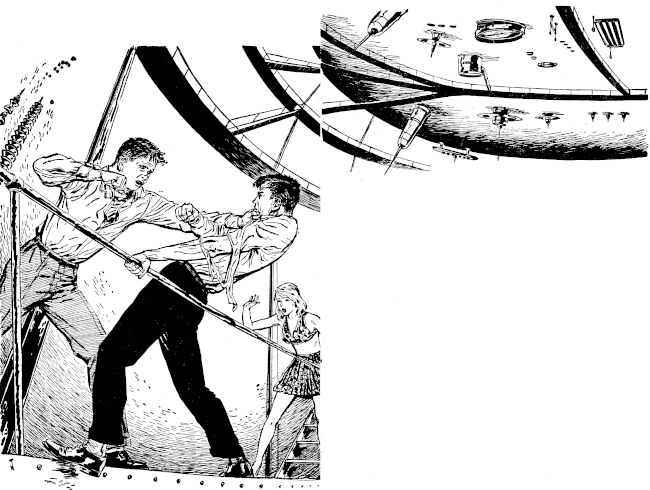
"You tricked me," Starbuck moaned. "That Robot ... was you."
A knee blurred up at Johnny, exploding in violent pain. He felt himself falling and managed to twist away from the edge of the sundered ramp. He hit the floor with waves of nausea boiling up from his stomach. He lay there, blinking his eyes.
Starbuck came for him.
He drew his legs up instinctively, the knees bent, then straightened as Starbuck leaned over him. His feet caught the big man squarely on the chest, lifted him, pushed—
Starbuck went over the edge of the ramp, screaming all the way down.
Inside, Johnny found Diane, dazed, on the floor. He ignored her. She could wait, for now he was a man possessed. The machinery which he could never hope to understand was all about him, bank on bank of it lining the walls, humming with its strange, sentient energy, glowing and flickering with a million lights.
Kill yourself.
Two words, clamoring, insistent, inside his skull. Their final hope.... He felt himself edging back toward the doorway, and the death which awaited him just outside. He looked at Diane, huddled on the floor, her lips parted—"Johnny...."
I love you, he thought. The words of death and those of life and hope fought inside his skull, twisting his brain, battling there for mastery....
He found something, a length of metal rod. He ripped it loose and began to attack the machinery he would never understand. He was a wild man. The strength flowed in from elsewhere, raising his arm, swinging it high over his head and down. Sparks flew as his metal club battered the crystaline tubes, the delicate wiring, the metal cases. Glass shattered, sprinkled him, brought blood from a dozen cuts on his face. Electricity hummed, then shrieked, then wailed off distantly on a register too high for his ears.
Raise his arm and plunge ... lift it and bring it down, battering, the metal club part of him....
It was Diane who eased the twisted rod from his fingers, soothed him with her words. "It's finished. Easy, Johnny. You've done it."
The place was a shambles. Bank on bank of gutted machinery lay silent there, on a floor strewn with glass, with wire, with filaments, with nameless things which were the brains for a million Robots.
"There's another way out, Johnny. Starbuck took me here. Behind that wall, you—"
She took his hand and they went. The passage was dark and cool and smelled musty, as if air did not circulate very well within it. It was a place for thinking and dreaming of tomorrow. It was a place for realizing you could go back to the hills and find Keleher and his Shining Ones and convince them they should at least look at the City, the City which belonged to them now, to them and DeReggio and his villagers—and all the others. And there must be a coming together of Keleher and DeReggio, with Johnny as mediator, and a realization that the last Plague victim had been smitten and humanity had a long path to travel but could set foot upon it right now, at once.
Outside, it was growing dark, but Johnny could make out the still forms of the Robots, gleaming red with final sunlight, sprawled upon the broken streets. The Shining Ones within the City stalked about furtively in small groups, not yet knowing what it meant to live without their masters. Perhaps in time Keleher and all the others could teach them.
"Hungry?" said Johnny. "We could stop and eat."
"No. You?"
"In a different way."
They followed the last slanting rays of the sun to the western river and the mainland beyond it.