Volume 11 — BIOGRAPHY OF EX-SLAVE CATHERINE SCALES
Reading edition
About ten years old at the "Srenduh", now quite feeble, but aristocratic in her black dress, white apron and small sailor hat made of black taffeta silk with a milliner's fold around the edge, Aunt Catherine is small, intensely black with finely cut features and thin lip. Her hand is finely molded, fingers long and slender. Her voice is soft and poise marks her personality. Sallie Martin, a ginger cake colored woman, sixty-five, has lived as a kind of caretaker with Aunt Catherine since 1934 and thereby gets her own roof and refreshment. For Aunt Catherine has gotten "relief" from the county welfare chief, Mrs. John Lee Wilson, and Jeff Scales, seventy, brings Sallie to the "relief" dispensary in his two horse wagon for the apples or onions or grape fruits or prunes with dried bena, milk, canned beef or potatoes as the stores yield. A white horse and a brown mule comprise the team, and several dogs trot along side. Sally also small and frail looking sits in a chair planted in the flat wagon bed behind the drivers' seat, a plank resting on the sides. Jeff drives close to the door, alights and helps Sallie step on to the back of the bed, thence to a chair he has placed, then to the ground, just as polite whites did to their women folks after the war when they would ride to town or to church or to picnics in wagons in order to carry the family, the servants, the dinner, horse feed, water bucket, chairs, cushions. Sallie gets in line, presents Aunt Katherine's card which she has gotten by mail, hears the dispensing lady call to the helping men what Aunt Catherine is to have, and struggles to the door with it where Jeff meets her, transfers the load to his wagon bed. Then with his hands he steadies Sallie as she mounts the chair, then the back of the wagon bed, over the side with voluminous long skirts, and old fashioned ruffled sun bonnet. Off to the hilly north part of Madison called Freetown, Jeff's [TR: Jeff] expertly guides his team through automobile traffi. [TR: traffic] During the worst of the depression Aunt Sallie said she kept her coal reserve in a tub upstairs so nobody could steal it.
Aunt Katherine strengthened by her relief food can talk comfortably.
"I shure did love my white fokes—Ole Marse, Timberlikk (Timberlake) an' Ole Miss Mary Timberlikk. My mother, Lucy Ann Timberlikk bough their portraits at the sale of the old Timberlake things, and kepp them an' brought them with her to Madison, when we moved up here, an kepp them until mummy was in her last sickness, an' two of Ole Misses daughters came over from Greensboro, an' begged,—an mammy sold the pictures to them for a quarter a piece. I still have Ole Misses mother's dish, though. I've got in [TR: it] packed away in a safe place. I'll get it and show it to you." It is a large flat platter of the ware called iron ware and was generally used to serve fried ham and eggs while the gravy came in a small deep dish. In summer, a heap of snaps greasy with middling meat slashed and boiled down dry with Irish potatoes around the edge came to table in the platter.
The keeper of the Timberlake oil portraits was Lucy, slave of Nat Scales, and Lucy's husband was Nathan Scales. Slave Nat Scales (named for Marse Nat) had married a black woman who came "across the water", Sallis [TR: Sallie?] Green who become by purchase Sallie Scales. Thus Aunt Katherine recalls her grandmother as one who "cum over the water with a white lady". The purchaser Mrs. Scales was from the LeSeur family. Her father was clerk of the Rockingham county court as early as [TR: missing date?] and kept the session records of his Presbyterian church in a fine neat script.
"The LeSeurs had as big a house as the Scales house at Deep Springs. I've stayed many a nite in it. It was next to Ole Marse Jimmie Scaleses. John Durham Scales, Marse Jimmy's grandson lived and died in it—his grandmother's house, the old Le Seur place, ten miles down the Dan river towards Leaksville. Miss Mary Le Seur married Marse Gus Timberlikk, an was the grandmother of William Timberlake Lipscomb who used to come up to Madison and go to Dr. Schuck's Beulah Academy just after the Srenduh. When Marse Billy'd get lonesome, he'd go down to Spring Garden and dance with the Scales girls. Ole Marse Le Seur's wife was Miss Lizzie Scales Marse Jimmie's.
"Nome, us slaves didn't have no chuch. Marse Nat Scales ud let his slaves go to the babtizings.
"I could hoe but I didn't do much clean up work. I spun on a great big wheel that went m-m-m-m-m. I wish I had a big wheel to spin on right now. My mammy, Lucy Ann, could weave. She sho loved her white fokes. Cullud fokes didn't have much sence den. She would take cow hair and kyard and spin it with a little cottin in to rolls, and then she'd weave cloth out of it.
"An how they made their shoes den: My father would cut shoes out of the raw cowhide and put them on bottoms (soles) he cut out uv wood. An he couldn't run in them a-tall, just had to stomp along! An day didn't put on shoe till nearly Christmas."
Schooling
Aunt Katherine said she "learned her letters" in a school fuh cullud fokes only taught by Mr. Sam Allen just after the Srenduh close to the old Timberlake place. Mr. Sam was the son of Mr. Val(entine) Allen an Miss Betsy Martin (she was the granddaughter of Governor Martin).
"Sometimes Miss Betsy'd git worried with little nigguh rolling roun on de floor thub hader under her feet, an' she'd say: 'Gway! Gway!! Gway fum hyuh! Gway tuh Pamlico!' An the little nigguhs'd say: 'Miss Betsy, whah's Pamplico?'
"'Nine miles tother sede o' hell!'
"Yesin Mr. Sam Allen learn't me my letters. He was crippled. He married a Grogan, an' two Allen girls married Grogans—one, Mary! Mr. Val's father was William Allen. I went to Mr. Vaul Allen's funeral an he was buried on his father's ole place, an Miss Betsy too.
"How de cullud fokes did hate to be sold down south in de cotton country! One time ole Marse Jimmy Scales wuz go sell uh hunduhd down south, and he died, an' all de cullud fokes wuz glad he died cause he wuz go sell um, an oftuh he died, day didn't halftuh be sold way fum home.
"One slave woman wuz sold way fum home—had three chillun, and daze six an eight an ten yuhs ole. She sang a song juss fo day tuh hub off. She put her three children between her knees. She sung, 'Lord, Be With Us.'"
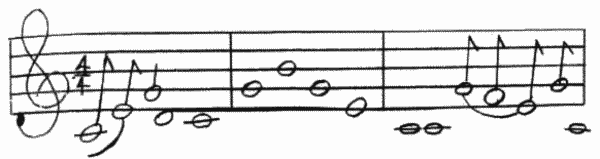
do—me—sol—re—do—sol—te—sol—me—do—do—sol—fa—me—sol—do "Remembuh me Remembuh me Oh Lord remembuh me"
This was sung full of quavers and pathos, and entreaty.
"Den she cried! An dey took huh off, and de chillun never saw her no more.
"Aftuh I learned my lettuhs at Marse Sam Allens school, I learned a Bible verse ebry day an if I want bixxy I'd learn ah half uh chaptuh. I read some newspapers, and some story books de Miss Mary Timberlikk give us chillun to read an look ovuh. I learned to write in a copy book, an I'd write stories about Christ, and several different stories. I filled a great big copy book with practice. I learned the most, tho', from Webstuh's Weekly in Reidsville. We took that papuh goin on five yuhs. I read evrything in it.
"Nome, I didn't know Miss Irene McGehiet. Uncle John R. Webster made that paper. It sure wuz a good paper!
"My daddy wuz Marse Nat's slave, an Porter Scales wuz his slave too. Ole Marse Jimmie Scale's sons was Nat Pitcher and John Durham, and John Durham went to wah. He took Richmond Scales long wiff him to wait on him! Cook fuh him! Make his pallet! Clean his clothes! Rub down his horse! Marse John Durum'd sleep with Richmond in de wintuh to keep him warm. Richmond'd carry him watuh in his canteen during a battle. Marse John Durum had on a ring that wuz carved and he tole Richmond take a good look at this ring sose he'd know him by it, if he didn't kum up aftuh a battle. Richmond ud hole onto his hawse's tail, an go wif him fuhs he could fo a battle.
"Yes'm I ma'd, Richmond Scales when he wuz a widower an had a boy named Jeff. I never had no chillun. Jeff's (70) seventy now, an lives right ovuh cross de street dere in the other hous the Vadens built sixty years ago. I live in one, too."
Aunt Katherine's house has a front room with stairway in the corner leading to one above. A back door leads to a side porch flanked by a two roomed ell, and ended by a pantry. Chimneys with fireplaces once gave heat, but economy had put in Aunt Katherine's tiny stove which she a lump at a time in the winters of depression and relief 1932-1937.
A big fat clean double bed, bureau, wash stand, "centuh" table, chairs and the stairway consumed the living room floor space.
"Nome! I joined de chuch after a big meetin' held by preacher Richard Walker about 1907. I joined the Methodist Chuch an I have always loved to go tuh chuch. This street goes on and goes into the Mayodan road at our new brick (1925) Methodist Chuch. Richmond Scales, my husband died long ago; my mother, about four years ago. She was very old! I wanted to move to Reidsville when we leff de ole plantation whab we could get more wok (waiting) waten on wimmen (obstetries) but the men fokes had kin fokes up hyuh, an we keem hyuh.
"I know whah de ole Sharp graveyard 'bout two miles fum (east) Madison close to Mist Tunnuh (Turner) Peay's; cause lots uh cullud fokes buried there an I went to the funerals. I could go straight tuh it."