Volume 13 — ILLUSTRATIONS (continued 6)
Reading edition
One day he come in at dinner and told his wife to git him something to eat. She told him they aint nothing but some buttermilk, and he says give me some of that. He hollered around till she fix him a big ash cake and he ate that and she made him another and he ate that. Then he drunk the rest of de gallon of buttermilk and went out and laid down on a tobacco scaffold in de yard and nearly died.
After while he jest stiffened out and looked like he was dead, and nobody couldn't wake him up. 'Bout forty niggers gathered round and tried but it done no good. Old mammy Polly got scared and sent after the white judge, old Squire Wilson, and he tried, and then the white preacher Reverend Dennison tried and old man Gorman tried. He was a infidel, but that didn't do no good.
By that time it was getting dark, and every nigger in a square mile was there, looking on and acting scared. Me and my partner who was a little bit cripple but mighty smart come up to see what all the rumpus was about, and we was jest the age to do anything.
He whispered to me to let him start it off and then me finish it while he got a head running start. I ast him what he talking about.
Then he fooled round the house and got a little ball of cotton and soaked it in kerosene from a lamp. It was a brass lamp with a hole and a stopper in the side of the bowl. Wonder he didn't burn his fool head off! Then he sidle up close and stuck dat cotton 'tween old Bab's toes. Old Bab had the biggest feet I ever see, too.
'Bout that time I lit a corn shuck in de lamp and run out in de yard and stuck it to de cotton and jest kept right on running!
My partner had a big start but I catch up wid him and we lay down in de bresh and listened to everybody hollering and old Bab hollering louder than anybody. Old Bab moved away after that.
All that foolishness happen after the War, but before de War while I was a little boy they wasn't much foolishness went on I warrant you.
I was born on de 15th of August in 1856, and belonged to Mister Addison Pyles. He lived in town, in Jackson, Tennessee, and was a old man when de War broke. He had a nephew named Irvin T. Pyles he raised from a baby, and Mister Irvin kept a store at de corner of de roads at our plantation. The plantation covered about 300 or 400 acres I reckon, and they had about 25 slaves counting de children.
The plantation was about 9 miles north of Red Mound, close to Lexington, Tennessee, and about a mile and a half from Parker's Crossroads where they had a big battle in de War.
They wasn't no white overseer on the place, except Mister Irvin, and he stayed in de store or in town and didn't bother about the farm work. We had a Negro overlooker who was my stepdaddy. His name was Jordan, and he run away wid de Yankees about de middle of de War and was in a Negro Yankee regiment. After he left we jest worked on as usual because we was afraid not to. Several of de men got away like that but he was de only one that got in de army.
They was a big house in de middle of de place and a settlement of Negro cabins behind and around it. We called it de settlement, but on other plantations where white folks lived there too they called it de quarters. We always kept this big house clean and ready, and sometimes de white folks come out from town and stay a few days and hunt and fish and look over de crops.
We all worked at farm work. Cotton and corn and tobacco mostly. We all laid off Sunday after noontime, but we didn't have no church nor preaching and we didn't hear anything 'bout Jesus much until after de emancipation.
I reckon old Master wasn't very religious, 'cause he never tell us 'bout the Holy Word. He jest said to behave ourselves and tell him when we wanted to marry, and not have but one wife.
We had little garden patches and cotton patches we could work on Sunday and what de stuff brung we could sell and keep the money. Old Master let us have what we made that way on Sunday. We could buy ribbons and hand soap and coal oil and such at de store. Master Irvin was always honest 'bout continuing de money, too.
We didn't have no carders and spinners nor no weavers on de plantation. They cost too much money to buy just for 25 niggers, and they cost a lot more than field niggers. So we got our clothes sent out to us from in town, and sometimes we was give cloth from de store to make our clothes out of.
We got de shorts and seconds from de mill when we had wheat ground, and so we had good wheat bread as well as corn pone, and de big smokehouse was on de place and we had all de meat we wanted to eat. Old Master sent out after de meat he wanted every day or so and we kept him in garden sass that way too.
We was right between de forks of Big Beaver and Little Beaver and we could go fishing without getting far off de place. We couldn't go far away without a pass, though, and they wasn't nobody on the place to write us a pass, so we couldn't go to meeting and dances and sech.
But de niggers on de other plantations could get passes to come to our place, and so we had parties sometimes there at our place. We always had them on Sundays, 'cause in the evening we would be too tired to work if we set up, and the other masters wouldn't give passes to their niggers to come over in de evening.
We had a white doctor lived at de next plantation, and old Master had a contract with old Dr. Brown to look after us. He had a beard as long as your arm. He come for all kinds of misery except bornings. Then we had a mid-wife who was a white woman lived down below us. They was poor people renting or living on war land. Nearly all de white folks in that country been there a long time and their old people got de land from de government for fighting in the Revolutionary War. Most all was from North Carolina—way back. I think old Master's pappy was from dere in de first place.
Old Master had two sons named Newton and Willis. Newton was in de War and was killed, and Willis went to war later and was sick a long time and come home early. Old Master was too old to go.
There was two daughters, Mary, de oldest, married a Holmes, and Miss Laura never did marry I don't think.
My mammy's name was Jane, and she was born on de 10th day of May in 1836. I know de dates 'cause old Master kept his book on all his niggers de same as on his own family. Mammy was the nurse of all de children but I think old Master sent her to de plantation about the time I was born. I don't think I had any pappy. I think I was jest one of them things that happened sometimes in slavery days, but I know old Master didn't have nothing to do with it—I'm too black.
Mammy married a man named Jordan when I was a little baby. He was the overlooker and went off to de Yankees, when dey come for foraging through dat country de first time.
He served in de Negro regiment in de battle at Fort Piller and a lot of Sesesh was killed in dat battle, so when de War was over and Jordan come back home he was a changed nigger and all de whites and a lot of de niggers hated him. All 'cepting old Master, and he never said a word out of de way to him. Jest told him to come on and work on de place as long as he wanted to.
But Jordan had a hard time, and he brung it on his self I reckon.
'Bout de first thing, he went down to Wildersville Schoolhouse, about a mile from Wildersville, to a nigger and carpet bagger convention and took me and mammy along. That was de first picnic and de first brass band I ever see. De band men was all white men and they still had on their blue soldier clothes.
Lots of de niggers there had been in de Union army too, and they had on parts of their army clothes. They took them out from under their coats and their wagon seats an put them on for de picnic.
There was a saloon over in Wildersville, and a lot of them went over there but they was scared to go in, most of them. But a colored delegate named Taylor and my pappy went in and ordered a drink. The bartender didn't pay them no mind.
Then a white man named Billy Britt walked up and throwed a glass of whiskey in Jordan's face and cussed him for being in de Yankee army. Then a white man from the North named Pearson took up the fight and him and Jordan jumped on Billy Britt, but de crowd stopped them and told pappy to git on back to whar he come from.
He got elected a delegate at de convention and went on down to Nashville and helped nominate Brownlow for governor. Then he couldn't come back home for a while, but finally he did.
Old Master was uneasy about de way things was going on, and he come out to de farm and stayed in de big house a while.
One day in broad daylight he was on de gallery and down de road come 'bout 20 bushwhackers in Sesesh clothes on horses and rid up to de gate. Old Master knowed all of them, and Captain Clay Taylor, who had been de master of de nigger delegate, was at the head of them.
They had Jordan Pyles tied with a rope and walked along on de ground betwixt two horses.
"Whar you taking my nigger?", Old Master say. He run down off de gallery and out in de road.
"He ain't your nigger no more—you know that", old Captain Taylor holler back.
"He jest as much my nigger as that Taylor nigger was your nigger, and you ain't laid hands on him! Now you jest have pity on my nigger!"
"Your nigger Jordan been in de Yankee army, and he was in de battle at Fort Piller and help kill our white folks, and you know it!" Old Captain Taylor say, and argue on like that, but old Master jest take hold his bridle and shake his head.
"No, Clay", he say, "that boy maybe didn't kill Confederates, but you and him both know my two boys killed plenty Yankees, and you forgot I lost one of my boys in de War. Ain't that enough to pay for letting my nigger alone?"
And old Captain Taylor give the word to turn Jordan loose, and they rid on down de road.
That's one reason my stepdaddy never did leave old Master's place, and I stayed on dere till I was grown and had children.
The Yankees come through past our place three-four times, and one time they had a big battle jest a mile and a half away at Parker's Crossroads.
I was in de field hoeing, and I remember I hadn't watered the cows we had hid way down in de woods, so I started down to water them when I first heard de shooting.
We had de stock hid down in de woods and all de corn and stuff hid too, 'cause the Yankees and the Sesesh had been riding through quite a lot, and either one take anything they needed iffen they found it.
First I hear something way off say "Br-r-rump!" Then again, and again. Then something sound like popcorn beginning to pop real slow. Then it git faster and I start for de settlement and de big house.
All Master's folks was staying at de big house then, and couldn't git back to town 'count of de soldiers, so they all put on they good clothes, with de hoop skirts and little sunshades and the lace pantaloons and got in the buggy to go see de battle!
They rid off and it wasn't long till all the niggers was following behind. We all got to a hill 'bout a half a mile from the crossroads and stopped when we couldn't see nothing but thick smoke all over de whole place.
We could see men on horses come in and out of de smoke, going this way and that way, and then some Yankees on horses broke through de woods right close to us and scattered off down through de field. One of de white officers rid up close and yelled at us and took off his hat, but I couldn't hear nothing he said.
Then he rid on and catch up with his men. They had stopped and was turning off to one side. He looked back and waved his hat again for us to git away from that, and jest then he clapped his hand to his belly and fell off his hoss.
Our white folks turned their buggy round and made it for home and no mistake! The niggers wasn't fur behind neither!
They fit on back toward our plantation, and some of the fighting was inside it at one corner. For three-four days after that they was burying soldiers 'round there, and some of de graves was on our old place.
Long time afterwards people come and moved all them to other graveyards at Shiloh and Corinth and other places. They was about a hundred killed all around there.
After de War I married Molly Timberlake and we lived on there 'til 1902, when we come to Indian Territory at Haskell. They wasn't no Haskell there then, and I helped to build dat town, doing carpenter work and the like.
We had two boys, Bill and Jim Dick, and eight daughters, Effie, Ida, Etta, Eva, Jessie, Tommie, Bennie and Timmie. Her real name is Timberlake after her mammy. They all went to school and graduated in the high schools.
My wife has been dead about ten years.
Oklahoma Writers' Project Ex-Slaves 10-13-37 [Date stamp: NOV 5 1937]
CHANEY RICHARDSON Age 90 years Fort Gibson, Okla.
I was born in the old Caney settlement southeast of Tahlequah on the banks of Caney Creek. Off to the north we could see the big old ridge of Sugar Mountain when the sun shine on him first thing in the morning when we all getting up.
I didn't know nothing else but some kind of war until I was a grown woman, because when I first can remember my old Master, Charley Rogers, was always on the lookout for somebody or other he was lined up against in the big feud.
My master and all the rest of the folks was Cherokees, and they'd been killing each other off in the feud ever since long before I was borned, and jest because old Master have a big farm and three-four families of Negroes them other Cherokees keep on pestering his stuff all the time. Us children was always afeared to go any place less'n some of the grown folks was along.
We didn't know what we was a-feared of, but we heard the Master and Mistress keep talking 'bout "another Party killing" and we stuck close to the place.
Old Mistress' name was Nancy Rogers, but I was a orphan after I was a big girl and I called her "Aunt" and "Mamma" like I did when I was little. You see my own mammy was the house woman and I was raised in the house, and I heard the little children call old mistress "mamma" and so I did too. She never did make me stop.
My pappy and mammy and us children lived in a one-room log cabin close to the creek bank and jest a little piece from old Master's house.
My pappy's name was Joe Tucker and my mammy's name was Ruth Tucker. They belonged to a man named Tucker before I was born and he sold them to Master Charley Rogers and he just let them go on by the same name if they wanted to, because last name didn't mean nothing to a slave anyways. The folks jest called my pappy "Charley Rogers' boy Joe."
I already had two sisters, Mary and Mandy, when I was born, and purty soon I had a baby brother, Louis. Mammy worked at the Big House and took me along every day. When I was a little bigger I would help hold the hank when she done the spinning and old Mistress done a lot of the weaving and some knitting. She jest set by the window and knit most all of the time.
When we weave the cloth we had a big loom out on the gallery, and Miss Nancy tell us how to do it.
Mammy eat at our own cabin, and we had lots of game meat and fish the boys get in the Caney Creek. Mammy bring down deer meat and wild turkey sometimes, that the Indian boys git on Sugar Mountain.
Then we had corn bread, dried bean bread and green stuff out'n Master's patch. Mammy make the bean bread when we git short of corn meal and nobody going to the mill right away. She take and bile the beans and mash them up in some meal and that make it go a long ways.
The slaves didn't have no garden 'cause they work the old Master's garden and make enough for everybody to have some anyway.
When I was about 10 years old that feud got so bad the Indians was always talking about getting their horses and cattle killed and their slaves harmed. I was too little to know how bad it was until one morning my own mammy went off somewhere down the road to git some stuff to dye cloth and she didn't come back.
Lots of the young Indian bucks on both sides of the feud would ride around the woods at night, and old Master got powerful oneasy about my mammy and had all the neighbors and slaves out looking for her, but nobody find her.
It was about a week later that two Indian men rid up and ast old master wasn't his gal Ruth gone. He says yes, and they take one of the slaves along with a wagon to show where they seen her.
They find her in some bushes where she'd been getting bark to set the dyes, and she been dead all the time. Somebody done hit her in the head with a club and shot her through and through with a bullet too. She was so swole up they couldn't lift her up and jest had to make a deep hole right along side of her and roll her in it she was so bad mortified.
Old Master nearly go crazy he was so mad, and the young Cherokee men ride the woods every night for about a month, but they never catch on to who done it.
I think old Master sell the children or give them out to somebody then, because I never see my sisters and brother for a long time after the Civil War, and for me, I have to go live with a new mistress that was a Cherokee neighbor. Her name was Hannah Ross, and she raised me until I was grown.
I was her home girl, and she and me done a lot of spinning and weaving too. I helped the cook and carried water and milked. I carried the water in a home-made pegging set on my head. Them peggings was kind of buckets made out of staves set around a bottom and didn't have no handle.
I can remember weaving with Miss Hannah Ross. She would weave a strip of white and one of yellow and one of brown to make it pretty. She had a reel that would pop every time it got to a half skein so she would know to stop and fill it up again. We used copperas and some kind of bark she bought at the store to dye with. It was cotton clothes winter and summer for the slaves, too, I'll tell you.
When the Civil War come along we seen lots of white soldiers in them brown butternut suits all over the place, and about all the Indian men was in it too. Old master Charley Rogers' boy Charley went along too. Then pretty soon—it seem like about a year—a lot of the Cherokee men come back home and say they not going back to the War with that General Cooper and some of them go off the Federal side because the captain go to the Federal side too.
Somebody come along and tell me my own pappy have to go in the war and I think they say he on the Copper side, and then after while Miss Hannah tell me he git kilt over in Arkansas.
I was so grieved all the time I don't remember much what went on, but I know pretty soon my Cherokee folks had all the stuff they had et up by the soldiers and they was jest a few wagons and mules left.
All the slaves was piled in together and some of the grown ones walking, and they took us way down across the big river and kept us in the bottoms a long time until the War was over.
We lived in a kind of a camp, but I was too little to know where they got the grub to feed us with. Most all the Negro men was off somewhere in the War.
Then one day they had to bust up the camp and some Federal soldiers go with us and we all start back home. We git to a place where all the houses is burned down and I ask what is that place. Miss Hannah say: "Skullyville, child. That's where they had part of the War."
All the slaves was set out when we git to Fort Gibson, and the soldiers say we all free now. They give us grub and clothes to the Negroes at that place. It wasn't no town but a fort place and a patch of big trees.
Miss Hannah take me to her place and I work there until I was grown. I didn't git any money that I seen, but I got a good place to stay.
Pretty soon I married Ran Lovely and we lived in a double log house here at Fort Gibson. Then my second husband was Henry Richardson, but he's been dead for years, too. We had six children, but they all dead but one.
I didn't want slavery to be over with, mostly because we had the War I reckon. All that trouble made me the loss of my mammy and pappy, and I was always treated good when I was a slave. When it was over I had rather be at home like I was. None of the Cherokees ever whipped us, and my mistress give me some mighty fine rules to live by to git along in this world, too.
The Cherokee didn't have no jail for Negroes and no jail for themselves either. If a man done a crime he come back to take his punishment without being locked up.
None of the Negroes ran away when I was a child that I know of. We all had plenty to eat. The Negroes didn't have no school and so I can't read and write, but they did have a school after the War, I hear. But we had a church made out of a brush arbor and we would sing good songs in Cherokee sometimes.
I always got Sunday off to play, and at night I could go git a piece of sugar or something to eat before I went to bed and Mistress didn't care.
We played bread-and-butter and the boys played hide the switch. The one found the switch got to whip the one he wanted to.
When I got sick they give me some kind of tea from weeds, and if I et too many roasting ears and swole up they biled gourds and give me the liquor off'n them to make me throw up.
I've been a good church-goer all my life until I git too feeble, and I still understand and talk Cherokee language and love to hear songs and parts of the Bible in it because it make me think about the time I was a little girl before my mammy and pappy leave me.
Oklahoma Writers' Project Ex-Slaves [Date stamp: AUG 16 1937]
RED RICHARDSON Age 75 yrs. Oklahoma City, Oklahoma
I was born July 21, 1862, at Grimes County, Texas. Smith Richardson was my father's name, and Eliza Richardson my mother's. My father came from Virginia. My mother she was born in Texas.
We lived in so many places round there I can't tell jest what, but we lived in a log house most of the time. We slept on the flo' on pallets on one quilt. We ate cornbread, beans, vegetables, and got to drink plenty milk. We ate rabbits, fish, possums and such as that but we didn't get no chicken. I don't have no fav'rite food, I don't guess.
We wore shirts, long shirts slit up the side. I didn't know what pants was until I was 14. In Grimes County it ain't even cold these days, and I never wore no shoes. I married in a suit made of broad cloth. It had a tail on the coat.
Master Ben Hadley, and Mistress Minnie Hadley, they had three sons: Josh, Henry and Charley. Didn't have no overseer. We had to call all white folks, poor or rich, Mr. Master and Mistress. Master Hadley owned 'bout 2,000 acres. He had a big number of slaves. They used to wake 'em up early in the mornings by ringing a large bell. They said they used to whip 'em, drive 'em, and sell 'em away from their chillun,—I'd hear my old folks talk about it. Say they wasn't no such a thing as going to jail. The master stood good for anything his nigger done. If the master's nigger killed 'im another nigger, the old master stood good.
They never had no schools for the Negro chillun. I can't remember the date of the first school—its in a book someplace—but anyway I went to one of the first schools that was established for the education of Negro chillun.
You know Mr. Negro always was a church man, but he don't mean nothing. I don't have no fav'rite spiritual. All of them's good ones. Whenever they'd baptise they'd sing:
"Harp From the Tune the Domeful Sound."
Which starts like this:
"Come live in man and view this ground where we must sho'ly lie."
I'm a member of Tabernacle Baptist Church myself, and I think all people should be religious 'cause Jesus died for us all.
The patrollers used to run after me but I'd jump 'em. They used to have a permit to go from one plantation to another. You had to go to old master and say, "I want to go to such and such a place." And if you had a permit they didn't bother you. The pateroller would stop you and say, "Where you going? You got a permit to go to such and such a place?" You'd say, yes suh, and show that pass. Den he wouldn't bother you and iffen he did old master would git on 'em.
When 10 o'clock come which was bed time the slaves would go to their cabins and some of 'em would go stealing chickens, hogs, steal sweet potatoes, and cook and eat 'em. Jest git in to all kind of devilment.
Old master would give 'em Sadday afternoon off, and they'd have them Sadday night breakdowns. We played a few games such as marbles, mumble peg, and cards—jest anything to pass off the time. Heahs one of the games we'd play an' I sho did like it too:
She is my sweetheart as I stand, Come and stand beside of me, Kiss her sweet and; Hug her near.
On Christmas they'd make egg nog, drink whiskey and kiss their girls.
Some wore charms to ward off the devil, but I don't believe in such. I do believe in voodoo like this: People can put propositions up to you and fool you. Don't believe in ghost. Tried to see 'em but I never could.
Old master didn't turn my father loose and tell 'em we was free. They didn't turn us loose 'til they got the second threat from President Lincoln. Good old Lincoln; they wasn't nothing like 'im. Booker T. Washington was one of the finest Negro Educators in the world, but old Jefferson Davis was against the cullud man.
I think since slavery is all over, it has been a benefit to the cullud man. He's got more freedom now.
Oklahoma Writer's Project Ex-Slaves
BETTY ROBERTSON Age 93 yrs. Fort Gibson, Oklahoma
I was born close to Webber's Falls, in the Canadian District of the Cherokee Nation, in the same year that my pappy was blowed up and killed in the big boat accident that killed my old Master.
I never did see my daddy excepting when I was a baby and I only know what my mammy told me about him. He come from across the water when he was a little boy, and was grown when old Master Joseph Vann bought him, so he never did learn to talk much Cherokee. My mammy was a Cherokee slave, and talked it good. My husband was a Cherokee born negro, too, and when he got mad he forgit all the English he knowed.
Old Master Joe had a mighty big farm and several families of negroes, and he was a powerful rich man. Pappy's name was Kalet Vann, and mammy's name was Sally. My brothers was name Sone and Frank. I had one brother and one sister sold when I was little and I don't remember the names. My other sisters was Polly, Ruth and Liddie. I had to work in the kitchen when I was a gal, and they was ten or twelve children smaller than me for me to look after, too. Sometime Young Master Joe and the other boys give me a piece of money and say I worked for it, and I reckon I did for I have to cook five or six times a day. Some of the Master's family was always going down to the river and back, and every time they come in I have to fix something to eat. Old Mistress had a good cookin' stove, but most Cherokees had only a big fireplace and pot hooks. We had meat, bread, rice, potatoes and plenty of fish and chicken. The spring time give us plenty of green corn and beans too. I couldn't buy anything in slavery time, so I jest give the piece of money to the Vann children. I got all the clothes I need from old Mistress, and in winter I had high top shoes with brass caps on the toe. In the summer I wear them on Sunday, too. I wore loom cloth clothes, dyed in copperas what the old negro women and the old Cherokee women made.
The slaves had a pretty easy time I think. Young Master Vann never very hard on us and he never whupped us, and old Mistress was a widow woman and a good Christian and always kind. I sure did love her. Maybe old Master Joe Vann was harder, I don't know, but that was before my time. Young Master never whip his slaves, but if they don't mind good he sell them off sometimes. He sold one of my brothers and one sister because they kept running off. They wasn't very big either, but one day two Cherokees rode up and talked a long time, then young Master came to the cabin and said they were sold because mammy couldn't make them mind him. They got on the horses behind the men and went off.
Old Master Joe had a big steam boat he called the Lucy Walker, and he run it up and down the Arkansas and the Mississippi and the Ohio river, old Mistress say. He went clean to Louisville, Kentucky, and back. My pappy was a kind of a boss of the negroes that run the boat, and they all belong to old Master Joe. Some had been in a big run-away and had been brung back, and wasn't so good, so he keep them on the boat all the time mostly. Mistress say old Master and my pappy on the boat somewhere close to Louisville and the boiler bust and tear the boat up. Some niggers say my pappy kept hollering, "Run it to the bank! Run it to the bank!" but it sunk and him and old Master died.
Old Master Joe was a big man in the Cherokees, I hear, and was good to his negroes before I was born. My pappy run away one time, four or five years before I was born, mammy tell me, and at that time a whole lot of Cherokee slaves run off at once. They got over in the Creek country and stood off the Cherokee officers that went to git them, but pretty soon they give up and come home. Mammy say they was lots of excitement on old Master's place and all the negroes mighty scared, but he didn't sell my pappy off. He jest kept him and he was a good negro after that. He had to work on the boat, though, and never got to come home but once in a long while.
Young Master Joe let us have singing and be baptized if we want to, but I wasn't baptized till after the War. But we couldn't learn to read or have a book, and the Cherokee folks was afraid to tell us about the letters and figgers because they have a law you go to jail and a big fine if you show a slave about the letters.
When the War come they have a big battle away west of us, but I never see any battles. Lots of soldiers around all the time though.
One day young Master come to the cabins and say we all free and can't stay there less'n we want to go on working for him just like we'd been, for our feed and clothes. Mammy got a wagon and we traveled around a few days and go to Fort Gibson. When we git to Fort Gibson they was a lot of negroes there, and they had a camp meeting and I was baptized. It was in the Grand River close to the ford, and winter time. Snow on the ground and the water was muddy and all full of pieces of ice. The place was all woods, and the Cherokees and the soldiers all come down to see the baptizing.
We settled down a little ways above Fort Gibson. Mammy had the wagon and two oxen, and we worked a good size patch there until she died, and then I git married to Cal Robertson to have somebody to take care of me. Cal Robertson was eighty-nine years old when I married him forty years ago, right on this porch. I had on my old clothes for the wedding, and I aint had any good clothes since I was a little slave girl. Then I had clean warm clothes and I had to keep them clean, too!
I got my allotment as a Cherokee Freedman, and so did Cal, but we lived here at this place because we was too old to work the land ourselves. In slavery time the Cherokee negroes do like anybody else when they is a death—jest listen to a chapter in the Bible and all cry. We had a good song I remember. It was "Don't Call the Roll, Jesus, Because I'm Coming Home." The only song I remember from the soldiers was: "Hang Jeff Davis to a Sour Apple Tree", and I remember that because they said he used to be at Fort Gibson one time. I don't know what he done after that.
I don't know about Robert Lee, but I know about Lee's Creek.
I been a good Christian ever since I was baptized, but I keep a little charm here on my neck anyways, to keep me from having the nose bleed. Its got a buckeye and a lead bullet in it. I had a silver dime on it, too, for a long time, but I took it off and got me a box of snuff. I'm glad the War's over and I am free to meet God like anybody else, and my grandchildren can learn to read and write.
Oklahoma Writers' Project Ex-slaves [Date stamp: AUG 18 1937]
HARRIET ROBINSON Age 95 yrs. 500 Block N. Fonshill Oklahoma City, Oklahoma.
I was born September 1, 1842, in Bastrop, Texas, on Colorado River. My pappy was named Harvey Wheeler and my mammy was named Carolina Sims. My brothers and sisters was named Alex, Taylor, Mary, Cicero, Tennessee, Sarah, Jeff, Ella and Nora. We lived in cedar log houses with dirt floors and double chimneys, and doors hung on wooden hinges. One side of our beds was bored in the walls and had one leg on the other. Them white folks give each nigger family a blanket in winter.
I nussed 3 white chillun, Lulu, Helen Augusta, and Lola Sims. I done this before that War that set us free. We kids use to make extra money by toting gravel in our aprons. They'd give us dimes and silver nickles.
Our clothes was wool and cotton mixed. We had red rustic shoes, soles one-half inch thick. They'd go a-whick a-whack. The mens had pants wid one seam and a right-hand pocket. Boys wore shirts.
We ate hominy, mush, grits and pone bread for the most part. Many of them ate out of one tray with wooden spoons. All vittles for field hands was fixed together.
Women broke in mules throwed 'em down and roped 'em. They'd do it better'n men. While mammy made some hominy one day both my foots was scalded and when they clipped them blisters, they jest put some cotton round them and catched all dat yellow water and made me a yellow dress out of it. This was 'way back yonder in slavery, before the War.
Whenever white folks had a baby born den all de old niggers had to come thoo the room and the master would be over 'hind the bed and he'd say, "Here's a new little mistress or master you got to work for." You had to say, "Yessuh Master" and bow real low or the overseer would crack you. Them was slavery days, dog days.
I remember in slavery time we had stages. Them devilish things had jest as many wrecks as cars do today. Only thing, we jest didn't have as many.
My mammy belonged to Master Colonel Sam Sims and his old mean wife Julia. My pappy belonged to Master Meke Smith and his good wife Harriett. She was sho' a good woman. I was named after her. Master Sam and Master Meke was partners. Ever year them rich men would send so many wagons to New Mexico for different things. It took 6 months to go and come.
Slaves was punished by whip and starving. Decker was sho' a mean slave-holder. He lived close to us. Master Sam didn't never whip me, but Miss Julia whipped me every day in the mawning. During the war she beat us so terrible. She say, "Your master's out fighting and losing blood trying to save you from them Yankees, so you kin git your'n here." Miss Julia would take me by my ears and butt my head against the wall. She wanted to whip my mother, but old Master told her, naw sir. When his father done give my mammy to Master Sam, he told him not to beat her, and iffen he got to whar he jest had to, jest bring her back and place her in his yard from whar he got her.
White folks didn't 'low you to read or write. Them what did know come from Virginny. Mistress Julia used to drill her chillun in spelling any words. At every word them chillun missed, she gived me a lick 'cross the head for it. Meanest woman I ever seen in my whole life.
This skin I got now, it ain't my first skin. That was burnt off when I was a little child. Mistress used to have a fire made on the fireplace and she made me scour the brass round it and my skin jest blistered. I jest had to keep pulling it off'n me.
We didn't had no church, though my pappy was a preacher. He preached in the quarters. Our baptizing song was "On Jordan's Stormy Bank I stand" and "Hark From The Tomb." Now all dat was before the War. We had all our funerals at the graveyard. Everybody, chillun and all picked up a clod of dirt and throwed in on top the coffin to help fill up the grave.
Taling 'bout niggers running away, didn't my step-pappy run away? Didn't my uncle Gabe run away? The frost would jest bite they toes most nigh off too, whiles they was gone. They put Uncle Isom (my step-pappy) in jail and while's he was in there he killed a white guardman. Then they put in the paper, "A nigger to kill", and our Master seen it and bought him. He was a double-strengthed man, he was so strong. He'd run off so help you God. They had the blood hounds after him once and he caught the hound what was leading and beat the rest of the dogs. The white folks run up on him before he knowed it and made them dogs eat his ear plumb out. But don't you know he got away anyhow. One morning I was sweeping out the hall in the big house and somebody come a-knocking on the front door and I goes to the door. There was Uncle Isom wid rags all on his head. He said, "Tell ole master heah I am." I goes to Master's door and says, "Master Colonel Sam, Uncle Isom said heah he am." He say, "Go 'round to the kitchen and tell black mammy to give you breakfast." When he was thoo' eating they give him 300 lashes and, bless my soul, he run off again.
When we went to a party the nigger fiddlers would play a chune dat went lak this:
I fooled Ole Mastah 7 years Fooled the overseer three; Hand me down my banjo And I'll tickle your bel-lee.
We had the same doctors the white folks had and we wore asafetida and garlic and onions to keep from taking all them ailments.
I 'member the battle being fit. The white folks buried all the jewelry and silver and all the gold in the Blue Ridge Mountains, in Orange, Texas. Master made all us niggers come together and git ready to leave 'cause the Yankees was coming. We took a steamer. Now this was in slavery time, sho' 'nuff slavery. Then we got on a steamship and pulled out to Galveston. Then he told the captain to feed we niggers. We was on the bay, not the ocean. We left Galveston and went on trains for Houston.
One, my sister Liza, was mulatto and Master Colonel Sims' son had 3 chillun by her. We never seen her no more after her last child was born. I found out though that she was in Canada.
After the War, Master Colonel Sims went to git the mail and so he call Daniel Ivory, the overseer, and say to him, "Go round to all the quarters and tell all the niggers to come up, I got a paper to read to 'em. They're free now, so you kin git you another job, 'cause I ain't got no more niggers which is my own." Niggers come up from the cabins nappy-headed, jest lak they gwine to the field. Master Colonel Sims say, "Caroline (that's my mammy), you is free as me. Pa said bring you back and I'se gwina do jest that. So you go on and work and I'll pay you and your three oldest chillun $10.00 a month a head and $4.00 fer Harriet," that's me, and then he turned to the rest and say "Now all you'uns will receive $10.00 a head till the crops is laid by." Don't you know before he got half way thoo', over half them niggers was gone.
Them Klu Klux Klans come and ask for water with the false stomachs and make lak they was drinking three bucketsful. They done some terrible things, but God seen it all and marked it down.
We didn't had no law, we had "bureau." Why, in them days iffen somebody stole anything from you, they had to pay you and not the Law. Now they done turned that round and you don't git nothing.
One day whiles master was gone hunting, Mistress Julia told her brother to give Miss Harriett (me) a free whipping. She was a nigger killer. Master Colonel Sam come home and he said, "You infernal sons o' bitches don't you know there is 300 Yankees camped out here and iffen they knowed you'd whipped this nigger the way you done done, they'd kill all us. Iffen they find it out, I'll kill all you all." Old rich devils, I'm here, but they is gone.
God choosed Abraham Lincoln to free us. It took one of them to free us so's they couldn't say nothing.
Doing one 'lection they sung:
Clark et the watermelon J. D. Giddings et the vine! Clark gone to Congress An' J. D. Giddings left behind.
They hung Jeff Davis up a sour apple tree. They say he was a president, but he wasn't, he was a big senator man.
Booker T. Washington was all right in his way, I guess, but Bruce and Fred Douglass, or big mens jest sold us back to the white folks.
I married Haywood Telford and had 13 head of chillun by him. My oldest daughter is the mammy of 14. All my chillun but four done gone to heaven before me.
I jined the church in Chapel Hill, Texas. I am born of the Spirit of God sho' nuff. I played with him seven years and would go right on dancing at Christmas time. Now I got religion. Everybody oughta live right, though you won't have no friends iffen you do.
Our overseer was a poor man. Had us up before day and lak-a-that. He was paid to be the head of punishment. I jest didn't like to think of them old slavery days, dogs' days.
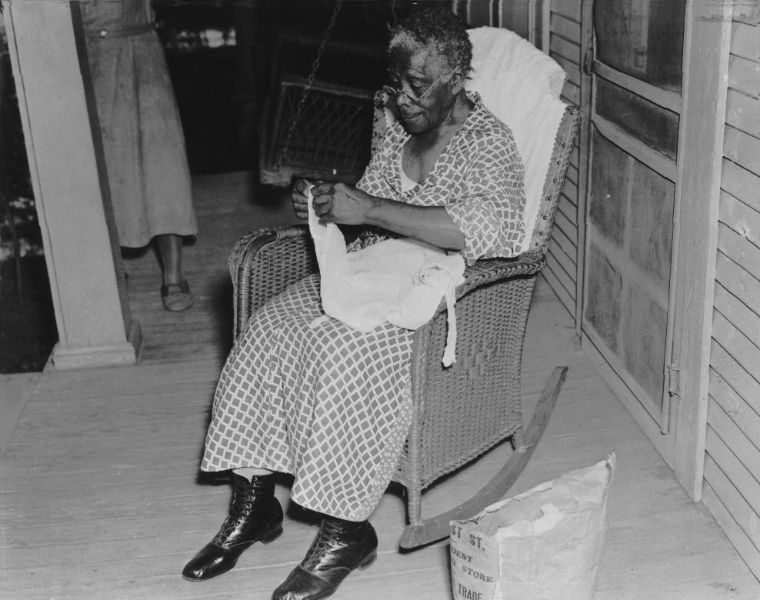
Oklahoma Writers' Project Ex-Slaves [HW: (photo)] [Date stamp: AUG 16 1937]
KATIE ROWE Age 88 yrs. Tulsa, Oklahoma
I can set on de gallery, whar de sunlight shine bright, and sew a powerful fine seam when my grandchillun wants a special purty dress for de school doings, but I ain't worth much for nothing else I reckon.
These same old eyes seen powerful lot of tribulations in my time, and when I shets 'em now I can see lots of l'il chillun jest lak my grandchillun, toting hoes bigger dan dey is, and dey pore little black hands and legs bleeding whar dey scratched by de brambledy weeds, and whar dey got whuppings 'cause dey didn't git out all de work de overseer set out for 'em.
I was one of dem little slave gals my own self, and I never seen nothing but work and tribulations till I was a grown up woman, jest about.
De niggers had hard traveling on de plantation whar I was born and raised, 'cause old Master live in town and jest had de overseer on de place, but iffen he had lived out dar hisself I speck it been as bad, 'cause he was a hard driver his own self.
He git biling mad when de Yankees have dat big battle at Pea Ridge and scatter de 'Federates all down through our country all bleeding and tied up and hungry, and he jest mount on his hoss and ride out to de plantation whar we all hoeing corn.
He ride up and tell old man Saunders—dat de overseer—to bunch us all up round de lead row man—dat my own uncle Sandy—and den he tell us de law!
"You niggers been seeing de 'Federate soldiers coming by here looking purty raggedy and hurt and wore out," he say, "but dat no sign dey licked!
"Dem Yankees ain't gwine git dis fur, but iffen dey do you all ain't gwine git free by 'em, 'cause I gwine free you befo' dat. When dey git here dey going find you already free, 'cause I gwine line you up on de bank of Bois d' Arc Creek and free you wid my shotgun! Anybody miss jest one lick wid de hoe, or one step in de line, or one clap of dat bell, or one toot of de horn, and he gwine be free and talking to de debil long befo' he ever see a pair of blue britches!"
Dat de way he talk to us, and dat de way he act wid us all de time.
We live in de log quarters on de plantation, not far from Washington, Arkansas, close to Bois d' Arc Creek, in de edge of de Little River bottom.
Old Master's name was Dr. Isaac Jones, and he live in de town, whar he keep four, five house niggers, but he have about 200 on de plantation, big and little, and old man Saunders oversee 'em at de time of de War. Old Mistress name was Betty, and she had a daughter name Betty about grown, and then they was three boys, Tom, Bryan, and Bob, but they was too young to go to de War. I never did see 'em but once or twice 'til after de War.
Old Master didn't go to de War, 'cause he was a doctor and de onliest one left in Washington, and purty soon he was dead anyhow.
Next fall after he ride out and tell us dat he gwine shoot us befo' he let us free he come out to see how his steam gin doing. De gin box was a little old thing 'bout as big as a bedstead, wid a long belt running through de side of de gin house out to de engine and boiler in de yard. De boiler burn cord wood, and it have a little crack in it whar de nigger ginner been trying to fix it.
Old Master come out, hopping mad 'cause de gin shet down, and ast de ginner, old Brown, what de matter. Old Brown say de boiler weak and it liable to bust, but old Master jump down off'n his hoss and go 'round to de boiler and say, "Cuss fire to your black heart! Dat boiler all right! Throw on some cordwood, cuss fire to your heart!"
Old Brown start to de wood pile grumbling to hisself and old Master stoop down to look at de boiler again, and it blow right up and him standing right dar!
Old Master was blowed all to pieces, and dey jest find little bitsy chunks of his clothes and parts of him to bury.
De wood pile blow down, and old Brown land way off in de woods, but he wasn't killed.
Two wagons of cotton blowed over, and de mules run away, and all de niggers was scared nearly to death 'cause we knowed de overseer gwine be a lot worse, now dat old Master gone.
Before de War when Master was a young man de slaves didn't have it so hard, my mammy tell me. Her name was Fanny and her old mammy name was Nanny. Grandma Nanny was alive during de War yet.
How she come in de Jones family was dis way: old Mistress was jest a little girl, and her older brother bought Nanny and give her to her. I think his name was Little John, anyways we called him Master Little John. He drawed up a paper what say dat Nanny allus belong to Miss Betty and all de chillun Nanny ever have belong to her, too, and nobody can't take 'em for a debt and things like dat. When Miss Betty marry, old Master he can't sell Nanny or any of her chillun neither.
Dat paper hold good too, and grandmammy tell me about one time it hold good and keep my own mammy on de place.
Grandmammy say mammy was jest a little gal and was playing out in de road wid three, four other little chillun when a white man and old Master rid up. The white man had a paper about some kind of a debt, and old Master say take his pick of de nigger chillun and give him back de paper.
Jest as Grandmammy go to de cabin door and hear him say dat de man git off his hoss and pick up my mammy and put her up in front of him and start to ride off down de road.
Pretty soon Mr. Little John come riding up and say something to old Master, and see grandmammy standing in de yard screaming and crying. He jest job de spur in his hoss and go kiting off down de road after dat white man.
Mammy say he ketch up wid him jest as he git to Bois d' Arc Creek and start to wade de hoss across. Mr. Little John holler to him to come back wid dat little nigger 'cause de paper don't kiver dat child, 'cause she old Mistress' own child, and when de man jest ride on, Mr. Little John throw his big old long hoss-pistol down on him and make him come back.
De man hopping mad, but he have to give over my mammy and take one de other chillun on de debt paper.
Old Master allus kind of techy 'bout old Mistress having niggers he can't trade or sell, and one day he have his whole family and some more white folks out at de plantation. He showing 'em all de quarters when we all come in from de field in de evening, and he call all de niggers up to let de folks see 'em.
He make grandmammy and mammy and me stand to one side and den he say to the other niggers, "Dese niggers belong to my wife but you belong to me, and I'm de only one you is to call Master.
"Dis is Tom, and Bryan, and Bob, and Miss Betty, and you is to call 'em dat, and don't you ever call one of 'em Young Master or Young Mistress, cuss fire to your black hearts!" All de other white folks look kind of funny, and old Mistress look 'shamed of old Master.
My own pappy was in dat bunch, too. His name was Frank, and after de War he took de name of Frank Henderson, 'cause he was born under dat name, but I allus went by Jones, de name I was born under.
Long about de middle of de War, after old Master was killed, de soldiers begin coming 'round de place and camping. Dey was Southern soldiers and dey say dey have to take de mules and most de corn to git along on. Jest go in de barns and cribs and take anything dey want, and us niggers didn't have no sweet 'taters nor Irish 'taters to eat on when dey gone neither.
One bunch come and stay in de woods across de road from de overseer's house, and dey was all on hosses. Dey lead de hosses down to Bois d' Arc Creek every morning at daylight and late every evening to git water. When we going to de field and when we coming in we allus see dem leading big bunches of hosses.
Dey bugle go jest 'bout de time our old horn blow in de morning and when we come in dey eating supper, and we smell it and sho' git hungry!
Before old Master died he sold off a whole lot of hosses and cattle, and some niggers too. He had de sales on de plantation, and white men from around dar come to bid, and some traders come. He had a big stump whar he made de niggers stand while dey was being sold, and de men and boys had to strip off to de waist to show dey muscle and iffen dey had any scars or hurt places, but de women and gals didn't have to strip to de waist.
De white men come up and look in de slave's mouth jest lak he was a mule or a hoss.
After old Master go, de overseer hold one sale, but mostly he jest trade wid de traders what come by. He make de niggers git on de stump, through. De traders all had big bunches of slaves and dey have 'em all strung out in a line going down de road. Some had wagons and de chillun could ride, but not many. Dey didn't chain or tie 'em 'cause dey didn't have no place dey could run to anyway.
I seen chillun sold off and de mammy not sold, and, sometimes de mammy sold and a little baby kept on de place and give to another woman to raise. Dem white folks didn't care nothing 'bout how de slaves grieved when dey tore up a family.
Old man Saunders was de hardest overseer of anybody. He would git mad and give a whipping some time and de slave wouldn't even know what it was about.
My uncle Sandy was de lead row nigger, and he was a good nigger and never would tech a drap of likker. One night some de niggers git hold of some likker somehow, and dey leave de jug half full on de step of Sandy's cabin. Next morning old man Saunders come out in de field so mad he was pale.
He jest go to de lead row and tell Sandy to go wid him, and start toward de woods along Bois d' Arc Creek wid Sandy follering behind. De overseer always carry a big heavy stick, but we didn't know he was so mad, and dey jest went off in de woods.
Purty soon we hear Sandy hollering and we know old overseer pouring in on, den de overseer come back by his self and go on up to de house.
Come late evening he come and see what we done in de day's work, and go back to de quarters wid us all. Then he git to mammy's cabin, whar grandmammy live too, he say to grandmammy, "I sent Sandy down in de woods to hunt a hoss, he gwine come in hungry purty soon. You better make him a extra hoe cake," and he kind of laugh and go on to his house.
Jest soon as he gone we all tell grandmammy we think he got a whipping, and sho' nuff he didn't come in.
De next day some white boys find uncle Sandy whar dat overseer done killed him and throwed him in a little pond, and dey never done nothing to old man Saunders at all!
When he go to whip a nigger he make him strip to de waist, and he take a cat-o-nine tails and bring de blisters, and den bust de blisters wid a wide strap of leather fastened to a stick handle. I seen de blood running out'n many a back, all de way from de neck to de waist!
Many de time a nigger git blistered and cut up so dat we have to git a sheet and grease it wid lard and wrap 'em up in it, and dey have to wear a greasy cloth wrapped around dey body under de shirt for three-four days after dey git a big whipping!
Later on in de War de Yankees come in all around us and camp, and de overseer git sweet as honey in de comb! Nobody git a whipping all de time de Yankees dar!
Dey come and took all de meat and corn and 'taters dey want too, and dey tell us, "Why don't you poor darkeys take all de meat and molasses you want? You made it and it's your's much as anybody's!" But we know dey soon be gone, and den we git a whipping iffen we do. Some niggers run off and went wid de Yankees, but dey had to work jest as hard for dem, and dey didn't eat so good and often wid de soldiers.
I never forget de day we was set free!
Dat morning we all go to de cotton field early, and den a house nigger come out from old Mistress on a hoss and say she want de overseer to come into town, and he leave and go in. After while de old horn blow up at de overseer's house, and we all stop and listen, 'cause it de wrong time of day for de horn.
We start chopping again, and dar go de horn again.
De lead row nigger holler "Hold up!" And we all stop again. "We better go on in. Dat our horn," he holler at de head nigger, and de head nigger think so too, but he say he afraid we catch de devil from de overseer iffen we quit widout him dar, and de lead row man say maybe he back from town and blowing de horn hisself, so we line up and go in.
When we git to de quarters we see all de old ones and de chillun up in de overseer's yard, so we go on up dar. De overseer setting on de end of de gallery wid a paper in his hand, and when we all come up he say come and stand close to de gallery. Den he call off everybody's name and see we all dar.
Setting on de gallery in a hide-bottom chair was a man we never see before. He had on a big broad black hat lak de Yankees wore but it din't have no yaller string on it lak most de Yankees had, and he was in store clothes dat wasn't homespun or jeans, and dey was black. His hair was plumb gray and so was his beard, and it come way down here on his chest, but he didn't look lak he was very old, 'cause his face was kind of fleshy and healthy looking. I think we all been sold off in a bunch, and I notice some kind of smiling, and I think they sho' glad of it.
De man say, "You darkies know what day dis is?" He talk kind, and smile.
We all don't know of course, and we jest stand dar and grin. Pretty soon he ask again and de head man say, No, we don't know.
"Well dis de fourth day of June, and dis is 1865, and I want you all to 'member de date, 'cause you allus going 'member de day. Today you is free, Jest lak I is, and Mr. Saunders and your Mistress and all us white people," de man say.
"I come to tell you", he say, "and I wants to be sho' you all understand, 'cause you don't have to git up and go by de horn no more. You is your own bosses now, and you don't have to have no passes to go and come."
We never did have no passes, nohow, but we knowed lots of other niggers on other plantations got 'em.
"I wants to bless you and hope you always is happy, and tell you got all de right and lief [TR: sic] dat any white people got", de man say, and den he git on his hoss and ride off.
We all jest watch him go on down de road, and den we go up to Mr. Saunders and ask him what he want us to do. He jest grunt and say do lak we dam please, he reckon, but git off dat place to do it, less'n any of us wants to stay and make de crop for half of what we make.
None of us know whar to go, so we all stay, and he split up de fields and show us which part we got to work in, and we go on lak we was, and make de crop and git it in, but dey ain't no more horn after dat day. Some de niggers lazy and don't git in de field early, and dey git it took away from 'em, but dey plead around and git it back and work better de rest of dat year.
But we all gits fooled on dat first go-out! When de crop all in we don't git half! Old Mistress sick in town, and de overseer was still on de place and he charge us half de crop for de quarters and de mules and tools and grub!
Den he leave, and we gits another white man, and he sets up a book, and give us half de next year, and take out for what we use up, but we all got something left over after dat first go-out.
Old Mistress never git well after she lose all her niggers, and one day de white boss tell us she jest drap over dead setting in her chair, and we know her heart jest broke.
Next year de chillun sell off most de place and we scatter off, and I and mammy go into Little Rock and do work in de town. Grandmammy done dead.
I git married to John White in Little Rock, but he died and we didn't have no chillun. Den in four, five years I marry Billy Rowe. He was a Cherokee citizen and he had belonged to a Cherokee name Dave Rowe, and lived east of Tahlequah before de War. We married in Little Rock, but he had land in de Cherokee Nation, and we come to east of Tahlequah and lived 'til he died, and den I come to Tulsa to live wid my youngest daughter.
Billy Rowe and me had three chillun, Ellie, John, and Lula. Lula married a Thomas, and it's her I lives with.
Lots of old people lak me say dat dey was happy in slavery, and dat dey had de worst tribulations after freedom, but I knows dey didn't have no white master and overseer lak we all had on our place. Dey both dead now I reckon, and dey no use talking 'bout de dead, but I know I been gone long ago iffen dat white man Saunder didn't lose his hold on me.
It was de fourth day of June in 1865 I begins to live, and I gwine take de picture of dat old man in de big black hat and long whiskers, setting on de gallery and talking kind to us, clean into my grave wid me.
No, bless God, I ain't never seen no more black boys bleeding all up and down de back under a cat o' nine tails, and I never go by no cabin and hear no poor nigger groaning, all wrapped up in a lardy sheet no more!
I hear my chillun read about General Lee, and I know he was a good man, I didn't know nothing about him den, but I know now he wasn't fighting for dat kind of white folks.
Maybe dey dat kind still yet, but dey don't show it up no more, and I got lots of white friends too. All my chillun and grandchillun been to school, and dey git along good, and I know we living in a better world, what dey ain't nobody "cussing fire to my black heart!"
I sho' thank de good Lawd I got to see it.
Oklahoma Writers' Project Ex-Slaves
MORRIS SHEPPARD Age 85 yrs. Fort Gibson, Okla.
Old Master tell me I was borned in November 1852, at de old home place about five miles east of Webber's Falls, mebbe kind of northeast, not far from de east bank of de Illinois River.
Master's name was Joe Sheppard, and he was a Cherokee Indian. Tall and slim and handsome. He had black eyes and mustache but his hair was iron gray, and everybody liked him because he was so good-natured and kind.
I don't remember old Mistress' name. My mammy was a Crossland negro before she come to belong to Master Joe and marry my pappy, and I think she come wid old Mistress and belong to her. Old Mistress was small and mighty pretty too, and she was only half Cherokee. She inherit about half a dozen slaves, and say dey was her own and old Master can't sell one unless she give him leave to do it.
Dey only had two families of slaves wid about twenty in all, and dey only worked about fifty acres, so we sure did work every foot of it good. We git three or four crops of different things out of dat farm every year, and something growing on dat place winter and summer.
Pappy's name was Caesar Sheppard and Mammy's name was Easter. Dey was both raised 'round Webber's Falls somewhere. I had two brothers, Silas and George, dat belong to Mr. George Holt in Webber's Falls town. I got a pass and went to see dem sometimes, and dey was both treated mighty fine.
The Big House was a double log wid a big hall and a stone chimney but no porches, wid two rooms at each end, one top side of de other. I thought it was mighty big and fine.
Us slaves lived in log cabins dat only had one room and no windows so we kept de doors open most of de time. We had home-made wooden beds wid rope springs, and de little ones slept on trundle beds dat was home made too.
At night dem trundles was jest all over de floor, and in de morning we shove dem back under de big beds to git dem out'n de way. No nails in none of dem nor in de chairs and tables. Nails cost big money and old Master's blacksmith wouldn't make none 'cepting a few for old Master now and den, so we used wooden dowels to put things together.
They was so many of us for dat little field we never did have to work hard. Up at five o'clock and back in sometimes about de middle of de evening, long before sundown, unless they was a crop to git in before it rain or something like dat.
When crop was laid by de slaves jest work 'round at dis and dat and keep tol'able busy. I never did have much of a job, jest tending de calves mostly. We had about twenty calves and I would take dem out and graze 'em while some grown-up negro was grazing de cows so as to keep de cows milk. I had me a good blaze-faced horse for dat.
One time old Master and another man come and took some calves off and Pappy say old Master taking dem off to sell. I didn't know what "sell" meant and I ast Pappy, "Is he going to bring 'em back when he git through selling them?" I never did see no money neither, until time of de War or a little before.
Master Joe was sure a good provider, and we always had plenty of corn pone, sow belly and greens, sweet potatoes, cow peas and cane molasses. We even had brown sugar and cane molasses most of de time before de War. Sometimes coffee, too.
De clothes wasn't no worry neither. Everything we had was made by my folks. My aunt done de carding and spinning and my mammy done de weaving and cutting and sewing, and my pappy could make cowhide shoes wid wooden pegs. Dey was for bad winter only.
Old Master bought de cotton in Ft. Smith because he didn't raise no cotton, but he had a few sheep and we had wool-mix for winter.
Everything was stripedy 'cause Mammy like to make it fancy. She dye wid copperas and walnut and wild indigo and things like dat and make pretty cloth. I wore a stripedy shirt till I was about eleven years old, and den one day while we was down in de Choctaw Country old Mistress see me and nearly fall off'n her horse! She holler, "Easter, you go right now and make dat big buck of a boy some britches!"
We never put on de shoes until about late November when de frost begin to hit regular and split our feet up, and den when it git good and cold and de crop all gathered in anyways, they is nothing to do 'cepting hog killing and a lot of wood chopping, and you don't git cold doing dem two things.
De hog killing mean we gits lots of spare-ribs and chitlings, and somebody always git sick eating too much of dat fresh pork. I always pick a whole passel of muskatines for old Master and he make up sour wine, and dat helps out when we git the bowel complaint from eating dat fresh pork.
If somebody bad sick he git de doctor right quick, and he don't let no negroes mess around wid no poultices and teas and sech things like cupping-horns neither!
Us Cherokee slaves seen lots of green corn shootings and de like of dat, but we never had no games of our own. We was too tired when we come in to play any games. We had to have a pass to go any place to have singing or praying, and den they was always a bunch of patrollers around to watch everything we done. Dey would come up in a bunch of about nine men on horses, and look at all our passes, and if a negro didn't have no pass dey wore him out good and made him go home. Dey didn't let us have much enjoyment.
Right after de War de Cherokees that had been wid the South kind of pestered the freedmen some, but I was so small dey never bothered me; jest de grown ones. Old Master and Mistress kept on asking me did de night riders persecute me any but dey never did. Dey told me some of dem was bad on negroes but I never did see none of dem night riding like some said dey did.
Old Master had some kind of business in Fort Smith, I think, 'cause he used to ride in to dat town 'bout every day on his horse. He would start at de crack of daylight and not git home till way after dark. When he get home he call my uncle in and ask about what we done all day and tell him what we better do de next day. My uncle Joe was de slave boss and he tell us what de Master say do.
When dat Civil War come along I was a pretty big boy and I 'remember it good as anybody. Uncle Joe tell us all to lay low and work hard and nobody bother us, and he would look after us. He sure stood good with de Cherokee neighbors we had, and dey all liked him. There was Mr. Jim Collins, and Mr. Bell, and Mr. Dave Franklin, and Mr. Jim Sutton and Mr. Blackburn that lived around close to us and dey all had slaves. Dey was all wid the South, but dey was a lot of dem Pin Indians all up on de Illinois River and dey was wid de North and dey taken it out on de slave owners a lot before de War and during it too.
Dey would come in de night and hamstring de horses and maybe set fire to de barn, and two of 'em named Joab Scarrel and Tom Starr killed my pappy one night just before de War broke out.
I don't know what dey done it for, only to be mean, and I guess they was drunk.
Them Pins was after Master all de time for a while at de first of de War, and he was afraid to ride into Fort Smith much. Dey come to de house one time when he was gone to Fort Smith and us children told dem he was at Honey Springs, but they knowed better and when he got home he said somebody shot at him and bushwhacked him all the way from Wilson's Rock to dem Wildhorse Mountains, but he run his horse like de devil was setting on his tail and dey never did hit him. He never seen them neither. We told him 'bout de Pins coming for him and he just laughed.
When de War come old Master seen he was going into trouble and he sold off most of de slaves. In de second year of de War he sold my mammy and my aunt dat was Uncle Joe's wife and my two brothers and my little sister. Mammy went to a mean old man named Peper Goodman and he took her off down de river, and pretty soon Mistress tell me she died 'cause she can't stand de rough treatment.
When Mammy went old Mistress took me to de Big House to help her, and she was kind to me like I was part of her own family. I never forget when they sold off some more negroes at de same time, too, and put dem all in a pen for de trader to come and look at.
He never come until the next day, so dey had to sleep in dat pen in a pile like hogs.
It wasn't my Master done dat. He done already sold 'em to a man and it was dat man was waiting for de trader. It made my Master mad, but dey didn't belong to him no more and he couldn't say nothing.
The man put dem on a block and sold 'em to a man dat had come in on a steamboat, and he took dem off on it when de freshet come down and de boat could go back to Fort Smith. It was tied up at de dock at Webber's Falls about a week and we went down and talked to my aunt and brothers and sister. De brothers was Sam and Eli. Old Mistress cried jest like any of de rest of us when de boat pull out with dem on it.
Pretty soon all de young Cherokee menfolks all gone off to de War, and de Pins was riding 'round all de time, and it aint safe to be in dat part around Webber's Falls, so old Master take us all to Fort Smith where they was a lot of Confederate soldiers.
We camp at dat place a while and old Mistress stay in de town wid some kinfolks. Den old Master get three wagons and ox teams and take us all way down on Red River in de Choctaw Nation.
We went by Webber's Falls and filled de wagons. We left de furniture and only took grub and tools and bedding and clothes, 'cause they wasn't very big wagons and was only single-yoke.
We went on a place in de Red River bottoms close to Shawneetown and not far from de place where all de wagons crossed over to go into Texas. We was at dat place two years and made two little crops.
One night a runaway negro come across from Texas and he had de blood hounds after him. His britches was all muddy and tore where de hounds had cut him up in de legs when he clumb a tree in de bottoms. He come to our house and Mistress said for us negroes to give him something to eat and we did.
Then up come de man from Texas with de hounds and wid him was young Mr. Joe Vann and my uncle that belong to young Joe. Dey called young Mr. Joe "Little Joe Vann" even after he was grown on account of when he was a little boy before his pappy was killed. His pappy was old Captain "Rich Joe" Vann, and he been dead ever since long before de War. My uncle belong to old Captain Joe nearly all his life.
Mistress try to get de man to tell her who de negro belong to so she can buy him, but de man say he can't sell him and he take him on back to Texas wid a chain around his two ankles. Dat was one poor negro dat never got away to de North, and I was sorry for him 'cause I know he must have had a mean master, but none of us Sheppard negroes, I mean the grown ones, tried to git away.
I never seen any fighting in de War, but I seen soldiers in de South army doing a lot of blacksmithing 'long side de road one day. Dey was fixing wagons and shoeing horses.
After de War was over, old Master tell me I am free but he will look out after me 'cause I am just a little negro and I aint got no sense. I know he is right, too.
Well, I go ahead and make me a crop of corn all by myself and then I don't know what to do wid it. I was afraid I would get cheated out of it 'cause I can't figure and read, so I tell old Master about it and he bought it off'n me.
We never had no school in slavery and it was agin the law for anybody to even show a negro de letters and figures, so no Cherokee slave could read.
We all come back to de old place and find de negro cabins and barns burned down and de fences all gone and de field in crab grass and cockleburrs. But de Big House aint hurt 'cepting it need a new roof. De furniture is all gone, and some said de soldiers burned it up for firewood. Some officers stayed in de house for a while and tore everything up or took it off.
Master give me over to de National Freedmen's Bureau and I was bound out to a Cherokee woman name Lizzie McGee. Then one day one of my uncles named Wash Sheppard come and tried to git me to go live wid him. He say he wanted to git de family all together agin.
He had run off after he was sold and joined de North army and discharged at Fort Scott in Kansas, and he said lots of freedmen was living close to each other up by Coffeyville in de Coo-ee-scoo-ee District.
I wouldn't go, so he sent Isaac and Joe Vann dat had been two of old Captain Joe's negroes to talk to me. Isaac had been Young Joe's driver, and he told me all about how rich Master Joe was and how he would look after us negroes. Dey kept after me 'bout a year, but I didn't go anyways.
But later on I got a freedman's allotment up in dat part close to Coffeyville, and I lived in Coffeyville a while but I didn't like it in Kansas.
I lost my land trying to live honest and pay my debts. I raised eleven children just on de sweat of my hands and none of dem ever tasted anything dat was stole.
When I left Mrs. McGee's I worked about three years for Mr. Sterling Scott and Mr. Roddy Reese. Mr. Reese had a big flock of peafowls dat had belonged to Mr. Scott and I had to take care of dem.
Whitefolks, I would have to tromp seven miles to Mr. Scott's house two or three times a week to bring back some old peafowl dat had got out and gone back to de old place!
Poor old Master and Mistress only lived a few years after de War. Master went plumb blind after he move back to Webber's Falls and so he move up on de Illinois River 'bout three miles from de Arkansas, and there old Mistress take de white swelling and die and den he die pretty soon. I went to see dem lots of times and they was always glad to see me.
I would stay around about a week and help 'em, and dey would try to git me to take something but I never would. Dey didn't have much and couldn't make anymore and dem so old. Old Mistress had inherited some property from her pappy and dey had de slave money and when dey turned everything into good money after de War dat stuff only come to about six thousand dollars in good money, she told me. Dat just about lasted 'em through until dey died, I reckon.
By and by I married Nancy Hildebrand what lived on Greenleaf Creek, 'bout four miles northwest of Gore. She had belonged to Joe Hildebrand and he was kin to old Steve Hildebrand dat owned de mill on Flint Creek up in de Going Snake District. She was raised up at dat mill, but she was borned in Tennessee before dey come out to de Nation. Her master was white but he had married into de Nation and so she got a freedmen's allotment too. She had some land close to Catoosa and some down on Greenleaf Creek.
We was married at my home in Coffeyville, and she bore me eleven children and then went on to her reward. A long time ago I came to live wid my daughter Emma here at dis place, but my wife just died last year. She was eighty three.
I reckon I wasn't cut out on de church pattern, but I raised my children right. We never had no church in slavery, and no schooling, and you had better not be caught wid a book in your hand even, so I never did go to church hardly any.
Wife belong to de church and all de children too, and I think all should look after saving their souls so as to drive de nail in, and den go about de earth spreading kindness and hoeing de row clean so as to clinch dat nail and make dem safe for Glory.
Of course I hear about Abraham Lincoln and he was a great man, but I was told mostly by my children when dey come home from school about him. I always think of my old Master as de one dat freed me, and anyways Abraham Lincoln and none of his North people didn't look after me and buy my crop right after I was free like old Master did. Dat was de time dat was de hardest and everything was dark and confusion.
Oklahoma Writers' Project Ex-Slaves [Date stamp: AUG 16 1937]
ANDREW SIMMS Age 80 Sapulpa, Okla.
My parents come over on a slave ship from Africa about twenty year before I was born on the William Driver plantation down in Florida. My folks didn't know each other in Africa but my old Mammy told me she was captured by Negro slave hunters over there and brought to some coast town where the white buyers took her and carried her to America.
She was kinder a young gal then and was sold to some white folks when the boat landed here. Dunno who they was. The same thing happen to my pappy. Must have been about the same time from the way they tells it. Maybe they was on the [HW: same] boat, I dunno.
They was traded around and then mammy was sold to William Driver. The plantation was down in Florida. Another white folks had a plantation close by. Mister Simms was the owner. Bill Simms—that's the name pappy kept after the War.
Somehow or other mammy and pappy meets 'round the place and the first thing happens they is in love. That's what mammy say. And the next thing happen is me. They didn't get married. The Master's say it is alright for them to have a baby. They never gets married, even after the War. Just jumped the broomstick and goes to living with somebody else I reckon.
Then when I was four year old along come the War and Master Driver takes up his slaves and leaves the Florida country and goes way out to Texas. Mammy goes along, I goes along, all the children goes along. I don't remember nothing about the trip but I hears mammy talk about it when I gets older.
Texas, that was the place, down near Fairfield. That's where I learn to do the chores. But the work was easy for the Master was kind as old Mammy herself and he never give me no hard jobs that would wear me down. All the slaves on our place was treated good. All the time. They didn't whip. The Master feeds all the slaves on good clean foods and lean meats so's they be strong and healthy.
Master Driver had four children, Mary, Julia, Frank and George. Every one of them children kind and good just the old Master. They was never mean and could I find some of 'em now hard times would leave me on the run! They'd help this old man get catched up on his eating!
Makes me think of the old song we use to sing:
Don't mind working from Sun to Sun, Iffen you give me my dinner— When the dinner time comes!
Nowadays I gets me something to eat when I can catch it. The trouble is sometimes I don't catch! But that ain't telling about the slave days.
In them times it was mostly the overseers and the drivers who was the mean ones. They caused all the misery. There was other whitefolks caused troubles too. Sneak around where there was lots of the black children on the plantation and steal them. Take them poor children away off and sell them.
There wasn't any Sunday Schooling. There was no place to learn to read and write—no big brick schools like they is now. The old Master say we can teach ourselves but we can't do it. Old Elam Bowman owned the place next door to Mister Driver. If he catch his slaves toying with the pencil, why, he cut off one of their fingers. Then I reckon they lost interest in education and get their mind back on the hoe and plow like he say for them to do.
I didn't see no fighting during of the War. If they was any Yankees soldiering around the country I don't remember nothing of it.
Long time after the War is over, about 1885, I meets a gal named Angeline. We courts pretty fast and gets married. The wedding was a sure enough affair with the preacher saying the words just like the whitefolks marriage. We is sure married.
The best thing we do after that is raise us a family. One of them old fashioned families. Big 'uns! Seventeen children does we have and twelve of them still living. Wants to know they names? I ain't never forgets a one! There was Lucy, Bill, Ebbie, Cora, Minnie, George, Frank, Kizzie, Necie, Andrew, Joe, Sammie, David, Fannie, Jacob, Bob and Myrtle.
All good children. Just like their old pappy who's tried to care for 'em just like the old Master takes care of their old daddy when he was a boy on that plantation down Texas way.
When the age comes on a man I reckon religion gets kind of meanful. Thinks about it more'n when he's young and busy in the fields. I believes in the Bible and what it says to do. Some of the Colored folks takes to the voodoo. I don't believe in it. Neither does I believe in the fortune telling or charms. I aims to live by the Bible and leave the rabbit foots alone!
Oklahoma Writers' Project Ex-Slaves 10-19-38 718 words
LIZA SMITH Age 91 Muskogee, Oklahoma
Both my mammy and pappy was brought from Africa on a slave boat and sold on de Richmond (Va.) slave market. What year dey come over I don't know. My mammy was Jane Mason, belonging to Frank Mason; pappy was Frank Smith, belonging to a master wid de same name. I mean, my pappy took his Master's name, and den after my folks married mammy took de name of Smith, but she stayed on wid de Masons and never did belong to my pappy's master. Den, after Frank Mason took all his slaves out of de Virginia county, mammy met up wid another man, Ben Humphries, and married him.
In Richmond, dat's where I was born, 'bout 1847, de Master said; and dat make me more dan 90-year old dis good year. I had two brothers named Webb and Norman, a half-brother Charley, and two half-sisters, Mealey and Ann. Me, I was born a slave and so was my son. His father, Toney, was one of de Mason slave boys; de Master said I was 'bout 13-year old when de boy was born.
Frank Mason was a young man when de War started, living wid his mother. Dey had lots of slaves, maybe a hundred, and dey always try to take good care of 'em; even after de War was over he worried 'bout trying to get us settled so's we wouldn't starve. De Master had overseer, but dere was no whuppings.
All de way from Richmond to a place dey call Waco, Texas, we traveled by ox-wagon and boats, and den de Master figures we all be better off over in Arkansas and goes to Pine Bluff.