Volume 4 / Part 1 — ILLUSTRATIONS (continued 3)
Reading edition
"Atter my fust husband died, I married Rich Bradley. Rich wuz a railroad man, and he went off to Washin'ton, D.C., to wuk. He sont me money all de time den, but when he went from dar to Shecargo to wuk I didn't hear from 'im long, and I don't know what's happened to 'im 'til now, for it's been a long time since I heared from 'im.
"I loves to run de cyards for my friends. I always tells 'em when I sees dere's trouble in de cyards for 'em, and shows 'em how to git 'round it, if I kin. None of de res' of my folks ever run de cyards, but I'se been at it ever since I wuz jus' a little gal, pickin' up old wore out cyards, dat had bean th'owed away, 'cause I could see things in 'em. I 'members one time when I wuz small and didn't know so good what de cyards wuz tellin' me, dat a rich man, one of de riches' in Wilkes County, wuz at our place, I tol 'im de cyards when I run 'em. I saw sompin' wuz goin' to happen on his place, dat two colored mens would be tangled up wid, but I didn't know jus' what wuz goin' to happen. And sho' 'nuff, two colored mens sot fire to his barns and burned up all his horses and mules, de onlies' thing dey saved wuz one ridin' horse. Dey ketched de mens, and dey served time for what dey done. One of 'em died way out yonder where dey sont 'em.
"I 'members one white lady way out in Alabama sont a note axin' me to run de cyards for her. I runned 'em and got one of my friends to writer her what I seed. Dey had run bright and dat wuz good luck. One time I runned de cyards for two sisters dat had done married two brothers, and de cyards run so close kin date I wuz able to tell 'em how dey wuz married and dey tol me dat I wuz right.
"And jus' a few days ago a old man come to see me thinkin' dat he wuz pizened. When I runned de cyards, I seed his trouble. He had been drinkin' and wuz sick, so I jus' give him a big dose of soda and cream of tartar and he got better. Den I tole him to go on home; dat nobody hadn't done nothin' to 'im and all he needed wuz a little medicine.
"I told Mr. Dick Armell of how he wuz goin' to git kilt if he went up in his airyplane dat day and begged him not to try it but to wait. He wouldn't listen and went on and got kilt jus' lak I tole 'im he would. I runned de cyards for Mrs. Armell lots of times for I liked 'im, and he wuz a fine man. I runned de cyards for 'im one time 'fore he went to de World's Fair, and de cyards run bright, and his trip wuz a good one jus' lak I tole 'im it would be.
"All de old white folks dat I wuz raised up wid, de Hills from Washin'ton, Wilkes, is gone now, 'cept I think one of de gals is wukin' at de capitol in Atlanta, but she done married now and I don't 'member her name."
Alice excused herself to answer a knock at the door. Upon her return she said: "Dat wuz one of my white chillun. I wukked for 'em so long and one of 'em comes by every now an' den to see if I needs sompin'. Her ma done had a new picture of herself took and wanted me to see it. Dey sho' is good to me."
Alice doesn't charge for "running the cards." She says she doesn't have a license, and is very thankful for anything that visitors may care to give her. She will not run the cards on Sunday. "Dat's bad luck," she said. "Come back some day when tain't Sunday, and I'll see whats in de cyards for you!"
Kizzie Colquitt
Old Aunt Kizzie Colquitt, about 75 years old, was busily washing in her neat kitchen. She opened the door and window frequently to let out the smoke, saying: "Dis old wore out stove don't draw so good." Her hands and feet were badly swollen and she seemed to be suffering.
"I'll be glad to tell all I kin 'member 'bout dem old times," she said. "I wuz borned durin' de war, but I don't 'member what year. My pa wuz Mitchell Long. He b'longed to Marster Sam Long of Elbert County. Us lived on Broad River. My ma wuz Sallie Long, and she b'longed to Marster Billie Lattimore. Dey stayed on de other side of Broad River and my pa and ma had to cross de river to see one another. Atter de war wuz over, and dey wuz free, my pa went to Jefferson, Georgia, and dar he died.
"My ma married some nigger from way out in Indiana. He promised her he would send money back for her chillun, but us never heered nothin' from 'im no mo'. I wuz wid' my w'ite folks, de Lattimores, when my ma died, way out in Indiana.
"Atter Marse Bob died, I stayed wid my old Missus, and slep' by her bed at night. She wuz good to me, and de hardes' wuk I done wuz pickin' up acorns to fatten de hogs. I stayed dar wid her 'til she died. Us had plenty t'eat, a smokehouse filled wid hams, and all de other things us needed. Dey had a great big fireplace and a big old time oven whar dey baked bread, and it sho' wuz good bread.
"My old Missus died when I wuz 'bout 6 years old, and I wus sont to Lexin'ton, Georgia, to live wid my sister. Dere wuz jus' da two of us chilluns. Den us wukked every day, and went to bed by dark; not lak de young folks now, gallivantin' 'bout all night long.
"When I wuz 'bout 14 I married and come to live on Dr. Willingham's place. It wuz a big plantation, and dey really lived. When de crops wuz all in and all de wuk done, dey had big times 'round dar.
"Dere wuz de corn shuckin' wid one house for de corn and another house for de shucks. Atter all de shuckin' wuz done, dere wuz eatin' and dancin'. And it wuz eatin' too! Dey kilt hogs, barbecued 'em, and roasted some wid apples in dey mouf's to give 'em a good flavor, and course a little corn likker went wid it. Dey had big doin's at syrup makin' time too, but dat wuz hard wuk den. Makin' syrup sho' wuz a heap of trouble.
"Later us lived wid de Johnson fambly, and atter my old man died, I come to dis town wid de Johnsons. Dere wuz three chilluns, Percy, Lewis, and a gal. I stayed wid 'em 'til de chilluns wuz all growed up and eddicated. All my other w'ite folks is gone; my sister done gone too, and my son; all de chillun dat I had, deys done daid too.
"Now I has to wash so I kin live. I used to have plenty, but times is changed and now sometimes I don't have nothin' but bread, and jus' bread is hard to git, heap of de time.
"I put in for one of dem old age pensions, but dey ain't give me nothin' yet, so I jus' wuk when I kin, and hope dat it won't be long 'fore I has plenty again."
OLD SLAVE STORY DELLA BRISCOE Macon, Georgia By Adella S. Dixon [HW: (Colored)] [JUL 28 1937]
Della Briscoe, now living in Macon, is a former slave of Mr. David Ross, who owned a large plantation in Putnam County. Della, when a very tiny child, was carried there with her father and mother, Sam and Mary Ross. Soon after their arrival the mother was sent to work at the "big house" in Eatonton. This arrangement left Della, her brother and sister to the care of their grandmother, who really posed as their mother. The children grew up under the impression that their mother was an older sister and did not know the truth until just after the close of the Civil War, when the mother became seriously ill and called the children to her bedside to tell them goodbye.
Mr. David Ross had a large family and was considered the richest planter in the county. Nearly every type of soil was found on his vast estate, composed of hilly sections as well as acres of lowlands. The highway entering Eatonton divided the plantation and, down this road every Friday, Della's father drove the wagon to town with a supply of fresh butter, for Mrs. Ross' thirty head of cows supplied enough milk to furnish the city dwellers with butter.
Refrigeration was practically unknown, so a well was used to keep the butter fresh. This cool well was eighty feet deep and passed through a layer of solid rock. A rope ladder was suspended from the mouth of the well to the place where the butter was lowered for preservation. For safety, and to shield it from the sun, reeds were planted all around the well. And as they grew very tall, a stranger would not suspect a well being there.
In addition to marketing, Della's father trapped beavers which were plentiful in the swampy part of the plantation bordering the Oconee, selling their pelts to traders in the nearby towns of Augusta and Savannah, where Mr. Ross also marketed his cotton and large quantities of corn. Oxen, instead of mules, were used to make the trips to market and return, each trip consuming six or seven days.
The young children were assigned small tasks, such as piling brush in "new grounds", carrying water to field hands, and driving the calves to pasture.
Punishment was administered, though not as often as on some plantations. The little girl, Della, was whipped only once—for breaking up a turkey's nest she had found. Several were accused of this, and because the master could not find the guilty party, he whipped each of the children.
Crime was practically unknown and Mr. Ross' slaves never heard of a jail until they were freed.
Men were sometimes placed in "bucks", which meant they were laid across blocks with their hands and feet securely tied. An iron bar was run between the blocks to prevent any movement; then, after being stripped, they were whipped. Della said that she knew of but one case of this type of punishment being administered a Ross slave. Sickness was negligible—childbirth being practically the only form of a Negro woman's "coming down".
As a precaution against disease, a tonic was given each slave every spring. Three were also, every spring, taken from the field each day until every one had been given a dose of calomel and salts. Mr. Ross once bought two slaves who became ill with smallpox soon after their arrival. They were isolated in a small house located in the center of a field, while one other slave was sent there to nurse them. All three were burned to death when their hut was destroyed by fire.
In case of death, even on a neighboring place, all work was suspended until the dead was buried.
Sunday, the only day of rest, was often spent in attending religious services, and because these were irregularly held, brush arbor meetings were common. This arbor was constructed of a brush roof supported by posts and crude joists. The seats were usually made of small saplings nailed to short stumps.
Religion was greatly stressed and every child was christened shortly after its birth. An adult who desired to join the church went first to the master to obtain his permission. He was then sent to the home of a minister who lived a short distance away at a place called Flat Rock. Here, his confession was made and, at the next regular service, he was formally received into the church.
Courtships were brief.
The "old man", who was past the age for work and only had to watch what went on at the quarters, was usually the first to notice a budding friendship, which he reported to the master. The couple was then questioned and, if they consented, were married without the benefit of clergy.
Food was distributed on Monday night, and for each adult slave the following staple products were allowed—
Weekly ration: On Sunday: 3-1/2 lbs. meat One qt. syrup 1 pk. of meal One gal. flour 1 gal. shorts One cup lard
Vegetables, milk, etc., could be obtained at the "big house", but fresh meat and chickens were never given. The desire for these delicacies often overcame the slaves' better natures, and some frequently went night foraging for small shoats and chickens.
The "old man" kept account of the increase or decrease in live stock and poultry and reported anything missing each day. When suspicion fell on a visitor of the previous night, this information was given to his master, who then searched the accused's dinner pail and cabin. If meat was found in either the culprit was turned over to his accuser for punishment. After being whipped, he was forbidden for three months to visit the plantation where he had committed the theft.
One of Della's grandmother's favorite recipes was made of dried beef and wheat. The wheat was brought from the field and husked by hand. This, added to the rapidly boiling beef, was cooked until a mush resulted, which was then eaten from wooden bowls with spoons of the same material. White plates were never used by the slaves.
Cloth for clothing was woven on the place. Della's grandmother did most of the spinning, and she taught her child to spin when she was so small that she had to stand on a raised plank to reach the wheel. After the cloth was spun it was dyed with dye made from "shoemake" (sumac) leaves, green walnuts, reeds, and copperas. One person cut and others sewed. The dresses for women were straight, like slips, and the garments of the small boys resembled night shirts. If desired, a bias fold of contrasting colour was placed at the waist line or at the bottom of dresses. The crudely made garments were starched with a solution of flour or meal and water which was strained and then boiled.
As a small child Della remembers hearing a peculiar knock on the door during the night, and a voice which replied to queries, "No one to hurt you, but keep that red flannel in your mouth. Have you plenty to eat? Don't worry; you'll be free." No one would ever tell, if they knew, to whom this voice belonged.
Just before the beginning of the Civil War a comet appeared which was so bright that the elder people amused themselves by sitting on the rail fence and throwing pins upon the ground where the reflection was cast. The children scrambled madly to see who could find the most pins.
During the early part of the war Mr. Ross fought with the Confederates, leaving his young son, Robert, in charge of his affairs. The young master was very fond of horses and his favorite horse—"Bill"—was trained to do tricks. One of these was to lie down when tickled on his flanks. The Yankees visited the plantation and tried to take this horse. Robert, who loved him dearly, refused to dismount, and as they were about to shoot the horse beneath him, the slaves began to plead. They explained that the boy was kind to every one and devoted to animals, after which explanation, he was allowed to keep his horse.
The breastworks at Savannah required many laborers to complete their construction, and as the commanders desired to save the strength of their soldiers, slave labor was solicited. Two slaves from each nearby plantation were sent to work for a limited number of days. The round trip from the Ross plantation required seven days.
Nearly every man had a family and when they returned from these long trips they drove to the quarters and fell on their knees to receive the welcome caresses of their small children.
Recreational facilities were not provided and slave children had little knowledge of how to play. Their two main amusements were building frog houses and sliding down a steep bank on a long board. One day, as they played up and down the highway, building frog houses at irregular intervals, little Della looked up and saw a group of Yankee calvarymen approaching. She screamed and began running and so attracted the attention of Mr. Ross who was at home on a furlough.
He saw the men in time to find a hiding place. Meanwhile, the soldiers arrived and the leader, springing from his horse, snatched Della up and spanked her soundly for giving the alarm, as they had hoped to take her master by surprise. Della said this was the first "white slap" she ever received.
Some of the Yankees entered the house, tore up the interior, and threw the furniture out doors. Another group robbed the smokehouse and smashed so many barrels of syrup that it ran in a stream through the yard. They carried much of the meat off with them and gave the remainder to the slaves. Chickens were caught, dressed, and fried on the spot as each soldier carried his own frying pan, and a piece of flint rock and a sponge with which to make a fire. The men were skilled in dressing fowls and cleaned them in a few strokes.
When they had eaten as much as they desired, a search for the corral was made, but the mules were so well hidden that they were not able to find them. Della's father's hands were tied behind him and he was then forced to show them the hiding place. These fine beasts, used for plowing, were named by the slaves who worked them. Characteristic names were: "Jule", "Pigeon", "Little Deal", "Vic", (the carriage horse), "Streaked leg," "Kicking Kid", "Sore-back Janie". Every one was carried off.
This raid took place on Christmas Eve and the slaves were frantic as they had been told that Yankees were mean people, especially was Sherman so pictured.
When Sherman had gone, Mr. Ross came from his hiding place in the "cool well" and spoke to his slaves. To the elder ones he said, "I saw you give away my meat and mules."
"Master, we were afraid. We didn't want to do it, but we were afraid not to."
"Yes, I understand that you could not help yourselves." He then turned to the children, saying, "Bless all of you, but to little Della, I owe my life. From now on she shall never be whipped, and she shall have a home of her own for life."
She shook with laughter as she said, "Master thought I screamed to warn him and I was only frightened."
True to his word, after freedom he gave her a three-acre plot of land upon which he built a house and added a mule, buggy, cow, hogs, etc. Della lived there until after her marriage, when she had to leave with her husband. She later lost her home. Having been married twice, she now bears the name of Briscoe, her last husband's name.
When the family had again settled down to the ordinary routine, a new plague, body lice, said to have been left by the invaders, made life almost unbearable for both races.
Della now lives with her granddaughter, for she has been unable to work for twenty-eight years. Macon's Department of Public Welfare assists in contributing to her livelihood, as the granddaughter can only pay the room rent.
She does not know her age but believes that she is above ninety. Her keen old eyes seemed to look back into those bygone days as she said, "I got along better den dan I eber hab since. We didn't know nuthin 'bout jail houses, paying for our burial grounds, and de rent. We had plenty o' food."
[HW: Dist. 6 Ex. Slv. #11] GEORGE BROOKS, EX-SLAVE Date of birth: Year unknown (See below) Place of birth: In Muscogee County, near Columbus, Georgia Present Residence: 502 East 8th Street, Columbus, Georgia Interviewed: August 4, 1936 [MAY 8 1937]
This old darky, probably the oldest ex-slave in West Georgia, claims to be 112 years of age. His colored friends are also of the opinion that he is fully that old or older—but, since none of his former (two) owners' people can be located, and no records concerning his birth can be found, his definite age cannot be positively established.
"Uncle" George claims to have worked in the fields, "some", the year the "stars fell"—1833.
His original owner was Mr. Henry Williams—to whom he was greatly attached. As a young man, he was—for a number of years—Mr. Williams' personal body-servant. After Mr. Williams' death—during the 1850's, "Uncle" George was sold to a white man—whose name he doesn't remember—of Dadeville, Alabama, with whom he subsequently spent five months in the Confederate service.
One of "Uncle" George's stories is to the effect that he once left a chore he was doing for his second "Marster's" wife, "stepped" to a nearby well to get a drink of water and, impelled by some strange, irresistible "power", "jes kep on walkin 'til he run slap-dab inter de Yankees", who corraled him and kept him for three months.
Still another story he tells is that of his being sold after freedom! According to his version of this incident, he was sold along with two bales of cotton in the fall of 1865—either the cotton being sold and he "thrown in" with it, or vice versa—he doesn't know which, but he does know that he and the cotton were "sold" together! And very soon after this transaction occurred, the seller was clapped in jail! Then, "somebody" (he doesn't remember who) gave him some money, put him on a stage-coach at night and "shipped" him to Columbus, where he learned that he was a free man and has since remained.
"Uncle" George has been married once and is the father of several children. His wife, however, died fifty-odd years ago and he knows nothing of the whereabouts of his children—doesn't even know whether or not any of them are living, having lost "all track o'all kin fokes too long ago to tawk about."
Unfortunately, "Uncle" George's mind is clouded and his memory badly impaired, otherwise his life story would perhaps be quite interesting. For more than twenty years, he has been supported and cared for by kind hearted members of his race, who say that they intend to continue "to look after the old man 'til he passes on."
EX-SLAVE INTERVIEW EASTER BROWN 1020 S. Lumpkin Street Athens, Georgia Written By: Mrs. Sadie B. Hornsby Edited By: John N. Booth Federal Writers' Project WPA Residency No. 7
"Aunt" Easter Brown, 78 years old, was sweeping chips into a basket out in front of her cabin. "Go right in honey, I'se comin' soon as I git some chips for my fire. Does I lak to talk 'bout when I wuz a chile? I sho does. I warn't but 4 years old when de war wuz over, but I knows all 'bout it."
"I wuz born in Floyd County sometime in October. My pa wuz Erwin and my ma wuz Liza Lorie. I don't know whar dey come from, but I knows dey wuz from way down de country somewhars. Dere wuz six of us chilluns. All of us wuz sold. Yessum, I wuz sold too. My oldest brother wuz named Jim. I don't riccolec' de others, dey wuz all sold off to diffunt parts of de country, and us never heared from 'em no more. My brother, my pa and me wuz sold on de block in Rome, Georgia. Marster Frank Glenn buyed me. I wuz so little dat when dey bid me off, dey had to hold me up so folkses could see me. I don't 'member my real ma and pa, and I called Marster 'pa' an' Mist'ess 'ma', 'til I wuz 'bout 'leven years old.
"I don't know much 'bout slave quarters, or what dey had in 'em, 'cause I wuz raised in de house wid de white folkses. I does know beds in de quarters wuz lak shelves. Holes wuz bored in de side of de house, two in de wall and de floor, and poles runnin' from de wall and de floor, fastened together wid pegs; on 'em dey put planks, and cross de foot of de bed dey put a plank to hold de straw and keep de little 'uns from fallin' out.
"What did us have to eat? Lordy mussy! Mist'ess! us had everything. Summertime dere wuz beans, cabbage, squashes, irish 'tatoes, roas'en ears, 'matoes, cucumbers, cornbread, and fat meat, but de Nigger boys, dey wuz plum fools 'bout hog head. In winter dey et sweet 'tatoes, collards, turnips and sich, but I et lak de white folkses. I sho does lak 'possums and rabbits. Yessum, some of de slaves had gyardens, some of 'em sholy did.
"No'm, us Niggers never wore no clothes in summer, I means us little 'uns. In de winter us wore cotton clothes, but us went barefoots. My uncle Sam and some of de other Niggers went 'bout wid dey foots popped open from de cold. Marster had 110 slaves on his plantation.
"Mist'ess wuz good to me. Pa begged her to buy me, 'cause she wuz his young Mist'ess and he knowed she would be good to me, but Marster wuz real cruel. He'd beat his hoss down on his knees and he kilt one of 'em. He whupped de Niggers when dey didn't do right. Niggers is lak dis; dey wuz brought to dis here land wild as bucks, and dey is lak chicken roosters in a pen. You just have to make 'em 'have deyselves. Its lak dat now; if dey'd 'have deyselves, white folkses would let 'em be.
"Dere warn't no jails in dem days. Dey had a gyuard house what dey whupped 'em in, and Mondays and Tuesdays wuz set aside for de whuppin's, when de Niggers what had done wrong got so many lashes, 'cordin' to what devilment dey had been doin'. De overseer didn't do de whuppin', Marster done dat. Dem patterrollers wuz sompin else. Mankind! If dey ketched a Nigger out atter dark widout no pass dey'd most nigh tear de hide offen his back.
"I'll tell you what dat overseer done one night. Some enemy of Marster's sot fire to de big frame house whar him and Mist'ess and de chillun lived. De overseer seed it burnin', and run and clam up de tree what wuz close to de house, went in de window and got Marster's two little gals out dat burnin' house 'fore you could say scat. Dat sho fixed de overseer wid old Marster. Atter dat Marster give him a nice house to live in but Marster's fine old house sho wuz burnt to de ground.
"De cyarriage driver wuz uncle Sam. He drove de chillun to school, tuk Marster and Mist'ess to church, and done de wuk 'round de house; such as, totin' in wood, keepin' de yards and waitin' on de cook. No'm us slaves didn't go to church; de Niggers wuz so wore out on Sundays, dey wuz glad to stay home and rest up, 'cause de overseer had 'em up way 'fore day and wuked 'em 'til long atter dark. On Saddays dey had to wash deir clothes and git ready for de next week. Some slaves might a had special things give to 'em on Christmas and New Years Day, but not on Marster's plantation; dey rested up a day and dat wuz all. I heared tell dey had Christmas fixin's and doin's on other plantations, but not on Marse Frank's place. All corn shuckin's, cotton pickin's, log rollin's, and de lak was when de boss made 'em do it, an' den dere sho warn't no extra sompin t'eat.
"De onliest game I ever played wuz to take my doll made out of a stick wid a rag on it and play under a tree. When I wuz big 'nough to wuk, all I done wuz to help de cook in de kitchen and play wid old Mist'ess' baby.
"Some of de Niggers runned away. Webster, Hagar, Atney, an' Jane runned away a little while 'fore freedom. Old Marster didn't try to git 'em back, 'cause 'bout dat time de war wuz over. Marster and Mist'ess sho looked atter de Niggers when dey got sick for dey knowed dat if a Nigger died dat much property wuz lost. Yessum, dey had a doctor sometime, but de most dey done wuz give 'em hoarhound, yellow root and tansy. When a baby wuz cuttin' teeth, dey biled ground ivy and give 'em.
"Louisa, de cook wuz married in de front yard. All I 'members 'bout it wuz dat all de Niggers gathered in de yard, Louisa had on a white dress; de white folkses sho fixed Louisa up, 'cause she wuz deir cook.
"Jus' lemme tell you 'bout my weddin' I buyed myself a dress and had it laid out on de bed, den some triflin', no 'count Nigger wench tuk and stole it 'fore I had a chance to git married in it. I had done buyed dat dress for two pupposes; fust to git married in it, and second to be buried in. I stayed on wid Old Miss 'til I got 'bout grown and den I drifted to Athens. When I married my fust husband, Charlie Montgomery, I wuz wukkin' for Mrs. W.R. Booth, and us married in her dinin' room. Charlie died out and I married James Hoshier. Us had one baby. Hit wuz a boy. James an' our boy is both daid now and I'se all by myself.
"What de slaves done when dey wuz told dat dey wuz free? I wuz too little to know what dey meant by freedom, but Old Marster called de overseer and told him to ring de bell for de Niggers to come to de big house. He told 'em dey wuz free devils and dey could go whar dey pleased and do what dey pleased—dey could stay wid him if dey wanted to. Some stayed wid Old Marster and some went away. I never seed no yankee sojers. I heared tell of 'em comin' but I never seed none of 'em.
"No'm I don't know nothin' 'bout Abraham Lincoln, Booker T. Washington or Jefferson Davis. I didn't try to ketch on to any of 'em. As for slavery days; some of de Niggers ought to be free and some oughtn't to be. I don't know nuttin much 'bout it. I had a good time den, and I gits on pretty good now.
"How come I jined de church? Well I felt lak it wuz time for me to live better and git ready for a home in de next world. Chile you sho has axed me a pile of questions, and I has sho 'joyed tellin' you what I knowed."
JULIA BROWN (Aunt Sally) 710 Griffin Place, N.W. Atlanta, Ga. July 25, 1936[TR:?] by Geneva Tonsill
[TR: One page of this interview was repeated in typescript; where there was a discrepancy, the clearer version was used.]
AH ALWAYS HAD A HARD TIME
Aunt Sally rocked back and forth incessantly. She mopped her wrinkled face with a dirty rag as she talked. "Ah wuz born fo' miles frum Commerce, Georgia, and wuz thirteen year ole at surrender. Ah belonged to the Nash fambly—three ole maid sisters. My mama belonged to the Nashes and my papa belonged to General Burns; he wuz a officer in the war. There wuz six of us chilluns, Lucy, Malvina, Johnnie, Callie, Joe and me. We didn't stay together long, as we wuz give out to different people. The Nashes didn't believe in selling slaves but we wuz known as their niggers. They sold one once 'cause the other slaves said they would kill him 'cause he had a baby by his own daughter. So to keep him frum bein' kilt, they sold him.
"My mama died the year of surrender. Ah didn't fare well after her death, Ah had sicha hard time. Ah wuz give to the Mitchell fambly and they done every cruel thing they could to me. Ah slept on the flo' nine years, winter and summer, sick or well. Ah never wore anything but a cotton dress, a shimmy and draw's. That 'oman didn't care what happened to the niggers. Sometimes she would take us to church. We'd walk to the church house. Ah never went nowhere else. That 'oman took delight in sellin' slaves. She'd lash us with a cowhide whip. Ah had to shift fur mahself.
"They didn't mind the slaves matin', but they wanted their niggers to marry only amongst them on their place. They didn't 'low 'em to mate with other slaves frum other places. When the wimmen had babies they wuz treated kind and they let 'em stay in. We called it 'lay-in', just about lak they do now. We didn't go to no horspitals as they do now, we jest had our babies and had a granny to catch 'em. We didn't have all the pain-easin' medicines then. The granny would put a rusty piece of tin or a ax under the mattress and this would ease the pains. The granny put a ax under my mattress once. This wuz to cut off the after-pains and it sho did too, honey. We'd set up the fifth day and after the 'layin-in' time wuz up we wuz 'lowed to walk out doors and they tole us to walk around the house jest once and come in the house. This wuz to keep us frum takin' a 'lapse.
"We wuzn't 'lowed to go around and have pleasure as the folks does today. We had to have passes to go wherever we wanted. When we'd git out there wuz a bunch of white men called the 'patty rollers'. They'd come in and see if all us had passes and if they found any who didn't have a pass he wuz whipped; give fifty or more lashes—and they'd count them lashes. If they said a hundred you got a hundred. They wuz somethin' lak the Klu Klux. We wuz 'fraid to tell our masters about the patty rollers because we wuz skeered they'd whip us again, fur we wuz tole not to tell. They'd sing a little ditty. Ah wish Ah could remember the words, but it went somethin' lak this:
'Run, Niggah, run, de Patty Rollers'll git you, Run Niggah, ran, you'd bettah git away.'
"We wuz 'fraid to go any place.
"Slaves ware treated in most cases lak cattle. A man went about the country buyin' up slaves lak buyin' up cattle and the like, and he wuz called a 'speculator', then he'd sell 'em to the highest bidder. Oh! it wuz pitiful to see chil'en taken frum their mothers' breast, mothers sold, husbands sold frum wives. One 'oman he wuz to buy had a baby, and of course the baby come befo' he bought her and he wouldn't buy the baby; said he hadn't bargained to buy the baby too, and he jest wouldn't. My uncle wuz married but he wuz owned by one master and his wife wuz owned by another. He wuz 'lowed to visit his wife on Wednesday and Saturday, that's the onliest time he could git off. He went on Wednesday and when he went back on Saturday his wife had been bought by the speculator and he never did know where she wuz.
"Ah worked hard always. Honey, you can't 'magine what a hard time Ah had. Ah split rails lak a man. How did Ah do it? Ah used a huge glut, and a iron wedge drove into the wood with a maul, and this would split the wood.
"Ah help spin the cotton into thread fur our clothes. The thread wuz made into big broaches—four broaches made four cuts, or one hank. After the thread wuz made we used a loom to weave the cloth. We had no sewin' machine—had to sew by hand. My mistress had a big silver bird and she would always catch the cloth in the bird's bill and this would hold it fur her to sew.
"Ah didn't git to handle money when I wuz young. Ah worked frum sunup to sundown. We never had overseers lak some of the slaves. We wuz give so much work to do in a day and if the white folks went off on a vacation they would give us so much work to do while they wuz gone and we better have all of that done too when they'd come home. Some of the white folks wuz very kind to their slaves. Some did not believe in slavery and some freed them befo' the war and even give 'em land and homes. Some would give the niggers meal, lard and lak that. They made me hoe when Ah wuz a chile and Ah'd keep rat up with the others, 'cause they'd tell me that if Ah got behind a run-a-way nigger would git me and split open my head and git the milk out'n it. Of course Ah didn't know then that wuzn't true—Ah believed everything they tole me and that made me work the harder.
"There wuz a white man, Mister Jim, that wuz very mean to the slaves. He'd go 'round and beat 'em. He'd even go to the little homes, tear down the chimneys and do all sorts of cruel things. The chimneys wuz made of mud 'n straw 'n sticks; they wuz powerful strong too. Mister Jim wuz jest a mean man, and when he died we all said God got tired of Mister Jim being so mean and kilt him. When they laid him out on the coolin' board, everybody wuz settin' 'round, moanin' over his death, and all of a sudden Mister Jim rolled off'n the coolin' board, and sich a runnin' and gittin' out'n that room you never saw. We said Mister Jim wuz tryin' to run the niggers and we wuz 'fraid to go about at night. Ah believed it then; now that they's 'mbalmin' Ah know that must have been gas and he wuz purgin', fur they didn't know nothin' 'bout 'mbalmin' then. They didn't keep dead folks out'n the ground long in them days.
"Doctors wuzn't so plentiful then. They'd go 'round in buggies and on hosses. Them that rode on a hoss had saddle pockets jest filled with little bottles and lots of them. He'd try one medicine and if it didn't do not [TR: no?] good he'd try another until it did do good and when the doctor went to see a sick pusson he'd stay rat there until he wuz better. He didn't jest come in and write a 'scription fur somebody to take to a drug store. We used herbs a lots in them days. When a body had dropsy we'd set him in a tepid bath made of mullein leaves. There wuz a jimson weed we'd use fur rheumatism, and fur asthma we'd use tea made of chestnut leaves. We'd git the chestnut leaves, dry them in the sun jest lak tea leaves, and we wouldn't let them leaves git wet fur nothin' in the world while they wuz dryin'. We'd take poke salad roots, boil them and then take sugar and make a syrup. This wuz the best thing fur asthma. It was known to cure it too. Fur colds and sich we used ho'hound; made candy out'n it with brown sugar. We used a lots of rock candy and whiskey fur colds too. They had a remedy that they used fur consumption—take dry cow manure, make a tea of this and flavor it with mint and give it to the sick pusson. We didn't need many doctors then fur we didn't have so much sickness in them days, and nachelly they didn't die so fast; folks lived a long time then. They used a lot of peachtree leaves too for fever, and when the stomach got upsot we'd crush the leaves, pour water over them and wouldn't let them drink any other kind of water 'till they wuz better. Ah still believes in them ole ho'made medicines too and ah don't believe in so many doctors.
"We didn't have stoves plentiful then: just ovens we set in the fireplace. Ah's toted a many a armful of bark—good ole hickory bark to cook with. We'd cook light bread—both flour and corn. The yeast fur this bread wuz made frum hops. Coals of fire wuz put on top of the oven and under the bottom, too. Everything wuz cooked on coals frum a wood fire—coffee and all. Wait, let me show you my coffee tribet. Have you ever seen one? Well, Ah'll show you mine." Aunt Sally got up and hobbled to the kitchen to get the trivet. After a few moments search she came back into the room.
"No, it's not there. Ah guess it's been put in the basement. Ah'll show it to you when you come back. It's a rack made of iron that the pot is set on befo' puttin' it on the fire coals. The victuals wuz good in them days; we got our vegetables out'n the garden in season and didn't have all the hot-house vegetables. Ah don't eat many vegetables now unless they come out'n the garden and I know it. Well, as I said, there wuz racks fitted in the fireplace to put pots on. Once there wuz a big pot settin' on the fire, jest bilin' away with a big roast in it. As the water biled, the meat turned over and over, comin' up to the top and goin' down again, Ole Sandy, the dog, come in the kitchen. He sot there a while and watched that meat roll over and over in the pot, and all of a sudden-like he grabbed at that meat and pulls it out'n the pot. 'Course he couldn't eat it 'cause it wuz hot and they got the meat befo' he et it. The kitchen wuz away frum the big house, so the victuals wuz cooked and carried up to the house. Ah'd carry it up mahse'f. We couldn't eat all the different kinds of victuals the white folks et and one mornin' when I was carryin' the breakfast to the big house we had waffles that wuz a pretty golden brown and pipin' hot. They wuz a picture to look at and ah jest couldn't keep frum takin' one, and that wuz the hardest waffle fur me to eat befo' I got to the big house I ever saw. Ah jest couldn't git rid of that waffle 'cause my conscience whipped me so.
"They taught me to do everything. Ah'd use battlin' blocks and battlin' sticks to wash the clothes; we all did. The clothes wuz taken out of the water an put on the block and beat with a battlin' stick, which was made like a paddle. On wash days you could hear them battlin' sticks poundin' every which-away. We made our own soap, used ole meat and grease, and poured water over wood ashes which wuz kept in a rack-like thing and the water would drip through the ashes. This made strong lye. We used a lot 'o sich lye, too, to bile with.
"Sometimes the slaves would run away. Their masters wuz mean to them that caused them to run away. Sometimes they would live in caves. How did they get along? Well, chile, they got along all right—what with other people slippin' things in to 'em. And, too, they'd steal hogs, chickens, and anything else they could git their hands on. Some white people would help, too, fur there wuz some white people who didn't believe in slavery. Yes, they'd try to find them slaves that run away and if they wuz found they'd be beat or sold to somebody else. My grandmother run away frum her master. She stayed in the woods and she washed her clothes in the branches. She used sand fur soap. Yes, chile, I reckon they got 'long all right in the caves. They had babies in thar and raised 'em too.
"Ah stayed with the Mitchells 'til Miss Hannah died. Ah even helped to lay her out. Ah didn't go to the graveyard though. Ah didn't have a home after she died and Ah wandered from place to place, stayin' with a white fambly this time and then a nigger fambly the next time. Ah moved to Jackson County and stayed with a Mister Frank Dowdy. Ah didn't stay there long though. Then Ah moved to Winder, Georgia. They called it 'Jug Tavern' in them days, 'cause jugs wuz made there. Ah married Green Hinton in Winder. Got along well after marryin' him. He farmed fur a livin' and made a good livin' fur me and the eight chilluns, all born in Winder. The chilluns wuz grown nearly when he died and wuz able to help me with the smalles ones. Ah got along all right after his death and didn't have sich a hard time raisin' the chilluns. Then Ah married Jim Brown and moved to Atlanta. Jim farmed at first fur a livin' and then he worked on the railroad—the Seaboard. He helped to grade the first railroad track for that line. He wuz a sand-dryer."
Aunt Sally broke off her story here. "Lord, honey, Ah got sich a pain in mah stomach Ah don't believe Ah can go on. It's a gnawin' kind of pain. Jest keeps me weak all over." Naturally I suggested that we complete the story at another time. So I left, promisin' to return in a few days. A block from the house I stopped in a store to order some groceries for Aunt Sally. The proprietress, a Jewish woman, spoke up when I gave the delivery address. She explained in broken English that she knew Aunt Sally.
"I tink you vas very kind to do dis for Aunt Sally. She neets it. I often gif her son food. He's very old and feeble. He passed here yesterday and he look so wasted and hungry. His stomick look like it vas drawn in, you know. I gif him some fresh hocks. I know dey could not eat all of them in a day and I'm afrait it von't be goof [TR: goot? or good?] for dem today. I vas trained to help people in neet. It's pert of my religion. See, if ve sit on de stritcar and an olt person comes in and finds no seat, ve get up and gif him one. If ve see a person loaded vid bundles and he iss old and barely able to go, ve gif a hand. See, ve Jews—you colored—but ve know no difference. Anyvon neeting help, ve gif."
A couple of days later I was back at Aunt Sally's. I had brought some groceries for the old woman. I knocked a long time on the front door, and, getting no answer, I picked my way through the rank growth of weeds and grass surrounding the house and went around to the back door. It opened into the kitchen, where Aunt Sally and her son were having breakfast. The room was small and dark and I could hardly see the couple, but Aunt Sally welcomed me. "Lawd, honey, you come right on in. I tole John I heard somebody knockin' at the do'."
"You been hearin' things all mornin'," John spoke up. He turned to me. "You must've been thinkin' about mamma just when we started eatin' breakfast because she asked me did I hear somebody call her. I tole her the Lawd Jesus is always a-callin' poor niggers, but she said it sounded like the lady's voice who was here the other day. Well I didn't hear anything and I tole her she mus' be hearin' things."
I'd put the bag of groceries on the table unobtrusively, but Aunt Sally wasn't one to let such gifts pass unnoticed. Eagerly she tore the bag open and began pulling out the packages. "Lawd bless you, chile, and He sho will bless you! I feels rich seein' what you brought me. Jest look at this—Lawdy mercy!—rolls, butter, milk, balogny...! Oh, this balogny, jest looky there! You must a knowed what I wanted!" She was stuffing it in her mouth as she talked. "And these aigs...! Honey, you knows God is goin' to bless you and let you live long. Ah'se goin' to cook one at a time. And Ah sho been wantin' some milk. Ah'se gonna cook me a hoecake rat now."
She went about putting the things in little cans and placing them on shelves or in the dilapidated little cupboard that stood in a corner. I sat down near the door and listened while she rambled on.
"Ah used to say young people didn't care bout ole folks but Ah is takin' that back now. Ah jest tole my son the other day that its turned round, the young folks thinks of the ole and tries to help 'em and the ole folks don't try to think of each other; some of them, they is too mean. Ah can't understand it; Ah jest know I heard you call me when Ah started to eat, and tole my son so. Had you been to the do' befo'?" She talked on not waiting for a reply. "Ah sho did enjoy the victuals you sent day befo' yistidy. They send me surplus food frum the gove'nment but Ah don't like what they send. The skim milk gripes me and Ah don't like that yellow meal. A friend brought me some white meal t'other day. And that wheat cereal they send! Ah eats it with water when Ah don't have milk and Ah don't like it but when you don't have nothin' else you got to eat what you have. They send me 75¢ ever two weeks but that don't go very fur. Ah ain't complainin' fur Ah'm thankful fur what Ah git.
"They send a girl to help me around the house, too. She's frum the housekeepin' department. She's very nice to me. Yes, she sho'ly is a sweet girl, and her foreman is sweet too. She comes in now 'n then to see me and see how the girl is gittin' along. She washes, too. Ah's been on relief a long time. Now when Ah first got on it wuz when they first started givin' me. They give me plenty of anything Ah asked fur and my visitor wuz Mrs. Tompkins. She wuz so good to me. Well they stopped that and then the DPW (Department of Public Welfare) took care of me. When they first started Ah got more than I do now and they've cut me down 'till Ah gits only a mighty little.
"Yes, Ah wuz talkin' about my husband when you wuz here t'other day. He wuz killed on the railroad. After he moved here he bought this home. Ah'se lived here twenty years. Jim wuz comin' in the railroad yard one day and stepped off the little engine they used for the workers rat in the path of the L. & M. train. He wuz cut up and crushed to pieces. He didn't have a sign of a head. They used a rake to git up the pieces they did git. A man brought a few pieces out here in a bundle and Ah wouldn't even look at them. Ah got a little money frum the railroad but the lawyer got most of it. He brought me a few dollars out and tole me not to discuss it with anyone nor tell how much Ah got. Ah tried to git some of the men that worked with him to tell me just how it all happened, but they wouldn't talk, and it wuz scand'lous how them niggers held their peace and wouldn't tell me anything. The boss man came out later but he didn't seem intrusted in it at all, so Ah got little or nothing fur his death. The lawyer got it fur hisse'f.
"All my chilluns died 'cept my son and he is ole and sick and can't do nothin' fur me or hisse'f. He gets relief too, 75¢ every two weeks. He goes 'round and people gives him a little t'eat. He has a hard time tryin' to git 'long.
"Ah had a double bed in t'other room and let a woman have it so she could git some of the delegates to the Baptist World Alliance and she wuz goin' to pay me fur lettin' her use the bed, but she didn't git anybody 'cept two. They come there on Friday and left the next day. She wuz tole that they didn't act right 'bout the delegates and lots of people went to the expense to prepare fur them and didn't git a one. Ah wuz sorry, for Ah intended to use what she paid me fur my water bill. Ah owes $3.80 and had to give my deeds to my house to a lady to pay the water bill fur me and it worries me 'cause Ah ain't got no money to pay it, fur this is all Ah got and Ah hates to loose my house. Ah wisht it wuz some way to pay it. Ah ain't been able to do fur mahse'f in many years now, and has to depend on what others gives me.
"Tell you mo' about the ole times? Lawd, honey, times has changed so frum when Ah was young. You don't hear of haints as you did when I growed up. The Lawd had to show His work in miracles 'cause we didn't have learnin' in them days as they has now. And you may not believe it but them things happened. Ah knows a old man what died, and after his death he would come to our house where he always cut wood, and at night we could hear a chain bein' drug along in the yard, jest as if a big log-chain wuz bein' pulled by somebody. It would drag on up to the woodpile and stop, then we could hear the thump-thump of the ax on the wood. The woodpile was near the chimney and it would chop-chop on, then stop and we could hear the chain bein' drug back the way it come. This went on fur several nights until my father got tired and one night after he heard it so long, the chop-chop, papa got mad and hollered at the haint, 'G---- D---- you, go to hell!!!' and that spirit went off and never did come back!
"We'd always know somebody wuz goin' to die when we heard a owl come to a house and start screechin'. We always said, 'somebody is gwine to die!' Honey, you don't hear it now and it's good you don't fur it would skeer you to death nearly. It sounded so mo'nful like and we'd put the poker or the shovel in the fire and that always run him away; it burned his tongue out and he couldn't holler no more. If they'd let us go out lak we always wanted to, Ah don't 'spects we'd a-done it, 'cause we wuz too skeered. Lawdy, chile, them wuz tryin' days. Ah sho is glad God let me live to see these 'uns.
"Ah tried to git the ole-age pension fur Ah sho'ly needed it and wuz 'titled to it too. Sho wuz. But that visitor jest wouldn't let me go through. She acted lak that money belonged to her. Ah 'plied when it first come out and shoulda been one of the first to get one. Ah worried powerful much at first fur Ah felt how much better off Ah'd be. Ah wouldn't be so dependent lak Ah'm is now. Ah 'spects you know that 'oman. She is a big black 'oman—wuz named Smith at first befo' she married. She is a Johns now. She sho is a mean 'oman. She jest wouldn't do no way. Ah even tole her if she let me go through and Ah got my pension Ah would give her some of the money Ah got, but she jest didn't do no way. She tole me if Ah wuz put on Ah'd get no more than Ah wuz gittin'. Ah sho believes them thats on gits more'n 75¢ every two weeks. Ah sho had a hard time and a roughety road to travel with her my visitor until they sent in the housekeeper. Fur that head 'oman jest went rat out and got me some clothes. Everything Ah needed. When Ah tole her how my visitor wuz doin' me she jest went out and come rat back with all the things Ah needed. Ah don't know why my visitor done me lak that. Ah said at first it wuz because Ah had this house but honey what could Ah do with a house when Ah wuz hongry and not able to work. Ah always worked hard. 'Course Ah didn't git much fur it but Ah lak to work fur what Ah gits."
Aunt Sally was beginning to repeat herself and I began to suspect she was talking just to please me. So I arose to go.
"Lawsy mercy, chile, you sho is sweet to set here and talk to a ole 'oman lak me. Ah sho is glad you come. Ah tole my son you wuz a bundle of sunshine and Ah felt so much better the day you left—and heah you is again! Chile, my nose wuzn't itchin' fur nothin'! You come back to see me real soon. Ah'se always glad to have you. And the Lawd's gonna sho go with you fur bein' so good to me."
My awareness of the obvious fulsomeness in the old woman's praise in no way detracted from my feeling of having done a good deed. Aunt Sally was a clever psychologist and as I carefully picked my way up the weedy path toward the street, I felt indeed that the "Lawd" was "sho goin'" with me.
EX-SLAVE INTERVIEW JULIA BUNCH, Age 85 Beech Island South Carolina Written by: Leila Harris Augusta Edited by: John N. Booth District Supervisor Federal Writers' Project Res. 6 & 7 [MAY 10 1938]
Seated in a comfortable chair in the living room of her home, Julia Bunch, Negress of 85 years, presented a picture of the old South that will soon pass away forever. The little 3-room house, approachable only on foot, was situated on top of a hill. Around the clean-swept yard, petunias, verbena, and other flowers were supplemented by a large patch of old-fashioned ribbon grass. A little black and white kitten was frisking about and a big red hen lazily scratched under a big shade tree in search of food for her brood. Julia's daughter, who was washing "white people's clothes" around the side of the house, invited us into the living room where her mother was seated.
The floors of the front porch and the living room were scrubbed spotlessly clean. There was a rug on the floor, while a piano across one corner, a chifforobe with mirrored doors, a bureau, and several comfortable chairs completed the room's furnishings. A motley assortment of pictures adorning the walls included: The Virgin Mother, The Sacred Bleeding Heart, several large family photographs, two pictures of the Dionne Quintuplets, and one of President Roosevelt.
Julia was not very talkative, but had a shy, irresistible chuckle, and it was this, together with her personal appearance and the tidiness of her home that left an indelible impression on the minds of her visitors. Her skin was very dark, and her head closely wrapped in a dark bandana, from which this gray hair peeped at intervals forming a frame for her face. She was clad in a black and white flowered print dress and a dark gray sweater, from which a white ruffle was apparent at the neck. Only two buttons of the sweater were fastened and it fell away at the waist displaying her green striped apron. From beneath the long dress, her feet were visible encased in men's black shoes laced with white strings. Her ornaments consisted of a ring on her third finger, earrings, and tortoise-rimmed glasses which plainly displayed their dime-store origin.
"I b'longed to Marse Jackie Dorn of Edgefield County, I was gived to him and his wife when dey was married for a weddin' gift. I nussed deir three chilluns for 'em and slep' on a couch in dier bedroom 'til I was 12 years old, den 'Mancipation come. I loved 'em so and stayed wid 'em for four years atter freedom and when I left 'em I cried and dem chilluns cried.
"Yassir, dey was sho' good white people and very rich. Dere warn't nothin' lackin' on dat plantation. De big house was part wood and part brick, and de Niggers lived in one or two room box houses built in rows. Marse Jackie runned a big grist mill and done de grindin' for all de neighbors 'round 'bout. Three or four Niggers wukked in de mill all de time. Us runned a big farm and dairy too.
"Dere was allus plenty t'eat 'cause Marster had a 2-acre gyarden and a big fruit orchard. Two cooks was in de kitchen all de time. Dey cooked in a big fireplace, but us had big ovens to cook de meat, biscuits and lightbread in. Us made 'lasses and syrup and put up fruits just lak dey does now.
"My Ma was head weaver. It tuk two or three days to set up de loom 'cause dere was so many little bitty threads to be threaded up. Us had dyes of evvy color. Yassir, us could make wool cloth too. De sheeps was sheered once a year and de wool was manufactured up and us had a loom wid wheels to spin it into thread.
"Old Marster never whupped nobody and dere was only one man dat I kin 'member dat de overseer whupped much and he 'served it 'cause he would run away in spite of evvything. Dey would tie him to a tree way down in de orchard and whup him."
Julia kept repeating and seemed anxious to impress upon the minds of her visitors that her white folks were good and very rich. "Yassir, my white folks had lots of company and visited a lot. Dey rode saddle horses and had deir own carriages wid a high seat for de driver. Nosir, she didn't ride wid hoopskirts—you couldn't ride wid dem on.
"Us bought some shoes from de market but dere was a travelin' shoemaker dat wukked by days for all de folks. He was a slave and didn't git no money; it was paid to his Marster. Us had our own blacksmith dat wukked all de time.
"De slaves from all de plantations 'round come to our corn shuckin's. Us had 'em down in de orchard. Lots of white folks comed too. Dey kilt hogs and us had a big supper and den us danced. Nosir, dere warn't no toddy, Marse didn't b'lieve in dat, but dey would beat up apples and us drinked de juice. It sho' was sweet too.
"Folks done dey travelin' in stages and hacks in dem days. Each of de stages had four hosses to 'em. When de cotton and all de other things was ready to go to market, dey would pack 'em and bring 'em to Augusta wid mules and wagons. It would take a week and sometimes longer for de trip, and dey would come back loaded down wid 'visions and clothes, and dere was allus a plenty for all de Niggers too.
"De white folks allus helped deir Niggers wid de weddin's and buyed deir clothes for 'em. I 'members once a man friend of mine come to ax could he marry one of our gals. Marster axed him a right smart of questions and den he told him he could have her, but he mustn't knock or cuff her 'bout when he didn't want her no more, but to turn her loose.
"Us had a big cemetery on our place and de white folks allus let deir Niggers come to de fun'rals. De white folks had deir own sep'rate buryin' ground, but all de coffins was home-made. Even de ones for de settlement peoples was made right in our shop. Yassum, dey sung at de fun'rals and you wants me to sing. I can't sing, but I'll try a little bit." Then with a beautiful and peculiar rhythm only attained by the southern Negro, she chanted:
'Come-ye-dat-love-de-Lord And-let-your-joys-be-known.'
"A rooster crowin' outside your door means company's comin' and a squinch owl means sho' death. Dose are all de signs I kin 'member and I don't 'member nothin' 'bout slavery remedies.
"Yassir, dey useter give us a nickel or 10 cents sometimes so us could buy candy from de store." Asked if she remembered patterollers she gave her sly chuckle and said: "I sho' does. One time dey come to our house to hunt for some strange Niggers. Dey didn't find 'em but I was so skeered I hid de whole time dey was dar. Yassir, de Ku Kluxers raised cain 'round dar too.
"I 'members de day well when Marster told us us was free. I was glad and didn't know what I was glad 'bout. Den 'bout 200 Yankee soldiers come and dey played music right dar by de roadside. Dat was de fust drum and fife music I ever heared. Lots of de Niggers followed 'em on off wid just what dey had on. None of our Niggers went and lots of 'em stayed right on atter freedom.
"Four years atter dat, I left Edgefield and come here wid my old man. Us had six chilluns. My old man died six years ago right dar 'cross de road and I'se livin' here wid my daughter. I can't wuk no more. I tried to hoe a little out dar in de field last year and I fell down and I hasn't tried no more since.
"I went once not so long ago to see my white folkses. Dey gived me a dollar to spend for myself and I went 'cross de street and buyed me some snuff—de fust I had had for a long time. Dey wanted to know if I had ever got de old age pension and said dat if I had been close to dem I would have had it 'fore now."
[HW: Ex. Slv. #6] [HW: MARSHAL BUTLER] Subject: Slavery Days And After District: No. 1 W.P.A. Editor and Research: Joseph E. Jaffee Supervisor: Joseph E. Jaffee [HW: (This copy has photog. attached.)]
Slavery Days And After
I'se Marshal Butler, [HW: 88] years old and was born on December 25. I knows it was Christmas Day for I was a gift to my folks. Anyhow, I'se the only niggah that knows exactly how old he be. I disremembers the year but you white folks can figure et out.
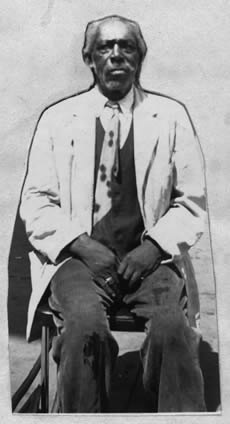
My mammy was Harriet Butler and my pappy was John Butler and we all was raised in Washington-Wilkes.
Mammy was a Frank Collar niggah and her man was of the tribe of Ben Butler, some miles down de road. Et was one of dem trial marriages—they'se tried so hard to see each other but old Ben Butler says two passes a week war enuff to see my mammy on de Collar plantation. When de war was completed pappy came home to us. We wuz a family of ten—four females called Sally, Liza, Ellen and Lottie and six strong bucks called Charlie, Elisha, Marshal, Jack, Heywood and little Johnnie, [TR: 'cuz he war' marked out] de baby.
De Collar plantation wuz big and I don't know de size of it. Et must have been big for dere war [HW: 250] niggahs aching to go to work—I guess they mus' have been aching after de work wuz done. Marse Frank bossed the place hisself—dere war no overseers. We raised cotton, corn, wheat and everything we un's et. Dere war no market to bring de goods to. Marse Frank wuz like a foodal lord of back history as my good for nothing grandson would say—he is the one with book-larning from Atlanta. Waste of time filling up a nigger's head with dat trash—what that boy needs is muscle-ology—jes' look at my head and hands.
My mammy was maid in de Collar's home and she had many fine dresses—some of them were give to her by her missus. Pappy war a field nigger for ole Ben Butler and I worked in the field when I wuz knee high to a grasshopper. We uns et our breakfast while et war dark and we trooped to the fields at sun-up, carrying our lunch wid us. Nothing fancy but jes' good rib-sticking victuals. We come in from the fields at sun-down and dere were a good meal awaiting us in de slave quarters. My good Master give out rations every second Monday and all day Monday wuz taken to separate the wheat from the chaff—that is—I mean the victuals had to be organized to be marched off to de proper depository.
Before we uns et we took care of our mules. I had a mule named George—I know my mule—he was a good mule.
"Yes, I hollow at the mule, and the mule would not gee, this mornin'. Yes, I hollow at the mule, and the mule would not gee. An' I hit him across the head with the single-tree, so soon."
Yes, Boss-man I remembers my mule.
Marse Frank gave mammy four acres of ground to till for herself and us childrens. We raised cotton—yes-sah! one bale of it and lots of garden truck. Our boss-man give us Saturday as a holiday to work our four acres.
All the niggers worked hard—de cotton pickers had to pick 200 pounds of cotton a day and if a nigger didn't, Marse Frank would take de nigger to the barn and beat him with a switch. He would tell de nigger to hollow loud as he could and de nigger would do so. Then the old Mistress would come in and say! "What are you doing Frank?" "Beating a nigger" would be his answer. "You let him alone, he is my nigger" and both Marse Frank and de whipped nigger would come out of the barn. We all loved Marse and the Mistress. No, we wuz never whipped for stealing—we never stole anything in dose days—much.
We sure froliked Saturday nights. Dat wuz our day to howl and we howled. Our gals sure could dance and when we wuz thirsty we had lemonade and whiskey. No sah! we never mixed [HW: no] whiskey with [HW: no] water.—Dem dat wanted lemonade got it—de gals all liked it. Niggers never got drunk those days—we wuz scared of the "Paddle-Rollers." Um-m-h and swell music. A fiddle and a tin can and one nigger would beat his hand on the can and another nigger would beat the strings on the [HW: fiddle] [TR: 'can' marked out.] with broom straws. It wuz almos' like a banjo. I remembers we sung "Little Liza Jane" and "Green Grows the Willow Tree". De frolik broke up in de morning—about two o'clock—and we all scattered to which ever way we wuz going.
We put on clean clothes on Sunday and go to church. We went to de white church. Us niggars sat on one side and de white folks sat on the other. We wuz baptized in de church—de "pool-room" wuz right in de church.
If we went visiting we had to have a pass. If nigger went out without a pass de "Paddle-Rollers" would get him. De white folks were the "Paddle-Rollers" and had masks on their faces. They looked like niggers wid de devil in dere eyes. They used no paddles—nothing but straps—wid de belt buckle fastened on.
Yes sah! I got paddled. Et happened dis way. I'se left home one Thursday to see a gal on the Palmer plantation—five miles away. Some gal! No, I didn't get a pass—de boss was so busy! Everything was fine until my return trip. I wuz two miles out an' three miles to go. There come de "Paddle-Rollers" I wuz not scared—only I couldn't move. They give me thirty licks—I ran the rest of the way home. There was belt buckles all over me. I ate my victuals off de porch railing. Some gal! Um-m-h. Was worth that paddlin' to see that gal—would do it over again to see Mary de next night.
"O Jane! love me lak you useter, O Jane! chew me lak you useter, Ev'y time I figger, my heart gits bigger, Sorry, sorry, can't be yo' piper any mo".
Um-m-mh—Some gal!
We Niggers were a healthy lot. If we wuz really sick Marse Frank would send for Doctor Fielding Ficklin of Washington. If jus' a small cold de nigger would go to de woods and git catnip and roots and sich things. If tummy ache—dere was de Castor oil—de white folks say children cry for it—I done my cryin' afterwards. For sore throat dere was alum. Everybody made their own soap—if hand was burned would use soap as a poultice and place it on hand. Soap was made out of grease, potash and water and boiled in a big iron pot. If yo' cut your finger use kerozene wid a rag around it. Turpentine was for sprains and bad cuts. For constipation use tea made from sheep droppings and if away from home de speed of de feet do not match de speed of this remedy.
No, boss, I'se not superstitious and I'se believe in no signs. I jes' carry a rabbits' foot for luck. But I do believe the screeching of an owl is a sign of death. I found et to be true. I had an Uncle named Haywood. He stayed at my house and was sick for a month but wasn't so bad off. One night uncle had a relapse and dat same night a screech owl come along and sat on de top of de house and he—I mean the owl,—"whooed" three times and next morning uncle got "worser" and at eleven o'clock he died.
I does believe in signs. When de rooster crows in the house it is sign of a stranger coming. If foot itches you is going to walk on strange land. If cow lows at house at night death will be 'round de house in short time. If sweeping out ashes at night dat is bad luck for you is sweeping out your best friend. Remember, your closest friend is your worst enemy.
If you want to go a courtin'—et would take a week or so to get your gal. Sometimes some fool nigger would bring a gal a present—like "pulled-candy" and sich like. I had no time for sich foolishness. You would pop the question to boss man to see if he was willing for you to marry de gal. There was no minister or boss man to marry you—no limitations at all. Boss man would jes say: "Don't forget to bring me a little one or two for next year" De Boss man would fix a cottage for two and dere you was established for life.
"If you want to go a courtin', I sho' you where to go, Right down yonder in de house below, Clothes all dirty an' ain't got no broom, Ole dirty clothes all hangin' in de room. Ask'd me to table, thought I'd take a seat, First thing I saw was big chunk o'meat. Big as my head, hard as a maul, ash-cake, corn bread, bran an' all."
Marse Frank had plenty of visitors to see him and his three gals was excuse for anyone for miles around to come trompin' in. He enterained mostly on Tuesday and Thursday nights. I remembers them nights for what was left over from de feasts the niggers would eat.
Dr. Fielding Ficklen [TR: earlier, 'Ficklin'], Bill Pope, Judge Reese,—General Robert Toombs and Alexander Stephens from Crawfordville—all would come to Marse Franks' big house.
General Robert Toombs lived in Washington and had a big plantation 'bout a mile from de city. He was a farmer and very rich. De General wuz a big man—'bout six feet tall—heavy and had a full face. Always had unlighted cigar in his mouth. He was the first man I saw who smoked ten cent cigars. Niggers used to run to get "the stumps" and the lucky nigger who got the "stump" could even sell it for a dime to the other niggers for after all—wasn't it General Toombs' cigar? The General never wore expensive clothes and always carried a crooked-handled walking stick. I'se never heard him say "niggah", never heard him cuss. He always helped us niggars—gave gave us nickles and dimes at times.
Alexander Stephens wuz crippled. He was a little fellow—slim, dark hair and blue eyes. Always used a rolling chair. Marse Frank would see him at least once a month.
I'se saw a red cloud in de west in 1860. I knew war was brewing. Marse Frank went to war. My uncle was his man and went to war with him—Uncle brought him back after the battle at Gettsburg—wounded. He died later. We all loved him. My mistress and her boys ran de plantation.
The blue-coats came to our place in '62 and 63. They took everythin' that was not red-hot or nailed down. The war made no changes—we did the same work and had plenty to eat. The war was now over. We didn't know we wuz free until a year later. I'se stayed on with Marse Frank's boys for twenty years. I'se did the same work fo $35 to $40 a year with rations thrown in.
I lived so long because I tells no lies, I never spent more than fifty cents for a doctor in my life. I believe in whiskey and that kept me going. And let me tell you—I'se always going to be a nigger till I die.
[HW: Dist. 5 Ex. Slave #13] AN INTERVIEW ON SLAVERY OBTAINED FROM MRS. SARAH BYRD—EX-SLAVE
Mrs. Sarah Byrd claims to be 95 years of age but the first impression one receives when looking at her is that of an old lady who is very active and possessing a sweet clear voice. When she speaks you can easily understand every word and besides this, each thought is well expressed. Often during the interview she would suddenly break out in a merry laugh as if her own thoughts amused her.
Mrs. Sarah Byrd was born in Orange County Virginia the youngest of three children. During the early part of her childhood her family lived in Virginia her mother Judy Newman and father Sam Goodan each belonging to a different master. Later on the family became separated the father was sold to a family in East Tennessee and the mother and children were bought by Doctor Byrd in Augusta, Georgia. Here Mrs. Byrd remarked "Chile in them days so many families were broke up and some went one way and der others went t'other way; and you nebber seed them no more. Virginia wuz a reg'lar slave market."
Dr. Byrd owned a large plantation and raised such products as peas potatoes, cotton corn (etc). There were a large number of slaves. Mrs. Byrd was unable to give the exact number but remarked. "Oh Lordy Chile I nebber could tell just how many slaves that man had t'wuz too many uv em."
The size of the plantation required that the slaves be classified according to the kind of work each was supposed to do. There were the "cotton pickers", the "plow hands," the "hoe hands," the "rail splitters," etc. "My very fust job," remarked Mrs. Byrd, "wuz that uv cotton picking." Mrs Byrd's mother was a full [TR: field?] hand.
Houses on the Byrd Plantation were made of logs and the cracks were daubed with mud. The chimnies were made of mud and supported by sticks.
Each fireplace varied in length from 3 to 4 feet because they serve the purpose of stoves; and the family meals were prepared in those large fireplaces often two and three pots were suspended from a rod running across the fireplace. Most of the log houses consisted of one room; however if the family was very large two rooms were built. The furnishings consisted only of a home-made table, benches, and a home-made bed, the mattress of which was formed by running ropes from side to side forming a framework. Mattresses were made by filling a tick with wheatstraw. The straw was changed each season. Laughing Mrs. Byrd remarked, "Yessirree, them houses wuz warmer than some are ter day."
Doctor Byrd was rather kind and tried to help his slaves as much as possible, but according to Mrs. Byrd his wife was very mean and often punished her slaves without any cause. She never gave them anything but the coarsest foods. Although there of plenty of milk and butter, she only gave it to the families after it had soured. "Many a day I have seed butter just sittin around in pans day after day till it got good and spoiled then she would call some uv us and give it ter us. Oh she wuz a mean un," remarked Mrs. Byrd. Continuing Mrs. Byrd remarked "she would give us bread that had been cooked a week." Mr. Byrd gave his slave families good clothes. Twice a year clothing was distributed among his families. Every June summer clothes were given and every October winter clothes were given. Here Mrs. Byrd remarked "I nebber knowed what it wuz not ter have a good pair uv shoes." Cloth for the dresses and shirts was spun on the plantation by the slaves.
The treatment of the slaves is told in Mrs. Byrd's own words:
"We wuz always treated nice by Master Byrd and he always tried ter save us punishment at the hands uv his wife but that 'oman wuz somethin' nother. I nebber will ferget once she sent me after some brush broom and told me ter hurry back. Well plums wuz jest gitting ripe so I just took my time and et all the plums I wanted after that I come on back ter the house. When I got there she called me upstairs, 'Sarah come here.' Up the steps I went and thar she stood with that old cow hide. She struck me three licks and I lost my balance and tumbled backward down the stairs. I don't know how come I didn't hurt myself but the Lord wuz wid me and I got up and flew. I could hear her just hollering 'Come back here! come back here!' but I ant stop fer nothing. That night at supper while I wuz fanning the flies from the table she sed ter the doctor. 'Doctor what you think? I had ter whip that little devil ter day. I sent her after brush broom and she went off and eat plums instead of hurrying back.' The doctor just looked at her and rolled his eyes but never sed a word. There wuz very little whipping on Byrd's plantation, but I have gone ter bed many a night and heard 'em gittin whipped on the plantation next ter us. If dey runned away they would put the hounds on 'em." Concluding her story on treatmeant Mrs. Byrd remarked "Yessirree I could tell that 'oman wuz mean the first time I seed her after we came from Virginia cause she had red eyes." "Pader rollers" stayed busy all the time trying to find slaves off their plantations without passes. Marriages were performed by having the couple jump the broom. If the [TR: 'couple' deleted, handwritten words above illegible] belonged to different masters oftentimes one master would purchase the other; but should neither wish to sell the man would then have to get passes to visit his wife on her plantation. "Dey would leave the plantation on Saturday afternoons and on Sunday afternoon you could see 'em coming in just lak they wuz coming from church," remarked Mrs. Byrd.
There were frolics on the Byrd plantation any time that the slaves chose to have them. "Yes sir we could frolic all we want ter. I use ter be so glad when Saturday night came cause I knowed us wuz go have a frolic and I wouldn't have a bit 'uv appetite I would tell my ma we gwine dance ter night I dont want nothin teet. Yes sir us would frolic all night long sometimes when the sun rise on Sunday morning us would all be layin round or settin on the floor. They made music on the banjo, by knocking bones, and blowing quills."
The Byrds did not provide a church on their plantation for their slaves neither were they allowed to attend the white church; instead they had prayer meetings in their own cabins where they could sing pray and shout as much as they wished. "I nebber will fergit the last prayer meeting us had," remarked Mrs. Byrd. "Two woman named Ant Patsy and Ant Prudence came over from the next plantation. I believed they slipped over there wid out gittin a pass. Anyway, they old master came there and whipped 'em and made 'em go home. I reckin he thought us wuz praying ter git free." Continuing—
I nebber will fergit the fust time I set eyes on them thar Yankees. I done already heard 'bout how they wuz going round ter the different plantations taking the horses and carrying away the money and other valuable things, but they had nebber come ter our place. So this day I saw 'em coming cross the railroad track and they look jest lack thunder there wuz so meny 'uv em. When they got ter our house every body wuz sleep and they knocked and knocked. We had a bad dog that didn't take no foolishness off nobody, so when he kept barking them Yankees cursed him and do you know he heshed up? I sid, 'Dear Lord what sort of man is that all he got ter do is curse that dog and he don't even growl.' Well, when they finally got in all they wanted wuz ter know if Mr. Byrd could help feed the soldiers until Monday. Mr. Byrd told 'em he would. Soon after that the war ended and we wuz called ter gether and told us wuz free. Some uv'em stayed there and some uv'em left. Us left and moved ter another plantation."
Mrs. Byrd who had previously given the writer an interview on folk-lore asked the writer to return at a later date and she would try to think up more information concerning superstitions, conjure, etc. The writer thanked her for the interview and promised to make another visit soon.
Ex-Slave #18 INTERVIEW WITH (MRS.) MARIAH CALLAWAY EX-SLAVE
[TR: A significant portion of this interview was repeated in typescript; where there was a discrepancy, the clearer version was used. Where a completely different word was substituted, 'the original' refers to the typewritten page.]
Mrs. Mariah Callaway sat in a chair opposite the writer and told her freely of the incidents of slavery as she remembered them. To a casual observer it will come as a surprise to know the woman was blind. She is quite old, but her thoughts were clearly and intelligently related to the writer.
Mrs. Callaway was born in Washington, Wilkes County, Georgia probably during the year 1852, as she estimated her age to be around 12 or 13 years when freedom was declared. She does not remember her mother and father, as her mother died the second day after she was born, so the job of rearing her and a small brother fell on her grandmother, Mariah Willis, for whom she was named. Mrs. Callaway stated that the old master, Jim Willis, kept every Negro's age in a Bible: but after he died the Bible was placed upstairs in the gallery and most of the pages were destroyed. The following is a story of the purchase of Mrs. Callaway's grandfather as related by her.
"My grandfather come directly from Africa and I never shall forget the story he told us of how he and other natives were fooled on board a ship by the white slave traders using red handkerchiefs as enticement. When they reached America, droves of them were put on the block and sold to people all over the United States.
The master and mistress of their plantation were Mr. Jim Willis and Mrs. Nancy Willis who owned hundreds of acres of land and a large number of slaves. Mrs. Callaway was unable to give an exact number but stated the Willises were considered wealthy people. On their plantation were raised sheep, goats, mules, horses, cows, etc. Cotton, corn and vegetables were also raised. The Willis family was a large one consisting of six children. 4 boys and 2 girls. Their home was a large two-story frame house which was set apart from the slave quarters.
Slave homes on the Willis plantation differed in no respect from the usual type found elsewhere. All homes were simple log cabins grouped together, forming what is known as slave quarters.
The Willis family as kind and religious and saw to it that their slaves were given plenty of food to eat. Every Monday night each family was given its share of food for the week. Each grown person was given a peck of corn [TR: meal on original page] and three pounds of meat; besides the vegetables, etc. On Tuesday morning each family was given an ample amount of real flour for biscuits.
Many of the slave families, especially Mrs. Callaway's family, were given the privilege of earning money by selling different products. "My grandfather owned a cotton patch," remarked Mrs. Callaway, "and the master would loan him a mule so he could plow it at night. Two boys would each hold a light for him to work by. He preferred working at night to working on his holidays. My master had a friend in Augusta, Ga., by the name of Steve Heard and just before my grandfather got ready to sell his cotton, the master would write Mr. Heard and tell him that he was sending cotton by Sam and wanted his sold and a receipt returned to him. He also advised him to give all the money received to Sam. When grandfather returned he would be loaded down with sugar, cheese, tea, mackerel, etc. for his family."
When the women came home from the fields they had to spin 7 cuts, so many before supper and so many after supper. A group of women were then selected to weave the cuts of thread into cloth. Dyes were made from red shoe berries and later used to dye this cloth different colors. All slaves received clothing twice a year, spring and winter. Mr. Jim Willis was known for his kindness to his slaves and saw to it that they were kept supplied with Sunday clothes and shoes as well as work clothing. A colored shoemaker was required to keep the plantation supplied with shoes; and everyone was given a pair of Sunday shoes which they kept shined with a mixture of egg white and soot.
The size of the Willis Plantation and the various crops and cattle raised required many different types of work. There were the plow hands, the hoe hands, etc. Each worker had a required amount of work to complete each day and an overseer was hired by slave owners to keep check on this phase of the work. "We often waited until the overseer got behind a hill, and then we would lay down our hoe and call on God to free us, my grandfather told me," remarked Mrs. Callaway. "However, I was a pet in the Willis household and did not have any work to do except play with the small children. I was required to keep their hands and faces clean. Sometimes I brought in chips to make the fires. We often kept so much noise playing in the upstairs bedroom that the master would call to us and ask that we keep quiet." Older women on the plantation acted as nurses for all the small children and babies while their parents worked in the fields. The mistress would keep a sharp eye on the children also to see that they were well cared for. A slave's life was very valuable to their owners.
Punishment was seldom necessary on the Willis plantation as the master and mistress did everything possible to make their slaves happy; and to a certain extent indulged them. They were given whisky liberally from their master's still; and other choice food on special occasions. "I remember once," remarked Mrs. Callaway, "my aunt Rachel burned the biscuits and the young master said to her, "Rachel, you nursed me and I promised not to ever whip you, so don't worry about burning the bread." My mistress was very fond of me, too, and gave me some of everything that she gave her own children, tea cakes, apples, etc. She often told me that she was my mother and was supposed to look after me. In spite of the kindness of the Willis family there were some slaves who were unruly; so the master built a house off to itself and called it the Willis jail. Here he would keep those whom he had to punish. I have known some slaves to run away on other plantations and the hounds would bite plugs out of their legs."
The Willis family did not object to girls and boys courting. There were large trees, and often in the evenings the boys from other plantations would come over to see the girls on the Willis plantation. They would stand in groups around the trees, laughing and talking. If the courtship reached the point of marriage a real marriage ceremony was performed from the Bible and the man was given a pass to visit his wife weekly. Following a marriage a frolic took place and the mistress saw to it that everyone was served nice foods for the occasion.
Frolics were common occurrences on the Willis plantation, also quilting parties. Good foods consisting of pies, cakes, chicken, brandied peaches, etc. "Dancing was always to be expected by anyone attending them," remarked Mrs. Callaway. "Our master always kept two to three hundred gallons of whisky and didn't mind his slaves drinking. I can remember my master taking his sweetened dram every morning, and often he gave me some in a tumbler. On Christmas Day big dinners were given for all of the slaves and a few ate from the family's table after they had finished their dinner."