Chapter V · THE BERNESE OBERLAND FROM END TO END (continued 2)
Reading edition
“Here we at last discovered genuine winter. Above, on the glaciers, all had been warmth, colour, and light. Here in this grim gorge all was sombre, grey, and chill. The hospice seemed to breathe a feeble defiance to the genius of this abode of frost. Never have I seen anything more desolate than the deserted post-road, gagged with old avalanche tracks and overhung with icicles. Below, the angry gash of the torrent peered out between cakes of ice, whilst above the waning light revealed sombre bosses of grey rock smothered in snow.
“We were anxious to telephone, so I took one of the guides and made all speed down the road. Some one had conveniently made tracks, which had iced during the night and afforded some furious running. At last, at 6 p.m., twelve hours after leaving the hut, we pulled up at Guttannen. Here we telephoned to Beatenberg and Kandersteg and then went in search of night quarters. The hotel was, of course, closed, but we found rooms for the night in an adjoining chalet and were afforded one of those sidelights on real Swiss life which the summer visitor so rarely sees.
“We supped in the one room which was warmed, and here the family were pursuing their various occupations. The patriarch was mumbling in the corner over his pipe, attracting, like the majority of patriarchs, little attention. The father, a guide in summer, chatted on the winter’s work. He appeared to think that cutting the wood and bearing it towards the valley left a man little time to grow fat. At the table a young girl was plying—alas!—not the spinning-wheel of a previous generation, but an unromantic ‘Singer.’ In front of her stood some dressmaker’s model, a hideous, headless monstrosity on a wire cage. On the stove a small youth slept contentedly. To him entered a bustling little damsel with the maternal instinct precociously developed. With unsuspected tenderness she gently lifted him up, still sleeping, bore him out of the room, and attacked ‘with an undaunted tread the long black passage up to bed.’
“Supper over, we lit our pipes with pardonable satisfaction. Our long journey had been carried through without a hitch. Perfect weather, thorough arrangements, every precaution. Seriously, one can scarcely be too careful in winter mountaineering. With every precaution, the entire complexion of things may be altered in one moment. A broken ski, a wrenched ankle, the work of a minute, and the situation becomes charged with painful anxiety. With superb indifference the mountains suffer us for ninety-nine days, and, perhaps on the hundredth—with equal indifference—they strike.
“Friday, January 8th.—Up once more before the dawn, to discover signs of bad weather, which had thoughtfully postponed its arrival till we had left the upper snows. One day earlier and we should have been cooped up in the Finsteraarhorn hut for four days, living on stale bread and tinned meat. A sleigh was hired to drive us to Meiringen, but I was anxious to finish the journey on ski, so, with unpardonable sophistry, I ‘tailed’ behind the sleigh. This proved far from easy on the icy, winding road.
“At last, six days and six hours after leaving Kandersteg, five happy men stepped on to the Meiringen platform. On lake Brienz the sky was veiled in dark, lowering clouds, and snow fell as we drove up to Beatenberg. On arriving, we were plied with those questions which a certain type of people offer as well-meant flattery: ‘Was it not too cold?’ ‘Wasn’t it too, too awfully dangerous?’ We could have accepted the heroic rôle with greater equanimity, had we failed to realise that any one with decent endurance and a fair knowledge of ski-ing could have accompanied us without risk.”
To give satisfaction to so many kind inquiries, I gave two days later my first lecture before a more than crowded audience, and Arnold Lunn supplemented it. The joint address is the common foundation of anything we have since written on the subject.
Let me now wind up with a few final remarks.
1. Winter mountaineering may be more difficult and more dangerous than summer climbing. One often has to face the most intense cold; but with first-class conditions such as we enjoyed, it is scarcely more arduous, and certainly much more enjoyable, than summer work. Our journey in summer would have involved hours of walking through damp, slushy snow. There would have been wearisome tramps up and down moraines, tedious stretches of mule paths, dull grinds over grass slopes, and I shudder to think—consider the mileage!—what the last day would have meant in July. As it was, we at no time suffered from the cold, and, strangely enough, though our days were long and mostly uphill, in point of time at least, we neither of us ever felt tired. This was, to be sure, owing to good ski technique. “The professor would never allow us to raise our ski off the surface of the snow. In that way they were absolutely no weight, and even the raising of the foot and leg was replaced by the glide upwards of the ski blade which provided a resting-point and support, reducing the muscular action to the same amount of forward movement as is necessary on level ground, without any additional force being employed in vertical action.”
Given good weather and normal conditions, a six-day traverse can be accomplished with very little fatigue and still less privation. I have done four such and have never been any the worse. One may weary somewhat of soup, bread and cheese, but barring these and similar drawbacks, there is no reason why any one of moderate physique and fair ski-ing powers should not follow in our steps.
Somehow the memories of those six days have the power to impart something of the magical colourings of a winter sunset to the drab dullness of lowland evenings. On the mountains we all have moments when life assumes unsuspected values, helping us to realise on our return to civilisation, that the things that are seen are temporal, whereas the things which for the time are not seen are for all practical purposes eternal. “The winter Alps are but a vision, a faint memory intruding itself at intervals when the roar of the commonplace is for a moment hushed in silence. If visions were not at times the most solid of realities this world would be intolerable.”
“Just for a moment I have had a fleeting vision,” wrote Lunn, when he had once more settled down to the round of daily life, “of the silent snows of the Aletsch, as you and I saw them that glad evening on the Loetschenlücke, lit in all the splendour of the January moon. It faded all too soon, and the winter Alps again seem very far away.”
2. I append a table of levels, in feet, similar to the table of my vertical displacements, in metres, which the reader has found at the end of the Diablerets to Kandersteg chapter:—
January 2nd.—Kandersteg to Mutthorn hut: 5,700 feet (Tschingel pass).
January 3rd.—Mutthorn hut to Petersgrat (our second pass): 1,000 feet.
January 4th.—From Kippel to Egon von Steiger hut (Loetschen pass): 6,000 feet.
January 5th.—From Concordia Platz to Grünhornlücke (our fourth pass): 2,000 feet.
January 6th.—From Fieschfirn to Finsteraarhorn: 5,000 feet.
January 7th.—From Fieschfirn to Oberaarjoch (fifth pass): 2,000 feet.
Add 2,000 feet for unconsidered trifles. The total vertical displacement is thus brought out at a little under 24,000 feet.
We paid each of our men a pound a day. Other expenses brought the cost to thirty pounds. It is better to have plenty of men and plenty of food. Plenty of food because one is always liable to be detained some days in the huts by the bad weather—plenty of men, which does not necessarily mean guides, because a party that can be broken up into sections is infinitely safer and handier. A party of six may be expressed by 2 + 2 + 2, or by 3 + 3, or by 4 + 2, dispositions which may fit into almost every emergency.
There is no doubt that sealskins are extremely convenient and a great saving of labour in going uphill, because they annihilate back-slip, the bugbear of beginners and of loaded men. Serious trouble may be caused by wrinkled and puckered-up hard snow, or by those extremely slippery patches, either snow or ice, which now and then upset the balance of the High Alp runner.
The remedy to this I have found in a contrivance against side-slip which figures as a permanent fixture on the powerful pair of military ski which I used on all my big traverses. It consists of two blades of hardish steel, about 5 inches long, sharpened and shaped in the fashion of skates. Linked to each other across the upper surface of my ski, they adhere to the sides by lateral pressure only, which is applied by means of a top screw. The edge of each blade stands out beyond the flat of the ski by the merest fraction of an inch, in front of one, and behind the other, foot. This secures straight running on hard snow and ice by biting into it, preventing side-slip when the broadside of the ski slew’s round to the drop of the slope. The laws of mechanics teach that this contrivance, maintained against the ski by side-pressure only, should get pushed out of place when, the ski being edged, an unduly large portion of the weight of the runner falls to be borne by the ski edge. But, in practice, it is not so, provided you are careful to obtain the maximum of side-pressure that the horizontal binding screw can produce.
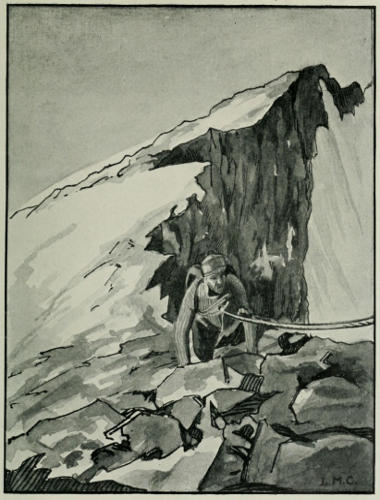
ADOLF ON THE FINSTERAARHORN ARÊTE.
To face p. 178.
Studs on the inside of the blade, making impressions upon the wood of the ski, without injuring it in any way, increase the resistance of this contrivance to the vertical pressure caused by the weight of the runner.
3. Within a few years from the date of writing, this part of the Alps will be girdled by a network of mountain railways. The Grindelwald-Jungfrau railway, already completed to the Jungfraujoch (11,000 feet), will deposit the ski-runner within a stone’s throw of the Concordia Platz. There he will, as the phrase goes, have it all his own way, with the resources of civilisation and a railway station to fall back upon.
The line of the Loetschberg, on the international railway, now being built to join Berne to Brigue, should be open to traffic by the end of 1913. It will then take but a few moments to run there and back, underground, between Kandersteg and Goppenstein in the Loetschenthal, joining together both ends of the ski route Kandersteg—Gastern—Mutthorn—Petersgrat (or Loetschberg)—Kippel—Goppenstein.
To the east, a line now under construction from Brigue, with a tunnel under the Furka pass to Andermatt, will connect the St. Gothard ski-ing grounds with those we have just described.
Skiers running down the Aletsch will be able to take train at Moerel or Fiesch. These coming facilities are not altogether pleasant to contemplate for those who hold the traditional ideas about the virginity and sanctity of the Alpine Holy of Holies; but to the extent in which it may be possible to work those lines in winter—and to this there is no insuperable physical obstacle—they will greatly contribute to the generalising of ski, and thereby confer inestimable benefits upon young people in Europe, while reducing to the minimum consistent with the zest of manly enjoyment those risks which are the haunting terror of the parents, sisters, and wives of the adventurous winter sportsman.