CHAPTER SECOND
Reading edition
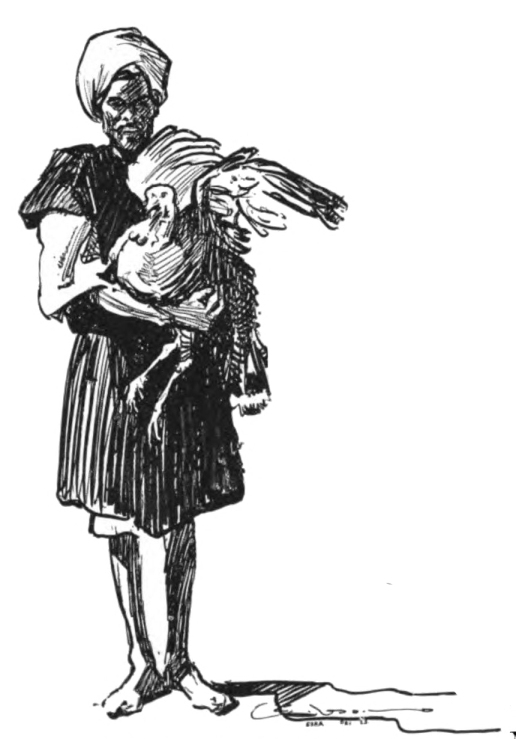
Our Christmas Dinner, Esneh, December 23.
SOME Egypt-bound tourists decide to go up the Nile before they buy their tickets at the company’s office in Bowling Green. Others, if they are good sailors, make up their minds before they reach Naples. Some are ill all the way to Port Saïd, and don’t cave. But most travelers are pretty sure to decide one way or the other soon after Mount Etna has been left behind, for the East begins for most people from that moment. If the guide-books fail to persuade you, there is pretty sure to be a fellow-passenger who will. The man who has once seen Upper Egypt does his best to make you dissatisfied with Lower Egypt. He can easily show you that your journey’s end is not Cairo, but, at the very least, the first cataract. This is the shortest distance he will listen to. And after he has your promise to go that far, he tells you of the wonders that can only be seen by going on to the second cataract.
My fellow-passenger was an old traveler. Others besides myself fell under the spell of his eloquence; so, before we had been at Shepheard’s a week, we were a party of six, with the steam-dahabiyeh Nitocris chartered for a month, beginning December 12. There were growing plants, rugs, and a piano on her deck, and six state-rooms below. Salem Ghesiri was our dragoman. He spoke
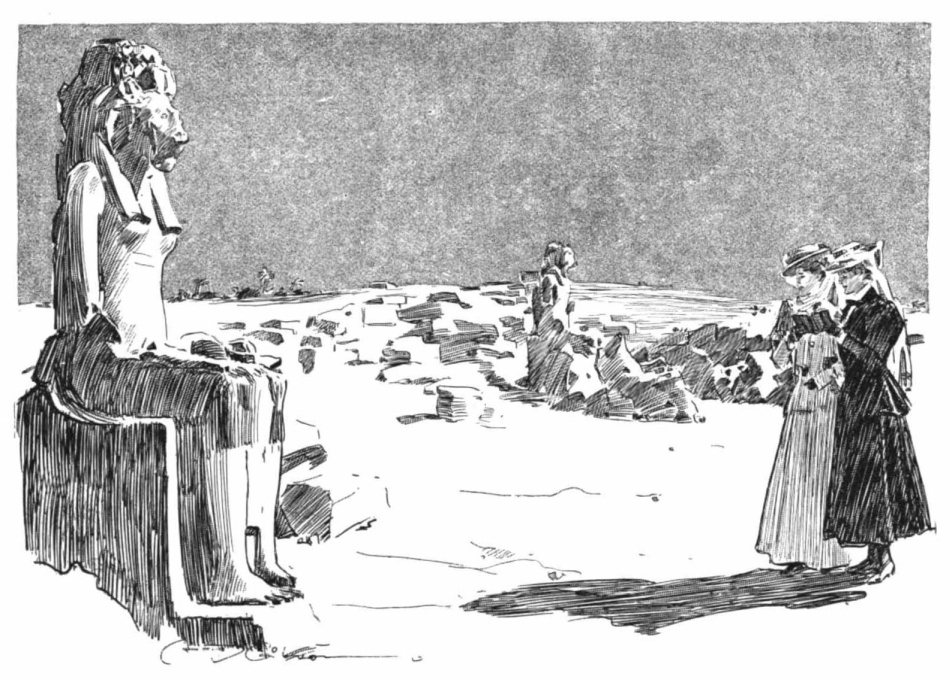
Karnak, January 2, 1898.
good English, and knew the river by heart. Before we left, a few days were spent in buying cork hats and sun umbrellas, and by ten o’clock on the morning of the 12th the crew had unloaded the trucks that had brought our belongings down from Shepheard’s, and we had started, with the wind and the current so strong against us that it was all we could do to make six miles an hour against them.
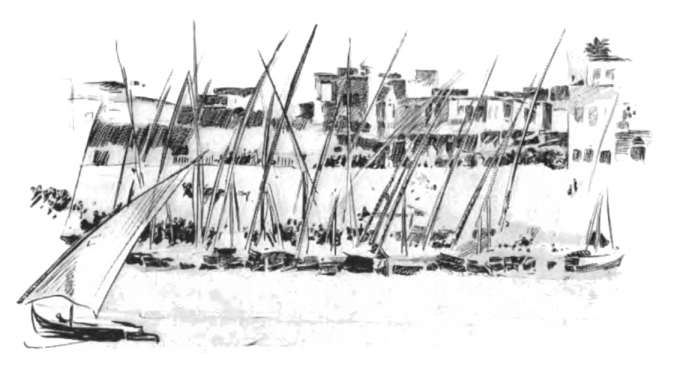
On our left were the mud houses of Old Cairo, with ancient quarries in the distance, and on the right, far beyond a forest of slanting masts that belonged to the picturesque ships which lined the bank, were the tops of the pyramids that we were leaving for a month. As evening approached, the
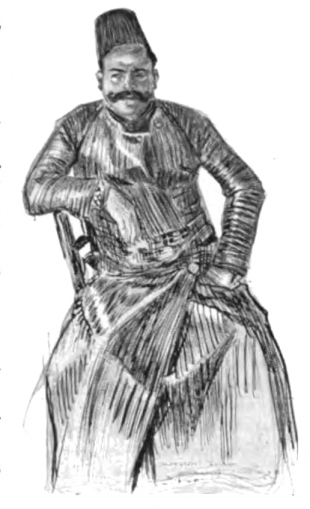
Salem Ghesiri Dragoman.
right bank seemed peopled with silhouettes of camels, donkeys, and men, while the figures on the opposite bank were rose-color. To us the day was cool, but to the crew it must have been cold, for their heads were wrapped in shawls and they huddled together in groups about the deck. The awning over us had been removed, and Ali, the pilot, looked like a partly unwrapped mummy as he sat at the wheel.
Those who go up the river in a dahabiyeh like to feel that they are in the same boat with the travelers whose books they read from New York to Port Saïd. This would be a very pleasant feeling, if it did not suggest the responsibility of keeping a record of days that, from all accounts, are sure to be of so much importance. There is a
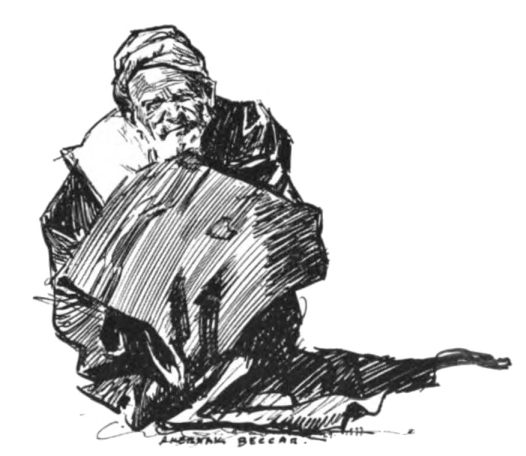
A Karnak Beggar.
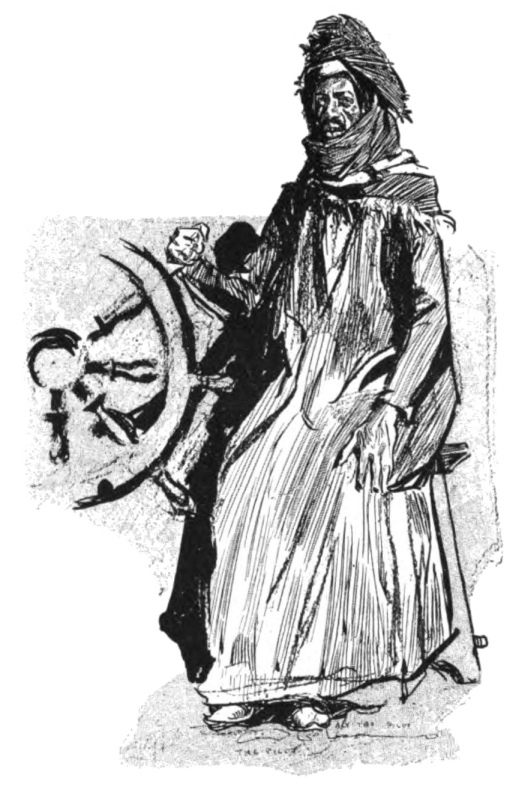
All, the Pilot.
sentimental belief that each day on the river is to be of the greatest importance, just as if thousands of tourists on Cook’s steamers were not taking the same journey each year. So overpowering becomes this delusion that even letters home seem to take the form of historic biographies, and sound like messages that are sometimes found floating in bottles thrown overboard by shipwrecked people. The Nile itself seems to insist that all mention of it should be made in the form of a diary, for, with very few exceptions, all accounts adopt that mode of expression when they come to it. Cairo and
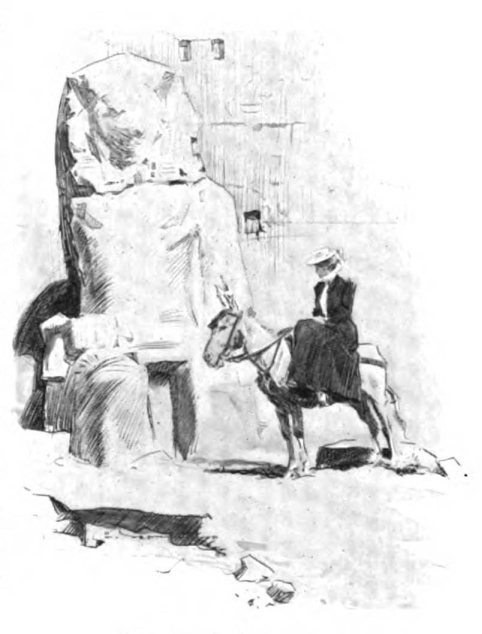
Statue of Thothmes, Karnak.
Upper Egypt may be treated in the form of essays, but the endless parallel banks of the river immediately suggest that all days will be very much alike and lose their identity, unless they are numbered and described. It seems to be of the greatest importance to find the best way to spell the name of the mud village where you tie up for the night (which name most of the guide-books spell differently)—as if it made any difference to the people at home.
But the diaries on the Nitocris during that month were very conscientious and particular about these small things, and I think they will all agree in their spelling, for each one of us waited until all the others had agreed upon the most popular way to spell the names of these various landmarks before we wrote them down.
We soon made friends with our crew. There were sixteen of them. They were
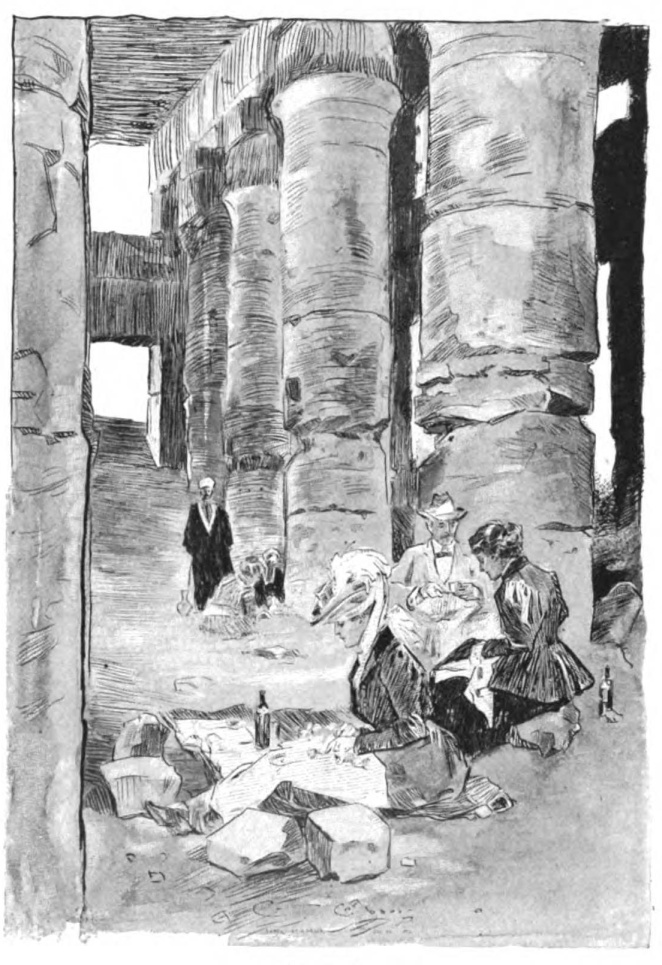
Lunching in Karnak.
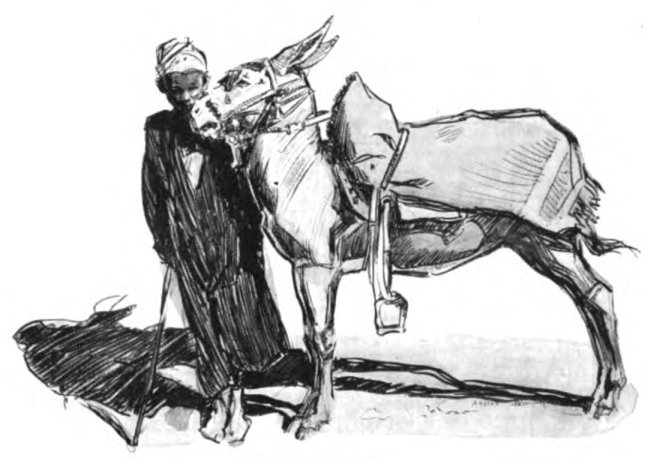
An Assiût Donkey.
from every part of Egypt, and of all colors, shading from the engineer, who was a cream-colored Turk,—when his face was washed,—to Ali, who must have been a Sudanese. Our head steward was almost as black, and the second steward was another of the cream-colored variety. We seldom saw the cook. Sometimes he would put his head and shoulders out of the hatchway, with his arms on the deck, and then we could see that he was a little, white-faced Turk with a large black mustache.
Salem was a Syrian Christian, and he had lost all his earnings in an unprofitable exhibit at the World’s Fair in Chicago. His costumes were always elaborate, and he was very ornamental, with his silk sashes and fancy turbans. He superintended our meals, and always suggested the next day’s program during dinner; so with our coffee we would read aloud Charles Dudley Warner’s and Miss Edwards’s opinions of our next stopping-place.
After our first dinner we tied to the bank, by a little village, Salem said, just big enough to have a name. It was-dark, and we could hear and see nothing; so we took his word for it.
We were off early the next morning, and all that day the river’s banks were fringed with sugar-cane and sakiehs. The many boats we passed were loaded with natives, sometimes perched upon loads of grain, or mixed in with turkeys and cattle.
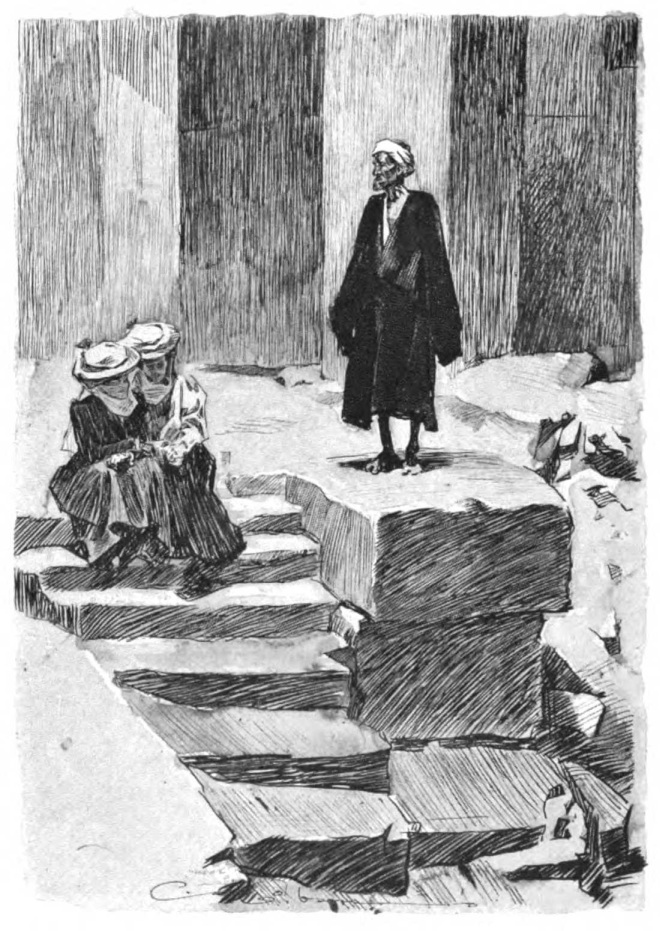
Temple of Ti.
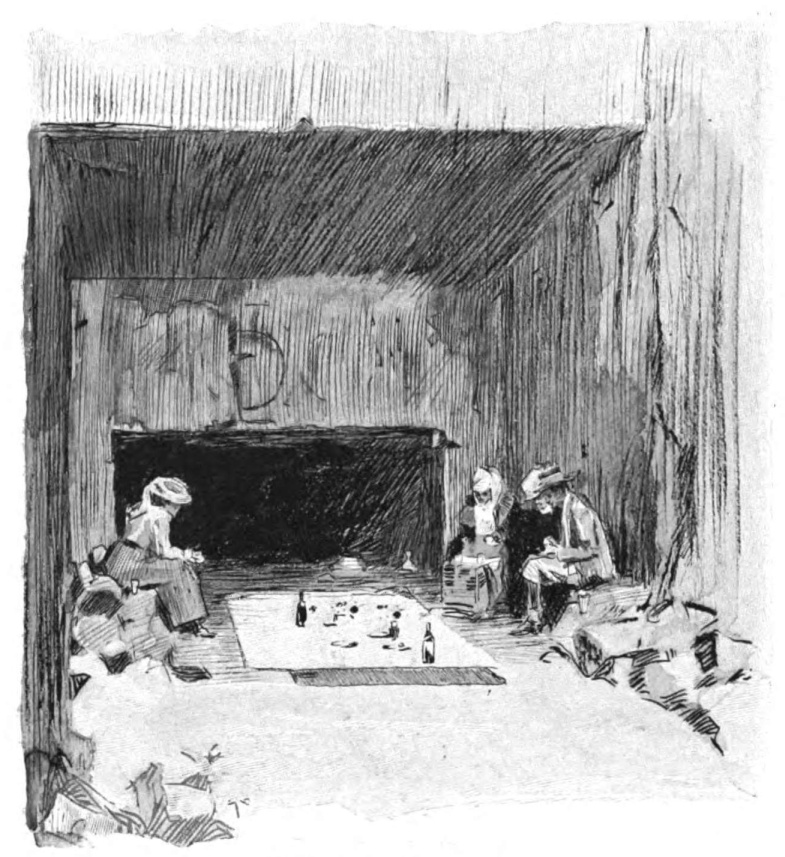
Tombs of the Kings, Thebes.
On December 14 we made our first landing, and had our first donkey ride, at Beni-Hassan, one hundred and seventy-one miles from Cairo. The Egyptian policemen who accompanied us to the tombs were out of keeping with the peaceful look of the place, and only succeeded in keeping at a distance the children, who were very pretty.
From the cliffs back of the village we had our first view of the valley of the Nile, with its delicate green fields, beginning immediately at the foot of the sun-baked hills on which we stood. I rode back before the rest to make a sketch; but the arrival of the post-boat put an end to that, and its passengers soon had our donkeys, beggars, naked children, policemen, and all, and were taking them back to
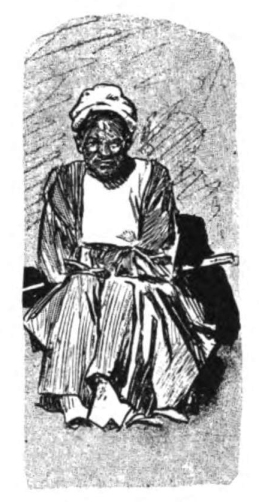
A Guardian of the Temple.
the tombs we had just left. The post-boat was to us what the foot-prints in the sand must have been to Robinson Crusoe. Our frame of mind underwent a change. We finally became reconciled to the fact that we were not doing anything uncommon, and from that moment our diaries suffered. Then the most contagious of all Nile ambitions seized us, and our one desire was to find a mummy.
Most of the 15th was spent with Baedeker, preparing for Assiût, where we were to tie up for the night.
After an early breakfast, we climbed the bank, and found that it was chiefly inhabited by beggars. We visited the tombs, and came back to the dahabiyeh by way of the bazaars, where the natives were dyeing the dark-blue cloth which they all dress in. That afternoon we came upon an army of pelicans on a mud flat in the middle of the river. At the sound of our whistle they got up, and we
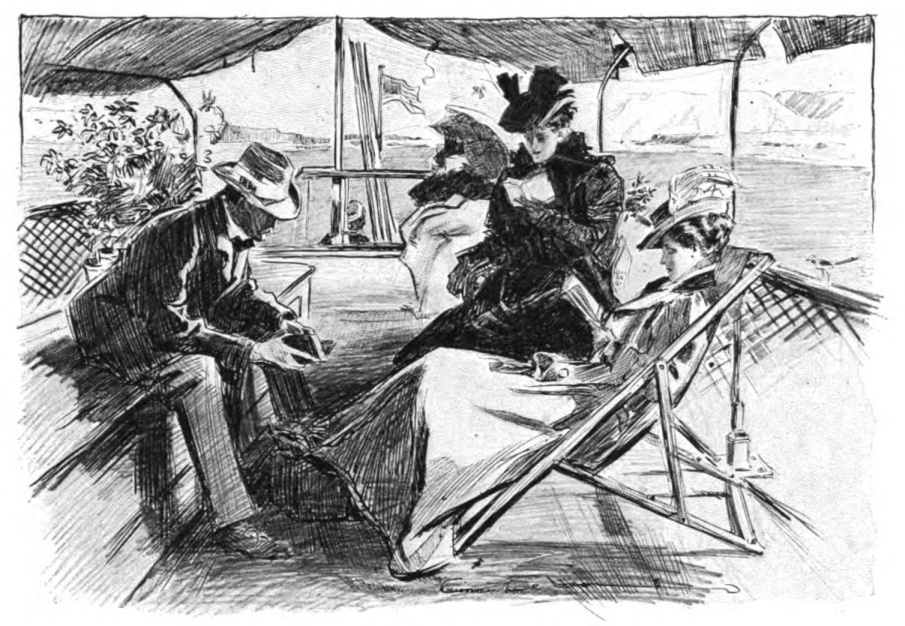
“Most of the day was spent with Baedeker.”
lost them far ahead in the twilight, and we thought of that tame pelican that waddles about in Shepheard’s stable-yard.
The next day we went by mud villages at the foot of high mountains of white limestone, until we stopped at Farshut for coal, and tried to awaken some sign of friendliness in the natives, who were as dull as the mud banks on which they sat.
On the afternoon of the 18th we reached Keneh, and in fifteen minutes we were on donkeys, going by villages filled with children and barking dogs, on our way to the temple of Dendera. This was to be our first big temple, and Salem had made it his chief excuse for hurrying us away from Beni-Hassan, Assiût, and the rest. Our donkeys raced along the edge of an empty canal, through herds of goats and buffalo, until we saw a low pile of stones in the distance, and then we reached the half-buried temple, and lighted candles, and went down into it and looked up at the mighty columns. Salem repeated all that the guide-books knew, and then took us around to the back wall and showed us the famous likeness of Cleopatra and her son Cæsarion.
Salem was pleased with the way we took our first temple, and rewarded us by saying it was only the beginning of what was to come. We complimented him on his choice of subjects, blew out our candles, picked the candle-grease from our fingers, and reached the dahabiyeh by sundown.
By one o’clock, on December 19, we were abreast of the promised Karnak, and could see the top of its pylons and obelisk. We had saved most of our enthusiasm for this place, and we were anxious to get ashore and expend it; reluctantly we went by it a few miles to Luxor for a better landing, where we were watched by a bank-load of natives until four o’clock. Then we walked through them to the village and temple of Luxor, which
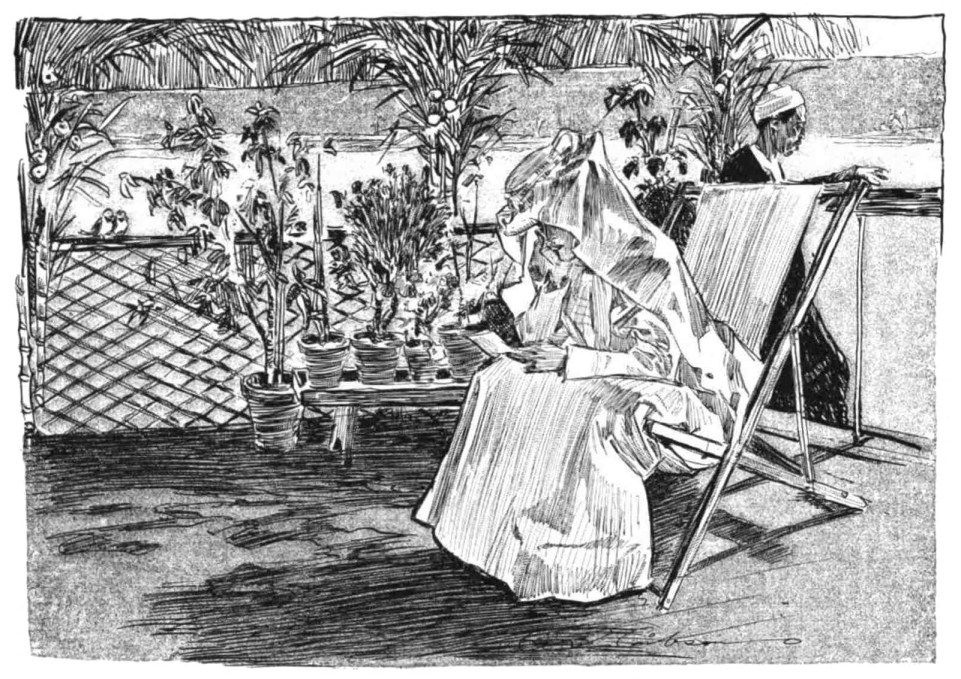
Christmas, 1897.
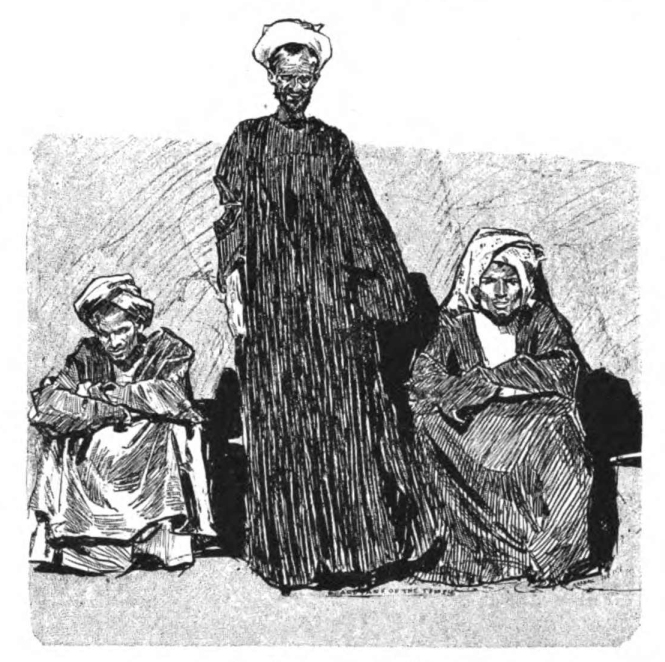
Guardians of the Temple.
served as a curtain-raiser to the next day’s visit to the greatest of all temples.
That evening a Cook’s steamer arrived, and we were deserted by the crowd on the bank. After dinner Ghesiri entertained the sheiks of the donkey-boys and made arrangements for our mounts for the next day. Two of us volunteered to go to the village and locate the dancing that the guide-books said could be found here, but we learned there was to be none until the following Saturday.
The next day was spent at Karnak, where Ghesiri led us over its famous stones, until lunch was brought from the Nitocris, and served in a colonnade surrounded by columns resembling huge granite lozenges, piled at all angles, one on top of the other, like ancient friends, those who had fought successfully with time supporting those who had been less fortunate; and apart from the rest, requiring no support, and with no friends to be helped, stood the greatest column of them all, the lonely survivor of the great peristyle court, with its lotus capital, looking down on all but its lonely rival, an obelisk. It looks as though it had been polished and placed there the day before, in striking contrast to its unfortunate mate, which centuries ago gave up battling with earthquakes and wars, and now lies, a hopeless ruin, at its feet.
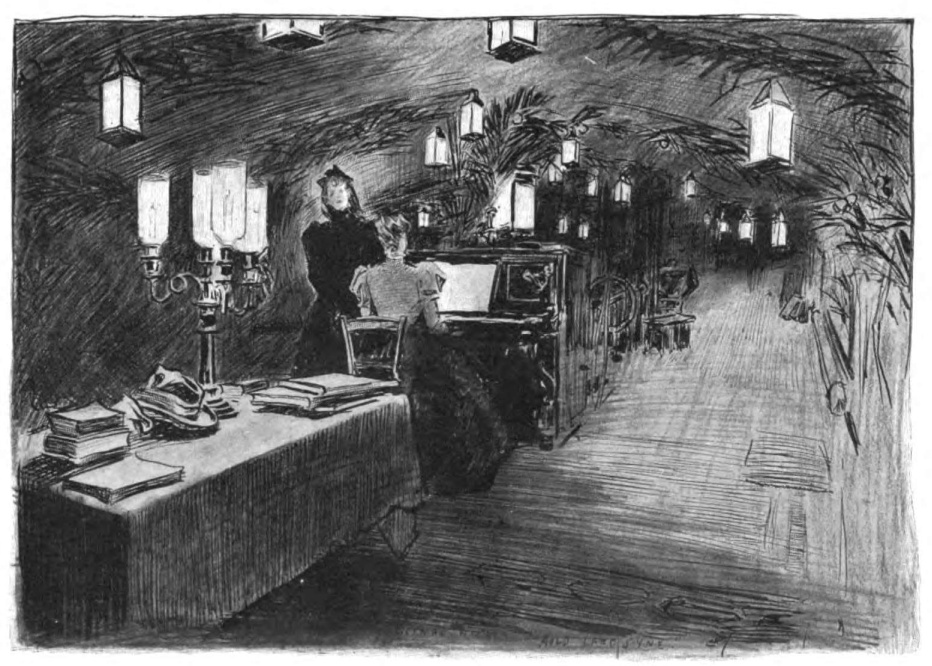
Christmas Night—“Auld Lang Syne.”
We spent the next three days at Karnak and Thebes, saving the tombs of the kings until we should stop again on our way down from Assuan.
And now the important question was, Where should we spend Christinas? The better we knew Karnak and Thebes, the more forbidding they had grown. They were too stiff and formal, and their great rigid Rameses too depressing for a Christmas. We wanted a cheerful temple, and we found it at Komombos.
We left Karnak on the morning of December 24, and spent Christmas eve at Edfu. That night the deck was entirely housed in by canvas. The crew sat in a circle back of the smoke-stack, and while they divided the cigarettes we had bought for them at Luxor, they listened to our “Down upon the Suwanee River.”
Christmas morning we came on deck, and found that Ghesiri had transformed it into a bower of palm-branches, sugar-cane, and oranges. The crew were all smiles, and when we presented them with the price of a sheep, they gave us three cheers and a merry Christmas. More cigarettes were distributed, and shortly after breakfast we started for Komombos.
There was little in the day to remind a New-Englander of Christmas. In the lightest clothes, we sat about the deck and watched the villages go by. It was good to see our old friends the water-wheels and cheerful sakiehs again. They looked better to us after our somber stay at Karnak. Early in the afternoon we came to Komombos, the temple we were looking for, and tied to the river’s bank just below it; and if you must be traveling on Christmas, there can be no better place to stop.
At Komombos the never-resting Nile has worked its way to the foot of the little hill on which the temple is making its last stand
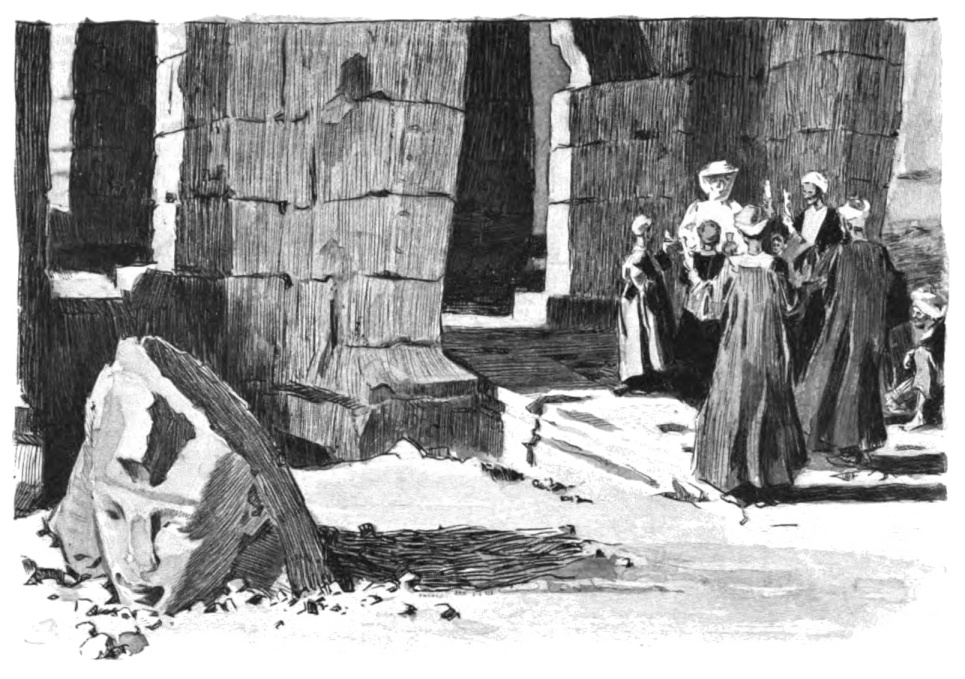
Thebes, January 2, 1898.
against time. Some kind friends have covered the bank with stones, but the river is slowly wearing them away, and sooner or later it will claim its own; and it will be a pity, for Komombos’s temple is dainty in comparison with Karnak, where great stiff Rameses stand with their arms folded across their breasts in very much the same manner in which the real arms are held in the glass case at the Gizeh Museum.
At Karnak there were miles of half-buried walls, and cut deep in them gigantic figures of Rameses, with one hand raised about to strike off the heads of enemies done up in bundles like asparagus and held by the hair of their heads, while armies are shown flying in confusion. The bas-reliefs at Komombos are more cheerful and cut with greater skill. They represent the ancient gods of Egypt in their more playful moods, floating down the Nile, spearing miniature hippopotamuses and crocodiles, with here and there a triumphant procession. The debris of the forgotten city that once covered Komombos has been removed, and the great hall, with its holy of holies now exposed to the light of day, is swept by the wind as clean as a Dutch kitchen; and yet the carvings are as fresh as the day they were made. From the Nitocris to the temple is only a few steps through some sugar-cane. It was a novel experience to find no donkey-boys with their patient and sleepy donkeys.
But the natives were different from any we had heretofore seen, and proved that we were getting into real Africa. They were mostly Nubians, and very black, and our preconceived idea of what an African should be.
Komombos and Philæ are the only temples we climbed up to, and it seems to me that they, above all others, lend themselves more readily to the sentimental tourist. It is easier for the imagination to people them; they are more like dwellings.
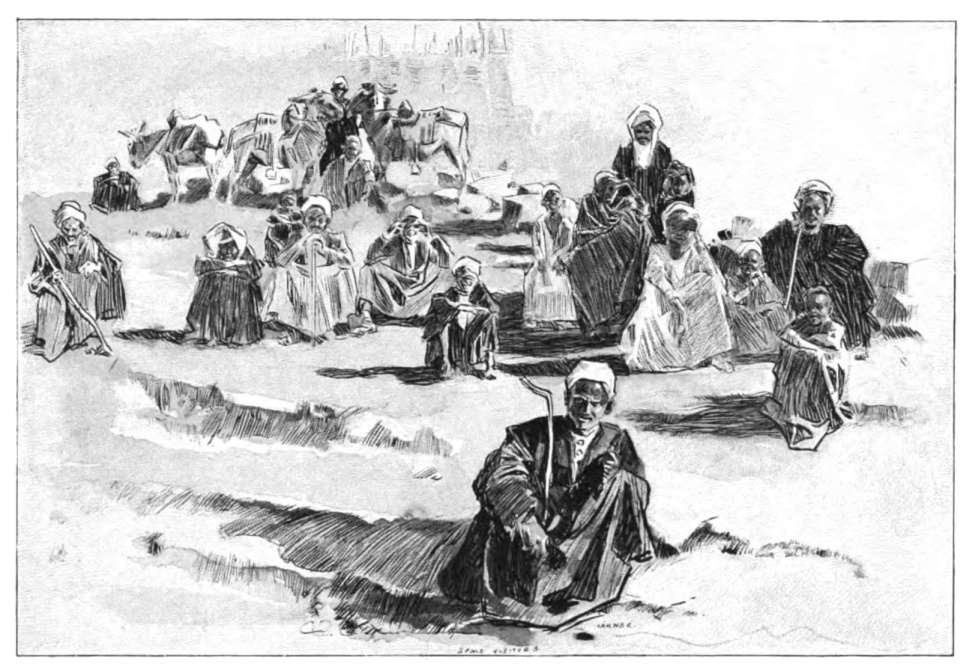
Home Visitors.
After tea had been brought from the Nitocris and served in its portals, we all decided that Komombos would be the temple to own. That evening the crew hung lanterns around the deck among the sugar-canes and palms, and after dinner they gave an exhibition, which started well enough with a dance by the first mate.
Since then I have found that all travelers on the Nile are likely to have this same experience. We were proof against the “Dhabir Devil” that the guide-books had warned us against, but Baedeker had made no mention of the possibility of this entertainment happening to us; still, the crew went at it as though it was an old story with them, and as I write this there may be some unsuspecting tourist about to go through with it. It sounds very good-natured on the part of the crew; and if the entertainment had stopped when the mate had finished the dance, it would have been well enough; but the dance was only to hold our attention while the others were getting ready, and then the dreary horse-play began. There was a barber-shop scene, in which flour paste was used and a door-mat acted as a towel. A crew that mutinies is tame compared with an Egyptian crew that acts. We stopped them as soon as we could without hurting their feelings, and they subsided and formed a circle back of the smoke-stack. The rest of the evening was spent in entertainment of our own choice, and by midnight all was still but the river, which never rests.