SKETCHES IN CANADA, (continued 6)
Reading edition
"Placed at the helm he sat, and watched the skies, Nor closed in sleep his ever-watchful eyes."
He kept himself awake by singing hymns, in which Mrs. Schoolcraft joined him. I lay still, looking up at the stars and listening: when there was a pause in the singing, we kept up the conversation, fearing lest sleep should overcome our only pilot and guardian. Thus we floated on beneath that divine canopy—"which love had spread to curtain the sleeping world:" it was a most lovely and blessed night, bright and calm and warm, and we made some little way, for both wind and current were in our favour.
As we were coasting a little shadowy island, our captain mentioned a strange circumstance, very illustrative of Indian life and character. A short time ago a young Chippewa hunter, whom he knew, was shooting squirrels on this spot, when by some chance a large blighted pine fell upon him, knocking him down and crushing his leg, which was fractured in two places. He could not rise, he could not remove the tree which was lying across his broken leg. He was in a little uninhabited island, without the slightest probability of passing aid; and to lie there and starve to death in agonies, seemed all that was left to him. In this dilemma, with all the fortitude and promptitude of resource of a thorough-bred Indian, he took out his knife, cut off his own leg, bound it up, dragged himself along the ground to his hunting canoe, and paddled himself home to his wigwam on a distant island, where the cure of his wound was completed. The man is still alive.
Perhaps this story appears incredible. I believe it firmly. At the time, and since then, I heard other instances of Indian fortitude, and of their courage and skill in performing some of the boldest and most critical operations in surgery, which I really cannot venture to set down. But I will mention one or two of the least marvellous. There was a young chief, and famous hunter, whose arm was shattered by the bursting of his rifle. No one would venture the amputation, and it was bound up with certain herbs and dressings, accompanied with many magical ceremonies. The young man, who seemed aware of the inefficacy of such expedients, waited till the moment when he should be left alone. He had meantime, with pain and difficulty, hatched one of his knives into a saw; with this he completed the amputation of his own arm; and when his relations appeared they found the arm lying at one end of the wigwam, and the patient sitting at the other, with his wound bound up, and smoking with great tranquillity.
VOYAGE ON LAKE HURON.
We remained in conversation till long after midnight; then the boat was moored to a tree, but kept off shore, for fear of the mosquitoes, and we addressed ourselves to sleep. I remember lying awake for some minutes, looking up at the quiet stars, and around upon the dark weltering waters, and at the faint waning moon, just suspended on the very edge of the horizon. I saw it sink—sink into the bosom of the lake as if to rest, and then with a thought of far-off friends, and a most fervent thanksgiving, I dropped asleep. It is odd that I did not think of praying for protection, and that no sense of fear came over me; it seemed as if the eye of God himself looked down upon me; that I was protected. I do not say I thought this any more than the unweaned child in its cradle; but I had some such feeling of unconscious trust and love, now I recall those moments.
I slept, however, uneasily, not being yet accustomed to a board and a blanket; ça viendra avec le temps. About dawn I awoke in a sort of stupor, but after bathing my face and hands over the boat side, I felt refreshed. The voyageurs, after a good night's rest, were in better humour, and took manfully to their oars. Soon after sunrise, we passed round that very conspicuous cape, famous in the history of north-west adventure, called the "Grand Détour," half-way between Mackinaw and the Sault. Now, if you look at the map, you will see that our course was henceforth quite altered; we had been running down the coast of the mainland towards the east; we had now to turn short round the point, and steer almost due west; hence its most fitting name, the Grand Détour. The wind, hitherto favourable, was now dead against us. This part of Lake Huron is studded with little islands, which, as well as the neighbouring mainland, are all uninhabited, yet clothed with the richest, loveliest, most fantastic vegetation, and no doubt swarming with animal life.
I cannot, I dare not, attempt to describe to you the strange sensation one has, thus thrown for a time beyond the bounds of civilised humanity, or, indeed, any humanity; nor the wild yet solemn reveries which come over one in the midst of this wilderness of woods and waters. All was so solitary, so grand in its solitude, as if nature unviolated sufficed to herself. Two days and nights the solitude was unbroken; not a trace of social life, not a human being, not a canoe, not even a deserted wigwam, met our view. Our little boat held on its way over the placid lake, and among green tufted islands; and we its inmates, two women, differing in clime, nation, complexion, strangers to each other but a few days ago, might have fancied ourselves alone in a new-born world.
THE ENCAMPMENT.
We landed to boil our kettle, and breakfast on a point of the island of St. Joseph's. This most beautiful island is between thirty and forty miles in length, and nearly a hundred miles in circumference, and towards the centre the land is high and picturesque. They tell me that on the other side of the island there is a settlement of whites and Indians. Another large island, Drummond's Isle, was for a short time in view. We had also a settlement here, but it was unaccountably surrendered to the Americans. If now you look at the map, you will wonder, as I did, that in retaining St. Joseph's and the Manitoolin islands, we gave up Drummond's Island. Both these islands had forts and garrisons during the war.
By the time breakfast was over, the children had gathered some fine strawberries; the heat had now become almost intolerable, and unluckily we had no awning. The men rowed languidly, and we made but little way; we coasted along the south shore of St. Joseph's, through fields of rushes, miles in extent, across Lake George, and Muddy Lake (the name, I thought, must be a libel, for it was as clear as crystal and as blue as heaven; but they say that, like a sulky temper, the least ruffle of wind turns it as black as ditchwater, and it does not subside again in a hurry), and then came a succession of openings spotted with lovely islands, all solitary. The sky was without a cloud, a speck—except when the great fish-eagle was descried sailing over its blue depths—the water without a wave. We were too hot and too languid to converse. Nothing disturbed the deep noon-tide stillness, but the dip of the oars, or the spring and splash of a sturgeon as he leapt from the surface of the lake, leaving a circle of little wavelets spreading around. All the islands we passed were so woody, and so infested with mosquitoes, that we could not land and light our fire, till we reached the entrance of St. Mary's River, between Nebish island and the mainland.
MOSQUITOES.
Here was a well-known spot, a sort of little opening on a flat shore, called the Encampment, because a party of boatmen coming down from Lake Superior, and camping here for the night, were surprised by the frost, and obliged to remain the whole winter till the opening of the ice, in the spring. After rowing all this hot day till seven o'clock against the wind (what there was of it), and against the current coming rapidly and strongly down from Lake Superior, we did at length reach this promised harbour of rest and refreshment. Alas! there was neither for us; the moment our boat touched the shore, we were enveloped in a cloud of mosquitoes. Fires were lighted instantly, six were burning in a circle at once; we were well nigh suffocated and smoke-dried—all in vain. At last we left the voyageurs to boil the kettle, and retreated to our boat, desiring them to make us fast to a tree by a long rope; then each of us taking an oar—I only wish you could have seen us—we pushed off from the land, while the children were sweeping away the enemy with green boughs. This being done, we commenced supper, really half famished, and were too much engrossed to look about us. Suddenly we were again surrounded by our adversaries; they came upon us in swarms, in clouds, in myriads, entering our eyes, our noses, our mouths, stinging till the blood followed. We had, unawares, and while absorbed in our culinary operations, drifted into the shore, got entangled among the roots of trees, and were with difficulty extricated, presenting all the time a fair mark and a rich banquet for our detested tormentors. The dear children cried with agony and impatience, and but for shame I could almost have cried too.
I had suffered from these plagues in Italy; you too, by this time, may probably know what they are in the southern countries of the old world; but 'tis a jest, believe me, to encountering a forest full of them in these wild regions. I had heard much, and much was I forewarned, but never could have conceived the torture they can inflict, nor the impossibility of escape, defence, or endurance. Some amiable person who took an especial interest in our future welfare, in enumerating the torments prepared for hardened sinners, assures us that they will be stung by mosquitoes, all made of brass, and as large as black beetles—he was an ignoramus and a bungler; you may credit me, that the brass is quite an unnecessary improvement, and the increase of size equally superfluous. Mosquitoes, as they exist in this upper world, are as pretty and perfect a plague as the most ingenious amateur sinner-tormentor ever devised. Observe, that a mosquito does not sting like a wasp, or a gad-fly; he has a long proboscis like an awl, with which he bores your veins and pumps the life-blood out of you, leaving venom and fever behind. Enough of mosquitoes—I will never again do more than allude to them; only they are enough to make Philosophy go hang herself, and Patience swear like a Turk or a trooper.
Well, we left this most detestable and inhospitable shore as soon as possible, but the enemy followed us, and we did not soon get rid of them; night came on, and we were still twenty miles below the Sault.
THE SAULT-SAINTE-MARIE.
I offered an extra gratuity to the men, if they would keep to their oars without interruption; and then, fairly exhausted, lay down on my locker and blanket. But whenever I woke from uneasy, restless slumbers, there was Mrs. Schoolcraft, bending over her sleeping children, and waving off the mosquitoes, singing all the time a low, melancholy Indian song; while the northern lights were streaming and dancing in the sky, and the fitful moaning of the wind, the gathering clouds, and chilly atmosphere foretold a change of weather. This would have been the comble de malheur. When daylight came, we passed Sugar Island, where immense quantities of maple sugar are made every spring, and just as the rain began to fall in earnest we arrived at the Sault-Sainte-Marie. On one side of the river, Mrs. Schoolcraft was welcomed by her mother; and on the other, my friends, the MacMurrays, received me with delighted and delightful hospitality. I went to bed—oh! the luxury!—and slept for six hours.
Enough of solemn reveries on starlit lakes—enough—too much—of self and self-communings; I turn over a new leaf, and this shall be a chapter of geography, and topography, natural philosophy, and such wise-like things. Draw the curtain first, for if I look out any longer on those surging rapids, I shall certainly turn giddy—forget all the memoranda I have been collecting for you, lose my reckoning, and become unintelligible to you and myself too.
This river of St. Mary is, like the Detroit and the St. Clair, already described, properly a strait, the channel of communication between Lake Superior and Lake Huron. About ten miles higher up, the great ocean-lake narrows to a point; then, forcing a channel through the high lands, comes rushing along till it meets with a downward ledge, or cliff, over which it throws itself in foam and fury, tearing a path for its billows through the rocks. The descent is about twenty-seven feet in three quarters of a mile, but the rush begins above, and the tumult continues below the fall, so that, on the whole, the eye embraces an expanse of white foam measuring about a mile each way, the effect being exactly that of the ocean breaking on a rocky shore: not so terrific, nor on so large a scale, as the rapids of Niagara, but quite as beautiful—quite as animated.
What the French call a saut (leap), we term a fall; the Sault-Sainte-Marie is translated into the falls of St. Mary. By this name the rapids are often mentioned, but the village on their shore still retains its old name, and is called the Sault. I do not know why the beautiful river and its glorious cataracts should have been placed under the peculiar patronage of the blessed Virgin; perhaps from the union of exceeding loveliness with irresistible power; or, more probably, because the first adventurers reached the spot on some day hallowed in the calendar.
The French, ever active and enterprising, were the first who penetrated to this wild region. They had an important trading post here early in the last century, and also a small fort. They were ceded, with the rest of the country, to Great Britain, in 1762.[36] I wonder whether, at that time, the young king or any of his ministers had the least conception of the value and immensity of the magnificent country thrown into our possession, or gave a thought to the responsibilities it brought with it!—to be sure they made good haste, both king and ministers, to get rid of most of the responsibility. The American war began, and at its conclusion the south shore of St. Mary's, and the fort, were surrendered to the Americans.
The rapids of Niagara, as I once told you, reminded me of a monstrous tiger at play, and threw me into a sort of ecstatic terror; but these rapids of St. Mary suggest quite another idea: as they come fretting and fuming down, curling up their light foam, and wreathing their glancing billows round the opposing rocks, with a sort of passionate self-will, they remind me of an exquisitely beautiful woman in a fit of rage, or of Walter Scott's simile—"one of the Graces possessed by a Fury;"—there is no terror in their anger, only the sense of excitement and loveliness; when it has spent this sudden, transient fit of impatience, the beautiful river resumes all its placid dignity, and holds on its course, deep and wide enough to float a squadron of seventy-fours, and rapid and pellucid as a mountain trout-stream.
FORT AND SETTLEMENTS.
Here, as everywhere else, I am struck by the difference between the two shores. On the American side there is a settlement of whites, as well as a large village of Chippewas; there is also a mission (I believe of the Methodists), for the conversion of the Indians. The fort, which has been lately strengthened, is merely a strong and high enclosure, surrounded with pickets of cedar-wood; within the stockade are the barracks, and the principal trading store. This fortress is called Fort Brady, after that gallant officer whom I have already mentioned to you. The garrison may be very effective for aught I know, but I never beheld such an unmilitary-looking set. When I was there to-day, the sentinels were lounging up and down in their flannel jackets and shirt sleeves, with muskets thrown over their shoulders—just for all the world like ploughboys going to shoot sparrows; however, they are in keeping with the fortress of cedar-posts, and no doubt both answer their purpose very well. The village is increasing into a town, and the commercial advantages of its situation must raise it ere long to a place of importance.
On the Canada side we have not even these demonstrations of power or prosperity. Nearly opposite to the American fort there is a small factory belonging to the North-west Fur Company; below this, a few miserable log-huts, occupied by some French Canadians and voyageurs in the service of the company, a set of lawless mauvais sujets, from all I can learn. Lower down stands the house of Mr. and Mrs. MacMurray, with the Chippewa village under their care and tuition; but most of the wigwams and their inhabitants are now on their way down the lake, to join the congress at the Manitoolin Islands. A lofty eminence, partly cleared and partly clothed with forest, rises behind the house, on which stand the little missionary church and school-house for the use of the Indian converts. From the summit of this hill you look over the traverse into Lake Superior, and the two giant capes which guard its entrance. One of these capes is called Gros-Cap, from its bold and lofty cliffs, the yet unviolated haunt of the eagle. The opposite cape is more accessible, and bears an Indian name, which I cannot pretend to spell, but which signifies "the place of the Iroquois' bones:" it was the scene of a wild and terrific tradition. At the time that the Iroquois (or Six Nations) were driven before the French and Hurons up to the western lakes, they endeavoured to possess themselves of the hunting-grounds of the Chippewas, and hence a bitter and lasting feud between the two nations. The Iroquois, after defeating the Chippewas, encamped, a thousand strong, upon this point, where, thinking themselves secure, they made a war feast to torture and devour their prisoners. The Chippewas, from the opposite shore, beheld the sufferings and humiliation of their friends, and, roused to sudden fury by the sight, collected their warriors, only three hundred in all, crossed the channel, and at break of day fell upon the Iroquois, now sleeping after their horrible excesses, and massacred every one of them, men, women, and children. Of their own party they lost but one warrior, who was stabbed with an awl by an old woman who was sitting at the entrance of her wigwam, stitching moccasins: thus runs the tale. The bodies were left to bleach on the shore, and they say that bones and skulls are still found there.
THE WHITE-FISH.
Here, at the foot of the rapids, the celebrated white-fish of the lakes is caught in its highest perfection. The people down below[37], who boast of the excellence of the white-fish, really know nothing of the matter. There is no more comparison between the white-fish of the lower lakes and the white-fish of St. Mary's than between plaice and turbot, or between a clam and a Sandwich oyster. I ought to be a judge, who have eaten them fresh out of the river four times a day, and I declare to you that I never tasted anything of the fish kind half so exquisite. If the Roman Apicius had lived in these latter days, he would certainly have made a voyage up Lake Huron to breakfast on the white-fish of St. Mary's river, and would not have returned in dudgeon, as he did, from the coast of Africa. But the epicures of our degenerate times have nothing of that gastronomical enthusiasm which inspired their ancient models, else we should have them all coming here to eat white-fish at the Sault, and scorning cockney white-bait. Henry declares that the flavour of the white-fish is "beyond any comparison whatever," and I add my testimony thereto—probatum est!
I have eaten tunny in the gulf of Genoa, anchovies fresh out of the bay of Naples, and trout of the Salz-kammergut, and divers other fishy dainties rich and rare,—but the exquisite, the refined white-fish exceeds them all; concerning those cannibal fish (mullets were they, or lampreys?) which Lucullus fed in his fish-ponds, I cannot speak, never having tasted them; but even if they could be resuscitated, I would not degrade the refined, the delicate white-fish by a comparison with any such barbarian luxury.
But seriously, and badinage apart, it is really the most luxurious delicacy that swims the waters. It is said that people never tire of them. Mr. MacMurray tells me that he has eaten them every day of his life for seven years, and that his relish for them is undiminished. The enormous quantities caught here, and in the bays and creeks round Lake Superior, remind me of herrings in the lochs of Scotland; besides subsisting the inhabitants, whites and Indians, during great part of the year, vast quantities are cured and barrelled every fall, and sent down to the eastern states. Not less than eight thousand barrels were shipped last year.
THE SKEVÁT.
These enterprising Yankees have seized upon another profitable speculation here: there is a fish found in great quantities in the upper part of Lake Superior, called the skevát[38], so exceedingly rich, luscious, and oily, when fresh, as to be quite uneatable. A gentleman here told me that he had tried it, and though not very squeamish at any time, and then very hungry, he could not get beyond the first two or three mouthfuls; but it has been lately discovered that this fish makes a most luxurious pickle. It is very excellent, but so rich even in this state, that, like the tunny marinée, it is necessary either to taste abstemiously, or die heroically of indigestion. This fish is becoming a fashionable luxury, and in one of the stores here I saw three hundred barrels ready for embarkation. The Americans have several schooners on the lakes employed in these fisheries: we have not one. They have besides planned a ship canal through the portage here, which will open a communication for large vessels between Lake Huron and Lake Superior, as our Welland Canal has united Lake Erie with Lake Ontario. The ground has already been surveyed for this purpose. When this canal is completed, a vessel may load in the Thames, and discharge her burthen at the upper end of Lake Superior. I hope you have a map before you, that you may take in at a glance this wonderful extent of inland navigation. Ought a country possessing it, and all the means of life beside, to remain poor, oppressed, uncultivated, unknown?
THE RAPIDS.
But to return to my beautiful river and glorious rapids, which are to be treated, you see, as a man treats a passionate beauty—he does not oppose her, for that were madness—but he gets round her. Well, on the American side, further down the river, is the house of Tanner, the Indian interpreter, of whose story you may have heard—for, as I remember, it excited some attention in England. He is a European of unmixed blood, with the language, manners, habits of a Red-skin. He had been kidnapped somewhere on the American frontiers when a mere boy, and brought up among the Chippewas. He afterwards returned to civilised life, and having relearned his own language, drew up a very entertaining and valuable account of his adopted tribe. He is now in the American service here, having an Indian wife, and is still attached to his Indian mode of life.
Just above the fort is the ancient burial-place of the Chippewas. I need not tell you of the profound veneration with which all the Indian tribes regard the places of their dead. In all their treaties for the cession of their lands, they stipulate with the white man for the inviolability of their sepulchres. They did the same with regard to this place, but I am sorry to say that it has not been attended to, for in enlarging one side of the fort, they have considerably encroached on the cemetery. The outrage excited both the sorrow and indignation of some of my friends here, but there is no redress. Perhaps it was this circumstance that gave rise to the allusion of the Indian chief here, when in speaking of the French he said, "They never molested the places of our dead!"
The view of the rapids from this spot is inexpressibly beautiful, and it has besides another attraction, which makes it to me a frequent lounge whenever I cross the river;—but of this by-and-bye. To complete my sketch of the localities, I will only add, that the whole country around is in its primitive state, covered with the interminable swamp and forest, where the bear and the moose-deer roam—and lakes and living streams where the beaver builds his hut.[39] The cariboo, or rein-deer, is still found on the northern shores.
The hunting-grounds of the Chippewas are in the immediate neighbourhood, and extend all round Lake Superior. Beyond these, on the north, are the Chippewyans; and on the south, the Sioux, Ottagamies, and Pottowottomies.
I might here multiply facts and details, but I have been obliged to throw these particulars together in haste, just to give you an idea of my present situation. Time presses, and my sojourn in this remote and interesting spot is like to be of short duration.
MRS. JOHNSTON.
One of the gratifications I had anticipated in coming hither—my strongest inducement perhaps—was an introduction to the mother of my two friends, of whom her children so delighted to speak, and of whom I had heard much from other sources. A woman of pure Indian blood, of a race celebrated in these regions as warriors and chiefs from generation to generation, who had never resided within the pale of what we call civilised life, whose habits and manners were those of a genuine Indian squaw, and whose talents and domestic virtues commanded the highest respect, was, as you may suppose, an object of the deepest interest to me. I observed that not only her own children, but her two sons-in-law, Mr. MacMurray and Mr. Schoolcraft, both educated in good society, the one a clergyman and the other a man of science and literature, looked up to this remarkable woman with sentiments of affection and veneration.
As soon, then, as I was a little refreshed after my two nights on the lake, and my battles with the mosquitoes, we paddled over the river to dine with Mrs. Johnston: she resides in a large log-house close upon the shore; there is a little portico in front with seats, and the interior is most comfortable. The old lady herself is rather large in person, with the strongest marked Indian features, a countenance open, benevolent, and intelligent, and a manner perfectly easy—simple, yet with something of motherly dignity, becoming the head of her large family. She received me most affectionately, and we entered into conversation—Mrs. Schoolcraft, who looked all animation and happiness, acting as interpreter. Mrs. Johnston speaks no English, but can understand it a little, and the Canadian French still better; but in her own language she is eloquent, and her voice, like that of her people, low and musical; many kind words were exchanged, and when I said anything that pleased her, she laughed softly like a child. I was not well and much fevered, and I remember she took me in her arms, laid me down on a couch, and began to rub my feet, soothing and caressing me. She called me Nindannis, daughter, and I called her Neengai, mother (though how different from my own fair mother, I thought, as I looked up gratefully in her dark Indian face!). She set before us the best dressed and best served dinner I had seen since I left Toronto, and presided at her table, and did the honours of her house with unembarrassed, unaffected propriety. My attempts to speak Indian caused, of course, considerable amusement; if I do not make progress, it will not be for want of teaching and teachers.
AN INDIAN LODGE.
After dinner we took a walk to visit Mrs. Johnston's brother, Wayish,ky, whose wigwam is at a little distance, on the verge of the burial-ground. The lodge is of the genuine Chippewa form, like an egg cut in half lengthways. It is formed of poles stuck in the ground, and bent over at top, strengthened with a few wattles and boards; the whole is covered over with mats, birch-bark, and skins; a large blanket formed the door or curtain, which was not ungracefully looped aside. Wayish,ky, being a great man, has also a smaller lodge hard by, which serves as a storehouse and kitchen.
AN INDIAN FAMILY.
Rude as was the exterior of Wayish,ky's hut, the interior presented every appearance of comfort, and even elegance, according to the Indian notions of both. It formed a good-sized room: a raised couch ran all round like a Turkish divan, serving both for seats and beds, and covered with very soft and beautiful matting of various colours and patterns. The chests and baskets of birch-bark, containing the family wardrobe and property; the rifles, the hunting and fishing tackle, were stowed away all round very tidily; I observed a coffee-mill nailed up to one of the posts or stakes; the floor was trodden down hard and perfectly clean, and there was a place for a fire in the middle: there was no window, but quite sufficient light and air were admitted through the door, and through an aperture in the roof. There was no disagreeable smell, and everything looked neat and clean. We found Wayish,ky and his wife and three of their children seated in the lodge, and as it was Sunday, and they are all Christians, no work was going forward. They received me with genuine and simple politeness, each taking my hand with a gentle inclination of the head, and some words of welcome murmured in their own soft language. We then sat down.
The conversation became very lively; and, if I might judge from looks and tones, very affectionate. I sported my last new words and phrases with great effect, and when I had exhausted my vocabulary—which was very soon—I amused myself with looking and listening.
Mrs. Wayish,ky (I forget her proper name) must have been a very beautiful woman. Though now no longer young, and the mother of twelve children, she is one of the handsomest Indian women I have yet seen. The number of her children is remarkable, for in general there are few large families among the Indians. Her daughter, Zah,gah,see,ga,quay (the sunbeams breaking through a cloud), is a very beautiful girl, with eyes that are a warrant for her poetical name—she is about sixteen. Wayish,ky himself is a grave, dignified man about fifty. He told me that his eldest son had gone down to the Manitoolin Island to represent his family, and receive his quota of presents. His youngest son he had sent to a college in the United States, to be educated in the learning of the white men. Mrs. Schoolcraft whispered me that this poor boy is now dying of consumption, owing to the confinement and change of living, and that the parents knew it. Wayish,ky seemed aware that we were alluding to his son, for his eye at that moment rested on me, and such an expression of keen pain came suddenly over his fine countenance, it was as if a knife had struck him, and I really felt it in my heart, and see it still before me—that look of misery.
After about an hour we left this good and interesting family. I lingered for a while on the burial-ground, looking over the rapids, and watching with a mixture of admiration and terror several little canoes which were fishing in the midst of the boiling surge, dancing and popping about like corks. The canoe used for fishing is very small and light; one man (or woman more commonly) sits in the stern, and steers with a paddle; the fisher places himself upright on the prow, balancing a long pole with both hands, at the end of which is a scoop-net. This he every minute dips into the water, bringing up at each dip a fish, and sometimes two. I used to admire the fishermen on the Arno, and those on the Lagune, and above all the Neapolitan fishermen, hauling in their nets, or diving like ducks, but I never saw anything like these Indians. The manner in which they keep their position upon a footing of a few inches, is to me as incomprehensible as the beauty of their forms and attitudes, swayed by every movement and turn of their dancing, fragile barks, is admirable.
George Johnston, on whose arm I was leaning (and I had much ado to reach it), gave me such a vivid idea of the delight of coming down the cataract in a canoe, that I am half resolved to attempt it. Terrific as it appears, yet in a good canoe, and with experienced guides, there is no absolute danger, and it must be a glorious sensation.
INDIAN WARFARE.
Mr. Johnston had spent the last fall and winter in the regions beyond Lake Superior, towards the forks of the Mississippi, where he had been employed as American agent to arrange the boundary line between the country of the Chippewas and that of their neighbours and implacable enemies, the Sioux. His mediation appeared successful for the time, and he smoked the pipe of peace with both tribes; but during the spring this ferocious war has again broken out, and he seems to think that nothing but the annihilation of either one nation or the other will entirely put an end to their conflicts; "for there is no point at which the Indian law of retaliation stops, short of the extermination of one of the parties."
I asked him how it is that in their wars the Indians make no distinction between the warriors opposed to them and helpless women and children?—how it could be with a brave and manly people, that the scalps taken from the weak, the helpless, the unresisting, were as honourable as those torn from the warrior's skull? And I described to him the horror which this custom inspired—this, which of all their customs, most justifies the name of savage!
He said it was inseparable from their principles of war and their mode of warfare; the first consists in inflicting the greatest possible insult and injury on their foe with the least possible risk to themselves. This truly savage law of honour we might call cowardly, but that, being associated with the bravest contempt of danger and pain, it seems nearer to the natural law. With regard to the mode of warfare, they have rarely pitched battles, but skirmishes, surprises, ambuscades, and sudden forays into each other's hunting-grounds and villages. The usual practice is to creep stealthily on the enemy's village or hunting-encampment, and wait till just after the dawn; then, at the moment the sleepers in the lodges are rising, the ambushed warriors stoop and level their pieces about two feet from the ground, which thus slaughter indiscriminately. If they find one of the enemy's lodges undefended they murder its inmates, that when the owner returns he may find his hearth desolate; for this is exquisite vengeance! But outrage against the chastity of women is absolutely unknown under any degree whatever of furious excitement.[40]
This respect for female honour will remind you of the ancient Germans, as described by Julius Cæsar: he contrasts in some surprise their forbearance with the very opposite conduct of the Romans; and even down to this present day, if I recollect rightly, the history of our European wars and sieges will bear out this early and characteristic distinction between the Latin and the Teutonic nations. Am I right, or am I not?
THE SAVAGE AND THE CHRISTIAN.
To return to the Indians. After telling me some other particulars, which gave me a clearer view of their notions and feelings on these points than I ever had before, my informant mildly added,—"It is a constant and favourite subject of reproach against the Indians—this barbarism of their desultory warfare; but I should think more women and children have perished in one of your civilised sieges, and that in late times, than during the whole war between the Chippewas and Sioux, and that has lasted a century."
I was silent, for there is a sensible proverb about taking care of our own glass windows: and I wonder if any of the recorded atrocities of Indian warfare or Indian vengeance, or all of them together, ever exceeded Massena's retreat from Portugal,—and the French call themselves civilised. A war party of Indians, perhaps two or three hundred (and that is a very large number), dance their war dance, go out and burn a village, and bring back twenty or thirty scalps. They are savages and heathens. We Europeans fight a battle, leave fifty thousand dead or dying by inches on the field, and a hundred thousand to mourn them, desolate; but we are civilised and Christians. Then only look into the motives and causes of our bloodiest European wars as revealed in the private history of courts:—the miserable, puerile, degrading intrigues which set man against man—so horridly disproportioned to the horrid result! and then see the Indian take up his war-hatchet in vengeance for some personal injury, or from motives that rouse all the natural feelings of the natural man within him! Really I do not see that an Indian warrior, flourishing his tomahawk, and smeared with his enemy's blood, is so very much a greater savage than the pipe-clayed, padded, embroidered personage, who, without cause or motive, has sold himself to slay or be slain: one scalps his enemy, the other rips him open with a sabre; one smashes his brains with a tomahawk, and the other blows him to atoms with a cannon-ball: and to me, femininely speaking, there is not a needle's point difference between the one and the other. If war be unchristian and barbarous, then war as a science is more absurd, unnatural, unchristian than war as a passion.
This, perhaps, is putting it all too strongly, and a little exaggerated—
God forbid that I should think to disparage the blessings of civilisation! I am a woman, and to the progress of civilisation alone can we women look for release from many pains and penalties and liabilities, which now lie heavily upon us. Neither am I greatly in love with savage life, with all its picturesque accompaniments and lofty virtues. I see no reason why these virtues should be necessarily connected with dirt, ignorance, and barbarism. I am thankful to live in a land of literature and steam-engines. Chatsworth is better than a wigwam, and a seventy-four is a finer thing than a bark canoe. I do not positively assert that Taglioni dances more gracefully than the Little-Pure tobacco-smoker, nor that soap and water are preferable as cosmetics to tallow and charcoal; for these are matters of taste, and mine may be disputed. But I do say, that if our advantages of intellect and refinement are not to lead on to farther moral superiority, I prefer the Indians on the score of consistency; they are what they profess to be, and we are not what we profess to be. They profess to be warriors and hunters, and are so; we profess to be Christians and civilised—are we so?
Then as to the mere point of cruelty;—there is something to be said on this point too. Ferocity, when the hot blood is up, and all the demon in man is roused by every conceivable excitement, I can understand better than the Indian can comprehend the tender mercies of our law. Owyawatta, better known by his English name, Red-Jacket, was once seen hurrying from the town of Buffalo, with rapid strides, and every mark of disgust and consternation in his face. Three malefactors were to be hung that morning, and the Indian warrior had not nerve to face the horrid spectacle, although—
"In sober truth the veriest devil That ere clenched fingers in a captive's hair."
THE DESCENT OF THE RAPIDS.
The more I looked upon those glancing, dancing rapids, the more resolute I grew to venture myself in the midst of them. George Johnston went to seek a fit canoe and a dextrous steersman, and meantime I strolled away to pay a visit to Wayish,ky's family, and made a sketch of their lodge, while pretty Zah,gah,see,gah,qua, held the umbrella to shade me.
The canoe being ready, I went up to the top of the portage, and we launched into the river. It was a small fishing canoe about ten feet long, quite new, and light and elegant and buoyant as a bird on the waters. I reclined on a mat at the bottom, Indian fashion (there are no seats in a genuine Indian canoe); in a minute we were within the verge of the rapids, and down we went, with a whirl and a splash!—the white surge leaping around me—over me. The Indian with astonishing dexterity kept the head of the canoe to the breakers, and somehow or other we danced through them. I could see, as I looked over the edge of the canoe, that the passage between the rocks was sometimes not more than two feet in width, and we had to turn sharp angles—a touch of which would have sent us to destruction—all this I could see through the transparent eddying waters, but I can truly say, I had not even a momentary sensation of fear, but rather of giddy, breathless, delicious excitement. I could even admire the beautiful attitude of a fisher, past whom we swept as we came to the bottom. The whole affair, from the moment I entered the canoe till I reached the landing place, occupied seven minutes, and the distance is about three quarters of a mile.[41]
THE CHIPPEWAS.
My Indians were enchanted, and when I reached home, my good friends were not less delighted at my exploit: they told me I was the first European female who had ever performed it, and assuredly I shall not be the last. I recommend it as an exercise before breakfast. As for my Neengai, she laughed, clapped her hands, and embraced me several times. I was declared duly initiated, and adopted into the family by the name of Wah,sàh,ge,wah,nó,quà. They had already called me among themselves, in reference to my complexion and my travelling propensities, O,daw,yaun,gee, the fair changing moon, or rather, the fair moon which changes her place: but now, in compliment to my successful achievement, Mrs. Johnston bestowed this new appellation, which I much prefer. It signifies the bright foam, or more properly, with the feminine adjunct, qua, the woman of the bright foam; and by this name I am henceforth to be known among the Chippewas.
Now that I have been a Chippewa born, any time these four hours[42], I must introduce you to some of my new relations "of the totem of the rein-deer;" and first to my illustrious grandpapa, Waub-Ojeeg[43] (the White-fisher).
The Chippewas, as you perhaps know, have long been reckoned among the most warlike and numerous, but also among the wildest and more untameable nations of the north-west. In progressing with the other Algonquin tribes from south to north, they seem to have crossed the St. Lawrence and dispersed themselves along the shores of Lake Ontario, and Lake Huron and its islands. Driven westward before the Iroquois, as they retired before the French and Hurons, the Chippewas appear to have crossed the St. Mary's River, and then spread along the south shores of Lake Superior. Their council fire, and the chief seat of the nation, was upon a promontory at the farthest end of Lake Superior, called by the French La Pointe, and by the Indians Che,goi,me,gon: by one name or the other you will find it on most maps, as it has long been a place of importance in the fur trade. Here was the grand national council fire (the extinction of which foretold, if it did not occasion, some dread national calamity), and the residence of the presiding chief. The Indians know neither sovereignty nor nobility, but when one family has produced several distinguished war-chiefs, the dignity becomes by courtesy or custom hereditary; and from whatever reason, the family of Wayish,ki or the Mudgi,kiwis, exercised, even from a remote period, a sort of influence over the rest of the tribe. One traveller says that the present descendants of these chiefs evince such a pride of ancestry as could only be looked for in feudal or despotic monarchies. The present representative, Piz,hi,kee (the Buffalo), my illustrious cousin, still resides at La Pointe. When presented with a silver medal of authority from the American government, he said haughtily, "What need of this? it is known to all whence I am descended!" Family pride, you see, lies somewhere very deep in human nature.
When the Chippewas first penetrated to these regions, they came in contact with the Ottagamies or Foxes, who, being descended from the same stock, received them as brothers, and at first ceded to them a part of their boundless hunting-grounds; and as these Ottagamies were friends and allies of the Sioux, these three nations continued for some time friends, and inter-marriages and family alliances took place. But the increasing power of the Chippewas soon excited the jealousy and apprehension of the other two tribes. The Ottagamies committed inroads on their hunting-grounds (this is the primary cause of almost all the Indian wars), the Chippewas sent an embassy to complain of the injury, and desired the Ottagamies to restrain their young men within the stipulated bounds. The latter returned an insulting answer. The war-hatchet was raised, and the Sioux and the Ottagamies united against the Chippewas: this was about 1726 or 1730. From this time there has been no peace between the Chippewas and Sioux.
WAUB-OJEEG.
It happened just before the declaration of war, that a young Chippewa girl was married to a Sioux chief of great distinction, and bore him two sons. When hostilities commenced the Sioux chief retired to his own tribe, and his wife remained with her relations, according to Indian custom. The two children, belonging to both tribes, were hardly safe with either; but as the father was best able to protect them, it was at last decided that they should accompany him. The Sioux chief and his boys departed to join his warriors, accompanied by his Chippewa wife and her relations, till they were in safety: then the young wife returned home weeping and inconsolable for the loss of her husband and children. Some years afterwards she consented to become the wife of the great chief at Chegoimegon. Her son by this marriage was Mamongazida, or Mongazida (the Loon's-foot), a chief of great celebrity, who led a strong party of his nation in the Canadian wars between the French and English, fighting on the side of the French. He was present at the battle of Quebec, when Wolfe was killed, and according to the Indian tradition, the Marquis Montcalm died in Mongazida's arms. After the war was over, he "shook hands" with the English. He was at the grand assemblage of chiefs, convened by Sir William Johnstone, at Niagara, and from him received a rich gorget, and broad belt of wampum, as pledges of peace and alliance with the English. These relics were preserved in the family with great veneration, and inherited by Waub-Ojeeg, and afterwards by his younger brother, Camudwa; but it happened that when Camudwa was out on a winter-hunt near the river Broulé, he and all his family were overtaken by famine and starved to death, and these insignia were then lost and never recovered. This last incident is a specimen of the common vicissitudes of Indian life; and when listening to their domestic histories, I observe that the events of paramount interest are the want or the abundance of food—hunger or plenty. "We killed a moose, or a bear, and had meat for so many days:" or, "we followed on the track of a bear, and he escaped us; we had no meat for so many days." These are the ever-recurring topics which in their conversation stand instead of the last brilliant essay in the Edinburgh or Quarterly, or the last news from Russia or Spain. Starvation from famine is not uncommon; and I am afraid, from all I hear, that cannibalism under such circumstances is not unknown. Remembering some recent instances nearer home, when extreme hunger produced the same horrid result, I could not be much astonished.
To return. Waub-Ojeeg was the second son of this famous Mongazida. Once when the latter went out on his "fall hunts," on the grounds near the Sioux territory, taking all his relatives with him (upwards of twenty in number), they were attacked by the Sioux at early dawn, in the usual manner. The first volley had gone through the lodges; before the second could be fired, Mongazida rushed out, and proclaiming his own name with a loud voice, demanded if Wabash, his mother's son, were among the assailants. There was a pause, and then a tall figure in his war-dress, and a profusion of feathers in his head, stepped forward and gave his hand to his half-brother. They all repaired to the lodge in peace together; but at the moment the Sioux chief stooped to enter, Waub-Ojeeg, then a boy of eight years old, who had planted himself at the entrance to defend it, struck him a blow on the forehead with his little war-club. Wabash, enchanted, took him up in his arms and prophesied that he would become a great war chief, and an implacable enemy of the Sioux. Subsequently the prophecy was accomplished, and Waub-Ojeeg commanded his nation in all the war-parties against the Sioux and Ottagamies. He was generally victorious, and so entirely defeated the Ottagamies, that they never afterwards ventured to oppose him, but retired down the Wisconsin river, where they are now settled.
But Waub-Ojeeg was something more and better than merely a successful warrior: he was remarkable for his eloquence, and composed a number of war-songs, which were sung through the Chippewa villages, and some of which his daughter can repeat. He was no less skilful in hunting than in war. His hunting-grounds extended to the river Broulé, at Fon du Lac; and he killed any one who dared to intrude on his district. The skins he took annually were worth three hundred and fifty dollars, a sum amply sufficient to make him rich in clothing, arms, powder, vermilion, and trinkets. Like Tecumseh, he would not marry early lest it should turn his attention from war, but at the age of thirty he married a widow, by whom he had two sons. Becoming tired of this elderly helpmate, he took a young wife, a beautiful girl of fourteen, by whom he had six children; of these my Neengai is the eldest. She described her father as affectionate and domestic. "There was always plenty of bear's meat and deer's flesh in the lodge." He had a splendid lodge, sixty feet in length, which he was fond of ornamenting. In the centre there was a strong post, which rose several feet above the roof, and on the top there was the carved figure of an owl, which veered with the wind. This owl seems to have answered the same purpose as the flag on the tower of Windsor Castle: it was the insignia of his power and of his presence. When absent on his long winter hunts the lodge was shut up, and the owl taken down.
The skill of Waub-Ojeeg as a hunter and trapper, brought him into friendly communication with a fur-trader named Johnston, who had succeeded the enterprising Henry in exploring Lake Superior. This young man, of good Irish family, came out to Canada with such strong letters of recommendation to Lord Dorchester, that he was invited to reside in the government house till a vacancy occurred in his favour in one of the official departments; meantime, being of an active and adventurous turn, he joined a party of traders going up the lakes, merely as an excursion, but became so enamoured of that wild life, as to adopt it in earnest. On one of his expeditions, when encamped at Che,goi,me,gon, and trafficking with Waub-Ojeeg, he saw the eldest daughter of the chief, and "no sooner looked than he sighed, no sooner sighed than he asked himself the reason," and ended by asking his friend to give him his beautiful daughter. "White man!" said the chief with dignity, "your customs are not our customs! you white men desire our women, you marry them, and when they cease to please your eye, you say they are not your wives, and you forsake them. Return, young friend, with your load of skins, to Montreal; and if there, the women of the pale faces do not put my child out of your mind, return hither in the spring and we will talk farther; she is young, and can wait." The young Irishman, ardently in love, and impatient and impetuous, after the manner of his countrymen, tried arguments, entreaties, presents, in vain—he was obliged to submit. He went down to Montreal, and the following spring returned and claimed his bride. The chief, after making him swear that he would take her as his wife according to the law of the white man, till death, gave him his daughter, with a long speech of advice to both.
AN INDIAN WIFE.
Mrs. Johnston relates, that previous to her marriage, she fasted, according to the universal Indian custom, for a guardian spirit: to perform this ceremony, she went away to the summit of an eminence, and built herself a little lodge of cedar boughs, painted herself black, and began her fast in solitude. She dreamed continually of a white man, who approached her with a cup in his hand, saying, "Poor thing! why are you punishing yourself? why do you fast? here is food for you!" He was always accompanied by a dog, which looked up in her face as though he knew her. Also she dreamed of being on a high hill, which was surrounded by water, and from which she beheld many canoes full of Indians, coming to her and paying her homage; after this, she felt as if she were carried up into the heavens, and as she looked down upon the earth, she perceived it was on fire, and said to herself, "All my relations will be burned!" but a voice answered and said, "No, they will not be destroyed, they will be saved;" and she knew it was a spirit, because the voice was not human. She fasted for ten days, during which time her grandmother brought her at intervals some water. When satisfied that she had obtained a guardian spirit in the white stranger who haunted her dreams, she returned to her father's lodge, carrying green cedar boughs, which she threw on the ground, stepping on them as she went. When she entered the lodge, she threw some more down upon her usual place (next her mother), and took her seat. During the ten succeeding days she was not permitted to eat any meat, nor anything but a little corn boiled with a bitter herb. For ten days more she eat meat smoked in a particular manner, and she then partook of the usual food of her family.
Notwithstanding that her future husband and future greatness were so clearly prefigured in this dream, the pretty O,shah,gush,ko,da,na,qua having always regarded a white man with awe, and as a being of quite another species (perhaps the more so in consequence of her dream), seems to have felt nothing throughout the whole negotiation for her hand but reluctance, terror, and aversion. On being carried with the usual ceremonies to her husband's lodge, she fled into a dark corner, rolled herself up in her blanket, and would not be comforted nor even looked upon. It is to the honour of Johnston, that he took no cruel advantage of their mutual position, and that she remained in his lodge ten days, during which he treated her with the utmost tenderness and respect, and sought by every gentle means to overcome her fear and gain her affection;—and it was touching to see how tenderly and gratefully this was remembered by his wife after a lapse of thirty-six years. On the tenth day, however, she ran away from him in a paroxysm of terror, and after fasting in the woods for four days, reached her grandfather's wigwam. Meantime, her father, Waub-Ojeeg, who was far off in his hunting camp, dreamed that his daughter had not conducted herself according to his advice, with proper wife-like docility, and he returned in haste two days' journey to see after her; and finding all things according to his dream, he gave her a good beating with a stick, and threatened to cut off both her ears. He then took her back to her husband, with a propitiatory present of furs and Indian corn, and many apologies and exculpations of his own honour. Johnston succeeded at length in taming this shy wild fawn, and took her to his house at the Sault-Sainte-Marie. When she had been there some time, she was seized with a longing once more to behold her mother's face, and revisit her people. Her husband had lately purchased a small schooner to trade upon the lake; this he fitted out, and sent her, with a retinue of his clerks and retainers, and in such state as became the wife of the "great Englishman," to her home at La Pointe, loaded with magnificent presents for all her family. He did not go with her himself, apparently from motives of delicacy, and that he might be no constraint upon her feelings or movements. A few months' residence amid comparative splendour and luxury, with a man who treated her with respect and tenderness, enabled the fair O,shah,gush,ko,da,na,qua, to contrast her former with her present home. She soon returned to her husband, and we do not hear of any more languishing after her father's wigwam. She lived most happily with Johnston for thirty-six years, till his death, which occurred in 1828, and is the mother of eight children, four boys and four girls.
She showed me her husband's picture, which he brought to her from Montreal; the features are very gentleman-like. He has been described to me by some of my Canadian friends, who knew him well, as a very clever, lively, and eccentric man, and a little of the bon vivant. Owing to his independent fortune, his talents, his long acquaintance with the country, and his connexion by marriage with the native blood, he had much influence in the country.
During the last American war, he of course adhered to the English, on an understanding that he should be protected; in return for which the Americans of course burnt his house, and destroyed his property. He never could obtain either redress or compensation from our government. The very spot on which his house stood was at the peace made over to the United States;—himself and all his family became, per force, Americans. His sons are in the service of the States. In a late treaty, when the Chippewas ceded an immense tract in this neighbourhood to the American government, a reserve was made in favour of O,shah,gush,ko,da,na,qua, of a considerable section of land, which will render her posterity rich territorial proprietors—although at present it is all unreclaimed forest. A large tract of Sugar Island is her property; and this year she manufactured herself three thousand five hundred weight of sugar of excellent quality. In the fall, she goes up with her people in canoes to the entrance of Lake Superior, to fish in the bays and creeks for a fortnight, and comes back with a load of fish cured for the winter's consumption. In her youth she hunted, and was accounted the surest eye and fleetest foot among the women of her tribe. Her talents, energy, activity, and strength of mind, and her skill in all the domestic avocations of the Indian women, have maintained comfort and plenty within her dwelling in spite of the losses sustained by her husband, while her descent from the blood of their ancient chiefs renders her an object of great veneration among the Indians around, who, in all their miseries, maladies, and difficulties, apply to her for aid or for counsel.
She has inherited the poetical talent of her father Waub-Ojeeg; and here is a little fable or allegory which was written down from her recitation, and translated by her daughter.
THE ALLEGORY OF WINTER AND SUMMER.
A man from the north, gray-haired, leaning on his staff, went roving over all countries. Looking around him one day, after having travelled without any intermission for four moons, he sought out a spot on which to recline and rest himself. He had not been long seated before he saw before him a young man, very beautiful in his appearance, with red cheeks, sparkling eyes, and his hair covered with flowers; and from between his lips he blew a breath that was as sweet as the wild rose.
Said the old man to him, as he leaned upon his staff, his white beard reaching down upon his breast, "Let us repose here awhile, and converse a little. But first we will build up a fire, and we will bring together much wood, for it will be needed to keep us warm."
The fire was made, and they took their seats by it, and began to converse, each telling the other where he came from, and what had befallen him by the way. Presently the young man felt cold. He looked round him to see what had produced this change, and pressed his hands against his cheeks to keep them warm.
The old man spoke and said, "When I wish to cross a river, I breathe upon it and make it hard, and walk over upon its surface. I have only to speak, and bid the waters be still, and touch them with my finger, and they become hard as stone. The tread of my foot makes soft things hard—and my power is boundless."
The young man, feeling ever moment still colder, and growing tired of the old man's boasting, and morning being nigh, as he perceived by the reddening east, thus began—
"Now, my father, I wish to speak."
"Speak," said the old man; "my ear, though it be old, is open—it can hear."
"Then," said the young man, "I also go over all the earth. I have seen it covered with snow, and the waters I have seen hard as stone; but I have only passed over them, and the snow has melted; the mountain streams have begun to flow, the rivers to move, the ice to melt: the earth has become green under my tread, the flowers blossomed, the birds were joyful, and all the power of which you boast vanished away!"
The old man drew a deep sigh, and shaking his head, he said, "I know thee, thou art Summer!"
"True," said the young man, "and here behold my head—see it crowned with flowers! and my cheeks how they bloom—come near and touch me. Thou art Winter! I know thy power is great; but, father, thou darest not come to my country,—thy beard would fall off, and all thy strength would fail, and thou wouldst die!"
The old man felt this truth; for before the morning was come, he was seen vanishing away: but each, before they parted, expressed a hope that they might meet again before many moons.
INDIAN SONGS.
The language of the Chippewas, however figurative and significant, is not copious. In their speeches and songs they are emphatic and impressive by the continual repetition of the same phrase or idea; and it seems to affect them like the perpetual recurrence of a few simple notes in music, by which I have been myself wound up to painful excitement, or melted to tears.
A cousin of mine (I have now a large Chippewa cousinship) went on a hunting excursion, leaving his wife and child in his lodge. During his absence, a party of Sioux carried them off, and on his return he found his fire extinguished, and his lodge empty. He immediately blackened his face (Indian mourning), and repaired to the lodge of his wife's brother, to whom he sang, in a kind of mournful recitative, the following song; the purport of which seems to be partly a request for aid against his enemies, and partly an excuse for the seeming fault of leaving his family unprotected in his wigwam.
My brother-in-law, do not wrongfully accuse me for this seeming neglect in exposing my family, for I have come to request aid from my brother-in-law!
The cry of my little son was heard as they carried him across the prairie, and therefore I have come to supplicate aid from my brother-in-law.
And the voice also of my wife was heard as they carried her across the prairie; do not then accuse your brother-in-law, for he has come to seek aid from his brother-in-law!
This song is, in measure, ten and eight syllables alternately; and the perpetual recurrence of the word brother-in-law seems intended to impress the idea of their relationship on the mind of the hearer.
The next is the address of a war party to their women, on leaving the village.[44]
Do not weep, do not weep for me, Loved women, should I die; For yourselves alone should you weep! Poor are ye all and to be pitied: Ye women, ye are to be pitied! I seek, I seek our fallen relations, I go to revenge, revenge the slain, Our relations fallen and slain, And our foes, our foes shall lie Like them, like them shall they lie, I go to lay them low, to lay them low!
And then da capo, over and over again.
The next is a love song, in the same style of iteration.
'Tis now two days, two long days, Since last I tasted food; 'Tis for you, for you, my love, That I grieve, that I grieve, 'Tis for you, for you that I grieve! The waters flow deep and wide, On which, love, you have sailed; Dividing you far from me. 'Tis for you, for you, my love, 'Tis for you, for you that I grieve!
If you look at some half thousand of our most fashionable and admired Italian songs—the Notturni of Blangini, for instance—you will find them very like this Chippewa canzonetta, in the no meaning and perpetual repetition of certain words and phrases; at the same time, I doubt if it be always necessary for a song to have a meaning—it is enough if it have a sentiment.
Here are some verses of a war song, in the same style as to composition, but breathing very different sentiments.
I sing, I sing, under the centre of the sky, Under the centre of the sky Under the centre of the sky I sing, I sing, Under the centre of the sky! Every day I look at you, you morning star, You morning star; Every day I look at you, you morning star, You morning star. The birds of the brave take a flight round the sky, A flight round the sky; The birds of the brave take a flight, take a flight, A flight round the sky. They cross the enemies' line, the birds! They cross the enemies' line; The birds, the birds, the ravenous birds, They cross the enemies' line. The spirits on high repeat my name, Repeat my name; The spirits on high, the spirits on high, Repeat my name. Full happy am I to be slain and to lie, On the enemy's side of the line to lie; Full happy am I, full happy am I, On the enemies' side of the line to lie.
I give you these as curiosities, and as being at least genuine; they have this merit, if they have no other.
Of the next song, I subjoin the music. It seems to have been composed on a young American (a Long-knife), who made love to a Chippewa girl (Ojibway quaince).
OJIBWAY QUAINCE.
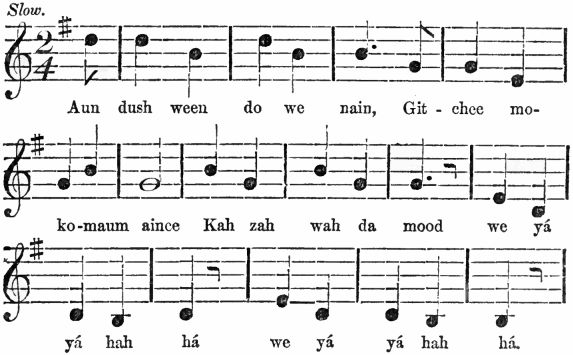
Aun dush ween do we nain, Git-chee mo-ko-maum aince Kah zah wah da mood We yá yá hah há we yá yá hah há. We ah, bem, ah dè, We mah jah need dè, We ne moo, sha yun We yà, yà hah hà! we yà yà hah hà! O mow we mah ne We mah jah need dè, O jib way quaince un nè, We yà, yà hah hà! we yà yà hah hà! Kah ween, goo shah, ween nè, Keesh wan zhe e we ye O gah, mah we mah zeen. We yà, yà hah yà! we yà yà hah hà! Mee goo shah ween e goo Ke bish quah bem ah de Che wah nain ne mah de. We yà, yà hah hà! we yà yà hah hà!
The literal meaning of the song, without the perpetual repetitions and transpositions, is just this:
Hah! what is the matter with the young Long-knife? he crosses the river with tears in his eyes. He sees the young Chippewa girl preparing to leave the place; he sobs for his sweetheart because she is going away, but he will not sigh for her long: as soon as she is out of sight he will forget her!
INDIAN MISSIONS.
I have been too long on the other side of the river; I must return to our Canadian shore, where indeed, I now reside, under the hospitable roof of our missionary. Mrs. MacMurray's overflowing good-nature, cleverness, and liveliness, are as delightful in their way as the more pensive intelligence of her sister.
I have had some interesting talk with Mr. MacMurray on the subject of his mission and the character of the people consigned to his care and spiritual guidance. He arrived here in 1832, and married Charlotte Johnston (O,ge,bu,no,qua) the following year. During the five years which have elapsed since the establishment of the mission, there have been one hundred and forty-five baptisms, seven burials, and thirteen marriages; and the present number of communicants is sixty-six.
He is satisfied with his success, and seems to have gained the good-will and attachment of the Indians around; he owes much, he says, to his sweet wife, whose perfect knowledge of the language and habits of her people have aided him in his task. She is a warm enthusiast in the cause of conversion, and the labour and fatigue of interpreting the prayers and sermons, and teaching the Indians to sing, at one time seriously affected her health. She has a good voice and correct ear, and has succeeded in teaching several of the women and children to sing some of our church hymns very pleasingly. She says all the Indians are passionately fond of music, and that it is a very effective means of interesting and fixing their attention. Mr. MacMurray says, they take the most eager delight in the parables, and his explanations of them—frequently melting into tears. When he collected them together and addressed them, on his first arrival, several of those present were intoxicated, he therefore took the opportunity of declaiming against their besetting vice in strong terms. After waiting till he had finished, one of their chief men arose and replied gravely: "My father, before the white men came, we could hunt and fish, and raise corn enough for our families; we knew nothing of your fire-water. If it is so very bad, why did the white men bring it here? we did not desire it!"
They were in a degraded state of poverty, recklessness, and misery: there is now at least some improvement; about thirty children attend Mrs. MacMurray's school; many of them are decently clothed, and they have gardens in which they have raised crops of potatoes and Indian corn. The difficulty is to keep them together for any time sufficient to make a permanent impression: their wild, restless habits prevail: and even their necessities interfere against the efforts of their teachers; they go off to their winter hunting-grounds for weeks together, and when they return, the task of instruction has to begin again.
One of their chiefs from the north came to Mr. MacMurray, and expressed a wish to become a Christian; unfortunately, he had three wives, and, as a necessary preliminary, he was informed that he must confine himself to one. He had no objection to keep the youngest, to whom he was lately married, and put away the two others, but this was not admissible. The one he had first taken to wife was to be the permitted wife, and no other. He expostulated; Mr. MacMurray insisted; in the end, the old man went off in high dudgeon. Next morning there was no sign of his wigwam, and he never applied again to be "made a Christian," the terms apparently being too hard to digest. "The Roman Catholic priests," said Mr. MacMurray, "are not so strict on this point as we are; they insist on the convert retaining only one wife, but they leave him the choice among those who bear that title."
They have a story among themselves of a converted Indian, who, after death, applied for admittance to the paradise of the white men, and was refused; he then went to the paradise of the Red-skins, but there too he was rejected: and after wandering about for some time disconsolate, he returned to life (like Gitchee Gausinee), to warn his companions by his experience in the other world.
Mr. MacMurray reckons among his most zealous converts several great medicine-men and conjurors. I was surprised at first at the comparative number of these, and the readiness with which they become Christians; but it may be accounted for in two ways: they are in general the most intelligent men in the tribe, and they are more sensible than any others of the false and delusive nature of their own tricks and superstitious observances. When a sorcerer is converted, he, in the first place, surrenders his meta,wa,aun, or medicine-sack, containing his manitos. Mr. MacMurray showed me several; an owl-skin, a wild cat-skin, an otter-skin; and he gave me two, with the implements of sorcery; one of birch-bark, containing the skin of a black adder; the other, an embroidered mink-skin, contains the skin of an enormous rattle-snake (four feet long), a feather died crimson, a cowrie shell, and some magical pebbles, wrapped up in bark—the spells and charms of this Indian Archimago, whose name was, I think, Matabash. He also gave me a drum, formed of a skin stretched over a hoop, and filled with pebbles, and a most portentous looking rattle formed of about a hundred bears' claws, strung together by a thong, and suspended to a carved stick, both being used in their medicine dances.
The chief of this Chippewa village is a very extraordinary character. His name is Shinguaconse, the Little Pine, but he chooses to drop the adjunct, and calls himself the Pine. He is not an hereditary chief, but an elective or war-chief, and owes his dignity to his bravery and to his eloquence; among these people, a man who unites both is sure to obtain power. Without letters, without laws, without any arbitrary distinctions of rank or wealth, and with a code of morality so simple, that upon that point they are pretty much on a par, it is superior natural gifts, strength, and intelligence, that raise an Indian to distinction and influence. He has not the less to fish for his own dinner, and build his own canoe.
Shinguaconse led a band of warriors in the war of 1812, was at Fort Malden, and in the battle of the Moravian towns. Besides being eloquent and brave he was a famous conjuror. He is now a Christian, with all his family; and Mr. MacMurray finds him a most efficient auxiliary in ameliorating the condition of his people. When the traders on the opposite side endeavoured to seduce him back to his old habit of drinking, he told them, "When I wanted it you would not give it to me; now I do not want it you try to force it upon me; drink it yourselves!" and turned his back.
The ease with which liquor is procured from the opposite shore, and the bad example of many of the soldiers and traders are, however, a serious obstacle to the missionary's success. Nor is the love of whisky confined to the men. Mrs. MacMurray imitated with great humour the deportment of a tipsy squaw, dragging her blanket after her, with one corner over her shoulder, and singing, in most blissful independence and defiance of her lordly husband, a song, of which the burden is,—
"The Englishman will give me some of his milk! I will drink the Englishman's milk!"
Her own personal efforts have reclaimed many of these wretched creatures.
Next to the passion for ardent spirits is the passion for gambling. Their common game of chance is played with beans, or with small bones, painted of different colours; and these beans have been as fatal as ever were the dice in Christendom. They will gamble away even their blankets and moccasins; and while the game lasts not only the players but the lookers-on, are in a perfect ecstacy of suspense and agitation.
Mr. MacMurray says, that when the Indians are here during the fishing season from the upper waters of the lake his rooms are crowded with them. Wherever there is an open door they come in. "It is impossible to escape from an Indian who chooses to inflict his society on you, or wishes for yours. He comes at all hours, not having the remotest idea of convenience or inconvenience, or of the possibility of intrusion. There is absolutely no remedy but to sit still and endure. I have them in my room sometimes without intermission, from sunrise to sunset." He added, that they never took anything, nor did the least injury, except that which necessarily resulted from their vile, dirty habits, and the smell of their kinnikinic, which together, I should think, are quite enough. Those few which are now here, and the women especially, are always lounging in and out, coming to Mrs. MacMurray about every little trifle, and very frequently about nothing at all.
Sir John Colborne took a strong interest in the conversion and civilisation of the Indians, and though often discouraged did not despair. He promised to found a village, and build log-houses for the converts here as at Coldwater (on Lake Simcoe); but this promise has not been fulfilled, nor is it likely to be so. I asked, very naturally, "Why, if the Indians wish for log-huts, do they not build them? They are on the verge of the forest, and the task is not difficult." I was told it was impossible; that they neither could nor would!—that this sort of labour is absolutely inimical to their habits. It requires more strength than the women possess; and for the men to fell wood and carry logs were an unheard-of degradation. Mrs. MacMurray is very anxious that these houses should be built because she thinks it will keep her converts stationary. Whether their morality, cleanliness, health and happiness, will be thereby improved, I doubt; and the present governor seems to have very decidedly made up his mind on the matter. I should like to see an Indian brought to prefer a house to a wigwam, and live in a house of his own building; but what is gained by building houses for them? The promise was made however, and the Indians have no comprehension of a change of governors being a change of principles. They consider themselves deceived and ill-treated. Shinguaconse has lately (last January) addressed a letter or speech to Sir Francis Head on the subject, which is a curious specimen of expostulation. "My father," he says; "you have made promises to me and to my children. You promised me houses, but as yet nothing has been performed, although five years are past. I am now growing very old, and to judge by the way you have used me, I am afraid I shall be laid in my grave before I see any of your promises fulfilled. Many of your children address you, and tell you they are poor, and they are much better off than I am in everything. I can say, in sincerity, that I am poor. I am like the beast of the forest that has no shelter. I lie down on the snow, and cover myself with the boughs of the trees. If the promises had been made by a person of no standing, I should not be astonished to see his promises fail. But you, who are so great in riches and in power, I am astonished that I do not see your promises fulfilled! I would have been better pleased if you had never made such promises to me, than that you should have made them and not performed them."
Then follows a stroke of Indian irony.
"But, my father, perhaps I do not see clearly; I am old, and perhaps I have lost my eye-sight; and if you should come to visit us, you might discover these promises already performed! I have heard that you have visited all parts of the country around. This is the only place you have not yet seen; if you will promise to come I will have my little fish (i. e. the white-fish) ready drawn from the water, that you may taste of the food which sustains me."
Shinguaconse then complains, that certain of the French Canadians had cut down their timber to sell it to the Americans, by permission of a British magistrate, residing at St. Joseph's. He says, "Is this right? I have never heard that the British had purchased our land and timber from us. But whenever I say a word, they say, 'Pay no attention to him, he knows nothing.' This will not do!"
He concludes with infinite politeness;
"And now, my father, I shall take my seat, and look towards your place, that I may hear the answer you will send me between this time and spring.
"And now, my father, I have done! I have told you some things that were on my mind. I take you by the hand, and wish you a happy new year, trusting that we may be allowed to see one another again."
AN INDIAN LOVER.
Mrs. Johnston told me that when her children are absent from her, and she looks for their return, she has a sensation, a merely physical sensation, like that she experienced when she first laid them to her bosom; this yearning amounts at times to absolute pain, almost as intolerable as the pang of child-birth, and is so common that the Indians have a word to express it. The maternal instinct, like all the other natural instincts, is strong in these people to a degree we can no more conceive than we can their quick senses. As a cat deprived of its kittens will suckle an animal of a different species, so an Indian woman who has lost her child must have another. "Bring me my son! or see me die!" exclaimed a bereaved mother to her husband, and she lay down on her mat, covered her head with her blanket, and refused to eat. The man went and kidnapped one of the enemy's children, and brought it to her. She laid it in her bosom, and was consoled. Here is the animal woman.
The mortality among the children is great among the unreclaimed Indians, from want of knowing how to treat infantine maladies, and from want of cleanliness. When dysentery is brought on from this cause, the children almost invariably perish. When kept clean, the bark-cradles are excellent things for their mode of life, and effectually preserve the head and limbs of the infant from external injury.
When a young Chippewa of St. Mary's sees a young girl who pleases him, and whom he wishes to marry, he goes and catches a loach, boils it, and cuts off the tail, of which he takes the flat bone, and sticks it in his hair. He paints himself bewitchingly, takes a sort of rude flute or pipe, with two or three stops, which seems to be only used on these amatory occasions, and walks up and down his village, blowing on his flute, and looking, I presume, as sentimental as an Indian can look. This is regarded as an indication of his intentions, and throws all the lodges in which there are young marriageable girls into a flutter, though probably the fair one who is his secret choice is pretty well aware of it. The next step is to make presents to the parents and relatives of the young woman; if these are accepted, and his suit prospers, he makes presents to his intended; and all that now remains is to bring her home to his lodge. He neither swears before God to love her till death—an oath which it depends not on his own will to keep, even if it be not perjury in the moment it is pronounced—nor to endow her with all his worldly goods and chattels, when even by the act of union she loses all right of property; but apparently the arrangements answer all purposes, to their mutual satisfaction.
The names of the women are almost always derived from some objects or appearances in nature, generally of a pleasing kind; the usual termination qua or quay, immediately blending with their signification the idea of womanhood. Thus, my Indian mother is "the green prairie," (woman). Mrs. Schoolcraft's name, Obah,bahm,wa,wa,ge,zhe,go,quà, signifies literally the "sound which the stars make rushing through the sky," and which I translate into the music of the spheres. Mrs. MacMurray is "the wild rose:" one of her youngest sisters is Wah,bu,nung,o,quà, the morning star (woman): another is Omis,ka,bu,go,quà, (the woman of) "the red leaf."
I went to-day to take leave of my uncle Wayish,ky, and found him ill—poor fellow! he is fretting about his younger son. I learn with pleasure that his daughter Zah,gah,see,ga,quà is likely to accompany me to the Manitoolin Islands.
July 31.
This last evening of my sojourn at the Sault-Sainte-Marie, is very melancholy—we have been all very sad. Mr. and Mrs. MacMurray are to accompany me in my voyage down the lake to the Manitoolin Islands, having some business to transact with the governor:—so you see Providence does take care of me! how I could have got there alone, I cannot tell, but I must have tried. At first we had arranged to go in a bark canoe; the very canoe which belonged to Captain Back, and which is now lying in Mr. MacMurray's court-yard: but our party will be large, and we shall be encumbered with much baggage and provisions—not having yet learned to live on the portable maize and fat: our voyage is likely to take three days and a half, even if the weather continues favourable, and if it do not, why we shall be obliged to put into some creek or harbour, and pitch our tent, gipsy fashion, for a day or two. There is not a settlement nor a habitation on our route, nothing but lake and forest. The distance is about one hundred and seventy miles, rather more than less; Mr. MacMurray therefore advises a bateau, in which, if we do not get on so quickly, we shall have more space and comfort,—and thus it is to be.
I am sorry to leave these kind, excellent people, but most I regret Mrs. Schoolcraft.[45]
WE EMBARK ON LAKE HURON.
August 1.
The morning of our departure rose bright and beautiful, and the loading and arranging our little boat was a scene of great animation. I thought I had said all my adieus the night before, but at early dawn my good Neengai came paddling across the river with various kind offerings for her daughter Wa,sàh,ge,wo,nò,quá, which she thought might be pleasant or useful, and more last affectionate words from Mrs. Schoolcraft. We then exchanged a long farewell embrace, and she turned away with tears, got into her little canoe, which could scarcely contain two persons, and handling her paddle with singular grace and dexterity, shot over the blue water, without venturing once to look back! I leaned over the side of our boat, and strained my eyes to catch a last glimpse of the white spray of the rapids, and her little canoe skimming over the expanse between, like a black dot: and this was the last I saw of my dear good Chippewa mamma!
Meantime we were proceeding rapidly down the beautiful river, and through its winding channels. Our party consisted of Mr. and Mrs. MacMurray and their lovely boy; myself; and the two Indian girls—my cousin Zah,gah,see,ga,quà, and Angelique, the child's attendant.
These two girls were, for Indians, singularly beautiful; they would have been beautiful anywhere. Angelique, though of unmixed Indian blood, has a face of the most perfect oval, a clear brown complexion, the long, half-shaded eye, which the French call coupé en amande; the nose slightly aquiline, with the proud nostril open and well defined; dazzling teeth;—in short, her features had been faultless, but that her mouth is a little too large—but then, to amend that, her lips are like coral: and a more perfect figure I never beheld. Zah,gàh,see,ga,quà is on a less scale, and her features more decidedly Indian.
We had a small, but compact and well-built boat, the seats of which we covered with mats, blankets, buffalo skins, cloaks, shawls, &c.: we had four voyageurs, Masta, Content, Le Blanc, and Pierrot; a very different set from those who brought me from Mackinaw: they were all Canadian voyageurs of the true breed, that is, half-breed, showing the Indian blood as strongly as the French. Pierrot, worthy his name, was a most comical fellow; Masta, a great talker, amused me exceedingly; Content was our steersman and captain; and Le Blanc, who was the best singer, generally led the song, to which the others responded in chorus.
They had a fixed daily allowance of fat pork, Indian meal, and tobacco: finding that the latter was not agreeable to me, though I took care not to complain, they always contrived with genuine politeness to smoke out of my way, and to leeward.
VOYAGE DOWN LAKE HURON.
After passing Sugar Island, we took the channel to the left, and entered the narrow part of the lake between St. Joseph's Island and the mainland. We dined upon a small picturesque islet, consisting of ledges of rock, covered with shrubs and abounding with whortleberries; on the upper platform we arranged an awning or shade, by throwing a sail over some bushes, and made a luxuriant dinner, succeeded by a basin of good tea; meantime, on the rocky ledge below, Pierrot was making a galette, and Masta frying pork.
Dinner being over, we proceeded, coasting along the north shore of St. Joseph's Island. There is, in the interior, an English settlement, and a village of Indians. The principal proprietor, who is a magistrate and justice of the peace; has two Indian women living with him—two sisters, and a family by each!—such are the examples sometimes set to the Indians on our frontiers.
In the evening we came to an island consisting of a flat ledge of rock, on which were the remains of a former camp-fire, surrounded by tall trees and bushes: here we pitched our little marquee, and boiled our kettle. The sun-set was most glorious, with some floating ominous clouds. The stars and the fire-flies came out together: the latter swarmed around us, darting in and out among the trees, and gliding and sparkling over the surface of the water. Unfortunately the mosquitoes swarmed too, notwithstanding the antipathy which is said to exist between the mosquito and the fire-fly. We made our beds by spreading mats and blankets under us; and then, closing the curtain of the tent, Mr. MacMurray began a very effective slaughter and expulsion of the mosquitoes. We laid ourselves down, Mrs. MacMurray in the middle, with her child in her bosom; Mr. MacMurray on one side, myself at the other, and the two Indian girls at our feet: the voyageurs, rolled in their blankets, lay down on the naked rock round the fire we had built—and thus we all slept. I must needs confess that I found my rocky bed rather uneasy, and my bones ached as I turned from side to side, but this was only a beginning. The night was close and sultry, and just before dawn I was wakened by a tremendous clap of thunder; down came the storm in its fury, the lake swelling and roaring, the lightning gambolling over the rocks and waves, the rain falling in a torrent; but we were well sheltered, for the men had had the precaution, before they slept, to throw a large oil cloth over the top of our little marquee. The storm ceased suddenly: daylight came, and soon afterwards we again embarked. We had made forty-five miles.
BREAKFAST AT RATTLESNAKE ISLAND.
The next morning was beautiful: the sun shone brightly, though the lake was yet heaving and swelling from the recent storm,—altogether it was like the laughing eyes and pouting lips of a half-appeased beauty. About nine o'clock we ran down into a lovely bay, and landed to breakfast on a little lawn surrounded by high trees and a thick wood, abounding in rattlesnakes and squirrels. Luckily for us, the storm had dispersed the mosquitoes.
Keeping clear of the covert to avoid these fearful snakes, I strayed down by the edge of the lake, and found a tiny creek, which answered all purposes, both of bath and mirror, and there I arranged my toilette in peace and security. Returning to our breakfast-fire, I stood some moments to admire the group around it—it was a perfect picture: there lay the little boat rocking on the shining waves, and near it Content was washing plates and dishes; Pierrot and Masta were cooking; the two Indian girls were spreading the tablecloth on the turf. Mrs. MacMurray and her baby—looking like the Madonna and child in the "Repose in Egypt,"—were seated under a tree; while Mr. MacMurray, having suspended his shaving-glass against the trunk of a pine, was shaving himself with infinite gravity and sang froid. Never, I think, were the graceful, the wild, the comic, so strangely combined!—add the rich background of mingled foliage, the murmur of leaves and waters, and all the glory of a summer morning!—it was very beautiful!