SPALATO TO CATTARO.
Reading edition
SPALATO TO CATTARO.
1875.
[I have not thought it needful to strike out of this paper a few allusions to the times when it was written, the early days of the revolt in Herzegovina with which the war of 1875-1878 began.]
As Spalato must be looked on as the great object of a Dalmatian voyage, it may also be looked on as its centre. After Spalato the coast scenery changes its character in a marked way. Hitherto hills, comparatively low and utterly barren, come down straight to the sea, while the higher mountains are seen only farther inland. From this point the great mountains themselves come nearer to the water. We are thus reminded of the change in the political boundary, how from this point the Hadriatic territory of Austria and of Christendom becomes narrower and narrower, till we reach the stage when the old dominion of Ragusa becomes a mere fringe between the sea and the Turk, fenced in from the former land of Saint Mark by the two points at either end where the less dangerous infidel was allowed to spread himself to the actual sea-board. But as the mountains come nearer to the sea, a fringe of cultivation, narrower or wider, now spreads itself between them and the water. Small towns and villages, detached houses, land tilled with the vine and the olive, now skirt the bases of the mountains, in marked contrast to the mere stony hills of the earlier part of the voyage. The islands too among whose narrow channels we have to make our way change their character also. After Spalato, instead of mere uninhabited rocks, we come to islands of greater size, some of them thirty or forty miles long, islands several of which have a distinct place in history, islands containing towns and cities, and which are still seats of industry and cultivation. These are the islands which give such a marked character to the map of this part of the Hadriatic, and they form the most marked feature in the fourth day's voyage of the course from Trieste to Cattaro. The endless islands which we have seen along the northern part of the Dalmatian shore, bare and uninhabited rocks as many of them are, are without history. Some of the Croatian islands indeed have somewhat of a history; but with these we are not dealing; the barren archipelago of Zara could never have had any tale to tell. First we pass through the channel which divides the mainland from the large island of Brazza, distinguished at a glance by its solid shape from its endless long and narrow fellows. Dreary and rocky as it seems, it is the most populous and industrious of the group, and at one point of its coast, San Pietro, the steamer makes a short halt. So it does at the picturesque little port of Almissa on the mainland, a nest of houses and trees at the mountain's foot, standing so invitingly as to make the traveller wish for a longer sojourn. Then comes Makarska, where we are allowed a short glimpse of the little hill-side town, smaller and more Dalmatian than any that we have yet seen. Presently we plunge into the full intricacies of the Dalmatian seas. We pass through the narrow channel which parts the mainland from the eastern promontory of the long, slender island of Lesina—the awl. Here we come within old Hellenic memories. We are now within the full range of Greek colonization, though of Greek colonization only in its latest stage. Issa, now Lissa, Black Korkyra, now Curzola, amongst the islands, and Epidauros on the mainland, were all of them undoubted Greek settlements. But Issa and Pharos, the only ones to which we can fix a positive date, were colonized only in the first half of the fourth century, and Dionysios of Syracuse had a hand in their colonization. Lesina is Pharos, the ancient colony of the Ægæan Paros, whose name still lives on Slavonic lips in the shape of Far or Hvar. It plays a considerable part in the history of Polybios, as the island of that Dêmêtrios whose crooked policy formed an important element in the affairs of mankind in the days when Greek and Roman history began to flow together into one stream. These islands form one of the highways by which Rome advanced to the possession of Illyricum, Macedonia, and Greece. But we see neither the ancient nor the modern city, neither Pharos nor Lesina; we merely skirt the island to find ourselves in the channel of Narenta. That name suggests yet another pirate power, later than that of Tenta and Dêmêtrios, that power of the old Pagania against which Venice, in her early days, had to wage so hard a struggle. We seem to be pressing on between the mainland and a long, slender, mountainous island; but our course suddenly turns; the seeming island is no other than the long peninsula of Sabioncello, a peninsula not Venetian but Ragusan. We get merely a glimpse down the gulf, at the end of which Turkish Klek once divided the possessions of the two maritime commonwealths, and still, nominally at least, breaks the continuity of Austrian dominion. But, if the peninsula was Ragusan, a narrow channel only parts it from an island which was a chief seat of the power of the rival city. We skirt the western horn of Sabioncello, and another turn leads us through the channel—narrower than any through which we have passed—which divides it from Curzola, Black Korkyra of old. We stop for a little while off the island capital, the fortress of Curzola, which was to the declining navy of Venice what Pola now is to the rising navy of Austria. This channel passed, we come to the last of the great islands. For miles and miles we skirt the Ragusan island of Meleda, long, slender, with its endless hills of no great height standing up like the teeth of a saw—a true sierra in miniature. Here volumes of scriptural controversy are open to us. As we are not tossed up and down in Hadria, but are floating along as on a lake or a river, we muse on the claims which all local and some independent authorities have set up for Illyrian Meleda, as against Phœnician Malta, to be the true seat of the shipwreck of Saint Paul. But Meleda can have its claims admitted only on the condition of being shut out from Hellenic fellowship, even though its barbarians were of a mood which led them to show no little kindness to strangers. It is hard also to understand how those who were making their way from Meleda to any point of Italy could have any possible business at Syracuse. At all events, with Meleda the island history ends, though the island scenery does not end as yet. Several islands, smaller than these more famous ones, but not so small as they look on the map, fringe the coast till we enter the haven of Gravosa, the port of modern Ragusa, with its thickly wooded shores, a marked contrast to the bleakness and barrenness of so many other points of the Dalmatian coast.
Ragusa, the city of argosies, the commonwealth which so long was the rival of Venice and which never stooped to be her subject, so thoroughly suggests maritime enterprise by her very name, that we are surprised to find that Ragusa herself has ceased to be a port of any moment. Her mighty walls, her castles, her more distant forts, still rise out of the sea, and the mightier wall of mountains just behind her still fence off her land, as the narrowest rim of Christendom, from the land of the infidel beyond. All this is as it was; modern military art has added to the defences of Ragusa, but it has not taken away her elder bulwarks. But her haven is now of the very smallest, and admits only vessels of the smallest size. The modern haven is at Gravosa, and the road which Sir Gardner Wilkinson describes as so well kept, but as useless because no carriages went upon it, is still as good and more useful. At this moment Ragusa bears the honourable character of a city of refuge for the unhappy ones who seek shelter under the government of a civilized state from the barbarian rule beyond the mountains. Her suburbs are crowded with women and children flying from the seat of war, for whom the charity both of the state and of private persons is doing much, but whose sufferings—as one who has seen them can bear witness—cry for the sympathy and help of all who have hearts and who have not invested in Turkish bonds. As we pass by and look on the city—no city surely fronts the sea more proudly than Ragusa—as we turn round to the island of La Croma, lying off what was Ragusa's harbour, the island which suggests the names of Richard of Poitou and of Maximilian of Mexico—the scene is so peaceful and lovely, the warlike defences look such mere things of the past, that it is hard indeed to believe that, just beyond the mountain barrier, warfare is going on in its bitterest and yet its noblest form—the struggle of an oppressed people to cast off the yoke of ages. This form of speech may grate somewhat on the received phrases of Western diplomacy; but, however we might be bound to write in England, in Dalmatia—so close to the facts—we may be allowed to write as all men in Dalmatia think and speak. We pass La Croma, and our time among the islands is over; no other that can be called more than a mere rock meets us between Ragusa and Cattaro. At last we enter the loveliest of inlets of the sea, the Bocche di Cattaro. A narrow strait leads us between points of land which were once Ragusan on the west and Venetian to the east, into the winding gulf, girded by mountains, and now for nearly its whole extent fringed by towns, villages, houses, cultivation in every form—a land where the sublimity of the rugged mountain has come into close partnership with the loveliness of the smiling dwelling-places of man. As we pass through the strait, a piece of barren mountain to the left marks the second piece of territory where the Turk was allowed to isolate the two commonwealths, and where, in name, his dominion still reaches to the shore of the lovely gulf. We pass on, as on the smoothest of lakes, round mountain headlands, with their rich fringe of life, by towns and villages, many of which have their own local history both in earlier and later times, till we reach the most distant of Dalmatian cities, Cattaro at the innermost point of her own unrivalled Bocche. Hemmed in between the mountains and the sea—though it seems almost strange to apply the word sea to the gentle waters of her harbour—with the mountains again rising on the other side, Cattaro seems indeed to be the end of its own world. Yet in the days of Venetian greatness, Cattaro was far indeed from being the last point of the dominion of Saint Mark. Climb the heights above the city, and the eye stretches far away along the Albanian coast, a coast along which many a city and island once bowed to the winged lion, till in fancy we track our course, as by stepping stones along the sea, to distant Crete and to more distant Cyprus.
Cattaro, the end of the outward journey, will also be the beginning of the journey back again. The little town, with its narrow paved streets, its little piazze, still keeps up the same Venetian tradition as elsewhere. And the walls of the fortress climbing far up the mountain show how firm was the grasp of the ruling city over its subjects. But at Cattaro and throughout the Bocche another feature strikes us which we do not see either at Spalato or at Ragusa. The churches do not all belong to one denomination; the Eastern, the Orthodox, Church, holds its own in this corner of Venetian or Austrian rule at least as firmly as its Latin rival. The fact is, what is forced upon our notice at every step, that, the further we go along this coast, the Italian element dies out and the Slavonic element grows. It is so in language, in dress, in everything. Zara, Spalato, Ragusa, Cattaro, each city is less and less Italian according to its geographical position. The inland country is, of course, Slave throughout. But at Cattaro the Slave element distinctly predominates, even in the town; Italian can hardly be said to be more than the best known among foreign languages. The pistol and yataghan worn in the belt, a general costume essentially the same as that of the Montenegrin, has gradually been growing upon us; here in Cattaro it is the rule, almost more than the rule. In short, the Bocchese, the Montenegrin, the Turkish rayah of Herzegovina, really differ in nothing but the difference of their political destinies. They are members of the same immediate family, whose fortunes have led them in three different directions. Now the religious tendency of the south-eastern Slaves, as is only natural from their geographical position, has always been towards the Eastern Church rather than the Western, towards the New Rome rather than towards the Old. Here, where the Slavonic element is so distinctly the stronger, the religious developement has taken its natural course, and the Orthodox population in Cattaro and all the coasts thereof is always a large minority, and in some places it actually outnumbers the Latins.
We have professed to give only the impressions of the outward voyage, though our account may have here and there been influenced by later impressions drawn from fuller observation on the way back. But the way back, and the fuller knowledge gained in its course, only brings out more strongly the intense charm of Dalmatian coast and mountain scenery, fitly united with the deep historic interest of cities which, though they seem to form a world apart by themselves, have played their part in the world's history none the less. No one can visit Dalmatia once without a wish that his first visit may not be his last; no one can take a glimpse of any of her cities without the desire that the glimpse may be only the forerunner of more perfect knowledge.
CURZOLA.
1881.
We part from Spalato; by the time that we have made two or three voyages in these seas, we shall find that there are several ways of reaching and parting from Spalato. We speak of course of ways by sea; by land there is but one way, and that way leads only to and from places at no great distance, and it does not lead to or from any place in the direction in which we are now bent. By sea the steamer takes two courses. One keeps along the mainland, that which allows a glimpse of the little towns of Almissa and Makarska, both nestling by the water's edge at the mountain's foot. Of these Almissa at least has an historical interest. Here Saint Mark was no direct sovereign; his lion, if we rightly remember, is nowhere to be seen, a distinction which, along this whole line of coast, Almissa alone shares with greater Ragusa. Was it a commonwealth by itself, cradled on the channel of Brazza like Gersau on the Lake of the Four Cantons? Or was it the haven of the inland commonwealth of Polizza, which, like Gersau and a crowd of other commonwealths, perished at the hands of their newborn French sister for the unpardonable crime of being old? But far more interesting is the other route of the steamers, that which leads us among the greater islands. Here, as soon as we pass Spalato, as soon as we pass the greatest monument of the dominion of Rome, we presently find ourselves in a manner within the borders of Hellas. We pass between Brazza and Solta, we skirt Lesina and think once more of its old Parian memories. We look out on Lissa, where the Hellenic name lives on with slighter change, but we are more inclined to dwell on those later memories which have made its name an unlucky one in our own day, a far luckier one in the days of our grandfathers. At last we make our first halt for study where a narrow strait divides the mainland, itself all but an island, from another ancient seat of Greek settlement, the once renowned isle of Curzola.
Curzola—such is its familiar Italian form—is the ancient Black Korkyra, and on Slavonic lips it still keeps the elder name in the shape of Kerker. But the sight of ἡ μέλαινα Κόρκυρα suggests a question of the same kind as that which the visitor is driven to ask on his first sight of Montenegro. How does a mass of white limestone come to be called the Black Mountain? Curzola can hardly be called a mass of white limestone; but the first glance shows nothing specially black about it, nothing to make us choose this epithet rather than any other to distinguish this Hadriatic Korkyra from the more famous Korkyra to the south. That some distinguishing epithet is needed is shown by the fact that, not so very long ago, a special correspondent of the Times took the whole history of Corfu and transferred it bodily to Curzola. The reason given for the name is the same in Curzola and in Montenegro. The blackness both of the island and of the mountain is the blackness of the woods with which they are covered. True the traveller from Cattaro to Tzetinje sees no woods, black or otherwise; but he is told that the name comes from thick woods on the other side of the principality. So he is told that Black Korkyra was called from its thick woods, its distinctive feature as compared with the many bare islands in its neighbourhood. But no black woods are now to be seen in that part of the island which the traveller is most likely to see anything of. There were such, he is told; but they have been cut down on this side, while on the other side they still flourish. As things are now, Curzola is certainly less bare than most of its fellows; but the impression which it gives us is, of the two, rather that of a green island than of a black one. It is not green in the sense of rich verdure, but such trees as show themselves give it a look rather green than black. At any rate, the island looks both low and well-covered, as compared with the lofty and rocky mountains of the opposite peninsula of Sabioncello. The two are at one point, and that a point close by the town of Curzola, separated by a very narrow strait. And the nearness of the two formed no inconsiderable part of their history. There was a time when Curzola must have been, before all things, a standing menace to Sabioncello, and to the state of which Sabioncello formed an outpost. Sabioncello, the long, narrow, stony peninsula, all backbone and nothing else, formed part of the dominions of the commonwealth of Ragusa. Curzola was for three centuries and a half a stronghold of that other commonwealth which Ragusa so dreaded that she preferred the Turk as her neighbour. Nowhere does the winged lion meet us more often or more prominently than on the towers and over the gates of Curzola. And no wonder; for Curzola was the choice seat of Venetian power in these waters, her strong arsenal, the place for the building of her galleys. If Aigina was the eyesore of Peiraieus, Curzola must have been yet more truly the eyesore of Sabioncello.
It is only of what must have been the special eyesore of its Ragusan neighbours, of the fortified town of Curzola and of a few points in its near neighbourhood, that we can now speak. Curzola is one of the larger Dalmatian islands; and it is an island of some zoological interest. It is one of the few spots in Europe where the jackal still lingers. Perhaps there is no other, but, as we have heard rumours of like phænomenon in Epeiros, a decided negative is dangerous. We believe that, according to the best scientific opinion, "lingered" is the right word. The jackal is not an importation from anywhere else into Curzola; he is an old inhabitant of Europe, who has kept his ground in Curzola after he has been driven out of other places. But he who gives such time as the steamer allows him in the island to the antiquities of the town of Curzola need cherish no hope or fear of meeting jackals. He might as soon expect to meet with a horse. For, true child of Venice, Curzola knows neither horse nor carriage. Horses and carriages are not prominent features in any of the Dalmatian towns; but they may be seen here and there. They are faintly tolerated within the walls of Ragusa, and we have certainly seen a cart in the streets of Zara. But at Curzola they are as impossible as at Venice itself, though not for the same reason. Curzola does not float upon the waters; it soars above them. The Knidian emigrants chose the site of their town in the true spirit of Greek colonists. It is such another site as the Sicilian Naxos, as the Epidauros of the Hadriatic, as Zara too and Parenzo, though Zara and Parenzo can lay no claim to a Greek foundation. The town occupies a peninsula, which is joined to the main body of the island by a narrow isthmus. The positive elevation is slight, but the slope close to the water on each side is steep. From the narrow ridge where stands the once cathedral church, the streets run down on each side, narrow and steep, for the most part ascended by steps. The horses of the wave are the only steeds for the men of Black Korkyra, and those steeds they have at all times managed with much skill. The seafaring habits of the people take off in some measure from the picturesque effect of the place. There is much less to be seen, among men at least, of local costume at Curzola than at other Dalmatian towns. We miss the Morlacchian turbans which become familiar at Spalato; we miss the Montenegrin coats of the brave Bocchesi, which fill the streets of Cattaro, not without a meaning. Seafaring folk are apt to wear the dress of their calling rather than that of their race, and the island city cannot be made such a centre for a large rural population as the cities on the mainland. But, if the men to be seen at Curzola are less picturesque than the men to be seen at Spalato or Ragusa, their dwellings make up for the lack. Curzola is a perfect specimen of a Venetian town. It is singular how utterly everything earlier than the final Venetian occupation of 1420 has passed away. The Greek colonist has left no sign of himself but the site. Of Roman, of earlier mediæval, times there is nothing to be seen beyond an inscription or two, one of which, a fragment worked into the pavement of one of the steep streets, records the connexion which once was between Curzola and Hungary. With præ-Venetian inscriptions we may class one which is post-Venetian, and which records another form of foreign dominion, one which may be classed with that of Lewis the Great as at least better than those which went between them. From 1813 to 1815—a time memorable at Curzola as well as at Cattaro—the island was under English rule, and the time of English rule was looked on as a time of freedom, compared with French rule before or with Austrian rule both before and after. It is not only that an official inscription speaks of the island as "libertate fruens" at the moment when the connexion was severed; we believe that we are justified in saying that those two years live in Black-Korkyraian memory as the one time for many ages when the people of Black Korkyra were let alone.
The formerly cathedral church is the only building in the town of Curzola which suggests any thought that it can be older than 1420. Documentary evidence, we believe, is scanty, and contains no mention of the church earlier than the thirteenth century. In England we should at first sight be tempted to assign the internal arcades to the latter days of the twelfth; but the long retention of earlier forms which is so characteristic of the architecture of this whole region makes it quite possible that they may be no earlier than the Venetian times to which we must certainly attribute the west front. Setting aside a later addition to the north, which is no improvement, this little duomo consists of a nave and aisles of five bays, ending in three round apses. Five bays we say, though on the north side there are only four arches; for the tower occupies one at the west end. The inner arcades and the west doorway are worthy of real study, as contributions to the stock of what is at any rate singular in architecture; indeed a more honourable word might fairly be used. The arcades consist of plain pointed arches rising from columns with richly carved capitals, and, like so many columns of all ages in this region, with tongues of foliage at their bases. Above is a small triforium, a pair of round arches over each bay; above that is a clerestory of windows which within seem to be square, but which outside are found to be broad pointed lancets with their heads cut off. In England or France such a composition as this would certainly, at the first sight of its general effect, be set down as belonging to the time of transition between Romanesque and Gothic, to the days of Richard of Poitou and Philip Augustus. And the proportions are just as good as they would be in England or France; there is not a trace of that love of ungainly sprawling arches which ruins half the so-called Gothic churches of Italy. But, when we look at the capitals, we begin to doubt. They are singularly rich and fine; but they are not rich and fine according to any received pattern. They are eminently not classical; they have nothing more than that faint Corinthian stamp which no floriated capital seems able quite to throw away; they do not come anything like so near to the original model as the capitals at Canterbury, at Sens, or even at Lisieux. But neither do they approach to any of the received Romanesque or Byzantine types, nor have they a trace of the freedom which belongs to the English foliage of days only a little later. They are more like, though still not very much like, our foliage of the fourteenth century; there is a massiveness about them, a kind of cleaving to the shape of the block, which after all has something Byzantine about it. Those on the north side have figures wrought among the foliage; the four responds have the four evangelistic symbols. Here then we cannot fail to find the lion of Saint Mark, but we find him only in his place as one of a company of four. Would the devotion of the Most Serene Republic have allowed its patron anywhere so lowly a place as this to occupy? Otherwise the character of the capitals, which extends to the small shafts in the triforium, might tempt us to assign a far later date to these columns and arches than their general effect would suggest. But at all events they are thoroughly mediæval; there is not the faintest trace of Renaissance about them.
Outside the church, the usual mixed character of the district comes out more strongly. The addition to the north, and the tower worked in instead of standing detached, go far to spoil what would otherwise be a simple and well-proportioned Italian front. Both the round window—of course there is a round window—and the great doorway are worthy of notice. The window is not a mere wheel; the diverging lines run off into real tracery, such as we might see in either England or France. The doorway is a curious example of the way in which for a long time in these regions, the square head, the round arch, and the pointed arch, were for some purposes used almost indifferently. The tradition of the square-headed doorway with the arched tympanum over it never died out. We may believe that the mighty gateways and doorways of Diocletian's palace set the general model for all ages. But when the pointed arch came in, the tympanum might be as well pointed as round. Sometimes the pointed tympanum crowns a thoroughly round-headed doorway, and is itself crowned with a square spandril, looking wonderfully like a piece of English Perpendicular. In the west doorway at Curzola things do not go quite to such lengths as this; but they go a good way. The square doorway is crowned by a pointed tympanum, containing the figure of a bishop; over that again is a kind of canopy. This is formed of a round arch, springing from a pair of lions supported on projections such as those which are constantly used, specially at Curzola, for the support of balconies. The lions which in many places would have supported the columns of the doorway seem, though wingless, to have flown up to this higher post. For here the doorway has nothing to be called columns, nothing but small shafts, twisted and otherwise, continued in the mouldings of the arch. The cornice under the low gable is very rich; the tower is of no great account, except the parapet, and the octagon and cupola which crown it, a rich and graceful piece of work of that better kind of Renaissance which we claim as really Romanesque.
In the general view of the town from the sea this tower counts for more than it does when we come close up to it in the nearest approach to a piazza which Curzola can boast. It is the crown of the whole mass of buildings rising from the water. At Curzola the fortifications are far more to the taste of the antiquary than they are at Ragusa; they fence things round at the bottom, instead of hiding everything from the top. We may shut our eyes to a modern fort or two on the hills; the walls of the town itself, where they are left, are picturesque mediæval walls broken by round towers, on some of which the winged lion does not fail to show himself. He presides again over a loggia by the seashore, one of those buildings with nondescript columns, which may be of any date, which most likely are of very late date, but which, because they are simply straightforward and sensible, are pleasing, whatever may be their date. Here they simply support a wooden roof, without either arch or entablature. And while we are seated under the lion in the loggia, we may look down at another lion in a sculptured fragment by the shore, in company with a female half-figure, something of the nature of a siren, Nereid, or mermaid, who seems an odd yoke-fellow for the Evangelist. He seems more in his natural place over the gate by which we shall most likely enter the town, a gate of 1643, itself square-headed, but with pointed vaulting within. Its inscriptions do not fail to commemorate the Trojan Antênor as founder of Black Korkyra, along with a more modern ruler, the Venetian John-Baptist Grimani. To the right hand, curiosity is raised by a series of inscriptions which have been carefully scratched out. About them there are many guesses and many traditions. One cannot help thinking that the deed was more likely to be done by the French than by the Austrian intruder. To scratch out an inscription is a foolish and barbarous act; but it implies an understanding of its meaning and a misapplied kind of vigour, which, of the two stolen eagles, was more likely to flourish under the single-headed one. The double-headed pretender, by the way, though he is seen rather too often in these parts, is seldom wrought in such lasting materials as Saint Mark's lion. So, when the good time comes, the stolen badge of Empire may, at Curzola as at Venice and Verona, pass away and be no more seen, without any destruction of monuments, old or new.
We are now fairly in the town. The best way to see Curzola thoroughly is for the traveller to make his way how he will to the ridge of the peninsula, and then systematically to visit the steep and narrow streets, going in regular order down one and up another. There is not one which does not contain some bit of domestic architecture which is well worth looking at. But he should first walk along the ridge itself from the gate by the isthmus to the point where the ground begins to slope to the sea opposite Sabioncello. Hard by the gate is the town-hall, Obcina, as it is now marked in the native speech. The mixed style—most likely of the seventeenth century—of these parts comes out here in its fulness. Columns and round arches which would satisfy any reasonable Romanesque ideal, support square windows which are relieved from ugliness by a slight moulding, the dentel—akin to our Romanesque billet—which is seen everywhere. But in a projecting building, which is clearly of a piece with the rest, columns with nondescript capitals support pointed arches. Opposite to the town-hall is one of the smaller churches, most of which are of but little importance. This one bears the name of Saint Michael, and is said to have formerly been dedicated to Orthodox worship. It shows however no sign of such use, unless we are to count the presence of a little cupola over the altar. We pass along the ridge, by a house where the projection for balconies, so abundant everywhere, puts on a specially artistic shape, being wrought into various forms, human and animal. Opposite the cathedral the houses display some characteristic forms of the local style, and we get more fully familiar with them, as we plunge into the steep streets, following the regular order which has been already prescribed. Some graceful scrap meets us at every step; the pity is that the streets are so narrow that it needs some straining of the neck to see those windows which are set at all high in the walls. For it is chiefly windows which we light upon: very little care seems to have been bestowed on the doorways. A square or segmental-headed doorway, with no attempt at ornament, was thought quite enough for a house for whose windows the finest work of the style was not deemed too good. Indeed the contrasts are so odd that, in the finest house in Curzola, in one of the streets leading down eastward from the cathedral, a central story for which magnificent would not be too strong a word is placed between these simple doorways below and no less simple square-headed windows above. This is one of the few houses in Curzola where the windows are double or triple divided by shafts. Most of the windows are of a single light, with a pointed, an ogee, or even a round head, but always, we think, with the eminently Venetian trefoil, and with the jambs treated as a kind of pilaster. With windows of this kind the town of Curzola is thick-set in every quarter. We may be sure that there is nothing older than the Venetian occupation, and that most of the houses are of quite late date, of the sixteenth and even the seventeenth century. The Venetian style clave to mediæval forms of window long after the Renaissance had fully set in in everything else. And for an obvious reason; whatever attractions the Renaissance might have from any other point of view, in the matter of windows at least it hopelessly failed. In the streets of Curzola therefore we meet with an endless store of windows, but with little else. Yet here and there there are other details. The visitor will certainly be sent to see a door-knocker in a house in one of the streets on the western slope. There Daniel between two lions is represented in fine bronze work. And some Venetian effigies, which would doubtless prove something for local history, may be seen in the same court. Of the houses in Curzola not a few are roofless; not a few have their rich windows blocked; not a few stand open for the visitor to see their simple inside arrangements. The town can still make some show on a day of festival; but it is plain that the wealth and life of Curzola passed away when it ceased to be the arsenal of Venice. And poverty has one incidental advantage; it lets things fall to ruin, but it does not improve or restore.
Two monasteries may be seen within an easy distance of the town. That of Saint Nicolas, approached by a short walk along the shore to the north-west, makes rather an imposing feature in the general view from the sea; but it is disappointing when we come near. Yet it illustrates some of the local tendencies; a very late building, as it clearly is, it still keeps some traces of earlier ideas. Two equal bodies, each with a pointed barrel-vault, might remind us of some districts of our own island, and, with nothing else that can be called mediæval detail, the round window does not fail to appear. The other monastery, best known as the Badia, once a house of Benedictines, afterwards of Franciscans, stands on a separate island, approached by a pleasant sail. The church has not much more to show than the other; but it too illustrates the prevalent mixture of styles which comes out very instructively in the cloister. This bears date 1477, as appears from an inscription over one of its doors. But this doorway is flat-headed and has lost all mediæval character, while the cloister itself is a graceful design with columns and trefoil arches, which in other lands one would attribute to a much earlier date. The library contains some early printed books and some Greek manuscripts, none seemingly of any great intrinsic value. A manuscript of Dionysios Periêgêtês is described as the property of the Korkyraian Nicolas and his friends. (Νικολάου Κερκυραίου καὶ τῶν φίλων. ) Nicolas had a surname, but unluckily it has passed away from our memory and from our notes. But the local description which he has given of himself makes us ask, Did the book come from Corfu, or did any citizen of Black Korkyra think it had a learned look so to describe himself?
On the staircase of the little inn at Curzola still hangs a print of the taking of the arsenal of Venice by the patriots of 1848. Strange that no Imperial, Royal, and Apostolic official has taken away so speaking a memorial of a deed which those who commemorate it would doubtless be glad to follow.
RAGUSA.
1875—1877—1881.
The voyage onward from Curzola will lead, as its next natural stopping-place, to Ragusa. At Curzola, or before he reaches Curzola, the traveller will have made acquaintance with what was once the territory of the Ragusan commonwealth, in the shape of the long peninsula of Sabioncello. He will have seen how all the winged lions of Curzola look out so threateningly towards the narrow tongue of land which bowed to Saint Blaise and not to Saint Mark. He will pass by Meleda, that one among the larger islands which obeyed Ragusan and not Venetian rule. After Meleda the islands cease to be the most important features in the geography or in the prospect. They end, so far as they give any character to the scene, in the group which lies off the mouth of the inlet of Gravosa and Ombla, the ordinary path to Ragusa. But he who would really take in the peculiar position of Ragusa will do well to pass by the city on his outward voyage, to go on to Cattaro, and to take Ragusa on the way back. The wisdom of so doing springs directly out of the history of the city. The haven, which is said—and we have no better derivation to suggest—to have given its name to argosies, could certainly not give shelter to a modern argosy. Nothing but smaller craft now make their way to Ragusa herself; steamers and everything else stop at the port of Gravosa. It has been only quite lately, long since the earlier visits which gave birth to the present sketches, that Ragusan enterprise has so far again awakened as to send a single steamer at long intervals from the true Ragusan haven to Trieste. He therefore who visits Ragusa on his outward voyage has to land at Gravosa and to make his way to Ragusa by land. He thus loses the first sight of the city from the sea which he has had at Zara and Spalato, and which at Ragusa is, setting special associations aside, even more striking than at Zara and Spalato. Before he sees Ragusa from the water, as Ragusa was made to be seen, he has already made acquaintance with the city in a more prosaic fashion. He will not indeed have had his temper soured by the inconveniences which Sir Gardner Wilkinson had to put up with more than thirty years ago. There is no more delay at the gate of Ragusa, there is no more difficulty in finding a carriage to take the traveller from Gravosa to Ragusa, than there is in the most frequented regions of the West. Still, in such a case, the traveller sees Ragusa for the first time from the land, and Ragusa of all places ought to be seen for the first time from the sea. Seen in this way, the general effect of Ragusa is certainly more striking than that of any other Dalmatian city; and it is so in some measure because the effect of Ragusa, whether looked at with the bodily eye or seen in the pages of its history, is above all things a general effect. There is not, as there is at Zara and at Spalato, any particular moment in the history of the city, any particular object in the city itself, which stands out prominently above all others. We draw near to Zara, and say, "There is the city that was stormed by the Crusaders," and, though we find much at Zara to awaken interest on other grounds, the crusading siege still remains the first thing. We draw near to Spalato; we see the palace and the campanile, and round the palace and the campanile everything gathers. We draw near to Ragusa; the eye is struck by no such prominent object; the memory seizes on no such prominent fact. But there is Ragusa; there is the one spot along that whole coast from the Croatian border to Cape Tainaros itself, which never came under the dominion either of the Venetian or of the Turk. Ragusa will be found at different times standing in something like a tributary or dependent relation to both those powers, but it never was actually incorporated with the dominions of either. In this Ragusa stands alone among the cities of the whole coast, Dalmatian, Albanian, and Greek. Among all the endless confusions and fluctuations of power in those regions, Ragusa stands alone as having ever kept its place, always as a separate, commonly as an independent, commonwealth. It lived on from the break-up of the Byzantine power on those coasts till the day when the elder Buonaparte, in the mere caprice of tyranny, without provocation of any kind, declared one day that the Republic of Ragusa had ceased to exist. This is the history of Ragusa, a history whose general effect is as striking as any history can be. It is a history too which, if we dig into its minute details, is full of exciting incidents, but not of incidents which, like the one incident in the history of Zara, stand out in the general history of Europe. There is, to be sure, one incident in Ragusan history which may claim some attention at the hands of Englishmen, and ought to claim more at the hands of Poitevins. Count Richard of Poitou, who was also by a kind of accident King of England, and who in the course of his reign paid England two very short visits, paid also a visit to Ragusa which was perhaps still shorter. But this again is an incident of mere curiosity. The homeward voyage and captivity of Richard had some effect on the general affairs of the world; his special visit to Ragusa affected only the local affairs of Ragusa. Ragusan history then may either be taken in at a glance, and a most striking glance it is; or else it may be studied with the minute zeal of a local antiquary. There is no intermediate point from which it can be looked at. In the general history of Europe Ragusa stands out, as the city itself stands out to the eye of the traveller, as that one among the famous cities of the Dalmatian and Albanian coast where the Lion of Saint Mark is not to be seen.
As is the history, so is the general effect. As we sail past Ragusa, as we look at the city from any of the several points which the voyage opens to us, we say at once, Here is one of the most striking sights of our whole voyage; but we cannot at once point our finger to any one specially striking object. There are good campaniles, but there is nothing very special about them; there are castles and towers in abundance, but each by itself on any other site would be passed by without any special remark. What does call for special remark and special admiration is the city itself, at once rising from the sea and fenced in from the sea by its lofty walls. It is the shore, with its rocks and its small inlets, each rock seized on as the site of a fortress. It is the background of hills, forming themselves a natural rampart, but with the artificial defences carried up and along them to their very crest. Here we are not tempted, as we are tempted at some points of our voyage, to forget that our voyage is one by sea, and to fancy that we are floating gently on some Swiss or Italian lake. Ragusa does not stand on a deep inlet like Cattaro, on a bay like Spalato, on a peninsula like Zara, fenced in by islands on one side and by the opposite shore of its haven on the other. Ragusa does indeed stand on a peninsula, but it is a peninsula of quite another kind; a peninsula of hills and rocks and inlets, offering a bold front to the full force of the open sea. One island indeed, La Croma, lies like a guard-ship anchored in front of the city, but we feel that La Croma is strictly an island of the sea. The islands of the more northern coast form as it were a wall to shelter the coast itself. And such a function seems specially to be laid upon the small islands which lie off the mouth of Ragusa's modern haven at Gravosa. Covered indeed as they are with modern fortifications, it is not merely in a figure that it is laid upon them. But La Croma fills no such function. The city of argosies boldly fronts the sea on which her argosies were to sail, and fiercely do the waves of that sea sometimes dash upon her rocks. Ragusa seems the type of a city which has to struggle with the element on which her life is cast, while Venice is the type of a city which has, in the sense of her own yearly ceremony, brought that element wholly under her dominion.
As we look up from the sea to the mountains, we feel yet more strongly how purely Ragusa was a city of the sea. Venice was an inland power on that Italian land off which she herself lay anchored. She might pass for an inland power even on the Ragusan side of the Hadriatic. The Dalmatian territory of Venice looks on the map like a narrow strip; but, compared with the Ragusan coast, the Venetian coast has a wide Venetian mainland to the back of it. But Ragusa lies at the foot of the mountains, and the crest of the mountains was her boundary. She has always sat on a little ledge of civilization, for four centuries on a little ledge of Christendom, with a measureless background of barbarism behind her. Those hills, the slopes of which begin in the streets of the city, once fenced in a ledge of Hellenic land from the native barbarians of Illyricum. Then they fenced in a ledge of Roman land from the Slavonic invader. Lastly, when we first looked on them, when we first crossed them, they still fenced in a ledge of Christian land from the dominion of the Infidel. And the newest arrangements of diplomacy make it still not wholly impossible to use the language which we used then. The Archduke of Austria and King of Dalmatia is immediate sovereign of Ragusa and her ancient territory; when we cross the line between Ragusa and Herzegovina, he rules only in the character familiar to some even of his Imperial forefathers, that of the man of the Turk. The Christian prince simply "administers;" it is the Infidel Sultan who is still held to reign. To form such a boundary as this has been no mean calling for the heights which look down upon Ragusa. It is well to climb those heights, best of all to climb them by the road which so lately led, which we might almost say still leads, from civilization to barbarism, from Christendom to Islam, and to look down on the city nestling between the sea and the mountains. The view is of the same kind as the view of the city from the sea. Rocks, inlets, walls, and towers, come out in new and varied groupings, but there is still no one prominent object. La Croma indeed, with its fallen monastery—its fortress is not seen—now comes in as a prominent object. But it shows by its very prominence the difference between this part of the Dalmatian coast, with its one island, all but invisible on the map, lying close to the shore, and the two archipelagos, one of small and obscure, one of great and historic islands, which the voyager has already passed by.
It would thus be well if we could look on Ragusa both from the sea and from the mountains before we approach the city by the one possible to reach it, by the road which leads from its port of Gravosa. This last is a picturesque haven of thoroughly Dalmatian character, lying on a smooth inlet with a small fertile fringe between the water and the mountains. The road, rising and falling, looking out on both the mountains and the sea, leads along among villas and chapels which gradually grow into a suburb till we reach the gate. Here we see not a few ruined houses, houses which have remained ruined for nearly seventy years, houses whose ruin was wrought by Montenegrin hands in the days when Ragusa was an unwilling possession of France and Montenegro a valued ally of England. But, before we reach the gate, we see what there was not in the time of Sir Gardner Wilkinson, carriages standing for hire, carriages no very long drive in which will take us over the late borders of Christendom. In that suburb too the traveller will most likely take up his quarters—quarters, it may be, looking down straight on the rocks and waves. And there, when war was raging at no great distance, and when Ragusa was the special centre of the purveyors of news, he was sure to hear both the latest truths and the latest fables. But he is still outside the city. No city brings better home to us than Ragusa the Eastern hyperbole of cities great and fenced up to heaven. We must leave the military architect to discuss their military merits or demerits. To the non-professional observer they seem to belong to that type of fortification, between mediæval and modern, which in these lands we naturally call Venetian, inapplicable as that name is at Ragusa. But they have clearly been strengthened and extended in more modern times. The city lies in a kind of hollow between the lower slopes of the mountain on one side, and a ridge which lies between the mountain and the sea, and which thus adds greatly to the appearance of the fortifications as seen from the sea. The one main street of Ragusa, the Stradone, thus lies in a valley with narrow streets running down towards it on both sides. Indeed, before the great earthquake of 1667 which destroyed so much of old Ragusa, part at least of this wide street was covered with water as a canal. It is so pent in with buildings that we hardly feel how near we are to the sea; yet the small port, the true port of Ragusa, is very near at hand. The two ends of the Stradone are guarded by gates, which lead up—for the ascent is considerable—to the outer gates at either end, still strong and still guarded, reminding us that we are in what is still really a border city. And over those gates we see, not the winged lion for which we have learned to look almost instinctively everywhere on these coasts, but the figure of Saint Blaise, San Biagio, the patron of Ragusa, whose relics form some of the choicest treasures in the rich hoard of her once metropolitan church. We pass under the saintly effigy, and we find that within the walls the general aspect of the city is comparatively modern. Most of the buildings, the metropolitan church among them, were rebuilt after a great earthquake in 1667. Such remains however of old Ragusa as are still left are of such surpassing interest in the history of architecture that we must keep them for a more special examination.
The history of Ragusa, as we have already said, is of a kind which must either be taken in at a glance or else dealt with in the minutest detail. All Dalmatian history for a good many centuries wants a more thorough sifting than has ever been brought to bear upon it. It wants it all the more because it is so closely connected with early Venetian history, than which no history is more utterly untrustworthy. But we may safely gather that Ragusa had its origin in the destruction of the Greek city of Epidauros, now Ragusa Vecchia. The old Epidaurian colony fell, like Salona, before the barbarians. Its inhabitants had no ready-made city to flee to, but they founded a city on the rocks which became Raousion or Ragusa. Whether any part of the Ragusan peninsula had ever become a dwelling-place of men at any earlier time it is needless to inquire. It is enough that Ragusa now became a city. As to the name of the city, our Imperial guide helps us to one of his strange etymologies. With him Epidauros has sunk into Πίταυρα—the t seems to have supplanted the d at a much earlier time—and the city on the rocks which its exiles founded was first called from its site Λαύσιον, which by vulgar use (ἡ κοινὴ συνήθεια, ἡ πολλάκις μεταφθείρουσα τὰ ὀνόματα τῇ ἐναλλαγῇ τῶν γραμμάτων ) became Ῥαούσιον. He tells us that, ἐπεὶ ἐπάνω τῶν κρημνῶν ἵσταται, λέγεται δὲ Ῥωμαϊστὶ ὁ κρημνὸς λαῦ, ἐκλήθησαν ἐκ τούτου Λαυσαῖοι, ἤγουν οἱ καθεζόμενοι εἰς τὸν κρημνόν . What tongue is meant by Ῥωμαϊστί? It is only because the strange form λαῦ seems to come one degree nearer to λᾶας ἀναιδής than to anything in Latin, that it dawns on us that it means Greek. But, under whatever name, the city on the rocks, small at first, strengthened by refugees from Salona, grew and prospered, and remained one of the outlying Roman or Greek posts which in the days of Constantine, as now, fringed the already barbarian land.
For some centuries after the time of Constantine Porphyrogenitus, the history of Ragusa defies abridgement. It is one web of intricate complications between the Emperors of the East and West, the Republic of Venice, the Kings of Hungary, Dalmatia, and Bosnia. Somewhat later the story begins to be more intelligible, when the actors get pretty well reduced to Venice, the Turk, and the Empire in a new form, that of Charles the Fifth. The republic of Ragusa contrived, which must surely have needed a good deal of skill, to keep on good terms at once with Charles and his son Philip and with their Turkish enemies. Yet Ragusa, though never incorporated by anything earlier than the dominion of Buonaparte, stood at different times in a kind of dependent relation both to Venice and to the Turk. At an earlier time the commonwealth for a short time received a Venetian Count. He was doubtless only meant to be like a foreign podestà, but Venice was a very dangerous place for Ragusa to bring a podestà from. In her later days Ragusa must be looked on as being under the protection of the Porte; but it was a protection which in no way interfered with her full internal freedom—such freedom at least as is consistent with the rule of an oligarchy. The geography of Dalmatia keeps to this day a curious memorial of the feeling which made Ragusa dread the Turk less than she dreaded Venice. To this day the Dalmatian kingdom does not extend continuously along the Dalmatian coast. At two points territory which till late changes was nominally Turkish, which is still only "administered," not "governed," by its actual ruler, comes down to the Hadriatic coast. These are at Klek, at the bottom of the gulf formed by the long Ragusan peninsula of Sabioncello, and at Sutorina on the Bocche di Cattaro. These two points mark the two ends of the narrow strip of coast which formed the territory of Ragusa. Rather than have a common frontier with Venice at either end, Ragusa willingly allowed the dominions of the Infidel to come down to her own sea on either side of her.
At last all dread from Venice passed away, but only because Saint Mark gave way to a more dangerous neighbour. The base conspiracy of Campoformio gave Venetian Dalmatia to an Austrian master, and the strips of Turkish territory which had once sheltered Ragusa from the Venetian now for a while sheltered her from the Austrian. Then the dividers of the spoil quarrelled; the master of France took to himself what France had betrayed to Austria. Presently he disliked the small oasis of independence, and added Ragusa to the dominion which was presently to take in Rome and Lübeck. Lastly, when the days of confusion were over, and order came back to the world, order at Ragusa took the form of a new foreign master. The Austrian, who had reigned for a moment at Zara and Cattaro, but who had never reigned at Ragusa, put forth his hand to filch Ragusa as he has since filched Spizza. The motive need not be asked. The pleasure of seizing the goods of a weaker neighbour is doubtless enough in either case.
One point in the history of Ragusa which needs a more thorough explanation than it has yet found is the fact that the Roman or Greek city, founded by men who had escaped from barbarian invaders—who must surely have been largely Slavonic—has become so pre-eminently a Slavonic city. There is no Italian party at Ragusa. Not that the city is strongly Panslavonic; the memory of local freedom has survived through both forms of foreign rule. The Ragusan aristocracy is Slavonic, and the Slavonic language holds quite another position at Ragusa from what it holds, for example, at Spalato. There all that claims to be literature and cultivation is Italian; at Ragusa, though Italian is familiarly spoken, the native literature and cultivation is distinctly Slave. The difference is marked in the very names of the two cities. Spalato is in Slavonic Spljet, a mere corruption of the corrupt Latin name. But Ragusa, on Slavonic lips—that is on the lips of its own citizens speaking their own language—is Dubrovnik, a perfectly independent Slavonic name. It may be the name of some Slavonic suburb or neighbouring settlement—like the Wendisches Dorf at Lüneburg—but at all events it is no corruption, no translation, of Latin Ragusa or of Constantine's Raousion.
As for King Richard, the Ragusan story is that he built the cathedral which was destroyed in 1667. It is said that he vowed to build a church on the island of La Croma, and that this purpose was changed into building one in the city instead of the former cathedral, while the commonwealth of Ragusa built a church on the island. La Croma thus becomes connected with the memory of two princes who died of thrusting themselves in matters which did not concern them. Richard, Count and King, might have lived longer if he had not quarrelled with his vassal at Limoges; Maximilian, Archduke and self-styled Emperor, was perfectly safe at La Croma, but when he took up the trade of a party-leader in Mexico, he could hardly look for anything but a Mexican party-leader's end. Of the monastery which formed his dwelling-place the great church is so utterly desecrated and spoiled that hardly anything can be made out. But a good deal remains of the cloister, and at a little distance stand the ruins of a beautiful little triapsidal basilica, which surely, all save a few additions, belongs to the age of the Lion-hearted King. Indeed we should be tempted to fix on this, rather than any other church of Ragusa or its island, as the work of Richard himself. It looks greatly as if a Count of Poitiers and Duke of Aquitaine had had a hand in it. A single wide body, with three apses opening into it, is not a Dalmatian idea, as it is not an English idea. But something like it might easily be found in Richard's own land of southern Gaul.
That Richard did come to Ragusa and to La Croma seems plain from the narrative in Roger of Howden. He hired a ship at Corfu expressly to take him to Ragusa. He landed "prope Gazere apud Ragusam." Gazere suggests Jadera or Zara, but "Gazere apud Ragusam" can hardly fail to mean La Croma. "Gazere" is the Arabic name for island—the same which appears in Algesiras—one of the Eastern words which passed into the lingua franca of the Crusaders. After all, Ragusa gives more interest to Richard than any that it takes from him. Born and twice crowned in England, he had little else to do with England than to squeeze money out of it. It mattered little to Englishmen—or to Normans either—whether their Poitevin lord was astounding the world at Acre, at Chaluz, or at La Croma.
Two other rather longer excursions than that to La Croma may be profitably made from Ragusa. There is, first of all, the short voyage to the site of the city which Ragusa supplanted, the Dalmatian Epidauros, now known by the odd name of Ragusa Vecchia. Beyond a few inscriptions, there is really next to nothing to be seen of the ancient city besides its site; but the site is well worthy of study. It is thoroughly the site for a Greek colony, and it has much in common with the more famous site of Korkyra and Epidamnos. The city occupied a peninsula, sheltered on the one hand by the mainland, on the other by another promontory, forming the outer horn of a small bay. In this position the town had the sea on every side; it had a double harbour, and was at the same time thoroughly sheltered on both sides. Such a site was the perfection of Greek colonial ideas. We have now got far away indeed from the earliest type of city—the hill-fort which dreads the sea, and which finds the need of the haven, and of the long walls to join the haven to the city, only in later times. The highest point of the promontory, the akropolis—if we can use that name in a city of such late date—is now forsaken, crowned only by a burying-ground and sepulchral church. The view is a noble one, looking out on the mainland and the sea, with the neighbouring island crowned by a forsaken monastery, and directly in front Ragusa herself on her rocks, with the beginnings of the Dalmatian archipelago rising in the distance. The modern town, which is hardly more than a village, with two or three churches and a small amount of fortification, covers the isthmus and the lower ground of the promontory. Such is all that is left of the northern city of Asklêpios, the city which played its part alike in the wars of Cæsar and in the wars of Belisarius, which in the great revolution that followed the Slavonic inroads perished to give birth to the more abiding city from which it has strangely borrowed its later name. That Ragusa Vecchia has so little to show is no ground for despising it or passing it by; the very lack of remains in some sort adds to the interest of the spot.
The voyage from New to Old Ragusa is not a long one. A shorter land journey on the same side of the city will lead to the sea-side village of Breno, which will not supply the traveller with anything in the antiquarian line, but which will reward him with a good deal of Dalmatian mountain and land scenery, especially with a waterfall, though one not quite on the scale of Kerka. And, to those who peer pryingly into all corners, the little inn of the place will suggest some memories of very modern history. That piece of history it has been the interest of exalted personages to keep unknown, and their efforts have been crowned with a remarkable degree of success. As the inn at Curzola contains picture memories of an unsuccessful struggle for freedom in 1848, so the inn at Breno contains picture memories of a more successful struggle waged twenty-one years later in the same cause and against the same enemy. When in 1869 the present ruler of Austria and Dalmatia strove, in defiance of every chartered right and every royal promise, to trample under foot the ancient rights of the freemen of the Bocche di Cattaro, the troops of the foreign intruder were driven back in ignominious defeat by the brave men of the mountains, and the master who had sent them was forced to renew the promises which he had striven to break. People still chatter about the mythical exploits of Tell, but hardly any one has heard of this little piece of successful resistance to oppression done only twelve years back. The deed is not forgotten by the neighbours of those who did it, and in the inn at Breno rude pictures may be seen showing the victorious Bocchese driving the troops of the stranger down those heights which at Vienna or at Budapest it seemed so easy a matter to bring into bondage. Strange to say, the pictures which record this Slavonic triumph have the legend beneath them in the High-Dutch tongue. Stranger still, it is the eye only and not the ear by which any knowledge of the matter is to be picked up. The wary native, even when spoken to in his own tongue, will not enlarge on the subjects of those pictures to a man in Western garb. It is perhaps not without reason if a stranger in Western garb is suspected in those parts to be a spy of the enemy.
If the voyage from New to Old Ragusa is not a long one, the sail on the other side of the city up the river's mouth to Ombla is shorter still. Its starting-point will be, not Ragusa itself but its port of Gravosa. Here the main object is scenery; but several houses, one at least of which will deserve some further mention, a nearly forsaken monastery with a good bell-tower and a not ungraceful church, and one or two living or forsaken chapels may be taken in, and they help us to complete some inferences as to the architecture of the district. But our business at this moment is mainly with the basin which lies at the foot of the limestone rock. The hills of Greece and Dalmatia constantly suggest, to one who knows the West of England, the kindred, though far lowlier, hills of Mendip. As the gorge under the akropolis of Mykênê at once suggests the gorge of Cheddar, so the basin of the Trebenitza at Ombla suggests, though the scale is larger, the basin of the Axe at Wookey Hole. The river runs out from the bottom of the rocks, and, to those who have been adventurous enough to cross the heights and to make their way through the desolate land of Herzegovina—the very land of limestone in all forms—as far as Trebinje, the river that reappears at Ombla is an old friend. There seems no doubt that it is the Trebenitza which, after hiding itself in a katabothra, comes out again to light in the Ombla basin. The journey to Trebinje itself is in its own nature less exciting now than it was in 1875. What it was when the drive thither from Ragusa enabled the traveller to say that he had been into "Turkey," and that he had seen a little of a land in a state of warfare, may perhaps be worth some separate mention. At present it is reported that Trebinje is cleaner than it was then, that it has been adorned with a Rudolfsplatz, and that justice is there administered to its Slavonic folk, Christian and Mussulman, in the tongue of which Rudolfsplatz is a specimen. It would therefore seem that the direct rule of the stranger is at least better than his "administration." At Ragusa men are allowed to speak their own tongue in which they were born.
RAGUSAN ARCHITECTURE.
1875—1877—1881.
We have spoken in a former article of the general aspect and the historical position of the city and commonwealth of Ragusa, her hills, her walls, her havens, her union of freedom from the lion of Saint Mark with half dependence on the crescent of Mahomet. But this ancient and isolated city has yet something more to tell of. There are several of the municipal and domestic buildings of the fallen republic, buildings which, as far as we know, have never been described or illustrated in detail in any English work, and of which no worthy representation can be found on the spot. In the work of Eitelberger much will be found; but for the ordinary English student there is no help at all. Yet, on the strength of these buildings, Ragusa may really claim a place among those cities which stand foremost in the history of architectural progress. And this fact is the more remarkable, and the more to be insisted on, because of the seemingly general belief that there is little or nothing to see at Ragusa in the way of architecture. But the truth is that far more of the old city escaped the earthquake of 1667 than would be thought at first sight. Because the cathedral is later, because the general aspect of the main street is later, the idea is suggested that nothing is left but the municipal palace. That alone would be a most important exception, but it is by no means the only one. If the traveller leaves the main street and turns up the narrow alleys which run from it up the hills on either side, alleys many of them which, at present at least, lead to nothing, he will find many scraps of domestic architecture which must belong to times earlier than the great blow of the seventeenth century. Signs of that blow are seen in many places in the form of scraps of detail of various kinds irregularly built up in the wall; but there are a great number of pointed doorways still in their places which no man can think are later than 1667. Some of these are simply pointed; others combine the pointed arch with the tympanum, sometimes with both the tympanum and the spandril. There is also a not unpleasing type of Renaissance doorway, a lintel resting on two pilasters with floriated capitals, which one can hardly believe are due to a time so late as the days after the earthquake. At all events, if they are later than the earthquake, they only go to strengthen the general position which we have to lay down, namely the way in which early forms lived on at Ragusa to an amazingly late date. This same examination of the narrow streets will also bring to light a few, but only a few, windows of the Venetian Gothic. The strength of Ragusa, as far as scraps of this kind are concerned, undoubtedly lies in its doorways.
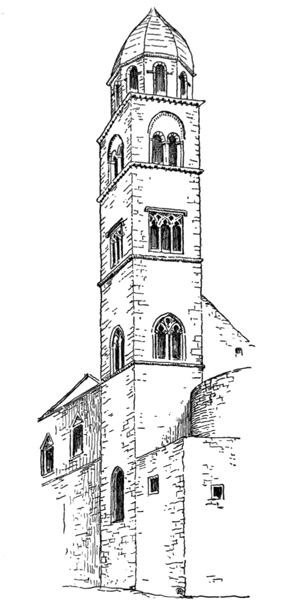
TOWER OF FRANCISCAN CHURCH, RAGUSA.
In the churches too there is more left than the mere scraps which are built up again. Parts at least of the tall towers—neither of them detached—of the Franciscan and Dominican churches, the former in the main street, the latter near the eastern gate, are also earlier. In the former the line of junction between the older tower and the ugly church which has been built up against it is clearly to be seen. The upper stage of this tower, and the small cupola which crowns it, may be later than the earthquake; but if so, they have caught the spirit of earlier work in an unusual degree, and all the lower part is in a form of Italian Gothic less unpleasing than usual. Both this tower and that of the Dominican church show how long the general type of the earliest Romanesque campaniles went on. Save in the small cupola, this tower has the perfect air, and almost the details, of a tower of the eleventh century: three ranges of windows with mid-wall shafts rise over one another; only they are grouped under containing arches in what in England we should call a Norman fashion. But, as this tower forms part of a Dominican monastery, it cannot be earlier than the thirteenth century, and its smaller details also cannot belong to any earlier date. Yet the general effect of this tower, even more than of the other, is that of a tower of the Primitive type. The Dominican church also keeps some details of Italian Gothic which must be older than the earthquake, and the cloister is one of the best specimens of that style. Its groupings of tracery under round arches, the poverty of design in the tracery itself, strike us as weak, if our thoughts go back to Salisbury or to Zürich; but the general effect is good, and the cloister—as distinguished from the buildings above it—may almost be called beautiful. Of more importance in the history of Ragusan architecture is the Franciscan cloister. Being Franciscan, it cannot be earlier than the thirteenth century, and it may well be much later. But it is essentially Romanesque in style. The general effect of the tall shafts which support its narrow round arches differs indeed a good deal from the general effect of the more massive Romanesque cloisters to which we are used elsewhere. But it is essentially one with them in style, and it is one of the many witnesses to the way in which at Ragusa early forms were kept in use till a late time.
But the architectural glory of Ragusa is certainly not to be looked for among its churches. The most truly instructive work that Ragusa has to show in any of its ecclesiastical buildings does not show itself at first sight, and its full significance is not likely to be understood till the civic and domestic buildings of the city and its suburbs have been well studied. When this has been done, it will be easily seen that certain arches and capitals in the subordinate buildings of the Dominican church have their part in the history of Ragusan art; but the great civic buildings must be seen and mastered first. Of these two of the highest interest escaped the common overthrow. They both show the Italian Gothic in its best shape; but they also show something else which is of far higher value. They show that peculiar form of Renaissance which can hardly be called Renaissance in any bad sense, which is in truth a last outburst of Romanesque, a living child of classical forms, not a dead imitation of them. Examples of this kind often meet us in Italy; we see something of it in the north side of the great piazza at Venice as compared with the southern side; but the Ragusan examples go beyond anything that we know of elsewhere. Give the palace of Ragusa—the palace, not of a Doge, but of a Rector—the same size, the same position, as the building which answers to it at Venice, and we should soon see that the city which so long held her own against Venice in other ways could hold her own in art also. The Venetian arcade cannot for a moment be compared to the Ragusan; the main front of the Ragusan building has escaped the addition of the ugly upper story which disfigures the Venetian. As wholes, of course no one can compare the two in general effect. Saint Blaise must yield to Saint Mark. But set Saint Blaise's palace on Saint Mark's site; carry out his arcade to the same boundless extent, and there is little doubt which would be the grander pile. The Venetian building overwhelms by its general effect; the Ragusan building will better stand the test of minute study.
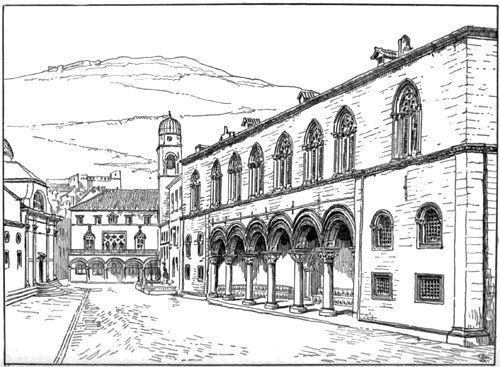
PALACE, RAGUSA.
The palace of the Ragusan commonwealth was begun in 1388, and finished in 1435, in the reign, as an inscription takes care to announce, of the Emperor Siegmund. What name shall we give to the style of this most remarkable building, at all events to the style of its admirable arcade? Here are six arches—why did not the architect carry on the design through the whole length of the building?—which show what, as late as the fifteenth century, a round-arched style could still do when it followed its natural promptings, instead of either binding itself by slavish precedents or striving after a helpless imitation of foreign forms. Never mind the date; here is Romanesque in all its truth and beauty; here, in the land which gave Rome so many of her greatest Cæsars, the arcade of Ragusa may worthily end the series which began with the arcades of Spalato. Siegmund, the last but one to wear the crown of Diocletian in the Eternal City, has his name not quite unworthily engraved on a building less removed in style than a distance of more than eleven centuries would have led us to expect from the everlasting house of Jovius. Does some pedantic Vitruvian brand the columns as too short? The architect has grasped the truth that, as the arch takes the place of the entablature, the height of the arch may fairly be taken out of the height of the column. Does he blame the massive abaci? They are wrought to bear the greater immediate weight which the arch brings upon the capital, and they avoid such shifts as the Ravenna stilt and the Byzantine double capital. Does he blame the capitals, which certainly do not follow the exact pattern of any Vitruvian order? Let us answer boldly, Why should art be put in fetters? A Corinthian capital is a beautiful form; but why should the hand of man be kept back from devising other beautiful forms? The Ragusan architect has ventured to cover some of his capitals with foliage which does not obey any pedantic rule; in others he has ventured—like the artists of the noble capitals which may still be seen in the Capitol and in Caracalla's baths—to bring in the forms of animal and of human, as well as of vegetable, life. In one point his taste seems slightly to have failed him; on some of the capitals the winged figures with which they are wrought savour a little of the vulgar Renaissance. But who shall blame the capital long ago engraved and commented on by Sir Gardner Wilkinson, in which however a neighbouring inscription shows that tradition was right in seeing the form of Asklêpios, and not that of a mere mortal alchemist, though tradition was certainly wrong in believing that Asklêpios had been brought ready made from his old home at Epidauros? And the capitals bear arches worthy of them, round arches with mouldings and ornaments, which thoroughly fit their shape, though, like the capitals, they do not servilely follow any prescribed rule. Altogether this arcade only makes us wish for more, for a longer range from the same hand. Compare it with the vulgar Italian work of the two neighbouring churches. Pisa and Durham might have stretched out the right hand of fellowship to Romanesque Ragusa before the earthquake; they would have held it back from Jesuited Ragusa after it.
The rest of the front cannot be called worthy of this admirable arcade. The windows behind the arcade are of the worse, those above it are of the better, kind of Italian Gothic. These last in fact are about as good as Italian Gothic can be. They are well proportioned two-light windows with Geometrical tracery, and in the general effect they really agree better than could have been looked for with the admirable arches below. Still they are Italian Gothic, and at Ragusa we should not welcome the loveliest form of tracery that Carlisle or Selby could give us. A Pisan arcade, pierced for light wherever light was wanted, would have been the right thing for the columns and arches to bear aloft. He who duly admires the arcade will do well to shut his eyes as he turns round the corner by the west front of the cathedral; but let him go inside, and the court, if not altogether worthy of the outer arcade, is no contemptible specimen of the same style. It contains one or two monuments of Ragusan worthies. The figure of Roland, which lay there neglected when we first saw Ragusa, has since been set up again in the open piazza. And, strange to say in these lands, it ventures to proclaim itself as having been set up, as it might have been in the old time, by the free act of the commune of Ragusa, without any of those cringing references to a foreign power which are commonly found expedient under foreign rule. The court is entered by a side door with two ancient knockers, one of them a worthy fellow of the great one at Durham or of that which we saw more lately at Curzola. But its chief interest comes from its strictly architectural forms, and from the comparison of them with those which are made use of on the outside. The court is very small, and it is surrounded on all sides, save that which is filled by the grand staircase, by an arcade of two, supporting a second upper range. The composition is thus better than that of the front itself, as there are two harmonious stages in the same style, without any intrusion of foreign elements, like the pointed windows in the front; but the arcades themselves, though very good and simple, do not carry out the wonderful boldness and originality of the outer range. Columns with tongues to their base with flowered capitals, showing a remembrance, but not a servile remembrance, of Corinthian models, support round arches. Over these is the upper range of two round arches over each one below, resting on coupled shafts, the arrangement which, from the so-called tomb of Saint Constantia, has spread to so many Romanesque cloisters and to so many works of the Saracen. Were this range open, instead of being foolishly glazed, this design of two stages of a true Romanesque, simpler, but perhaps more classical, than the outer arcade, would form a design thoroughly harmonious and satisfactory.
Now when we come to examine this inner court more minutely, we shall find that it is certainly of later date than the outer arcade, and that it supplanted earlier work which formed part of the same design as the outer arcade. It is impossible to believe that the court is later than the great earthquake; but 1667 was not the only year in which Ragusa underwent visitations of that kind; and it is an allowable guess that a rebuilding took place after an earlier earthquake in the beginning of the sixteenth century. That some change took place at some time is certain. There are preparations for spanning arches at one point of the outer wall of the court, which could never have agreed with the position of the present columns. And we have a most interesting piece of documentary evidence which carries us further. In a manuscript account of the building of the palace, it is mentioned that at the entrance were two columns, on the capital of one of which was carved the Judgement of Solomon, while the other showed the Rector of Ragusa sitting to administer justice after the model of Solomon. Now this cannot refer to the outer arcade, where none of the capitals show those subjects. Still less is there anything like it in the arcade of the court, nor can there have been since the present arrangement was made. But the description is no freak of the imagination; both capitals are in being; one of them is still within the palace. The capital showing the Rector in his chair dispensing justice to his fellow-citizens is built in at a corner in the upper story of the court. And a capital of exactly the same style, and with the Judgement of Solomon carved on one face of it, may still be seen in the garden of a house outside the city of which we shall have presently to speak. It is thus perfectly plain that the inner court was rebuilt at some time later than the days of Siegmund, and that this rebuilding displaced an inner design more in harmony with the outer arcade, and of which these two capitals formed a part.
To our mind this palace, to which Sir Gardner Wilkinson hardly does justice, and of which Mr. Neale takes no notice at all, really deserves no small place in the history of Romanesque art. It shows how late the genuine tradition lingered on, and what vigorous offshoots the old style could throw off, even when it might be thought to be dead. One or two capitals show that the Ragusan architect knew of the actual Renaissance. But it was only in that one detail that he went astray. In everything else he started from sound principles, and from them vigorously developed for himself. And the fruit of his work was a building which thoroughly satisfies every requirement of criticism, and on which the eye gazes with ever increased delight, as one of the fairest triumphs of human skill within the range of the builder's art.
But the palace must not be spoken of as if it stood altogether alone among the buildings of the city. There is another civic building, which, though it does not reach the full perfection of its great neighbour, must also be treated as a true fruit, in some sort a more remarkable fruit, of the same spirit which called its greater neighbour into being. This is the building which acted at once in the characters of mint and custom-house, the second character being set forth by its name wrought in nails on the great door. This building stands just where the main street and the piazza join, close by the arch leading to the town-gate. Here we have an arcade of five, the columns of which are crowned with capitals, Composite in their general shape, but not slavishly following technical precedents, nor all of them exactly alike. They have a heavy abacus, which, as well as the soffit of the round arch, is enriched with flowered work. One or two of them are none the better for being new chiselled in modern times. Here is something which is quite unlike Northern Romanesque, but which still is absolutely identical with it in principle. The column and the round arch are there in their purity, and the enrichment is of a kind which we instinctively feel is in place at Ragusa, though it would be out of place at Caen or Mainz or Durham. Whatever the date may be, the thing is thoroughly good, incomparably better than either the Italian Gothic or the cosmopolite Jesuit style. Above the arcade are windows with the usual Venetian attempt at tracery, a large square window between two with ogee arches; above is a stage with square windows, which we may hope is a later addition. The merits of the three stages lessen as they get higher. Yet from the date, when we come to find it out, it seems not impossible that the arcade and both the stages above it may really be of the same date. In the inner court there are no such discordant elements as there are without, though the forms of different styles are quite as much mingled. Octagonal piers support round arches; pointed doorways with thoroughly Ragusan tympana open into the chamber behind them. On this arcade rests another, with round arches on the short sides of the court, and pointed arches on the long sides, rising from columns and square piers alternately. Above is a range which might as well be away. Square windows, round Ragusan windows, might well be endured; but Renaissance shields and Renaissance angels show that the infection had begun. Now this beautiful piece of Romanesque work—we give it that name in defiance of dates—was finished in 1520, when the world on the southern side of the Alps was, for the most part, running after the dreariest forms of the mere revived Italian. This amazingly late date makes this building even more wonderful than the palace, though it certainly is not its rival in beauty. The arcades, good as they are, cannot be compared to those of the palace, and the Venetian work above is still more inferior. Still, the later the date, the more honour to the architect who designed such a work at such a time. And the later the date, the more likely that he built his arcade according to the promptings of his own genius, and added the two ranges of windows in deference to the two rival fashions of his time.
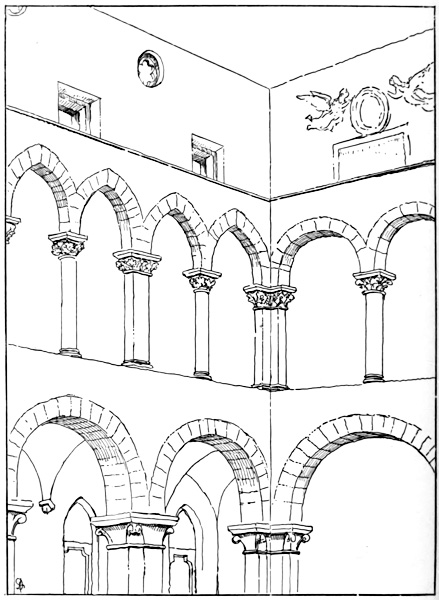
DOGANA, RAGUSA.
The arcade of this building, taken alone without reference to the windows above, is the last link in a chain which shows that the preservation of good architectural ideas at so late a time is no mere accident. Indeed, if we pass from public buildings within the city to private buildings outside of it, we shall begin to doubt whether the dogana is the last chain, and whether there are not still later buildings which are fairly entitled to the Romanesque name. The best of the houses of the Ragusan patricians are to be found, not within the city, but by the port at Gravosa, and further on on the way to Ombla. Several of those, while their other features are Venetian Gothic, or even later still, have—commonly in their upper loggie—a column or two supporting a round arch, which are certainly not vulgar Renaissance, and which keep on the sound tradition of the palace and the dogana. The finest of these is the house of the Counts Caboga, known as Batahovina, on the coast on the way to Ombla. Here, as in the palace, as in the dogana, an arcade of this late local Romanesque supports an upper story of Venetian Gothic, very inferior and most likely much later than that in either of the civic buildings. It has however at each end an open loggia matching the arcade below. The columns, plain and with twisted flutes—distant kinsfolk of Waltham, Durham, Dunfermline, and Lindisfarn—have capitals such as we might look for in much earlier Romanesque.
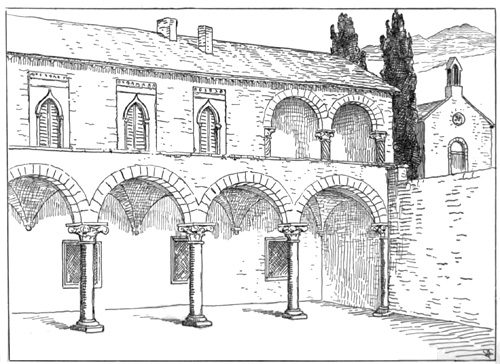
CABOGA HOUSE, GRAVOSA.
This, we may note by the way, is the house in whose garden the column from the palace, wrought with the Judgement of Solomon, still lies hid. Indeed we might go further away from the palace than the loggie of the houses. At Ragusa art extends itself to objects which might have been thought hardly capable of artistic treatment. Stone is common, and it is used for all manner of purposes. Among other things stone vine-props are common. In not a few cases these take the form of columns, slenderer doubtless than the rules of classical proportion, realizing the description of Cassiodorus about the tall columns like reeds, the lofty buildings propped as it were on the shafts of spears. Sometimes the columns are fluted or twisted; in a great many cases they have real capitals, with various forms according to taste. It often happens that a row of such columns, whether on a house-top or in a vineyard, really becomes an architectural object, a genuine colonnade. Here the style, the construction at least, is Greek rather than Romanesque; but the principle is the same. A good and rational artistic form is kept in use, and is applied to a purpose for which it is fitted.
All these examples, the palace, the dogana, the houses, the remains in the Dominican church, we might almost say the vine-props, look one way. All point to the existence of a Ragusan style, to an unbroken Romanesque tradition, which could not wholly withstand the inroads of the pseudo-Gothic of Italy, but which could at least keep its place alongside of the intruder. All help us to see how instructive must have been the course of architectural developement at Ragusa, and how much has been lost to the history of art by the destruction of so many of the buildings of the city in the great earthquake. It is easy to see that for a long time the struggle between the genuine Romanesque tradition, the Italian Gothic, and the new ideas of the Renaissance, must have been very hard. How long real Romanesque went on, bringing in new developements of its own, but remaining still as truly Romanesque by unbroken succession as anything at Pisa or Durham, is shown by the noble arches of the palace, and the still later dogana. The slight touch of Renaissance in some of the capitals of the palace in no sort takes away from the general purity of the style. Still over these noble arcades are windows of Venetian Gothic, and one of the most characteristic features of the Ragusan streets are the flat-headed doorways. But these, alternating as they do with pointed ones, help to make out our case. On the other hand, it is equally plain that in some cases the Renaissance came in early. A little chapel by the basin at Ombla, bearing date 1480, is in a confirmed Renaissance style, and looks more like 1580. Yet of true Renaissance there is very little. One large house in the city, older than the earthquake, stands quite alone as the kind of thing which might easily have been built in Italy or copied in England. But at Ragusa, in the near neighbourhood of several native doorways of different shapes, of many native vine-props, of several native wells—for wells too take an artistic style and copy the form of a capital—the regular trim Palladian building looks strangely out of place. Even in the Stradone, where in the houses there is little architecture of any kind, a touch of ancient effect is kept in the form of the shops, with their arches and stone dressers, thoroughly after the mediæval pattern. And some architectural features never died out. The round window with tracery goes on long after every other feature of Romanesque or Gothic is forgotten. It is to be seen in endless little chapels of very late date in the city and suburbs, sometimes standing apart, sometimes attached to private houses.