SIX MONTHS IN AMERICA. (continued 2)
Reading edition
In our way back to the steamer, every canoe shot down the Saut. This is an exceedingly dangerous experiment, except when they are guided by people who have been long accustomed to the management of them. The Saut, which is the only outlet to the waters of Lake Superior, may be about one-third of a mile in width, and about half-a-mile in length; the fall in that space being about twenty-four feet. The canoes, with the paddles fore and aft, soon began to feel the effect of the current, and were immediately after carried forward with great velocity. In many places the waters were without foam, and perfectly transparent, and the large loose rocks at the bottom were distinctly seen; many of them rise nearly to the surface, but were avoided by the remarkable dexterity of the steersman, where the slightest want of skill must inevitably have overturned the canoe. The descent occupied between three or four minutes. The rapids on the left bank were evidently more furious, and are very seldom descended.
The Saut de St. Marie was originally occupied by the French as a military and trading port. At the foot of the rapids there is, I was informed, some of the finest fly-fishing in the world: the trout are very fine, in enormous quantities, and rise very freely. But our inexorable captain cared for none of these things. White-fish (supposed by some to be of the salmo genus), are also exceedingly plentiful. Their flavour is remarkably fine and delicate.
The next morning we approached the island of Michilimackinac, signifying in the Indian language, the Great Turtle; and so called from its outline bearing a supposed resemblance to that animal when lying upon the water, though I cannot say that I could discover so flattering a likeness. When within a short distance it appeared to be diamond-shaped, with an angle projecting towards us, and the sides regularly scarped by the hand of nature. Apparently about the centre of the island rises what in America is called a “bluff;” a word which is provoking from its absurdity, and constant recurrence in American descriptions of scenery. What is a bluff?—I asked, and so would any other Englishman: “A bluff, sir! don’t you know what a bluff is? A bluff, sir, is a piece of rising ground, partly rock, not all of it, with one side steep, but yet not very steep, the other side sloping away, yet not too suddenly; the whole of it, except the steep side, covered with wood; in short, sir, a bluff is a bluff!” The word, I think, may do well enough to express a small rough rocky hill, but sometimes it happens that a bluff is highly picturesque, and then to talk of a most beautiful bluff, is something like talking of “Beauty and the Beast.” As a substantive, and, in the sense in which it is used in America, the word is exclusively their own, and it really would not be fair to call it English. Nevertheless, there is, and shall be, “a bluff” in the midst of the island of Michilimackinac, rising to the height of more than three hundred feet above the waters of the lake, which have been ascertained to be about six hundred feet above the level of the Atlantic. On the left side of the island is the town, and above it appeared the fort. In the bay were several trading sloops, smaller craft, and Indian canoes; and the sun shone brilliantly on the whole of this enlivening scene, which we saw to the best advantage. The town may contain about eight hundred inhabitants, exclusively of the garrison. The Indians are sometimes to be seen in great numbers, even to the amount of one thousand or one thousand five hundred, who live in wigwams close to the water’s edge. A wigwam, or Indian village, is a collection of small tents constructed of matting and birch bark. The day before, we had met twenty-two canoes in the open lake, each containing seven or eight Indians, who were going from Mackinac to our settlement at Pen-y-tang-y-shen, on Lake Huron, to receive their annual presents from the British government.
Mackinac is the rendezvous of the North-West American missionary establishment. It contained six missionaries; of whom four were Presbyterian, one a Catholic, and one of the Church of England, and a large establishment for the instruction of one hundred children, of whatever persuasion.
A very curious and regularly shaped natural Gothic arch, on the top of a rock at the north-eastern side, elevated about two hundred feet above the level of the lake; a huge isolated calcareous rock; and a small cave called Skull Cave, are the natural curiosities of the island.
The principal trade is the fur trade, which is carried on there to a great extent, chiefly through the medium of Canadian voyageurs. The fort, which is kept in admirable order, commands the whole town, but is itself commanded by another eminence in the woods behind it. During the late war a strong party of British and Indians pushed across from Drummond’s Island, with eleven pieces of cannon, and being favoured by the darkness of the night, contrived to gain this eminence, distant half-a-mile, without being perceived by the Americans in the fort, who had not received notice of the war having broken out. They beat the “reveillée” as usual in the morning, and were exceedingly astonished to hear it immediately answered by the British, who were above them. Resistance would have been useless, and the fort surrendered. The remains of the old British fortification are still to be seen upon the hill: it is called Fort Holmes, after Major Holmes, a gallant American officer, who was advancing to retake it, and met his fate at the head of the attacking column. Mackinac was given up to the Americans by the treaty of Ghent, in 1814. There was originally a French fort and settlement on the main land of the Michigan territory. The first British garrison who occupied it were murdered by the Indians, and the fort and settlement were afterwards removed by the British to the island.
I amused myself with shooting pigeons, which are to be found on the island in great numbers. I was quite surprised at the extraordinary facility and quickness of eye, with which my guide, half Indian and half Canadian, discovered them sitting in the thickest foliage; his sight seemed to me to be far keener than that of an English sportsman when looking for a hare. The woods with which the island is covered, are principally composed of hazel and maple; I could have fancied myself in a Kentish preserve, but that wild raspberries were in great abundance in the open spaces.
In the evening I went to see the Indians spear fish by torch light. A lighted roll of birch bark, emitting a most vivid flame, was held over the head of the boat, where the Indians were stationed with their spears. The water was excessively clear, and the fish were attracted by the light, and several of them were instantly pinned to the ground at the depth of four or five feet.
About ten miles north-east of Mackinac are the St. Martin’s islands; one of them abounds in gypsum. At about the same distance from Mackinac and on the main land, I was informed that there was a remarkably fine trout stream that would amply repay the fly-fisher for his trouble in going there. There is no fly fishing at Mackinac, but very fine fish are to be taken with a bait: they have pike, bass, white-fish, and what are called salmon-trout, in great perfection. As to these last, I very much question whether they are of the salmo genus at all; as they never rise at a fly. They certainly are not what are called salmon-trout by English sportsmen, nor are they the large butt-trout of the English lakes. I saw a boat-load containing a dozen that had been caught in one night weighing from fifteen to twenty pounds each; they more resembled in every respect the fish called the salmon in the Lake Wenner in Sweden, and which I have seen taken of an enormous size below the falls of Trollhätta. The meat at this season (August) was white, but well flavoured. I was informed that it becomes of a reddish colour in October or November.
Mackinac is an excellent market for Indian curiosities.
Our next destination was Green bay, on Lake Michigan. On our way we passed several fine-looking islands,—all thickly covered with forests, and apparently uninhabited. A fort and a flourishing settlement are to be seen at Green bay; but there is nothing attractive about either, and the country is very flat and uninteresting, except to a sportsman. There are plenty of wild fowl to be found at Duck creek, about three miles off, and I proceeded there in hopes of shooting some, but did not fall in with them until it was too late to have much sport. However, I chanced to meet an old Indian who had been more successful, and I carried back to the steam-boat two silver ducks, which answered every purpose, as no questions were asked. My guide had been enumerating to me the different wild animals to be found in that part of the forest, and I chanced to ask him, if foxes were plentiful; his answer was amusing, “Yes, sir; there is considerable fox.” In the very darkest part of the forest, about two and a half miles from the mouth of the creek, was the residence of an Indian doctress and fortune-teller. I landed there out of curiosity to have my fortune told; but her manner, her language, and the substance of what she said, differed in no respect from that of a common English gipsy woman. She shuffled a dirty pack of cards, and told me of the fair lady and the dark lady, the false friend and the true friend, the treasure to be found and the journey to be taken, with the same chapter of accidents and unavoidable dangers. I purchased some of her medical herbs: the principal plant was sarsaparilla. I observed wild rice growing in great abundance on the margin of the stream.
By passing up the river at Green bay, a traveller may proceed in canoes down the Wiskansaw river to the head of the Mississippi, having only to pass over one mile of terra firma; so that with this single exception, the whole distance from Quebec to New Orleans may be travelled by water.
We left Green bay, and returned to Mackinac, and passed the day much in the same manner as before. Our evening’s entertainment was rather of a novel description. A Catholic priest, whom we had previously left at Mackinac, and who was known to be an eloquent man, was going to preach in the chapel, and accordingly many of us went to hear him: he had come to the island for the sole purpose of holding a religious controversy with some of the Presbyterian clergy. The expected meeting did not however take place; and having been, or fancying himself to have been very much wronged, he entered into a long explanation of the whole affair. He read letters and papers, and commented upon them in his robes from the altar; he made a long tirade, in which sarcasm and ridicule were successively prominent, and wound up his speech more suited to the bar than the pulpit, by accusing his adversary of telling a “thumper.” Whether he was in the right or the wrong was little to the purpose: in common, I believe, with every one that heard him, I thought the whole proceeding was exceedingly disgraceful.
We now steered again for Fort Gratiot, and passed to Detroit and Lake Erie. From Detroit to Buffalo it is three hundred and fifty miles. We touched at several posts; and in short, after a voyage of one thousand eight hundred and ten miles, performed in nineteen days, we arrived at Buffalo, and fired a salute of twenty-four guns, one for each state. The distances the steam-boat had passed over were as follows. From Buffalo to Detroit, three hundred and fifty miles; to Fort Gratiot, seventy-five; length of Lake Huron, two hundred and twenty; from the mouth of the river St. Marie to the Saut, and back to the Lake, one hundred miles; thence to Mackinac, forty miles; to Green bay, one hundred and eighty; back to Mackinac, one hundred and eighty more; thence to Fort Gratiot, two hundred and forty; to Detroit, seventy-five; to Buffalo, three hundred and fifty; total, one thousand eight hundred and ten miles. The voyage altogether had been very pleasant, and the weather so favourable that quadrilles were danced on deck almost every evening. On one night only, the surface of Lake Huron was agitated by something like a squall, and the rolling of the steam-boat was exceedingly disagreeable. I had nothing to complain of, but the conceit and untameable insolence of the stewards; which were remarked, and I have no doubt will be remembered, by many of the warmest admirers of liberty and equality who were on board.
Buffalo is a large, thriving and cheerful town, containing about fourteen thousand inhabitants. The principal street is spacious and handsome, and of great length.
And now for Niagara, the diapason of fresh waters! An hour’s drive brought me to the village of Black Rock, where the Niagara river is about half a mile in breadth, and runs from the lake with a very strong current. Opposite to Black Rock are the remains of Fort Erie, unsuccessfully besieged by the British in 1814.
I proceeded along the side of the river. Its rapidity soon ceases, and it presents a surface as still and as calm as that of a lake. A turn of the road brought my voiture to a small inn, close to the field of battle of Chippewa, fought during the last war. At this spot, which by the road is about four miles distant, we were within hearing of the deep hollow roar of the cataract, and first saw the spray that arose from the gulph beneath. Both are sometimes perceptible at a far greater distance. The moon was just rising, and threw a faint, pale light over the river, which is here expanded to a breadth of several miles. There was scarcely a ripple to be seen; the whole sheet of water was tranquil and resigned: the stream appeared to cease flowing, while all nature, hushed and breathless, listened with it to the distant thunders of the cataract. This scene is continued for about a mile further, and thence the tale is soon told. The bed of the river begins to slope, and the agitation of the waters indicate the commencement of the rapids. The mighty stream rushes forward with ungovernable violence—its confusion and exasperation are increased every instant—it nears the brink of the precipice in a state of frenzy—and bounds over it to its destiny of mist and foam, in unexampled volume, and with terrific impetuosity.
This stupendous fall has been frequently and well described; and I do but trespass on your patience in remarking, that it is divided into three parts by two islands—a larger and a smaller one. Including these, the bed of the river immediately above the fall is suddenly narrowed to about three quarters of a mile. The fall of the rapids above, commencing near the village of Chippawa, two miles from the brink of the cataract, is estimated at ninety feet. On the American side, the river is precipitated from a height of one hundred and sixty-four feet: on the Canadian bank, the fall is about ten feet less; but contains by far the greater quantity of water, the precipice having been worn into the form of a vast crescent by the “green water,” (so called on account of its brilliantly transparent colour when the sun shines on it), which falls from the middle of the river in a solid mass, not less than five or six feet in thickness, and is driven forwards with an impetus that hurls it into the gulph below, at a distance of fifty feet from the base of the rock.
The finest general view is, I think, to be obtained from the top of Mr. Forsyth’s hotel (where, be it added, having just entered the British dominions, we drank his Majesty’s health in a bumper, at the table d’hôte), because the whole surrounding country and the rapids, which of themselves are worth a long journey, are seen at the same time. The bottom of the fall it is true is not visible; but I believe the view will not be thought the less magnificent on that account, as it is very possible from that spot to imagine the height of the fall to be even greater than it really is. I may also be allowed to remark, that I think the immediately surrounding scenery is sufficiently in keeping with the grandeur of the cataract, although I am aware that many are of a different opinion. The country is on the same level both above and below the fall, as the river precipitates itself into a channel which it has formed in the solid, but soft fetid limestone, and which, as is usually contended, has been hollowed out by the receding cataract, all the way from Lewistown, distant seven miles.
This fact has been sometimes doubted, but it would appear, without much reason. It has been ascertained that an irregular ledge of rock is extended between the lakes Erie and Ontario, at a varying distance from either of them; sometimes piercing through the soil that covers it, and in many places jutting out with salient and re-entering angles, like an immense fortification; and it has been supposed that the Niagara river has found its way into one of the ravines formed between them, which has thus become the bed of the river, towards lake Ontario. This theory, however, is very much weakened, if not entirely overthrown, by the observations of our countryman, Lieutenant Owen, who, when employed on the government surveys in the years 1815, 16, 17 and 18, contrived to force his boat nearer to the foot of the falls than any person had ever done, and ascertained by repeated soundings, that the nearly constant depth of the river from Lewistown to the falls, was about two hundred feet, excepting in limited spaces, where it did not exceed forty-five feet. These spaces or points he conceived to be composed of granite “in situ,” or of some other rock, which being harder than the soft lime-stone of which the bed of the river is generally composed, had offered a proportionably greater resistance to the regular action of the falling element.
Having first stripped off my clothes, and enveloped myself in an oilskin dress, I followed a guide, who conducted me under the fall. This is a service of some danger, as a single false step in some places might prove fatal. As we crept along the side of the rock we encountered a most furious gust of wind, that increased in violence till we were fairly behind the sheet of water, and arrived at what is called the Termination Rock. Here we remained for a few minutes, gasping for breath, stunned with the noise, and drenched with a shower of spray. If I wished to speak I was obliged to put my mouth close to the ear of the guide, and to raise my voice to the utmost; and it was with the greatest difficulty that I could look upwards for a moment, and glance at the tumbling element, as it rushed over the edge of the rock that towered high above our heads, and then fell into the abyss within arm’s length of us, with the rapidity of lightning.
About half-a-mile below the fall, the river is crossed in a ferry-boat. On the American side a wooden bridge of admirable construction conducts the visiter to Goat Island, the larger of the two which divides the fall. A walk of a few minutes will lead him to another bridge, thrown from rock to rock, till it actually overhangs the edge of the principal part of the cataract. I am fully persuaded, that when any one who has seen the fall from this spot asserts that he is disappointed, it is but a proof of insufferable affectation, or what Johnson would call “stark insensibility.” It is possible, that some flat-souled Dutchman, who would think of nothing but how he might turn the course of the river by a dam; or some passionless manufacturing Yankee, who would “guess it to be a pity that such an all-mighty water power should remain unemployed,” might regard the scene, when viewed from any other point, and remain unmoved by its grandeur; but it is next to impossible to look upon it from this bridge, and not be affected with something like awe and astonishment. Let the atheist—and, if he will, with wine and warmth in his bosom—repair to this spot, as is usual, by moonlight, when one-half of the cataract is in shade, and the other glistening with more than snowy whiteness,—he may there gaze in security, and enjoy the sublime without terror; but should one thought of annihilation trouble him—should he covet the pinion of the bald eagle as he fearlessly glides over the abyss, or envy the finned tribe that can live and revel in the boiling gulf beneath—let him reflect, that his reason is with him, the undoubted substitute for these physical advantages; his reason, alike the promoter of his happiness and the medium of his misery. Then, turning to a more tranquil scene, let him gaze on the silvery spirit-like beauties of the lunar rainbow; let him observe the worlds upon worlds that throng the heavens above him, declaring the existence of their Creator as they roll onward in eternal obedience to his will, but in silent amazement at his meaning; and let him ask why his reason should be, as it were, so tantalized by his senses. Had no lesson been intended, the firmament might as well have been placed far beyond the reach of mortal sight, and perhaps the little he can see and know of it may teach him to believe in, and hope for, another and happier home, by proving to him, at once, how much must be withheld from him, and how much must remain to be enjoyed.
I am not aware whether the experiment has ever been tried, but I should conceive that the effect of a Bengal light sent up from this bridge, on a dark stormy winter’s night, would be exceedingly fine.
At about two miles below the fall, the river again becomes a torrent. I proceeded along the edge of the chasm through which it rages, in order to visit “the Whirlpool,” whose deep and gloomy appearance well repaid me for a very hot walk.
I procured a hack, and rode to the abyss in the side of the river, known by the appellation of the “Devil’s Hole.” I followed a party who had descended the ladders before me; we all, as I learned afterwards, took a wrong path to the right, which soon conducted us to the edge of a small but impassable precipice, and under the impression that we had seen all that was worth seeing, we re-ascended the ladders and returned to Niagara, after having enjoyed a very fine view of the river from the bold flattened rock, that is projected on the left hand.
The road by which I passed down the Canadian side of the river, for the purpose of joining the steam-boat on Lake Ontario, at but a very short distance from Niagara, lies over the field of the murderous and severely contested battle of Bridgewater, or Lundy’s Lane, which was fought on the night of the 25th of July, 1814, and terminated without much advantage to either party. A few miles further on, to the left, is a heavy-looking pillar, erected to the memory of General Brock, who was killed early in the battle of Queenston, October 13, 1812, in which the Americans were forced to repass the river with great loss, whilst several thousands of their militia were idly looking on from the other bank.
Near the mouth of the river, on the Canadian side, is Fort George; on the American bank stands Fort Niagara, in which the notorious William Morgan, who wrote a book, in which, as I have before remarked, he revealed the secrets of freemasonry, was confined under false pretences, previously to his being murdered by some fanatic masons, and afterwards, as it is supposed, pitched into the lake, or the Niagara river.
I am afraid I shall be excommunicated by my American readers, as I visited neither the Erie nor the Welland Canals; not even the Locks at Lockport, or the Deep Cut, or the Mountain Ridge. The Welland canal, however, is unquestionably a great national work, and reflects much credit upon the spirited individuals by whom it was undertaken; by its means, the obstacles presented to navigation by the falls of the Niagara, have been effectually overcome, and a communication opened between the lakes Erie and Ontario.
Ontario is one of the deepest of the lakes; its mean depth being about six hundred feet. It has been ascertained that the bottom of lake Erie, which is two hundred and seventy miles in length, is six feet higher than the surface of lake Ontario. The distance between the two lakes is thirty-five miles, in which space the river Niagara is supposed to fall about three hundred feet, which is therefore the depth of lake Erie.
I embarked in a splendid steam-boat, “the Great Britain,” proceeding to Kingston, at the other end of the lake. I could not but remark, that although a finer vessel, her table was by no means so well supplied as that of the American boat in which I had made my excursion to the great lakes.
During the short time we remained at Kingston we were entertained by the band of the 66th, which gave us the national airs of England and America in the finest style: the principal British naval establishment and dockyard on the lakes, is at Kingston. I observed two first-raters and a large frigate on the stocks. The St. Lawrence, of one hundred and twenty guns, which made one cruise at the end of the last war, was rotten, and half sunk in the water. There were several smaller vessels in ordinary, but those on the stocks are not to be proceeded with, according to the stipulations of the treaty of Ghent.
Immediately afterwards, we entered the thousand “islands,” extending for sixty miles up the river St. Lawrence. There are in fact, twelve hundred of them, and although certainly very picturesque, are without variety, and much resemble those on the lakes, being flat and thickly covered with trees. Their number is not of course perceived, as they lie so closely together along the side of the channel that they appear more like points or promontories from the main shore.
I quitted the steamer at Cornwall, and entered a large boat with a number of ladies and gentlemen who, like myself, wished to descend the rapids. In our way to Montreal we were obliged to change our mode of travelling by land and water, no less than four times in one day. The river above Montreal is full of rapids. The most formidable of these are called the Long Saut and the rapids of the Cedars. We passed down two or three of minor consideration, and then commenced the descent of the “Long Saut.” Our boat was carried along at a great rate for several miles, and soon approached the only part that can be considered dangerous, where the river was running with appalling violence. The waves as soon as they are formed, do not subside and then swell up again at regular distances, but dart furiously onward, racing and crowding upon each other in a most extraordinary confusion of spray and foam, that rises to a height of four or five feet, and splashes over the sides of the boat, to the great discomfiture of the ladies’ dresses, and the very serious looks of the gentlemen. The boatmen directed our attention to the rapids of the “Lost Channel” on our left, from which we were divided by an island. They are far more dangerous than those we were passing, and at a distance of half-a-mile, we could see that the river was most terribly agitated. The “Lost Channel” receives its name from the number of persons that have perished there. In the old French war, three hundred British troops were lost in the torrent; the first boat took the wrong channel, the others followed, and all went to pieces. The floating bodies first intimated to a French garrison on the river below, the surprise that had been intended for them. The boatmen are of course usually experienced persons, and if sober there is no danger; but it is not always that they are so. At one place our tipsy pilots allowed the boat to swing across the stream: fortunately the worst of the rapids were passed, or an accident might have occurred. Both the Long Saut and those of the Cedars which we saw from the road, are certainly more boisterous than those at the Saut de St. Marie, on account of the greater body of water in the St. Lawrence, but the descent at the latter is more rapid as the fall is far more precipitate in proportion to its length.
I entered a steam-boat on the banks of the Ottawa, which although a noble-looking stream in other respects, is dark and dirty in comparison with the St. Lawrence. The latter river seems not to relish the alliance. A sudden change is perceivable in the colour of the water, the line of junction being distinctly observable; and for scores of miles down the St. Lawrence, its clearer waters confine themselves to the eastern bank, while those on the western are discoloured by the “Ottawa tide.” I afterwards ascended the Ottawa. We arrived at La Chine, and proceeded by land to Montreal. The mountain behind it was already in sight, but the city itself by this road, remained hidden till we were within a very few miles of it. I passed through it the same evening, intending to see it on my return. The Hercules, a very fine steam-boat, carried me to Quebec in about twenty hours; touching at “the Three Rivers,” eighty-four miles from Quebec, and ninety-six from Montreal. Six miles from Quebec, we passed the mouth of the Chaudiere river, celebrated for its falls, which are situated about three or four miles from the spot where it empties itself into the St. Lawrence, whose banks, every where interesting, become still more so on approaching Quebec, being thickly lined with Canadian villages. Every cottage is white; the churches are of the same colour, with their spires covered with tin, and are frequently to be seen at a great distance out-topping the neighbouring forest and glistening in the sunbeam. In some places the river is two miles in width; but at Quebec it is narrowed to about a mile, which adds to the beauty of the view by making the lofty banks appear higher than they really are. On the left are seen the fortifications on Cape Diamond, the most elevated spot in the vicinity of the city. On the right is Point Levi. At different distances down the river are Cape Tourment and the Beaufort mountains, and the Isle of Orleans, dividing the river into two channels—that on the left being dangerous for any but very small vessels. The city itself was not visible till the boat was standing in for the landing-place. Numerous merchant ships were lying at anchor in different parts of the river; whilst rafts, ferry-boats, and smaller craft, were moving in all directions. The Government-House, or Castle of St. Louis, was the most prominent object: below it on the right, is the old parliament house. The space which intervenes between these buildings and the water, is occupied by the lower town, which like all lower towns, is far more dirty and lively than the upper ones, where some of the streets are dull and even gloomy. The only two large steeples in Quebec, are those of the Protestant and Catholic churches. The upper town is surrounded by a strong rampart, and cannon are planted in every place where they could be used with advantage in case of a siege. The whole city is commanded by the fortress on Cape Diamond, which it is supposed, when finished, will be impregnable. The interior works occupy a space of about six acres, and are advanced to the edge of the precipice, where it is about three hundred and fifty feet in height. In 1775, the American General Montgomery and his two aides-de-camp were killed by the same cannon-shot at the water’s edge beneath the fort.
I think I shall never forget the appearance of the view from the ramparts. It is very beautiful and inexpressibly enlivening. In looking down the river, the isle d’Orleans is on the right; in the extreme distance is Cape Tourment; while on the left is a gently sloping bank, exhibiting all the varied hues of extensive cultivation, between thirty and forty miles in length, and from two to five and six miles in width, and reaching from the margin of the water to the foot of the Beaufort mountains. The most conspicuous villages are Indian Lorette, Charleburg, Beaufort, and the Chateau Richer, easily distinguished by their light steeples covered with tin. Beside these, many hundreds of white cottages are scattered over the plain; and the road to Montmorenci is entirely lined with them. I was reminded by the prospect, of the highly cultivated garden that environs a city on the eastern coast of Spain. Olive trees and vineyards, it is true, there were none; but olive trees and vineyards are not missed at a great distance, and the Charleburg country is backed by the fine range of the Beaufort mountains, which although not of the highest elevation, can yet boast of a very picturesque outline; and being thickly covered with a noble forest, have at least one advantage over the barren rocks that usually rear their heads in the vicinity of a Spanish “vega.”
On the south side of the city, at a distance of two miles, are the plains of Abraham, and at their further extremity, is Wolfe’s cave. The view from the bank above is scarcely less enchanting than that I had so lately turned from. On the western horizon are seen the mountains which by the late decision of the king of the Netherlands are to form the boundary line between the Canadas and the United States. The intermediate landscape is most delightful; large yellow patches of cultivation rescued from the apparently endless forest, are espied in different directions, each surrounding some thriving village in the interior, whilst the opposite banks of the river are fringed with Canadian cottages, as white as lime and brush can make them; and the intervening and majestic waters of the St. Lawrence having at length escaped from the turbulence of the rapids, are seen flowing beneath, as calmly and as silently, as when, during the darkness of a night more than seventy years ago, the gallant Wolfe was floated on the retiring tide to his victory and his grave.
Till within a year or two, the stone close to which he breathed his last, was remaining on the field; but the proprietor, a person of infinite taste, has had it removed, part of it having been used for the purposes of the builder, while other parts of it are constantly undergoing a process of subdivision for the benefit of the curious.
A plain, but very elegant stone obelisk, worth a dozen such as Washington’s monument at Baltimore, or General Brock’s at Queen’s Town Heights, had been lately erected to the memory of Wolfe and Montcalm. The idea of paying this late tribute to the memory of those illustrious soldiers, originated with Lord Dalhousie. A singularly chaste classical inscription from the pen of Dr. Fisher, the editor of the Quebec Gazette, will be engraved in front of the monument. It is as follows:
WOLFE——MONTCALM.
Mortem. Virtus. Communem. Famam. Historia. Monumentum Posteritas. Dedit. A. S. 1827.
A longer inscription will be placed on the other side of the monument. An aged nun is now living in the Ursuline convent at Quebec, who remembers having held a taper when the remains of the chivalrous Frenchman were lowered to his grave in the chapel vault. I saw a small oval slab of marble, which was shortly to be fixed in the wall near the spot where he is buried. It bore the following inscription:—“Honheur á Montcalm: ledest in en lui derobant la victoire, l’a recompensé par une mort glorieuse.”
Quebec was taken from the French in the reign of Charles I., 130 years before the death of Wolfe, but being thought of little value, was given up in the same reign to Louis XIII., by the treaty of St. Germain.
At Lorette are to be purchased the best Indian moccassins, and other leathern curiosities, at the house of Mere Paul. The three Huron chiefs who visited England in 1825, and who were introduced in the first circles in London, may now be seen, any hot day, sober or intoxicated, just as it may happen, sitting perhaps in the dust, before the doors of their cottages. They take great pleasure in showing the medals and portraits they received in England, and the queen, or wife of the principal chief—a short, dumpy, masculine woman—occasionally comes to Quebec to sell moccassins, and has no aboriginal antipathy to a glass of gin. She constantly wears in her bosom (and very close to it too) a silver medal, presented to her husband by the Lord Mayor. There is some good woodcock shooting at Lorette, and a very pretty waterfall,—the foam spreading itself over the rocks, so as to resemble the finest lacework.
On looking up the course of the St. Lawrence, from this very interesting village, a wide opening is discerned in the distant bank, once apparently the channel of the river, which at some time as is supposed, by a junction with the mouth of the river St. Charles, made an island of the promontory on which Quebec now stands.
The Canadian cottages are in general extremely neat, the windows, in particular, being remarkably clean; and occasionally a tall pole or flag staff, is placed in front of one of them, to indicate the residence of an officer of militia.
Of the falls of Montmorenci, I will only remark, that they are well worth the ride, or the walk, or the sail to them. The splendid view of Quebec, the river, and the surrounding country, that is enjoyed from the ground above them is a sufficient recompence; and no stranger should leave Quebec without paying them a visit. The same may be said of the falls of the Chaudière. They are in fact much finer than those of Montmorenci, and within riding distance.
At Chateau Richer there is one of the best snipe grounds in the Canadas. In October they may be shot in extraordinary numbers, but should the sportsman be disappointed in finding his game, he may proceed to the falls of St. Anne, distant twelve miles. I mention this, supposing him to be a regular water-fall man. I had ceased to be so since I had seen Niagara. The different accounts I heard of Lake Charles prevented me from going there. Some told me it was full of cat-fish, and large frogs, which eat the little ones; others called it a beautiful lake, and that good trout-fishing was to be had there. I certainly eat some small ones, which had been caught there, of a most delicious flavour.
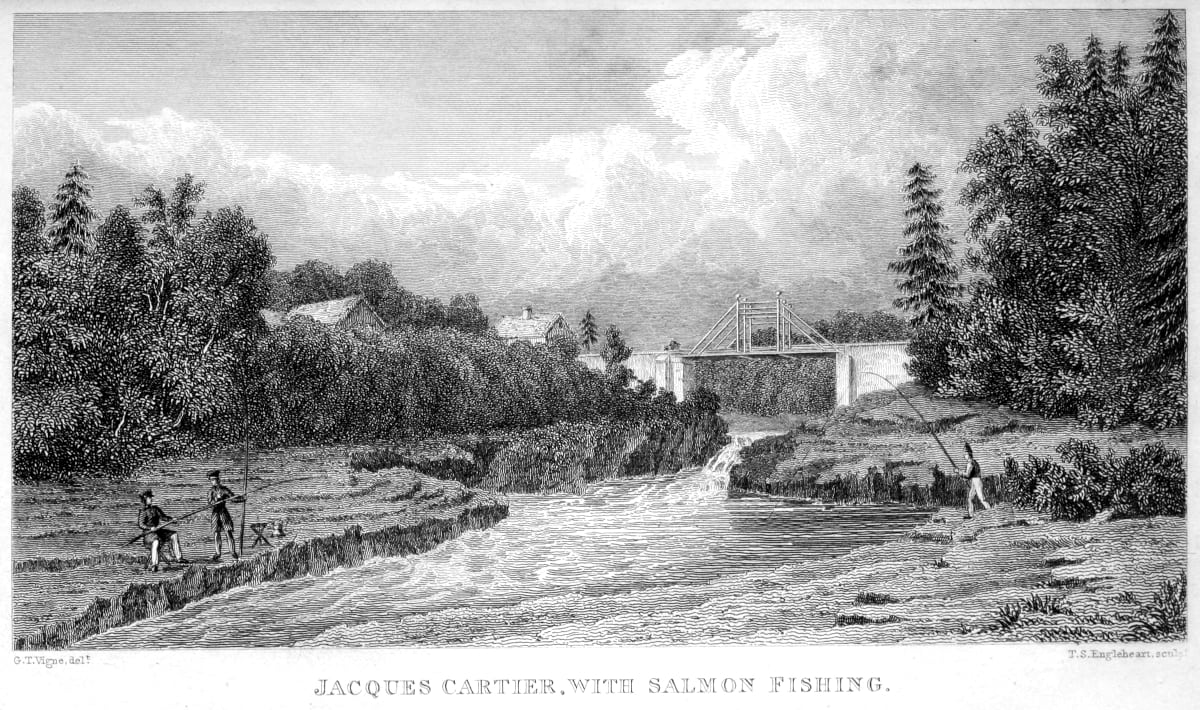
G. T. Vigne, delṭ T. S. Engleheart, sculpṭ
JACQUES CARTIER, WITH SALMON FISHING.
Published by Whittaker & Co. April 10. 1832.
The attractions of Jâques Cartier, twenty-seven miles from Quebec, were not to be so trifled with. This is the finest place for salmon fishing in the Canadas, and a very pretty spot into the bargain. All is as it should be; there is a small, but clean and comfortable country inn: the landlord throws a fly beautifully; his sister, a very pretty Canadian girl, waits at table; and the mother broils the salmon à merveille. The river, at all times a torrent, and now very much swollen by two whole days’ rain, was rushing with the greatest fury through the narrow channel it has worn for itself through the solid rock. The bridge, which is close to the inn, is a very neat government work. Under it is a hole, forty or fifty feet in depth; and when the river is low and clear, salmon may be seen lying there in great numbers. But the season was too far advanced, the weather too cold, and the river too high; and my friend and I, seeing that we could not expect sport, returned, having killed but one salmon a-piece in the course of the afternoon. A fine open ledge of rocks extends along the side of the river, affording some excellent fishing stations. The place is named after Jâques Cartier, who first sailed up the St. Lawrence in 1535, and founded the city of Montreal. He is said to have wintered there, at the mouth of the river which bears his name. On his return to France, he was of course coolly received, as he brought no precious metals. He sailed a second time, with orders to establish a colony on the St. Lawrence, but having had the misfortune to quarrel with the Indians, he returned to his native country to die of a broken heart.
The Canadian peasantry are of the middle size, or under it. Although they breathe some of the purest air in America, their countenances are worn, and unhealthy in appearance. They may be said to be smoke-dried, being seldom without a pipe in their mouths, and in winter they shut themselves up in their cottages, and breathe an atmosphere of tobacco fumes. I am not of course speaking of the athletic progeny of British settlers, when I affirm that a tall, fine hale-looking man is rarely to be met with. Nevertheless, the French Canadians are a brave, hardy, independent race, and happier, I should imagine, than any peasantry in the world. They pay no taxes, or just sufficient to keep the roads in repair. Most of them have small farms, and find a ready market for the produce; and those who have no land of their own, can easily find employment with those that have. They never give away money, but are exceedingly hospitable in other respects; and the poor Irish emigrant, who is travelling barefoot and pennyless to the place of his destination, is sure of a meal at any cottage where they have one to give. There still remains much of the French naiveté in their character, and at a few miles from Quebec, they know and care as little about the proceedings of government, as the Irish peasant did, and does now, about Catholic emancipation. Without meaning to detract from the merit of their charity, it may be remarked, that there is something like a spirit of conciliation, if not of apprehension, mixed up with it, for they are afraid that the “Bas de soie,” as they call the stockingless Irish, will finally drive them and their descendants from house and home.
The population of Upper Canada, which I did not visit (my time being occupied in the unexpected voyage on the Great Lakes), is about 250,000. That of Lower Canada may be estimated at 500,000; but the amount in both provinces is rapidly increasing. Sixty thousand emigrants had landed at Quebec in 1831, before the river was frozen up, being more than double the number that arrived in 1830. Many of them brought out considerable sums of money. One morning, during my stay at Quebec, an old Scotchman, who had lived about fourteen years in the Canadas, returned from Scotland with ninety of his countrymen, whom he had persuaded to follow him: he himself bringing with him several thousand pounds, and the others possessing one, two, or three hundred pounds a-piece. Two thousand of the emigrants that arrived in Upper Canada, were small farmers from the North of England.
The soil of Upper Canada is as productive as any in the world, so that the emigrant has no occasion to pass into the United States, in order to obtain a better, unless he proceed to particular spots where he would be liable to catch a fever and ague, and where the excessive heats together with the moisture and richness of the soil, render it so hastily prolific, that it is often a matter of great uncertainty whether a crop will arrive at perfection. The strong natural prejudice in favour of the British flag; the fact that the British manufactures can be purchased after payment of a very trifling duty of two per cent., whereas they must have paid an average duty of 30 per cent., if coming viâ the United States: that lands of equal fertility, and possessing equal advantages of situation, are sold at one half the price that is paid in the United States: that the climate of the Canadas is most decidedly the healthier of the two; are additional and substantial inducements to a permanent residence in the British colonies. Good land in the best situations is sold by the Canada land company at from 10s. to 15s. the acre: their sales for the year 1831, having amounted to 100,000 acres at an average price of 10s. per acre. One-seventh of the lands in every township in the United States is reserved for the payment of the clergy; and the agent for the clergy reserves, is authorized to sell 100,000 acres a year at 15s. an acre.
The nature of uncleared land is known by the timber which grows upon it. Where a great variety of timber abounds, the soil is generally a black loam. A clayey soil is known by the great proportion of firs intermixed with other trees, but when they grow alone, it is found that sand usually predominates. This is also the case where there are none but oaks and chestnut trees. Potatoes and turnips succeed better than any other crop on newly cleared land.
Both in the United States, and the Canadas, great quantities of sugar are made from the maple tree. The molasses are an excellent substitute for sweatmeats. In the month of March, a notch is cut in the tree, and a small pipe of wood is fastened into it, through which the sap runs into a wooden trough that is placed to receive it, and in this manner from five to seven pounds’ weight of sugar may be obtained annually from one tree. The process of boiling and preparing the sugar takes place in the forest.
The agents of the Canada Land Company, on the arrival of emigrants at Quebec or Montreal, for the season of 1832, undertake to convey them free of expense to York or the head of Lake Ontario, in the vicinity of the choicest lands, provided the emigrants pay a first instalment in London, Quebec, or Montreal, or two shillings an acre upon not less than one hundred acres: and the Company’s agents in all parts of the Upper Province, will give such emigrants every information and assistance in their power. Should emigrants on their arrival at York not settle on the Company’s lands, the money paid by them will be returned, deducting the actual expense of conveyance. At York there are large buildings expressly appropriated to the reception of emigrant families previously to their finding employment; and both the government and the Canada Land Company have waggons drawn up on the wharfs, in order to convey them and their baggage from the place of landing.
I cannot add any thing new to the particulars given in the printed papers relating to emigration, which are issued both by government and the Canada Land Company; to say nothing of the “Wiltshire Letters,” or the “Hints to Emigrants,” published at Quebec. These may all be purchased for a few pence, and the information they contain is, of course, derived from the best sources. Their instructions and advice on the subject of imposition, which might be practised upon emigrants at their first arrival, will be found most useful.
Wheat at the Canadas, according to the distance from the place of export, varies from 3s. to 5s. 6d. the bushel; beef (winter) 2½d. the pound, (summer) 3½d. to 4d.; mutton in the winter is 2½d. the pound, in summer it is a little dearer; potatoes are from 1s. to 2s. the bushel; a goose or a turkey may be purchased for 2s. or 2s. 6d., and a couple of fowls for 1s. or 1s. 6d. Ship-carpenters can earn from 5s. to 7s. a-day; labourers 2s. 6d. to 4s. a-day; handicraft tradesmen from 5s. to 7s. 6d. a-day; house-servants receive from 26s. to 36s. a-month, with food; females from 15s. to 30s. a-month, with food. In Quebec and Montreal, excellent board and lodging may be obtained in the principal hotels and boarding-houses at 20s. to 30s. a-week. A labourer or mechanic would pay 7s. to 9s. 6d. a-week, for which he will get tea or coffee, with meat for breakfast, a good dinner, and supper at night. An excellent private dwelling-house may be rented at from 100l. to 150l. a-year unfurnished; shops according to their situation at from 30l. to 100l. A farm of 100 acres with 20 or 30 acres clear, with a dwelling house, may be purchased in the Canadas for 150l. to 300l. according to the situation. There are, I believe, few persons who would not allow that emigration should be encouraged, at all events as a temporary remedy, and the rage for building discouraged, provided it can be done by just and legitimate means. The British government have an emigrant agent at Quebec; it encourages emigration, and finds co-operation and assistance in the Canada Land Company and the Emigrant’s Hospital at Quebec. Yet if the timber trade in the Canadas were suddenly destroyed by the measures which are said to be in contemplation, the immediate consequence would be, that the efforts of government in regard to one object would be neutralized by its own acts with reference to another. At present, there are from six hundred to eight hundred ships employed every summer in the timber trade. They sometimes carry out a cargo of coals, or salt, both paying a very insignificant freight (coals sell in Quebec at 26s. the chaldron) or more usually go out as it is termed in ballast, and thus afford facilities of emigration at an exceedingly cheap rate, to thousands whose absence from Great Britain is an advantage to both countries, as far as population is concerned; and who otherwise benefit the mother country by affording an additional market for her cotton and other manufactures, which they soon find the means of purchasing. In destroying the Canada timber trade by a sudden increase of duties, she is depriving herself of all these advantages. She would bring sudden ruin upon a numerous class of individuals who have large capitals invested in saw mills, and other buildings connected with the trade; she would deprive thousands of the means of buying and selling land; a number of ships would be thrown out of employment; emigration would be stopped, or at least greatly impeded for want of the facilities which are now given; England would not gain in the affections of the Canadas; she would lose a rapidly increasing market, and the benefit of a fine race of British peasantry, who would be ever ready to fight in defence of their newly adopted country.
The timber is cut in the winter, before the sap rises. Suppose then that the new duties were imposed, that the trade had consequently ceased, and that next year a war, by which the Baltic would be closed, should break out about the month of March, no timber would have been cut and prepared in the Canadas, and there can be no doubt that Great Britain would be obliged either to purchase inferior timber, cut in the summer, and prepared at a great additional expense, or remain without a supply of timber for sixteen months. It is said, and with truth, that clearing, for the sake of the timber only, rather impedes than assists the progress of cultivation,—a few trees only being selected on a given space, which are squared on the spot, while the lumber and branches are left to present additional difficulty to the farmer by becoming entangled in the underwood; and it has been also remarked, that the annihilation of the trade would benefit the Canadas, by augmenting the capital and labour that is annually expended in agricultural purposes, and that the additional quantity of exported wheat, would soon make amends for their temporary loss: but it should also be considered, that the white-pine, which forms much the largest proportion of the timber exported from the Canadas, is in many places found on a rocky and sandy soil, which is not available for the purposes of cultivation, and moreover that the quantity of wheat exported, is already increasing with the tide of emigration to an incalculable amount.
In a mercantile and political view, it would be better that the Canada timber trade should not be interfered with; but if any increase of the duties be resolved upon, it should certainly be gradual. One reason why the Canada timber is not so much liked as that which comes from the Baltic, is, that it is not so well squared and finished off for the market. In the first year, a gradual increase of duties might remedy this defect, by encouraging competition, while at the same time both the British government, and the Canadian capitalist, would be enabled to see their way more clearly.
A great proportion of the lands in Lower Canada is divided into seignories, which were originally granted by the French crown, under the feudal tenure. No seignory has been created since the conquest in 1759: but when crown lands have been disposed of, they have been granted in what is termed free and common soccage, and laid out like the old seignories, of which there are about two hundred, in a direction of N.N.W. by E.S.E., nearly at right angles with the banks of the St. Lawrence. The seignor then made grants or “concessions” to his under tenants, which by the old French custom were thirty acres in length, by three, fronting the river. This measurement, however, is now often departed from. The seignor receives from his tenants an annual rent of a very trifling amount, which is not redeemable: he is, also, entitled to a mutation fine, called “lods et vents,” being one-twelfth part of the money paid by the purchaser of land within the seignory. The old French law compels the tenants to bring their wheat to be ground at the seignor’s mill. This custom has been sometimes objected to, but no complaint can be reasonably made on the score of its being an injury to the farmer. It imposes no burden, because he can have his wheat ground at his own door, and if the seignor’s mill does not perform the work properly, he may take it to another.
In the Canadas, the civil and criminal laws of England are in force generally, subject to provincial alterations. The old French law, which was in existence previously to the year 1663, is still the law of property, with some exceptions, in Lower Canada. None of the laws enacted in France since that period, extended to the colony unless enregistered there. This is the reason why the ordinance of 1673, for the better regulation of trade, is not in force. The criminal laws of England were transplanted into the colonies, by 14 Geo. iii. c. 83, and, of course, none passed since that period can become law in the Canadas, unless they are particularly specified and included in their provisions. Properly speaking, the Canadas have no commercial code. Great confusion sometimes arises respecting the decisions according to the English custom of merchants, and those made under the old French code, and actions at law are frequently settled according to what appears to be the principle of natural justice, rather than according to established precedent. This surely conveys a reflection upon the wisdom of the provincial legislature; but the fact is, that the mercantile community is not sufficiently represented in the house of assembly for Lower Canada.
Lower Canada is divided into three judicial districts—of Quebec, the Three Rivers, and Montreal, the boundary line being drawn nearly at right angles with the St. Lawrence.
There are but three courts of justice—the Court of Appeal, the King’s Bench, and the Summary Court. The governor sometimes sits as president of the Court of Appeal; but the chair is more often filled by one of the chief justices. The court is formed by all the members of the executive council.
The Court of King’s Bench is divided into a superior and inferior court. The latter has jurisdiction only where the matter in dispute is of the value of ten pounds or under. There are a chief justice and three puisnè judges at Quebec; the same at Montreal, and a district judge at the Three Rivers. When the superior court is held at this latter place, it is held by one of the chief justices, two puisnè judges, and the district judge. The summary courts have jurisdiction over property to the value of one hundred francs, and are held once a month before a commissioner appointed by the provincial government, on petition from the country inhabitants. Quarter sessions are held regularly before three magistrates, with much the same power as in England, for the punishment of offences against the criminal law; and petty civil cases may be disposed of daily by one or more magistrates. A magistrate is required to have property of the real actual value of 300l., and the oaths upon taking office are very strict.
A barrister may act as an attorney and solicitor at the same time,—which, as in the United States, appears to have originated in the impossibility of making the profession pay, without such an arrangement. Pleadings may be written in either language, and English and Canadian French are spoken almost indiscriminately in the courts. I have observed great and unavoidable confusion in the inferior court of King’s Bench—the judges, counsel, solicitors, clients, and witnesses all talking occasionally at the same time in either language, just as it may happen; and in the midst of the uproar, the Stentorian voice of the officer of the court may be heard as he endeavours to restore tranquillity by calling out Silence! (English), Silence! (French), in quick succession. But the proceedings in the superior court are conducted with all the decorum of an English court of justice; and the old jealous British lion, painted in the king’s arms over the heads of the judges, frowns grimly upon the scene, with a pair of eyebrows sufficient to inspire even ermined dignity itself with awe and veneration. Many of the powers belonging to a court of equity, are exercised by the court of King’s Bench under the old French law. It grants injunctions by a process termed a sequestre. It takes care of the property of minors, and appoints curators of the persons and property of lunatics. The law of entail by a limitation, called a “substitution fidei commissaire,” is well known in Lower Canada, but seldom acted upon.
The attention of the legislature has of late been called to the state of the law of dower and mortgage, both of which are often productive of great confusion and actual injustice. Supposing there has been no renunciation of her dower by the marriage contract, the wife upon her marriage is entitled to a dower of one-half of the estate of inheritance then in the possession of her husband; and this dower is of itself an estate of inheritance which descends to her children, supposing they take nothing by the “communautè,” an arrangement by which the wife is entitled to one-half of all property real and personal, acquired subsequently to the marriage. A communautè may exist with a settlement or without one, as in the case I have proposed. At the death of the wife in the life time of the husband or vice versâ, the law permits the children to elect—between one-half of the property in communautè to be enjoyed immediately, and the real estate which would have formed the dower of the wife had she survived her husband, which is not to be divided amongst them till after the death of the surviving parent. It sometimes happens that the husband and wife have joined in the sale of the estate, perhaps for the present benefit of the children, and with their knowledge. This sale, however, cannot deprive the children of their estate of inheritance in the dower after the decease of the wife, and although it is justly reckoned disgraceful for the children to claim the estate from a purchaser under such circumstances, yet it is sometimes done in cases where there was nothing left to be divided in communautè. A gentleman informed me that such an instance had occurred to himself. He had purchased an estate, and had been in possession about twenty years. It had been sold by the husband and wife upwards of forty years; but they were both still living, and he was much surprised one day at being informed by the children, that at the decease of their mother, they intended to come upon him for the amount of the dower, as there was no prospect of receiving any thing by the communautè.
Till lately, under the then existing law of mortgage, a purchaser could seldom be sure of buying an unincumbered estate; a previous possessor in want of money might have been before a notary and have borrowed of a dozen different persons, on what is called a tacit mortgage. No title deeds were required by the lender, but all the property of the borrower is liable for the amount borrowed; and claims of this kind were constantly made upon estates even after the possessor, who had taken all pains to clear them off, had reason to think himself secure in the enjoyment of them. But by a bill that passed the legislature in 1828, newly purchased property is cleared against creditors who do not put in their claims within four months, the rights of widows and minors forming an exception.
No writ can issue to secure the person of a debtor in the common gaol until all his property real and personal has been sold, the real property having been advertised in the Gazette for four months. At the expiration of that period, attempts are sometimes made by a fraudulent debtor or his friends, to evade imprisonment by a purchase in the debtor’s name of real property to a trifling amount, which must be again advertised, and so on; although of course wherever the attempt to defraud can be made apparent, the courts of justice will interfere. In cases of a commercial nature where a judgment has been obtained, the debtor has the right of being enlarged, upon giving security that he will not leave the limits of the city.
In general, the Canadian farmers when old and unable to work, make over their property by a notarial writing to one of their sons, on condition of his paying a certain sum of money to his other children; a custom which has the effect of preventing too great a division of real property. In the deed, which is rather curious, it is stipulated that the old man is to be supported by his son; that he is to receive from him a certain quantity of tea, sugar, and tobacco; he is to be furnished if necessary with a horse to ride to chapel on Sundays and festivals; and when dead a certain number of masses are to be said for his soul.
The governor of Lower Canada is assisted by an executive council, composed of any persons whom he chooses to recommend to his majesty for appointment. The legislative council, of which the members are also appointed by the king for life, and the Lower House, or House of Assembly, consisting at present of eighty-four members. The Chief Justice is the Speaker; and the puisnè judges of Quebec are members of the Legislative Council; but it is in contemplation to procure an act of Parliament to remedy this unconstitutional arrangement. Independently of the objection that could be urged against it as an abuse, the judges find ample employment for their time in their other avocations. They were placed there as a matter of course when the colony was in its infancy; but the reasons have ceased as the colony has increased in wealth and population. The Legislative Council is composed of the principal officers of the province, and other persons of consideration. Their number is unlimited, but is usually about thirty. The members of the House of Assembly are elected in the same manner as the members of the House of Commons in England. Quebec and Montreal return four members each. There are but two boroughs; William Henry or Sorel returning one member, and the “Three Rivers” returning two members. The other members are returned by counties, but no qualification whatever is required of any. This is an advantage in a young country, where society is comparatively small, and wealth is so often separated from talent. The qualification necessary for a voter is real property to the annual value of forty shillings. In the towns the payment of ten pounds a-year rent is sufficient, and single women are allowed to vote. The sittings of the Legislative Council, and the House of Assembly, do not usually occupy more than ten weeks in the year, commencing about the middle of January.
By far the larger proportion of the House of Assembly are of the radical persuasion. Like the rest of the old French Canadians, they have a strong negative attachment to the British government: because they are satisfied with the protection they enjoy, and are aware that they could not exist without it; but their proceedings evince little actual gratitude or affection for the mother country. Their grievances, whether they are those that really do exist, or those that are to be traced in the imaginary discontents of a few leading demagogues, being frequently discussed with more than constitutional jealousy, and with more petulant vehemence than is merited by the redressing and conciliatory spirit of the British government. And yet when we consider the events that are passing in Europe, it is not singular that such should be the conduct of a people, of whom it is said, that when a constitution was first talked of, they would have preferred that their country should have continued under the direction of a governor and council, or rather under that of a governor alone.
During the last session a bill passed the house of assembly, for an allowance to the members of 10s. a-day, beside their travelling expenses, but was rejected by the legislative council. Nevertheless when the Supply Bill came under consideration, the house of assembly tacked on the desired amount for the payment of their members, and the bill in that state was most inconsistently consented to by the legislative council.
Another instance of unconstitutional irregularity may be mentioned. The 31st of Geo. iii., c. 31, declares who shall be qualified to sit as members of the assembly, but it creates no disqualification to sit and vote in persons accepting offices of trust and profit, after their election. By this act also, no bill reserved by the governor for the royal signature shall have any force or authority within either province, unless his majesty’s assent thereto shall be signified within the space of two years from the day on which the bill shall have been presented for his majesty’s assent by the governor. In the year 1830, after various proceedings in the same matter, a bill for the disqualification of persons accepting government offices, until re-elected, from sitting in the legislative assembly, was passed by both houses, and the governor thought it of sufficient importance to reserve it for the royal assent. Two years, as we have seen, is allowed for the signification of his majesty’s pleasure, and if no answer is given in that time, the bill passes into a law forthwith. The bill was sent to England, and long before the time had expired, the impatient house of assembly entered a resolution on their journals, that any member accepting an office under government shall be considered as vacating his seat ipso facto, with the capability of being re-elected. As to the justice of the case, there can be no doubt; but when they themselves had commenced the application in a constitutional manner, their subsequent attempt to fly in the face of the prerogative does not reflect much credit on their loyalty.
The net revenue of Lower Canada for the year 1830, was 128,345l. 3s. 4d., being an increase of 5200l. over the preceding year. The bulk of this sum is at the disposal of the provincial legislature; and is expended in the country on internal improvements of every kind. The proposed civil list for the year 1831 amounted to 19,500l.; but 14,000l. of this is all that is asked of the province by the royal message, besides a reservation by virtue of the prerogative, of what are termed the casual and territorial revenues of the crown, such as the rents of the Jesuits’ estates, rents of the king’s posts, &c. &c., which, to use the words of the governor’s message, of the 23d of February, 1831, can operate in no degree as a tax upon the people, or tend either in their nature, or in the mode of their collection, to impede or impair the prosperity of the province. But nevertheless the committee of the house of assembly have resolved never to compromise what they call the natural and constitutional right of watching over and controlling the receipt and expenditure of the whole revenue. Will they object when the remuneration of their clergy is thrown upon them, as is contemplated by the British government?
It would be tedious, and far beyond the limits of this work, to enter into a detail of all the grievances complained of by the house of assembly; many of them have been, or are in the way of being, remedied, and they may be found in the report of the committee of the house of commons on the affairs of the Canadas, in 1827. They complain in their petition to parliament that the affairs of the province were growing worse under the existing government; that the value of land was diminished; that there was a waste of the public revenue; that the enactment of beneficial laws was rejected by one branch of the legislature composed of persons dependent on the government; that the creditor of the government had not sufficient remedy; that sufficient security was not required of persons having the disposal of the public moneys; that the independence of the judges was not sufficiently consulted; and they asked for the appointment of a resident agent for the colonies, in England, &c. &c.
One of the schemes at present in agitation in the house of assembly is the entire dissolution of the legislative council; a measure which that more loyal body do not exactly relish, and on the 31st of March, 1831, they passed a number of resolutions expressive of their loyalty, and respectfully setting forth their grievances at the same time. In the report of a special committee of the house of assembly appointed for taking into consideration the governor’s message, in which his majesty, relying on the liberality and justice of the legislature of Lower Canada, invites them to consider the propriety of making some settled provision for such portion of the civil government of the province, as may upon examination appear to require an arrangement of a more permanent nature than those supplies which it belongs to the legislature to determine by annual votes; it was resolved, that as information relative to the expenditure of the sum demanded for casual expenses, and divers services, and of the manner in which the rents of the Jesuits’ estates, and the other casual and territorial revenues, are applied, was still refused by the British government; they had therefore deemed it inexpedient to make “aucune allocation permanente ulterieure pour les depenses du gouvernement;”—the legislative council, in their resolutions noticed above, having expressed a cordial disposition to concur with his majesty’s government in making such an arrangement.
The Jesuits’ estates, the convent, and the seminary, hold the city of Quebec in signory. The convent of the Jesuits is now converted into a barrack, and forms one side of the market-place in the upper town. By the way, I should recommend any traveller to visit the market-place in the lower town, where he will see some of the old French Canadians, with their long pig-tails tied up with eel-skins. The order of the Jesuits was suppressed at the conquest of the colony by the British. Government took possession of the estates belonging to them, and has since enjoyed the whole revenue, amounting to about 2500l. per annum; and though frequently applied to by the provincial legislature, has thought fit to conceal the manner in which it has been employed. Amongst other expenses, those incurred in the building the episcopal church, were, it is said, defrayed from this source.
Before I quitted Quebec, I was present at a ball, given by a lady and gentleman who had been united for the first time that day fifty years, and were again married on that morning by a Catholic priest.
I returned from Quebec to Montreal by the John Bull steam-boat, probably the largest river boat in the world. Montreal is considerably larger than Quebec, and contains 50,000 inhabitants. Its front towards the river will be much improved by a fine quay which is now building. The principal objects are the convents and the new Catholic cathedral, a very large and handsome specimen of the simple gothic; but its internal decorations do not correspond with its majestic exterior. The view from the mountain of Montreal, nearly 700 feet high, is of the same kind, but I think inferior to the view from the ramparts of Quebec. The city is nearly two miles distant, and is seen to great advantage lying along the bank of the magnificent St. Lawrence, whose broadly expanded waters can be followed by the eye for many a league, both above and below the city. On the opposite side, the country is one vast flat plain, from which the isolated mountain of Chambli, and another peak at a few miles distance, abruptly arise; and by relieving the monotony of the view, have the merit of giving it a decided tone and character, to which it would not otherwise be entitled. The horizon is formed by the bold outline of the distant mountains of Vermont, and those of the eastern part of the state of New York.
I left Montreal to make an excursion up the Ottowa. The beauty of this river, the situation of Bytown, and the Rideau canal, were themes of admiration with every one who had seen them. I went on board a steam-boat at the village of La Chine, and in a few hours we were in sight of St. Ann’s, and alongside the rapids, which we passed by means of a short canal. About this spot the clear but dark-coloured “Ottowa tide” is chequered by many a green isle, if they can be so called, when clothed, as I saw them, in the diversified and brilliant colours that characterise the foliage of the American forest during the autumn. Every variety of green can be discerned—from the darkness of the fir, to the silvery leaf of the poplar or the willow—while the unaccustomed eye is delighted by the bright yellow of the fading hickory, and the admirable finish which is given to the picture, by the broad patches of deep and actual crimson of the sumach and the soft maple. I must again repeat, that I have seen nothing of the kind that can equal the surpassing beauty of an American forest in “the fall.” It may with justice be compared to the brilliancy of a bed of tulips. We entered the lake of the Two Mountains, so called from two lofty hills on the right. On the top of one of them, Mount Calvary, is a chapel built by the Jesuits, and connected with the Indian village on the margin of the lake by a line of chapels, placed at intervals in the pathway. Its sudden appearance in the bosom of the forest, is extremely effective and picturesque. Immediately behind the Indian village is a large bank of white sand, which in the distance may be easily taken for a well-cleared stubble field. At Carillon we were obliged to leave the steam boat, and proceed by land to the town of Grenville, along the side of the canal, cut for the purpose of avoiding the rapids of the “Long Saut,” which, when the river is swollen, are said to be exceedingly violent, even more so than those of the St. Lawrence. I found the banks on both sides of the river were cleared and cultivated to a degree that far exceeded my expectations, whilst the unfinished canal gives employment to several hundred poor emigrants, who were living chiefly in log-houses along the road-side, ranged amongst many other dwellings of a better description.
The Ottowa, although perceptibly inferior to the St. Lawrence in width and volume, is still one of the largest second-rate rivers in North America. Below Carillon, which is thirty-five miles from St. Ann’s, I observed nothing excepting the foliage I have mentioned, that an acquaintance with American scenery had not rendered familiar; but on approaching Grenville a lofty range of hills, containing rich mines of plumbago, ranges very majestically on the north bank of the river, which in many places is widened to a surface equalling that of a small lake, with its shores broken by majestic headlands. Soon afterwards, cultivation comparatively ceases, and the river bears a resemblance to the wilder part of the Ohio above Louisville, excepting that the forest trees on its banks and islands, are not so lofty as those of the latter river.
Bytown is 65 miles from Grenville and 120 from Montreal. It is divided into an upper and lower town; containing many excellent houses. Thirty years ago, there was scarcely an habitation in the vicinity, excepting that of Philemon Wright, Esq., a Bostonian, and one of the best farmers in Canada, who with singular enterprise and sagacity, foresaw that at no very distant period it must become a place of importance, and as the Americans would say, “located himself” in the untouched forests of the Ottowa. A new world has sprung up around him, and he now predicts, with great appearance of truth, that Bytown will become the capital of the country: a glance at the map will shew the justice of his reasoning. The Ottowa or Grand river, runs through the country for about 500 miles above Bytown. In its course it is joined by several considerable streams, by means of which a water communication can be extended to Hudson’s bay on the north; and on the south it is connected with Lake Huron, which is not more than 100 miles distant, through the medium of Lake Nipisany; and as the Saut de St. Marie, at the foot of Lake Superior, is said to be 800 miles nearer Montreal than to New York, it is highly probable that a considerable proportion of the product of the country around the great lakes, even from the further part of Lake Michigan, will find its way to the Ottowa.
The pretty, unpretending fall of the Rideau, so called by the French from its resemblance to a white curtain, is seen on the left immediately before the boat rounds the headland that conceals the locks of the celebrated Rideau canal, which are suddenly presented to the view, lying in a slope, between two lofty and precipitous banks, nearly perpendicular towards the river. That on the right is 160 feet in height, composed of limestone. On the area of the top, which may be from 500 to 600 yards in circumference, are the barracks and the hospital. It will probably be the site of an impregnable fortress, which might be built for 60,000l.; an expense which should not be spared, when it is considered that the splendid works on the canal, at present unfortified, might be destroyed in half-an-hour. The locks themselves, eight in number, are magnificent in every respect, and reflect the highest credit on the engineer, Colonel By. In length they occupy a space of 1260 feet, and from the surface of the river to the top of the bank there is a perpendicular rise of 84 feet. Each lock is 134 feet long, 33 wide, and 17 in depth. The canal, for several miles above Bytown, is supplied by the Rideau river, and before it reaches Kingston on Lake Ontario, a distance of 140 miles, a head of water is obtained by means of thirteen dams of different dimensions, the largest being 300 feet wide and 65 deep. The navigation is continued by means of these dams, as there is not above seven or eight miles of excavation throughout the whole distance.
On the supposition that military stores are to be sent from Montreal to supply the troops in Upper Canada, or a fleet on Lake Ontario, it is intended that they should pass through the channel behind the island of Montreal, which is not yet rendered navigable; that they should proceed up the Ottowa, ascending the rapids by means of the Grenville canal, and upon arriving at Bytown, be forwarded to Kingston along the Rideau, which thus affords a method of communication infinitely shorter than any land conveyance,—an additional advantage arising from its great distance from the American frontier, and proportionate security from hostile incursion. Although the Rideau canal is principally a military work, it will be of the greatest importance in a commercial point of view, on account of its affording a direct means of conveyance by its communication with a number of smaller streams that intersect it at intervals, and which will enable the settlers who live many miles from the banks to forward the produce of their farms, with certainty and celerity. The difficulty and expense of conveyance was originally a great drawback upon the use of British manufactures in the Upper Province; they paid a freight from Quebec of 5l. a ton; but by means of the Rideau canal, the freight has been reduced one-half. Land, according to its situation on different parts of the canal, was selling from two to five dollars the acre; crown lands at a fixed price of 1l. the acre. On application to any of the crown land agents, a ticket may be obtained, containing a permission to cut timber on a certain space of ground, on payment of a duty to government of one penny the foot.
On the opposite side of the river stands the village of Hull. A winding road about a mile in length conducted me to the bridges thrown over the fall of the Ottowa, which according to the usual appellation bestowed by the French upon any fall of magnitude in the Canadas, is termed the “Chaudiere,” or “boiler.” The bed of the river is divided into five channels formed in the solid rock, with more or less of a fall in each of them. The largest may be about thirty feet in height, and from its greater violence has worn away the precipice for a considerable distance behind the others, which project and recede in a most singular manner, whilst the river not contented with so many ways of escape, rolls over the bare ledge of the rock that is extended between them, so that its eager waters are tumbling in all directions. The whole width of the stream immediately at the head of the fall, is more than half a mile. It was not particularly full when I saw it, but was darting through the bridges with extreme violence. In the spring, when the river is swollen by the melted ice and snow, the whole of the rocks are so deeply covered by the flood, that there is little or no fall to be seen even at the Chaudiere, as the principal fall is called; and I could easily conceive that the rush of water at that season of the year must be tremendous. The whole scene was exceedingly curious; and although rather disappointed at first sight, I felt myself amply repaid for my excursion to Bytown. When it was first understood that a bridge was to be thrown across from rock to rock, an old American who had known the river in its fury, and firmly believed that such a scheme was impracticable, was heard to predict with great emphasis, and corresponding action, that some day or other “it would go right slit to immortal smash.” Many of the poor Scotch emigrants answered to my inquiry as to their destination, that they were “ganging to Perth;” a thriving town, about fifty miles above Bytown, and situated between the Ottowa and the Rideau canal. Thirty miles on the river above Bytown, is the settlement on the Lake “des Chats.”
On the evening of the fatal field of Culloden, the unfortunate Prince Charles Edward presented himself, wearied and alone, at the door of a hut, and requested sustenance and momentary concealment; the inmate, a poor tailor, who recognized his person, mounted guard at the door whilst his illustrious guest was sleeping within, on a pallet of heather. He was soon aroused by the tailor, who awakened him by exclaiming in Gaelic, “My prince, core of my heart! save yourself, for the enemy are upon you.” A party of cavalry were galloping towards the hut, and the prince had just time to escape through a small back window, and reach the Morven mountains. For his greater comfort in repose he had deposited his sword upon a bench in a corner of the hut; and in the precipitancy of his flight he had forgotten to take it with him. The tailor had just time to conceal it, by removing the earth and burying it under the heather. The cavalry demanded the prince, saying that they had information that he had taken refuge in the hut, and carried off the tailor as their prisoner, who was afterwards confined in Edinburgh castle. In the mean time the sword still remained where he had buried it, but the hut became a heap of ruins. Whilst the “Clan and Disarming Act” (afterwards repealed by the exertions of the Duke of Montrose) was in force, he dare say nothing about the sword, but upon his death-bed in Breadalbane, the poor tailor informed his cousin, Finlay Mc Nauton, where the sword was to be found. He searched and found it, in the spot where it had lain from 1745 to 1784. The belt and scabbard were rotted with moisture, and the blade of course nearly covered with rust. It is the real old Highland basket-hilted claymore. On the rust being removed, the burning heart of the Bruce surmounted by the crown of Scotland became visible on the blade. Between them is engraved “Le Chevalier.” On the reverse are the words, “Vive le Roi,” extending the whole length of the blade. Finlay Mc Nauton joined the veteran battalion, and died at Gibraltar, the sword being still in his possession. Upon his death, it passed with the rest of his effects into the hands of John Mc Nauton, his brother, who is still alive at a very advanced age in Glengary, the oldest settlement in Upper Canada. Who would expect to hear that this sword, positively the most classical object in America, is now, as it were, lying in state on the banks of the Lake “des Chats,” in the wild forests of the Ottowa, not less than 150 miles from Montreal. Mc Nab of Mc Nab, the nephew and representative of the late laird, founded the settlement with the advice and under the auspices of his kinsman, the Earl of Dalhousie, the late governor of Lower Canada. He has collected around him about two hundred of his clan, whose forefathers followed his ancestors in the hour of battle, and have now gone with him in the day of their distress to clear and cultivate the wilderness of the Ottowa under his superintendence. He has possession of the sword, and never shows it to a stranger but in the presence of his piper, who is ordered to play the whole time. It was given to him by John Mc Nauton, who added in Gaelic, that “some damned long-legged fellow of a Sassanach had asked him for the sword and offered him money for it, but that he would never disgrace the clan of Mc Nauton by giving over that sword to an Englishman.”
The boundary line between Upper and Lower Canada leaves the St. Lawrence about 28 miles below Cornwall, and after running in nearly a straight direction, comes in contact with the Ottowa river at Point Fortune, opposite to Carillon. It pursues the course of the river for many a league beyond the habitations of civilised society; and then strikes off to Hudson’s bay. During the last session, an Act was passed in the provincial Parliament for the appointment of Commissioners to ascertain its exact direction, in order to satisfy the borderers, who complained of being subjected to the laws of either province alternately. The idea of an union of the two Canadas has apparently been dropped for the present. Perhaps the majority of the British inhabitants in both provinces would be in favour of such a project, or at all events would not offer much opposition to it; but the French population in Lower Canada would display a most violent aversion to any change of the kind. The old French law would of course be superseded by the laws of England subject to provincial alterations, and the French Canadian influence in the government would decline in proportion to the importance of the British interest in the House of Assembly, which would be increased by the accession of delegates from the Upper Province. Upper Canada would have no objection to a port of entry, by which her share of the duties on imports would be exactly regulated by the quantity she consumed. Every ship trading to the Canadas must of course discharge her cargo either at Quebec or Montreal. By the arrangement, solicited and obtained by Upper Canada in 1822, no duties can be laid on goods imported or passing into Lower Canada without the consent of both provinces, or by the British parliament; and the just proportion of the duties due to each province settled by arbitration, and its share paid over to the Upper Province. The proportion it now receives by the existing regulation is 25 per cent.; but this it will be seen must be increased, when it is considered that by far the greater number of the settlers resort to the Upper Province, that the French Canadian peasantry usually prefer the coarse cloth of their own manufacture, and that therefore the bulk of the imports from Great Britain must find their way to the northern shore of Lake Ontario.
It is probable that much confusion would ensue for a length of time after an union should take place, and it is equally so, that the Canadas themselves would eventually be gainers by the measure; but the more serious question is, whether it is not better for the mother country to have two parties there, instead of one; and whether it would be politic in Great Britain to promote an arrangement that would render the colonies far more independent than would be consistent with their allegiance to their mother country. As it is, the French Canadian interest is really on the decline, and the British population is wonderfully increasing. Every thing considered, the Canadas are improving with a rapidity not surpassed by any country upon earth; and I humbly conceive, that experimental interference should be deprecated, because it would lead to a certain interruption of their present career of prosperity, for the sake of a distant and not certain advantage.
I returned to Montreal. When a traveller approaches Montreal he naturally turns his eye to the mountain behind it, and feels surprised that there is no fortification by which a city of so much importance, and so near the American frontier could be commanded,—strictly speaking, a fort should be built on the top of the mountain, and at La Chine, and on Nun’s island, by which, together with the batteries on St. Helen’s island in the river, immediately opposite to the city, the passage of the St. Lawrence would be effectually defended. But, when it is considered that the top of the hill, or mountain, is three miles from the city; that it requires eleven pounds of powder to throw a thirteen-inch shell to the distance of one mile; that all the fortifications in the world would not preserve the Canadas to us, if the natives were against us; that the Americans could never take Montreal so long as the Canadians would fight on our side; that there is a prospect of a lasting peace between Great Britain and the United States; and finally, the probability that before another half century has passed away, the Canadas will cease, by a bloodless negociation, to be a British colony—an enormous expense may well be spared, by leaving the city in its present state.
The picturesque island of St. Helen’s, contains a small garrison, and a large quantity of military stores. On the angle of the saluting battery on the south-west corner of the island, the French flag waved its last in the Canadas.
I left Montreal, after having discovered that there was a pack of fox-hounds kept close by, and that they hunted regularly, and occasionally on by-days. They had not been long organised, but promised very well. I was also present for one day during the races. The course is two miles in length, and in excellent condition, being railed off the whole distance. I saw one race, which was admirably contested; but the ground was not well attended, and the others did not go off with spirit. I was told, however, that there was a great prospect of improvement, as the Canadians were beginning to be fond of the sport. The excitement would have been much greater if it had lasted but two days instead of four; and a public ball afterwards would not have been amiss.