SIX MONTHS IN AMERICA.
Reading edition
Reader,
I will not inflict upon you the penalty of preface or dedication, being fully persuaded that you would care for neither; and therefore if you are disposed to follow me to America, I will inform you at once, that after having seen the greater part of Europe, I went on board the packet, George Canning, on the 24th of March, 1831, and sailed from Liverpool for New York, with my note-book, sketch-book, gun, and fishing rod—alone, unbewifed and unbevehicled, as a man ought to travel, and with the determination of being, as far as an Englishman can be, unprejudiced; and of seeing all I could of the United States in the space of about six months.
Having said this, I beg of you to remember that I do not profess to tell you what may be seen in a year. I may be allowed to mention, that the George Canning is one of the best of the twenty-six packets that sail from Liverpool to different parts of North America. Every possible comfort and every reasonable luxury is at the command of the passenger; and, whether he be confined to his state-room from the effects of sea-sickness, or indulging a most Atlantic appetite, and quaffing champagne to the memory of Columbus, he cannot fail at the end of his voyage to be loud in the praises of her excellent commander, Captain Allyn. We saw an average number of young whales, but contrived to miss the icebergs and the sea-serpent; and after an excellent passage of twenty-three-days (the voyage from Liverpool, at this season of the year, being scarcely ever less than thirty), we sailed through the Narrows into the splendid bay of New York. The passage so named is about three quarters of a mile in width, and defended by four or five hundred pieces of cannon. The most prominent object is a diamond-shaped fort, which appears to rise out of the water, and is called Fort La Fayette, because it fired its first salute in honour of that General, upon his arrival on the shores of America in 1824. The fort on the New Jersey side, as if in opposition to its French-named antagonist, is known by the very English name of Fort Tomkins.
On the Long Island beach is seen New Utrecht, a small sea-bathing place, and celebrated as the spot where the British troops, under the command of Sir Henry Clinton, were landed without opposition, previously to their attack of New York in 1776. Numerous vessels of different sizes that had been detained outside by contrary winds, were working their way through the Narrows at the same time, and presented a most animating spectacle. They were from all parts of the world; the sun shone full upon their white sails; the broad bright pine-streak reddened beneath his declining rays, and added a characteristic elegance to the appearance of the American ships, which taken as a class, are certainly handsomer than those of any other nation. That the trim and figure of a British merchantman are usually inferior to those of America, is owing to the circumstance of there being no tonnage-duty in America; and therefore, their ships are constructed for the carriage of a given number of tons with the greatest speed; but by the British method of rating their ships, a merchantman can be constructed so as to carry more than her legal tonnage without paying for it; of which John Bull very properly takes advantage by swelling out his ships as much as possible, so long as he can avoid the liability of being charged at a higher rate.
We had scarcely entered the bay when the wind dropped; steam-boats were plying in all directions, and one of them coming alongside, I was glad to avail myself of her assistance, and arrived at New York before sunset. Within two minutes after I had landed I found myself in the Broadway, the principal street and promenade in the city. At two o’clock on every fine day, all the fashion and too-gaily dressed beauty of New York are to be seen there. It contains the finest shops, and altogether has a very lively and city-like appearance, which, nevertheless, suffers considerably on account of the houses being mostly built of red brick. Its width, I should say, is about the same as that of Oxford-street; in length it is, or rather will be when finished, about three miles. The courts of justice hold their sittings in the city-hall, a large and handsome building of Massachusetts white marble and brown free-stone, which stands in the centre of what is called the Park, a green open space on the side of the Broadway. The prison, a gloomy-looking structure, is too conspicuous, and exceedingly handy, being so near to it that a “ponte de ’i sospiri” might be thrown across from one to the other with great effect. But it is not in the contemplation of the most refined and magnificent works of art, that the European traveller in the United States must expect to derive his principal gratification. The public buildings in New York for the different purposes of charity, education, and commerce, are very numerous; but there are none that can lay claim to his particular attention: in a few hours, with a little assistance from a cabriolet or an omnibus, he might see all that is worth his notice in the city, considered merely as a collection of buildings, containing 200,000 inhabitants. It is the extraordinary energy and urgency of commerce that will chiefly attract his attention. The wharfs on the North river are flanked by superb steam-boats, daily and hourly employed in the conveyance of thousands; those on the East river, by double and triple lines of the most beautiful merchantmen; while the three streets which run successively parallel to them might be taken for one enormous warehouse, the pavement being nearly blocked up with merchandise from every country, and exhibiting a rattling and somewhat dangerous confusion of carts and cranes, that is quite beyond a “private gentleman’s belief,” till he has seen it. Although the actual numerical tonnage of the trade of New York is four times less than that of Liverpool, yet the appearance of bustle and business is far more striking at New York: the reason is, that there is so much more retail trade carried on in the latter city than in Liverpool, or any other city in the world. Innumerable boats descend the North river, laden with timber, or live and dead stock, and provisions for the markets of New York, and carry back a petty and varied cargo of wearing apparel and other necessaries that are wanted in the interior.
Although Philadelphia is a larger place, the balance of trade between New York and that city is usually, if not always, in favour of New York. Imported goods sold at Philadelphia, on account of the New York merchants, are paid for in bills made payable at Philadelphia. The banks at New York discount these bills, which as they become due are satisfied on demand by payment in specie; so that there is a constant flow of hard dollars from Philadelphia to New York.
In order to see the city in perfection, the North river must be crossed, and a fine view is obtained from any of the rising grounds on the opposite bank. But to include a distant view of the city and the bay in the same drawing, I should recommend a station on Staten Island, or on the opposite heights about Gowanus. On this head the British public will soon be satisfied. Before I quitted America, I was favoured with a sight of the most exact and admirable drawings to be used as materials for the next view at the Colosseum in the Regent’s Park, which I understood was to be that of New York and its environs. It is singular that, as in London, they should all have been taken from the top of St. Paul’s church. Unless I were anxious to write either an almanack or a guide-book, I think I need not here say more about New York; reserving for another place any remarks that apply generally to one city as well as another. I will merely add, that I should strongly recommend every one to visit the Museum before he commences a tour; and that the city contains two excellent theatres, of which that in the Park is the more fashionable: I heard the English version of the “Cenerentola” performed in very good style: I was delighted with the singing of our countrywoman. Mrs. Austin, and I laughed heartily at the drolleries of Mr. Hackett, who is an unrivalled mimic of the eccentricities of his countrymen. An Italian opera is confidently expected by the next season. At present the first society in New York, which is very good, is seldom to be seen at the theatre. In my ignorance, I was very much astonished the first evening I went there, at seeing a multitude of persons, who would have thought it a gross mistake not to have been taken for gentlemen, sitting occasionally in the front and almost always in the back seats of the dress circle, with their hats on, in the presence of ladies, who were scattered in different parts of the same box.
Now, New York, if not the most refined, is certainly, strictly speaking, the most fashionable place in the Union, and it is not to be wondered at, that foreigners who have just landed from Europe and who very probably go to the theatre on the first evening of their arrival, should thence imbibe strange and unjust ideas of the best American manners. I have heard that common sense is the characteristic of the Americans; and I think there is great truth in the remark; but I do not like it when it is so very common. These republican De Courcys are very fond of wearing their hats: I never was at church in the United States, without observing individuals (I do not say many), who would evidently have been very sorry to have been thought guilty of any impropriety, putting their hats on when the service was over, in the very body of the church. These are no trifles when considered as part of the national manners. But in the United States there is no standard for manners: their political independence is oftentimes imperceptibly identified with independence of behaviour that procures for individuals an unfavourable opinion, of which the men and their minds are alike unworthy.
It was the twenty-third of April, St. George’s day, when I left New York to commence my tour; the members of the St. George’s Society were going to dine together, and the huge banner of the saint was waving from one of the upper windows of the City-hotel, as I emerged from the gloomy recesses, in enormous establishments ycleped single-bedded rooms, and proceeded to the wharf where the New Brunswick steamers are to be found, and where it is coolly and most intelligibly intimated to the traveller, in very large letters, that he can have “Transportation to Philadelphia,” at a very trifling expense. These steam-boats are necessarily very large; being frequently destined to carry three or even four hundred passengers: they are constructed in the best manner for obtaining the greatest proportionate space and a free circulation of air. They may fairly be said to be three-deckers. The working-beam is usually placed at a great height above the upper-deck, and the whole of the engine is so much raised that no inconvenience arises from the heat of the boilers. When one of these steamers is seen approaching from a distance, the confusion of green and white galleries gives it very much the appearance of a moving summer-house. The rapidity with which we moved across the bay procured me a constant change of scene: the banks were dotted with small villages, but I observed but few gentlemen’s seats. At a distance, on the right, stands the town of Newark, a considerable place, discernible by its white steeples. We passed Perth Amboy at the mouth of the Rariton river; the first British settlement in New Jersey. The governor’s house, the picquet and guard-house, can be seen from the river. The governor’s house resembles a Gloucestershire spinning mill. I was landed at New Brunswick, where I found conveyances awaiting the arrival of the steamer in order to carry its passengers across the country to Bordentown. Notwithstanding that this road is one of the principal thoroughfares between New York and Philadelphia, yet I was fairly and quickly jolted into the conviction that although it was probable I should travel over many that were as bad, yet that I could not by any possibility find one that was worse. Allowances are to be made for the roads I afterwards saw, in the back settlements; but the condition of this one was really disgraceful. There was a great deal of wood on every side; but it can hardly be called forest, being what is here termed second-growth wood. A great part of these lands had been cleared by the earlier settlers, but were allowed to remain uncultivated, and to be overgrown whenever a soil of greater fertility and sufficiently protected, was discovered in the interior of the country.
Bordentown, is a small, but neat and pretty, village on the banks of the Delaware. On the outskirts is a large and rather irregular brick building at the extremity of a court-yard, which is flanked by stabling and other outhouses, with extensive gardens and pleasure grounds behind them, laid out a l’Anglais. This is the residence of the Count Survilliers, better known, in England at least, as Joseph Buonaparte. I was provided with an introduction to his Excellency, and paid him a morning visit. His reception of me was exceedingly courteous. The instant he appeared, I was most forcibly struck with the very strong resemblance he bore to the later portraits of Napoleon. His person, I should say, was rather larger; the expression of the eye was the same, though more subdued; the same hair, the same shaped head, and the same contour of feature generally, with a darker complexion, and a good set of teeth. I should say, the principal difference was observable in the mouth, which seemed more inclinable to the jocose than the sanguinary. After some conversation, which was carried on in French, and turned chiefly on the subject of European travel, his Excellency showed me his pictures, which are numerous and interesting. He has several fine Murillos, and a most beautiful Madonna by Vandyke. He has many portraits of his own family; among these is one of Napoleon in his coronation robes, and the well-known picture of the First Consul on horseback, crossing the Alps. I felt an emotion which I will not attempt to describe, when, as we passed round the room, he paused before the latter picture, and drew my attention to it, remarking that it was the original, by David. The cabinet of statues and mosaics is also very fine, and the collection altogether by far the best in America. His Excellency occasionally mixes in society both at New York and Philadelphia, and talks without reserve of his former situation, “Quand j’etais roi d’Espagne.” “Dans mes belles affaires,” are occasionally introduced in his conversation. By his advice I subsequently mounted the observatory in his grounds. Thence I enjoyed a very fine view of the country on the opposite side of the Delaware, whose broad and rapid stream was flowing beneath me; on the left, the river seemed to lose itself among the distant woods of Pennsylvania; on the right, at a distance of about six miles, is Trenton, made notorious by the daring passage of the Delaware, and the subsequent defeat and capture, of a body of Hessians, by General Washington, on the night of the 25th of December, 1776, during a violent storm, and when the danger of the revolutionists was at its crisis.
Bordentown is about twenty-six miles from Philadelphia. The next day I proceeded to that city in a steam-boat, which stopped for passengers at every considerable village on the well-wooded, but flat and uninteresting, banks of the river. At length Philadelphia makes its appearance, stretching for nearly three miles along the western side of a bend or angle of the river. This view is certainly a fine one, but it would be much improved by the appearance of a few more steeples or lofty structures. From the water two or three only are visible above this immense assemblage of red houses; and yet the city contains nine episcopal churches, a great number of public buildings, and charitable institutions without end.
Great attention is paid to the education of the poorer classes: the constitution of Pennsylvania declaring, “That the legislature shall, as soon as convenient, provide by law for the establishment of schools, in such manner that the poor may be educated without expense.”
Philadelphia has been often described. The streets cross each other at right angles: those running parallel with the river are numbered, second, third, fourth, &c.; the others usually bear the name of some fruit or tree. The word street is usually omitted: in describing the way, a person would tell you that the place you were looking for was in Walnut, below fifth; Sassafras, above second; Mulberry, between seventh and eighth, &c. These streets run over a distance of two miles, from the Delaware to the Schuyllkill river, which enters the Delaware about nine miles to the south of Philadelphia. The Bank of Pennsylvania is a small building, but elegantly designed from the Temple of the Muses, on the Ilyssus, near Athens.
The new Mint of the United States was unfinished, but promised to be a chaste and beautiful building, on a larger scale, from the same model. On the 4th of July, 1776, the Declaration of Independence was signed, and afterwards read from the steps of the State-house, where the state courts of justice are now held. The room in which this took place had been fitted up for La Fayette in 1824, as the most appropriate place for levee tenure; but when I saw it, it was occupied by workmen, who had instructions to replace every thing as it was when it acquired its present reputation.
The Academy of Fine Arts much exceeded my expectations. Although the most conspicuous pictures were those of American academicians, yet here and there the eye was attracted by a Vandyke, a Rubens, a Guercino, and a Salvator Rosa, or some good copies from them. There were a few landscapes by Ruysdael, and a fine Murillo: the subject was the Roman daughter. The productions from the English school, were portraits of John H. Powell, Esq. by Sir Thomas Lawrence, of John Kemble by Sir M. A. Shee, and another of Dugald Stuart by Sir H. Raeburn. Any person conversant with the pictures of this latter artist, would have recognised this, by the usual green colouring in the back-ground. There were five admirable portraits by Mr. Stewart, the American artist, of the Presidents Washington, Adams, Jefferson, Madison, and Monroe. The best full-length portrait of Washington is that in the Fauneuil Hall at Boston; but as a half-length this is, I believe, considered the original. They were all remarkable for their easy and unsophisticated attitudes. Mr. Stewart has been dead about five years. Mr. Hardinge has also very great merit as a portrait painter; but Mr. Sully has the reputation of being the first in America. A portrait of Sir Thomas Lawrence, by that gentleman, is a most successful imitation of the style of the late president. He exhibited also an excellent full-length portrait of General La Fayette; and Mr. Tuman, a scarcely inferior artist, is at present employed in painting another, of Mr. Penn, which will occupy a place beside the General in the Hall of Independence. I also observed a composition-landscape, by Mr. Fisher, which had very great merit. It was well remarked in the preface to the catalogue, that so many of the pictures did not need indulgence, in comparison with that which had heretofore been cheerfully, and with justice, conceded to them. This was very true of a large proportion of them, but some nevertheless, needed it not a little; and in fact had no business there. It is a pity that the Americans do not take warning by the constant outcry that for so many years has been justly raised against the swarm of portraits that annually cluster on the walls of Somerset-house. They might well devote more of their time and talent to historical painting. With the exception of the “Sortie from Gibraltar,” by Colonel Trumbull, and another very indifferent picture, there were, I think, no historical pieces in the room appropriated to modern events. The Americans cannot plead a want of subjects: the revolution is not half illustrated; besides, they may depend upon it, portrait painting is a very aristocratical thing after all, and should not be generally encouraged, on that account. In running over the walls of a modern exhibition-room, the eye is fatigued by its endeavours to avoid an encounter with the features of individuals in a new character, to which many of them never had the slightest pretensions, except upon canvass.
The water-works on the Schuyllkill are probably the finest in the world: they can scarcely be praised too highly for beauty of design, simplicity of construction, and real usefulness. A dam, sixteen hundred feet in length, is thrown across the river, by which the stream is backed up for several miles, and an enormous water-power thus created. The solid rock has been excavated, in order to obtain what is termed a race; and by means of huge double-forcing pumps, worked by four immense wheels, the water is thrown up into an ample reservoir, fifty-six feet above the highest ground in the city. It is calculated that each wheel and pump could raise one million two hundred and fifty thousand gallons in twenty-four hours, if allowed to play without intermission. The rising ground in the neighbourhood of the water-works affords the best and nearest general view of the city. Thence I visited the botanical gardens of Mr. Pratt, containing a very fine orangery and a choice collection of exotics, and delightfully situated on the east side of the Schuyllkill, which spreads out to a great extent immediately beneath them, with banks wooded to the water’s edge. In a very few years this fine scene is destined to be unnatured. By this time a rail-road is commenced, which will run from Philadelphia to Columbia, a distance of eighty-two miles: it will there join the great Pennsylvanian canal, which has been finished nearly all the way from the eastern side of the Alleghany mountains. In order to pass these, a rail-road on inclined planes, will be constructed; by which the rich mineral productions on the western slope of the mountains, consisting chiefly of iron and bituminous coal of the finest quality, will be quickly forwarded to Philadelphia in any quantity. The greatest height of the Alleghany mountains in Pennsylvania, is thirteen hundred feet. The rail-road I have mentioned, will pass at a short distance from the water-works; and therefore, in all probability, no very long period will elapse before the vicinity will become a coal-yard.
The porcelain manufactory is not far off. I was told that the material was little inferior to that of Sevres, but I found the painting indifferent. French China is still preferred, and superiority cannot yet be expected in this department.
In my way back to the city, I visited the Penitentiary of Pennsylvania. This is the most extensive building in the United States. The front is 670 feet in length—very handsome, and bearing a baronial and gloomy appearance, in the style of our old English castles. Its area is a square, with a tower at each angle of the prison wall. It is intended that eight corridors should radiate from an observatory in the centre of the area, but only three are in use at present. These contain the cells, and command a free circulation of air, and a plentiful supply of water. The only punishment adopted, is solitary confinement. This Penitentiary is too young an establishment to afford a perfect confidence in the opinions of those who are favourable to its system. The reports of the inspectors are, however, extremely encouraging. The first and present warder (Mr. Samuel R. Wood) was only appointed in June 1829. This gentleman, who is well known as a kind of second Howard in his way, has visited many of the principal prisons in Europe; and now finds employment for his talents and his humanity in, I believe, his native city. Every crime committed in the state of Pennsylvania, on this side of the Alleghany mountains, that is punishable by imprisonment at all for the space of one year or more, is to be expiated by solitary confinement within this Penitentiary. That at Pittsburg, on the Ohio, receives those whose crimes are committed on the western side of the Alleghany. Every prisoner is allowed to work at his trade; or if he have none, or one that he cannot follow in his cell, he is allowed to choose one, and is instructed by one of the overseers, who are all masters of different trades. Mr. Wood, in his last report, gives it as his opinion, that a prisoner who has two years or upwards to remain in prison, can, in his solitary cell, earn sufficient to clear all his expenses from his admission till his discharge. The Philadelphia system differs from that at Sing-sing, in the state of New York. At Sing-sing, the prisoners are brought out to work together, but are not allowed to speak to each other. At Philadelphia they never work together; and from the time of his admission, one prisoner never sees, or speaks with, another. My English ideas were not a little startled at first, when I found that high treason is expiable by solitary confinement for not less than three, nor more than six years; and that the punishment for the second offence was solitary confinement for ten years. Treason against the state of Pennsylvania is here alluded to. By the articles of the constitution, treason against the United States shall consist only in levying war against them; or in adhering to their enemies, giving them aid and comfort. No person shall be convicted of treason unless on the testimony of two witnesses to the same overt act, or on confession in open court. Congress shall have power to declare the punishment of treason, but no attainder of treason shall work corruption of blood or forfeiture, except during the life of the person attainted. Treason against the United States is a capital offence. Murder, in the second degree, that is, murder committed in a sudden quarrel, but without malice prepense, is punished by solitary confinement at labour for three, and not more than six years; for the second offence, for a period not exceeding ten years. The punishment for burglary is solitary confinement for not less than two, nor more than ten years; for the second offence, for a period not exceeding fifteen years. For robbery, or being accessory thereto before the fact, the period is for not less than one, nor more than seven years; for the second offence, for a period not exceeding twelve years. Mayhem, kidnapping, horsestealing, perjury, &c. are all punished by solitary confinement for different periods. Almost every species of forgery, or aiding, abetting, or commanding the perpetration of a forgery, whether it be of the coin of the state, or have reference to the sale, utterance, or delivery, or having in possession the metallic plate used in the forging of any note of any bank incorporated in the state of Pennsylvania; or forging, defacing, corrupting, or embezzling any charters, gifts, grants, bonds, bills, wills, conveyances, or contracts; or defacing, or falsifying any enrolment, registry, or record; or forging any entry of the acknowledgment, certificate, or endorsement, whereby the freehold or inheritance of any person or persons may be charged; or of counterfeiting the hand or seal of another with intent to defraud; or the privy or great seal of the state of Pennsylvania, is punished with solitary confinement for a period of not less than one, nor more than seven years; and for the second offence, for a period not exceeding ten years. It is expected that few offenders will run the risk of solitary confinement for a second time.
When first received, the prisoner is left alone, and it seldom happens that he does not ask for a Bible, and work, after the lapse of a few hours. A Bible and a few other religious books are allowed him. In a few days the withdrawal of his employment is felt, and adopted as a punishment, with the most obstinate and hardened. The chaplain occasionally visits the prisoners, and on Sundays he takes a station whence the words of prayer and exhortation can be heard by every prisoner in his cell, as they echo along the vaulted roof of the corridor.
If any punishment can be said to be dignified, that of solitary confinement has a claim to that epithet. Justice to society is nobly done, not only in the removal of the prisoner in the first instance, but, secondly, by enabling him to return, as it were, to the world, a wiser and a better man. The end of solitary confinement is the reformation of the criminal, by obliging him to think who never thought before. If reflection can be awakened, and conscience can obtain a hearing, its advantages will be readily acknowledged. The prisoner is forced to commune with his own soul: the all-powerful voice of ridicule is absent and unheard; remorse is not stifled, and penitence is not put to flight, by the sneers of a dissolute companion: with no one to admire, and applaud his resolution to be “game”—to submit, is the only alternative.
In England the system could not, generally, I think, succeed. The effect of solitary confinement might be the same on the moral character of the prisoner, but unless something like a permanent means of getting a livelihood be secured to him, after his removal from the prison, the principal and best object of the punishment would not be obtained. This would be extremely difficult in a country of small extent, with a superabundant population, and a supply of labour far exceeding the demand. The regenerated offender might, perhaps, contrive to avoid observation; but if necessity compelled him to labour for his subsistence, it is probable that he would not find employment; and the necessary consequence would be, that all his good resolutions would vanish at the approach of want.
No country is so well adapted for the experiment as the United States of America. Enterprise is abroad in every direction, and labour is well paid. When the period of confinement is at an end, the criminal may wander to any corner of that vast continent,—and go where he will, the wages of industry are always at his command. He is in little fear of being recognised by his fellow-prisoners, because no prisoner is allowed to see another. His former associates in crime are dispersed, or in prison, or in the grave; and the hope that attended him in his cell is realised, by the facility of gaining a new character, and friends who are ignorant of his crime. It should be added to this notice of the Penitentiary, that every cell opens into a small paved court-yard, in which the prisoner can take exercise; and that the system has not been found prejudicial to health of mind or body, as had been anticipated.
I visited the Museum at Philadelphia, which is said to be the best in the United States. It contains a skeleton of the mammoth; a fine collection of Indian curiosities and American animals: the most extraordinary of these is, perhaps, a specimen of the gigantic raya or ray, or devil-fish, measuring twelve feet in length, by fifteen in breadth; and weighing more than 2000 lbs. In the gallery are arranged a number of portraits, chiefly of distinguished Americans, which are said to be admirable likenesses; but certainly not valuable as paintings. I was much better pleased altogether with the museum belonging to the Academy of Natural Sciences. It is much smaller than the other, but far more scientifically arranged.
The Dock-yard at Philadelphia contained, when I visited it, a sixty-gun frigate, nearly finished; and the Pennsylvania, a four decker, with a round stern, also in an unfinished state, and destined to carry one hundred and forty-four guns. This enormous vessel is two hundred and twenty feet in length, and fifty-eight across the main-beam. Her timbers seemed light, in proportion to her immense size; they certainly do not appear to be thicker than those of an ordinary British seventy-four. The great strength of the knees, however, are said to compensate for the apparent weakness of her other timbers. There were no workmen employed upon her, and saltpetre was strewed over her wherever it would lie. She is larger than the old Santissima Trinidad, destroyed at Trafalgar; but not so large as a Turkish ship of the line, launched, I believe, since the battle of Navarino. All the guns of the Pennsylvania will be thirty-two-pound carronades on the spar-deck, and long guns on the others. Her anchor weighs more than 11,000 lbs. With such a tremendous weight of metal, it is probable that she would not be able to stand the wear and tear of the long blockades in which many of our ships were employed during the war.
The timber of the live-oak, so called from its being an evergreen, is supposed to be imperishable. This tree grows almost exclusively in the Southern States; but is annually becoming more scarce and valuable, as the extreme slowness of its growth cannot keep pace with the demand: the Americans will probably find themselves obliged to plant it, before another quarter of a century has elapsed.
The following treatment of the different kinds of timber used in the American navy is recommended in the report of the Secretary of the Navy for 1829. Live-oak should be immersed for twelve months in water, then taken up and placed under cover to protect it against sun, rain, and high winds. Its immersion is recommended by the fact that it renders it less liable to split. White-oak which is inferior to the British white, or navy-oak, should be docked about eighteen months in fresh, or two years in salt water; then taken up and sawed into such sizes as may be required, then placed under cover for about two or three years. Yellow pine should be docked about twelve months; then taken up, sawed, and covered for two years. Mast timber should be immersed and covered in mud till wanted for use. All timber ought to be cut when the greatest portion of sap is in circulation, at some time from the first of November to the end of February; it should then be immersed in water, and never taken out but early in the spring: and it was given as an opinion, that if all timber underwent this process, the ships might last double the time they otherwise would.
I went to both the principal theatres, but did not think that either they or the performances were as good as at New York. I saw Mr. Cooper, the famed American actor, in some old play, of which I forget the name. His voice is extremely good: I remember that I thought him dignified, but rather stiff, without however being the least awkward in his acting. I also saw young Burke, as Doctor Pangloss. His acting I thought admirable, and most humourous; and his violin playing is quite extraordinary for his age. His tragedy is very little inferior to his comedy.
The United States’ bank at Philadelphia is a beautiful building, being a copy from the Parthenon, with such alterations as were absolutely indispensable in order to render it fit for purposes of business. It has no side columns; but the portico is a splendid specimen of the Doric. The Ionic pillars in the interior, were brought from Italy. The present United States’ bank, was incorporated by Act of Congress on the 10th of April, 1816, and is chartered till the 3d of March, 1836. It paid a bonus to Government of 1,500,000 dollars. Its capital is 35,000,000 dollars, divided into 350,000 shares of 100 dollars each; 70,000 shares were subscribed by government, which therefore became a proprietor of one fifth. After a thorough investigation of the right of Congress to pass an act of incorporation, this bank was first called into existence in the year 1791, when General Washington was president; and its charter expired in the year 1811. The two opposing parties of Federalist and Democrat had in effect began to show themselves, though not exactly by those names, in 1787. In 1790, Mr. Hamilton, the secretary of the treasury, made his celebrated report on the state of the public debts contracted during the revolutionary war. He proposed that the debts of the continental Congress and those incurred by the States individually, should be funded by the general government, and that the interest should be paid by taxes on articles of luxury and on ardent spirits. This, it was thought, would give too much power to the Federal government, in opposition to the rights of the States separately considered; and it was on account of their conflicting opinions respecting this federal measure, that the two parties who supported or opposed the new constitution, first acquired the names of Federalist and Democrat. Their first differences under these appellations, were on the bank question, which afterwards became, and is now to a certain extent, a test of political principle. Its establishment had been opposed on constitutional grounds by Mr. Jefferson and Mr. Madison; by the former in the executive cabinet, and by the latter in congress, and both distinguished Democrats. It was asserted that congress had no power to create corporations. The Federalist was in favour of a liberal construction of the articles of the constitution, and an extension of the powers thereby vested in the federal assembly or congress of the United States, in opposition to what are termed state rights, or powers claimed separately by the states in their individual capacity. The federalist was said to be friendly to Great Britain, and to be indifferent to the principles of the French revolution. He was in favour of the Alien law, by which the president was enabled to compel suspected foreigners to leave the country; and of the Sedition law, which provided for the prosecution and punishment of false and malicious accusations against the president and members of congress. In fact, these measures were passed by congress during the administration of John Adams, who succeeded General Washington, and was the second and last of the federal party elected to the office of president. The democrat regarded the principles of the federalist as far too aristocratical for the atmosphere of America. He was a strict interpreter of the articles of the constitution, and kept a careful watch, lest the federal government, in its united capacity, should usurp any powers which he considered as the rights and privileges of individual states. Under the overwhelming influence of the democrat principles, which have been on the increase more and more from the first year of Mr. Jefferson’s presidency, the federalist party have experienced a great decrease in number, and their principles have lost much of their rigidity. In fact, the two parties may be said to be nearly extinct, even in name; the terms Federalist and Democrat being rarely mentioned now.
The federalist was always the enemy of universal suffrage. He was for imposing a substantial qualification on every voter; on the principle that property, and not persons, should be represented. In Pennsylvania for instance, the right of suffrage is possessed by every freeman of the age of twenty-one years, who has resided in the state for two years next preceding, and who within that time, has paid a state or county tax, assessed at least six months before the election: and a poll tax of fifty cents per annum, confers this right upon individuals who are not in circumstances to pay any other. That corruption to a great extent is generated by this system, is admitted on all hands; it is obviously a matter of course that it should be so. Even in democratic America there are to be found thousands who readily acknowledge the real causes of their prosperity to be identified with those that have prevented this system from figuring in its real colours; and who freely admit that it proceeds from a comparative exemption from taxes; an unbounded extent of country; an admirable spirit of enterprise; a population not too large, and a consequent abundance of employment—not from the existence of a peculiar political system.
But to return to the subject of the United States’ bank. When Mr. Jefferson and the democrats came into power, the renewal of the bank charter was discussed as a party question. At this period excitement was at its height; and the federalists made themselves so conspicuous by their indiscriminating opposition to those measures of commercial restriction adopted by the democrats in power, against Great Britain, in compliance with the policy of the new French government, that they were considered by a large proportion of the American nation, as the apologists for the conduct of a country already regarded in the light of a public enemy. Yet such was the general opinion of the good that had been diffused throughout the Union by the bank, that the question of the renewal of its charter, was only lost by the casting vote of the president of the senate, and by one vote in the house of representatives. In less than three years after the expiration of the charter in 1811, the war with Great Britain having taken place in the mean time, the finances were in a state of incredible embarrassment; and the re-establishment of the United States’ bank recommended by Mr. Dallas, who was then secretary to the treasury, received the sanction of Mr. Madison; and the measure passed both branches of congress during the ascendency of that very party which was previously opposed to it.
In consequence of the non-renewal of the bank charter, bank credit to the amount of 15,000,000 of dollars was withdrawn from the public service, and a number of local banks immediately sprang up.
Freed from the salutary control of the United States’ bank, they commenced a system of imprudent trading, and excessive issues, which speedily disordered the currency of the country; and notwithstanding all her resources, and all her patriotism, in the last year of the last war, the United States were on the eve of bankruptcy, solely for the want of some national institution that would have assisted the exigences of government, and supported a circulating medium of general credit throughout the Union. The loss of the United States during the three years when there was no bank, was estimated at not less than 46,000,000 of dollars, sustained exclusively by want of a sound currency and an efficient system of finance.
The United States’ bank has established branch banks at twenty-two of the principal commercial cities of the Union. When it was first opened there were, as we have seen, but two parties in the country, both acting from motives purely patriotic. The number is now increased, and interest is not now, as it was then, left out of the question. The bank charter does not expire till 1836; but the sentiments of the president on the subject of its renewal, which so deeply involves the commercial happiness of the Union, cannot but be speculated upon with peculiar interest, even at this distance of time.
It is said that General Jackson is unfavourable to its renewal. In his message of 1830 he expressed an opinion, that the bank had failed in the great end of establishing an uniform and sound currency. This is supposed to have reference merely to the circumstance of the bank, not in all cases redeeming the bills issued by any one of its branches indiscriminately at all the others. But it would be an obvious injustice to oblige the bank to any such measure: the attempt would be quite incompatible with its existence; as it is evident, that if the exchange were unfavourable in one State, and favourable in another, the flow of notes from the State where it is unfavourable, would soon suspend or contract all the operations of the bank; and the very evil of an inequality of the currency, which the establishment was designed to remedy, would be increased by a vain attempt to perform impossibilities. I need not, however, pursue this subject further; but will only add, that all reasoning and experience seem to favour a belief in the advantages which the banking establishment has conferred on the country. It is, besides, in possession of a considerable surplus fund, after deducting seven per cent., which will enable it to meet any contingences that may arise. In lieu of the United States’ bank, an establishment to be termed a national bank, founded on the credit of the government and its revenues, has been proposed by General Jackson and others. Five hundred agents are employed at the present moment in transacting the affairs of the United States’ bank; but the enormous increase of patronage which would accrue to the government by the establishment of the proposed National bank, would be nothing in comparison with the power that would be vested in it, from its having under its control the dispensation of bank accommodations to the amount of at least 50,000,000 of dollars. When these consequences are considered, it is difficult to conceive how such a plan could find support among the subjects of a government professing to be thoroughly democratical.
The society of Philadelphia is, taken all together, the best in the United States. The gay season is during the winter months. Balls and concerts are then frequent and well attended: in this respect I was unfortunate, as I was in that city in May—but I was partly recompensed for my loss, by the promenade in Washington Square, which, although shady enough, and prettily laid out, is not what the most fashionable promenade in Philadelphia ought to be;—and I could not but remark, that the display of beauty and elegance to be seen there about six o’clock on the afternoon of a fine day, was most richly deserving of a better place of parade. I cannot in conscience assert that, as far as it went, I thought it equal, and yet I am scarcely willing to pronounce it inferior, to the splendid cortège of Kensington gardens.
I had come to the conclusion that I should not be able to descend the Mississippi to New Orleans. By the time that I should arrive there, the extreme heats of an American summer would have been prevailing in that very unhealthy climate, and a stranger is almost certain to be attacked by fever and ague. The voyage down the river occupies five or six days; the voyage up the river is not performed in less than ten or twelve; and I was consoled by learning that the voyage is exceedingly tedious, as the low banks offer no variety of scenery for many days—so much so, that upon rising in the morning, a person might almost be persuaded he had not moved from that part of the river where he had been the previous evening. I therefore determined to make a tour through part of Pennsylvania: I had heard much of the beauty of the scenery, of the trout fishing, and “all that,” and accordingly having engaged a place in the coach to Harrisburg, the capital of the State, I started by it, at the nondescript hour of two in the morning, and arrived at Harrisburg the same evening. The road lay through a well-cultivated, but not particularly interesting country; at least I did not think so, for it rained in torrents the whole morning; and although I was inside the coach, one arm was completely wet through, in consequence of the oilskin panels being but loosely fastened. The great heat of summer renders it necessary that the conveyances should be as airy as possible; the panels, which are made either of leather or oilskin, are rolled up in dry weather; but the “gentleman in the corner” sometimes comes off very badly on a cold or rainy day. In addition to this, it must be remembered that the American coaches usually carry nine inside, and do not afford too much liberty to the legs. The three passengers who sit in the middle, lean their shoulders against a broad leather strap, which passes across the coach; and as this occasionally gets unhooked in passing over a forest road, their heads are instantly thrown in contact with the stomachs of those who are behind them.
The most considerable place we passed was Reading, which has much the appearance of a second-rate country town in England. Viewed from the Sunbury road, by which I returned to it in my way back to Philadelphia, its situation, in a fine surrounding country, appears to much greater advantage. We passed no other place of note but Lebanon; in the vicinity of which is to be found some of the finest arable land in Pennsylvania. Harrisburg is delightfully situated on the Susquehanna. It was here for the first time I saw that beautiful river; in breadth about three quarters of a mile. Its clear and shallow stream is not really slow, but at a little distance it appears as tranquil and unruffled as the surface of a lake. Immediately opposite to Harrisburg is an island, from either side of which a long wooden bridge is thrown to the opposite bank of the river. Harrisburg is the capital of Pennsylvania, and is a thriving, neat and pretty-looking town, containing about four thousand inhabitants. The House of Assembly, or Capitol, as it is always called in America, is built on an eminence. The sittings of the senate and house of representatives of Pennsylvania were held first at Philadelphia, then at Lancaster, and subsequently for nearly the last twenty years at Harrisburg, which, from its central situation, has been found much more convenient. The chamber where the representatives hold their sittings is very large, with separate desks for every two or three members, disposed in a semicircle, in the same manner as in the French chamber of deputies. The chair in which the Speaker sits was filled by the celebrated patriot John Hancock, when he presided in the assembly, by the members of which the declaration of independence was signed in the state-house at Philadelphia. The senate and representatives had just finished their sittings, after having passed only two hundred and sixty-seven Acts. I saw a list of them. They chiefly related to internal improvements; and many of them made honourable provision for old soldiers, or the widows and families of old soldiers, who had served in the revolutionary war. An experiment, which would have been deemed serious in an older country, was on the eve of trial: an Act had been passed for levying a tax on personal property throughout the state. The bulk of the taxes had hitherto been paid by the land owners, and a new assessment made once every three years. The annual tax is at the rate of one, two, or three dollars the acre, according to the value of the land. The owner of personal property only, however, enjoyed an immunity, of which the present measure was intended to divest him, by making him pay a tax of one dollar in a thousand. Every individual will be obliged to swear to the amount of his personal property; and should he be supposed to swear falsely, an officer will be empowered to compel the production of any deed, bond, note, or bill, or of any writing being evidence of a debt owing to him. However, the general opinion seemed to be, that the graceless impost would be acquiesced in as one of fairness and necessity. On account of the enterprise of canals, railroads, and other improvements, the state debt of Pennsylvania is larger than that of any other of the Union, amounting to 14,463,161 dollars,—the debt of New York amounting to nearly 9,000,000 dollars. The individual State debts are very likely to be increased rather than diminished, in the end; but as no State debt has in any instance been increased except for the purposes of internal improvements, the augmentation of the debt will but add eventually to the prosperity and wealth of the State. Suppose any state, New York for instance, were to borrow 4,000,000 dollars for some public work, as a canal or rail-road, at a fixed rate of interest, and that the capital borrowed were to be reimbursable in the year 1850. Such a rate of tonnage would be levied on the canal or railroad as would, after payment of the interest, leave a sinking fund available for the redemption of the capital borrowed, and the State would be left in possession of a large tract of country rendered productive and valuable on account of the additional facility afforded for the carriage of produce to market. Once only since the formation of the constitution, and during the presidency of John Adams, has a direct and general property-tax been imposed by the federal government in time of peace.
The view from the dome of the capitol at Harrisburg is very fine; but a much better is obtained from the summit of a hill about a mile behind the town, although, perhaps, the town itself is not seen to such advantage. A great part of the surrounding country is very well cultivated; corn-fields, pasture, and woodlands, are distributed over hill and hollow; and occasionally here and there is perceived a small farm-house, of a neater and more English appearance than any I had yet seen. On every side the landscape is terminated as usual by a boundless forest. The Susquehanna seems to lose itself through a gap in the Blue Mountains; and throughout the whole of its course, which is visible for a great distance, its banks and beautiful islands are clothed with the richest foliage to the water’s edge. I proceeded along the north bank of the river towards Duncan’s Island, and after a ride of eight or nine miles, I arrived at the gap I have just mentioned. Its scenery forcibly reminded me of the Rhine at Drachenfells. The abrupt and lofty hill on the left is not surmounted by a “castled crag,” but it overhangs, perhaps, a nobler river, whose banks are covered with the forest trees of America, instead of being formally scarped for the culture of vines, trimmed like gooseberry bushes. At a short distance from the gap, the river is crossed by an enormous wooden bridge of eight arches, which is very nearly half a mile in length. The bridges in America are usually of wood, of admirable construction, neatly painted, and covered over like many of the bridges in Switzerland. The piers are of stone of great size, and buttressed towards the stream. This bridge is the largest of the kind I have seen any where.
In the garden of the inn, or tavern, as it is usually called, is an Indian tumulus, about fifteen feet in height, hemispherical in shape, and evidently once much higher. These tumuli are to be seen in various parts of Pennsylvania, and in fact, in all parts of America; often two are found at no great distance from one another. At Liverpool, in that state, are two of them, about three quarters of a mile apart; but one had been ploughed over by the Gothic proprietor of the soil. At first it is not difficult to infer from this, that a great battle had taken place in the vicinity, and that each party had adopted this place for the burial of the dead,—that universally, and eternally distinguishing characteristic between mankind and those of the brute creation that make the nearest approaches to humanity. Where, however, they are found singly, the researches of Mr. Jefferson and of others, induce us to believe that they were heaped together upon other occasions. In one which he opened, Mr. Jefferson conjectures that there might be as many as a thousand skeletons; and appearances indicated that it had derived its origin and enlargement from a custom of collecting the bones of the dead on the spot at different times. They were deposited in layers, but in the utmost confusion of relative position; the bones of the most distant parts of the body being crowded together. Those of infants and half-grown persons were found among them. These tumuli are sometimes composed of earth, and sometimes of loose stones, like the cairn and carnedd of Scotland and Wales.
The conjecture, that they were either raised over the dead in battle, or in accordance with the custom supposed by Mr. Jefferson, is the more probable, on account of the bones being always found in quantities. The European tumuli, of whatever age or nation, have either been heaped up over the ashes of some distinguished person, or are found to contain but a few coffins, of rough-hewn and loose stone. In America, I believe, none are supposed to cover the remains of one person only, deeply buried as in Europe, under the superincumbent mass; but in the tumuli of America the external coating of earth will easily crumble away when disturbed, and will frequently discover the bones at a trifling depth beneath the surface. Arrows and other implements of war are frequently found amongst them. The formation of these tumuli is no where understood to be a modern custom. The Indians have a feeling of reverence for them, and use them as land marks; but the most aged are unable to furnish any clue to the discovery of their antiquity. The knowledge of their own ancestors is confined to three or four generations, and nothing certain is known of the aborigines who formed these tumuli. Humboldt himself, in his “New Spain,” after a learned dissertation on the subject, is obliged to admit that “the general question of the first origin of the inhabitants of the continent, is beyond the limits prescribed to history, and is not perhaps even a philosophical question.” There can be no doubt that they were a distinct race, and more civilised than the wild Indians of the present day, whose Asiatic origin is also a subject of dispute. Humboldt believes that the analogy between the languages of Tartary and those of the new Continent extends to a very small number of words. He adds, that the want of wheat, oats, barley, rye, and of all those nutritive gramina which go under the name of cereal, seems to prove that if Asiatic tribes passed into America, they must have descended from pastoral people. We see in the old continent, that the cultivation of cereal gramina, and the use of milk were introduced as far back as we have any historical records. The inhabitants of the new continent, cultivated no other gramina than maize. They fed on no species of milk, though the lamas alpacas, and in the north of Mexico and Canada, two kinds of indigenous oxen, would have afforded them milk in abundance. These are striking contrasts between the Mongol and American race. However, in the Transactions of the Literary and Historical Society of Quebec, there has lately been published a “Catalogue of a few (ninety-six) remarkable instances, which induce a belief of the Asiatic origin of the North American Indians. By Major Mercer, R. A.” These I recommend, as they are very interesting. Robertson says that “the Esquimaux Indians, are the only people in America who, in their aspect and character, bear any resemblance to the Northern Europeans.” They differ from all the other Indian tribes in their language, disposition, and habits of life. He thence infers the probability of their having originally passed over from the North-west of Europe, and adds, “that among all the other inhabitants of America, there is such a striking similitude in the form of their bodies, and the qualities of their minds, that notwithstanding the diversities occasioned by the influence of climate, or unequal progress of improvement, we must pronounce them to be descended from one source—the north east of Asia.” It may be here added, that Cuvier, when speaking of the mouflon of the Blue Mountains, informs us, that it is the only quadruped of any size, the discovery of which is entirely modern, and gives it as his opinion, that perhaps it is only a Siberian goat that has crossed the ice.
The junction of the Susquehanna and Juniata rivers, takes place at Duncan’s Island. The latter is a much smaller river, varying from one to two hundred yards in breadth. In some places its thickly forested banks rise to a great height above the gloomy-looking stream, whose dark placidity is occasionally disturbed by small rapids, or falls, as they are termed, though they hardly deserve the name. I observed a sunken raft, and one solitary fish-hawk (osprey). The road continues along the side of the Juniata for several miles; it then leaves it, and conducts the traveller to Lewistown. I observed nothing remarkable in this place. Its situation, however, is picturesque, as it is surrounded with abrupt hills and rising grounds of different elevation, with plenty of forest, as usual. The distance from Lewistown to a place called Brown’s Mills, is not more than five miles. Here I found an excellent country inn, kept by an Irishman, and a most delicious trouting stream, running rapidly through the woods, and emerging close to the inn. It is wadeable in every part, and swarms with trout, some of them weighing more than three pounds. Those killed with a fly, do not average more than half a pound in weight; but it is no uncommon occurrence to kill five or six dozen in two or three hours. When I was there, and in fact during the whole time I passed in Pennsylvania, the season was early, and the weather cold and unfavourable, so that I killed but very few fish. A severe walk of twenty-five miles through the forest, and across a range of hills known by the name of the Seven Mountains, brought me to Belfont; a large and thriving town, conspicuous from being placed on a hill in the midst of a very pretty country. Close to Belfont are three full mountain streams, or creeks, as they are called in America. Spring creek in particular, contains an enormous quantity of trout, of about the same size as those at Brown’s Mills; but the weather was still unfavourable, and it was all in vain that I waded down the stream for nearly four miles. I took but seven or eight moderate-sized fish. The red hackle is considered the best general fly. The other streams are known by the names of the Bald Eagle, and Logan’s creek. The former takes its name from a bald eagle’s nest, that was annually built in the vicinity, or, which is more probable, from a tribe of Indians so called, who resided there. At the head waters of the other creek, is still seen the place of residence of the celebrated Mingo chief, Logan,—whose eloquent message to Lord Dunmore, is too well known to need insertion here. Many of the aged inhabitants of Belfont still remember him. His fate resembled that of Demosthenes and Cicero: he perished for his eloquence. An old officer of the United States army, who, soon after the close of the revolutionary war, was ordered to make surveys of the country watered by the Alleghany river, informed me that Logan’s nephew, a remarkably fine young Indian, dined with him one day in his tent, and that he asked him what became of Logan. I killed him, was the reply. Why did you kill him?—The nation ordered it. For what reason?—He was too great a man to live: he talked so well, that although the whole nation had intended to put any plan in execution, yet, if Logan did not approve of it, he would soon gain a majority in favour of his opinions. Was he not then generally in the right?—Often; but his influence divided the nation too much. Why did they choose you to put him to death? If any one else had done it, I would certainly have killed him: I, who am his nephew, shall inherit his greatness. Will they not then kill you also?—Yes: and when I become as great a man as Logan (laying his hand on his breast with dignity), I shall be content to die! He added, that he shot him near the Alleghany river. When informed of the resolution of the council of his nation, Logan stopped his horse, drew himself up in an attitude of great dignity, and received the fatal ball without a murmur.
From Belfont I proceeded on foot over the mountains to Philipsburg, on the western slope of the Alleghany ridge. The distance was about twenty-eight miles. After walking for several hours along the side of the Bald Eagle creek, I arrived at the foot of the Alleghanies. They are composed of sandstone, and are more extensive than any in the States on this side of the Rocky Mountains, though their height is inconsiderable. The most elevated part of the ridge in Pennsylvania does not, as I have said before, exceed 1300 feet; but at the other peak, in Virginia, it rises to 3950 feet above the level of the great western rivers, being two or three hundred feet higher than Ben Lomond. The High Peak on the Rocky Mountains is the highest mountain in the United States, and attains an elevation of 12,500 feet. Mount Washington, the highest of the White Mountains, is 6234 feet in height; Mansfield, in Vermont, the most lofty of the Green Mountains, is somewhat higher than Ben Nevis in Scotland, as it rises to 4279 feet. I ascended the Alleghany by a good road, that wound gradually up the side of the mountain, and after a walk of about three hours and a half, I was in full contemplation of the most extensive forest view I had ever yet beheld. I have seen many of the dark and impenetrable pine forests in the north of Europe, where the mountains are far higher, and the scenery proportionably grander, but I never remember a forest so interminable as that I am speaking of. One small patch of cultivation was perceivable in a very distant valley, called, I believe, Penn’s Valley. The vast thickets of Norway, Sweden, and Russia, are chiefly of pine trees, and are grand and gloomy enough, but sometimes tiresome from their monotony. Nature has painted them with her usual ability; but the colouring she has employed may be compared to that of a drawing in Indian ink, equally creditable to the artist, but not so pleasing to the eye as a many-tinted picture. There are plenty of pines on the Alleghany, but there is also an immense assemblage of other trees. A lady informed me, that being desirous of sending to England specimens of the different woods of this part of the country, she collected fifty-two without any difficulty; but there are many more than these. The principal material of the American navy is, as I have before noticed, afforded by the live-oak, so called from its being an evergreen, and from its elasticity, extreme durability, and other generous properties. The leaf of this tree resembles the ilex of Spain and England, but is rather larger, and more pointed. It is not found in Pennsylvania—growing in the southern States chiefly, in Georgia and the Carolinas, whence it is conveyed to the different dock-yards of the Union.
There are here, nevertheless, more than thirty varieties of the oak, each bearing a distinct fruit: of these, the white-oak, which is inferior in quality but comes the nearest to the navy-oak of Great Britain; the red-oak, the black, and the rock, or scrub-oak, are the most common. The other trees of the forest, are usually the Spanish-chestnut (two varieties)—the horse-chestnut is not indigenous in America, but thrives well; I saw one at the Manor near Baltimore—the hickory (two varieties); the black-walnut; the American-poplar, or tulip-tree, the pride of the American forest, and growing frequently to an enormous size; yellow, white, spruce, and hemlock pines—the larch is not found, or is rarely to be met with, in the United States: I have not seen them in the Canadas—bass-wood, or common English-lime; sugar-maple, white maple, red and white elm, willow, sassafras, black and yellow birch, ash, gum-tree, beech, iron-wood, mulberry, dog-wood, rhododendron in great quantities, kalmea, latifolia, hazel, red and white cedar, clematis, virginiana, indigo, and a great variety of ferns and wild vines.
In the autumn, or fall, as it is universally and prettily termed in America, the forest view is excessively beautiful, in consequence of the brilliant assemblage of colours exhibited by the diversity of foliage collected together. My eye roved over a constant succession of mountain and valley, and hill and hollow, all alike clothed in the glorious forest garb, whilst the more distant tints became bluer and bluer, till they faded away at the farthest verge of the horizon. The Indian had long been driven or bought out from this part of the country; but the rocks and thickets of the forest beneath me had doubtless concealed many an ambush, and witnessed many a carnage. They had responded to the sharp twang of the rifle, and re-echoed the more terrific war-whoop; but during the time that I remained on the top of the mountain, all around me was as silent as the place was solitary, with the exception of the occasional stroke from the peaceful axe of the back-woodsman, that resounded from a glade about a mile from the spot where I had sat down to rest myself.
I soon afterwards passed the Moshanan Creek, in which an expert fisherman on a favourable day can kill any quantity of trout he pleases. Beside the bridge, is a small and solitary tavern, kept by an Englishman from Gloucestershire. With him resides an old man named Joseph Earl, a complete specimen of the real backwoodsman; just such a character as Leatherstocking, in Mr. Cooper’s novel. He will take his rifle and his knapsack, and frequently absent himself for weeks at a time in search of game. If he kill a deer, he will carry off the skin, and hang up the venison in a secure place, and from his intimate acquaintance with the mountains, and every settler who lives in them, no long time elapses before he can command any assistance he may require. The principal tenants of the forest are the cougar or painter (panther), as it is very improperly termed; the bear, the wolf, the lynx (called the cat-a-mount), the wild cat, the marmot, the racoon, the opossum, and red and grey foxes. The deer, which in some places is very abundant, is the cervus virginianus, a species unknown in Europe, of a size between the red and common fallow deer, with a small palmated horn. Beside this there are but two species of deer found in the eastern States, the moose deer, or great Siberian elk, and the American elk, four of which were exhibited in London some years ago under the coined name of wapiti, and which have bred very well in England. Other kinds of deer, and goats, and sheep, and an antelope from the Rocky Mountains, are exhibited in the Zoological museum. The reindeer is found in the colder latitudes of Lower Canada, where it exists in large herds. A species of stag of gigantic size, with enormous horns, which Humboldt considers as a distinct species, is very common in the forests and plains of New California. He thinks it probable that the horns which were displayed by Montezuma to the companions of Cortez, as objects of curiosity on account of their immense size, belonged to this animal. A species of the same genus as the European chevreuil, or roebuck, is also found in Canada and some of the States. It is larger, and longer eared than the European animal. Of the cervus virginianus, or common deer of America, a single hunter will sometimes kill two or three in a day; but will more often go without a shot, as they are very wild, and their sense of smelling exceedingly acute. A still day is unfavourable; a windy day is the best, as the sportsman can then come very near them on the windward side. The cougar is their greatest enemy, but is luckily not very common. A few years ago an American gentleman who had taken up his shooting-quarters at the tavern I have just mentioned, wounded a deer, and tracked it by the blood. On coming up with it, he observed a cougar on the animal; he fired, and had the satisfaction to see it drop dead. When he approached, he saw another, that had crouched behind the body of the deer. He disabled him, and killed him with the third shot. As he was returning, he killed another deer, and brought all the four skins with him to the tavern. The old Englishman shewed me the scalp of a deer that had been killed during the last season: a cougar was in full pursuit of him; and the deer took to the water close by the tavern. The cougar sprang on him in the water, but made off when he saw one of the old man’s sons approaching with a rifle, from which the poor deer received his death-wound immediately afterwards. I found that there was a penalty of five dollars for killing a deer at this season of the year.
The winged game of these forests are—the wild turkey, which being pursued with avidity by the sportsman, is becoming more scarce every day: it is larger than the tame turkey, and its plumage closely resembles that of the dark-coloured domesticated bird, but is rather more brilliant; the pheasant, which is a species of wood-grouse; the partridge, which should rather be termed a quail, but which is, in fact, as I have hereafter noticed, neither one nor the other; the woodcock, snipe, pigeons, and wild fowl, in great abundance.
The largest snakes found in these forests, are the rattle-snake, the copper-head, or moccasin-snake, so called from its yellow colour, resembling that of the moccasin, or Indian sandal; and the black-snake. The latter grows to the length of seven or eight feet, and even longer. It moves with great rapidity, is a species of the boa-constrictor, and its habits and manner of taking its prey are similar to those of that tremendous reptile. The bite is not poisonous. The copper-head is a very dangerous snake, as it gives no warning like the rattle-snake. Its name is its description, as far as it goes. Its length is about three feet. The rattle-snake is too well known to need much description: it invariably raises its tail and rattles before it strikes, so that, in general, it can be easily avoided. The Indians consider this as proof of its noble nature, and accordingly they never destroy it, believing that it has something divine in it. A large rattle-snake would measure four feet in length, perhaps, or a little more, but is very thick in proportion. When about to attack, it suddenly coils itself, with the tail raised, and rattling in the middle of the coil, and can strike from nearly its whole length. It is a very spirited animal; and from its moving but slowly out of the way, is destroyed with little difficulty. Much has been said of the extreme danger of its bite, and of the number of persons bitten; but like the accidents from canine madness in England, they are far more often heard of than met with. It is most probable that a person would die, unless immediately assisted,—or have at all events a very narrow escape, if bitten on any part of the body that happened to be naked; but if struck through his clothes, so great a proportion of poison is by them absorbed, or prevented from coming in contact with the blood, that the bite, if taken in time, is not dangerous.
It is a well known and singular fact, that the body of a person bitten, will sometimes change whilst under the influence of the poison, to the colour of the snake that bit him. The plant called the rattle-snake weed (bidens frondosa) is a remedy used by the Indians, and sometimes, I was credibly informed, with great effect. The leaves and root are boiled in milk and used as a poultice; the milk is also taken internally. In Mr. Pratt’s botanical garden at Philadelphia, I saw a specimen of another plant which is also considered efficacious (polygela senaga) called by the French “l’herbe a serpente a sonnettes.” It grows in damp and shady parts of the woods, to a height of about two feet; has a small pointed leaf, and a single fusiform root, resembling a piece of stick-liquorice. I was, however, assured by a physician of eminence at Philadelphia, that the only remedy he had never known to fail, was the speedy application of a cupping glass to the wound, and a large tea spoonful of ammonia in a wine glass filled with water, administered every hour till the symptoms took a favourable turn. It is well known that hogs soon destroy every snake in the woods around a settlement. They eat them, and are seldom known to suffer from the bite, owing, it is said, to the quantity of fat in their system. Almost every wild animal is their enemy; small birds will often peck at them, although at the same time credence is certainly to be given to the stories of fascination or terror by which small animals, such as squirrels and birds, are sometimes rendered unable to escape from them. Deer will crush them to death, by jumping on them with all their four feet brought close together. I was frequently told that rattle-snakes were common here and there; but still I never saw one: the fact is, that they generally lie concealed. A person travelling in the woods, will sometimes come suddenly upon fifty or a hundred of them basking on the rocks. They all retire as the cold weather approaches, and lie torpid during the whole winter; so that a sportsman is in no danger from them. A French gentleman, who a year or two ago was shooting grouse very early in the season, on the mountains in New Jersey, was suddenly struck near his hip by a rattle-snake of the largest size; thanks to his loose fustain trowsers, the fangs did not touch him; the brute could not extricate itself, and hung upon him till stunned by repeated blows from his gun.
Philipsburg is rapidly increasing, under the advantages of English superintendence: it contains about eight hundred inhabitants in the town and environs. It is almost exclusively the property of one English gentleman, who is master of nearly 70,000 acres in that part of the country. While I partook of his hospitality, I was agreeably surprised by the circle of English society, which I found collected under his roof. Several English have made Philipsburg their place of residence. Its advantages consist in a remarkably healthy situation on the western slope of the Alleghanies, where the descent is so gradual as to be hardly perceptible; an easy and constant communication with Philadelphia, and Pittsburgh on the Ohio; excellent trout-fishing, and shooting in the forest; a very cheap market (a sheep or deer can be bought for a dollar), and excellent medical advice. Uncleared land may be purchased at one, two, or three dollars an acre.
The large beaver dams in this neighbourhood afford the finest pasture imaginable. They run for several miles along the side of the Moshanan Creek. What is now called a beaver dam, is not merely the fence or dam which that industrious animal had thrown across the stream, but the whole meadow over which the water was spread in consequence of its being arrested in its course. The beaver was held sacred by the Indians, and their habitations were probably undisturbed for centuries. The stream, when checked in its career by the dam which those extraordinary animals had constructed, found its level, of course, in every nook to which it could gain access; and tree and shrub rotted away with so much moisture. As the beaver was destroyed, or driven out by the progress of civilization, the dams gave way, and the stream soon returned to its former channel, and the bottom of the pond or dam is converted into a fine meadow, exceedingly valuable for the purposes of the grazier. A person may travel through the forest for many miles, and will suddenly emerge upon a green open space, with scarcely a tree or shrub upon it, although at the same time it be surrounded by a leafy wall of the loftiest forest trees. An English gentleman had just commenced a farm on one of these dams, and I rode about six miles through the woods to visit him. The place had much the appearance of an English park, which deer and other wild animals would frequently cross, and sometimes within rifle-shot from his window. It was more than a mile in length, with the shape and appearance of a billiard table.
At Philipsburg, and in the neighbourhood, are several iron works. I visited a curious screw manufactory there: the machine for heading the screws was invented on the spot, and probably there is not such another to be found any where. It turned out about sixty screws in a minute, and finished them off with a neatness that would excite the surprise even of a mechanist.
I have before mentioned that Philadelphia will shortly be connected with the Ohio river, by means of the Columbia rail-road, from which the great Pennsylvania canal will soon be finished to the foot of the Alleghany mountains, where it will be joined by another rail-road, which will pass the mountains, and communicate with Pittsburg. Another rail-road will, most probably, be constructed, so as to intersect the same canal a little above Huntingdon. It will come from the bituminous coal district, which lies about Philipsburg and Clearfield county, and is spread over a great extent of ground on the western slope of the Alleghany. Plenty of stone or anthracite coal is to be found in many parts of Pennsylvania, and in vast quantities; but the bituminous coal used in the transatlantic cities is supplied either from Liverpool, from Nova Scotia, or from Virginia. The particles of the Virginia coal, however, are too much divided, and it more resembles the coal used by a blacksmith, than the Newcastle coal. I have understood that bituminous coal has been lately discovered, although in very small quantities, in Pennsylvania, on the eastern side of the mountain. The anthracite coal throws out a very powerful heat, but is very troublesome and unmanageable, requiring a long time before it will kindle properly; burning without flame or smoke, and creating an unpleasant and rather unhealthy dryness in the atmosphere of a room. An experiment had been successfully tried in New York, by which the anthracite coal had been rendered subservient to the purposes of the steam-engine. It was contrived that a stream of hydrogen-gas, generated by part of the engine, should flow constantly over the burning coal, so that a powerful flame was thus fed under the boiler. But in all cases where a manageable fire is required, the bituminous coal is far preferable. By means of the Philipsburg rail-road, the whole country will be supplied with this valuable mineral, at a very moderate expense, from the inexhaustible stores on the western slope of the Alleghany. The necessity of making cheaper iron is becoming daily more imperative in the United States. For this end, to say nothing of the carriage of timber, the Philipsburg rail-road will be very advantageous, as it will bring down the coal to be converted into coke, to be used in the smelting furnaces; and it will pass through the midst of the Juniata iron district, where more than twenty forges and furnaces already exist in full activity; and whose increasing importance calls for a more adequate and expeditious mode of conveyance than it at present commands. The whole country will be much benefited; and independently of the real and lasting advantages to be gained by the construction of the Philipsburg rail-road, an early attention to the plan, from the proper quarter, will be but justice to the exertions of a gentleman, who, with his brothers before him, has devoted time and capital to the enterprise, and has called into existence a highly respectable community, and the most thriving and useful settlement in the back woods of Pennsylvania.
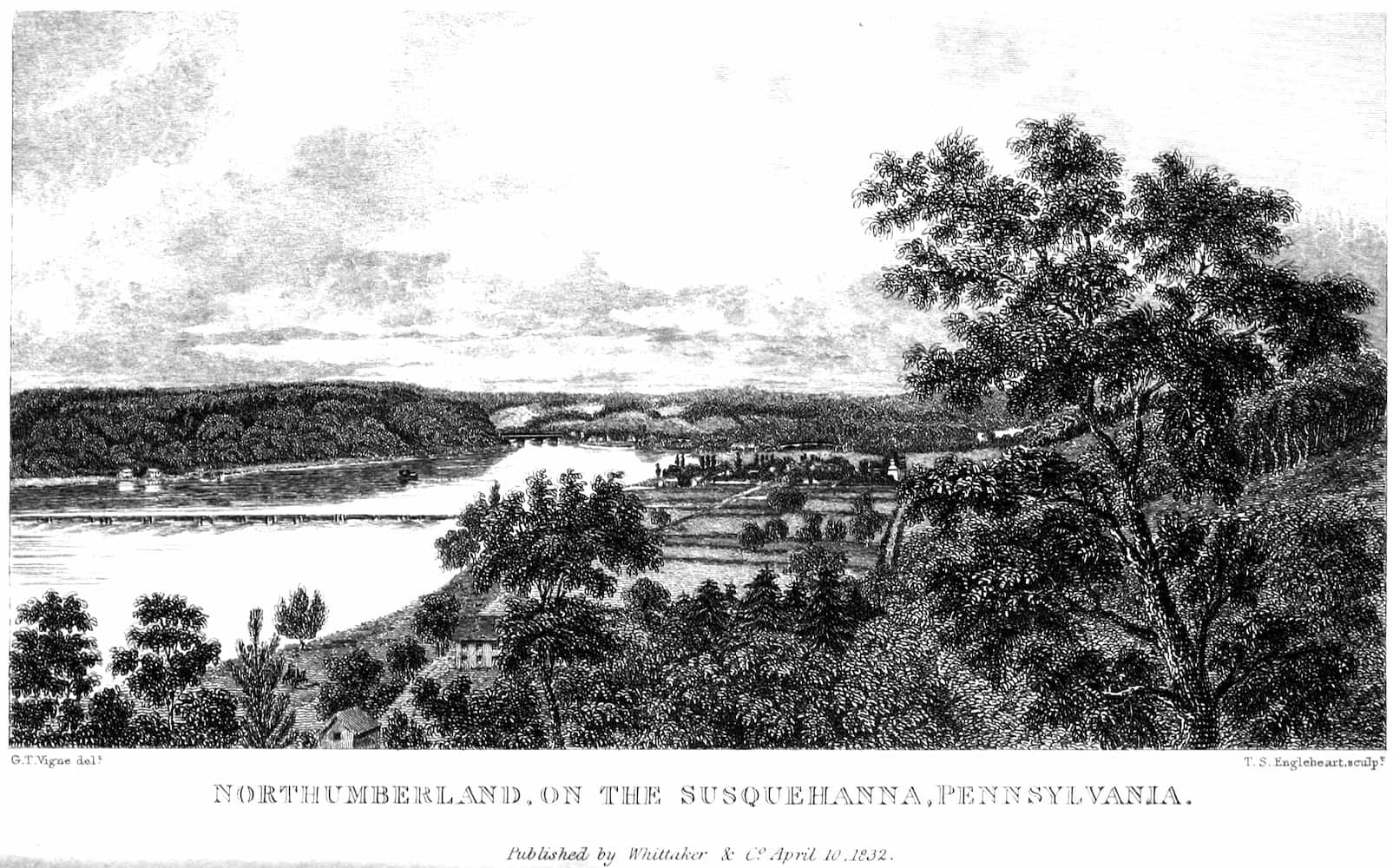
G.T. Vigne delṭ T. S. Engleheart, sculpṭ
NORTHUMBERLAND, ON THE SUSQUEHANNA, PENNSYLVANIA.
Published by Whittaker & C
o
. April 10, 1832.
I left Philipsburg, and returned to Belfont, whence I took the road to Northumberland. In about six hours I again came in sight of the Susquehanna, flowing through an extensive valley, with its lofty southern bank robed to the very summit by a covert so thickly interwoven as to be absolutely impassable. I proceeded down the side of the river till I arrived at the ferry at Dunnsburg. Here I met with a piece of singular incivility and impudence. The insolent young Charon allowed me to place my luggage in his leaky bark; but as I was proceeding to take my seat, he “calkilated,” with the most disagreeable twang (at least, I thought so) that I had yet heard, “that I must pay him a fip (five-penny bit) before I put my foot into his boat.” It was all in vain that I pointed to my portmanteau, intimating that it would be “assets” for the payment of my passage to the other side. Nothing would satisfy him but my fip beforehand; and I was obliged to pay it. It appeared that some stage-passengers had gone off without paying, and he did not wish to be cheated a second time. The guard who arrived with the mail, was so enraged at his conduct, that he actually took out one of the horses, crammed him through the river, and arrived safely on the other side with the letter-bags.
Within a mile or two of Dunnsburg, are some Indian tumuli; but I did not stop to see them. I travelled onward through a most delightful country, abounding in black-oak; the bark of which is sent down the river, and shipped off in great quantities for England, where it is used in dying. I enjoyed a very fine view from the hill over which the road passes near Moncey; but I afterwards saw the same prospect to much greater advantage, from Northumberland. This place contains about two thousand inhabitants, and is most delightfully situated on the neck of land that separates the northern and western branches of the Susquehanna. The celebrated Dr. Priestley spent the latter years of his life in this place. He died about twenty-five years ago. I was assured by an old and intimate friend of his, who was with him but a few minutes before he died, that there was great foundation for a prevalent belief, that for some months previously to his death, he changed his opinions in favour of the divinity of Christ.
Good land, in a state of cultivation, is worth twenty, thirty, forty, or even a hundred dollars the acre, in this part of the country. The average profits of land amount to twelve and a half per cent. Thirty bushels of wheat is a good crop. The wages of the married labourer are fifteen dollars a month (the United States dollar is equal to 4s. 6d.). Single men, who board at the house of their employer, receive but ten. Wherever I made inquiry, I found the rate of labourers’ wages to be much the same throughout the States.
I crossed the western branch of the Susquehanna by a new and handsome wooden bridge, built as usual on stone piers. Its length was 1316 feet, and it cost 70,000 dollars. I then immediately ascended the heights on the other side. From them I had a full view of both branches of this “shining river,” an appellation which none deserves better than the Susquehanna. I preferred the scenery around Moncey to that in the direction of Wyoming. The sun was declining behind the precipice on which I stood, which was thrown more and more into shade, as the red rays glanced through the pines on its summit, and swept downward into the broad and beautiful valley beneath me. The windings of the river were visible to a great distance. Although considerably larger, it strongly reminded me of the Thames seen from Richmond-hill. Its tranquil lake-like stream meandered through the country, encircling several islands: at one time gliding in silence through the forest, or emerging to roll its waters over a rich and extensive meadow, it freshened every thing in its course; and when it had fully performed the task of ornament and usefulness allotted to it by nature, it seemed to lose itself through a gap in the Blue Mountains, from which in reality it issued.
Beautiful as it is, yet, were this England, I could not help thinking, how different would be the appearance of the country! I am gazing on a view, as splendid as any one of the same character I ever beheld in any land,—I see before me a noble river, winding its way through an exquisite landscape, of hill and dale, and wood and verdure, abounding in every resource that could make a country life agreeable; but it is in vain that my disappointed eye roves over the scene, and rests on the most magnificent situations for park and palace: where, thought I, are the “stately homes of England?”—where is the marble-fronted hall, and the village church beside it, with its spire pointing to the heavens? The powerless genius of embellishment wanders disconsolate along the beautiful banks of the Susquehanna, and bitterly complains that he is fettered by the spirit of democracy.
I am far from meaning to infer in the above passage, that there is any lack of churches in the United States. On the contrary, they are numerous. As an Englishman, I am here speaking merely with reference to situation, and the association of ideas excited in my mind.
The Americans, in general, are not fond of comparisons between England and their own country, except in cases where the balance is in their favour; but still, I have often observed that there is no subject of conversation more gladly discussed by an American gentleman, and more particularly by those who have country houses of their own, than the splendour of the seats of our nobility and gentry, and the perfection of society which is enjoyed at them. There is nothing in England so apt to elicit from them a remark of honest regret, as their knowledge of the very remote probability, I may almost add, the utter hopelessness, of their ever being able to boast of seats and villas at all equal to those on this side of the Atlantic, so long as the present form of government exists in full force. Who would build a really splendid mansion, which, after his death, will probably either become a ruin, or be sold, and converted into an hospital? or who would clear and beautify a park of any extent, to be divided and ploughed up by his needy successors? I have seen country houses in America, whose delightful situation, and gentlemanly appearance, (although it must be allowed, they often look their best at a distance), only serve to render the prospect of division the more melancholy. I have been kindly received at many of them: I have usually noticed a due attention to comfort and elegance, and invariably, to kindness and hospitality; but I have not been able to avoid a remark, that there did not appear to be much difference in the size of the houses, or the extent of the grounds, as if there existed a general and mournful acknowledgment, that a just medium was to be observed between the expense incurred with reference to present enjoyment, and the probability of an ultimate loss of capital, when the future was regarded. I could name a few, but very few, exceptions.
Whatever the Americans may think of their institutions in other respects, there are many sensible Americans—and I have met with them—who will acknowledge the inefficacy of these to counteract the disadvantages, not to say miseries, sometimes arising from the non-existence of the law of primogeniture. The object is, to exclude the preponderance of wealth, because it tends to generate an aristocracy of political power. The non-existence of the law of primogeniture is, I think, with great deference, but lamely defended by Chancellor Kent, in his admirable Commentaries on American Law, and which, by the way, are most richly deserving of a place in every library, if it be merely on account of the learned dissertations on the history of every republic of note that has ever existed. He quotes Adam Smith in support of his opinions; the Marquess Garnier, his French translator; and the Baron de Stael Holstein,—and although he acknowledges the attendant evils, yet he says it would be an error to suppose that they have been already felt. But surely there are some which he does not contemplate in his work; but which must be acknowledged to have a miserable effect upon the state of society. A sale, not unattended with sacrifice, takes place at the decease of nearly every person who dies in possession of landed property. This is followed by a minute division of the proceeds amongst the next of kin. As to the law of dower, it is much the same as that of England generally; but where the sale has been made, the produce is considered as real estate so far, and the widow receives an annuity from one third in lieu of her dower. This does not effect the distribution of the remainder, which is divided as in England. It often happens, that the share of each person, if young, is just enough to purchase his destruction.
Very frequently, but in some States more than others, its most prominent application is detected by the effects of a vicious indulgence in ardent spirits, principally among the second and lower classes. Drunkenness still prevails to an alarming extent, notwithstanding the benign presence of the temperate societies. I have heard the most melancholy and appalling accounts of its ravages in private life; and in one place I was informed of its disgusting influence over judicial morality. The root of the evil is in the expectations which are formed: it is the certainty of actual possession of property at a future time, accompanied by ignorance as to its amount, that so often cherishes in the children the most dissolute habits of idleness, with all their attendant evils. Supposing both of them in the same easy circumstances as country gentlemen, and fathers of families, how different must of necessity be the sentiments of an American and an Englishman, when they survey their respective fire sides! Both see around them their wives and children, in the possession of affluence and comfort, and happy in the enjoyment of each other’s society. But in the event of his death, how gloomy may be the picture drawn by the one, in opposition to that contemplated by the other! A divided estate and a dispersed family, present themselves to the mind of the American; or perhaps a small part of them living together, but unable to command any share of the luxuries, and not many of the comforts they enjoy during his lifetime, in consequence of a secession of property by marriage, or decrease of it from dissipation. The Englishman feels a debt of gratitude to the constitution of his country: in the event of his death, his house, in the possession of his eldest son, will be a home for his widow and a place of meeting for his children. His younger sons have been brought up under the idea that they are to be the architects of their own fortunes, and such a doctrine has not rendered them unhappy, because it has enforced the virtue of contentment. The law of primogeniture perpetuates, through the eldest son, a species of parental affection and authority; and where there is a title to descend, there is a further inducement to the eldest son to emulate the virtues or the actions of an illustrious father; or, if that father has brought disgrace upon a distinguished name or sullied the escutcheon of a distinguished family (which, be it added, is sometimes the case), the son may be naturally desirous of wiping away the stain, and of giving the benefit of his example to society, by his imitation of the character of a nobler ancestor. There is yet a further deficiency of inducement to exertion existing in the American, and in every other democracy. In England, a young man in the enjoyment of a sufficient income, and who is consequently not obliged to labour at any profession with a view to its increase, yet with the possibility of obtaining a title, will exert his abilities to the utmost; but in America, the stimulus of titled distinction being unknown, it must often happen that the finest talents are doomed to remain unemployed.