TUSCAN SCHOOLS (continued 2)
Reading edition
Like all other artists, Raphael is at his best when, undisturbed by outside influences, he follows the free original impulse of his own mind. His peculiar element was grace and beauty of form, in so far as these are the expression of high moral purity.
The following works of his third period are especially deserving of mention.
The Aldobrandini Madonna, now in the National Gallery—in which the Madonna is sitting on a bench, and bends down to the little S. John, her left arm round him. The Madonna of the Duke of Alba, in the Hermitage at St. Petersburg. La Vierge au voile, in the Louvre; the Madonna is seated in a kneeling position, lifting the veil from the sleeping Child in order to show him to the little S. John. The Madonna della Seggiola, in the Pitti at Florence (painted about 1516), a circular picture. The Madonna della Tenda at Munich; a composition similar to the last, except that the Child is represented in more lively action, and looking upwards.
A series of similar, but in some instances more copious compositions, belong to a still later period; they are in a great measure the work of his scholars, painted after his drawings, and only partly worked upon by Raphael himself. Indeed many pictures of this class should perhaps be considered altogether as the productions of his school, at a time when that school was under his direct superintendence, and when it was enabled to imitate his finer characteristics in a remarkable degree.
In this class are the Madonna dell'Impannata, in the Pitti, which takes its name from the oiled-paper window in the background. The large picture of a Holy Family in the Louvre, painted in 1518, for Francis I., is peculiarly excellent. The whole has a character of cheerfulness and joy: an easy and delicate play of graceful lines, which unite in an intelligible and harmonious whole. Giulio Romano assisted in the execution.
With regard to the large altar-pieces of his later period in which several Saints are assembled round the Madonna, it is to be observed that Raphael has contrived to place them in reciprocal relation to each other, and to establish a connection between them; while the earlier masters either ranged them next to one another in simple symmetrical repose, or disposed them with a view to picturesque effect.
Of these the Madonna di Foligno, in the Vatican, is the earliest. In the upper part of the picture is the Madonna with the Child, enthroned on the clouds in a glory, surrounded by angels. Underneath, on one side, kneels the donor, behind him stands S. Jerome. On the other side is S. Francis, kneeling, while he points with one hand out of the picture to the people, for whom he entreats the protection of the Mother of Grace; behind him is S. John the Baptist, who points to the Madonna, while he looks at the spectator as if inviting him to worship her.
The second, the Madonna del Pesce has much more repose and grandeur as whole, and unites the sublime and abstract character of sacred beings with the individuality of nature in the happiest manner. It is now in Madrid, but was originally painted for S. Domenico at Naples, about 1513. It represents the Madonna and Child on a throne; on one side is S. Jerome; on the other the guardian angel with the young Tobias who carries a fish (whence the name of the picture). The artist has imparted a wonderfully poetic character to the subject. S. Jerome, kneeling on the steps of the throne, has been reading from a book to the Virgin and Child, and appears to have been interrupted by the entrance of Tobias and the Angel. The infant Christ turns towards them, but at the same time lays his hand on the open book, as if to mark the place. The Virgin turns towards the Angel, who introduces Tobias; while the latter dropping on his knees, looks up meekly to the Divine Infant. S. Jerome looks over the book to the new-comers, as if ready to proceed with his occupation after the interruption.
But the most important is the famous Madonna di San Sisto, at Dresden. Here the Madonna appears as the queen of the heavenly host, in a brilliant glory of countless angel-heads, standing on the clouds, with the eternal Son in her arms; S. Sixtus and S. Barbara kneel at the sides. Both of them seem to connect the picture with the real spectators. This is a rare example of a picture of Raphael's later time, executed entirely by his own hand.
Two large altar pictures still claim our attention; they also belong to Raphael's later period. One is the Christ Bearing the Cross, in Madrid, known by the name of Lo Spasimo di Sicilia, from the convent of Santa Maria dello Spasimo at Palermo, for which it was painted. Here, as in the tapestries, we again find a finely conceived development of the event, and an excellent composition. The other is the Transfiguration, now in the Vatican, formerly in S. Pietro at Montorio.
PLATE IX.—RAPHAEL PORTRAIT OF BALDASSARE CASTIGLIONE Louvre, Paris
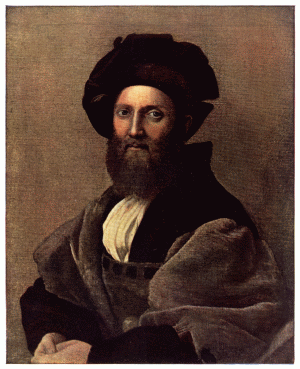
This was the last work of the master (left unfinished at his death); the one which was suspended over his coffin, a trophy of his fame, for public homage.
"I cannot believe myself in Rome," wrote Count Castiglione, on the death of the master, "now that my poor Raphael is no longer here." Men regarded his works with religious veneration as if God had revealed himself through Raphael as in former days through the prophets. His remains were publicly laid out on a splendid catafalque, while his last work, the Transfiguration, was suspended over his head. He was buried in the Pantheon, under an altar adorned by a statue of the Holy Virgin, a consecration offering from Raphael himself. Doubts having been raised as to the precise spot, a search was made in the Pantheon in 1833, and Raphael's bones were found; the situation agreeing exactly with Vasari's description of the place of interment. On the 18th of October, in the same year, the relics were reinterred in the same spot with great solemnities.
The schools of Lombardy and the Emilia, which derive their characteristics from Florentine rather than from Venetian influences, may here be briefly mentioned before turning to the consideration of the Venetian School. In 1482, it will be remembered, Leonardo went to Milan, where he remained till the end of the century; and the extent of his influence may be judged from many of the productions of Bernadino Luini (1475-1532) and Giovanni Antonio Bazzi, known as Sodoma (1477-1549). Of Ambrogio di Predis we have already heard in connection with the painting of our version of Leonardo's Virgin of the Rocks. Giovanni Antonio Boltraffio (1467-1516) was a pupil of Vincenzo Foppa, but he soon abandoned the manner of the old Lombard School, and came under the influence of the great Florentine, of whom he became a most enthusiastic disciple.
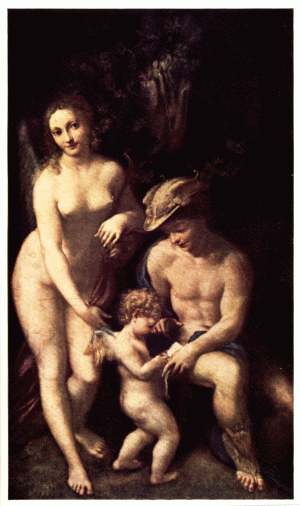
More independent—indeed, he is officially characterised as "an isolated phenomenon in Italian Art"—was Antonio Allegri, commonly called Correggio, from the place of his birth. In 1518 he settled at Parma, where he remained till 1530, so that he is usually catalogued as of the School of Parma, which for an isolated phenomenon serves as well as any other. Of late years his popularity has been somewhat diminished by the increasing demands of private collectors for works which are purchasable, and most of Correggio's are in public galleries. At Dresden are some of the most famous, notably the Nativity, called "La Notte," from its wonderful scheme of illumination, and two or three large altar-pieces. The Venus Mercury and Cupid in our National Gallery, though sadly injured, is still one of his masterpieces. It was purchased by Charles I. with the famous collection of the Duke of Mantua. Our Ecce Homo is entitled to rank with it, as is also the little Madonna of the Basket.
PLATE X.—CORREGGIO MERCURY, CUPID, AND VENUS National Gallery, London