ALADDIN AND THE WONDERFUL LAMP
Reading edition
KNOW, O King, that, once upon a time, in a far city of Cathay, there dwelt a poor tailor who had an only son named Aladdin. This boy was a born ne’er-do-well, and persistently resisted all his father’s efforts to teach him a trade by means of which he would be able in future to earn a livelihood. Aladdin would sooner play at knucklebones in the gutter with others as careless as himself than he would set his mind to honest business; and, as to obeying his parents in the smallest matter, it was not in his nature. Such was this boy Aladdin, and yet—so remarkable is the favour of fate—he was strangely predestined for great things.
Stricken with grief because of the waywardness and idle conduct of his son the father fell ill and died, and the mother found great difficulty in supporting herself, to say nothing of the worthless Aladdin as well. While she wore the flesh off her bones in the endeavour to obtain a meagre subsistence Aladdin would amuse himself with his fellow urchins of the street, only returning home to his meals. In this way he continued until he was fourteen years of age, when his extraordinary destiny took him by the hand, and led him, step by step, through adventures so wonderful that words can scarce describe them.
One day he was playing in the gutter with his ragged companions, as was his wont, when a Moorish Dervish came by, and, catching sight of Aladdin’s face, suddenly stopped and approached him. This Dervish was a sorcerer who had discovered many hidden secrets by his black art; in fact, he was on the track of one now; and, by the look on his face as he scrutinised Aladdin’s features, it seemed that the boy was closely connected with his quest.
The Dervish beckoned to one of the urchins and asked him who Aladdin was, who his father was, and indeed all about him. Having thus learned the whole history of the boy and his family the Dervish gave his informer some coins and sent him away to spend them. Then he approached Aladdin and said to him, “Boy, I seem to recognise in thee a family likeness. Art thou not the tailor’s son?” Aladdin answered him that he was, and added that his father was dead.
On hearing this the Dervish cried out with grief and embraced Aladdin, weeping bitterly. The boy was surprised at this and enquired the cause of such sorrow. “Alas!” replied the Dervish with tears running down his cheeks, “my fate is an unhappy one. Boy, I have come from a distant country to find my brother, to look upon his face again, and to cheer and comfort him; and now thou tellest me he is dead.” He took Aladdin’s face in his hands and gazed searchingly upon it as he continued: “Boy, I recognise my brother’s features in thine; and, now that he is dead, I will find comfort in thee.”
Aladdin looked up at him in wonder, for he had never been told that he had an uncle; indeed, he was inclined to doubt the truth of the matter; but, when the Dervish took ten pieces of gold from his purse and placed them in his hand, all doubt was out of the question, and he rejoiced at having found so rich an uncle. The Dervish then asked him concerning his mother and begged him to show him the way to her house. And, when Aladdin had shewed him, he gave the boy more gold and said, “Give this to thy mother with my blessing, and say that her brother-in-law, who has been absent forty years, has returned and will visit her to-morrow to weep with her over the place where his brother is buried.” With this he departed, and Aladdin ran to his mother to tell her the news.
“Mother! Mother!” he cried excitedly, bursting in upon her, “my uncle hath returned after forty years; he wept when I told him my father was dead; he salutes thee and—” “My son,” she broke in, “what are these wild words? Thou hast no uncle, and the only one thou ever hadst died many years before thou wast born.” “Nay, nay;” returned Aladdin, “this is my father’s brother; he recognised my father’s features in mine and wept, and gave me this to bring to thee, with a message that he would come to see thee to-morrow.”
He handed her the gold, and, as the widow took it, her doubt was lessened considerably. “I wonder,” she cried. “Can it be that my husband’s brother did not die after all, or that he has risen from the grave? In either case he is rich and generous.”
On the morrow the Dervish sought Aladdin in the street where he had seen him the day before, and found him there among his disreputable friends. Taking him aside he kissed him and embraced him; then, placing ten gold pieces in his hand, he said, “Hasten now to thy mother and give her these gold pieces and say that her brother-in-law would come to sup at her house this night.”
So Aladdin left him and ran home to his mother with the gold pieces and the message. Then the widow busied herself and prepared for the coming of this new-found relative. She bought rich food, and borrowed from the neighbours such dishes, utensils and napery as she required. When the supper was ready, and the widow was about to send Aladdin to hasten the guest, the Dervish entered, followed by a slave bearing fruit and wine, which he set down, and then went his way. The Dervish, weeping bitterly, saluted the widow and immediately fell to asking questions about the departed, finally desiring to know which was his empty seat. On being shown it he prostrated himself and cried, “Alas! that I should return to find his place vacant. Oh! woe; there is no power nor strength but in God!” And he ceased not to weep until he had convinced the widow that his grief was genuine.
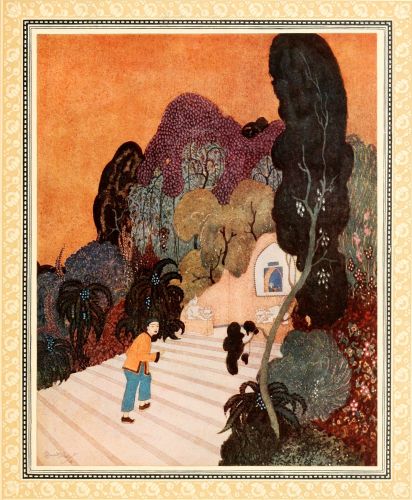
Aladdin finds the Magic Lamp. Page 71
Then, when he was comforted and they all sat at supper together, the Dervish told them how he had journeyed from a far land with one thought only: to see his brother once again; and how, with a great joy, he had chanced to find Aladdin, in whose face he had recognised his brother’s likeness—a joy so suddenly turned to sadness and grief on his learning that his only brother was dead. At his words the widow fell to weeping, whereupon the Dervish, to change the subject of talk, turned to Aladdin and asked him if he knew any art or trade. At this Aladdin hung his head, and, as he was too ashamed to answer, his mother dried her tears and answered for him. “Alack!” she said, “he is nothing but an idler. He spends his time as thou didst find him, playing with ragamuffins in the street, and is never at home except at meal times. And I—I am an old woman and ugly through toil and hardship, and grief at his behaviour. O my brother-in-law! It is he who should provide for me, not I for him.”
“I am grieved to hear this of thee,” said the Dervish, turning to Aladdin; “for thou art no longer a child, but a man of ability and kindness; and thou shouldst work to provide for thine aged mother so that she may live in comfort. Now, tell thine uncle what trade thou wouldst follow, and he will start thee in it so that in time thou mayst be able to support thy mother and thyself. Come, my son!” But Aladdin was still silent, and it was clear that he had no mind to work at any trade. Seeing this the Dervish made a better offer. “Wouldst thou like to be a merchant?” he asked. “If so I will give thee a shop with all kinds of merchandise, and thou shalt buy and sell and get gain, and rise to a position of importance.”
Now Aladdin regarded a merchant as a well-dressed, well-fed being, who did no work to speak of, but, from the profits on his wares, lived in a state of perfect delight. So the suggestion pleased him, and he replied with a smile that, above all things, he would like to be a merchant. “It is well, O Son of my brother!” replied the Dervish. “Then, to-morrow, I will take thee to the market and purchase a fine dress for thee, so that thou wilt be well received amongst thy fellow merchants; and, on the following day, I will stock a shop and set thee up in it; for this is the least I can do to show the great affection I bear for the memory of my late lamented brother.”
At this Aladdin clapped his hands with glee, and his mother was rejoiced. If at first she had been disposed to doubt the Dervish she now accepted him unreservedly as her brother-in-law, saying within herself, “Who but the boy’s uncle would behave with such great kindness towards him?” And she chid her boy for his own good, and counselled him straitly to obey his uncle in all things. The Dervish also gave Aladdin much sound advice on the conduct of trade, so that the boy’s head was bursting with buying and selling, and he could not sleep that night for dreams of rich stuffs, and bales of merchandise. At last, when the Dervish arose and took his departure, promising to return for Aladdin on the morrow and take him to buy his merchant’s dress, the wizard felt that he had proved himself undoubtedly the best of brothers-in-law, and the best of uncles.
True to his word the Dervish came on the morrow, and Aladdin, holding him affectionately by the hand, went with him forth to the market. There they entered a shop full of the finest materials, and the Dervish asked to be shewn some dresses such as a wealthy merchant might wear. The owner of the shop laid a great variety before him and the Dervish said, “Now, my son, choose what dress you like.” This delicate favour of choice pleased Aladdin greatly, for it seemed that he had now at last reached the age of discretion. He picked out one that he liked, and the Dervish paid the price without any attempt at bargaining. Then they went together to the Hammam, and, when they had bathed and rested, Aladdin clothed himself in his new dress and came forth in great delight, kissing his uncle’s hand and thanking him again and again.
The Dervish then showed Aladdin the market and the traffic in goods, saying that he must study all these things in order to be apt in his profession. From the markets they passed on to the mosques and other fine buildings in the city, and thence to an eating-place where the finest food was served on silver dishes, and the sherbet was of the rarest kind. Here they regaled themselves sumptuously, and rested. And, whenever Aladdin thanked his uncle for his kindness, the Dervish replied, “Nay, boy; am I not thine uncle? Would that I could do more by my brother’s son.”
When the afternoon came they strolled in the beautiful gardens, and the Dervish delighted Aladdin by showing him the pleasure grounds and the magnificent palaces. And so they wandered on, hand in hand, until they came to a garden full of every delight, where crystal streams flowed between glorious banks of flowers, and fountains played and sparkled in the sunlight. There they sat down by the side of the running water and made merry, so that none observing them could doubt that they were kind uncle and glad nephew.
After they had rested the Dervish suggested a walk, and he led Aladdin through garden after garden until they came to the confines of the city, beyond which stood a high hill. “Shall we return, O my uncle?” said Aladdin, who was in no mood for climbing the hill. “There are no more gardens outside the city.” “Nay,” replied the Dervish, “on the hillside is the loveliest garden of all. Bear up, my son, and be a man; we shall soon be there.” And, as they went, he beguiled the boy with anecdotes, so that Aladdin forgot both the length of the way and his weariness.
At last they came to a place on the hillside where the Dervish paused and looked about him, saying to himself, “This is the spot I have journeyed so far to find.” But to Aladdin he said, “Rest here awhile, O my son, and, when thou art refreshed, gather some wood and we will make a fire; then, if thou wish to see a most wonderful thing, I will shew thee that which will take thy breath away.”
At this Aladdin’s curiosity was excited, and, with no thought of resting, he began at once to gather wood. When he had collected a sufficient quantity the Dervish lighted the fire, and, taking from his wallet a little box, drew some fine powder from it and scattered it over the fire, uttering an incantation. Immediately, amid rumblings of thunder, the earth reeled and opened. At this Aladdin fled in terror, but the Dervish, powerless to effect his purpose without the boy’s aid, flew after him in a rage, and smote him over the head, so that he fell to the ground stunned.
When, presently, he regained his senses, he sat up and cried out, “What have I done, O my uncle, that thou shouldst strike me?” “Nay, my son,” replied the Dervish, “I intended not to hurt thee. Come, now, be a man, and obey my wishes if thou wouldst see the wonderful things that I will shew thee.” With such words as these he banished Aladdin’s fears and smoothed him over. Then he directed him to the opening in the earth, where there was revealed a slab of marble with a brass ring let into it. The Dervish stooped and began to draw figures upon the ground, saying as he did so, “Obey me, Aladdin, in all that I say, for so thou shalt become richer than all the kings of the earth. Know, O my son, that beyond that slab of stone lies vast treasure which none but thee can acquire and live. Therefore, advance, my son, and take the brass ring in thy hand, and lift the slab from its place; for it is predestined that thou art the only one on this earth that hath the power to do this thing.” And Aladdin, stirred to great wonder by the words of the Dervish, would have done his bidding with alacrity, but, on looking at the marble slab, he saw that it was far too heavy for him.
“Never can I raise that alone, O my uncle,” he said. “Wilt thou not help me?” “Nay,” answered the Dervish, “it will yield to no hand but thine. Grasp the ring and repeat the names of as many of thine ancestors as thou canst remember, beginning with thy father and mother; for thine ancestors are my ancestors, O my son! By this the stone will come away quite easily in thy hand as if it were a feather. Am I not thine uncle, and have I not said it? And did I not cleave the hillside with my incantations? Wherefore, pluck up courage, and forget not that all the riches beyond that stone are for thee.”
Thus encouraged Aladdin advanced to the stone, repeating the names of all the ancestors he could remember; and, taking hold of the ring, lifted the heavy slab from its place with perfect ease, and threw it aside. Then within the aperture lay revealed a stairway of twelve steps leading into a passage.
While Aladdin was gazing at this wonder the Dervish took a ring from his finger and placed it upon the middle finger of the boy’s right hand, saying impressively as he did so, “Listen to me, O my son! fear nothing in what I am about to bid thee do, for this ring will be thy protection in all dangers and against all evils. If thou shouldst find thyself in evil case thou hast only to—, but of that I will tell thee presently. What is more important now is this. In order to come at the treasure, O my son, steady thyself and listen attentively, and see to it that thou fail not a word of these my instructions. Go down the steps and traverse the passage to the end, where thou wilt find a chamber divided into four parts, each containing four vessels of gold. Touch not these on thy life, for if so much as the fringe of thy robe cometh in contact with any of them, thou wilt immediately be turned into stone. Linger not to gaze upon them, but pass right through to the end, where thou wilt find a door. Open this, repeating again the names of thine ancestors, when lo, thou wilt behold a beautiful garden before thee. Take the pathway that is ready for thy feet and proceed forty nine cubits until thou comest to an alcove, where is set a stairway of forty nine steps. Look not to ascend that stairway: it is not for thee nor me; but direct thine attention to a lamp hanging above the alcove. Take it from its fastening, and pour out the oil therein; then put it in thy breast securely, and retrace thy steps to me. Is it clear to thee, my son?”
“O my uncle, it is quite clear,” replied Aladdin, and he repeated the instructions he had received. “Pull thy wits together then, my son,” said the Dervish, well pleased; “and descend, for verily thou art a man of mettle, and not a child. Yea, thou, and thou only, art the rightful owner of all this great treasure. Come now!”
Filled with courage from the wizard’s words, and enticed by the dazzle of untold riches, Aladdin descended the twelve steps and passed through the fourfold chamber with the utmost care lest he should touch any of the golden jars therein with so much as the fringe of his garment. When he came to the door at the far end he paused to repeat the names of his ancestors, and opened it; then, lo, before him lay a beautiful garden where the trees were laden with many coloured fruit, while sweet voiced birds sang in the branches. He took the pathway that lay before his feet, and, as he followed it, he looked up and noticed that the trees bore, not fruit as he had supposed, but sparkling jewels flashing with many colours. On boughs where rosy apples might have hung were blood-red rubies half hidden in the leaves, and, where the purple grape might have clustered, were branches of large sapphires. On some trees white blossoms grew, and every blossom was a pearl, while what seemed like drops of dew among the blossoms were purest diamonds. All the leaves of the trees were of mother-of-emerald, and on their under surface they held, like seeds, rows of the emerald itself. Virgin gold peeled like bark from the trunks and branches, and, when bird chased bird through the foliage, there fell such a rain of wealth on the dull earth’s lap as would have enriched a king far above his fellow kings.
But Aladdin, though dazzled by the glitter, thought these sparkling things were but coloured glass; and it was for such that he plucked them with boyish delight until his pockets were full. “These are lovely things to play with,” he said, and proceeded to fill his girdle also.
As he made his way along the garden path, plucking the bright jewels as he went, he caught sight of the alcove at the far end, and, remembering his uncle’s instructions, hastened towards it. There was the stairway of forty-nine steps, and there, hanging from a crystal beam, was the Lamp. He paused, looking up at it. How should he reach it? His uncle had said that the stairway was neither for Aladdin nor for himself, and yet he saw at a glance that the only way of reaching the Lamp was by mounting seven steps of the stairway. He hesitated, then, concluding that the Lamp was the whole object of his quest, and that he must reach it at all costs, he ventured. With some misgivings he mounted the seven steps and, reaching out, took the Lamp from its fastening and descended with it. Then, emptying out the oil, he placed it securely in his bosom, saying “Now, as my uncle said to me, with this Lamp in my bosom all is mine!”
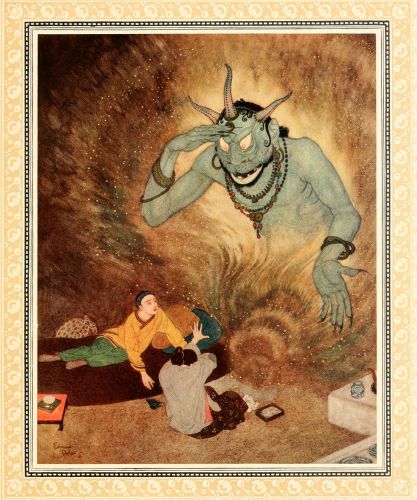
Aladdin and the Efrite. Page 78
As Aladdin was returning along the pathway among the trees, laden with the precious jewels, fear assailed him lest his uncle would be angry at his delay, for it was borne in upon him that no great delight can come to a mortal without his having to suffer for it. Whereupon he hastened his footsteps, and, passing through the fourfold chamber without touching the golden jars—for the fear of that was still upon him,—he arrived quickly at the foot of the stairway of twelve steps. Heavily weighted as he was with the jewels and the Lamp he proceeded to mount the stairs at a run. But the jewels grew heavier, and the Lamp weighed upon his bosom, so that he was exhausted by the time he was halfway up. Kneeling on the seventh step he looked up and saw the Dervish urging him on with the greatest impatience.
“Bear with me, O my uncle,” he said. “I am heavily weighted and am out of breath. I will soon come to thee.” Then he climbed three steps and one step more, and sank exhausted before the last, which was far higher than the others. The jewels and the Lamp oppressed him with heaviness and he could not mount that last step. “O my uncle, give me thy hand and help me up,” he cried. But the wizard dare not touch him, for so the spell of fate was worded and he must abide by it. “Nay,” he called down, “thou art man enough! It is the Lamp that hampers thee. Reach up and place it on the ledge here; then thou canst mount easily thyself.”
The Dervish held out his hand expectantly for the Lamp and his eyes glittered. Aladdin saw the evil light in them, and, having some mother wit, replied, “O my uncle, the Lamp is no weight at all; it is simply that I am exhausted and this step is too high for me. Give me thy hand and help me up.” “Give me the Lamp!” cried the Dervish holding his hand out for it, and beginning to rage. “Place it on the ledge before thee, and then I will help thee up.” “Nay,” returned Aladdin, growing obstinate, “if thou wilt not give me thy hand I will not give thee the Lamp, for it is in my thoughts that thou wantest the Lamp more than thou wantest me.”
This enraged the Dervish to a point beyond control, and he said within himself, “If I get not the Lamp then may it perish with him!” And, taking a box from his wallet, he threw some powder on the embers of the fire, muttering curses and incantations as he did so. Immediately a flame shot up, and its many tongues went hither and thither, licking the air. The earth shuddered and groaned with a hollow thunder; then the marble slab closed of itself over the aperture, the hillside rushed together above it, and all was as before, save that Aladdin was sealed within that cavern without hope of escape.
Long and loud did Aladdin call to his supposed uncle to save him from a living death; but there was no answer to his cries, and, at last, when he was almost exhausted, he took counsel of himself and plainly saw the truth of the matter. The Dervish was no uncle of his, but a cunning wizard who had made a catspaw of him to secure treasure which, by the laws of magic and destiny, he was powerless to come at in any other way. The whole thing, from the very beginning, was a trick; and he saw it clearly now that it was too late. The way out was sealed, and the darkness pressed heavily upon him. Frantic with the desire to escape from this dungeon he thought of the garden and the stairway in the alcove; but, when he had groped his way to the end of the passage, he found the door closed, and all his efforts failed to open it. The names of his ancestors were of no avail against the magic of the Dervish. At this he wept loudly, and continued to weep throughout the night, until his rage and despair were spent. At last he sank down exhausted on the lowest step of the stairway by which he had first descended, and, feeling himself utterly abandoned by man, he raised his hands to God, praying for deliverance from his calamity.
Now, while he was holding his hands in supplication, he felt the ring upon his middle finger—the ring which the Dervish had placed there saying, “In whatever difficulty thou mayst find thyself this ring will be thy protection; thou hast only to—but of that I will tell thee later.” The Dervish had perhaps given him the ring to gain his confidence, and had purposely omitted to reveal its secret. But now, in answer to Aladdin’s prayer, the power of the ring was revealed as if by the merest chance; for, when he felt the ring, he looked at it; and, seeing a light from the jewel therein, he breathed upon it and rubbed it with his palm to increase its lustre. No sooner had he done this when, lo, the Slave of the Ring appeared, and gathered shape before him, first in a luminous haze, and then, gradually, in clearer and clearer contour.
“Ask what thou wilt, and it shall be done,” said the apparition; “for know that I am the Slave of the Ring and the slave of him on whose finger my master placed the ring.”
Aladdin, seeing before him an Efrite after the order of those invoked by the Lord Suleiman, was terrified, and his tongue clave to the roof of his mouth, so that he could not speak. But the Efrite reassured him with kindly speech. “Thou hast only to ask,” he said, “and thy wish will be fulfilled; for, since my master’s ring is on thy hand, I am thy servant.”
At this Aladdin took heart, and, having considered his wish, resolved to put the matter to the test. “O Slave of the Ring!” he said, “my wish is that thou take me from this dungeon and place me in the light of day where the sun shines and the breezes blow—if indeed it is day, for here have I been for many, many hours.”
Scarcely had he spoken the words when there was a clap of thunder. The cavern opened, and, by some mysterious power, he was conveyed through the opening. Then, when he sat up and looked around him, he was in the light of day upon the hillside, and everything was as it had been when he and the Dervish had first reached the spot.
Aladdin marvelled greatly at this, and said within himself, “I wonder if it was all a dream!” But, when he looked at the ring upon his finger and felt the Lamp and the jewel-fruit he had gathered from the trees in the garden, he knew it was not a dream. Besides, there was the spot where the fire had been; and it was now but a heap of grey ashes on the ground. Turning himself about, he saw the path by which they had ascended, and the gardens stretching below. Nothing had changed. The side of the hill which the Dervish by his magic had opened for his entrance, and the Slave of the Ring had now closed up behind him, was as it had been when he first saw it.
Seeing that he was safe and sound in the outer world, Aladdin fell on his knees and gave thanks to the most High for his deliverance from a terrible death. Then straightway he arose and took the path that led down the hillside and through the gardens of the city in the direction of his home. At length, with wearied body, but elated mind, he reached the doorway of his dwelling, and, entering, found his mother weeping.
“Where hast thou been, my son?” she cried. “All night long I lay awake, anxious for thee; and now it is again near nightfall, and thou comest like one about to die. Where hast thou been, and where is thine uncle?”
But Aladdin could not answer her. What with utter weariness, and the joy of gaining his home once more, he fell in a swoon at her feet. Quickly she dashed water on his face and restored him. Then, when she had made him eat, she enquired gently what had befallen him.
“O my mother,” said Aladdin, “how much thou art to blame! Thou gavest me over to a devil of a sorcerer who tried, by his evil arts, to compass my ruin. I have a stout reckoning against thee for this; for, look you; this vile and wicked one, whom thou toldst me was my uncle, was naught but a liar and an impostor. Think, mother, of the richness of his promises! What was he not going to do for me? His affection for me was overwhelming, and he ceased not to pretend in that lying hypocrisy until the cheat was exposed and I saw that his purpose was to use me for his own ends, and then to destroy me. Mother, the devils beneath the sea and the earth are not the equal of this vile sorcerer.” And thus, having vented his anger at the false conduct of the Dervish, he proceeded to tell his mother, first about the lamp and the jewel-fruit, then about all that had happened on the hillside, from the opening of the earth by a magic spell, to the closing of it again, and his subsequent escape through the Slave of the Ring. “And thus,” he concluded, “thus did this devil’s own shew me in the end that he was accursed and that he cared no jot for me, but only for the Lamp.”
Then Aladdin took the Lamp and the precious stones from his bosom and placed them before his mother, albeit neither knew why the Lamp had been so coveted by the Dervish, or that the stones were more valuable than any possessed by kings. And Aladdin, now weeping for joy at his deliverance, and now cursing with rage at the vile hypocrisy of the sorcerer, found sympathy in both cases in his mother, who wept and cursed with him, crying out that the Omnipotent, who had graciously saved his life, would most assuredly punish that wicked man for his abominable actions.
Now, neither Aladdin nor his mother had rested for two days and two nights, so that, exhausted at length with weeping and with heaping maledictions on the Dervish, they slept; and, when they awoke, it was about noon of the following day. Aladdin’s first words on pulling his wits together were to the effect that he was hungry. “Nay, O my son,” replied his mother, “there is nothing to eat in the house, for thou didst eat yesterday all that there was. But stay, I have some spinning that is ready for the market. I will take and sell it and buy some food.”
She was busying herself about this when Aladdin suddenly called out to her, “Mother! bring me the Lamp, and I will take and sell that; it will fetch more than the spinning.” Now, although Aladdin and his mother knew that the Dervish had greatly coveted the Lamp, they both imagined that he had some strange reason of his own for this; and, as the Lamp was an article that would command a ready sale, the mother quickly agreed to Aladdin’s proposal and brought the Lamp to him in answer to his call. On regarding it closely, however, she observed that it was very dirty. Well knowing that it would fetch a better price if it were clean and bright, she set to work to polish it with some fine sand; when lo, as soon as she started to rub the Lamp, the air before her danced and quivered and a chill gasp of wind smote her in the face. Then, looking up, she saw, towering above her, a being monstrous and terrible, with a fierce face in which gleamed fiery eyes beneath frowning brows. She gazed at this apparition in fear and astonishment, for she knew it was surely a powerful Efrite such as were under the power of the Lord Suleiman. Then the being spoke: “Thou hast invoked me; what is thy wish?” But she only gazed at him, dumb with terror. Again the awful being spoke: “Thou hast summoned me, for I am the Slave of the Lamp which is in thy hand. What is thy desire?” At this the poor woman could no longer endure her fear, and, with a cry, she fell in a swoon.
Aladdin had heard the Efrite’s words and had hastened to his mother’s side. He had already seen the power of the Slave of the Ring, and he guessed that now the Slave of the Lamp had appeared, and was ready to do the bidding of the one who held the Lamp. So he quickly took it from his mother’s hand, and, standing before the Efrite, plucked up courage and said, “I desire food, O Slave of the Lamp! the finest food that ever was set before a king.”
No sooner had he spoken than the Efrite vanished, but only to reappear immediately, bearing a rich tray of solid silver, on which were twelve golden dishes with fruits and meats of various kinds. There were also flagons of wine and silver goblets. As Aladdin stared in amazement at this magnificent repast the Efrite set the tray down before him and vanished in a flash. Then Aladdin turned to his mother and dashed cold water on her face, and held perfumes to her nostrils until she regained consciousness and sat up. And when she beheld the sumptuous repast set out upon the golden dishes she was greatly astonished, and imagined that the Sultan had sent it from his palace. But Aladdin, who was very hungry, fell to eating heartily; and, while persuading his mother to eat, he would tell her nothing.
It was not until they had satisfied their hunger, and placed the remainder aside for the morrow, that Aladdin informed her what had happened. Then she questioned him, saying, “O my son, was not this the same Efrite that appeared to thee when thou wast in the cavern?” “Nay,” he answered. “That was the Slave of the Ring; this was the Slave of the Lamp.” “At all events,” said she, “it was a terrible monster that nearly caused my death through fear. Promise me, O my son, that thou wilt have naught further to do with the Ring and the Lamp. Cast them from thee, for the Holy Prophet hath told us to have no traffic with devils.”
“Nay, nay, O my mother,” protested Aladdin; “it were wiser to keep them, for did not the Slave of the Ring deliver me from death? and has not the Slave of the Lamp brought us delicious food when we were hungry?” “That may be so,” replied his mother, “but hear my words, my son; no good thing can come of these dealings with accursèd spirits, and it were better for thee to have died in the cavern than to invoke their aid.” And thus she pleaded with him to cast away the Ring and the Lamp, for she was sore afraid of the power of the Evil One. But Aladdin would not undertake to do this, although, in respect for her wishes, he agreed to conceal the objects so that she might never need to look upon them. He also agreed to invoke neither of the Efrites again, unless it were a case of dire necessity. And with this his mother had to rest content.
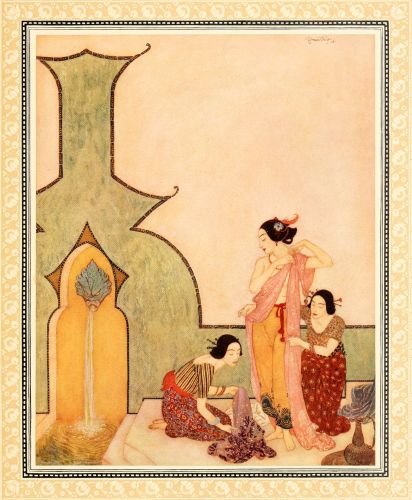
The Lady Bedr-el-Budur at her bath. Page 84
Mother and son continued to live on the food that remained, until, in a few days, it was all gone. Then Aladdin took up one of the dishes from the tray, and, not knowing that it was of pure gold, went out to sell it and buy food with the proceeds. In the market he came to the shop of a Jew—a man of exceeding vile methods of buying and selling; and he showed the dish to him. This Jew, as soon as he saw the dish, knew it for pure gold and glanced sharply at Aladdin to find whether he knew its value. But Aladdin’s face told him nothing; so he enquired, “What price do you ask, O my master?” “Its value in the market,” returned Aladdin; and at this the Jew pondered, saying within himself, “If he knoweth the value, and I offer him too little, he will give me a bad name in the market; yet, if he knoweth not, I should be ruining myself by offering him too large a price. Perchance he knoweth not.” Then, preferring that others might call him a rogue rather than that the event might prove him a fool in his own eyes, he took a single gold piece from his pocket and handed it to Aladdin. On this and its issue, seeing quickly that Aladdin knew not the value of the thing—for he took the gold piece and walked away—the Jew repented him bitterly of his rash act, for he could have bought the dish for much less.
As for Aladdin, he hastened home and gave the gold piece to his mother, begging her to buy food with it. She did so, and they ate, and were comforted. And so, from day to day, they lived on the proceeds of one dish after another, which the unregenerate Hebrew bought at cheaper and cheaper prices, saying always that the metal was inferior and that the demand for such goods was not what it used to be. And, when at last the dishes were all sold, Aladdin summoned the Jew to the house to inspect the goblets and also the tray, which was too heavy for him to carry to the market. When the Jew saw how much silver there was in the tray and the goblets he forgot himself and offered ten gold pieces for them—at least a thirtieth part of their value. Aladdin took the gold pieces, and the Jew departed with the tray. So food was forthcoming for many more days; but at last the money was exhausted and there was now nothing left to sell. At this Aladdin, who, in deference to his mother’s wishes, had concealed the Lamp and the Ring against a necessitous occasion, brought forth the former and rubbed it, for so, he concluded, was the Slave invoked. His conclusion was right, for no sooner had he rubbed the Lamp than the Efrite suddenly appeared before him, immense and of terrible aspect.
“What is thy wish, O my master?” said the Efrite; “for I am the Slave of the Lamp and of him who holds it.” “My wish,” answered Aladdin, “is that you bring me another tray of food similar to the one you brought before.” Immediately the Efrite vanished, and, in a moment, appeared again, bearing a tray of food exactly similar to the one he had brought before. He set this down before Aladdin and then disappeared.
“Mother! Mother!” cried Aladdin in delight. “Come here and see what we have for supper.” When she hastened to him and saw the delicate food, and smelt the rich savours, she was pleased, although she knew that Aladdin had summoned the Efrite and commanded him to bring the tray. “Look at it, Mother!” cried Aladdin; “and thou wouldst have me cast away the Lamp by means of which we have gotten this repast!” “O my son,” answered she, “if the Slave of the Lamp be a devil then he is a good devil; but, for all that, I know I should swoon again at sight of him.”
And they ate and drank and were merry, the food lasting them some days. Then, just as a tidy housewife clears away the platter after a meal, so, when the food was all gone, Aladdin proceeded to dispose of the dishes as before. Taking one of them he went forth to find the Jew, but it chanced that on his way he passed the shop of a fair-dealing man—that is to say, not a Jew—who had no vile methods of buying and selling, but was just, and feared God. When this man saw Aladdin passing he called to him, and told him that he had frequently seen him selling things to the Jew, and warned him about it. “Thou knowest not how the Jew will trick thee,” he said, “for the goods of the faithful are fair spoil to the Jews; and it was ever so, and ever will be. If, therefore, thou hast aught to sell, I will give thee its full value, in the name of the Prophet.”
Then Aladdin shewed him the dish of gold and he took it, and weighed it on the scales. “Did you sell any of this kind to the Jew?” he asked. “Yes,” answered Aladdin, “many—all of them exactly the same.” “And what price did he pay you?” “A gold piece for the first, and afterwards less.” The merchant looked grieved and spat on the ground. “My son,” he said; “it is not meet that a servant of God should fall into the hands of the Jew. Woe unto him, accursèd! He hath cheated thee sore, for my balance tells me truly the weight of this dish, which is of pure gold; and its value is seventy pieces of gold. Here is the price if thou wouldst sell.”
He counted out seventy gold pieces and handed them to Aladdin, who took them and thanked the merchant heartily for his honest exposure of the Jew’s wickedness. And thereafter he brought the remaining dishes, and at last the tray, to that merchant, and received from him their full value; so that Aladdin and his mother were placed above want and in a comfortable position for people of their station in life.
During this time Aladdin had changed his ways greatly. He no longer consorted with the ragamuffins of the street but selected for his friends men of standing and integrity. His daily practice was to go to the market and converse with the merchants in a serious and business-like manner in the endeavour to learn their methods and the value of stuffs. And often he would watch the jewellers at their work, and the goods they handled; and, through knowledge thus acquired, he began to suspect that the jewel-fruit he had gathered in the garden of the cavern was not glass, as he had imagined, but real gems. By this and that, and by comparing and asking questions, he came at length to the certainty that he actually possessed the richest jewels in all the earth. The smallest among them was bigger and more sparkling by far than the largest and finest he could see in any jeweller’s shop.
One day, while his mind was engaged with this amazing thing, and while he was as usual studying the ways of the merchants in the bazaar and the varying quality of their goods, a thing happened which was predestined to have far-reaching results on his life. He was in the jewellers’ market, taking note of things, when a herald came by, crying to all people: “Take heed! By command of the Sultan, King of the Age and Lord of the Earth, let all doors be closed, and let none come forth from shop or dwelling on pain of instant death, for the Sultan’s daughter, Bedr-el-Budur cometh to the bath! Take heed!”
Now, on hearing this, a great longing arose in Aladdin’s breast to look upon the face of Bedr-el-Budur, the Sultan’s daughter. “All people extol her loveliness,” he said to himself; “and I—even if I die for it—I will look upon her face; for something—I know not what—impels me to gaze on Bedr-el-Budur the beautiful.”
So, with this will, he speedily found the way. Hastening to the Hammam he secreted himself behind the door so that, unobserved himself, he might see her when she came in. And he had not long to wait, for, presently, the Sultan’s daughter arrived; and, as she entered, she lifted the veil from her face, so that Aladdin saw her features clearly.
What a wondrous beauty was there! The witchery of her eyes! The ivory of her skin! The jet of her glossy tresses! These, and the swaying of her graceful body as she walked, caused Aladdin’s heart to turn to water and then to spring wildly into flame. “What a creature is this Princess!” he said within himself. “I knew not that God had ever created such a soul of loveliness.” Then, suddenly, an overwhelming love for her took him by the heart, and gat hold of him utterly, so that he knew naught else for the very stress of it.
Like one walking in a dream Aladdin went home and sat him down in dejection of spirit. For a long time he answered not his mother’s questions as to what ailed him, but continued like one who had beheld a vision so lovely that it had deprived him of his senses. At last, however, he looked up, and said, “O my mother, know that until to-day I had believed that all women were of thy fashion of face, but now I find they are not; for to-day I saw the Sultan’s daughter, and she is more beautiful than all others on earth.” And Aladdin told her how he had hidden behind the door of the Hammam, so that, when Bedr-el-Budur had entered and lifted her veil, he had seen her clearly; and how, on that, a great love had leapt up in his heart and filled him to the exclusion of all else. “And there is no rest for me,” he concluded, “until I win the Lady Bedr-el-Budur, and make her my wife.”
At these daring words Aladdin’s mother regarded him sharply, with fear on her face. “Art thou mad, my son?” she cried. “For, if such an insane act is thine intention, then God save thee!” “Nay, O my mother,” he answered, “I am not mad. But, as I risked my life to see her, so will I risk it again to win her; for, without her, life is of no account to me. I will go to the Sultan and ask him to give me the lovely Bedr-el-Budur for my lawful wife.”
Seeing his determination his mother was sore afraid, and knew not what to do. For a long time she reasoned with him anxiously, pointing out what a scandal it would be for the son of a poor tailor to aspire to the Sultan’s daughter—the highest in the land, and one whom the Sultan would scarce bestow upon a King who was his equal. Aladdin listened very quietly, and then replied that his resolve was unshaken; and, though he admitted the truth of all she had said, he would nevertheless carry out his purpose, for the Lady Bedr-el-Budur was the only thing in the world to him, and if he did not win her he would die. In vain she suggested that there were many of his own class he might marry; besides, to approach the Sultan on such a matter meant certain death; unless, indeed, the Sultan thought to bind him on an ass, with his face to the tail, and parade him through the city with the heralds shouting, “Behold the reward of presumption and the payment of impertinence!”
These arguments, and more, his mother put before him; but Aladdin shook his head at all of them, and remained firm in his determination. “And further, O my mother,” he said, “I wish now that thou go thyself to the Sultan and put my request to him, for am I not thy child? And is it not thy duty to perform this office for me?”
“O my son,” she cried in despair, “wilt thou bring me into thy madness? I, a poor woman of humble birth, to go in to the Sultan and demand the princess for my son! Why, if I were to go even to one of our equals and demand his daughter, I should immediately be asked what money and goods we possessed; and, if I could not give a ready reply on that matter to an equal, what reply, do you imagine, could I give the Sultan? Besides all this, O my son, how shall I even gain access to the Sultan’s presence for this purpose without bearing a rich gift to offer him? Out on thee, my son, for thy presumption! What hast thou done for thy country, or what are thy vast possessions that the Sultan should reward thee with his daughter?”
“Mother,” answered Aladdin, “thy words have served me well, for they have called to my recollection a thing which, through excess of love for the Lady Bedr-el-Budur, I had forgotten. Thou sayest that thou canst not approach the Sultan without a rich gift. Then, O my mother, if I place in thy hands an offering richer than any King in the world can make to any other, wilt thou carry out my desire?”
Thinking his words were wild as the wind, and that he could produce no such offering, his mother agreed; but, remembering the Slave of the Lamp, and what had already been done in that way, she stipulated with Aladdin that she would carry out his wish only on condition that it required no further invoking of the Efrite. Aladdin assured her on this and asked her to fetch him a china bowl. Wondering greatly she arose, and brought the bowl to him. Then Aladdin emptied into it all the sparkling jewels which he carried within his garments, and, when they were heaped together in the bowl they shone with a dazzling splendour. Liking well her amazement he explained to his mother how he had learned in the market place that what he had at first thought were mere glass were really the rarest of precious stones, the equal of the least of which could not be found in the treasuries of Kings. On hearing this, and at sight of the brilliant, flashing gems, his mother was dumbfounded, for she saw that this was indeed a treasure beyond all imagination, and worthy of the Sultan’s acceptance. But, as she had naught to say, Aladdin spoke for her, and held her to her promise.
“Thou seest, O my mother,” he said, “that this is an offering excelling all others. Now, therefore, according to thy promise, arise straightway and go to the Sultan, bearing these wondrous jewels. I am greatly mistaken if he accepteth not the gift.” “But, O my son,” answered she in dismay, “what can I say to him? The gift is fabulous indeed, but still more fabulous is the request thou desirest me to put to him. For, if I say I want his daughter for my son, he may be so angered at my impertinence that he will take the jewels and condemn me to death. And then he may search for thee, my son; and, when he hath found thee, and looked upon thy face, we shall assuredly die together.”
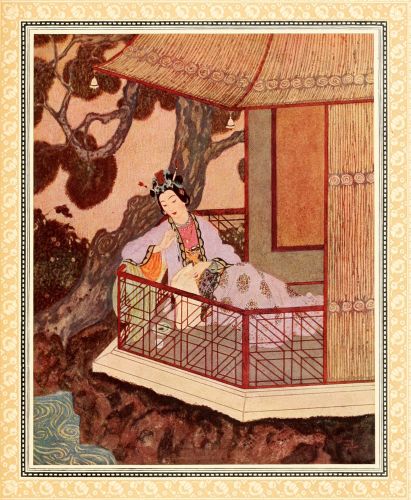
The Lady Bedr-el-Budur. Page 113
Aladdin made a gesture of impatience at his mother’s view of the matter. “On my head and eye,” he said angrily, “though thou art my mother thou art verily lacking in sense. I put it to you: What man living, yea, even though he be the Sultan, would refuse to grant thy request when thou comest to him with the price of more than half his kingdom? Nay, my mother,—for such thou art,—thou art surely deficient in wisdom.” And he took up the bowl of glittering jewels and weighed the chances of them in his hand.
But his mother, silenced as she was with his shrewd words, was terrified at the prospect of her visit to the Sultan, and still went on raising difficulties. “Haply, O my son, he will be pleased to see me, because of the gift; but what if he say to me, ‘Who is this, thy son, who seeketh the hand of my daughter? What is his condition and state of life?’” “How can he ask thee that,” answered Aladdin, “when the jewels in the bowl are crying out my state and my condition? Such a thing will never happen, except in thy mind. Do thou now arise and go to him, for I will no longer listen to these fanciful excuses.” “Nay, nay, my son,” she cried, seeing there was no withdrawing from her promise; “I will go, but give me till the morning to strengthen and prepare myself.”
So Aladdin curbed his impatience and agreed to wait until the following day; but, since he realised that it was not impossible that the project might fail, and that he might have to seek to the Slave of the Lamp for advice and help in difficulty, he spoke to his mother on the matter. “O my mother,” he said, “it was the condition of thy promise that I should not invoke the Slave of the Lamp in the furtherance of this my desire; yet it must be understood between us that if thou make a blunder—which thou needst not do—then, to extricate us from a dire calamity, I am free to rub the Lamp and see what its Slave can do for our salvation.”
His mother assented to this, for she knew, if she failed with the Sultan, all was lost; and, in such case, even the aid of a demon would be acceptable. “Then,” said Aladdin, “see thou to it that in thy gossip to our neighbours no word of the Lamp escape thy lips, for, if this wonderful possession of ours become known, it will speedily pass out of our hands and its virtues with it. Therefore keep thy counsel, O my mother, and babble not of our secret.” “Fear nothing, my son,” she replied, “the Lamp is our peculiar possession, and no word shall pass my lips concerning it.” And they ceased not to talk of their project, and the saving powers of the Lamp, far into the night.
When morning dawned Aladdin’s mother arose and prepared herself for the visit to the Palace, and, wrapping the bowl of jewels in a cloth, went forth early. When she arrived at the Palace she found herself among the first there assembled, and at once fell to watching the princes and nobles and high officials as they came in. When the audience was full the Sultan came in and seated himself on the royal divan. All bowed down before him, and then stood waiting with folded arms for his permission to be seated. And, when he gave permission, all sat down in their due order of precedence. Then he listened to their petitions in the same order, and gave his decisions, until the hour grew late, and the audience was declared closed. The Sultan arose and went into the Palace, and the princes, with the nobles and the people, went their ways. Among them went Aladdin’s mother, thinking to herself that this would be a matter of many days.
She hastened home to Aladdin, who, when he saw her with the bowl of jewels just as when she departed, cried, “What is this, O my mother? Hath he refused the jewels, and thy head still on thy shoulders?” “Nay, my son,” she replied; “be patient! There were many before me and I had no opportunity.” And she told him how she had gained a place in the audience, and how it was only a matter of waiting till her turn came to place her petition before the Sultan; perchance to-morrow or the next day.
Aladdin was overjoyed at this; and, though his exceeding love for the Princess probed him sore, yet he resolved to possess his soul in patience against the fulfilment of his desire. But what he momently expected was hourly delayed, and, from that time forth, the daily postponement of his request added fuel to the flame of love in his heart; for, on the following morning, his mother set forth again for the Palace and returned again in the evening but one day nearer to the putting of her petition. And every day thereafter she stood in the audience with the bowl of jewels under her arm and heard the petitions, but dared not for very timidity address the Sultan. And in this way she continued for a whole month, while Aladdin was nursing his impatient soul and waiting on the issue.
Now the Sultan, being observant, had noticed the woman present herself constantly at the levée; and, at length, one day, after the audience had dispersed and the Sultan had retired with his Grand Vizier, he said to him, “Hearken, O Vizier! for many days have I seen an old woman at the levée, and on each occasion she has carried a bundle under her arm. Knowest thou aught of her?” And the Vizier, who had little esteem for women, replied, “Doubtless a woman like other women, O our Lord! Maybe she cometh with a deadly grievance against her husband, whom she desires to be beheaded; and, when thou grantest her desire, she will plead for his life, supplicating thee with tears; for such was ever their way.” But the Sultan was curious about the woman and her silent persistence, and was not satisfied to dismiss the matter so easily. So he commanded the Vizier to see to it that, should the woman present herself again, she be instantly brought before him.
And so it came about. Aladdin’s mother, though weary with her many attendances, still persevered in her quest, feeling that, for the sake of her son, she would endure all delay so that the issue might come at last. And it came according to the Sultan’s command to the Grand Vizier; for one day the Sultan saw her waiting in the audience chamber and ordered the Vizier to bring her forward that he might consider her affair.
Now, at last, she was face to face with the Sultan, making obeisance to him and kissing the ground at his feet. “I have seen thee here, O woman, for many days,” said the Sultan; “and thou hast not approached me. If thou hast a wish that I can grant, lay it before me.” At this she kissed the ground again, and prayed fervently for the prolongation of his life. Then she said, “O King of all the Ages, I have a request; but, peace be on thee, it is a strange one! Wherefore I claim thy clemency before I state it.”
These words whetted the Sultan’s curiosity, and, as he was a man of great gentleness, he spoke her softly in reply, and not only assured her of his clemency but ordered all others present to withdraw, saving only the Grand Vizier, so that he might hear her petition in secret.
“Now, woman,” said the Sultan, turning to her, “make thy petition, and the peace and protection of God be on thee.” “Thy forgiveness, also, O King,” she said. “God forgive thee if there is aught to forgive,” he replied. And at this Aladdin’s mother unfolded the tale of her son’s exceeding love for Bedr-el-Budur, the Sultan’s daughter: how life had become intolerable to him because of this, and how his only thought was to win the Lady Bedr-el-Budur for his wife, or die—either of grief, or by the Sultan’s anger. Wherefore, his life being in the balance in any case, she had come as a last resort to beg the Sultan to bestow his daughter on her son. And she concluded by beseeching the Sultan not to punish either her or her son for this unparalleled hardihood.
The Sultan looked at the Grand Vizier, whose face was of stone—for the Lady Bedr-el-Budur had already been promised to his son: a matter well understood between them. “What sayest thou?” said the Sultan, regarding him with merriment in his eyes. But the Grand Vizier only cast a contemptuous look at Aladdin’s mother, and answered him: “O King of the Age! Thou knowest how to deal with this petition.” At this the Sultan laughed outright, and, turning a kindly face to the humble suppliant, observed her minutely. “What is that bundle thou hast under thine arm?” he said at last, remembering that she had brought it with her on every occasion.
Aladdin’s mother, greatly relieved to see the Sultan laughing, unfolded the wrappings of the bowl and handed it to him. As soon as he took it in his hand, and saw the size and splendid sparkle of the jewels, the Sultan laughed no longer, but gazed at them, speechless with wonder and admiration. Then at length, he handed the bowl to the Grand Vizier, saying, “Upon my oath, this is a marvellous thing! Tell me, O Vizier, have I in my treasury a single jewel that will compare with even the smallest of these?”
The Grand Vizier also was taken aback by their dazzling loveliness and beauty. He would have lied, saying they were glass or crystal, but the stones themselves flashed back the purposed lie in his teeth. All he could reply was, “Never, O my lord the King, have I beheld the like of these; nor is there one in thy treasury that could equal the beauty of the smallest of them.” And, saying this, the Vizier turned very pale, for neither he nor his son could approach the Sultan with such a gift. And it was as he had feared, and as Aladdin had prophesied: the Sultan required to know nothing further than what was before him in the bowl, for it was evident that the giver of these rare jewels must take precedence of all others, since, if they were sold in the market, their price would buy a dozen Grand Viziers and their sons, to say nothing of princes and nobles with their palaces and all. Indeed, as the Vizier readily saw, the worth of the precious stones might equal the worth of the Sultan’s kingdom, and this caused his knees to quake, for he quickly concluded within his mind that there was more behind this thing than what the eye beheld: perchance the old woman’s story was but the curtain that concealed a richer treasury than Cathay had ever heard of.
“O Vizier,” said the Sultan in dry and chilling tones, “it seemeth that in this land there are men greater than the greatest. What sayest thou? The man who sends me this kingly gift cannot conceal his greatness and worthiness behind the thin, loose yarn spun by his messenger here. That he is worthy of my daughter is clearly proved, O Vizier; and I, the Sultan, King of the Age, having power over all men, do withdraw my former promise to thee to bestow her on thy son. Bedr-el-Budur, the one beautiful jewel in the treasury of my heart, is my gift in return to the man who has sent me these priceless jewels.”
The Grand Vizier bit his lips and pondered awhile. Then he spoke. “Peace be on thee, O King of all the Earth. But is not thy promise worth most of all? Thou didst pledge me thy daughter for my son, and with that pledge I went, thinking that the whole earth and all therein were not its value. Wherefore, O King, I pray that thou wilt allow this matter time. If thou wilt pledge this foster mother of a prince that thou wilt comply with her request in three months time, then it seems to me that, by so doing, thou wilt cement the good feeling and loosen the griefs of all parties concerned. And in the meantime—yea, I have good reason for saying it—there will come before thee, O King of the Age, a gift compared to which this thou hast seen is but dross.”
The Sultan weighed the Grand Vizier’s words in his mind, and concluded that it would be best for all concerned to accept the gift from Aladdin’s mother and to grant her son’s wish, but at the same time to felicitate the Grand Vizier by imposing a three months’ stay of the nuptials. Accordingly, he said to the woman, “Tell thy son that he hath my royal assent, and that I will give him my daughter in marriage; but, as every woman knows, these things cannot be hastened, for there are garments and necessaries to be prepared; wherefore thy son (on whom be peace) must abide in patience for, let us say, three months. At the end of that time he may approach me for the fulfilment of my promise.”
Satisfied with this, Aladdin’s mother thanked and blessed the Sultan, and, buoyed up with a burden of delight, almost flew back to her house. There Aladdin was awaiting for her, and, when he saw her hastening, and noticed that she had returned without the bowl of jewels, his heart rose high to meet her. “Hath the Sultan considered thy request?” he cried, as she came in panting. “Hath he accepted the jewels? Tell me that only, and I know the rest without a movement of thy tongue.”
And his mother, whose haste and condition had already answered all his questions, answered them still further with “Yea, yea, yea!” Then she related to him the details of the interview, laying stress upon the fact that, although the Sultan had been moved at the sight of the jewels to make immediate arrangements for the marriage, a private word from the Grand Vizier had led him to delay the ceremony for three months. “Take heed, my son!” she concluded. “The Grand Vizier hath a motive for this counsel of delay. He is thine enemy. I saw it in his face. Beware of him!”
Aladdin was greatly relieved by her news. He felt like one jerked out of the grave; and, where the Sultan was favourable to his suit, he was in no mood to fear a Grand Vizier. “Nay, nay,” he said, “the jewels have the eye of the Sultan more than the Grand Vizier hath his ear. Fear nothing, O my mother! The Sultan’s word is good, and I rest content to wait; though I know not how such a long time as three months can be got into the calendar.”
Two of these long, weary months went by, and Aladdin nursed his soul in patience. Then a thing happened which gave him seriously to think. On a day in the first week of the third month his mother went forth into the market place about sunset to buy oil, and she saw that all the shops were closed, and the people were adorning their windows with bright garlands as if for some festivity. She wondered greatly at this, thinking the Sultan had either changed his birthday or that another child had been born to him. Yet she had gleaned nothing of any great event from the gossip of her neighbours. Having, after much difficulty, found an oil shop open, she bought her oil, and questioned the man. “Uncle,” she said; “what is abroad in the city that the people close their shops and place candles and garlands in their windows?” “Thou art evidently a stranger,” replied the man. “Nay, I am of this city,” said she. “Then must thou cleanse thine ears,” he retorted. “Hast thou not heard that the Grand Vizier’s son is to take to himself this evening the beautiful Bedr-el-Budur? Surely, woman, thou hast been sleeping all day on thine ears, for the news went abroad early this morning. The Vizier’s son is at the Hamman, and these soldiers and officials you see in the streets are waiting to escort him to the palace. And, look you, you are fortunate to get oil to-day, for all those who purvey oil to the Grand Vizier and his household have closed their shops as a mark of respect.”
On hearing this, Aladdin’s mother was so distressed that her knees shook, and she walked away without replying—even forgetting to pay for the oil. But the man speedily called her back and reminded her that, though the Grand Vizier had never given him an order, she had, and the price of the oil was such and such. In confusion of face she paid him and then hurried away, the oilman looking after her and wondering what manner of woman was this. Had he known all, he might have wondered more, or ceased to wonder.
Meanwhile, Aladdin’s mother went home in a state of great consternation. Though her feet hastened, her heart lagged behind her, for she knew not how to tell her son the terrible news. She was afraid that after his joy at the Sultan’s promise, and his patient waiting, this blow would send him from his mind. Then she contrived it in her thoughts that it was best to provoke her son’s anger against the Sultan, rather than his grief at the loss of Bedr-el-Budur. Accordingly, as soon as she entered the house and found him sitting thinking, as was his wont of late, she said, “O my son, who can put trust in a King? When I went to buy oil, I found that the Sultan had proclaimed a holiday, and all the shops were closed except one. Tush! There is no faith in Sultans!”
“How now, O my mother?” answered Aladdin. “Treason hath a loud voice. With the Sultan and the Grand Vizier, hush! What ails thee? Thy hand is a-tremble.” And she answered him: “O my son, there is no faith nor trust but in God. Said I not to thee that the Grand Vizier was thine enemy? Out on him and the Sultan, for their word is but hot wind, and there is no faith in the promise of a King.” “I see by thy face and by thy speech,” said Aladdin, “that thou hast some bad news. What is it, O my mother?”
Then his mother told how that the Sultan had violated his covenant, and how the marriage of the Lady Bedr-el-Budur to the Grand Vizier’s son was to take place that very evening. For this she heaped abuse upon the Grand Vizier, saying that it was only the worst of men that could so lead the Sultan to break his promise. When she had told all, and Aladdin understood how the matter lay, he arose, more in anger than in grief, and cried out against the Grand Vizier and cursed all the parties concerned in the affair. But presently he remembered that, when all seemed lost, he still had the Lamp, and that was something in time of trouble and difficulty. So he suddenly restrained his speech and fell to thinking what manner of death the Vizier’s son should die. His mother, seeing him in better spirits, questioned him. “What now, O my son?” she said. “Is thy bitterness of feeling gone? What gift wilt thou send the wedded pair? Peradventure another bowl of jewels?” She spoke mockingly for she wanted him to spend his wrath and save his reason. “Nay, O my mother,” replied Aladdin lightly; “they are not wedded yet; and, on my head and eye, verily it is not every knot that holds.”
With this he arose and retired to his own chamber, where he brought out the Lamp. Then, having considered well the manner of his wish, he rubbed it. Immediately the Efrite stepped out of the unseen and stood before him, saying, “Thou hast invoked me: what is thy desire? I am the Slave of the Lamp in thy hand and am here to do thy bidding.” And Aladdin answered: “Know, O Slave of the Lamp, that the Sultan promised me his daughter for my wife, but he has broken his word, and this night she is to be united with the Grand Vizier’s son; wherefore I wish that, as soon as the pair retire, thou take them up, with the couch whereon they lie, and bring them hither to me.” “I hear and obey,” said the Slave of the Lamp, and immediately vanished.
Aladdin waited expectantly for some time, for he guessed that the moment would not be long delayed when the wedded pair would retire from the ceremonies. And his guess was right, for when he had waited a little longer, suddenly a cold blast of air swept through the chamber; the wall opened and there appeared the Efrite bearing in his arms the wedded pair upon the nuptial couch. They had been transported in the twinkling of an eye, and, when the Efrite had set the couch down at Aladdin’s feet, they were both stupefied with astonishment at this proceeding.
“Take that scurvy thief,” said Aladdin to the Efrite, pointing to the Vizier’s son, “and bind him and lodge him in the wood-closet for the night.” And the Efrite did so. He took up the Vizier’s son in one hand, and, reaching with the other for cords, drew them from the invisible and bound the miscreant securely. Then he placed him in the wood-closet and blew an icy blast upon him to comfort him. Returning to Aladdin he said, “It is done, O Master of the Lamp! Is there aught else thou dost desire?” “Naught but this,” replied Aladdin. “In the morning, when the Sultan is proceeding towards their chamber to wish them long life and happiness, convey them back thither in a state of sleep so that the Sultan’s knock at their door may wake them.” “I will obey,” said the Efrite, and, in a moment, the air closed over him and he was gone.
And Aladdin smiled to himself to think that this thing had been done. Then he turned to the Lady Bedr-el-Budur, who was sitting weeping on the couch. “O lovely one,” said he, “weep not; for I would not hurt one hair of thy head, nor sully thine honour in any way. Know that I love thee too much to harm thee; but, since thy father the Sultan promised me thee, and has violated his word, I am determined that none other shall call thee his. Rest in peace, lovely lady; for neither am I thy husband nor the thief of thy husband’s honour. Wherefore, weep not, but rest in peace.”
So saying he took a sword that hung on the wall of his chamber, and, having placed it by her side in token of security, he stretched himself upon the couch so that they lay with the sword between them. Thus they passed the night. The Sultan’s daughter wept the long night through, and Aladdin could not close his eyes for thinking of his unfortunate rival’s condition in the wood-closet. Towards morning Bedr-el-Budur, utterly exhausted with weeping, fell asleep; and, as Aladdin gazed upon her, he saw that indeed her loveliness was rare; and, the more he gazed, the more he thought of the unhappy fate of the Vizier’s son. Never was a man so badly treated as to be bound fast on his wedding night and laid in a wood-cellar in deadly fear of the dreadful apparition that had placed him there.
In the morning, while Bedr-el-Budur still slept, the Slave of the Lamp appeared according to Aladdin’s command. “O my master,” he said, “the Sultan hath left his couch and is about to knock at the door of the bridal chamber. I am here to perform thy bidding on the instant.” “So be it,” answered Aladdin. “Convey them together on the couch back to their place.” And scarcely had he spoken when the Efrite vanished and reappeared with the Vizier’s son, whom he quickly unbound and laid upon the couch beside the sleeping Bedr-el-Budur. Then, lifting the couch with the two upon it, he vanished, and Aladdin knew that, before the Sultan had knocked at the door of the bridal chamber, everything would be as it had been. Everything? No, not everything; for the Lady Bedr-el-Budur must awake as from a terrible nightmare; and, as for the Vizier’s son, would he sing a song to the Sultan about spending the night in the wood-closet? Aladdin pondered over this and decided that nothing less than a repetition of the affair would wring the truth from either of them.
At this moment the Sultan knocked at the door of the bridal chamber in the Palace, and the Vizier’s son, still cold from the wood-closet, arose and opened to him. The Sultan advanced to the couch, and kissed his daughter, and asked her if she was happy and content. By way of answer she glared at him in sullen silence, for she had not forgotten, in dreams or in waking, what had happened to her. The Sultan, not understanding what had befallen, and feeling annoyed, turned and left the chamber to lay the matter before the Queen, to whose ear their daughter’s tongue might the more easily be loosed. So he came to the Queen and told her how Bedr-el-Budur had received him, concluding his recital with the remark, “Thus it is; there is trouble behind the door of that bridal chamber.”
But the Queen smiled at his serious fears and answered him: “O my Lord the King, thou knowest little of the heart of a woman. When it is happiest, a trifle makes it sad; and, when it would send tears of laughter and joy to the eyes, it sometimes turns perverse against itself for very gladness, and sends tears of pain instead. Wherefore, be not angry with her, but let me go and see her. She will surely confide in me.”
So saying, she arose and robed herself, and went to the bridal chamber. At first sight of her daughter’s dejected attitude and pained expression she imagined that some lovers’ quarrel over a mere trifle had occurred; but when she kissed her, wishing her good morning, and Bedr-el-Budur answered no word to her salutation, she began to think that some grave trouble rested on her daughter’s mind. And it was not until she had coaxed her, and used every argument known to a mother, that she received an answer to her questions. “Be not angry with me, O my mother,” said Bedr-el-Budur at last, raising her sad, beautiful eyes, “but know that a terrible thing has happened,—a thing which I hardly dare tell thee lest thou think I have lost my reason. Scarcely had we retired, O my mother, when there suddenly appeared a huge black shape,—terrible, horrific in aspect; and this—I know not what nor who—lifted the couch whereon we lay and conveyed us in a flash to some dark and vile abode of the common people.” And then to her mother’s astonished ears she unfolded the tale of all that had happened during the night till, suddenly, in the morning, she awoke to find the monstrous shape replacing them in the bridal chamber at the moment her father the Sultan had knocked at the door. “And that, O my mother,” she concluded, “is why I could not answer my father, for I was so bewildered and stricken with unhappiness that I thought that I was mad; though, now I have thought about the affair from beginning to end, I know that I have my wits like any other.”
“Truly, O my daughter,” said the Queen with great concern, “if thou were to tell this story to thy father he would say thou wert mad. Wherefore, I counsel thee, child, tell it to him not; neither to him nor to any other one.” “Nay, O my mother,” answered Bedr-el-Budur, “dost thou doubt me? I have told thee the plain truth, and, if thou doubt it, ask my husband if my tale be true or not.” But the Queen replied, “Sweep these fancies from thy mind, O my daughter; and arise and robe thyself to attend the rejoicings which this day have been prepared in the City in thine honour. For the whole people is in glad array, and the drums will beat and music will delight the ears of all; and the musicians will sing thy praises and all will wish thee long life and happiness.”
Leaving Bedr-el-Budur, then, with her tirewomen, the Queen sought the Sultan, and begged him not to be angry with their daughter, for she had been distressed with unhappy dreams. Then she sent for the Vizier’s son to come to her secretly, and, when he stood before her, she related to him what Bedr-el-Budur had told her, and asked him if it were true or if he knew aught of it. “Nay,” he answered, for he had thought the matter over and feared that the truth might rob him of his bride; besides, his acquaintance with the wood-closet seemed to him discreditable, and he felt little inclined to boast of it. “Nay, O my lady the Queen,” said he; “I know naught of these things beyond what thou hast told me.”
From this there was no doubt left in the Queen’s mind that her daughter had suffered from a nightmare so vivid that she had been unable easily to cast it from her. Nevertheless, she felt assured that, as the day wore on, with its gaieties and rejoicings, Bedr-el-Budur would be enabled to rid herself of these troublous imaginings of the night, and resume her former self.
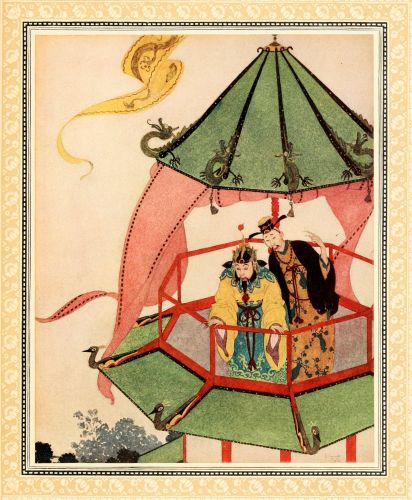
The Sultan and his Vizier looking for Aladdin’s magic Palace. Page 122
All that day the City was thrown into a state of the utmost festivity which the Sultan and the Queen busied themselves to augment, for to restore their daughter’s happiness was their chief concern. The Grand Vizier, who knew only that his daughter-in-law had been troubled by evil dreams, laid this not to his conscience in that he had persuaded the Sultan to break his pledge, but attempted rather to mend matters by adopting every means in his power to increase the universal gaiety. The drums beat, and music echoed through the City. Trumpeters went forth, fanfaring the beauty of Bedr-el-Budur; heralds proclaimed her graces in the streets and byways; singers extolled her charms; and the heavy burden of taxation was lifted from the people’s backs for one month, so that they might stand up for a little and see what a great man was the Grand Vizier in the Sultan’s eyes, and what a charming person his son must be to deserve the beautiful cause of these wonderful things. As for the Vizier’s son, he ceased not to pursue all manner of gaieties, thinking thereby to convince himself that the wood-closet was naught but an odious dream. But all this festivity and rejoicing failed to dispel Bedr-el-Budur’s gloom. Being of a sincere nature, she could not pretend like the Vizier’s son, nor could she love him the better for stoutly denying what was plain truth to them both.
And, as the City went about its gladness without restraint, Aladdin strolled forth from his mother’s house and viewed it all from the point of view of one who knows. When he surveyed the delighted rabble rejoicing over the happiness of bride and bridegroom he laughed within himself, saying, “Little they know!” But when he heard all men envying the great honour and distinction of the Grand Vizier’s son, and praising him in that his excellent qualities had won the heart of the Lady Bedr-el-Budur, he feared that he might die for laughing. “Verily, ye glad people,” he said within himself, “ye would envy him to distraction if ye only knew that he would far sooner rest in a wood-closet than on the bridal couch. Ha! Ha! Ha! Ye doubt me? Then come and peep into the wood-closet to-night, ye rabble! and see for yourselves what a happy bridegroom he makes of himself, the gallows-bird that he is!”
At eventime, when the wild rejoicing of the City had fatigued itself against replenishment by wine, Aladdin retired to his chamber and rubbed the Lamp. Immediately the Slave appeared and desired to know his wish. “O Slave of the Lamp,” said Aladdin, “do as thou didst last night. See to it that thou convey the bridal pair hither again as man and maid at the eleventh hour of their innocence.” The Slave of the Lamp vanished in a moment, and Aladdin sat for a long time; yet he was content, for he knew that the wily Efrite was but waiting his opportunity. At length the monster reappeared before him, bearing in his arms the bridal couch with the pair upon it, weeping and wringing their hands in excess of grief and terror. And, at Aladdin’s word the Slave took the Vizier’s son as before and put him to bed in the wood-closet, where he remained, bound fast in an icy chill. Then having dismissed the Efrite with injunctions to convey the pair back in the morning as he had done the day before, Aladdin placed the sword between Bedr-el-Budur and himself and composed himself to rest, regardless of her weeping and restlessness; for, he said to himself, “I am sufficiently rewarded for all my trouble. The Vizier’s son hath retired to the wood-closet. He careth not for this world’s joys—the gallows-bird! And he leaves me his bride to protect in the hour of need. Verily he is of a trusting nature.” And Aladdin slept not nor stirred the whole night through; and it was as if Bedr-el-Budur’s sobbing and tribulation were cut off from him by the sword that lay between them. And when it was morning, and the Sultan was about to knock at the door of the bridal chamber in the palace, the Slave of the Lamp appeared and conveyed the bride and the bridegroom swiftly back to their place.
On being set down in the bridal chamber, dazed and bewildered, they had not returned to their proper senses when the knock came at the door. The Sultan had come to wish his daughter good-morning, and to see also if she would behave towards him as on the former occasion. The bridegroom arose, shivering with cold,—for he had but a moment since left the wood-closet,—and opened the door. He made way for the Sultan, who entered, and, approaching the couch, saluted Bedr-el-Budur with a kiss. But, when he asked her if she was not the happiest of women, she made no reply, but met his gaze with an angry stare. It was easy to see that she was perfectly miserable. But the Sultan did not look at it in that light, he saw only what he took for sullen obstinacy, and, flying into a passion, drew his sword, saying, “By Allah! tell me what ails thee, or thy head will not remain upon thy body.”
Then Bedr-el-Budur wept and supplicated him, and told him what had befallen on the second night as on the first, so that as she revealed it all his pity was aroused, and he sheathed his sword. “Thy words ring true, O my daughter!” he said. “But fear not, and be comforted; for at this moment I am minded to set a guard on this chamber so that no such thing may happen a third time. For the present, peace be on thee!”
The Sultan repaired immediately to the Grand Vizier and told him all; and asked him whether he had received the same version of this matter from his son. But the Grand Vizier shook his head in the manner of one who might be lying and might not. “Then,” said the Sultan, “go at once and question him, for it may be that my daughter hath seen visions and dreamed dreams; albeit, I am unable to disbelieve the truth of her story.”
So the Grand Vizier went and enquired of his son, and presently returned to the Sultan in great perplexity of face, for his son, whatever he had admitted before, had now confessed to everything, even to the wood-closet. And, moreover, he had begged and implored his father to obtain his release from this most unhappy marriage, since it was better to be without a bride and sleep in peace than to have one and perish with cold in a wood-closet. Thus it was with the Vizier’s son.
“O King of the Age,” said the Grand Vizier, who could not see his way to conceal the truth, “my son telleth the same tale as thy daughter, the Lady Bedr-el-Budur. Wherefore I beseech thee that thou set a guard this night, so that——” “Nay,” broke in the Sultan angrily; “it is an unhappy marriage and bodes no good. Thou didst persuade me that my promise to that woman in respect of her son was not binding, but these unhappy events and ill-omened affairs make me think thou wast mistaken. Abide not another night, for worse may happen. Go forth, O Vizier, and proclaim the marriage annulled. Bid the people cease to rejoice, and command all to go their own ways and comport themselves as if the marriage had not been.”
At this the Grand Vizier bowed his head and went forth exceeding wroth, and proclaimed the annulment of the marriage to all the people. Great was the wonder at this on every hand, for, among them all, none knew why, save one alone; and that one was Aladdin, the Master of the Lamp and of the Slave of the Lamp. He alone knew, and it was almost with regret that he decided the wood-closet need have no tenant that night.
Whether the Sultan had swiftly forgotten, or tardily remembered, his pledge, Aladdin troubled not to enquire. He waited patiently until the three months had expired, and then sent his mother to demand of the Sultan the fulfilment of his promise.
So it transpired that, on the day of the expiration of the term, the Sultan saw Aladdin’s mother standing in the Hall of Audience. He was not astonished at this, for the matter of his broken or twisted pledge had somewhat disturbed his dreams. “Behold! there she stands!” he said to the Grand Vizier. “Bring her before me immediately.” The Vizier arose, his face like autumn leaves withered in the wind, and did as he was bidden.
“What is thy suit?” asked the Sultan of Aladdin’s mother as soon as she stood before him. Then, when she had kissed the ground and prayed for the prolongation of his life, she answered: “O King of all the Earth, the three months thou didst proscribe are at an end and I have come to ask thee to redeem thy pledge in respect of thy daughter and my son Aladdin.”
The Sultan, who had not now the bowl of jewels before him to blind his vision, regarded her intently, and saw that she was of humble state; then, as he turned in perplexity to the Grand Vizier, he observed that the expression on his face was the expression of one who ponders the laying of a stratagem and the way it should be hatched. “What is thy thought on this, O Vizier?” he said. “My word is my word, and I regret that thou shouldst have explained it away; yet it seems to me that this woman is not of the kind that could mother-in-law my daughter. Hast thou a plan which is not a trick? If thou hast, whisper it in mine ear.”
The Grand Vizier was pleased to hear the Sultan appealing to his ready wit in this way, for he was consumed with chagrin at what had befallen his son and desired only to non-suit this woman who had out-bid him with the jewels. So he unfolded his plan—his stratagem—his trick, privately to the Sultan’s ear. “O King of the Age,” he said, “thy pledge holds good, as ever it did; yea, as good as marriage vows. But verily, if this common woman’s son desireth thy daughter for his wife, there should be a settlement befitting such a suit. Wherefore ask of him forty bowls of gold filled with jewels of the same blood and tincture as the woman brought at first, with forty female slaves to carry them, and a fitting retinue of forty. This thing, which is a Sultan’s right to ask, it seemeth to me he cannot contrive to execute, and thus thou shalt be free of him.”
“By Allah!” said the Sultan, “thou art of ready wit, O Vizier! Truly a marriage settlement is needed.” Then, turning to Aladdin’s mother, he said: “O woman! know that when one asketh the daughter of the Sultan one must have standing, for so it is in royal circles; and, to prove that standing, the suitor must show that he is able to provide for the Sultan’s daughter and keep her in that state to which she has been accustomed. Wherefore he must bring to me forty golden bowls filled with jewels such as thou didst bring, with forty beautiful female slaves to carry them and forty black slaves as a retinue. Coming like this, thy son may claim my daughter, for the Sultan’s word is the Sultan’s word.”
A sad woman then was Aladdin’s mother. She returned to her son sick at heart, saying with herself, “Forty bowls of jewels, with forty maids and forty black slaves! How can my son do this? Better he had not entered on this affair!” Then, with bitterness, she added, “The Sultan asketh far too little: forty five bowls with forty five maids and forty five slaves and a palace to boot! Oh! what a thing it is to live up to such a demand as I have made.” Thinking like this she found her son and spoke sorrowfully to him. “O my son,” she exclaimed, weeping, “said I not to thee that the Grand Vizier was thine enemy? The Sultan remembered his pledge, but the Vizier—may his bones rot!—spake in his ear, and the outcome is this: forty golden bowls of jewels, forty female slaves to carry them, and forty slaves as an escort. With this dowry, O my son, thou mayest approach the Sultan and claim his daughter as thy bride.”
Loudly Aladdin laughed to scorn. “O my mother,” he said; “is this all the Sultan requireth? The Grand Vizier—may his bones rot as thou sayest!—hath proposed what he imagines an impossible thing; but it is not at all impossible. Now, mother, set some food before me, and, when I have eaten, I will tell thee.”