Front matter
Reading edition
A Complete Novel by W. C. Tuttle
Author of “Hidden Blood,” “The Lovable Liar,” etc.
“Skeeter Bill” Sarg, newly elected sheriff of Moon River County, sat awkwardly at his desk, squinting closely at a strange cowboy who was perched on a chair opposite the sheriff.
This cowboy was not a stranger to Crescent City, but he was to Skeeter Bill, who knew only a few of the riders in that part of the county. This cowboy was of medium height, with black, curly hair cut rather short, high cheek-bones, a slightly flattened nose and deep-set brown eyes. His mouth was narrow, with rather prominent lips, his chin square, with scarcely any depression between his lower lip and chin.
Sitting on his boot-heels, humped back against the office wall was “Kaintuck” Kennedy, Skeeter Bill’s deputy, trying to roll a cigaret with one hand. A pile of torn cigaret papers and spilled tobacco attested to the fact that Kaintuck was not at all proficient.
Skeeter Bill picked up a silver dollar from his desk and looked at it closely. To him it was a perfectly good dollar, a trifle new, but good, honest coin of the realm. He looked back at the stranger.
“How can yuh tell?” he asked.
The strange cowboy smiled knowingly.
“Easy enough. I’ve tested a good many of ’em, Sheriff. That is only one of many.”
“Uh-huh.”
Skeeter took several silver dollars from his pocket and handed them across the table. Unhesitatingly the cowboy selected two of the dollars.
“Yuh mean to say that they’re bad?” asked Skeeter.
“Bad. Yuh might say, they’re both bad and good. In fact, they are almost too good, Sheriff. Combination of lead, silver and glass. Oh sure, they sound good. It would take an expert to detect them—but nevertheless they are counterfeit.”
“Uh-huh. Where do yuh reckon they’re made?”
“Somewhere in Moon River Valley.” The man lowered his voice. “It has taken the Government over a year to trace it to this valley. My work has been confined to range cases, because I can qualify as a cowpuncher.
“I came here with the intention of working alone. It is not our policy to take the local officers into our confidence until the actual arrests are ready to be made. I have been working at the Tin Cup ranch for a month, and before that I was at the Lazy H.
“But I seem to be up against a stone wall, Sheriff. That money comes out of Moon River Valley, just as sure as eggs are eggs; but I am free to admit that there isn’t a clue of any kind to work on.”
“Yuh said yore name was Frank Moran, didn’t yuh?”
“Yeah.”
“Pleased t’meetcha, Moran. That’s Kaintuck Kennedy over by the wall, Moran. He’s my deputy.”
Kaintuck looked up and grinned—
“Howdy. Didja ever learn to roll ’em with one hand?”
“Never tried it,” smiled Moran. “Looks easy.”
“Yeah, it does,” admitted Kaintuck. “Like catchin’ counterfeiters.”
“That’s right,” laughed Moran. “Mebbe you’ve got an idea how to catch ’em, Kennedy.”
“Uh-huh. Use the same scheme that ‘Frenchy’ Le Blanc used. He was runnin’ a sort of a store up in the Bitter Roots, and he does a credit business. Frenchy don’t know one figure from another; so he figures out a lot of funny marks that mean so-and-so owes him a certain amount.
“He writes all these funny marks on a board, and when he collects all his debts, he planes the board off and starts in all over again. One day he sells somebody a case of aigs, and forgets who it is.
“So at the end of the month he charges up one case of aigs to everybody that deals with him. He had three fights before he hit the right party, but he got paid for his aigs—four times. Now, my idea would be to arrest everybody in Moon River Valley that had one of them bad dollars in their pocket.”
“You’d probably get into a lot of trouble,” laughed Moran.
“Yeah—” dryly. “And you’d probably get a —— of a lot of criminals, too.”
“Kaintuck is a pessimist,” grinned Skeeter. “He never sees any good in anythin’.”
“Only when I look in the mirror, Skeeter. Say, Moran, is all them dollars the same date?”
“No. They’ve made several molds. Most of ’em are from 1899 to 1906. I’m expectin’ you boys to keep all this under your hats, of course.”
“Sure thing,” nodded Skeeter. “It’s somethin’ I don’t know a danged thing about. I dunno how they’d go ahead to make the money; but I’m takin’ yore word for it, Moran. Quite likely they’ll object to bein’ caught, eh?”
“Uncle Sam does not deal lightly with counterfeiters.”
“You’ve been takin’ a big chance—workin’ alone.”
“We have to take a chance.” Moran got to his feet. “If it was known who I am, I wouldn’t last a week. I am lettin’ you in on this, Sheriff, because I need help, and because of another reason. Here.”
He took a letter from his pocket and handed it to Skeeter Bill. It read—
Frank Moran: Would advise taking up matter with new sheriff. Know him to be capable man. Must get action soon or relinquish the case, because it is taking too long to suit the Department. My regards to the sheriff. (Signed) Long.
“‘Shorty’ Long, U. S. marshal, eh?” smiled Skeeter Bill, handing back the letter. “Yeah, I sure know him.”
“Good old Shorty,” nodded Moran. “He’s sure a white man.”
“Yeah,” nodded Skeeter thoughtfully. “Shorty sure is. Yuh never happened to hear him tell about the time he herded sheep down in Sundance Flats, did yuh?” Skeeter laughed softly.
“No, he never told me about it,” grinned Moran. “But one of his deputies started to tell me the story one day, and somethin’ interrupted him; so I never heard it.”
“Well, you git him to tell yuh,” laughed Skeeter. “I’d only spoil it.”
“I sure will,” grinned Moran. “Well, I’ll mosey along. Probably drop in here in a few days and see what you’ve found out. In case yuh write to Long, tell him I’m doin’ the best I can. Yuh might explain what I’m up against, Sheriff. I’ve tried to show ’em, but they probably don’t understand.
“In another letter he suggests sendin’ in another man to help me, but that would only complicate matters, don’tcha see. These counterfeiters are always lookin’ for Government men, and they’d be suspicious of a stranger.”
“That’s a cinch,” nodded Skeeter. “I’ll see what I can find out and let yuh know. If it was rustlers or bank robbers, I’d stand a show; but bad money is sure a new proposition to me.” He shook hands with Moran, who went back up the street. Skeeter sat down and squinted at Kaintuck, who was still tearing cigaret papers and spilling tobacco.
“How long do yuh reckon it’ll take yuh to learn to roll one cigaret one-handed, Kaintuck?” he asked curiously.
“How long?” Kaintuck grinned lazily. “Well, I dunno, Skeeter. Prob’ly as long as it’ll take you to catch a counterfeiter.”
“I’m scared yo’re goin’ to waste a lot of tobacco, cowboy.”
“And yo’re goin’ to waste a lot of time, Skeeter.”
“Time don’t mean nothin’ on this job,” laughed Skeeter. “I’m goin’ to be here for two years.”
It was Skeeter’s first month as sheriff of Moon River County, and the job was still a mystery to him. He knew nothing of clerical work. Kaintuck Kennedy knew even less than Skeeter Bill.
Even the election was a surprize to Skeeter. He had not expected to be elected. In fact he had won by eleven votes, which was a substantial majority in Moon River.
Skeeter was tall, thin, and with a serious expression. But he was not always serious. Back of those level gray eyes and inquisitive eyebrows was an over-developed sense of humor, and he had the faculty of wearing the same expression under all conditions.
As one of his staunch supporters had said—
“Skeeter Bill shore is fitted to this new job. Havin’ been a real good horse-thief, he’s able to think like one; and that helps a lot, when yo’re huntin’ one.”
All of which shows that Skeeter Bill’s past did not interfere with his present and future. Until his election he had been working for the KG7 outfit, twenty miles south of Crescent City, the county seat. He and Kaintuck had bunked together, and it was entirely fitting that he make Kaintuck his deputy.
Kaintuck was the opposite physically to Skeeter Bill. He was not over five feet seven inches in height, rather stout and bow-legged. He tried hard to wear a mustache, but it was rather a dismal failure; being wispy and yellow, one end insisting on twisting toward his chin, while the other pointed indifferently toward his eye.
“Looks like somebody had pasted a danged S on yore lip,” was Skeeter’s opinion. “Yuh ought to get a crutch for one end, or hang a weight on the other.”
Crescent City was a nondescript cattle town. A branch line of the N. W. railroad swung in out of the desert, wound its way through a pass, and into the valley; only to leave by another heavily graded pass.
The main street of the town was crooked, as though one end of the place did not care to have the other end know what it was doing. Being the county seat, it naturally became the center of industry. Twenty miles to the north was a fairly new mining district, which outfitted at Crescent City, although the Silver Bell mine was the only one to employ any great number of men.
A two-horse stage made tri-weekly trips to the Silver Bell district, carrying the mail and express. It was a bad road, built with an idea of economy, and naturally followed the lines of least resistance. An empty buggy was a good load for two horses, but the turns were so short and the road so narrow that four horses would have been just two too many.
There were a number of cattle outfits in the valley, but the Tin Cup and the Lazy H were the largest. The Tin Cup brand was owned by “Monk” Clark, who raised both horses and cattle, while the Lazy H, Sam Ertle’s brand, raised only such horses as were needed in handling their cattle.
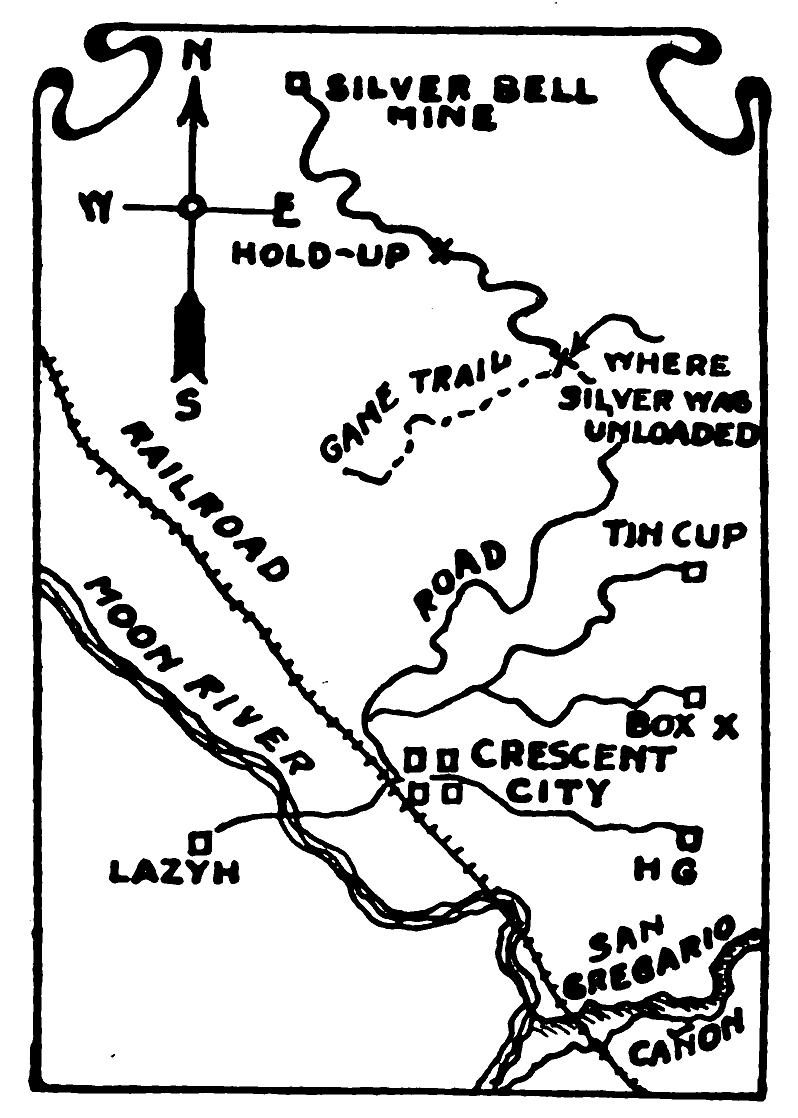
Both Clark and Ertle had worked against Skeeter in the campaign. Clark had thought himself sort of a political boss in Moon River County, and a defeat did not please him in the least.
Monk Clark was a big, burly man, middle-aged, and with a hair-trigger disposition. Sam Ertle was small, wiry, soft-spoken, and a very capable cattleman. He had only operated the Lazy H for about fifteen months, having bought it in at a sale, after Cleve Hart, the original owner, had been killed.
Skeeter Bill had never had any serious trouble with either of them, and their opposition to his election was merely because of political differences.
For several minutes after Moran left the office Skeeter silently contemplated his two counterfeit dollars. Kaintuck continued to tear papers and spill tobacco.
“You got any silver dollars?” asked Skeeter. Kaintuck looked up at him.
“Have I got any silver dollars?” Kaintuck rubbed his chin and squinted at Skeeter. “Cowboy, I reckon I know what yo’re thinkin’ about, and all I can do is shake my head and hope you’ll believe me. I know how yuh feel about them two dollars that just spoiled on yuh. Yo’re melancholy, that’s all—and misery likes company.”
“But it ain’t ethical for yuh to spend bad money.”
“I ain’t spendin’ it, am I?”
“That’s true. If I was a detective I’d know what to do. Dang that feller, anyway! I’m supposed to investigate on the quiet. Investigate what?”
“Counterfeitin’,” grinned Kaintuck. “Kinda make a house-to-house canvass, and ask everybody if they’ve seen anybody makin’ bad money. Yuh might start out by—”
“Gettin’ killed,” finished Skeeter. “When it comes to detectin’, me and you run a dead-heat.”
“Prob’ly. Still there’s one satisfaction, Skeeter; yuh don’t have to catch ’em. There ain’t nothin’ in yore oath of office that says you’ve got to catch counterfeiters.”
“No, that’s right, too, Kaintuck. I wish somebody would rob a bank or steal a horse to take this off my mind.”
“Mine too,” said Kaintuck seriously. “I ain’t took a shot at anybody since I’ve been a deputy. ——! If I thought that all sheriffs and deputies was as incompetent as we are, I’d resign right now and take up horse stealin’. I shore would, Skeeter.”
Kaintuck walked to the office door and slouched against the side.
“Train’s in,” he announced.
A few moments later he looked back at Skeeter and said—
“Looks like a couple of drummers had come in, Skeeter.”
“Tell ’em we ain’t buyin’ nothin’ today.”
“One of ’em has got on a hard hat. I’ll betcha they’re comin’ to see us, Skeeter.”
Skeeter got to his feet and walked to the doorway, where he watched the two middle-aged, well-dressed men approach the office door. He nodded to them and they stopped.
“Howdy, folks,” said Skeeter pleasantly.
“How do you do?” said one of them, looking at the sign over the door. “Thought perhaps you would be able to furnish us with some information. We are on our way to the Silver Bell mine, and it seemed impossible for us to get reliable information as to when the stage trips are made.”
“You just about hit it,” said Skeeter, squinting up the street. “The stage is about due to travel, I think. Stay on this side of the street and yuh can’t miss it.”
They thanked him and went on.
“Them ain’t drummers,” declared Kaintuck.
“No-o-o? Jist how do yuh read their sign?”
“Don’t have to read, Skeeter. What in —— would a drummer do at the Silver Bell—sell ’em some silver?”
Skeeter grinned slowly.
“You’ve got all the instincts of a successful detective, Kaintuck Kennedy. Let’s me and you go and find somethin’ to eat. We ought to be detectives enough to find food.”
They closed the office, crossed the street and walked past the big Half-Moon Saloon and gambling house to a little Chinese restaurant. Several cowboys were eating their noonday meal, and one of them waved a fork at them as they sat down.
“That’s ‘Curley’ Adams,” said Kaintuck. “He worked for the KG7 before yuh came, Skeeter. He’s with the Tin Cup now.”
Adams was a young man, with a pleasant, devil-may-care sort of face, and a winning smile. In a few minutes he came over and shook hands with Kaintuck, who introduced him to Skeeter.
“Yo’re with the Tin Cup, ain’t yuh, Curley?” asked Kaintuck.
“Yeah. I’ve been out there almost a year now, Kaintuck. How do yuh like bein’ a deputy sheriff?”
“Got a good bed,” grinned Kaintuck. “Been settin’ on a chair for so long that my legs prob’ly won’t bend sideways enough to let me set in a saddle. Yo’re stickin’ to the job kinda steady, ain’t yuh, Curley?”
“Yeah,” Curley flushed slightly. “Savin’ my money these days. Yuh see, I’ve kinda got an idea I’d like to have somethin’ for myself, Kaintuck.”
“Yea-a-a-a-ah? My ——!” Kaintuck opened his eyes wide and stared at Skeeter. “I’ll betcha the boy’s in love!”
Curley’s ears grew red and he tried to smile.
“Don’t try to fool yore Uncle Dudley,” warned Kaintuck. “I sabe all about it. Now, you take my advice and—”
“Don’t do it, Adams,” advised Skeeter. “I mean—don’t take his advice. He’s never been married, and I don’t reckon he’s ever been in love; so tighten yore own cinch.”
“Ain’t never been in love!” Kaintuck snorted loudly. “Say, I’m the jigger that showed Romeo what to say.”
“You’d run if a woman tried to speak to yuh.”
“Shore I would. ’F you had as much experience as I have, you’d run, too. I could write books about my love experiences.”
Curley Adams laughed and walked out with the other cowboys from the Tin Cup ranch. Kennedy squinted after them, a grin on his lips.
“I wonder who the girl is, Skeeter?” he said. “Curley shore is a real nice boy. He ain’t as wild as the rest of that gang, and he’s got brains enough to start out for himself.”
“Other folks’ matrimonial affairs don’t interest me none,” said Skeeter thoughtfully. “I can’t think of nothin’ but bad dollars these days. Tomorrow me and you start detectin’.”
“Sounds good,” grinned Kaintuck. “I’ve read detective stories and they shore listened real good. But yuh got to find yuh a clue, Skeeter. Yuh never get nowhere without a clue.”
“I’ve got me one.”
“Yuh have? Gee, that’s fine! Lemme hear it.”
“I will not. Go get yore own clue, Kaintuck.”
“Shucks! Ain’t it big enough for two of us?”
“Well,” explained Skeeter softly, “it ain’t big enough yet. Mebbe it’ll grow, and if it gets big enough, and you ain’t got one by that time, mebbe I’ll let yuh gnaw on a corner of mine.”
A buckboard, drawn by a pair of tired-looking bronchos, bumped along over the dusty road, heading away from Crescent City and going toward the HG ranch, which was located about five miles east of the town.
Hank Gregory, the owner of the ranch, humped over in his seat, the reins held loosely in his big hands, while beside him sat his twenty-year-old daughter, Joy. The rear of the buckboard held a trunk and numerous hand-baggage.
There had been no rain for months in the Moon River Valley, and the yellow dust of the road was fetlock deep to the horses. It rolled up on the wheels, drifting away in clouds to turn more gray the immediate landscape.
It was a fairly steady climb from town to the HG ranch, the road winding through brushy coulées, twisting to higher ground, where patches of alkali, like spilled mortar, made huge gaps in the purple and gray of the sage.
To the eastward towered the blue line of the main divide, as if a painter had swept a full brush of blue to break the line between the gray of the hills and the pale blue of the sky. Grasshoppers buzzed and crackled away from the plodding team, and from along the slope came the piping bark of a prairie-dog, as though protesting against any one stirring up so much dust.
Gregory was a big, slow-moving sort of person, with iron-gray hair and a deeply lined face. Joy did not resemble her paternal ancestor in any way. She was not beautiful, but by no means unbeautiful. Joy Gregory was just an average girl; possibly a trifle more capable than the average, due to living where capability rates higher than feminine attractiveness.
She studied the serious profile of her father’s face for several moments, as they rode along through the filmy dust.
“Dad, you don’t seem glad to have me back,” she said.
He glanced sideways at her, spat over the wheel and cleared his throat.
“No, you don’t need to fix up any excuse,” she said quickly. “You can’t blame me, Dad. Aunt Emma died so suddenly that I hardly knew what to do; and you couldn’t expect me to stay down there in Cheyenne alone. I know what you want to say. You contend that a cattle ranch is no place for a young lady. Well, what’s to be done about it? I’m here.”
“Yeah, yo’re here,” nodded Gregory grimly.
“And I’ve been away a year,” said Joy slowly, “and my own father never said he was glad to see me.”
“Joy, don’t say that. I’m glad to see yuh. But I’ve always said—”
“That a cattle ranch wasn’t any place for your daughter. My mother was the daughter of a rancher.”
“Yeah, that’s true.”
“And I’m as good at punching cows as any man, Dad.”
Gregory snorted and helped himself to another huge chew of tobacco. He had his own ideas of how his daughter should be raised.
“And besides,” Joy smiled softly, “I might marry a cowboy.”
“That’s what I reckoned—” dryly. “Curley Adams, eh?”
Joy laughed.
“Quien sabe, Dad? I haven’t seen Curley for over a year. But he writes wonderful letters. Curley is educated. He has been saving his money all that year, and—who knows?”
“Yeah! He must ’a’ saved as much as four hundred dollars in a year. That won’t give him much of a start.”
“You started on nothing, Dad.”
Gregory winced slightly, but did not reply.
“And he’s honest,” continued Joy. “That is something that you can’t say about a majority of the cowpunchers in the Moon River hills.”
“Well, we won’t argue that point, Joy. There’s a lot of honest men in the poorhouse.”
“But not many in the penitentiary.”
Gregory laughed shortly.
“I’ve had the last word on the HG ranch for over a year, but I’m runnin’ second now. Well, there’s the old starve-to-death layout, Joy. It ain’t changed much in a year, has it?”
They had driven around the point of a hill, where they might look down at the sprawling buildings of the little ranch. It was located on a little flat, at the mouth of a cañon; a huddle of one-story buildings, sheds and corrals. None of the buildings had ever felt the caress of a paint-brush.
Two huge oaks shaded the rambling old ranch-house, giving a note of color to the otherwise drab exterior. Several horses drowsed inside the pole-corrals, a tall, red steer poked around the fence, picking up an occasional straw, while a flock of mongrel chickens chased grasshoppers in the front yard of the ranch-house.
“No-o-o-o, it hasn’t changed much,” agreed Joy. “I don’t believe that the red steer was there the last time I saw it; so there is some change, Dad. I don’t suppose the house has been cleaned since I left.”
“Yes it has. When I got yore letter, I had old ‘Calamity’ give it a cleanin’.”
“I’ll bet it was good,” laughed Joy. “How is old Calamity?”
“Well, I dunno. The —— old mossback is prob’ly a little worse than he was a year ago.”
They drove up to the front of the ranch-house and Calamity came out to greet them. No one had ever known—that is, no one in Moon River Valley had ever known—what his right name was.
He was just Calamity; a thin-faced, hawk-nosed, little old man; philosopher, liar, who loved his friends, but cursed them as thoroughly as he did his enemies. Calamity lived almost entirely in the past, when he was a gunman, and when, as he expressed it—
“There wasn’t a —— stran’ of bob-wire as long as yore finger from Laredo to the No’th Pole.”
“Hello, Calamity!” called Joy.
The old man came slowly out to the buckboard, squinting at her, as if trying to remember her, although he knew she was coming.
“Well, ’f it ain’t little Joy!” he exploded. “Ha, ha, ha, ha! Growed up so I didn’t know yuh. Took one look at yuh, and I says to myself, ‘Darned if Hank ain’t brought a strange woman home with him.’ I did so.
“Brought yore trunk, too. Look at the valises! Whooee! Say, I knowed a woman that traveled plumb from the Gulf of Mexico to Astoria, Oregon, and didn’t even have a pocket-book.”
Joy laughed, as she dismounted—
“That woman must have had a tough time, Calamity.”
“She died before she started the trip,” laughed Calamity. “They took her no’th in a casket. Ha, ha, ha, ha! Well, I s’pose I’ve got to unload that trunk. Oh, I ain’t foolin’ myself. I know what a woman’s trunk usually weighs.”
Joy laughed and ran up the front steps into the house, while Gregory helped Calamity remove the trunk. Joy looked around the living-room, a frown between her eyes. Everywhere was dirt. She kicked aside a Navajo rug, disclosing a great accumulation. Calamity had made the cleaning as easy as possible for himself.
Her father and Calamity came in with the trunk and found her inspecting Calamity’s trash-heap.
“That’s a woman for yuh,” wailed Calamity. “They’ve got to uncover all the scandal they can find. Them dirt-heaps has been as safe as a church all this time.” Calamity shook his head sadly. “I suppose you’ll be washin’ winders next.”
“They need it,” said Joy. “Why, you can’t see through any of them.”
“Well, why should yuh? There ain’t nothin’ to look at out there, Joy. And nobody can shoot yuh through a winder they can’t see through. Ha, ha, ha, ha!”
“Well, I’d rather be shot than to live like a pig,” retorted Joy. “Put a kettle of water on the stove.”
“Yes’m.” Calamity became very meek and hastened to comply with her orders.
He knew that his usual equivocations would have little effect on Joy.
He put a big kettle of water on the stove, filled up the firebox and went outside, where he joined Gregory, who was unhitching the team.
“Joy goin’ to stay here?” asked Calamity.
“Yeah. Where in —— else can she stay?”
“Yuh don’t need to git mad at me about it, Hank. I jist asked, tha’sall. A year has shore made a lot of difference with that girl, Hank. She’s a woman.”
“Uh-huh.”
Gregory stripped the harness off a horse and let the animal loose. He hung up the harness and leaned against a corner of the shed, watching two riders who were coming in from the west.
It was Monk Clark and Frank Moran, the government detective, who had talked with Skeeter Bill. They rode up to Gregory and Calamity. Clark had seen Joy through the open door, as he rode past the house.
“Howdy, gents,” he greeted them.
They returned the greeting in kind. Clark jerked a gloved thumb toward the house, as though in interrogation.
“Joy came this mornin’,” said Gregory. “I got a letter from her last night, and had to drive in this mornin’. Her aunt died in Cheyenne, and she had to come home.”
“Huh!”
Clark turned his head and squinted toward the house, where Joy was hanging some Navajo rugs over the railing of the porch.
“Young lady, eh?” smiled Moran.
“Woman,” corrected Calamity.
Monk Clark smiled. He was a big, rawboned individual, possibly forty years of age. His face was heavily lined, rather sullen in repose, his eyes scarcely ever more than half-open. His mouth was wide, thin-lipped, and decorated with a black, brushlike mustache.
Clark wanted to boss Moon River Valley politically, and had succeeded fairly well until the recent election. His candidates for prosecuting attorney and sheriff had both been defeated, and those were the two offices that Clark particularly wanted to dominate.
“Yeah, she’s a woman now,” nodded Clark.
“And a pretty one,” added Moran. “I’d like to meet her, Gregory.”
Hank Gregory squinted at Moran.
“Yeah? Well, I reckon yuh can. C’mon.”
The four men walked to the porch, and Joy shook hands with Monk Clark before she was introduced to Frank Moran. After the introduction Joy excused herself and went back to her work.
“Hm-m-m-m,” mused Clark aloud. “And she’s only been away a little over a year, eh? Big change, Hank. Goin’ to keep her here at the ranch?”
“Until she mates up with some cowpuncher, I s’pose.”
“And that won’t be long,” laughed Moran. “I haven’t seen many like her in Moon River Valley.”
“Don’t let yore rope drag too much,” advised Clark coldly.
Moran laughed softly.
“My rope ain’t draggin’, Boss. But I’ve got a good pair of eyes.”
A few minutes later Clark and Moran left the ranch and rode toward Crescent City. Clark seemed very thoughtful, and his demeanor drew a smile from Moran.
“That HG ranch ain’t such a nice place for a young lady,” offered Moran.
“No,” said Clark shortly. “Joy is a nice girl.”
“Looks nice.”
“Yeah.”
They rode into Crescent City and tied their horses at the Half-Moon hitch-rack. It was in the middle of the week, and there was little activity in Crescent City, except on Saturday and Sunday.
Curley Adams was coming up the street, and met them at the door of the Half-Moon.
“How soon can yuh give me my time, Monk?” asked Curley.
“Eh? You quittin’ the Tin Cup, Curley?”
“Yeah. I just bought out the old Box X brand.”
Clark shoved the sombrero back on his head and squinted at Curley.
“You bought the old Box X ranch?”
“Well, there wasn’t much to buy,” admitted Curley. “The old buildings are pretty badly shot to pieces, and there ain’t nothin’ much left, except the brand—but it’s a start.”
“Yea-a-ah, I suppose it is,” Monk Clark grinned slowly. “All yuh need is some cattle and horses, Curley.”
“Well, they’ll come, Monk.”
“Uh-huh,” Monk scratched his chin reflectively and smiled at Curley. “One thing yuh got to remember, young man—there’s a maverick law in this country now. All mavericks belong to the Cattlemen’s Association. It ain’t what it used to be.”
“When you started, eh?”
Moran laughed, when Monk’s ears turned red. It was well known that Monk Clark had been a great gatherer of mavericks—unbranded calves, which had been weaned, and on which any man might put his own brand.
It had been a legitimate procedure, until the practice became such a source of profit that some men did not wait for the calf to desert its mother. They forced the issue and got rich on the results. It was a common occurrence for one man’s cows to bring in twin calves, while the cows of his neighbor brought in nothing but a sad expression.
“Well, yuh might say that things have changed,” admitted Monk Clark coldly.
He did not relish having any one laugh at him.
“You’ve got about thirty-five dollars comin’, ain’t yuh, Curley? I’ll buy a drink. C’mon.”
They entered the saloon, ordered their drinks, and Clark counted out the money to Adams.
“So yo’re goin’ to be a cattleman, eh?” queried Monk. “It’s a long, hard pull, Curley. Better stick to a salary.”
Curley shook his head.
“Not for mine, Monk. I’ve got to get somethin’ for myself, and I don’t know anythin’ but cows.”
“You own a horse and a rope, don’t yuh?” asked Moran.
Curley turned his head and looked at Moran.
“Yeah.”
“Well, what more could yuh want? Many a puncher has got rich—if he didn’t get hung in his own loop.”
“Thank yuh,” coldly.
“Oh, yuh don’t need to get frosty, Adams. I don’t know how yuh ever expect to make a livin’ off that old Box X—and keep honest.”
“Maybe I won’t make a livin’, Moran.”
Moran laughed sneeringly.
“Oh, I guess you’ve got it figured out all right.”
Splat! Curley’s fist landed just beneath Moran’s left cheek-bone, knocking him the full length of the bar, where he went flat on his back. A little lower and Moran would have been completely knocked out, but as it was he was so badly dazed that he goggled foolishly, while his left eye puffed rapidly, assuming a deep mauve tint.
“I’d swear to gosh, that was some punch,” observed the bartender blandly.
He was used to scenes of violence. Curley started toward the prostrate Moran, but Monk Clark stopped him.
“That’s a-plenty,” said Clark. “Let him get up now.”
Moran got slowly to his feet, and Clark stepped aside, as though to give Moran a chance to retaliate; but the fight had all been taken out of Moran. He leaned against the bar and felt tenderly of his eye, which was completely shut now.
“Next time,” said Curley softly, “yuh might do a little thinkin’ before yuh speak, Moran.”
“I might,” nodded Moran. “Mebbe I will, and mebbe I won’t.”
He picked up his hat, yanked it viciously down on his head and strode toward the door.
Skeeter Bill and Kaintuck were coming in, and Moran halted to let them in before he went out. Kaintuck squinted at the swollen eye and whistled softly.
“Stick flew up and hit yuh, eh?” he questioned.
Moran snarled an unintelligible answer and brushed past them into the street.
“Must ’a’ been at least a cord of wood,” declared Kaintuck, as they turned toward the bar. Curley was caressing his sore knuckles, but grinned at them.
“What happened?” asked Kaintuck.
Monk Clark moved away from the bar, but did not speak to either Skeeter Bill or Kaintuck.
“Moran spoke before he thought,” said the bartender.
“Didn’t amount to anythin’,” said Curley easily. “Merely a difference of opinion.”
“Must ’a’ been quite a difference,” grinned Kaintuck. “I heard that yuh bought the old Box X, Curley.”
“Uh-huh—today, Kaintuck.”
“By golly, that’s fine. And the next thing will be the weddin’ bells, I suppose. Whooee! Won’t we have some shivaree!”
“I’m afraid that’s a long time off,” said Curley.
“Picked the girl, ain’tcha?”
“Yeah, but—”
“Say! Yo’re half married right now. Will she have yuh?”
“Wait a minute,” cautioned Skeeter Bill. “This ain’t no place to discuss such things, Kaintuck. Let’s have a drink.” Skeeter turned and motioned to Monk Clark.
“Have a drink?”
“No, thank yuh.” Clark shook his head and walked out of the saloon.
Moran was not in sight. Clark crossed the street and walked to the little post-office, where he secured the ranch mail. Old Abe Neeley, who wore his glasses on the end of his nose and chewed tobacco so violently that the glasses seemed to oscillate continually, was the postmaster.
“How’s everythin’ at the Tin Cup, Monk?” he asked.
“All right, Abe. What’s new around here?”
“New, ——! Nothin’ ever happens around here. Didja know that Hank Gregory’s daughter came home t’day? Changed a lot in a year. Stopped here for the mail, and I didn’t hardly know her. Thought Joy Gregory was goin’ t’ be one of them runty kind of females; but she sure talled up considerable.
“Shouldn’t be surprized ’f we had a weddin’ around here after while, unless I’ve read the signs all wrong.”
“Weddin’? Who’s goin’ to get married?” asked Monk.
Old Abe chawed reflectively for several moments.
“Well, as I done said, the signs look right. For the past year I’ve been gettin’ letters for Curley Adams, sent from Cheyenne; and every few days he posts one to Miss Joy Gregory, Cheyenne. Big, fat letters too, Monk. A feller don’t waste two-cent stamps and good paper, ’less he means somethin’.”
Monk nodded thoughtfully. So that was who Kaintuck Kennedy had meant, he mused. Curley Adams had bought out the Box X, and was going to marry Joy Gregory.
“Of course, I may be wrong,” admitted old Abe.
“Yuh may be,” nodded Monk. “If I was you I wouldn’t tell any more people about it. Yuh might get yore foot in it, Abe.”
“Well, yeah, I s’pose that’s right, too.”
Clark left the post-office and met Moran at the hitch-rack, where they mounted their horses and started toward the Tin Cup ranch.
“Does yore eye hurt yuh much?” asked Clark.
“Not much,” sullenly.
“Get a piece of fresh beef from the cook and bind it on. It’ll take the swellin’ out.”
“Yeah. I suppose that —— fool thinks he can do things like that and get away with it.”
Monk Clark turned in his saddle and looked at the disgruntled Moran.
“You shot off yore face too much, Moran, and got what was comin’ to yuh. Let it drop now. Curley is touchy about his honesty. He’s on the square; so let him alone, sabe?”
“All right. Just the same—”
“We won’t argue about it, Frank. He knocked yuh loose from yore boots and made yuh goggle like an owl. If it had been guns instead of fists, you’d be gettin’ a measure for a pine overcoat. Curley Adams is just too —— smart with a gun for you.”
“You talk like he was yore best friend, Monk.”
“Well, he’s not,” denied Clark. “But I like to give the devil his due. I’m just tellin’ yuh this, Frank; it might save yuh a lot of skin to know that Curley Adams can whip yuh at any mark in the road, and if yuh intend to swap lead with him—don’t let him know it ahead of time, tha’sall.”
“Much obliged, Monk.”
“Oh, ——, yo’re welcome.”
Kaintuck hungered for action. Neither he nor Skeeter Bill had seen anything of Frank Moran since Curley Adams had hit him, which was several days ago. Kaintuck complained audibly because Skeeter Bill would not share his clue with him. Then he grew skeptical, pessimistic.
“You ain’t got no clue, Skeeter,” he declared.
“I’ve got one,” grinned Skeeter, “but I dunno how good it is. Let’s me and you ride out and see what Curley Adams is doin’ to the poor old Box X.”
“That’s a good idea, Skeeter. I’m shore tired of the fish-pots of civilization, and I crave a ride on a horse.”
“Yuh mean flesh-pots, don’tcha, Kaintuck?”
“I stand corrected, but not convinced. A man’s a sucker to stick around a town—and if a sucker ain’t fish, I’m a camel.”
They saddled their horses and rode out of town. The Box X was located northeast of Crescent City and about midway between the Tin Cup and the HG. It was a tumbledown sort of a place, the oldest brand in the valley, and in recent years it had gone from bad to worse.
Ownership had finally descended to Mike Gower, proprietor of a general merchandise store, who had probably taken it for a debt. There were several good water-holes, a running stream and a well-known brand.
Perhaps Curley Adams had visions of building it up again and making it a producing outfit. It would take several hundred dollars to repair the buildings—and it takes money to start a herd—but Curley was young and optimistic.
Skeeter and Kaintuck rode north out of town, left the main highway and went into the hills. There was no hurry; so they poked along lazily. The average cowpuncher is not a fast rider, except in an emergency.
They rode up a long slope through greasewood and sage, following one of the ages-old trails, which led out over a pinnacle, giving them a fine view of the Moon River Valley, although slightly hazy in the heat.
To the west, far down the valley they could see the green line of foliage which marked the course of Moon River. It swung in to the south of Crescent City, fading to a thin line where it entered San Gregario cañon.
Northward they could follow the course of the road, which led to the higher hills at the Silver Bell mine, where the deep cañons already showed purple in the haze. To the east stretched the broken hills of the Tin Cup and Box X ranches.
A bunch of range horses filed slowly out of the cañon to the north, stopped against the skyline and considered the two riders on the pinnacle. Evidently not caring for closer associations, they wheeled and disappeared over the ridge.
Skeeter Bill puffed slowly on his cigaret, his eyes half closed against the strong light.
“Must ’a’ been quite a lot of noise around here when this country was in the makin’, Kaintuck. Some of it got blowed up and some got blowed down.”
“Uh-huh,” said Kaintuck meditatively. “I’ve often wondered if this country was made on purpose.”
“I reckon there was a reason, Kaintuck. But me and you ain’t goin’ to argue about it jist now. Let’s move on.”
They were within about a mile of the Box X, riding around the head of a brushy coulée, when Skeeter reined in his horse and squinted down across the hills.
“Whatcha see?” asked Kaintuck, reining in his horse.
“Couple of coyotes,” said Skeeter.
He looped one leg around the horn of his saddle and began rolling a cigaret.
“Couple of coyotes?” queried Kaintuck. “My gosh, this sure is awful! Yuh don’t reckon they’ll bite us, do yuh, mister?”
“Yuh never can tell about a coyote,” said Skeeter seriously, as he scratched a match on his chaps and lighted his cigaret.
“Do yuh reckon we better turn back?” grinned Kaintuck.
“No, we’ll turn down. C’mon.”
Skeeter rode straight down the side of the coulée, fairly sliding his horse through the thick brush. Kaintuck swore at Skeeter for being a fool, but followed him down.
About a hundred yards from where they had entered the coulée, Skeeter pulled up his horse and they dismounted.
“Them coyotes came out of the coulée just about here,” said Skeeter. “Smell it, Kaintuck?”
“Somethin’ has been dead,” nodded Kaintuck, wrinkling his nose.
Skeeter circled back through the brush, while Kaintuck held the two horses. In a few minutes he heard Skeeter calling him.
“Tie them horses and come over here,” called Skeeter.
Kaintuck had little trouble locating Skeeter, and he could see that Skeeter was deadly serious.
Kaintuck shoved his way through the brush and stood beside Skeeter, who was looking down at the skeleton of a man. The coyotes had torn the bones apart, and there were only shreds of cloth to show that the body had once been clothed.
“That’s what my hunch done for me,” said Skeeter softly. “When I seen them two coyotes, I got a hunch to see what they had been feedin’ on.”
Kaintuck squatted on his heels and looked at the bones. It was the first time he had ever seen the skeleton of a man, and there was something fascinating about the grisly, grinning skull, which had once been the head of a man.
“Ain’t a darned thing left to show who he was,” stated Skeeter mournfully. “Mebbe some old prospector that died a natural death.”
“Might be,” said Kaintuck sadly. “He ain’t been dead so awful long.”
They rolled smokes and considered their find. A couple of magpies swooped up the swale, cackling angrily when they discovered that some human beings were interfering with their prospective meal.
“No, I don’t reckon he’s been dead so awful long,” said Skeeter. “The coyotes and magpies would pick him pretty clean in a week. I dunno what we’re goin’ to do with him, Kaintuck. It’s a cinch we can’t carry him back on our horses, and we ain’t got no right to bury him.
“Suppose we hang the bones up in a tree and come back later for ’em. The magpies will prob’ly get at ’em, but they can’t hurt ’em much now.”
“Wish I had gloves,” complained Kaintuck, as Skeeter drew a pair from under his cartridge-belt.
“I’ll hang ’em,” smiled Skeeter.
He assembled the bones and was about to pick them up, when something attracted his eye. It had been lodged in the vertebrae, and rolled loose when Skeeter moved the upper part of the skeleton.
Skeeter picked it up, looking it over closely.
“This feller didn’t die of his own accord, Kaintuck. Here’s the bullet that done the job, I reckon.”
Together they examined the bit of metal, which was as perfect in shape as the day it came from the bullet mold, except for the markings of the lands, which had shaped its course through the revolver barrel.
“Looks like a .41,” observed Skeeter. “Didja ever see a more perfect bullet, Kaintuck?”
“Never did. Probably didn’t hit a bone, ’cause the nose of it ain’t even dented. Must ’a’ kinda got lodged in the spine and stayed there until now. But that don’t mean nothin’, Skeeter.”
“Well, not much,” admitted Skeeter. “Who shoots a .41?”
“I used to,” said Kaintuck thoughtfully. “Never liked it. That was down in Texas. I dunno who uses one around here.”
Skeeter put the bullet in his vest pocket and proceeded to place the bones in a stunted cottonwood. They searched the ground thoroughly, but were unable to find anything more.
“It’s kinda funny where his clothes went to,” said Skeeter, as they mounted their horses.
“Mebbe he didn’t have any on,” suggested Kaintuck.
“Yeah, that might be true. By golly, you’ve got all the instincts of a detective.”
They rode along for quite a while, both of them wondering who the unfortunate had been. As far as they knew there had not been any one reported missing.
“It’s kinda hard luck,” said Kaintuck slowly. “Nobody will ever know who he is—none of his friends, if he had any.”
“That’s right. Let’s keep it dark for a while, Kaintuck. It can’t hurt him none to hang there in a tree for a while. If somebody killed him, they’ll shut up like a steel trap if his skeleton is found. They’re as safe as a church—now.”
“All right,” grudgingly.
Kaintuck liked to talk, and he had visions of much telling about their discovery.
They did not find Curley at the Box X, although there were evidences that he had been there recently. An old shed had been torn down to furnish boards for some repairs on the ranch-house; a stove had been installed in the kitchen, and a small stock of groceries adorned the shelves.
The old Box X ranch-house faced the north, a weathered old wreck of a place, with little of its former beauty left as far as paint was concerned. The roof sagged in the middle, the shingles stood up in ungallant array, and the chimney looked like the top of the badly decayed tooth of some prehistoric creature.
The stable was almost roofless, its door swinging from one hinge. To the west of the house was a flat piece of ground, extending out about a hundred feet to the edge of a creek bank. Brush grew almost to the front porch on the north, and to the northeast was a deep washout filled with greasewood and wild rose bushes.
Skeeter and Kaintuck walked around, looking the place over, wondering how long it would take Curley Adams to make the old place habitable.
“Got a lot of work ahead of him,” grinned Kaintuck. “But I’m bettin’ that Curley will get a lot of fun out of it.”
“He’s got the right idea, anyway,” said Skeeter. “Let’s go over to the Gregory ranch. I’d kinda like to get a look at that girl.”
“She’s prob’ly engaged,” warned Kaintuck seriously.
“’Sall right with me,” laughed Skeeter. “I’m a detective—not a Romeo. And, anyway, a sheriff ought to get acquainted with the folks.”
“I thought yuh was goin’ to say ‘friend’,” said Kaintuck. “I’ve heard that Gregory trailed along with Monk Clark, tryin’ to beat yuh for office.”
“Tha’sall right, Kaintuck. I prob’ly wouldn’t ’a’ voted for Gregory if he’d been runnin’ for sheriff. But that’s no reason why I should keep away from him.”
“I s’pose that’s a pious way of lookin’ at it, Skeeter. Forgive yore enemies, but don’t forget ’em. An old preacher down in Texas explained all that to me—about forgivin’ my enemies. I told him that his argument was one-sided, ’cause the enemies might not know it.
“He told me all about turnin’ the other cheek, when somebody slapped yuh, and I asked him how many times he’d been slapped. It jist don’t work out, Skeeter Bill.”
“Lotsa things don’t, Kaintuck. The idea is fine. If yuh happen to hate somebody, it ain’t so hard to kinda forgive ’em. Yuh can do it. Life is too short to go around with yore heart full of hate agin’ anybody.”
“Shore,” nodded Kaintuck. “Yeah, that’s fine. But suppose somebody hates you? That makes ’em an enemy, don’t it? And all the forgivin’ yuh can boil up in yore system ain’t goin’ to stop ’em from bustin’ yuh one, if they get a good chance.”
Skeeter grinned at the bobbing ears of his horse and shook his head slowly.
“I can’t argue agin’ that, Kaintuck. Mebbe a preacher could show yuh how it works out—I can’t.”
“Yeah! Jist like a jigger down in Texas. He showed me a non-refillable whisky bottle. It shore looked great. He was goin’ to make a million dollars on it. I never did see a feller as happy as he was—until I asked him how in —— he was goin’ to get the whisky into it in the first place.
“When it comes to religion, I ain’t got a leg to stand on in an argument—not a leg. But when it comes to whisky bottles, I shore am conversant with the subject, from the distillery to the delirium tremens.”
They rode to the Gregory ranch, but found only Calamity at home. He masticated violently, squinted at Skeeter’s badge, and wiped the back of his hand across his mouth.
“Yo’re the new sheriff, eh? Name’s Sarg, ain’t it? I’m Calamity. Rode the range before yuh could even find barb-wire in a dictionary. Yessir, I can remember when Sittin’ Bull was a calf. They had reg’lar sheriffs in them days, by ginger!”
“I’ve heard that you was an old-timer,” smiled Skeeter.
“Old-timer! My ——, I sh’d say so.”
“Where’s Gregory?” asked Skeeter.
“Gregory? Oh, yeah. Ex-cuse me. Yuh see, everybody calls him Hank, and yuh kinda had me confused f’r a minute. Gregory—yeah. Well, I dunno where he is. Said he was goin’ to town.”
“Prob’ly that’s where he went,” said Kaintuck dryly.
“His daughter came back a few days ago, didn’t she?”—thus Skeeter, trying to act indifferently.
Calamity opened his mouth widely, closed it slowly and spat audibly.
“Oh, that’s the Gregory yuh wanted to see, eh? Huh! Well,” Calamity turned his head and looked toward the hills. “She piled on to a jug-headed roan a while ago and said she was goin’ to find out if they’d moved any of the hills since she went away. —— only knows where she is now.”
They did not stay long at the HG ranch. Calamity wanted them to listen to him tell about how the early day sheriffs handled bad men, but neither of them cared to hear it.
Back in Crescent City, they stabled their horses and sat down in their office. Skeeter took the bullet from his pocket and looked it over. Outside of the scorings on it, there was nothing to show that it had ever been fired. The rim of the blunt point was as clear cut as it could be made.
“I wish that darn thing could talk,” said Kaintuck.
He had opened his tobacco and book of papers, preparatory to making another attempt at one-handed rolling.
Skeeter had taken out his knife and was testing the quality of the bullet. It did not cut like lead.
“Kaintuck,” he said softly, “this bullet is silver!”
“No!” Kaintuck swept his papers aside and leaned across the table. “How do yuh know, Skeeter?”
“Look at it. Try to cut the edge of it. You never seen any lead as hard as that. If it ain’t silver—what is it?”
Kaintuck examined it closely, tested it. He took a dollar from his pocket and whittled at the milled edge.
“They cut about the same, Skeeter. But why in —— would any one mold a silver bullet to shoot a man with?”
Skeeter shook his head and took the bullet.
“I dunno. I can sabe why a man would counterfeit a dollar, but I’ll be darned if I know why he’d counterfeit a bullet—in silver.”
“Find the man who shoots silver bullets,” grinned Kaintuck.
“Yeah—find him. But for gosh sake, don’t mention this to a single soul, Kaintuck.”
“Why not?” blankly.
“My gosh, if yuh do we’ll never find out. Listen, Kaintuck; if the man who fired that shot knew we was lookin’ for the man who shot a silver bullet, wouldn’t he cover his tracks so danged deep that we’d never find out?”
“I s’pose,” dubiously. “But how in —— are yuh goin’ to find out anythin’ if yuh don’t ask questions? We’ve got a skeleton in a tree and a silver bullet in yore pocket, but we don’t dare to mention it. This is a —— of a job!”
“It sure is a fine job,” grinned Skeeter.
“You’ll tell Moran, won’t yuh, Skeeter?”
“Tell nobody. These are our clues, Kaintuck. Let Moran find some for himself—if he can. Where would a man get silver to mold into bullets?”
“Silver Bell mine, or they might melt a dollar.”
“Uh-huh,” Skeeter grew thoughtful. “And the Silver Bell ain’t in the habit of givin’ away silver, I don’t suppose.”
“A feller could buy some, couldn’t he?”
“Yeah, I suppose he could. Anyway, in the mornin’ me and you are goin’ to the Silver Bell mine, Kaintuck.”
“All right. We’ve had so much in our mind today that we’ve plumb forgot to eat. I could fold m’self plumb around some ham and aigs and feel like a medder-lark.”
Skeeter shoved the mysterious bullet deep down in his pocket and they headed for a restaurant.
“I think we’re gettin’ along good,” said Skeeter. “For once in our lives we’re usin’ our brains.”
It was shortly after Skeeter and Kaintuck had left the Gregory ranch that Monk Clark rode up to the ranch-house and dismounted.
Calamity had watched him from a front window, a quizzical expression on his seamed face, as he noted that Clark was “all dressed up.” It was seldom that Clark dressed up; so seldom that Calamity could not remember the time.
Calamity went out on the porch and squinted at Clark, who was self-conscious of his appearance. A spotless, white bosom, which bulged badly, a high collar, red four-in-hand tie, and an old cutaway coat covered the upper half of his body. From his waist downward, he remained as usual.
“Did somebody die?” queried Calamity in awe-struck tones.
“What do yuh mean?” growled Clark.
“All duded up thataway. Yuh ought to use glue on that shirt. It kinda gaps open and shows yore red undershirt, Monk. And jist one more thing; yuh better git a lower collar or move yore ears up another notch or two, ’cause yo’re sure sawin’ ’em off close to yore head.”
“My looks are none of yore —— business!” snapped Monk.
“I s’pose not. I remember a dude, back in 1866. He—”
“I don’t care a —— what you remember! Where’s Gregory?”
“I dunno. Said he was goin’ to town.”
Monk moved past Calamity and peered into the living-room.
“No, she ain’t here either,” said Calamity. “I shore appreciate havin’ yuh dress up thataway to come over to see me, but it don’t impress me a —— of a lot. Back in 1866—”
“Aw-w-w-w, stop it!” exploded Monk. “Calamity, I wonder how you ever lived as long as you have.”
“I ain’t never met my match,” said Calamity seriously.
“Mm-m-m-yah! I suppose that’s true,” Monk sat down in a rocking-chair and his bosom immediately bulged beyond his chin.
Calamity chuckled hoarsely and went into the house. He knew that Monk’s patience was stretched to the breaking point. While many of the others felt that Clark was a man who must be treated with great respect, Calamity did not.
In fact, he hated Monk Clark. Not such a strange thing, at that, because Calamity hated nearly everybody. And he was not afraid of anybody. It was not often that Calamity was amused sufficiently to chuckle, but he was now. To think of Monk Clark coming to see Joy Gregory almost made Calamity laugh.
But it was no laughing matter with Monk Clark. He planted his feet against the railing and swore to himself. At times Calamity peered out to see if Monk was still there—and he was. At least Monk was no quitter.
It was late in the afternoon when Hank Gregory came home and found Monk on the porch. Calamity came out, after Monk and Hank had exchanged greetings. Hank noticed Monk’s attire, but said nothing.
“Where’s Joy?” asked Gregory.
“I dunno,” said Calamity. “She rode away jist a short time after you left, Hank.”
“Rode away? Where was she goin’?”
“I never asked her.”
“Huh! No, I don’t suppose yuh did. Go alone?”
“Nope.”
“Didn’t, eh? Who was she with?”
“Cowpuncher.”
“Who?”
“Curley Adams.”
Monk glared at Calamity. He had been sitting on that porch for hours waiting for her to come home. Calamity actually chuckled and went back in the house. The chuckle grated on the soul of Monk Clark.
“—— curly-headed cowpuncher!” he muttered.
“Who—Calamity?”
“Calamity, ——!”
For several minutes there was only silence. Then Monk Clark cleared his throat harshly and leaned closer to Gregory.
“Hank, are you goin’ to let yore daughter marry Adams?”
“Am I goin’ to let her?” Gregory laughed shortly. “Joy is of age, Monk.”
“Of age, eh?”
“Yeah—couple of years past.”
“Means that you ain’t got nothin’ to say about who she marries, eh?”
“Just about that, Monk. Curley is all right, I guess. Just bought the old Box X ranch, I heard.”
Monk snorted with disgust.
“Old Box X! What in —— does that amount to?”
“I dunno, Monk. Anyway, it’s their business. Say, what interest have you got in this matter?”
“Well,” slowly, “I’m free, white and twenty-one.”
“You—uh—say, Monk, you—” Gregory checked a laugh. “Monk, you wasn’t figurin’ on marryin’ Joy, was yuh?”
“What in —— is so funny about that?”
“Oh, I see.”
“I could give her more than a forty-a-month puncher could.”
“I suppose yuh could—mebbe.”
“Why the ‘mebbe’?”
“I reckon she loves Adams, Monk.”
“And yuh think she’ll marry him?”
“I kinda look for it.”
“And starve to death with him on the Box X.”
“No-o-o-o, I wouldn’t say that, Monk. Yuh see, there ain’t nobody ever starved to death in Moon River Valley.”
“All right,” Monk got to his feet and hitched up his belt. “I reckon I’ll be goin’.”
He went down to his horse just as Curley and Joy rode in through the gate.
They continued on up to the porch and dismounted. Curley suppressed a grin with difficulty. It was the first time he had ever seen Monk Clark dressed like that.
“How do you do, Mr. Clark?” said Joy pleasantly.
“Howdy,” grunted Clark. “Well, I’ll be goin’.”
Calamity had appeared on the porch again.
“Don’t hurry away,” said Joy. “Won’t you sit down a while?”
Calamity chuckled again, and Clark swung into his saddle.
“Thank yuh,” he said ungraciously. “I’ve set long enough.”
“Back in 1866, I knowed about a hen that set for two months on a basket of Chiny aigs—” began Calamity seriously.
Clark swung his horse around and galloped toward the gate. Down in his heart was a desire to kill Calamity. Joy’s burst of laughter floated to his ears, and he felt that she knew he had made a fool of himself.
“Go ahead and laugh,” he muttered. “I sure made a —— fool of myself.”
Back in the hills, he stopped long enough to divest himself of the white shirt, collar and tie, which he threw away. Then he knotted a black muffler around his neck and rode on.
At first Clark was in a rage against Calamity. If Calamity had told him that Joy was riding with Curley Adams, it would have been all right, but to keep him sitting out on that porch for hours, dressed up—that was the rub.
And he knew that Joy had laughed at him. A laugh hurt Monk Clark more than a blow—a laugh from a girl. He wondered bitterly if they were all laughing at him now. It was the first time he had ever dressed up to visit a girl—and the last.
He rode past the Box X, but drew rein long enough to look at the place. The setting sun threw long shadows from the old buildings. There was such an air of utter desolation about the place, like the ruins of some ancient dwelling, that Monk Clark shook his big head as he remembered that Curley Adams intended to marry Joy Gregory and bring her there to live.
He rode on, reaching the Tin Cup ranch just at dark. The well-lighted ranch-house, nestled in a group of huge sycamores and cottonwoods, the wide veranda, the huge red stable looming up against the hills, the well-kept fences, all spoke of prosperity, good management—a fit home for any daughter of the ranges. Yet she chose the Box X.
He stabled his horse and walked to the house. The boys were eating supper in the long dining-room, and he halted near the door long enough to hear his name mentioned.
“I tell yuh he went courtin’,” insisted one of the boys. “I seen him. He had on a boiled shirt and a red tie. Ha, ha, ha, ha! Had on his funeral coat, too. I’ll make yuh a little bet that he went to see Joy Gregory.”
He did not wait to hear more, but went to his room, where he changed shirts, took a stiff drink of liquor and sat down to think it over; to think what a fool he had been.
Some of the boys found his horse in the stable and notified Wong, the cook, who hurried up to Clark’s room, and timidly knocked on the door.
“Come in!” snapped Clark.
Wong opened the door and bobbed his head.
“Yo’ like some sluppah, Misser Clark?”
“No!” roared Clark. “Get to —— out of here!”
Wong shut the door softly and padded back to the kitchen, shaking his head slowly.
“Too much love one time—no good,” he decided.
It was the following day that a heavy wagon came creaking down over the grades from the Silver Bell mine. The rear wheels were locked, the team was holding back as much as possible, but even at that there were times when the wagon threatened to run over the team.
On the one seat sat the driver, a stolid-faced, round-headed sort of person, who regularly hauled supplies from Crescent City to the Silver Bell mine, and with him sat the two well-dressed men who had inquired of Skeeter Bill about the stage to the mines.
There was little chance for conversation among the three, as it required all their efforts to cling to the jerking, bouncing seat. While the driver braced heavily against the brake with his foot and held tightly to the lines, he was able to maintain an equilibrium of sorts, but the two passengers had nothing except the wagon-box and the seat to keep them from being flung off the equipage.
Lurching and jerking, the rear wheels almost skidding off the narrow grade, they swung around a sharp curve on to a piece of comparatively level road.
The two passengers relaxed slightly, with sighs of relief, but jerked back to attention when two masked men dropped off the upper side of the road and leveled rifles at them.
“Whoa!” The driver threw his weight on the brake so suddenly that his passengers almost left the seat.
The two masked men came forward, still covering the driver and passengers.
“Git down,” ordered one of the masked men.
The passengers were so cramped from their ride and frightened that they were hardly able to climb down over the wheel. One of them slipped and almost fell off the grade, and a masked man chuckled with amusement.
“Go back past the wagon, all three of yuh,” ordered the spokesman.
Wonderingly they filed to the rear, herded by one of the holdup men, while the other climbed to the driver’s seat, kicked the brake loose and drove away.
They could hear the wagon rattling along the rocky grades, the sound growing more faint until it died away in the distance. For possibly ten minutes more the masked man kept them covered. Then he motioned down the road.
“I reckon I can git along without you fellers,” he said.
“We can go now?” asked the driver wonderingly.
“I don’t care a —— what yuh do now.” The masked man backed around the curve and disappeared.
For a space of time the three men grouped together on the grade, hardly knowing just what to do.
“That was a crazy thing to do,” declared the driver. “Who in —— ever heard of anybody holdin’ up a tote-wagon?”
The two passengers looked at each other helplessly.
“And stealin’ a few hundred pounds of lead,” continued the driver.
“A few hundred pounds of lead,” echoed one of the men. “You fool, that wasn’t lead—it was silver!”
“The —— it was! Why Sam Rugg said—”
“No matter what Sam Rugg said!” snapped the other. “There was approximately a thousand pounds of silver bullion in that wagon.”
“Geeminy gosh! Why did he ever send it—”
The driver took off his hat and mopped his brow. He had wondered why Sam Rugg, superintendent of the Silver Bell, had loaded his wagon with lead bars.
Some one had told him that these two strangers were Belden and Stanfield, owners of the Silver Bell, and he had heard hints that they had come to see why the silver production had fallen so heavily in a year.
There had also been rumors of high-grading—ore stealing—at the Silver Bell, although none of the workmen seemed to know whether there was any truth in the matter or not. But this matter of a thousand pounds of silver was almost beyond the imagination of the driver.
“And it was our own suggestion,” said Frank Belden disconsolately. “It seemed the safe thing to do. There has been a leak somewhere, Ed.”
“And rather a heavy leak, it seems,” nodded Stanfield. “No doubt the high-graders have accomplices at the mine.” He shrugged his heavy shoulders. “I suppose we may as well start walking.”
“Might as well,” agreed the driver. “It’s a —— of a long walk to Crescent City, but it’s mostly all downhill.”
They started down the grades without further comment. Far below them stretched the Moon River Valley, hazy in the morning sun.
“That’s a pretty big steal of silver,” said Stanfield. “I don’t see how they can ever use it, Frank. A thousand pounds of silver won’t be an easy thing to dispose of—especially with some one watching for it.”
“I’ve been wondering about that part of it,” replied Belden. “They’ll have to carry it in the wagon, and it might not be hard to trace that outfit.”
“Might as well save your breath,” advised the driver. “It’s a long walk to town, and that sun is sure goin’ to be hot.”
And while the three men drifted along the grades, Skeeter Bill Sarg and Kaintuck Kennedy were coming up the lower grades out of the valley, heading for the Silver Bell.
Because of the steep road they traveled slowly, stopping at times to give their horses a chance to rest, while they scanned the country. Neither of them had ever been at the Silver Bell mine.
“I never could see why they don’t discover mines close to town,” complained Kaintuck. “They’d save a lot on the haulin’.”
“Yuh ought to take it up with ’em,” grinned Skeeter. “Mebbe they never thought of it.”
“I s’pose not. Any danged fool that’ll dig for a livin’ ain’t got much sense. I might git a patent on it, Skeeter.”
They laughed and rode on up the grades. About a mile farther on they stopped again. Just beyond them, the road circled the head of a deep cañon, swinging back along the cañon rim opposite them. It was about two hundred yards on an air-line across the cañon to the opposite grade, at a point where the road disappeared around another right-hand curve.
And just at this curve stood a team and wagon, where two or three men were working frantically to unload something.
Skeeter and Kaintuck watched them for several moments.
“Whatcha s’pose they’re tryin’ to do, Skeeter?” queried Kaintuck.
“I dunno. Mebbe they broke down and have to unload.”
It was too far for Skeeter and Kaintuck to recognize any of the men. The heavy growth of jack-pines and underbrush grew up against the lower side of the grade, and it seemed as if these men were unloading into this brush.
One of the men sprang from the rear of the wagon into the brush, while another climbed down over the right front wheel, leaving one man in the wagon. These two seemed to be arguing over something.
Another man clambered from the brush at the lower side of the grade and joined the one at the front wheel.
“Four men,” muttered Skeeter.
As if in answer to his statement, one of the men looked across the cañon and saw them.
His discovery seemed to electrify the other three. They ran around the rear of the wagon, while the fourth man climbed over the opposite side of the wagon-box.
“What in —— do you reckon that means?” asked Kaintuck.
“Trouble!” snapped Skeeter.
He had seen a man appear over the top of the wagon, holding a rifle.
They whirled their horses around and spurred them into a run down the grade, heading for a protecting curve, while the rocks beside them splattered lead. The curve was within twenty feet of the two riders, when Kaintuck’s horse lurched sideways, went down on one shoulder, flinging Kaintuck over the edge of the grade and turning a complete somersault.
Skeeter’s horse barely made the turn, its hind feet throwing rocks off the grade, as Skeeter whirled it back against the upper side and fell out of the saddle.
Drawing his gun, he ran back to the curve, calling Kennedy’s name. The horse was dead, its body half off the grade, blocked against a pine snag. But Kaintuck did not answer. Skeeter slid along the bank, trying to get another view of the men at the wagon.
A bullet smashed against the rocks near his head, apprising him of the fact that the men were still anxious to kill him. Skeeter squinted ruefully at his six-shooter. It was about three hundred yards from there to the wagon.
“I’ve gotta lot of chance against rifles,” he grunted, shoving the gun back in his holster.
Another bullet struck the ground near the dead horse, and showered him with gravel. He withdrew around the curve, while two more bullets whined past him.
“Them fellers are sure enterprising,” he announced to himself. “Kaintuck! Hey! Kaintuck!”
But Kaintuck did not answer.
“Went and got himself killed,” mourned Skeeter. “Well, I’ve got to find him, I reckon. I wish I knowed why they’re shootin’ at me, and what they’re doin’ with that wagon.”
Keeping the point of rock at the curve between himself and the wagon, he slipped off the grade and began working back toward the spot where Kaintuck had gone over.
He could not see the team now, and had no idea what the four men were doing. In fact, they were of less interest to him than Kaintuck was just now. He slipped and slid along the side of the hill around the curve, clinging to the jack-pines.
Then he heard a welcome sound—Kaintuck swearing. At least, thought Skeeter, he is not dead yet.
“Where are yuh, Kaintuck?” asked Skeeter cautiously.
“Gee-o-graphically speakin’, I dunno where in —— I am,” replied Kaintuck disgustedly. “Part of me is on the ground and part of me is in a —— tree.”
“Which end is in the tree?”
“South. —— it, I’ve got my ankle hung up in the crotch of a snag, and I can’t hump high enough to get loose.”
“Why don’tcha slip yore foot out of the boot?”
“Think yo’re smart, don’tcha? C’mon down and show me how yuh think I ought to do it.”
Skeeter slid down to him and managed to extricate the boot. Kaintuck slumped down on the ground and grinned painfully. His face was scratched, his shirt badly torn, and one leg of his overalls had been ripped open from thigh to knee.
“Yuh didn’t get hurt none, didja?” asked Skeeter anxiously.
“Didn’t I? Huh! Horse dead?”
“Yeah. Turned over once and quit cold. My gosh, you sure turned a hooligan, Kaintuck.”
“Didn’t I?” Kaintuck laughed convulsively and squinted back toward the grade. “I jist sailed down here, all spraddled out like a flyin’ squirrel, hooked one foot in the top of that snag and went ’round and ’round, like a—say, what became of them jiggers that was shootin’ at us?”
“Still there, I reckon—” dryly. “I went back to take a look, and they shot at me some more. If yuh feel like goin’ back to the road, we’ll take another look at ’em.”
Kaintuck shook his head, rubbing his knee with both hands.
“Nawsir. Them danged fools ain’t got no better sense than to shoot right at yuh, and they’ve got rifles. Say, I shore put a lot of strain on this one leg. I’ll betcha she’s a foot longer than the other one.”
“Can yuh walk on it, Kaintuck?”
Kaintuck got to his feet, grimacing with pain.
“Don’t think I can make it, Skeeter. Mebbe it’ll ease up a little if I set down a while. First time I ever played pop-the-whip with my leg, and I sure took all the kinks out. F’r instance, I used to have a bulge, which was knowed as a knee, but I yanked it all out.”
“Prob’ly be a cripple for life,” nodded Skeeter. “Let a thing like that rest too long and yuh never can get it unhooked. Yuh never can tell about it, Kaintuck. Yore knee might bend the other way, like a stork’s does.”
“Git me a bill and spear frogs,” nodded Kaintuck, flexing his knee. “That doohickey that keeps it from bendin’ the wrong way is all right; so I reckon I’m all right. Let’s try and git back to the road.”
With much swearing, Kaintuck managed to pull himself up the hill, favoring his left leg as much as possible. They worked around the point and reached the road near Skeeter’s horse.
As they stood on the road, debating their next move, they heard the rattle of a wagon coming down the hill.
They exchanged a swift glance and moved in against the rocky bank, drawing their guns.
“Got a lot of nerve,” gritted Skeeter. “Good luck, Kaintuck.”
“Same to you,” said Kaintuck evenly, his six-shooter balanced in his right hand. “They’ll pay for that horse.”
The rattle and crunch of the wagon came closer and closer. They could hear some one talking, the jingle of harness. Then the horses swung almost into them, shied toward the outer edge, and were jerked to a stop.
Skeeter and Kaintuck stepped out, covering the three men on the seat. It was Belden, Stanfield and the driver. Their six arms went upward in unison. “For ——’s sake!” snorted Belden. “Again?”
Skeeter went closer, looking them over carefully.
“Yuh might talk a little,” said Skeeter.
“We might talk a whole lot,” said the driver.
“If we get tired of listenin’ we’ll tell yuh when to stop,” said Skeeter. “It might interest yuh to know that one of yore shots killed my deputy’s horse.”
“One of our shots?” gasped Belden.
“The shots we heard,” said Stanfield. “I’ll bet—”
“We’re not gamblin’,” said Skeeter. “Do some talkin’.”
Stanfield had been leaning forward, squinting at the insignia of the sheriff’s office on Skeeter’s shirt.
“Are you the sheriff?” he asked.
“Yeah. And I’ve got a gun in my hand and a finger on the trigger, and I hadn’t ought to miss yuh at this distance.”
“These are the two men who asked us about the Silver Bell stage,” said Kaintuck.
“I know it,” nodded Skeeter.
“My name is Stanfield, and my companion’s name is Belden. We own the Silver Bell mine. This other man does freighting for the mine.”
“Tha’sall right with me,” said Skeeter. “But that ain’t no reason for yuh to shoot at us.”
“We never did!” blurted the driver. “We ain’t even got a gun.”
“Let me tell him about it,” said Belden. “Several miles up the grades, we were held up by two masked men who took our team and wagon. One man held us there until the other had driven away.
“There was nothing for us to do except to start walking down into the valley. That was quite a while ago. We must have walked five miles, at least. We heard the echo of some shots, and wondered what it meant.
“Just back there a little ways we found our team and wagon in the middle of the road. There wasn’t a soul around; so we climbed in and came on. That’s our story.”
“Sounds pretty good,” nodded Skeeter. “The holdup part sounds kinda funny though. What did they take, except the team and wagon?”
“A thousand pounds of silver bullion.”
“A—a—take down yore hands, gents.”
The three pairs of hands came down and three men sighed with relief.
“Half-a-ton of silver!” blurted Kaintuck. “Gee-e-e mighty!”
“And they unloaded it over there,” said Skeeter. “No wonder they didn’t want us to come along. Of all the danged nerve in the world!”
He squinted off across the hills and rubbed his nose with the back of his hand.
“You can stop them, can’t you?” asked Belden nervously. “They haven’t had time to get far away.”
“And I’d get stopped,” said Skeeter seriously. “There’s four men in the gang—four that we seen. It means that they had some pack horses ready for the stuff. One or two men will act as a rear guard for that stuff, and—” Skeeter shook his head slowly. “Nope, it would be suicide.”
“But you are the sheriff,” said Belden. “It is your duty—”
“Tha’sso? There ain’t nothin’ in my oath of office that says I’m supposed to get killed. Yuh might read about a sheriff that shoved his beak into danger on purpose, but when yuh do yuh can just bet it ain’t old man Sarg’s high-pocket kid.”
Skeeter turned to Kaintuck, who was grinning softly.
“Kaintuck, I reckon yo’re elected to rest a while. Set down in the brush and practice rollin’ ’em one-handed, while I go back to Crescent City, get yuh a live horse and a couple of rifles. Be back as quick as I can.”
He walked to his horse, mounted almost on the run and was out of sight so fast that no one had a chance to offer any suggestions.
“That’s jist like him,” grinned Kaintuck.
“But—but the thieves will be miles away before he can return,” protested Belden. “Is he afraid to—”
“Yuh can take that out and burn it,” interrupted Kaintuck. “Skeeter Bill ain’t afraid, but he’s no —— fool. My horse is dead, and them jiggers have rifles. We’ve got to have an even break, pardner.”
There was no argument left, as far as Kaintuck was concerned; so the driver kicked the brake loose and the equipage proceeded on down the grade, while Kaintuck limped to his dead horse and removed saddle and bridle.
Then he sat down in the shade and wasted much tobacco and cigaret papers. His strained leg gave him a little trouble, but Kaintuck was an optimist, as far as injuries were concerned. He knew it was about eight miles to Crescent City, and that Skeeter Bill would be back as soon as possible; so he made himself comfortable.
Skeeter Bill did not make his return to town at all conspicuous. He rode in at the rear of his office, walked to the livery-stable, where he secured a horse, and came back to his office. It did not take him long to procure two rifles, two belts of ammunition and some extra shells for their six-shooters.
Leaving at the rear of his office he rode quietly out of town, swung back to the road and headed for the grades at top speed. He met the three men with the wagon, but did not stop to talk.
Kaintuck was still wasting tobacco when Skeeter rode up, but pocketed the rest of the sack and proceeded to saddle the horse.
“Anythin’ new?” asked Skeeter.
“Yeah.”
“What?”
“I find out that some cigaret papers are tougher than others. Yuh shore made good time, Skeeter. Meet the wagon?”
“Uh-huh.”
Kaintuck belted on his rifle cartridges, stuffed the loading-gate full of 30-30’s, levered one into the chamber, and announced himself ready.
They rode back to the spot where the wagon had been unloaded, dismounted and led their horses off the edge of the grade. There was plenty of evidence that the unloading had been done at that spot. The brush had been trampled down and there was an abundance of horse tracks a little further down the hill, where a heavy growth of jack-pines had masked them from the road.
“All unshod horses,” said Skeeter, after examining the spot where the packing had been done.
They picked up several empty cartridge shells from the grade, and found them all to be 30-30 caliber.
“We’ll just have to follow ’em down the hill,” said Skeeter. “They’ll all stick together and mebbe we can trail ’em.”
There was an old game trail leading toward the bottom of the cañon, starting almost from the spot where the packing had been done, but there were no horse-tracks on it. In fact, it showed no tracks of any kind.
“They’ve got to get out of this cañon,” declared Skeeter. “We’ll take the old trail and take a chance on cuttin’ their tracks further down.”
“Mebbe,” nodded Kaintuck. “They prob’ly had reasons for not takin’ the trail.”
Skeeter started down the trail, leading his horse, but had only gone a few feet when he stopped. In the middle of the trail was the imprint of a man’s boot sole, clearly etched in a film of dust.
It was the print of a right boot. Skeeter squatted down and studied it, while Kaintuck moved in close and looked it over.
“That feller sure left his imprint,” said Skeeter. “He runs his heels over on the outer edge, Kaintuck.”
“How do yuh know, Skeeter?”
“’Cause it shows that he does. Prob’ly run ’em over bad. See that line through the heel mark? He didn’t want to take ’em to a shoemaker and have a new heel put on; so he squared up that heel on the outer edge, fitted in a piece of sole-leather and filled her plumb full of nails. And to make it last a while, he took a big nail, cut it short and nailed it close to the edge. Yuh can see the head of the nail.”
“Yeah, that shore is it,” agreed Kaintuck. “But how can yuh tell it wasn’t done by a shoemaker?”
“’Cause it’s a bad fittin’ patch. And a shoemaker would ’a’ put on one of them iron jiggers, shaped like a half-moon instead of a ten-penny nail.”
Skeeter grinned widely at his own acumen and led the way down the trail. There were no more tracks in the trail. They reached the bottom of the cañon and began their search for horse-tracks.
The game-trail passed through an open swale at the bottom of the cañon, but as far as they could discover no horses had passed through the swale.
“Well, they couldn’t cross below nor above here,” complained Kaintuck. “The brush is so danged thick yuh can’t even see through it.”
Skeeter climbed up on the side of the cañon, searching for another opening where the pack train might have crossed, but as far as he could see there was no place. He mounted his horse and rode back over the game-trail to the grade, where he dismounted and searched for the spot where the horses had gone down the hill.
The ground was fairly hard, but the prints were plain enough where the loading had been done. For several minutes Skeeter puzzled over the problem. The game-trail was the one way down, and it did not seem reasonable that the thieves would slow their getaway by traveling over down-timber and brush. The old trail had been packed so hard that Skeeter’s shod horse only showed the calk marks, except at the upper end of the trail where a miniature slide had left a dirt patch large enough to show the imprint of the patched-heel boot.
Anyway, he could find no tracks away from where the horses had milled around during the packing up of the silver.
“Must ’a’ had wings,” he told himself.
An idea suddenly came to him, and he went back to the trail, where he examined it closely. A grin flashed across his lips and he mounted hurriedly, riding as swiftly as possible back to Kaintuck, who was still searching near the open swale.
“Git yore horse,” called Skeeter. “These jiggers muffled their horses’ hoofs. No wonder there ain’t a mark of any kind.”
Kaintuck mounted and they spurred down the narrow trail. Not a hundred yards further along the trail they found where a horse had slipped a chunk off the trail, leaving the fresh dirt exposed.
“I thought of that, while you was up the hill,” said Kaintuck wisely.
“That’s why yuh spent all yore time lookin’ somewhere else, I suppose,” laughed Skeeter.
“Well, anyway, we’ll be in a —— of a fix as soon as we run out of trail,” said Kaintuck. “They won’t foller this old deer-trail forever.”
“I thought of that quite a while ago,” said Skeeter.
They followed the old trail to a point where it disappeared, and there they lost all chance of picking up the horse-tracks. The ground was hard, and the muffled hoofs made no marks. There was nothing for them to do, except to follow the slope down into the valley, trusting to luck to pick up the tracks again.
But luck was not with them. After hours of hard riding, circling back and forth across the hills, they reached the banks of Moon River, which they followed back to Crescent City. It was after dark when they stabled their horses and went out to eat.
They found Frank Moran in the restaurant, and after they finished their meal Moran went to the office with them and Skeeter told him the story of the silver robbery.
“I heard it talked about,” said Moran. “These two men who own the mine told all about it when they got back. I guess every one around here has heard about it.”
Skeeter stretched his legs and puffed on his cigaret.
“It kinda looks to me like the counterfeiters had picked enough stuff to keep ’em moldin’ dollars for a long time,” he observed. “It ain’t nothin’ that I’d hang a man for, but dang ’em, they killed Kaintuck’s horse and darned near got Kaintuck. I can’t forgive ’em for doin’ that.”
“It shows that they’re desperate men,” said Moran.
“Yeah, I s’pose they are. Slick, too. They muffled their pack-animals’ hoofs.”
“Is that so?” Moran grew interested. “Couldn’t you find a track?”
“Not a horse-track, except where they packed up. They shoot 30-30 rifles, and they shoot straight.”
“Yo’re danged right they do,” agreed Kaintuck, flexing his sore leg. “I’m goin’ to declare open season on counterfeiters right now.”
“You heard anythin’ new?” asked Skeeter.
Moran shook his head.
“Got any more letters from Shorty Long?”
“No. Kinda expected to hear from him today, but no mail came. I’m danged if I can find out anythin’.”
“It looks to me,” said Skeeter slowly, “as though somebody at the mine is workin’ with ’em—somebody who put ’em wise to the shipment of this silver. Do you know the superintendent, Sam Rugg?”
“I’ve seen him,” said Moran. “He’s a big, hard-faced sort of a jigger, with a black mustache.”
“Uh-huh,” Skeeter squinted at his boots for several moments. Then—
“Moran, have you accomplished anythin’ since you’ve been workin’ on this case?”
“Just what do yuh mean, Sheriff?”
“What I said. You’ve been punchin’ cows and workin’ at the different ranches; but have yuh done anythin’? Have yuh even got a suspicion of where this money is bein’ made?”
Moran was inclined to get a trifle peevish at Skeeter’s tone, but thought better of it and was forced to admit that he had accomplished nothing.
“It isn’t a thing yuh can come right out and show your flag,” said Moran. “You know how long I’d last if it was known that I was a detective.”
Skeeter nodded thoughtfully.
“Yeah, I guess that’s right.”
“You can see how hard it is to get a clue,” said Moran.
“Well, I dunno. I’ve got several, Moran.”
“You have?” This was interesting.
Skeeter nodded and began manufacturing a cigaret.
“Mind tellin’ me what they are?” queried Moran.
“I’m goin’ to tell you the same thing I told Kaintuck; to go out and get some for yourself.”
Skeeter grinned widely at Moran, who was at a loss just what to say.
“And I ain’t got me none yet,” complained Kaintuck. “It kinda looks like when they parceled out the brains I was out fishin’. Skeeter is real smart.”
Moran laughed shortly.
“That ain’t hardly fair, Sheriff. This case is mine, and I don’t like the idea of a sheriff getting a clue and keepin’ it from me.”
“Tha’sso?” Skeeter grinned at the ceiling. “Yo’re like that picture of the kid in a bathtub, reachin’ for a slippery bar of soap. Won’t be happy till he gits it. Well, I’ve got my bar of soap, Moran.
“I dunno much about the manufacture of bad money, but I do sabe holdup stuff. These jiggers are awful smart. At first I had an idea they was smarter than me, but they ain’t. Nawsir, I’m jist as smart as they are.”
“Well, that’s good—” thus Moran, just a little peevish—“I wish you’d tell me what you’ve stumbled on to, but if you won’t, you won’t. I’m willin’ to put my cards on the table, face up.”
“You ain’t got any cards,” grinned Skeeter. “If I didn’t hold more cards in this game than you do, I’d call for a new deck. Aw, yuh don’t need to get sore, Moran. I’m no detective, but I’ve got somethin’ to work on—and that’s more than you’ve got.”
“Anythin’ is more than I’ve got,” Moran grinned and got to his feet. “If it gets to be more than you can handle, let me in on it. Uncle Sam is dependin’ on me to clear up this case, and I hate to fall down completely, yuh know.”
“All right,” promised Skeeter. “Mebbe a little later I’ll tell yuh what I know. But I want to be sure first.”
They shook hands and Moran went away. Kaintuck squinted at Skeeter and shook his head.
“You shore bragged about yourself a lot, cowboy. I dunno what got into yuh.”
Skeeter laughed at Kaintuck.
“Mebbe I threw a scare into him, Kaintuck. He’d hate like —— for a ordinary sheriff to clear up a case that he couldn’t handle.”
“You kinda usin’ a spur on him, eh?”
“Yuh might say I am. I was scared you might mention that boot-track in the trail, Kaintuck. Let him find his own clues. He’d prob’ly go around the country, killin’ folks jist for a chance to look at the bottom of their heels.”
“Aw, ——, he wouldn’t do a thing like that, Skeeter.”
“Yuh never can tell what a detective like him might do.”
It was the following day that Monk Clark came back to the Gregory ranch; but this time he did not wear his Sunday garments, nor did he go to the ranch-house. Hank Gregory was at the stable when Clark rode up, and Calamity was helping Joy plant some roses in the front yard—much to Calamity’s disgust.
“What do you know about roses?” asked Joy, straightening up from a bush and pushing her hair back from her eyes.
Her hand was dirty and it left a streak on her nose.
“What do I know,” grinned Calamity, “about roses? Lemme tell yuh about some roses I set out in—”
“1866,” finished Joy quizzically.
“A tub,” corrected Calamity. “It was in the summer of 1866, if I remember. Say, Joy, here comes Monk Clark. If yuh act like yo’re workin’, he mebbe won’t come up here. That is, unless yuh want to see him.”
“I don’t,” declared Joy.
“He’s got a lot of money.”
“I suppose he has,” Joy picked up the shovel and began digging around the bush.
“And he ain’t so bad lookin’,” added Calamity thoughtfully.
Joy dropped the shovel and looked closely at Calamity.
“Are you pleading Monk Clark’s cause?” she asked.
“My ——, I should say not! I was just kinda feelin’ sorry for him, tha’sall. Geemi-nee-e-e, he sure must love yuh! Any man that’ll wear what he wore over here—”
“Quit it, Calamity! He’s going down to the stable where dad is. I hope he stays there until he gets ready to go home.”
Calamity squinted toward Clark, who was riding up to Hank Gregory, and turned back to his job of criticizing Joy’s botanical efforts.
“I came past the Box X,” offered Clark, after the customary greetings had been exchanged.
“Yeah? Understand Curley is fixin’ things up over there.”
“He’s got a lot of fixin’ to do, Hank.”
Gregory laughed shortly and squinted toward the front of the house, where Joy and Calamity were arguing over the placing of a certain bush. Clark scowled toward them, but turned away.
“I don’t know how yuh stand for that —— old fool around here,” said Clark. “He’s no good.”
“Calamity? Oh, he’s all right. Did yuh see Curley as yuh came past, Monk?”
“Yeah. I didn’t stop. He’ll starve to death on that ranch—if nothin’ worse happens to him.”
Gregory squinted at Clark closely.
“Meanin’ what, Monk?”
“Well, yuh never can tell what might happen to him.”
“Uh-huh.” There was a note of suspicion in Gregory’s voice. “I hope nothin’ happens to him, Monk. Him and Joy are goin’ to get married as soon as he gets the old place fixed up.”
“Tha’sso?” Clark spat viciously. “Mebbe they will.”
For several moments, the two men looked closely at each other. Gregory looked toward the house, his eyes narrowed against the sunlight. Then—
“I dunno what yuh mean by that, Monk. I told Curley that it would be all right with me. If Joy wants him, she sure can have him.”
“I didn’t say anythin’,” replied Clark. “It’s a free country. And another thing, Hank—you better not get too short with me. I play square with my friends, as long as they remain friends. I know too much about you, sabe?”
Gregory’s lips shut tightly for several moments and he looked toward the house, while Clark grinned softly.
“I sabe all that,” said Gregory softly.
“Might not listen well to some folks,” suggested Clark.
Gregory shook his head.
“No, I reckon not. I’ve often wondered about it, Monk. I dunno whether I killed that sheriff or not.”
“That part don’t matter, Hank. There were three of yuh. Two of yore outfit died in their saddles. If it hadn’t been for me, you’d have been hanged. Just stop and remember that I kept yuh under cover until the chase had died down enough for you to make a getaway. They’re probably still lookin’ for the man who killed the sheriff—and you was the only survivor.”
Gregory nodded slowly.
“That’s true, Monk. But I wasn’t guilty of doin’ anythin’ wrong. I didn’t know them two fellers had stolen horses until it was all over. When a man begins to shoot at me, I shoot at him.”
Clark smiled wisely.
“That’s all very fine, but you’d have a fine time explainin’ that to a jury in Badger County.”
“Prob’ly—” slowly. Gregory’s eyes were steady as he looked straight at Clark and said:
“Monk, why bring this up now? You ain’t aimin’ to hold a club over me, are yuh?”
“I just wanted yuh to know how I stand.”