EVELINA’S GARDEN (continued 2)
Reading edition
“I’ll write a letter to him,” gasped Evelina again. “Good-night, sir.” She pulled her little black silk shawl over her head and hastened home, and all night long her candle burned, while her weary little fingers toiled over pages of foolscap-paper to convince Thomas Merriam fully, and yet in terms not exceeding maidenly reserve, that the love of his heart and the companionship of his life were worth more to her than all the silver and gold in the world. Then the next morning she despatched it, all neatly folded and sealed, and waited.
It was strange that a letter like that could not have moved Thomas Merriam, when his heart too pleaded with him so hard to be moved. But that might have been the very reason why he could withstand her, and why the consciousness of his own weakness gave him strength. Thomas Merriam was one, when he had once fairly laid hold of duty, to grasp it hard, although it might be to his own pain and death, and maybe to that of others. He wrote to poor young Evelina another letter, in which he emphasized and repeated his strict adherence to what he believed the line of duty in their separation, and ended it with a prayer for her welfare and happiness, in which, indeed, for a second, the passionate heart of the man showed forth. Then he locked himself in his chamber, and nobody ever knew what he suffered there. But one pang he did not suffer which Evelina would have suffered in his place. He mourned not over nor realized the grief of her tender heart when she should read his letter, otherwise he could not have sent it. He writhed under his own pain alone, and his duty hugged him hard, like the iron maiden of the old tortures, but he would not yield.
As for Evelina, when she got his letter, and had read it through, she sat still and white for a long time, and did not seem to hear when old Sarah Judd spoke to her. But at last she rose and went to her chamber, and knelt down, and prayed for a long time; and then she went out in the garden and cut all the most beautiful flowers, and tied them in wreaths and bouquets, and carried them out to the north side of the house, where her cousin Evelina was buried, and covered her grave with them. And then she knelt down there and hid her face among them, and said, in a low voice, as if in a listening ear, “I pray you, Cousin Evelina, forgive me for what I am about to do.”
And then she returned to the house, and sat at her needle-work as usual; but the old woman kept looking at her, and asking if she were sick, for there was a strange look in her face.
She and old Sarah Judd had always their tea at five o’clock, and put the candles out at nine, and this night they did as they were wont. But at one o’clock in the morning young Evelina stole softly down the stairs with her lighted candle, and passed through into the kitchen; and a half-hour after she came forth into the garden, which lay in full moonlight, and she had in her hand a steaming teakettle, and she passed around among the shrubs and watered them, and a white cloud of steam rose around them. Back and forth she went to the kitchen; for she had heated the great copper wash-kettle full of water; and she watered all the shrubs in the garden, moving amid curling white wreaths of steam, until the water was gone. And then she set to work and tore up by the roots with her little hands and trampled with her little feet all the beautiful tender flower-beds; all the time weeping, and moaning softly: “Poor Cousin Evelina! poor Cousin Evelina! Oh, forgive me, poor Cousin Evelina!”
And at dawn the garden lay in ruin, for all the tender plants she had torn up by the roots and trampled down, and all the stronger-rooted shrubs she had striven to kill with boiling water and salt.
Then Evelina went into the house, and made herself tidy as well as she could when she trembled so, and put her little shawl over her head, and went down the road to the Merriams’ house. It was so early the village was scarcely astir, but there was smoke coming out of the kitchen chimney at the Merriams’; and when she knocked, Mrs. Merriam opened the door at once, and stared at her.
“Is Sarah Judd dead?” she cried; for her first thought was that something must have happened when she saw the girl standing there with her wild pale face.
“I want to see the minister,” said Evelina, faintly, and she looked at Thomas’s mother with piteous eyes.
“Be you sick?” asked Mrs. Merriam. She laid a hard hand on the girl’s arm, and led her into the sitting-room, and put her into the rocking-chair with the feather cushion. “You look real poorly,” said she. “Sha’n’t I get you a little of my elderberry wine?”
“I want to see him,” said Evelina, and she almost sobbed.
“I’ll go right and speak to him,” said Mrs. Merriam. “He’s up, I guess. He gets up early to write. But hadn’t I better get you something to take first? You do look sick.”
But Evelina only shook her head. She had her face covered with her hands, and was weeping softly. Mrs. Merriam left the room, with a long backward glance at her. Presently the door opened and Thomas came in. Evelina stood up before him. Her pale face was all wet with tears, but there was an air of strange triumph about her.
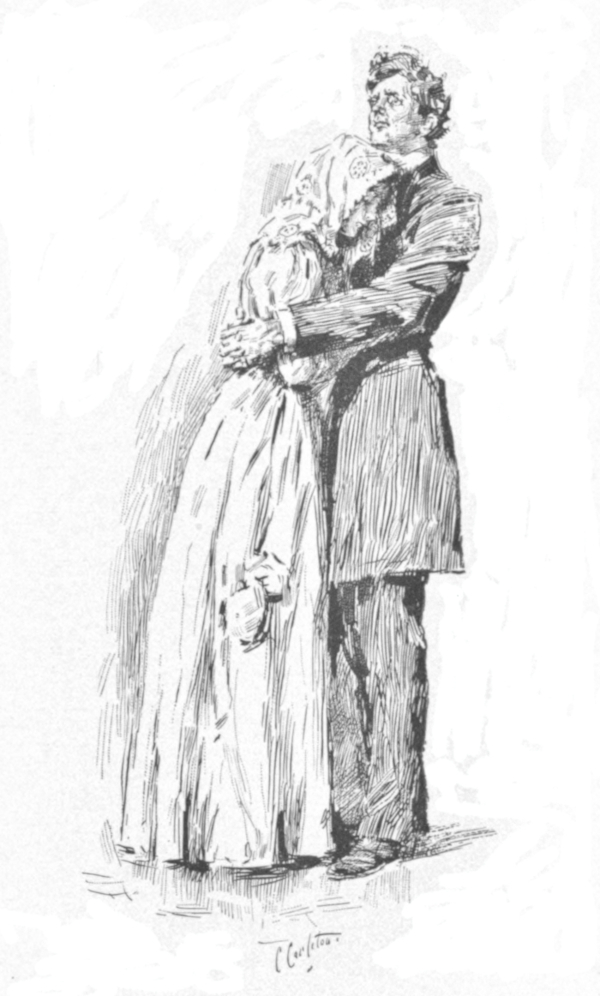
“‘THE LORD MAKE ME WORTHY OF THEE, EVELINA!’”
“The garden is dead,” said she.
“What do you mean?” he cried out, staring at her, for indeed he thought for a minute that her wits had left her.
“The garden is dead,” said she. “Last night I watered the roses with boiling water and salt, and I pulled the other flowers up by their roots. The garden is dead, and I have lost all Cousin Evelina’s money, and it need not come between us any longer.” She said that, and looked up in his face with her blue eyes, through which the love of the whole race of loving women from which she had sprung, as well as her own, seemed to look, and held out her little hands; but even then Thomas Merriam could not understand, and stood looking at her.
“Why—did you do it?” he stammered.
“Because you would have me no other way, and—I couldn’t bear that anything like that should come between us,” she said, and her voice shook like a harp-string, and her pale face went red, then pale again.
But Thomas still stood staring at her. Then her heart failed her. She thought that he did not care, and she had been mistaken. She felt as if it were the hour of her death, and turned to go. And then he caught her in his arms.
“Oh,” he cried, with a great sob, “the Lord make me worthy of thee, Evelina!”
There had never been so much excitement in the village as when the fact of the ruined garden came to light. Flora Loomis, peeping through the hedge on her way to the store, had spied it first. Then she had run home for her mother, who had in turn sought Lawyer Lang, panting bonnetless down the road. But before the lawyer had started for the scene of disaster, the minister, Thomas Merriam, had appeared, and asked for a word in private with him. Nobody ever knew just what that word was, but the lawyer was singularly uncommunicative and reticent as to the ruined garden.
“Do you think the young woman is out of her mind?” one of the deacons asked him, in a whisper.
“I wish all the young women were as much in their minds; we’d have a better world,” said the lawyer, gruffly.
“When do you think we can begin to move in here?” asked Mrs. Martha Loomis, her wide skirts sweeping a bed of uprooted verbenas.
“When your claim is established,” returned the lawyer, shortly, and turned on his heel and went away, his dry old face scanning the ground like a dog on a scent. That afternoon he opened the sealed document in the presence of witnesses, and the name of the heir to whom the property fell was disclosed. It was “Thomas Merriam, the beloved and esteemed minister of this parish,” and young Evelina would gain her wealth instead of losing it by her marriage. And furthermore, after the declaration of the name of the heir was this added: “This do I in the hope and belief that neither the greed of riches nor the fear of them shall prevent that which is good and wise in the sight of the Lord, and with the surety that a love which shall triumph over so much in its way shall endure, and shall be a blessing and not a curse to my beloved cousin, Evelina Leonard.”
Thomas Merriam and Evelina were married before the leaves fell in that same year, by the minister of the next village, who rode over in his chaise, and brought his wife, who was also a bride, and wore her wedding-dress of a pink and pearl shot silk. But young Evelina wore the blue bridal array which had been worn by old Squire Adams’s bride, all remodelled daintily to suit the fashion of the times; and as she moved, the fragrances of roses and lavender of the old summers during which it had been laid away were evident, like sweet memories.