EXTRACTS FROM DICTIONARY. (continued 2)
Reading edition
Sign for White Man as follows: The extended index (M turned inward) is drawn from the left side of the head around in front to the right side, about on a line with the brim of the hat, with the back of the hand outward; and then for Fort, viz, on level of the breasts in front of body, both hands with fingers turned inward, straight, backs joined, backs of hands outward, horizontal, turn outward the hands until the fingers are free, curve them, and bring the wrists together so as to describe a circle with a space left between the ends of the curved fingers. (Dakota I.) "From his fortified place of abode."
Another: Both hands in front of body, fists, backs outward, hands in contact, draw them apart on a straight line right to right, left to left about two feet, then draw the index, other fingers closed, across the forehead above the eyebrows. This is the sign preferred by the Sioux. (Dakota I.)
Extend the fingers of the right hand; place the thumb on the same plane close beside them, and then bring the thumb side of the hand horizontally against the middle of the forehead, palm downward and little finger to the front. (Dakota II; Ute I.) "Visor of forage cap."
First make the sign for Soldier substantially the same as (Dakota VI) below, then that for White Man, viz.: Draw the opened right hand horizontally from left to right across the forehead a little above the eyebrows, the back of the hand to be upward and the fingers pointing toward the left; or, close all the fingers except the index and draw it across the forehead in the same manner. (Dakota IV.) For illustrations of other signs for white man see Figs 315 and 329, infra.
Fig. 276.

Place the radial sides of the clinched hands together before the chest, then draw them horizontally apart. (Dakota VI; Arikara I.) "All in a line." Fig. 276.
Put thumbs to temples, and forefingers forward, meeting in front, other fingers closed. (Apache III.) "Cap-visor."
——, Arikara.
Make the sign for Arikara (see Tribal Signs) and that for Brave. (Arikara I.)
——, Dakota.
Make the sign for Dakota (see Tribal Signs) and that for Soldier. (Dakota VI.)
——, Indian.
Both fists before the body, palms down, thumbs touching, then draw them horizontally apart to the right and left. (Arapaho II; Cheyenne V; Ponka II; Pani I.) This is the same sign illustrated in Fig. 276, above, as given by tribes there cited for white or American soldier. The tribes now cited use it for a soldier of the same tribe as the gesturer, or perhaps for soldier generically, as they subjoin a tribal sign or the sign for white man, when desiring to refer to any other than their own tribe.
TRADE or BARTER; EXCHANGE.
—— TRADE.
First make the sign of Exchange (see below), then pat the left arm with the right finger, with a rapid motion from the hand passing it toward the shoulder. (Long.)
Strike the extended index finger of the right hand several times upon that of the left. (Wied.) I have described the same sign in different terms and at greater length. It is only necessary, however, to place the fingers in contact once. The person whom the prince saw making this sign may have meant to indicate something more than the simple idea of trade, i.e., trade often or habitually. The idea of frequency is often conveyed by the repetition of a sign (as in some Indian languages by repetition of the root). Or the sign-maker may have repeated the sign to demonstrate it more clearly. (Matthews.) Though some difference exists in the motions executed in Wied's sign and that of (Oto and Missouri I), there is sufficient similarity to justify a probable identity of conception and to make them easily understood. (Boteler.) In the author's mind exchange was probably intended for one transaction, in which each of two articles took the place before occupied by the other, and trade was intended for a more general and systematic barter, indicated by the repetition of strokes. Such distinction would not perhaps have occurred to most observers, but as the older authorities, such as Long and Wied, give distinct signs under the separate titles of trade and exchange they must be credited with having some reason for so doing. A pictograph connected with this sign is shown on page 381, supra.
Cross the forefingers of both hands before the breast. (Burton.) "Diamond cut diamond." This conception of one smart trader cutting into the profits of another is a mistake arising from the rough resemblance of the sign to that for cutting. Captain Burton is right, however, in reporting that this sign for trade is also used for white man, American, and that the same Indians using it orally call white men "shwop," from the English or American word "swap" or "swop." This is a legacy from the early traders, the first white men met by the Western tribes, and the expression extends even to the Sahaptins on the Yakama River, where it appears incorporated in their language as swiapoin. It must have penetrated to them through the Shoshoni.
Cross the index fingers. (Macgowan.)
Cross the forefingers at right angles. (Arapaho I.)
Both hands, palms facing each other, forefingers extended, crossed right above left before the breast. (Cheyenne II.)
The left hand, with forefinger extended, pointing toward the right (rest of fingers closed), horizontal, back outward, otherwise as (M), is held in front of left breast about a foot; and the right hand, with forefinger extended (J), in front of and near the right breast, is carried outward and struck over the top of the stationary left (+) crosswise, where it remains for a moment. (Dakota I.)
Hold the extended left index about a foot in front of the breast, pointing obliquely forward toward the right, and lay the extended right index at right angles across the left, first raising the right about a foot above the left, palms of both inward, other fingers half closed. This is also an Arapaho sign as well as Dakota. Yours is there and mine is there; take either. (Dakota IV.)
Fig. 277.
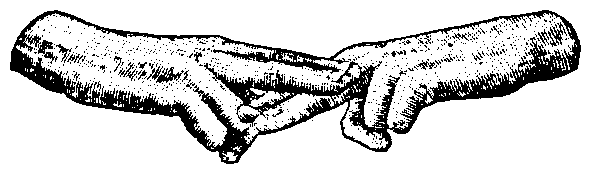
Place the first two fingers of the right hand across those of the left, both being slightly spread. The hands are sometimes used, but are placed edgewise. (Dakota V.) Fig. 277.
Another: The index of the right hand is laid across the forefinger of the left when the transaction includes but two persons trading single article for article. (Dakota V.)
Strike the back of the extended index at a right angle against the radial side of the extended forefinger of the left hand. (Dakota VI, VII.) Fig. 278.
Fig. 278.
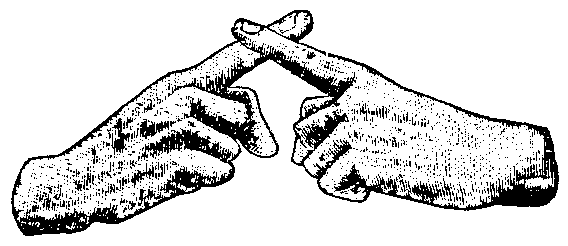
The forefingers are extended, held obliquely upward, and crossed at right angles to one another, usually in front of the chest. (Mandan and Hidatsa I.)
Bring each hand as high as the breast, forefinger pointing up, the other fingers closed, then move quickly the right hand to the left, the left to the right, the forefingers making an acute angle as they cross. (Omaha I; Ponka I.)
The palm point of the right index extended touches the chest; it is then turned toward the second individual interested, then touches the object. The arms are now drawn toward the body, semiflexed, with the hands, in type-positions (W W), crossed, the right superposed to the left. The individual then casts an interrogating glance at the second person. (Oto and Missouri I.) "To cross something from one to another."
Close the hands, except the index fingers and the thumbs; with them open, move the hands several times past one another at the height of the breast; the index fingers pointing upward and the thumbs outward. (Iroquois I.) "The movement indicates 'exchanging.'"
Hold the left hand horizontally before the body, with the forefinger only extended and pointing to the right, palm downward; then, with the right hand closed, index only extended, palm to the right, place the index at right angles on the forefinger of the left, touching at the second joints. (Kaiowa I; Comanche III; Apache II; Wichita II.)
Pass the hands in front of the body, all the fingers closed except the forefingers. (Sahaptin I.)
Close the fingers of both hands (K); bring them opposite each shoulder; then bring the hands across each other's pathway, without permitting them to touch. At the close of the sign the left hand will be near and pointing at the right shoulder; right hand will be near and pointing at the left shoulder. (Comanche I.)
Close both hands, leaving the forefingers only extended; place the right before and several inches above the left, then pass the right hand toward the left elbow and the left hand toward the right elbow, each hand following the course made by a flourishing cut with a short sword. This sign, according to the informant, is also employed by the Banak and Umatilla Indians. (Comanche II; Pai-Ute I.)
The forefingers of both hands only extended, pass the left from left to right, and the right at the same time crossing its course from the tip toward the wrist of the left, stopping when the wrists cross. (Ute I.) "Exchange of articles."
Right hand carried across chest, hand extended, palm upward, fingers and thumb closed as if holding something; left hand, in same position, carried across the right, palm downward. (Kutchin I.)
Hands pronated and forefingers crossed. (Zun̄i I.)
Deaf-mute natural sign:
Close the hand slightly, as if taking something, and move it forward and open the hand as if to drop or give away the thing, and again close and withdraw the hand as if to take something else. (Bollard.)
American instructed deaf-mutes use substantially the sign described by (Mandan and Hidatsa I).
—— To buy.
Fig. 279.
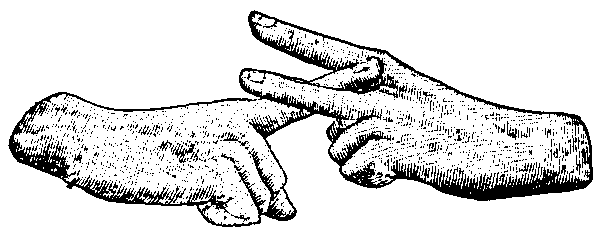
Hold the left hand about twelve inches before the breast, the thumb resting on the closed third and fourth fingers; the fore and second fingers separated and extended, palm toward the breast; then pass the extended index into the crotch formed by the separated fingers of the left hand. This is an invented sign, and was given to illustrate the difference between buying and trading. (Ute I.) Fig. 279.
Deaf-mute natural sign:
Make a circle on the palm of the left hand with the forefinger of the right hand, to denote coin, and close the thumb and finger as if to take the money, and put the hand forward to signify giving it to some one, and move the hand a little apart from the place where it left the money, and then close and withdraw the hand, as if to take the thing purchased. (Ballard.)
Italian sign:
To indicate paying, in the language of the fingers, one makes as though he put something, piece after piece, from one hand into the other—a gesture, however, far less expressive than that when a man lacks money, and yet cannot make up a face to beg it; or simply to indicate want of money, which is to rub together the thumb and forefinger, at the same time stretching out the hand. (Butler.) An illustration from De Jorio of the Neapolitan sign for money is given on page 297, supra.
—— EXCHANGE.
The two forefingers are extended perpendicularly, and the hands are then passed by each other transversely in front of the breast so as nearly to exchange positions. (Long.)
Pass both hands, with extended forefingers, across each other before the breast. (Wied.) See remarks on this author's sign for Trade, supra.
Hands brought up to front of breast, forefingers extended and other fingers slightly closed; hands suddenly drawn toward and past each other until forearms are crossed in front of breast. (Cheyenne II.) "Exchange; right hand exchanging position with the left."
Left hand, with forefinger extended, others closed (M, except back of hand outward), is brought, arm extended, in front of the left breast, and the extended forefinger of the right hand, obliquely upward, others closed, is placed crosswise over the left and maintained in that position for a moment, when the fingers of the right hand are relaxed (as in Y), brought near the breast with hand horizontal, palm inward, and then carried out again in front of right breast twenty inches, with palm looking toward the left, fingers pointing forward, hand horizontal, and then the left hand performs the same movements on the left side of the body, (Dakota I.) "You give me, I give you."
The hands, backs forward, are held as index hands, pointing upward, the elbows being fully bent; each hand is then, simultaneously with the other, moved to the opposite shoulder, so that the forearms cross one another almost at right angles. (Mandan and Hidatsa I.)
YES; AFFIRMATION; IT IS SO. (Compare Good.)
The motion is somewhat like truth, viz: The forefinger in the attitude of pointing, from the mouth forward in a line curving a little upward, the other fingers being carefully closed; but the finger is held rather more upright, and is passed nearly straightforward from opposite the breast, and when at the end of its course it seems gently to strike something, though with rather a slow and not suddenly accelerated motion. (Long.)
Wave the hand straight forward from the face. (Burton.) This may be compared with the forward nod common over most of the world for assent, but that gesture is not universal, as the New Zealanders elevate the head and chin, and the Turks are reported by several travelers to shake the head somewhat like our negative. Rev. H.N. Barnum denies that report, giving below the gesture observed by him. He, however, describes the Turkish gesture sign for truth to be "gently bowing with head inclined to the right." This sidewise inclination may be what has been called the shake of the head in affirmation.
Another: Wave the hand from the mouth, extending the thumb from the index and closing the other three fingers. (Burton.)
Gesticulate vertically downward and in front of the body with the extended forefinger (right hand usually), the remaining fingers and thumb closed, their nails down. (Creel; Arapaho I.)
Right hand elevated to the level and in front of the shoulder, two first fingers somewhat extended, thumb resting against the middle finger; sudden motion in a curve forward and downward. (Cheyenne II.) It has been suggested that the correspondence between this gesture and the one given by the same gesturer for sitting (made by holding the right hand to one side, fingers and thumb drooping, and striking downward to the ground or object to be sat upon) seemingly indicates that the origin of the former is in connection with the idea of "resting," or "settling a question." It is however at least equally probable that the forward and downward curve is an abbreviation of the sign for truth, true, a typical description of which follows given by (Dakota I). The sign for true can often be interchanged with that for yes, in the same manner as the several words.
The index of the horizontal hand (M), other fingers closed, is carried straight outward from the mouth. This is also the sign for truth. (Dakota I.) "But one tongue."
Extend the right index, the thumb against it, nearly close the other fingers, and holding it about a foot in front of the right breast, bend the hand from the wrist downward until the end of the index has passed about six inches through an arc. Some at the same time move the hand forward a little. (Dakota IV.) "A nod; the hand representing the head and the index the nose."
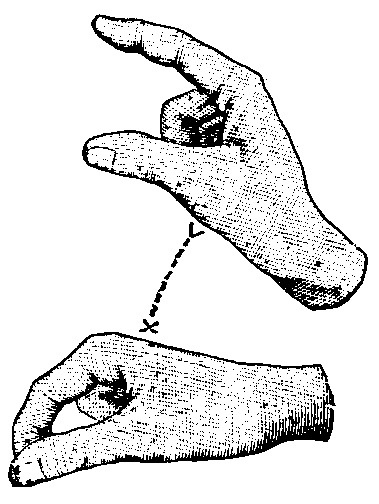
Hold the naturally closed hand before the right side of the breast, or shoulder, leaving the index and thumb extended, then throw the hand downward, bring the index against the inner side of the thumb. (Dakota VI, VII, VIII.) Fig. 280. Compare also Fig. 61, p. 286, supra, Quintilian's sign for approbation.
Fig. 280.
The right hand, with the forefinger only extended and pointing forward, is held before and near the chest. It is then moved forward one or two feet, usually with a slight curve downward. (Mandan and Hidatsa I.)
Bend the right arm, pointing toward the chest with the index finger; unbend, throwing the hand up and forward. (Omaha I.)
Another: Close the three fingers, close the thumb over them, extend forefinger, and then shake forward and down. This is more emphatic than the preceding, and signifies, Yes, I know. (Omaha I.)
The right arm is raised to head with the index finger in type-position (I1), modified by being more opened. From aside the head the hands sweep in a curve to the right ear as of something entering or hearing something; the finger is then more open and carried direct to the ground as something emphatic or direct. (Oto and Missouri I.) "'I hear,' emphatically symbolized." It is doubted if this sign is more than an expression of understanding which may or may not imply positive assent. It would not probably be used as a direct affirmative, for instance, in response to a question.
The hand open, palm downward, at the level of the breast, is moved forward with a quick downward motion from the wrist, imitating a bow of the head. (Iroquois I.)
Throw the closed right hand, with the index extended and bent, as high as the face, and let it drop again naturally; but as the hand reaches its greatest elevation the index is fully extended and suddenly drawn into the palm, the gesture resembling a beckoning from above toward the ground. (Kaiowa I; Comanche III; Apache II; Wichita II.)
Quick motion of the right hand forward from the mouth; first position about six inches from the mouth and final as far again away. In first position the index finger is extended, the others closed; in final, the index loosely closed, thrown in that position as the hand is moved forward, as though hooking something with it; palm of hand out. (Sahaptin I.)
Another: Move right hand to a position in front of the body, letting arm hang loosely at the side, the thumb standing alone, all fingers hooked except forefinger, which is partially extended (E 1, palm upward). The sign consists in moving the forefinger from its partially extended position to one similar to the others, as though making a sly motion for some one to come to you. This is done once each tune the assent is made. More emphatic than the preceding. (Sahaptin I.) "We are together, think alike."
Deaf-mute natural sign:
Indicate by nodding the head. (Ballard.)
Deaf-mute sign:
The French mutes unite the extremities of the index and thumb so as to form a circle and move the hand downward with back vertical and turned outward. It has been suggested in explanation that the circle formed and exhibited is merely the letter O, the initial of the word oui.
Fiji sign:
Assent is expressed, not by a downward nod as with ourselves, but by an upward nod; the head is jerked backward. Assent is also expressed by uplifting the eyebrows. (Fison.)
Turkish sign:
One or two nods of the head forward. (Barnum.)
Other remarks and illustrations upon the signs for yes are given on page 286, supra.