RICHARD WAGNER
Margaret Armour translation
WITH ILLUSTRATIONS
BY ARTHUR RACKHAM
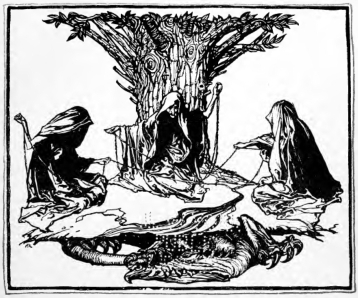
TRANSLATED BY MARGARET ARMOUR
LONDON WILLIAM-HEINEMANN
NEW YORK DOUBLEDAY PACE & Co
1911
CONTENTS SIEGFRIED ACT 1 ACT 2 ACT 3 THE TWILIGHT OF THE GODS PRELUDE ACT 1 ACT 2 ACT 3
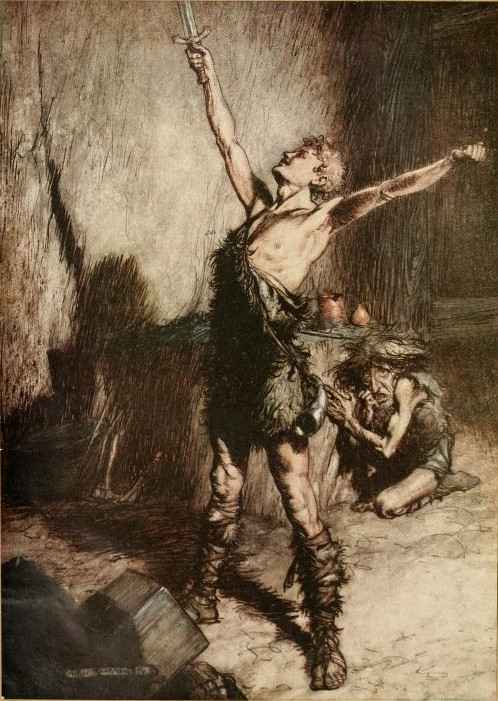
"Nothung! Nothung! Conquering sword!
LIST OF ILLUSTRATIONS
"Nothung! Nothung! Conquering sword!plate 1
Mime at the anvilplate 2
Mime and the infant Siegfriedplate 3
"And there I learned What love was like"plate 4
Siegfried sees himself in the streamplate 5
Mime finds the mother of Siegfried in the forestplate 6
"In dragon's form Fafner now watches the hoard"plate 7
Mime and the Wandererplate 8
The forging of Nothungplate 9
Siegfried kills Fafnerplate 10
"The hot blood burns like fire!"plate 11
The dwarfs quarrelling over the body of Fafnerplate 12
"Magical rapture Pierces my heart; Fixed is my gaze, Burning with terror; I reel, my heart faints and fails!plate 13
"Sun, I hail thee! Hail, O light! Hail, O glorious day!"plate 14
Brünnhilde throws herself into Siegfried's armsplate 15
The three Nornsplate 16
The Norns vanishplate 17
Siegfried leaves Brünnhilde in search of adventureplate 18
Siegfried hands the drinking-horn back to Gutrune, and gazes at her with sudden passionplate 19
Brünnhilde kisses the ring that Siegfried has left with herplate 20
The ravens of Wotanplate 21
"The ring upon thy hand— ... ah, be implored! For Wotan fling it away!"plate 22
The wooing of Grimhilde, the mother of Hagenplate 23
"Swear to me, Hagen, my son!"plate 24
"O wife betrayed, I will avenge Thy trust deceived"plate 25
"Though gaily ye may laugh, In grief ye shall be left, For, mocking maids; this ring Ye ask shall never, be yoursplate 26
"Siegfried! Siegfried! Our warning is true: Flee, oh, flee from the curse!"plate 27
Siegfried's death plate 28
Brünnhilde on Grane leaps on to the funeral pyre of Siegfriedplate 29
The Rhine-Maidens obtain possession of the ring and bear it off in triumphplate 30
SIEGFRIED

CHARACTERS
SIEGFRIED MIME THE WANDERER ALBERICH FAFNER ERDA BRÜNNHILDE
SCENES OF ACTION
I.A CAVE IN A WOOD
II.DEPTHS OF THE WOOD
III.WILD REGION AT THE FOOT OF A ROCKY MOUNTAIN; AFTERWARDS: SUMMIT OF "BRÜNNHILDE'S ROCK"
THE FIRST ACT
A rocky cavern in a wood, in which stands a naturally formed smith's forge, with big bellows. Mime sits in front of the anvil, busily hammering at a sword.
MIME
[Who has been hammering with a small hammer, stops working.
Slavery! worry! Labour all lost! The strongest sword That ever I forged, That the hands of giants Fitly might wield, This insolent urchin For whom it is fashioned Can snap in two at one stroke, As if the thing were a toy!
[Mime throws the sword on the anvil ill-humouredly, and with his arms akimbo gazes thoughtfully on the ground.
There is one sword That he could not shatter: Nothung's splinters Would baffle his strength, Could I but forge Those doughty fragments That all my skill Cannot weld anew. Could I but forge the weapon, Shame and toil would win their reward!
[He sinks further back his head bowed in thought.
Fafner, the dragon grim, Dwells in the gloomy wood; With his gruesome and grisly bulk The Nibelung hoard Yonder he guards. Siegfried, lusty and young, Would slay him without ado; The Nibelung's ring Would then become mine. The only sword for the deed Were Nothung, if it were swung By Siegfried's conquering arm; And I cannot fashion Nothung, the sword!
[He lays the sword in position again, and goes on hammering in deep dejection.
Slavery! worry! Labour all lost! The strongest sword That ever I forged Will never serve For that difficult deed. I beat and I hammer Only to humour the boy; He snaps in two what I make, And scolds if I cease from work.
[He drops his hammer.
SIEGFRIED
[In rough forester's dress, with a silver horn hung by a chain, bursts in boisterously from the wood. He is leading a big bear by a rope of bast, and urges him towards Mime in wanton fun.
Hoiho! Hoiho!
[Entering.
Come on! Come on! Tear him! Tear him! The silly smith!
[Mime drops the sword in terror, and takes refuge behind the forge; while Siegfried, shouting with laughter, keeps driving the bear after him.
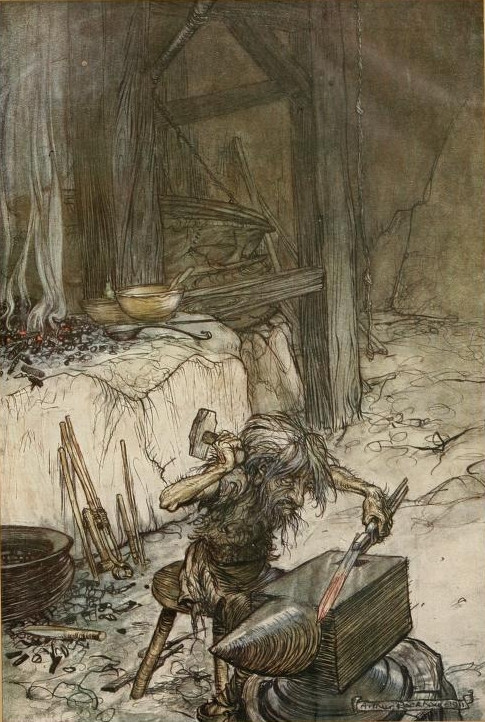
Mime at the anvil. See p. 2
MIME
Hence with the beast! I want not the bear!
SIEGFRIED
I come thus paired The better to pinch thee; Bruin, ask for the sword!
MIME
Hey! Let him go! There lies the weapon; It was finished to-day.
SIEGFRIED
Then thou art safe for to-day!
[He lets the bear loose and strikes him on the back with the rope.
Off, Bruin! I need thee no more.
[The bear runs back into the wood.
MIME [Comes trembling from behind the forge.
Slay all the bears Thou canst, and welcome; But why thus bring the beasts Home alive?
SIEGFRIED
[Sits down to recover from his laughter.
For better companions seeking Than the one who sits at home, I blew my horn in the wood, Till the forest glades resounded. What I asked with the note Was if some good friend My glad companion would be. From the covert came a bear Who listened to me with growls, And I liked him better than thee, Though better friends I shall find. With a trusty rope I bridled the beast, To ask thee, rogue, for the weapon.
[He jumps up and goes towards the anvil.
MIME
[Takes up the sword to hand it to Siegfried.
I made the sword keen-edged; In its sharpness thou wilt rejoice.
[He holds the sword anxiously in his hand; Siegfried snatches it from him.
What matters an edge keen sharpened, Unless hard and true the steel?
[Testing the sword.
Hei! What an idle, Foolish toy! Wouldst have this pin Pass for a sword?
[He strikes it on the anvil, so that the splinters fly about. Mime shrinks back in terror.
There, take back the pieces, Pitiful bungler! 'Tis on thy skull It should have been broken! Shall such a braggart Still go on boasting, Telling of giants And prowess in battle, Of deeds of valour, And dauntless defence?— A sword true and trusty Try to forge me, Praising the skill He does not possess? When I take hold Of what he has hammered, The rubbish crumbles At a mere touch! Were not the wretch Too mean for my wrath, I would break him in bits As well as his work— The doting fool of a gnome!— And end the annoyance at once!
[Siegfried throws himself on to a stone seat in a rage. Mime all the time has been cautiously keeping out of his way.
MIME
Again thou ravest like mad, Ungrateful and perverse. If what for him I forge Is not perfect on the spot, Too soon the boy forgets The good things I have made! Wilt never learn the lesson Of gratitude, I wonder? Thou shouldst be glad to obey him Who always treated thee well.
[Siegfried turns his back on Mime in a bad temper, and sits with his face to the wall.
Thou dost not like to be told that!
[He stands perplexed, then goes to the hearth in the kitchen.
But thou wouldst fain be fed. Wilt eat the meat I have roasted, Or wouldst thou prefer the broth? 'Twas boiled solely for thee.
[He brings food to Siegfried, who, without turning round, knocks both bowl and meat out of his hand.
SIEGFRIED
Meat I roast for myself; Sup thy filthy broth alone!
MIME [In a wailing voice, as if hurt.
This is the reward Of all my love! All my care Is paid for with scorn. When thou wert a babe I was thy nurse, Made the mite clothing To keep him warm, Brought thee thy food, Gave thee to drink, Kept thee as safe As I keep my skin; And when thou wert grown I waited on thee, And made a bed For thy slumber soft. I fashioned thee toys And a sounding horn, Grudging no pains, Wert thou but pleased. With counsel wise I guided thee well, With mellow wisdom Training thy mind. Sitting at home, I toil and moil; To heart's desire Wander thy feet. Through thee alone worried, And working for thee, I wear myself out, A poor old dwarf!
[Sobbing.
And for my trouble The sole reward is By a hot-tempered boy
[Sobbing.
To be hated and plagued!
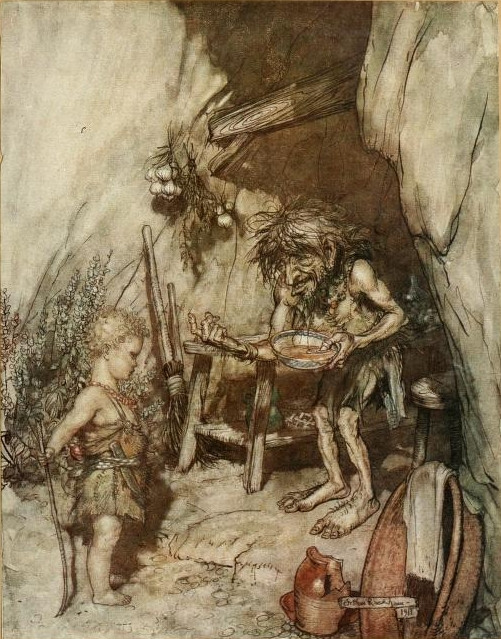
Mime and the infant Siegfried. See p. 8.
SIEGFRIED
[Has turned round again and has quietly watched Mime's face, while the latter, meeting the look, tries timidly to hide his own.
Thou hast taught me much, Mime, And many things I have learned; But what thou most gladly hadst taught me A lesson too hard has proved— How to endure thy sight. When with my food Or drink thou dost come, I sup off loathing alone; When thou dost softly Make me a bed, My sleep is broken and bad; When thou wouldst teach me How to be wise, Fain were I deaf and dumb. If my eyes happen To fall on thee, I find all thou doest Amiss and ill-done; When thou dost stand, Waddle and walk, Shamble and shuffle, With thine eyelids blinking, By the neck I want To take the nodder, And choke the life From the hateful twitcher. So much, O Mime, I love thee! Hast thou such wisdom, Explain, I pray thee, A thing I have wondered at: Though I go roaming Just to avoid thee, Why do I always return? Though I love the beasts All better than thee— Tree and bird And the fish in the brook, One and all They are dearer than thou— How is it I always return? Of thy wisdom tell me that.
MIME
[Tries to approach him affectionately.
My child, that ought to show thee That Mime is dear to thy heart.
SIEGFRIED
I said I could not bear thee; Forget not that so soon.
MIME
[Recoils, and sits down again apart, opposite Siegfried.]
The wildness that thou shouldst tame Is the cause, bad boy, of that. Young ones are always longing After their parents' nest; What we love we all long for, And so thou dost yearn for me; 'Tis plain thou lovest thy Mime, And always must love him. What the old bird is to the young one, Feeding it in its nest Ere the fledgling can flutter, That is what careful, clever Mime To thy young life is, And always must be.
SIEGFRIED
Well, Mime, being so clever, This one thing more also tell me:
[Simply.
The birds sang together So gaily in spring,
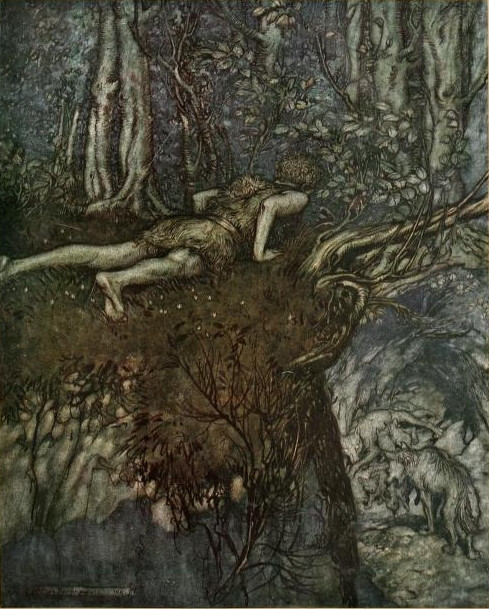
"And there I learned What love was like" See p. 11
[Tenderly.
The one alluring the other; And thou didst say, When I asked thee why, That they were wives with their husbands.
They chattered so sweetly, Were never apart; They builded a nest In which they might brood; The fluttering young ones Came flying out, And both took care of the young. The roes in the woods, too, Rested in pairs, The wild wolves even, and foxes. Food was found them and brought By the father, The mother suckled the young ones. And there I learned What love was like; A whelp from its mother I never took. But where hast thou, Mime, A wife dear and loving, That I may call her mother?
MIME [Angrily.
What dost thou mean? Fool, thou art mad! Art thou then a bird or a fox?
SIEGFRIED
When I was a babe Thou wert my nurse, Made the mite clothing To keep him warm; But tell me, whence Did the tiny mite come? Could babe without mother Be born to thee?
MIME [Greatly embarrassed.
Thou must always Trust what I tell thee. I am thy father And mother in one.
SIEGFRIED
Thou liest, filthy old fright! The resemblance 'twixt child and parent I often have seen for myself. I came to the limpid brook, And the beasts and the trees I saw reflected; Sun and clouds too, Just as they are, Were mirrored quite plain in the stream. I also could spy This face of mine, And quite unlike thine Seemed it to me; As little alike As a fish to a toad: And when had fish toad for its father?
MIME [Very angrily.
How canst thou talk Such terrible stuff?
SIEGFRIED [With increasing animation.
Listen! At last I understand What in vain I pondered so long: Why I roam the woods And run to escape thee, Yet return home in the end.
[He springs up.
I cannot go till thou tell me What father and mother were mine.
MIME
What father? What mother? Meaningless questions!
SIEGFRIED
[Springs upon Mime, and seizes him by the throat.
To answer a question Thou must be caught first; Willingly Thou never wilt speak; Thou givest nothing Unless forced to. How to talk I hardly had learned Had it not by force Been wrung from the wretch. Come, out with it, Mangy old scamp! Who are my father and mother?
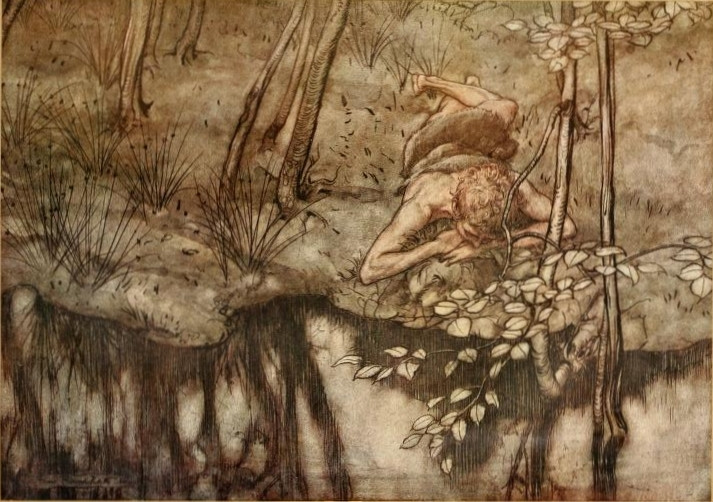
Siegfried sees himself in the stream. See p. 12
MIME
[After making signs with his head and hands, is released by Siegfried.
Dost want to kill me outright! Hands off, and the facts thou shalt hear, As far as known to myself. O ungrateful And graceless child, Now learn the cause of thy hatred! Neither thy father Nor kinsman I, And yet thou dost owe me thy life! To me, thy one friend, A stranger wert thou; It was pity alone Sheltered thee here; And this is all my reward. And I hoped for thanks like a fool! A woman once I found Who wept in the forest wild; I helped her here to the cave, That by the fire I might warm her. The woman bore a child here; Sadly she gave it birth. She writhed about in pain; I helped her as I could. Bitter her plight; she died. But Siegfried lived and throve.
SIEGFRIED [Slowly.
My poor mother died, then, through me?
MIME
To my care she commended thee; 'Twas willingly bestowed. The trouble Mime would take! The worry kind Mime endured! "When thou wert a babe I was thy nurse...."
SIEGFRIED
That story I often have heard. Now say, whence came the name Siegfried?
MIME
'Twas thus that thy mother Told me to name thee, That thou mightst grow To be strong and fair. "I made the mite clothing To keep it warm...."
SIEGFRIED
Now tell me, what name was my mother's?
MIME
In truth I hardly know. "Brought thee thy food, Gave thee to drink...."
SIEGFRIED
My mother's name thou must tell me.
MIME
Her name I forget. Yet wait! Sieglinde, that was the name borne By her who gave thee to me. "I kept thee as safe As I keep my skin...."
SIEGFRIED
[With increasing urgency.
Next tell me, who was my father?
MIME [Roughly.
Him I have never seen.
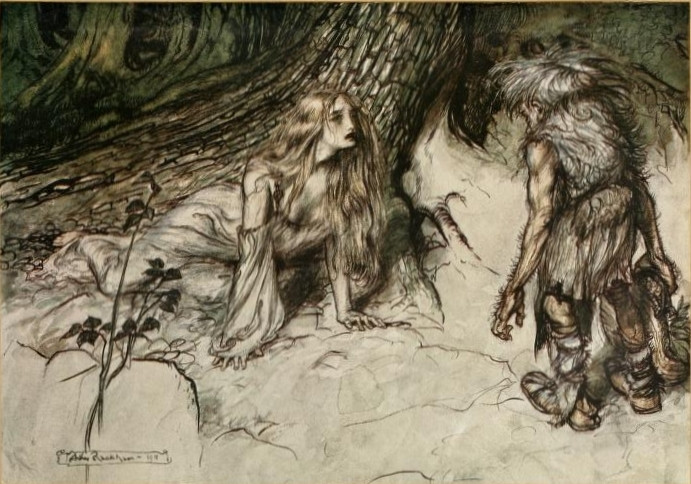
Mime finds the mother of Siegfried in the forest. See p. 13
SIEGFRIED
But my mother told it thee, surely.
MIME
He fell in combat Was all that she said. She left the fatherless Babe to my care. "And when thou wert grown I waited on thee, And made a bed For thy slumber soft"...
SIEGFRIED
Still, with thy tiresome Starling song! That I may trust thy story, Convinced thou art not lying, Thou must produce some proof.
MIME
But what proof will convince thee?
SIEGFRIED
I trust thee not with my ears, I trust thee but with mine eyes: What witness speaks for thee?
MIME
[After some thought takes from the place where they are concealed the two pieces of a broken sword.
I got this from thy mother: For trouble, food, and service This was my sole reward. Behold, 'tis a splintered sword! She said 'twas borne by thy father In the fatal fight when he fell.
SIEGFRIED [Enthusiastically.
And thou shalt forge These fragments together, And furnish my rightful sword! Up! Tarry not, Mime; Quick to thy task! If thou hast skill, Thy cunning display. Cheat me no more With worthless trash; These fragments alone Henceforth I trust. Lounge o'er thy work, Weld it not true, Trickily patching The goodly steel, And thou shalt learn on thy limbs How metal best should be beat! I swear that this day The sword shall be mine; My weapon to-day I shall win!
MIME [Alarmed.
What wouldst thou to-day with the sword?
SIEGFRIED
Leave the forest For the wide world, Never more to return. Ah, how fair A thing is freedom! Nothing holds me or binds! No father have I here, And afar shall be my home; Thy hearth is not my house, Nor my covering thy roof. Like the fish Glad in the water, Like the finch Free in the heavens, Off I will float, Forth I will fly, Like the wind o'er the wood Wafted away, Thee, Mime, beholding no more!
[He runs into the forest.
MIME [Greatly alarmed.
Stop, boy! Stop, boy! Whither away? Hey! Siegfried! Siegfried! Hey!
[He looks after the retreating figure for some time in astonishment; then he goes back to the smithy and sits down behind the anvil.
He storms away! And I sit here: To crown my cares Comes still this new one; My plight is piteous indeed! How help myself now? How hold the boy here? How lead the young madcap To Fafner's lair? And how weld the splinters Of obstinate steel? In no furnace fire Can they be melted, Nor can Mime's hammer Cope with their hardness.
[Shrilly.
The Nibelung's hate, Need and sweat Cannot make Nothung whole, Never will weld it anew.
[Sobbing, he sinks in despair on to a stool behind the anvil.
WANDERER (WOTAN)
[Enters from the wood by the door at the back of the cave. He wears a long dark blue cloak, and, for staff, carries a spear. On his head is a round, broad-brimmed slouched hat.
All hail, cunning smith! A seat by thy hearth Kindly grant The wayworn guest.
MIME [Starting up in alarm.
Who seeks for me here In desolate woods, Finds my home in the forest wild?
WANDERER [Approaching very slowly step by step.
Wanderer names me the world, smith. From far I have come; On the earth's back ranging, Much I have roamed.
MIME
If Wanderer named, Pray wander from here Without halting for rest.
WANDERER
Good men grudge me not welcome; Many gifts I have received. By bad hearts only Is evil feared.
MIME
Ill fate always Dwelt by my side; Thou wouldst not add to it, surely!
WANDERER [Slowly coming nearer and nearer.
Always searching, Much have I seen; Things of weight Have told to many; Oft have rid men Of their troubles, Gnawing and carking cares.
MIME
Though thou hast searched, And though much thou hast found, I need neither seeker nor finder. Lonely am I, And lone would be; Idlers I harbour not here.
WANDERER [Again coming a little nearer.
There were many Thought they were wise, Yet what they needed Knew not at all; Useful lore was Theirs for the asking, Wisdom was their reward.
MIME
[More and more anxious as he sees the Wanderer approach.
Idle knowledge Some may covet; I know enough for my needs.
[The Wanderer reaches the hearth.
My own wits suffice, I want no more, So, wise one, keep on thy way.
WANDERER [Sitting down at the hearth.
Nay, here at thy hearth I vow by my head To answer all thou shalt ask. My head is thine, 'Tis forfeit to thee, Unless I can give Answers good, Deftly redeeming the pledge.
MIME
[Who has been staring at the Wanderer open-mouthed, now shrinks back; aside, dejectedly.
Now how to get rid of the spy? The questions asked must be artful.
[He summons up courage for an assumption of sternness; aloud.
Thy head for thy Lodging pays: 'Tis pawned; now seek to redeem it. Three the questions Thou shalt be asked.
WANDERER
Thrice then I must answer.
MIME [Pulls himself together and reflects.
Since, far on the back Of the wide earth roving, Thy feet have ranged o'er the world, Come, answer me this: Tell me what race Dwells in the earth's deep gorges.
WANDERER
In the depths of earth The Nibelungs have their home; Nibelheim is their land. Black elves they all are; Black Alberich Once was their ruler and lord. He subdued the busy Folk by a ring Gifted with magical might; And they piled up Shimmering gold, Precious, fine-wrought, To win him the world and its glory.
Proceed with thy questions, dwarf.
MIME
[Sinks into deeper and deeper meditation.
Thou knowest much, Wanderer, Of the hidden depths of earth. Now, answer me this: Tell me what race Breathes on earth's back and moves there.
WANDERER
On the earth's broad back The race of the giants arose; Riesenheim is their land. Fasolt and Fafner, The rude folk's rulers, Envied the Nibelung's might. So his wonderful hoard They won for themselves, And with it gained the ring too. The brothers quarrelled About the ring, And slain was Fasolt. In dragon's form Fafner now watches the hoard.
One question threatens me still.
MIME [Quite lost in thought.
Much, Wanderer, Thou dost know Of the earth's back rude and rugged. Now answer aright: Tell me what race Dwells above in the clouds.
WANDERER
Above in the clouds Dwell the Immortals; Walhall is their home. They are light-spirits; Light-Alberich, Wotan, rules as their lord. From the world-ash-tree's Holiest bough once Wotan made him a shaft. Though the stem rot, The spear shall endure, And with that spear-point Wotan rules the world. Trustworthy runes Of holy treaties Deep in the shaft he cut. Who wields the spear Carried by Wotan The haft of the world Holds in his hand. Before him kneels The Nibelung host; The giants, tamed, Bow to his will. All must obey, and for ever, The spear's eternal lord.
[He strikes the ground with the spear as if by accident, and a low growl of thunder is heard, by which Mime is violently alarmed.
Confess now, cunning dwarf, Are not my answers right, And is not my head redeemed?
MIME
[After attentively watching the Wanderer with the spear, becomes very frightened, seeks in a confused manner for his tools, and looks timidly aside.
Both thou hast won, Wager and head; Thy way now, Wanderer, go.
WANDERER
Knowledge useful to thee Thou wert to ask for; Forfeit my head if I failed. Forfeit be thine, Knowest thou not The thing it would serve thee to know. Greeting thou Gavest me not; My head into thy hand I gave That I might rest by thy hearth. By wager fair Forfeit thy head, Canst thou not answer Three things when asked; So sharpen well, Mime, thy wits!
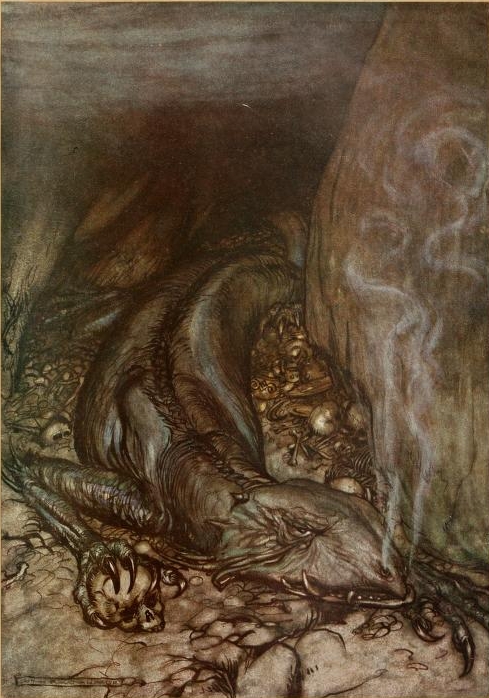
"In dragon's form Fafner now watches the hoard" See p. 21
MIME
[Very much frightened, and after much hesitation, at last composes himself with timid submission.
Long it is Since I left my land; Long it seems to me Since I was born. I saw here the eye of Wotan Shine, peering into my cave; His glance dazes My mother-wit. But well were it now to be wise. Come then, Wanderer, ask. Perhaps fortune will favour The dwarf, and redeem his head.
WANDERER [Comfortably sitting down again.
Then first, honest dwarf, Answer this question: Tell the name of the race That Wotan treats most harshly,
[Very softly, but audibly.
And yet loves beyond all the rest.
MIME [With more cheerfulness.
Though unlearnèd In heroes' kinship, This question I answer with ease. The Wälsungs are Wotan's Chosen stock, By him begotten And loved with passion, Though they are shown no grace. Siegmund and Sieglinde Born were to Wälse, A wild and desperate Twin-born pair; Siegfried had they as son, The strongest shoot from the tree. My head, say, is it Still, Wanderer, mine?
WANDERER [Pleasantly.
How well thou knowest And namest the race! Rogue, I see thou art clever. The foremost question Thou hast solved; The second answer me, dwarf. A crafty Niblung Shelters Siegfried, Hoping he will slay Fafner, That the dwarf may be lord of the hoard, The ring being his. Say, what sword, If Fafner to fall is, Must be by Siegfried swung?
MIME
[Forgetting his present situation more and more, rubs his hands joyfully.
Nothung is The name of the sword; Into an ash-tree's stem Wotan struck it; One only might bear it: He who could draw it forth. The strongest heroes Tried it and failed; Only by Siegmund Was it done; Well he fought with the sword Till on Wotan's spear it was split. By a crafty smith Are the fragments kept, For he knows that alone With the Wotan sword A brave and foolish boy, Siegfried, can slay the foe.
[Much pleased.
A second time My head have I saved?
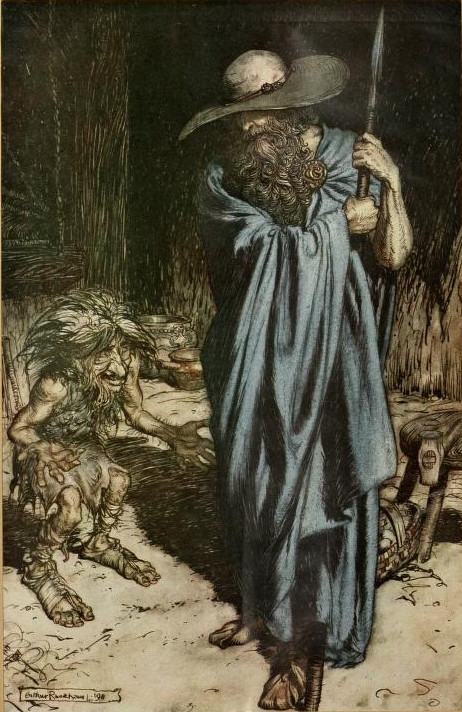
Mime and the Wanderer. See p. 17
WANDERER [Laughing.
The wisest of wise ones Thou must be, surely; Who else could so clever be! But wouldst thou by craft Employ the boy-hero As instrument of thy purpose, With one question more I threaten thee. Tell me, thou artful Armourer, Whose skill from the doughty splinters Nothung the sword shall fashion.
MIME [Starts up in great terror.
The splinters! The sword! Alas! my head reels! What shall I do? What can I say? Accursèd sword! I was mad to steal it! A perilous pass It has brought me to. Always too hard To yield to my hammer! Rivet, solder— Useless are both.
[He throws his tools about as if he had gone crazy, and breaks out in utter despair.
The cleverest smith Living has failed; And, that being so, Who shall succeed? How rede aright such a riddle?
WANDERER [Has risen quietly from the hearth.
Three things thou wert to ask me; Thrice was I to reply. Thy questions were Of far-off things, But what stood here at thy hand— Needed much—that was forgot, Now that I guess it, Thou goest crazed, And won by me Is the cunning one's head. Now, Fafner's dauntless subduer, Hear, thou death-doomed dwarf. By him who knows not How to fear Nothung shall be forged.
[Mime stares at him; he turns to go.
So ward thy head Well from to-day. I leave it forfeit to him Who has never learned to fear.
[He turns away smiling, and disappears quickly in the wood. Mime has sunk on to the bench overwhelmed.
MIME
[Stares before him into the sunlit wood, and begins to tremble more and more violently.
Accursèd light! The air is on fire! What flickers and flashes? What buzzes and whirs? What sways there and swings And circles about? What glitters and gleams In the sun's hot glow? What rustles and hums And rings so loud? With roll and roar It crashes this way! It bursts through the wood, Making for me!
[He rises up in terror.
Its jaws are wide open, Eager for prey; The dragon will catch me! Fafner! Fafner!
[He sinks shrieking behind the anvil.
SIEGFRIED
[Behind the scenes, is heard breaking from the thicket.
Ho there! Thou idler! Is the work finished?
[He enters the cave.
Quick, come show me the sword.
[He pauses in surprise.
Where hides the smith? Has he made off? Hey, there! Mime, thou coward! Where art thou? Where hidest thou?
MIME
[In a small voice, from behind the anvil.
'Tis thou then, child? Art thou alone?
SIEGFRIED [Laughing.
Under the anvil? Why, what doest thou there? Wert thou grinding the sword?
MIME [Comes forward, greatly upset and confused.
The sword? The sword? How could I weld it?
[Half aside.
By him who knows not How to fear Nothung shall be forged. Too wise am I To attempt such work.
SIEGFRIED [Violently.
Wilt thou speak plainly Or must I help thee?
MIME [As before.
Where shall I turn in my need? My wily head Wagered and lost is,
[Staring before him.
And forfeit to him it will fall Who has never learned to fear.
SIEGFRIED [Vehemently.
Dost thou by shuffling Seek to escape?
MIME [Gradually recovering himself.
Small need to fly Him who knows fear! But that lesson was one never taught thee. A fool, I forgot The one great thing; What thou wert taught Was to love me, And alas! the task proved hard. Now how shall I teach thee to fear?
SIEGFRIED [Seizes him.
Hey! Must I help thee? What work hast thou done?
MIME
Concerned for thy good, In thought I was sitting: Something of weight I would teach thee.
SIEGFRIED [Laughing.
'Twas under the seat That thou wert sitting; What weighty thing foundest thou there?
MIME
[Recovering himself more and more.
Down there I learned how to fear, That I might teach thee, dullard.
SIEGFRIED [With quiet wonder.
This fear then, what is it?
MIME
Thou knowest not that, Yet wouldst from the forest Forth to the world? What help in the trustiest sword, Hadst thou not learned to fear?
SIEGFRIED [Impatiently.
What absurd Invention is this?
MIME
[Approaching Siegfried with more and more confidence.
'Tis thy mother's wish Speaking through me. I must fulfil The promise I gave her: That the world and its wiles Thou shouldst not encounter Until thou hadst learned how to fear.
SIEGFRIED [Vehemently
Is it an art? Why was I not taught? Explain: this fearing, what is it?
MIME
In the dark wood Hast thou not felt, When shades of dusk Fall dim and drear, When mournful whispers Sigh afar, And fierce growling Sounds at hand, When strange flashes Dart and flicker, And the buzzing And clamour grow—
[Trembling.
Hast thou not felt grim horror Hold every sense in its clutches?—
[Quaking.
When the limbs shiver, Shaken with terror,
[With a quivering voice.
And the heart, filled with dismay, Hammers, bursting the breast— Hast thou not yet felt that, A stranger art thou to fear.
SIEGFRIED [Musing.
Wonderful truly That must be. Steadfast, strong Beats my heart in my breast. The shiver and shudder, The fever and horror, Burning and fainting, Beating and trembling— Ah, how glad I would feel them,
[Tenderly.
Could I but learn this delight! But how, Mime, Can it be mine? How, coward, could it be taught me?
MIME
Following me, The way thou shalt find; I have thought it all out. I know of a dragon grim That slays and swallows men: Fear thou wilt learn from Fafner, When I lead to where he lies.
SIEGFRIED
Where has he his lair?
MIME
Neidhöhl' Named, it lies east Towards the end of the wood.
SIEGFRIED
It lies not far from the world?
MIME
The world is quite close to the cave.
SIEGFRIED
That I may learn what this fear is, Lead me there straightway; Then forth to the world! Make haste! Forge me the sword. In the world fain I would swing it.
MIME
The sword? Woe's me!
SIEGFRIED
Quick to the smithy! Show me thy work!
MIME
Accursèd steel! Unequal my skill to the task; The potent magic Surpasses the poor dwarf's strength. 'Twere more easily done By one who never felt fear.
SIEGFRIED
Artful tricks The idler would play me; He is a bungler; He should confess, And not seek to lie his way out. Here with the splinters! Off with the bungler!
[Coming to the hearth.
His father's sword Siegfried will weld: By him shall it be forged.
[Flinging Mime's tools about, he sets himself impetuously to work.
MIME
If thou hadst practised Thy craft with care, Thou wouldst have profited now; But thou wert far Too lazy to learn, And now at need canst do nothing.
SIEGFRIED
Where the master has failed What hope for the scholar, Had he obeyed him in all?
[He makes a contemptuous grimace at him.
Be off with thee! Meddle no more, In case with the steel I melt thee.
[He has heaped a large quantity of charcoal on the hearth, and keeps blowing the fire, while he screws up the pieces of the sword in a vice and files them to shavings.
MIME
[Who has sat down a little way off, watches Siegfried at work.
Why file it to bits? There is the solder All fused, ready to hand.
SIEGFRIED
Off with the pap, I need it not; With paste I fashion no sword!
MIME
Now the file is ruined, The rasp is useless; Why grind thus the steel to splinters?
SIEGFRIED
It must be shivered And ground into shreds; Only so can splinters be patched.
[He goes on filing with great energy.
MIME [Aside.
I see a craftsman Is useless here; By his own folly the fool is best served. Look how he toils With lusty strokes; The steel disappears, And still he keeps cool.
[Siegfried has blown the fire to a bright flame.
Though I am as old As cave and wood, The like I never yet saw!
[While Siegfried continues to file the piece of the sword impetuously, Mime seats himself a little further off.
He will forge the sword— I see it plain— Boldly weld it anew. The Wanderer was right. Where shall I hide My luckless head? If nothing teaches him fear, Forfeit it falls to the boy.
[Springing up and bending down in growing agitation.
But woe to Mime! If Siegfried learn fear, The dragon will never be slain; And, if so, how gain the ring? Accurst dilemma! Would I escape, I must find out some way Of subduing the boy for myself.
SIEGFRIED
[Has now filed down the pieces, and puts the filings in a crucible, which he places on the fire.
Hey, Mime! The name!— Quick, name the sword That I have pounded to pieces.
MIME [Starts and turns towards Siegfried.
Nothung, that is The name of the sword; 'Twas mother told me the tale.
SIEGFRIED
[During the following song keeps blowing the fire with the bellows.
Nothung! Nothung! Conquering sword! What blow, I wonder, broke thee. Thy keen-edged glory I chopped to chaff; The splinters now I am melting. Hoho! Hoho! Hohei! Hohei! Hoho! Bellows blow! Brighten the flame! In the woods A tree grew wild; It fell, by my hand hewn down. The brown-stemmed ash To charcoal I burned; Now it lies heaped high on the hearth. Hoho! Hoho! Hohei! Hohei! Hoho! Bellows blow! Brighten the flame! How bravely, brightly The charcoal burns! How clear and fair its fire! With showering sparks It leaps and glows,— Hohei! Hoho! Hohei!— Dissolving the splintered steel! Hoho! Hoho! Hohei! Hohei! Hoho! Bellows, blow! Brighten the flame! Hoho! Hoho! Hoho, hohei! Hohei! Nothung! Nothung! Conquering sword! Thy steel chopped to chaff is fused; In thine own sweat Thou swimmest now,
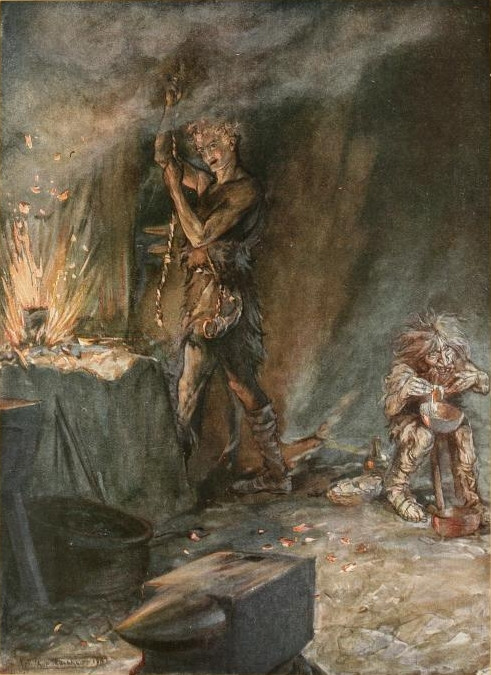
The forging of Nothung. See p. 34
[He pours the glowing contents of the crucible into a mould, which he holds up.
But soon my sword thou shalt be!
MIME
[During the pauses in Siegfried's song, still aside, sitting at a distance.
The sword he will forge And vanquish Fafner, So much I can clearly foresee; Hoard and ring The victor will have; How to win them both for myself! By wit and wiles They shall be captured, And safe shall be my head.
[In the foreground, still aside.
After the fight, when athirst, For a cooling draught he will crave; Of fragrant juices Gathered from herbs The draught I will brew for him. Let him drink but a drop, And in slumber Softly lapped he shall lie: With the very sword That he fashioned to serve him He shall be cleared from my way, And treasure and ring made mine.
[He rubs his hands with satisfaction.
Ha! dull didst hold me, Wanderer wise! Does my subtle scheming Please thee now? Have I found A path to peace?
[He springs up joyfully, fetches several vessels, shakes spices and herbs from them into a pot, and tries to put it on the hearth.
SIEGFRIED
[Has plunged the mould into a pail of water. Steam and loud hissing ensue as it cools.
In the water flowed A flood of fire; Furious with hate, Grimly it hissed; Though scorching it ran, In the cooling flood No more it flows; Stiff, stark it became, Hard is the stubborn steel; Yet warm blood Shall flow thereby! Now sweat once again, That swift I may weld thee, Nothung, conquering sword!
[He thrusts the steel into the fire, and blows the bellows violently. While doing so he watches Mime, who, from the other side of the hearth, carefully puts his pot on the fire.
What does the booby Make in his pot? While I melt steel, What art thou brewing?
MIME
A smith is put to shame, And learns from the lad he taught; All the master's lore is useless now; He serves the boy as cook. Steel thou dost brew into broth; Old Mime boils thee Eggs for thy meal.
[He goes on with his cooking.
SIEGFRIED
Mime, the craftsman, Learns to cook now, And cares no longer to forge; I have broken All the swords that he made me; What he cooks my lips shall not touch.
[During the following he takes the mould from the fire, breaks it, and lays the glowing steel on the anvil.
To find out what fear is Forth he will guide me; A far-off teacher shall teach me; Even what he does best He cannot do well; In everything Mime must bungle!
[During the forging.
Hoho! Hoho! Hohei! Forge me, my hammer, A trusty sword. Hoho! Hahei! Hoho! Hahei! Blood-stained was once Thy steely blue, The crimson trickle Reddened thy blade. How cold was thy laugh! The warm blood cooled at thy touch! Heiaho! Haha! Haheiaha! Now red thou comest From the fire, And thy softened steel To the hammer yields. Angry sparks thou dost shower On me who humbled thy pride. Heiaho! Heiaho! Heiahohohohoho! Hahei! Hahei! Hahei! Hoho! Hoho! Hohei! Forge me, my hammer, A trusty sword! Hoho! Hahei! Hoho! Hahei! How I rejoice In the merry sparks! The bold look best When by anger stirred! Gay thou laughest to me, Grimly though thou dost pretend! Heiaho, haha, haheiaha! Both heat and hammer Served me well; With sturdy strokes I stretched thee straight; Now banish thy modest blush, Be as cold and hard as thou canst. Heiho! Heiaho! Heiahohohohoho! Heiah!
[He swings the blade, plunges it into the pail of water, and laughs aloud at the hissing.
MIME
[While Siegfried is fixing the blade in the hilt, moves about in the foreground with the bottle into which he has poured the contents of the pot. Aside.
He forges a sharp-edged sword: Fafner, the foe Of the dwarf, is doomed; I brewed a deadly draught: Siegfried must perish When Fafner falls. By guile the goal must be reached; Soon shall smile my reward! For the shining ring My brother once made, And which with a potent Spell he endowed, The gleaming gold That gives boundless might— That ring I have won now, I am its lord.
[He trots briskly about with increasing satisfaction.
Alberich even, Whom I served, Shall be the slave Of Mime the dwarf. As Nibelheim's prince I shall descend there, And all the host Shall do my will; None so honoured as he, The dwarf once despised! To the hoard will come thronging Gods and men;
[With increasing liveliness.
The world shall cower, Cowed by my nod, And at my frown Shall tremble and fall! No more shall Mime Labour and toil, When others win him Unending wealth. Mime, the valiant, Mime is monarch, Prince and ruler, Lord of the world! Hei, Mime! Great luck has been thine! Had any one dreamed of this!
SIEGFRIED
[During the pauses in Mime's song has been filing and sharpening the sword and hammering it with the small hammer. He flattens the rivets of the hilt with the last strokes, and now grasps the sword.
Nothung! Nothung! Conquering sword! Once more art thou firm in thy hilt. Severed wert thou; I shaped thee anew, No second blow thy blade shall shatter. The strong steel was splintered, My father fell; The son who now lives Shaped it anew. Bright-gleaming to him it laughs, And for him its edge shall be keen.
[Swinging the sword before him.
Nothung! Nothung! Conquering sword! Once more to life I have waked thee. Dead wert thou, In fragments hewn, Now shining defiant and fair. Woe to all robbers! Show them thy sheen! Strike at the traitor, Cut down the rogue! See, Mime, thou smith; Thus sunders Siegfried's sword!
[He strikes the anvil and splits it in two from top to bottom, so that it falls asunder with a great noise. Mime, who has mounted a stool in great delight, falls in terror to a fitting position on the ground. Siegfried holds the sword exultantly on high. The curtain falls.
THE SECOND ACT
A deep forest
Quite in the background the entrance to a cave. The ground rises towards a flat knoll in the middle of the stage, and slopes down again towards the back, so that only the upper part of the entrance to the cave is visible to the audience. To the left a fissured cliff is seen through the trees. It is night, the darkness being deepest at the back, where at first the eye can distinguish nothing at all.
ALBERICH
[Lying by the cliff, gloomily brooding.
In night-drear woods By Neidhöhl' I keep watch, With ear alert, Keen and anxious eye. Timid day, Tremblest thou forth? Pale art thou dawning Athwart the dark?
[A storm arises in the wood on the right, and from the same quarter there shines down a bluish light.
What comes yonder, gleaming bright? Nearer shimmers A radiant form; It runs like a horse and it shines; Breaks through the wood, Rushing this way. Is it the dragon's slayer? Can it mean Fafner's death?
[The wind subsides; the light vanishes.
The glow has gone, It has faded and died; All is darkness. Who comes there, shining in shadow?
WANDERER
[Enters from the wood, and stops opposite Alberich.
To Neidhöhl' By night I have come; In the dark who is hiding there?
[As from a sudden rent in the clouds moonlight streams forth and lights up the Wanderer's figure.
ALBERICH
[Recognises the Wanderer and shrinks back at first in alarm, but immediately after breaks out in violent fury.
'Tis thou who comest thus? What wilt thou here? Go, get thee hence! Begone, thou insolent thief!
WANDERER [Quietly.
Schwarz-Alberich Wanders here? Guardest thou Fafner's house?
ALBERICH
Art thou intent On mischief again? Linger not here! Off with thee straightway! Has grief enough Not deluged the earth through thy guile? Spare it further Sorrow, thou wretch!
WANDERER
I come as watcher, Not as worker. The Wanderer's way who bars?
ALBERICH
Thou arch, pestilent plotter! Were I still the blind, Silly fool that I was, When I was bound thy captive, How easy were it To steal the ring again from me! Beware! For thy cunning I know well,
[Mockingly.
And of thy weakness I am fully aware too. Thy debts were cancelled, Paid with my treasure; My ring guerdoned The giants' toil, Who raised thy citadel high. Still on the mighty Haft of thy spear there The runes are written plain Of the compact made with the churls; And of that Which by labour they won Thou dost not dare to despoil them: Thy spear's strong shaft Thou thyself wouldst split; The staff that makes thee Master of all Would crumble to dust in thy hand.
WANDERER
By the steadfast runes of treaties Thou hast not, Base one, been bound; On thee my spear may spend its strength, So keen I keep it for war.
ALBERICH
How dire thy threats! How bold thy defiance! And yet full of fear is thy heart! Foredoomed to death Through my curse is he Who now guards the treasure. What heir will succeed him? Will the hoard all desire Belong as before to the Niblung?— That gnaws thee with ceaseless torment. For once I have got it Safe in my grasp, Better than foolish giants Will I employ its spell. The God who guards heroes Truly may tremble! I will storm Proud Walhall with Hella's hosts, And rule, lord of the world!
WANDERER [Quietly.
Thy design I know well, But little I care: Who wins the ring Will rule by its might.
ALBERICH
Thou speakest darkly, But to me all is plain. Thy heart is bold Because of a boy,
[Mockingly.
A hero begot of thy blood. Hast thou not fostered a stripling To pluck the fruit thou durst not
[With growing violence.
Pluck frankly for thyself?
WANDERER [Lightly.
With me 'Tis useless to wrangle; But Mime thou shouldst beware; For thy brother brings here a boy To compass the giant's doom. He knows not of me; He works for Mime alone. And so I say to thee, Do as seems to thee best.
[Alberich makes a movement expressive of violent curiosity.
Take my advice, Be on thy guard: The boy will hear of the ring When Mime tells him the tale.
ALBERICH [Violently.
Wilt thou hold thy hand from the hoard?
WANDERER
Whom I love Must fight for himself unaided; The lord of his fate, He stands or falls: All my hope hangs upon heroes.
ALDERICH
Does none but Mime Dispute me the ring?
WANDERER
Only thou and Mime Covet the gold.
ALDERICH
And yet it is not to be mine?
WANDERER [Quietly coming nearer.
A hero comes To set the hoard free; Two Nibelungs yearn for the gold. Fafner falls, He who guards the ring; Then a hand, seizing, shall hold it. More wouldst thou learn, There Fafner lies, Who, if warned of his death, Gladly would give up the toy. Come, I will wake him for thee.
[He goes towards the cave, and, standing on the rising ground in front of it, calls towards it.
Fafner! Fafner! Wake, dragon! Wake!
ALBERICH [With anxious amazement, aside.
Does the madman mean it? Am I to have it?
FAFNER'S VOICE
Who troubles my sleep?
WANDERER [Facing the cave.
A well-wisher comes To warn thee of danger; Thy doom can be averted, If thou wilt pay the price With the treasure that thou guardest.
[He leans his ear towards the cave, listening.
FAFNER'S VOICE
What would he?
ALBERICH
[Has come to the Wanderer and calls into the cave.
Waken, Fafner! Dragon, awake! A doughty hero comes To try his strength against thine.
FAFNER'S VOICE
I want a meal.
WANDERER
Bold is the boy and strong; Sharp-edged is his sword.
ALBERICH
The ring he seeks, Nothing besides. Give me the ring, and so The strife shall be stayed. Still guarding the hoard, In peace shalt thou live long!
FAFNER [Yawning.
I have and I hold:— Let me slumber!
WANDERER
[Laughs aloud and then turns again to Alberich.
Well, Alberich! That ruse failed, But call me rogue no more. This one thing thou shouldst Never forget: Each according to his kind must act; Nothing can change him. I leave thee the field now; Show a bold front, And try thy luck with thy brother; Thou knowest his kind perhaps better. And things unknown Thou also shalt learn!
[He turns away, and disappears quickly in the wood. A storm arises and a bright light breaks forth; then both quickly cease.
ALBERICH
[Looks after the Wanderer as he gallops off.
Away on his shining Horse he rides, And leaves me to care and scorn! Laugh on! Laugh on, Ye light-minded And high-spirited Race of immortals! One day ye shall perish And pass! Until the gold Has ceased to gleam, Will wise Alberich watch, And his hate shall prevail.
[He slips into the chasm at the side. The stage remains empty. Dawn.
As the day dawns Siegfried and Mime enter. Siegfried carries his sword in a sword-belt of rope. Mime examines the place carefully. At last he looks towards the background, which remains in deep shadow, whilst the rising ground in the middle becomes, after a time, more and more brightly illuminated by the sun.
MIME
Our journey ends here; Here we halt.
SIEGFRIED
[Sits down under the lime-tree and looks about him.
So here I shall learn what fear is? A far way thou hast led me; We have wandered lone together A whole night long in the woods. This is the last Of thee, Mime! Can I not master My lesson here, Alone I will push forward And never see thee again.
MIME
Lad, believe me, If thou canst not Learn it here and now, No other place, No other time Ever will teach thee fear. Dost thou see That cavern yawning dark? Yonder dwells A dragon dread and grim, Horribly fierce, Enormous in size, With terrible jaws That threaten and gape; With skin and hair, All at a gulp, The brute could swallow thee whole.
SIEGFRIED
[Still sitting under the lime-tree.
'Twere well to close up his gullet; His fangs I will therefore avoid.
MIME
Poison pours From his venomous mouth; Were he to spue out Spittle on thee, Thy body and bones would decay.
SIEGFRIED
That the poison may not consume me, I will keep out of its reach.
MIME
A serpent's tail Sweeping he swings; Were that about thee wound And folded close, Thy limbs would be broken like glass.
SIEGFRIED
That his swinging tail may not touch me, Warily then I must watch. But answer me this: Has the brute a heart?
MIME
A pitiless, cruel heart.
SIEGFRIED
It lies, however, Where all hearts lie, Brute and human alike?
MIME
Of course! There, boy, The dragon's lies too. At last thou beginnest to fear?
SIEGFRIED
[Who till now has been lying indolently stretched out, sits up suddenly.
Nothung into His heart I will thrust! Is that what is meant by fearing? Hey, old dotard! Canst thou teach me Nothing but this With all thy craft, Linger no longer by me: No fear is here to be learnt.
MIME
Wait awhile yet! What I have told thee Seems to thee empty sound; When thou hast heard And seen him thyself, Thy senses will swoon, overwhelmed! When thine eyes grow dim, And when the ground rocks, When in thy breast Thy heart beats loud,
[Very friendly.
Thou wilt remember who brought thee, And think of me and my love.
SIEGFRIED
Thy love is not wanted! Hast thou not heard? Out of my sight with thee; Let me alone! Begin again talking of love, And on the instant I go! The horrible winking, The nods and blinking— When shall I see The last of them, And rid be at length of the fool?
MIME
Well, I will off, And rest there by the spring. Thou must stay here, And as the sun scales the sky Watch for the foe: From his cave He lumbers this way, Winds and twists Past this spot, To water at the fountain.
SIEGFRIED [Laughs.
Liest thou by the spring, Unchecked thither the brute shall go; He shall swallow thee Down with the water, Ere with my sword To the heart I stab him! So heed well what I say: Rest not beside the spring. Seek somewhere else A far-off spot, And nevermore return.
MIME
Thou wilt not refuse Cooling refreshment When the fierce fight is over?
[Siegfried motions him angrily away.
Call on me too Shouldst thou need counsel,
[Siegfried repeats the gesture with more violence.
Or if felled on a sudden by fear.
[Siegfried rises and drives him away with furious gestures.
MIME [Aside, as he goes away.
Fafner and Siegfried— Siegfried and Fafner— Might each the other but slay!
[He disappears in the wood on the right.
SIEGFRIED
[Stretches himself at his ease under the lime-tree, and looks after Mime as he departs.
He is no father of mine! How merry of heart I feel! Never before Seemed the forest fair; Never day Wore as lovely a smile, For the loathed one has gone at last, To be looked on by me no more.
[He meditates in silence.
My father—what was he like?— Ha! like me, without doubt. Had Mime by chance had a son, He would have been Mime's image: Quite as disgusting, Filthy and grey, Small and bent, Hunchbacked and halting, With ears long and hanging, Rheumy eyes running— Off with the fright! To see him makes me sick!
[He leans further back and looks up through the branches of the tree. Deep silence. Woodland murmurs.
What could my mother, I wonder, be like; That is not So easy to picture.
[Very tenderly.
Her clear shining eyes Must have been soft, And gentle like the roe-deer's, Only far fairer.
[Very softly.
In fear and woe she bore me, But why did she die through me? Must then all human mothers Thus die on giving Birth to a son? That would truly be sad! Ah, if I only Could see my mother!— See my mother, A woman once!
[He sighs softly, and leans still further back. Deep silence. Louder murmuring of the wood. His attention is at last caught by the song of the birds. He listens with growing interest to one singing in the branches above him.
O lovely warbler, I know not thy note; Hast thou thy home in this wood? If I could but understand him, His sweet song might say much— Perhaps of my mother tell me. A surly old dwarf Said to me once That men might learn To follow the sense Of birds when they were singing; Could it indeed be done? Ha! I will sing After him, On the reed follow him sweetly. Though wanting the words, Repeating his measure— Singing what is his language— Perhaps I shall know what he says.
[He runs to the neighbouring spring, cuts a reed off with his sword, and quickly makes himself a pipe out of it. He listens again.
He stops to hear, So now for my song!
[He blows into the pipe, breaks off, and cuts it again to improve it. He resumes his blowing, shakes his head, and cuts the pipe once more. After another attempt he gets angry, presses the pipe with his hand, and tries again. He ceases playing and smiles.
That rings not right; For the lovely tune The reed is not suited at all. I fear, sweet bird, I am too dull; Thy song cannot I learn.
[He hears the bird again and looks up to him.
He listens so roguishly There that he shames me;
[Very tenderly.
He waits, and nothing rewards him. Heida! Come hearken Now to my horn;
[He flings the pipe away.
All I do sounds wrong On the stupid reed; To a song of the woods That I know, A merry song, listen now rather. I hoped it would bring Some comrade to me, But wolves and bears Were the best that came. Now I will see Who answers its note: What comrade will come to its call.
[He takes the silver hunting-horn and blows on it. During the long-sustained notes he keeps his eyes expectantly on the bird. A movement in the background. Fafner, in the form of a monstrous lizard-like dragon, has risen from his lair in the cave. He breaks through the underwood and drags himself up to the higher ground, so that the front part of his body rests on it, while he utters a loud sound, as if yawning.
SIEGFRIED
[Looks round and gazes at Fafner in astonishment. He laughs.
My horn with its note Has allured something lovely; A jolly companion wert thou.
FAFNER
[At the sight of Siegfried has paused on the high ground, and remains there.
What is that?
SIEGFRIED
If thou art a beast Who can use its tongue, Perchance thou couldst teach me something. Here stands one Who would learn to fear; Say, wilt thou be his teacher?
FAFNER
Is this insolence?
SIEGFRIED
Courage or insolence, What matter? With my sword I will slay thee, Wilt thou not teach me to fear.
FAFNER [Makes a laughing sound.
Drink I came for; Now food I find too!
[He opens his jaws and shows his teeth.
SIEGFRIED
What a fine set of teeth Thou showest me there! Sweetly they smile In thy dainty mouth! 'Twere well if I closed up thy gullet; Thy jaws are gaping too wide!
FAFNER
They were not made For idle talk, But they will serve To swallow thee.
SIEGFRIED
Hoho! Ferocious, Merciless churl! I have no fancy To be eaten. Better it seems to me That without delay thou shouldst die!
FAFNER [Roaring.
Pruh! Come, Boy, with thy boasts!
SIEGFRIED [Draws his sword.
Beware, growler! The boaster comes!
[He springs towards Fafner and remains defiantly confronting him. Fafner drags himself further up the knoll and spits at Siegfried from his nostrils. Siegfried avoids the poison, springs nearer, and stands on one side. Fafner tries to reach him with his tail. Siegfried, who is nearly caught, springs over Fafner with one bound, and wounds him in the tail. Fafner roars, pulls his tail angrily away, and raises the front part of his body so that he may throw its full weight on Siegfried, thus offering his breast to the stroke. Siegfried quickly looks to see where his heart is, and thrusts his sword into it up to the hilt. Fafner raises himself still higher in his pain, and, when Siegfried has let go his sword and sprung aside, he sinks on the wound.
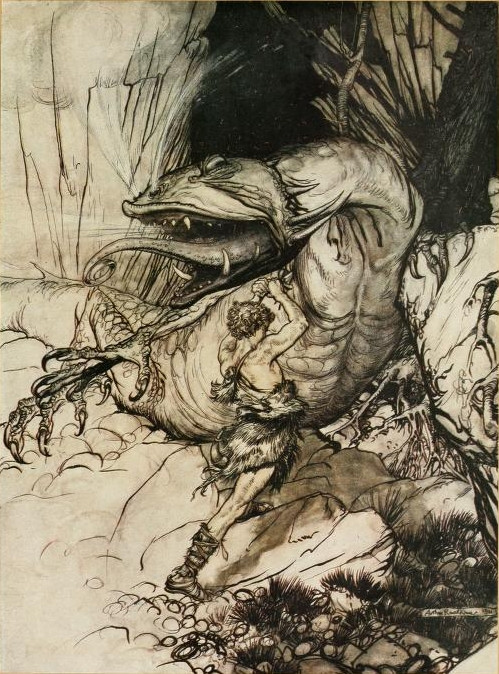
Siegfried kills Fafner. See p. 56
SIEGFRIED
Lie there, envious brute! Nothung's point home has speeded!
FAFNER [In a weaker voice.
Who art thou, boy bold-hearted, That hast pierced my breast? Who stirred up thy childish soul To the murderous deed? Thy brain schemed not the harm Wrought by thy hand.
SIEGFRIED
Not much have I learned, Not even who I am; Thou thyself with thy taunting Stirred me to fight and to slay.
FAFNER
O boy bright-eyed, Who knowest not yet who thou art, Whom thou hast murdered Hear from me. Two mighty giants there were, Fasolt and Fafner; The brothers now are both fallen. For the cursèd gold We got from the Gods I did Fasolt to death. He who now guards The hoard as dragon, Fafner, the last remaining, Falls, by a rosy boy slain. Boy in thy bloom, Watch and be wary: He who stirred thee blind to this deed Takes thought how to compass thy death.
[Dying.
Mark the ending! Think on me!
SIEGFRIED
Who was my father? Tell, if thou canst. Dying, thou showest, Wild one, much wisdom. Siegfried my name is; haply That may help thee to guess.
FAFNER
Siegfried!...
[He raises himself and dies.
SIEGFRIED
The dead can tell no tidings. My living sword, lead! Lead onward, my sword!
[Fafner has rolled to the side in dying. Siegfried now draws the sword from his breast. In doing so his hand gets sprinkled with the blood; he draws it back quickly.
The hot blood burns like fire!
[Involuntarily he raises his fingers to his mouth to suck the blood from them. As he looks musingly before him his attention becomes more and more attracted by the singing of the birds.
I almost seem To hear the birds speaking to me. Is there a spell, Perhaps, in the blood? The curious bird up there— Hark! he sings to me.
VOICE OF THE WOOD-BIRD
[From the branches of the lime-tree above Siegfried.
Hei! Siegfried now owns All the Nibelung hoard! Oh! could he the hoard In the cave but find! Tarnhelm, if he could but win it, Would help him to deeds of renown; And could he discover the ring, It would make him the lord of the world!
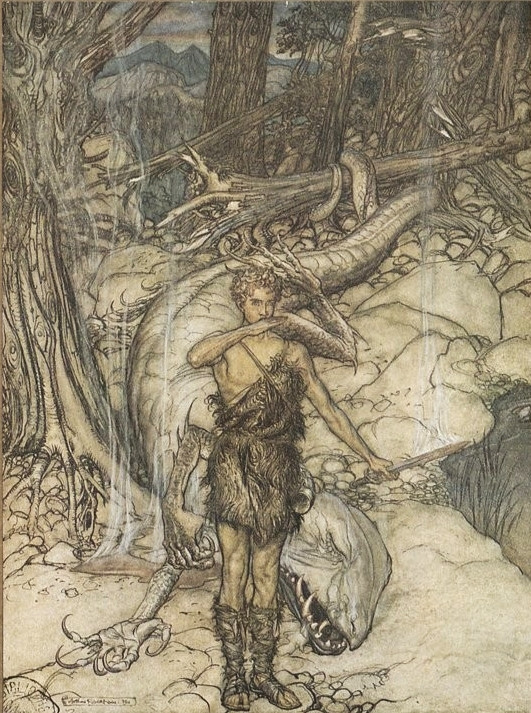
"The hot blood burns like fire!" See p 58.
SIEGFRIED
[Has listened holding his breath and beaming with delight.
Thanks, bonnie bird, For the counsel good: I follow the call!
[He turns towards the back and descends to the cave, where he at once disappears.
Mime steals up, looking about him timidly to assure himself of Fafner's death. At the same time Alberich comes out of the cleft on the opposite side. He observes Mime, rushes on him and bars his way, as the latter turns towards the cave.
ALBERICH
On what errand Furtive and sly, Knave, dost thou slink?
MIME
Accursèd brother, That thou shouldst come! What brings thee here?
ALBERICH
Rogue, has my gold Provoked thy greed? Dost covet my goods?
MIME
Get thee gone quickly! This corner is mine; What huntest thou here?
ALBERICH
Have I disturbed thee, Thief, at thy work, Secret and sly?
MIME
What I have slaved And toiled to win Shall not escape me.
ALBERICH
Who was it robbed The Rhine of gold for the ring? And whose cunning wrought The spell of magical might?
MIME
Who made the Tarnhelm, Changing its wearer's form? Though thou didst want it, Was it designed by thee?
ALBERICH
And what of thyself Couldst aright have fashioned, thou bungler? The magic ring Forced thee to master thy craft.
MIME
And where is the ring? 'Twas reft from thy clutch by the giants. What thou hast lost I will gain and keep by my guile.
ALBERICH
What the boy has won Would the niggard deny him? 'Tis not thine; the hero Who won it is now its lord.
MIME
I brought him up; For my pains now he shall pay; For its reward My trouble has waited too long.
ALBERICH
Just for rearing him, The old niggardly, Beggarly knave, Bold as brass, A king now would become? The ring would befit Better a dog Than bumpkin like thee. Never to thee The magical ring shall fall!
MIME [Scratches his head.
Well, keep it, then, And guard with care The gleaming gold; Be thou lord, But treat me as a brother; Give me against it Tarnhelm for toy, Fairly exchanged; Divided thus, There will be booty for both.
[He rubs his hands confidingly.
ALBERICH [With a mocking laugh.
Share it with thee? And the Tarnhelm too! How sly thou art! I could never Sleep for a moment safely.
MIME [Beside himself.
What! not even Strike a bargain! I must go bare, Beggared of gain! Thou wouldst leave me with nothing!
[Shrieking.
ALBERICH
Nothing, not so Much as a nail, Shall fall to thy portion.
MIME [In a fury.
Neither ring nor Tarnhelm Shall thy hand touch, then; 'Tis I will not share! I will call on Siegfried, Summon the aid Of his keen-edged sword; The lad will make Short work, dear brother, of thee!
ALBERICH
[Siegfried having appeared in the background.
Turn and look there! From the cavern hither he comes.
MIME
He will have chosen Trivial toys.
ALBERICH
He bears the Tarnhelm!
MIME
Also the ring!
ALBERICH
Curst luck! The ring!
MIME [Laughing maliciously.
Get him to give thee the ring now! 'Tis I, not thou, who shall win it.
ALBERICH
And yet to its lord Must it at last be surrendered!
[He disappears in the cleft.
[During the foregoing Siegfried, with Tarnhelm and ring, has come slowly and meditatively from the cave; he regards his booty thoughtfully, and stops on the knoll in the middle of the stage.
SIEGFRIED
I do not know Of what use Ye are; I chose you From out the heaped-up hoard Because of friendly advice. Meanwhile, of this day Be ye worn as witness, Recalling to mind How with fallen Fafner I fought, And yet could not learn how to fear.
[He hangs the Tarnhelm on his girdle and puts the ring on his finger. Silence. His notice is involuntarily drawn to the bird again, and he listens to him with breathless attention.
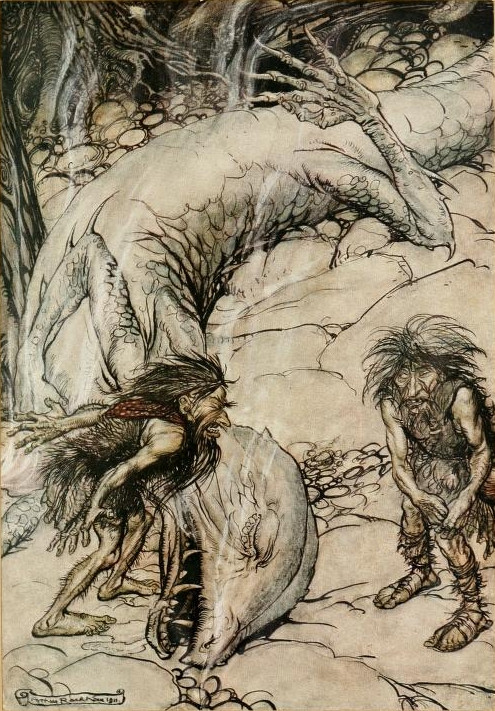
The dwarfs quarrelling over the body of Fafner. See p. 59.
THE WOOD-BIRD'S VOICE
Hei! Siegfried now owns Both the helm and the ring! Oh! let him not listen To Mime, the false! He were wise to be wary of Mime's treacherous tongue. He will understand Mime's secret intent, Because he has tasted the blood.
[Siegfried's mien and gestures show that he has understood the bird's song. He sees Mime approaching, and remains without moving, leaning on his sword, observant and self-contained, in his place on the knoll till the close of the following scene.
MIME
[Steals forward, and observes Siegfried from the foreground.
He weighs in his mind The booty's worth; Can there by chance Have come this way A Wanderer wise Who talked to the child, And taught him crafty runes? Doubly sly Be then the dwarf; My snares must be cunning, Cleverly set, That with cajoling And wily falsehoods The insolent boy I may fool.
[He goes nearer to Siegfried and welcomes him with flattering gestures.
Ha! Welcome, Siegfried! Say, bold fighter, Hast thou been taught how to fear?
SIEGFRIED
A teacher still is to find.
MIME
But the dragon grim Has fallen before thee? A fell and fierce monster was he.
SIEGFRIED
Though grim and spiteful the brute, I grieve over his death, While there live still, unpunished, Blacker scoundrels than he was! The one who bade me slay I hate far more than the slain.
MIME [Very friendly.
Have patience! Thou wilt not Look on me long.
[Sweetly.
In endless sleep Soon thine eyelids will be sealed. Thy uses are over,
[As if praising him.
Done is the deed; The only task left For me is to win the booty. Methinks that task will not tax me; Thou wert always easy to fool.
SIEGFRIED
To me thou art plotting harm, then?
MIME [Astonished.
What makes thee think that?
[Continuing tenderly.
Siegfried, listen, my own one! I have always loathed Thee and all that are like thee. It was not from love That I reared thee with care: The gold hid in Fafner's cave I worked for as my reward.
[As if he were promising him something nice.
If thou wilt not yield It up to me,
[As if he were ready to lay down his life for him.
Siegfried, my son, Thou plainly must see
[As if in friendly jest.
I have no choice but to slay thee!
SIEGFRIED
That I am hated Pleases me; But must I lose my life for thy pleasure?
MIME [Angrily.
I never said that; Thou hast made a mistake. See, thou art weary From stress of strife, Burning with fever and thirst; Mime, the kind one, To cool thy thirst Brought a quickening draught. While thy blade thou didst melt I brewed thee the drink; Touch it, and straight Thy sword shall be mine, And mine the hoard and Tarnhelm too.
[Tittering.
SIEGFRIED
So thou of my sword And all it has won me— Ring and booty—wouldst rob me?
MIME [Violently.
Why wilt mistake so my words! Do I drivel or dote? I use the utmost Pains with my speech, That what in my heart I mean may be hidden; And the stupid boy Misunderstands what I say! Open thy ears, boy, And attend to me! Hear, now, what Mime means. Take this: the drink will refresh thee As my drinks oft have done. Many a time When fretful and bad, Though loth enough, The draughts I brought thou hast swallowed.
SIEGFRIED
Of a cooling drink I were glad; Say, how has this one been brewed?
MIME
[Jesting merrily, as if describing to him a pleasant state of intoxication which the liquor is to bring about.
Hei! Just drink it! Trust to my skill. In mist and darkness Soon shall thy senses be sunk; None to watch or ward them, Stark-stretched shall thy limbs be. Thou lying thus, 'Twere not hard To take the booty and hide it; But wert thou to awake, Nevermore would Mime be safe, Even owning the ring. So with the sword He has made so sharp
[With a gesture of extravagant joy.
First I will hack The child's head off! Then I shall have both rest and the ring!
[Tittering.
SIEGFRIED
Thou wouldst, then, slay me when sleeping?
MIME [Furiously.
Do what, child? Did I say that?
[He takes pains to assume the utmost tenderness. Carefully and distinctly.
I only mean To chop off thy head!
[With the appearance of heartfelt solicitude for Siegfried's health.
For even if I Had loathed thee less, And had not thy scoffs And my drudgery shameful So loudly urged to vengeance,
[Gently.
I should never dare to pause Till from my path I thrust thee:
[Jestingly again.
How else could I come by the booty, Which Alberich covets as well?
[He pours the liquid into the drinking-horn, and offers it to Siegfried with pressing gestures.
Now, my Wälsung, Wolf-begot, Drink the draught and be choked, And never drink again!
[Tittering.
SIEGFRIED [Threatens him with his sword.
Taste thou my sword, Loathsome babbler!
[As if seized by violent loathing, he gives Mime a sharp stroke with his sword. Instantly Mime falls dead to the ground. Alberich's voice in mocking laughter from the cleft.
SIEGFRIED
[Looking at Mime on the ground, quietly hangs his sword again on his belt.
Envy's wage Pays Nothung; 'Twas for this that I forged him.
[He picks up Mime's body, carries it to the knoll, and throws it into the cave.
In the cavern, there, Lie on the hoard; With steadfast guile The gold thou hast gained: Now let it belong to its master! And a watchman good I give thee, that thieves Never may enter and steal.
[With a great effort he pushes the body of the dragon in front of the entrance to the cave, which it completely stops up.
There lie thou too, Dragon grim; Along with thy foe Greedy of gain Thou shalt guard the glittering gold: So both at last shall rest in peace.
[He looks down thoughtfully into the cave for a time, and then turns slowly to the front of the stage as if tired. He passes his hand over his brow.
Hot I feel From the heavy toil; Fast and furious Flows my blood, My hand burns on my head. High stands the sun in heaven; From azure heights Falls his gaze Through a cloudless sky on my crown. Pleasant shadows will cool me under the linden.
[He stretches himself out under the lime-tree, and again looks up through the boughs.
If only, pretty warbler, So long and so Rudely disturbed, I could once more hear thee singing! On a branch I see thee Merrily swaying; Chirping and chattering, Brothers and sisters Are happily hovering round. But I—I am alone, Without brother or sister; My mother died, My father fell, Unseen by their son! The one soul I knew Was a loathsome old dwarf;
[Warmly.
Love he festered not By kindness; Many a cunning Snare did he set me; At last I was forced to slay him.
[He looks sorrowfully up at the branches.
Bird sweet and friendly, I ask thee a boon: Wilt thou find for me A comrade true?— Wilt thou choose for me the right one? So oft I have called, And yet no one has come! Thou, my friend, Wilt manage it better, So wise thy counsel has been.
[Softly.
Now sing! I hearken to thy song.
THE WOOD-BIRD'S VOICE
Hei! Siegfried has slain The deceitful dwarf! I know for him now A glorious bride. She sleeps where rugged rocks soar; Ringed is her chamber by fire. Who battles the flames, Wakens the bride, Brünnhilde wins as reward.
SIEGFRIED
[Starts up impetuously from his seat.
O lovely song, Flower-sweet breath! Thy yearning music Burns in my breast! Like leaping flame It kindles my heart. What races so swift Through soul and senses? Sweetest of friends, O say!
[He listens.
THE WOOD-BIRD'S VOICE
Grieving yet glad, Love I am singing; Blissful, from woe Weaving my song: They only who yearn understand.
SIEGFRIED
Forth, forth then, Swift and rejoicing! Forth from the wood to the fell! Just one thing more I would learn, sweet singer: Say, shall I break through the fire? Can I awaken the bride?
[He listens again.
THE WOOD-BIRD'S VOICE
No coward wins Brünnhild' for bride, Or wakes the maid: Only a heart without fear.
SIEGFRIED [Shouting with joy.
The foolish boy Who has never learned fear, Dear bird, that dullard am I! To-day I took endless Trouble in vain, To find out what fear was from Fafner. With longing I burn Now from Brünnhild' to learn it. What path soonest leads to the fell?
[The bird flutters up, circles over Siegfried, and flies hesitatingly before him.
SIEGFRIED
The bird to my goal will guide me. Fly where thou wilt, I follow thy flight!
[He runs after the bird, who for a time flies uncertainly hither and thither to tease him; at last he follows him, when, taking a definite direction towards the back, the bird flies away.
THE THIRD ACT
A wild spot at the foot of a rocky mountain which rises precipitously at the back on the left. Night, storm, lightning and violent thunder. The latter ceases shortly, but the lightning continues to flash from the clouds for some time. The Wanderer enters and walks resolutely towards a cavernous opening in a rock in the foreground, and takes up his position there, leaning on his spear, while he calls the following towards the entrance to the cave.
WANDERER
Waken, Wala! Wala! Awake! From thy long sleep, Slumberer, wake at my call! I summon thee forth: Arise! Arise! From cloud-covered caves In earth's dim abysses, arise! Erda! Erda, Old as the world! From depths dark and hidden Rise to the day! With song I call thee, I sing to wake thee, From deep dreams of wisdom Bid thee arise. All-knowing one! Fount of knowledge! Erda! Erda, Old as the world! Waken! Awaken, thou Vala! Awaken!
[A dim bluish light begins to dawn in the cavern. In this light Erda, during the following, rises very gradually from below. She appears to be covered with hoar-frost, which glitters on her hair and garments.
ERBA
Loud is the call; Strong the spell that summons; I have been roused From dark and wise dreams: Who wakes me from my sleep?
WANDERER
'Tis I who awake thee With song of magic, That what in slumber Was folded fast may rise. The wide earth ranging, Far I have roamed, Seeking for knowledge, Wisdom at fountains primeval. No one that lives Is wiser than thou; Thou knowest all In the hidden depths, What moves on hill, Dale, in water and air. Where life is found, There thou art breathing; And where brains ponder, There is thy thought. Men say that all Knowledge is thine. That I might ask of thee counsel, I have called thee from sleep.
ERBA
My sleep is dreaming, My dreaming brooding, My brooding wisdom's calm working. But while I sleep The Norns are wakeful: They twine the rope, And deftly weave what I know. The Norns thou shouldst have questioned.
WANDERER
In thrall to the world Sit the Norns weaving; They cannot alter What ordained is. But I would fain Be taught of thy wisdom How a wheel on the roll can be stayed.
ERBA
Dark and troubled My mind grows through men's deeds. A God once subdued The Wala's self to his will. A wish-maiden I bore to Wotan; From fields of battle She brought him slain heroes; Bold is she And wise to boot: Why waken me? Why seek not counsel From Erda's and Wotan's child?
WANDERER
The Valkyrie, Brünnhild'? Meanest thou her? She flouted the storm-controller, When, sorely urged, himself he controlled. What the swayer and lord Of battles longed for, What he refrained from Against his desire, Brünnhilde, bold, Rash, over-confident, When the fight was at fiercest, Strove for herself to perform. War-father Punished the maid: He pressed slumber into her eyes, On the flame-girt rock she sleeps. The hallowed maid Will waken alone, That she may love and wed with a man. Small hope of answer from her.
ERBA
Dazed have I felt Since I woke; Wild, confused Seems the world! The Valkyrie, The Wala's child, Bound lay, fettered by sleep, While her all-knowing mother slept! Does revolt's teacher Chide revolt? Does the deed he urged to Anger him, done? He who guards the right, To whom vows are sacred, Hinders the right?— Reigns through falsehood? Let me down to the dark, That my wisdom may slumber!
WANDERER
I will not let thee descend, For a potent magic I wield. All-wise one, Planted by thee The sting of care was In Wotan's dauntless heart; For, through thy wisdom, Downfall and shameful Doom were foretold him; My mind was fettered by fear. Now let the world's Wisest of women Answer and say How a God may conquer his care.
ERBA
Thou art not What thou hast said. Why art thou come, wild and wayward, To trouble the Wala's sleep?
WANDERER
Thou art not What thou hast dreamed. Thy end draws near, Mother of wisdom; Thy wisdom at war With me shall perish. Knowest thou Wotan's will?
[A long silence.
I tell thee That thou mayest sleep For evermore unvexed by care. That the Gods are doomed, No longer dismays me, Since I will it so. What, with myself at war, in anguish, Despairing, once I resolved, Gaily, gladly, With delight I now do. Mad with disgust I decreed once The world to the Nibelung's hate, But now to the valiant Wälsung I leave it with joy. One who never knew me, Though chosen by me, A boy bold and fearless, Helped not by Wotan, Has won the Nibelung's ring. Blest in love, Void of all envy, On him shall fall harmless Alberich's curse, For no fear does he know. Soon thy child and mine, Brünnhild', Shall be waked by him; And when waked Our child shall achieve A deed to redeem the world. So slumber again, Closing thine eyelids; Dreaming behold my downfall! Whatever comes after, The God rejoicing Yields to youth ever young. Descend, then, Erda, Mother of fear! World-sorrow! Descend! Descend! And sleep for aye!
[Erda, whose eyes are already closed, and who has gradually been sinking deeper, disappears entirely. The cavern has become quite dark again.
Dawn lights up the stage; the storm has ceased. The Wanderer has gone close to the cave, and leans with his back against it, facing the wings.
WANDERER
Lo! Yonder Siegfried comes.
[He remains where he is without changing his position. Siegfried's wood-bird flutters towards the foreground. Suddenly the bird stops in his direct flight, flutters to and fro in alarm, and disappears quickly towards the back.
SIEGFRIED [Enters and stops.
My bird has vanished from sight! With fluttering wings And lovely song Blithely he showed me the way, And then forsook me and fled! I must discover The rock for myself: The path I followed so far 'Twere best still to pursue.
[He goes towards the back.
WANDERER [Still in the same position.
Boy, pray tell me, Whither away?
SIEGFRIED [Halts and turns round.
Did some one speak? Perhaps he knows the road.
[He goes nearer to the Wanderer.
I would find a rock That by flaming fire is surrounded: There sleeps a maid Whom I would awake.
WANDERER
Who bade thee seek This rock flame-circled?— Taught thee to yearn for the woman?
SIEGFRIED
It was a singing Woodland bird; He gave me welcome tidings.
WANDERER
A wood-bird chatters idly What no man understands; How then couldst thou tell The song's true meaning?
SIEGFRIED
Because of the blood Of a dragon grim That fell before me at Neidhöhl'— The burning blood Had scarce touched my tongue When the sense of the singer grew plain.
WANDERER
Who was it urged thee on To try thy strength, And slay this dragon so dread?
SIEGFRIED
My guide was Mime, A faithless dwarf: What fear is fain he had taught me. But 'twas the dragon Roused me himself, Wrathful, to strike the blow; For he threatened me with his jaws.
WANDERER
Who forged the sword So hard and keen That it slew the daunting foe?
SIEGFRIED
I forged it myself When the smith was beaten; Swordless else I should have been still.
WANDERER
But who made The mighty splinters From which the sword was welded strong?
SIEGFRIED
What know I of that? I only know That the splintered steel was useless Were not the sword forged anew.
WANDERER
[Bursts out laughing with gleeful good-humour.
I fully agree.
SIEGFRIED [Surprised.
At what dost thou laugh? Prying greybeard! Prithee have done; Keep me no longer here talking. Speak if thou knowest Whither my way lies; And hold thy tongue Unless thou canst tell.
WANDERER
Good boy, have patience! If I seem old, More need to show me due honour.
SIEGFRIED
What an odd notion! My whole life long A hateful old man Has blocked my pathway; Him I at last swept aside. Standest thou longer Trying here to stay me, I warn thee frankly
[With a significant gesture.
That thou like Mime shalt fare.
[He goes still nearer to the Wanderer.
But what art thou like? Why wearest thou Such a monstrous hat, And why hangs it so over thy face?
WANDERER [Still without altering his position.
That is the way I wear it When against the wind I go.
SIEGFRIED [Inspecting him still more closely.
But an eye beneath it is wanting. Perchance by some one Whose way thou didst Too boldly bar It has been struck out. Take thyself off, Or else very soon The other thou shalt lose also!
WANDERER
I see, my son, Where thou art blind, And hence thy jaunty assurance. With the eye that is Amissing in me Thou lookest now on the other That still is left me for sight.
SIEGFRIED
[Who has been listening thoughtfully, now bursts involuntarily into hearty laughter.
Thy foolish talk sets me laughing! But come, this nonsense must finish. At once show me my way; Then proceed thou too on thine own; For me further Use thou hast none: So speak, or off thou shalt pack!
WANDERER [Gently.
Child, didst thou know Who I am, Thy scoffs I had been spared! From one so dear, Insult hard to endure is. Long have I loved Thy radiant race, Though from my fury In terror it shrank. Thou whom I love so, All too fair one, Rouse my wrath not to-day; It would ruin both thee and me.
SIEGFRIED
Still art thou dumb, Stubborn old man? Stand to one side, then; That pathway, I know, Leads to the slumbering maid; For thither the wood-bird Was guiding when he flew off.
[It suddenly becomes dark again.
WANDERER
[Breaking out in anger and assuming a commanding attitude.
In fear of its life it fled. It knew that here Was the ravens' lord; Dire his plight were he caught! The way that it guided Thou shalt not go!
SIEGFRIED
[Amazed, falls hack and assumes a defiant attitude.
Hoho! Interferer! Who then art thou That wilt not let me pass?
WANDERER
Fear thou the rock's defender! My might it is Holds the maiden fettered by sleep. He who would wake her, He who would win her, Impotent makes me for ever. A burning sea Encircles the maid, Fires fiercely glowing Surround the rock; He who craves the bride The flames must boldly defy.
[He points with his spear towards the rocky heights.
Look up above! That light dost thou see? The surging heat, The splendour, grows; Clouds of fire rolling, Tongues of flame writhing, Roaring and raging, Come ravening down. Thy head now Is flooded with light;
[A flickering glow, increasing in brightness, appears on the summit of the rock.
The fire will seize thee, Seize and devour thee.— Back, back, there, foolhardy boy!
SIEGFRIED
Stand back, old babbler, thyself! For where the fire is burning, To Brünnhilde yonder I go!
[He advances; the Wanderer bars his way.
WANDERER
Hast thou no fear of the fire, Then barred by my spear be thy path! I still hold the haft That conquers all; The sword thou dost wield It shivered long ago: Upon my spear eternal Break it once more.
[He stretches out his spear.
SIEGFRIED [Drawing his sword.
'Tis my father's foe, Found here at last! Now, then, for vengeance! In luck am I! Brandish thy spear: My sword will hew it in twain!
[With one stroke he hews the Wanderer's spear in two pieces. Lightning flashes from the spear up towards the rocks, where the light, until now dim, begins to flame brighter and brighter. A violent thunder-clap, which quickly dies away, accompanies the stroke.
WANDERER
[Quietly picking up the pieces of the spear which have fallen at his feet.
Fare on! I cannot prevent thee!
[He suddenly disappears in utter darkness.
SIEGFRIED
With his spear in splinters Vanished the coward!
[The growing brightness of the clouds of fire, which keep sinking down lower and lower, attracts Siegfried's eye.
Ha! Rapturous fire! Glorious light! Shining my pathway Opens before me. In fiery flames plunging, Through fire I will win to the bride! Hoho! Hahei! To summon a comrade I call!
[He sets his horn to his lips and plunges into the fiery billows, which, flowing down from the heights, now spread over the foreground. Siegfried, who is soon lost to view, seems, from the sound of his horn, to be ascending the mountain. The flames begin to fade, and change gradually into a dissolving cloud lit by the glow of dawn.
The thin cloud has resolved itself into a fine rose-coloured veil of mist, which so divides that the upper part rises and disappears, disclosing the bright blue sky of day; whilst on the edge of the rocky height, now becoming visible (exactly the same scene as in the third Act of "The Valkyrie"), a veil of mist reddened by the dawn remains hanging, which suggests the magic fire still flaming below. The arrangement of the scene is exactly the same as at the end of "The Valkyrie." In the foreground, under a wide-spreading fir-tree, lies Brünnhilde in full shining armour, her helmet on her head, and her long shield covering her, in deep sleep.
SIEGFRIED
[Coming from the back, reaches the rocky edge of the summit, and at first shows only the upper part of his body. He looks round him for a longtime in amaze. Softly.
Solitude blissful On sun-caressed height!
[He climbs to the summit, and, standing on a rock at the edge of the precipice at the back, gazes at the scene in astonishment. He looks into the wood at the side and comes forward a little.
What lies in shadow, Asleep in the wood? A charger Resting in slumber deep.
[Approaching slowly he stops in surprise when, still at some little distance from her, he sees Brünnhilde.
What radiant thing lies yonder?
The steel, how it gleams and glints! Is it the glare That dazzles me still? Shining armour? Shall it be mine?
[He lifts up the shield and sees Brünnhilde's form; her face, however, is for the most part hidden by her helmet.
Ha! It covers a man! The sight stirs thoughts sweet and strange! The helm must lie Hard on his head; Lighter lay he Were it unloosed.
[He loosens the helmet carefully and removes it from the head of the sleeper. Long curling hair breaks forth. Tenderly.
Ah! how fair!
[He stands lost in contemplation.
Clouds gleaming softly Fringe with their fleeces This lake of heaven bright; Laughing, the glorious Face of the sun Shines through the billowy clouds!
[He bends lower over the sleeper.
His bosom is heaving, Stirred by his breath; Ought I to loosen the breastplate?
[He tries to loosen the breastplate.
Come, my sword, Cleave thou the iron!
[He draws his sword and gently and carefully cuts through the rings on both sides of the breastplate; he then lifts this off along with the greaves, so that Brünnhilde now lies before him in a soft woman's robe. He draws back startled and amazed.
That is no man!
[He stares at the sleeper, greatly excited.
Magical rapture Pierces my heart; Fixed is my gaze, Burning with terror; I reel, my heart faints and fails!
[He is seized with sudden terror.
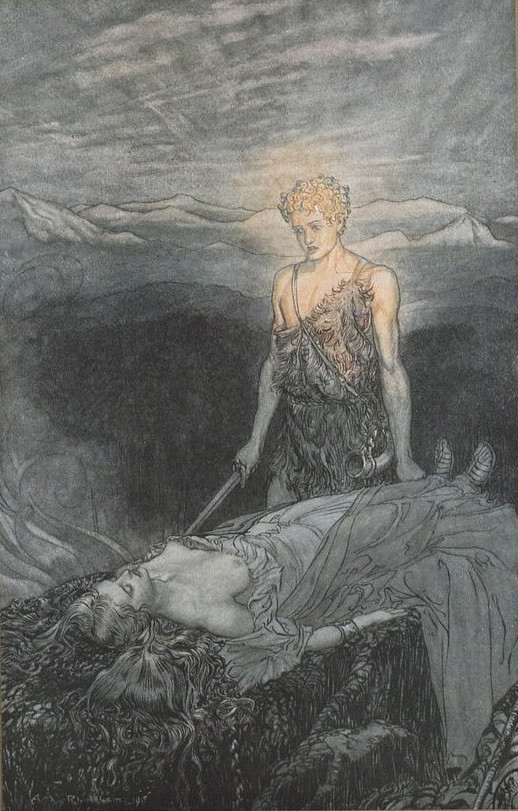
"Magical rapture Pierces my heart; Fixed is my gaze, Burning with terror; I reel, my heart faints and fails!" See p. 86
On whom shall I call, For aid imploring? Mother! Mother! Remember me!
[He sinks as if fainting on to Brünnhilde's bosom; then he starts up sighing.
How waken the maid, Causing her eyelids to open?
[Tenderly.
Her eyelids to open? What if her gaze strike me blind! How shall I dare To look on their light? All rocks and sways And swirls and revolves; Uttermost longing Burns and consumes me; My hand on my heart, It trembles and shakes! What ails thee, coward? Is this what fear means? O mother! Mother! Thy dauntless child!
[Very tenderly.
A woman lying asleep Has taught him what fear is at last! How conquer my fear? How brace my heart? That, myself, I waken, I must waken the sleeper!
[As he approaches the sleeping figure again he is overcome by tenderer emotions at the light. He bends down lower; sweetly.
Softly quivers Her flower-sweet mouth! Its lovely trembling Has charmed my despair! Ah! And the fragrant, Blissful warmth of her breath!
[As if in despair.
Awaken! Awaken, Maiden divine!
[He gazes at her.
She hears me not. New life from the sweetest Of lips I will suck, then, Even though kissing I die!
[He sinks, as if dying, on to the sleeping figure, and, closing his eyes, fastens his lips on Brünnhilde's. Brünnhilde opens her eyes. Siegfried starts up, and remains standing before her.
BRÜNNHILDE
[Rises slowly to a sitting posture. Raising her arms, she greets the earth and sky with solemn gestures on her return to consciousness.
Sun, I hail thee! Hail, O light! Hail, O glorious day. Long I have slept; I am awake. What hero broke Brünnhilde's sleep?
SIEGFRIED
[Awed and entranced by her look and her voice, stands as if spellbound.
Through the fierce fires flaming Round this rock I burst; I unloosened thy helmet strong: I awoke thee. Siegfried am I.
BRÜNNHILDE [Sitting upright.
Gods, I hail you! Hail, O World! Hail, O Earth, in thy glory! My sleep is over now, My eyes open. It is Siegfried Who bids me wake!
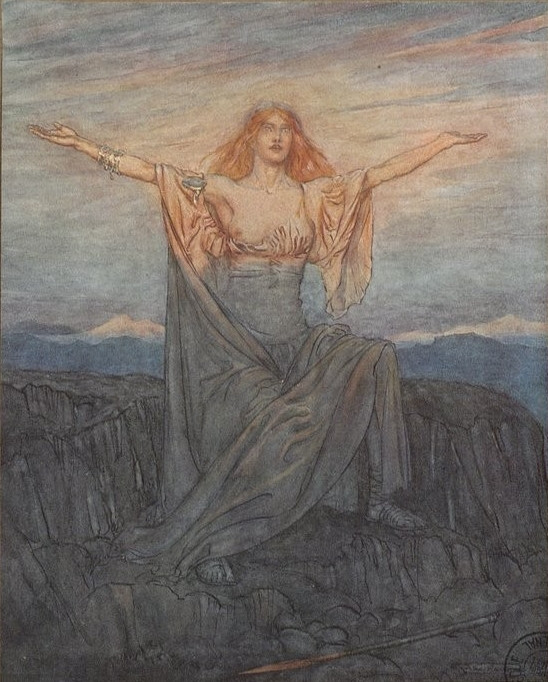
"Sun, I hail thee! Hail, O light! Hail, O glorious day!" See p. 88
SIEGFRIED
[Breaking forth in rapturous exaltation.
I hail thee, mother Who gave me birth! Hail, O Earth, That nourished my life So that I see those eyes Beam on me, blest among men!
BRÜNNHILDE
I hail the mother Who gave thee birth! Hail, O Earth, That nourished thy life! No eye dared see me but thine; To thee alone might I wake!
[Both remain full of beaming ecstasy, lost in mutual contemplation.
BRÜNNHILDE
O Siegfried! Siegfried! Hero most blest! Of life the awaker, Conquering light! O joy of the world, couldst know How thou wert always loved! Thou wert my gladness, My care wert thou! Thy life I sheltered Before it was thine; My shield was thy shelter Ere thou wert born: So long loved wert thou, Siegfried!
SIEGFRIED [Softly and timidly.
My mother did not die, then? Did the dear one but sleep?
BRÜNNHILDE
[Smiles and stretches her hand out kindly towards him.
Adorable child! Nevermore thy mother will greet thee! Thyself am I, If I be blest with thy love. All things I know Known not to thee; Yet only of my love Born is my wisdom. O Siegfried! Siegfried! Conquering light! I loved thee always, For I alone Divined the thought hid by Wotan: Hidden thought I dared not So much as utter; Thought that I thought not, Feeling it only; For which I worked, Battled and strove, Defying even Him who conceived it; For which in penance Prisoned I lay, Because thought it was not, But felt alone! For what the thought was— Say, canst thou guess it?— Was love of thee, nothing but that!
SIEGFRIED
How wondrous sounds Thy rapturous song! But dark the meaning to me.
[Tenderly.
Of thine eyes the splendour I see plain, I can feel thee breathing Soft and warm, Sweet can hear The singing of thy voice, But what thou sayest I strive Vainly to understand. I cannot grasp clearly Things so far distant; Needed is every sense To feel and behold thee! By laming fear Fettered am I, For how to fear Thou hast taught me at last; Thou who hast bound me In bonds of such power, Give me my courage again!
[He remains in great excitement with his yearning gaze fixed on her.
BRÜNNHILDE
[Turns her head gently aside and looks towards the wood.
I see there Grane, My sacred horse; In gladness he grazes Who slept with me! He too has by Siegfried been waked.
SIEGFRIED
[Without changing his position.
My gaze on a mouth Most lovely is feasting; My lips are afire With passionate yearning For the pasture sweet that I look on!
BRÜNNHILDE
[Points to her armour, which she now perceives.
I see there the shield That sheltered heroes; And there is the helmet That hid my head: It shields, it hides me no more!
SIEGFRIED [With fire.
By a glorious maid My heart has been hurt Wounds in my head A woman has struck: I came without shield or helm!
BRÜNNHILDE [With increased sadness.
I see there the breastplate's Glittering steel; A keen-edged sword Sundered the rings, From the form of the maiden Loosened the mail: Nor shelter nor shield is left To the weak and sorrowful maid!
SIEGFRIED [With heat.
Through billows of fire I battled to thee, No buckler or breastplate Sheltered or screened; The flames have won Their way to my heart; My blood hot-surging Rushes and leaps; A ravening fire Is kindled within me: The flames that shone Round Brünnhilde's rock Are burning now in my breast! O maid, extinguish the fire! Calm the commotion and rage!
[He has embraced her passionately.
BRÜNNHILDE
[Springs up, resists him with the utmost strength of terror, and flies to the other side of the stage.
No God's touch have I known! With awe the heroes Greeted the maiden: Holy came she from Walhall. Woe's me! Woe's me! Woe the affront, The bitter disgrace! He wounds me sore Who waked me from sleep! He has broken breastplate and helm; Now I am Brünnhild' no more.
SIEGFRIED
Thou art to me The dreaming maid still; Brünnhilde lies Lapped still in sleep. Awake, be a woman to me!
BRÜNNHILDE [Bewildered.
Confused are my senses, My mind is blank: Wisdom, dost thou forsake me?
SIEGFRIED
Said not thy song Thy wisdom drew Its light from thy love of me?
BRÜNNHILDE [Staring before her.
Shadows drear-falling Darken my gaze; Mine eyes see dimly, The light dies out, Deep is the dark. From dread-haunted mists Fear in a frenzy Comes writhing forth; Terror stalks me And grows with each stride!
[She hides her eyes with her hands in violent terror.
SIEGFRIED
[Gently removing her hands from her eyes.
Dread lies dark On eyelids bound; With the fetters vanish The fear and gloom; Rise from the dark and behold: Bright as the sun is the day.
BRÜNNHILDE [Much agitated.
Flaunting my shame, Bright as the sun shines the day! O Siegfried! Siegfried! Pity my woe! I have always Lived and shall live— Always in sweet, Rapturous yearning, And always to make thee blest! O Siegfried! Glorious Wealth of the world! Laughing hero! Life of the earth! Ah, forbear! Leave me in peace! Touch me not, Mad with delirious frenzy! Break me not, Bring me not under thy yoke, Undo not the loved one so dear! Hast thou rejoiced Thyself to see Reflected clear in the stream? If into wavelets The water were stirred, And ruffled the limpid Calm of the brook, Thy face would not be there, Only water's rippling unrest. So untouched let me stay, Trouble me not, And thy face Mirrored bright in me Will smile to thee always, Gay and merry and glad! O Siegfried, Radiant child, Love thyself And leave me in peace; O bring not thine own to naught!